


 Скачать презентацию A Countywide targeted surveillance decolonization project in select orthopedic
4135afd079231339f03d6e72519154aa.ppt
- Количество слайдов: 1
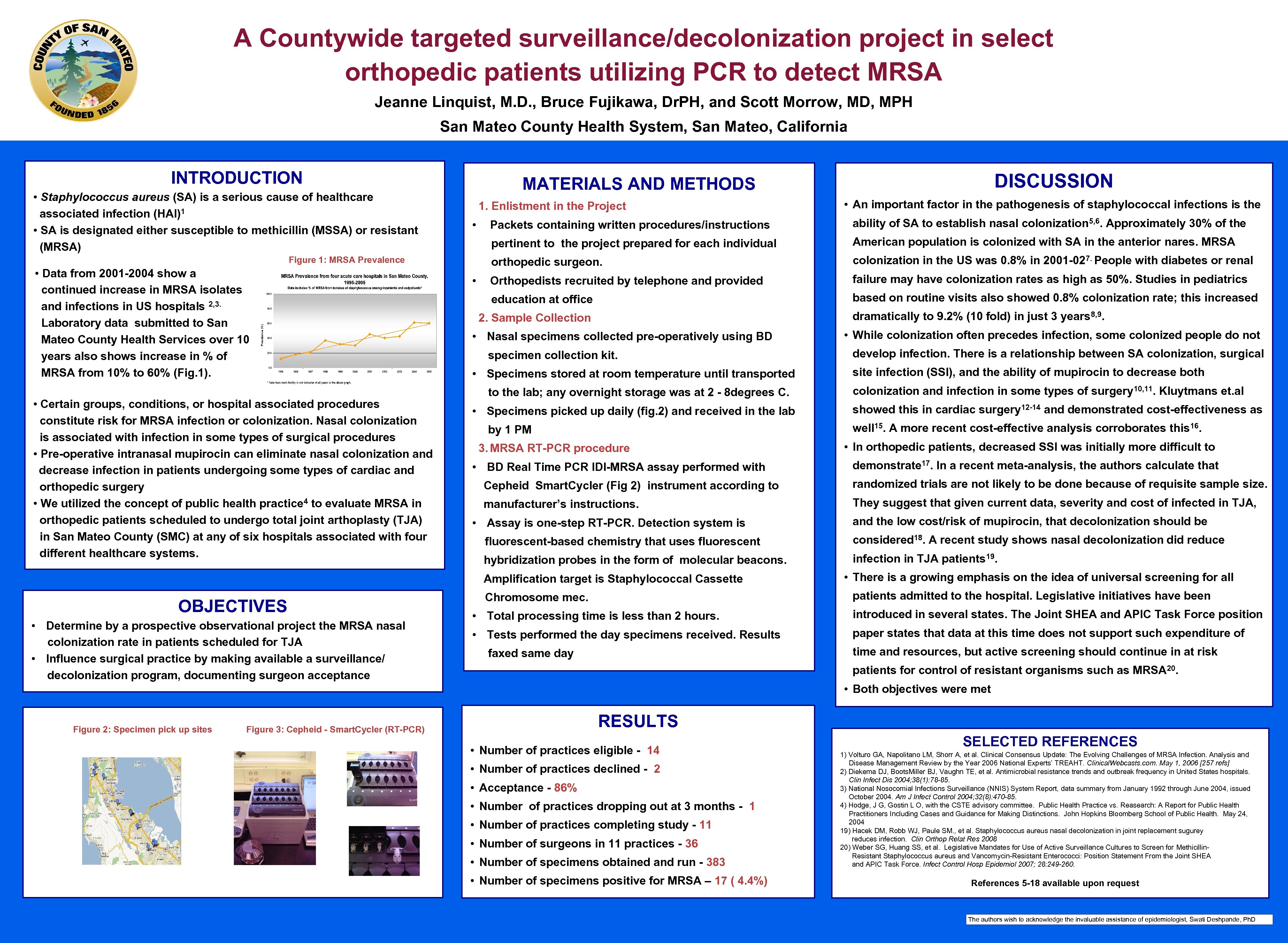 A Countywide targeted surveillance/decolonization project in select orthopedic patients utilizing PCR to detect MRSA Jeanne Linquist, M. D. , Bruce Fujikawa, Dr. PH, and Scott Morrow, MD, MPH San Mateo County Health System, San Mateo, California INTRODUCTION • Staphylococcus aureus (SA) is a serious cause of healthcare associated infection (HAI)1 • SA is designated either susceptible to methicillin (MSSA) or resistant (MRSA) 1. Enlistment in the Project • Certain groups, conditions, or hospital associated procedures constitute risk for MRSA infection or colonization. Nasal colonization is associated with infection in some types of surgical procedures • Pre-operative intranasal mupirocin can eliminate nasal colonization and decrease infection in patients undergoing some types of cardiac and orthopedic surgery • We utilized the concept of public health practice 4 to evaluate MRSA in orthopedic patients scheduled to undergo total joint arthoplasty (TJA) in San Mateo County (SMC) at any of six hospitals associated with four different healthcare systems. American population is colonized with SA in the anterior nares. MRSA orthopedic surgeon. colonization in the US was 0. 8% in 2001 -027. People with diabetes or renal Orthopedists recruited by telephone and provided failure may have colonization rates as high as 50%. Studies in pediatrics education at office • Packets containing written procedures/instructions ability of SA to establish nasal colonization 5, 6. Approximately 30% of the based on routine visits also showed 0. 8% colonization rate; this increased dramatically to 9. 2% (10 fold) in just 3 years 8, 9. 2. Sample Collection • Nasal specimens collected pre-operatively using BD specimen collection kit. • Specimens stored at room temperature until transported to the lab; any overnight storage was at 2 - 8 degrees C. • Specimens picked up daily (fig. 2) and received in the lab • Determine by a prospective observational project the MRSA nasal colonization rate in patients scheduled for TJA • Influence surgical practice by making available a surveillance/ decolonization program, documenting surgeon acceptance • While colonization often precedes infection, some colonized people do not develop infection. There is a relationship between SA colonization, surgical site infection (SSI), and the ability of mupirocin to decrease both colonization and infection in some types of surgery 10, 11. Kluytmans et. al showed this in cardiac surgery 12 -14 and demonstrated cost-effectiveness as well 15. A more recent cost-effective analysis corroborates this 16. by 1 PM 3. MRSA RT-PCR procedure • BD Real Time PCR IDI-MRSA assay performed with • In orthopedic patients, decreased SSI was initially more difficult to demonstrate 17. In a recent meta-analysis, the authors calculate that Cepheid Smart. Cycler (Fig 2) instrument according to randomized trials are not likely to be done because of requisite sample size. manufacturer’s instructions. They suggest that given current data, severity and cost of infected in TJA, • Assay is one-step RT-PCR. Detection system is and the low cost/risk of mupirocin, that decolonization should be fluorescent-based chemistry that uses fluorescent considered 18. A recent study shows nasal decolonization did reduce hybridization probes in the form of molecular beacons. infection in TJA patients 19. Amplification target is Staphylococcal Cassette OBJECTIVES • An important factor in the pathogenesis of staphylococcal infections is the pertinent to the project prepared for each individual • Figure 1: MRSA Prevalence • Data from 2001 -2004 show a continued increase in MRSA isolates and infections in US hospitals 2, 3. Laboratory data submitted to San Mateo County Health Services over 10 years also shows increase in % of MRSA from 10% to 60% (Fig. 1). DISCUSSION MATERIALS AND METHODS • There is a growing emphasis on the idea of universal screening for all patients admitted to the hospital. Legislative initiatives have been Chromosome mec. • Total processing time is less than 2 hours. introduced in several states. The Joint SHEA and APIC Task Force position • Tests performed the day specimens received. Results paper states that data at this time does not support such expenditure of time and resources, but active screening should continue in at risk faxed same day patients for control of resistant organisms such as MRSA 20. • Both objectives were met Figure 2: Specimen pick up sites RESULTS Figure 3: Cepheid - Smart. Cycler (RT-PCR) • Number of practices eligible - 14 • Number of practices declined - 2 • Acceptance - 86% • Number of practices dropping out at 3 months - 1 • Number of practices completing study - 11 • Number of surgeons in 11 practices - 36 • Number of specimens obtained and run - 383 • Number of specimens positive for MRSA – 17 ( 4. 4%) SELECTED REFERENCES 1) Volturo GA, Napolitano LM, Shorr A, et al. Clinical Consensus Update: The Evolving Challenges of MRSA Infection. Analysis and Disease Management Review by the Year 2006 National Experts’ TREAHT. Clinical. Webcasts. com. May 1, 2006 [257 refs] 2) Diekema DJ, Boots. Miller BJ, Vaughn TE, et al. Antimicrobial resistance trends and outbreak frequency in United States hospitals. Clin Infect Dis 2004; 38(1): 78 -85. 3) National Nosocomial Infections Surveillance (NNIS) System Report, data summary from January 1992 through June 2004, issued October 2004. Am J Infect Control 2004; 32(8): 470 -85. 4) Hodge, J G, Gostin L O, with the CSTE advisory committee. Public Health Practice vs. Reasearch: A Report for Public Health Practitioners Including Cases and Guidance for Making Distinctions. John Hopkins Bloomberg School of Public Health. May 24, 2004 19) Hacek DM, Robb WJ, Paule SM. , et al. Staphylococcus aureus nasal decolonization in joint replacement sugurey reduces infection. Clin Orthop Relat Res 2008 20) Weber SG, Huang SS, et al. Legislative Mandates for Use of Active Surveillance Cultures to Screen for Methicillin. Resistant Staphylococcus aureus and Vancomycin-Resistant Enterococci: Position Statement From the Joint SHEA and APIC Task Force. Infect Control Hosp Epidemiol 2007; 28: 249 -260. References 5 -18 available upon request The authors wish to acknowledge the invaluable assistance of epidemiologist, Swati Deshpande, Ph. D