


 Скачать презентацию A Core Course on Modeling relations deterministic stochastic
c062ba68638bb1b08d4191173874c1fe.ppt
- Количество слайдов: 56
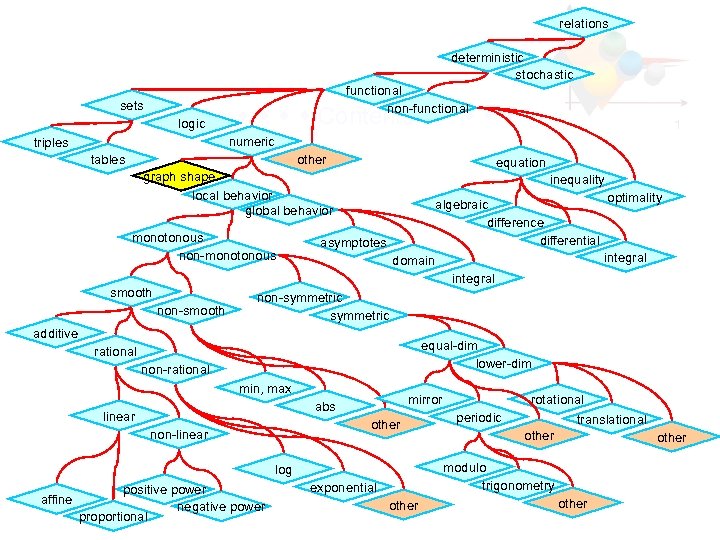 A Core Course on Modeling relations deterministic stochastic Week 4 -Dealing with mathematical relations functional non-functional sets logic Contents 1 numeric triples tables other equation graph shape local behavior global behavior monotonous non-monotonous inequality algebraic difference differential asymptotes optimality integral domain integral smooth non-symmetric additive equal-dim lower-dim rational non-rational min, max mirror abs linear other non-linear modulo trigonometry log positive power affine negative power proportional periodic rotational translational other exponential other
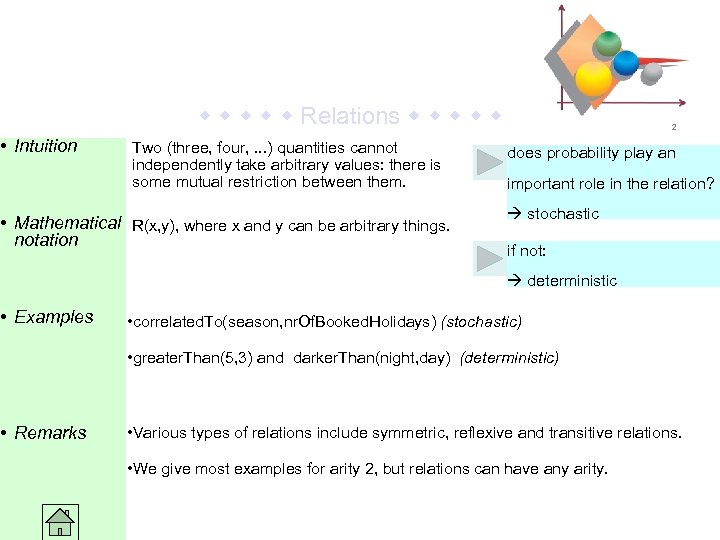 A Core Course on Modeling Week 4 -Dealing with mathematical relations • Intuition Relations Two (three, four, . . . ) quantities cannot independently take arbitrary values: there is some mutual restriction between them. • Mathematical R(x, y), where x and y can be arbitrary things. notation • Examples • Remarks 2 does probability play an important role in the relation? stochastic if not: deterministic • correlated. To(season, nr. Of. Booked. Holidays) (stochastic) • greater. Than(5, 3) and darker. Than(night, day) (deterministic) • Various types of relations include symmetric, reflexive and transitive relations. • We give most examples for arity 2, but relations can have any arity.
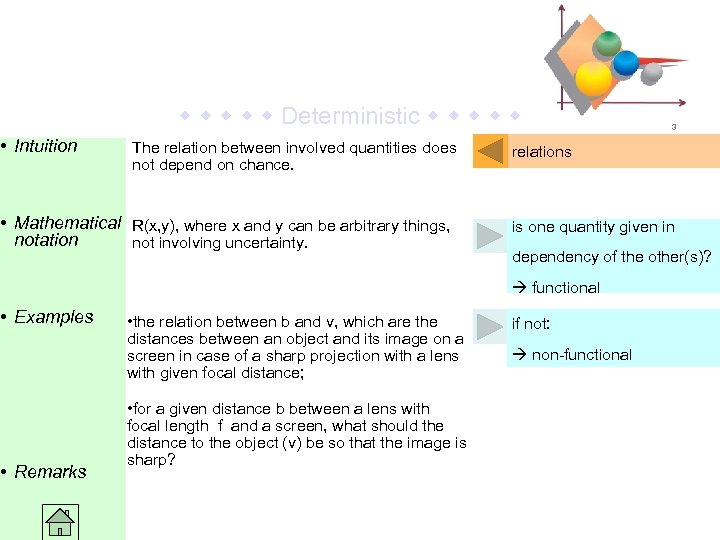 A Core Course on Modeling Week 4 -Dealing with mathematical relations • Intuition Deterministic The relation between involved quantities does not depend on chance. • Mathematical R(x, y), where x and y can be arbitrary things, notation not involving uncertainty. • Examples • Remarks relations is one quantity given in dependency of the other(s)? functional • the relation between b and v, which are the distances between an object and its image on a screen in case of a sharp projection with a lens with given focal distance; • for a given distance b between a lens with focal length f and a screen, what should the distance to the object (v) be so that the image is sharp? 3 if not: non-functional
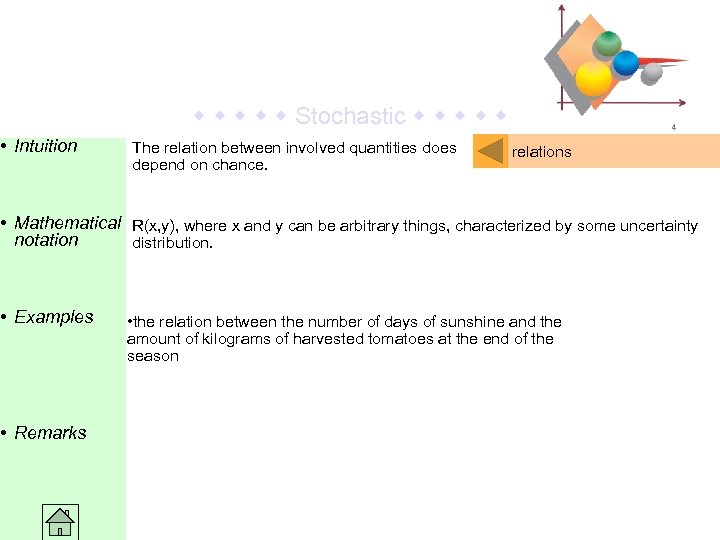 A Core Course on Modeling Week 4 -Dealing with mathematical relations • Intuition Stochastic The relation between involved quantities does depend on chance. 4 relations • Mathematical R(x, y), where x and y can be arbitrary things, characterized by some uncertainty notation distribution. • Examples • Remarks • the relation between the number of days of sunshine and the amount of kilograms of harvested tomatoes at the end of the season
 A Core Course on Modeling Week 4 -Dealing with mathematical relations • Intuition Functional There is a recipe to obtain output we need to know (say, y) that is fully determined given some known input (say, x) 5 deterministic should the recipe produce • Mathematical y=f(x); x and y can be any types (numbers, vectors, objects, . . . ) notation a number? numeric • Examples true or false? logic • Remarks • The value of a propery for a concept • the sine of an angle • the weekday of a date (e. g. , 29 July 2012 is a Friday) • square root • the current I through a resistor R when applying voltage V is given by I=V/R The collection of all x’s is called domain of f; DOM(f); the collection of all y’s is called range of f, RANGE(f). should the recipe produce does the recipe involve sets (e. g. in the form of tables) sets should the recipe produce something else? other In mathematics, the recipe need not to be computable. For instance, the solutions of an equation of 5 th degree are a function of its coefficients, but this function is not computable in a finite number of steps. In modeling, we assume that, for functional relations, the recipe can be implemented on a computer in order to give a numerical approximation of y.
 A Core Course on Modeling Week 4 -Dealing with mathematical relations • Intuition Equation There is enough information about some x we need to know so that it is fully determined, but we don’t yet have x given in the form a recipe to express x in other, known quantities • Mathematical f(x)=0 (equation in unknown x); Df(x)=0 or notation Df(x)=h(x) or Df(x)=h(x, f) (differential equation; • Examples • Remarks D is differential operator and f is unknown function; other forms occur as well) • Most physical and economical laws come in the form of equations, relating quantities, but not necessarily expressing the quantity you are interested in as a function of known quantities. To obtain these, equations need to be solved. There is a relation between functions and equations: for a function y=f(x) we may want to know the x such that y equals some given y 0. Solving the equation is the same as finding an inverse f-1 for the function f; the unknown x is then f-1(y 0) 6 non-functional is the unknown x a number? algebraic is the unknown a function and do we know something about its derivative(s)? differential equation is the unknown a function and do we know something about differences? difference equation is the unknown a function and do we know something about its integral? integral equation
 A Core Course on Modeling Week 4 -Dealing with mathematical relations • Intuition Algebraic There is enough information about a number x we need to know so that it is fully determined, but we don’t yet have a recipe to express x in other, known quantities 7 equation • Mathematical f(x)=0 (equation in unknown x). Often x=(x 1, x 2, . . ) and f=(f 1, f 2, …). Equations notation where the unknowns are numbers can be algebraic (involving +, -, x, / only), including linear, quadric and n-th degree equations, and rational equations; and transcendental equations involving sin, cos, exp, log etc. • Examples • Algebraic equations occur often in the form: given a function y=f(x), for what x does f attain y=y 0. • How long do I need to put € 100, - in the bank, such that 3% compound annual interest produces € 150, -? • Remarks Usually, in modeling, we only need a numerical approximation to x. For most types of equations (linear, quadratic, and some forms of triginometric equations form famous exceptions), numerical solution is the only possible approach.
 A Core Course on Modeling Week 4 -Dealing with mathematical relations • Intuition Differential We are interested in a function f(x), but we only have information about its derivative(s), and perhaps some boundary conditions such as f(x 0)=y 0. We need to have f in a form such that we can evaluate f(x) in arbitrary x. 8 equation • Mathematical Df(x)=0 (homogeneous) or Df(x)=h(x, f) (inhomogeneous notation differential equation; D is a differential operator such as d/dx, and f is the unknown function; other forms occur as well) • Examples • Dynamical systems model the temporal behavior of some signal s=f(t) as a function of time t, • A vessel of water leaking: dh(t)/dt=-ch(t), h(t 0)=h 0, where h(t) is the water level and c relates to the size of the opening. • Remarks Differential equations is a vast area of mathematics that we don’t even start to develop here. Solving by far most differential equations requires numerical approximation.
 A Core Course on Modeling Week 4 -Dealing with mathematical relations • Intuition Difference We are interested in a function f(x), but we only have information about its increments or decrements if x takes discrete steps, and perhaps some boundary conditions such as f(x 0)=y 0. We need to have f in a form such that we can evaluate f(x) in arbitrary (discrete) x. 9 equation • Mathematical F( f)=H(x, f), where f =f(x+h)-f(x) notation • Examples • Remarks • Phenomena where time can be treated discretely • Financial systems with monthly or annual transactions (e. g. , compound interest) or systems that are sampled in time. (Finite) difference equations occur when we try to approximate differential equations by numerical procedures. We encountered difference equations in week 3 when dealing with dynamical systems.
 A Core Course on Modeling Week 4 -Dealing with mathematical relations • Intuition Integral We are interested in a function f(x), but we only have information about an integral of f, and perhaps some boundary conditions f(x 0)=y 0. We need to have f in a form such that we can evaluate f(x) in arbitrary x. 10 equation • Mathematical Various forms; see http: //en. wikipedia. org/wiki/Integral_equation notation • Examples • Remarks • Light is distributed in a space, and reflected to the walls. To find the distribution of illumination over the walls, we need to take the reflections into account. The reflected light, incident in some point, is an integral over all wall area, visible from that point, of the unknown light distribution. • Google uses the so-called page-rank algorithm. This calculates the so-called weight of a page, which is defined as the sum of the weights of the pages referring to it. If we approximate an integral by a sum, finding the weight of pages is an example of an integral equation.
 A Core Course on Modeling Week 4 -Dealing with mathematical relations • Intuition Inequality There is enough information about a quantity x we need to know, so that it is limited to one or more ranges, but we don’t yet have a recipe to express this range in other, known quantities 11 non-functional • Mathematical Solve x from f(x)<0 (often, there are multiple x’s and multiple f ’s) notation • Examples • Remarks • Scheduling often means: finding an order for a set of tasks, some of which can be executed simultaneously, such that a total passage time is not exceed, whereas some tasks can only start after completion of others. This amounts to solving a set of inequalities. • Problems involving geometric tolerances (machine parts, manufacturing, architecture) often give rise to sets of inequalities.
 A Core Course on Modeling Week 4 -Dealing with mathematical relations • Intuition Optimality There is a recipe to find y from x, y=f(x); we need to know x such that y is optimal (minimal or maximal), often subject to additional conditions. 12 non-functional • Mathematical min x DOM(f) f(x), subject to h(x)=0 and/or g(x)>0 where there can be multiple x’s, notation h’s and g’s. There can be multiple x’s and functions h and g, there is only one f, though. • Examples • Most design problems aim to get a situation where something (energy consumption, price, produced noise, comfort, …) is optimal – either maximal or minimal • Remarks Mathematical optimisation requires that there is only one function f(x) to be optimized. In case we want several things f 1, f 2, … to be optimal (e. g. highest efficiency and lowest price), we can form a penalty function, P(x)= 1 f 12(x)+ 2 f 22(x)+ … and minimize P. The determine relative importances of the various criteria f 1, f 2, ….
 A Core Course on Modeling Week 4 -Dealing with mathematical relations • Intuition Non-functional Quantities x, y have a relation R, but R is not given in the form of a recipe to immediately obtain x from y, or y from x. • Mathematical For instance: solve x from f(x, y)=0 (equation), notation from f(x, y)<0 (inequality) or from min x DOM(f) f(x) • Examples • Remarks (optimality) 13 deterministic should we find a recipe to obtain one quantity in terms of the other(s)? equation should we find a value of x • A bottle of wine and a corkscrew together cost 20€; the corkscrew is 3 x as expensive as the wine; what does the wine cost (equation)? • What is the maximum number of cars X on a road with maximum velocity Y such that no traffic jam occurs (optimality)? Equations, inequalities and optimality often occur together. For instance: what is the smallest amount of fuel (optimality) such that a given car travels 100 km (equation, a. k. a. constraint) in at most one hour (inequality)? such that some y is minimal or maximal? optimality should we find a range of x’s such that some condition holds? inequality
 A Core Course on Modeling Week 4 -Dealing with mathematical relations • Intuition Sets There is a discrete amount of information in the form of elements (=concepts), grouped in one or more sets (a database). We need the set of concepts fulfilling certain conditions. • Mathematical Concepts and their properties can be written e. g. notation using the dot-notation; selections are written • Examples • Remarks using logic (AND, OR, NOT) and sets are combined using set theory ( , , , …) • Given a table of employees in a firm, some being salespersons, and a table of timestamped sales transactions, find out which employee sold most products during last month. • Given a knowledge base (ontology) containing related information about books, authors, and countries, find books of some genre, written by an author of some nationality. Most systems for interrogating data allow conditions to use numerical expressions apart from logical conditions and set-operations 14 functional do all concepts have a set of properties that is known beforehand, concepts being represented as tuples, i. e. rows in tables? tables is the structure of concepts not known beforehand, all info in a concept being written as triples (concept, property, value)? triples
 A Core Course on Modeling Week 4 -Dealing with mathematical relations • Intuition Tables are lists of tuples, a tuple being a list of properties with values. Tuples in a table have the same properties. We want one or more tuples, perhaps combining tables, representing the answer to a question about the information stored in the tables. 15 sets • Mathematical Languages such as MYSQL have constructs for defining tables, inserting or deleting tuples, and selecting tuples: either existing tuples that meet certain notation constraints, or combinations of properties of existing tuples into new tuples. • Examples Given a table of patients in a hospital, and a table of medical staff, find out if two patients were treated by the same doctor (e. g. , as a possible cause fo the occurrence of a contageous infection). • Remarks The vast majority of active websites (web shops etc) use MYSQL or similar database architecture.
 A Core Course on Modeling Week 4 -Dealing with mathematical relations • Intuition Triples Triple stores are lists of triples, a triple consisting of (concept, property, value). We want one or more triples, typically combining existing triples, representing the answer to a question about the information stored in the triple store. 16 functional • Mathematical Languages such as SPARQL have constructs for inserting, deleting, selecting and constructing triples: either existing triples that meet certain constraints, or notation • Examples • Remarks combinations of existing triples into new triples. If two knowledge bases (triple stores) agree on using some standardized sets of properties (so called namespaces, typically targeted to an application domain), the information in the two knowledge bases can be combined by means of automated reasoning by a computer. Information, stemming from different origins, is rarely organised into consistent table format. MYSQL-type queries cannot handle such differences in structure. The triple-mechanism, being the core technology of WEB 2. 0, is a way to make inferences across various triple stores, defined and maintained by different owners.
 A Core Course on Modeling Week 4 -Dealing with mathematical relations • Intuition Logic Suppose we have a set of facts and a set of rules. We might be interested in the truth or falsehood of some new fact. To this end we use functions f with RANGE(f)={true, false}: so called predicates. 17 functional • Mathematical Given a set of predicates and rules of the form P(x) Q(x), where P and Q are predicates over dummy variable x, automated inference systems can search the notation space of deducable propositions to see if a given proposition is true. • Examples Suppose we have fact 1: is. Fruit(appel) and rule 1: is. Fruit(x) is. Edible(x). Then we can deduce (=assess the truth of ) is. Edible(appel). With more extensive sets of facts and rules, we can have an automated inference system to help us e. g. drawing medical diagnoses or trouble shooting complex apparatus. • Remarks Reasoning on the basis of facts and implications is one form of (hard or classic) AI. Except for limited knowledge domains, the strength of classic AI seems to be quite limited. More advanced methods use statistics, fuzzy sets, neural networks and other means.
 A Core Course on Modeling Week 4 -Dealing with mathematical relations • Intuition Numeric If we are interested in a numerical result, given numerical values of known quantities, we use algebraic computation (together with standard functions such as sin, cos, exp, …) 18 functional are we interested in all of • Mathematical y = f(x), where x R and y R. (Functions where x notation and y are restricted to rationals or integers also occur). DOM(f) ? global • Examples limited region of DOM(f)? • Remarks Most of highschool physics and economy formulas are functions. For instance, the location of a falling object as function of time (s(t)= -1/2 gt 2), the volume of geometric objects are functions of their size, etc. are we only interested in a local Arbitrary numeric relations typically not correspond 1 -to-1 to numeric functions. Example: Ohms law corresponds to three functions: V=f(I, R)=IR; I=f(V, R)=V/R; R=f(I, V)=V/I. Also, numeric functions can often be decomposed into simpler functions. Example: the focal length f of a lens to map an object at distance v to an image on distance b is f=bv/(b+v). This could also be f=p/q, where p=fp(b, v)=bv and q=fq(b, v)=b+v. The latter functions are simpler, but quantities p and q have no immediate meaning. Developing functions is often a trade-off between simplicity and meaning.
 A Core Course on Modeling Week 4 -Dealing with mathematical relations • Intuition Other If we regard a function as a ‘machine’ that produces some y depending on specification x, and we can give a precise format for y, we can see the production of y as function application. • Mathematical y = f(x), where x and y are taken from arbitrary (non-numerical) sets. notation 19 functional • Examples • A list is a function: x is an index in the list, and y is the object found on the x-th location in the list. • A tuple (=a concept, representing an object – as in conceptual modeling) is a function: x is the name of the attribute and y is the value of that attribute. • Types of objects that can be precisely formatted are, e. g. , images (JPG, NPG, …), sounds (WAV, MP 3, …) geometries (VRML) and many others. An application that takes input in the form of one of such formats and produces output in the same or a different format can be viewed as a (computable) function. • Remarks Standardizing object formats such as JPG, MP 3, … was a first step to interpret the execution of software applications as function evaluation. The next step is, to have a standardized language for defining object formats. This language is XML. Our earlier presentation of conceptual modeling in terms of concepts, properties and values can be expressed immediately in XML.
 A Core Course on Modeling Week 4 -Dealing with mathematical relations • Intuition Local behavior Many quantities occurring as arguments for functions can take an unbounded range of values. The practical interpretation of these numbers, however, often imposes natural bounds: it is meaningless to try to evaluate the function beyond these bounds. • Mathematical x 0 DOM(f) x 1 notation • Examples • Remarks • World record times on 100 m sprint, W, descend as a function of time t. This behavior can be approximated as W=f. W(t)=at+b, with a<0. This only makes sense for t less than –b/a. • Following http: //en. wikipedia. org/wiki/Growth_chart, an upper bound on the weight increase of 95% of children can be approximated by w=fw(t)=4. 0+2. 0 t, w in kg and t in months. f. W is meaningless (say) for t>1200 and for t<0. 20 numerical Is the behavior increasing (decreasing) over the entire domain we are interested in? monotonous Is the behavior both increasing in some places and decreasing in other places of the domain we are interested in? non-monotonous Limiting the domain may be a consequence of the modeled system (the upper bound of 1200 in above example: people don’t get much older than 100 years – moreover, the function is no longer accurate for, say, t>250); the lower bound t=0, however, comes from the used mathematical expression ( t is undefined for t<0).
 A Core Course on Modeling Week 4 -Dealing with mathematical relations • Intuition Global behavior Many quantities occurring as arguments for functions can take an unbounded range of values. Sometimes, we cannot a priori restrict the domain: we need to take the global behavior of the function into account. • Mathematical DOM(f) = R notation • Examples • Remarks • A model for illumination strength as a function of distance to a lamp needs to give a decreasing behavior as a function of distance for arbitrary large distance; • A model for diagnosing tachycardia (a heart disease) may use a 14 -day ECG as input. It is not a priori known which part of the data contains anomalous behavior; • The probability density P(v), say, of finding value v for some property as a function v, needs to fulfill the condition that the area underneath the graph of P(v) where v ranges from - to + is euqal to 1. 21 numeric Do we know something about the behavior in the long range? asymptotes Do we (want to) know something about a restricted part of DOM(f) ? domain Do we (want to) know something about the area ‘underneath’ the graph of the function? integral
 A Core Course on Modeling Week 4 -Dealing with mathematical relations • Intuition Asymptotes Some functions are such that, ‘in the long run’, the function approximates some other function, or even a constant value. It can be important to know such ultimate behavior (asymptote or asymptotic behavior); conversely, when we know asymptotes, it can help constructing the function. 22 global • Mathematical > 0, x. A : |x|>|x. A | |f(x)-f. A(x)| < notation • Examples • Remarks • Some dynamic processes show complex behavior, immediately after the occurrence of an event, but ‘calm down’ after a while (e. g. , a stone falling in a pond: the circular waves, after a while, subside). The ‘calm’ state is an asymptote. • The asymptotic state of a plucked guitar string is a decaying harmonic vibration, irrespective of the initial shape of the string • The asymptotic running time for a particular sorting algorithm for N numbers approaches the function f(N)=c. N log N for constant c, and N sufficiently large.
 A Core Course on Modeling Week 4 -Dealing with mathematical relations • Intuition Domain The purpose of a model including a function f may be, to assess for which part of the domain something interesting happens. 23 global • Mathematical Given y=f(x), we are asked to give the set of x’s notation for which some condition P(y) holds. • Examples • Remarks • The income I of a company selling goods is I=f. I(P, Q)=PQ where P is the price per sold item and Q is the quantity of sold items. For larger P, however, Q will decrease (less people buy expensive items), so Q=f. Q(P). We may ask the range of prices such that I is at least some minimum income I 0. • In physics: radiactive radiation is absorbed in lead. The intensity is a function of the led layer thickness. What is the thickness of a layer of lead such that 95% of incoming radiation is absorbed? • MRI is a technique where medical images are formed, based on detecting radiation emitted by Hydrogen atoms in a strong magnetic field. Algorithms for MRI imaging solve the problem of finding the domain of the function that describes the radiation emission as a function of location in the patient’s body.
 A Core Course on Modeling Week 4 -Dealing with mathematical relations • Intuition Integral For a class of functions, called distributions, meaningful (e. g. , measurable) quantities only correspond to segments of the area Q underneath the graph of the function. We masy either be interested in Q for a given function, or the function may have to be constrained such that a given Q is obtained. 24 global • Mathematical Q= a…b f(x)dx notation • Examples • Remarks • In statistics, a probability density or probability distribution P(x) is a function that tells, for some quantity, how large the chance is that its value will be between x and x+ (for sufficiently small). So, the chance that x is larger than some x 0 is x 0… P(t)dt, and the fact that it is certain that x must have some value is expressed by - … P(t)dt = 1. • Suppose we have some amount P of paint and we know that painting takes C kg/m 2, and h = f(x) is the height of some interestingly shaped wall (x and h in meters), for a segment x 0 … x 1 of the wall we can paint we have that x 0 … x 1 f(x)dx = P/C. This can be used, e. g. , to find x 1 for given x 0 or vice versa.
 A Core Course on Modeling Week 4 -Dealing with mathematical relations • Intuition • Mathematical notation • Examples • Remarks Non-monotonous A function y=f(x), that is non monotonous in some domain, both ascends and descends in that domain. That is, there is at least one point x where y changes its direction. x 0: x 0 D : ( x
 A Core Course on Modeling Week 4 -Dealing with mathematical relations • Intuition • Mathematical notation • Examples • Remarks Monotonous A function y=f(x), that is monotonous in some domain D, either ascends (increases) or descends (decreases) for all x in D. ( x: x D: desc(f(x))) ( x: x D: asc(f(x))) 26 local is the behavior everywhere smooth (that is, if we sufficiently zoom in in a part of the function, does it resemble a straight line)? • As a function of distance to a light source, the light intensity monotonically decreases. • As a function of time, the total amount of industrial waste produced by human civilisation monotonically increases. smooth does the behavior have one or more abrupt bends? non-smooth Functions can monotonically increase or decrease yet never exceed some value. If they increase or decrease on all of R with exceeding some value, they are said to have a (horizontal) asymptote.
 A Core Course on Modeling Week 4 -Dealing with mathematical relations • Intuition • Mathematical notation • Examples • Remarks Non-symmetric Something is symmetric is it suffices to know only part (say, the left half of the floorplan of a mirror symmetric building) of it in order to know all of it. If there is no (simple) way to fill in the missing part(s), the thing is non symmetric. 27 non-monotonous MS: R R : ( x: f(x)=f(MS(x)), where MS is a symmetry mapping (such as rotation, translation, …) (notice: there is no simple intensional definition of the collection of symmetry mappings) • Macroscopic processes that develop in time are not reversible. If they are also non-periodic (e. g. , the growth of a population – perhaps represented by an exponential increase in time), they are non-symmetric. • Processes that are sufficiently stochastic typically loose any symmetry. A sharp definition of non-symmetric is difficult, as the class of symmetry mappings cannot be formally specified. ‘Symmetry’ also includes permutations. E. g. , the outcome of a collision between two billiard balls is the same if we swap the balls.
 A Core Course on Modeling Week 4 -Dealing with mathematical relations • Intuition • Mathematical notation • Examples • Remarks Symmetric Something is symmetric is it suffices to know only part (say, the left half of the floorplan of a mirror symmetric building) of it in order to know all of it. MS: R R : ( x: f(x)=f(MS(x)), where MS is a symmetry mapping (such as rotation, translation, …) (notice: there is no simple intensional definition of the collection of symmetry mappings) • Things that result from only non-oriented forces (e. g. , electrostatic attraction by point-charge) are spherically symmetric. • Things that take place the same way everywhere (say, the collision of billiard balls) are translationally symmetric. • Things that take place the same way always (say, something cooling down) are time-shift symmetric. 28 non-monotonous due to the symmetry in the behavior, can we write the function with fewer arguments? lower dimension despite the symmetry in the behavior, do we still need the same number of arguments to evaluate the function? equal dimension • A sharp definition of symmetry is difficult, as the class of symmetry mappings cannot be formally specified. • ‘Symmetry’ also includes permutations. E. g. , the outcome of a collision between two billiard balls is the same if we swap the balls.
 A Core Course on Modeling Week 4 -Dealing with mathematical relations • Intuition • Mathematical notation • Examples • Remarks Equal dimension Symmetry of a function f may allow to drop 1 or more arguments. This lowers the dimension of DOM(f). If not, the domain keeps the same dimension despite the symmetry. g: x DOM(f): y DOM(g): g(y)=f(x) DIM(DOM(g))
 A Core Course on Modeling Week 4 -Dealing with mathematical relations • Intuition • Mathematical notation • Examples • Remarks Lower dimension Symmetry of a function f may allow to drop 1 or more arguments. This lowers the dimension of DOM(f). A function with a lower dimensional domain is attractive: it is usually simpler to compute. It is therefore beneficient to exploit symmetry. g: x DOM(f): y DOM(g): g(y)=f(x) DIM(DOM(g))
 A Core Course on Modeling Week 4 -Dealing with mathematical relations Mirror 31 • Intuition In some functions y=f(x), replacing x by –x gives the same result. It is as if we need only half the graph and put it in front of a mirror to see the other half. • Mathematical notation f(x)= f(-x), or, in general: f(x)=f(a-x) for some a. • Examples • Due to inaccuracy, repeatedly measured values for some quantity Q are not identical. They form a distribution. Unless we make systematic errors, the distribution is often mirror symmetric around the most probably value for Q. • Remarks • Functions f(x) for which f(x)=f(-x) are called even. Examples are f(x)=x 2 and f(x)=cos(x). Functions such as f(x)=x, f(x)=x 3, f(x)=sin(x) have the property that f(-x)= -f(x). These are not mirror symmetric (they are called odd), but they could be called symmetric in the sense that knowledge of their behavior on part of the domain informs us about their behavior on the entire domain. equal dimension
 A Core Course on Modeling Week 4 -Dealing with mathematical relations • Intuition Periodic In some functions y=f(x), replacing x by x+p gives the same result. We can repeat this: f(x+p)=f(x+2 p), and so on, so such functions repeat themselves on the domain. • Mathematical notation f(x)= f(x+p) for some constant p. • Examples • Many phenomena are periodic in time: all sorts of oscillations (sound), rotations (planet orbits, electrons), financial processes (monthly salaries), biological processes (sleep-wake, reproductive cycles), artefacts (traffic lights). • Many phenomena are periodic in space: all sorts of waves and ripples (sand dunes, some types of clouds, radio waves), construction principles (cog wheels, brick walls, …). • Remarks 32 equal dimension is the repetitive behavior like a smooth wave? trigonometric Processes that are periodic in time often occur in the combination of damping or dissipation (energy leaking out of the system): a vibrating string after a while stops making a sound. Such behaviors are often the product of a periodic function and a decreasing function (such as an exponential) does the repetitive behavior contain sharp bends (e. g. , like sawteeth)? modulo is there any other form of repetitive behavior? other
 A Core Course on Modeling Week 4 -Dealing with mathematical relations • Intuition • Mathematical notation Other There are many forms of symmetry, other than mirror, translation or rotation. For instance: a spiral and a screw are clearly symmetric, and so are various tilings (2 D) or crystal structures (3 D). 33 equal dimension In each case, we have some mapping MS and x DOM(f), f(x)=f(MS(x)). • Examples • For a spiral (such as the shape of some shells), MS is a combination of a rotation and applying a scale factor • For a helix (such as the shape of a drill, or unfolded DNA), MS is a combination of a rotation and a translation • For the scrabble board, MS is a rotation over 0, /2, , or 3 /2. • Remarks A symmetry map MS generates a set of points when repeatedly applied to some starting point. For instance, a rotation generates circles, a translation generates lines, the combination of a rotation and a scaling generates spirals. Combining multiple such mappings generates highly complex, but sometimes very beautifull so-called iterated function sets.
 A Core Course on Modeling Week 4 -Dealing with mathematical relations Modulo 34 • Intuition A point in time is denoted as a number of hours, minutes and seconds. All three repeatedly take a sequence of values: 0. . . 23, 0… 59. This form of periodicity is the result of integer division: the sequences are the possible remainders of dividing, respectively, by 24, 60 and 60. • Mathematical notation 0 x mod p < p for integer x and p, where mod (from ‘modulo’) is the remainder by division. • Examples • Remarks periodic • Processes involving time (e. g. , energy consumption in an urban environment) shows periodic behavior with several periods (24 hours; 7 days; 30 / 31 days; 365 / 366 days …); • configurations in systems of cog wheels and other periodically re-used resources (shopping carts, labour shifts, … ) can show complex periodic behavior
 A Core Course on Modeling Week 4 -Dealing with mathematical relations Trigonometric 35 • Intuition Many periodic systems involve rotations, represented by angles as function of time. When measuring an angle, we encounter the periodicity of the circle, and therefore all functions derived from angles (sin, cos, tan, …) are perodic. • Mathematical notation sin(x)=sin(x+2 ), cos(x)=cos(x+2 ), tan(x)=tan(x+ ) • Examples • Motions of the planets and the classical motion of electrons in magnetic fields (Lorentz force) • In electric (resistor-capacity-induction), or mechanic (damper-spring-mass) systems we don’t see anything rotating. Still, there is often periodic behavior. This is always caused by the existence of two opposite causes (e. g. , in a mass-spring system: the inertia of the mass, and the elastic force in the spring) where alternatingly one and the other dominates. In a circular motion (rotation), in hindsight, we also can identify such periodic competition between two aspects: there, they are the vertical and horizontal deviation. If one is big, the other is small, and vice versa. This is the reason that oscillations are well described with complex numbers: the two competing aspects are the real and imaginary part of the complex number. • Remarks periodic There is an intimate connection between trigonometry, exponents and complex numbers, expressed by Euler’s theorem: e i =cos + i sin , which underlies all techniques for solving linear 2 nd order differential equations – such as mass-spring systems and electric networks.
 A Core Course on Modeling Week 4 -Dealing with mathematical relations Other 36 • Intuition Sometimes, periodicity results from a construction principle. If many copies of the same thing are brought close togethere is little alternative for periodic arrangement. – unless an external phenomenon causes (stochastic) perturbation. Adding heat melts a crystal structure, turning periodicity into chaos. • Mathematical notation f(x)=f(x+p) for constant p • Examples • The arrangmenet of atoms in a crystal; • The arrangement of leaves on the branch of a tree (Acacia!), the vertebrae in a spine, or the optic cells in a retina; • The repetitive arrangement of all the same houses in a suburb street, lamp posts near a motorway, or rivets on a beam in a steel construction. • Remarks Although they are rare, there are some examples of non-periodic crystalline structures. A famous example is the Penrose tiling, consisting of two types of elements (quadrilaterals with angles that are multiples of 36 degrees). First constructed as a mathematical curiosity, it was later discovered to occur in physical reality. periodic
 A Core Course on Modeling Week 4 -Dealing with mathematical relations Rotational 37 • Intuition Most round things are round, either because they (need to) rotate, or because their construction is isotropic (meaning: no preferred direction). The properties of something round are the same when being rotated. So the representation of something round as a function of location can safely ignore the angle-dependency. • Mathematical notation If (x, y) DOM(f), : f(x, y)=f( (x, y)), where (x, y) is a rotation over angle of the point (x, y), then g: g( (x 2+y 2))=f(x, y). Example: a rotational paraboloid, f(x, y)=x 2+y 2, is identical to g(r, )=r 2, where r= (x 2+y 2); the latter function does not depend on : g(r, )=g(r). • Examples • In 3 D, spherical symmetry: planets are approximately spheres because they (presumably) were formed under the infuence of gravity only, and gravity is isotropic; • In 3 D, axial symmetry: a ceramic vase has a round cross section because it results from a process involving rotation; • In 2 D, a cog wheel has a round projection because it needs to rotate; • Remarks There is a close connection between rotation and complex multiplication. A complex number can be seen as a vector in a 2 D plane (the real-imaginary plane). For two complex numbers, z 1=x 1+iy 1, z 2=x 2+iy 2, their product is x 1 x 2 -y 1 y 2+i(x 1 y 2+x 2 y 1). The angle with the positive real axis of z 1 is arctan (y 1/x 1); for z 2 it is arctan (y 2/x 2); for z 1 z 2 it is the sum of the two (follows from summation formula for tan(x)). So rotating (in 2 D) is the same as multiplying with a complex number with length 1 and angle with the positive real axis equal to the desired rotation angle. lower dimension
 A Core Course on Modeling Week 4 -Dealing with mathematical relations Translational 38 • Intuition Most straight things are straight, either because they (need to) translate, or because their construction is translation-invariant (meaning: no preferred location). The properties of something straight are the same when being translated. The representation of something translation-invariant as a function of location does not have to depend on the individual locations, only on the difference between locations. • Mathematical notation If (x, y) DOM(f), p : f(x 1, x 2)=f(x 1+p, x 2+p), then g: g(x 1 -x 2)=f(x 1, x 2). • Examples • The light intensity in a point r 1, due to a lightsource in point r 2 must not change if we displace both r 1 and r 2 over the same vector. Therefore, the light intensity can only depend on the distance r 1 -r 2. • The velocities of billiard balls after a collision cannot depend on the location of the collision. Therefore, the formula for the new velocities can only contain the difference of the locations of the balls. • Remarks lower dimension
 A Core Course on Modeling Week 4 -Dealing with mathematical relations Other 39 • Intuition A function is simpler when it has fewer arguments. It is therefore recommended to seek if, for some purpose, multiple arguments can be replaced by a single argument. • Mathematical notation If g, h: (x, y) DOM(f), h(g(x, y))=f(x, y), then g(x, y) is the preferred variable to work with rather than x and y separately. • Examples • It had long been assumed that cholesterol levels in humans relate to life expectancy, e. There are two kinds of cholesterol, so two levels c 1 and c 2. It was very difficult to find a function e=fe(c 1, c 2). It turns out, however, that there is a simple function e=ge(c 1/c 2). Therefore, c 1/c 2 is a more meaningful quantity than c 1 and c 2 separately. • In relation to dimensional analysis: if some quantity q, in principle, could depend on quantities p 1, p 2, …pn it is recommended to seek dimensionless quantities r 1, r 2, … rm (m
 A Core Course on Modeling Week 4 -Dealing with mathematical relations • Intuition • Mathematical notation • Examples • Remarks Smooth The world may be whimsical, but in models we often want to ignore small irregular variations. We often first want to capture the global behavior. We don’t want things in one place to be too uncorrelated to things nearby. This is expressed in the intuition of smoothness. One way to formalize smoothness is, to think of the largest circle or sphere that can touch a function graph or function surface on either side without intersecting it: the larger its radius, the smoother the function. 40 monotonous if we add some constant to x, is the difference in f independent of x? additive if we multiply x by some constant (for x sufficiently • We may be interested to know how smooth something is: smoother behavior can be represented with less information; • We may want to make something smoother (e. g. , remove noise introduced by measuring), typically replacing values with averages between values and their neighbors. Differentiability (the existence of a derivative) is loosely related to smoothness. The function y=sin(1/x) is differentiable but highly non-smooth; the function y=10 for x<0 and y=10+0. 0001 x for x>0 is not differentiable in x=0, but it is very smooth. large), is the change ratio of f independent of x? rational none of the two above? non-rational
 A Core Course on Modeling Week 4 -Dealing with mathematical relations • Intuition • Mathematical notation • Examples • Remarks Non-smooth The world may be whimsical, and some whimsicalities may be the essential features of the modeled system. In those cases our model must represent these features. Often, they constitute jumps or abrupt changes in slope. One way to formalize smoothness is, to think of the largest circle or sphere that can touch a function graph or function surface on either side without intersecting it. In a jump or abrupt slope change, the maximal radius is zero. • The path of a billiard ball is non-smooth at the instance of a collision, as is a light ray when it passes from one medium to another • Non-smoothness is the characteristic of boundary conditions, that is: the place or circumstance where one condition abruptly changes to another condition. 41 monotonous does the bahavior have (a) flat segment(s) adjacent to a sharp bend? min, max does the behavior have local minimum or maximum in a sharp bend? absolute none of the two above? behavior Usually, non smoothness occurs in isolated points, called singularities. The other in between singularities is smooth and can be represented with little or no information. Therefore, singularities in a phenomenon (say, an image, a spectrum, a distribution) carry the bulk of the non-trivial information contents of the phenomenon.
 A Core Course on Modeling Week 4 -Dealing with mathematical relations Additive 42 • Intuition Adding corresponds to the intuition of combining sets or quantities. The thing added has to be of the same dimension as what it is added to. There is a notion of ‘ 0’, corresponding to adding nothing, or to ‘not adding’. • Mathematical notation p, q: f(p)-f(q) = p-q. Adding is commutative, a+b=b+a, and associative: a+(b+c)=(a+b)+c; it distributes over multiplication: a*(b+c)=a*b+a*c • Examples • Suppose we are calculating the effect of thermal isolation of a house. The total energy loss is the sum of the energy losses through the roof, through the walls and through the windows. • The sum to be paid for a collection of goods is the sum of the amounts to pay for the separate goods. • Superposition in physics holds that if a quantity q 1 corresponds to phenomenon p 1, and q 2 to p 2, the quantity corresponding to the two phenomena working simultaneously is q 1+q 2. • Remarks smooth Alternatives for additive behavior are for instance the root of the sum of squares, or the logarithm of the sum of exponentials. An example of the first is the addition of the energy in two interfering waves; an example of the second is the addition of the perceived loudness of two sources of sound.
 A Core Course on Modeling Week 4 -Dealing with mathematical relations • Intuition Rational If evaluating f(x) only involves adddition, subtraction, multiplication or division, f is rational. Plotting both the output and the input on logarithmic scales, for sufficiently large |x|, gives a straight line; the slope of which is the power p of the asymptotic behavior, f(x)=Cxp. • Mathematical notation A rational function is the quotient of two polynomials; a polynomial in variable x is the sum of integer powers of x, each with its own coefficient. • Examples • The focal distance of a lens so that a point at distance v is sharply projected onto a screen at distance b is bv/(b+v): a rational function of b and v. • The response of a linear dynamic system as a function of the frequency of an input signal, i(t)=A 0 sin( t) is given by the so-called transfer function H( ). This is a rational function of . • Remarks 43 smooth if we multiply x with a constant, does f scale with the same constant? linear if we multiply x with a constant, does f scale differently? non-linear Any function in x, only consisting of combinations of +, -, * and / can be re-written to contain only one division, numerator and denominator being polynomials in x only. Let n and m be the degrees of numerator and denominator (that is, the highest occurring power of x), respectively. For |x| sufficiently large, the entire function approaches Cxn-m, C being the ratio of the coefficients for x in the numerator and the denominator: This is called the asymptotic behavior of a function; it is extremely important in doing predictions about behavior of processes. It may be hard to assess what ‘sufficiently large’ means, though.
 A Core Course on Modeling Week 4 -Dealing with mathematical relations • Intuition • Mathematical notation • Examples • Remarks Non-rational If the evaluation of a function cannot be written with finitely many addditions, subtractions, multiplications or divisions, a function is non-rational. An other word for non-rational is transcendental. A non-rational function of x is most often represented as a Taylor series: a summation of infinitely many terms of the form aixi. Transcendental functions such as exp, log, sin etc. can all be defined as Taylor series with appropriate coefficients ai. • The Gaussian distribution from probability theory; • The exponential increase or decay as a function of time (e. g. , unbounded growth or extinction) , or exponential attenuation as a function of the thickness of an absorption or filtering layer. smooth if we multiply x with a constant, does f increase (decrease) with a constant? logarithmic if we add a constant to x does f scale with a constant? exponential neither of the two? The value of non-rational functions, in general, cannot be calculated in a finite amount of steps. Efficient numerical procedures exist, however, to make accurate estimates with arbitrary precision. 44 other
 A Core Course on Modeling Week 4 -Dealing with mathematical relations • Intuition Linear behavior corresponds to proportionality: if x is scaled by a factor s, the function value f(x) also is scaled by the same factor. It means that evaluation of f(x) involves a multiplication: f(x)=px; the dimension of x can differ from the dimension of y=f(x). • Mathematical notation p, q 1, q 2: (f(q 1)-f(p))/(f(q 2)-f(p)) = (q 1 -p)/(q 2 -p). f(x)=ax+b, so a can be found as a=(f(q)-f(p))/(q-p) and b=f(0). • Examples • The temperature scales Centigrade, Fahrenheit and Kelvin are linearly related: given one, the others are found by applying linear functions. • Many non-linear functions locally (i. e. , in a small part of the domain) can be approximated as linear functions, e. g. , ex 1+x, sin(x) x and (1+x) 1+x/2. • Remarks 45 rational if we scale x with a constant, does f scale with the same constant? proportional if not: affine • The graph of linear behavior is a straight line. If it passes through the origin, the behavior is proportional; otherwise it is affine, written as f(x)=ax+b.
 A Core Course on Modeling Week 4 -Dealing with mathematical relations Proportional 46 • Intuition Proportional means: if x is scaled by a factor s, the function value f(x) also is scaled by the same factor. It means that evaluation of f(x) involves a multiplication: f(x)=Cx; the dimension of x can differ from the dimension of y=f(x). • Mathematical notation p, q: f(p)/f(q) = p/q. Also: p, q: f(p+q)=f(p)+f(q) (although this equation, over R, has also other, albeit highly pathological, solutions than f(x)=Cx) , and f(x)=Cx. Multiplying is commutative, ab=ba, and associative: a(, bc)=(ab)c; it does not distribute over addition: a+(bc) (a+b)(a+c) • Examples • Ohm’s law: V I and V R, hence V IR, and the constant of proportionality is 1 • Gay-Lussac’s law: P T (pressure – temperature of an amount of gas with constant volume) • Salary is proportional to time: if every month the same amount of money is earned, the constant of proportionality is the monthly income. • Remarks The graph of proportional behavior is a straight line through the origin. . linear
 A Core Course on Modeling Week 4 -Dealing with mathematical relations Affine 47 • Intuition Affine behavior means: proportional plus some offset. The offset is the value that results if the input is 0. Since the application of an affine function involves an addition, f(x)=ax+b; the dimension of f(x) equals the offset; x can have a different dimension. • Mathematical notation p, q 1, q 2: (f(q 1)-f(p))/(f(q 2)-f(p)) = (q 1 -p)/(q 2 -p). f(x)=ax+b, so a can be found as a=(f(q)-f(p))/(qp) and b=f(0). • Examples Remarks linear • All linear behavior that is not proportional, is affine. • If we approximate some behavior y=f(x) as linear behavior in the neighborhood of some x=x 0 (sometimes called the equilibrium point, the starting position, the rest position, te start position, etc. ), f(x 0) is the offset. The coefficient a is found by studying the behavior for x near x 0: f(x) f(x 0)+(x-x 0)df/dx(x=x 0) • When showing trends, the current situation is often arbitrarily set to some value (e. g. , 1 or 100). The differences with respect to the current situation are said to be indexed. This is to abstract from the precise value of the current situation. In linear approximation, this is to eliminate an unimportant b. Sometimes the distinction between proportional and affine is called homogenous (b=0) vs. inhomogenous (b 0)
 A Core Course on Modeling Week 4 -Dealing with mathematical relations Positive power 48 • Intuition Rational behavior means that, for |x| sufficiently large, the behavior approaches Cxp for either positive or negative p. Such behavior is characterized in that f(q 1)/f(q 2) equals (q 1/q 2)p, so log(f(q 1)/f(q 2)) = p log (q 1/q 2). In other words, plotting the log of the ratio of the function values agains the ratio of the arguments gives a straight line through the origin with slope p. • Mathematical notation for |x| sufficiently large, f(x)=Cxp, p>0. For arbitrary x, f(x) is a ratio of two polynomials, where p is the difference of the highest occurring powers in numerator and denominator. • Examples • Remarks non-linear • The area of a shape, or the volume of a body, increases as x 2 or x 3, respectively, with the size x. So the amount of pixels in an image increases with the resolution squared. • The distance for a vehicle with speed v to come to a standstill quadratically increases with v. Not every super-linear increasing behavior is polynomial with an integer power. Two examples: the volume of an object, given its surface area s is proportional to s(3/2) – which is a rational function; the amount of processing to sort N numbers is proportional to N log N – which increases faster than proportional with N, but slower than Np for any constant p (either integer or non-integer). The latter is non-rational behavior.
 A Core Course on Modeling Week 4 -Dealing with mathematical relations Negative power 49 • Intuition Rational behavior means that, for |x| sufficiently large, the behavior approaches Cxp for either positive or negative p. Such behavior is characterized in that f(q 1)/f(q 2) equals (q 1/q 2)p, so log(f(q 1)/f(q 2)) = p log (q 1/q 2). In other words, plotting the log of the ratio of the function values agains the ratio of the arguments gives a straight line through the origin with slope p. • Mathematical notation for |x| sufficiently large, f(x)=Cxp, p<0. For arbitrary x, f(x) is a ratio of two polynomials, where p is the difference of the highest occurring powers in numerator and denominator. • Examples • Remarks non-linear • The gravity force due to an object with mass decreases with the square of the distance to that object. The same is true for electrostatic force; magnetic force between two magnets decreases with distance to the power -4. • Light intensity decreases with distance to the power -2 from a light source.
 A Core Course on Modeling Week 4 -Dealing with mathematical relations • Intuition • Mathematical notation • Examples • Remarks Non-linear Every smooth function, in a sufficiently small part of the domain, can locally be approximated by a linear function. So we never know if some perceived linear behavior, if we extend the domain, could turn nonlinear in the long run. It requires at least three data points to make sure behavior is non-linear. If f is a non-linear ration function, there are two polynomials, p 1(x) and p 2(x), at least one of them has degree at least 2, such that f(x)=p 1(x)/p 2(x). Consider a taperecorder playing. The tape goes from left reel to right reel. The diameter of the left real decreases, the right one increases. If the tape runs with constant speed, the diameters of the reels change nearly, bot not exactly, linear with time. The sums of the diameters is nearly, but not exactly, cosntant. 50 rational does the behavior go to infinity for some x? negative power does f stay finite for all x? positive power • From observing data only, it is impossible to assess if behavior is rational or non rational. Any non-rational behavior (say, exponential) on a finite domain can be approximated with arbitrary accuracy by a rational function. • Assuming that linear behavior, on a limited domain, is globally linear is called linear extrapolation. Linear extrapolation (and extrapolation in general) is dangerous; nevertheless, extrapolation underlies all of the emperical laws that in turn underly quantitative science.
 A Core Course on Modeling Week 4 -Dealing with mathematical relations • Intuition • Mathematical notation • Examples • Remarks Logarithm 51 Every constant increase in the output requires the non-rational multiplication with a constant, dimensionless factor of the input. If some behavior, when plotted on an exponential scale, gives a straight line, the behavior is logarithmically. x=Blog y is the solution of y=Bx. Usually, base B is 10 or e=2. 71829… Let f(c 1 x)=c 2+f(x) (c 1 is dimensionless). For logarithmic behavior, f(x)=a log bx, we have that f(c 1 x)=a log bx + a log c 1=f(x)+c 2, so a=c 2 /log c 1. The value of b is given by ef(x)/a/x. Quantities in chemistry are often defined as logarithms of physical quantities, e. q. , p. H= -log [H+], where [H+] is the concentration of H+ ions in a diluted solution. (Notice that one can argue whether or not [H+] is dimensionless). Quantities related to perception are often defined as logarithms of physical quantities, e. g. , d. B=log(P 1/P 0) where P 1 is some (audio) power to be measured and P 0 is a reference power. One property of the logarithm is, that a huge variation in the input (that needs to be strictly positive) gives rise to a small variation in the output. The logarithmic function can be said to compress the input value. To deal with a large dynamic range, in such a way that relative changes rather than absolute changes in the input variable are reported, the logarithm is the ideal transformation, as it linearly depends on the ratio x 1/x 0 of input values x 1 and x 0. For this reason it is believed that many biological sensors (roughly) behave as logarithms; also for artificial sensors, a logarithmic dependency is often desirable.
 A Core Course on Modeling Week 4 -Dealing with mathematical relations • Intuition • Mathematical notation • Examples • Remarks Exponential Every constant, dimensionless increase in the input yields the multiplication with a constant factor in the input. If some behavior, when plotted on a logarithmic scale, gives a straight line, the behavior is exponential. 52 non-rational Every exponential behavior, y=ax, can be written as y=e x ln a. Euler’s constant, e=2. 71829… is such that f(x)=ex=f ’(x). For exponential behavior, f(c 1+x)=c 2 f(x) (c 1 dimensionless). For f(x)=a ebx, we have that f(c 1+x)=a ebx ebc 1=f(x)c 2, so b=(log c 2)/c 1. The factor a follows from a=f(x)/ebx. • eax with a>0 represents increase where a constant increment of the input causes multiplication by a factor in the output. If x is time, this occurs in unbounded growth (bacteria, capital in the case of accumulating interest). • eax with a<0 represents decreas where a constant increment of the input causes reduction with a factor in the output. If x is time, this occurs in (radioactive) decay. If x is thickness, it occurrs in absorption. Since the derivative of eax equals aeax, the exponential function plays a crucial role in solving differential equations. Replacing the unknown function f(x) by F(s)= f(x)e-sxdx (this is the so-called Laplace transform) means that f’(x) is to be replaced by s. F(s)-f(0). Therefore the differential equation in f(x) becomes an algebraic equation in F(s) – which is much easier to solve. The resulting F(s) can be transformed back to a function in x (see http: //en. wikipedia. org/wiki/Laplace_transform ). The Laplace transform replaces differentiation to multiplication; this can be compared to the logaritmh chaning multiplication to addition.
 A Core Course on Modeling Week 4 -Dealing with mathematical relations • Intuition • Mathematical notation • Examples • Remarks Other Apart from logarithm and exponential, there are many other forms of non-rational functions, that is: functions that cannot be computed in finite amount of additions, subtractions, multiplications, or divisions. The trigonometric functions are one family of examples. 53 non-rational Non-rational functions are called transcendental. Rational combinations of transcendental functions (that is, quotients of polynomials in transcendental functions) are also transcendental. In most cases, linear behavior does only apply to a limited domain. If argument x becomes sufficiently large or sufficiently small, most behaviors saturate – that is: the output f(x) is subject to some upper and lower bound. A simple example is in population dynamics: the reduction of prey is only proportional to the amount of predators in a limited range; similarly, the increase of predators is proportional to the amount of prey in a limited range only. A function to formalise this behavior is the logistic function, f(x)=1/(1+e-x). Round x=0, this behaves as f(x) 0. 5+x, but 0 f(x) 1. Other applications of the logistic function include economics (price elasticity), chemistry, and physics.
 A Core Course on Modeling Week 4 -Dealing with mathematical relations • Intuition • Mathematical notation Min, max Often, increasing or decreasing behavior is limited by some boundary. This merits the use of max or min functions. 54 non-smooth max(x, y)=x if x>y; max(x, y)=y if y>x. The max function is commutative and associative: max(a, b)=max(b, a); max(a, b), c)=max(a, max(b, c)). Sometimes, max(a, b, c) is used as abbreviation for max(a, max(b, c)). The min() function can be defined as min(x, y)=x+y-max(x, y). The functions max and min are continuous but not differentiable in the situation where x=y; on left and right sides of this singularity, the derivatives are 1 and 0, respectively. • Examples In the case of modeling (financial) transactions, chemical reactions or other producer – consumer processes, an interaction can only occur if at least one of each type of occurring ingredients is available. For instance, selling as good requires a buyer, a seller, at least one good on the side of the seller, and at least a sufficient amount of money on the side of the buyer. So the number of possible transactions of some sort is min(nr. Buyers, nr. Sellers), min(sellers. goods, buyers. amounts. Of. Money)). • Remarks Since min and max are not differentiable, they prevent methods for optimisation that involve taking derivatives, such as steepest descent methods (http: //en. wikipedia. org/wiki/Steepest_descent ).
 A Core Course on Modeling Week 4 -Dealing with mathematical relations • Intuition • Mathematical notation Absolute value If a behavior is the same, irrespective of the sign of the independent variable, we may encounter the absolute value. 55 non-smooth abs(x)=x if x>0; abs(x)= -x if x<0. The function abs(x) is continuous, but not differentiable. It is singular for x=0; on both sides of the singularity its derivatives are -1 and +1 , respectively. • Examples Sometimes, the difference between two quantities determines whether or not something will happen. E. g. , some demographic model may predict that the chance for moving depends on the difference in income between two neighbors. This is the absolute difference: the chance is symmetric on which of the two neighbors is richer. • Remarks The absolute value is not differentiable. Sometimes it can be replaced by an expression involving squares and square roots, which is differentiable and which may have a similar interpretation. For example: in some interpretation of ‘distance’ between points (x 1, y 1) and (x 2, y 2) we may set d=abs(x 1 -x 2)+abs(y 1 -y 2); in another interpretation we may set d= ((x 1 x 2)2+(y 1 -y 2)2). In the first case, the points (x 2, y 2) with distance at most 1 to the point (x 1, y 1) are in a square with side 2; in the second case, they are in a circle round (x 1, y 1) with diameter 2.
 A Core Course on Modeling Week 4 -Dealing with mathematical relations • Intuition • Mathematical notation • Examples • Remarks Other Behavior can be non-smooth for many different reasons. Sometimes the non-smooth behavior is an artefact that we may want to get rid of (byh smoothing); sometimes it is essential. For instance, if we deal with problems that essentially involve integers where integer values depend on real-valued input quantities. 56 non-smooth Non-smooth can mean discontontinuous. A function is discontinuous in x=x 0 if p>0 : |f(x 0 - )-f(x 0+ |>p. A continuous function that is non-smooth is either (in some points) not differentiable, or the radius of the largest touching circle (or ball) that stays on one side of the function graph (or surface) is zero. • Suppose we have a model that calculates the optimal number of counters n =fn(t) for a super market in depedence of the average transaction time t per customer. There is no such thing as a half counter, so the function fn(t) will be non-smooth. • If a function is to be taken from a table, the index of the table is an integer. Even if the values in the table are real numbers, the dependency of this function on its input will be nonsmooth, since the argument of the function takes discrete values only.