


 Скачать презентацию A Cognitive Framework for Delegation to an Assistive
3831a4cd65844cf39b8c373b9038b16a.ppt
- Количество слайдов: 30
 A Cognitive Framework for Delegation to an Assistive User Agent Karen Myers and Neil Yorke-Smith Artificial Intelligence Center, SRI International 3/16/2018
 Overview n n n CALO: a learning cognitive assistant User delegation of tasks to CALO Delegative BDI agent framework Goal adoption and commitments Summary and research issues
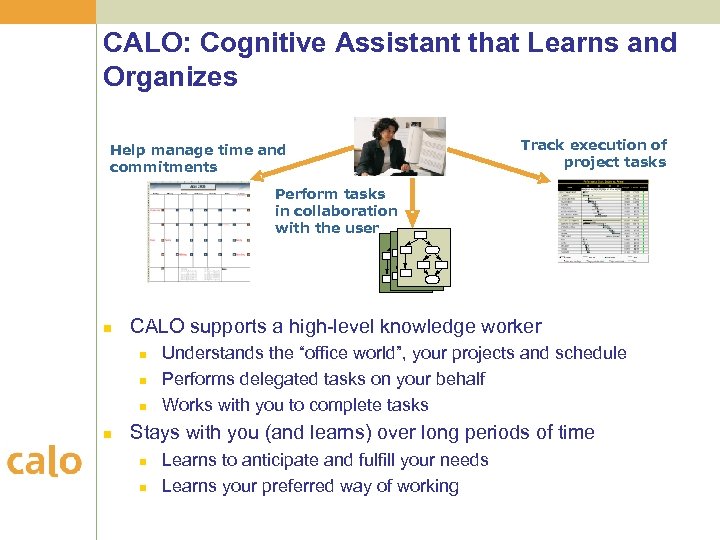 CALO: Cognitive Assistant that Learns and Organizes Help manage time and commitments Track execution of project tasks Perform tasks in collaboration with the user n CALO supports a high-level knowledge worker n n Understands the “office world”, your projects and schedule Performs delegated tasks on your behalf Works with you to complete tasks Stays with you (and learns) over long periods of time n n Learns to anticipate and fulfill your needs Learns your preferred way of working
 CALO Year 2
 Overview n n n CALO: a learning cognitive assistant User delegation of tasks to CALO Delegative BDI agent framework Goal adoption and commitments Summary and research issues
 Delegation May Lead to Conflicts n Focus on delegation of tasks from user to CALO n n n Not on tasks to be performed in collaboration One aspect of CALO’s role as intelligent assistant CALO cannot act if conflicts over actions n Conflicts in tasks n n n “purchase this computer on my behalf” “register me for the Fall Symposium” Conflicts in guidance n n “always ask for permissions by email” “never use email for sensitive purchases”
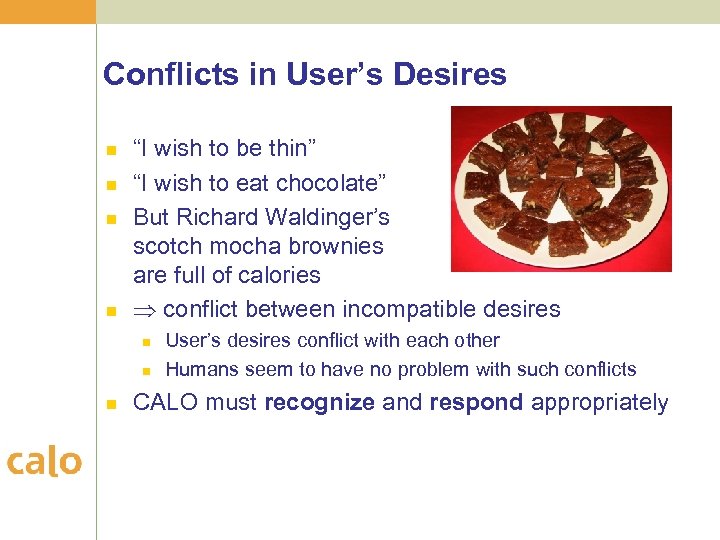 Conflicts in User’s Desires n n “I wish to be thin” “I wish to eat chocolate” But Richard Waldinger’s scotch mocha brownies are full of calories conflict between incompatible desires n n n User’s desires conflict with each other Humans seem to have no problem with such conflicts CALO must recognize and respond appropriately
 Other Types of Conflicts n Current and new commitments n Currently CALO is undertaking tasks to: n n n Purchase an item of computer equipment Register user for a conference Now user tasks CALO to register for a second conference Set of new goals is logically consistent and coherent But infeasible because insufficient discretionary funds Commitments and advice n n n User tasks CALO to schedule visitor’s seminar in best conference room Existing advice: “Never change a booking in the auditorium without consulting me” New goal and existing advice are inconsistent
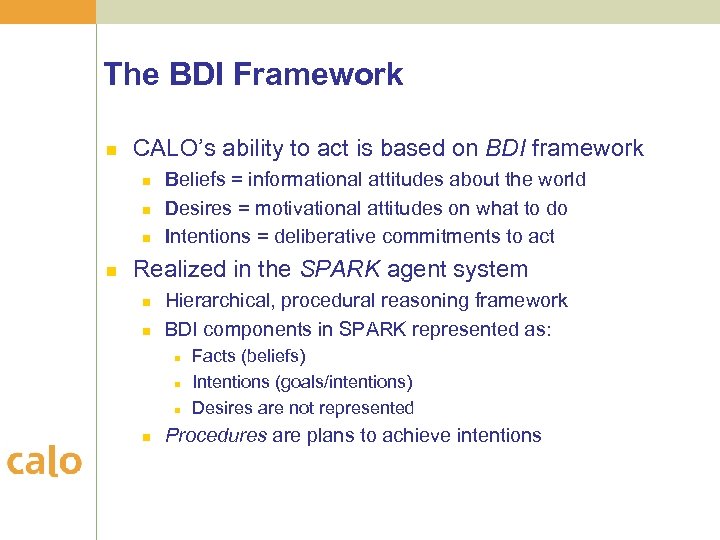 The BDI Framework n CALO’s ability to act is based on BDI framework n n Beliefs = informational attitudes about the world Desires = motivational attitudes on what to do Intentions = deliberative commitments to act Realized in the SPARK agent system n n Hierarchical, procedural reasoning framework BDI components in SPARK represented as: n n Facts (beliefs) Intentions (goals/intentions) Desires are not represented Procedures are plans to achieve intentions
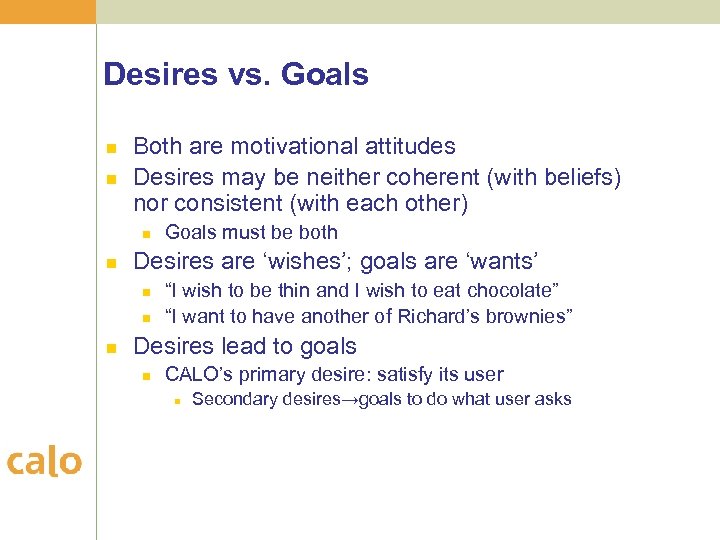 Desires vs. Goals n n Both are motivational attitudes Desires may be neither coherent (with beliefs) nor consistent (with each other) n n Desires are ‘wishes’; goals are ‘wants’ n n n Goals must be both “I wish to be thin and I wish to eat chocolate” “I want to have another of Richard’s brownies” Desires lead to goals n CALO’s primary desire: satisfy its user n Secondary desires→goals to do what user asks
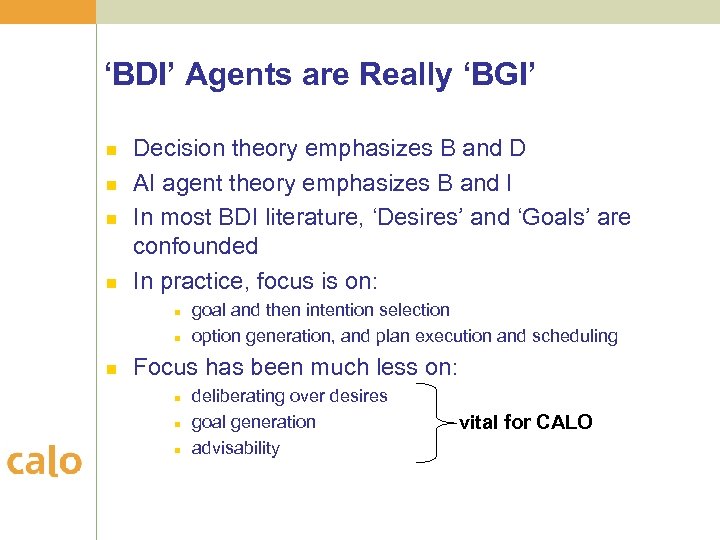 ‘BDI’ Agents are Really ‘BGI’ n n Decision theory emphasizes B and D AI agent theory emphasizes B and I In most BDI literature, ‘Desires’ and ‘Goals’ are confounded In practice, focus is on: n n n goal and then intention selection option generation, and plan execution and scheduling Focus has been much less on: n n n deliberating over desires goal generation advisability vital for CALO
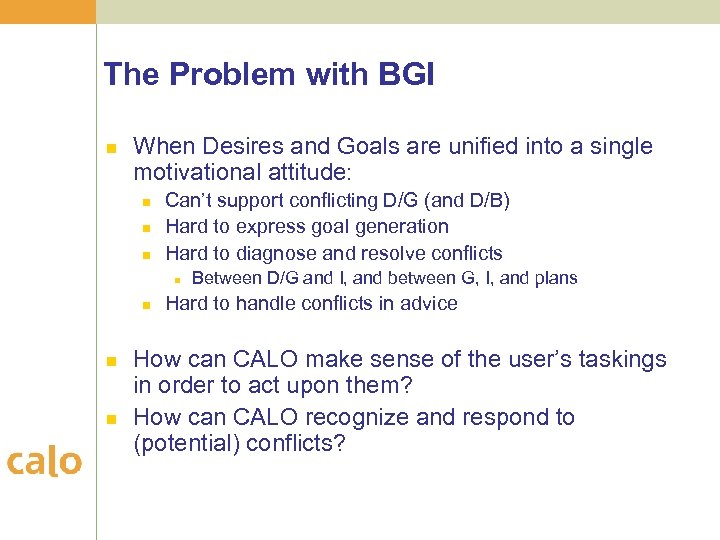 The Problem with BGI n When Desires and Goals are unified into a single motivational attitude: n n n Can’t support conflicting D/G (and D/B) Hard to express goal generation Hard to diagnose and resolve conflicts n n Between D/G and I, and between G, I, and plans Hard to handle conflicts in advice How can CALO make sense of the user’s taskings in order to act upon them? How can CALO recognize and respond to (potential) conflicts?
 Overview n n n CALO: a learning cognitive assistant User delegation of tasks to CALO Delegative BDI agent framework Goal adoption and commitments Summary and research issues
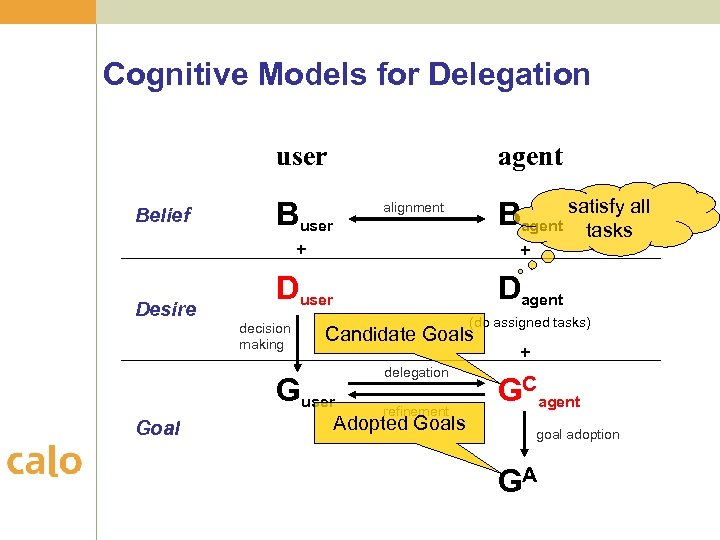 Cognitive Models for Delegation user Belief agent Buser Bagent satisfy all tasks alignment + Desire + Duser decision making Dagent (do assigned tasks) Candidate Goals Guser Goal delegation refinement Adopted Goals + GCagent goal adoption GA
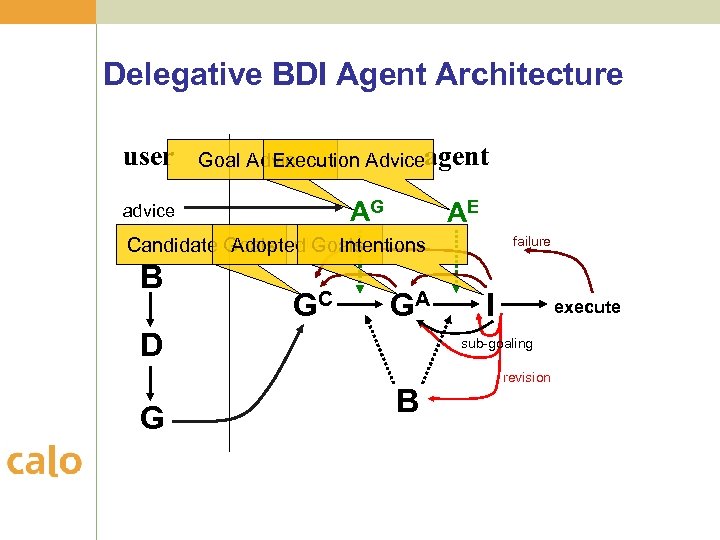 Delegative BDI Agent Architecture user Goal Advice Execution Adviceagent AG advice AE failure Candidate Goals conflicts Intentions Adopted Goals B GC GA D G I execute sub-goaling B revision
 Overview n n n CALO: a learning cognitive assistant User delegation of tasks to CALO Delegative BDI agent framework Goal adoption and commitments Summary and research issues
 Requirements on Goal Adoption n Self-consistency: GA must be mutually consistent Coherence: GA must be mutually consistent relative to the current beliefs B Feasibility: GA must be mutually satisfiable relative to current intentions I and available plans n n Includes resource feasibility Reasonableness: GA should be mutually ‘reasonable’ with respect to current B and I n Common sense check: did you really mean to purchase a second laptop computer today?
 Responding to Conflicting Desires n Goal adoption process should admit: n n Adopting, suspending, or rejecting candidate goals Modifying adopted goals and/or intentions Modifying beliefs (by acting to change world state) Example: User desires to attend a conference in Europe but lacks sufficient discretionary funds n n n shorten a previously scheduled trip cancel the planned purchase of a new laptop or apply for a travel grant from the department
 Combined Commitment Deliberation n Goal adoption n n Intention reconsideration n n Adopted Goals Candidate Goals ( Desires) Extended agent life-cycle Non-adopted Candidate Goals Execution problems with Adopted Goals Propose combined commitment deliberation mechanism n n Based on agent’s deliberation over its mental states Bounded rationality: as far as the agent believes and can compute
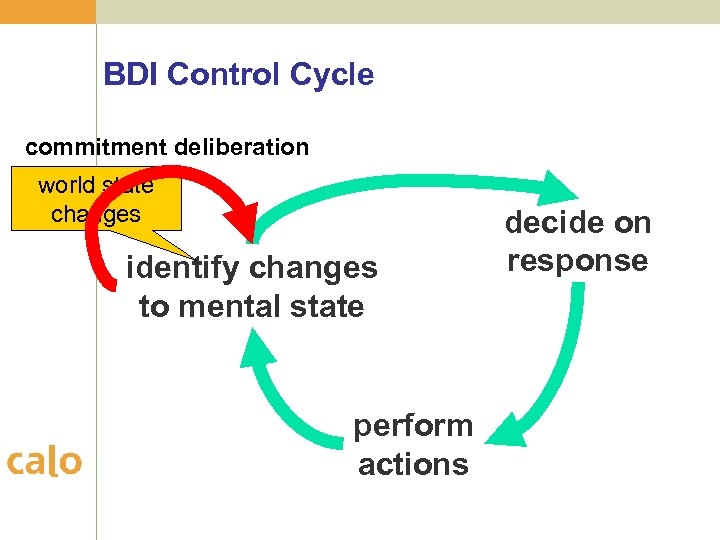 BDI Control Cycle commitment deliberation world state changes identify changes to mental state perform actions decide on response
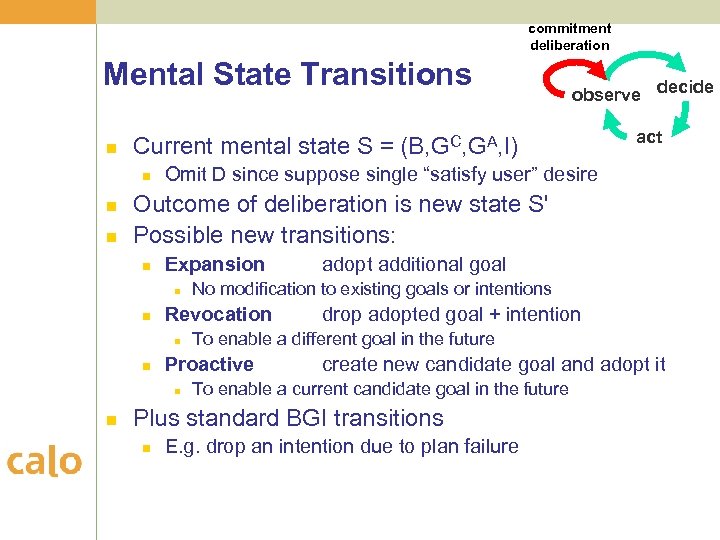 commitment deliberation Mental State Transitions n Current mental state S = (B, GC, GA, I) n n n act Omit D since suppose single “satisfy user” desire Outcome of deliberation is new state S' Possible new transitions: n Expansion n drop adopted goal + intention To enable a different goal in the future Proactive n adopt additional goal No modification to existing goals or intentions Revocation n n observe decide create new candidate goal and adopt it To enable a current candidate goal in the future Plus standard BGI transitions n E. g. drop an intention due to plan failure
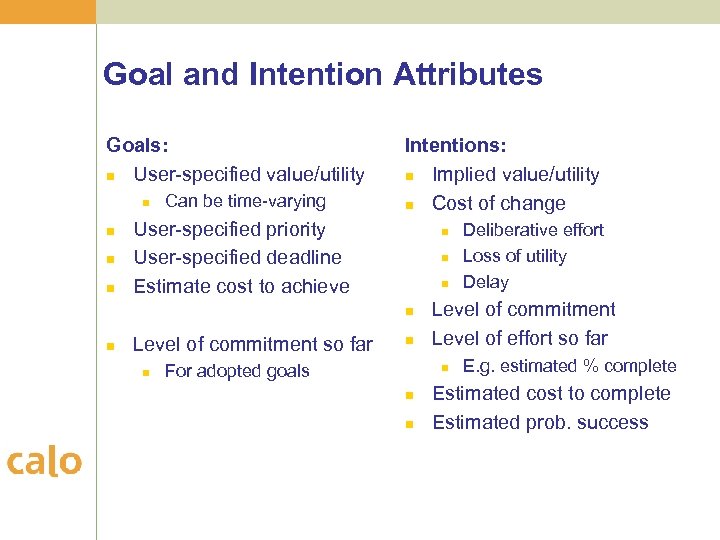 Goal and Intention Attributes Goals: n User-specified value/utility n n Can be time-varying Intentions: n Implied value/utility n Cost of change User-specified priority User-specified deadline Estimate cost to achieve n n n Level of commitment so far n n For adopted goals Level of commitment Level of effort so far n n n Deliberative effort Loss of utility Delay E. g. estimated % complete Estimated cost to complete Estimated prob. success
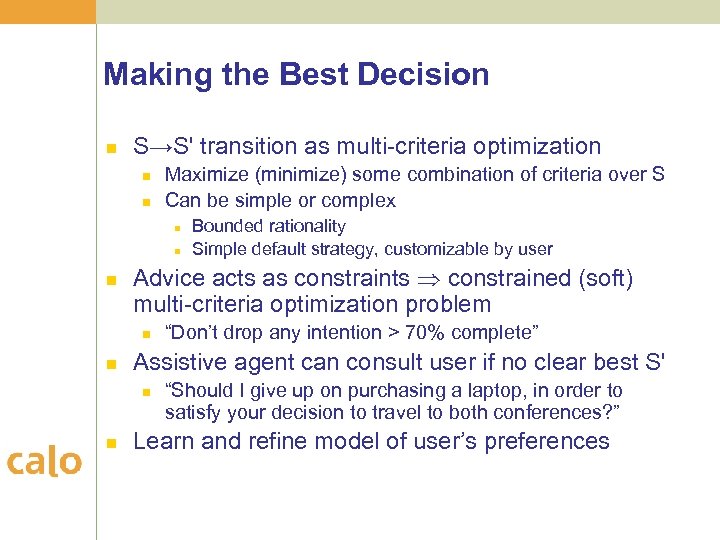 Making the Best Decision n S→S' transition as multi-criteria optimization n n Maximize (minimize) some combination of criteria over S Can be simple or complex n n n Advice acts as constraints constrained (soft) multi-criteria optimization problem n n “Don’t drop any intention > 70% complete” Assistive agent can consult user if no clear best S' n n Bounded rationality Simple default strategy, customizable by user “Should I give up on purchasing a laptop, in order to satisfy your decision to travel to both conferences? ” Learn and refine model of user’s preferences
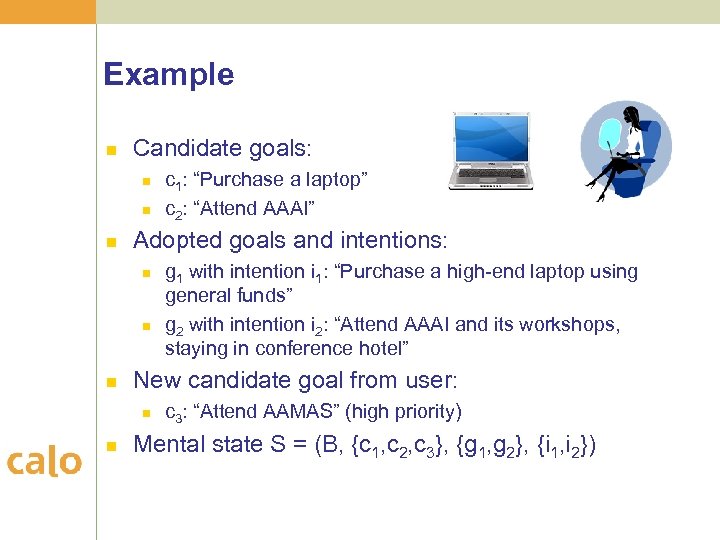 Example n Candidate goals: n n n Adopted goals and intentions: n n n g 1 with intention i 1: “Purchase a high-end laptop using general funds” g 2 with intention i 2: “Attend AAAI and its workshops, staying in conference hotel” New candidate goal from user: n n c 1: “Purchase a laptop” c 2: “Attend AAAI” c 3: “Attend AAMAS” (high priority) Mental state S = (B, {c 1, c 2, c 3}, {g 1, g 2}, {i 1, i 2})
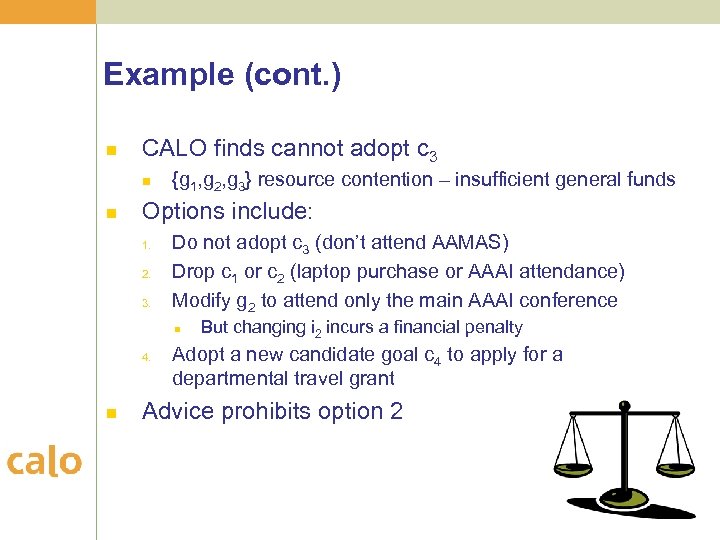 Example (cont. ) n CALO finds cannot adopt c 3 n n {g 1, g 2, g 3} resource contention – insufficient general funds Options include: 1. 2. 3. Do not adopt c 3 (don’t attend AAMAS) Drop c 1 or c 2 (laptop purchase or AAAI attendance) Modify g 2 to attend only the main AAAI conference n 4. n But changing i 2 incurs a financial penalty Adopt a new candidate goal c 4 to apply for a departmental travel grant Advice prohibits option 2
 Example (cont. ) n CALO builds optimization problem and solves it n Problem constructed and solution method employed both depend on agent’s nature n n n Finds best is tie between options 3 and 4 n n n E. g. ignore % of intention completed No more than 10 ms to solve Agent’s strategy (based on user guidance) is to consult user over which to do User instructs CALO to do both options New mental state S' = (B', {c 1, c 2, c 3, c 4}, {g 1, g'2, g 3, g 4}, {i 1, i'2})
 Overview n n n CALO: a learning cognitive assistant User delegation of tasks to CALO Delegative BDI agent framework Goal adoption and commitments Summary and research issues
 Summary n CALO acts as user’s intelligent assistant n n n Proposed delegative BDI agent framework n n n Classical BDI framework inadequate Implemented BDI systems lack formal grounding Separate Desires and Goals Separate Candidate and Adopted Goals Incorporate user guidance and preferences Combined commitment deliberation for goal adoption and intention reconsideration Enables reasoning necessary for an agent such as CALO Implemented by extending SPARK agent framework
![Related Work n BOID framework [Broersen et al] n n BDGICTL logic [Dastani et](https://present5.com/presentation/3831a4cd65844cf39b8c373b9038b16a/image-29.jpg "Related Work n BOID framework [Broersen et al] n n BDGICTL logic [Dastani et") Related Work n BOID framework [Broersen et al] n n BDGICTL logic [Dastani et al] n n Different types of agents based on B/D/G/I conflict resolution strategies Merging desires into goals Intention reconsideration [Schut et al] Collaborative problem solving [Leveque and Cohen; Allen and Ferguson] Social norms and obligations [Dignum et al]
Related Work n BOID framework [Broersen et al] n n BDGICTL logic [Dastani et al] n n Different types of agents based on B/D/G/I conflict resolution strategies Merging desires into goals Intention reconsideration [Schut et al] Collaborative problem solving [Leveque and Cohen; Allen and Ferguson] Social norms and obligations [Dignum et al]
 Future Work n n n Extend goal reasoning to consider resource feasibility (in progress) Proactive goal anticipation and adoption Collaborative human-CALO problem solving n Beyond (merely) completing user-delegated tasks n Multi-CALO coordination and teamwork Learning as part of CALO’s extended life-cycle n More information: http: //calo. sri. com/ n