


 Скачать презентацию A Changing Society Section 1 698 -701
d9bd67392a4b0c8c5c6361c02fb7042e.ppt
- Количество слайдов: 39
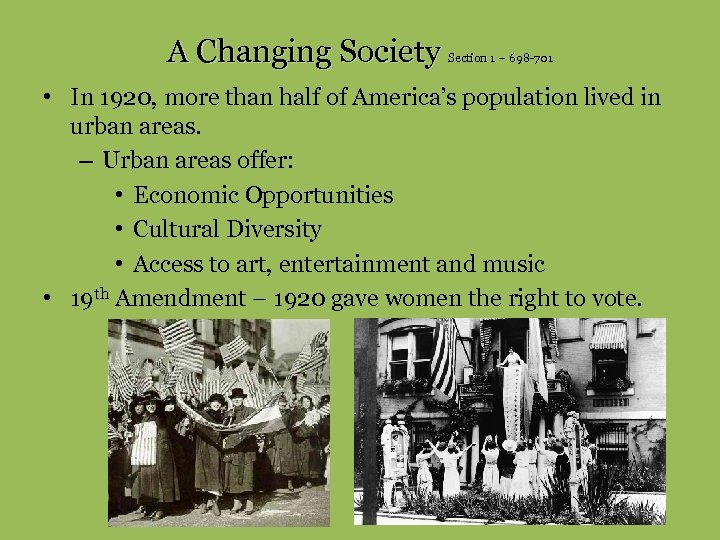 A Changing Society Section 1 – 698 -701 • In 1920, more than half of America’s population lived in urban areas. – Urban areas offer: • Economic Opportunities • Cultural Diversity • Access to art, entertainment and music • 19 th Amendment – 1920 gave women the right to vote.
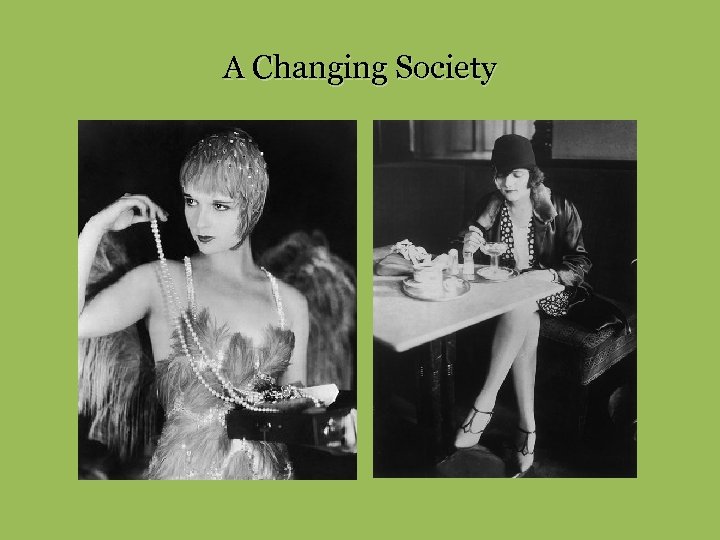
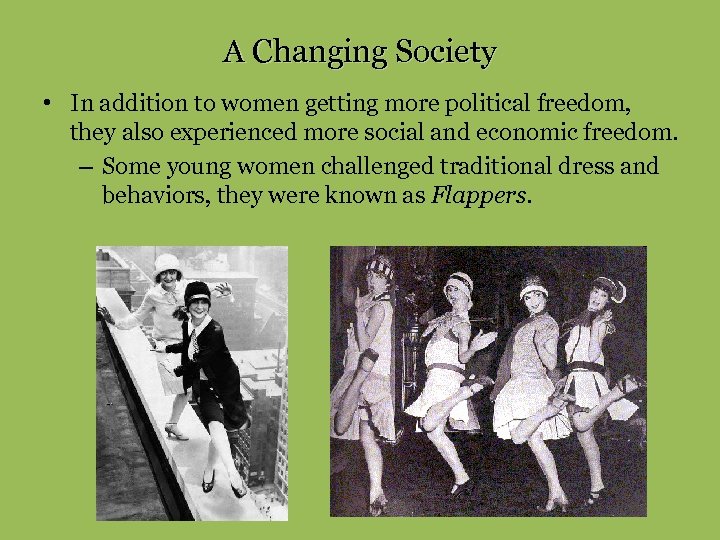 A Changing Society • In addition to women getting more political freedom, they also experienced more social and economic freedom. – Some young women challenged traditional dress and behaviors, they were known as Flappers.
 A Changing Society
 The Peacetime Economy • After WWI, 4. 5 million soldiers returned home looking for work. – Results: • Women were forced to give up their jobs. • US government cancelled huge contracts for war materials. – Businesses slowed production and laid off workers. » Unemployment rose and wages fell.
 The Peacetime Economy • As wartime production ended and jobs and wages fell, many workers went on strike. – Strike = when workers join together, stop working and demand higher pay, better working conditions, better benefits, etc. • Many people felt that Communists and/or Anarchists were behind these strikes. – Communists = People who want the government to own all property. – Anarchists = People who want to get rid of all government.
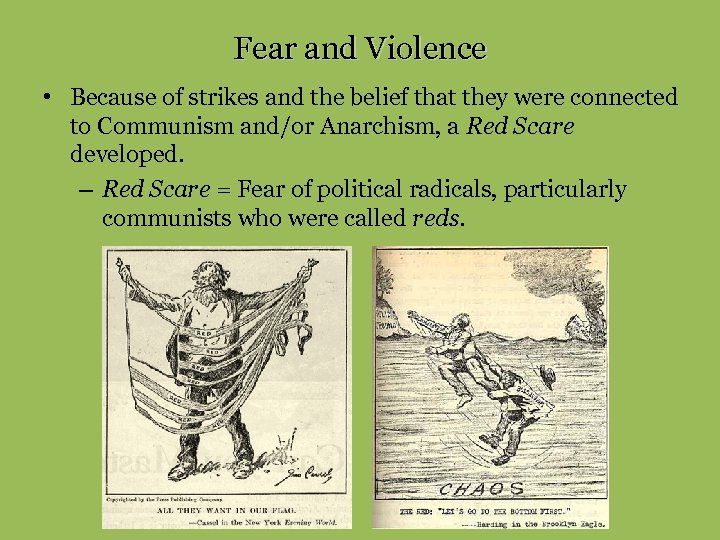 Fear and Violence • Because of strikes and the belief that they were connected to Communism and/or Anarchism, a Red Scare developed. – Red Scare = Fear of political radicals, particularly communists who were called reds.
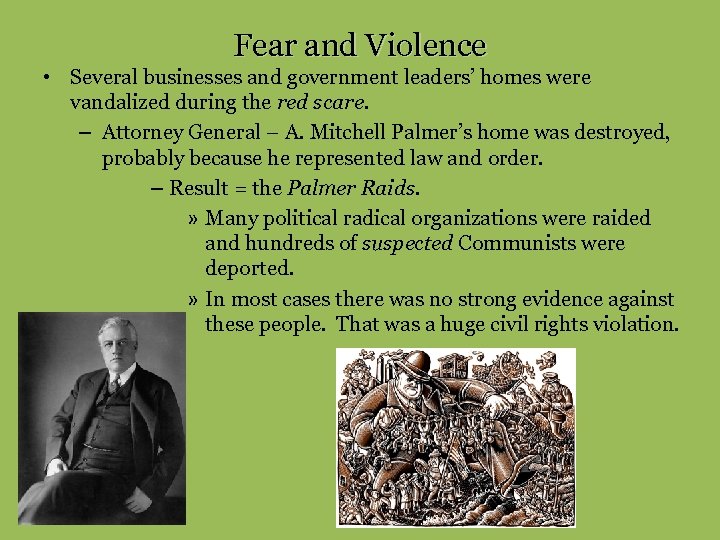 Fear and Violence • Several businesses and government leaders’ homes were vandalized during the red scare. – Attorney General – A. Mitchell Palmer’s home was destroyed, probably because he represented law and order. – Result = the Palmer Raids. » Many political radical organizations were raided and hundreds of suspected Communists were deported. » In most cases there was no strong evidence against these people. That was a huge civil rights violation.
 Fear and Violence • Xenophobia = the fear and hatred of foreigners. – Many Americans became concerned that the country was moving in the wrong direction, and so the American Civil Liberties Union (ACLU) was formed. • The ACLU’s mission is to protect the peoples’ civil rights.
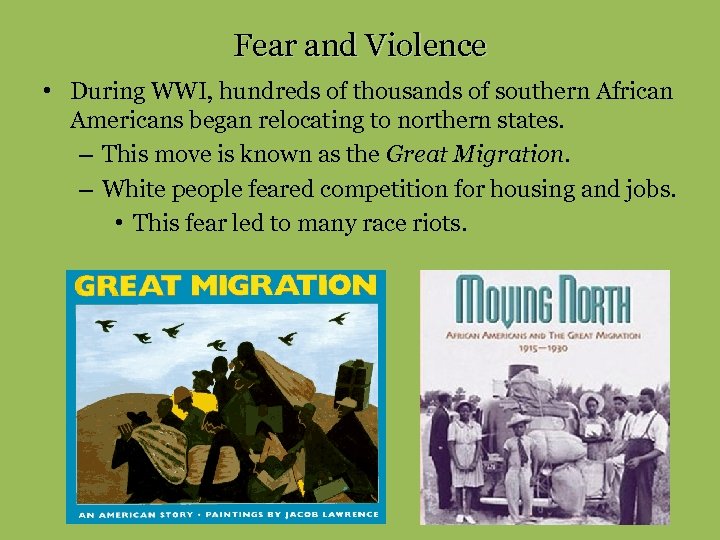 Fear and Violence • During WWI, hundreds of thousands of southern African Americans began relocating to northern states. – This move is known as the Great Migration. – White people feared competition for housing and jobs. • This fear led to many race riots.
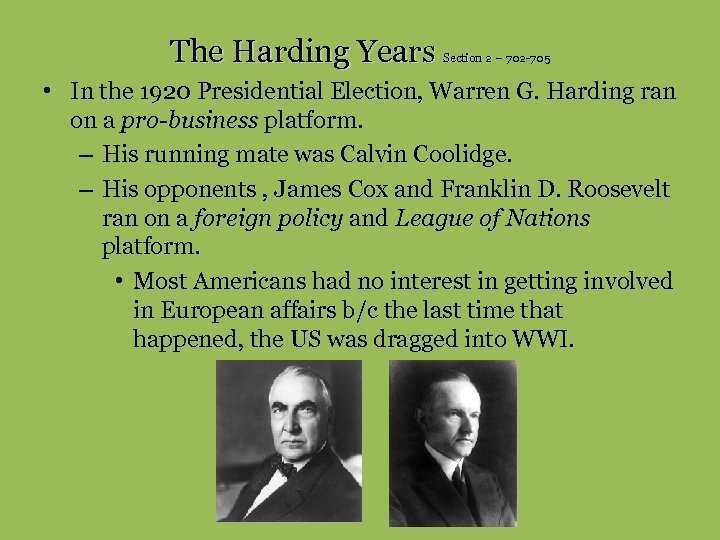 The Harding Years Section 2 – 702 -705 • In the 1920 Presidential Election, Warren G. Harding ran on a pro-business platform. – His running mate was Calvin Coolidge. – His opponents , James Cox and Franklin D. Roosevelt ran on a foreign policy and League of Nations platform. • Most Americans had no interest in getting involved in European affairs b/c the last time that happened, the US was dragged into WWI.
 The Harding Years • Warren G. Harding won a landslide victory. – He was not a good leader, but he surrounded himself with people who excelled in their particular fields. • Harding focused their attention on strengthening the US economy. – Tax cuts were given and business began to boom. » Soon, the postwar recession ended as both unemployment and prices on goods and services fell.
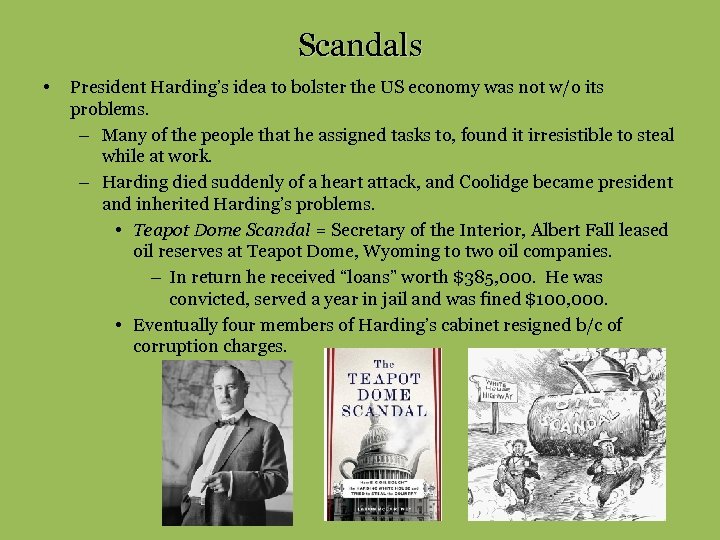 Scandals • President Harding’s idea to bolster the US economy was not w/o its problems. – Many of the people that he assigned tasks to, found it irresistible to steal while at work. – Harding died suddenly of a heart attack, and Coolidge became president and inherited Harding’s problems. • Teapot Dome Scandal = Secretary of the Interior, Albert Fall leased oil reserves at Teapot Dome, Wyoming to two oil companies. – In return he received “loans” worth $385, 000. He was convicted, served a year in jail and was fined $100, 000. • Eventually four members of Harding’s cabinet resigned b/c of corruption charges.
 Republican Foreign Policy • President Coolidge continued to try and keep the US out of world affairs. – The US followed a policy on disarmament = limits on military weapons. – In 1928, the US and 14 other countries signed the Kellogg-Briand Pact = outlawed war. • The leaders of these countries didn’t know how to enforce the Pact.
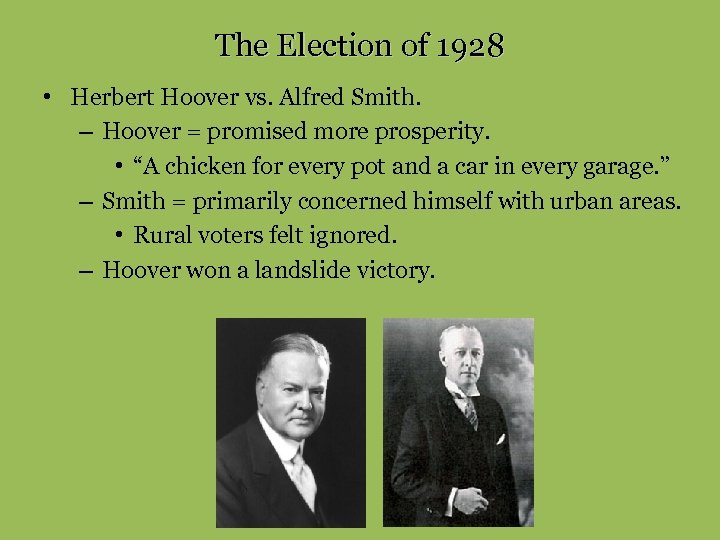 The Election of 1928 • Herbert Hoover vs. Alfred Smith. – Hoover = promised more prosperity. • “A chicken for every pot and a car in every garage. ” – Smith = primarily concerned himself with urban areas. • Rural voters felt ignored. – Hoover won a landslide victory.
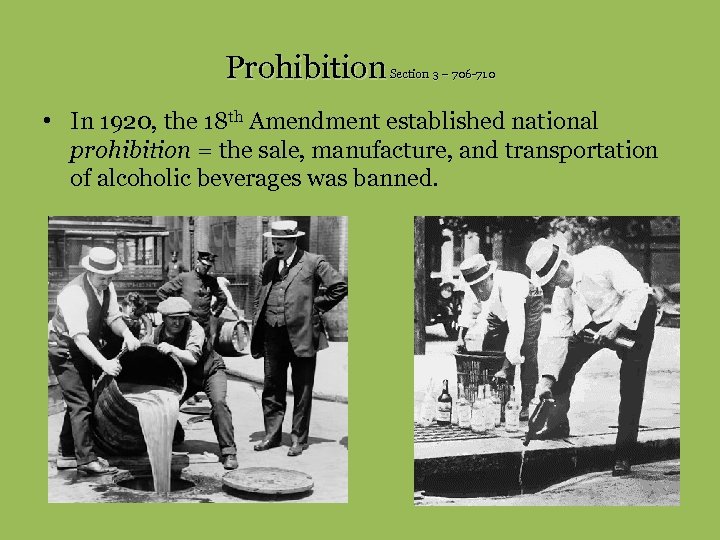 Prohibition Section 3 – 706 -710 • In 1920, the 18 th Amendment established national prohibition = the sale, manufacture, and transportation of alcoholic beverages was banned.
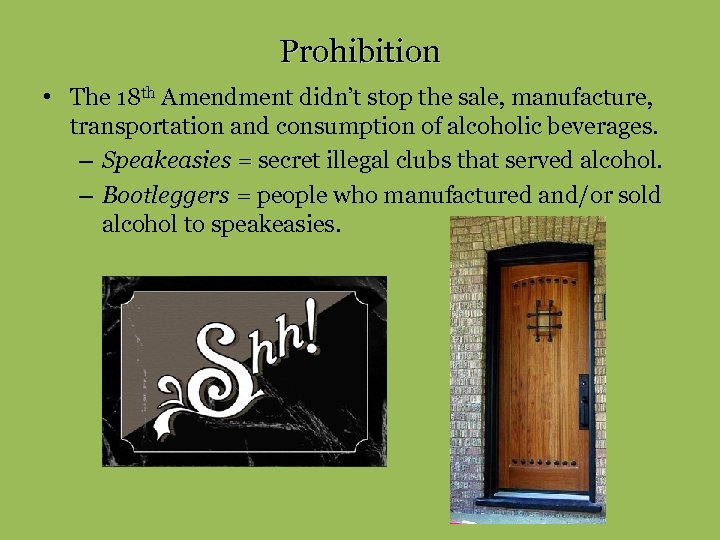 Prohibition • The 18 th Amendment didn’t stop the sale, manufacture, transportation and consumption of alcoholic beverages. – Speakeasies = secret illegal clubs that served alcohol. – Bootleggers = people who manufactured and/or sold alcohol to speakeasies.
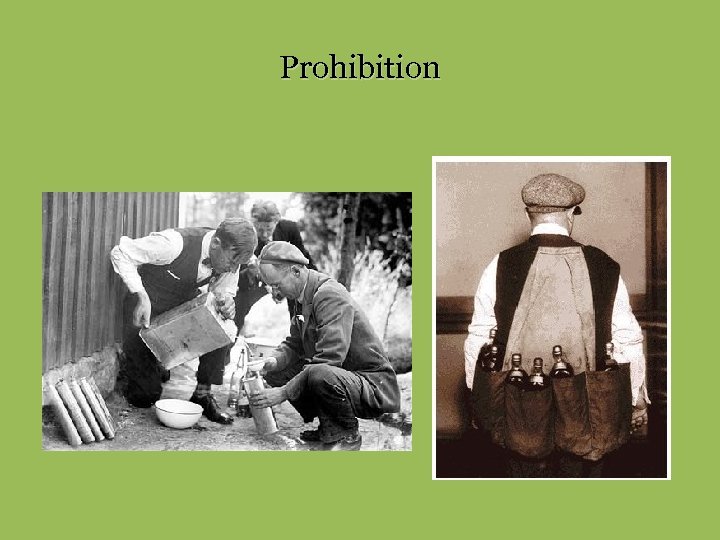 Prohibition
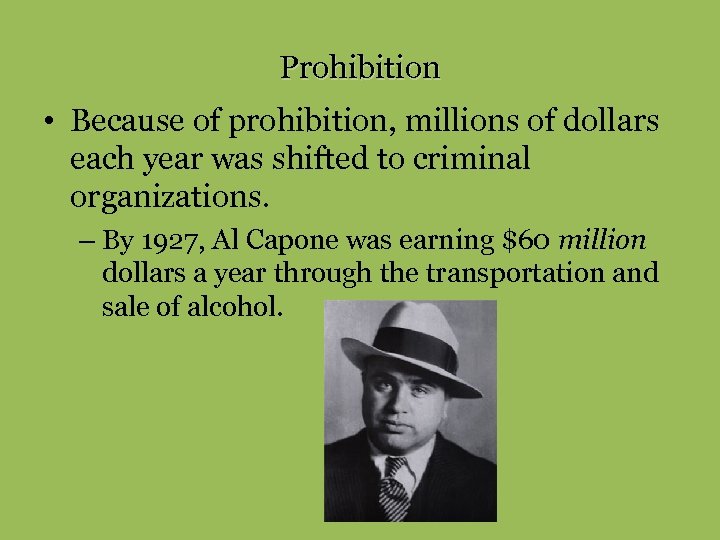 Prohibition • Because of prohibition, millions of dollars each year was shifted to criminal organizations. – By 1927, Al Capone was earning $60 million dollars a year through the transportation and sale of alcohol.
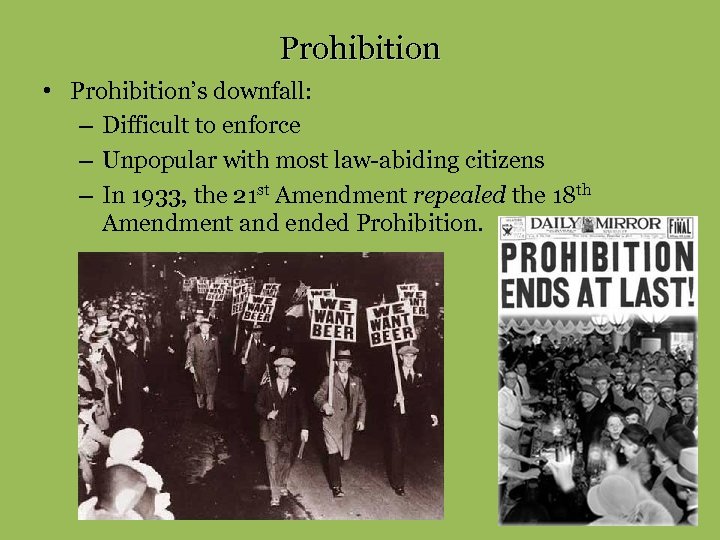 Prohibition • Prohibition’s downfall: – Difficult to enforce – Unpopular with most law-abiding citizens – In 1933, the 21 st Amendment repealed the 18 th Amendment and ended Prohibition.
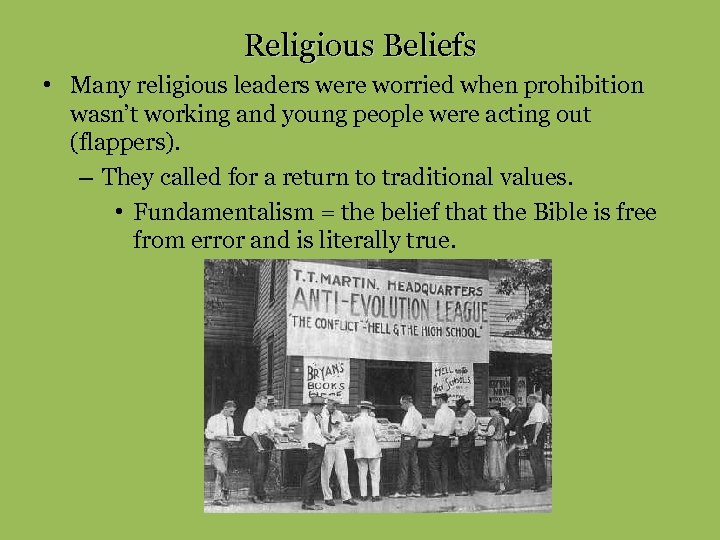 Religious Beliefs • Many religious leaders were worried when prohibition wasn’t working and young people were acting out (flappers). – They called for a return to traditional values. • Fundamentalism = the belief that the Bible is free from error and is literally true.
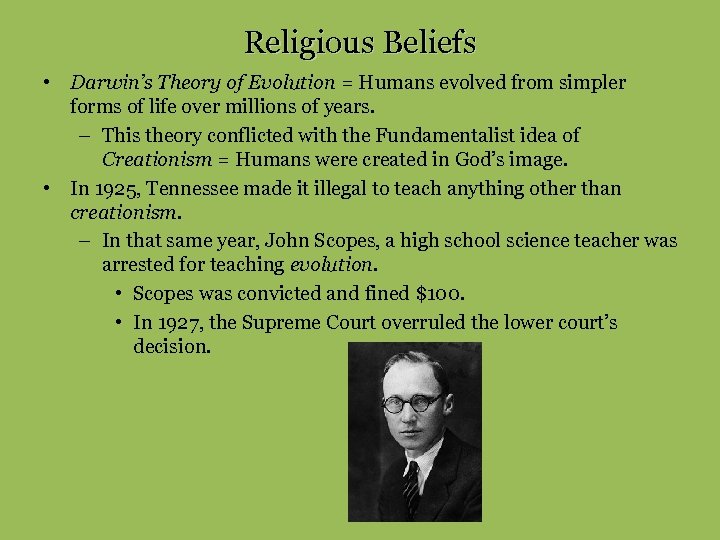 Religious Beliefs • Darwin’s Theory of Evolution = Humans evolved from simpler forms of life over millions of years. – This theory conflicted with the Fundamentalist idea of Creationism = Humans were created in God’s image. • In 1925, Tennessee made it illegal to teach anything other than creationism. – In that same year, John Scopes, a high school science teacher was arrested for teaching evolution. • Scopes was convicted and fined $100. • In 1927, the Supreme Court overruled the lower court’s decision.
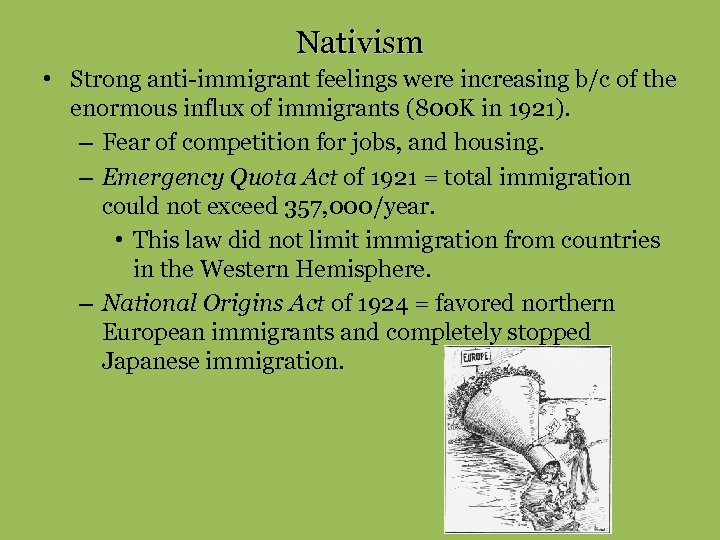 Nativism • Strong anti-immigrant feelings were increasing b/c of the enormous influx of immigrants (800 K in 1921). – Fear of competition for jobs, and housing. – Emergency Quota Act of 1921 = total immigration could not exceed 357, 000/year. • This law did not limit immigration from countries in the Western Hemisphere. – National Origins Act of 1924 = favored northern European immigrants and completely stopped Japanese immigration.
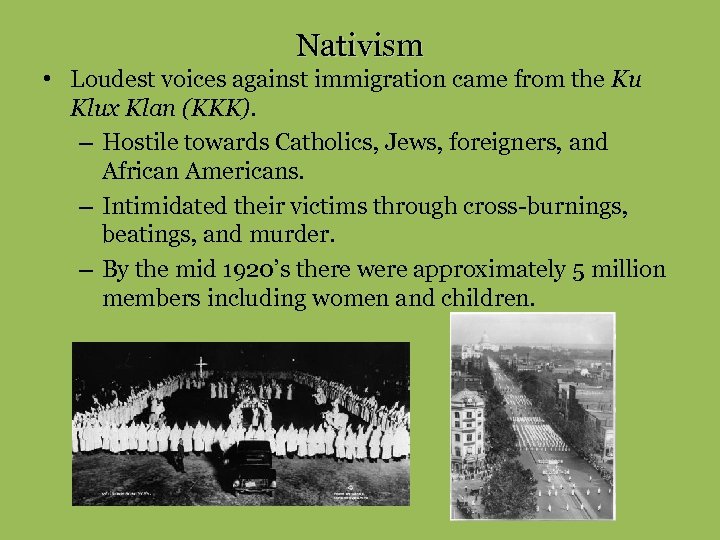 Nativism • Loudest voices against immigration came from the Ku Klux Klan (KKK). – Hostile towards Catholics, Jews, foreigners, and African Americans. – Intimidated their victims through cross-burnings, beatings, and murder. – By the mid 1920’s there were approximately 5 million members including women and children.
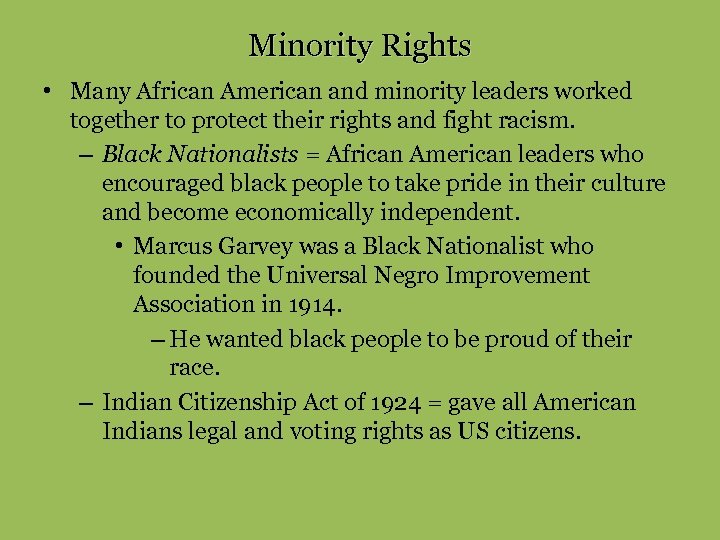 Minority Rights • Many African American and minority leaders worked together to protect their rights and fight racism. – Black Nationalists = African American leaders who encouraged black people to take pride in their culture and become economically independent. • Marcus Garvey was a Black Nationalist who founded the Universal Negro Improvement Association in 1914. – He wanted black people to be proud of their race. – Indian Citizenship Act of 1924 = gave all American Indians legal and voting rights as US citizens.
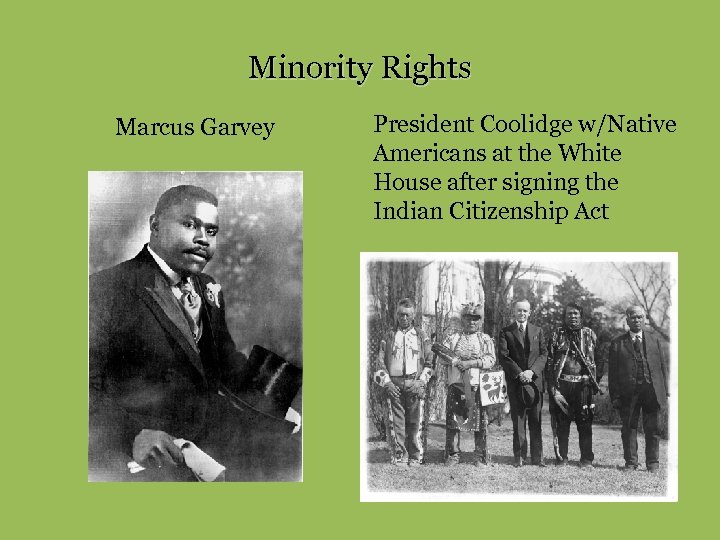 Minority Rights Marcus Garvey President Coolidge w/Native Americans at the White House after signing the Indian Citizenship Act
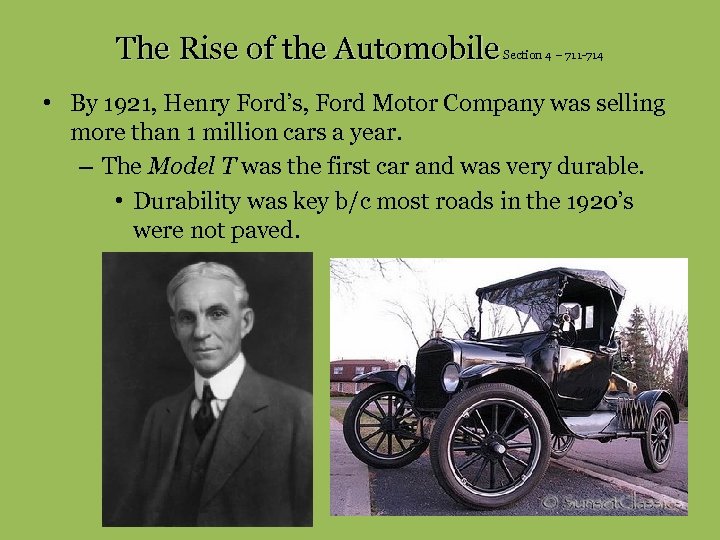 The Rise of the Automobile Section 4 – 711 -714 • By 1921, Henry Ford’s, Ford Motor Company was selling more than 1 million cars a year. – The Model T was the first car and was very durable. • Durability was key b/c most roads in the 1920’s were not paved.
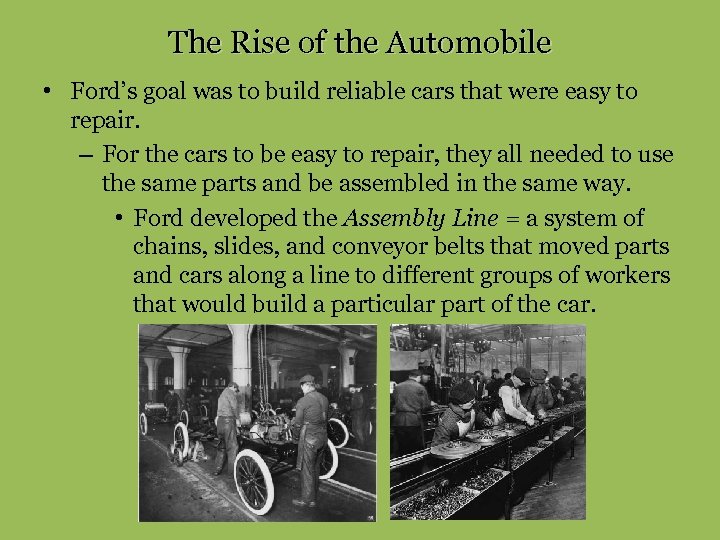 The Rise of the Automobile • Ford’s goal was to build reliable cars that were easy to repair. – For the cars to be easy to repair, they all needed to use the same parts and be assembled in the same way. • Ford developed the Assembly Line = a system of chains, slides, and conveyor belts that moved parts and cars along a line to different groups of workers that would build a particular part of the car.
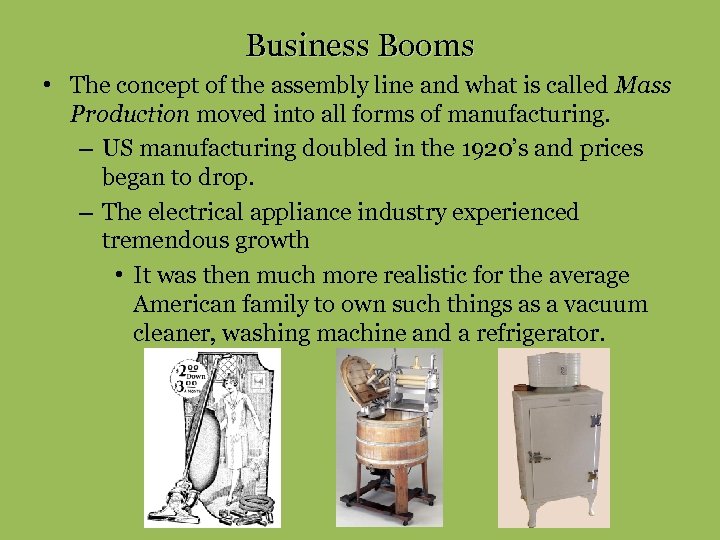 Business Booms • The concept of the assembly line and what is called Mass Production moved into all forms of manufacturing. – US manufacturing doubled in the 1920’s and prices began to drop. – The electrical appliance industry experienced tremendous growth • It was then much more realistic for the average American family to own such things as a vacuum cleaner, washing machine and a refrigerator.
 Business Booms • In addition to household goods being cheaper, they could also be bought on credit. – Installment Plans = place a small down payment on an item and then make a monthly payment with interest until the principle balance is paid. • Principle Balance = the cost or “sticker price” of the item.
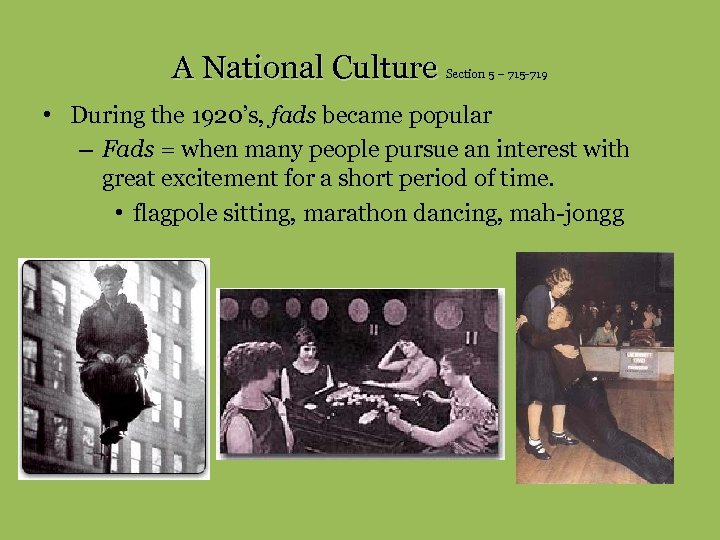 A National Culture Section 5 – 715 -719 • During the 1920’s, fads became popular – Fads = when many people pursue an interest with great excitement for a short period of time. • flagpole sitting, marathon dancing, mah-jongg
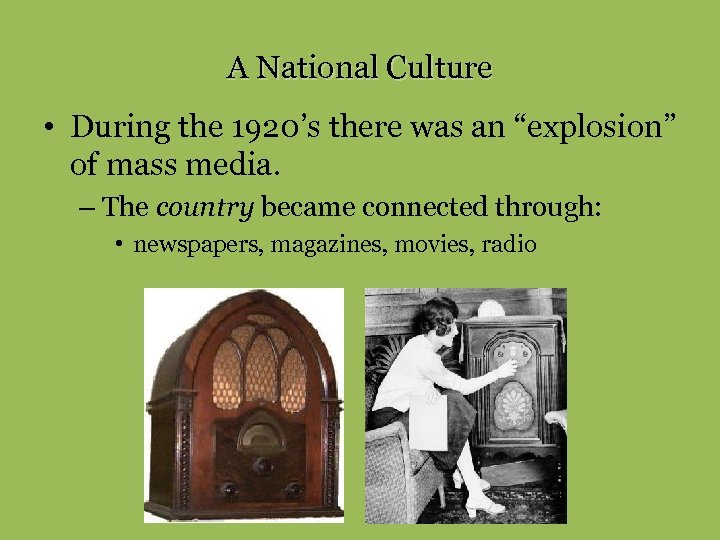 A National Culture • During the 1920’s there was an “explosion” of mass media. – The country became connected through: • newspapers, magazines, movies, radio
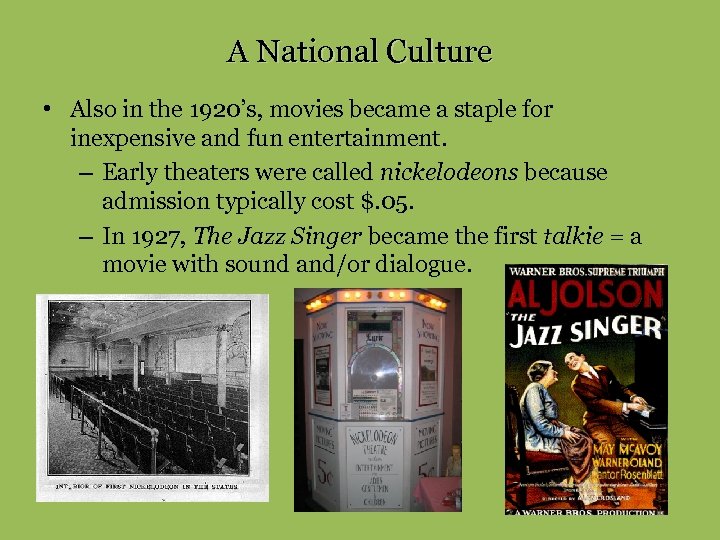 A National Culture • Also in the 1920’s, movies became a staple for inexpensive and fun entertainment. – Early theaters were called nickelodeons because admission typically cost $. 05. – In 1927, The Jazz Singer became the first talkie = a movie with sound and/or dialogue.
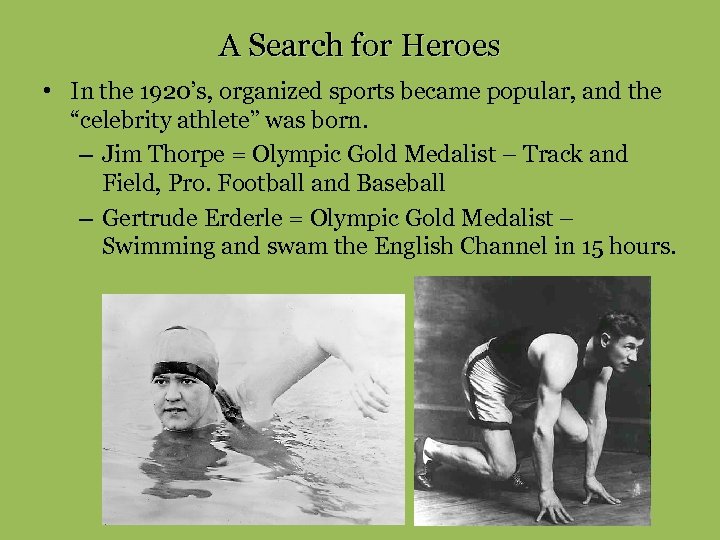 A Search for Heroes • In the 1920’s, organized sports became popular, and the “celebrity athlete” was born. – Jim Thorpe = Olympic Gold Medalist – Track and Field, Pro. Football and Baseball – Gertrude Erderle = Olympic Gold Medalist – Swimming and swam the English Channel in 15 hours.
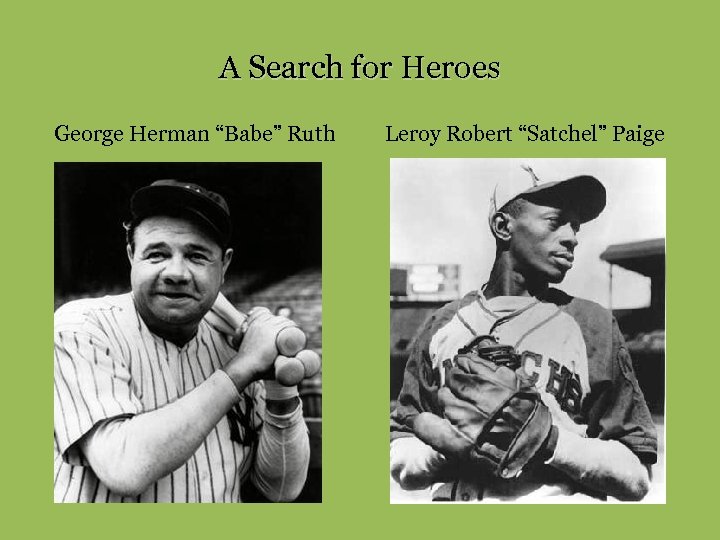 A Search for Heroes George Herman “Babe” Ruth Leroy Robert “Satchel” Paige
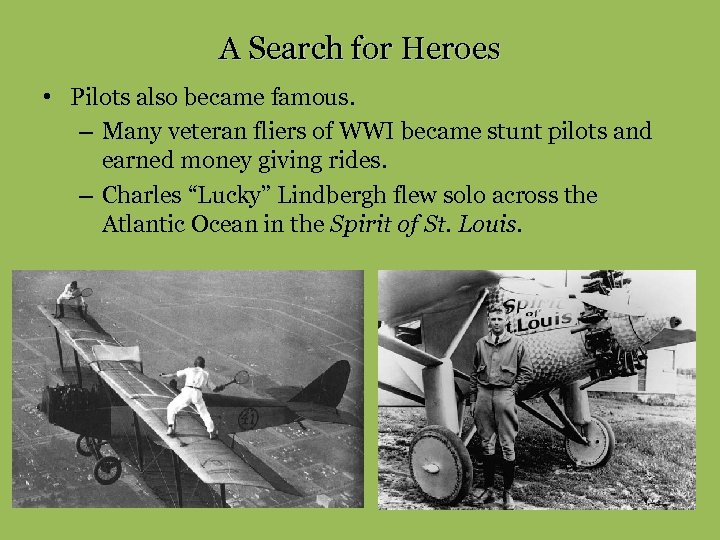 A Search for Heroes • Pilots also became famous. – Many veteran fliers of WWI became stunt pilots and earned money giving rides. – Charles “Lucky” Lindbergh flew solo across the Atlantic Ocean in the Spirit of St. Louis.
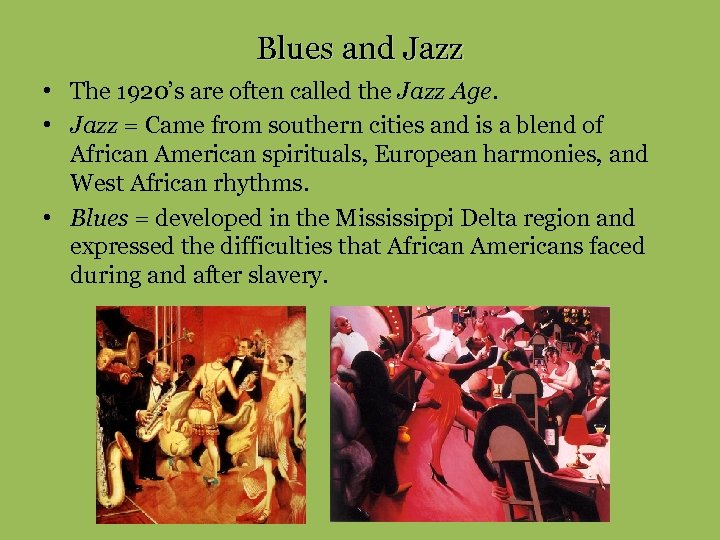 Blues and Jazz • The 1920’s are often called the Jazz Age. • Jazz = Came from southern cities and is a blend of African American spirituals, European harmonies, and West African rhythms. • Blues = developed in the Mississippi Delta region and expressed the difficulties that African Americans faced during and after slavery.
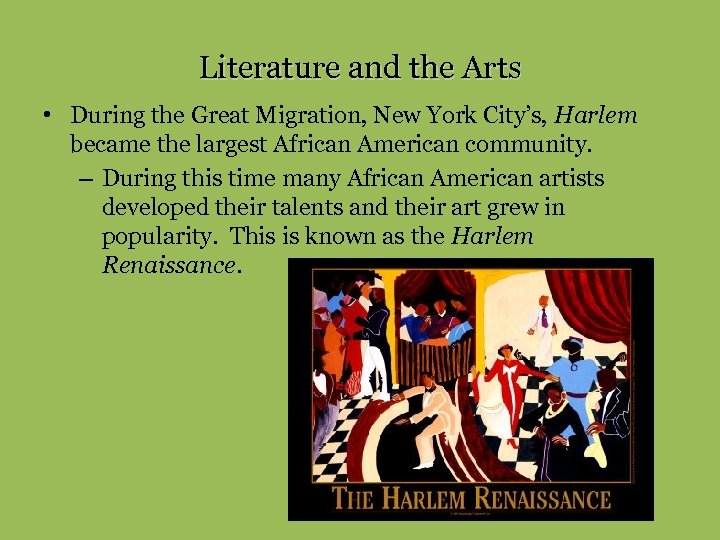 Literature and the Arts • During the Great Migration, New York City’s, Harlem became the largest African American community. – During this time many African American artists developed their talents and their art grew in popularity. This is known as the Harlem Renaissance.
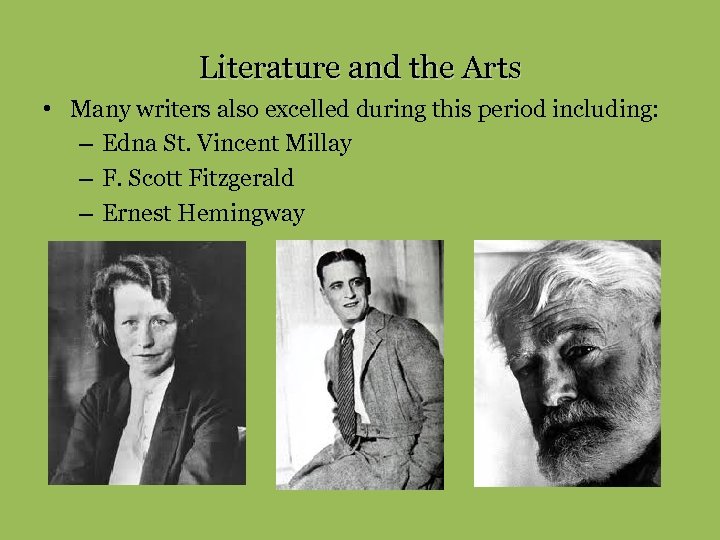 Literature and the Arts • Many writers also excelled during this period including: – Edna St. Vincent Millay – F. Scott Fitzgerald – Ernest Hemingway
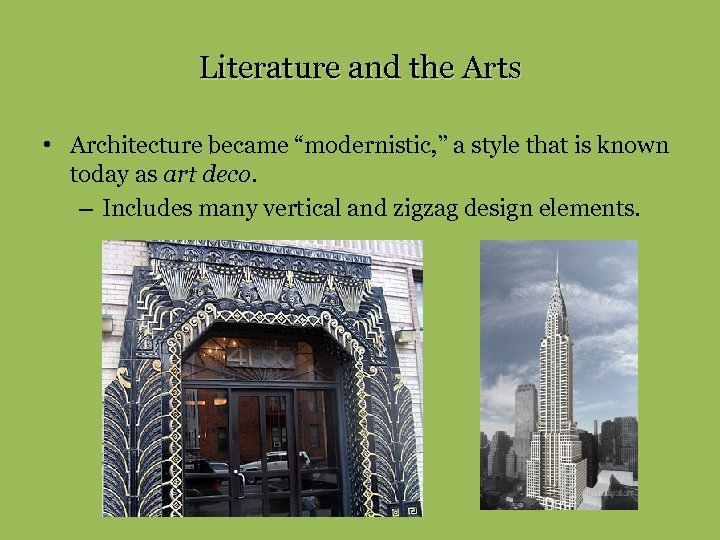 Literature and the Arts • Architecture became “modernistic, ” a style that is known today as art deco. – Includes many vertical and zigzag design elements.