 Скачать презентацию A Case for Theory-Based Research on Level of
db6ee658f3d61f1e6b8b834db71d2aba.ppt
- Количество слайдов: 18



A Case for Theory-Based Research on Level of Automation and Adaptive Automation David B. Kaber Department of Industrial Engineering North Carolina State University This work was supported by a grant through the National Aeronautics and Space Administration Langley Research Center. The opinions expressed are those of the author and do not necessarily reflect the views of NASA.
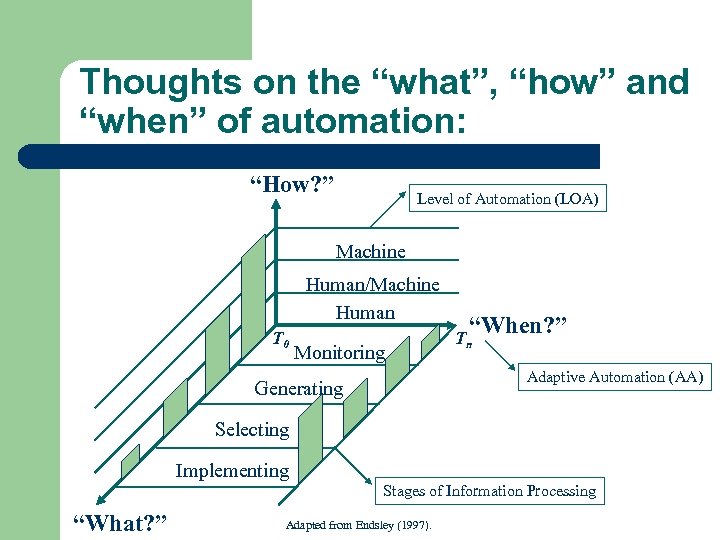
Thoughts on the “what”, “how” and “when” of automation: “How? ” Level of Automation (LOA) Machine Human/Machine Human T 0 Monitoring “When? ” Tn Adaptive Automation (AA) Generating Selecting Implementing Stages of Information Processing “What? ” Adapted from Endsley (1997).
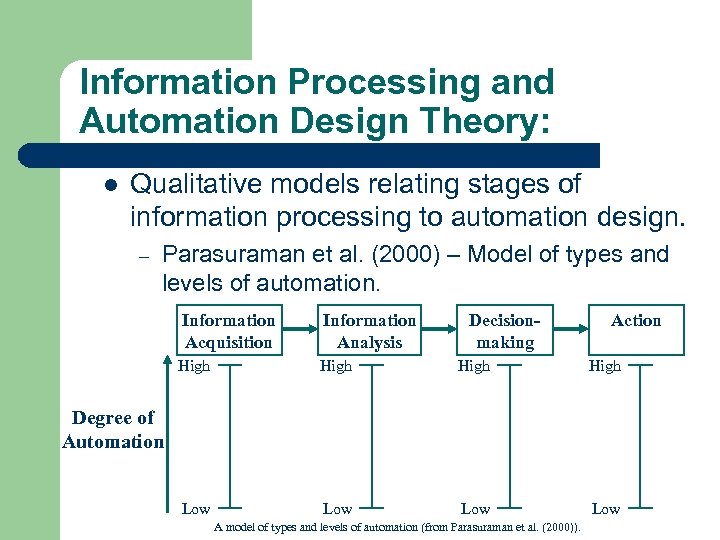
Information Processing and Automation Design Theory: l Qualitative models relating stages of information processing to automation design. – Parasuraman et al. (2000) – Model of types and levels of automation. Information Acquisition Information Analysis Decisionmaking Action High Low Low Degree of Automation A model of types and levels of automation (from Parasuraman et al. (2000)).
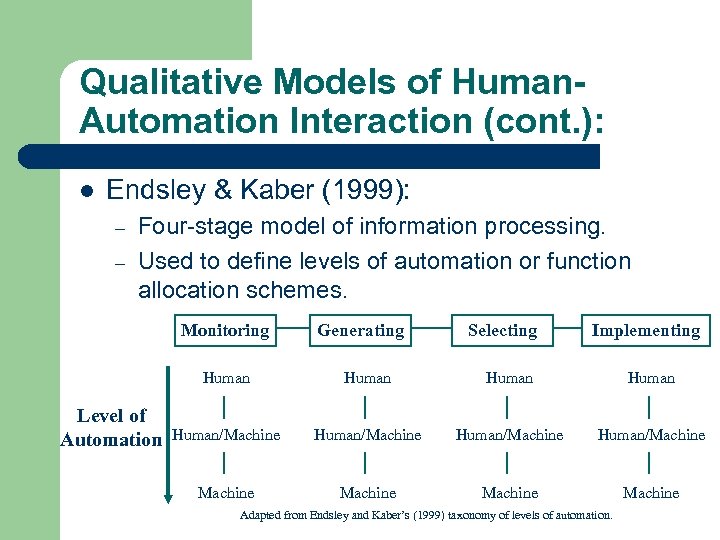
Qualitative Models of Human. Automation Interaction (cont. ): l Endsley & Kaber (1999): – – Four-stage model of information processing. Used to define levels of automation or function allocation schemes. Monitoring Generating Selecting Implementing Human Level of Automation Human/Machine Human/Machine Machine Adapted from Endsley and Kaber’s (1999) taxonomy of levels of automation.
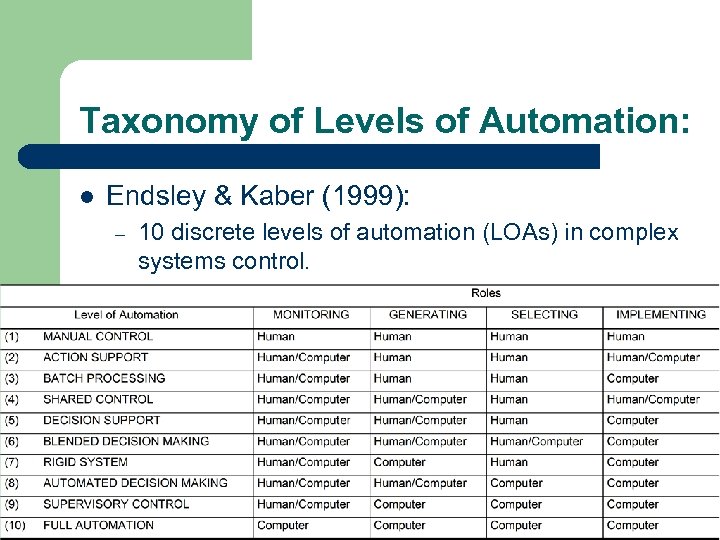
Taxonomy of Levels of Automation: l Endsley & Kaber (1999): – 10 discrete levels of automation (LOAs) in complex systems control.
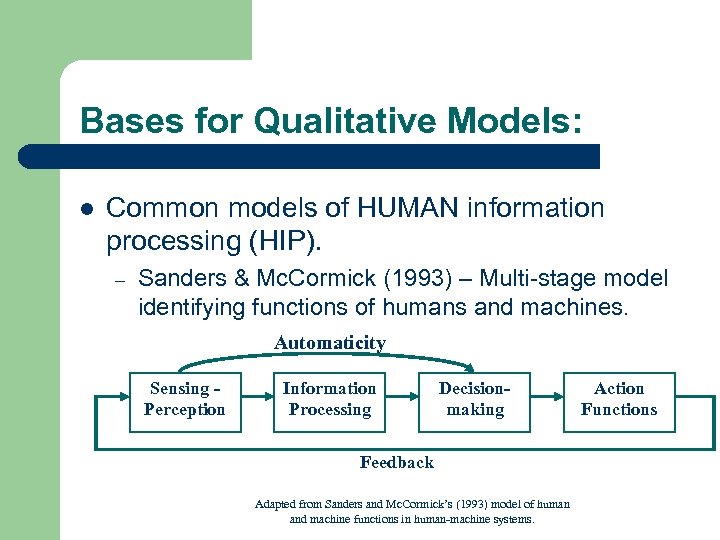
Bases for Qualitative Models: l Common models of HUMAN information processing (HIP). – Sanders & Mc. Cormick (1993) – Multi-stage model identifying functions of humans and machines. Automaticity Sensing Perception Information Processing Decisionmaking Feedback Adapted from Sanders and Mc. Cormick’s (1993) model of human and machine functions in human-machine systems. Action Functions
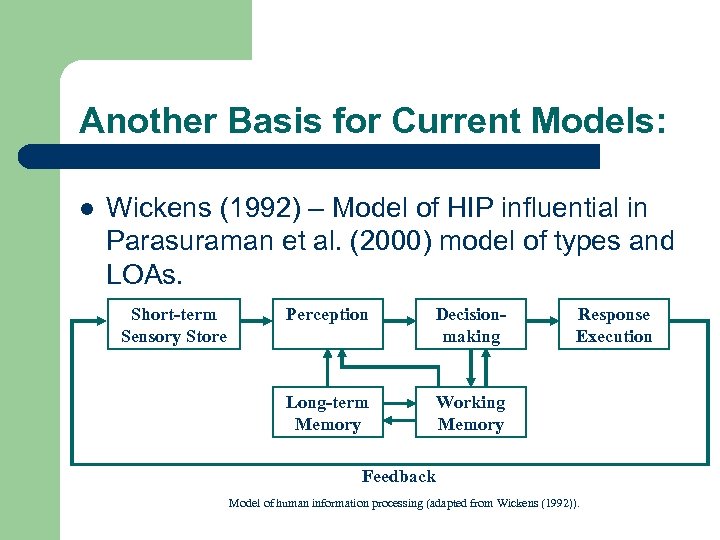
Another Basis for Current Models: l Wickens (1992) – Model of HIP influential in Parasuraman et al. (2000) model of types and LOAs. Short-term Sensory Store Perception Decisionmaking Long-term Memory Response Execution Working Memory Feedback Model of human information processing (adapted from Wickens (1992)).
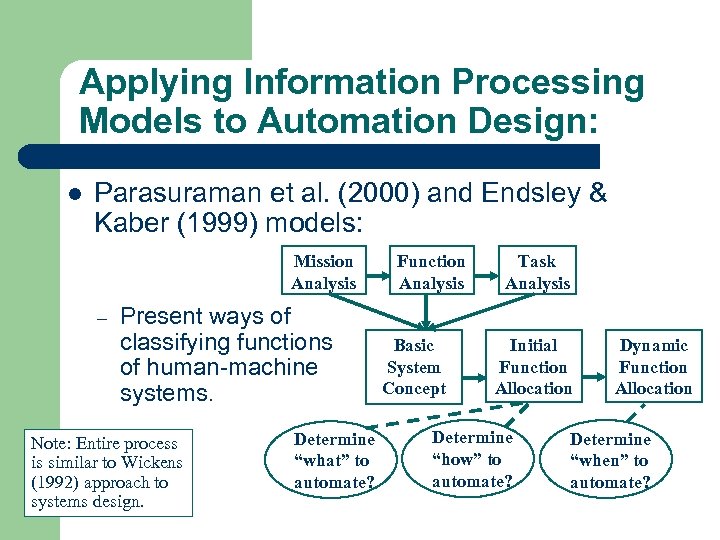
Applying Information Processing Models to Automation Design: l Parasuraman et al. (2000) and Endsley & Kaber (1999) models: Mission Analysis – Present ways of classifying functions of human-machine systems. Note: Entire process is similar to Wickens (1992) approach to systems design. Determine “what” to automate? Function Analysis Basic System Concept Task Analysis Initial Function Allocation Determine “how” to automate? Dynamic Function Allocation Determine “when” to automate?
Unique Aspects of Approach: l l l Link LOAs to stages of information processing. Types of functions considered are general information processing functions. – Compare with Sheridan & Verplank’s (1978) hierarchy of LOAs – Functions primarily represent action states (“gets”, “starts”, etc. ) or choice reactions (“selects”). Historical function allocation lists technology-centered (Fitts, 1956): – – Advances in understanding of out-of-the (control) loop performance (Endsley & Kiris, 1995; Kaber et al. , 1998) shifted focus of lists on human abilities. Contemporary taxonomies of LOA (e. g. , Endsley & Kaber (1999)) developed by considering performance consequences of automation l Complacency, vigilance decrements, loss of SA, skill decay.
Importance of Research: l Link general theories on information processing and automation to applications. – l Parasuraman et al. (2000) - Application of model to air traffic control (ATC). Contemporary models of human-automation interaction (HAI) may serve as design rationale for human-centered automation. – Knowledge of performance with systems can be classified according to model and used to further develop general theory on HAI. l Theory may serve to answer several questions: What stages of information processing are conducive to automation from human perspective? – To what extent can stage be automated safely/effectively? – What stages are robust to automation reliability problems? –
Theoretical Research Challenges: l l Validate processing stages of models in terms of representation of actual functions performed by human-machine systems. Models can be used for logical function allocation, but practical implications are difficult to predict. – Hypothesis Endsley & Kaber (1999): l l Results l Intermediate LOAs moderate workload, maintain situation awareness (SA) and improve performance. Low level automation produced superior performance, but at cost of SA. “Good” SA observed under high LOAs.
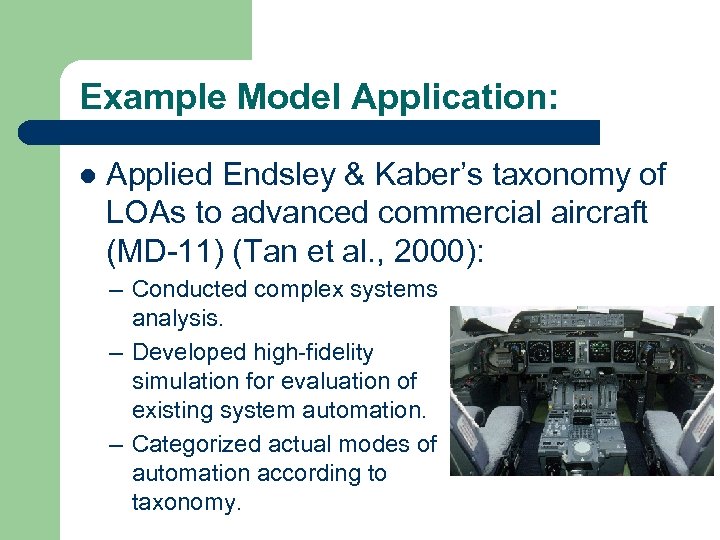
Example Model Application: l Applied Endsley & Kaber’s taxonomy of LOAs to advanced commercial aircraft (MD-11) (Tan et al. , 2000): – Conducted complex systems analysis. – Developed high-fidelity simulation for evaluation of existing system automation. – Categorized actual modes of automation according to taxonomy.
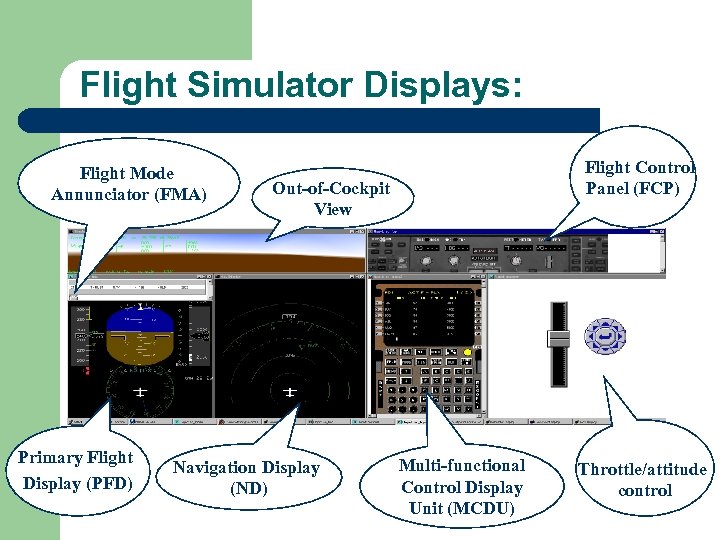
Flight Simulator Displays: Flight Mode Annunciator (FMA) Primary Flight Display (PFD) Flight Control Panel (FCP) Out-of-Cockpit View Navigation Display (ND) Multi-functional Control Display Unit (MCDU) Throttle/attitude control
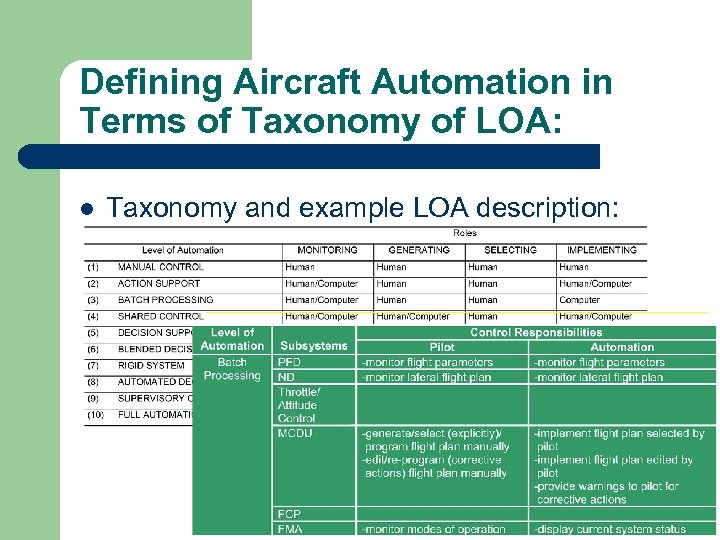
Defining Aircraft Automation in Terms of Taxonomy of LOA: l Taxonomy and example LOA description:
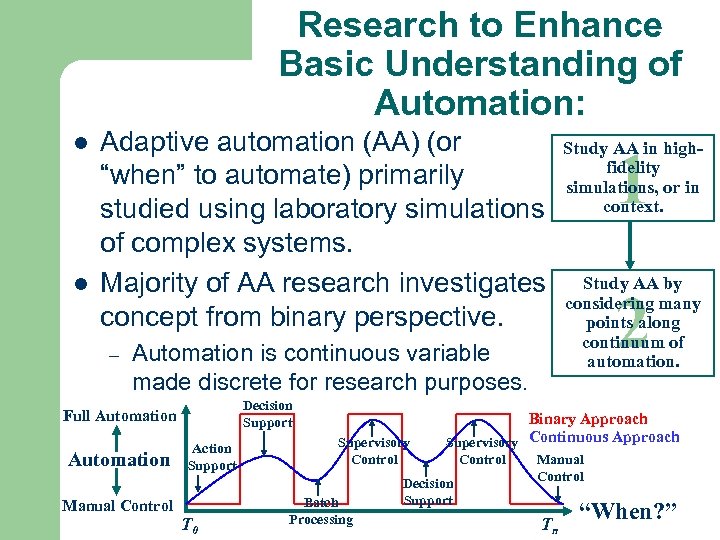
Research to Enhance Basic Understanding of Automation: l l Adaptive automation (AA) (or “when” to automate) primarily studied using laboratory simulations of complex systems. Majority of AA research investigates concept from binary perspective. – Automation is continuous variable made discrete for research purposes. Decision Support Full Automation Manual Control Action Support T 0 Supervisory Control Batch Processing Study AA in highfidelity simulations, or in context. 1 Study AA by considering many points along continuum of automation. 2 Binary Approach Supervisory Continuous Approach Decision Support Control Manual Control Tn “When? ”
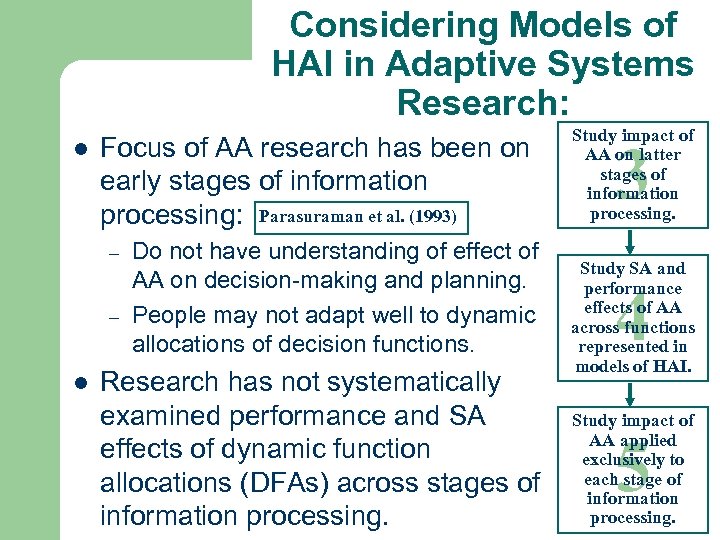
Considering Models of HAI in Adaptive Systems Research: l Focus of AA research has been on early stages of information processing: Parasuraman et al. (1993) – – l Do not have understanding of effect of AA on decision-making and planning. People may not adapt well to dynamic allocations of decision functions. Research has not systematically examined performance and SA effects of dynamic function allocations (DFAs) across stages of information processing. Study impact of AA on latter stages of information processing. 3 Study SA and performance effects of AA across functions represented in models of HAI. 4 Study impact of AA applied exclusively to each stage of information processing. 5
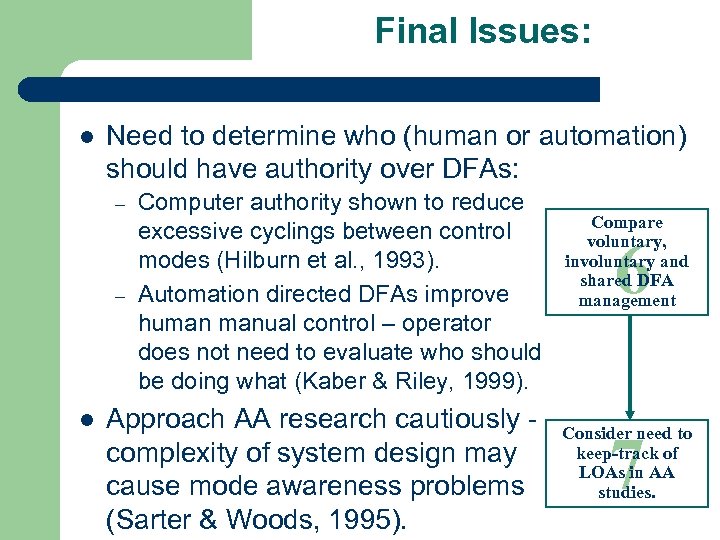
Final Issues: l Need to determine who (human or automation) should have authority over DFAs: – – l Computer authority shown to reduce excessive cyclings between control modes (Hilburn et al. , 1993). Automation directed DFAs improve human manual control – operator does not need to evaluate who should be doing what (Kaber & Riley, 1999). Approach AA research cautiously complexity of system design may cause mode awareness problems (Sarter & Woods, 1995). Compare voluntary, involuntary and shared DFA management 6 Consider need to keep-track of LOAs in AA studies. 7
Conclusions: l l l Can’t study AA without considering LOA – concepts “like peas and carrots” (F. Gump). Taxonomies of LOA provide means for systematically studying complexities of automation. Need to apply models of HAI to real systems to expand theory to design rationales. – l Classify systems and understand underlying factors in automated system performance. Need to develop framework of AA research.
Скачать презентацию A Case for Theory-Based Research on Level of
db6ee658f3d61f1e6b8b834db71d2aba.ppt