


 Скачать презентацию A CANADIAN DOMESTIC EMISSIONS TRADING SYSTEM Status of
bba88a0419f0131b65056120257bf244.ppt
- Количество слайдов: 15
 A CANADIAN DOMESTIC EMISSIONS TRADING SYSTEM Status of Policy Development Peter Graham Canadian Forest Service Natural Resources Canada Forestry and Agriculture GHG Modeling Forum Shepherdstown, WV (October 12 -15, 2004)
 Part 1: Large Final Emitters • The Climate Change Plan for Canada (Nov. ’ 02) established a three-pronged approach to Large Final Emitters (LFEs): – Targets for emission reductions of 55 Mt from 2010 “business as usual” • Covenants with a regulatory backstop • Targets will be based on emission intensity – the ratio of emissions to physical output – Access to emissions trading, domestic offsets, and international permits to provide flexibility; and – Complementary measures, including cost-shared investments in innovative technologies, to reduce emissions.
 Additional Commitments • The federal government has committed: – That during the first compliance period, the Government will ensure that Canadian companies would have the opportunity to meet their obligations at a price no greater than CDN$15 per tonne CO 2 e; and – To set emissions intensity targets at a level no more than 15 percent below projected 2010 levels.
 LFE Obligations • LFEs will be prohibited from emitting GHGs without an equivalent number of permits. • LFEs will be required to quantify and report their GHG emissions on an annual basis. • Government will provide a number of permits through an allocation method to be defined by regulation. • At the end of each year, LFEs will be required to remit a permit for each tonne of CO 2 equivalent that they released. – Companies that do not have enough permits at this point will have to buy additional ones on the market.
 Part 2: Overview of Offset System • Offsets provide a market incentive for GHG reductions/removals outside the Large Final Emitters (LFE) system • Federal interdepartmental group (led by Environment Canada) working on system design since early 2003 • Discussion Paper and cross Canada consultations (June 2003); general support from stakeholders • Current policy work focused on setting rules for
 Overview of Offset System (2) Creation of offset credit • tradable unit created in domestic Offset System • represents 1 tonne of CO 2 e reduced or removed Uses of offset credits • used to achieve the 55 Mt reduction target when submitted by LFEs as a compliance unit • used to reduce the outstanding Kyoto gap if purchased by citizens [or government] and “cancelled” • banked for future use
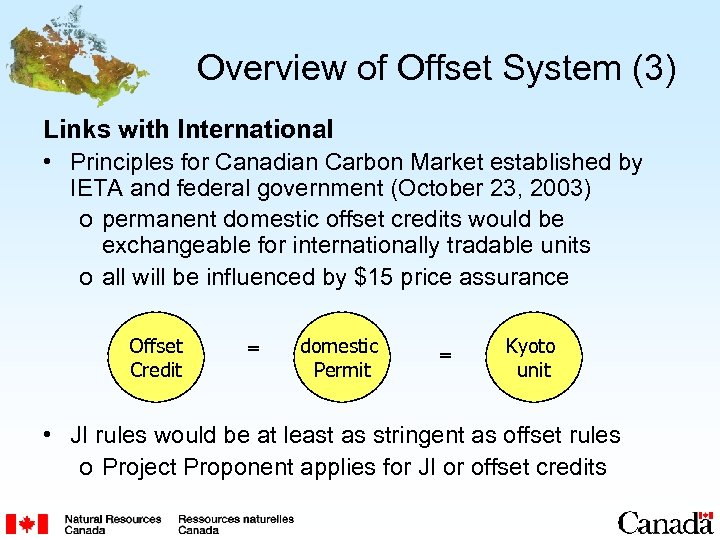 Overview of Offset System (3) Links with International • Principles for Canadian Carbon Market established by IETA and federal government (October 23, 2003) o permanent domestic offset credits would be exchangeable for internationally tradable units o all will be influenced by $15 price assurance Offset Credit = domestic Permit = Kyoto unit • JI rules would be at least as stringent as offset rules o Project Proponent applies for JI or offset credits
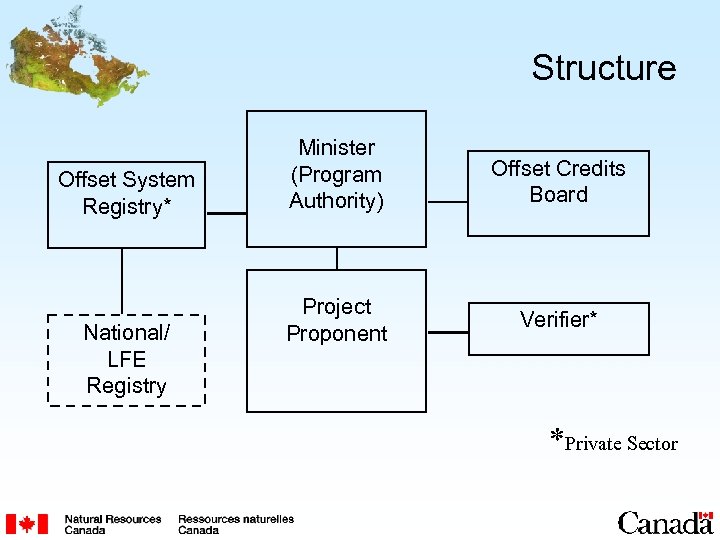 Structure Offset System Registry* National/ LFE Registry Minister (Program Authority) Offset Credits Board Project Proponent Verifier* *Private Sector
 Credit Creation Process • Project development • Project proponent develops ‘project document’ • Project Document Registered Project Document • Initial review of project by Program Authority • Validation of project by Program Authority • Reduction/Removal Report & Verification Report • Project proponent quantifies reduction or removals (R/R) • R/R verified by certified third party • Certification Report & Issuance • Program Authority certifies all requirements are met and number of credits to be issued • Credits issued and projects are tracked in Offset System Registry
 Scope Of Offset System • Climate Change Plan for Canada – scope includes forest and agriculture reductions and removals, possibly landfill gas • Offset System Discussion Paper – proposed the scope be “as broad as practical” (removals or reductions from sources included in Canada’s reporting for Kyoto compliance but not covered by a LFE allocation) • Also being considered for inclusion: o Clean Energy o Demand Side Initiatives of LFEs (& other DSM)
 Proposed Eligibility Criteria • Project eligible if initial R/R after January 1, 2002 • Crediting period begins in 2008 (no end date specified) • R/R must be real (net GHGs, net of leakage), quantifiable and verifiable • R/R must be surplus to those resulting from other climate change measures (no double-counting) • Ownership of R/R must be clear • R/R must be unique (credited once in Offset System) • Eligibility re-assessed every 5 years (baselines every 10 years)
 Baselines Crediting based on difference between the business-asusual project baseline (e. g. , “without project” emissions, industry standard) and “with project” measured emissions, or use a streamlined coefficient approach Current thinking … • agriculture: activity-based coefficients or projectspecific estimates • forests: project-by-project approach • clean energy: national emission intensity standard • landfill gas: project-by-project approach
 Sink Credits • Both temporary & permanent credits being considered • Temporary credits o represents storage of 1 tonne of CO 2 e for 1 year o used to defer a LFE obligation but must be replaced one year after use o may restrict use by a LFE to limit government liability • Permanent credits o represents permanent storage of 1 tonne of CO 2 e o liability for replacement if the sink is reversed will be shared between Project Proponent and government
 Status of Design & Next Steps no final decisions on design • Design Paper available by end of 2004/early 2005 for stakeholder comment • System could begin operation in 2006 if infrastructure in place – Cabinet approval and legislation • Possibly provide market liquidity and experience o early start (using existing legislation) o early issuance of 2008+ credits
 For further information… • www. climatechange. gc. ca • www. ec. gc. ca • www. nrcan. gc. ca