 Скачать презентацию A Business Case for Peering William B Norton
4f277964381fefeb2e635c76775d4737.ppt
- Количество слайдов: 31



A Business Case for Peering William B. Norton Co-Founder and Chief Technical Liaison July 17 th, 2001 Gigabit Peering Forum III Dallas, TX
Motivation • “Internet Service Providers and Peering” – 2 year study of Peering Coordinators – Document Process, Mindset, Strategies • Documented Peering Processes • Learned a lot about Peering Coordinators Professionals

Peering is a game of relationships
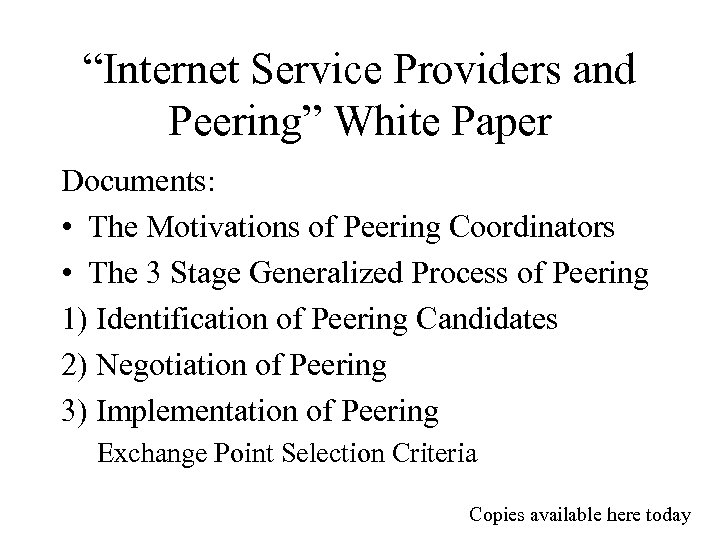
“Internet Service Providers and Peering” White Paper Documents: • The Motivations of Peering Coordinators • The 3 Stage Generalized Process of Peering 1) Identification of Peering Candidates 2) Negotiation of Peering 3) Implementation of Peering Exchange Point Selection Criteria Copies available here today
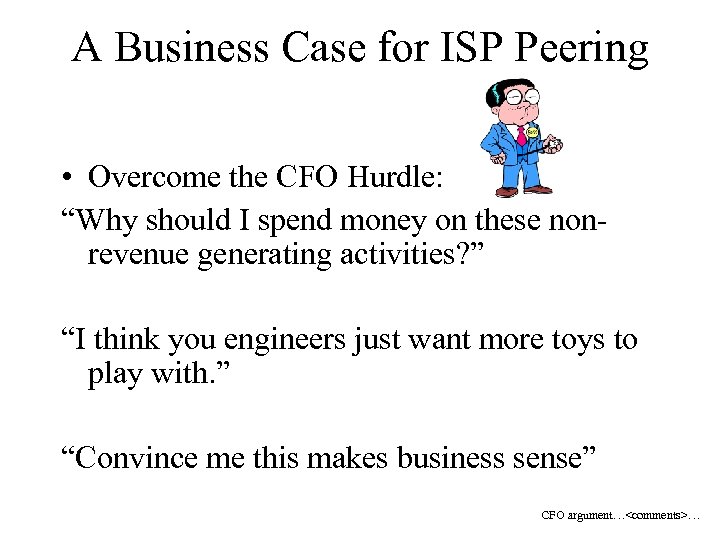
A Business Case for ISP Peering • Overcome the CFO Hurdle: “Why should I spend money on these nonrevenue generating activities? ” “I think you engineers just want more toys to play with. ” “Convince me this makes business sense” CFO argument…<comments>…
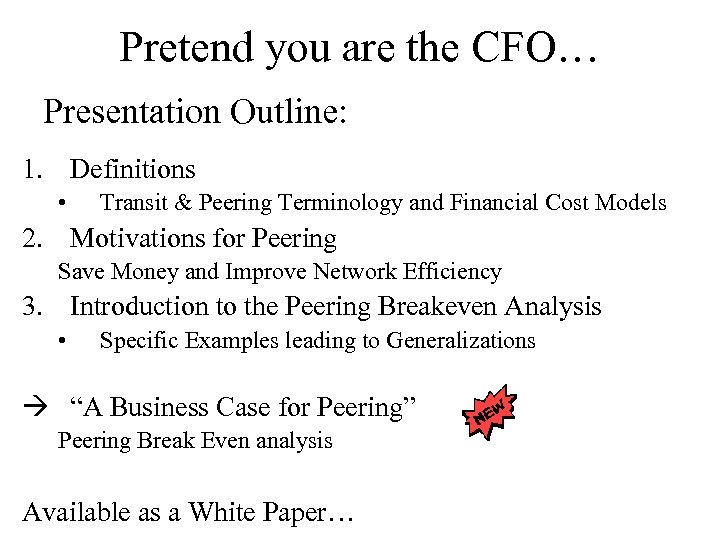
Pretend you are the CFO… Presentation Outline: 1. Definitions • Transit & Peering Terminology and Financial Cost Models 2. Motivations for Peering Save Money and Improve Network Efficiency 3. Introduction to the Peering Breakeven Analysis • Specific Examples leading to Generalizations “A Business Case for Peering” Peering Break Even analysis Available as a White Paper…
Definitions • Gives us tools (lexicon) to facilitate discussion • Market Confusion over misuse of terms: Transit Peering Effective Peering Bandwidth • Terminology critical to have meaningful discussion on Peering
Understand that… 1. The Internet is a network of networks 2. Internet Service Providers sell access to the Internet 3. Internet Service Providers must themselves connect to the Internet. • How do they connect to the rest of the Internet?
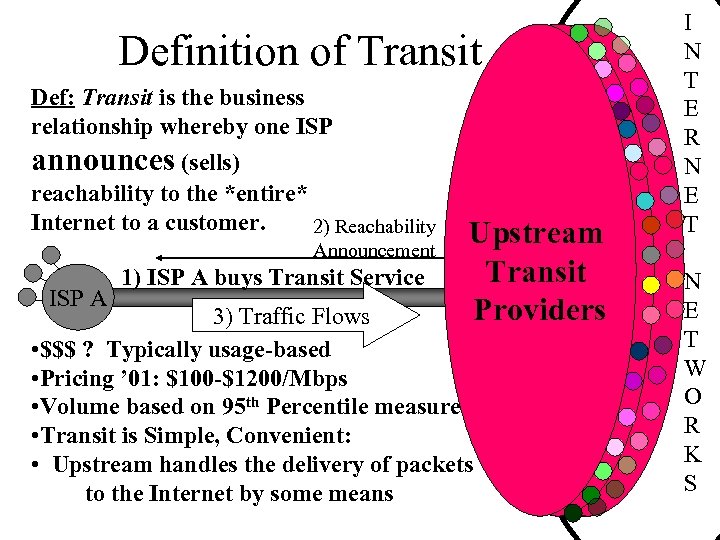
Definition of Transit Def: Transit is the business relationship whereby one ISP announces (sells) reachability to the *entire* Internet to a customer. 2) Reachability Announcement ISP A 1) ISP A buys Transit Service Upstream Transit Providers Provider 3) Traffic Flows • $$$ ? Typically usage-based • Pricing ’ 01: $100 -$1200/Mbps • Volume based on 95 th Percentile measure • Transit is Simple, Convenient: • Upstream handles the delivery of packets to the Internet by some means I N T E R N E T W O R K S
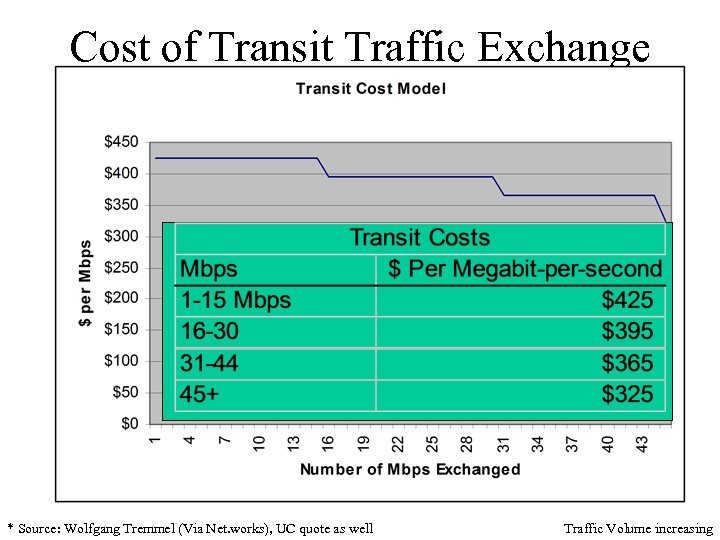
Cost of Transit Traffic Exchange * Source: Wolfgang Tremmel (Via Net. works), UC quote as well Traffic Volume increasing
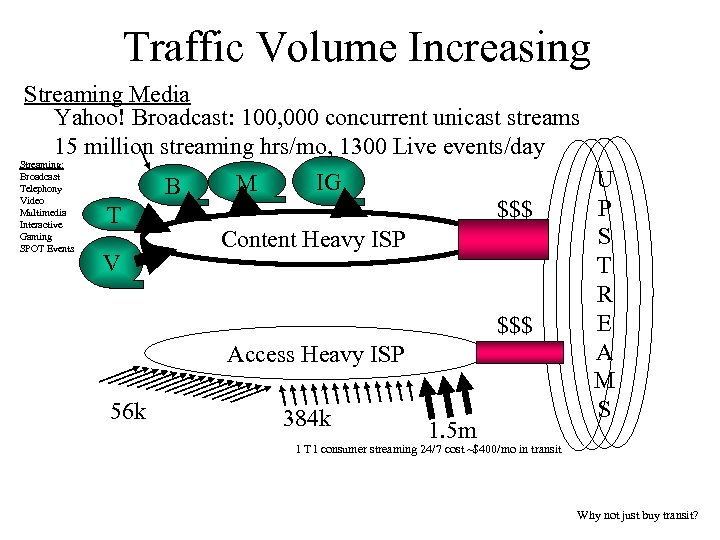
Traffic Volume Increasing Streaming Media Yahoo! Broadcast: 100, 000 concurrent unicast streams 15 million streaming hrs/mo, 1300 Live events/day Streaming: Broadcast IG M Telephony B Video Multimedia $$$ T Interactive Gaming Content Heavy ISP SPOT Events V $$$ Access Heavy ISP 56 k 384 k 1. 5 m U P S T R E A M S 1 T 1 consumer streaming 24/7 cost ~$400/mo in transit Why not just buy transit?
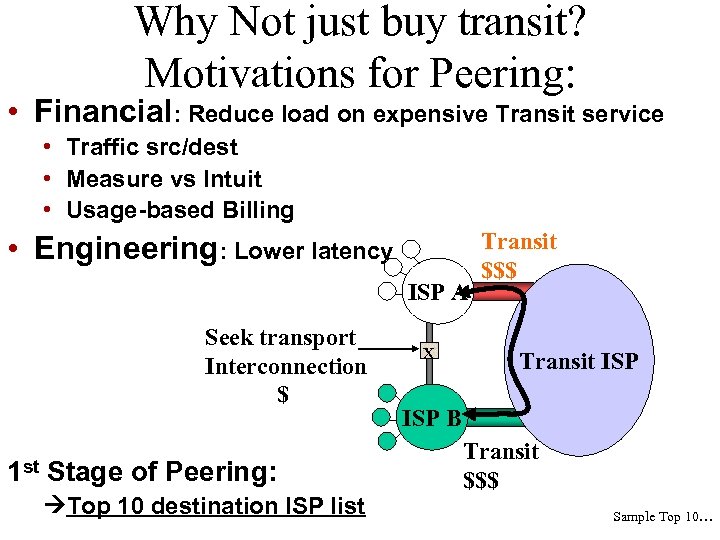
Why Not just buy transit? Motivations for Peering: • Financial: Reduce load on expensive Transit service • Traffic src/dest • Measure vs Intuit • Usage-based Billing • Engineering: Lower latency ISP A Seek transport Interconnection $ 1 st Stage of Peering: Top 10 destination ISP list x Transit $$$ Transit ISP B Transit $$$ Sample Top 10…
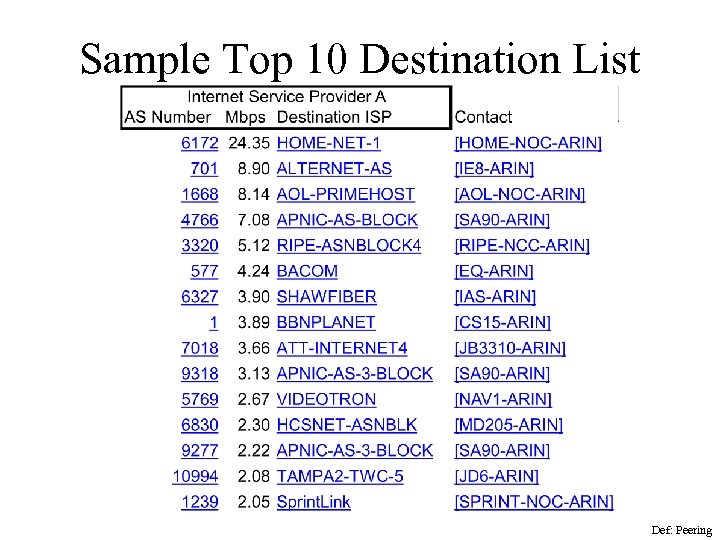
Sample Top 10 Destination List Def: Peering
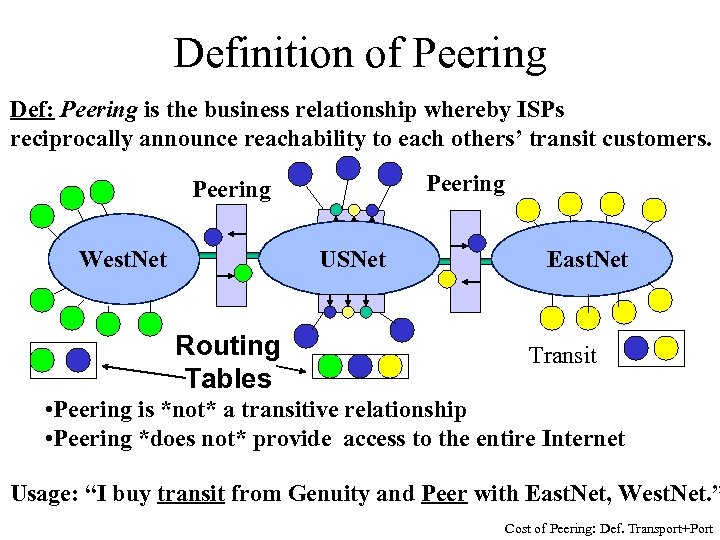
Definition of Peering Def: Peering is the business relationship whereby ISPs reciprocally announce reachability to each others’ transit customers. Peering West. Net USNet Routing Tables East. Net Transit • Peering is *not* a transitive relationship • Peering *does not* provide access to the entire Internet Usage: “I buy transit from Genuity and Peer with East. Net, West. Net. ” Cost of Peering: Def. Transport+Port
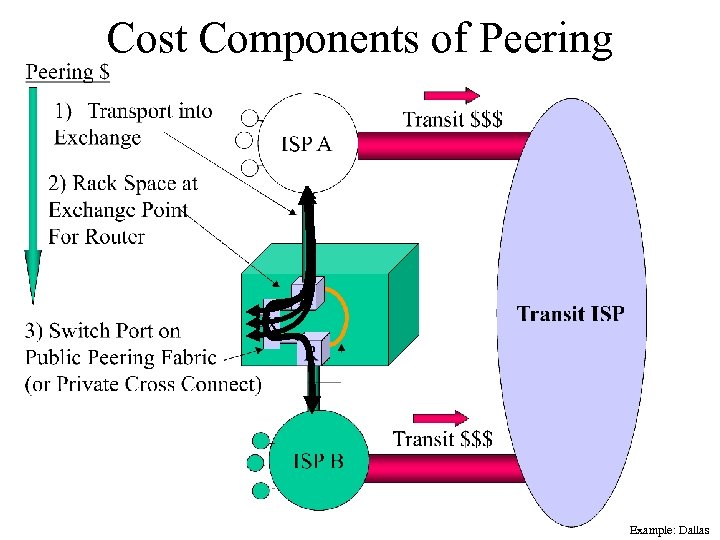
Cost Components of Peering Example: Dallas
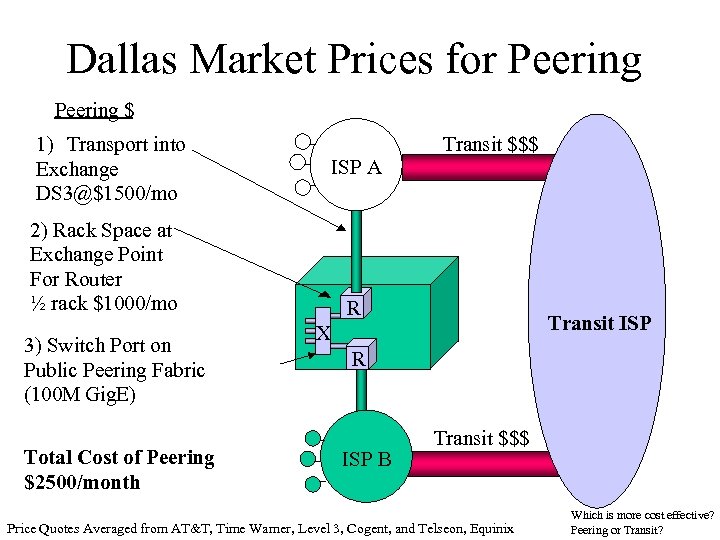
Dallas Market Prices for Peering $ 1) Transport into Exchange DS 3@$1500/mo ISP A 2) Rack Space at Exchange Point For Router ½ rack $1000/mo 3) Switch Port on Public Peering Fabric (100 M Gig. E) Total Cost of Peering $2500/month Transit $$$ R Transit ISP X R ISP B Transit $$$ Price Quotes Averaged from AT&T, Time Warner, Level 3, Cogent, and Telseon, Equinix Which is more cost effective? Peering or Transit?
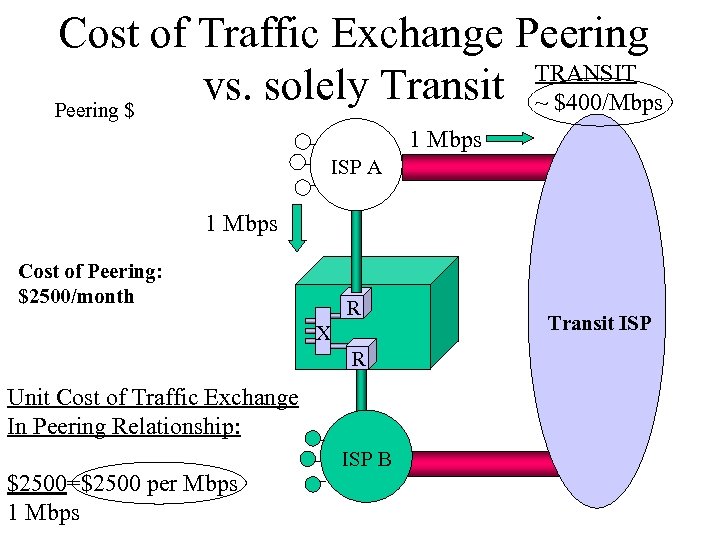
Cost of Traffic Exchange Peering TRANSIT vs. solely Transit ~ $400/Mbps Peering $ 1 Mbps ISP A 1 Mbps Cost of Peering: $2500/month R X R Unit Cost of Traffic Exchange In Peering Relationship: $2500=$2500 per Mbps 1 Mbps ISP B Transit ISP
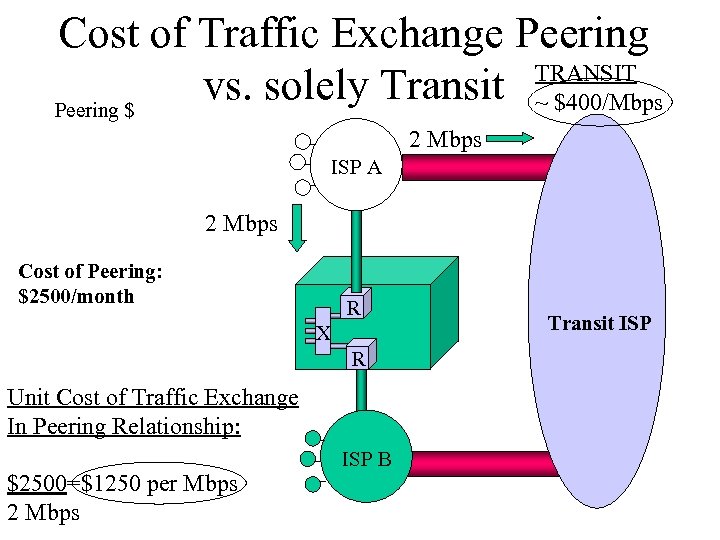
Cost of Traffic Exchange Peering TRANSIT vs. solely Transit ~ $400/Mbps Peering $ 2 Mbps ISP A 2 Mbps Cost of Peering: $2500/month R X R Unit Cost of Traffic Exchange In Peering Relationship: $2500=$1250 per Mbps 2 Mbps ISP B Transit ISP
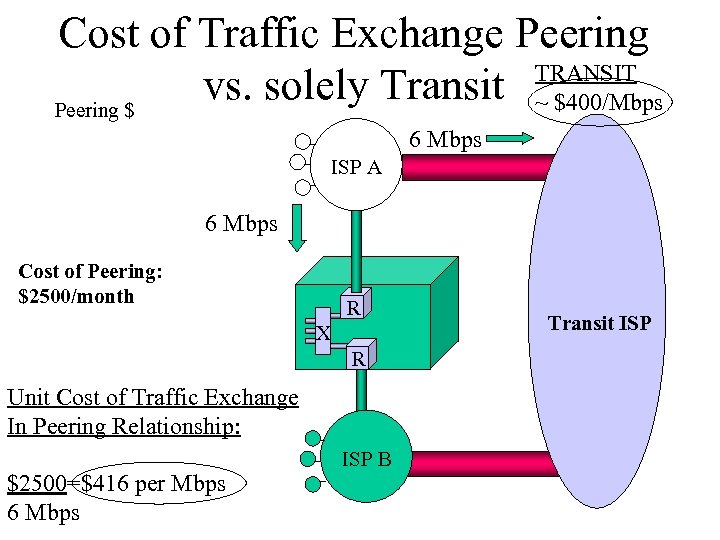
Cost of Traffic Exchange Peering TRANSIT vs. solely Transit ~ $400/Mbps Peering $ 6 Mbps ISP A 6 Mbps Cost of Peering: $2500/month R X R Unit Cost of Traffic Exchange In Peering Relationship: $2500=$416 per Mbps 6 Mbps ISP B Transit ISP
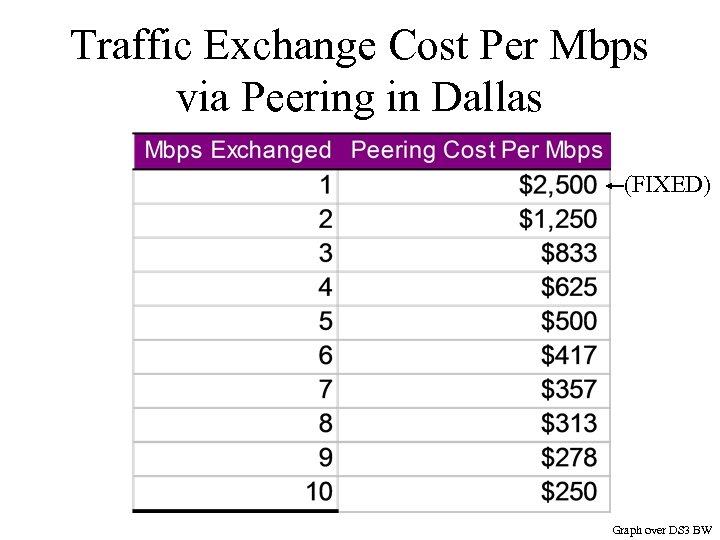
Traffic Exchange Cost Per Mbps via Peering in Dallas (FIXED) Graph over DS 3 BW
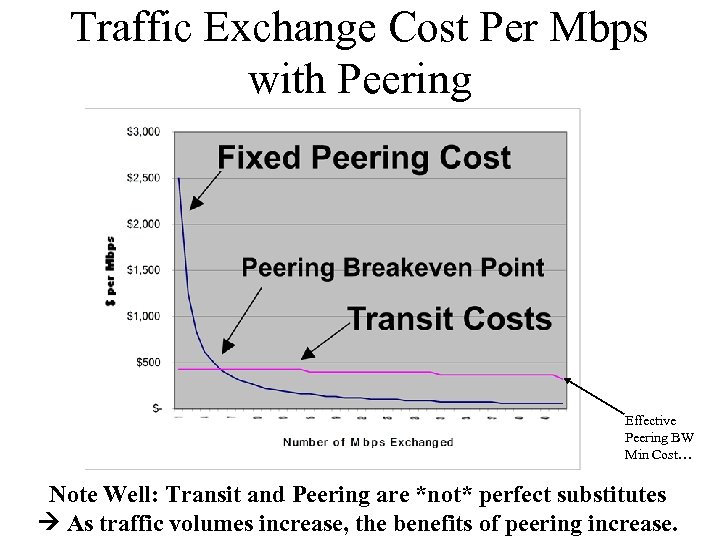
Traffic Exchange Cost Per Mbps with Peering Effective Peering BW Min Cost… Note Well: Transit and Peering are *not* perfect substitutes As traffic volumes increase, the benefits of peering increase.
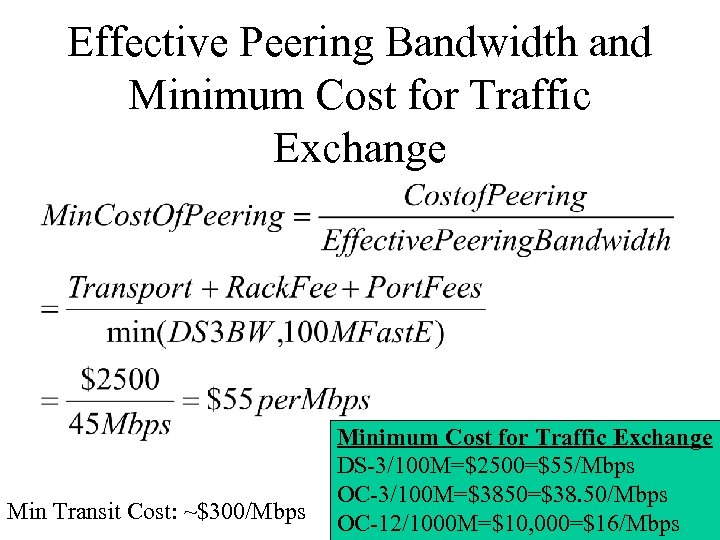
Effective Peering Bandwidth and Minimum Cost for Traffic Exchange Min Transit Cost: ~$300/Mbps Minimum Cost for Traffic Exchange DS-3/100 M=$2500=$55/Mbps OC-3/100 M=$3850=$38. 50/Mbps OC-12/1000 M=$10, 000=$16/Mbps
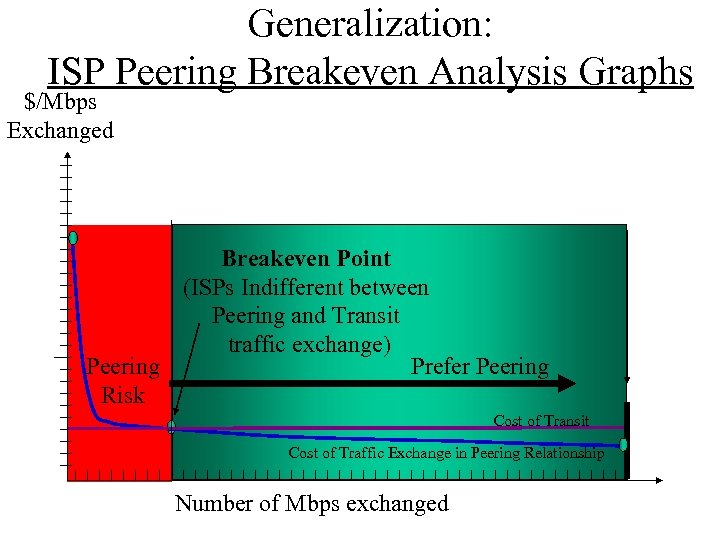
Generalization: ISP Peering Breakeven Analysis Graphs $/Mbps Exchanged Breakeven Point (ISPs Indifferent between Peering and Transit traffic exchange) Peering Prefer Peering Risk Cost of Transit Cost of Traffic Exchange in Peering Relationship Number of Mbps exchanged
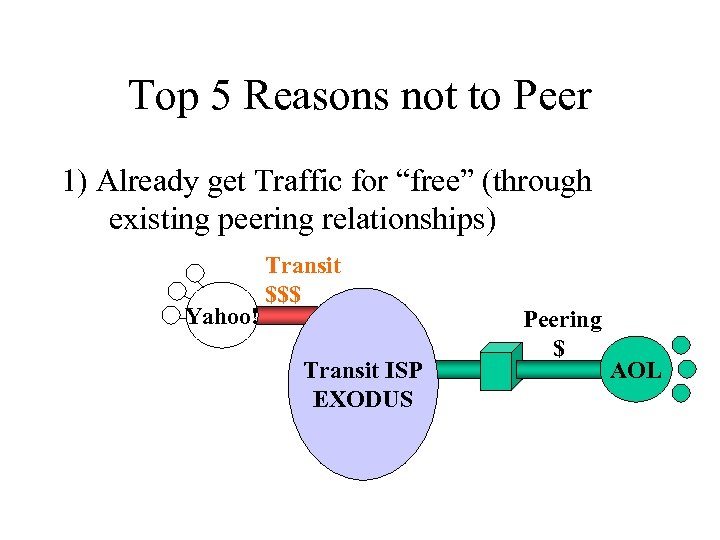
Top 5 Reasons not to Peer 1) Already get Traffic for “free” (through existing peering relationships) Yahoo! Transit $$$ Transit ISP EXODUS Peering $ AOL
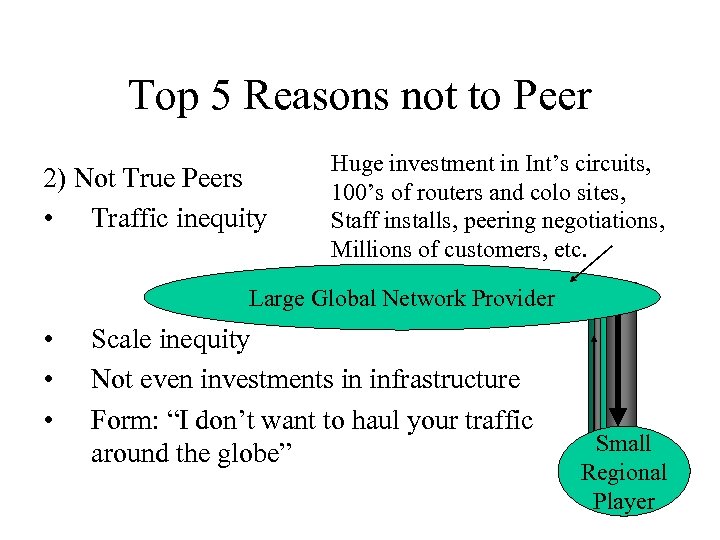
Top 5 Reasons not to Peer 2) Not True Peers • Traffic inequity Huge investment in Int’s circuits, 100’s of routers and colo sites, Staff installs, peering negotiations, Millions of customers, etc. Large Global Network Provider • • • Scale inequity Not even investments in infrastructure Form: “I don’t want to haul your traffic around the globe” Small Regional Player
Top 5 Reasons Not to Peer 3) Lack of Technical Competence Troubleshooting network problems takes longer when the other ISP NOC and engineers lack the technical expertise during an outage…
Top 5 Reasons Not to Peer 4) Transit Sales Preferred • We rather sell you transit…“Let me introduce you to our sales guys”
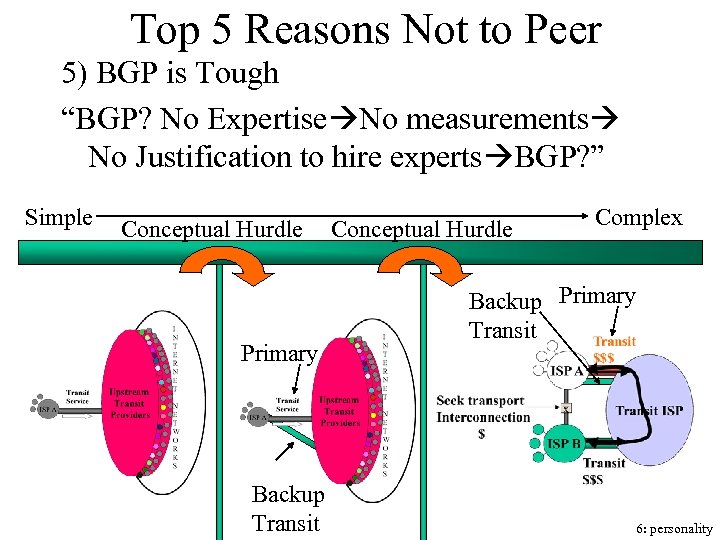
Top 5 Reasons Not to Peer 5) BGP is Tough “BGP? No Expertise No measurements No Justification to hire experts BGP? ” Simple Conceptual Hurdle Primary Backup Transit Conceptual Hurdle Complex Backup Primary Transit 6: personality

Top 5 Reasons Not To Peer 5+ Personality Clashes: They don’t understand each other and they didn’t like the interaction
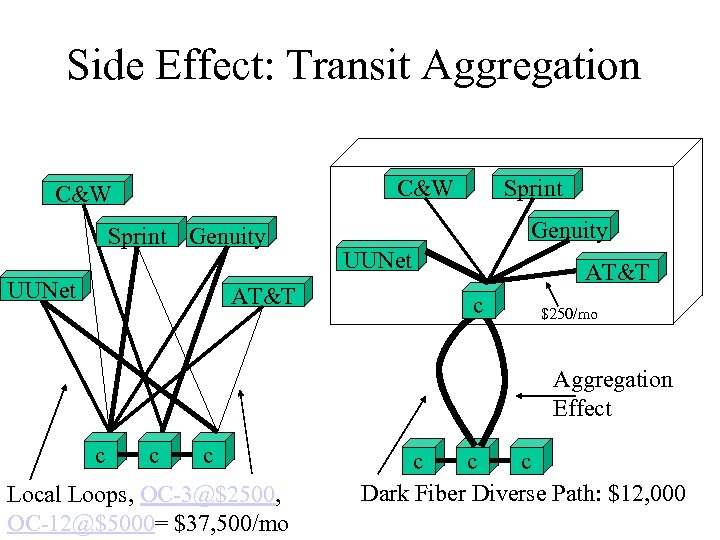
Side Effect: Transit Aggregation C&W Sprint Genuity UUNet AT&T c $250/mo Aggregation Effect c c c Local Loops, OC-3@$2500, OC-12@$5000= $37, 500/mo c c c Dark Fiber Diverse Path: $12, 000
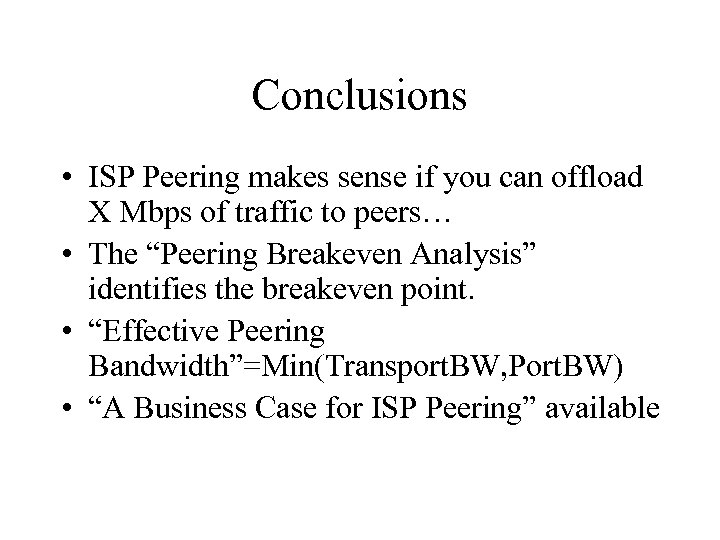
Conclusions • ISP Peering makes sense if you can offload X Mbps of traffic to peers… • The “Peering Breakeven Analysis” identifies the breakeven point. • “Effective Peering Bandwidth”=Min(Transport. BW, Port. BW) • “A Business Case for ISP Peering” available
Скачать презентацию A Business Case for Peering William B Norton
4f277964381fefeb2e635c76775d4737.ppt