 Скачать презентацию A Brief Overview of Agent Communication in the
f5af2607c56b91ba48a30c54a7b2fbe2.ppt
- Количество слайдов: 73



A Brief Overview of Agent Communication in the Semantic Web Era -- and Beyond -Tim Finin University of Maryland, Baltimore County April 2007 http: //ebiquity. umbc. edu/resource/html/id/220/
Overview • Agent communication languages • 1990 -2000 DARPA knowledge sharing effort • 1997 -2002 FIPA • 2000 - (Semantic) Web • 2010 - and beyond • Are we making progress?
Agent Communication • Agent-to-agent communication is key to realizing the potential of the agent paradigm, just as the development of human language was key to the development of human intelligence and societies. • Agents use an Agent Communication Language (ACL) to communication information and knowledge. • Genesereth (CACM 1994) defined a software agent as any system which uses an ACL to exchange information. Genesereth, M. R. , Ketchpel, S. P. : “Software Agents”, Communications of the Association for Computing Machinery, July 1994, pp 48 -53.
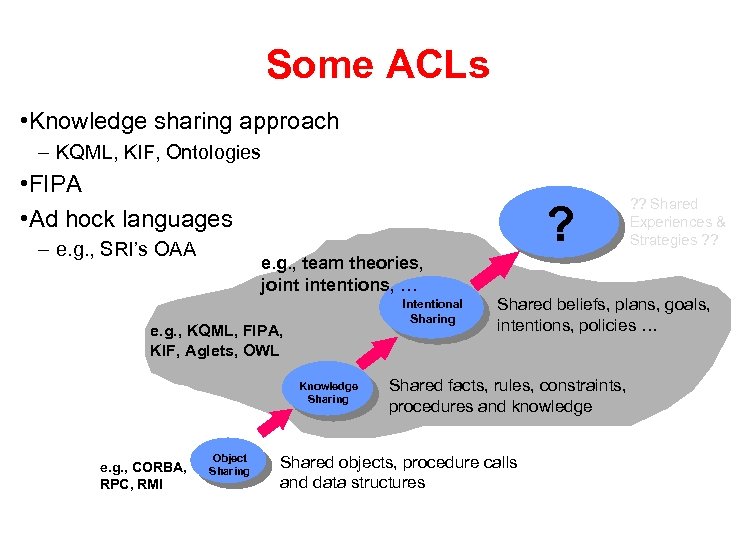
Some ACLs • Knowledge sharing approach – KQML, KIF, Ontologies • FIPA • Ad hock languages – e. g. , SRI’s OAA ? e. g. , team theories, joint intentions, … Intentional Sharing e. g. , KQML, FIPA, KIF, Aglets, OWL Knowledge Sharing e. g. , CORBA, RPC, RMI ? ? Shared Experiences & Strategies ? ? Object Sharing Shared beliefs, plans, goals, intentions, policies … Shared facts, rules, constraints, procedures and knowledge Shared objects, procedure calls and data structures
BDI Agents, Theories and Architectures • BDI architectures describe the internal state of an agent by the mental states of beliefs, goals and intentions • BDI theories provide a conceptual model of the knowledge, goals, and commitments of an agent • BDI agents have some (implicit or explicit) representations of the corresponding attitudes • BDI models are important in defining the semantics of ACLs
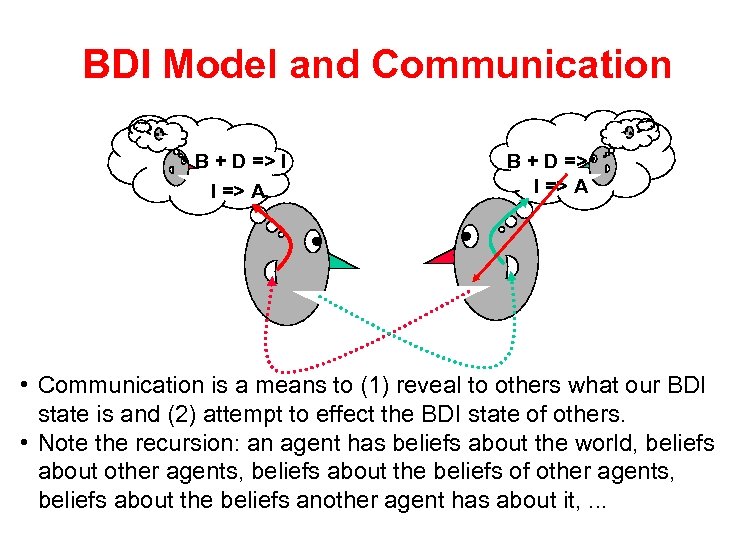
BDI Model and Communication B + D => I I => A • Communication is a means to (1) reveal to others what our BDI state is and (2) attempt to effect the BDI state of others. • Note the recursion: an agent has beliefs about the world, beliefs about other agents, beliefs about the beliefs of other agents, beliefs about the beliefs another agent has about it, . . .
1990 -2000 Knowledge Sharing Effort
Historical Note: Knowledge Sharing Effort • Initiated by DARPA circa 1990 with later support from NSF, AFOSR, etc. – Participation by ~100 researchers in academia and industry • Developing techniques, methodologies and software tools for knowledge sharing and knowledge reuse. • Sharing and reuse can occur at design, implementation or execution time. • Mostly wound down by ~2000 as funding dried up and industry failed to adopt the ideas
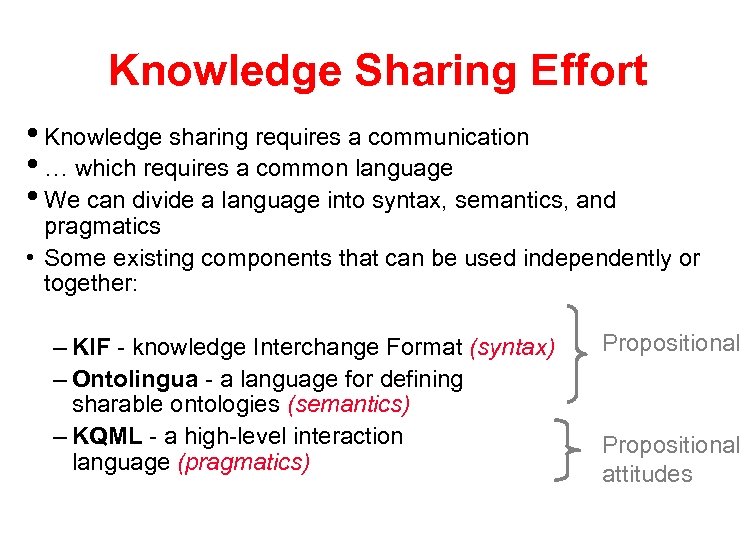
Knowledge Sharing Effort • Knowledge sharing requires a communication • … which requires a common language • We can divide a language into syntax, semantics, and pragmatics • Some existing components that can be used independently or together: – KIF - knowledge Interchange Format (syntax) – Ontolingua - a language for defining sharable ontologies (semantics) – KQML - a high-level interaction language (pragmatics) Propositional attitudes
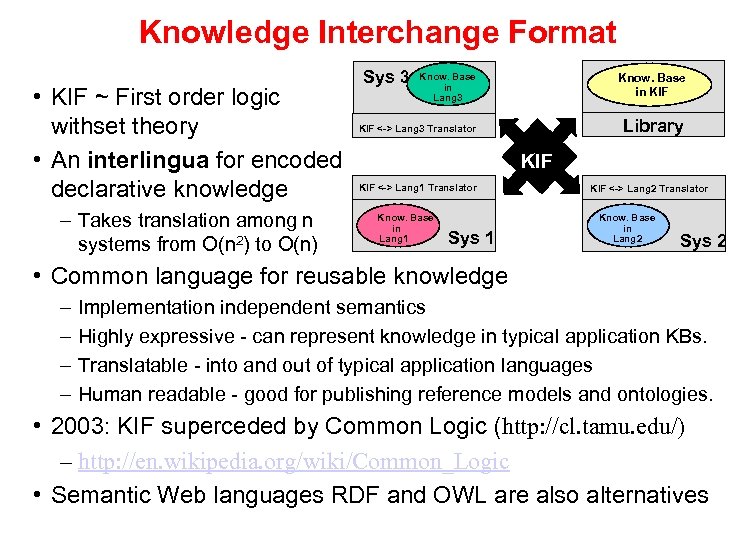
Knowledge Interchange Format • KIF ~ First order logic withset theory • An interlingua for encoded declarative knowledge – Takes translation among n systems from O(n 2) to O(n) Sys 3 Know. Base in Lang 3 Know. Base in KIF <-> Lang 3 Translator Library KIF <-> Lang 1 Translator Know. Base in Lang 1 Sys 1 KIF <-> Lang 2 Translator Know. Base in Lang 2 Sys 2 • Common language for reusable knowledge – – Implementation independent semantics Highly expressive - can represent knowledge in typical application KBs. Translatable - into and out of typical application languages Human readable - good for publishing reference models and ontologies. • 2003: KIF superceded by Common Logic (http: //cl. tamu. edu/) – http: //en. wikipedia. org/wiki/Common_Logic • Semantic Web languages RDF and OWL are also alternatives
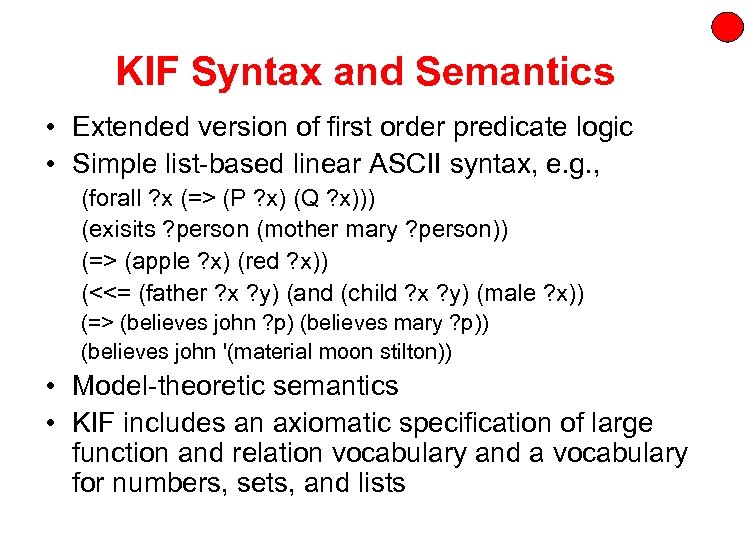
KIF Syntax and Semantics • Extended version of first order predicate logic • Simple list-based linear ASCII syntax, e. g. , (forall ? x (=> (P ? x) (Q ? x))) (exisits ? person (mother mary ? person)) (=> (apple ? x) (red ? x)) (<<= (father ? x ? y) (and (child ? x ? y) (male ? x)) (=> (believes john ? p) (believes mary ? p)) (believes john '(material moon stilton)) • Model-theoretic semantics • KIF includes an axiomatic specification of large function and relation vocabulary and a vocabulary for numbers, sets, and lists
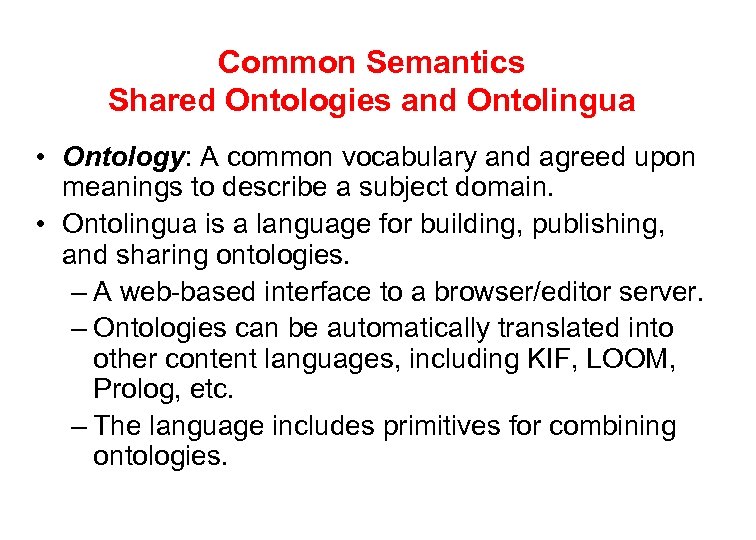
Common Semantics Shared Ontologies and Ontolingua • Ontology: A common vocabulary and agreed upon meanings to describe a subject domain. • Ontolingua is a language for building, publishing, and sharing ontologies. – A web-based interface to a browser/editor server. – Ontologies can be automatically translated into other content languages, including KIF, LOOM, Prolog, etc. – The language includes primitives for combining ontologies.
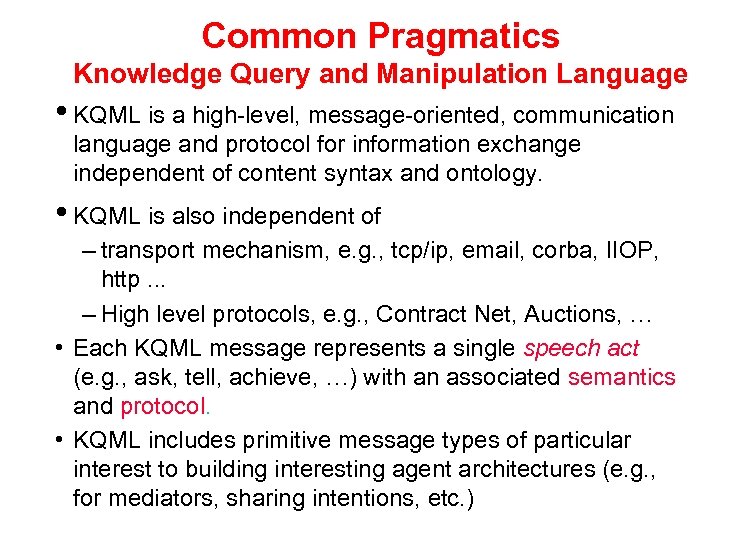
Common Pragmatics Knowledge Query and Manipulation Language • KQML is a high-level, message-oriented, communication language and protocol for information exchange independent of content syntax and ontology. • KQML is also independent of – transport mechanism, e. g. , tcp/ip, email, corba, IIOP, http. . . – High level protocols, e. g. , Contract Net, Auctions, … • Each KQML message represents a single speech act (e. g. , ask, tell, achieve, …) with an associated semantics and protocol. • KQML includes primitive message types of particular interest to building interesting agent architectures (e. g. , for mediators, sharing intentions, etc. )
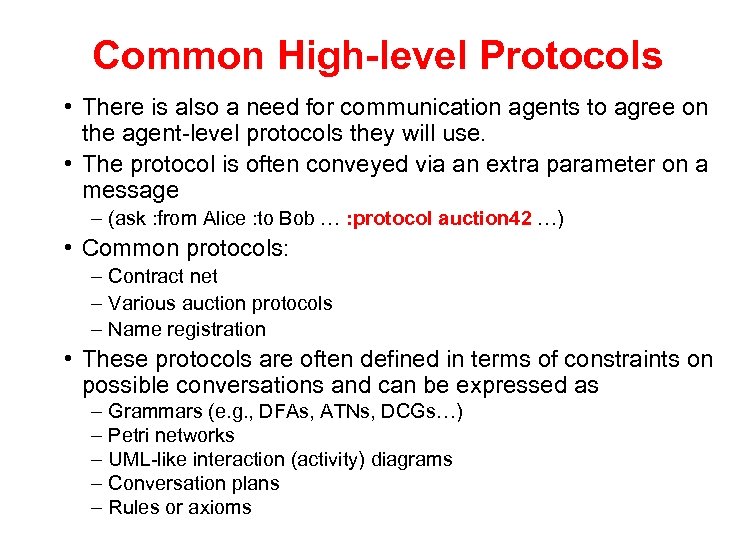
Common High-level Protocols • There is also a need for communication agents to agree on the agent-level protocols they will use. • The protocol is often conveyed via an extra parameter on a message – (ask : from Alice : to Bob … : protocol auction 42 …) • Common protocols: – Contract net – Various auction protocols – Name registration • These protocols are often defined in terms of constraints on possible conversations and can be expressed as – – – Grammars (e. g. , DFAs, ATNs, DCGs…) Petri networks UML-like interaction (activity) diagrams Conversation plans Rules or axioms
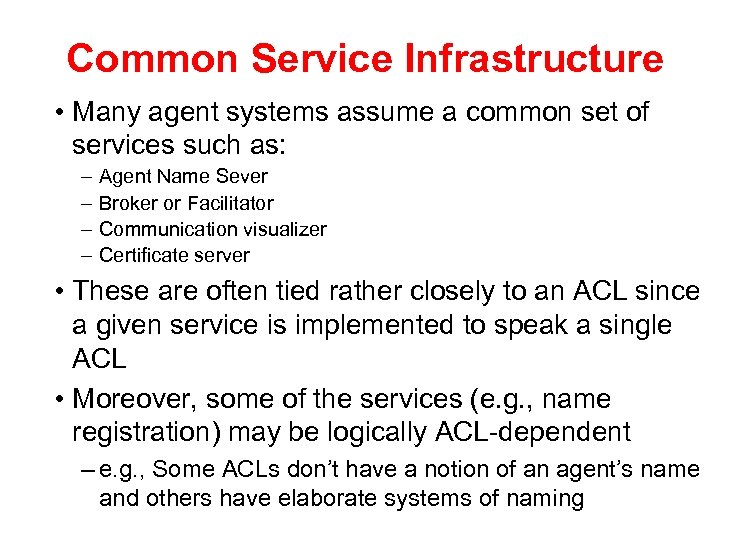
Common Service Infrastructure • Many agent systems assume a common set of services such as: – – Agent Name Sever Broker or Facilitator Communication visualizer Certificate server • These are often tied rather closely to an ACL since a given service is implemented to speak a single ACL • Moreover, some of the services (e. g. , name registration) may be logically ACL-dependent – e. g. , Some ACLs don’t have a notion of an agent’s name and others have elaborate systems of naming
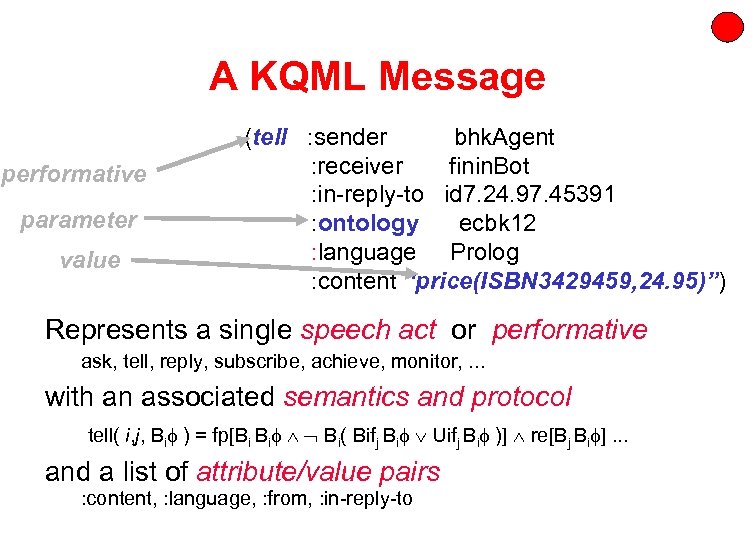
A KQML Message performative parameter value (tell : sender bhk. Agent : receiver finin. Bot : in-reply-to id 7. 24. 97. 45391 : ontology ecbk 12 : language Prolog : content “price(ISBN 3429459, 24. 95)”) Represents a single speech act or performative ask, tell, reply, subscribe, achieve, monitor, . . . with an associated semantics and protocol tell( i, j, Bi ) = fp[Bi Bi Bi( Bifj Bi Uifj Bi )] re[Bj Bi ]. . . and a list of attribute/value pairs : content, : language, : from, : in-reply-to
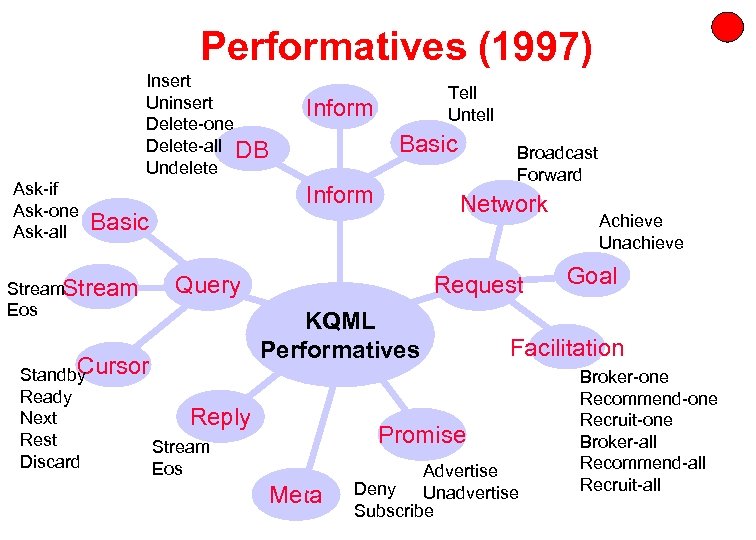
Performatives (1997) Insert Uninsert Delete-one Delete-all DB Undelete Ask-if Ask-one Ask-all Inform Basic Stream Eos Tell Untell Network Query Cursor Standby Ready Next Reply Rest Stream Discard Eos Broadcast Forward Request KQML Performatives Goal Facilitation Promise Meta Achieve Unachieve Advertise Deny Unadvertise Subscribe Broker-one Recommend-one Recruit-one Broker-all Recommend-all Recruit-all
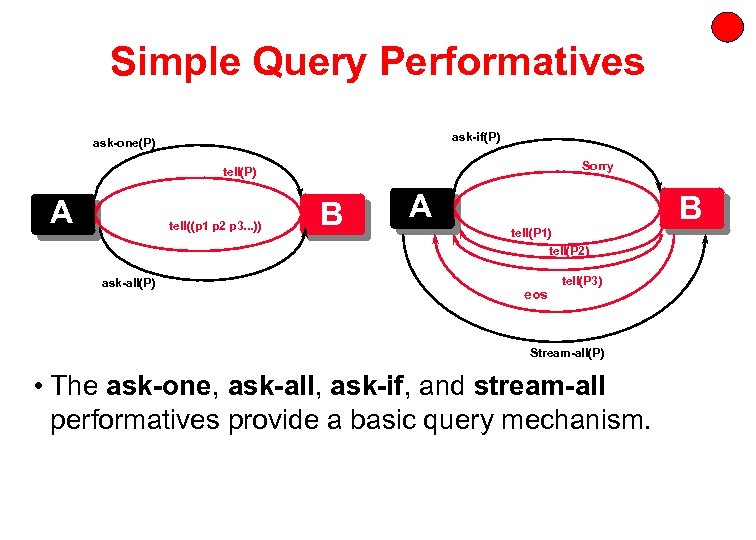
Simple Query Performatives ask-if(P) ask-one(P) Sorry tell(P) A tell((p 1 p 2 p 3. . . )) ask-all(P) B A B tell(P 1) tell(P 2) eos tell(P 3) Stream-all(P) • The ask-one, ask-all, ask-if, and stream-all performatives provide a basic query mechanism.
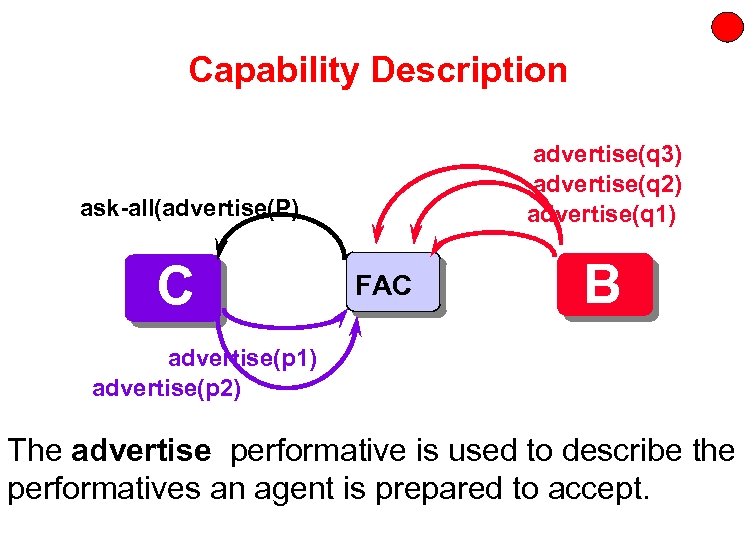
Capability Description advertise(q 3) advertise(q 2) advertise(q 1) ask-all(advertise(P) A C FAC B advertise(p 1) advertise(p 2) The advertise performative is used to describe the performatives an agent is prepared to accept.
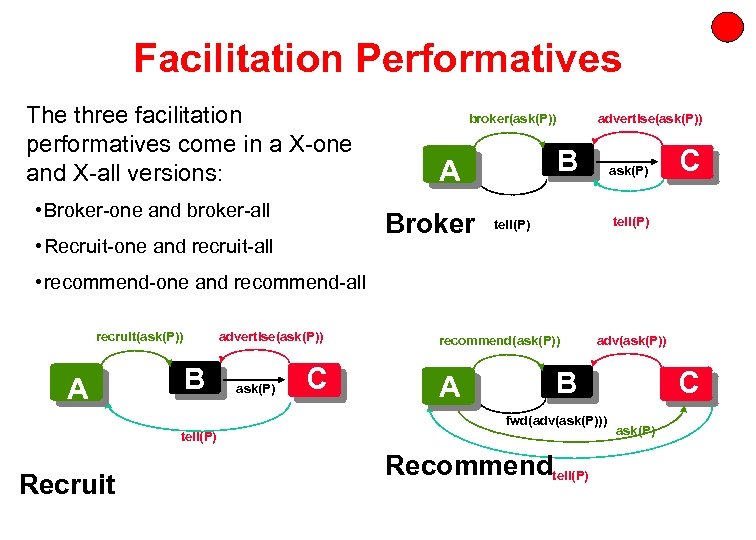
Facilitation Performatives The three facilitation performatives come in a X-one and X-all versions: • Broker-one and broker-all B A Broker • Recruit-one and recruit-all advertise(ask(P)) broker(ask(P)) ask(P) C tell(P) • recommend-one and recommend-all advertise(ask(P)) recruit(ask(P)) A B ask(P) C recommend(ask(P)) A adv(ask(P)) B fwd(adv(ask(P))) tell(P) Recruit Recommendtell(P) C ask(P)
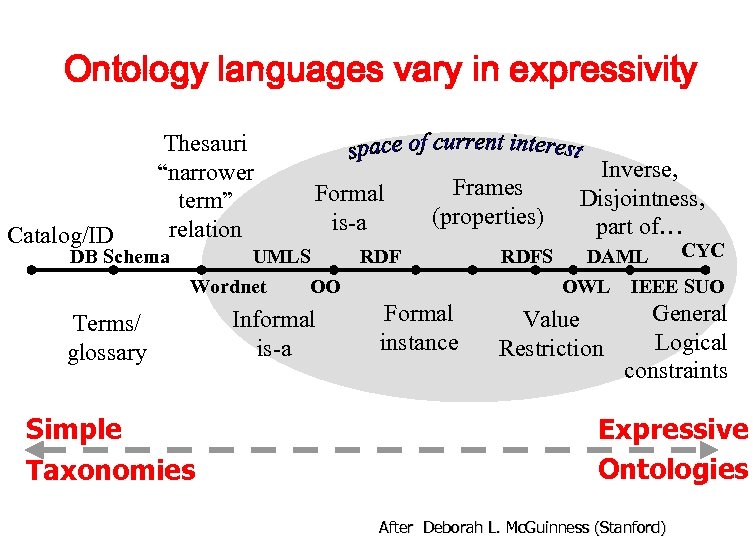
Ontology languages vary in expressivity Catalog/ID Thesauri “narrower term” relation DB Schema Formal is-a UMLS Wordnet Terms/ glossary Simple Taxonomies Frames (properties) RDF OO Informal is-a RDFS Inverse, Disjointness, part of… DAML OWL Formal instance Value Restriction CYC IEEE SUO General Logical constraints Expressive Ontologies After Deborah L. Mc. Guinness (Stanford)
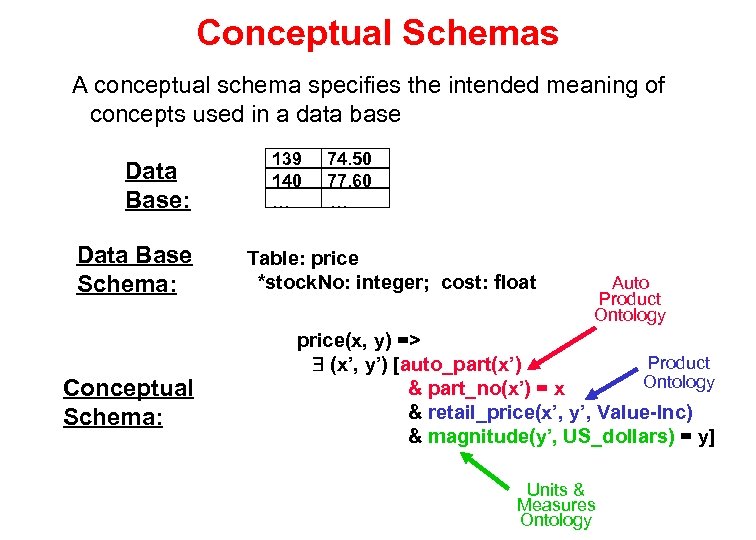
Conceptual Schemas A conceptual schema specifies the intended meaning of concepts used in a data base Data Base: Data Base Schema: Conceptual Schema: 139 140 … 74. 50 77. 60 … Table: price *stock. No: integer; cost: float Auto Product Ontology price(x, y) => Product (x’, y’) [auto_part(x’) Ontology & part_no(x’) = x & retail_price(x’, y’, Value-Inc) & magnitude(y’, US_dollars) = y] Units & Measures Ontology
1997 -2003 Standardization FIPA
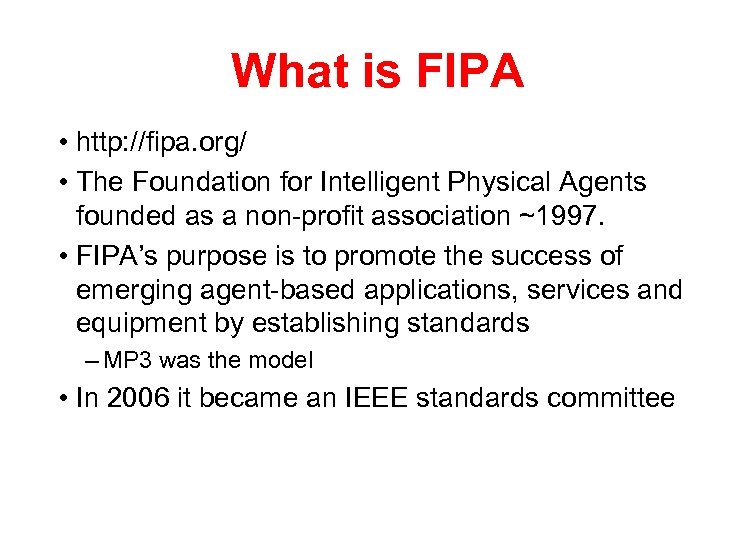
What is FIPA • http: //fipa. org/ • The Foundation for Intelligent Physical Agents founded as a non-profit association ~1997. • FIPA’s purpose is to promote the success of emerging agent-based applications, services and equipment by establishing standards – MP 3 was the model • In 2006 it became an IEEE standards committee
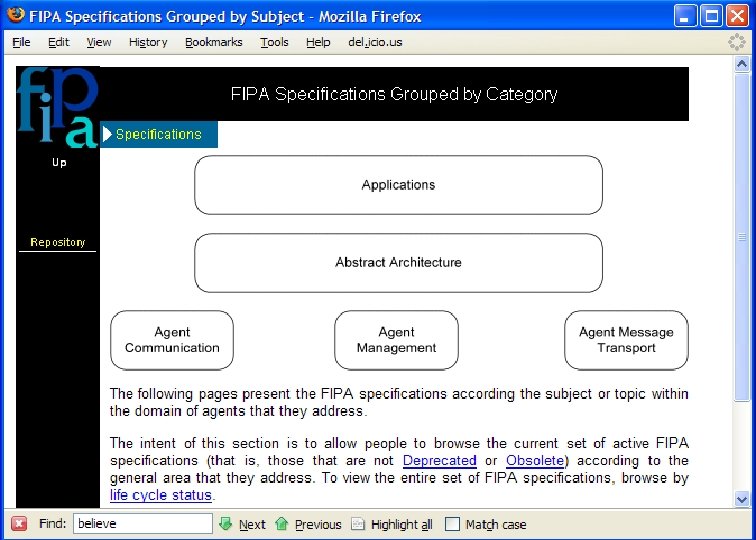
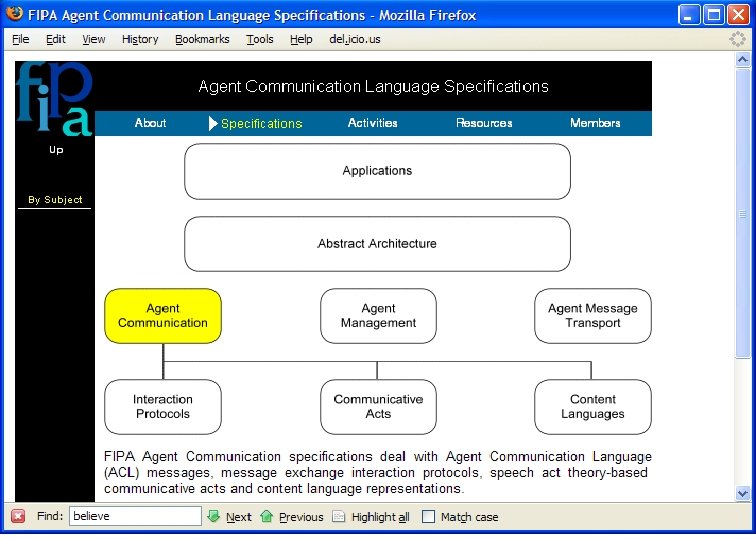
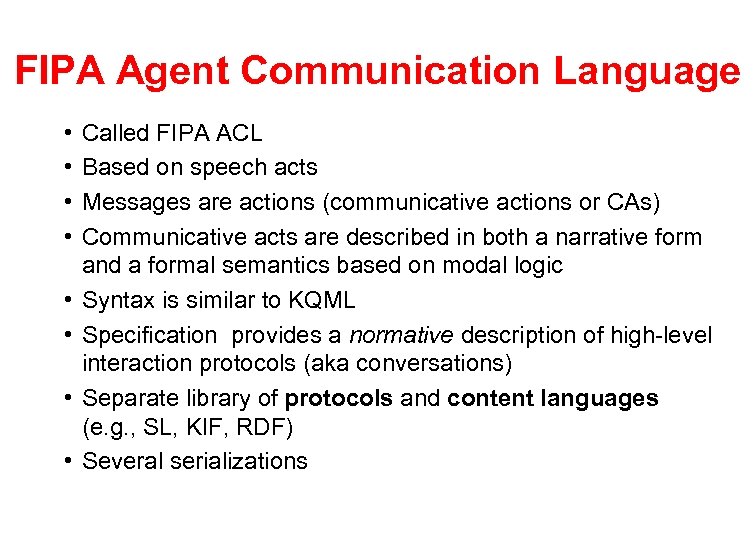
FIPA Agent Communication Language • • Called FIPA ACL Based on speech acts Messages are actions (communicative actions or CAs) Communicative acts are described in both a narrative form and a formal semantics based on modal logic Syntax is similar to KQML Specification provides a normative description of high-level interaction protocols (aka conversations) Separate library of protocols and content languages (e. g. , SL, KIF, RDF) Several serializations
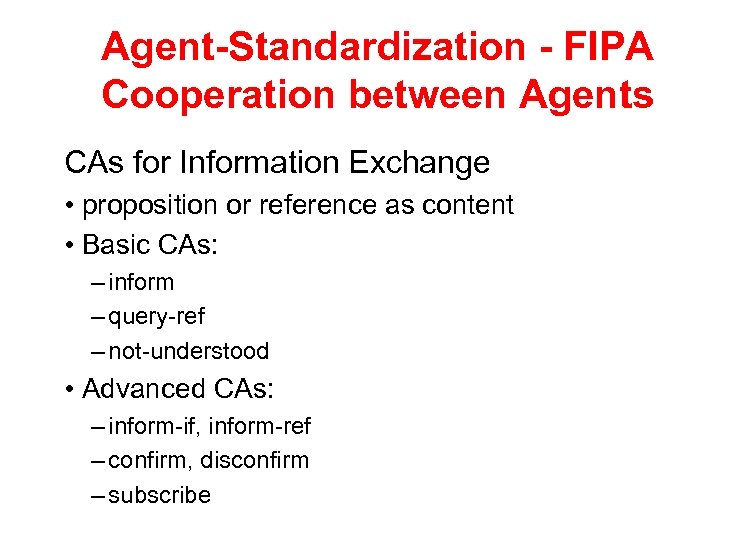
Agent-Standardization - FIPA Cooperation between Agents CAs for Information Exchange • proposition or reference as content • Basic CAs: – inform – query-ref – not-understood • Advanced CAs: – inform-if, inform-ref – confirm, disconfirm – subscribe
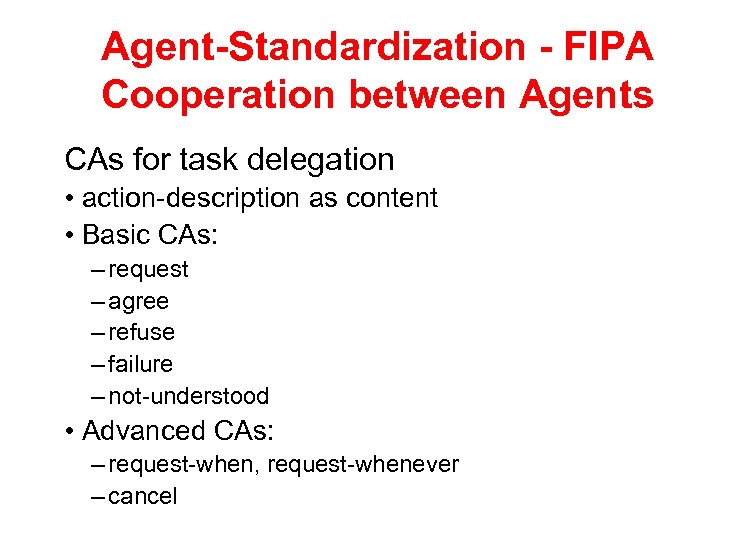
Agent-Standardization - FIPA Cooperation between Agents CAs for task delegation • action-description as content • Basic CAs: – request – agree – refuse – failure – not-understood • Advanced CAs: – request-when, request-whenever – cancel
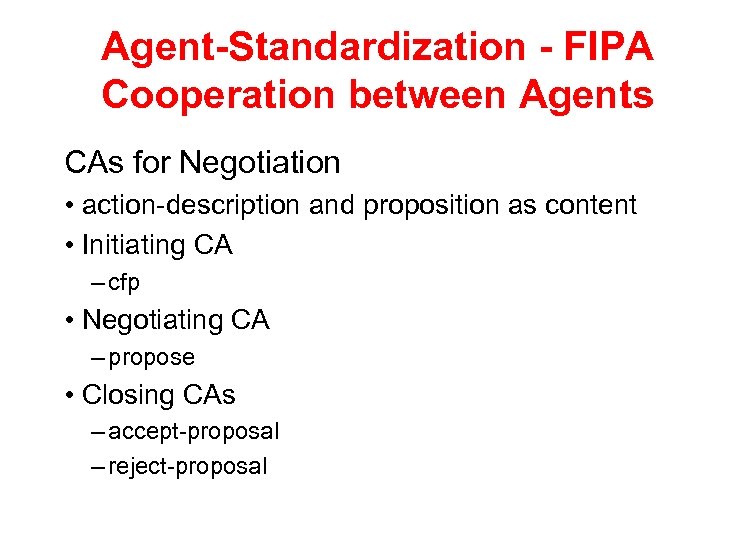
Agent-Standardization - FIPA Cooperation between Agents CAs for Negotiation • action-description and proposition as content • Initiating CA – cfp • Negotiating CA – propose • Closing CAs – accept-proposal – reject-proposal
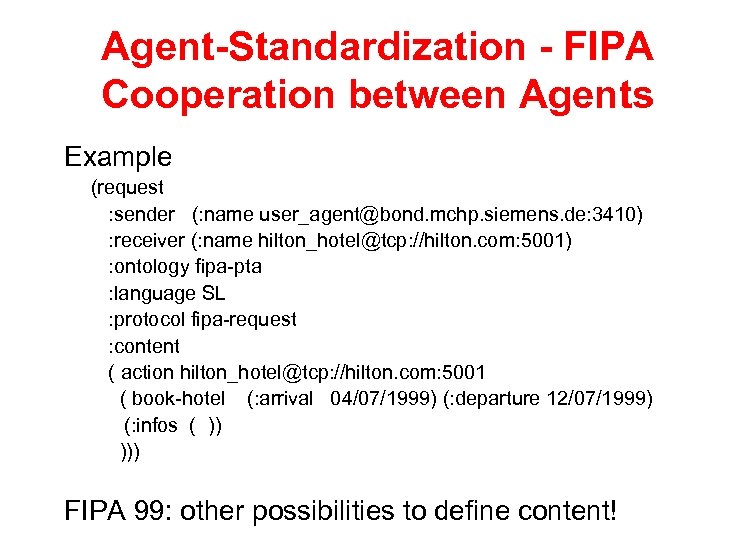
Agent-Standardization - FIPA Cooperation between Agents Example (request : sender (: name user_agent@bond. mchp. siemens. de: 3410) : receiver (: name hilton_hotel@tcp: //hilton. com: 5001) : ontology fipa-pta : language SL : protocol fipa-request : content ( action hilton_hotel@tcp: //hilton. com: 5001 ( book-hotel (: arrival 04/07/1999) (: departure 12/07/1999) (: infos ( )) ))) FIPA 99: other possibilities to define content!
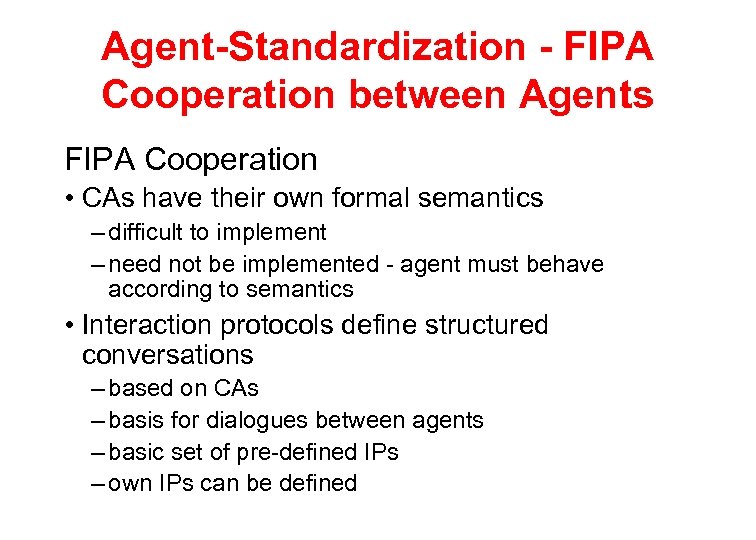
Agent-Standardization - FIPA Cooperation between Agents FIPA Cooperation • CAs have their own formal semantics – difficult to implement – need not be implemented - agent must behave according to semantics • Interaction protocols define structured conversations – based on CAs – basis for dialogues between agents – basic set of pre-defined IPs – own IPs can be defined
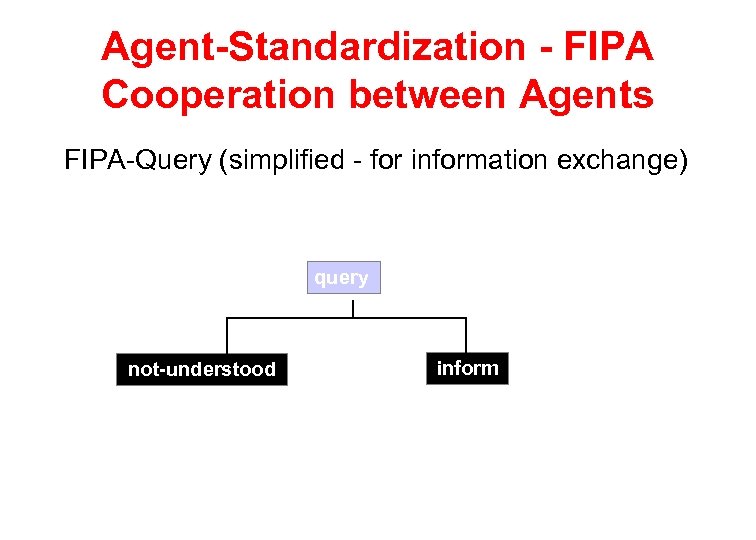
Agent-Standardization - FIPA Cooperation between Agents FIPA-Query (simplified - for information exchange) query not-understood inform
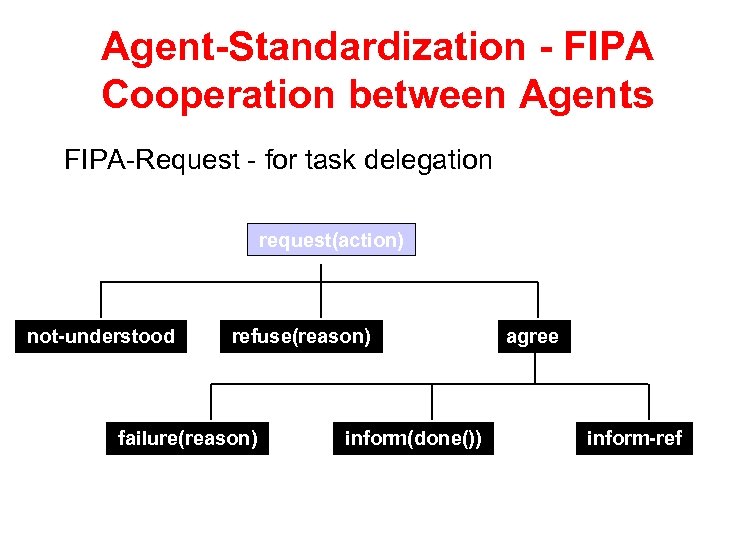
Agent-Standardization - FIPA Cooperation between Agents FIPA-Request - for task delegation request(action) not-understood refuse(reason) failure(reason) inform(done()) agree inform-ref
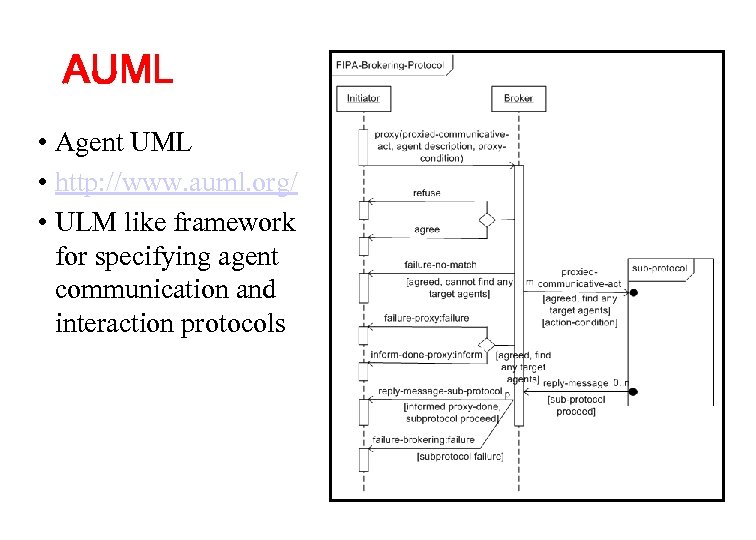
AUML • Agent UML • http: //www. auml. org/ • ULM like framework for specifying agent communication and interaction protocols
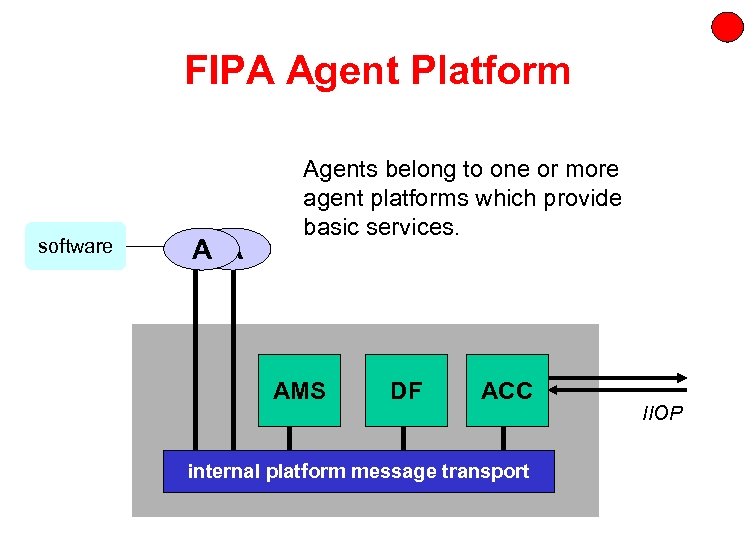
FIPA Agent Platform software A A Agents belong to one or more agent platforms which provide basic services. AMS DF ACC internal platform message transport IIOP
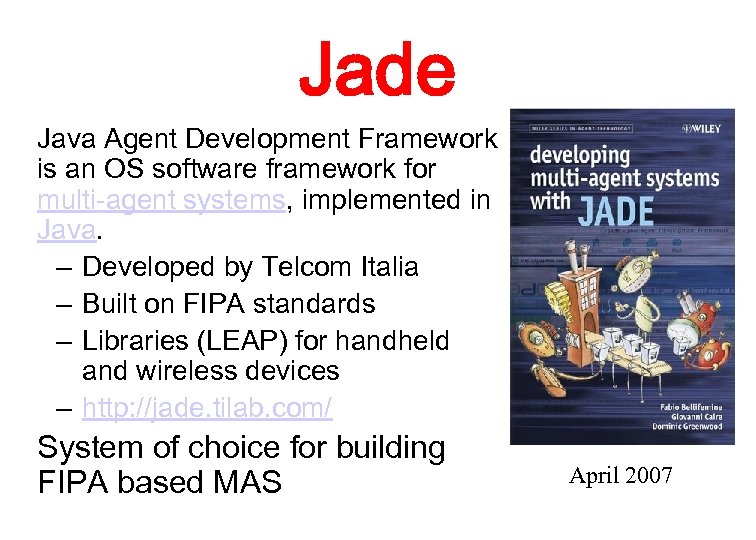
Jade Java Agent Development Framework is an OS software framework for multi-agent systems, implemented in Java. – Developed by Telcom Italia – Built on FIPA standards – Libraries (LEAP) for handheld and wireless devices – http: //jade. tilab. com/ System of choice for building FIPA based MAS April 2007
2000 -? Semantic Web
“XML is Lisp's bastard nephew, with uglier syntax and no semantics. Yet XML is poised to enable the creation of a Web of data that dwarfs anything since the Library at Alexandria. ” -- Philip Wadler, Et tu XML? The fall of the relational empire, VLDB, Rome, September 2001.
“The web has made people smarter. We need to understand how to use it to make machines smarter, too. ” -- Michael I. Jordan, paraphrased from a talk at AAAI, July 2002 by Michael Jordan (UC Berkeley)
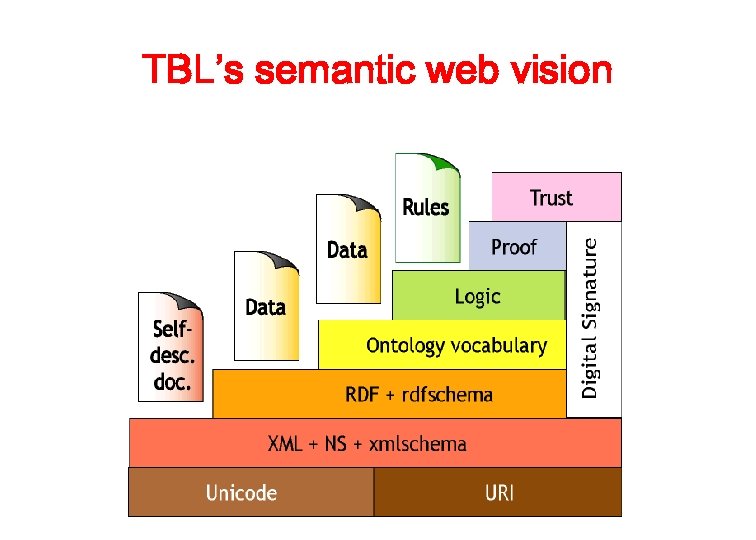
“The Semantic Web will globalize KR, just as the WWW globalize hypertext” -- Tim Berners-Lee
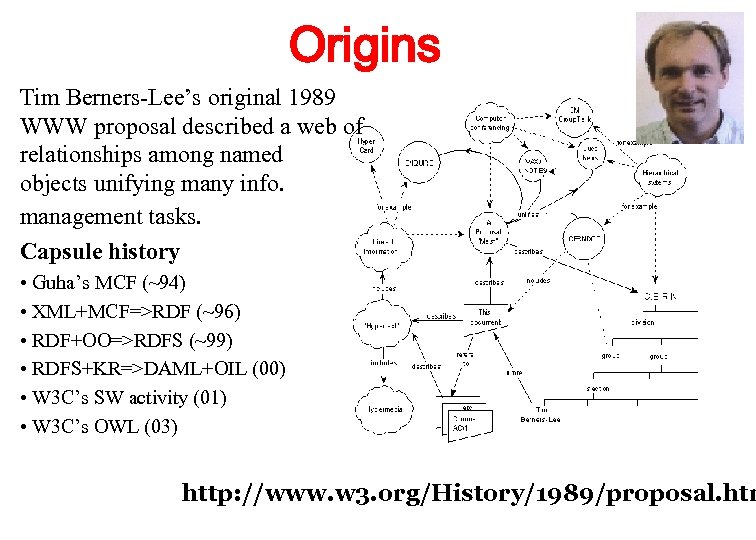
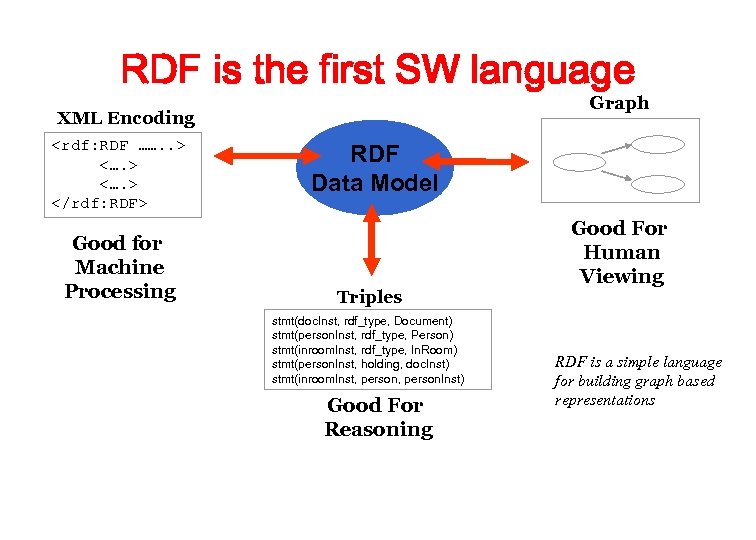
Origins Tim Berners-Lee’s original 1989 WWW proposal described a web of relationships among named objects unifying many info. management tasks. Capsule history • Guha’s MCF (~94) • XML+MCF=>RDF (~96) • RDF+OO=>RDFS (~99) • RDFS+KR=>DAML+OIL (00) • W 3 C’s SW activity (01) • W 3 C’s OWL (03) http: //www. w 3. org/History/1989/proposal. htm
W 3 C’s Semantic Web Goals Focus on machine consumption: "The Semantic Web is an extension of the current web in which information is given well-defined meaning, better enabling computers and people to work in cooperation. " -- Berners-Lee, Hendler and Lassila, The Semantic Web, Scientific American, 2001
Agents? • DARPA gave the Semantic Web a big push starting in 2000 – Going from simple RDF to OWL • DARPA Agent Markup Language • Goal was to give agents access to information and knowledge • And to populate the web with intelligent agents providing services
TBL’s semantic web vision
RDF is the first SW language Graph XML Encoding <rdf: RDF ……. . > <…. > </rdf: RDF> Good for Machine Processing RDF Data Model Triples stmt(doc. Inst, rdf_type, Document) stmt(person. Inst, rdf_type, Person) stmt(inroom. Inst, rdf_type, In. Room) stmt(person. Inst, holding, doc. Inst) stmt(inroom. Inst, person. Inst) Good For Reasoning Good For Human Viewing RDF is a simple language for building graph based representations
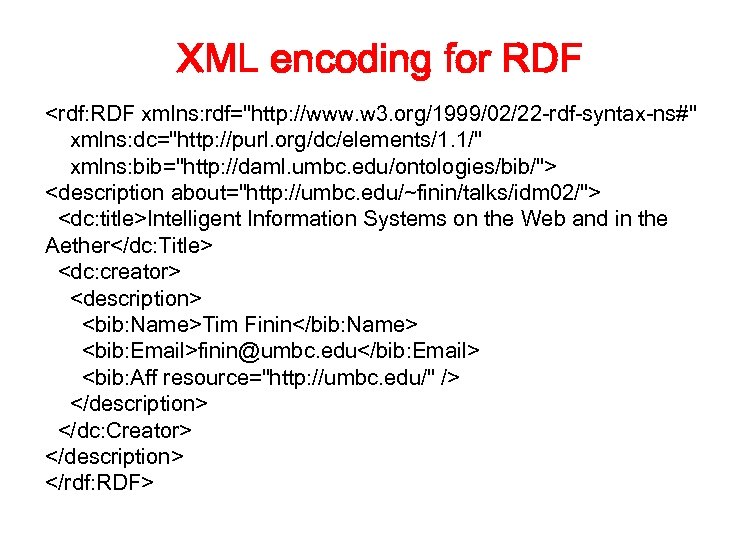
Simple RDF Example dc: Title http: //umbc. edu/ ~finin/talks/idm 02/ “Intelligent Information Systems on the Web and in the Aether” dc: Creator bib: Aff http: //umbc. edu/ bib: name “Tim Finin” bib: email “finin@umbc. edu”
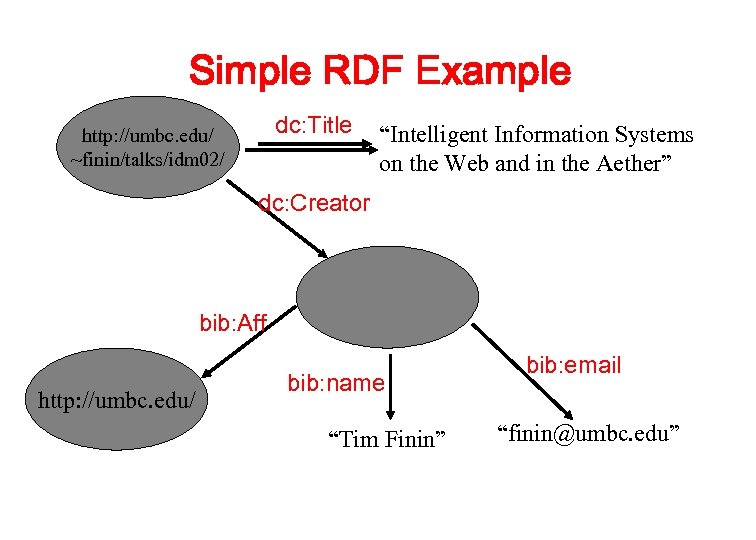
XML encoding for RDF <rdf: RDF xmlns: rdf="http: //www. w 3. org/1999/02/22 -rdf-syntax-ns#" xmlns: dc="http: //purl. org/dc/elements/1. 1/" xmlns: bib="http: //daml. umbc. edu/ontologies/bib/"> <description about="http: //umbc. edu/~finin/talks/idm 02/"> <dc: title>Intelligent Information Systems on the Web and in the Aether</dc: Title> <dc: creator> <description> <bib: Name>Tim Finin</bib: Name> <bib: Email>finin@umbc. edu</bib: Email> <bib: Aff resource="http: //umbc. edu/" /> </description> </dc: Creator> </description> </rdf: RDF>
A usecase: FOAF • FOAF (Friend of a Friend) is a simple ontology to describe people and their social networks. – See the foaf project page: http: //www. foaf-project. org/ • We recently crawled the web and discovered over 1, 000 valid RDF FOAF files. – Most of these are from the http: //live. Journal. com/ blogging system which encodes basic user info in foaf – See http: //apple. cs. umbc. edu/semdis/wob/foaf/ <foaf: Person> <foaf: name>Tim Finin</foaf: name> <foaf: mbox_sha 1 sum>2410… 37262 c 252 e</foaf: mbox_sha 1 sum> <foaf: homepage rdf: resource="http: //umbc. edu/~finin/" /> <foaf: img rdf: resource="http: //umbc. edu/~finin/images/passport. gif" /> </foaf: Person>
FOAF: why RDF? Extensibility! • FOAF vocabulary provides 50+ basic terms for making simple claims about people • FOAF files can use other RDF terms too: RSS, Music. Brainz, Dublin Core, Wordnet, Creative Commons, blood types, starsigns, … • RDF guarantees freedom of independent extension – OWL provides fancier data-merging facilities • Result: Freedom to say what you like, using any RDF markup you want, and have RDF crawlers merge your FOAF documents with other’s and know when you’re talking about the same entities. After Dan Brickley, danbri@w 3. org
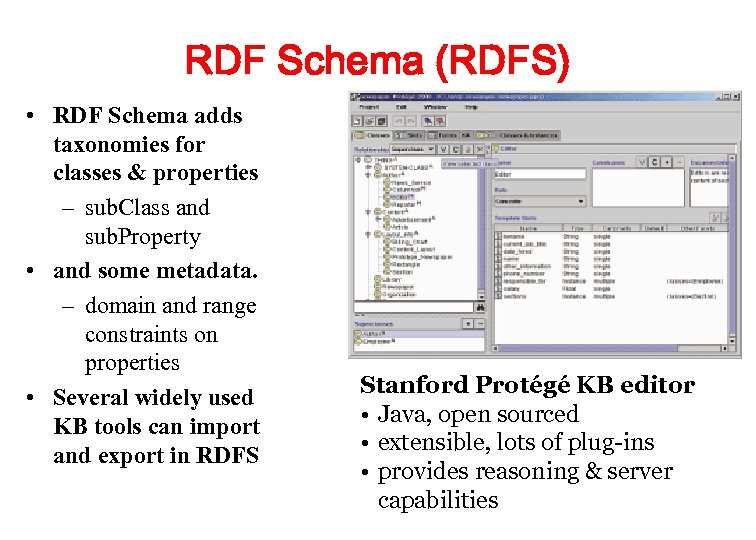
RDF Schema (RDFS) • RDF Schema adds taxonomies for classes & properties – sub. Class and sub. Property • and some metadata. – domain and range constraints on properties • Several widely used KB tools can import and export in RDFS Stanford Protégé KB editor • Java, open sourced • extensible, lots of plug-ins • provides reasoning & server capabilities
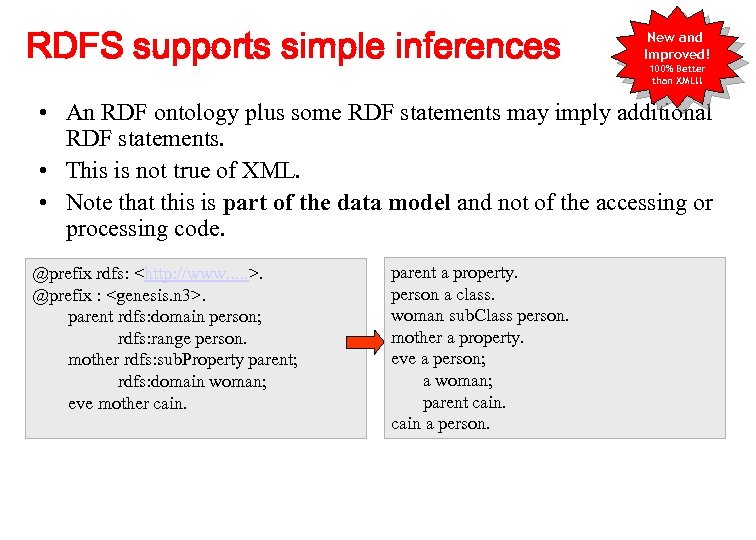
RDFS supports simple inferences New and Improved! 100% Better than XML!! • An RDF ontology plus some RDF statements may imply additional RDF statements. • This is not true of XML. • Note that this is part of the data model and not of the accessing or processing code. @prefix rdfs: <http: //www. . . >. @prefix : <genesis. n 3>. parent rdfs: domain person; rdfs: range person. mother rdfs: sub. Property parent; rdfs: domain woman; eve mother cain. parent a property. person a class. woman sub. Class person. mother a property. eve a person; a woman; parent cain a person.
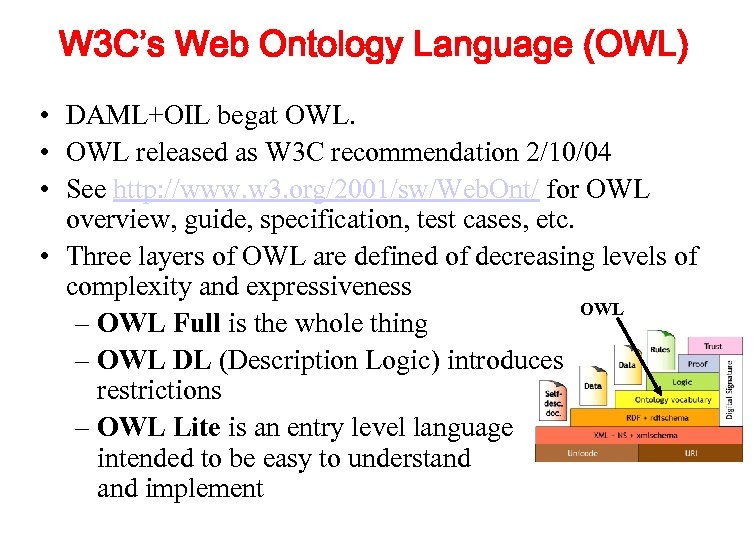
W 3 C’s Web Ontology Language (OWL) • DAML+OIL begat OWL. • OWL released as W 3 C recommendation 2/10/04 • See http: //www. w 3. org/2001/sw/Web. Ont/ for OWL overview, guide, specification, test cases, etc. • Three layers of OWL are defined of decreasing levels of complexity and expressiveness OWL – OWL Full is the whole thing – OWL DL (Description Logic) introduces restrictions – OWL Lite is an entry level language intended to be easy to understand implement
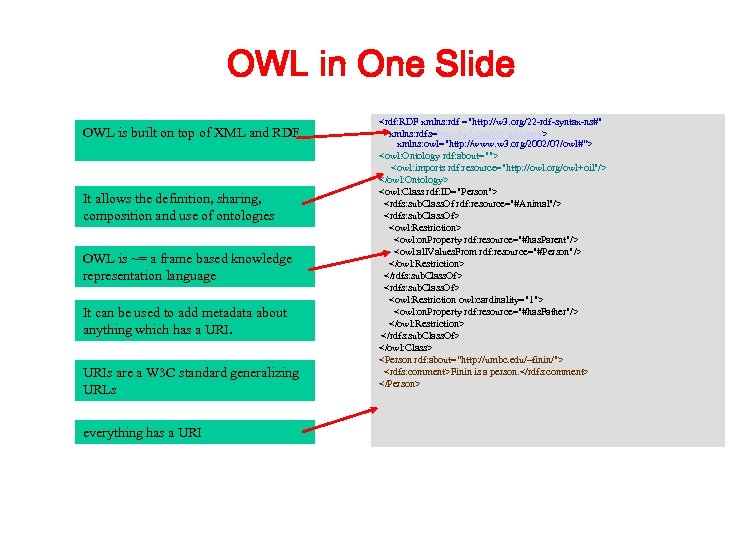
OWL in One Slide OWL is built on top of XML and RDF It allows the definition, sharing, composition and use of ontologies OWL is ~= a frame based knowledge representation language It can be used to add metadata about anything which has a URIs are a W 3 C standard generalizing URLs everything has a URI <rdf: RDF xmlns: rdf ="http: //w 3. org/22 -rdf-syntax-ns#" xmlns: rdfs=http: //w 3. org/rdf-schema#> xmlns: owl="http: //www. w 3. org/2002/07/owl#”> <owl: Ontology rdf: about=""> <owl: imports rdf: resource="http: //owl. org/owl+oil"/> </owl: Ontology> <owl: Class rdf: ID="Person"> <rdfs: sub. Class. Of rdf: resource="#Animal"/> <rdfs: sub. Class. Of> <owl: Restriction> <owl: on. Property rdf: resource="#has. Parent"/> <owl: all. Values. From rdf: resource="#Person"/> </owl: Restriction> </rdfs: sub. Class. Of> <rdfs: sub. Class. Of> <owl: Restriction owl: cardinality="1"> <owl: on. Property rdf: resource="#has. Father"/> </owl: Restriction> </rdfs: sub. Class. Of> </owl: Class> <Person rdf: about=“http: //umbc. edu/~finin/"> <rdfs: comment>Finin is a person. </rdfs: comment> </Person>
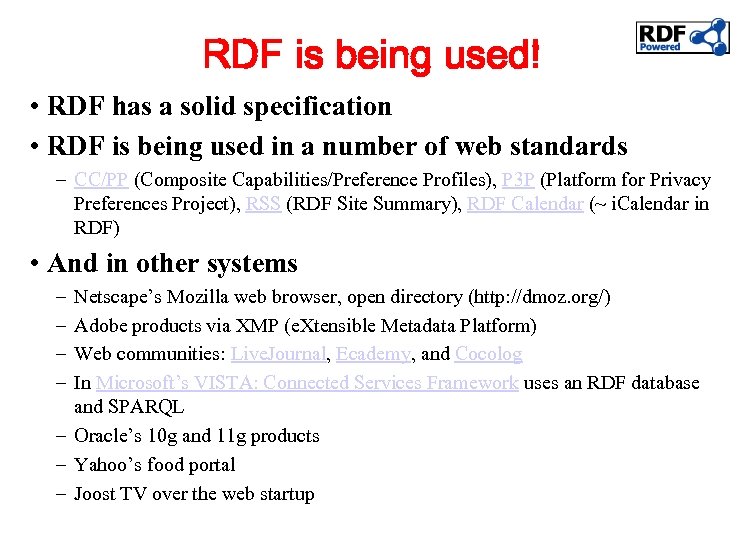
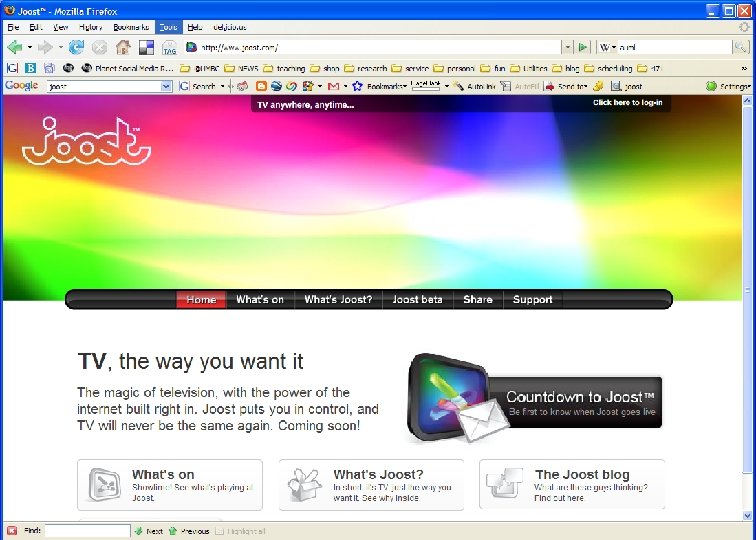
RDF is being used! • RDF has a solid specification • RDF is being used in a number of web standards – CC/PP (Composite Capabilities/Preference Profiles), P 3 P (Platform for Privacy Preferences Project), RSS (RDF Site Summary), RDF Calendar (~ i. Calendar in RDF) • And in other systems – – Netscape’s Mozilla web browser, open directory (http: //dmoz. org/) Adobe products via XMP (e. Xtensible Metadata Platform) Web communities: Live. Journal, Ecademy, and Cocolog In Microsoft’s VISTA: Connected Services Framework uses an RDF database and SPARQL – Oracle’s 10 g and 11 g products – Yahoo’s food portal – Joost TV over the web startup
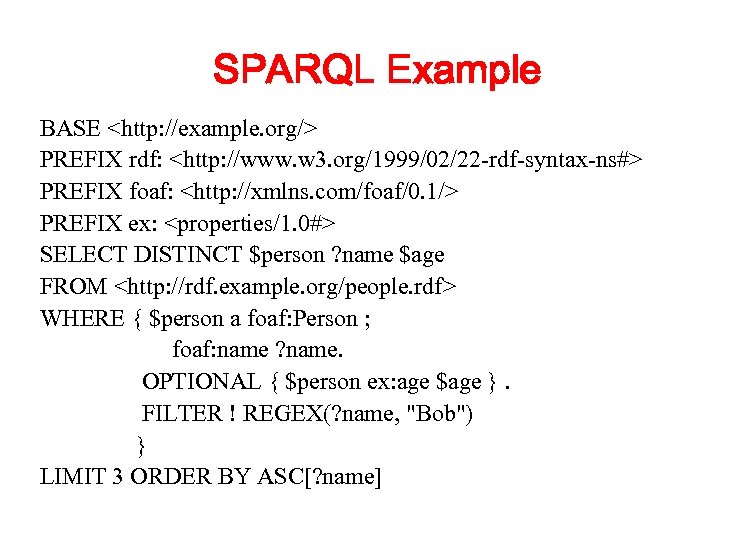
SPARQL Example BASE <http: //example. org/> PREFIX rdf: <http: //www. w 3. org/1999/02/22 -rdf-syntax-ns#> PREFIX foaf: <http: //xmlns. com/foaf/0. 1/> PREFIX ex: <properties/1. 0#> SELECT DISTINCT $person ? name $age FROM <http: //rdf. example. org/people. rdf> WHERE { $person a foaf: Person ; foaf: name ? name. OPTIONAL { $person ex: age $age }. FILTER ! REGEX(? name, "Bob") } LIMIT 3 ORDER BY ASC[? name]
Some applications involving ACLs and the Semantic Web
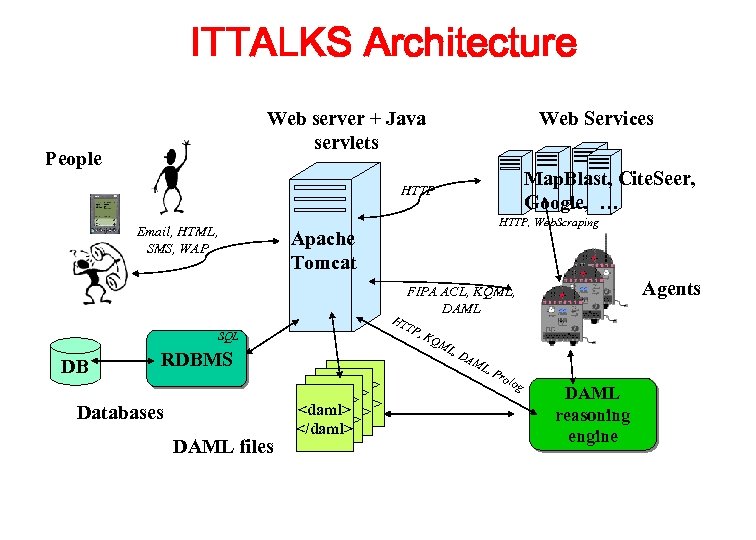
ITTALKS Architecture Web Services Web server + Java servlets People Map. Blast, Cite. Seer, Google, … HTTP Email, HTML, SMS, WAP HTTP, Web. Scraping Apache Tomcat HT TP SQL DB RDBMS Databases DAML files <daml> </daml> Agents FIPA ACL, KQML, DAML , K QM L, D AM L, P rol og DAML reasoning engine
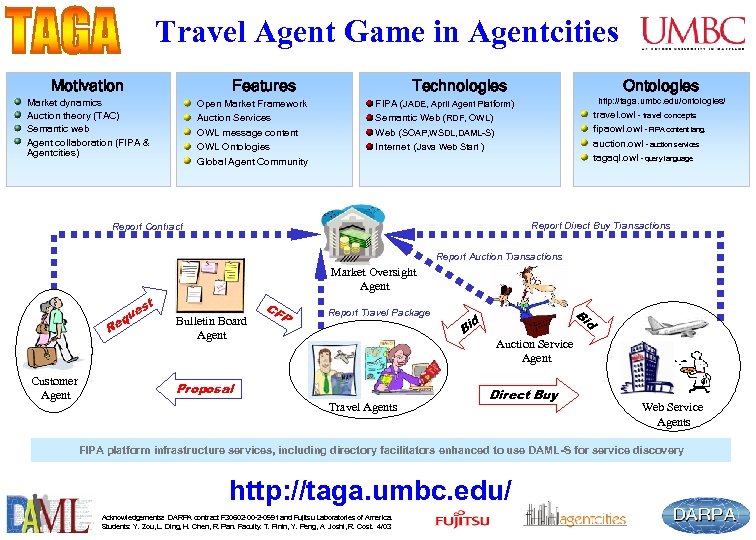
Travel Agent Game in Agentcities Motivation Features Market dynamics Auction theory (TAC) Semantic web Agent collaboration (FIPA & Agentcities) Open Market Framework Auction Services OWL message content OWL Ontologies Global Agent Community Technologies Ontologies http: //taga. umbc. edu/ontologies/ FIPA (JADE, April Agent Platform) Semantic Web (RDF, OWL) Web (SOAP, WSDL, DAML-S) Internet (Java Web Start ) travel. owl – travel concepts fipaowl. owl – FIPA content lang. auction. owl – auction services tagaql. owl – query language Report Direct Buy Transactions Report Contract Report Auction Transactions Market Oversight Agent Customer Agent eq Bulletin Board Agent CF P Report Travel Package Proposal Travel Agents d Bi id B R t s ue Auction Service Agent Direct Buy Web Service Agents FIPA platform infrastructure services, including directory facilitators enhanced to use DAML-S for service discovery http: //taga. umbc. edu/ Acknowledgements: DARPA contract F 30602 -00 -2 -0591 and Fujitsu Laboratories of America. Students: Y. Zou, L. Ding, H. Chen, R. Pan. Faculty: T. Finin, Y. Peng, A. Joshi, R. Cost. 4/03
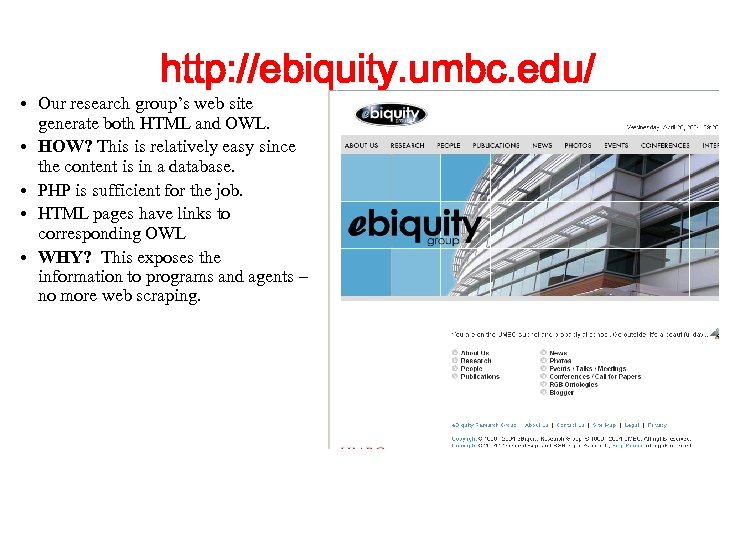
http: //ebiquity. umbc. edu/ • Our research group’s web site generate both HTML and OWL. • HOW? This is relatively easy since the content is in a database. • PHP is sufficient for the job. • HTML pages have links to corresponding OWL • WHY? This exposes the information to programs and agents – no more web scraping.
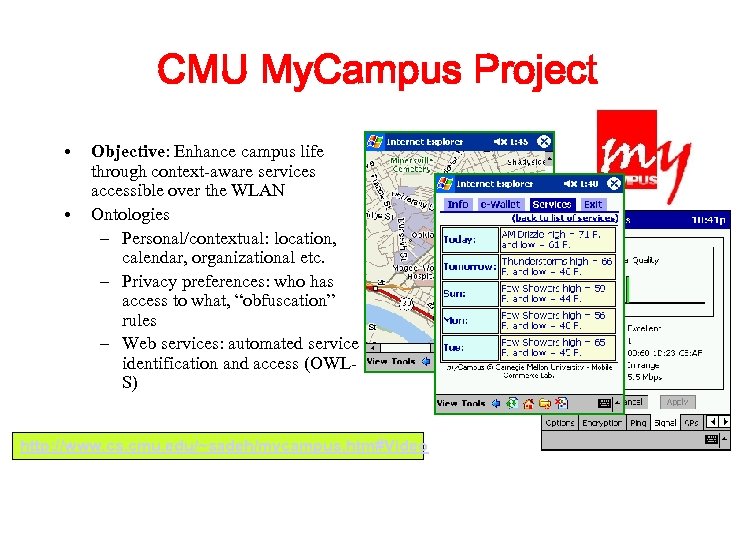
CMU My. Campus Project • • Objective: Enhance campus life through context-aware services accessible over the WLAN Ontologies – Personal/contextual: location, calendar, organizational etc. – Privacy preferences: who has access to what, “obfuscation” rules – Web services: automated service identification and access (OWLS) http: //www. cs. cmu. edu/~sadeh/mycampus. htm#Video
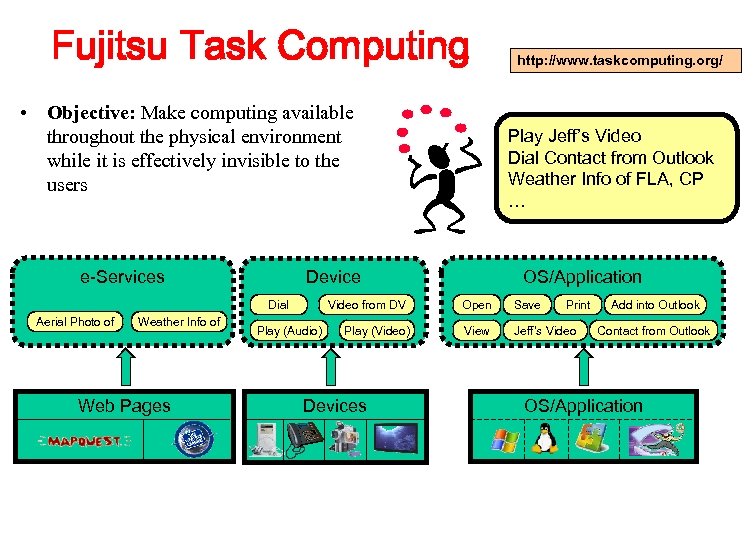
Fujitsu Task Computing • Objective: Make computing available throughout the physical environment while it is effectively invisible to the users e-Services Aerial Photo of Weather Info of Web Pages Play Jeff’s Video Dial Contact from Outlook Weather Info of FLA, CP … OS/Application Device Dial Video from DV Play (Audio) Play (Video) Devices http: //www. taskcomputing. org/ Open Save Print View Jeff’s Video Add into Outlook Contact from Outlook OS/Application
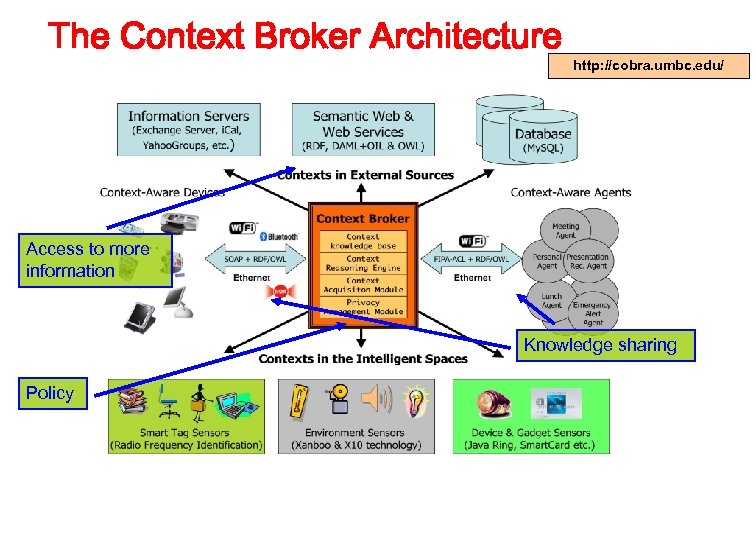
The Context Broker Architecture http: //cobra. umbc. edu/ Access to more information Knowledge sharing Policy
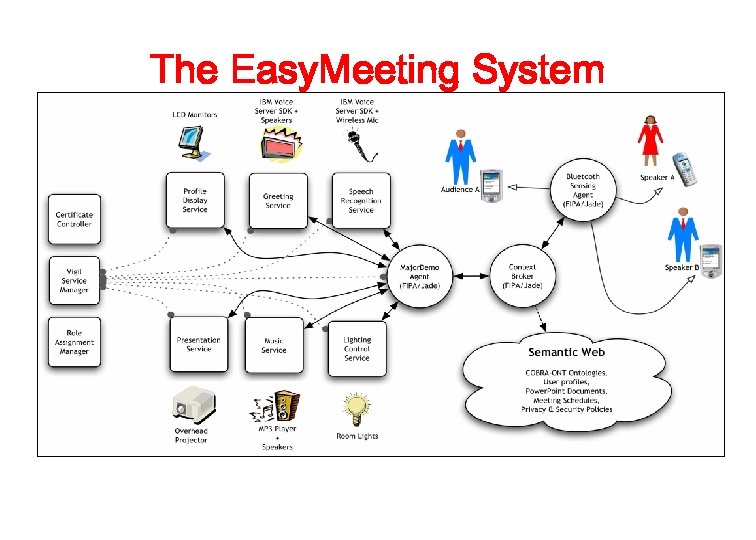
The Easy. Meeting System
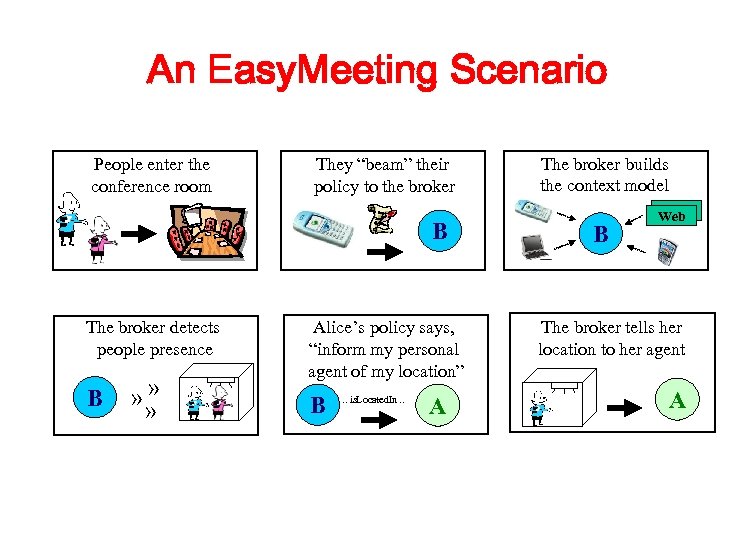
An Easy. Meeting Scenario People enter the conference room They “beam” their policy to the broker B The broker detects people presence B » » » Alice’s policy says, “inform my personal agent of my location” B . . is. Located. In. . A The broker builds the context model B Web The broker tells her location to her agent A
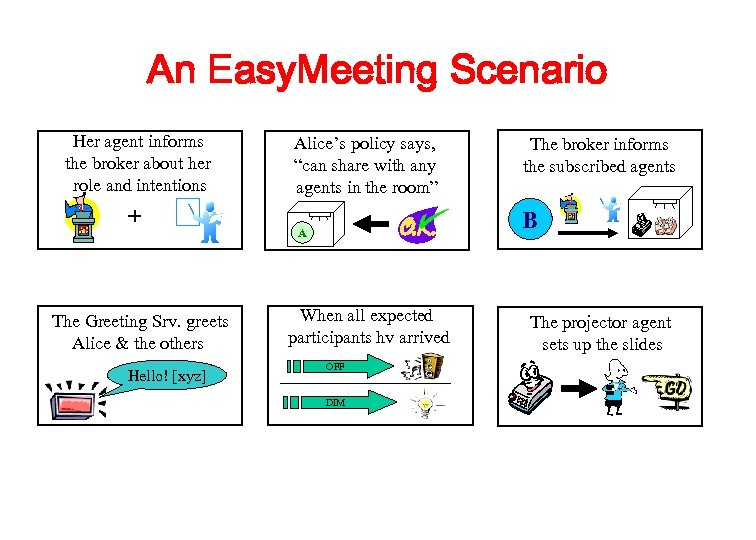
An Easy. Meeting Scenario Her agent informs the broker about her role and intentions + The Greeting Srv. greets Alice & the others Hello! [xyz] Alice’s policy says, “can share with any agents in the room” The broker informs the subscribed agents B A When all expected participants hv arrived OFF DIM The projector agent sets up the slides
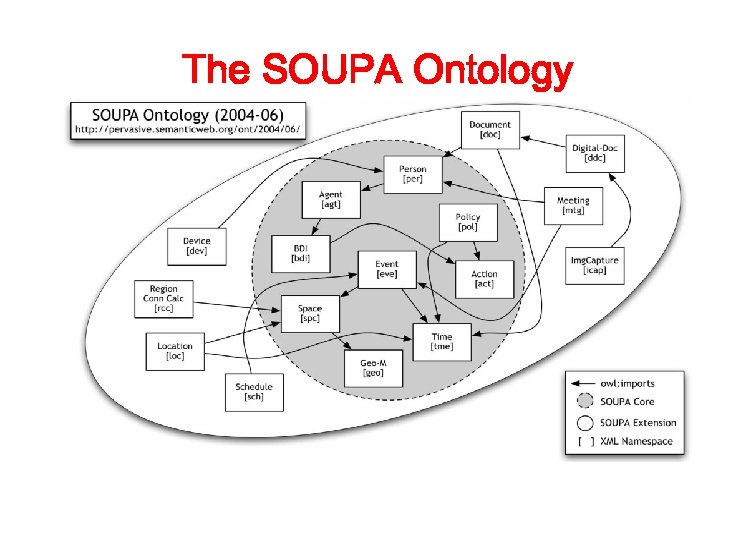
The SOUPA Ontology
2010 and Beyond
It's hard to make predictions, especially about the future
Things to watch • Google (e. g. , Google. Base) • Wikipedia (e. g. , Semantic Media. Wiki) • Freebase (OWL meets Wikipedia? ) • Joost – a high profile startup (internet meets TV) is using RDF and considers it to be "XML on steroids. " • If RDF is the new KIF, then SPARQL might evolve into the new KQML
Conclusions
Some key ideas • Software agents offer a new paradigm for very large scale distributed heterogeneous applications. • The paradigm focuses on the interactions of autonomous, cooperating processes which can adapt to humans and other agents. • Agent Communication Languages are a key enabling technology – Mobility is an orthogonal characteristic which many, but not all, consider central. – Intelligence is always a desirable characteristic but is not strictly required by the paradigm. • The paradigm is still forming and ACLs will continue to evolve.
Скачать презентацию A Brief Overview of Agent Communication in the
f5af2607c56b91ba48a30c54a7b2fbe2.ppt