 Скачать презентацию A bottom up typology of parent feeding practices
d135d46c3dba5d2bd26b0248d10b8130.ppt
- Количество слайдов: 50



A “bottom up” typology of parent feeding practices relates to Head Start child BMI and diet Franklin, Michelle Feese Mary Lou Lackey, Sheryl Hughes, Richard Shewchuk, John Bentley, Edmond Kabagambe UAB and Baylor College of Medicine
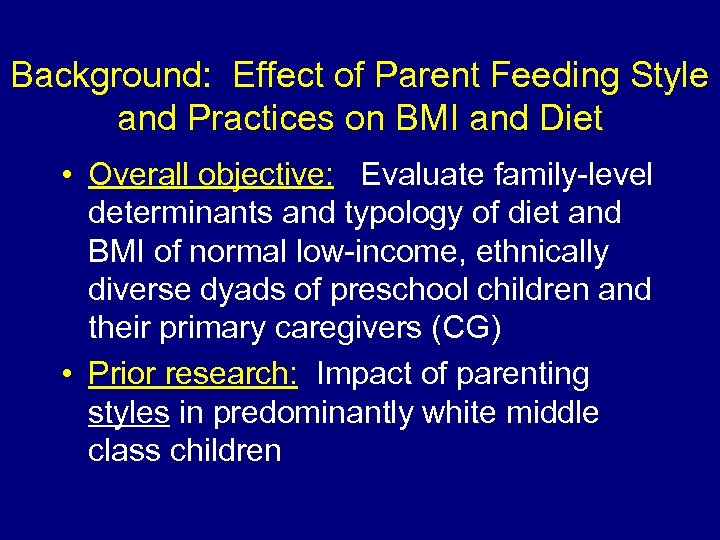
Background: Effect of Parent Feeding Style and Practices on BMI and Diet • Overall objective: Evaluate family-level determinants and typology of diet and BMI of normal low-income, ethnically diverse dyads of preschool children and their primary caregivers (CG) • Prior research: Impact of parenting styles in predominantly white middle class children
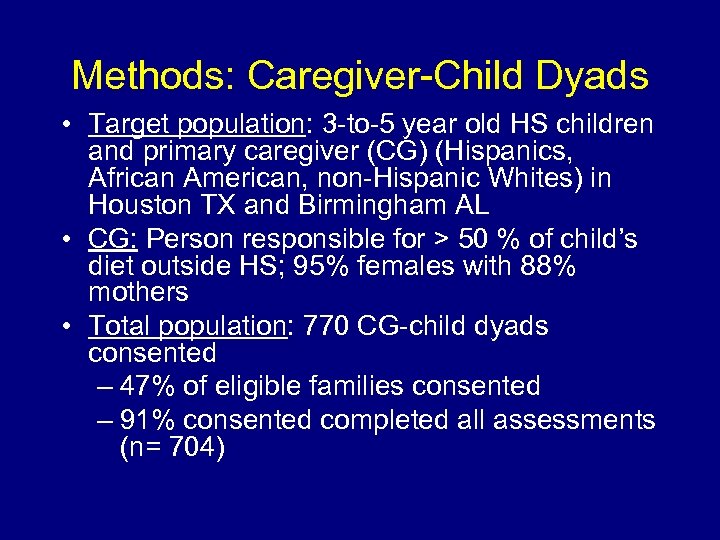
Methods: Caregiver-Child Dyads • Target population: 3 -to-5 year old HS children and primary caregiver (CG) (Hispanics, African American, non-Hispanic Whites) in Houston TX and Birmingham AL • CG: Person responsible for > 50 % of child’s diet outside HS; 95% females with 88% mothers • Total population: 770 CG-child dyads consented – 47% of eligible families consented – 91% consented completed all assessments (n= 704)
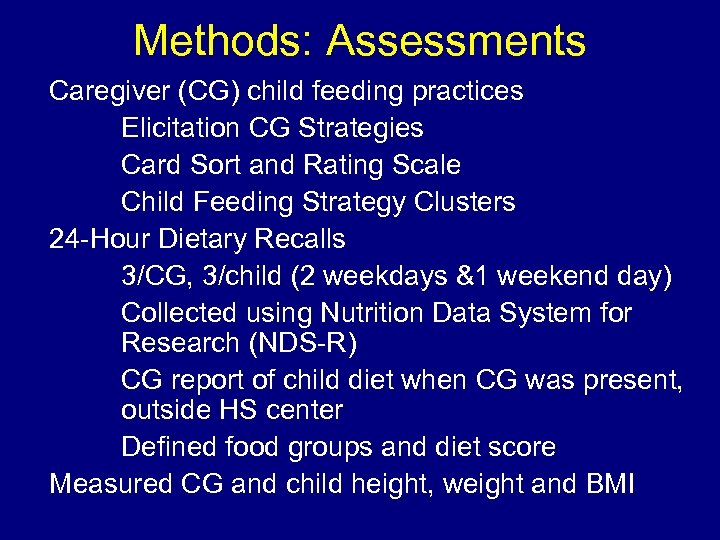
Methods: Assessments Caregiver (CG) child feeding practices Elicitation CG Strategies Card Sort and Rating Scale Child Feeding Strategy Clusters 24 -Hour Dietary Recalls 3/CG, 3/child (2 weekdays &1 weekend day) Collected using Nutrition Data System for Research (NDS-R) CG report of child diet when CG was present, outside HS center Defined food groups and diet score Measured CG and child height, weight and BMI
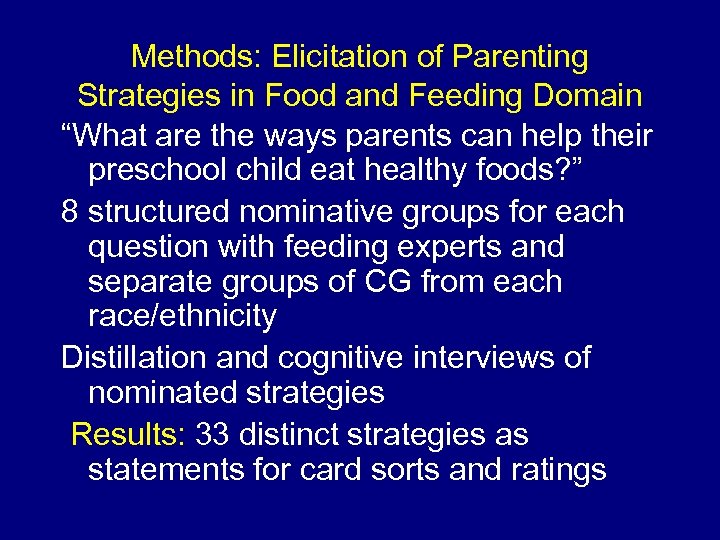
Methods: Elicitation of Parenting Strategies in Food and Feeding Domain “What are the ways parents can help their preschool child eat healthy foods? ” 8 structured nominative groups for each question with feeding experts and separate groups of CG from each race/ethnicity Distillation and cognitive interviews of nominated strategies Results: 33 distinct strategies as statements for card sorts and ratings
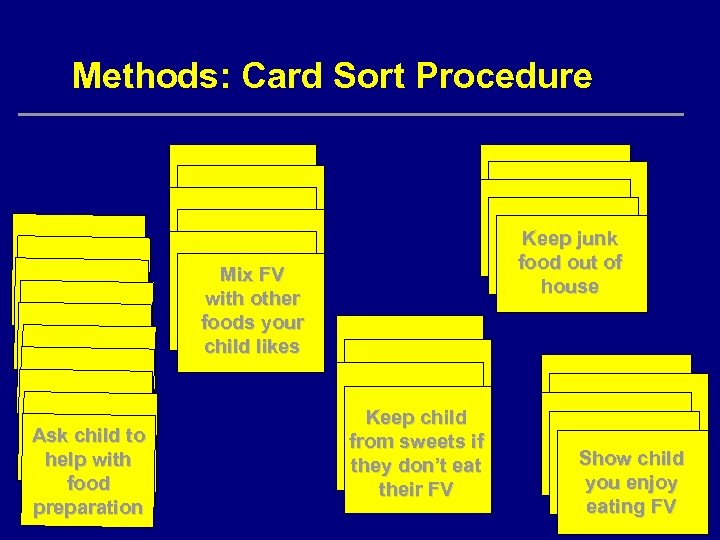
Methods: Card Sort Procedure Keep junk food out of house Mix FV with other foods your child likes Ask child to help with food preparation Keep child from sweets if they don’t eat their FV Show child you enjoy eating FV
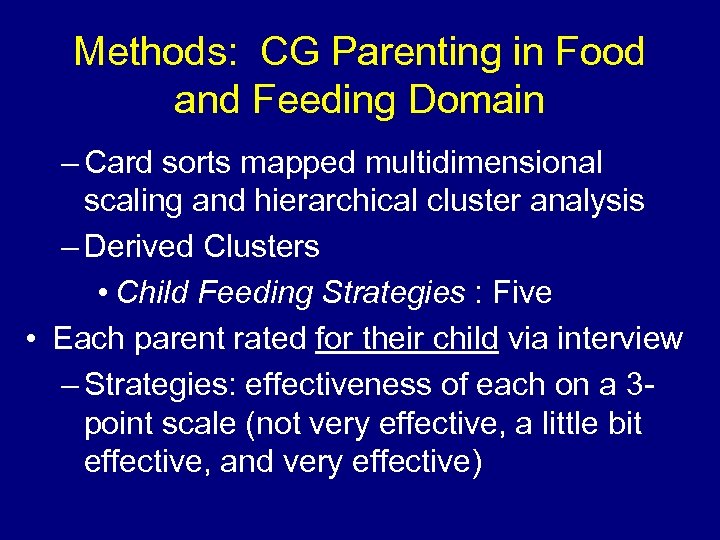
Methods: CG Parenting in Food and Feeding Domain – Card sorts mapped multidimensional scaling and hierarchical cluster analysis – Derived Clusters • Child Feeding Strategies : Five • Each parent rated for their child via interview – Strategies: effectiveness of each on a 3 point scale (not very effective, a little bit effective, and very effective)
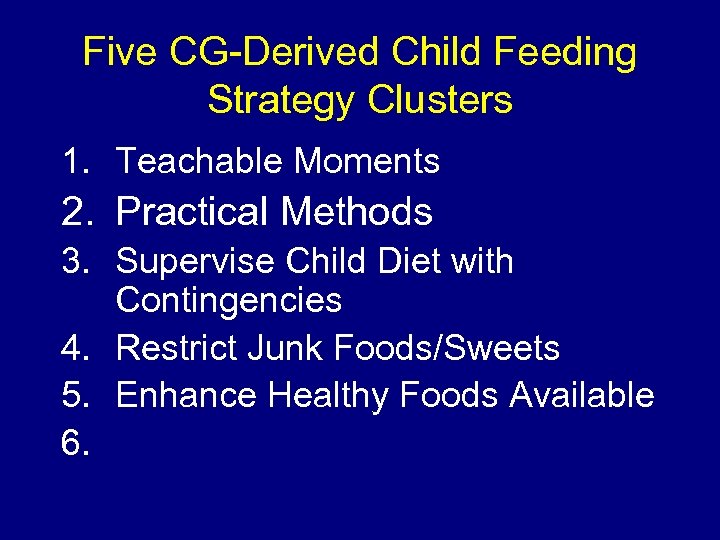
Five CG-Derived Child Feeding Strategy Clusters 1. Teachable Moments 2. Practical Methods 3. Supervise Child Diet with Contingencies 4. Restrict Junk Foods/Sweets 5. Enhance Healthy Foods Available 6.
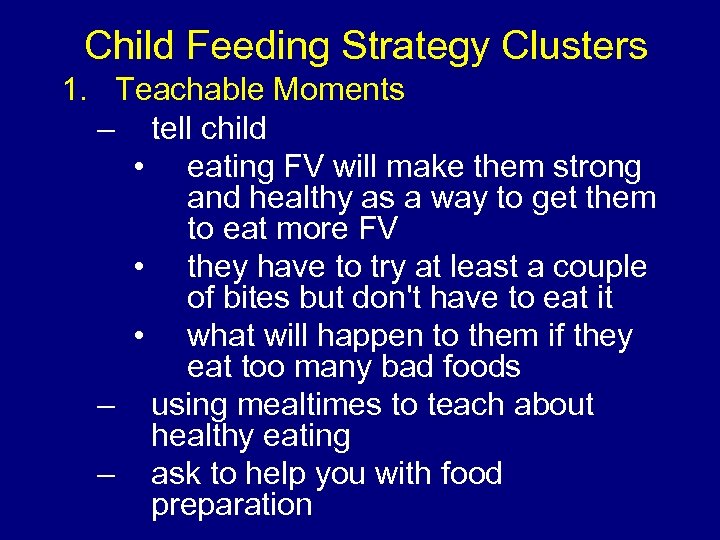
Child Feeding Strategy Clusters 1. Teachable Moments – tell child • eating FV will make them strong and healthy as a way to get them to eat more FV • they have to try at least a couple of bites but don't have to eat it • what will happen to them if they eat too many bad foods – using mealtimes to teach about healthy eating – ask to help you with food preparation
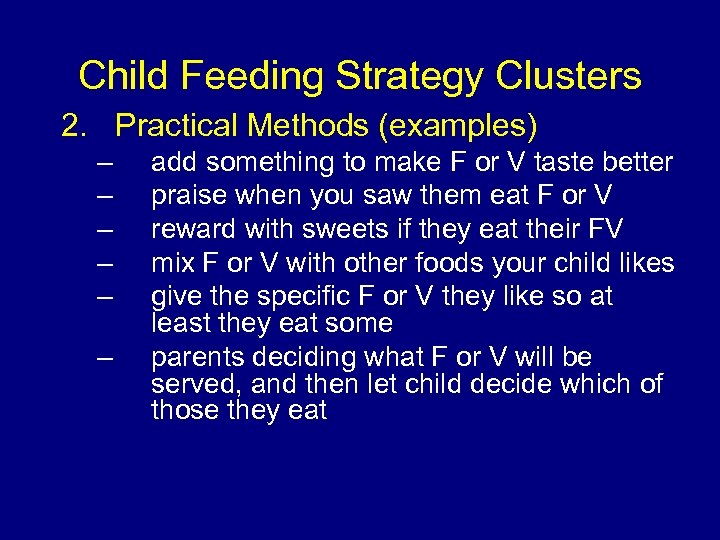
Child Feeding Strategy Clusters 2. Practical Methods (examples) – – – add something to make F or V taste better praise when you saw them eat F or V reward with sweets if they eat their FV mix F or V with other foods your child likes give the specific F or V they like so at least they eat some parents deciding what F or V will be served, and then let child decide which of those they eat
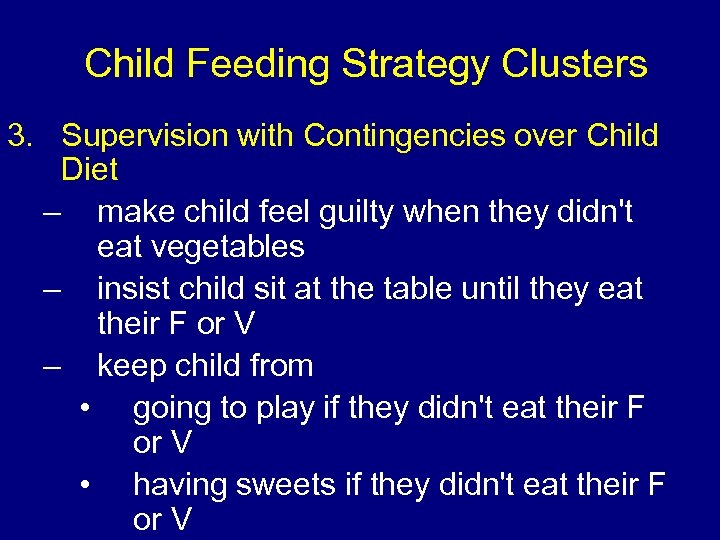
Child Feeding Strategy Clusters 3. Supervision with Contingencies over Child Diet – make child feel guilty when they didn't eat vegetables – insist child sit at the table until they eat their F or V – keep child from • going to play if they didn't eat their F or V • having sweets if they didn't eat their F or V
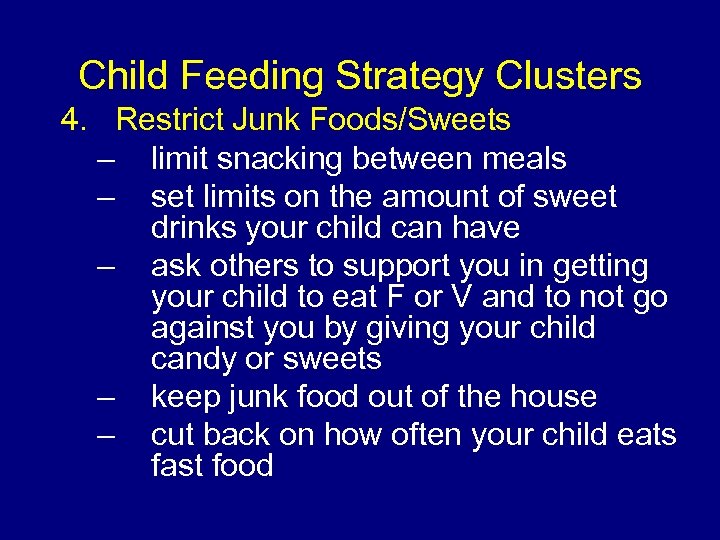
Child Feeding Strategy Clusters 4. Restrict Junk Foods/Sweets – limit snacking between meals – set limits on the amount of sweet drinks your child can have – ask others to support you in getting your child to eat F or V and to not go against you by giving your child candy or sweets – keep junk food out of the house – cut back on how often your child eats fast food
Child Feeding Strategy Clusters 5. Enhance Healthy Food Availability (examples) • • • show your child that you enjoy eating FV offer F or V without forcing your child to eat them include some form of F or V or juice in most meals so that your child gets used to eating them sit at the table and eating together as a family put F or V where your child can easily reach them buy F or V instead of junk food make sure that F or V are available around your house
Authoritarian Child Feeding Practices (examples) • Physically struggle to get him/her to eat • Promise something other than food if he/she eats • Say something to show your disapproval for not eating dinner • Warn that you will take away something other than food if he/she doesn’t eat
Authoritative Child Feeding Practices (examples) • Encourage to eat by arranging the food to make it more interesting • Reason to get him/her to eat • Allow to choose the foods he/she wants to eat for dinner from foods already prepared • Compliment for eating food • Say something positive about child’s food during dinner
Permissive Child Feeding Practices (examples) • Allow to eat as much as he/she wants • Permit to decide whether he/she gets a second or third helping • Let decide how much he or she should eat off of the plate • Allow to eat what and when he/she wants to eat
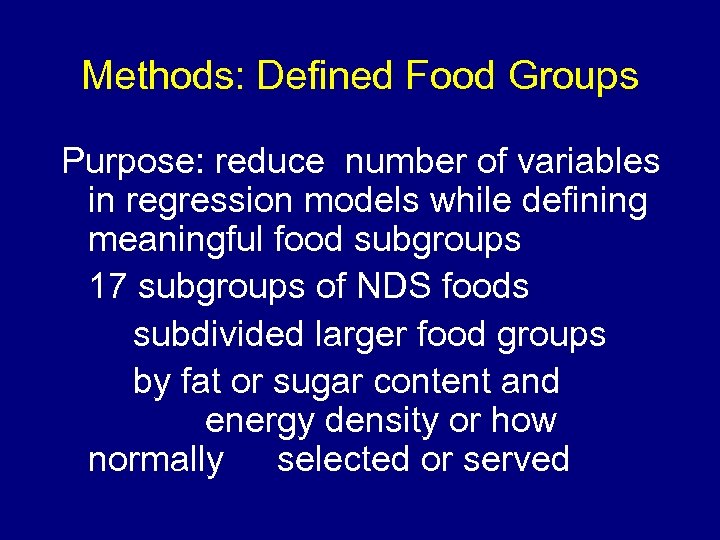
Methods: Defined Food Groups Purpose: reduce number of variables in regression models while defining meaningful food subgroups 17 subgroups of NDS foods subdivided larger food groups by fat or sugar content and energy density or how normally selected or served
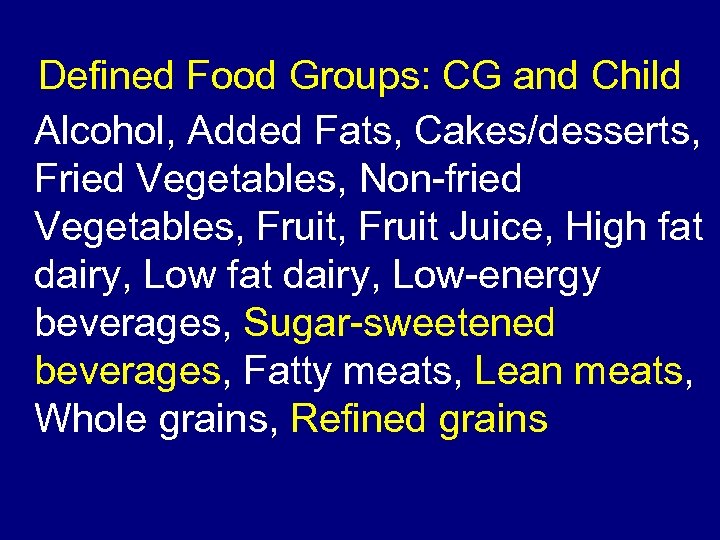
Defined Food Groups: CG and Child Alcohol, Added Fats, Cakes/desserts, Fried Vegetables, Non-fried Vegetables, Fruit Juice, High fat dairy, Low-energy beverages, Sugar-sweetened beverages, Fatty meats, Lean meats, Whole grains, Refined grains
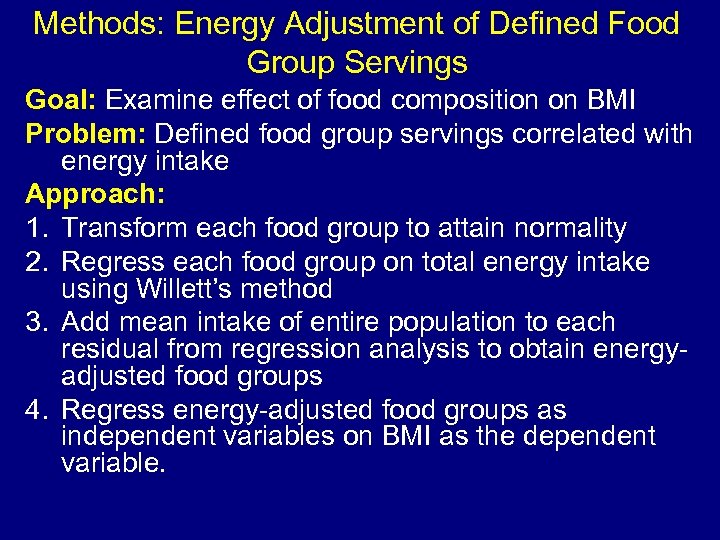
Methods: Energy Adjustment of Defined Food Group Servings Goal: Examine effect of food composition on BMI Problem: Defined food group servings correlated with energy intake Approach: 1. Transform each food group to attain normality 2. Regress each food group on total energy intake using Willett’s method 3. Add mean intake of entire population to each residual from regression analysis to obtain energyadjusted food groups 4. Regress energy-adjusted food groups as independent variables on BMI as the dependent variable.
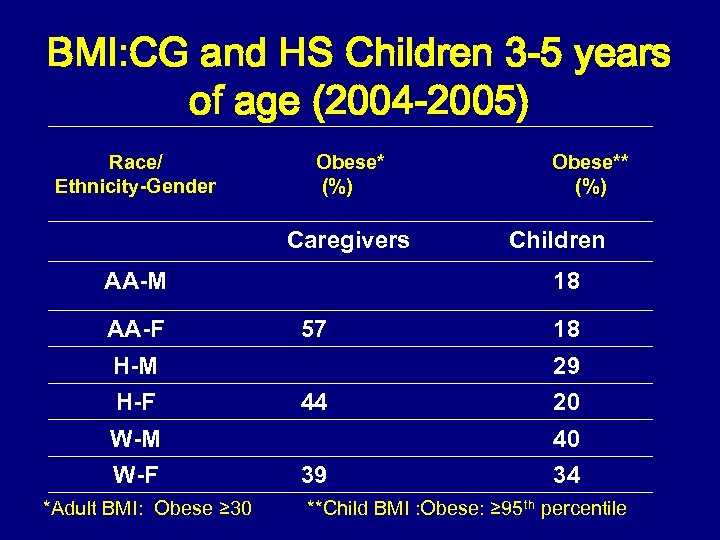
BMI: CG and HS Children 3 -5 years of age (2004 -2005) Race/ Ethnicity-Gender Obese* (%) Caregivers AA-M AA-F 57 *Adult BMI: Obese ≥ 30 18 29 44 W-M W-F Children 18 H-M H-F Obese** (%) 20 40 39 34 **Child BMI : Obese: ≥ 95 th percentile
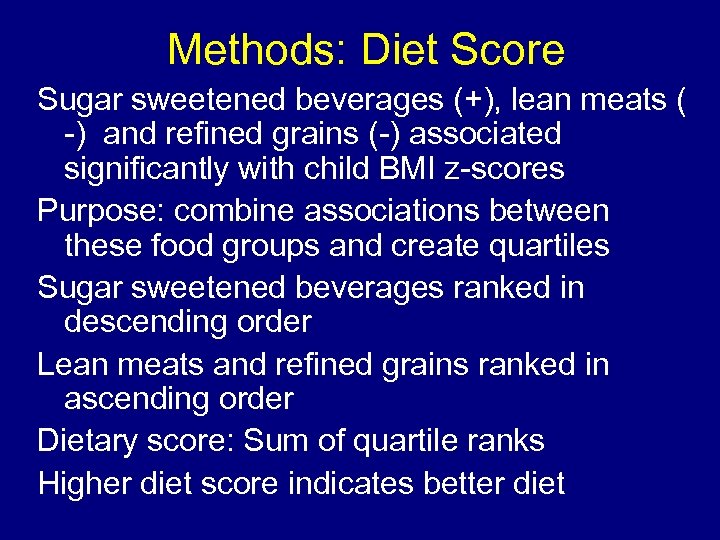
Methods: Diet Score Sugar sweetened beverages (+), lean meats ( -) and refined grains (-) associated significantly with child BMI z-scores Purpose: combine associations between these food groups and create quartiles Sugar sweetened beverages ranked in descending order Lean meats and refined grains ranked in ascending order Dietary score: Sum of quartile ranks Higher diet score indicates better diet
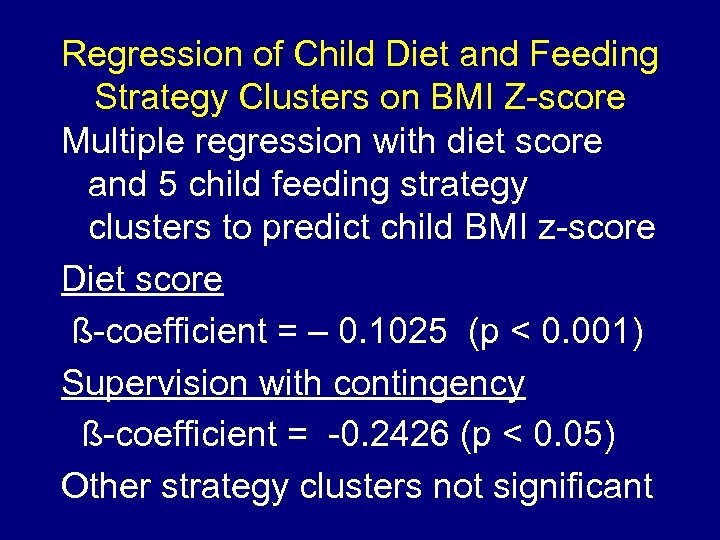
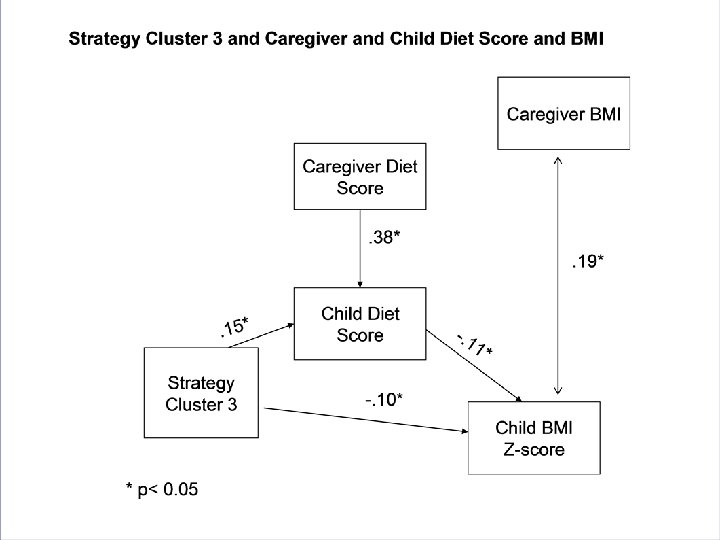
Regression of Child Diet and Feeding Strategy Clusters on BMI Z-score Multiple regression with diet score and 5 child feeding strategy clusters to predict child BMI z-score Diet score ß-coefficient = – 0. 1025 (p < 0. 001) Supervision with contingency ß-coefficient = -0. 2426 (p < 0. 05) Other strategy clusters not significant
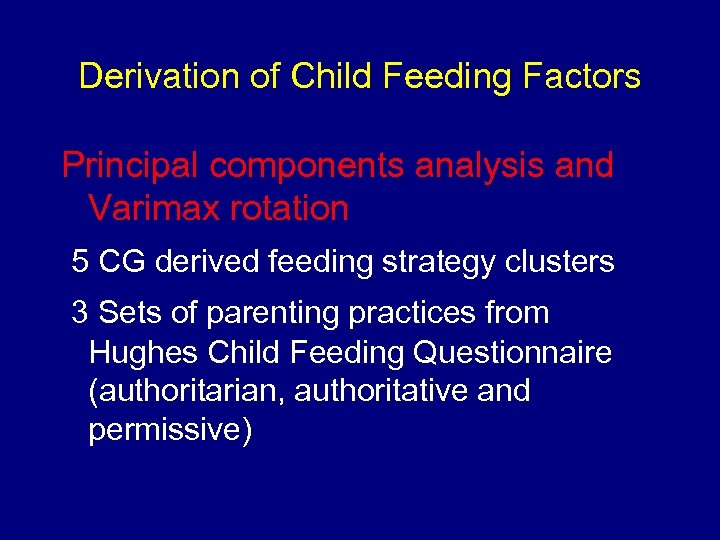
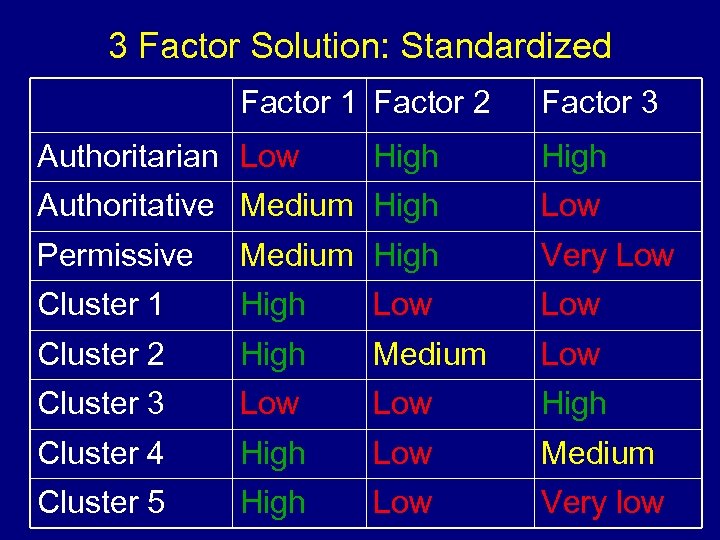
Derivation of Child Feeding Factors Principal components analysis and Varimax rotation 5 CG derived feeding strategy clusters 3 Sets of parenting practices from Hughes Child Feeding Questionnaire (authoritarian, authoritative and permissive)
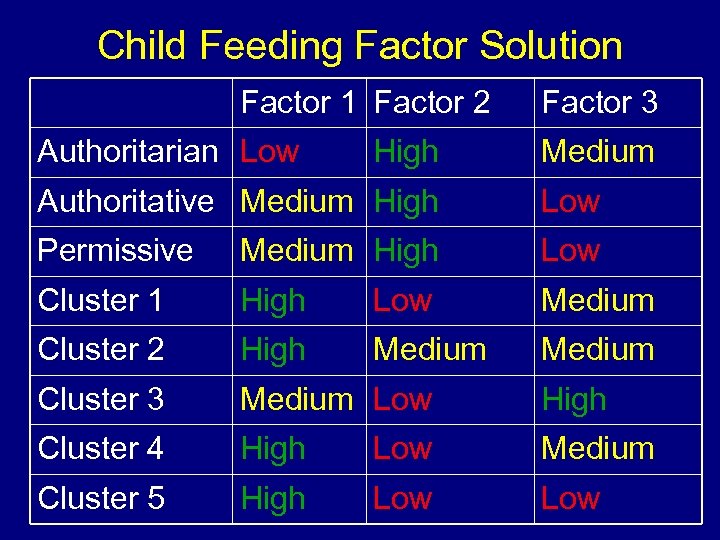
Child Feeding Factor Solution Factor 1 Factor 2 Authoritarian Low High Factor 3 Medium Authoritative Medium High Low Permissive Medium High Low Cluster 1 High Low Medium Cluster 2 High Medium Cluster 3 Medium Low High Cluster 4 High Low Medium Cluster 5 High Low
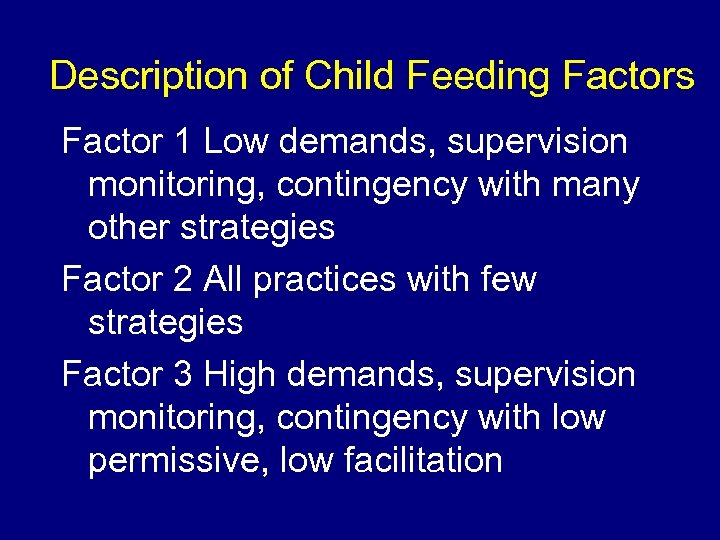
Description of Child Feeding Factors Factor 1 Low demands, supervision monitoring, contingency with many other strategies Factor 2 All practices with few strategies Factor 3 High demands, supervision monitoring, contingency with low permissive, low facilitation
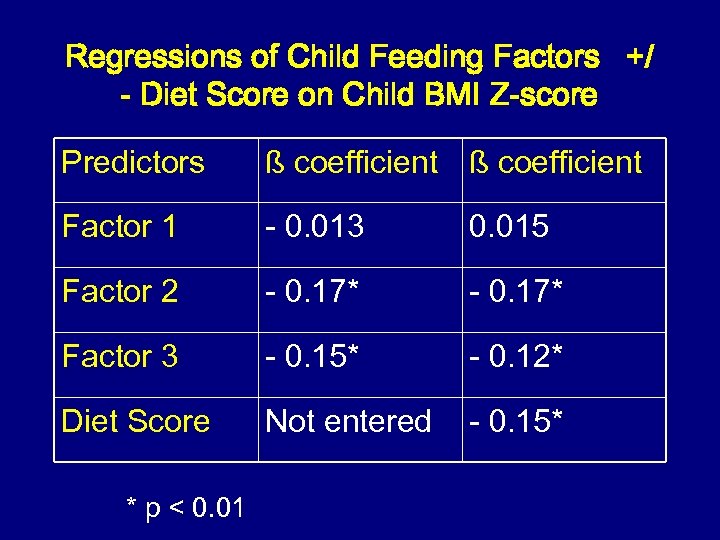
Regressions of Child Feeding Factors +/ - Diet Score on Child BMI Z-score Predictors ß coefficient Factor 1 - 0. 013 0. 015 Factor 2 - 0. 17* Factor 3 - 0. 15* - 0. 12* Diet Score Not entered - 0. 15* * p < 0. 01
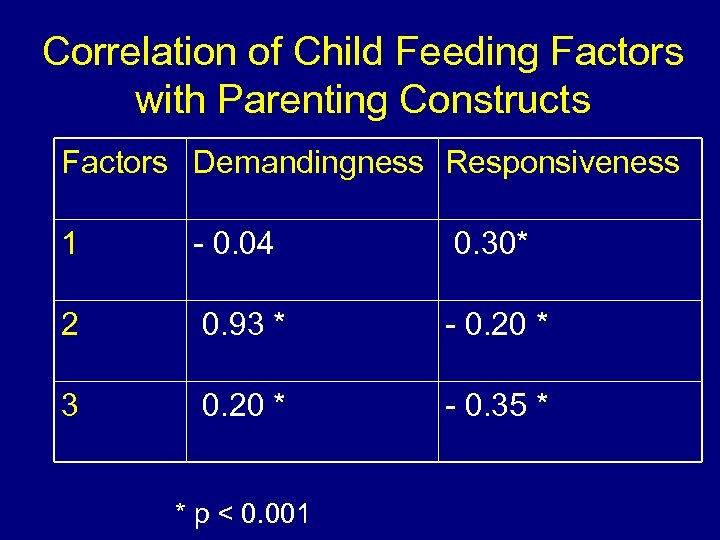
Correlation of Child Feeding Factors with Parenting Constructs Factors Demandingness Responsiveness 1 - 0. 04 0. 30* 2 0. 93 * - 0. 20 * 3 0. 20 * - 0. 35 * * p < 0. 001
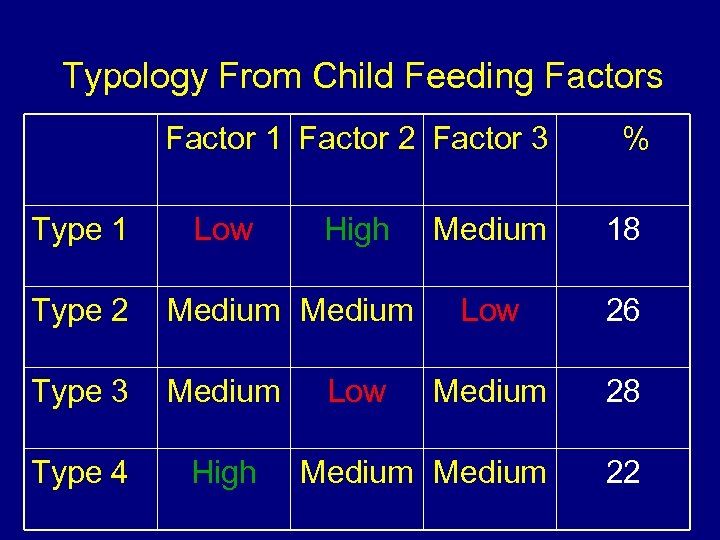
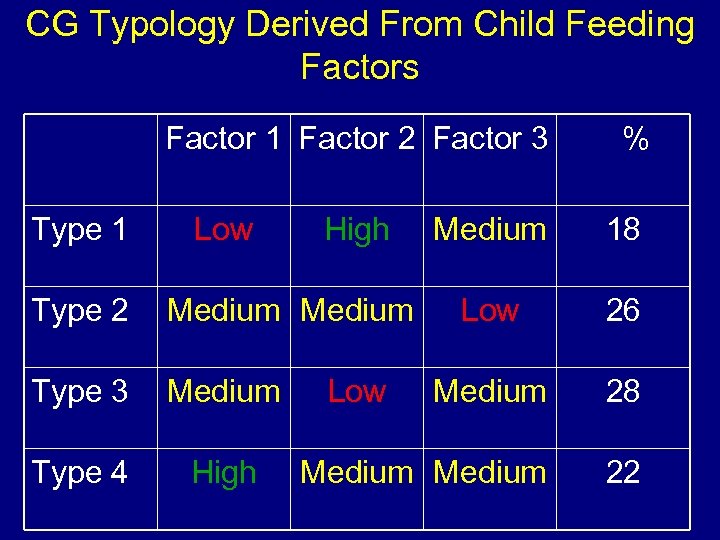
Typology From Child Feeding Factors Factor 1 Factor 2 Factor 3 Type 1 Low High % Medium 18 Low 26 Medium 28 Medium 22 Type 2 Medium Type 3 Medium Type 4 High Low
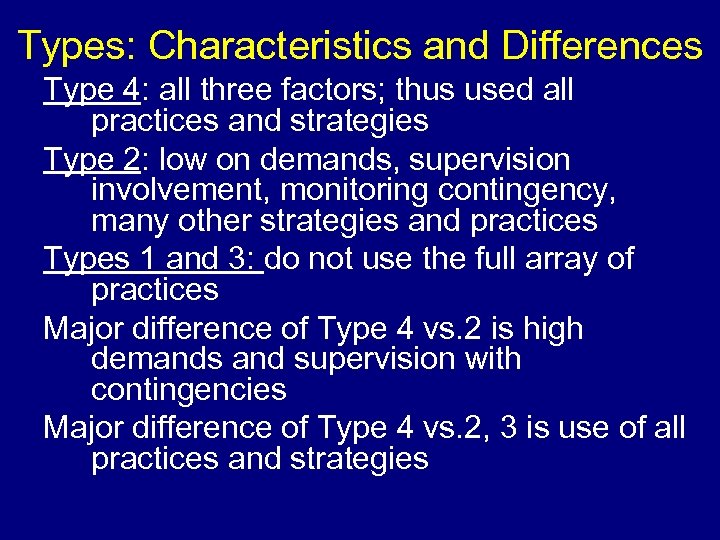
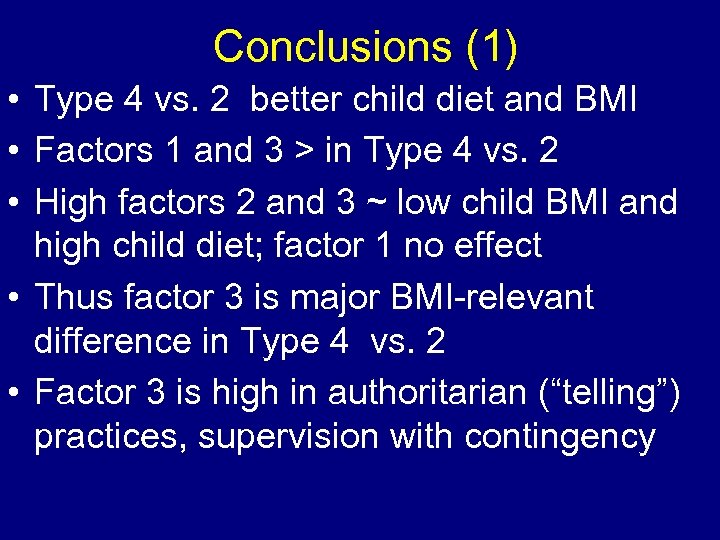
Types: Characteristics and Differences Type 4: all three factors; thus used all practices and strategies Type 2: low on demands, supervision involvement, monitoring contingency, many other strategies and practices Types 1 and 3: do not use the full array of practices Major difference of Type 4 vs. 2 is high demands and supervision with contingencies Major difference of Type 4 vs. 2, 3 is use of all practices and strategies
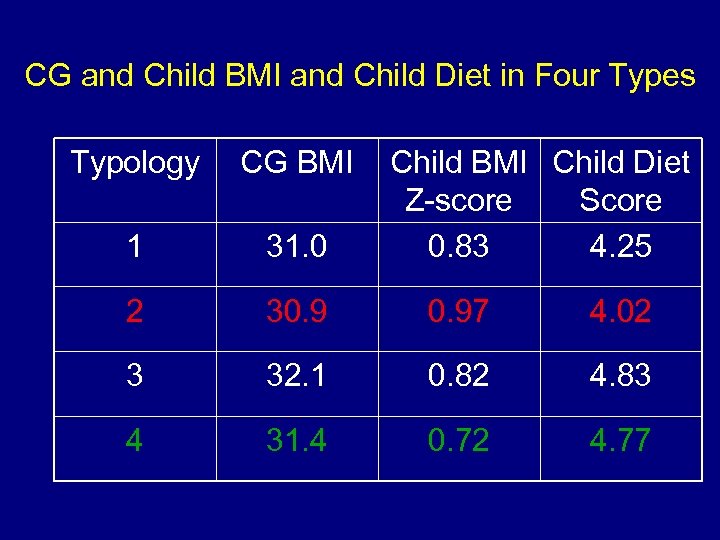
CG and Child BMI and Child Diet in Four Types Typology CG BMI Child Diet Z-score Score 0. 83 4. 25 1 31. 0 2 30. 97 4. 02 3 32. 1 0. 82 4. 83 4 31. 4 0. 72 4. 77
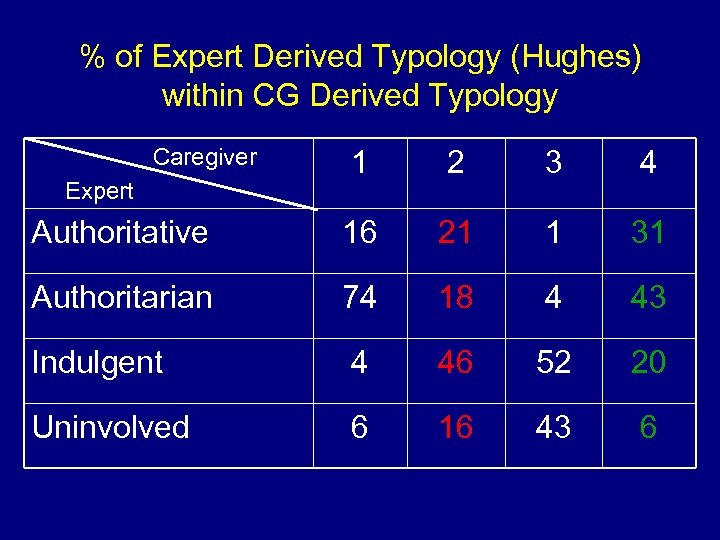
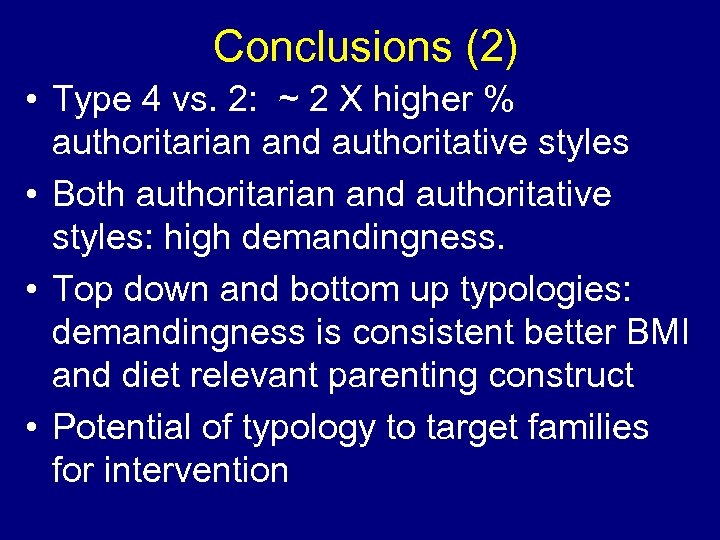
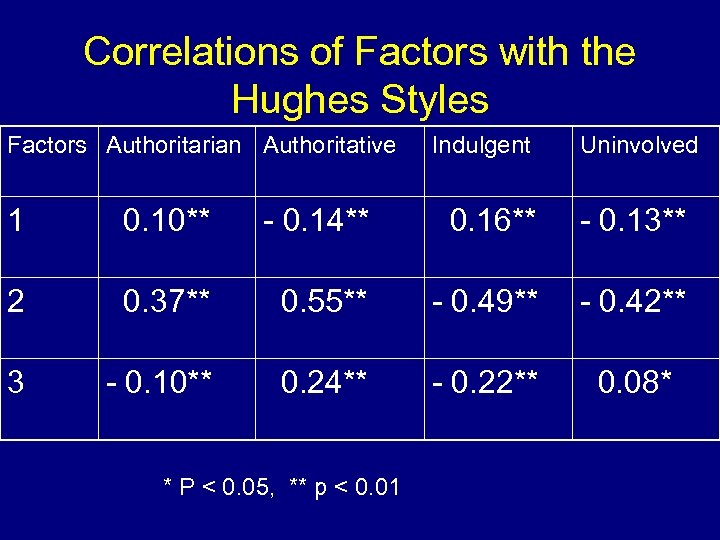
% of Expert Derived Typology (Hughes) within CG Derived Typology Caregiver 1 2 3 4 Authoritative 16 21 1 31 Authoritarian 74 18 4 43 Indulgent 4 46 52 20 Uninvolved 6 16 43 6 Expert
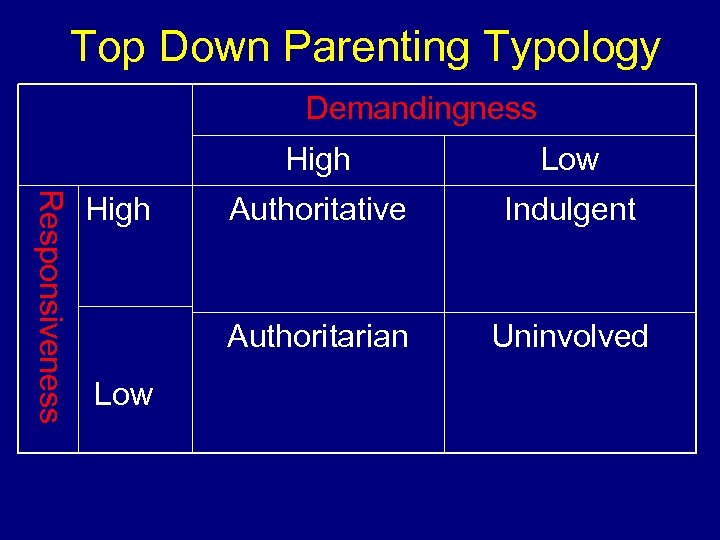
Top Down Parenting Typology Demandingness Responsiveness High Low Authoritative Indulgent Authoritarian High Low Uninvolved
CG Typology Derived From Child Feeding Factors Factor 1 Factor 2 Factor 3 Type 1 Low High % Medium 18 Low 26 Medium 28 Medium 22 Type 2 Medium Type 3 Medium Type 4 High Low
Conclusions (1) • Type 4 vs. 2 better child diet and BMI • Factors 1 and 3 > in Type 4 vs. 2 • High factors 2 and 3 ~ low child BMI and high child diet; factor 1 no effect • Thus factor 3 is major BMI-relevant difference in Type 4 vs. 2 • Factor 3 is high in authoritarian (“telling”) practices, supervision with contingency
Conclusions (2) • Type 4 vs. 2: ~ 2 X higher % authoritarian and authoritative styles • Both authoritarian and authoritative styles: high demandingness. • Top down and bottom up typologies: demandingness is consistent better BMI and diet relevant parenting construct • Potential of typology to target families for intervention
Future: Intervene in HS and Homes with Focus on Meal and Play Interactions

That’s All Folks! Questions
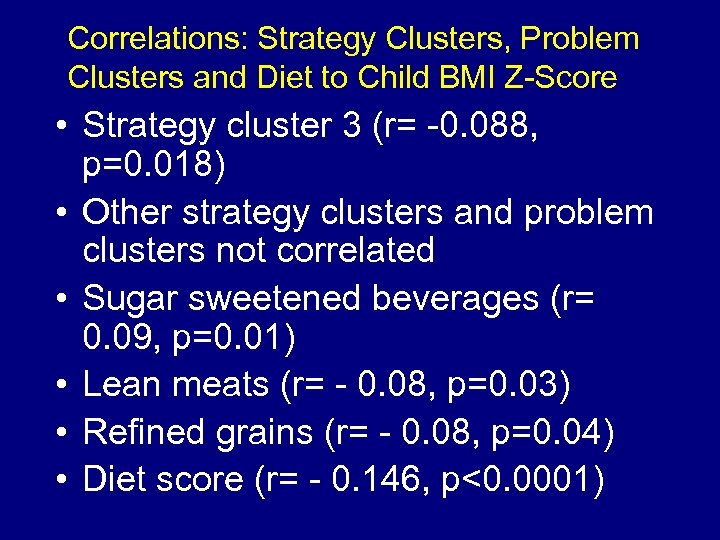
Correlations: Strategy Clusters, Problem Clusters and Diet to Child BMI Z-Score • Strategy cluster 3 (r= -0. 088, p=0. 018) • Other strategy clusters and problem clusters not correlated • Sugar sweetened beverages (r= 0. 09, p=0. 01) • Lean meats (r= - 0. 08, p=0. 03) • Refined grains (r= - 0. 08, p=0. 04) • Diet score (r= - 0. 146, p<0. 0001)
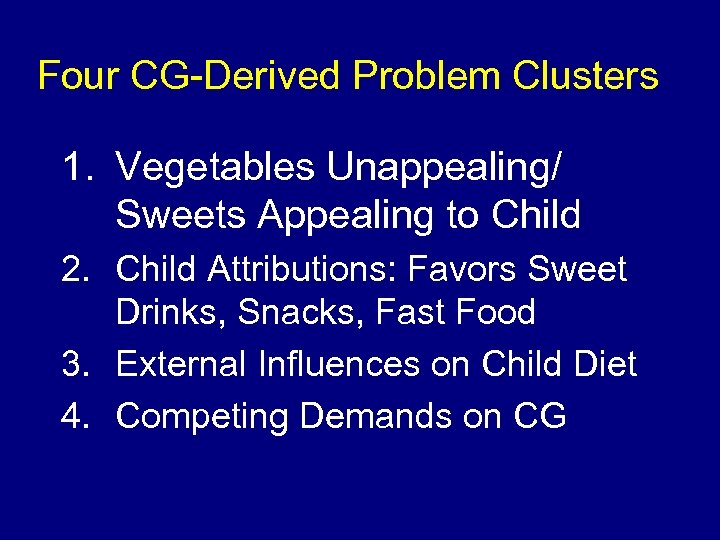
Four CG-Derived Problem Clusters 1. Vegetables Unappealing/ Sweets Appealing to Child 2. Child Attributions: Favors Sweet Drinks, Snacks, Fast Food 3. External Influences on Child Diet 4. Competing Demands on CG
3 Factor Solution: Standardized Factor 1 Factor 2 Authoritarian Low Factor 3 High Authoritative Medium High Low Permissive Medium High Very Low Cluster 1 High Low Cluster 2 High Medium Low Cluster 3 Low High Cluster 4 High Low Medium Cluster 5 High Low Very low
Correlations of Factors with the Hughes Styles Factors Authoritarian Authoritative Indulgent Uninvolved 1 0. 10** - 0. 14** 0. 16** - 0. 13** 2 0. 37** 0. 55** - 0. 49** - 0. 42** 3 - 0. 10** 0. 24** - 0. 22** 0. 08* * P < 0. 05, ** p < 0. 01
Eligibility for Head Start Household income < the federal poverty level ($20, 000 for a family of 4) or If the family is eligible or in the absence of child care would potentially be eligible for public assistance
Head Start: National Enrollment (Fiscal YR 2005) National Enrollment 906, 993 5 years old and older 4% 4 years old 52% (Early Head Start) 3 years old and under 44% Eligibility: Household income < the federal poverty level ($20, 000 for a family of 4) Race/Ethnic Composition Black/African-American 31 % White 35 % Hispanic/Latino 33 % American Indian/Alaskan Native 5. 2% Asian 1. 9% Hawaiian/Pacific Islander 0. 8% Bi-Racial/Multi-Racial 7. 4% Unspecified/Other 18. 6%
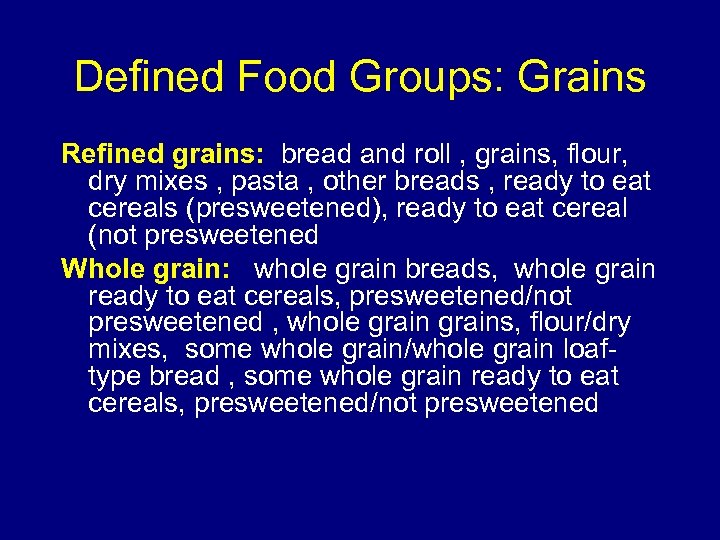
Defined Food Groups: Grains Refined grains: bread and roll , grains, flour, dry mixes , pasta , other breads , ready to eat cereals (presweetened), ready to eat cereal (not presweetened Whole grain: whole grain breads, whole grain ready to eat cereals, presweetened/not presweetened , whole grains, flour/dry mixes, some whole grain/whole grain loaftype bread , some whole grain ready to eat cereals, presweetened/not presweetened
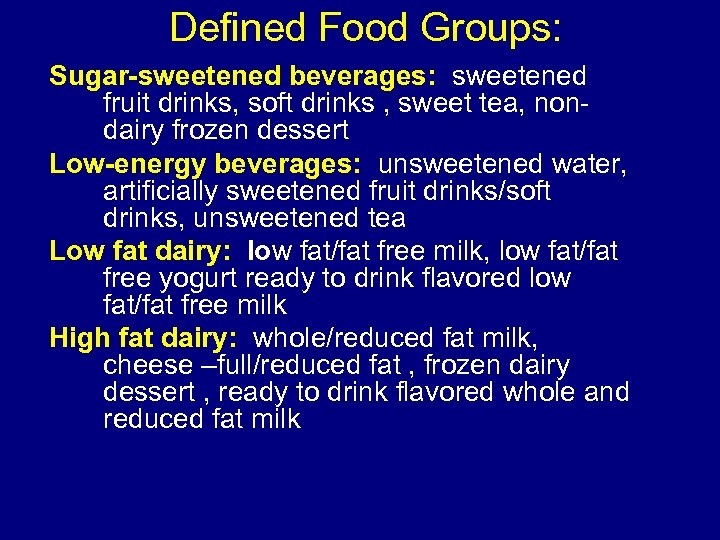
Defined Food Groups: Sugar-sweetened beverages: sweetened fruit drinks, soft drinks , sweet tea, nondairy frozen dessert Low-energy beverages: unsweetened water, artificially sweetened fruit drinks/soft drinks, unsweetened tea Low fat dairy: low fat/fat free milk, low fat/fat free yogurt ready to drink flavored low fat/fat free milk High fat dairy: whole/reduced fat milk, cheese –full/reduced fat , frozen dairy dessert , ready to drink flavored whole and reduced fat milk
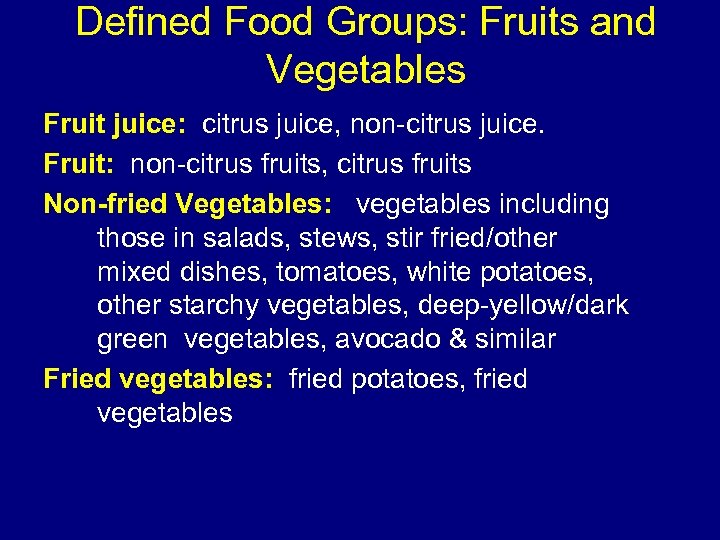
Defined Food Groups: Fruits and Vegetables Fruit juice: citrus juice, non-citrus juice. Fruit: non-citrus fruits, citrus fruits Non-fried Vegetables: vegetables including those in salads, stews, stir fried/other mixed dishes, tomatoes, white potatoes, other starchy vegetables, deep-yellow/dark green vegetables, avocado & similar Fried vegetables: fried potatoes, fried vegetables
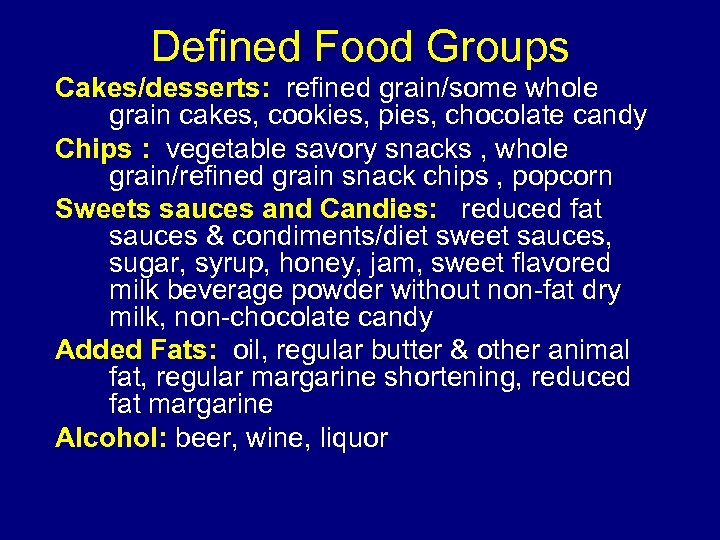
Defined Food Groups Cakes/desserts: refined grain/some whole grain cakes, cookies, pies, chocolate candy Chips : vegetable savory snacks , whole grain/refined grain snack chips , popcorn Sweets sauces and Candies: reduced fat sauces & condiments/diet sweet sauces, sugar, syrup, honey, jam, sweet flavored milk beverage powder without non-fat dry milk, non-chocolate candy Added Fats: oil, regular butter & other animal fat, regular margarine shortening, reduced fat margarine Alcohol: beer, wine, liquor
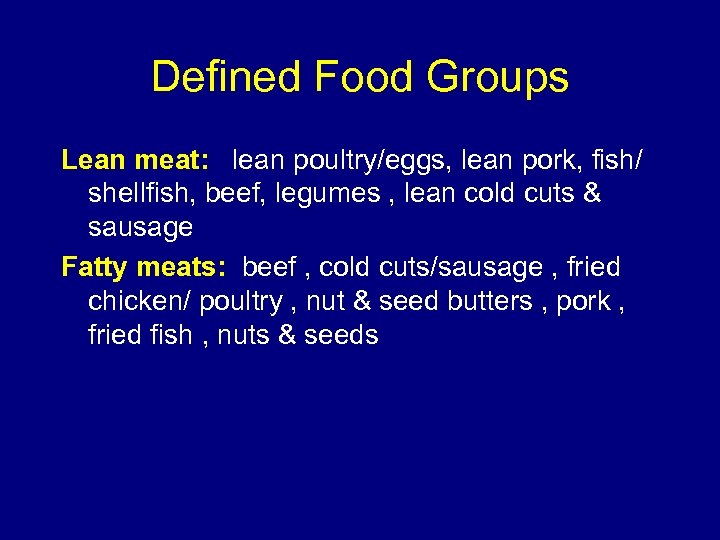
Defined Food Groups Lean meat: lean poultry/eggs, lean pork, fish/ shellfish, beef, legumes , lean cold cuts & sausage Fatty meats: beef , cold cuts/sausage , fried chicken/ poultry , nut & seed butters , pork , fried fish , nuts & seeds
Скачать презентацию A bottom up typology of parent feeding practices
d135d46c3dba5d2bd26b0248d10b8130.ppt