 Скачать презентацию A Better Choice for Sensor Sleeping Ou Yang
6ad44136852f3bbca547efa1ff7f6c43.ppt
- Количество слайдов: 25




A Better Choice for Sensor Sleeping Ou Yang and Wendi Heinzelman 1 -28 -2009
Outline n n Motivation and Goal Methodology - Sleep at single layer individually - Sleep at multiple layers simultaneously Simulation Results - Performance of single layer sleeping - Comparisons of multi-layer sleeping Conclusions 2
Motivation n Wireless sensors are energy constrained n Save energy to extend network lifetime n Make sensors sleep when they are not used 3
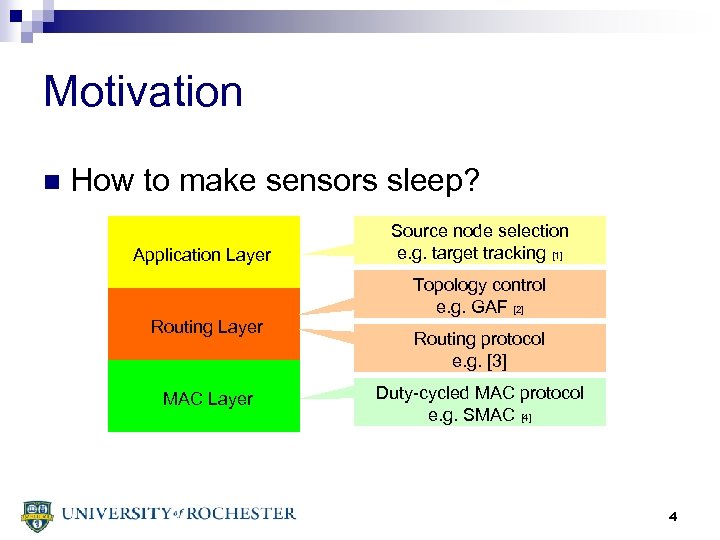
Motivation n How to make sensors sleep? Application Layer Source node selection e. g. target tracking [1] Topology control e. g. GAF [2] Routing Layer MAC Layer Routing protocol e. g. [3] Duty-cycled MAC protocol e. g. SMAC [4] 4
![Goal Application Layer Source node selection e. g. target tracking [1] Topology control e.](https://present5.com/presentation/6ad44136852f3bbca547efa1ff7f6c43/image-5.jpg "Goal Application Layer Source node selection e. g. target tracking [1] Topology control e.")
Goal Application Layer Source node selection e. g. target tracking [1] Topology control e. g. GAF [2] Routing Layer MAC Layer Routing protocol e. g. [3] Duty-cycled MAC protocol e. g. SMAC [4] Which is better? - Given application requirements - Given network scenario n Is there a single layer providing most benefit? n Multi-layer better than individual layer? n Need cross-layer coordination? n 5
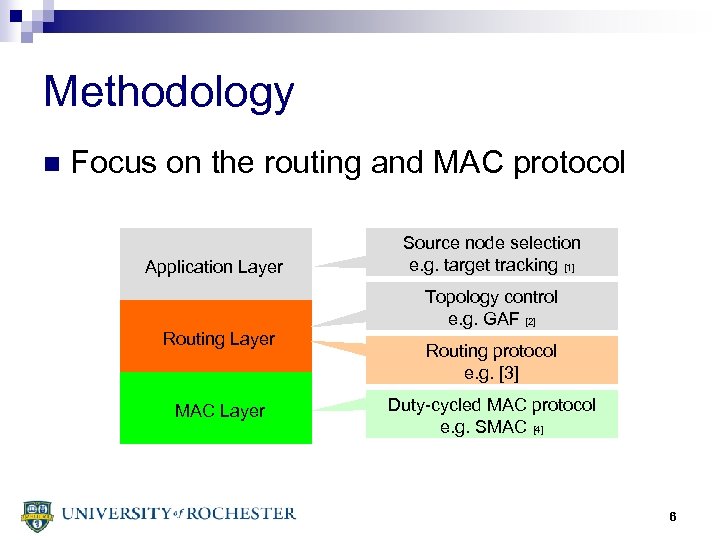
Methodology n Focus on the routing and MAC protocol Application Layer Source node selection e. g. target tracking [1] Topology control e. g. GAF [2] Routing Layer MAC Layer Routing protocol e. g. [3] Duty-cycled MAC protocol e. g. SMAC [4] 6
![Methodology n All combinations of sleeping schemes Non-sleeping Sleeping Directed Diffusion [5] Sleeping Directed](https://present5.com/presentation/6ad44136852f3bbca547efa1ff7f6c43/image-7.jpg "Methodology n All combinations of sleeping schemes Non-sleeping Sleeping Directed Diffusion [5] Sleeping Directed")
Methodology n All combinations of sleeping schemes Non-sleeping Sleeping Directed Diffusion [5] Sleeping Directed Diffusion IEEE 802. 11 [6] SMAC [4] Routing Protocol MAC Protocol 7
![Non-sleeping Routing Protocol Directed Diffusion [5] n n n Data-centric - Data is named](https://present5.com/presentation/6ad44136852f3bbca547efa1ff7f6c43/image-8.jpg "Non-sleeping Routing Protocol Directed Diffusion [5] n n n Data-centric - Data is named")
Non-sleeping Routing Protocol Directed Diffusion [5] n n n Data-centric - Data is named in attribute-value pairs Exploratory phase - Discover source nodes - Low data rate flooding Reinforcement phase - “Pull down” data from selected source node - High data rate unicast 8
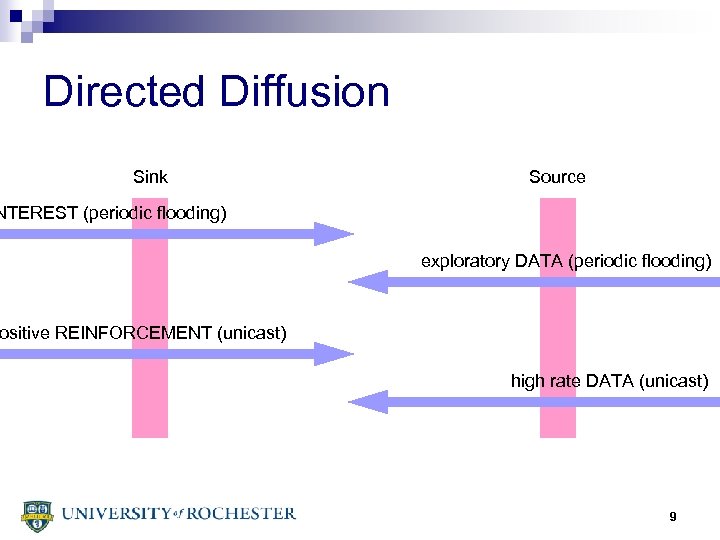
Directed Diffusion Sink Source NTEREST (periodic flooding) exploratory DATA (periodic flooding) ositive REINFORCEMENT (unicast) high rate DATA (unicast) 9
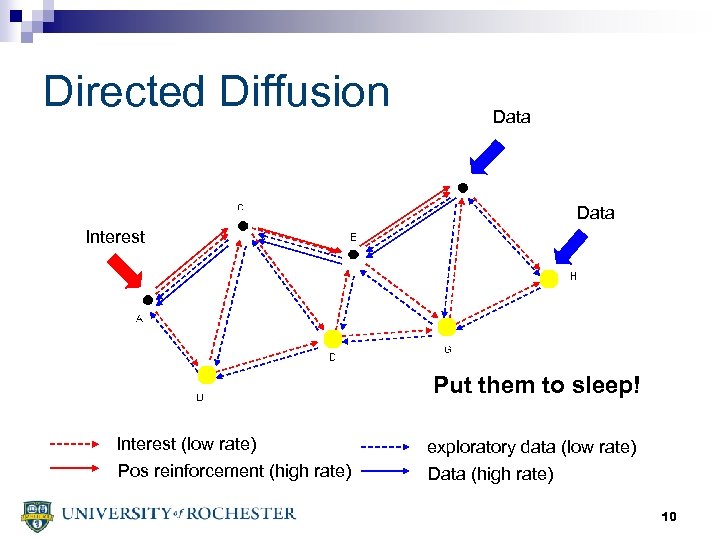
Directed Diffusion Data Interest Put them to sleep! Interest (low rate) exploratory data (low rate) Pos reinforcement (high rate) Data (high rate) 10
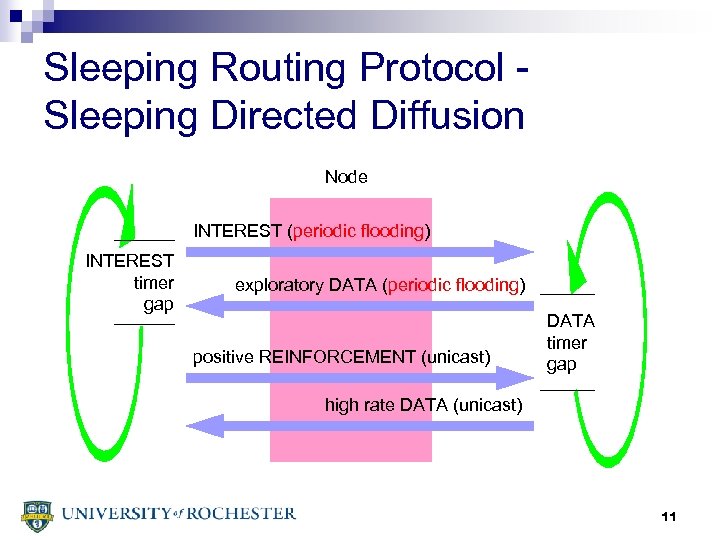
Sleeping Routing Protocol Sleeping Directed Diffusion Node INTEREST (periodic flooding) INTEREST timer gap exploratory DATA (periodic flooding) positive REINFORCEMENT (unicast) DATA timer gap high rate DATA (unicast) 11
![Sleeping MAC – SMAC [4] Duty-cycled MAC - Fixed awake time in a cycle](https://present5.com/presentation/6ad44136852f3bbca547efa1ff7f6c43/image-12.jpg "Sleeping MAC – SMAC [4] Duty-cycled MAC - Fixed awake time in a cycle")
Sleeping MAC – SMAC [4] Duty-cycled MAC - Fixed awake time in a cycle n Synchronization - Periodic SYNC packets n Similar to IEEE 802. 11 - CSMA - RTS/CTS n 12
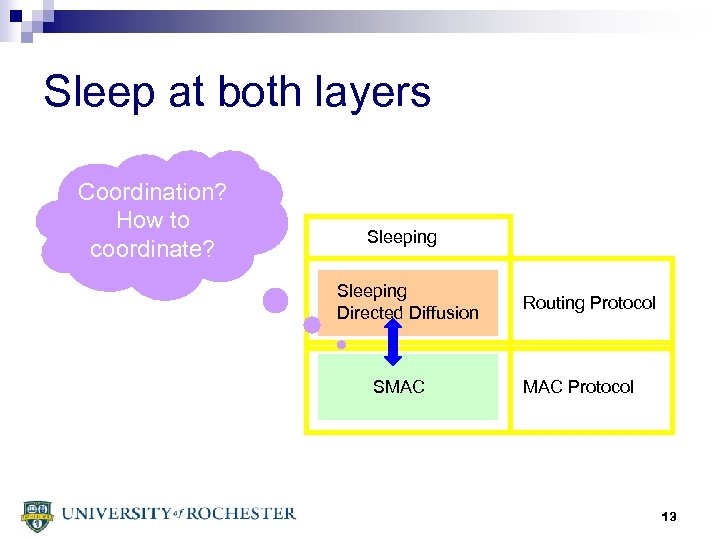
Sleep at both layers Coordination? How to coordinate? Sleeping Directed Diffusion SMAC Routing Protocol MAC Protocol 13
Sleep at both layers Problem - When sleeping at routing layer, no need to wake up at MAC layer n Coordination - Routing protocol has higher priority to put sensor to sleep n 14
Sleep at both layers Problem - MAC updates topology according to periodic SYNC packets - MAC cannot differentiate routing layer sleeping and energy depletion n Coordination - Add energy info into SYNC packets n 15
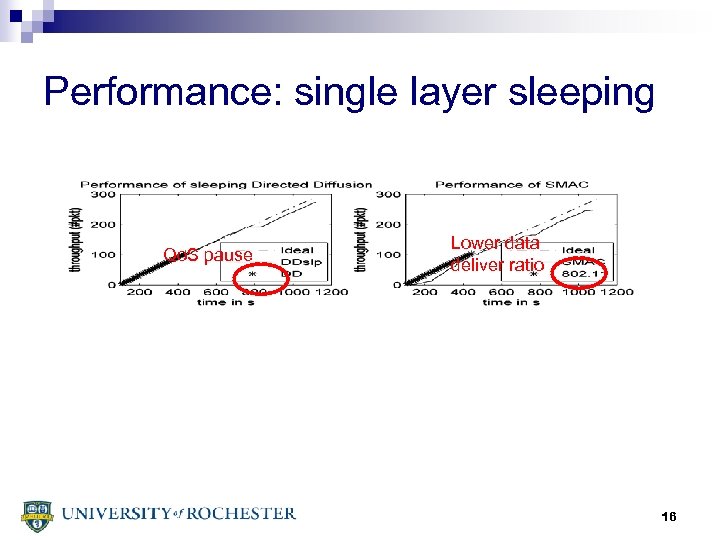
Performance: single layer sleeping Qo. S pause Lower data deliver ratio 16
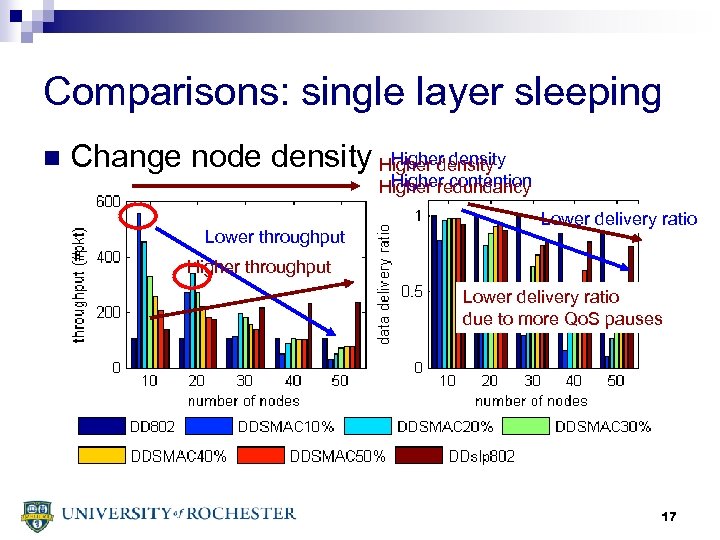
Comparisons: single layer sleeping n Higher density Change node density Higher contention Higher redundancy Lower throughput Lower delivery ratio Higher throughput Lower delivery ratio due to more Qo. S pauses 17
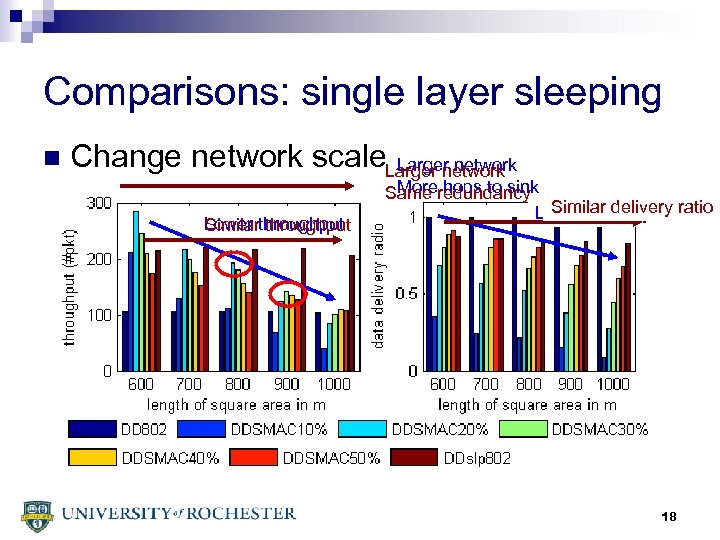
Comparisons: single layer sleeping n Change network scale. Larger network Lower throughput Similar throughput More hops to sink Same redundancy Similar delivery ratio Lower delivery ratio 18
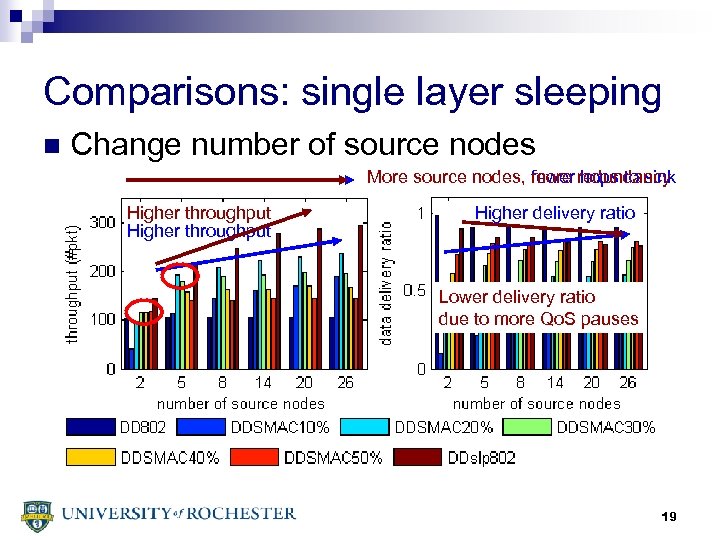
Comparisons: single layer sleeping n Change number of source nodes More source nodes, fewer redundancy more hops to sink Higher throughput Higher delivery ratio Lower delivery ratio due to more Qo. S pauses 19
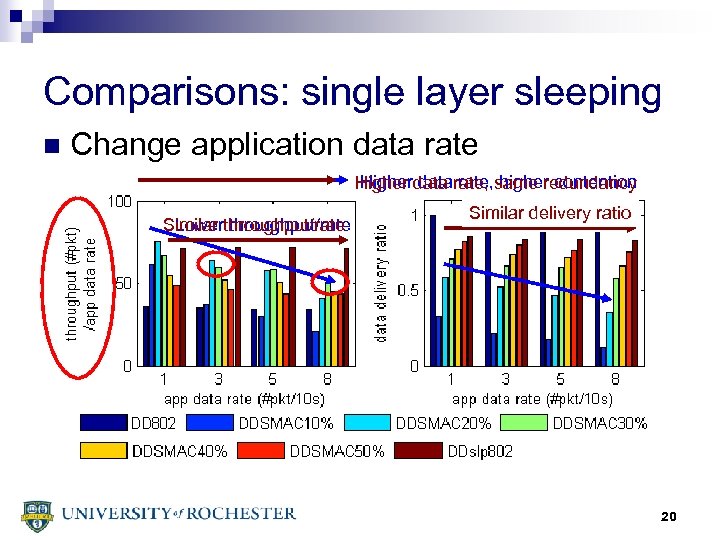
Comparisons: single layer sleeping n Change application data rate Higher data rate, higher contention Higher data rate, same redundancy Similar throughput/rate Lower throughput/rate Similar delivery ratio Lower delivery ratio 20
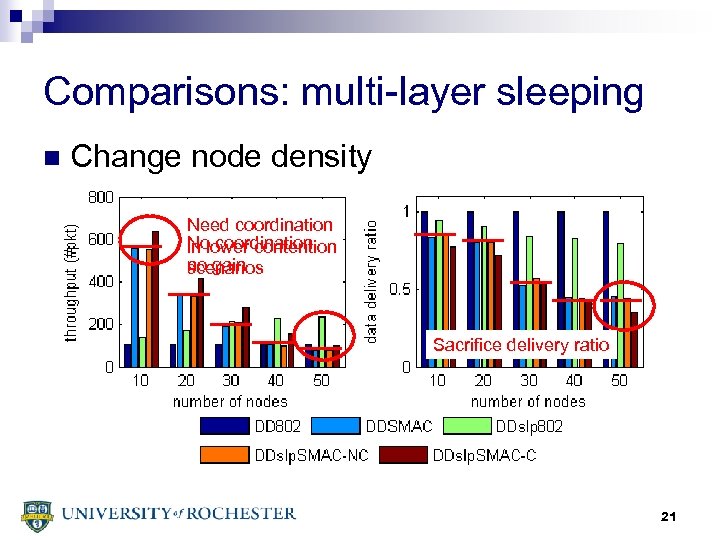
Comparisons: multi-layer sleeping n Change node density Need coordination No coordination in lower contention no gain scenarios Sacrifice delivery ratio 21
Discussions Other routing protocols? - Sensors sleep when not routing data - e. g. , Geographic routing n Other MAC protocols? - Duty-cycled MAC - e. g. , T-MAC, B-MAC n 22
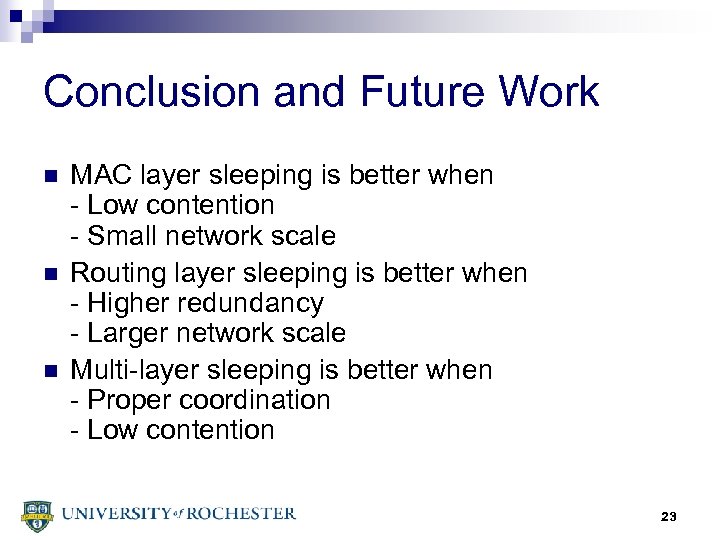
Conclusion and Future Work n n n MAC layer sleeping is better when - Low contention - Small network scale Routing layer sleeping is better when - Higher redundancy - Larger network scale Multi-layer sleeping is better when - Proper coordination - Low contention 23
![References n n n [1] Zoghi, M. R. , Kahaei, M. H. : Sensor](https://present5.com/presentation/6ad44136852f3bbca547efa1ff7f6c43/image-24.jpg "References n n n [1] Zoghi, M. R. , Kahaei, M. H. : Sensor")
References n n n [1] Zoghi, M. R. , Kahaei, M. H. : Sensor Selection for. Target Tracking in WSN Using Modified INS Algorithm. In: 3 rd. Internatioanl Conference on Information and Communication. Technologies: From Theory to Applications, pp. 1 -6. 2008 [2] Xu, Y, Heidemann, J. , Estrin, D. : Geography-informed Energy Conservation for Ad Hoc. Routing. In: 7 th Annual International Conference on Mobile Computingand Networking, pp. 70 -84. 2001 [3] Zheng, R. , Kravets, R. : On-demand Power. Management for Ad Hoc Networks. In: 22 nd Annual Joint Conference ofthe IEEE Computer and Communications Societies, vol. 1, pp. 481 -491. 2003 [4] Ye, W. , Heidemann, J. , Estrin, D. : Medium Access Control with Coordinated Adaptive Sleeping for Wireless. Sensor Networks. IEEE/ACM Trans. on Networking, vol. 12, issue 3, pp. 493 -506. 2004 [5] Intanagonwiwat, C. Govindan, R. Estrin, D. Heidemann, J. : Directed Diffusion for Wireless Sensor Networking. IEEE/ACM Trans. on Networking, vol. 11, issue 1, pp. 2 -16. 2003 [6] LAN MAN Standards Committee of the IEEE Computer Society: Wireless LAN medium access control (MAC) and physical layer (PHY) specification, IEEE, New York, NY, USA, IEEE Std 802. 11 -1997 edition, 1997 24
Thank you Q&A 25
Скачать презентацию A Better Choice for Sensor Sleeping Ou Yang
6ad44136852f3bbca547efa1ff7f6c43.ppt