 Скачать презентацию a A viszontbiztosítók helyzete mi lesz a díjakkal
bc8d6ace1849c753cc306a2179f4a4a5.ppt
- Количество слайдов: 23



a A viszontbiztosítók helyzete mi lesz a díjakkal? Outlook reinsurance markets Johannes Martin Hartmann Swiss Re Europe, Head Market Underwriting CEE MABISZ Conference - Budapest, 19 October 2011
Today’s agenda P&C reinsurance global market outlook Swiss Re and the Hungarian insurance market (Re)insurance topics a Questions & answers MABISZ Conference | Budapest | 19 October 2011 2
a P&C reinsurance global market outlook MABISZ Conference | Budapest | 19 October 2011 3
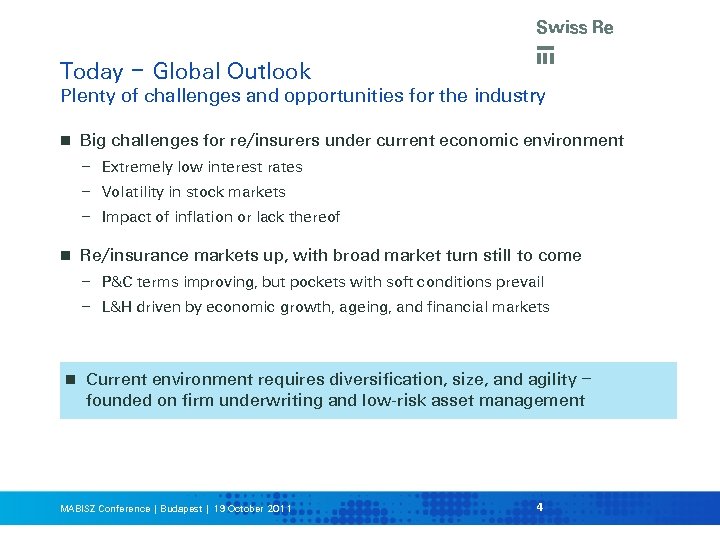
Today – Global Outlook a Plenty of challenges and opportunities for the industry Big challenges for re/insurers under current economic environment – Extremely low interest rates – Volatility in stock markets – Impact of inflation or lack thereof Re/insurance markets up, with broad market turn still to come – P&C terms improving, but pockets with soft conditions prevail – L&H driven by economic growth, ageing, and financial markets Current environment requires diversification, size, and agility – founded on firm underwriting and low-risk asset management MABISZ Conference | Budapest | 19 October 2011 4
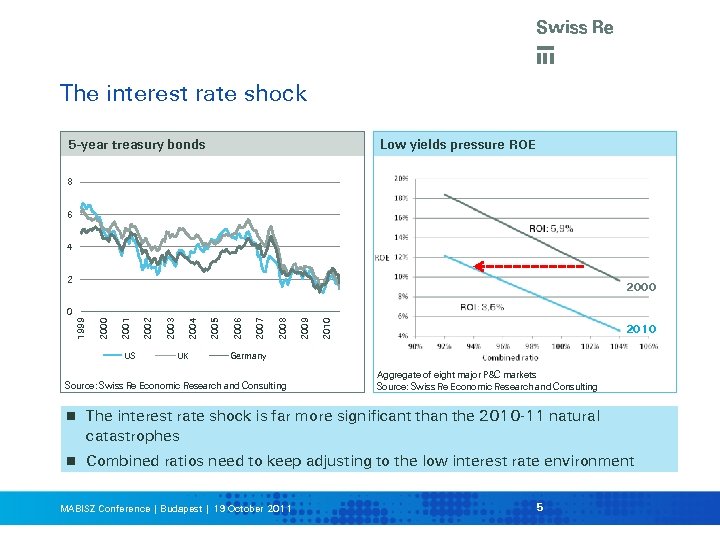
a The interest rate shock 5 -year treasury bonds Low yields pressure ROE 8 6 4 2 2000 US UK 2010 2009 2008 2007 2006 2005 2004 2003 2002 2001 2000 1999 0 2010 Germany Source: Swiss Re Economic Research and Consulting Aggregate of eight major P&C markets Source: Swiss Re Economic Research and Consulting The interest rate shock is far more significant than the 2010 -11 natural catastrophes Combined ratios need to keep adjusting to the low interest rate environment MABISZ Conference | Budapest | 19 October 2011 5
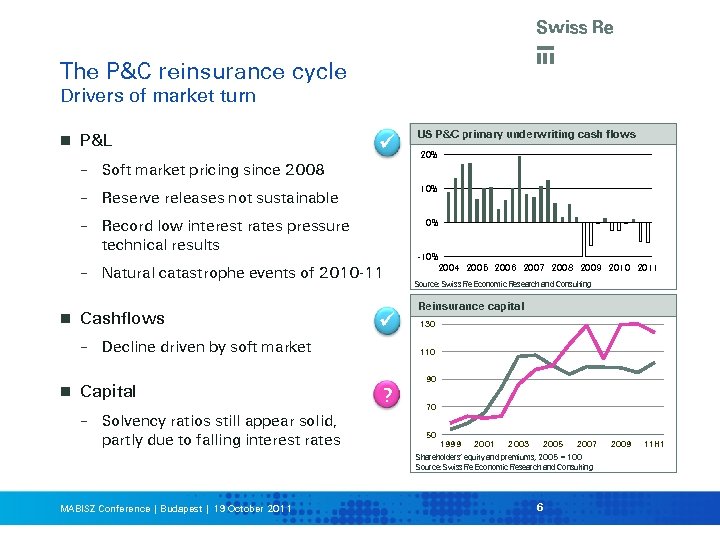
a The P&C reinsurance cycle Drivers of market turn P&L – Reserve releases not sustainable – Record low interest rates pressure technical results – 20% 0% Decline driven by soft market Capital – 10% Natural catastrophe events of 2010 -11 Cashflows – US P&C primary underwriting cash flows Soft market pricing since 2008 – Solvency ratios still appear solid, partly due to falling interest rates -10% 2004 2005 2006 2007 2008 2009 2010 2011 Source: Swiss Re Economic Research and Consulting Reinsurance capital 130 110 ? 90 70 50 1999 2001 2003 2005 2007 Shareholders’ equity and premiums, 2005 = 100 Source: Swiss Re Economic Research and Consulting MABISZ Conference | Budapest | 19 October 2011 6 2009 11 H 1
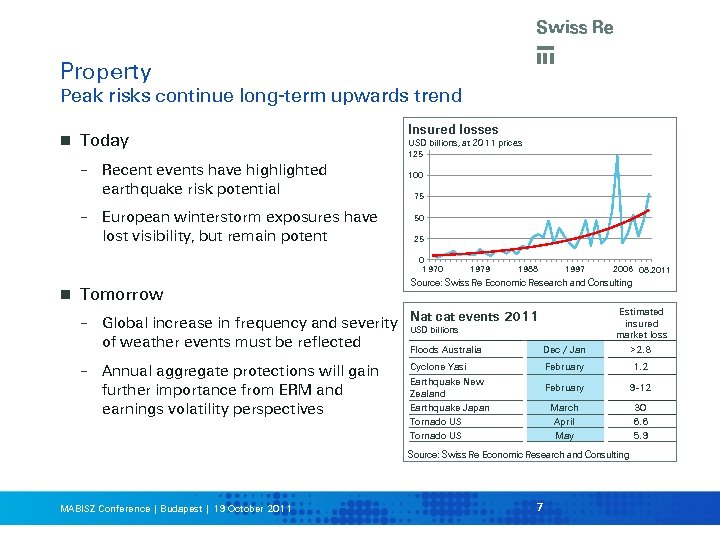
a Property Peak risks continue long-term upwards trend Today Insured losses USD billions, at 2011 prices 125 – – Recent events have highlighted earthquake risk potential European winterstorm exposures have lost visibility, but remain potent 100 75 50 25 0 1970 Tomorrow 1979 1988 1997 Source: Swiss Re Economic Research and Consulting Floods Australia Dec / Jan Estimated insured market loss >2. 8 Cyclone Yasi February 1. 2 February 9 -12 March April May 30 6. 6 5. 9 Nat cat events 2011 – Global increase in frequency and severity USD billions of weather events must be reflected – Annual aggregate protections will gain further importance from ERM and earnings volatility perspectives 2006 08. 2011 Earthquake New Zealand Earthquake Japan Tornado US Source: Swiss Re Economic Research and Consulting MABISZ Conference | Budapest | 19 October 2011 7
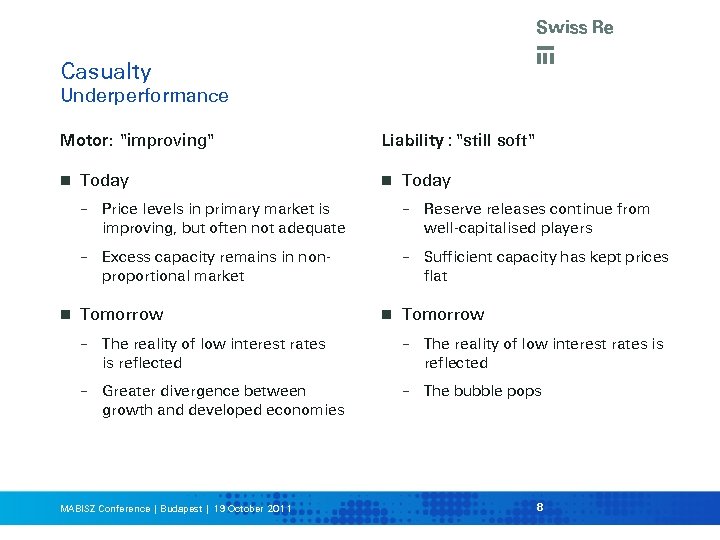
a Casualty Underperformance Motor: "improving" Today Liability : "still soft" Today – – Reserve releases continue from well-capitalised players – Price levels in primary market is improving, but often not adequate Excess capacity remains in nonproportional market – Sufficient capacity has kept prices flat Tomorrow – The reality of low interest rates is reflected – Greater divergence between growth and developed economies – The bubble pops MABISZ Conference | Budapest | 19 October 2011 8
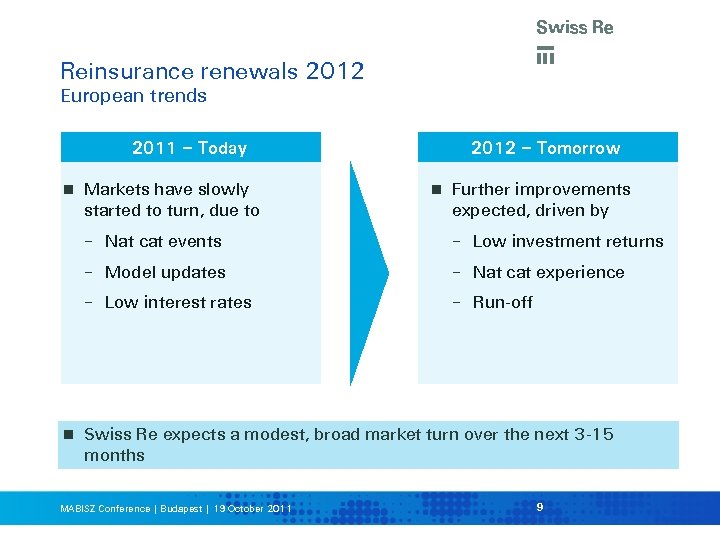
a Reinsurance renewals 2012 European trends 2011 – Today Markets have slowly started to turn, due to 2012 – Tomorrow Further improvements expected, driven by – – Low investment returns – Model updates – Nat cat experience – Nat cat events Low interest rates – Run-off Swiss Re expects a modest, broad market turn over the next 3 -15 months MABISZ Conference | Budapest | 19 October 2011 9
Swiss Re and The Hungarian Insurance Market MABISZ Conference | Budapest | 19 October 2011 a 10
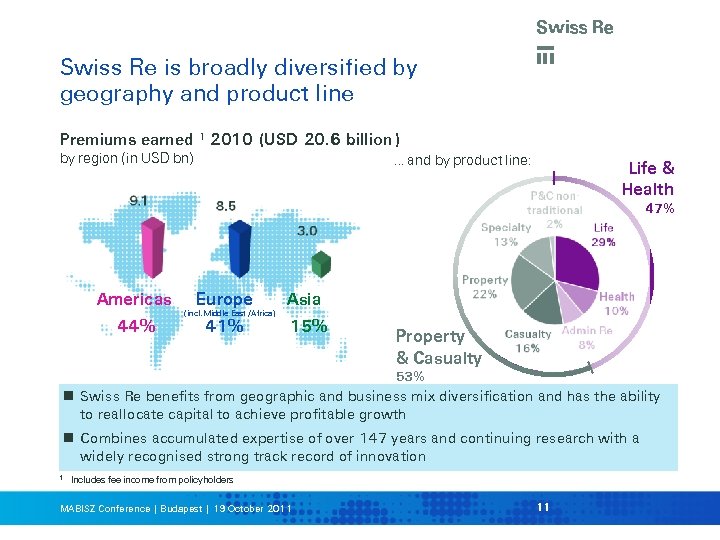
Swiss Re is broadly diversified by geography and product line a Premiums earned 1 2010 (USD 20. 6 billion ) by region (in USD bn) … and by product line: Life & Health 47% Americas 44% Europe (incl. Middle East /Africa) 41% Asia 15% Property & Casualty 53% Swiss Re benefits from geographic and business mix diversification and has the ability to reallocate capital to achieve profitable growth Combines accumulated expertise of over 147 years and continuing research with a widely recognised strong track record of innovation 1 Includes fee income from policyholders MABISZ Conference | Budapest | 19 October 2011 11
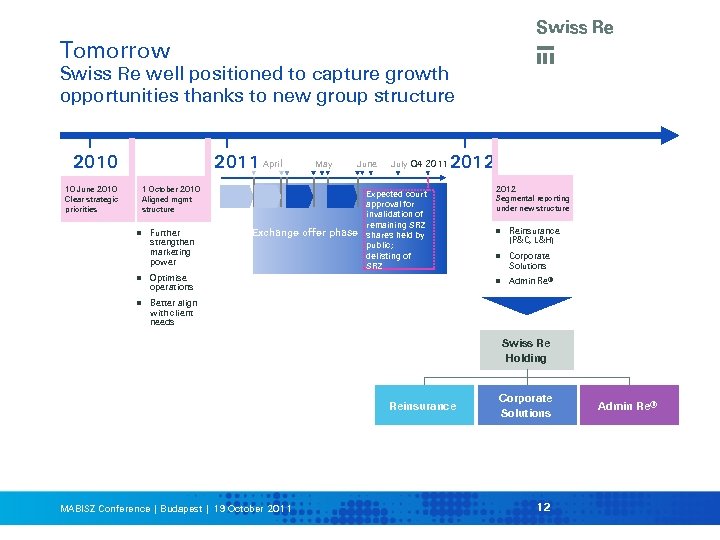
a Tomorrow Swiss Re well positioned to capture growth opportunities thanks to new group structure 2010 10 June 2010 Clear strategic priorities 2011 April May June 1 October 2010 Aligned mgmt structure Further strengthen marketing power 2012 Expected court approval for invalidation of remaining SRZ shares held by public; delisting of SRZ 2012 Segmental reporting under new structure Reinsurance (P&C, L&H) Corporate Solutions Optimise operations Exchange offer phase July Q 4 2011 Admin Re® Better align with client needs Swiss Re Holding Reinsurance MABISZ Conference | Budapest | 19 October 2011 Corporate Solutions 12 Admin Re®
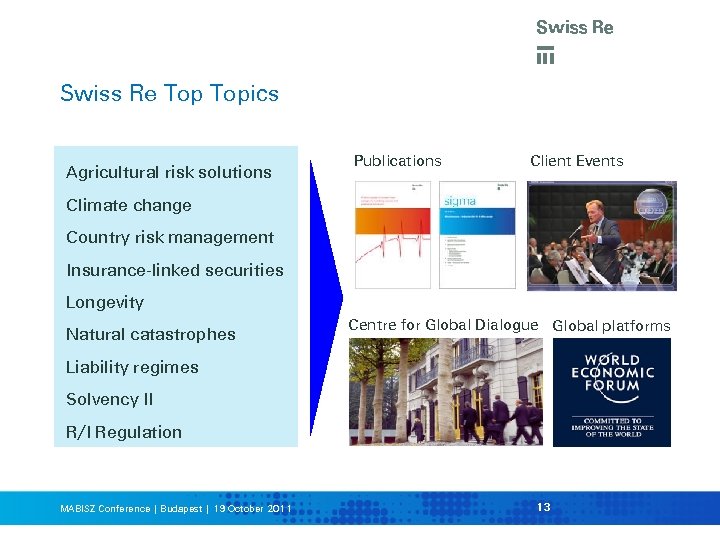
a Swiss Re Topics Agricultural risk solutions Publications Client Events Climate change Country risk management Insurance-linked securities Longevity Natural catastrophes Centre for Global Dialogue Global platforms Liability regimes Solvency II R/I Regulation MABISZ Conference | Budapest | 19 October 2011 13
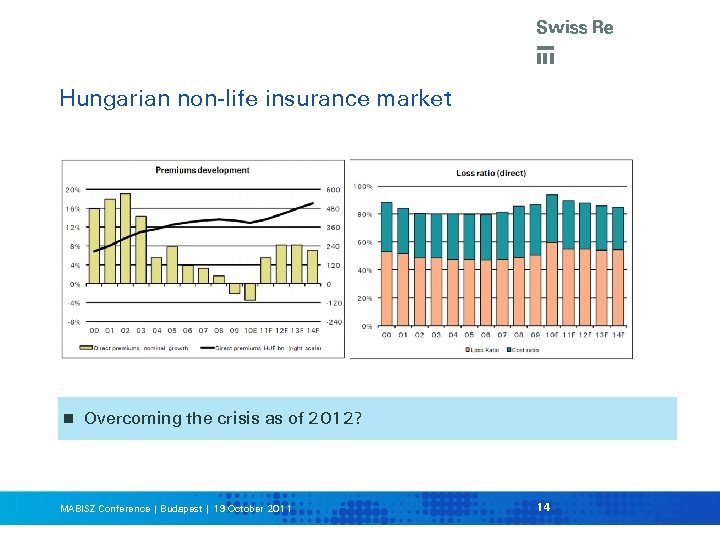
Hungarian non-life insurance market a Overcoming the crisis as of 2012? MABISZ Conference | Budapest | 19 October 2011 14
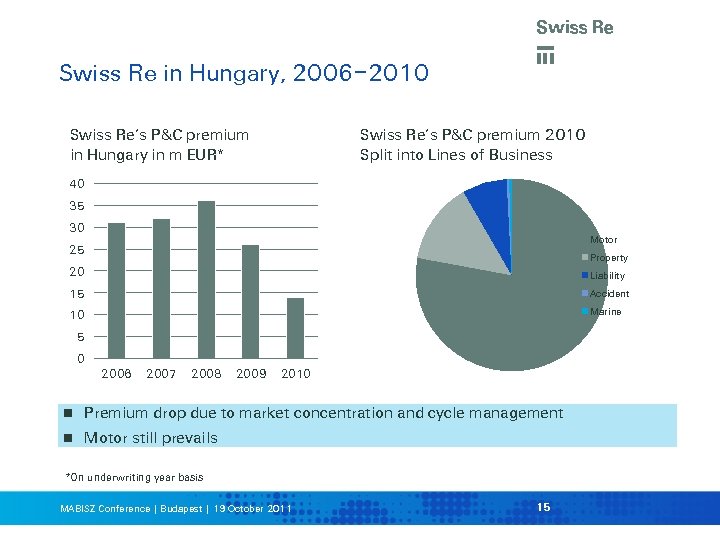
Swiss Re in Hungary, 2006– 2010 Swiss Re’s P&C premium in Hungary in m EUR* a Swiss Re’s P&C premium 2010 Split into Lines of Business 40 35 30 Motor 25 Property 20 Liability 15 Accident 10 Marine 5 0 2006 2007 2008 2009 2010 Premium drop due to market concentration and cycle management Motor still prevails *On underwriting year basis MABISZ Conference | Budapest | 19 October 2011 15
a (Re)insurance topics MABISZ Conference | Budapest | 19 October 2011 16
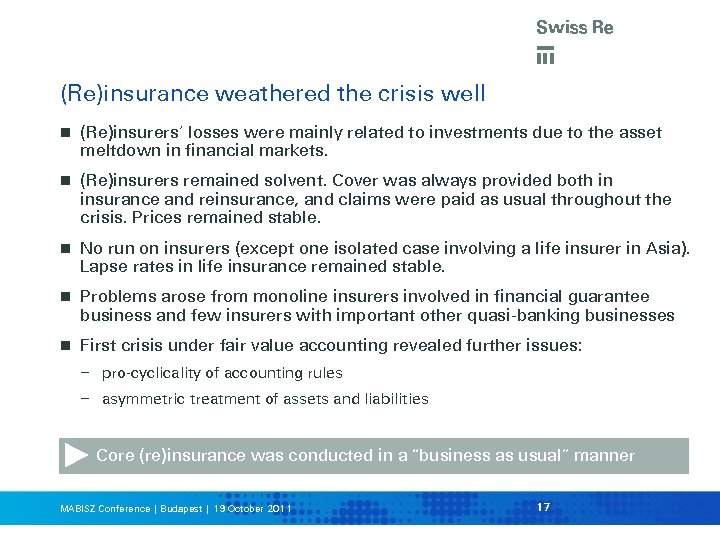
(Re)insurance weathered the crisis well a (Re)insurers’ losses were mainly related to investments due to the asset meltdown in financial markets. (Re)insurers remained solvent. Cover was always provided both in insurance and reinsurance, and claims were paid as usual throughout the crisis. Prices remained stable. No run on insurers (except one isolated case involving a life insurer in Asia). Lapse rates in life insurance remained stable. Problems arose from monoline insurers involved in financial guarantee business and few insurers with important other quasi-banking businesses First crisis under fair value accounting revealed further issues: – pro-cyclicality of accounting rules – asymmetric treatment of assets and liabilities Core (re)insurance was conducted in a “business as usual” manner MABISZ Conference | Budapest | 19 October 2011 17
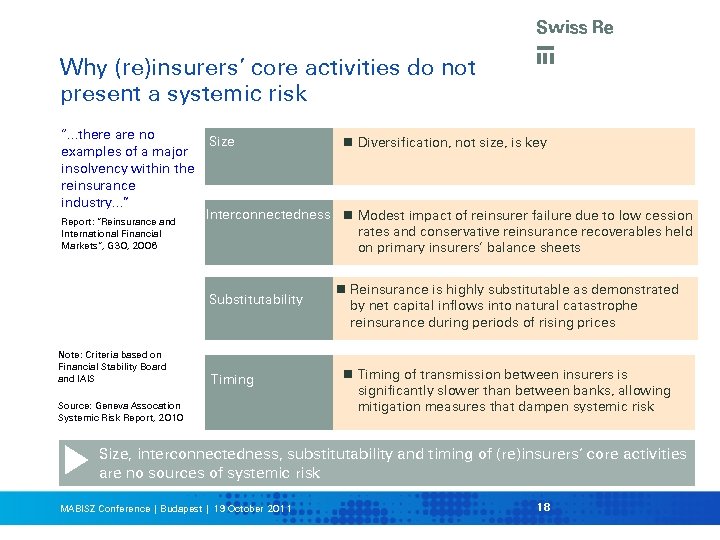
Why (re)insurers’ core activities do not present a systemic risk “…there are no examples of a major insolvency within the reinsurance industry…” Report: “Reinsurance and International Financial Markets”, G 30, 2006 Size Diversification, not size, is key Interconnectedness Modest impact of reinsurer failure due to low cession rates and conservative reinsurance recoverables held on primary insurers’ balance sheets Substitutability Note: Criteria based on Financial Stability Board and IAIS a Timing Source: Geneva Assocation Systemic Risk Report, 2010 Reinsurance is highly substitutable as demonstrated by net capital inflows into natural catastrophe reinsurance during periods of rising prices Timing of transmission between insurers is significantly slower than between banks, allowing mitigation measures that dampen systemic risk Size, interconnectedness, substitutability and timing of (re)insurers’ core activities are no sources of systemic risk MABISZ Conference | Budapest | 19 October 2011 18
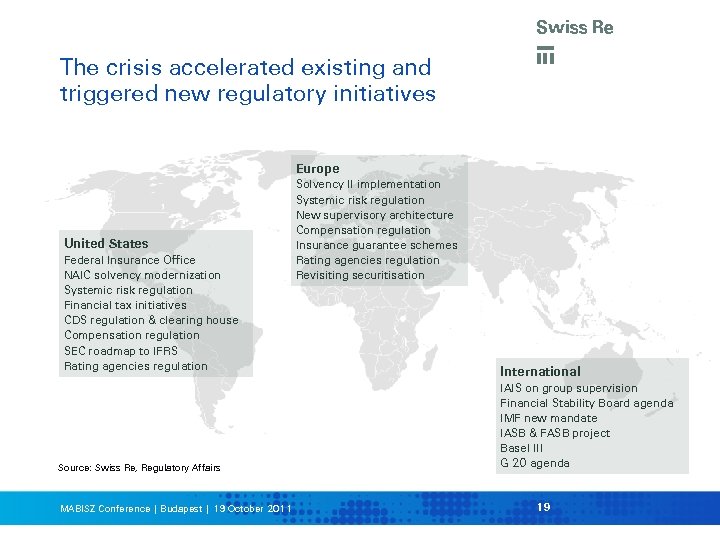
The crisis accelerated existing and triggered new regulatory initiatives a Europe United States Federal Insurance Office NAIC solvency modernization Systemic risk regulation Financial tax initiatives CDS regulation & clearing house Compensation regulation SEC roadmap to IFRS Rating agencies regulation Source: Swiss Re, Regulatory Affairs MABISZ Conference | Budapest | 19 October 2011 Solvency II implementation Systemic risk regulation New supervisory architecture Compensation regulation Insurance guarantee schemes Rating agencies regulation Revisiting securitisation International IAIS on group supervision Financial Stability Board agenda IMF new mandate IASB & FASB project Basel III G 20 agenda 19
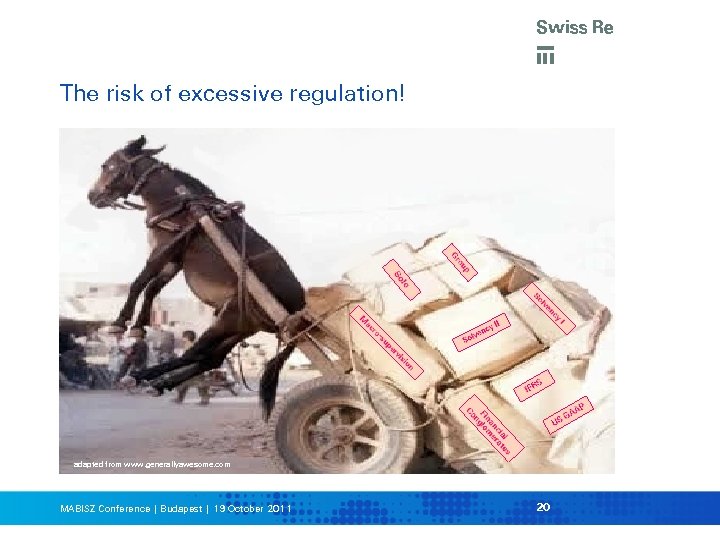
The risk of excessive regulation! a adapted from www. generallyawesome. com MABISZ Conference | Budapest | 19 October 2011 20
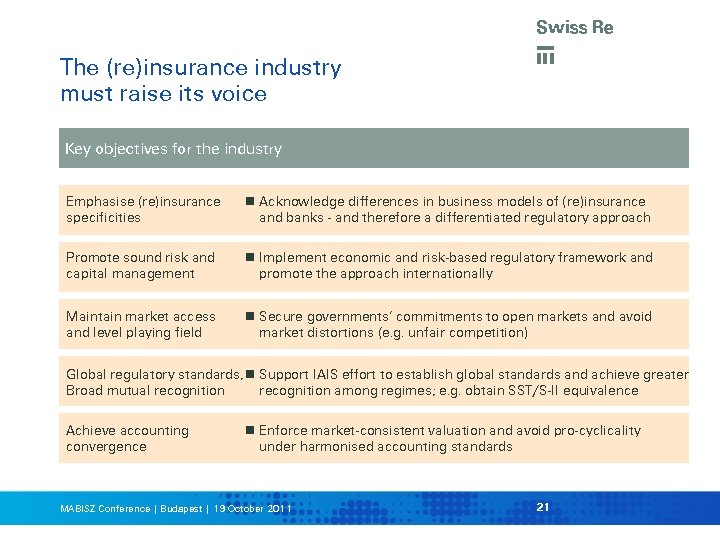
The (re)insurance industry must raise its voice a Key objectives for the industry Emphasise (re)insurance specificities Acknowledge differences in business models of (re)insurance and banks - and therefore a differentiated regulatory approach Promote sound risk and capital management Implement economic and risk-based regulatory framework and promote the approach internationally Maintain market access and level playing field Secure governments’ commitments to open markets and avoid market distortions (e. g. unfair competition) Global regulatory standards, Support IAIS effort to establish global standards and achieve greater Broad mutual recognition among regimes; e. g. obtain SST/S-II equivalence Achieve accounting convergence Enforce market-consistent valuation and avoid pro-cyclicality under harmonised accounting standards MABISZ Conference | Budapest | 19 October 2011 21

a Questions & answers MABISZ Conference | Budapest | 19 October 2011 22
a Cautionary note on forward-looking statements Certain statements and illustrations contained herein are forward-looking. These statements and illustrations provide current expectations of future events based on certain assumptions and include any statement that does not directly relate to a historical fact or current fact. Forward-looking statements typically are identified by words or phrases such as “anticipate“, “assume“, “believe“, “continue“, “estimate“, “expect“, “foresee“, “intend“, “may increase“ and “may fluctuate“ and similar expressions or by future or conditional verbs such as “will“, “should“, “would“ and “could“. These forward-looking statements involve known and unknown risks, uncertainties and other factors, which may cause Swiss Re’s actual results, performance, achievements or prospects to be materially different from any future results, performance, achievements or prospects expressed or implied by such statements. Such factors include, among others: further instability affecting the global financial system and developments related thereto; changes in global economic conditions; Swiss Re’s ability to maintain sufficient liquidity and access to capital markets, including sufficient liquidity to cover potential recapture of reinsurance agreements, early calls of debt or debt-like arrangements and collateral calls under derivative contracts due to actual or perceived deterioration of Swiss Re’s financial strength; the effect of market conditions, including the global equity and credit markets, and the level and volatility of equity prices, interest rates, credit spreads, currency values and other market indices, on Swiss Re’s investment assets; changes in Swiss Re’s investment result as a result of changes in its investment policy or the changed composition of its investment assets, and the impact of the timing of any such changes relative to changes in market conditions; uncertainties in valuing credit default swaps and other credit-related instruments; possible inability to realise amounts on sales of securities on Swiss Re’s balance sheet equivalent to its mark-to-market values recorded for accounting purposes; the outcome of tax audits, the ability to realise tax loss carryforwards and the ability to realise deferred tax assets (including by reason of the mix of earnings in a jurisdiction or deemed change of control), which could negatively impact future earnings; the possibility that hedging arrangements may not be effective; the lowering or loss of financial strength or other ratings of one or more of the companies in the Swiss Re group or developments adversely affecting the ability to achieve improved ratings; the cyclicality of the reinsurance industry; uncertainties in estimating reserves; uncertainties in estimating future claims for purposes of financial reporting, particularly with respect to large natural catastrophes, as significant uncertainties may be involved in estimating losses from such events and preliminary estimates may be subject to change as new information becomes available; the frequency, severity and development of insured claim events; acts of terrorism and acts of war; mortality and morbidity experience; policy renewal and lapse rates; extraordinary events affecting Swiss Re’s clients and other counterparties, such as bankruptcies, liquidations and other credit-related events; current, pending and future legislation and regulation affecting Swiss Re or its ceding companies, and regulatory or legal actions; changes in accounting standards; significant investments, acquisitions or dispositions, and any delays, unexpected costs or other issues experienced in connection with any such transactions, including, in the case of acquisitions, issues arising in connection with integrating acquired operations; changing levels of competition; operational factors, including the efficacy of risk management and other internal procedures in managing the foregoing risks; and challenges in implementation, adverse responses of counterparties, regulators or rating agencies, or other issues arising from, or otherwise relating to, the changes in Swiss Re's corporate structure. These factors are not exhaustive. Swiss Re operates in a continually changing environment and new risks emerge continually. Readers are cautioned not to place undue reliance on forward-looking statements. Swiss Re undertakes no obligation to publicly revise or update any forward-looking statements, whether as a result of new information, future events or otherwise. MABISZ Conference | Budapest | 19 October 2011 23
Скачать презентацию a A viszontbiztosítók helyzete mi lesz a díjakkal
bc8d6ace1849c753cc306a2179f4a4a5.ppt