


 Скачать презентацию OH 1720 MHz Masers Tracers of Supernova Remnant
f459e14afcb8f4fe88a6f87a01e13169.ppt
- Количество слайдов: 23
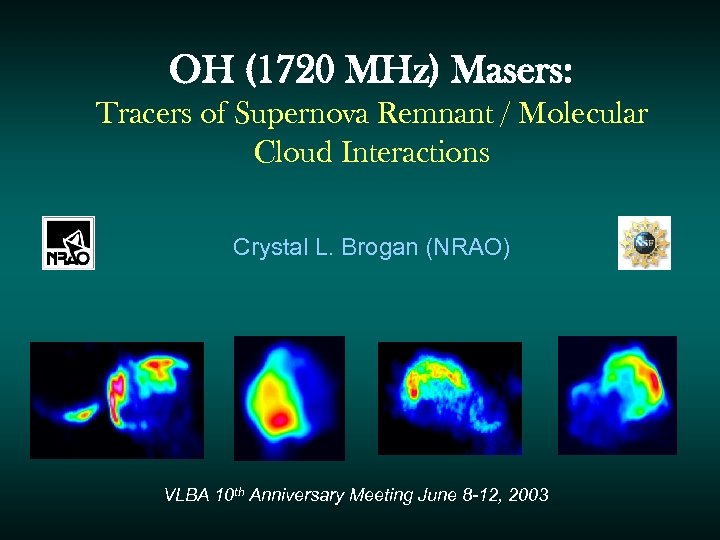 OH (1720 MHz) Masers: Tracers of Supernova Remnant / Molecular Cloud Interactions Crystal L. Brogan (NRAO) VLBA 10 th Anniversary Meeting June 8 -12, 2003
 The Search for SNR/ Molecular Cloud Interactions • SNRs are one of the most energetically important constituents of the Galactic medium - Input of mechanical energy (turbulence) - Responsible for cosmic rays up to 1014 e. V - Possibly trigger new generations of star formation • Searching for SNR/molecular cloud interactions is difficult! - There’s lots of ground to cover - Galactic velocity confusion a big pain (HI, CO(1 -0)) - Most unambiguous tracers of shocked gas are at high frequencies – difficult to get lots of time => We need a better tracer!
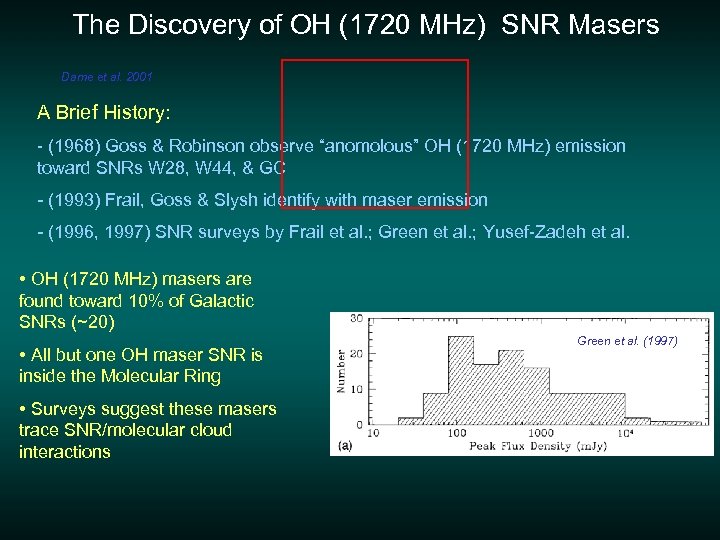 The Discovery of OH (1720 MHz) SNR Masers Dame et al. 2001 A Brief History: - (1968) Goss & Robinson observe “anomolous” OH (1720 MHz) emission toward SNRs W 28, W 44, & GC - (1993) Frail, Goss & Slysh identify with maser emission - (1996, 1997) SNR surveys by Frail et al. ; Green et al. ; Yusef-Zadeh et al. • OH (1720 MHz) masers are found toward 10% of Galactic SNRs (~20) • All but one OH maser SNR is inside the Molecular Ring • Surveys suggest these masers trace SNR/molecular cloud interactions Green et al. (1997)
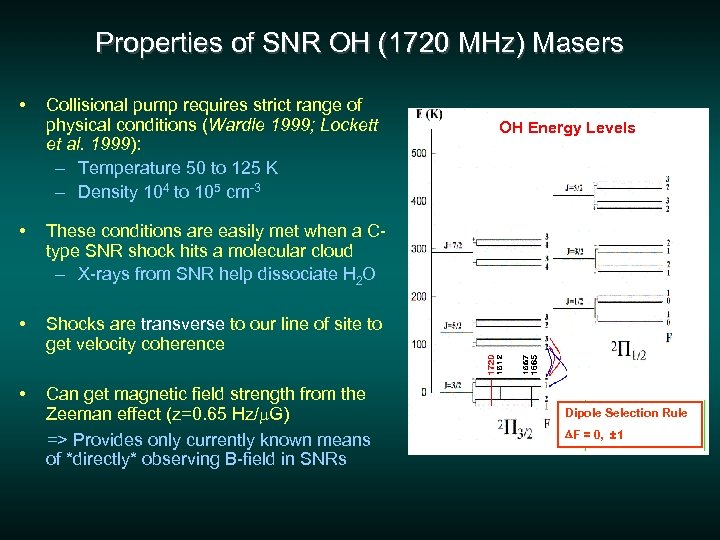 Properties of SNR OH (1720 MHz) Masers • Collisional pump requires strict range of physical conditions (Wardle 1999; Lockett et al. 1999): – Temperature 50 to 125 K – Density 104 to 105 cm-3 • These conditions are easily met when a Ctype SNR shock hits a molecular cloud – X-rays from SNR help dissociate H 2 O • Shocks are transverse to our line of site to get velocity coherence • Can get magnetic field strength from the Zeeman effect (z=0. 65 Hz/m. G) => Provides only currently known means of *directly* observing B-field in SNRs OH Energy Levels Dipole Selection Rule DF = 0, ± 1
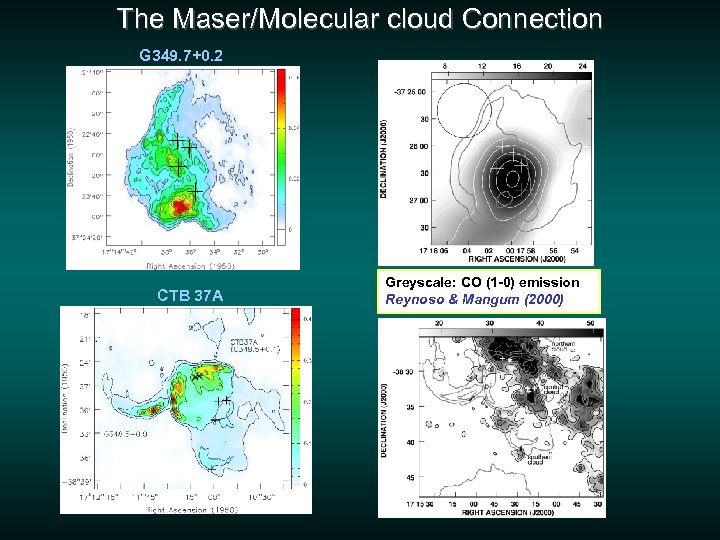 The Maser/Molecular cloud Connection G 349. 7+0. 2 CTB 37 A Greyscale: CO (1 -0) emission Reynoso & Mangum (2000)
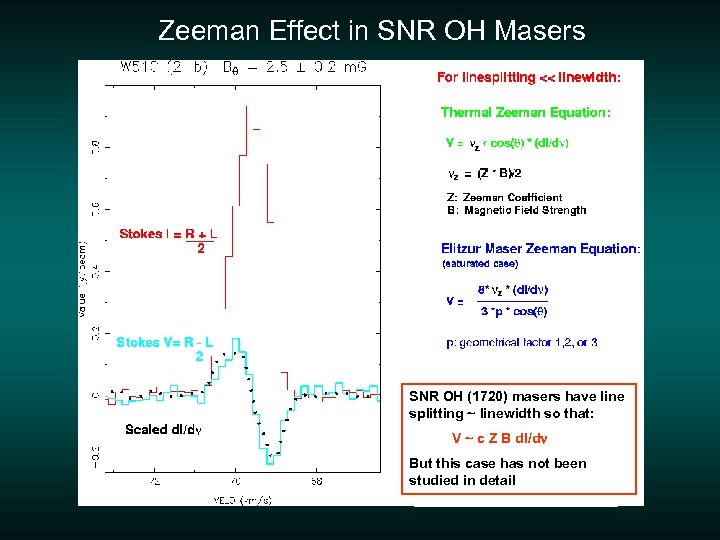 Zeeman Effect in SNR OH Masers SNR OH (1720) masers have line splitting ~ linewidth so that: V ~ c Z B d. I/dn But this case has not been studied in detail
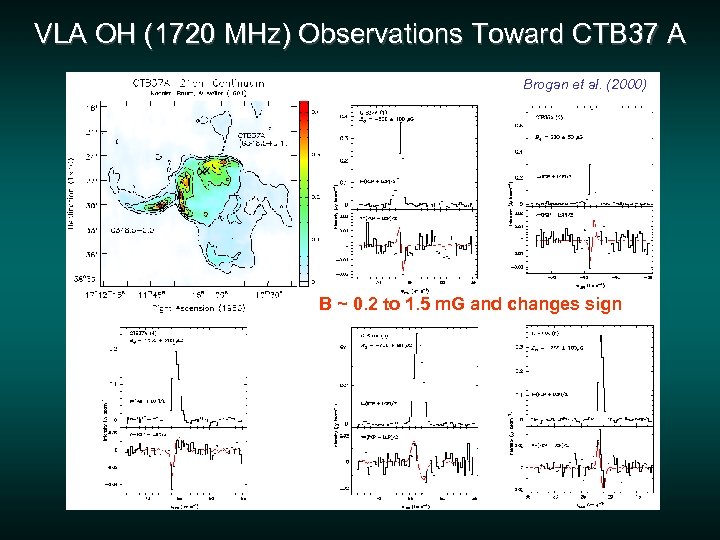 VLA OH (1720 MHz) Observations Toward CTB 37 A Brogan et al. (2000) B ~ 0. 2 to 1. 5 m. G and changes sign
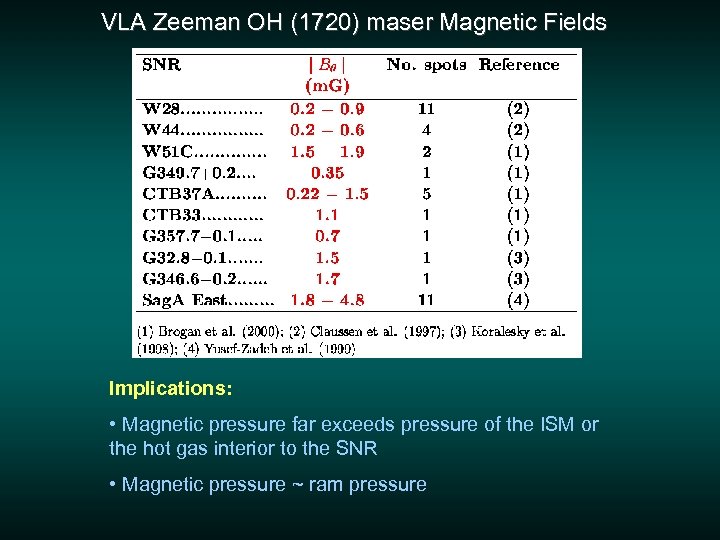 VLA Zeeman OH (1720) maser Magnetic Fields Implications: • Magnetic pressure far exceeds pressure of the ISM or the hot gas interior to the SNR • Magnetic pressure ~ ram pressure
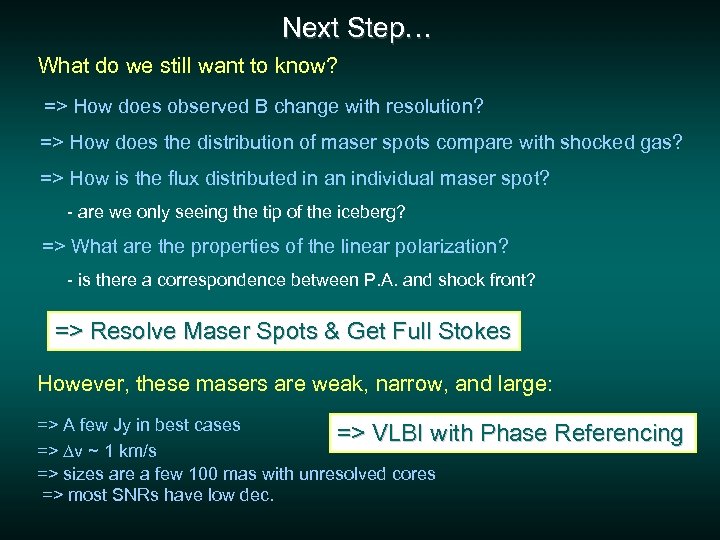 Next Step… What do we still want to know? => How does observed B change with resolution? => How does the distribution of maser spots compare with shocked gas? => How is the flux distributed in an individual maser spot? - are we only seeing the tip of the iceberg? => What are the properties of the linear polarization? - is there a correspondence between P. A. and shock front? => Resolve Maser Spots & Get Full Stokes However, these masers are weak, narrow, and large: => A few Jy in best cases => VLBI with => Dv ~ 1 km/s => sizes are a few 100 mas with unresolved cores => most SNRs have low dec. Phase Referencing
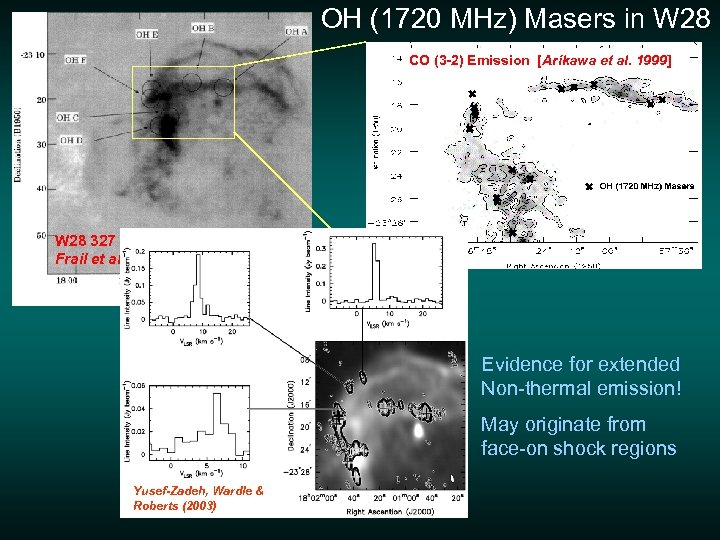 OH (1720 MHz) Masers in W 28 CO (3 -2) Emission [Arikawa et al. 1999] W 28 327 MHz Continuum Frail et al. 1993 Zeeman magnetic field strengths from the VLA are ~ 0. 2 – 0. 9 m. G Claussen et al. (1997) Yusef-Zadeh, Wardle & Roberts (2003) Evidence for extended Non-thermal emission! May originate from face-on shock regions
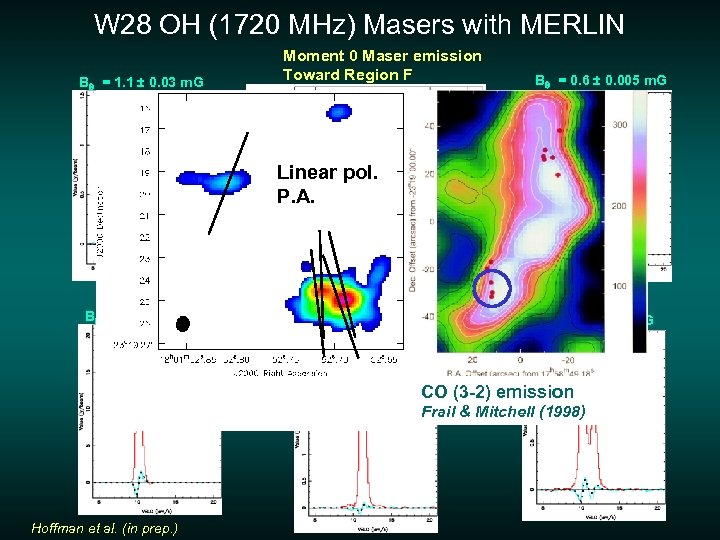 W 28 OH (1720 MHz) Masers with MERLIN Bq = 1. 1 ± 0. 03 m. G Moment 0 Maser emission Toward Region F Bq = 0. 6 ± 0. 005 m. G Linear pol. P. A. Beam 610 x 250 mas Bq = 0. 7 ± 0. 02 m. G Bq = 0. 3 ± 0. 02 m. G Bq = 0. 8 ± 0. 05 m. G CO (3 -2) emission Frail & Mitchell (1998) Hoffman et al. (in prep. )
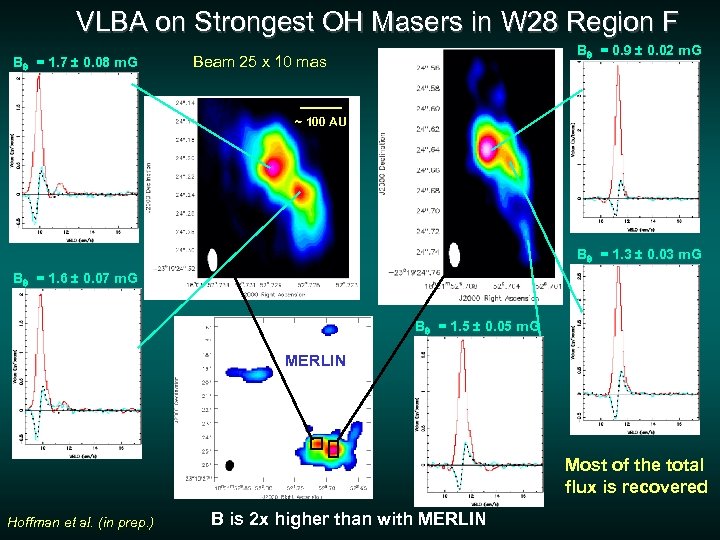 VLBA on Strongest OH Masers in W 28 Region F Bq = 1. 7 ± 0. 08 m. G Bq = 0. 9 ± 0. 02 m. G Beam 25 x 10 mas ~ 100 AU Bq = 1. 3 ± 0. 03 m. G Bq = 1. 6 ± 0. 07 m. G Bq = 1. 5 ± 0. 05 m. G MERLIN Most of the total flux is recovered Hoffman et al. (in prep. ) B is 2 x higher than with MERLIN
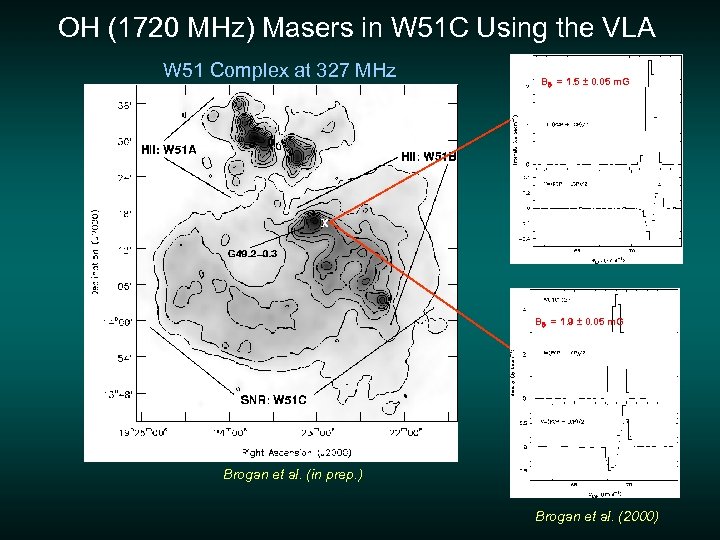 OH (1720 MHz) Masers in W 51 C Using the VLA W 51 Complex at 327 MHz Bq = 1. 5 ± 0. 05 m. G Bq = 1. 9 ± 0. 05 m. G Brogan et al. (in prep. ) Brogan et al. (2000)
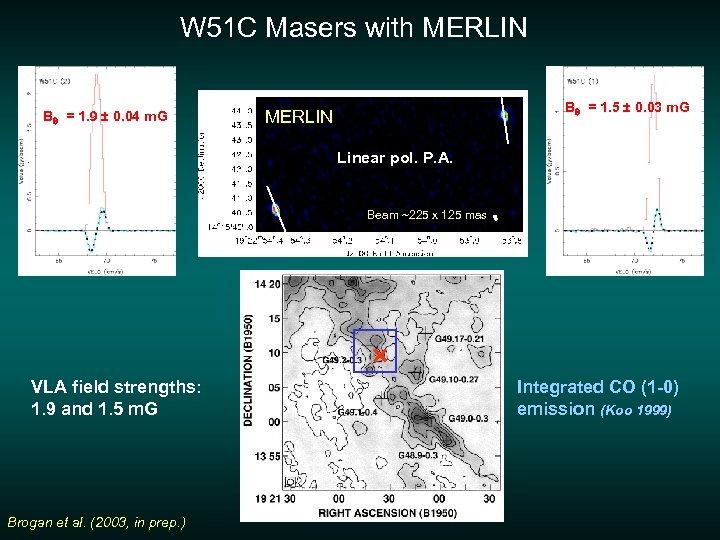 W 51 C Masers with MERLIN Bq = 1. 9 ± 0. 04 m. G Bq = 1. 5 ± 0. 03 m. G MERLIN Linear pol. P. A. Beam ~225 x 125 mas + VLA field strengths: 1. 9 and 1. 5 m. G Brogan et al. (2003, in prep. ) Integrated CO (1 -0) emission (Koo 1999)
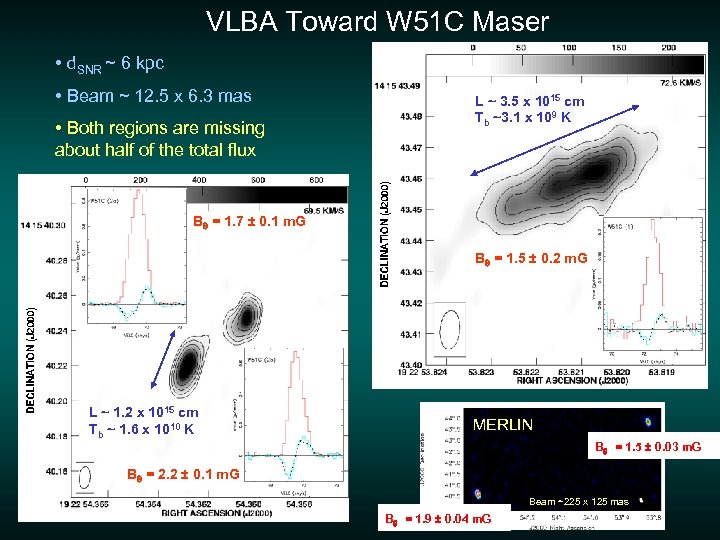 VLBA Toward W 51 C Maser • d. SNR ~ 6 kpc • Beam ~ 12. 5 x 6. 3 mas • Both regions are missing about half of the total flux L ~ 3. 5 x 1015 cm Tb ~3. 1 x 10⁹ K Bq = 1. 7 ± 0. 1 m. G Bq = 1. 5 ± 0. 2 m. G L ~ 1. 2 x 1015 cm Tb ~ 1. 6 x 10¹⁰ K MERLIN Bq = 1. 5 ± 0. 03 m. G Bq = 2. 2 ± 0. 1 m. G Beam ~225 x 125 mas Bq = 1. 9 ± 0. 04 m. G
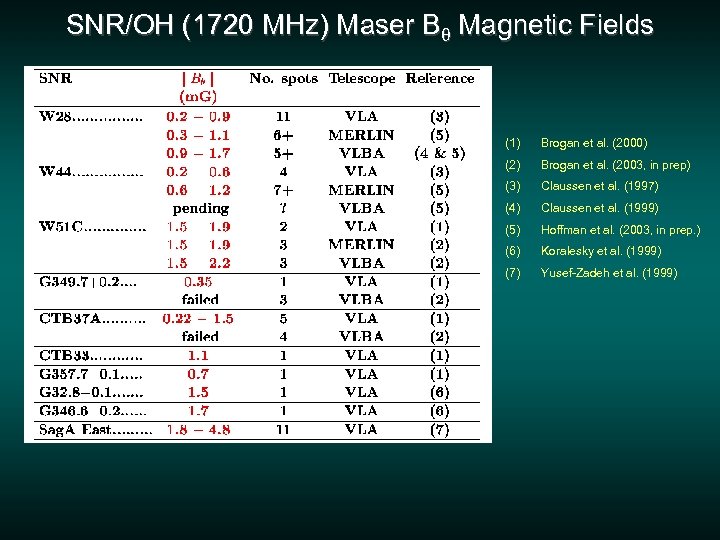 SNR/OH (1720 MHz) Maser Bq Magnetic Fields (1) Brogan et al. (2000) (2) Brogan et al. (2003, in prep) (3) Claussen et al. (1997) (4) Claussen et al. (1999) (5) Hoffman et al. (2003, in prep. ) (6) Koralesky et al. (1999) (7) Yusef-Zadeh et al. (1999)
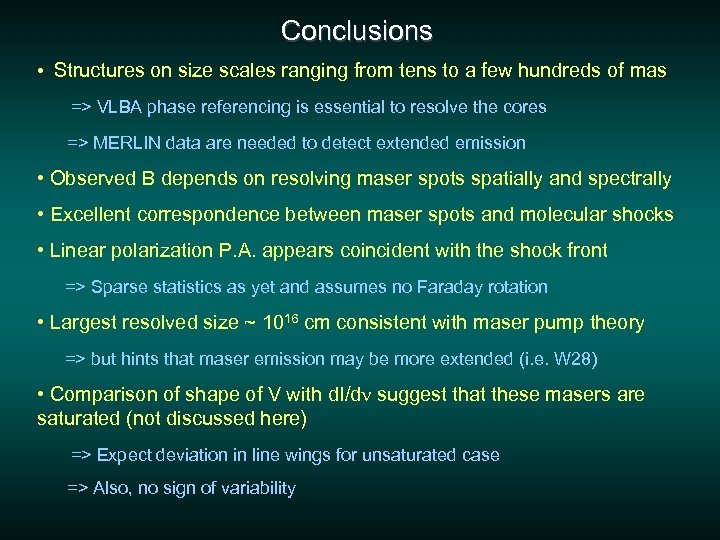 Conclusions • Structures on size scales ranging from tens to a few hundreds of mas => VLBA phase referencing is essential to resolve the cores => MERLIN data are needed to detect extended emission • Observed B depends on resolving maser spots spatially and spectrally • Excellent correspondence between maser spots and molecular shocks • Linear polarization P. A. appears coincident with the shock front => Sparse statistics as yet and assumes no Faraday rotation • Largest resolved size ~ 1016 cm consistent with maser pump theory => but hints that maser emission may be more extended (i. e. W 28) • Comparison of shape of V with d. I/dn suggest that these masers are saturated (not discussed here) => Expect deviation in line wings for unsaturated case => Also, no sign of variability
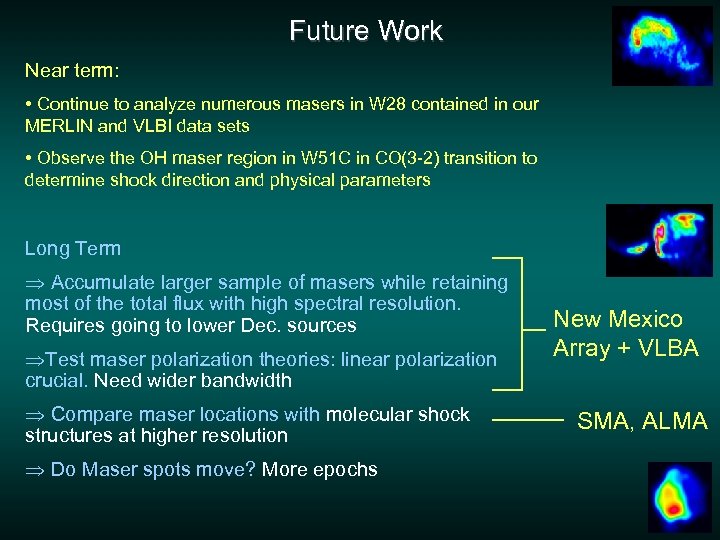 Future Work Near term: • Continue to analyze numerous masers in W 28 contained in our MERLIN and VLBI data sets • Observe the OH maser region in W 51 C in CO(3 -2) transition to determine shock direction and physical parameters Long Term Þ Accumulate larger sample of masers while retaining most of the total flux with high spectral resolution. Requires going to lower Dec. sources ÞTest maser polarization theories: linear polarization crucial. Need wider bandwidth Þ Compare maser locations with molecular shock structures at higher resolution Þ Do Maser spots move? More epochs New Mexico Array + VLBA SMA, ALMA


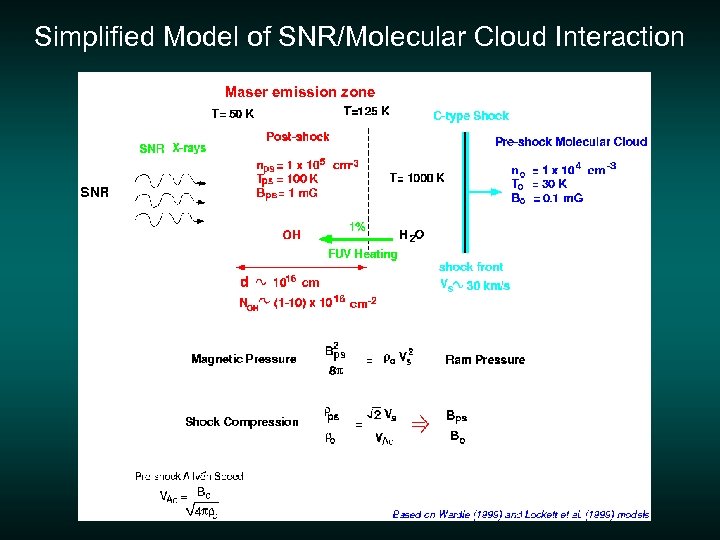 Simplified Model of SNR/Molecular Cloud Interaction Maser emission zone
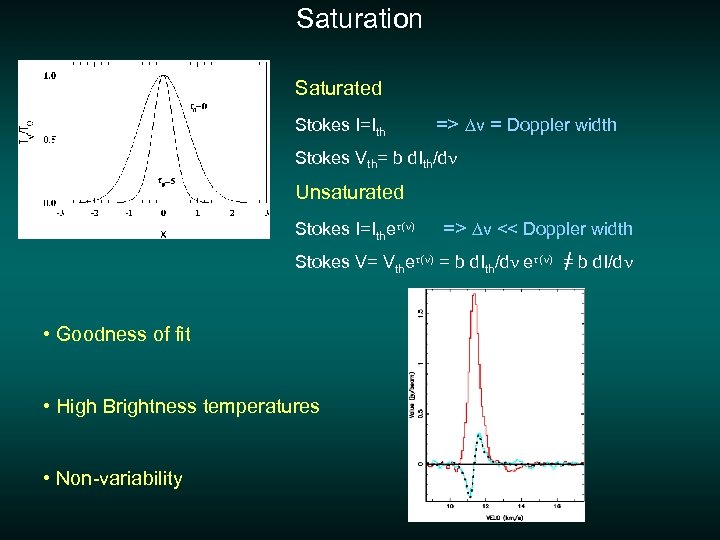 Saturation Saturated Stokes I=Ith => Dv = Doppler width Stokes Vth= b d. Ith/dn Unsaturated Stokes I=Ithet(n) => Dv << Doppler width Stokes V= Vthet(n) = b d. Ith/dn et(n) = b d. I/dn • Goodness of fit • High Brightness temperatures • Non-variability
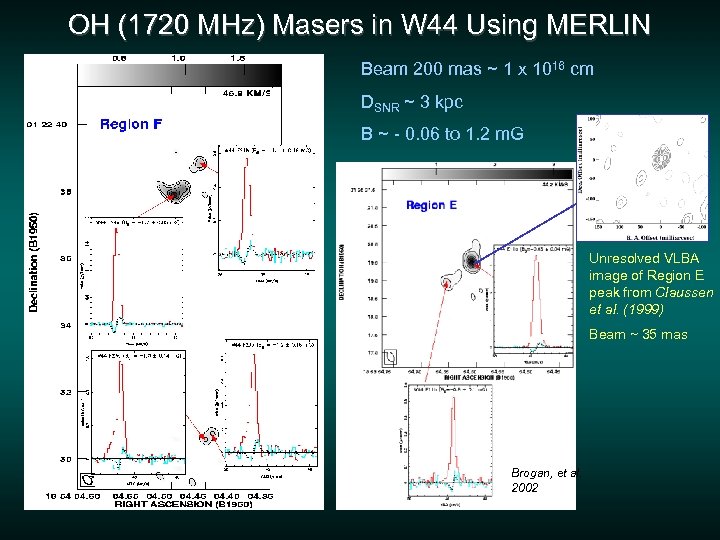 OH (1720 MHz) Masers in W 44 Using MERLIN Beam 200 mas ~ 1 x 1016 cm DSNR ~ 3 kpc B ~ - 0. 06 to 1. 2 m. G Unresolved VLBA image of Region E peak from Claussen et al. (1999) Beam ~ 35 mas Brogan, et al. 2002