


 Скачать презентацию 9 th APIC CEFIC European Conference on Active Pharmaceutical
be1e5c2dd483143f4e65a04d15b02b63.ppt
- Количество слайдов: 28
 9 th APIC/CEFIC European Conference on Active Pharmaceutical Ingredients Impact of European Legislation on Indian API Manufacturers 10 th October 2006 (09. 00 -09. 45) Nandkumar Chodankar (Ph D) Sekhsaria Chemicals Ltd. Mumbai, India
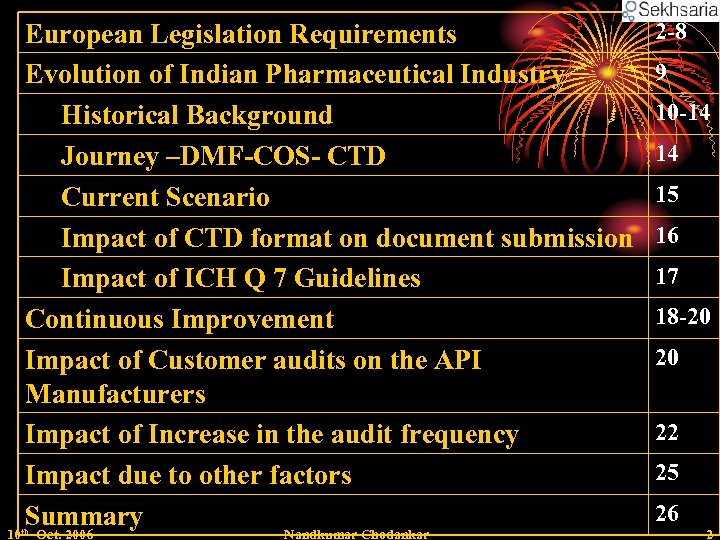 European Legislation Requirements Evolution of Indian Pharmaceutical Industry Historical Background Journey –DMF-COS- CTD Current Scenario Impact of CTD format on document submission Impact of ICH Q 7 Guidelines Continuous Improvement Impact of Customer audits on the API Manufacturers Impact of Increase in the audit frequency Impact due to other factors Summary 10 th Oct. 2006 Nandkumar Chodankar 2 -8 9 10 -14 14 15 16 17 18 -20 20 22 25 26 2
 European New Legislation • The pharmaceutical manufacturer is responsible for ensuring that the APIs have been manufactured in accordance with the EU Guidelines to Good Manufacturing Practice for Active Substances, Volume 4, Part II. • After 17 th December 2005, pharmaceutical manufacturer’s QP certifies by his or her signature to the register for release of medicinal products that also the API has been manufactured in accordance with GMP • This means that after that date the signature of the QP implies a greater responsibility. No separate signature is required in the register to certify that APIs have been manufactured in accordance with GMP. 10 th Oct. 2006 Nandkumar Chodankar 3
 Document to substantiate that APIs have been manufactured in accordance to GMP • The pharmaceutical manufacturer must have evidence of appropriate audit being performed on all its API manufacturers (in respect of manufacturing, packaging, repackaging, mixing, labeling, re-labeling, and supplementary labeling). Audit reports will become an issue for future inspections at the premises of pharmaceutical manufacturers. 10 th Oct. 2006 Nandkumar Chodankar 4
 Are third party inspection reports acceptable? • Most of the EU accepts third party inspections reports with following conditions, that: • The auditor is a QP • The auditor is independent of the company to be audited. • The auditor is acquainted with the rules of the governing medicinal products in the European Union, Volume 4, Part II • The audit report has been reviewed by the pharmaceutical manufacturer • The audit report is adequate. • Third party audit report must be in detail not just a summary. 10 th Oct. 2006 Nandkumar Chodankar 5
 Today’s Situation • From 17 th December 2005 onwards the medicinal products of an API manufacturer who is not audited are quarantined on inspection until the API manufacturer has been audited. • Exception to the rule is there are some medicinal products that are not comprised by the rules on APIs. • Medicinal products dispensed by a special compassionate-use- permit in EU (Denmark) • Medicinal products prepared in accordance with a magisterial formula • Medicinal products for clinical studies for which a marketing authorization has not been granted 10 th GMP Requirement for API questions & Answers) http; //www. dkma. dk/1024/vis. UKLSArtikel. asp Oct. 2006 Nandkumar Chodankar 6
 Definition of API Manufacturer • An API manufacturer is defined in Executive Order No. 1242 of 12 December 2005, which briefly states that the API manufacturer is: • The manufacturer of API • The company in charge of packaging the APIs • The company in charge of repackaging / unpackaging, mixing the APIs • The company in charge of labeling or relabeling or providing supplementary labels for API. 10 th Oct. 2006 Nandkumar Chodankar 7
 Are Regular Inspections in the offing? • As a general rule, API manufacturers will not be inspected at regular intervals unless the manufacture concerned requires an authorization pursuant to EU Medicinal Act • API manufacturer who wish to receive GMP certificate must request an authority inspection. 10 th Oct. 2006 Nandkumar Chodankar 8
 Evolution of Indian Pharmaceutical Industry
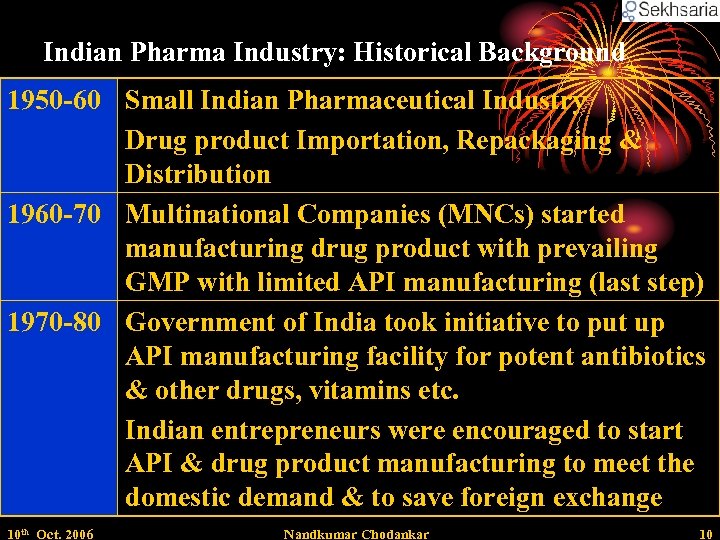 Indian Pharma Industry: Historical Background 1950 -60 Small Indian Pharmaceutical Industry Drug product Importation, Repackaging & Distribution 1960 -70 Multinational Companies (MNCs) started manufacturing drug product with prevailing GMP with limited API manufacturing (last step) 1970 -80 Government of India took initiative to put up API manufacturing facility for potent antibiotics & other drugs, vitamins etc. Indian entrepreneurs were encouraged to start API & drug product manufacturing to meet the domestic demand & to save foreign exchange 10 th Oct. 2006 Nandkumar Chodankar 10
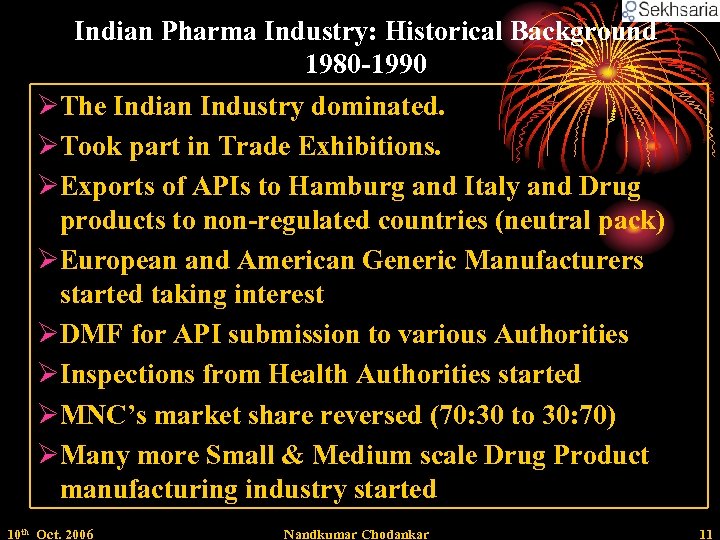 Indian Pharma Industry: Historical Background 1980 -1990 ØThe Indian Industry dominated. ØTook part in Trade Exhibitions. ØExports of APIs to Hamburg and Italy and Drug products to non-regulated countries (neutral pack) ØEuropean and American Generic Manufacturers started taking interest ØDMF for API submission to various Authorities ØInspections from Health Authorities started ØMNC’s market share reversed (70: 30 to 30: 70) ØMany more Small & Medium scale Drug Product manufacturing industry started 10 th Oct. 2006 Nandkumar Chodankar 11
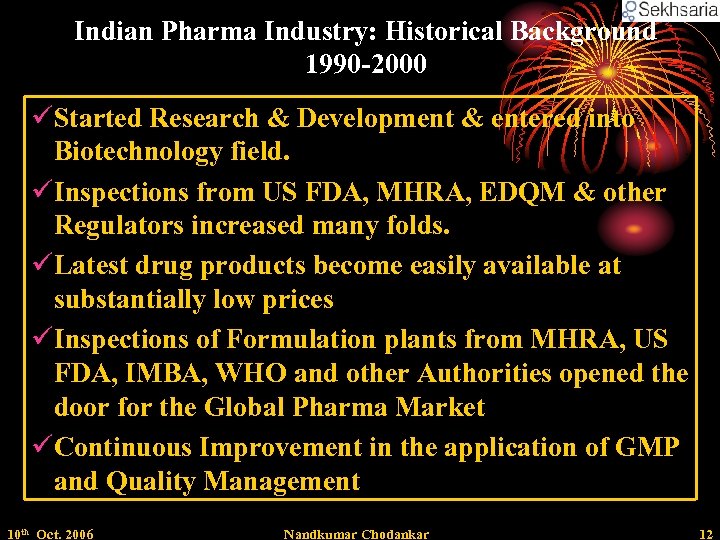 Indian Pharma Industry: Historical Background 1990 -2000 üStarted Research & Development & entered into Biotechnology field. üInspections from US FDA, MHRA, EDQM & other Regulators increased many folds. üLatest drug products become easily available at substantially low prices üInspections of Formulation plants from MHRA, US FDA, IMBA, WHO and other Authorities opened the door for the Global Pharma Market üContinuous Improvement in the application of GMP and Quality Management 10 th Oct. 2006 Nandkumar Chodankar 12
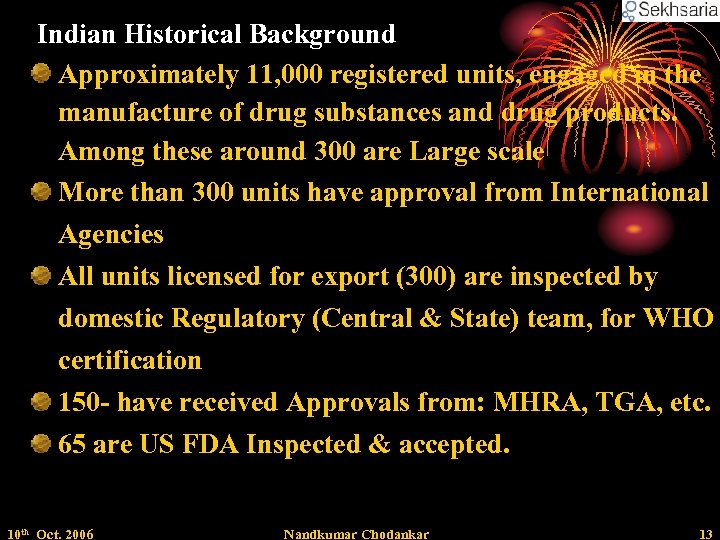 Indian Historical Background Approximately 11, 000 registered units, engaged in the manufacture of drug substances and drug products. Among these around 300 are Large scale More than 300 units have approval from International Agencies All units licensed for export (300) are inspected by domestic Regulatory (Central & State) team, for WHO certification 150 - have received Approvals from: MHRA, TGA, etc. 65 are US FDA Inspected & accepted. 10 th Oct. 2006 Nandkumar Chodankar 13
 Journey: DMF to EDMF- COS –CTD Formats UK companies took the lead and their Quality Assurance personnel started investing their time in Indian companies. Grabbing of opportunity: Indians were quick to learn and grab the opportunity. Introduction of COS and its declaration that the APIs are manufactured under GMP, Introduction of ICH Guidelines and their implementation: . The CTD format for DMF submission. 10 th Oct. 2006 Nandkumar Chodankar 14
 Current scenario: DMFs, COSs, Dossiers and ANDAs DMF Filing by Indians: Largest number of DMFs & COSs from Indian Companies About 132 ANDA in Partnerships have been submitted with US Generic companies. Similarly Dossiers have been submitted A few have signed partnerships. The acquisitions of pharmaceutical industries by Indians and vice versa. Indian Generic Products available at Indian cost with International standard for all Regulated Markets 10 th Oct. 2006 Nandkumar Chodankar 15
 The impact of CTD Formats for Document submission • The new legislation such as improved documentation/CTD is a positive move for all involved as it is moving to one common standard of documents and ultimately material and pharmacopoeia standards which has a very positive impact on the ability of companies to produce good documentation and quality product. Indians have taken a lead in this field. 10 th Oct. 2006 Nandkumar Chodankar 16
 The Impact: ICH Q 7 requirements for GMP Manufacturing Ø Implementation of ICH Q 7 A guideline for manufacturing API and Intermediates. Ø Training of the staff to understand to follow the requirements of the ICH guidelines Ø Realigning of the facilities to meet GMP & environmental requirements Ø Separation of the Final API purification step from the other synthetic steps, and manufacture it with precisely as per the ICH Q 7 Requirements Ø Product isolation at each stage of manufacturing in a controlled environment. Ø Critical unit operations like Drying, Milling, Packaging, Labeling, etc. , in controlled environment. 10 th Oct. 2006 Nandkumar Chodankar 17
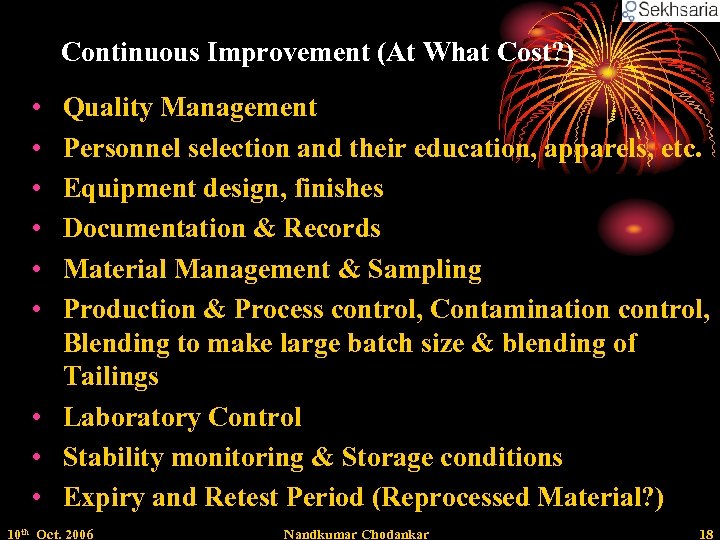 Continuous Improvement (At What Cost? ) • • • Quality Management Personnel selection and their education, apparels, etc. Equipment design, finishes Documentation & Records Material Management & Sampling Production & Process control, Contamination control, Blending to make large batch size & blending of Tailings • Laboratory Control • Stability monitoring & Storage conditions • Expiry and Retest Period (Reprocessed Material? ) 10 th Oct. 2006 Nandkumar Chodankar 18
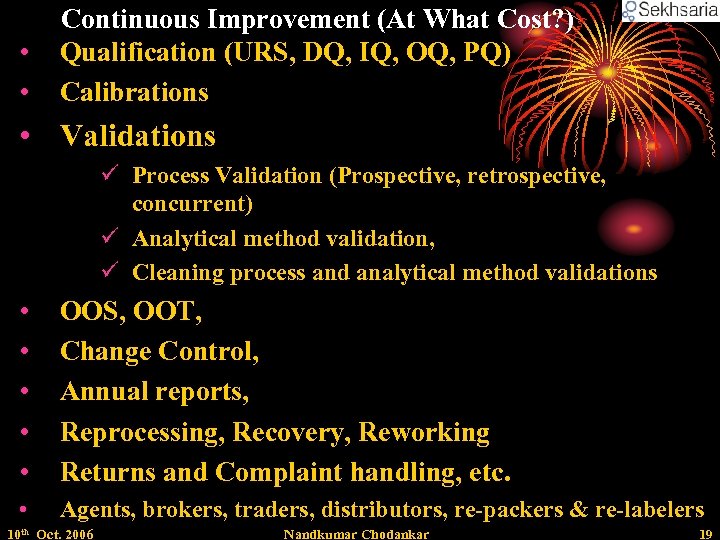 • • Continuous Improvement (At What Cost? ) Qualification (URS, DQ, IQ, OQ, PQ) Calibrations • Validations ü Process Validation (Prospective, retrospective, concurrent) ü Analytical method validation, ü Cleaning process and analytical method validations • • • OOS, OOT, Change Control, Annual reports, Reprocessing, Recovery, Reworking Returns and Complaint handling, etc. • Agents, brokers, traders, distributors, re-packers & re-labelers 10 th Oct. 2006 Nandkumar Chodankar 19
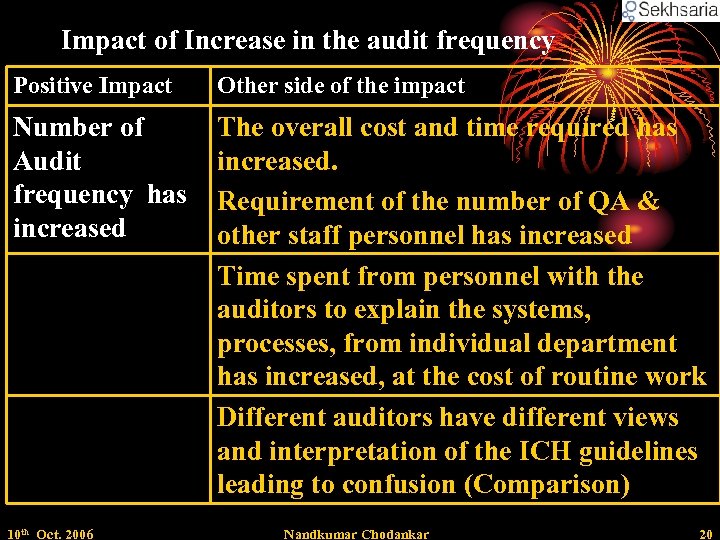 Impact of Increase in the audit frequency Positive Impact Other side of the impact Number of Audit frequency has increased The overall cost and time required has increased. Requirement of the number of QA & other staff personnel has increased Time spent from personnel with the auditors to explain the systems, processes, from individual department has increased, at the cost of routine work Different auditors have different views and interpretation of the ICH guidelines leading to confusion (Comparison) 10 th Oct. 2006 Nandkumar Chodankar 20
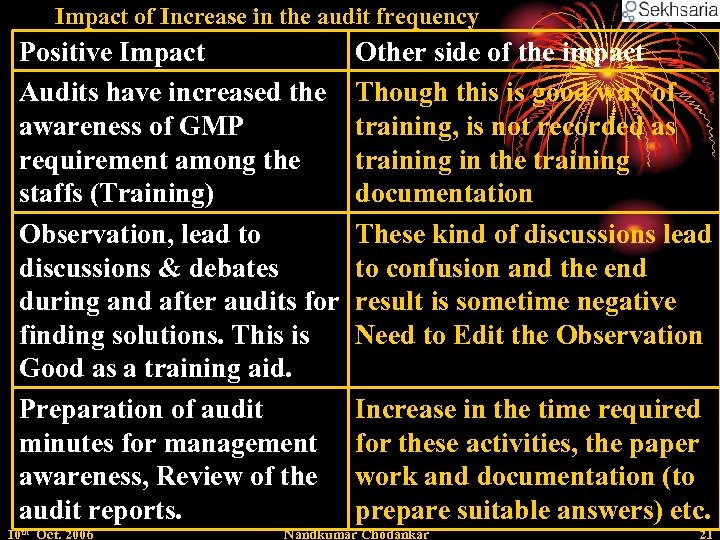 Impact of Increase in the audit frequency Positive Impact Audits have increased the awareness of GMP requirement among the staffs (Training) Observation, lead to discussions & debates during and after audits for finding solutions. This is Good as a training aid. Preparation of audit minutes for management awareness, Review of the audit reports. 10 th Oct. 2006 Other side of the impact Though this is good way of training, is not recorded as training in the training documentation These kind of discussions lead to confusion and the end result is sometime negative Need to Edit the Observation Increase in the time required for these activities, the paper work and documentation (to prepare suitable answers) etc. Nandkumar Chodankar 21
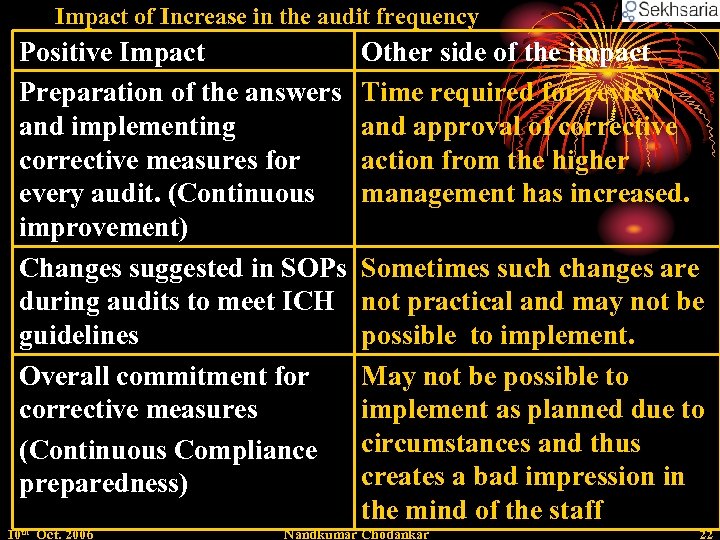 Impact of Increase in the audit frequency Positive Impact Preparation of the answers and implementing corrective measures for every audit. (Continuous improvement) Changes suggested in SOPs during audits to meet ICH guidelines Overall commitment for corrective measures (Continuous Compliance preparedness) 10 th Oct. 2006 Other side of the impact Time required for review and approval of corrective action from the higher management has increased. Sometimes such changes are not practical and may not be possible to implement. May not be possible to implement as planned due to circumstances and thus creates a bad impression in the mind of the staff Nandkumar Chodankar 22
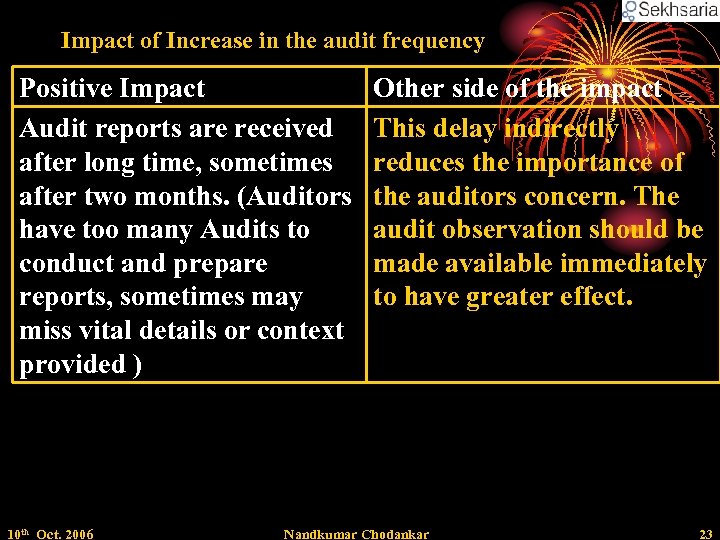 Impact of Increase in the audit frequency Positive Impact Audit reports are received after long time, sometimes after two months. (Auditors have too many Audits to conduct and prepare reports, sometimes may miss vital details or context provided ) 10 th Oct. 2006 Other side of the impact This delay indirectly reduces the importance of the auditors concern. The audit observation should be made available immediately to have greater effect. Nandkumar Chodankar 23

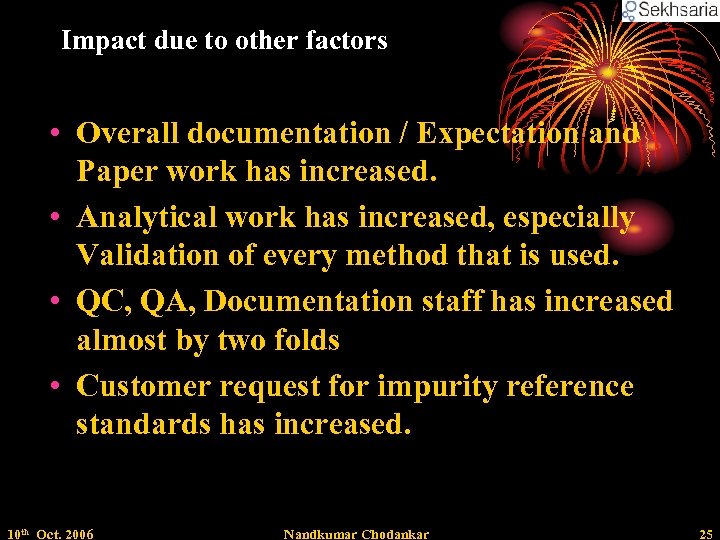 Impact due to other factors • Overall documentation / Expectation and Paper work has increased. • Analytical work has increased, especially Validation of every method that is used. • QC, QA, Documentation staff has increased almost by two folds • Customer request for impurity reference standards has increased. 10 th Oct. 2006 Nandkumar Chodankar 25
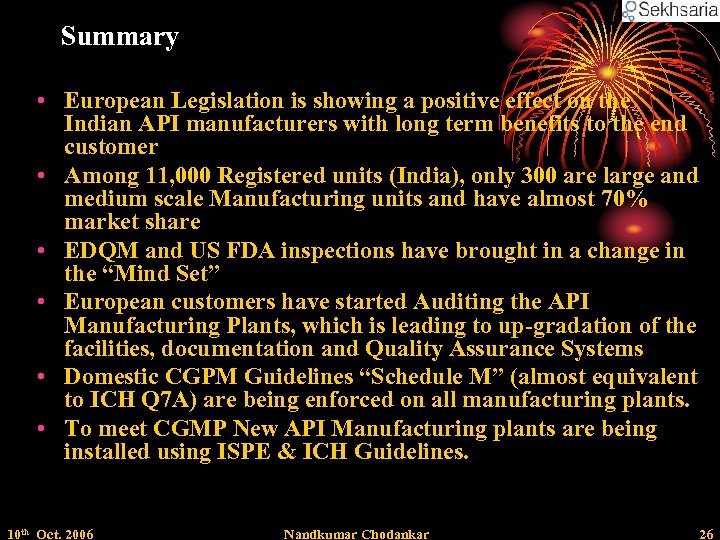 Summary • European Legislation is showing a positive effect on the Indian API manufacturers with long term benefits to the end customer • Among 11, 000 Registered units (India), only 300 are large and medium scale Manufacturing units and have almost 70% market share • EDQM and US FDA inspections have brought in a change in the “Mind Set” • European customers have started Auditing the API Manufacturing Plants, which is leading to up-gradation of the facilities, documentation and Quality Assurance Systems • Domestic CGPM Guidelines “Schedule M” (almost equivalent to ICH Q 7 A) are being enforced on all manufacturing plants. • To meet CGMP New API Manufacturing plants are being installed using ISPE & ICH Guidelines. 10 th Oct. 2006 Nandkumar Chodankar 26
 • I will like to thank the following individuals for making this presentation possible; • Laurie Cook • Lalit Sharma 10 th Oct. 2006 Nandkumar Chodankar 27
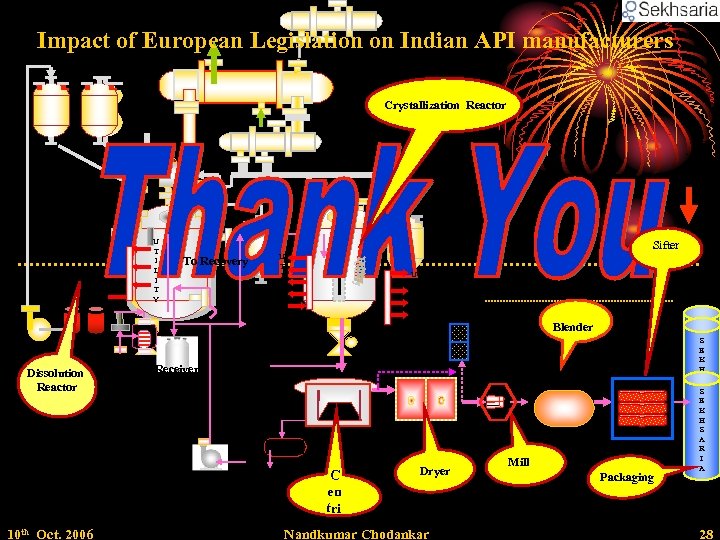 Impact of European Legislation on Indian API manufacturers To Vacuum Crystallization Reactor U T I L I T Y Dissolution Reactor To Recovery Sifter U T I L I T Y Multi Mill Blender S E S K E H K S H A S R A S I R E A I K A H Receiver Pump Mother Liquor Tank 10 th Oct. 2006 U T I L I T Y Dryer C en tri fu Nandkumar Chodankar Mill Packaging S A R I A 28