 Скачать презентацию 9 October 2014 Contracts for Difference On the
27e4b90288ad3b006bf0bddbe16f106f.ppt
- Количество слайдов: 41



9 October 2014 Contracts for Difference: On the Launchpad Chris Andrew © Allen & Overy 2014 1
The Ongoing UK Energy Policy Trilemma Security of Supply – In the next decade a fifth of existing UK generating capacity will come off-line. DECC estimate electricity demand growth of 30% - 100% by 2050. Decarbonisation – DECC’s 2050 Pathways analysis shows that the decarbonisation of the generation sector by around 2030 is effectively a necessity for meeting the legal requirements of the 2008 Climate Change Act to reduce CO 2 emissions by 80% 1990 – 2050. – The Fourth Carbon Budget commits UK to 50% reduction by 2027. – The European Commission has proposed a 2030 policy framework for climate and energy policies envisaging: a 40% GHG reduction, but EU rather than national renewable energy targets. Affordability – Between 2013 and 2020 required expenditure on UK energy infrastructure is estimated at £ 110 bn. – Government acknowledges that consume prices will rise. It no longer claims that EMR will reduce the effects of rising fossil fuel prices (as this is dependant on assumptions as to future fossil fuel prices), rather that EMR is a cheaper (6%) way of achieving 2030 carbon targets. – The Levy Control Framework implies a subsidy (over and above the Carbon Price Floor) for large-scale low-carbon generation of £ 7. 6 bn (2012 prices) in 2020/21. © Allen & Overy 2014 2
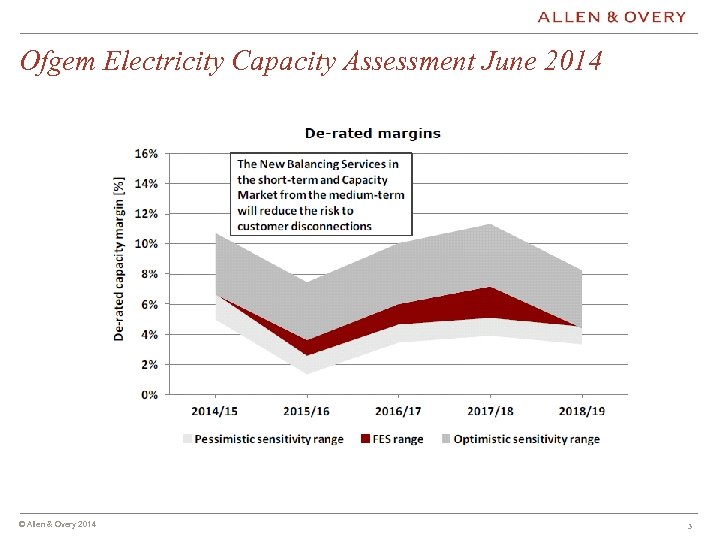
Ofgem Electricity Capacity Assessment June 2014 © Allen & Overy 2014 3
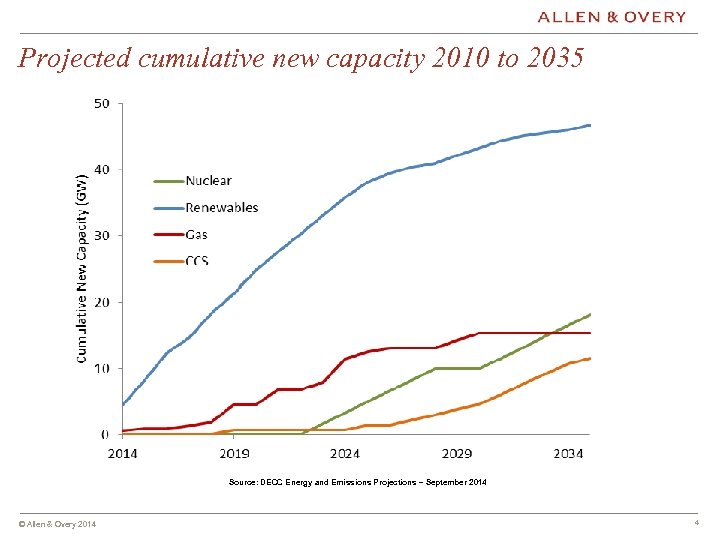
Projected cumulative new capacity 2010 to 2035 Source: DECC Energy and Emissions Projections – September 2014 © Allen & Overy 2014 4
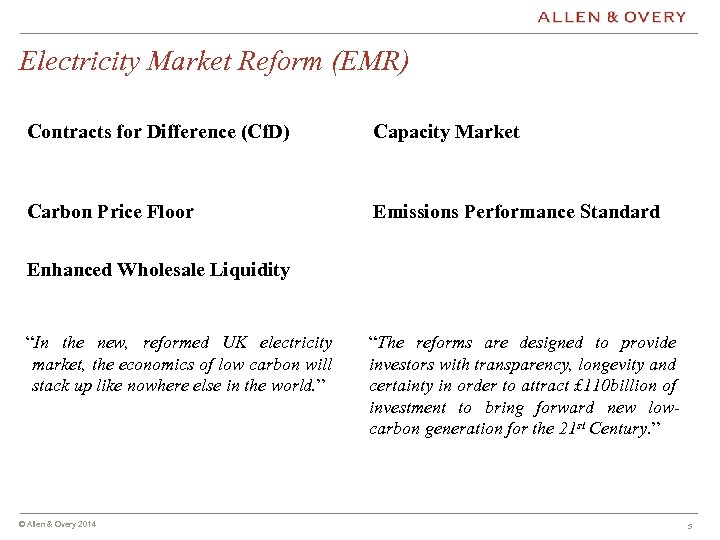
Electricity Market Reform (EMR) Contracts for Difference (Cf. D) Capacity Market Carbon Price Floor Emissions Performance Standard Enhanced Wholesale Liquidity “In the new, reformed UK electricity market, the economics of low carbon will stack up like nowhere else in the world. ” © Allen & Overy 2014 “The reforms are designed to provide investors with transparency, longevity and certainty in order to attract £ 110 billion of investment to bring forward new lowcarbon generation for the 21 st Century. ” 5
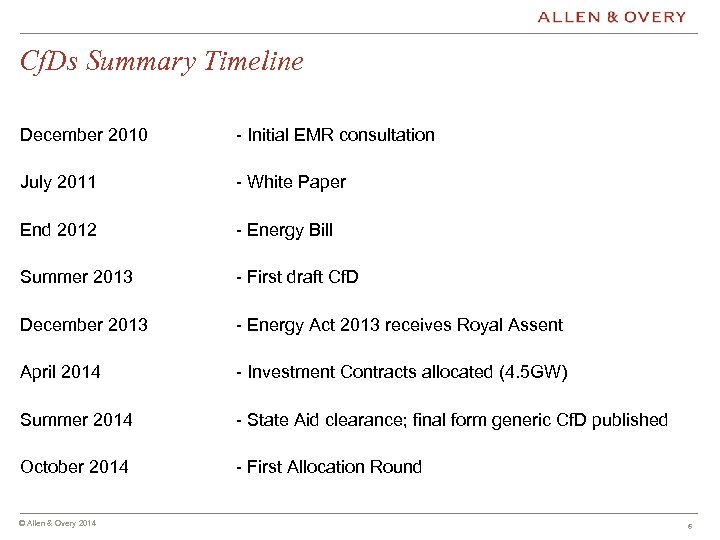
Cf. Ds Summary Timeline December 2010 - Initial EMR consultation July 2011 - White Paper End 2012 - Energy Bill Summer 2013 - First draft Cf. D December 2013 - Energy Act 2013 receives Royal Assent April 2014 - Investment Contracts allocated (4. 5 GW) Summer 2014 - State Aid clearance; final form generic Cf. D published October 2014 - First Allocation Round © Allen & Overy 2014 © Allen & Overy 2013 6
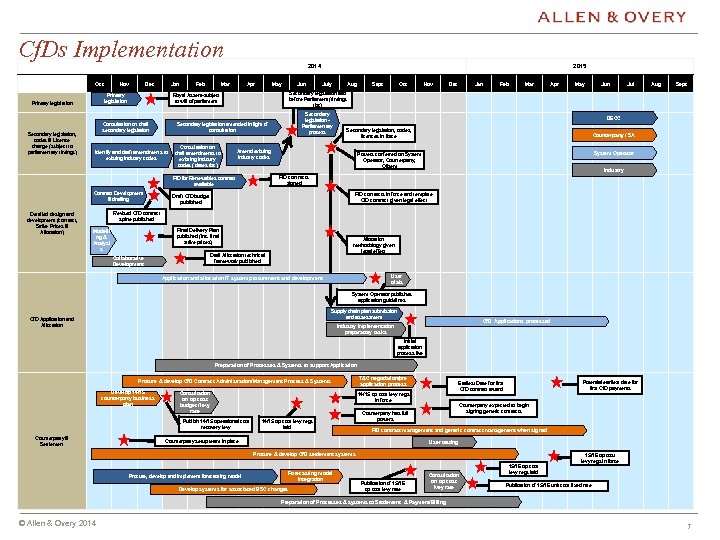
Cf. Ds Implementation 2014 Oct Primary legislation Secondary legislation, codes & Licence change (subject to parliamentary timings) Nov Dec Jan Primary legislation Feb Mar Apr May Identify and draft amendments to existing industry codes Detailed design and development (contract, Strike Prices & Allocation) Aug Sept Oct Nov Dec Jan Feb Mar Apr May Jun Jul Aug Sept DECC Secondary legislation, codes, licences in force Amend existing industry codes Counterparty / SA System Operator Powers conferred on System Operator, Counterparty, Ofgem Industry Fi. D contracts signed Fi. D for Renewables contract available Contract Development & drafting Secondary legislation Parliamentary process Secondary legislation amended in light of consultation Consultation on draft amendments to existing industry codes ( dates tbc) July Secondary legislation laid before Parliament (timings tbc) Royal Assent-subject to will of parliament Consultation on draft secondary legislation Jun 2015 Fi. D contracts in force and template Cf. D contract given legal effect Draft Cf. D budget published Revised Cf. D contract spine published Final Delivery Plan published (inc. final strike prices) Modelli ng & Analysi s Collaborative Development Allocation methodology given legal effect Draft Allocation technical framework published User trials Application and allocation IT system procurement and development System Operator publishes application guidelines Supply chain plan submission and assessment Cf. D Application and Allocation Cf. D Applications processed Industry implementation preparatory tasks Initial application process live Preparation of Processes & Systems to support Application Procure & develop Cf. D Contract Administration/Management Process & Systems Develop 14/15 counterparty business plan Consultation on op cost budget / levy rate Publish 14/15 operational cost recovery levy Counterparty & Settlement T&C negotiation/pre application process 14/15 op cost levy regs laid Potential earliest date for first Cf. D payments Earliest Date for first Cf. D contract award 14/15 op cost levy regs in force Counterparty expected to begin signing generic contracts Counterparty has full powers Fi. D contract management and generic contract management when signed Counterparty setup team in place User testing Procure & develop Cf. D settlement systems Forecasting model integration Procure, develop and implement forecasting model Develop systems for associated BSC changes Publication of 15/16 op cost levy rate Consultation on op cost Ivey rate 15/16 op cost levy regs laid 15/16 op cost levy regs in force Publication of 15/16 unit cost fixed rate Preparation of Processes & systems to Settlement & Payment/Billing © Allen & Overy 2014 © Allen & Overy 2013 7
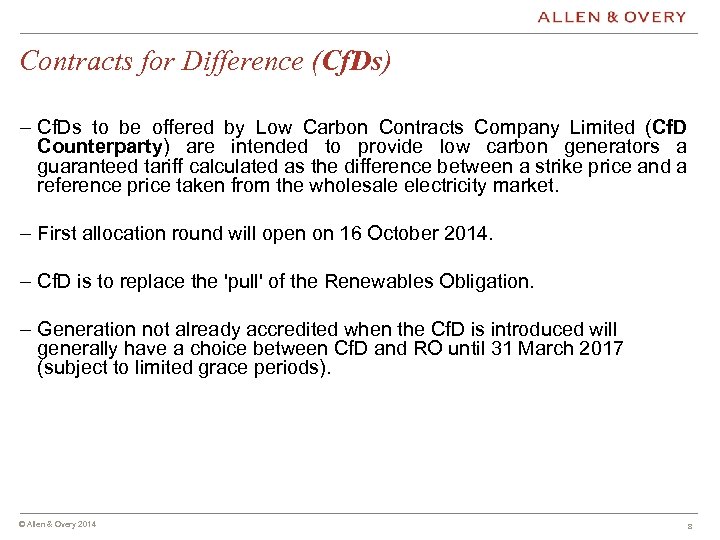
Contracts for Difference (Cf. Ds) – Cf. Ds to be offered by Low Carbon Contracts Company Limited (Cf. D Counterparty) are intended to provide low carbon generators a guaranteed tariff calculated as the difference between a strike price and a reference price taken from the wholesale electricity market. – First allocation round will open on 16 October 2014. – Cf. D is to replace the 'pull' of the Renewables Obligation. – Generation not already accredited when the Cf. D is introduced will generally have a choice between Cf. D and RO until 31 March 2017 (subject to limited grace periods). © Allen & Overy 2014 8
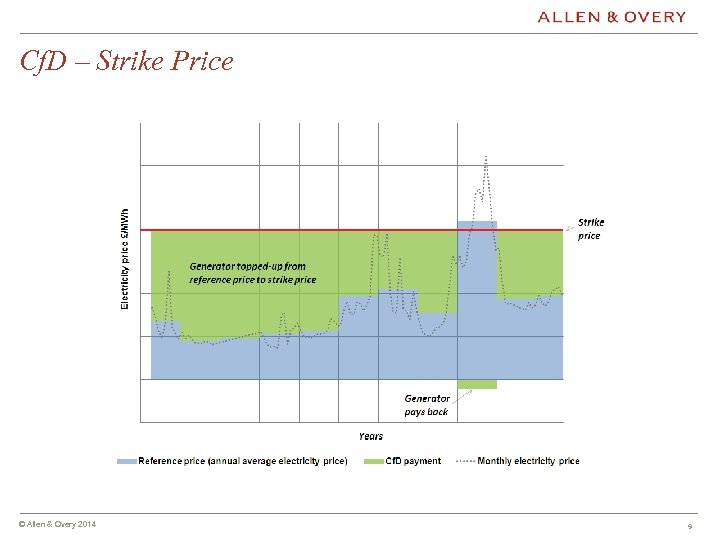
Cf. D – Strike Price © Allen & Overy 2014 9
Cf. D Payments to Generators – Payments to generators will be capped at the value of the strike price (i. e. generators take risk of negative prices). – Reference Price – used as a proxy for the market price for electricity – intermittent generation: an hourly day-ahead price – base load generation: season ahead price, possible generator option to move to year ahead. – Strike Price – fully CPI indexed – administratively set maxima, but can be lower where competitive allocation. © Allen & Overy 2014 © Allen & Overy 2013 10
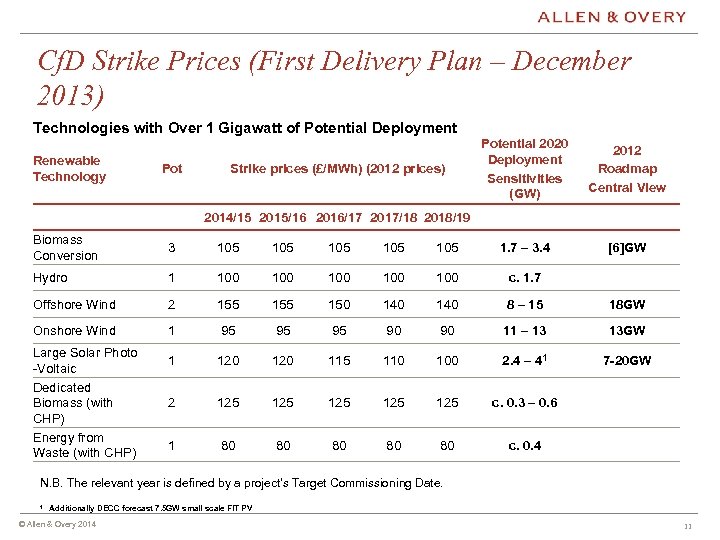
Cf. D Strike Prices (First Delivery Plan – December 2013) Technologies with Over 1 Gigawatt of Potential Deployment Renewable Technology Pot Strike prices (£/MWh) (2012 prices) Potential 2020 Deployment Sensitivities (GW) 2012 Roadmap Central View [6]GW 2014/15 2015/16 2016/17 2017/18 2018/19 Biomass Conversion 3 105 105 105 1. 7 – 3. 4 Hydro 1 100 100 100 c. 1. 7 Offshore Wind 2 155 150 140 8 – 15 18 GW Onshore Wind 1 95 95 95 90 90 11 – 13 13 GW 1 120 115 110 100 2. 4 – 41 7 -20 GW 2 125 125 125 c. 0. 3 – 0. 6 1 80 80 80 c. 0. 4 Large Solar Photo -Voltaic Dedicated Biomass (with CHP) Energy from Waste (with CHP) N. B. The relevant year is defined by a project’s Target Commissioning Date. 1 Additionally DECC forecast 7. 5 GW small scale FIT PV © Allen & Overy 2014 11
Cf. D Terms – Cf. D Agreement and Cf. D Terms and Conditions were published in August 2014. – On announcing an allocation round, the Secretary of State will issue notice of what terms are available for that round. – The terms of the Cf. D will be largely standardised across all technologies; however, different standard terms may be issued for different categories of Cf. D. – “Minor and necessary” modifications may occur for individual generators. © Allen & Overy 2014 12
Minor and Necessary Modifications – Changes to terms of standardised Cf. D can be requested – Modifications must be minor and necessary – Application should be submitted to Cf. D Counterparty using the template form – Last submission day is 20 Business Days before the end of the Application Closing Date – Early submission allows time for rejection and resubmission – Last day for Cf. D Counterparty to respond is 5 Business Days before the end of the Application Closing Date © Allen & Overy 2013 © Allen & Overy 2014 13
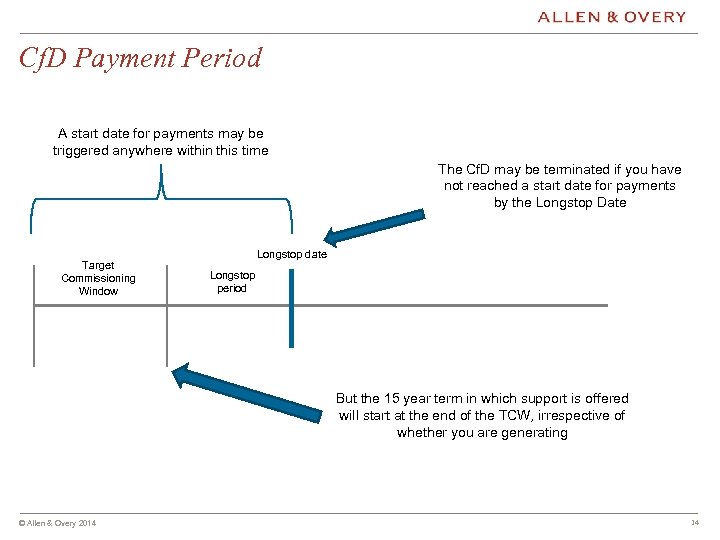
Cf. D Payment Period A start date for payments may be triggered anywhere within this time The Cf. D may be terminated if you have not reached a start date for payments by the Longstop Date Target Commissioning Window Longstop date Longstop period But the 15 year term in which support is offered will start at the end of the TCW, irrespective of whether you are generating © Allen & Overy 2013 © Allen & Overy 2014 14
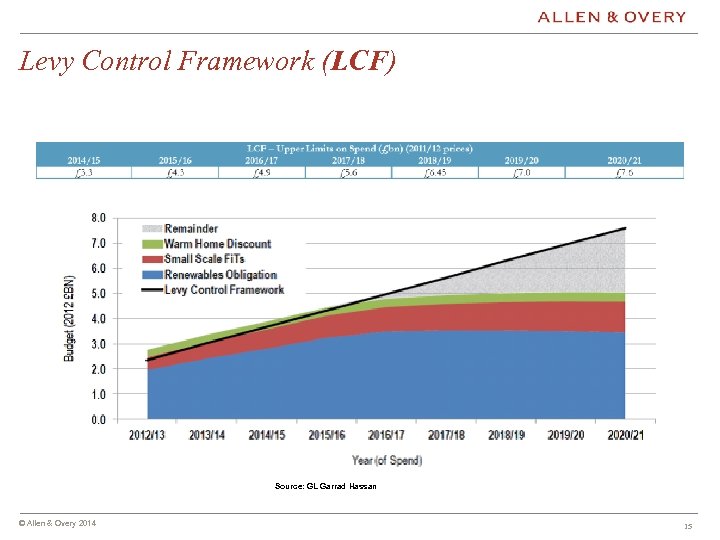
Levy Control Framework (LCF) Source: GL Garrad Hassan © Allen & Overy 2013 © Allen & Overy 2014 15
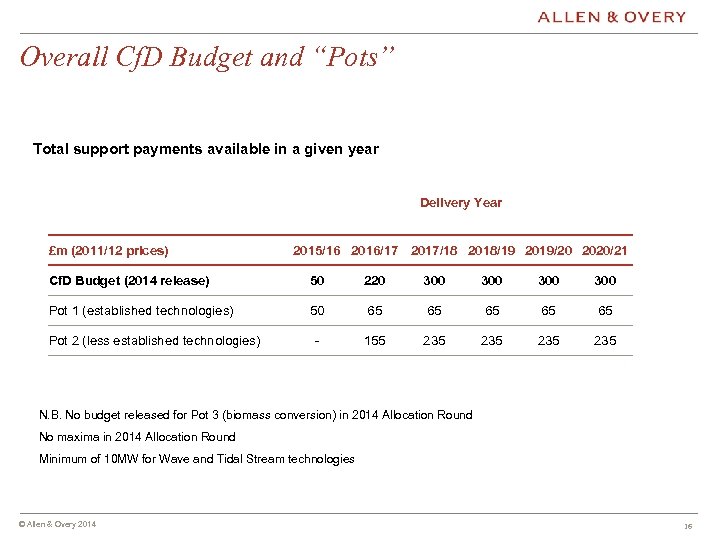
Overall Cf. D Budget and “Pots” Total support payments available in a given year Delivery Year £m (2011/12 prices) 2015/16 2016/17 2017/18 2018/19 2019/20 2020/21 Cf. D Budget (2014 release) 50 220 300 300 Pot 1 (established technologies) 50 65 65 65 - 155 235 235 Pot 2 (less established technologies) N. B. No budget released for Pot 3 (biomass conversion) in 2014 Allocation Round No maxima in 2014 Allocation Round Minimum of 10 MW for Wave and Tidal Stream technologies © Allen & Overy 2014 16
LCF Budget and Cf. D Budget – 2015/16 Renewables Obligation level increased by approximately 20% on the 2014/15 level – approximate cost of £ 3. 65 bn in 2012 money – higher level than was expected in the Delivery Plan – No LCF increase announced – Budget increased for Pot 1 and Pot 2 compared to July 2014 Draft Budget Notice – RUK calculate new budgets would allow about 700 MW of onshore wind and 800 MW of offshore wind at the administratively set strike prices, and more if those prices are lower – However, the Final Allocation Framework for the October 2014 Allocation Round set new, lower reference prices, reduced by approximately £ 10/MWh – This means that the valuation of each application will be higher than previously expected and therefore, the increase in budget will have limited impact on the capacity © Allen & Overy 2013 © Allen & Overy 2014 17
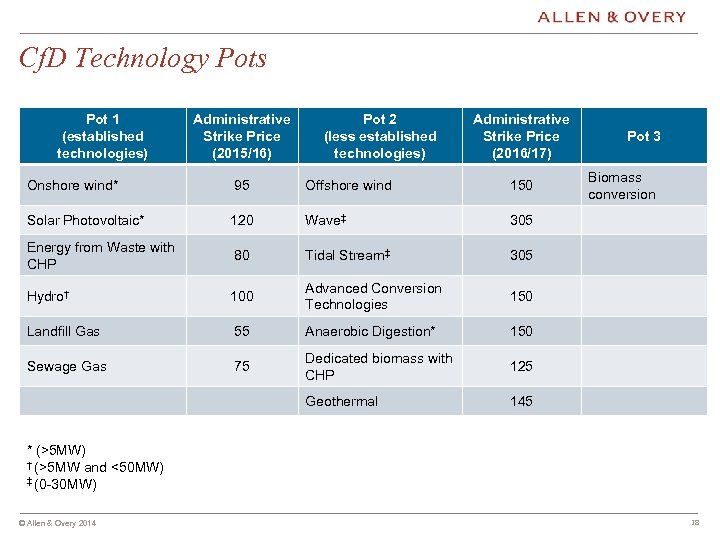
Cf. D Technology Pots Pot 1 (established technologies) Administrative Strike Price (2015/16) Pot 2 (less established technologies) Administrative Strike Price (2016/17) Onshore wind* 95 Offshore wind 150 Solar Photovoltaic* 120 Wave‡ 80 Tidal Stream‡ 305 Hydro† 100 Advanced Conversion Technologies 150 Landfill Gas 55 Anaerobic Digestion* 150 Sewage Gas 75 Dedicated biomass with CHP 125 Geothermal Biomass conversion 305 Energy from Waste with CHP Pot 3 145 * (>5 MW) † (>5 MW and <50 MW) ‡ (0 -30 MW) © Allen & Overy 2013 © Allen & Overy 2014 18
Qualification Requirements – The generating station which is the subject of the application must be an eligible generating station. – To be a qualifying applicant, the generator must: 1. meet Eligibility Requirements 2. not be an Excluded Applicant 3. provide additional information/data – The applicant must include a statement which identifies the set of standard Cf. D terms and conditions that apply or identifies any “minor and necessary” modifications agreed with the Cf. D Counterparty prior to the start of the allocation round © Allen & Overy 2014 © Allen & Overy 2013 19
Eligibility Requirements – – Applicable planning consents must have been given for the proposed generating station and other relevant works that enable the unit to be established or altered and electricity to be supplied (e. g. development consent order; TWA order, s 36 consent; planning permission; and/or a marine licence) Connection agreement requirements: – – – For projects connecting directly to the transmission or distribution system, a grid connection agreement For projects connecting indirectly (private networks), an agreement between the applicant and the operator of the private network that permits connection to the transmission or distribution system For projects not connecting to the transmission or distribution system, a declaration stating no connection is applicable Supply Chain Approval Certificate (for projects of 300 MW and above) received from DECC Supplemental requirements for phased offshore projects, e. g. timing and capacity requirements © Allen & Overy 2014 © Allen & Overy 2013 20
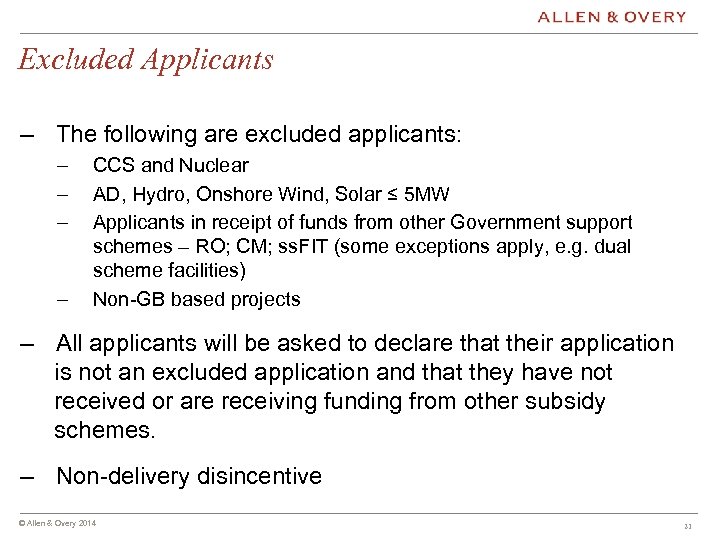
Excluded Applicants – The following are excluded applicants: – – CCS and Nuclear AD, Hydro, Onshore Wind, Solar ≤ 5 MW Applicants in receipt of funds from other Government support schemes – RO; CM; ss. FIT (some exceptions apply, e. g. dual scheme facilities) Non-GB based projects – All applicants will be asked to declare that their application is not an excluded application and that they have not received or are receiving funding from other subsidy schemes. – Non-delivery disincentive © Allen & Overy 2014 © Allen & Overy 2013 21
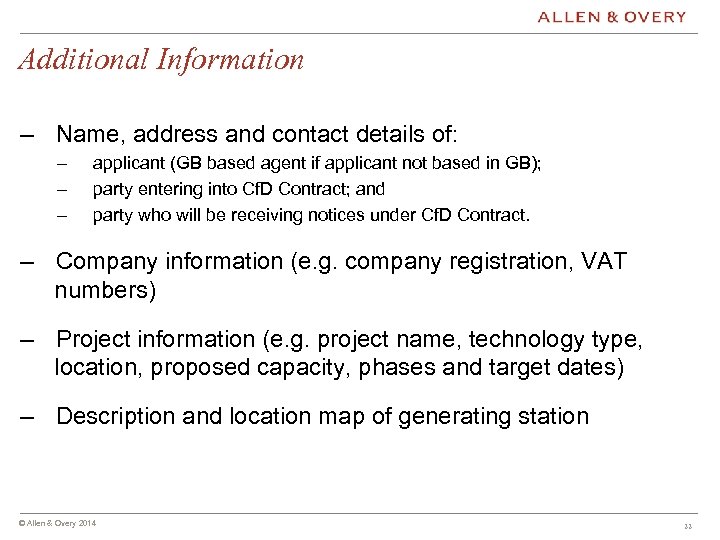
Additional Information – Name, address and contact details of: – – – applicant (GB based agent if applicant not based in GB); party entering into Cf. D Contract; and party who will be receiving notices under Cf. D Contract. – Company information (e. g. company registration, VAT numbers) – Project information (e. g. project name, technology type, location, proposed capacity, phases and target dates) – Description and location map of generating station © Allen & Overy 2014 © Allen & Overy 2013 22
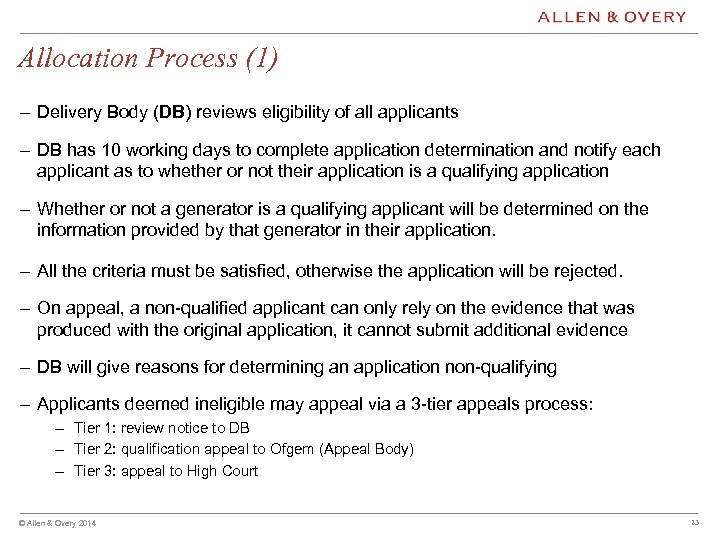
Allocation Process (1) – Delivery Body (DB) reviews eligibility of all applicants – DB has 10 working days to complete application determination and notify each applicant as to whether or not their application is a qualifying application – Whether or not a generator is a qualifying applicant will be determined on the information provided by that generator in their application. – All the criteria must be satisfied, otherwise the application will be rejected. – On appeal, a non-qualified applicant can only rely on the evidence that was produced with the original application, it cannot submit additional evidence – DB will give reasons for determining an application non-qualifying – Applicants deemed ineligible may appeal via a 3 -tier appeals process: – Tier 1: review notice to DB – Tier 2: qualification appeal to Ofgem (Appeal Body) – Tier 3: appeal to High Court © Allen & Overy 2013 © Allen & Overy 2014 23
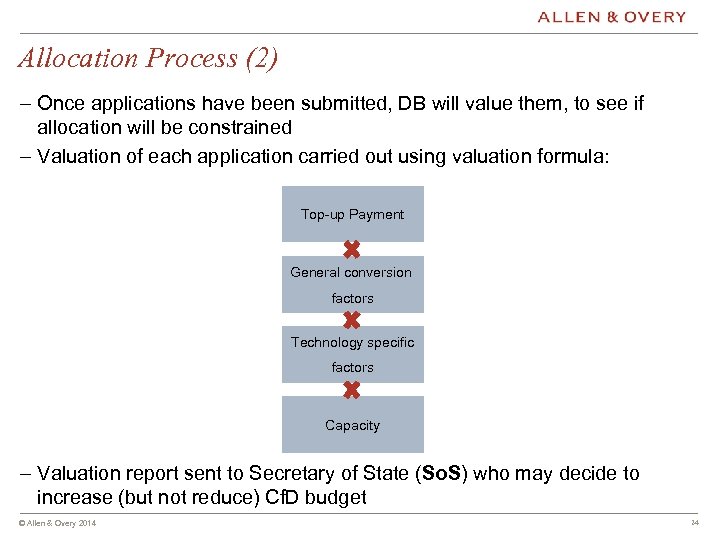
Allocation Process (2) – Once applications have been submitted, DB will value them, to see if allocation will be constrained – Valuation of each application carried out using valuation formula: Top-up Payment General conversion factors Technology specific factors Capacity – Valuation report sent to Secretary of State (So. S) who may decide to increase (but not reduce) Cf. D budget © Allen & Overy 2013 © Allen & Overy 2014 24
Allocation Process (3) – If sufficient budget for all projects in a pot, then unconstrained allocation will apply and all projects will receive the Administrative Strike Price – If there is insufficient budget for any delivery year in budget profile (or Maxima exceeded), constrained allocation will apply for that pot for all delivery years (or that Maxima) – auction required © Allen & Overy 2013 © Allen & Overy 2014 25
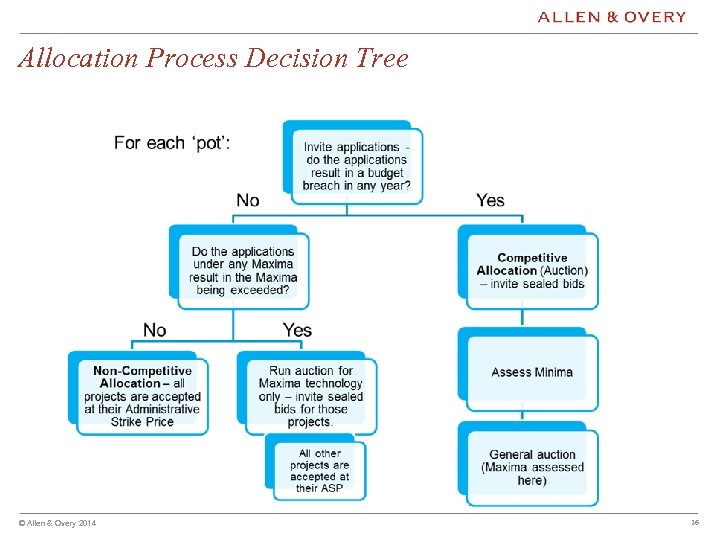
Allocation Process Decision Tree © Allen & Overy 2013 © Allen & Overy 2014 26
Auction Procedure – Each project submits sealed bids (strike price they are willing to accept) into the relevant delivery year, which is the year in which the Target Commissioning Date of the project falls – Auction ranks all projects in a pot by price and accepts cheapest first in any delivery year (regardless of technology type), until the budget for the pot is used up – Clearing price for a pot is the price of the most expensive project accepted in that delivery year (pay-as-clear rule) – For a successful project its Cf. D strike price is the applicable clearing price, capped at the relevant Administrative Strike Price © Allen & Overy 2013 © Allen & Overy 2014 27
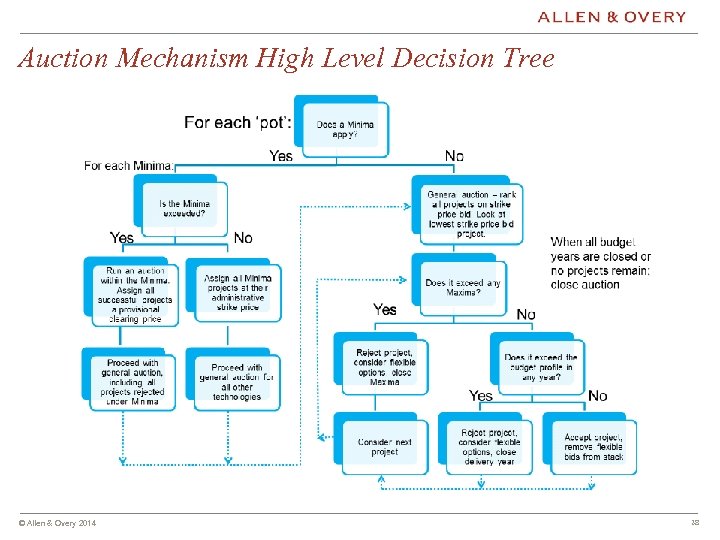
Auction Mechanism High Level Decision Tree © Allen & Overy 2013 © Allen & Overy 2014 28
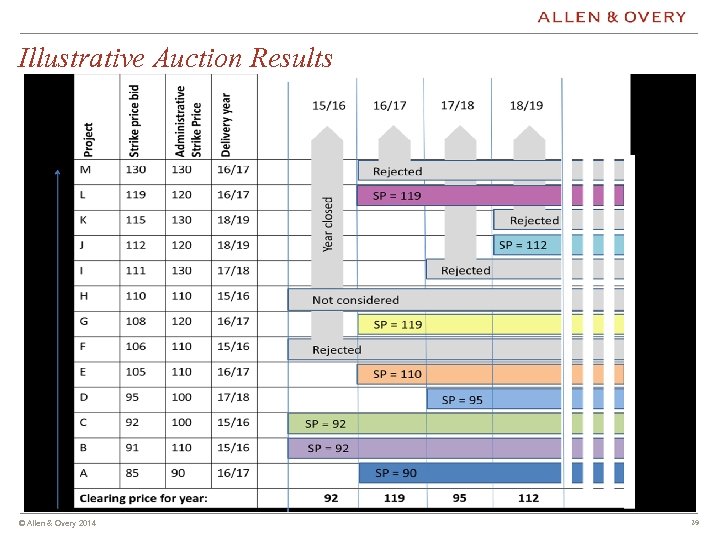
Illustrative Auction Results © Allen & Overy 2013 © Allen & Overy 2014 29
Flexible bids – Generators are allowed to submit flexible bids, i. e. a bid which allows the bidder to vary the capacity, price and/or delivery date of their project – For each application, an applicant may submit up to 10 flexible bids – No more than three flexible bids may be in any given delivery year – Each flexible bid must have: – a different strike price; – a capacity no greater than that in the original application; and – a Target Commissioning Date which is no earlier than that in the original application – The flexible bid with the lowest strike price will be considered first and should be the applicant’s first choice bid – Only one bid can be accepted for each application © Allen & Overy 2013 © Allen & Overy 2014 30
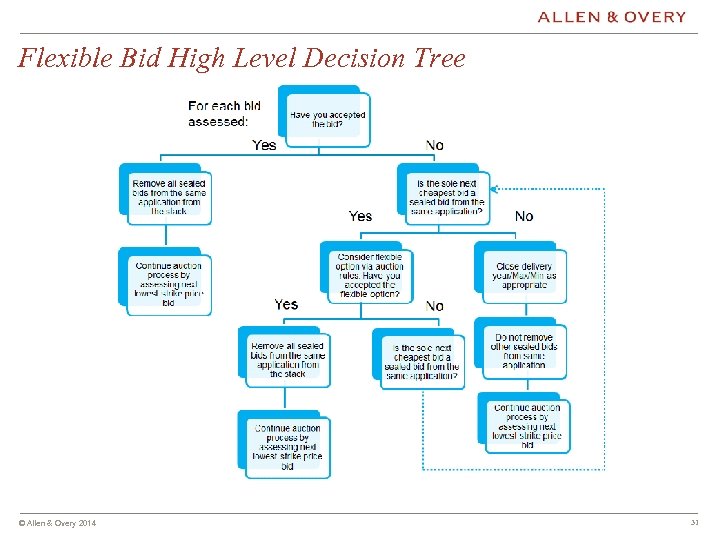
Flexible Bid High Level Decision Tree © Allen & Overy 2013 © Allen & Overy 2014 31
Audit, Secretary of State’s Review & Notification – DB must ensure that Independent Audit of the Valuation and Allocation calculations are carried out – So. S will have 2 days from receipt of notification from DB to review the Auditor’s Report with the DB’s recommendation and determine whether the Allocation process must proceed to notification, re-run, or be terminated – At end of allocation round DB will notify each qualifying applicant whether their application has been successful – DB will give Cf. D notification to Cf. D Counterparty, who will offer contracts to successful applicants – DB will publish Allocation Round report and an Appeals Register © Allen & Overy 2013 © Allen & Overy 2014 32
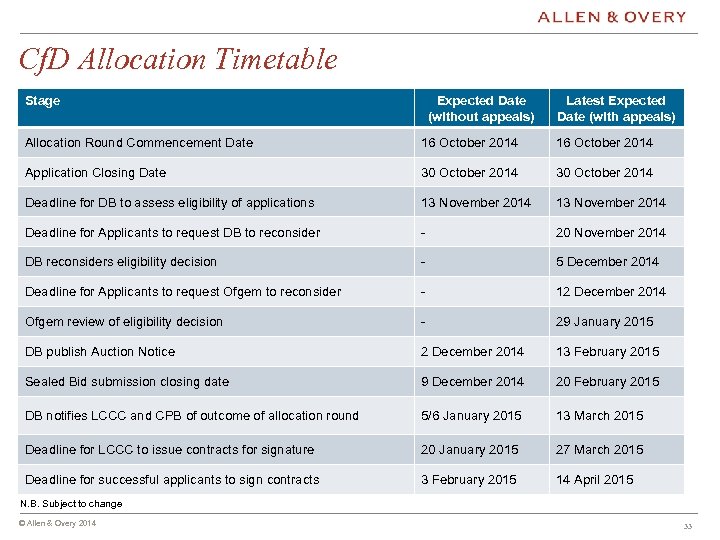
Cf. D Allocation Timetable Stage Expected Date (without appeals) Latest Expected Date (with appeals) Allocation Round Commencement Date 16 October 2014 Application Closing Date 30 October 2014 Deadline for DB to assess eligibility of applications 13 November 2014 Deadline for Applicants to request DB to reconsider - 20 November 2014 DB reconsiders eligibility decision - 5 December 2014 Deadline for Applicants to request Ofgem to reconsider - 12 December 2014 Ofgem review of eligibility decision - 29 January 2015 DB publish Auction Notice 2 December 2014 13 February 2015 Sealed Bid submission closing date 9 December 2014 20 February 2015 DB notifies LCCC and CPB of outcome of allocation round 5/6 January 2015 13 March 2015 Deadline for LCCC to issue contracts for signature 20 January 2015 27 March 2015 Deadline for successful applicants to sign contracts 3 February 2015 14 April 2015 N. B. Subject to change © Allen & Overy 2014 © Allen & Overy 2013 33
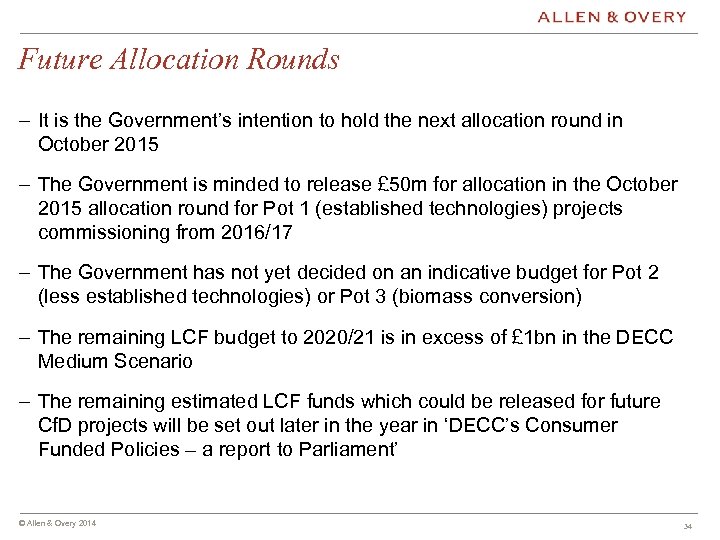
Future Allocation Rounds – It is the Government’s intention to hold the next allocation round in October 2015 – The Government is minded to release £ 50 m for allocation in the October 2015 allocation round for Pot 1 (established technologies) projects commissioning from 2016/17 – The Government has not yet decided on an indicative budget for Pot 2 (less established technologies) or Pot 3 (biomass conversion) – The remaining LCF budget to 2020/21 is in excess of £ 1 bn in the DECC Medium Scenario – The remaining estimated LCF funds which could be released for future Cf. D projects will be set out later in the year in ‘DECC’s Consumer Funded Policies – a report to Parliament’ © Allen & Overy 2014 © Allen & Overy 2013 34
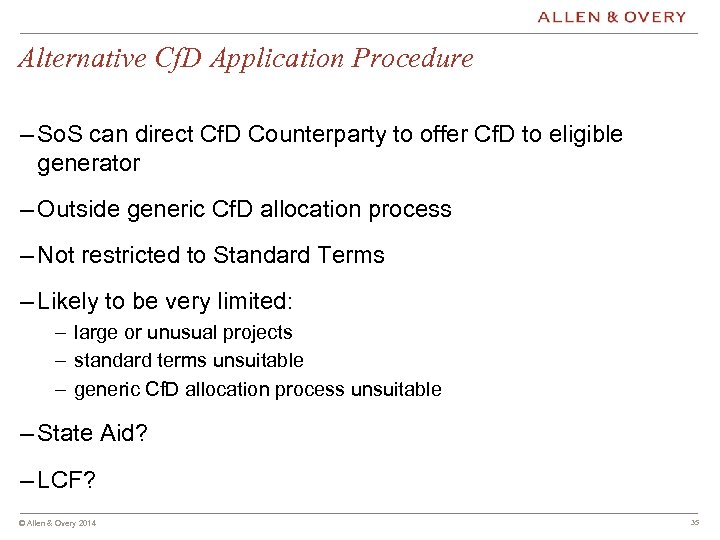
Alternative Cf. D Application Procedure – So. S can direct Cf. D Counterparty to offer Cf. D to eligible generator – Outside generic Cf. D allocation process – Not restricted to Standard Terms – Likely to be very limited: – large or unusual projects – standard terms unsuitable – generic Cf. D allocation process unsuitable – State Aid? – LCF? © Allen & Overy 2013 © Allen & Overy 2014 35
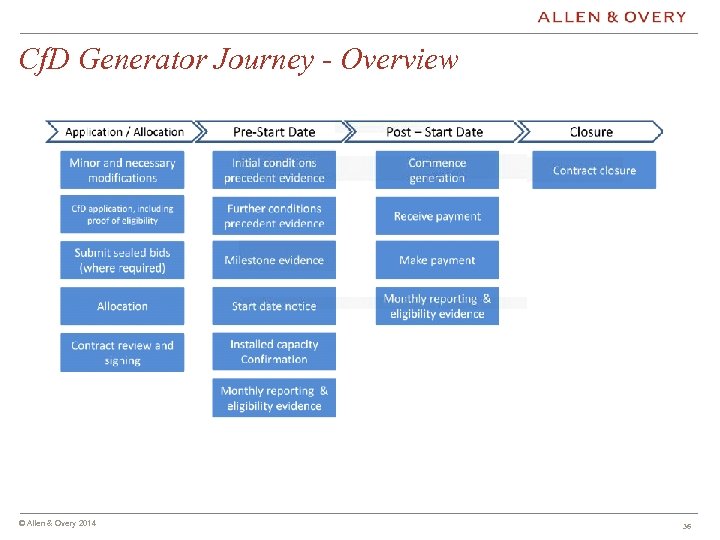
Cf. D Generator Journey - Overview © Allen & Overy 2014 © Allen & Overy 2013 36
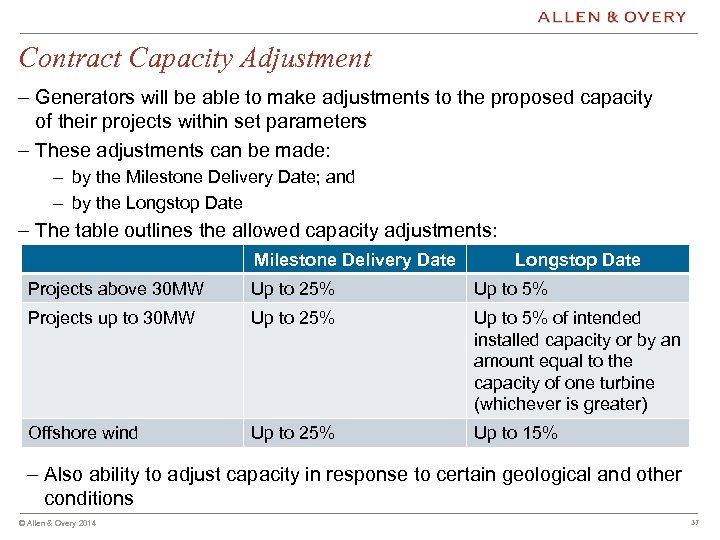
Contract Capacity Adjustment – Generators will be able to make adjustments to the proposed capacity of their projects within set parameters – These adjustments can be made: – by the Milestone Delivery Date; and – by the Longstop Date – The table outlines the allowed capacity adjustments: Milestone Delivery Date Longstop Date Projects above 30 MW Up to 25% Up to 5% Projects up to 30 MW Up to 25% Up to 5% of intended installed capacity or by an amount equal to the capacity of one turbine (whichever is greater) Offshore wind Up to 25% Up to 15% – Also ability to adjust capacity in response to certain geological and other conditions © Allen & Overy 2013 © Allen & Overy 2014 37
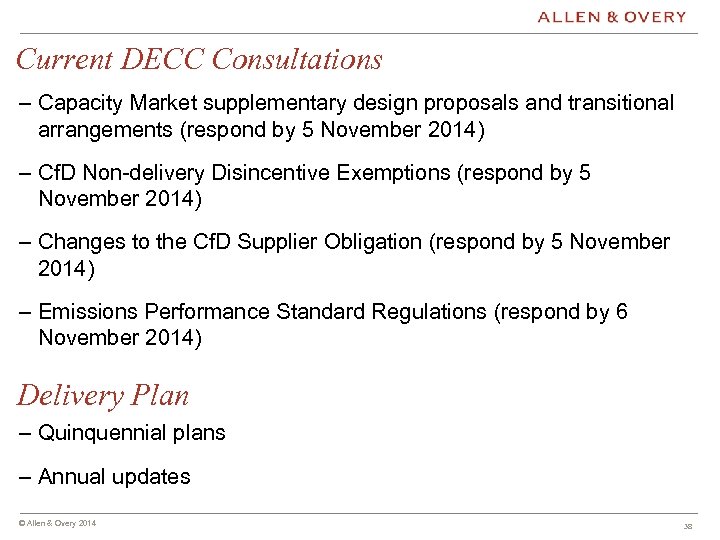
Current DECC Consultations – Capacity Market supplementary design proposals and transitional arrangements (respond by 5 November 2014) – Cf. D Non-delivery Disincentive Exemptions (respond by 5 November 2014) – Changes to the Cf. D Supplier Obligation (respond by 5 November 2014) – Emissions Performance Standard Regulations (respond by 6 November 2014) Delivery Plan – Quinquennial plans – Annual updates © Allen & Overy 2014 © Allen & Overy 2013 38
A&O EMR site http: //www. allenovery. com/UK-Electricity-Market-Reform © Allen & Overy 2014 39
Questions? These are presentation slides only. The information within these slides does not constitute definitive advice and should not be used as the basis for giving definitive advice without checking the primary sources. Allen & Overy means Allen & Overy LLP and/or its affiliated undertakings. The term partner is used to refer to a member of Allen & Overy LLP or an employee or consultant with equivalent standing and qualifications or an individual with equivalent status in one of Allen & Overy LLP's affiliated undertakings. © Allen & Overy 2014 40
Contacts Chris Andrew Allen & Overy Email: chris. andrew@allenovery. com Tel: +44 20 3088 2684 © Allen & Overy 2014 41
Скачать презентацию 9 October 2014 Contracts for Difference On the
27e4b90288ad3b006bf0bddbe16f106f.ppt