 Скачать презентацию 9 A Unit 3 Teenage problems Grammar D
f03214569b921ffd30588f0965e7116d.ppt
- Количество слайдов: 29



9 A Unit 3 Teenage problems Grammar D + Integrated skills Wang Wenyu, Xieqiao Middle School
D. Five kinds of sentence structure
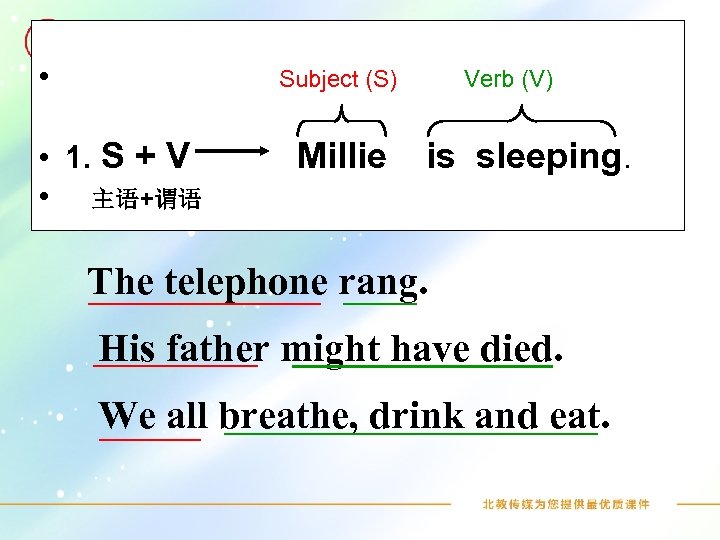
• Subject (S) • 1. S + V • 主语+谓语 Millie Verb (V) is sleeping. The telephone rang. His father might have died. We all breathe, drink and eat.

注:这种结构中的谓语动词是不及物 动词(intransitive verb),状语 (adverbial)并非结构上不可缺少的 成分。但在某种情况下,不加状语 便不能表达完整的意思,看看下面 的句型:
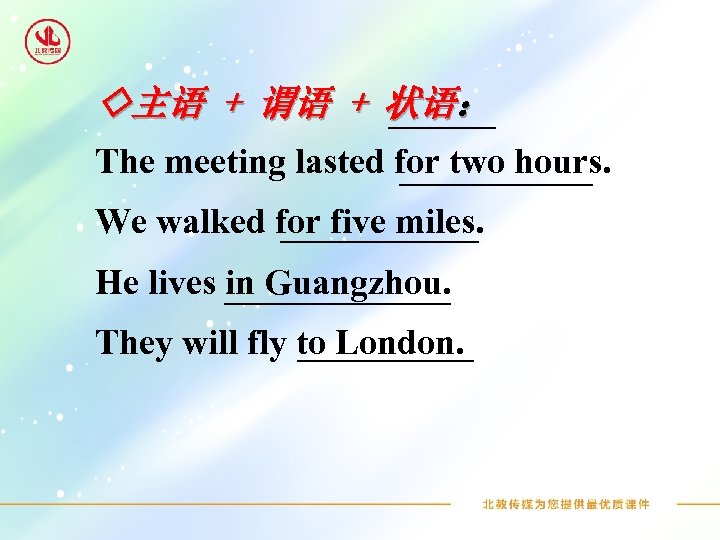
◇主语 + 谓语 + 状语: The meeting lasted for two hours. We walked for five miles. He lives in Guangzhou. They will fly to London.
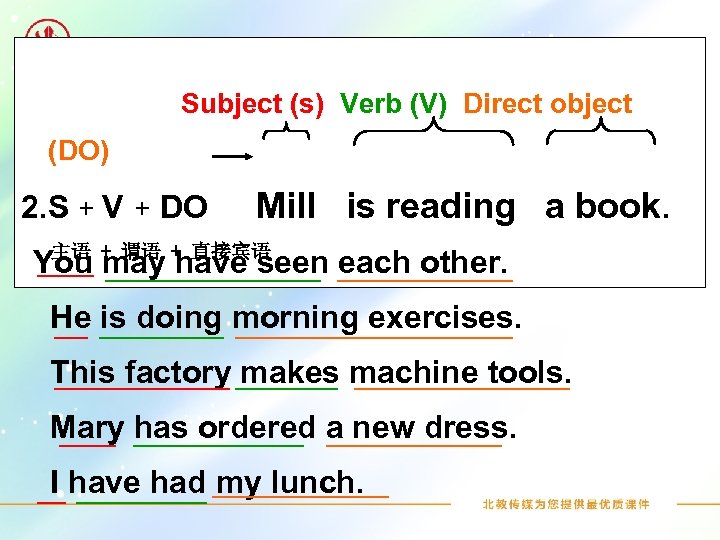
Subject (s) Verb (V) Direct object (DO) 2. S + V + DO Mill is reading a book. 主语 + 谓语 + 直接宾语 You may have seen each other. He is doing morning exercises. This factory makes machine tools. Mary has ordered a new dress. I have had my lunch.
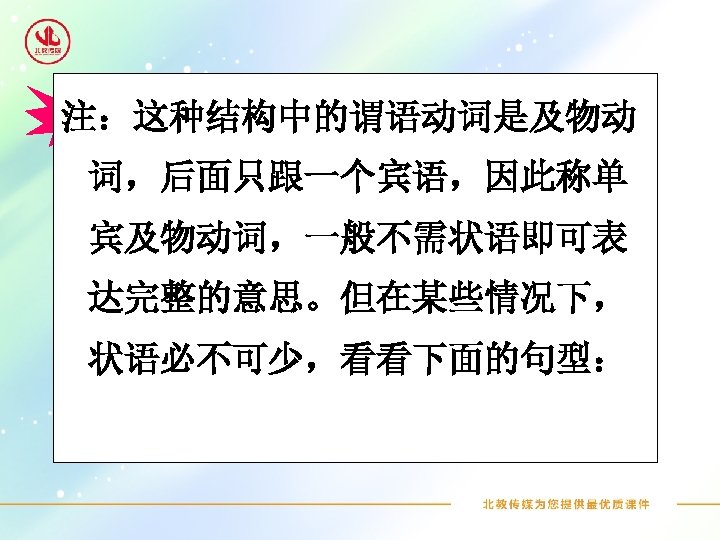
注:这种结构中的谓语动词是及物动 词,后面只跟一个宾语,因此称单 宾及物动词,一般不需状语即可表 达完整的意思。但在某些情况下, 状语必不可少,看看下面的句型:
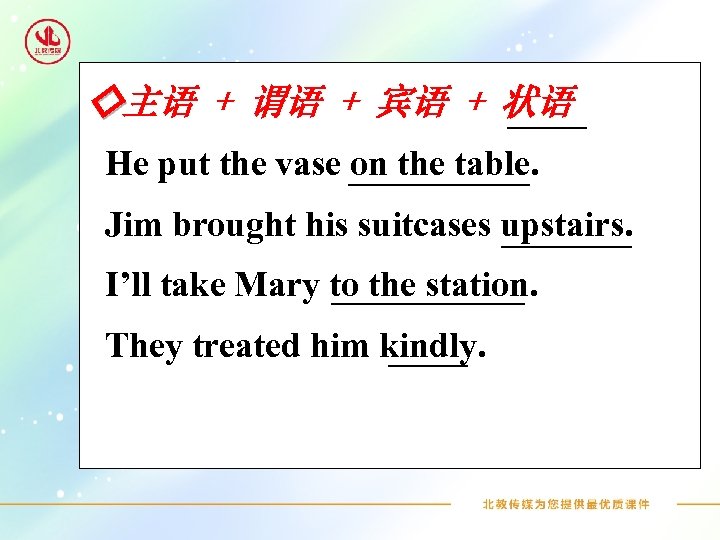
◇主语 + 谓语 + 宾语 + 状语 He put the vase on the table. Jim brought his suitcases upstairs. I’ll take Mary to the station. They treated him kindly.
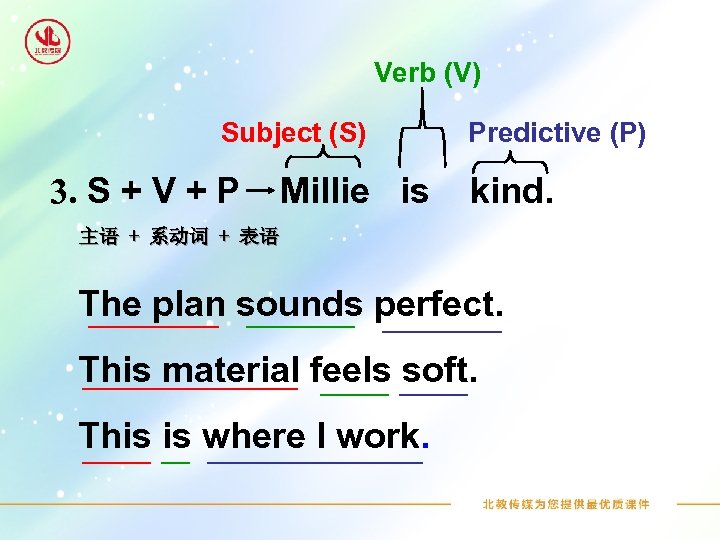
Verb (V) Subject (S) 3. S + V + P Millie is Predictive (P) kind. 主语 + 系动词 + 表语 The plan sounds perfect. This material feels soft. This is where I work.
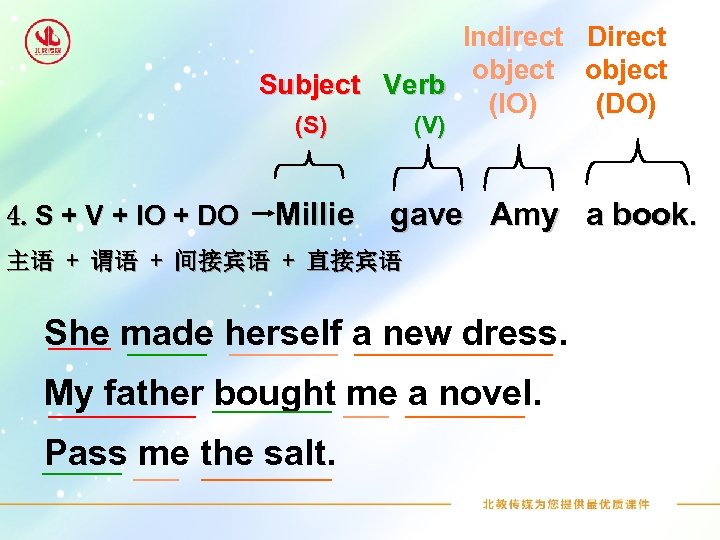
Indirect Direct object Subject Verb (IO) (DO) (S) 4. S + V + IO + DO Millie (V) gave Amy a book. 主语 + 谓语 + 间接宾语 + 直接宾语 She made herself a new dress. My father bought me a novel. Pass me the salt.
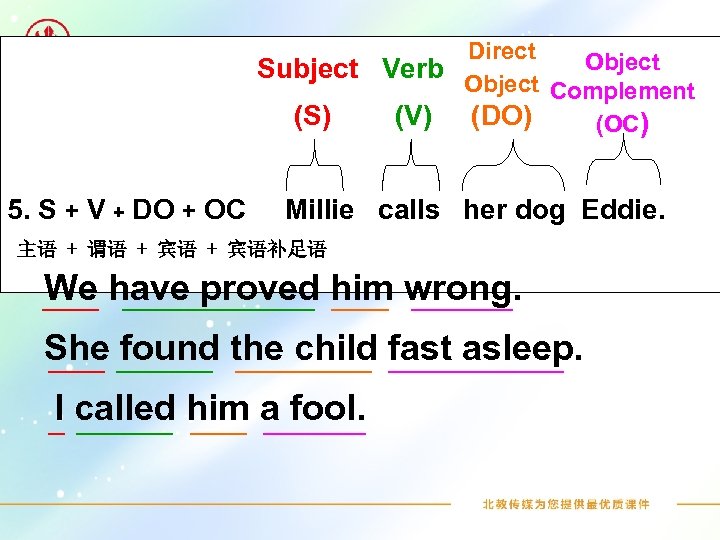
Direct Object Subject Verb Object Complement (S) (V) (DO) (OC) 5. S + V + DO + OC Millie calls her dog Eddie. 主语 + 谓语 + 宾语补足语 We have proved him wrong. She found the child fast asleep. I called him a fool.
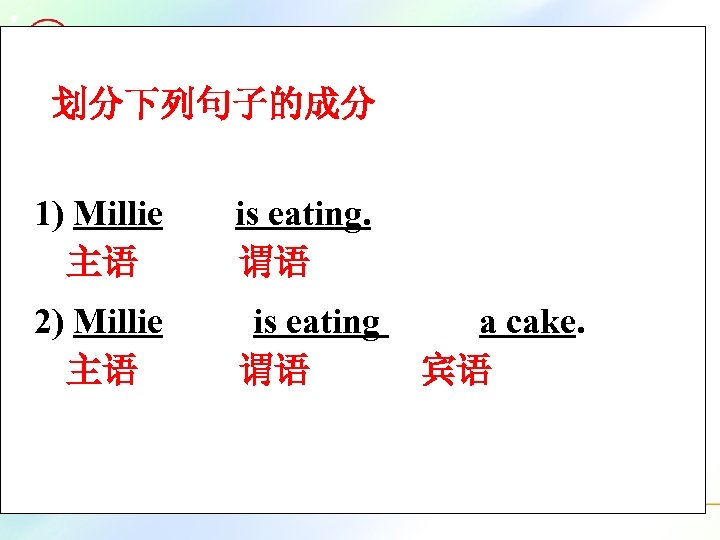
划分下列句子的成分 1) Millie 主语 is eating. 谓语 2) Millie 主语 is eating 谓语 a cake. 宾语
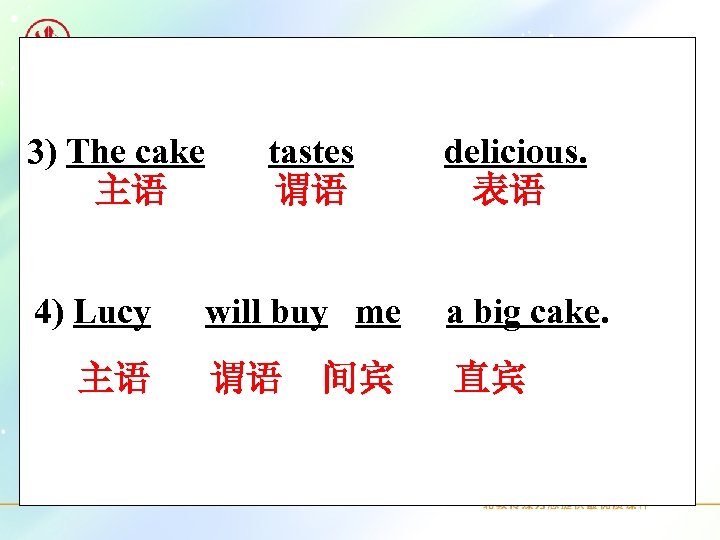
3) The cake 主语 4) Lucy 主语 tastes 谓语 delicious. 表语 will buy me a big cake. 谓语 直宾 间宾
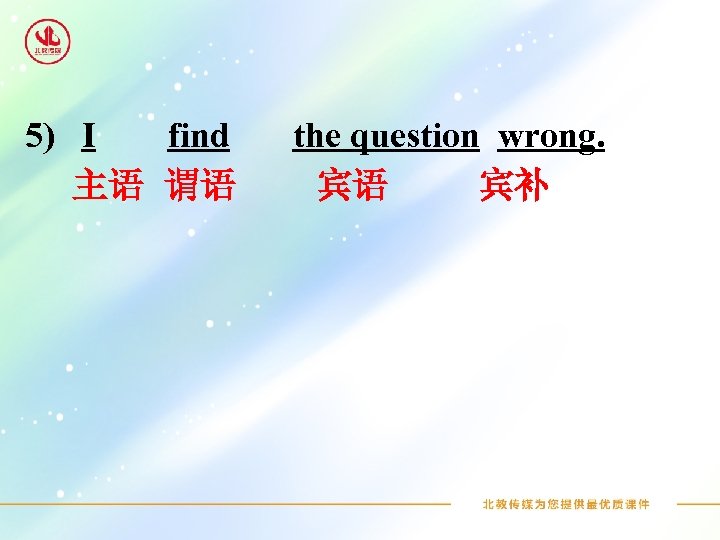
5) I find 主语 谓语 the question wrong. 宾语 宾补
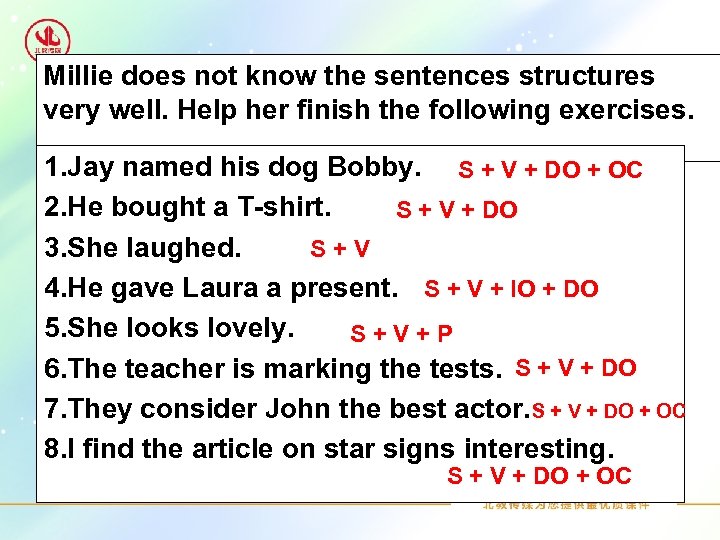
Millie does not know the sentences structures very well. Help her finish the following exercises. 1. Jay named his dog Bobby. S + V + DO + OC 2. He bought a T-shirt. S + V + DO 3. She laughed. S+V 4. He gave Laura a present. S + V + IO + DO 5. She looks lovely. S+V+P 6. The teacher is marking the tests. S + V + DO 7. They consider John the best actor. S + V + DO + OC 8. I find the article on star signs interesting. S + V + DO + OC
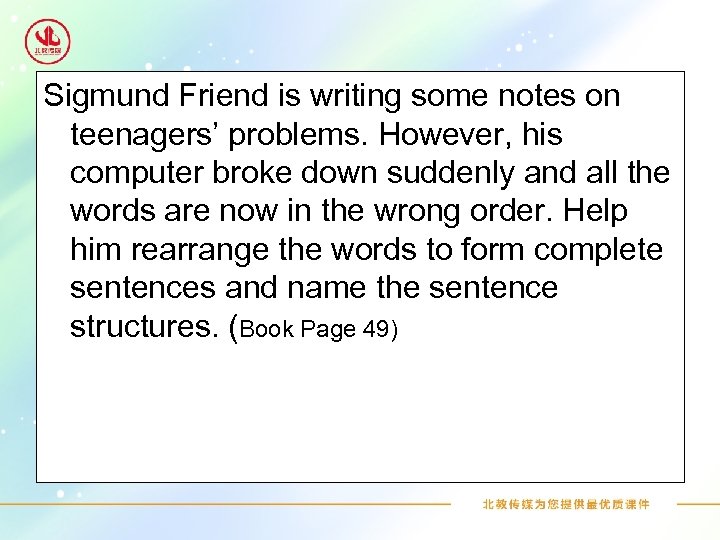
Sigmund Friend is writing some notes on teenagers’ problems. However, his computer broke down suddenly and all the words are now in the wrong order. Help him rearrange the words to form complete sentences and name the sentence structures. (Book Page 49)
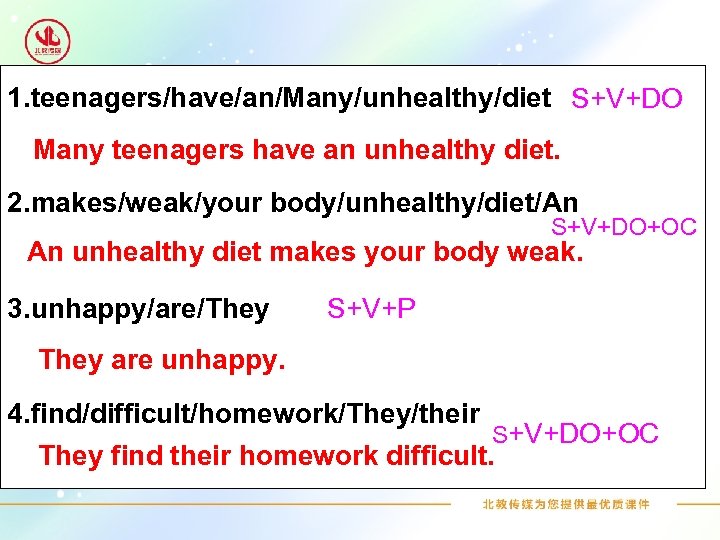
1. teenagers/have/an/Many/unhealthy/diet S+V+DO Many teenagers have an unhealthy diet. 2. makes/weak/your body/unhealthy/diet/An S+V+DO+OC An unhealthy diet makes your body weak. 3. unhappy/are/They S+V+P They are unhappy. 4. find/difficult/homework/They/their S+V+DO+OC They find their homework difficult.
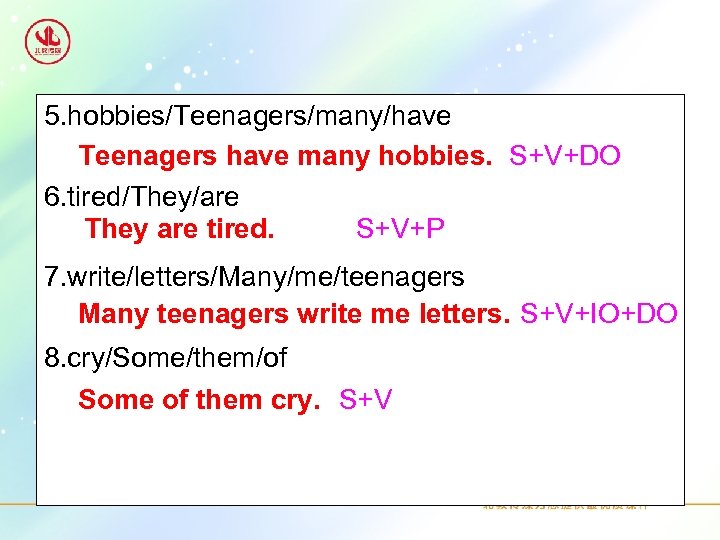
5. hobbies/Teenagers/many/have Teenagers have many hobbies. S+V+DO 6. tired/They/are They are tired. S+V+P 7. write/letters/Many/me/teenagers Many teenagers write me letters. S+V+IO+DO 8. cry/Some/them/of Some of them cry. S+V
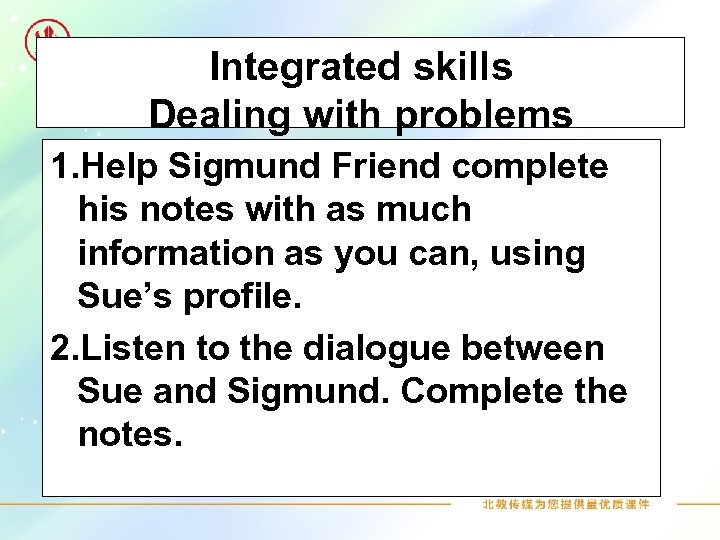
Integrated skills Dealing with problems 1. Help Sigmund Friend complete his notes with as much information as you can, using Sue’s profile. 2. Listen to the dialogue between Sue and Sigmund. Complete the notes.
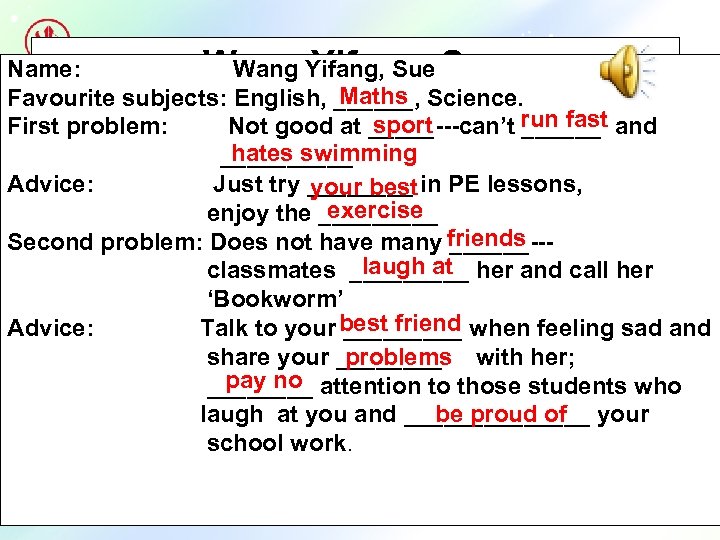
Wang Yifang, Sue Name: Wang Yifang, Maths Favourite subjects: English, ______, Science. sport First problem: Not good at _____---can’t run fast and ______ hates swimming _____ Advice: Just try ____ in PE lessons, your best exercise enjoy the _____ Second problem: Does not have many friends ______--laugh at classmates _____ her and call her ‘Bookworm’ Advice: Talk to your best friend when feeling sad and _____ share your ____ with her; problems pay no ____ attention to those students who be proud of laugh at you and _______ your school work.
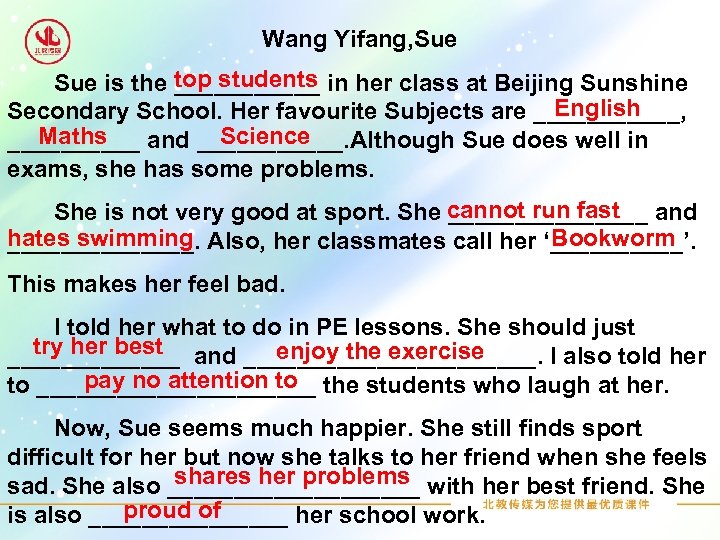
Wang Yifang, Sue top students Sue is the ______ in her class at Beijing Sunshine English Secondary School. Her favourite Subjects are ______, Maths Science _____ and ______. Although Sue does well in exams, she has some problems. She is not very good at sport. She cannot run fast and ________ hates swimming Also, her classmates call her ‘_____’. Bookworm _______. This makes her feel bad. I told her what to do in PE lessons. She should just try her best enjoy the exercise _______ and ___________. I also told her pay no attention to to ___________ the students who laugh at her. Now, Sue seems much happier. She still finds sport difficult for her but now she talks to her friend when she feels shares her problems sad. She also __________ with her best friend. She proud of is also ________ her school work.
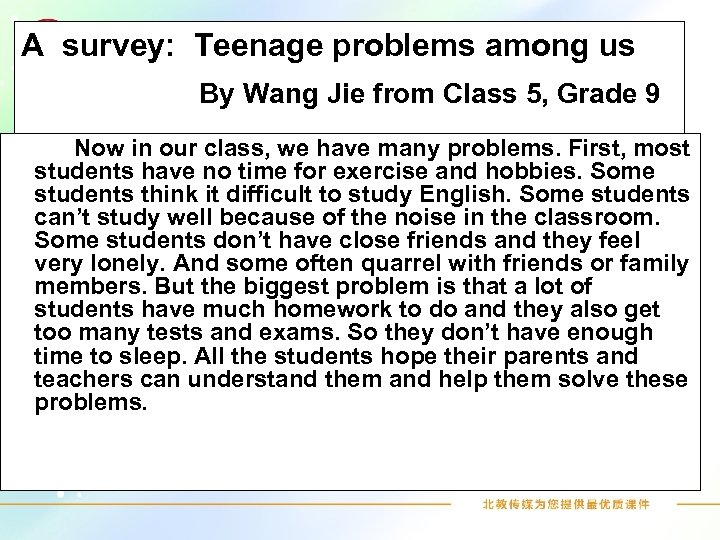
A survey: Teenage problems among us By Wang Jie from Class 5, Grade 9 Now in our class, we have many problems. First, most students have no time for exercise and hobbies. Some students think it difficult to study English. Some students can’t study well because of the noise in the classroom. Some students don’t have close friends and they feel very lonely. And some often quarrel with friends or family members. But the biggest problem is that a lot of students have much homework to do and they also get too many tests and exams. So they don’t have enough time to sleep. All the students hope their parents and teachers can understand them and help them solve these problems.
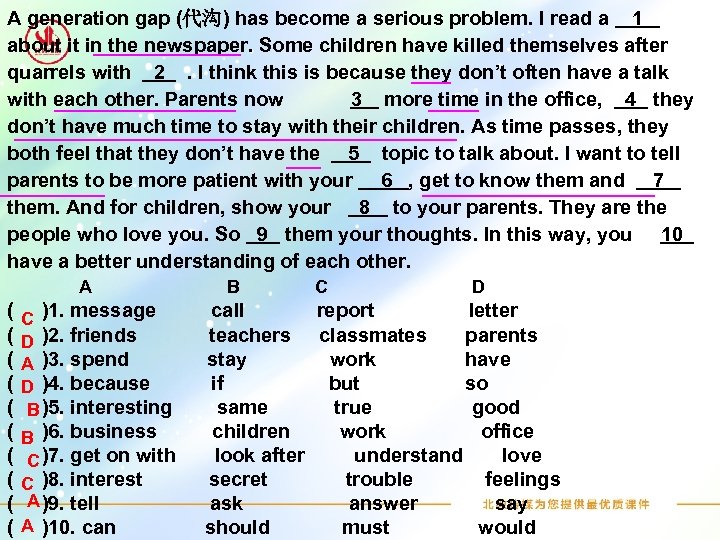
A generation gap (代沟) has become a serious problem. I read a 1 about it in the newspaper. Some children have killed themselves after quarrels with 2. I think this is because they don’t often have a talk with each other. Parents now 3 more time in the office, 4 they don’t have much time to stay with their children. As time passes, they both feel that they don’t have the 5 topic to talk about. I want to tell parents to be more patient with your 6 , get to know them and 7 them. And for children, show your 8 to your parents. They are the people who love you. So 9 them your thoughts. In this way, you 10 have a better understanding of each other. A ( ( ( ( ( C )1. D )2. A )3. D )4. B )5. message friends spend because interesting B )6. business C )7. get on with C )8. interest A )9. tell A )10. can B C D call report letter teachers classmates parents stay work have if but so same true good children work office look after understand love secret trouble feelings ask answer say should must would
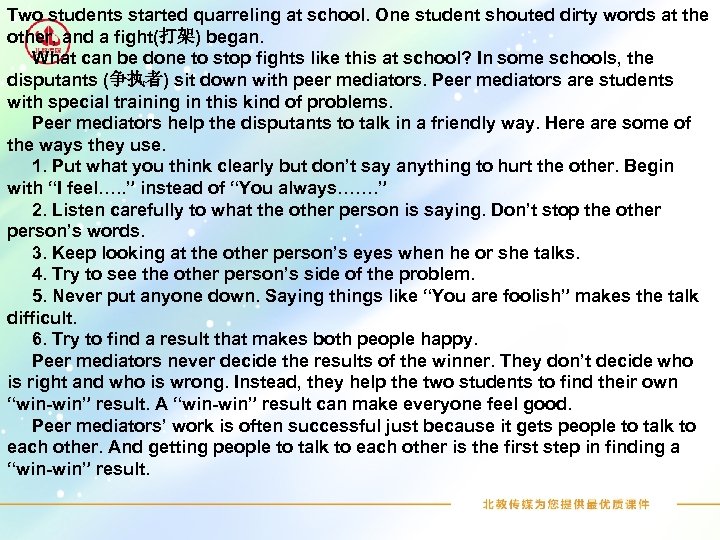
Two students started quarreling at school. One student shouted dirty words at the other, and a fight(打架) began. What can be done to stop fights like this at school? In some schools, the disputants (争执者) sit down with peer mediators. Peer mediators are students with special training in this kind of problems. Peer mediators help the disputants to talk in a friendly way. Here are some of the ways they use. 1. Put what you think clearly but don’t say anything to hurt the other. Begin with “I feel…. . ” instead of “You always……. ” 2. Listen carefully to what the other person is saying. Don’t stop the other person’s words. 3. Keep looking at the other person’s eyes when he or she talks. 4. Try to see the other person’s side of the problem. 5. Never put anyone down. Saying things like “You are foolish” makes the talk difficult. 6. Try to find a result that makes both people happy. Peer mediators never decide the results of the winner. They don’t decide who is right and who is wrong. Instead, they help the two students to find their own “win-win” result. A “win-win” result can make everyone feel good. Peer mediators’ work is often successful just because it gets people to talk to each other. And getting people to talk to each other is the first step in finding a “win-win” result.
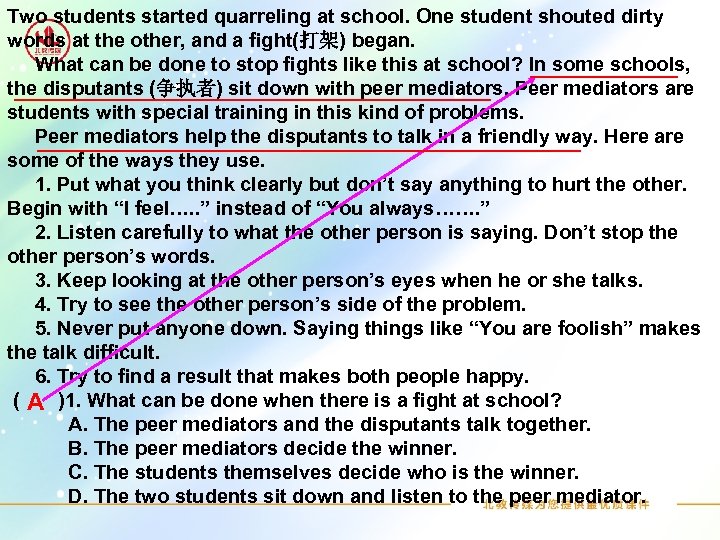
Two students started quarreling at school. One student shouted dirty words at the other, and a fight(打架) began. What can be done to stop fights like this at school? In some schools, the disputants (争执者) sit down with peer mediators. Peer mediators are students with special training in this kind of problems. Peer mediators help the disputants to talk in a friendly way. Here are some of the ways they use. 1. Put what you think clearly but don’t say anything to hurt the other. Begin with “I feel…. . ” instead of “You always……. ” 2. Listen carefully to what the other person is saying. Don’t stop the other person’s words. 3. Keep looking at the other person’s eyes when he or she talks. 4. Try to see the other person’s side of the problem. 5. Never put anyone down. Saying things like “You are foolish” makes the talk difficult. 6. Try to find a result that makes both people happy. ( A )1. What can be done when there is a fight at school? A. The peer mediators and the disputants talk together. B. The peer mediators decide the winner. C. The students themselves decide who is the winner. D. The two students sit down and listen to the peer mediator.
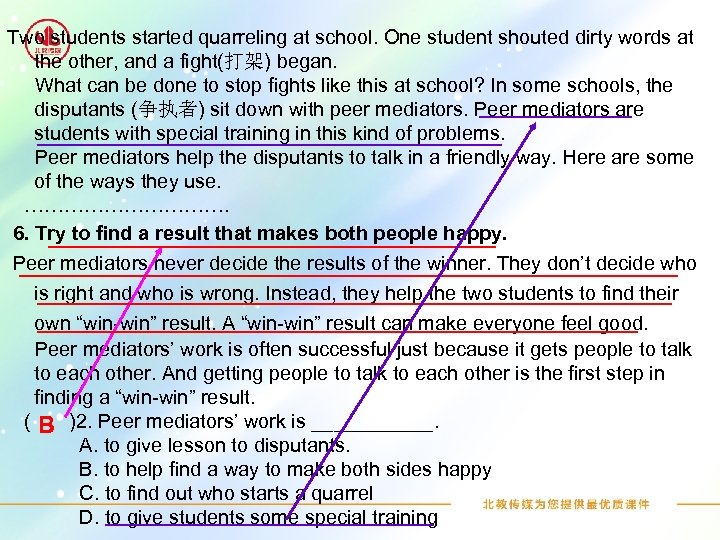
Two students started quarreling at school. One student shouted dirty words at the other, and a fight(打架) began. What can be done to stop fights like this at school? In some schools, the disputants (争执者) sit down with peer mediators. Peer mediators are students with special training in this kind of problems. Peer mediators help the disputants to talk in a friendly way. Here are some of the ways they use. ……………. 6. Try to find a result that makes both people happy. Peer mediators never decide the results of the winner. They don’t decide who is right and who is wrong. Instead, they help the two students to find their own “win-win” result. A “win-win” result can make everyone feel good. Peer mediators’ work is often successful just because it gets people to talk to each other. And getting people to talk to each other is the first step in finding a “win-win” result. ( B )2. Peer mediators’ work is ______. A. to give lesson to disputants. B. to help find a way to make both sides happy C. to find out who starts a quarrel D. to give students some special training
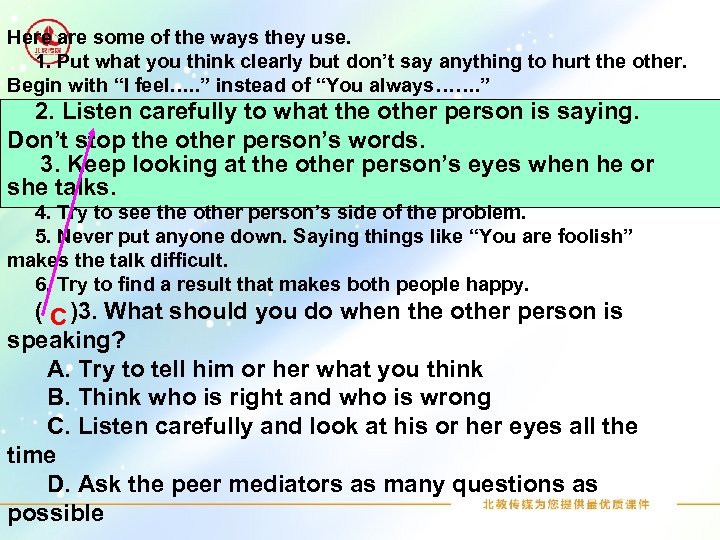
Here are some of the ways they use. 1. Put what you think clearly but don’t say anything to hurt the other. Begin with “I feel…. . ” instead of “You always……. ” 2. Listen carefully to what the other person is saying. Don’t stop the other person’s words. 3. Keep looking at the other person’s eyes when he or she talks. 4. Try to see the other person’s side of the problem. 5. Never put anyone down. Saying things like “You are foolish” makes the talk difficult. 6. Try to find a result that makes both people happy. ( C )3. What should you do when the other person is speaking? A. Try to tell him or her what you think B. Think who is right and who is wrong C. Listen carefully and look at his or her eyes all the time D. Ask the peer mediators as many questions as possible
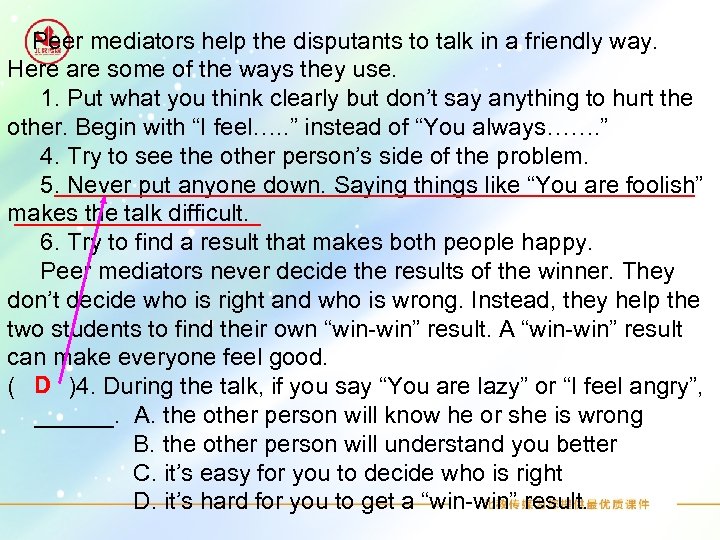
Peer mediators help the disputants to talk in a friendly way. Here are some of the ways they use. 1. Put what you think clearly but don’t say anything to hurt the other. Begin with “I feel…. . ” instead of “You always……. ” 4. Try to see the other person’s side of the problem. 5. Never put anyone down. Saying things like “You are foolish” makes the talk difficult. 6. Try to find a result that makes both people happy. Peer mediators never decide the results of the winner. They don’t decide who is right and who is wrong. Instead, they help the two students to find their own “win-win” result. A “win-win” result can make everyone feel good. ( D )4. During the talk, if you say “You are lazy” or “I feel angry”, ______. A. the other person will know he or she is wrong B. the other person will understand you better C. it’s easy for you to decide who is right D. it’s hard for you to get a “win-win” result.
 Скачать презентацию 9 A Unit 3 Teenage problems Grammar D
f03214569b921ffd30588f0965e7116d.ppt