


 Скачать презентацию 802 15 4 Samer Shammaa Telecommunications Eng Dept
1c820d0e50925e8b5c340dde3fd2ab6b.ppt
- Количество слайдов: 53
 802. 15. 4 Samer Shammaa Telecommunications Eng. Dept. Dr. Pramode Verma
 Outline Introduction WSN Applications Topologies Architecture Physical Layer MAC Layer Superframe structure
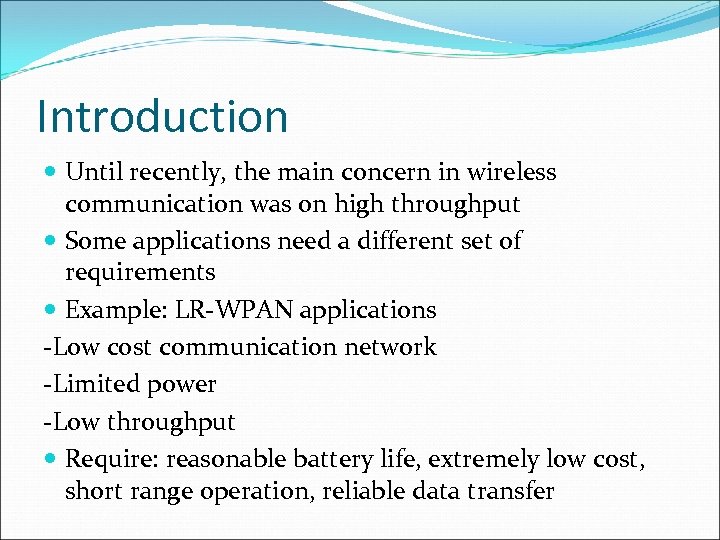 Introduction Until recently, the main concern in wireless communication was on high throughput Some applications need a different set of requirements Example: LR-WPAN applications -Low cost communication network -Limited power -Low throughput Require: reasonable battery life, extremely low cost, short range operation, reliable data transfer
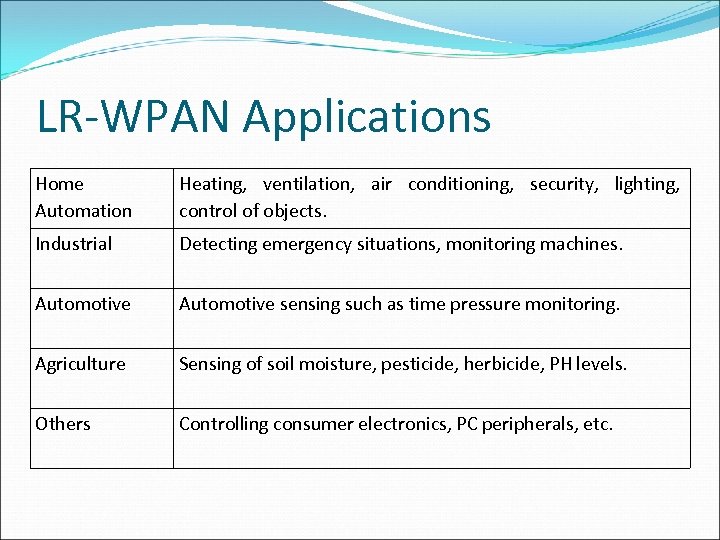 LR-WPAN Applications Home Automation Heating, ventilation, air conditioning, security, lighting, control of objects. Industrial Detecting emergency situations, monitoring machines. Automotive sensing such as time pressure monitoring. Agriculture Sensing of soil moisture, pesticide, herbicide, PH levels. Others Controlling consumer electronics, PC peripherals, etc.
 Solution? Existing standards not suitable for these applications b/c of complexity, power consumption, and high cost. Need a simple, flexible protocol IEEE 802. 15. 4 defines protocol via RF for PAN. Provide a standard with ultra-low complexity, cost, and power for low-data-rate wireless connectivity among inexpensive fixed, portable, and moving devices.
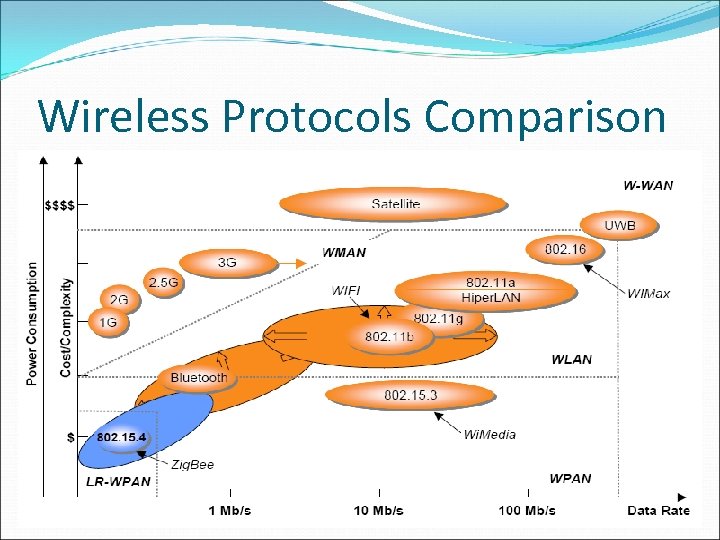 Wireless Protocols Comparison
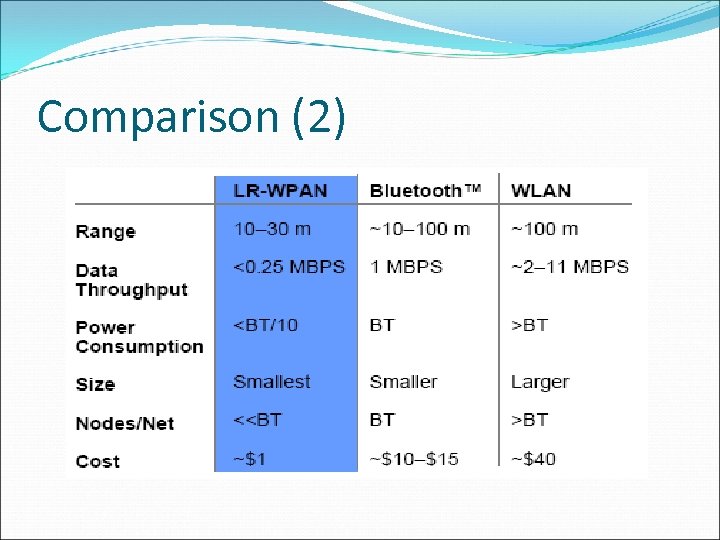 Comparison (2)
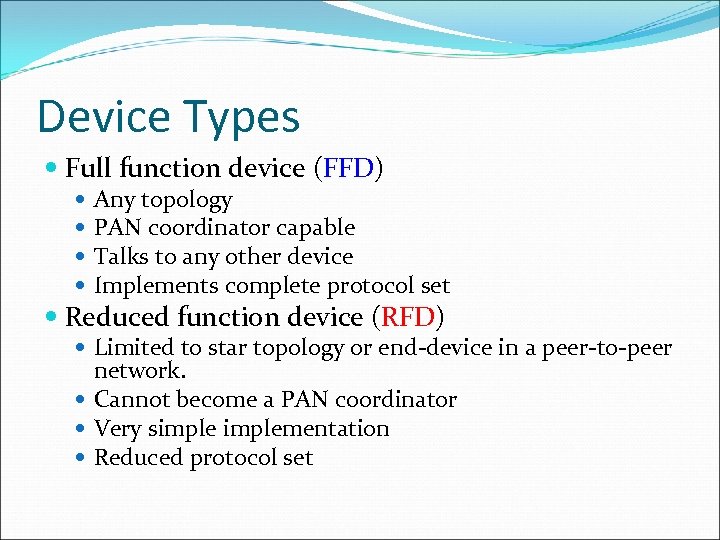 Device Types Full function device (FFD) Any topology PAN coordinator capable Talks to any other device Implements complete protocol set Reduced function device (RFD) Limited to star topology or end-device in a peer-to-peer network. Cannot become a PAN coordinator Very simplementation Reduced protocol set
 Modes of Operation Network Device: An RFD or FFD implementation containing an IEEE 802. 15. 4 medium access control and physical interface to the wireless medium. Coordinator: An FFD with network device functionality that provides coordination and other services to the network. PAN Coordinator: A coordinator that is the principal controller of the PAN. A network has exactly one PAN coordinator.
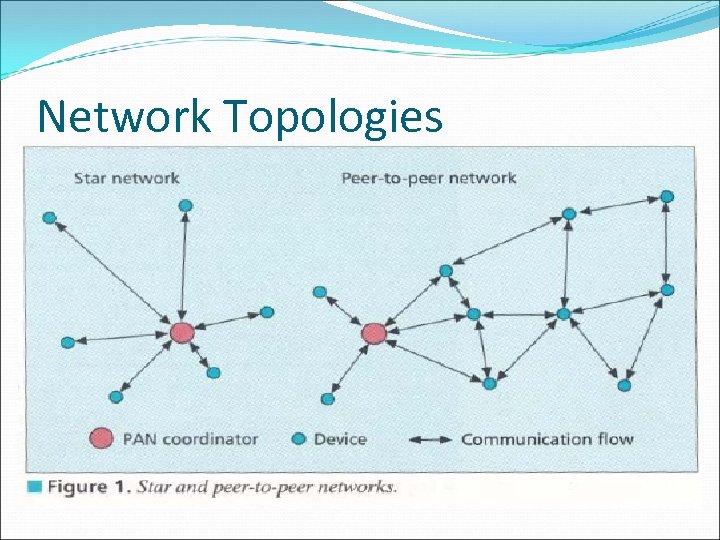 Network Topologies
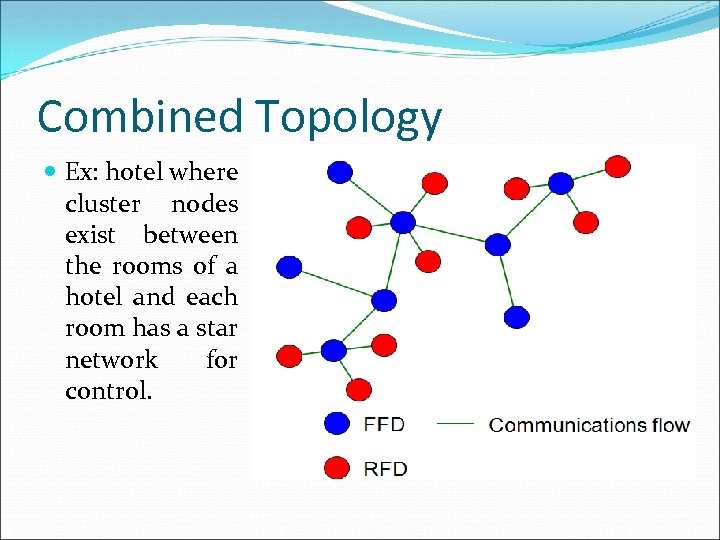 Combined Topology Ex: hotel where cluster nodes exist between the rooms of a hotel and each room has a star network for control.
 Star Network Formation After an FFD is activated, it can establish its own network and become the PAN coordinator Choose a PAN Identifier different from surrounding networks (within RF sphere of influence) The PAN coordinator allows other devices, potentially both FFDs and RFDs, to join its network.
 Peer-to-peer Network Formation Each device is capable of communicating with any other device within its radio sphere of influence One Device is nominated as the PAN coordinator Form first cluster by choosing an unused PAN identifier and broadcasting beacon frames to neighboring devices. A candidate device receiving a beacon frame may request to join the network at the PAN coordinator. If the PAN coordinator permits the device to join, it adds the new device as a child device in its neighbor list.
 Continued… Newly joined device adds the PAN coordinator as its parent in its neighbor list and begins transmitting periodic beacons Other candidate devices may then join the network at that device. Once predetermined application or network requirements are met, the first PAN coordinator may instruct a device to become the PAN coordinator of a new cluster adjacent to the first one. Other devices gradually connect and form a multicluster network structure
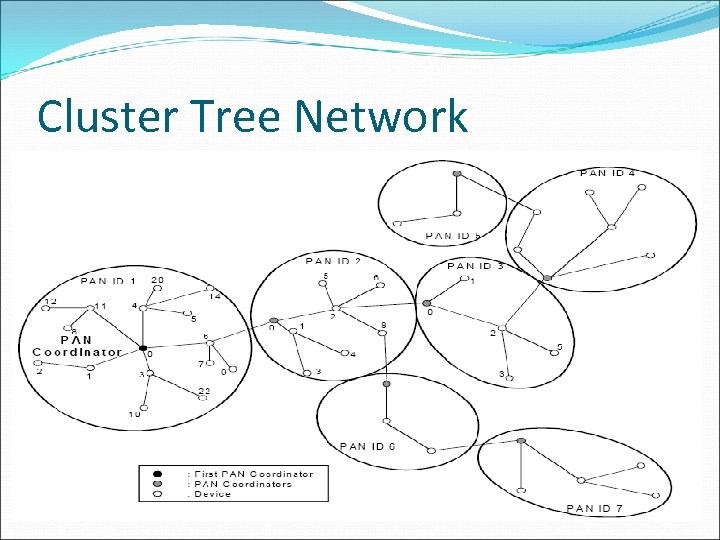 Cluster Tree Network
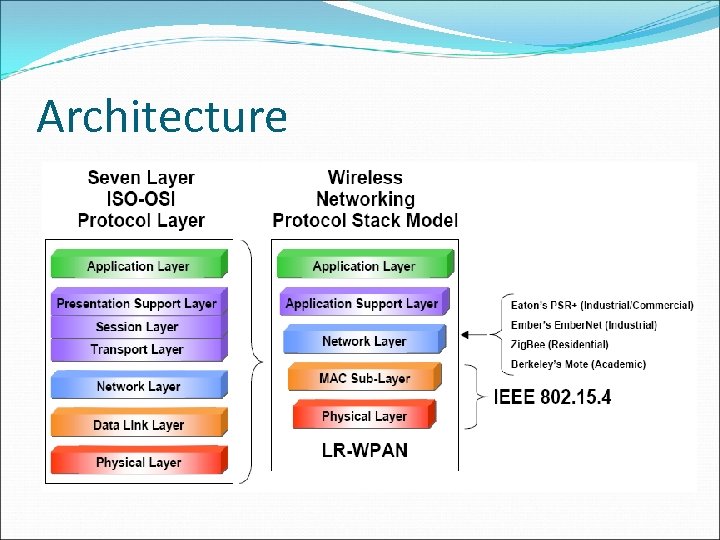 Architecture
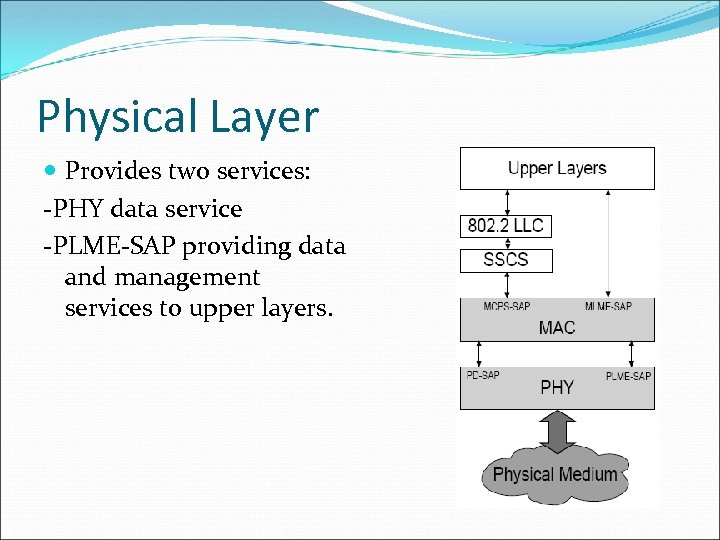 Physical Layer Provides two services: -PHY data service -PLME-SAP providing data and management services to upper layers.
 PHY Data Service Enables the transmission and reception of PHY protocol data units (PPDUs) across the physical radio channel Activation and deactivation of the radio transceiver Energy detection within the current channel Link quality indication for received packets Clear channel assessment for CSMA-CA Channel frequency selection Channel switching
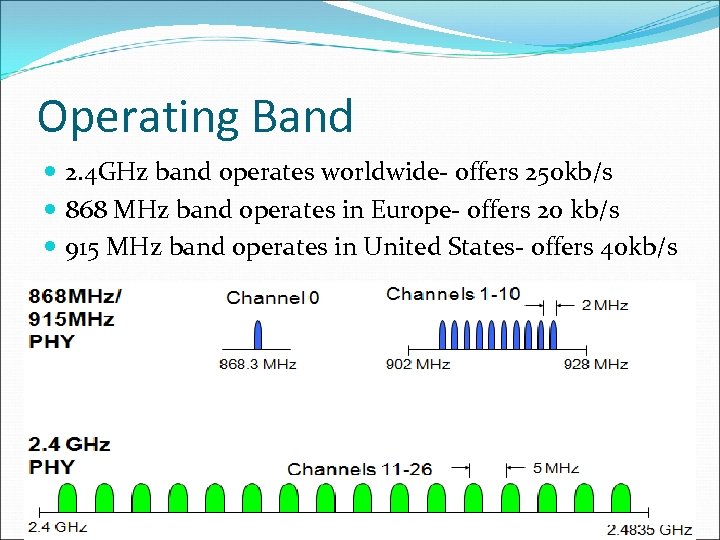 Operating Band 2. 4 GHz band operates worldwide- offers 250 kb/s 868 MHz band operates in Europe- offers 20 kb/s 915 MHz band operates in United States- offers 40 kb/s
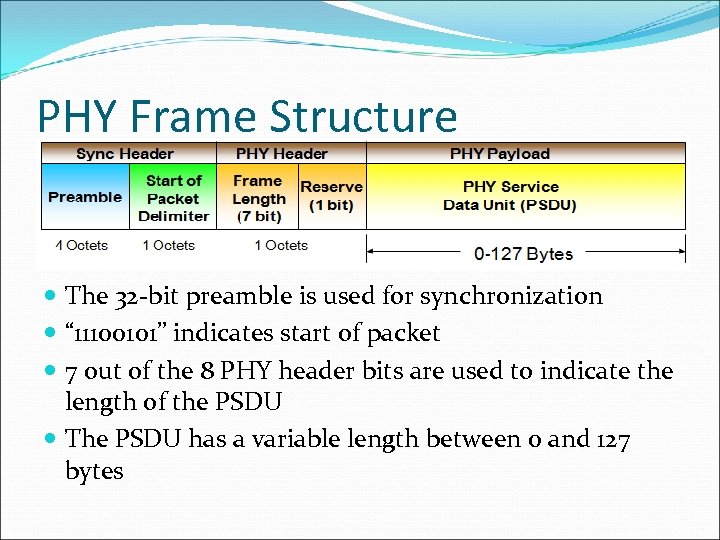 PHY Frame Structure The 32 -bit preamble is used for synchronization “ 11100101” indicates start of packet 7 out of the 8 PHY header bits are used to indicate the length of the PSDU The PSDU has a variable length between 0 and 127 bytes
 MAC Layer The MAC sublayer provides two services: -MAC data service: enables the transmission and reception of MAC protocol data units (MPDUs) across the PHY data service -MLME-SAP: provides data and management services to upper layers
 MAC Sublayer Features Beacon management Channel access Guaranteed Time Slot (GTS) management Frame validation Acknowledged frame delivery Association Disassociation Provides means for implementing applicationappropriate security mechanisms
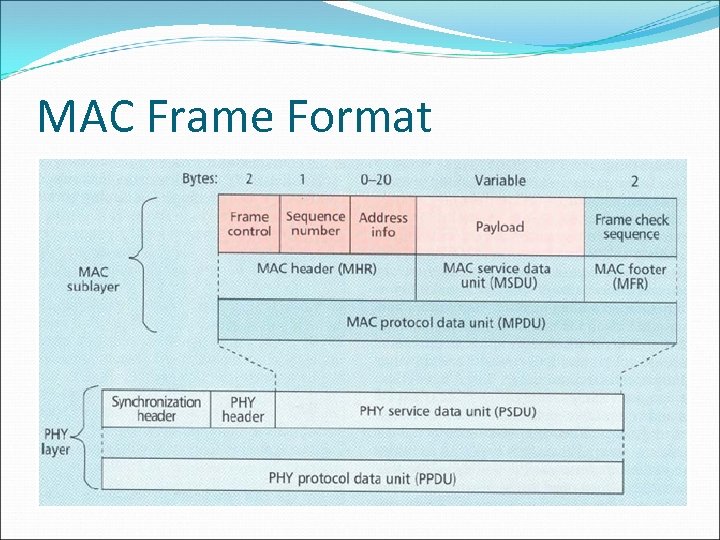 MAC Frame Format
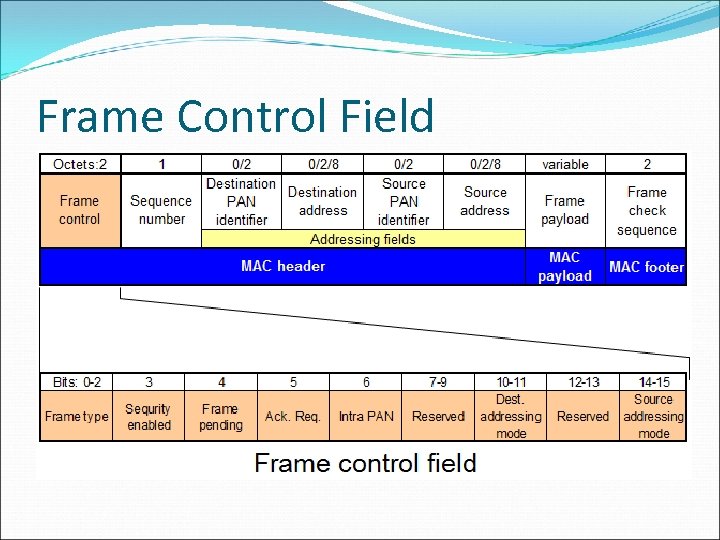 Frame Control Field
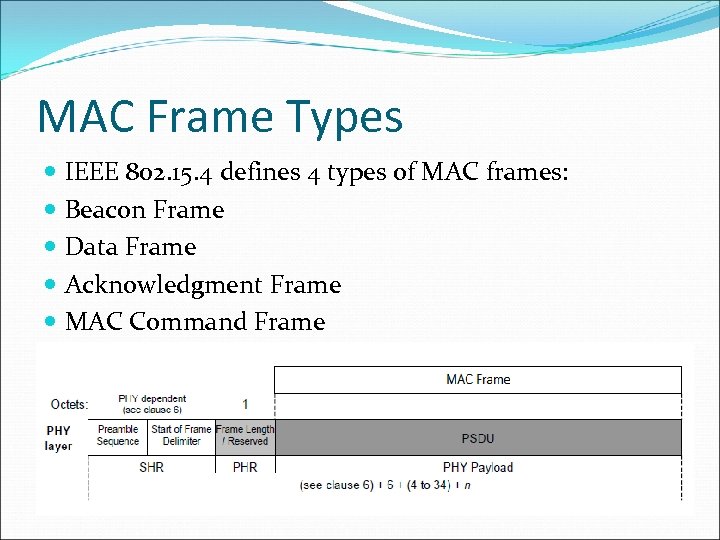 MAC Frame Types IEEE 802. 15. 4 defines 4 types of MAC frames: Beacon Frame Data Frame Acknowledgment Frame MAC Command Frame
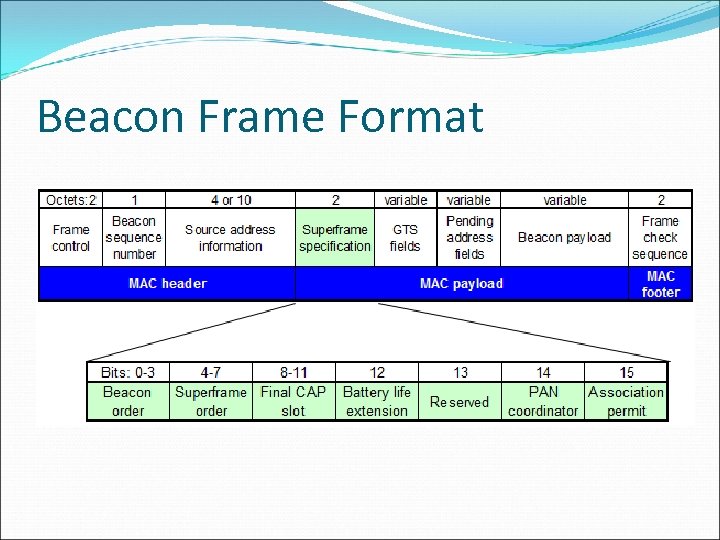 Beacon Frame Format
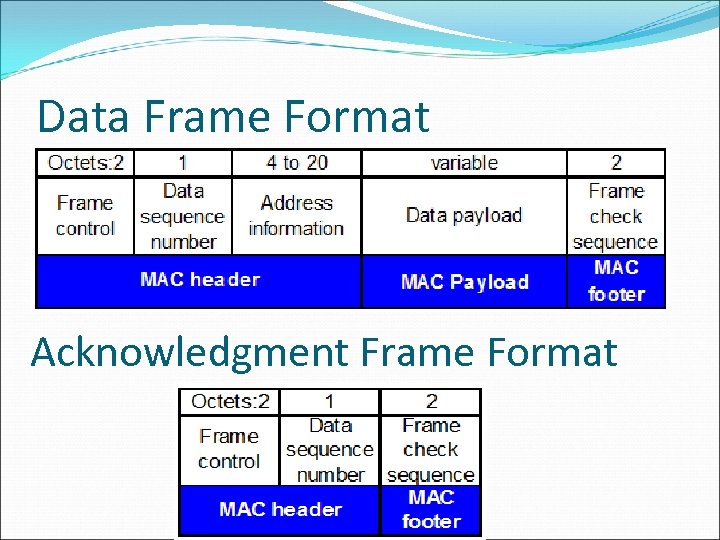 Data Frame Format Acknowledgment Frame Format
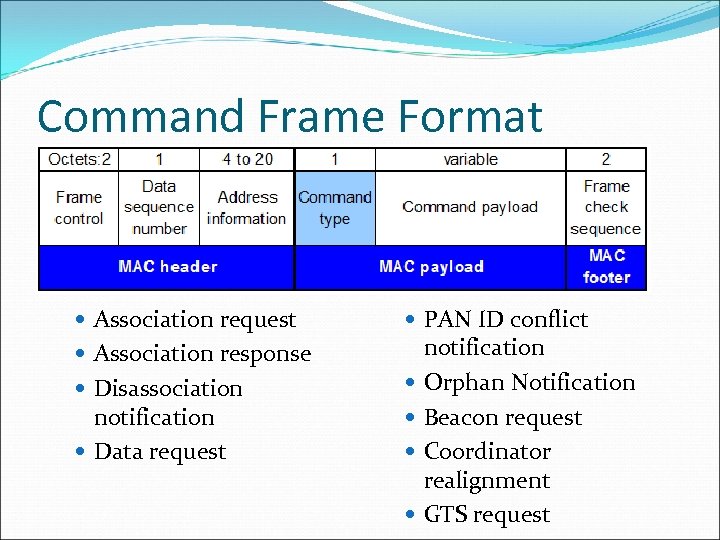 Command Frame Format Association request PAN ID conflict Association response Disassociation notification Data request notification Orphan Notification Beacon request Coordinator realignment GTS request
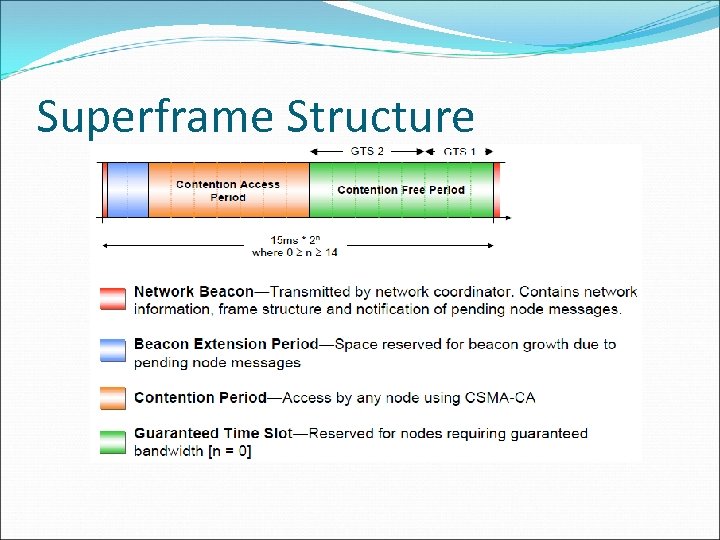
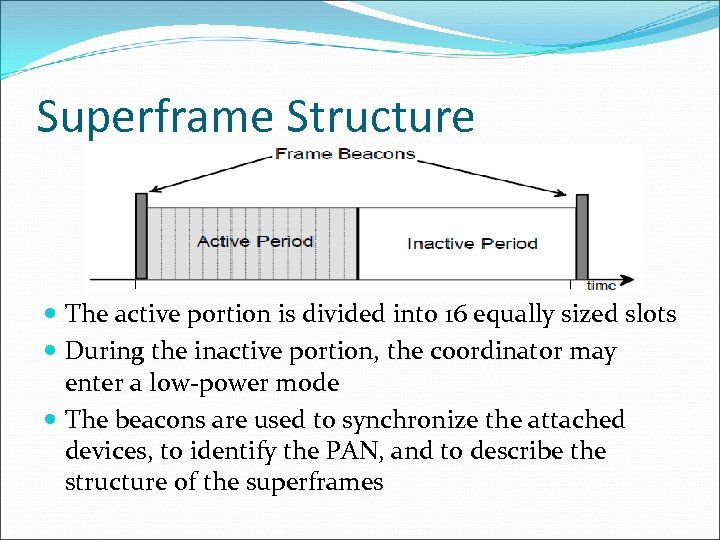 Superframe Structure The active portion is divided into 16 equally sized slots During the inactive portion, the coordinator may enter a low-power mode The beacons are used to synchronize the attached devices, to identify the PAN, and to describe the structure of the superframes
 Superframe Structure
 Guaranteed Time Slots (GTSs) For low-latency applications or applications requiring specific data bandwidth PAN coordinator may dedicate portions of the active superframe to that application PAN coordinator may allocate up to seven of these GTSs, and a GTS may occupy more than one slot period
 Questions?
 Data Transfer Three types of data transfer: -Data transfer to a coordinator in which a device transmits the data -Data transfer from a coordinator in which the device receives the data -Data transfer between two peer devices *In star topology only first two are used *The mechanisms for each transfer type depend on whether the network supports the transmission of beacons
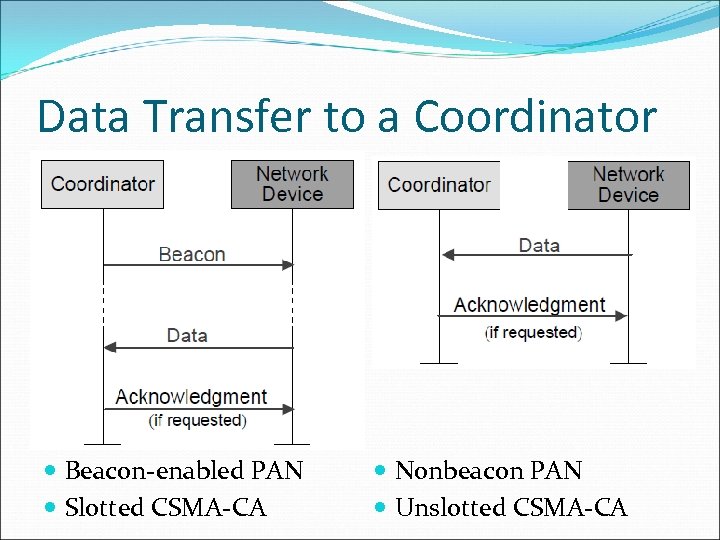 Data Transfer to a Coordinator Beacon-enabled PAN Slotted CSMA-CA Nonbeacon PAN Unslotted CSMA-CA
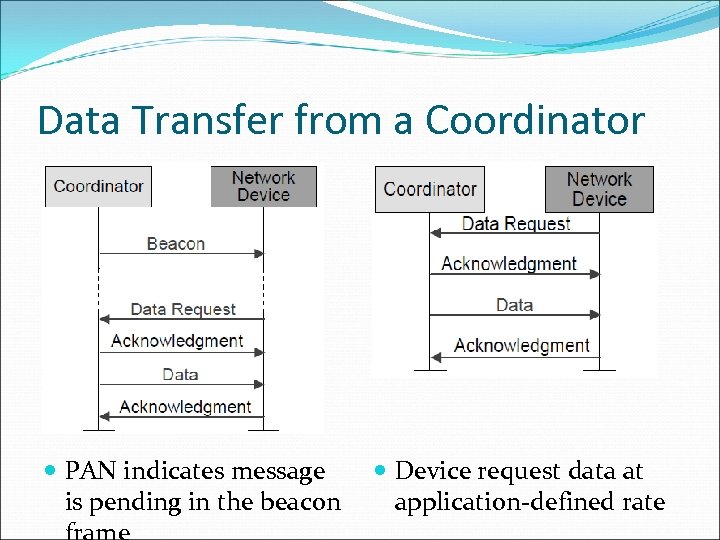 Data Transfer from a Coordinator PAN indicates message is pending in the beacon Device request data at application-defined rate
 Peer-to-peer Data Transfers Devices wishing to communicate will need to either receive constantly or synchronize with each other In the first case, the device can simply transmit its data using unslotted CSMA-CA In the latter case, other measures need to be taken in order to achieve synchronization
 Improving Probability of Successful Delivery The IEEE 802. 15. 4 LR-WPAN employs various mechanisms to improve the probability of successful data transmission: CSMA-CA mechanism Frame acknowledgment Data verification
 Unslotted CSMA-CA Mechanism Used by nonbeacon-enabled PANs Each time a device wishes to transmit data frames or MAC commands, it waits for a random period If the channel is found to be idle, following the random backoff, the device transmits data If the channel is found to be busy following the random backoff, the device waits for another random period before trying to access the channel again Acknowledgment frames are sent without using a CSMA-CA mechanism
 Slotted CSMA-CA Mechanism Used by beacon-enabled PANs Backoff slots are aligned with the start of the beacon transmission Device locates the boundary of the next backoff slot and then waits for a random number of backoff slots If the channel is busy, following this random backoff, the device waits for another random number of backoff If the channel is idle, the device begins transmitting on the next available backoff slot boundary
 Frame Acknowledgment A successful reception and validation of a data or MAC command frame can be optionally confirmed with an acknowledgment If the originator does not receive an acknowledgment after some period, it assumes that the transmission was unsuccessful and retries the frame transmission When the acknowledgment is not required, the originator assumes the transmission was successful
 Data Verification-FCS Mechanism In order to detect bit errors, an FCS mechanism employing a 16 -bit International Telecommunication Union—Telecommunication Standardization Sector (ITU-T) cyclic redundancy check (CRC) is used to detect errors in every frame
 Approaches for Low Power The protocol has been developed to favor batterypowered devices Battery-powered devices will require duty-cycling to reduce power consumption Thus will spend most of their operational life in a sleep state Each device periodically listens to the RF channel in order to determine whether a message is pending Higher powered devices have the option of listening to the RF channel continuously
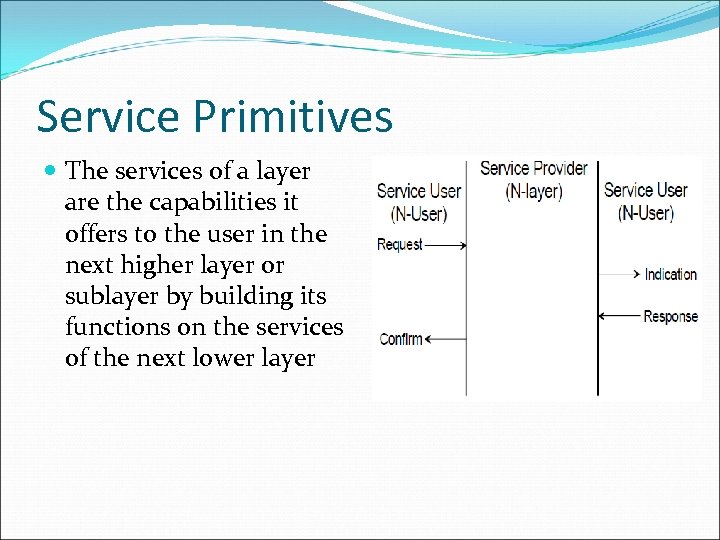 Service Primitives The services of a layer are the capabilities it offers to the user in the next higher layer or sublayer by building its functions on the services of the next lower layer
 Continued… Each event consists of passing a service primitive from one layer to the other through a layer SAP associated with an N-user Service primitives convey the required information by providing a particular service A service is specified by describing the service primitives and parameters that characterize it
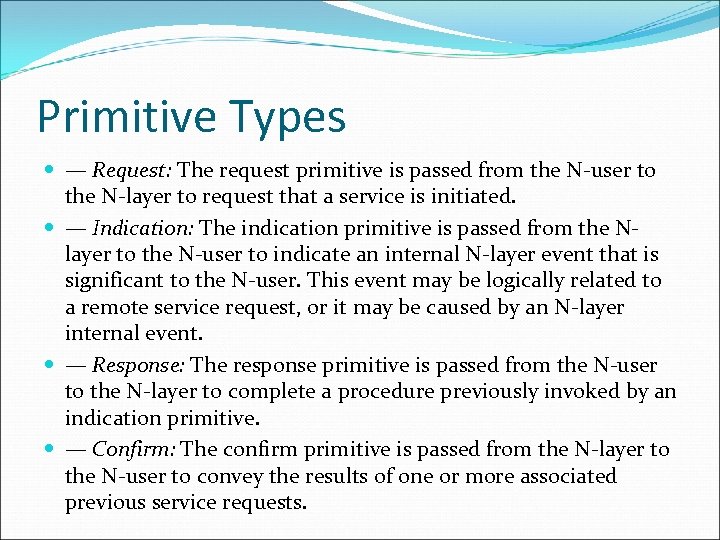 Primitive Types — Request: The request primitive is passed from the N-user to the N-layer to request that a service is initiated. — Indication: The indication primitive is passed from the Nlayer to the N-user to indicate an internal N-layer event that is significant to the N-user. This event may be logically related to a remote service request, or it may be caused by an N-layer internal event. — Response: The response primitive is passed from the N-user to the N-layer to complete a procedure previously invoked by an indication primitive. — Confirm: The confirm primitive is passed from the N-layer to the N-user to convey the results of one or more associated previous service requests.
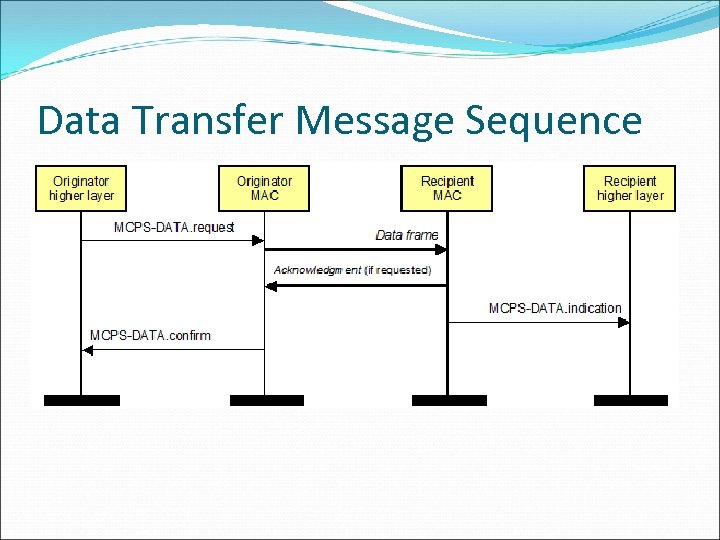 Data Transfer Message Sequence
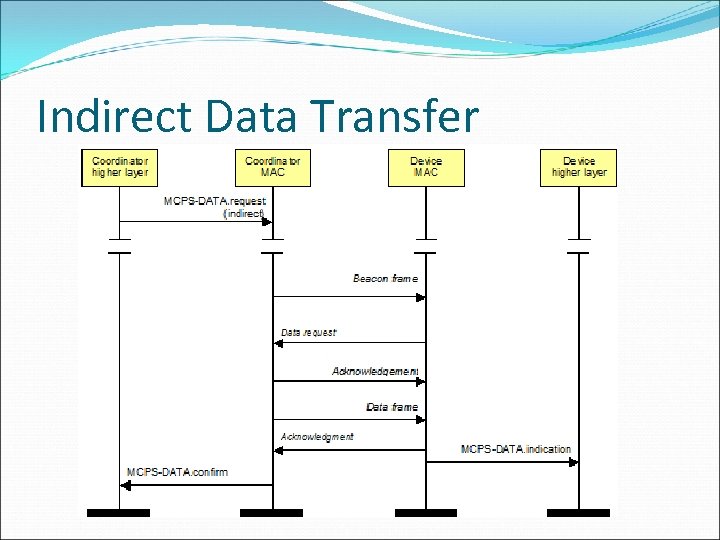 Indirect Data Transfer
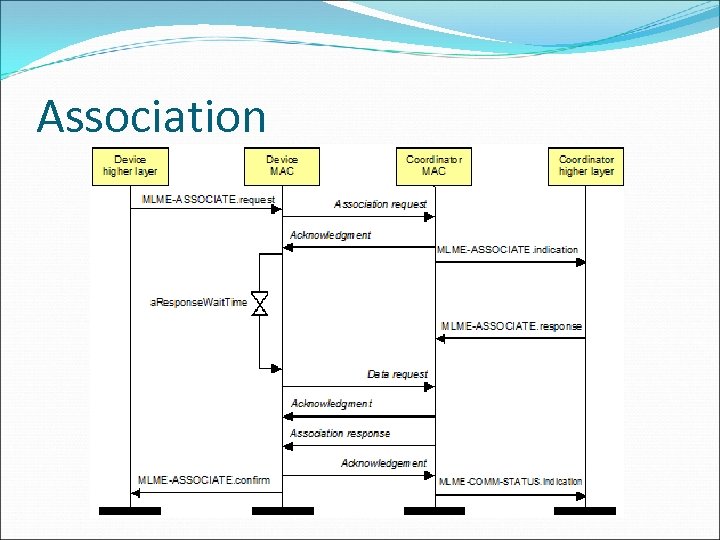 Association
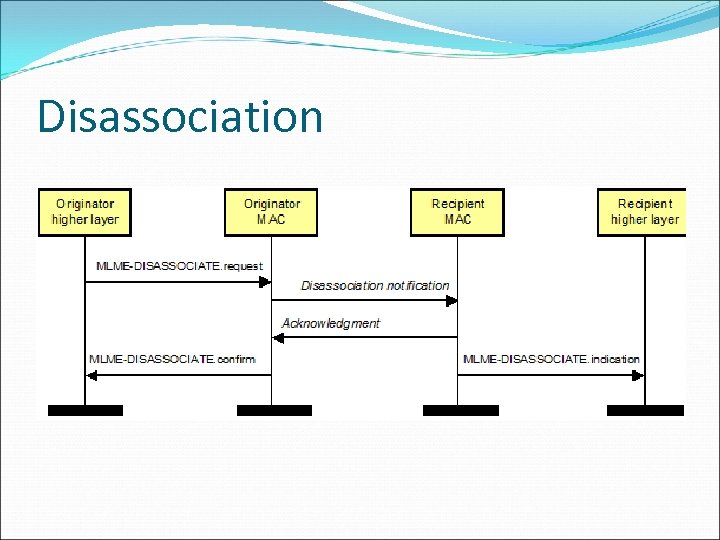 Disassociation
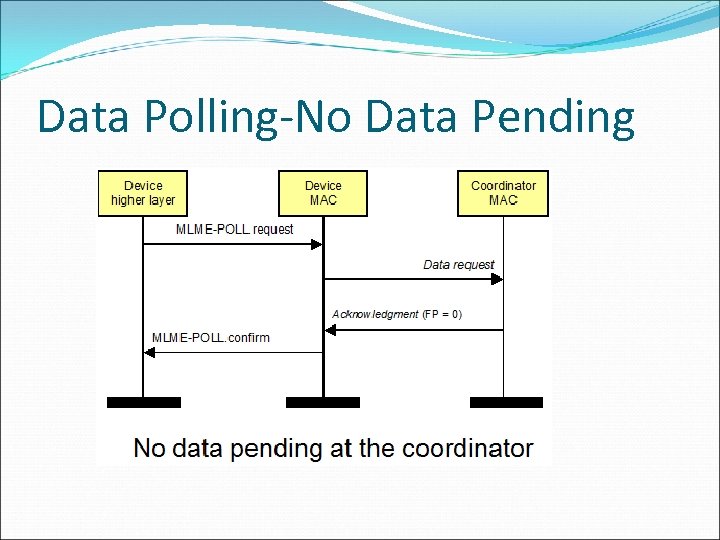 Data Polling-No Data Pending
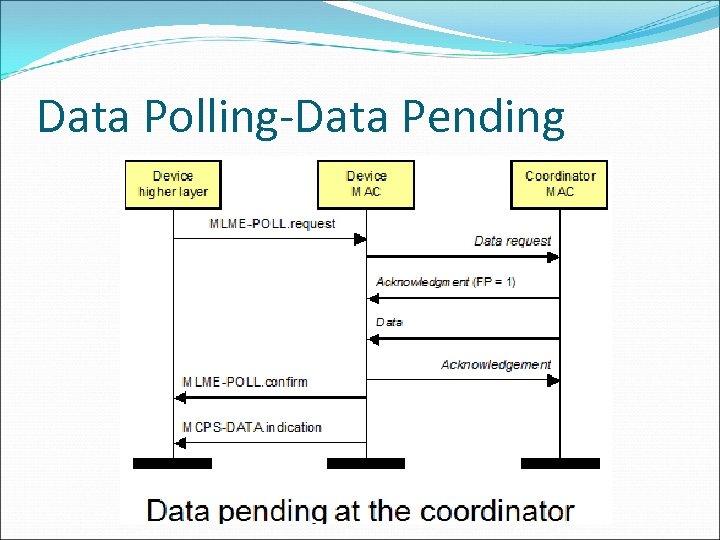 Data Polling-Data Pending
 References -IEEE Std. 802. 15. 4™-2006 -Marco Naeve, Eaton Corp. , IEEE 802. 15. 4 MAC Overview, 05/2004 -IEEE Std. 802. 15. 4 Enabling Pervasive Wireless Sensor Networks, Dr. Jose Gutierrez, Eaton Corp. http: //deneb. cs. kent. edu/~mikhail/classes/seminar. u 04/praveen_lrwpan. ppt - 140. 117. 169. 69/course 1/zigbee-802. 15. 4. ppt
 Questions?