


 Скачать презентацию 8 IP Over ATM Set of IP
5e06e62fa739e6365a70027265d6e929.ppt
- Количество слайдов: 61
 8. IP Over ATM • Set of IP hosts within a same IP domain (subnet) communicate with each other directly over ATM network. • The IP hosts outside their subnet (domain) communicate with other IP hosts in another subnet via an IP router.
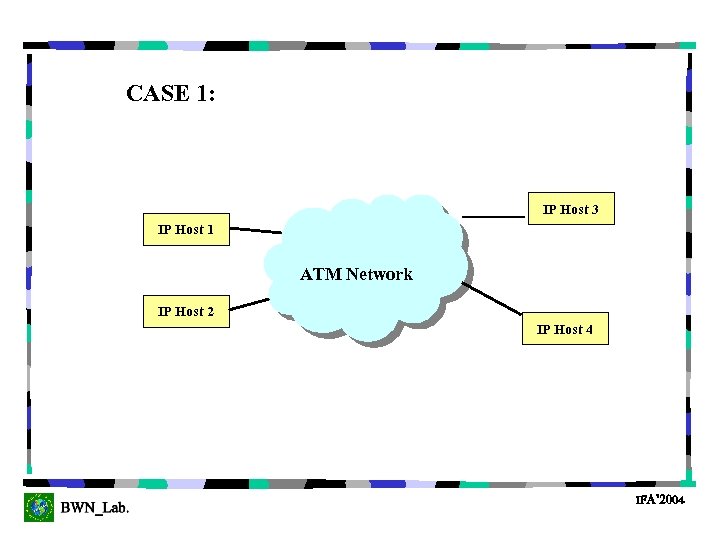 CASE 1: IP Host 3 IP Host 1 ATM Network IP Host 2 IP Host 4
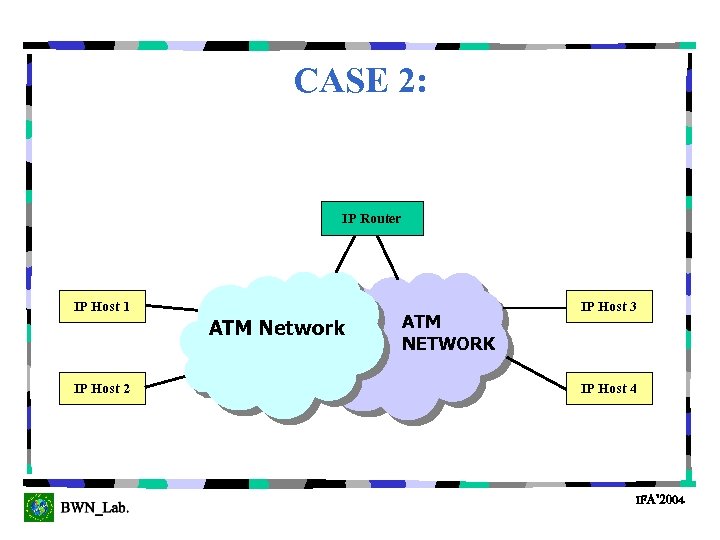 CASE 2: IP Router IP Host 1 ATM Network IP Host 2 ATM NETWORK IP Host 3 IP Host 4
 IP Over ATM • OVERLAY MODEL IP over ATM • PEER MODEL MULTIPROTOCOL LABEL SWITCHING (MPLS) Integrated ATM switching and IP Routing Function. No Address Resolution Protocol.
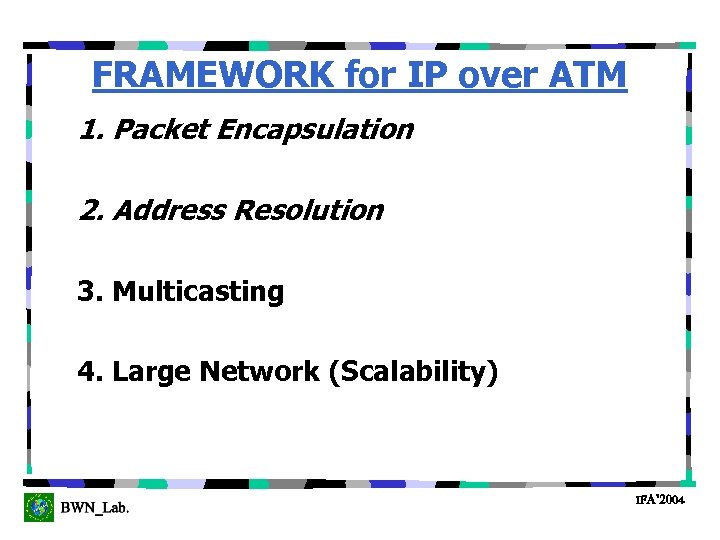 FRAMEWORK for IP over ATM 1. Packet Encapsulation 2. Address Resolution 3. Multicasting 4. Large Network (Scalability)
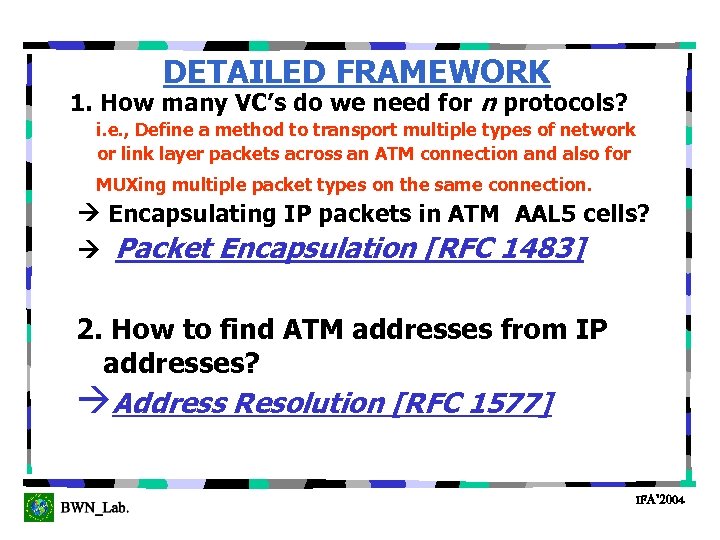 DETAILED FRAMEWORK 1. How many VC’s do we need for n protocols? i. e. , Define a method to transport multiple types of network or link layer packets across an ATM connection and also for MUXing multiple packet types on the same connection. Encapsulating IP packets in ATM AAL 5 cells? Packet Encapsulation [RFC 1483] 2. How to find ATM addresses from IP addresses? àAddress Resolution [RFC 1577]
![DETAILED FRAMEWORK 3. How to handle multicast? MARS [RFC 2022] 4. How do we](https://present5.com/presentation/5e06e62fa739e6365a70027265d6e929/image-7.jpg "DETAILED FRAMEWORK 3. How to handle multicast? MARS [RFC 2022] 4. How do we") DETAILED FRAMEWORK 3. How to handle multicast? MARS [RFC 2022] 4. How do we go through n subnets on a large ATM network? NHRP
DETAILED FRAMEWORK 3. How to handle multicast? MARS [RFC 2022] 4. How do we go through n subnets on a large ATM network? NHRP
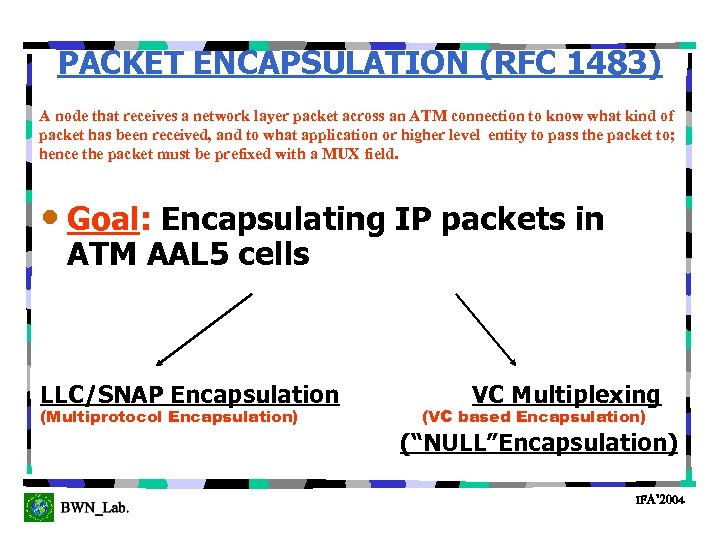 PACKET ENCAPSULATION (RFC 1483) A node that receives a network layer packet across an ATM connection to know what kind of packet has been received, and to what application or higher level entity to pass the packet to; hence the packet must be prefixed with a MUX field. • Goal: Encapsulating IP packets in ATM AAL 5 cells LLC/SNAP Encapsulation (Multiprotocol Encapsulation) VC Multiplexing (VC based Encapsulation) (“NULL”Encapsulation)
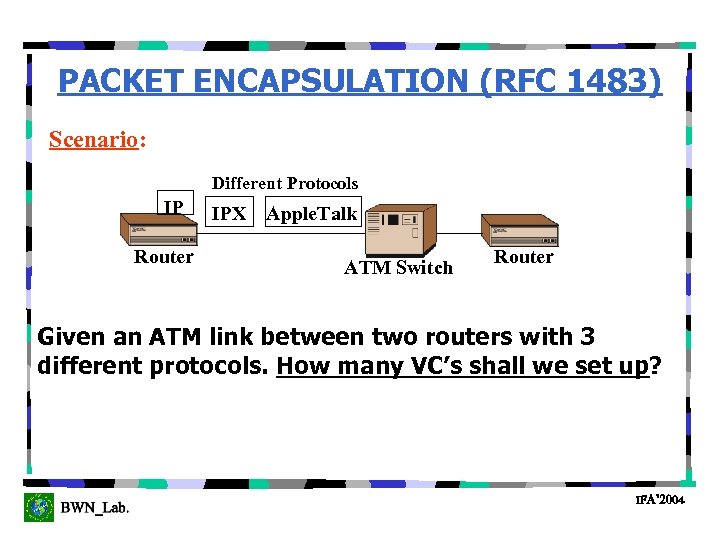 PACKET ENCAPSULATION (RFC 1483) Scenario: Different Protocols IP Router IPX Apple. Talk ATM Switch Router Given an ATM link between two routers with 3 different protocols. How many VC’s shall we set up?
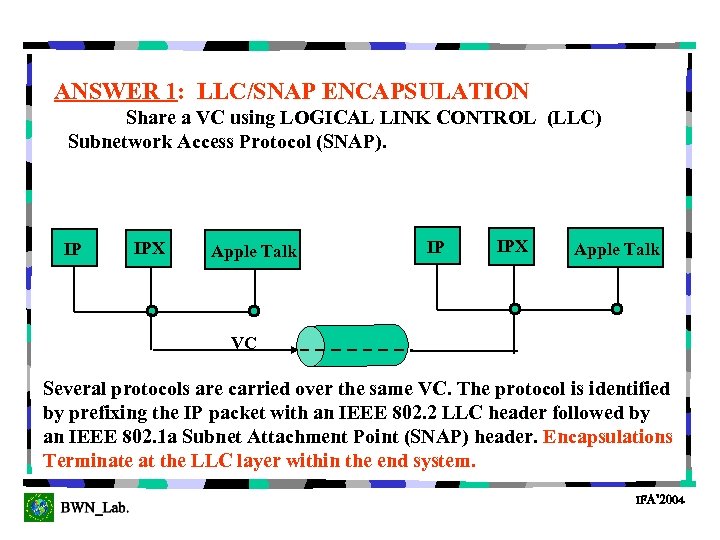 ANSWER 1: LLC/SNAP ENCAPSULATION Share a VC using LOGICAL LINK CONTROL (LLC) Subnetwork Access Protocol (SNAP). IP IPX Apple Talk VC Several protocols are carried over the same VC. The protocol is identified by prefixing the IP packet with an IEEE 802. 2 LLC header followed by an IEEE 802. 1 a Subnet Attachment Point (SNAP) header. Encapsulations Terminate at the LLC layer within the end system.
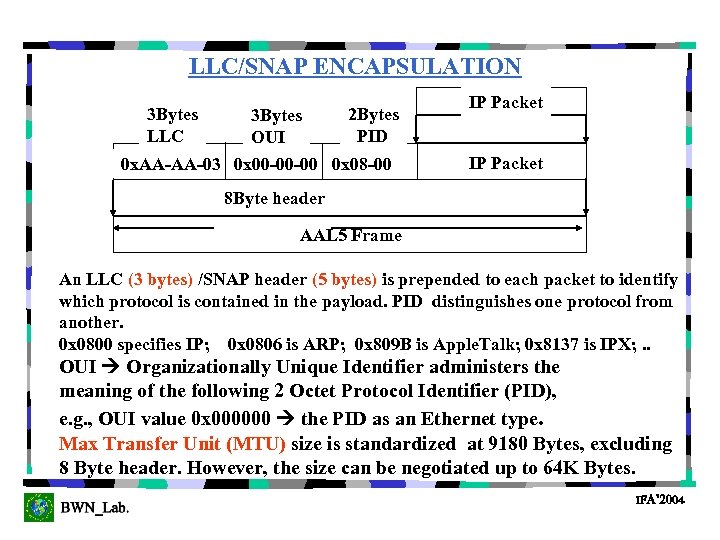 LLC/SNAP ENCAPSULATION 3 Bytes LLC 3 Bytes OUI 2 Bytes PID 0 x. AA-AA-03 0 x 00 -00 -00 0 x 08 -00 IP Packet 8 Byte header AAL 5 Frame An LLC (3 bytes) /SNAP header (5 bytes) is prepended to each packet to identify which protocol is contained in the payload. PID distinguishes one protocol from another. 0 x 0800 specifies IP; 0 x 0806 is ARP; 0 x 809 B is Apple. Talk; 0 x 8137 is IPX; . . OUI Organizationally Unique Identifier administers the meaning of the following 2 Octet Protocol Identifier (PID), e. g. , OUI value 0 x 000000 the PID as an Ethernet type. Max Transfer Unit (MTU) size is standardized at 9180 Bytes, excluding 8 Byte header. However, the size can be negotiated up to 64 K Bytes.
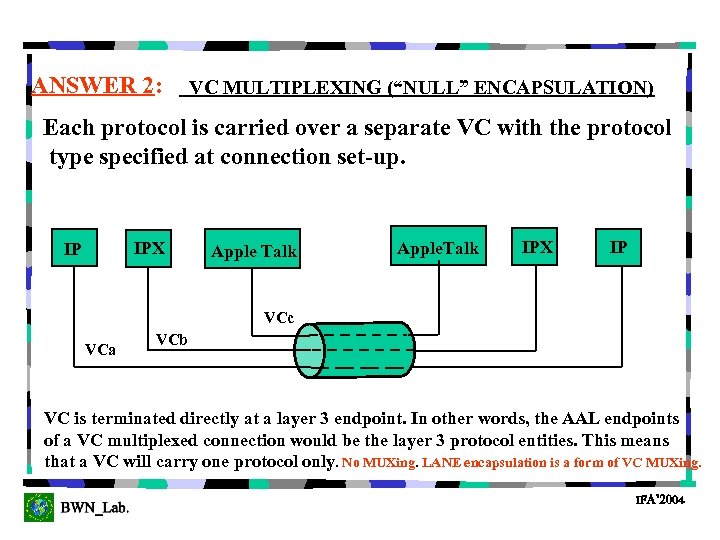 ANSWER 2: VC MULTIPLEXING (“NULL” ENCAPSULATION) Each protocol is carried over a separate VC with the protocol type specified at connection set-up. IPX IP Apple Talk Apple. Talk IPX IP VCc VCa VCb VC is terminated directly at a layer 3 endpoint. In other words, the AAL endpoints of a VC multiplexed connection would be the layer 3 protocol entities. This means that a VC will carry one protocol only. No MUXing. LANE encapsulation is a form of VC MUXing.
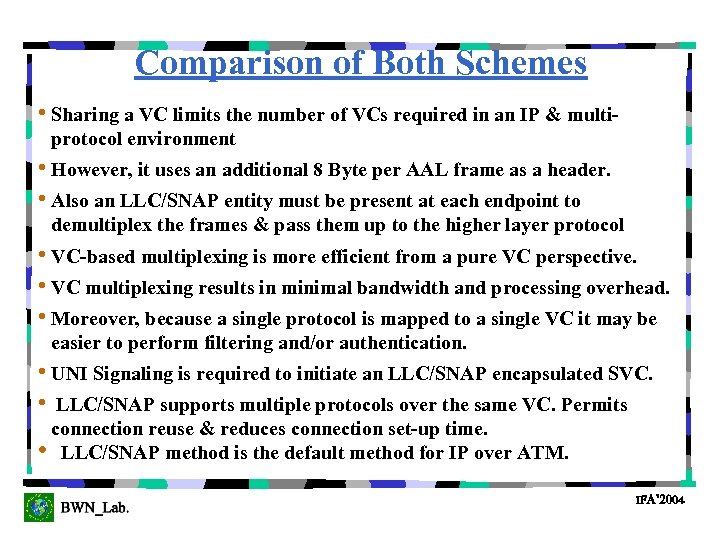 Comparison of Both Schemes • Sharing a VC limits the number of VCs required in an IP & multiprotocol environment • However, it uses an additional 8 Byte per AAL frame as a header. • Also an LLC/SNAP entity must be present at each endpoint to demultiplex the frames & pass them up to the higher layer protocol • VC-based multiplexing is more efficient from a pure VC perspective. • VC multiplexing results in minimal bandwidth and processing overhead. • Moreover, because a single protocol is mapped to a single VC it may be easier to perform filtering and/or authentication. • UNI Signaling is required to initiate an LLC/SNAP encapsulated SVC. • LLC/SNAP supports multiple protocols over the same VC. Permits connection reuse & reduces connection set-up time. • LLC/SNAP method is the default method for IP over ATM.
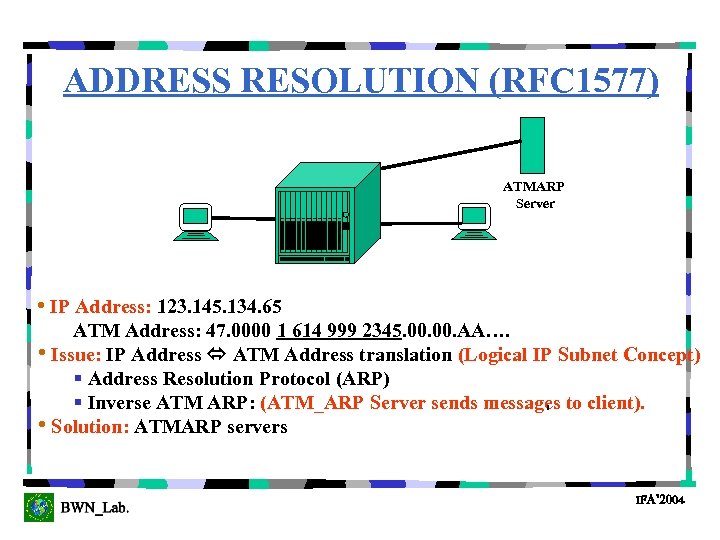 ADDRESS RESOLUTION (RFC 1577) ATMARP Server • IP Address: 123. 145. 134. 65 ATM Address: 47. 0000 1 614 999 2345. 00. AA…. • Issue: IP Address ATM Address translation (Logical IP Subnet Concept) § Address Resolution Protocol (ARP) § Inverse ATM ARP: (ATM_ARP Server sends messages to client). • Solution: ATMARP servers
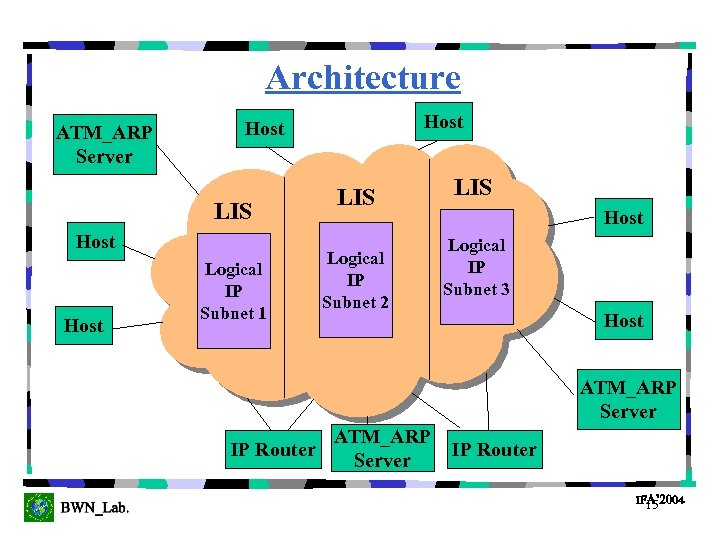 Architecture ATM_ARP Server LIS Host Logical IP Subnet 1 LIS Logical IP Subnet 2 LIS Host Logical IP Subnet 3 Host ATM_ARP Server ATM_ARP IP Router Server IP Router 15
 Architecture (Cont. ) • • Hosts on subnet are assigned an IP address and PHY layer address (ATM). IP nodes (end-systems and routers) in the ATM network are grouped into logical IP subnets (LIS) (with similar subnet addresses). The nodes in one LIS communicate with those outside their LIS through IP routers. When communicating with another host on the same subnet using ATM, it is necessary to resolve the destination IP address with the ATM address of the end-point.
 Architecture (Cont. ) • When traversing subnet boundaries, it is necessary to first pass through a IP router which can continue to implement any filtering, access or security policies.
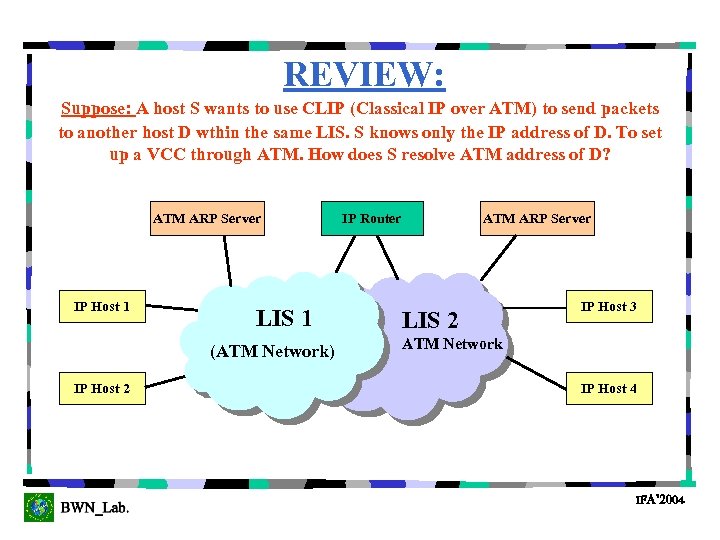
 Architecture (cont. ) • Within each LIS, there is an ATM Address Resolution Protocol Server (ATM_ARP) which performs directory services function for the nodes in the LIS. • A single LIS can support many hosts and routers with the same IP network & subnet mask. • Communication between any two members of the LIS takes place over ATM PVC or SVC.
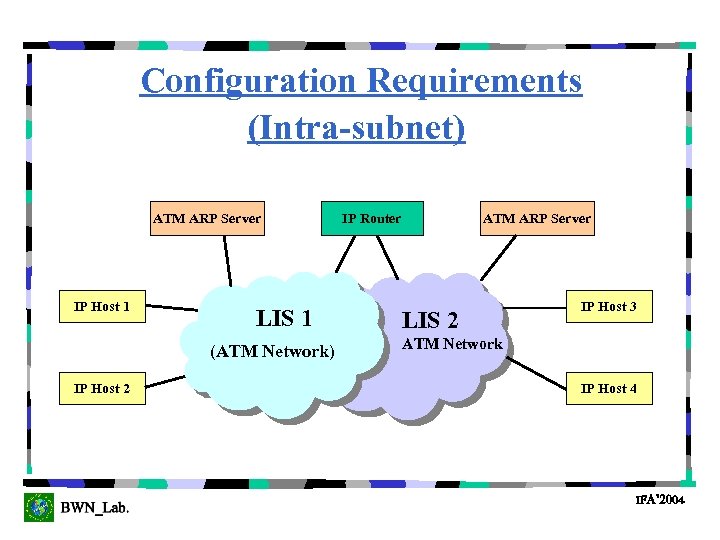 Configuration Requirements (Intra-subnet) ATM ARP Server IP Host 1 LIS 1 (ATM Network) IP Host 2 IP Router ATM ARP Server LIS 2 IP Host 3 ATM Network IP Host 4
 Configuration Requirements (Cont. ) • All LIS members must use ATMARP and In. ATMARP in conjunction with an ATMARP server entity to resolve IP and ATM addresses when using SVCs. • All LIS members must use In. ATMARP to resolve VCs to IP addresses when using PVCs. An ATMARP server entity is not required when using PVCs. • All LIS members must be able to communicate with all other LIS members using an ATM PVC or SVC. This implies that the underlying ATM fabric can be fully meshed.
 Configuration Requirements (Cont. ) The following ATM parameters must be configured for each member of the LIS: • ATM Hardware Address : This is the ATM address of the individual IP host. • ATMARP Request Address : This is the ATM address of the ATMARP server for the LIS. If the LIS is using only PVCs, then this requirement may be null.
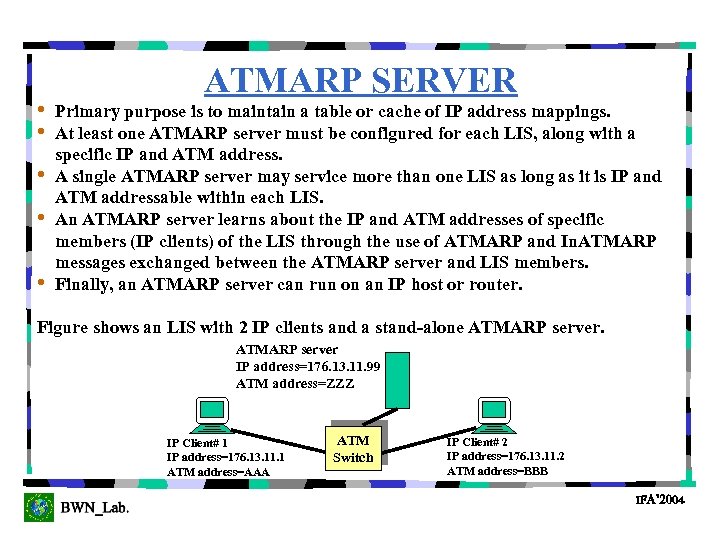 • • • ATMARP SERVER Primary purpose is to maintain a table or cache of IP address mappings. At least one ATMARP server must be configured for each LIS, along with a specific IP and ATM address. A single ATMARP server may service more than one LIS as long as it is IP and ATM addressable within each LIS. An ATMARP server learns about the IP and ATM addresses of specific members (IP clients) of the LIS through the use of ATMARP and In. ATMARP messages exchanged between the ATMARP server and LIS members. Finally, an ATMARP server can run on an IP host or router. Figure shows an LIS with 2 IP clients and a stand-alone ATMARP server IP address=176. 13. 11. 99 ATM address=ZZZ IP Client# 1 IP address=176. 13. 11. 1 ATM address=AAA ATM Switch IP Client# 2 IP address=176. 13. 11. 2 ATM address=BBB
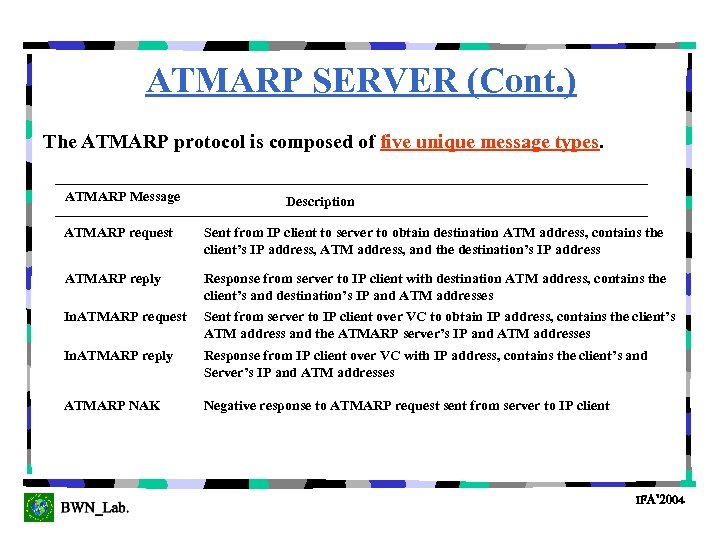 ATMARP SERVER (Cont. ) The ATMARP protocol is composed of five unique message types. ATMARP Message Description ATMARP request Sent from IP client to server to obtain destination ATM address, contains the client’s IP address, ATM address, and the destination’s IP address ATMARP reply Response from server to IP client with destination ATM address, contains the client’s and destination’s IP and ATM addresses In. ATMARP request Sent from server to IP client over VC to obtain IP address, contains the client’s ATM address and the ATMARP server’s IP and ATM addresses In. ATMARP reply Response from IP client over VC with IP address, contains the client’s and Server’s IP and ATM addresses ATMARP NAK Negative response to ATMARP request sent from server to IP client
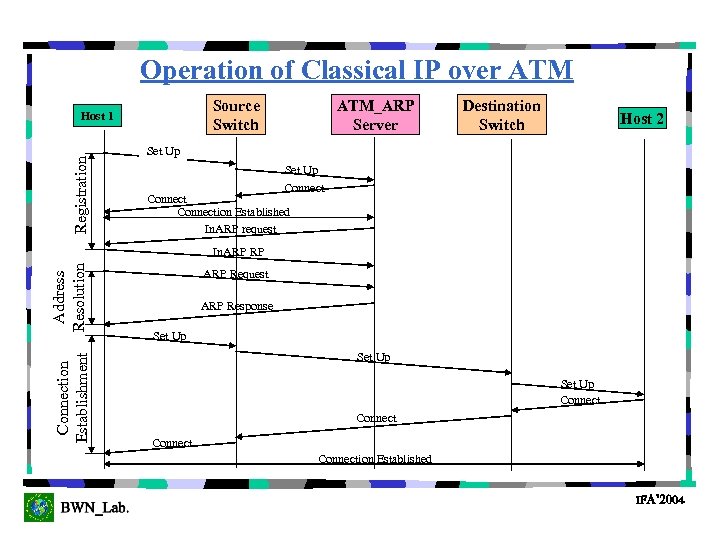
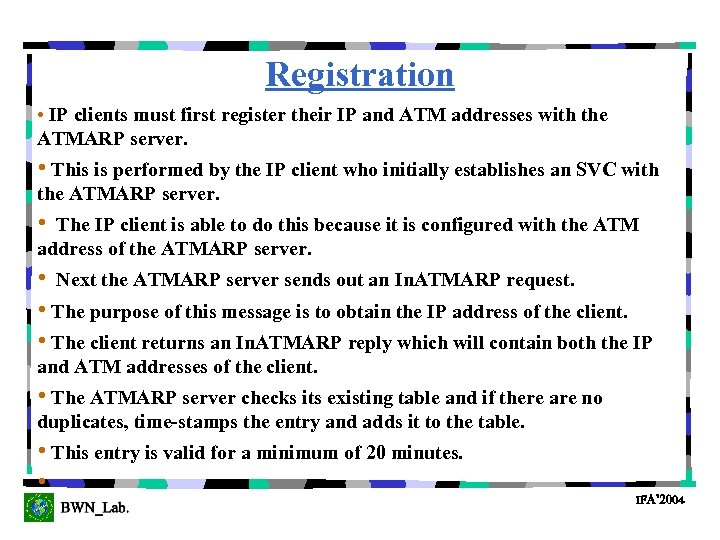 Registration • IP clients must first register their IP and ATM addresses with the ATMARP server. • This is performed by the IP client who initially establishes an SVC with the ATMARP server. • The IP client is able to do this because it is configured with the ATM address of the ATMARP server. • Next the ATMARP server sends out an In. ATMARP request. • The purpose of this message is to obtain the IP address of the client. • The client returns an In. ATMARP reply which will contain both the IP and ATM addresses of the client. • The ATMARP server checks its existing table and if there are no duplicates, time-stamps the entry and adds it to the table. • This entry is valid for a minimum of 20 minutes. •
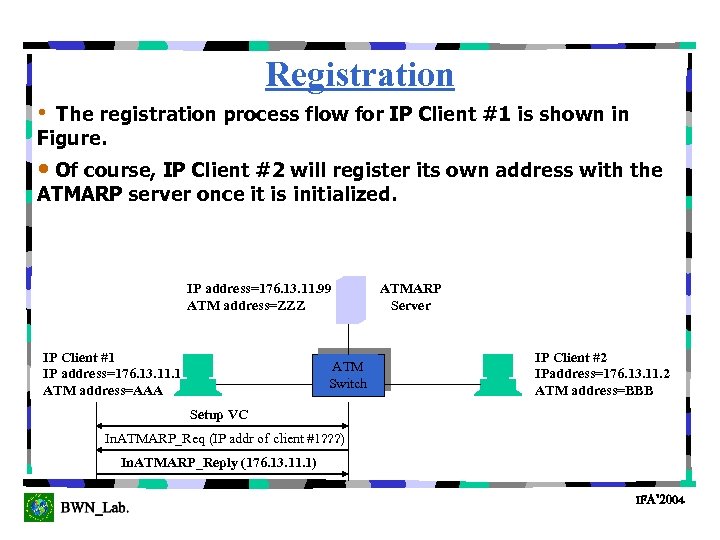 Registration • The registration process flow for IP Client #1 is shown in Figure. • Of course, IP Client #2 will register its own address with the ATMARP server once it is initialized. IP address=176. 13. 11. 99 ATM address=ZZZ IP Client #1 IP address=176. 13. 11. 1 ATM address=AAA ATM Switch Setup VC In. ATMARP_Req (IP addr of client #1? ? ? ) In. ATMARP_Reply (176. 13. 11. 1) ATMARP Server IP Client #2 IPaddress=176. 13. 11. 2 ATM address=BBB
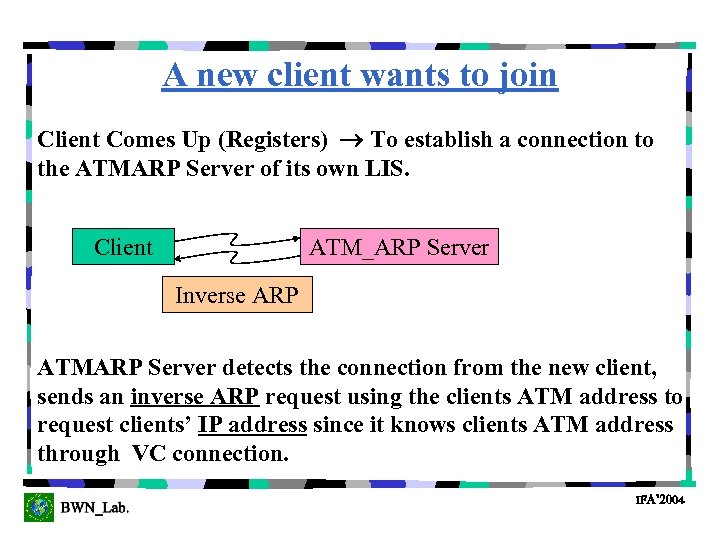 A new client wants to join Client Comes Up (Registers) To establish a connection to the ATMARP Server of its own LIS. Client ATM_ARP Server Inverse ARP ATMARP Server detects the connection from the new client, sends an inverse ARP request using the clients ATM address to request clients’ IP address since it knows clients ATM address through VC connection.
 ADDRESS RESOLUTION • If IP Client #1 wishes to communicate with IP Client #2 and a connection already exists, then the packets will immediately flow over that connection. • IP Client #1 may contain the ATM address of IP Client #2 in its own ARP cache and if so, then it can immediately set up an SVC to IP Client #2. • However, if a connection does not already exist and IP Client #1 does not know the ATM address of IP Client #2, then the ATMARP process is invoked. • IP Client #1 sends an ATMARP request to the ATMARP server that contains the source IP address, destination IP address, and source ATM address.
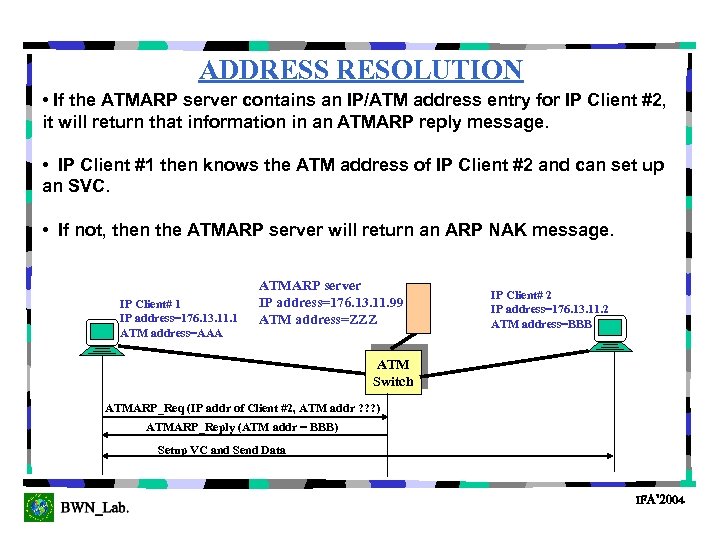 ADDRESS RESOLUTION • If the ATMARP server contains an IP/ATM address entry for IP Client #2, it will return that information in an ATMARP reply message. • IP Client #1 then knows the ATM address of IP Client #2 and can set up an SVC. • If not, then the ATMARP server will return an ARP NAK message. IP Client# 1 IP address=176. 13. 11. 1 ATM address=AAA ATMARP server IP address=176. 13. 11. 99 ATM address=ZZZ ATM Switch ATMARP_Req (IP addr of Client #2, ATM addr ? ? ? ) ATMARP_Reply (ATM addr = BBB) Setup VC and Send Data IP Client# 2 IP address=176. 13. 11. 2 ATM address=BBB
 Example: • Client in LIS 1 wants to communicate with a client in LIS 2 must go through ROUTER 1 even though a direct VC can be established between two clients over the ATM network. • Two clients are attached to two different ATM switches. • Within this LIS Host 2 had registered earlier with ATMARP server. • Each node is configured with the ATM address of its ATM_ARP server. • Host 1 establishes a connection to its LIS ATM_ARP Server and then resolves an address for Host 2 in the same LIS. 29
 Operation of Classical IP over ATM Source Switch Registration Host 1 ATM_ARP Server Destination Switch Host 2 Set Up Connection Established In. ARP request Connection Establishment Address Resolution In. ARP RP ARP Request ARP Response Set Up Connection Established
 REVIEW: Suppose: A host S wants to use CLIP (Classical IP over ATM) to send packets to another host D wthin the same LIS. S knows only the IP address of D. To set up a VCC through ATM. How does S resolve ATM address of D? ATM ARP Server IP Host 1 LIS 1 (ATM Network) IP Host 2 IP Router ATM ARP Server LIS 2 IP Host 3 ATM Network IP Host 4
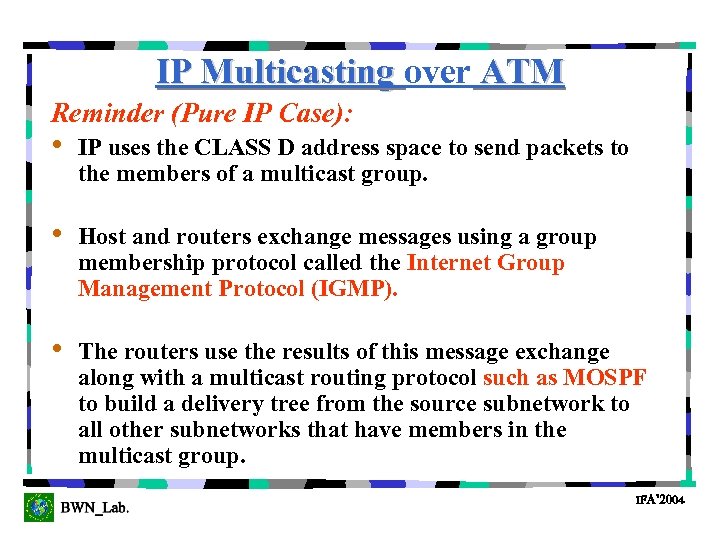 IP Multicasting over ATM Reminder (Pure IP Case): • IP uses the CLASS D address space to send packets to the members of a multicast group. • Host and routers exchange messages using a group membership protocol called the Internet Group Management Protocol (IGMP). • The routers use the results of this message exchange along with a multicast routing protocol such as MOSPF to build a delivery tree from the source subnetwork to all other subnetworks that have members in the multicast group.
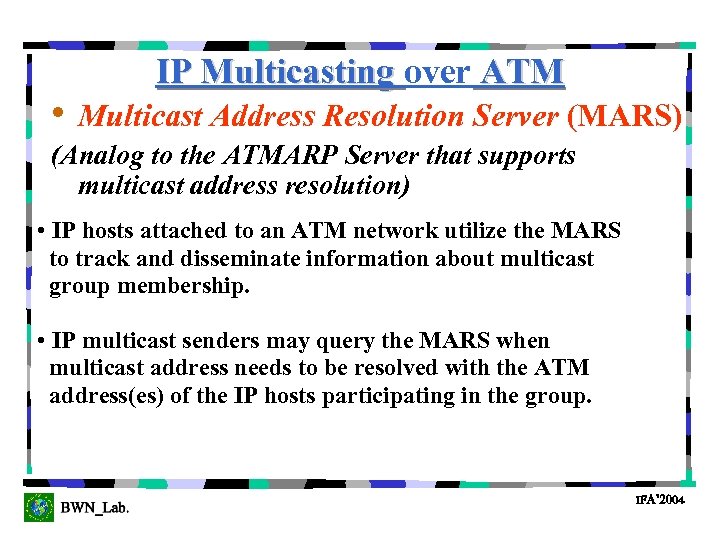 IP Multicasting over ATM • Multicast Address Resolution Server (MARS) (Analog to the ATMARP Server that supports multicast address resolution) • IP hosts attached to an ATM network utilize the MARS to track and disseminate information about multicast group membership. • IP multicast senders may query the MARS when multicast address needs to be resolved with the ATM address(es) of the IP hosts participating in the group.
 IP Multicasting over ATM (Ctd) The following should also be noted about the MARS: • The concept of a CLUSTER is used to define ATM hosts (or routers) that are participating in an ATM level multicast and that share a MARS. • A cluster is mapped to a single LIS but it is possible to extend the MARS to support a single cluster over multiple LISs. • However, that would require support for multicast routing (e. g. , MOSPF, PIM) over ATM, which is an area that requires further study. • So for now consider a one-to-one relationship between LIS and CLUSTER.
 • But instead of maintaining a table of IP to ATM address pairs, it holds an extended table consisting of IP group addresses and then the ATM addresses of the specific CLUSTER MEMBERS. This is called a HOST MAP. • For example, an entry for members belonging to multicast group 232. 200. 1 might look like: {232. 200. 1, ATM Address 2, …, ATM Address N}
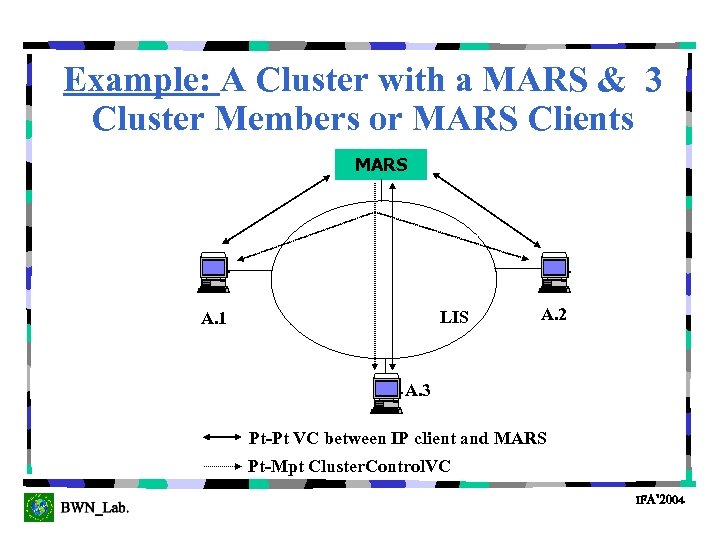 Example: A Cluster with a MARS & 3 Cluster Members or MARS Clients MARS LIS A. 1 A. 2 A. 3 Pt-Pt VC between IP client and MARS Pt-Mpt Cluster. Control. VC
 • Clients who wish to participate in a multicast group establish a point-to-point VC with the MARS. • Clients register with the MARS by sending a MARS_JOIN message containing the “all nodes” group address (224. 0. 0. 1) as described in RFC 1112. • The MARS will then add the client as a leaf on its Cluster. Control. VC. • The Cluster. Control. VC is a point-to-multipoint VC that is established between the MARS and all multicastcapable cluster members (hosts or routers). • The Cluster. Control. VC is used by the MARS to distribute group membership updates to all members of the cluster.
 • • • For example, after host A. 2 registers, the MARS will send a MARS_JOIN message out over its Cluster. Control. VC to all members, indicating that host A. 2 has registered and is multicast-capable. Clients who wish to join or leave a specific multicast group will send a MARS_JOIN or MARS_LEAVE message to the MARS containing one or more IP group addresses. Again, this information will be propagated to other cluster members over the Cluster. Control. VC so that sources (roots) can add to or prune their multicast trees. Clients send a MARS_REQUEST to the MARS seeking address resolution of a specific IP group address. MARS responds with a MARS_MULTI message which contains the HOST MAP for the IP group address.
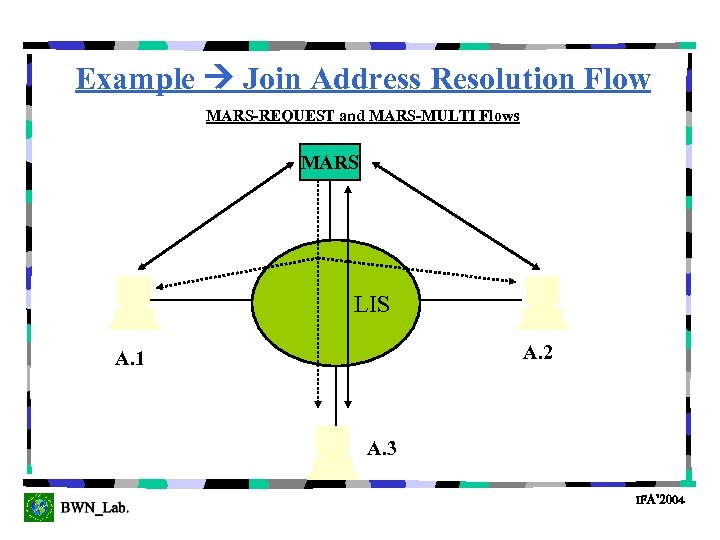 Example Join Address Resolution Flow MARS-REQUEST and MARS-MULTI Flows MARS LIS A. 2 A. 1 A. 3
 • Hosts A. 2 and A. 3 forward MARS_JOIN messages up to the MARS indicating they wish to join multicast group XYZ. • The MARS redirects these messages out over the Cluster. Control. VC. • Host A. 1 wishes to send packets to group address XYZ. • It issues a MARS_REQUEST message to the MARS which returns a MARS_MULTI message that contains a HOST MAP of (XYZ, A. 2, A. 3). • A. 1 now has sufficient information to establish a point-tomultipoint VC with the group members A. 2 and A. 3, and will begin multicasting.
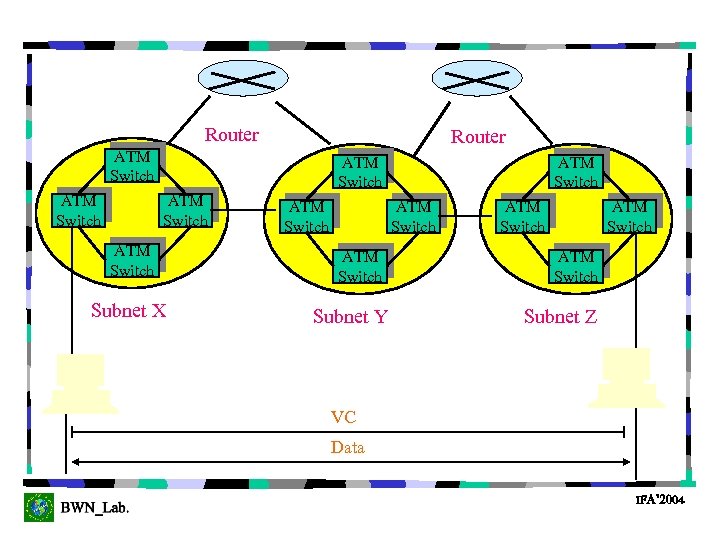
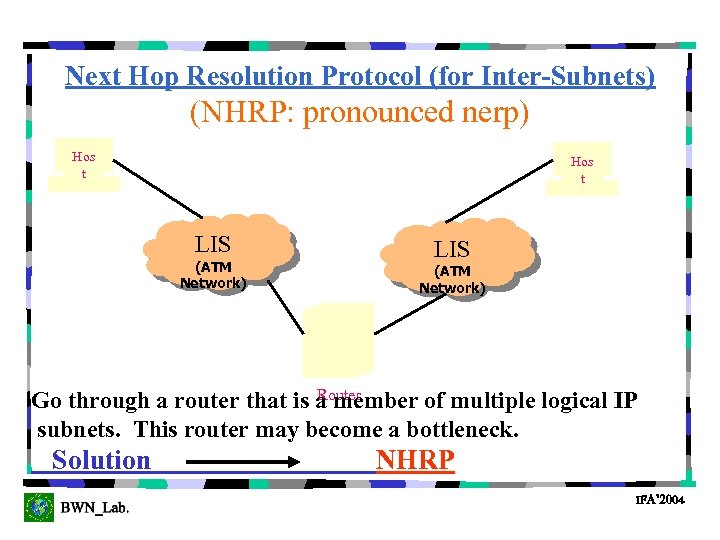 Next Hop Resolution Protocol (for Inter-Subnets) (NHRP: pronounced nerp) Hos t LIS (ATM Network) Router Go through a router that is a member of multiple logical IP subnets. This router may become a bottleneck. Solution NHRP
 Router ATM Switch ATM Switch Subnet X ATM Switch Subnet Y VC Data ATM Switch Subnet Z
 NHRP (Addendum) • Main Objective: Find the most efficient shortcut path through ATM network so that intermediate IP routers can be bypassed. • Recall: Previously an IP router had to forward packets between 2 LISs. CLIP model resolves only the ATM address that belongs to the same LIS. CLIP model requires an IP router to perform packet forwarding between two different LISs. • NHRP: provides shortcuts to traverse multiple LISs making it more suitable for larger networks.
 NHRP • It is an address resolution technique for resolving IP addresses with ATM addresses in a multiple subnet environment. • The purpose of NHRP is to provide a host or router with the ATM address of a destination IP address so that one or more layer-3 hops can be bypassed by using a direct connection over the ATM network. • NHRP can be considered an extension to the ATMARP process described in RFC 1577. • Whereas ATMARP is used to map IP and ATM addresses in a single LIS, NHRP is used to map IP and ATM addresses in a multiple LIS environment contained within a single ATM network.
 NHRP Terminology 1. NON-BROADCAST MULTI-ACCESS NETWORK (NBMA) An NBMA network is defined as: * Does not support an inherent broadcast or multicast capability. * Enables any host (or router) attached to the NBMA network to communicate directly with another host on the same NBMA network. ATM, Frame Relay, SMDS, and X. 25 are all examples of NBMA networks. An NBMA ATM network may contain one or more LISs. * The NBMA is partitioned into administrative domains. Logical NBMA Subnets (LNS) * Each LNS is served by an NHS (Next Hop Server)
 NHRP Terminology (Cont. ) 2. NEXT HOP SERVER (NHS) (These are responsible for answering NHRP resolution requests by means of NHRP replies. ) • NHS serves a set of hosts (or NHRP stations) in the NBMA network and answers NHRP resolution requests from these stations called NHC (Next Hop Clients). • Both NHS and NHC contain a CACHE or table of IP & ATM addresses for devices attached to the ATM network (Address Resolution Cache). • If the desired destination IP address is not on the ATM network, then the NHS will provide the ATM address of the router nearest to the destination. • The NHS should run on a router so as to facilitate forwarding of NHRP requests, replies, and other messages over the default-routed path. • The NHS responds to queries from NHRP clients. • The NHS serves a specific set or domain of NHRP clients for whom it is responsible.
 NHRP Terminology (Cont. ) 3. NEXT HOP CLIENTS (NHC) • • NHRP cloud contains entities called NHCs. These are responsible for initiating NHRP resolution request packets. REMARK: • Both NHC and NHS maintain an ADDRESS RESOLUTION CACHE. • An NHC in NHRP replaces an ATMARP client in CLIP (Classical IP over ATM Case) • NHS replaces an ATMARP server.
 NHRP Configuration • NHRP clients must be attached to an ATM network and must be configured with the ATM address of the NHS that is serving the client. Alternatively, it should have a means of locating its NHS. • Techniques under consideration involving other server location requirements such as ATMARP and MARS are a group address and a configuration server. • NHRP can run on an ATM-attached host or router. The NHS will likely be located on a station’s peer or default router.
 NHRP Configuration (Cont. ) • NHRP clients can be serviced by more than one NHS. • NHRP Servers are configured with their own IP and ATM addresses, a set of IP address prefixes that correspond to the domain of NHRP clients it is serving, and an NBMA (ATM) network identifier. • If the NHRP server is located on an egress router attached to a non-ATM network, then the NHRP server must exchange routing information between the ATM and non-ATM network.
 NHRP Client Registration • NHRP clients register with their NHRP server in one of the two ways: 1 - Manual Configuration 2 - NHRP Registration Packets • The NHRP registration packet contains the following information along with additional values: {NHC’s ATMaddress, NHC’s IPaddress, NHS’s IPaddress} • With this information, the NHRP server can begin to build its table of IP and ATM addresses.
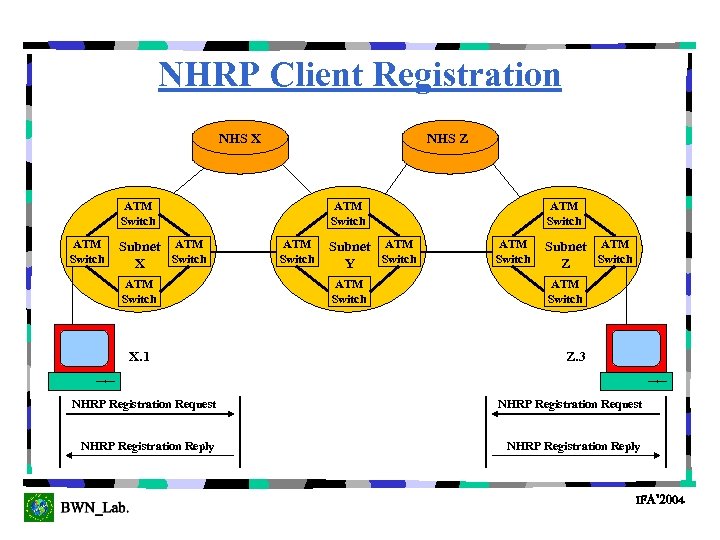 NHRP Client Registration NHS X NHS Z ATM Switch Subnet ATM Switch X. 1 ATM Switch Subnet ATM Switch Y ATM Switch Subnet ATM Switch Z. 3 NHRP Registration Request NHRP Registration Reply
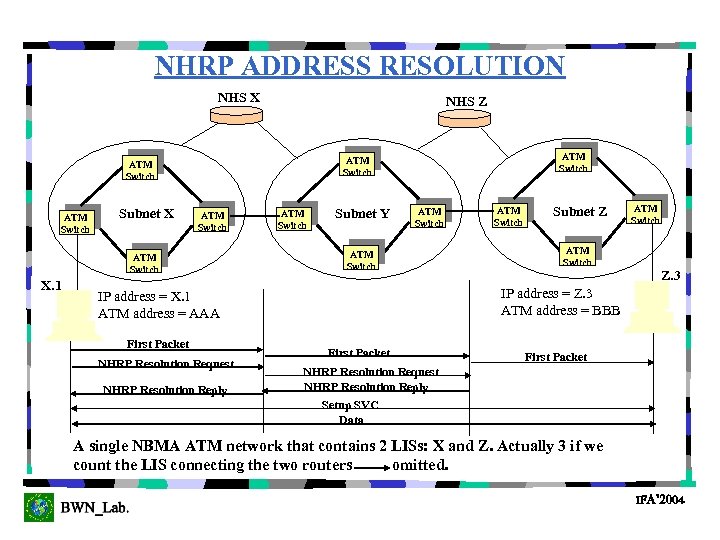 NHRP ADDRESS RESOLUTION NHS X NHS Z ATM Switch Subnet X ATM Switch X. 1 ATM Switch Subnet Y ATM Switch NHRP Resolution Request NHRP Resolution Reply Subnet Z ATM Switch IP address = Z. 3 ATM address = BBB IP address = X. 1 ATM address = AAA First Packet ATM Switch First Packet NHRP Resolution Request NHRP Resolution Reply Setup SVC Data A single NBMA ATM network that contains 2 LISs: X and Z. Actually 3 if we count the LIS connecting the two routers omitted. ATM Switch Z. 3
 NHRP ADDRESS RESOLUTION • The LISs are connected by two routers that serve as NHRP servers for subnets X and Z, respectively. • The routers are running a normal intra-AS routing protocol, OSPF, and are connected by an ATM PVC so they are exchanging routing information. • The station attached to subnet X with the IP address of X. 1 wishes to communicate with station Z. 3. • • Station X. 1 builds a packet and addresses it to Z. 3. If Z. 3 ATM address known, then X. 1 uses an existing VCC to send its data. If not, I. e. , X. 1 does not know the ATM address of Z. 3, then it sends NHRP. This packet is forwarded over an existing ATM VC to the default router. This causes X. 1 to send a NHRP Next Hop Resolution Request message to NHS X with the following information: [AAA, X. 1, Z. 3]. Station X. 1 may also opt to hold onto the packet until a NHRP reply is received or drop it. The first option, the default, is the better choice because that allows data to flow over the default-routed path.
 NHRP ADDRESS RESOLUTION • • NHS X checks to see if it serves station Z. 3. It also checks to see if it has an entry in its cache for Z. 3. SUPPOSE Neither is true so the NHRP (Next Hop Resolution Request) is forwarded to the adjacent NHRP server, NHS Z receives the NHRP Next Hop Resolution Request from NHS X. NHS Z determines that it serves the destination IP address contained in the request message. An entry is contained in the cache or table of NHS Z which contains an IP to ATM address mapping for the destination IP address of Z. 3. NHS Z resolves the destination IP address, Z. 3, with its matching ATM address, BBB. It places this information in a NHRP Next Hop Resolution Reply and returns it to station X. 1 over a default-routed path that the request came from.
 NHRP ADDRESS RESOLUTION • The NHRP Next Hop Resolution Reply could flow directly back to the initiator X. 1 if (1) A VC exists between station X. 1 and NHS Z, (2) An NHRP Reverse NHS record Extension is not included in the request message, and (3) The authentication policy permits direct communication between the initiator, station X. 1, NHS Z. (4) Sending a direct response back to the NHRP initiator may save time but does not enable any of the intermediate NHSs to cache information contained in the NRP Next Hop Resolution Reply messages. • As the NHRP Resolution Reply flows back to station X. 1, NHS X may cache the information contained in the packet. • This means it could add the entry of [Z. 3, BBB] into its cache.
 NHRP ADDRESS RESOLUTION • This information could be used by NHS X to provide a non- authoritative NHRP Next Hop Resolution Reply for another station on subnet X that wishes to communicate DIRECTLY WITH STATION Z. 3. • An authoritative NHRP Next Hop resolution reply is the one that is generated by the NHS that directly serves the NHRP client. • If a NHRP client generates an authoritative resolution request, then only the serving NHS can respond authoritatively. • If a NHRP client generates a non-authoritative resolution request, then any NHS that can resolve the request can respond.
 NHRP ADDRESS RESOLUTION • Nonauthoritative reply speeds up the Address Resolution Process. • However, we need to increase the CACHE SIZE requirement at the NHS. • Another disadvantage is that when IP-ATM address binding at the destination changes, a transit NHS will respond with a wrong address resolution reply.
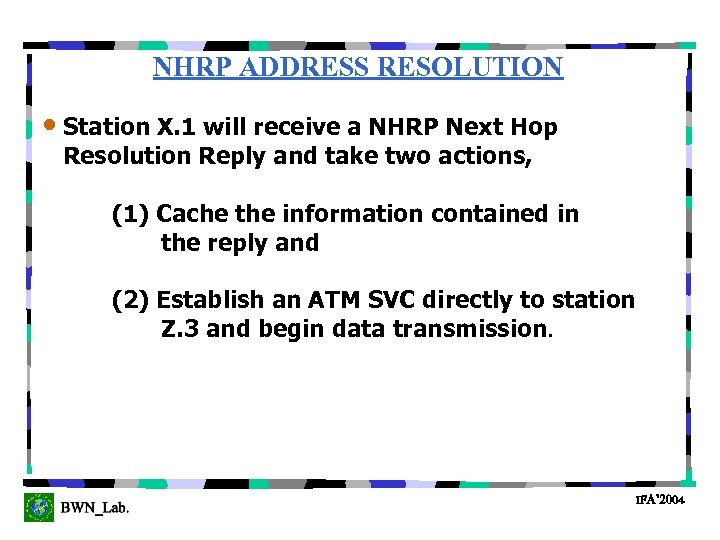 NHRP ADDRESS RESOLUTION • Station X. 1 will receive a NHRP Next Hop Resolution Reply and take two actions, (1) Cache the information contained in the reply and (2) Establish an ATM SVC directly to station Z. 3 and begin data transmission.
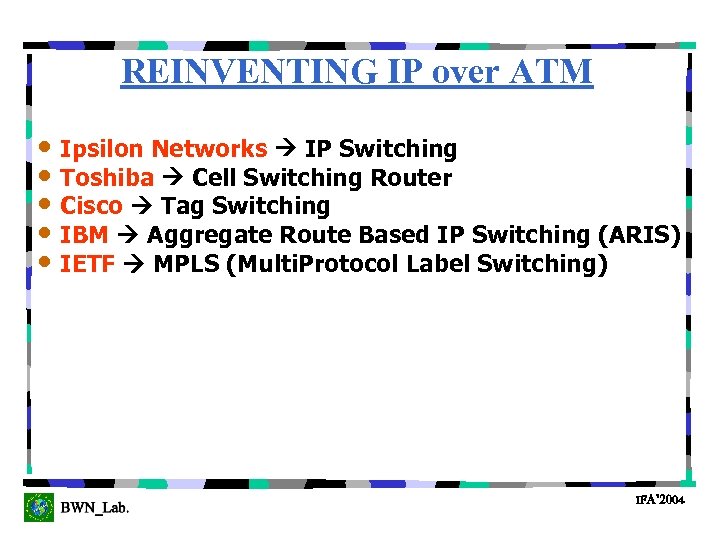 REINVENTING IP over ATM • Ipsilon Networks IP Switching • Toshiba Cell Switching Router • Cisco Tag Switching • IBM Aggregate Route Based IP Switching (ARIS) • IETF MPLS (Multi. Protocol Label Switching)
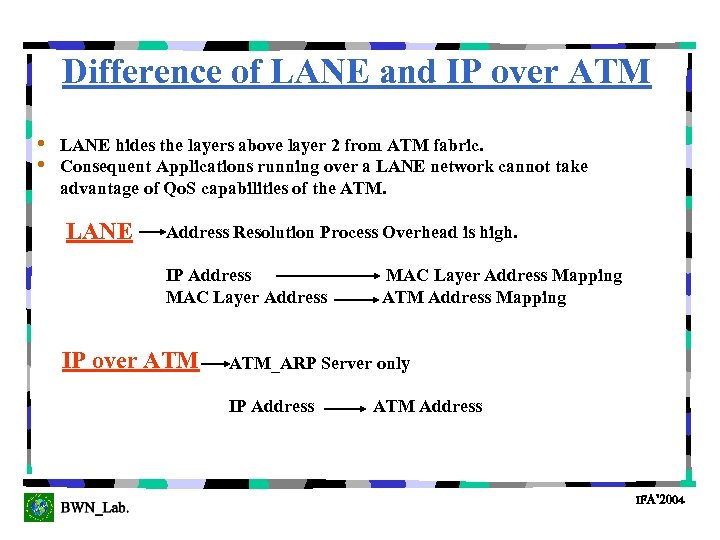 Difference of LANE and IP over ATM • • LANE hides the layers above layer 2 from ATM fabric. Consequent Applications running over a LANE network cannot take advantage of Qo. S capabilities of the ATM. LANE Address Resolution Process Overhead is high. IP Address MAC Layer Address IP over ATM MAC Layer Address Mapping ATM_ARP Server only IP Address ATM Address
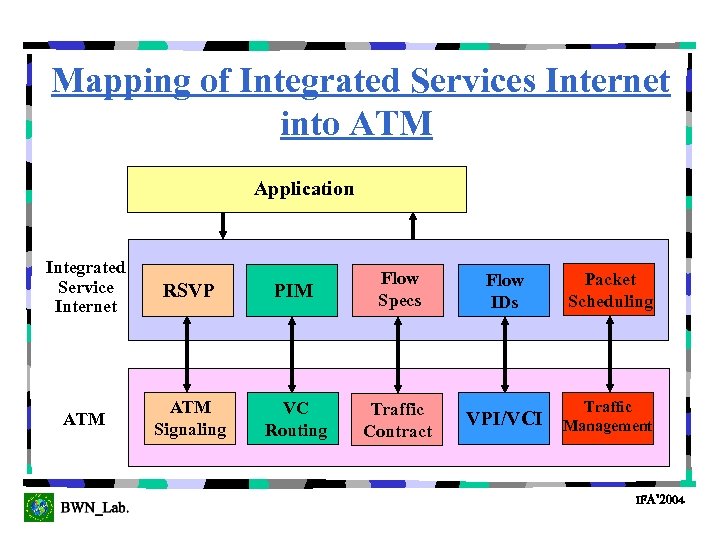 Mapping of Integrated Services Internet into ATM Application Integrated Service Internet RSVP ATM Signaling PIM Flow Specs Flow IDs Packet Scheduling VC Routing Traffic Contract VPI/VCI Traffic Management