


 Скачать презентацию 8 Identifying Market Segments and Targets Marketing Management
cd9f4575be6f197b56b0c14abcb5ab6c.ppt
- Количество слайдов: 36
 8 Identifying Market Segments and Targets Marketing Management, 13 th ed
 Chapter Questions • What are the different levels of market segmentation? • How can a company divide a market into segments? • How should a company choose the most attractive target markets? • What are the requirements for effective segmentation? Copyright © 2009 Pearson Education, Inc. Publishing as Prentice Hall 8 -2
 Effective Targeting Requires… • Identify and profile distinct groups of buyers who differ in their needs and preferences • Select one or more market segments to enter • Establish and communicate the distinctive benefits of the market offering Copyright © 2009 Pearson Education, Inc. Publishing as Prentice Hall 8 -3
 Four levels of Micromarketing • Segments—similar needs and wants • Niches--sub-segments with a distinctive mix of benefits • Local areas—marketing programs tailored to the needs and wants of local customer groups in trading areas, neighborhoods, even individual stores • Individuals—segments of one (i. e. , one -to-one marketing) Copyright © 2009 Pearson Education, Inc. Publishing as Prentice Hall 8 -4
 What is a Market Segment? A market segment consists of a group of customers who share a similar set of needs and wants. Copyright © 2009 Pearson Education, Inc. Publishing as Prentice Hall 8 -5
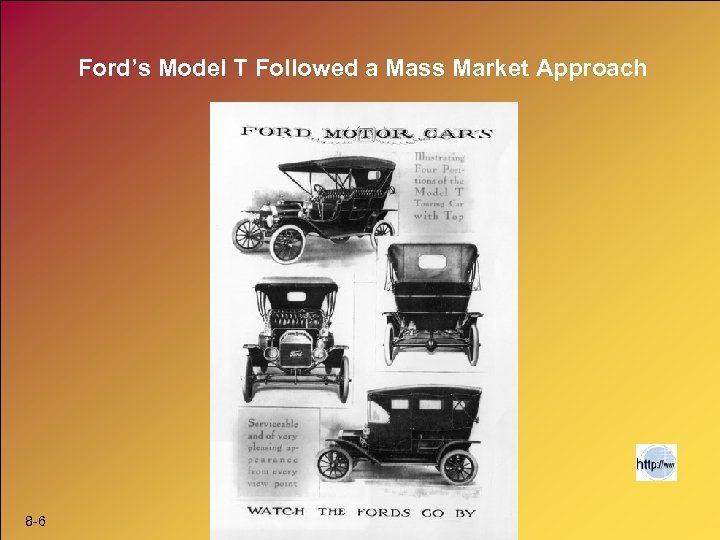 Ford’s Model T Followed a Mass Market Approach 8 -6
 Niche Marketers Enterprise Rent-a-Car targets the insurancereplacement market 8 -7
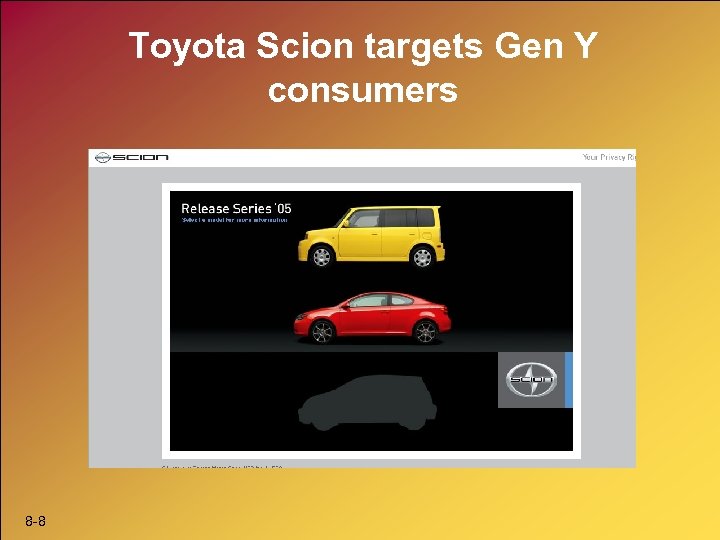 Toyota Scion targets Gen Y consumers 8 -8
 Flexible Marketing Offerings • Naked solution: • Discretionary Product and service options: Some elements that all segment members value options but value not all Copyright © 2009 Pearson Education, Inc. Publishing as Prentice Hall 8 -9
 Preference Segments • Homogeneous preferences exist when consumers want the same things • Diffused preferences exist when consumers want very different things • Clustered preferences reveal natural segments from groups with shared preferences Copyright © 2009 Pearson Education, Inc. Publishing as Prentice Hall 8 -10
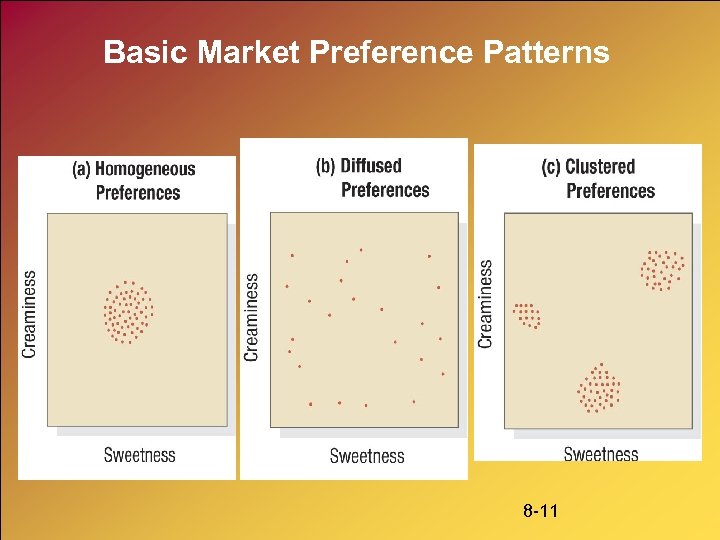 Basic Market Preference Patterns 8 -11
 The Long Tail • Chris Anderson explains the long tail equation: • The lower the cost of distribution, the more you can economically offer without having to predict demand; • The more you can offer, the greater the chance that you will be able to tap latent demand for minority tastes; and • Aggregate enough minority taste, and you may find a new market. Copyright © 2009 Pearson Education, Inc. Publishing as Prentice Hall 8 -12
 What is Customerization? Customerization combines operationally driven mass customization with customized marketing in a way that empowers consumers to design the product and service offering of their choice. Copyright © 2009 Pearson Education, Inc. Publishing as Prentice Hall 8 -13
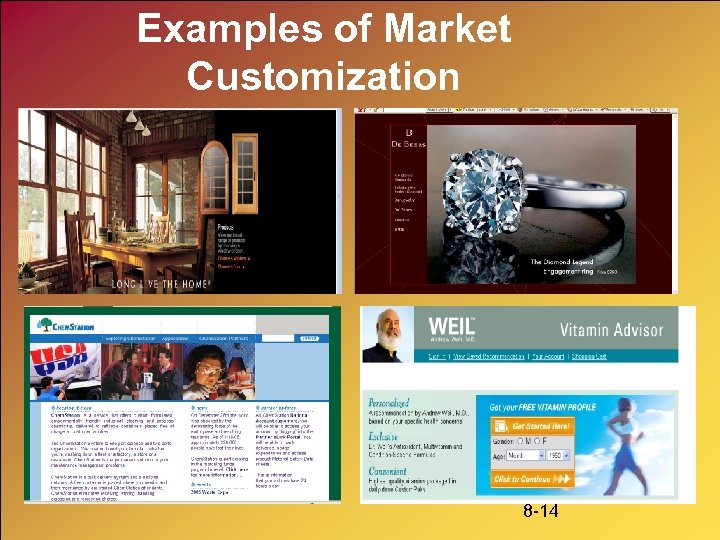 Examples of Market Customization 8 -14
 Segmenting Consumer Markets • Geographic—nations, states, regions, countries, cities, neighborhoods • Demographic—age, life-cycle stage, gender, income, generation, social class • Psychographic-psychological/personality • Behavioral--knowledge of, attitude toward, use of, or response to a product Copyright © 2009 Pearson Education, Inc. Publishing as Prentice Hall 8 -15
 Claritas’ Prizm (Potential Rating Index by Zip Markets)— combine geographic, demographic data to give richer descriptions of consumers and neighborhoods • Grouping take into consideration 39 factors in five broad categories: • • • Education and affluence Family life cycle Urbanization Race and ethnicity Mobility Copyright © 2009 Pearson Education, Inc. Publishing as Prentice Hall 8 -16
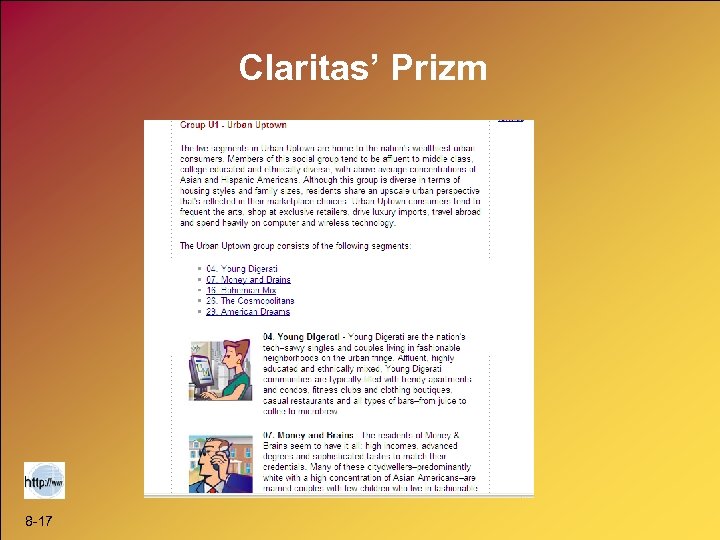 Claritas’ Prizm 8 -17
 Demographic Segmentation • Age and Life Cycle—customer wants and abilities change with age. • Life stage—a person’s major concern (e. g. , divorce, 2 nd marriage, buying new home) • Gender—male and female • Income—upper, middle, lower • Social class—occupation, education, type and location of housing • Generation Copyright © 2009 Pearson Education, Inc. Publishing as Prentice Hall 8 -18
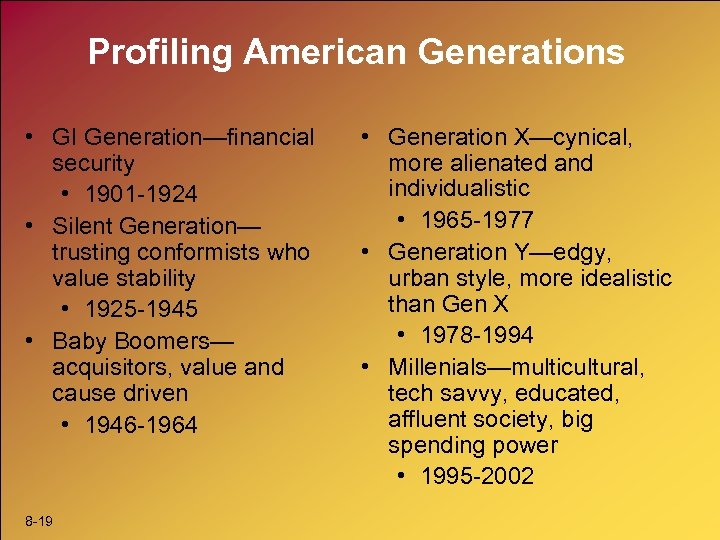 Profiling American Generations • GI Generation—financial security • 1901 -1924 • Silent Generation— trusting conformists who value stability • 1925 -1945 • Baby Boomers— acquisitors, value and cause driven • 1946 -1964 8 -19 • Generation X—cynical, more alienated and individualistic • 1965 -1977 • Generation Y—edgy, urban style, more idealistic than Gen X • 1978 -1994 • Millenials—multicultural, tech savvy, educated, affluent society, big spending power • 1995 -2002
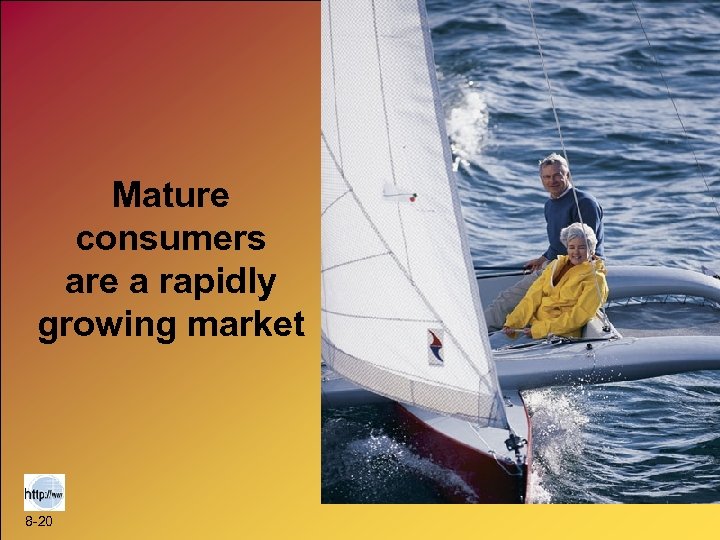 Mature consumers are a rapidly growing market 8 -20
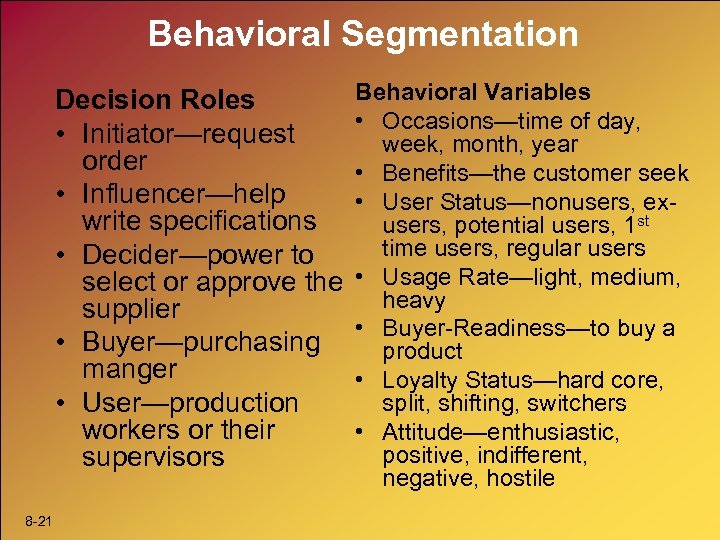 Behavioral Segmentation Behavioral Variables Decision Roles • Occasions—time of day, • Initiator—request week, month, year order • Benefits—the customer seek • Influencer—help • User Status—nonusers, exwrite specifications users, potential users, 1 st time users, regular users • Decider—power to select or approve the • Usage Rate—light, medium, heavy supplier • Buyer-Readiness—to buy a • Buyer—purchasing product manger • Loyalty Status—hard core, split, shifting, switchers • User—production workers or their • Attitude—enthusiastic, positive, indifferent, supervisors negative, hostile 8 -21
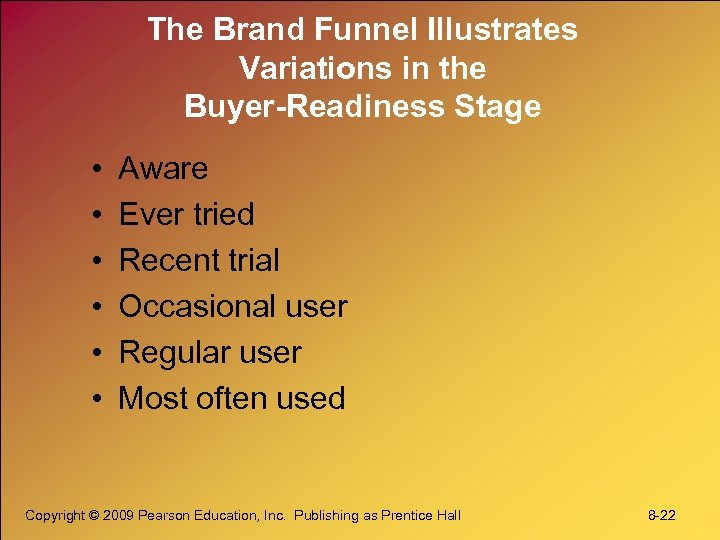 The Brand Funnel Illustrates Variations in the Buyer-Readiness Stage • • • Aware Ever tried Recent trial Occasional user Regular user Most often used Copyright © 2009 Pearson Education, Inc. Publishing as Prentice Hall 8 -22
 Loyalty Status • Hard-core—buy only one brand all of the time • Split loyals—loyal to two or three brands • Shifting loyals—shift loyalty from one brand to another • Switchers—show no loyalty to any brand Copyright © 2009 Pearson Education, Inc. Publishing as Prentice Hall 8 -23
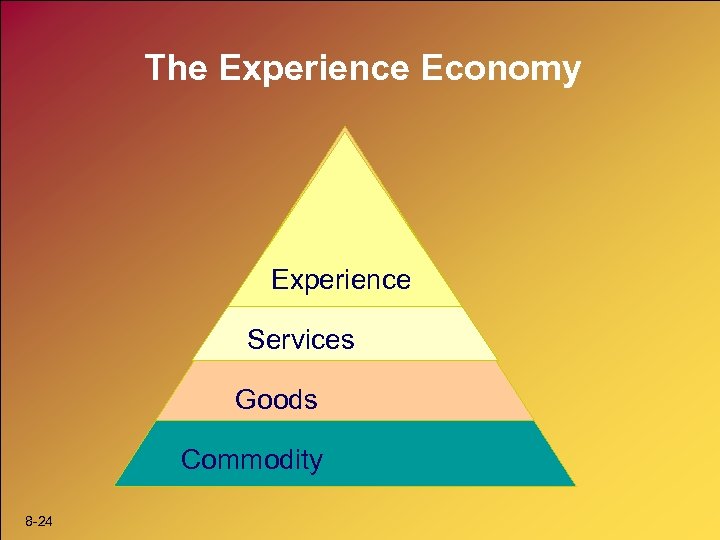 The Experience Economy Experience Services Goods Commodity 8 -24
 Models of Sequential Segmentation Stage of decision • First-time prospects • Novices • Sophisticates 8 -25 Orientation • Price-oriented—low price • Solution-oriented— benefits and advice • Strategic-value— supplier investing and participating in the customer’s business
 Segmenting for Business Markets • Demographic—industry, company size, location • Operating variable--technology, user or nonuser status—heavy, medium, light, customer capabilities • Purchasing approaches--functions, power structure, existing relationships, policies, criteria • Situational factors--urgency, specific applications, order size • Personal characteristics—buyer-seller similarity, attitudes toward risk, loyalty Copyright © 2009 Pearson Education, Inc. Publishing as Prentice Hall 8 -26
 Steps in Segmentation Process • Need-based segmentation—similar needs and benefits • Segment identification—determine which demographics, lifestyles, and usage behaviors to make segment distinct • Segment attractiveness—market growth, competitive intensity, market access • Segment profitability—income potential • Segment positioning—create value proposition and product-price based on unique customer needs and charteristics • Segment acid test—create segment storyboard • Market mix strategy—the four p’s Copyright © 2009 Pearson Education, Inc. Publishing as Prentice Hall 8 -27
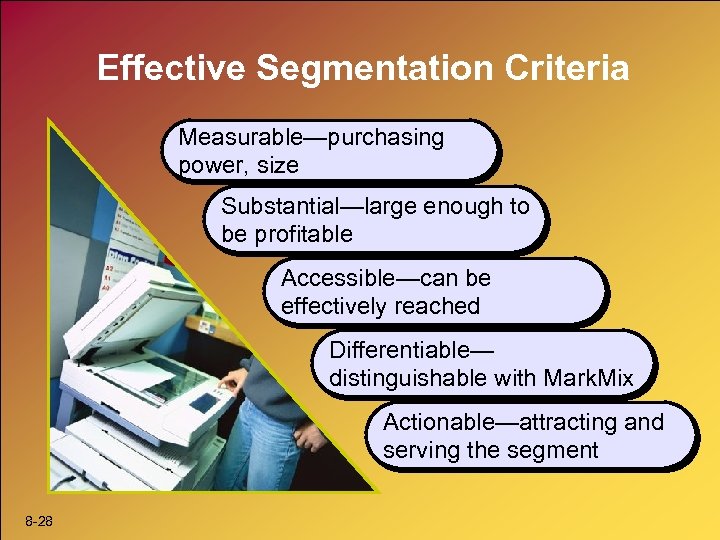 Effective Segmentation Criteria Measurable—purchasing power, size Substantial—large enough to be profitable Accessible—can be effectively reached Differentiable— distinguishable with Mark. Mix Actionable—attracting and serving the segment 8 -28
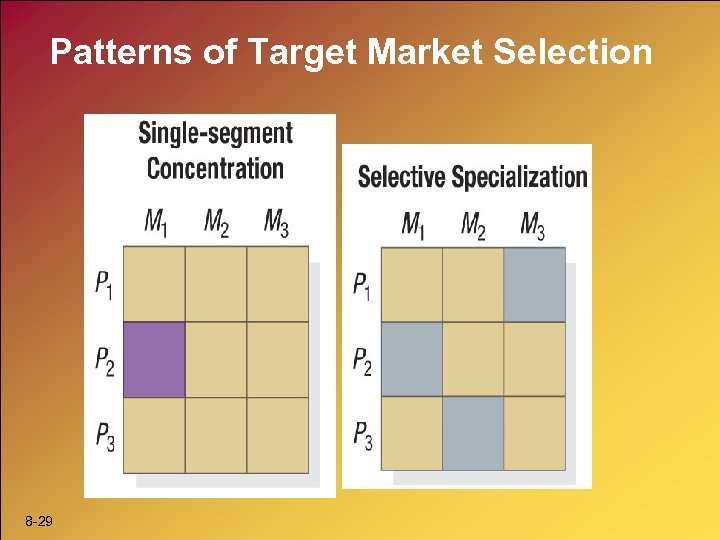 Patterns of Target Market Selection 8 -29
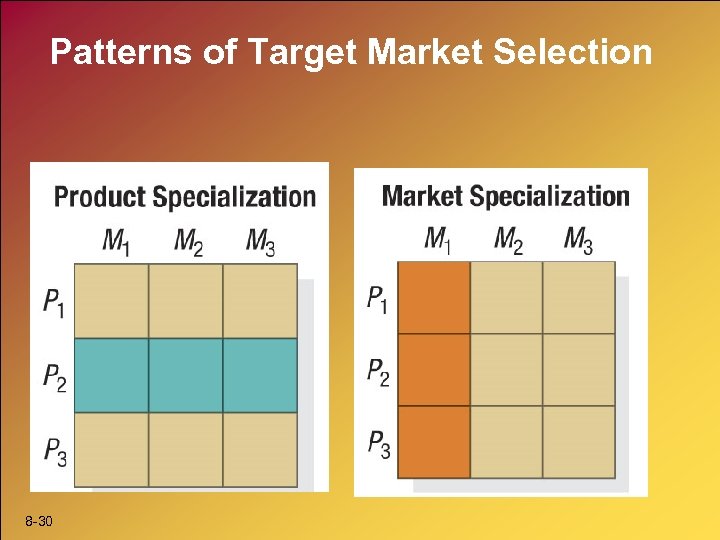 Patterns of Target Market Selection 8 -30
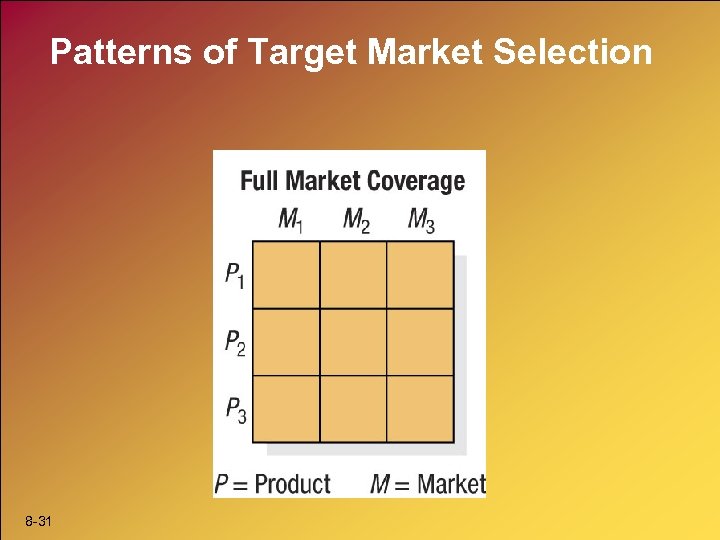 Patterns of Target Market Selection 8 -31
 Study Question 1 The argument for ____ marketing is that it creates the largest potential market, which leads to the lowest costs, which in turn can lead to lower prices or higher margins. A. B. C. D. E. Niche Micro Macro Differentiated mass Copyright © 2009 Pearson Education, Inc. Publishing as Prentice Hall 8 -32
 Study Question 2 If a marketing manager observes that his or her market shows no natural segments and consumers seem to have roughly the same preferences, the marketing manager will most likely be faced with a ____ preferences pattern. A. homogeneous B. heterogeneous C. Diffused D. Clustered E. scattered Copyright © 2009 Pearson Education, Inc. Publishing as Prentice Hall 8 -33
 Study Question 3 A niche is characterized as being all of the following EXCEPT that ____. A. the customers in the niche have a distinct set of needs B. the customers will pay a premium to the firm that satisfies their needs C. the niche is not likely to attract other competitors D. the customers generally have smaller amounts of income E. the nicher gains certain economies through specialization Copyright © 2009 Pearson Education, Inc. Publishing as Prentice Hall 8 -34
 Study Question 4 If a marketer decides to segment a market based on neighborhoods, the marketer will have chosen the ____ method of segmentation. A. Demographic B. Psychographic C. Geographic D. Cultural E. social class Copyright © 2009 Pearson Education, Inc. Publishing as Prentice Hall 8 -35
 Study Question 5 If a market is segmented according to light, medium, and heavy product users, the marketer segmenting this market is using the ____ as the means to segment. A. user status B. usage rate C. buyer-readiness stage D. occasion E. benefit Copyright © 2009 Pearson Education, Inc. Publishing as Prentice Hall 8 -36