 Скачать презентацию 8 Home and Automobile Insurance What do you
5481a9c5640a2ba9b516508ba6d67147.ppt
- Количество слайдов: 25



8 Home and Automobile Insurance What do you know from reading the textbook and/or life experience? 8 -1
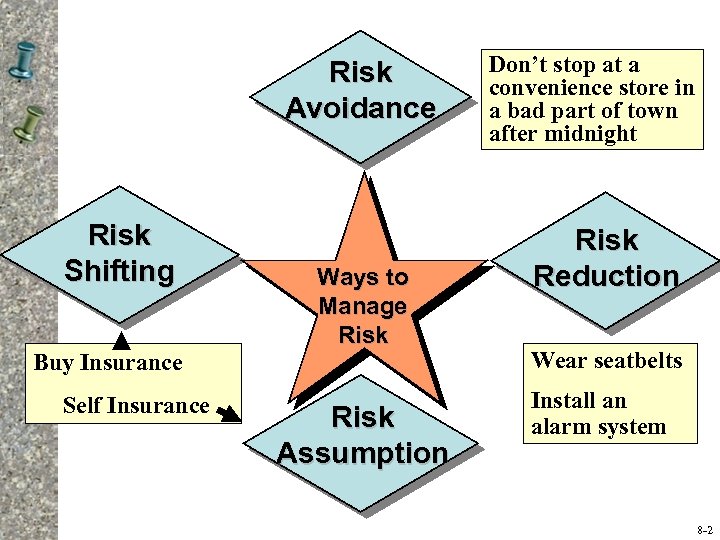
Risk Avoidance Risk Shifting Buy Insurance Self Insurance Ways to Manage Risk Assumption Don’t stop at a convenience store in a bad part of town after midnight Risk Reduction Wear seatbelts Install an alarm system 8 -2
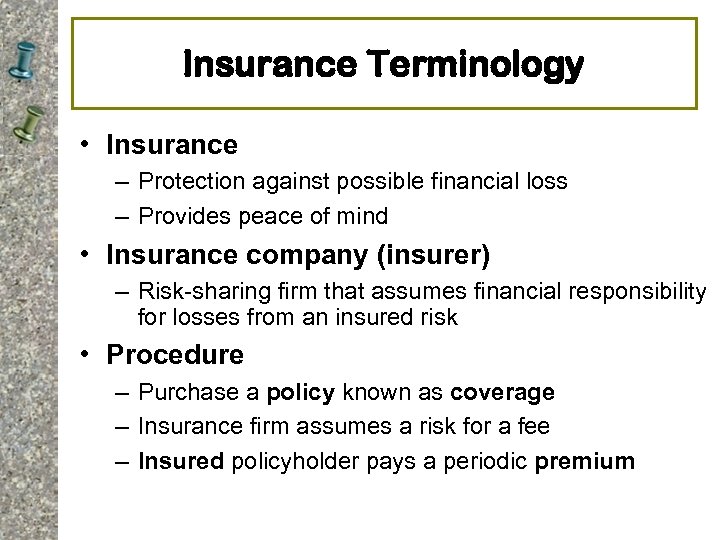
Insurance Terminology • Insurance – Protection against possible financial loss – Provides peace of mind • Insurance company (insurer) – Risk-sharing firm that assumes financial responsibility for losses from an insured risk • Procedure – Purchase a policy known as coverage – Insurance firm assumes a risk for a fee – Insured policyholder pays a periodic premium
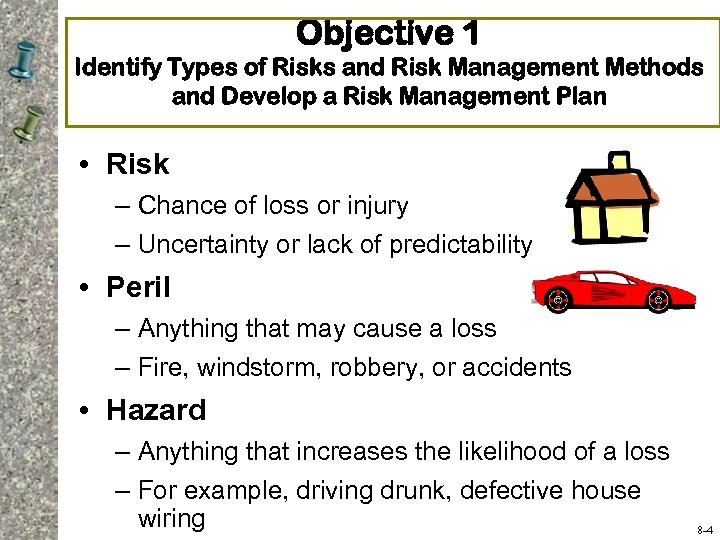
Objective 1 Identify Types of Risks and Risk Management Methods and Develop a Risk Management Plan • Risk – Chance of loss or injury – Uncertainty or lack of predictability • Peril – Anything that may cause a loss – Fire, windstorm, robbery, or accidents • Hazard – Anything that increases the likelihood of a loss – For example, driving drunk, defective house wiring 8 -4
Most Common Types of Risk • Personal Risks – Loss of income or life – Caused by illness, disability, old age, or unemployment • Property Risks – Losses to property – Caused by perils such as fire or theft • Liability Risks – Losses caused by negligence – Resulting in injury or property damage • Pure Risk = Insurable – Accidental, unintentional – Nature and financial loss of the risk can be predicted • Speculative Risk = Uninsurable – Chance of loss or gain – Starting a small business, gambling, or investing 8 -5
Property and Liability Insurance • Potential property losses – Home, automobiles, furniture, clothing, personal belongings – Risk #1: Physical damage caused by perils (e. g. , fire) – Risk #2: Loss or damage caused by criminal behavior • Liability = legal responsibility for the financial cost of another person’s losses or injury (if you are held legally liable) • Liability due to negligence – Failure to take ordinary and reasonable care • Vicarious Liability – You are held responsible for the actions of another person, such as your child throwing a ball through a neighbor’s window 8 -6
Objective 2 Assess Insurance Coverage and Policy Types for Homeowners and Renters Homeowner’s Insurance Coverage • Damage or destruction of dwelling and other structures on property • Garage, tool shed, trees, and shrubs – Additional Living Expenses • May be limited to 20 -30% of property value for 6 -9 months – Personal Property • Furniture, appliances and clothing; household inventory advisable • Usually 55% to 75% of property value • Limits on certain items such as jewelry – Personal Liability and Related Coverage • Covers injuries to others on property (e. g. , fall on ice) 8 -7
Homeowner’s Insurance Coverages • Endorsements and Floaters – Endorsements add coverage – Personal property floater • Covers specific items of high value • Jewelry, furs, art collections • Specialized Coverage • Earthquake endorsement • Flood coverage • Business use of a home 8 -8
Who Has Renter’s Insurance? • What do you know about it? • Liability limits? • Replacement cost coverage?
Renter’s Insurance • Broad Form – Covers personal property loss or damage specified in the policy • Comprehensive Form – Protects property against all perils not excluded • Renter’s insurance is relatively inexpensive – Replacement value coverage more costly – Covers property only in your home – Usually includes liability coverage • Many renters do not have insurance 8 -10
Home Insurance Policy Forms • Basic Form (HO-1) – Protects against perils such as fire, lightning, windstorms, hail, smoke, theft, vandalism and riots (specific named perils) • Broad Form (HO-2) – Wider coverage including falling objects and damage from ice, snow or sleet (more specific named perils) • Special Form (HO-3) – Basic + Broad form + all other risks unless specifically excluded (commonly earthquake, flood, nuclear accidents, business usage) • Tenant’s Form (HO-4) – Covers personal property against listed risks • Comprehensive Form (HO-5) – Expands HO-3 coverage to replacement cost; increasingly rare! • Condominium Owner (HO-6) – Covers personal property and building additions 8 -11
Objective 3 Analyze the Factors that Influence the Amount of Coverage and Cost of Home Insurance • Determine amount of coverage needed: – – Replacement value of home ? Value of home’s contents ? Protection for specific items ? (Jewelry, furs, art) Liability coverage ? • Consider “loss frequency” (likely # of times for loss) and “loss severity” (potential magnitude of a loss) • Principle of Indemnity- insurance will pay no more than actual financial losses suffered • Policy Limits- specify the maximum dollar amounts that will be paid under a policy 8 -12
Policy Provisions • Look for a policy with full coverage (100% value) – Coinsurance clause requires you to pay a part of a loss. • Claim settlement methods: – Actual Cash Value (ACV) • Replacement cost less depreciation – Replacement Cost • Full cost to repair or replace the damaged or lost item • 10 -20% > actual cash value coverage 8 -13
Factors That Affect Home Insurance Costs • Location of Home (e. g. , rural vs. urban) • Type of Structure (e. g. , brick vs. wood) • Coverage Amount and Policy type • Home Insurance Discounts – Alarm system – Smoke detectors – If you insure car with the same company • Company Differences – Compare costs and coverages 8 -14
Objective 4 Identify the Important Types of Automobile Insurance Coverage • Financial Responsibility Law – State legislation requiring proof of financial ability to cover the cost of damage or injury caused in an automobile accident – 45 states have compulsory automobile liability insurance laws – NJ has very low liability limits: 15/30/5 8 -15
Motor Vehicle Bodily Injury Coverage • Bodily Injury Liability – Covers financial loss due to legal expenses, medical expenses, lost wages, etc. associated with injuries caused by an accident for which you were responsible – Expressed as 3 numbers: 100/300/50 • Maximum coverage in $1, 000’s • $100, 000 maximum paid for injuries to any one person • $300, 000 maximum paid in total (2+ people) • $50, 000 maximum paid for property damage 8 -16
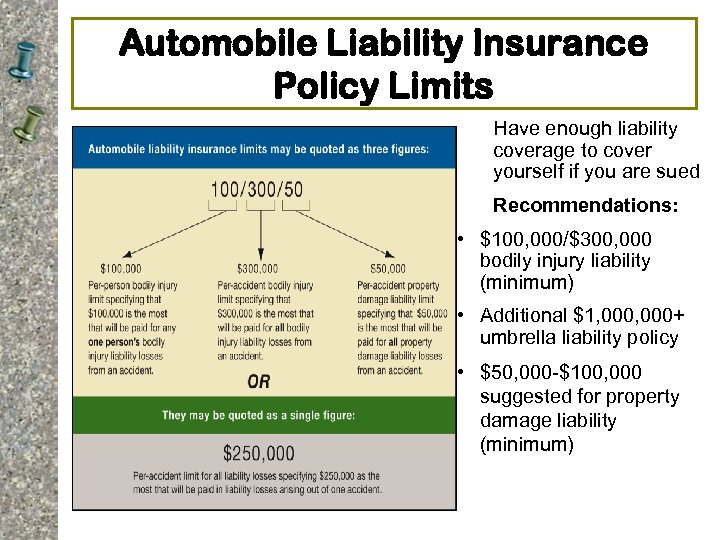
Automobile Liability Insurance Policy Limits Have enough liability coverage to cover yourself if you are sued Recommendations: • $100, 000/$300, 000 bodily injury liability (minimum) • Additional $1, 000+ umbrella liability policy • $50, 000 -$100, 000 suggested for property damage liability (minimum)
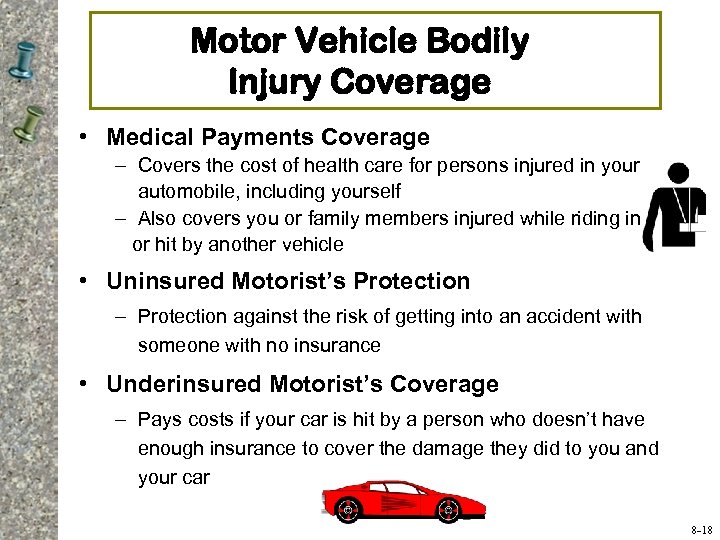
Motor Vehicle Bodily Injury Coverage • Medical Payments Coverage – Covers the cost of health care for persons injured in your automobile, including yourself – Also covers you or family members injured while riding in or hit by another vehicle • Uninsured Motorist’s Protection – Protection against the risk of getting into an accident with someone with no insurance • Underinsured Motorist’s Coverage – Pays costs if your car is hit by a person who doesn’t have enough insurance to cover the damage they did to you and your car 8 -18
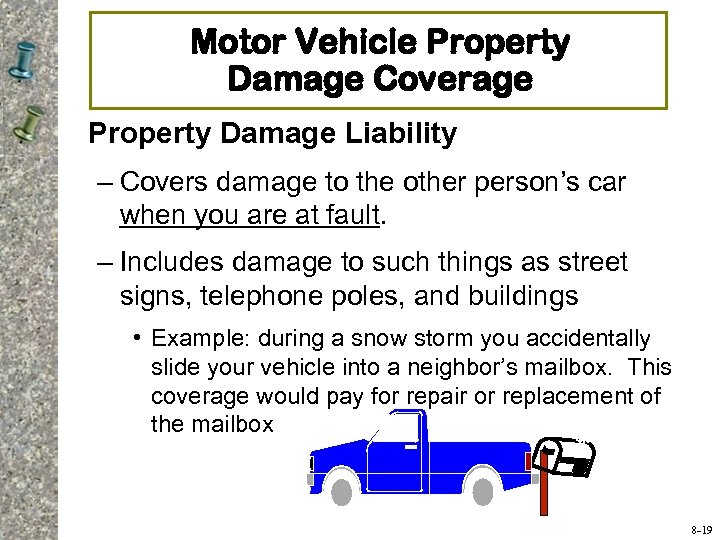
Motor Vehicle Property Damage Coverage Property Damage Liability – Covers damage to the other person’s car when you are at fault. – Includes damage to such things as street signs, telephone poles, and buildings • Example: during a snow storm you accidentally slide your vehicle into a neighbor’s mailbox. This coverage would pay for repair or replacement of the mailbox 8 -19
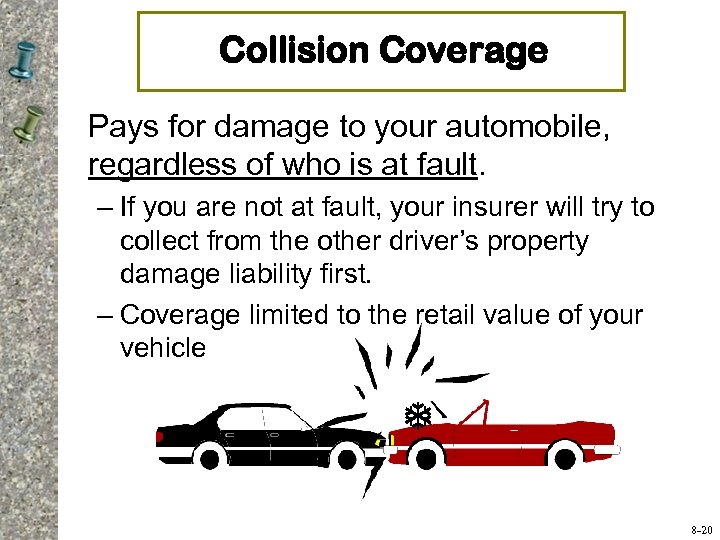
Collision Coverage Pays for damage to your automobile, regardless of who is at fault. – If you are not at fault, your insurer will try to collect from the other driver’s property damage liability first. – Coverage limited to the retail value of your vehicle 8 -20
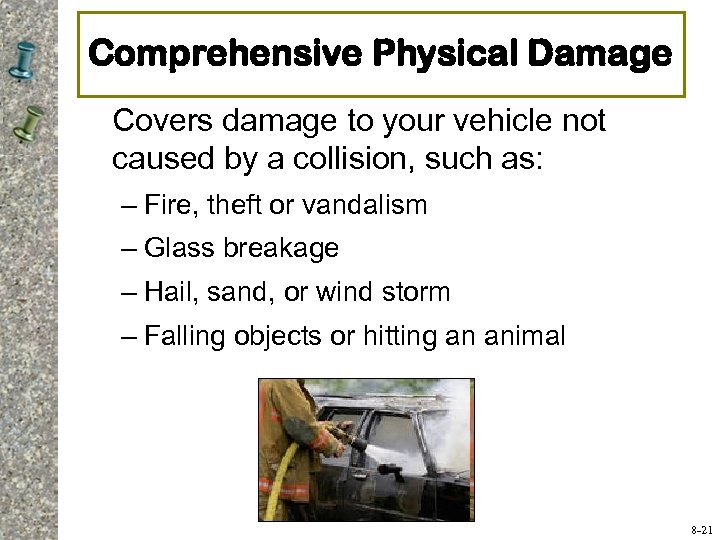
Comprehensive Physical Damage Covers damage to your vehicle not caused by a collision, such as: – Fire, theft or vandalism – Glass breakage – Hail, sand, or wind storm – Falling objects or hitting an animal 8 -21
Auto Insurance Videos • What is Liability Coverage? : https: //www. youtube. com/watch? v=qq 4 gjx q 0 v 8 o • What is Comprehensive Coverage? : https: //www. youtube. com/watch? v=nt. Pe 3 m. URmzo
Motor Vehicle Insurance Premium Factors • Vehicle Type – Year, make, model, and theft rate • Rating Territory – Accident, auto theft, and vandalism rates in the area where you live • Driver Classification – Age, sex, marital status, credit history, driving record, driving habits – Assigned risk pool for those unable to obtain insurance Reducing Automobile Insurance Premiums • Compare Companies • Premium Discounts – – – Establish and maintain a good driving record Install security devices such as a car alarm If more than one vehicle, insure with the same company Larger deductibles “Bundle” with other types of insurance (e. g. , homeowners, renters) 8 -23
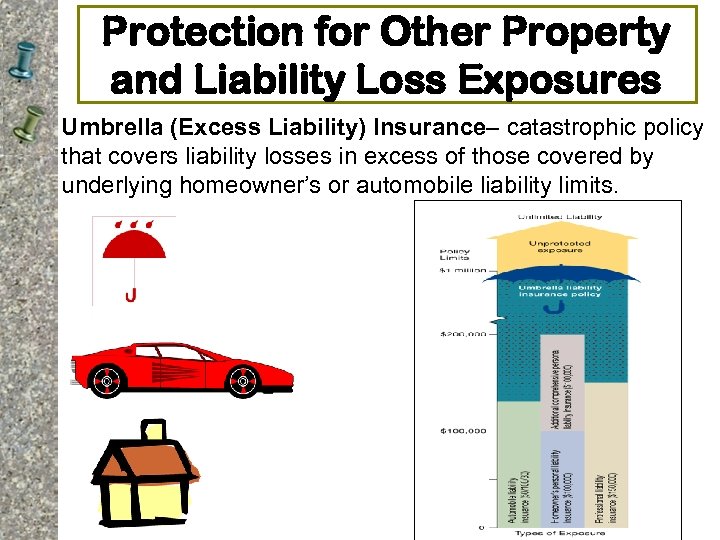
Protection for Other Property and Liability Loss Exposures Umbrella (Excess Liability) Insurance– catastrophic policy that covers liability losses in excess of those covered by underlying homeowner’s or automobile liability limits.
Infographic Insights https: //www. allstate. com/tools-and-resources/infographics. aspx
Скачать презентацию 8 Home and Automobile Insurance What do you
5481a9c5640a2ba9b516508ba6d67147.ppt