


 Скачать презентацию 8 882 LHC Physics Experimental Methods and Measurements
e79844e21646f050332d4b08d7ff3cc7.ppt
- Количество слайдов: 29
 8. 882 LHC Physics Experimental Methods and Measurements Particle Detectors Overview [Lecture 3, February 11, 2009]
 Physics Colloquium Series ‘ 09 The Physics Colloquium Series Thursday, February 12 at 4: 15 pm in room 34 -101 Jochen Schneider LCLS Experimental Facilities Division, SLAC, CA and Center for Free-Electron Laser Science (CFEL), Germany "Science at SASE Free-Electron Lasers" For a full listing of this semester’s colloquia, please visit our website at web. mit. edu/physics Spring
 Organizational Issues Accounts please make sure you have one so we can get started Teaching assistant I will be the TA. . . Recitation Friday at 10: 00 pm in 24 -507 Particle Detectors Overview 3
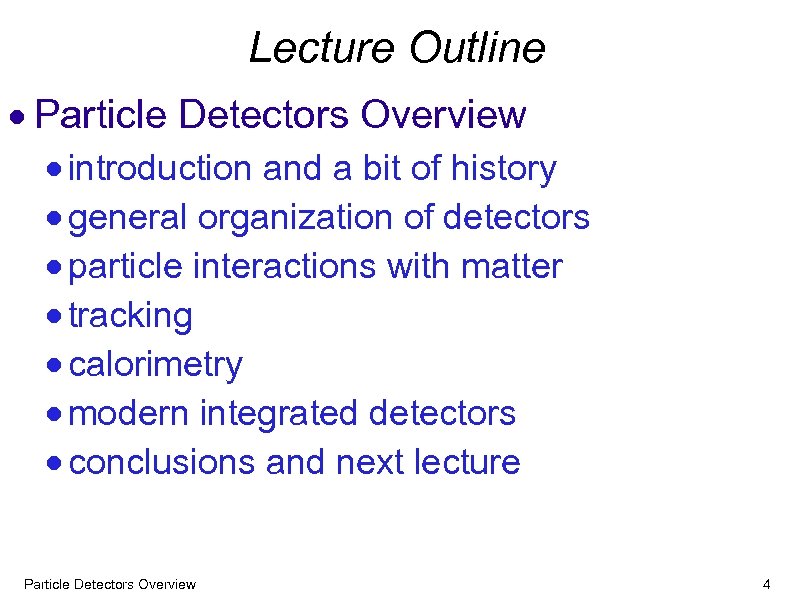 Lecture Outline Particle Detectors Overview introduction and a bit of history general organization of detectors particle interactions with matter tracking calorimetry modern integrated detectors conclusions and next lecture Particle Detectors Overview 4
 Motherhood and Apple Pie The ultimate goal of particle detectors is to determine the particles creation/decay point, its momentum and its type (mass). Detecting particles always implies to interact with them. Path is thus always affected by observation. If it's perfect it ain't real. Particle detectors always rely on electromagnetic interaction (photons or charged particles). Particle Detectors Overview 5
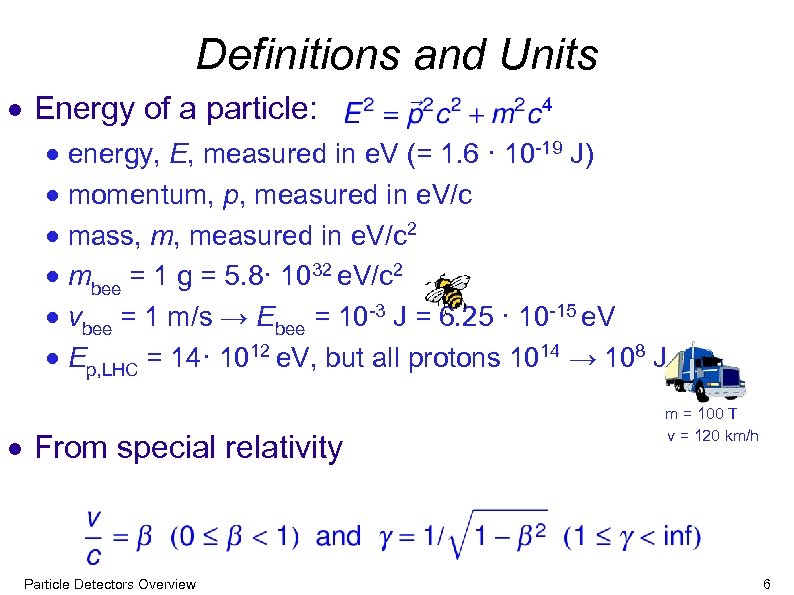 Definitions and Units Energy of a particle: energy, E, measured in e. V (= 1. 6 · 10 -19 J) momentum, p, measured in e. V/c mass, m, measured in e. V/c 2 mbee = 1 g = 5. 8· 1032 e. V/c 2 vbee = 1 m/s → Ebee = 10 -3 J = 6. 25 · 10 -15 e. V Ep, LHC = 14· 1012 e. V, but all protons 1014 → 108 J From special relativity Particle Detectors Overview m = 100 T v = 120 km/h 6
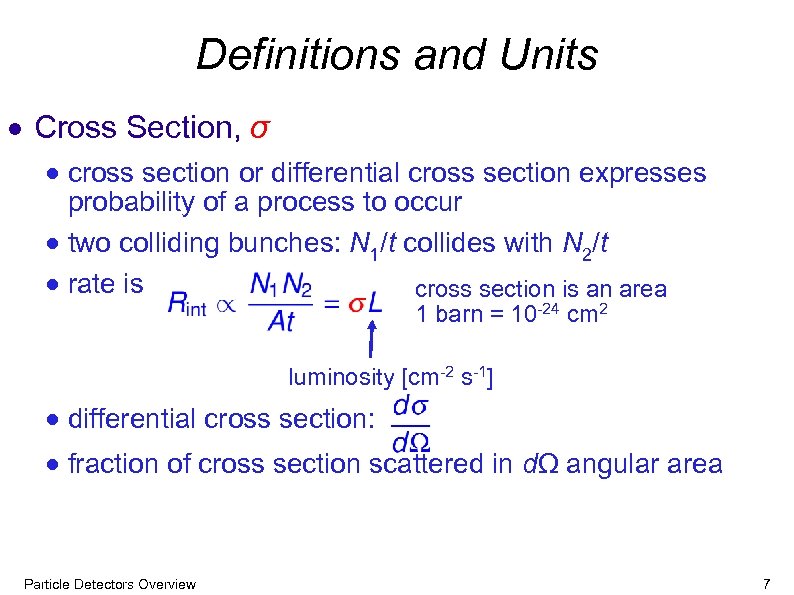 Definitions and Units Cross Section, σ cross section or differential cross section expresses probability of a process to occur two colliding bunches: N 1/t collides with N 2/t rate is cross section is an area 1 barn = 10 -24 cm 2 luminosity [cm-2 s-1] differential cross section: fraction of cross section scattered in dΩ angular area Particle Detectors Overview 7
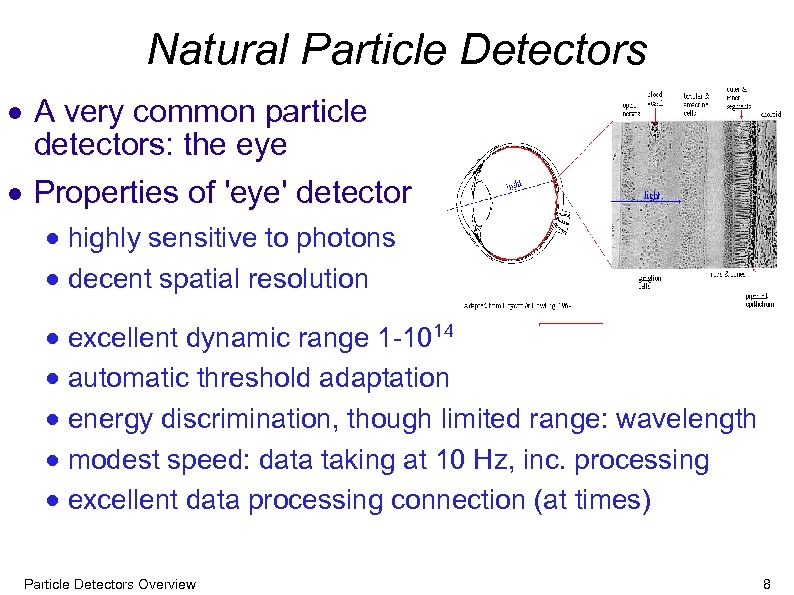 Natural Particle Detectors A very common particle detectors: the eye Properties of 'eye' detector highly sensitive to photons decent spatial resolution excellent dynamic range 1 -1014 automatic threshold adaptation energy discrimination, though limited range: wavelength modest speed: data taking at 10 Hz, inc. processing excellent data processing connection (at times) Particle Detectors Overview 8
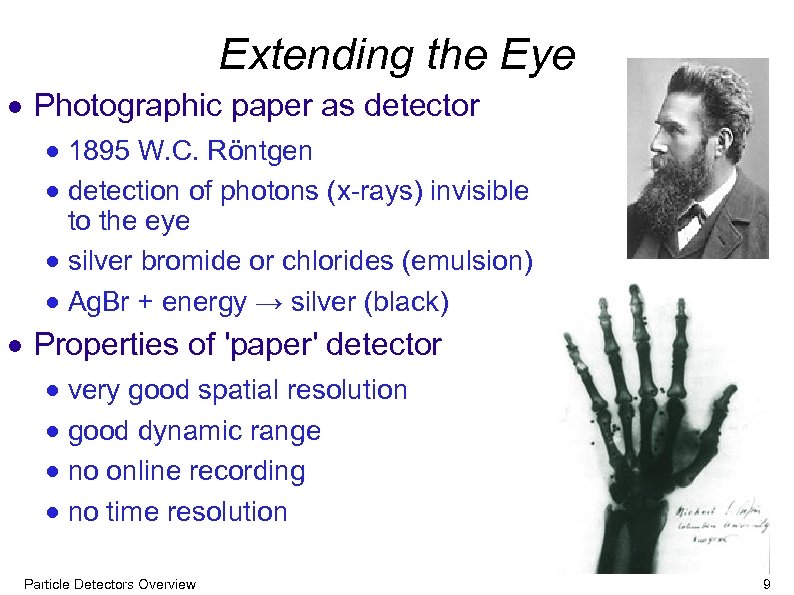 Extending the Eye Photographic paper as detector 1895 W. C. Röntgen detection of photons (x-rays) invisible to the eye silver bromide or chlorides (emulsion) Ag. Br + energy → silver (black) Properties of 'paper' detector very good spatial resolution good dynamic range no online recording no time resolution Particle Detectors Overview 9
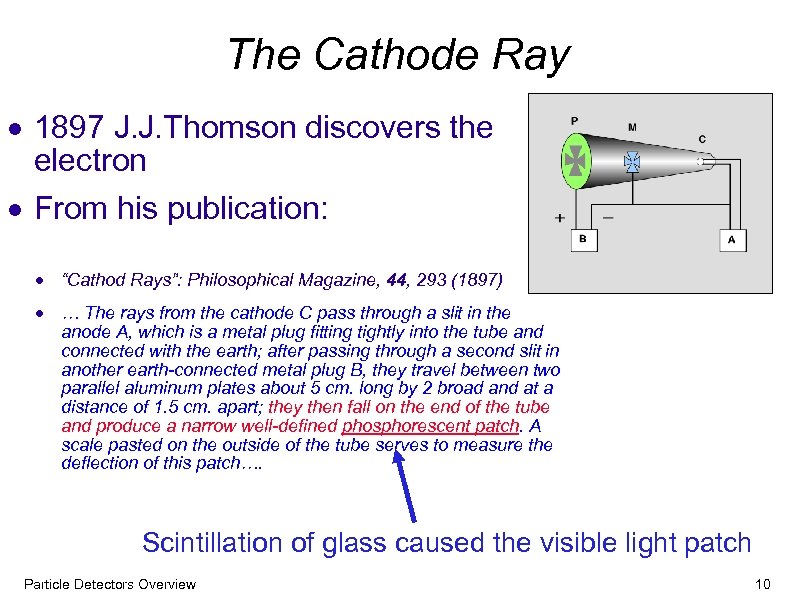 The Cathode Ray 1897 J. J. Thomson discovers the electron From his publication: “Cathod Rays”: Philosophical Magazine, 44, 293 (1897) … The rays from the cathode C pass through a slit in the anode A, which is a metal plug fitting tightly into the tube and connected with the earth; after passing through a second slit in another earth-connected metal plug B, they travel between two parallel aluminum plates about 5 cm. long by 2 broad and at a distance of 1. 5 cm. apart; they then fall on the end of the tube and produce a narrow well-defined phosphorescent patch. A scale pasted on the outside of the tube serves to measure the deflection of this patch…. Scintillation of glass caused the visible light patch Particle Detectors Overview 10
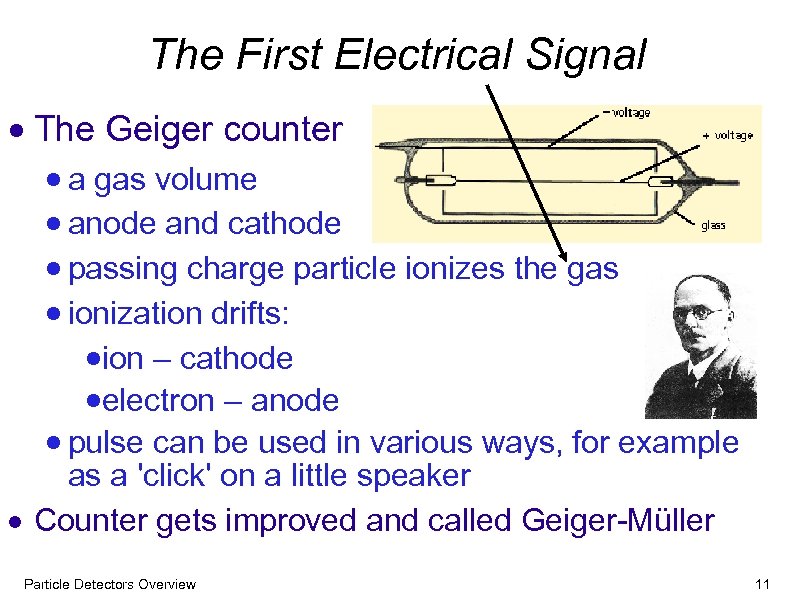 The First Electrical Signal The Geiger counter a gas volume anode and cathode passing charge particle ionizes the gas ionization drifts: ion – cathode electron – anode pulse can be used in various ways, for example as a 'click' on a little speaker Counter gets improved and called Geiger-Müller Particle Detectors Overview 11
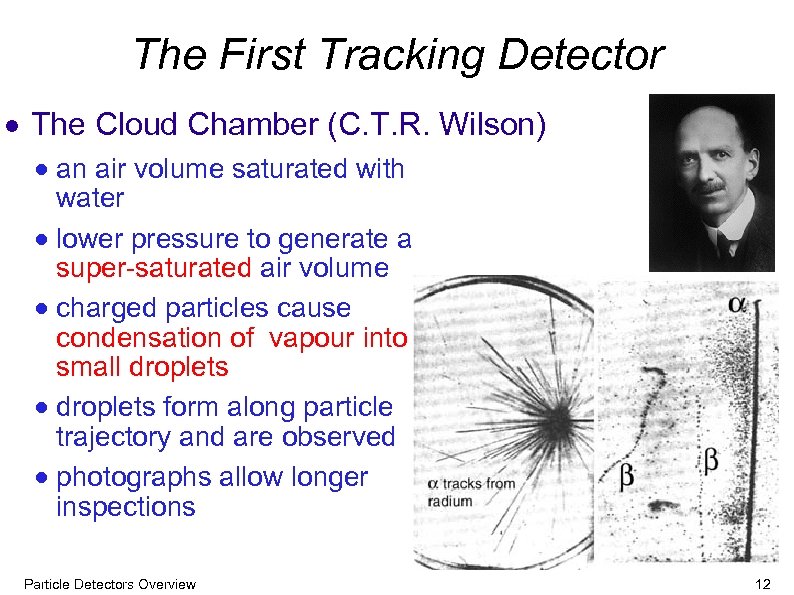 The First Tracking Detector The Cloud Chamber (C. T. R. Wilson) an air volume saturated with water lower pressure to generate a super-saturated air volume charged particles cause condensation of vapour into small droplets form along particle trajectory and are observed photographs allow longer inspections Particle Detectors Overview 12
 Detectors and Particle Physics Theory and experiment share an intimate and fruitful connection: detectors allow one to detect particles experimenters study their behaviour new particles are found by direct observation or by analyzing their decay products theorists predicts behaviour of (new) particles experimentalists design the particle detectors to detect them and collect the data Particle Detectors Overview 13
 Overview of Detectors Modern detector types What do particle detectors measure? tracking (gas, solids) spacial locations scintillation and light detectors momentum calorimeters energy particle Id systems flight times Integral piece of detectors trigger systems data acquisition systems offline system Particle Detectors Overview 14
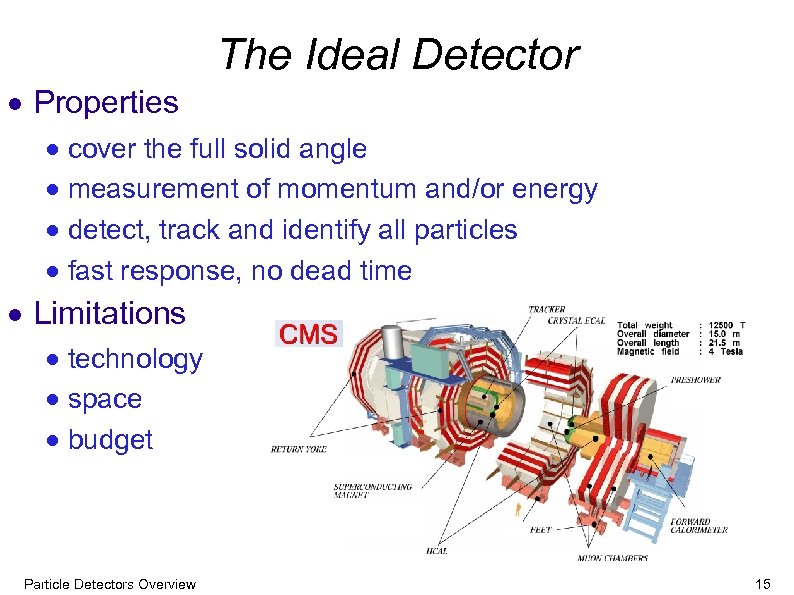 The Ideal Detector Properties cover the full solid angle measurement of momentum and/or energy detect, track and identify all particles fast response, no dead time Limitations technology space budget Particle Detectors Overview 15
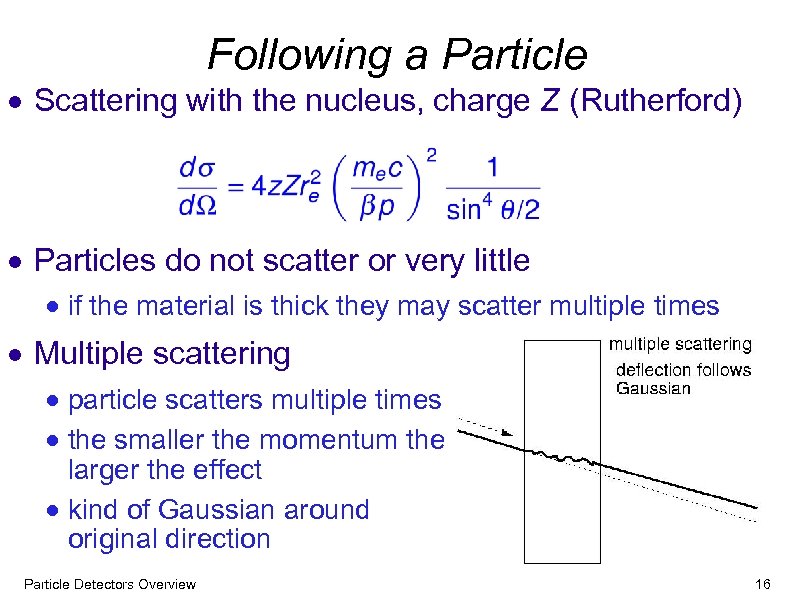 Following a Particle Scattering with the nucleus, charge Z (Rutherford) Particles do not scatter or very little if the material is thick they may scatter multiple times Multiple scattering particle scatters multiple times the smaller the momentum the larger the effect kind of Gaussian around original direction Particle Detectors Overview 16
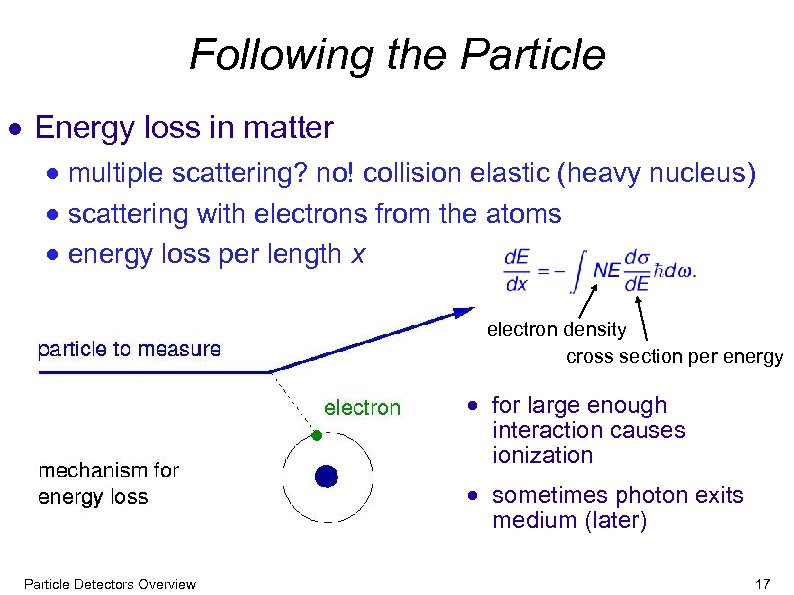 Following the Particle Energy loss in matter multiple scattering? no! collision elastic (heavy nucleus) scattering with electrons from the atoms energy loss per length x electron density cross section per energy for large enough interaction causes ionization sometimes photon exits medium (later) Particle Detectors Overview 17
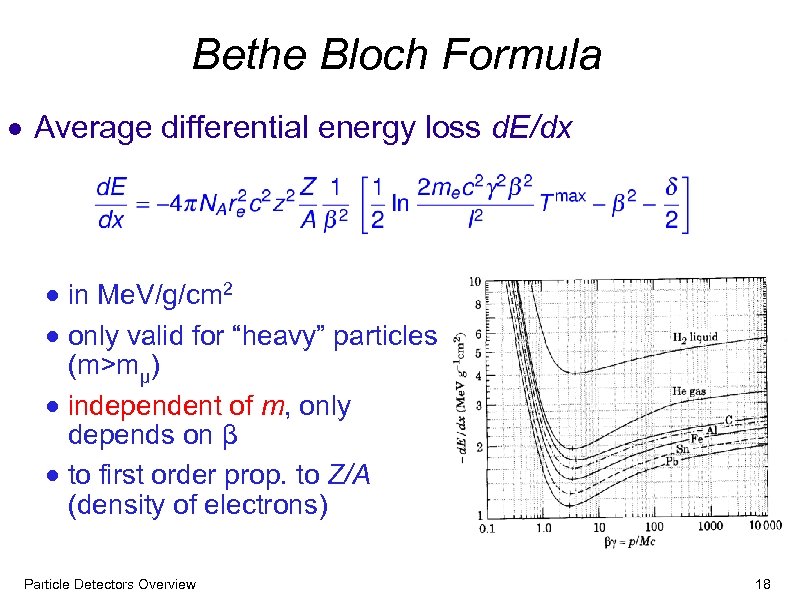 Bethe Bloch Formula Average differential energy loss d. E/dx in Me. V/g/cm 2 only valid for “heavy” particles (m>mμ) independent of m, only depends on β to first order prop. to Z/A (density of electrons) Particle Detectors Overview 18
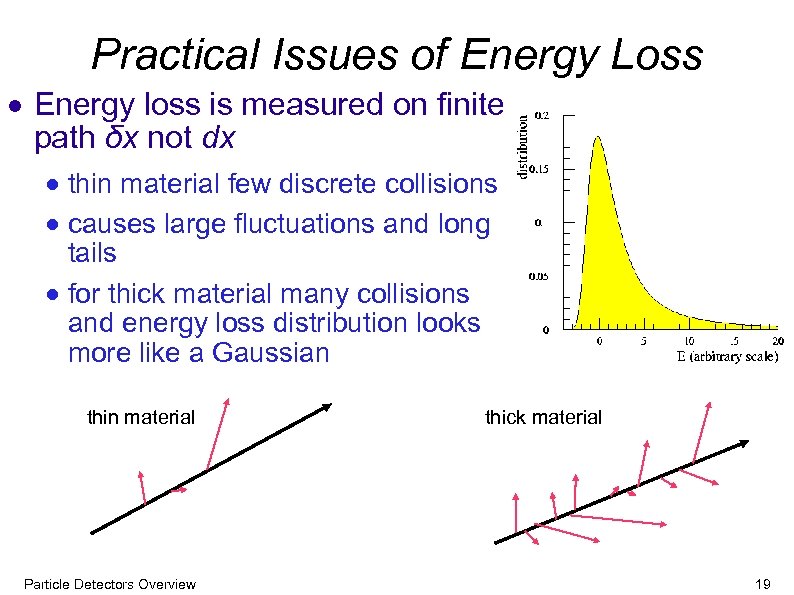 Practical Issues of Energy Loss Energy loss is measured on finite path δx not dx thin material few discrete collisions causes large fluctuations and long tails for thick material many collisions and energy loss distribution looks more like a Gaussian thin material Particle Detectors Overview thick material 19
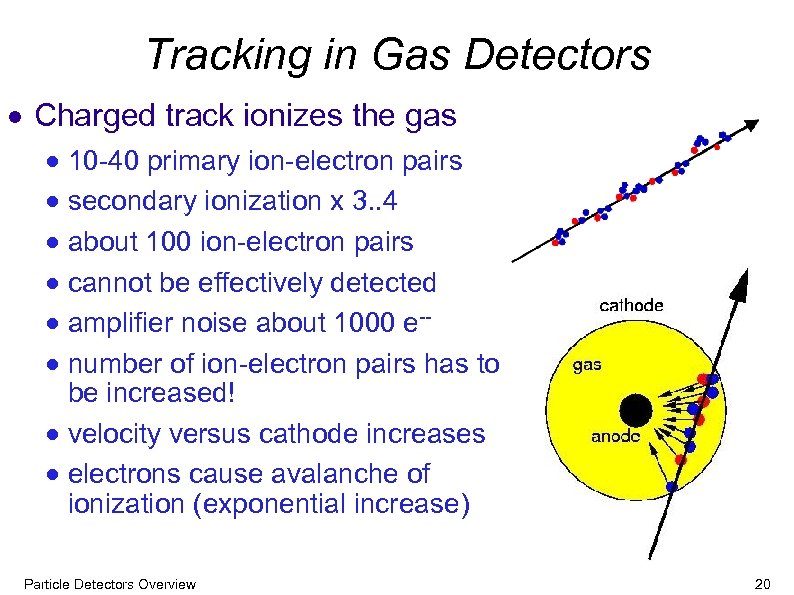 Tracking in Gas Detectors Charged track ionizes the gas 10 -40 primary ion-electron pairs secondary ionization x 3. . 4 about 100 ion-electron pairs cannot be effectively detected amplifier noise about 1000 e- number of ion-electron pairs has to be increased! velocity versus cathode increases electrons cause avalanche of ionization (exponential increase) Particle Detectors Overview 20
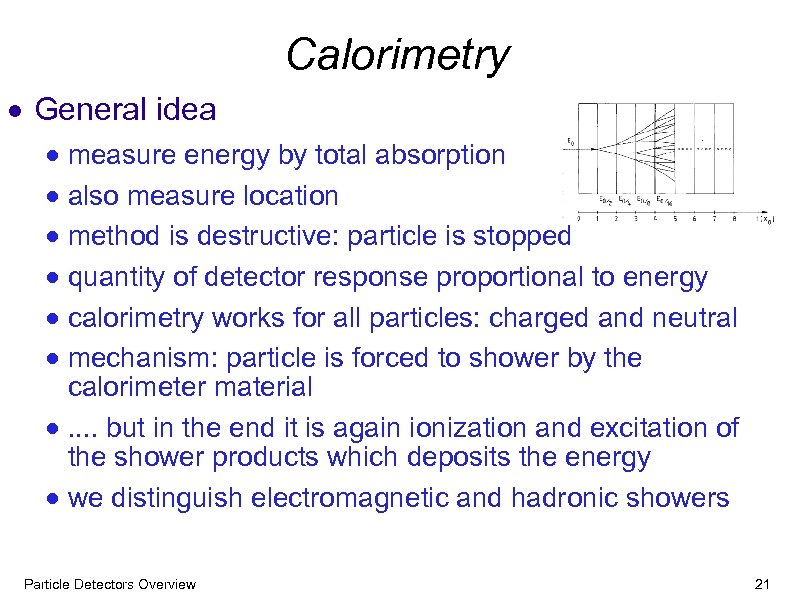 Calorimetry General idea measure energy by total absorption also measure location method is destructive: particle is stopped quantity of detector response proportional to energy calorimetry works for all particles: charged and neutral mechanism: particle is forced to shower by the calorimeter material . . but in the end it is again ionization and excitation of the shower products which deposits the energy we distinguish electromagnetic and hadronic showers Particle Detectors Overview 21
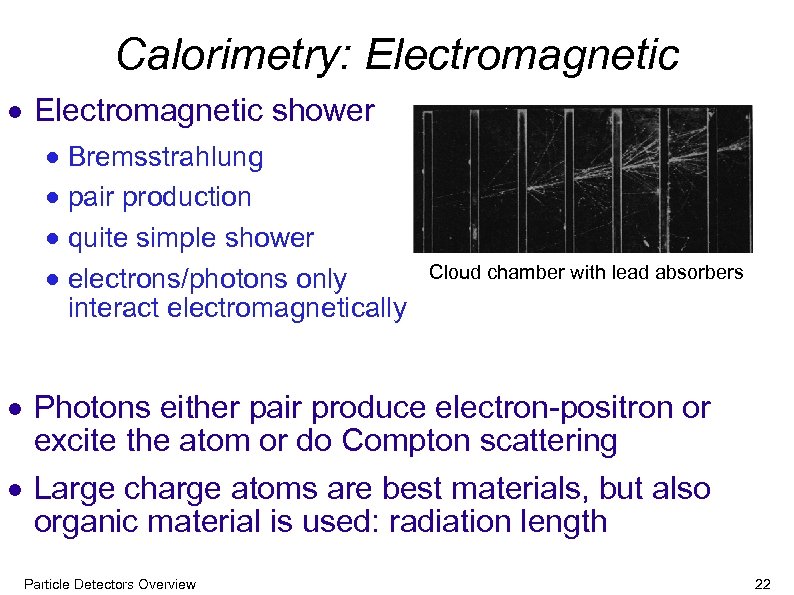 Calorimetry: Electromagnetic shower Bremsstrahlung pair production quite simple shower electrons/photons only Cloud chamber with lead absorbers interact electromagnetically Photons either pair produce electron-positron or excite the atom or do Compton scattering Large charge atoms are best materials, but also organic material is used: radiation length Particle Detectors Overview 22
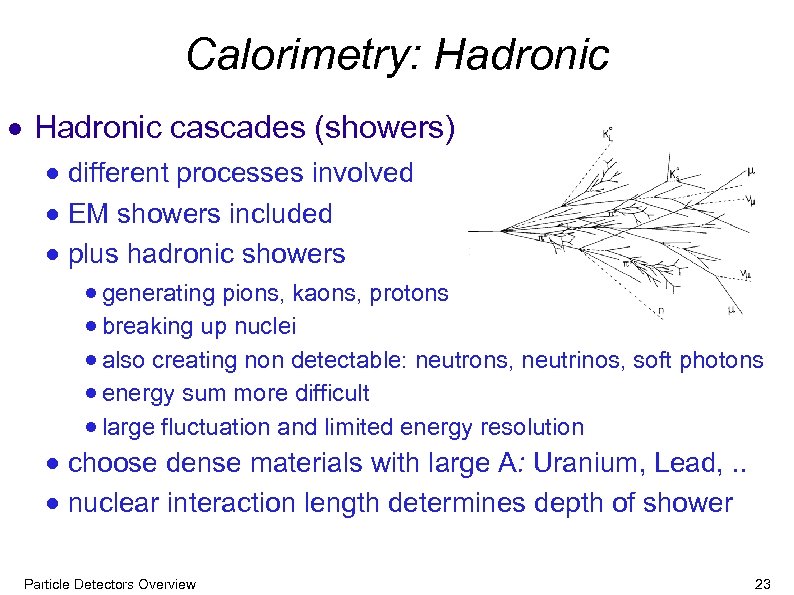 Calorimetry: Hadronic cascades (showers) different processes involved EM showers included plus hadronic showers generating pions, kaons, protons breaking up nuclei also creating non detectable: neutrons, neutrinos, soft photons energy sum more difficult large fluctuation and limited energy resolution choose dense materials with large A: Uranium, Lead, . . nuclear interaction length determines depth of shower Particle Detectors Overview 23
 Muon Detection Muon is basically a track do standard tracking tricks But muons are minimally ionizing penetrate through a lot of material it makes calorimetry with muons special does not get stuck in the calorimeter (missing energy) signature is recognizable and is used for selection of muons are really identified outside of the calorimeters they are the last remaining particles after calorimeter absorption (there also neutrinos of course. . ) typically at least 4 nuclear interaction length shield the muon detectors Particle Detectors Overview 24
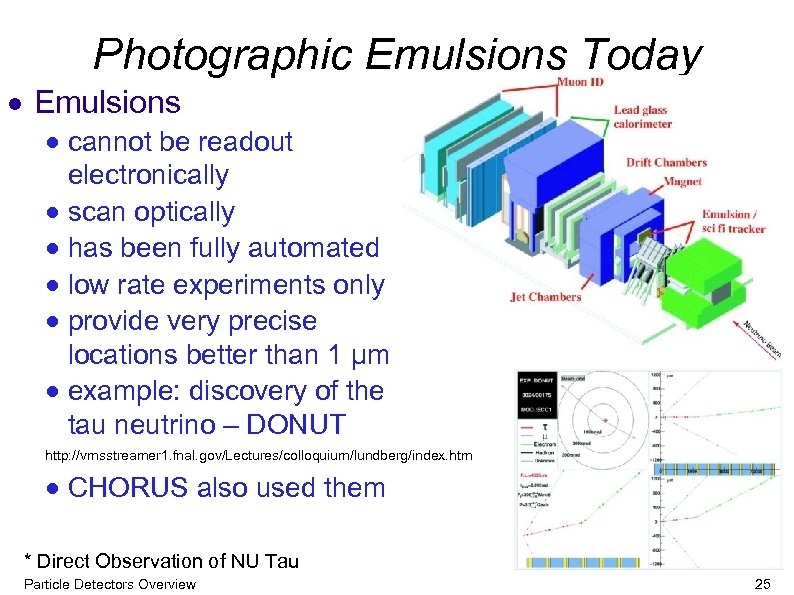 Photographic Emulsions Today Emulsions cannot be readout electronically scan optically has been fully automated low rate experiments only provide very precise locations better than 1 μm example: discovery of the tau neutrino – DONUT http: //vmsstreamer 1. fnal. gov/Lectures/colloquium/lundberg/index. htm CHORUS also used them * Direct Observation of NU Tau Particle Detectors Overview 25
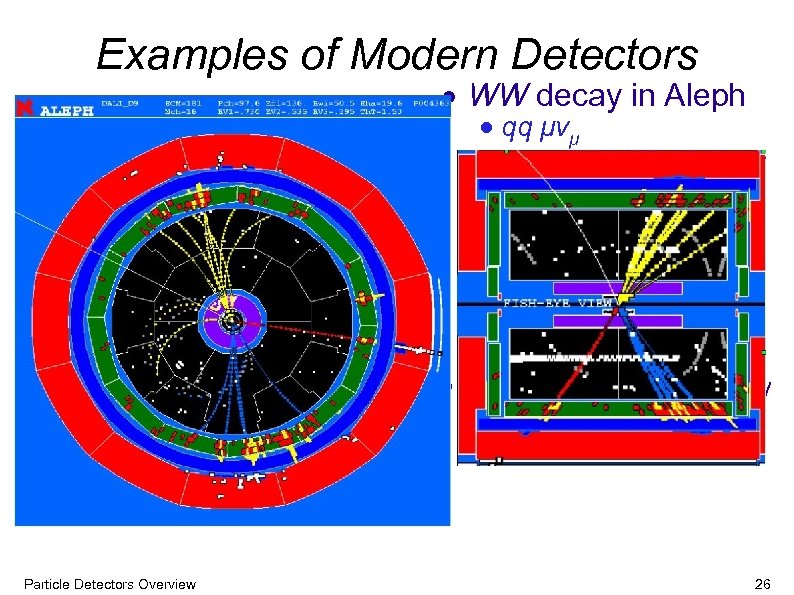 Examples of Modern Detectors WW decay in Aleph qq μνμ 2 jets, muon, missing energy Particle Detectors Overview 26
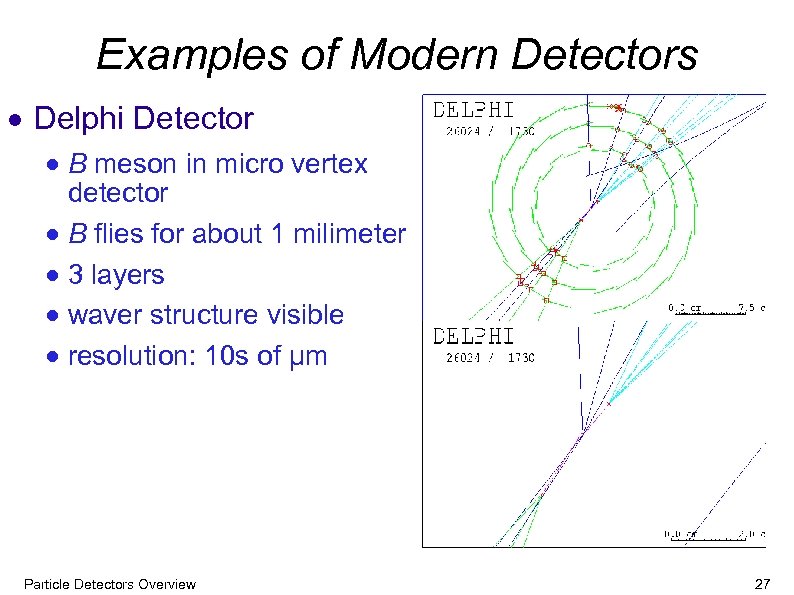 Examples of Modern Detectors Delphi Detector B meson in micro vertex detector B flies for about 1 milimeter 3 layers waver structure visible resolution: 10 s of μm Particle Detectors Overview 27
 Conclusion Particle detectors follow simple principles detectors interact with particles most interactions are electromagnetic imperfect by definition but have gotten pretty good crucial to figure out what detector type goes where Three main ideas track charged particles and then stop them stop neutral particles finally find the muons which are left Particle Detectors Overview 28
 Next Lecture Heavy Ion Physics Overview general introduction the strong force and QCD state diagram real life heavy ion physics variables and their implementation measurements experimental status Particle Detectors Overview 29