 Скачать презентацию 8 -1 CHAPTER 8 Bonds and Their Valuation
6093873e04430e4dbcfc1a514ecd92db.ppt
- Количество слайдов: 43



8 -1 CHAPTER 8 Bonds and Their Valuation n Key features of bonds n Bond valuation n Measuring yield n Assessing risk Copyright © 1999 by The Dryden Press All rights reserved.
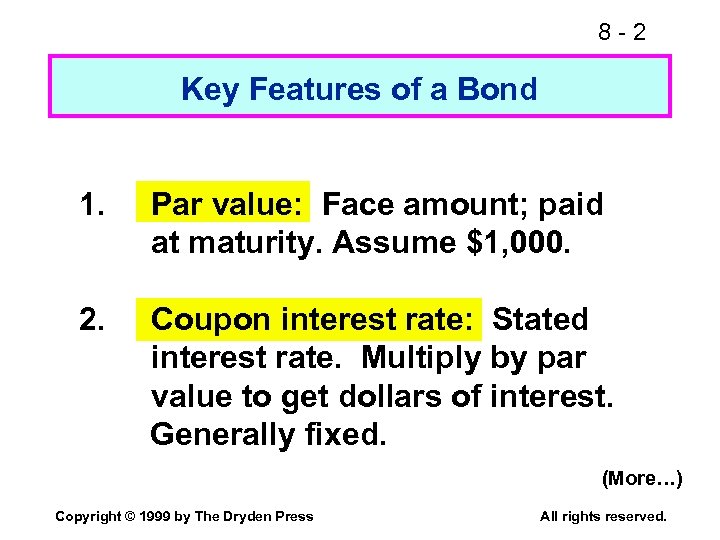
8 -2 Key Features of a Bond 1. Par value: Face amount; paid at maturity. Assume $1, 000. 2. Coupon interest rate: Stated interest rate. Multiply by par value to get dollars of interest. Generally fixed. (More…) Copyright © 1999 by The Dryden Press All rights reserved.
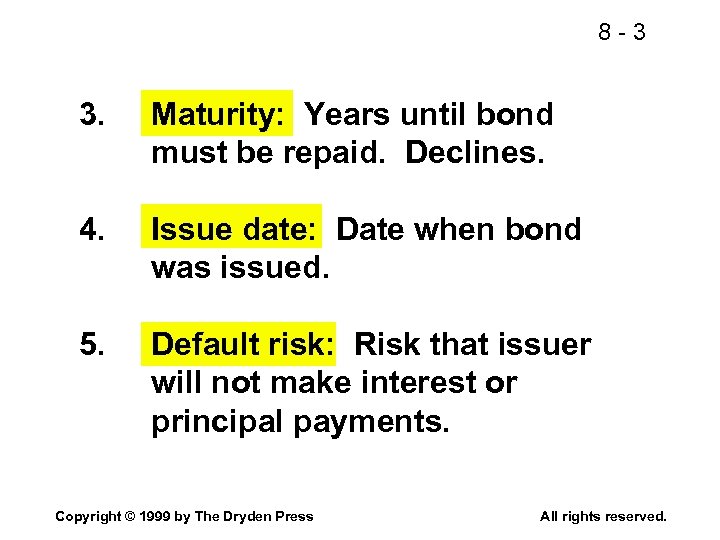
8 -3 3. Maturity: Years until bond must be repaid. Declines. 4. Issue date: Date when bond was issued. 5. Default risk: Risk that issuer will not make interest or principal payments. Copyright © 1999 by The Dryden Press All rights reserved.
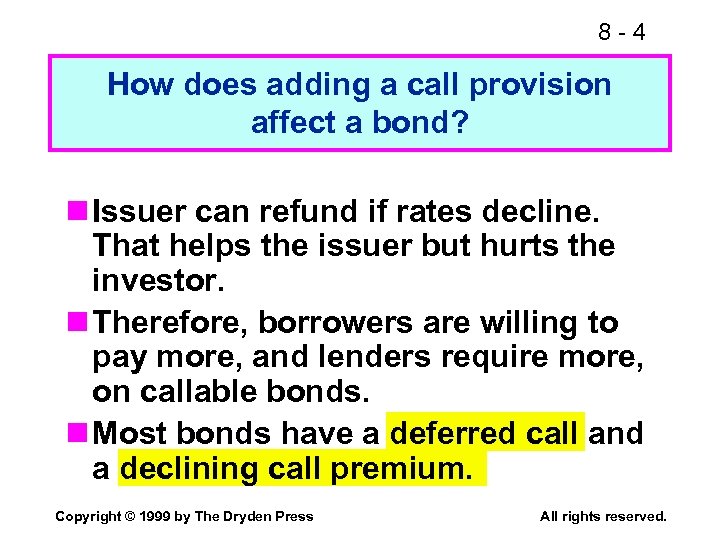
8 -4 How does adding a call provision affect a bond? n Issuer can refund if rates decline. That helps the issuer but hurts the investor. n Therefore, borrowers are willing to pay more, and lenders require more, on callable bonds. n Most bonds have a deferred call and a declining call premium. Copyright © 1999 by The Dryden Press All rights reserved.
8 -5 What’s a sinking fund? n Provision to pay off a loan over its life rather than all at maturity. n Similar to amortization on a term loan. n Reduces risk to investor, shortens average maturity. n But not good for investors if rates decline after issuance. Copyright © 1999 by The Dryden Press All rights reserved.
8 -6 Sinking funds are generally handled in 2 ways 1. Call x% at par per year for sinking fund purposes. 2. Buy bonds on open market. Company would call if kd is below the coupon rate and bond sells at a premium. Use open market purchase if kd is above coupon rate and bond sells at a discount. Copyright © 1999 by The Dryden Press All rights reserved.
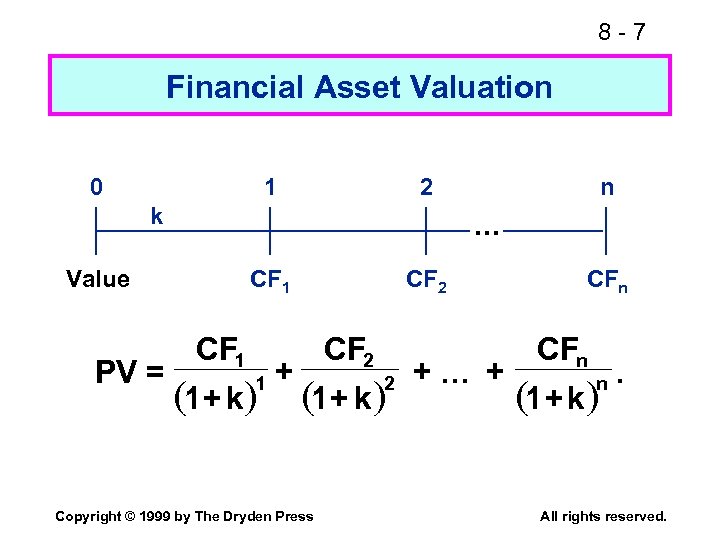
8 -7 Financial Asset Valuation 0 1 2 k . . . Value PV = n CF 1 (1+ k) 1 + CF 2 (1+ k) Copyright © 1999 by The Dryden Press 2 +. . . + CFn (1+ k) n . All rights reserved.
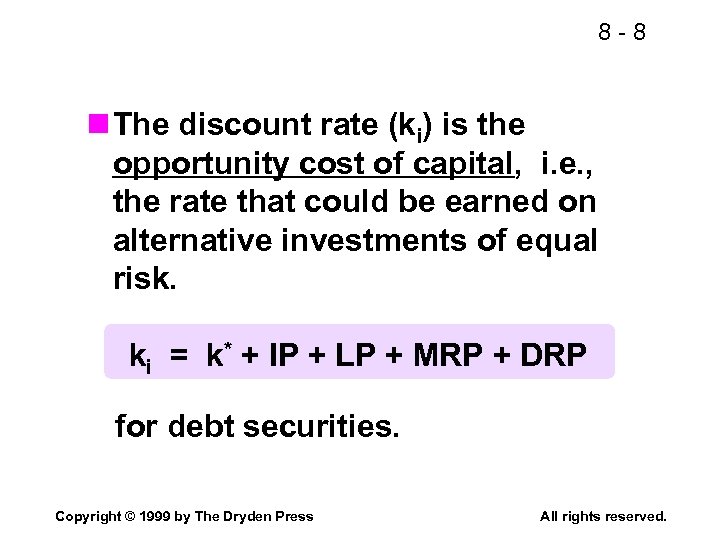
8 -8 n The discount rate (ki) is the opportunity cost of capital, i. e. , the rate that could be earned on alternative investments of equal risk. ki = k* + IP + LP + MRP + DRP for debt securities. Copyright © 1999 by The Dryden Press All rights reserved.
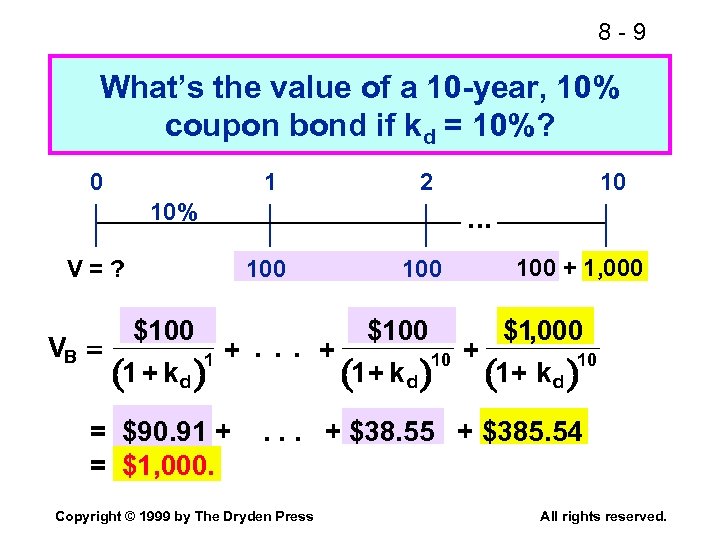
8 -9 What’s the value of a 10 -year, 10% coupon bond if kd = 10%? 0 1 2 10% . . . V=? VB = 10 100 $100 (1 + k d ) 1 +. . . + = $90. 91 + = $1, 000. 100 + 1, 000 100 $100 (1 + k d ) 10 + $1, 000 (1+ k d ) 10 . . . + $38. 55 + $385. 54 Copyright © 1999 by The Dryden Press All rights reserved.
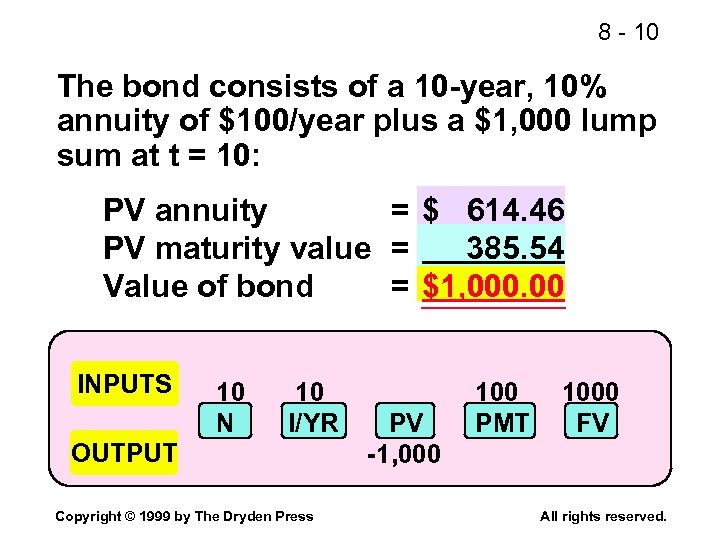
8 - 10 The bond consists of a 10 -year, 10% annuity of $100/year plus a $1, 000 lump sum at t = 10: PV annuity = $ 614. 46 PV maturity value = 385. 54 Value of bond = $1, 000. 00 INPUTS 10 N 10 I/YR OUTPUT Copyright © 1999 by The Dryden Press PV -1, 000 100 PMT 1000 FV All rights reserved.
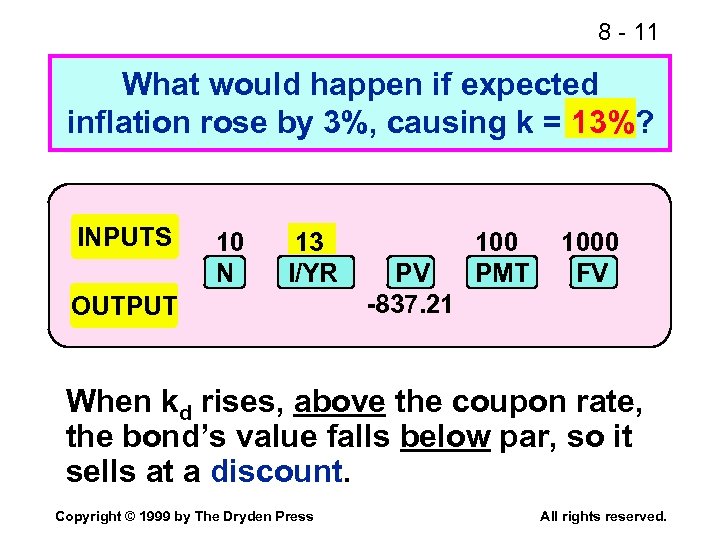
8 - 11 What would happen if expected inflation rose by 3%, causing k = 13%? INPUTS 10 N 13 I/YR OUTPUT PV -837. 21 100 PMT 1000 FV When kd rises, above the coupon rate, the bond’s value falls below par, so it sells at a discount. Copyright © 1999 by The Dryden Press All rights reserved.
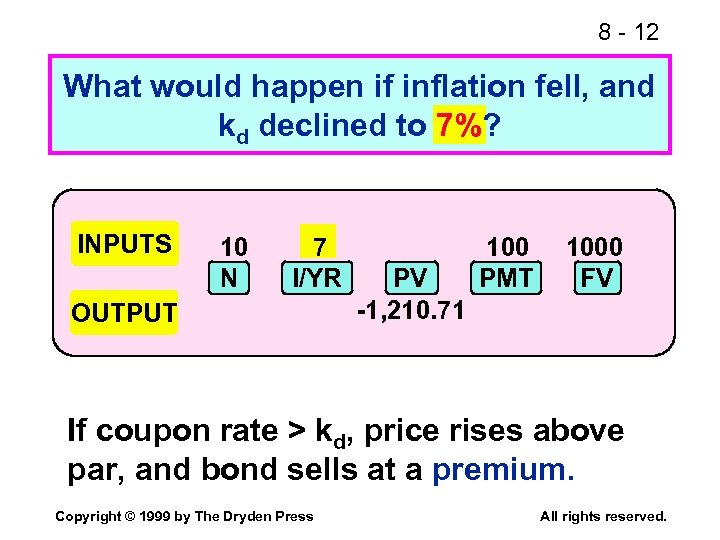
8 - 12 What would happen if inflation fell, and kd declined to 7%? INPUTS 10 N 7 I/YR OUTPUT PV -1, 210. 71 100 PMT 1000 FV If coupon rate > kd, price rises above par, and bond sells at a premium. Copyright © 1999 by The Dryden Press All rights reserved.
8 - 13 Suppose the bond was issued 20 years ago and now has 10 years to maturity. What would happen to its value over time if the required rate of return remained at 10%, or at 13%, or at 7%? Copyright © 1999 by The Dryden Press All rights reserved.
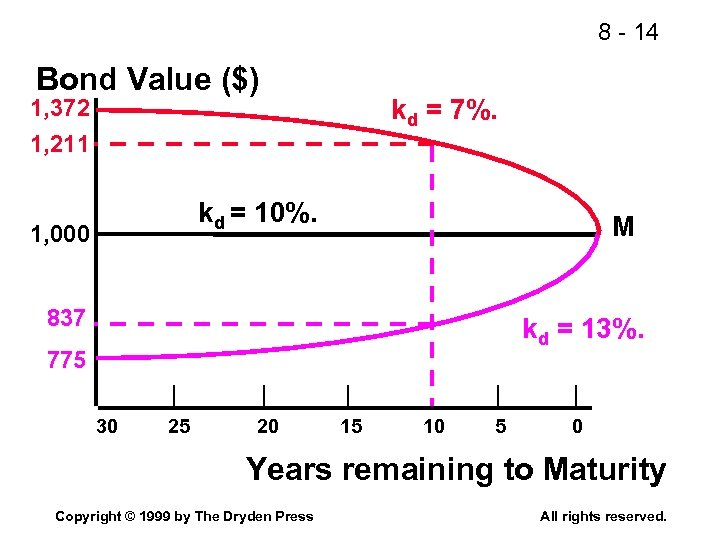
8 - 14 Bond Value ($) kd = 7%. 1, 372 1, 211 kd = 10%. 1, 000 M 837 kd = 13%. 775 30 25 20 15 10 5 0 Years remaining to Maturity Copyright © 1999 by The Dryden Press All rights reserved.
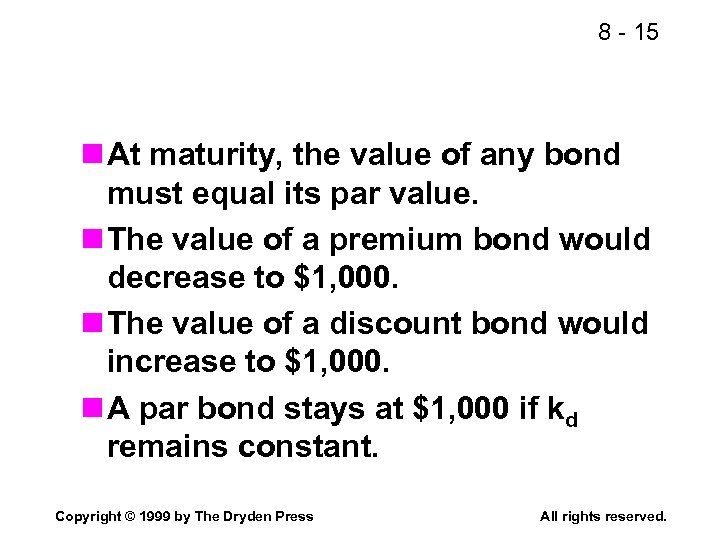
8 - 15 n At maturity, the value of any bond must equal its par value. n The value of a premium bond would decrease to $1, 000. n The value of a discount bond would increase to $1, 000. n A par bond stays at $1, 000 if kd remains constant. Copyright © 1999 by The Dryden Press All rights reserved.
8 - 16 What’s “yield to maturity”? n YTM is the rate of return earned on a bond held to maturity. Also called “promised yield. ” Copyright © 1999 by The Dryden Press All rights reserved.
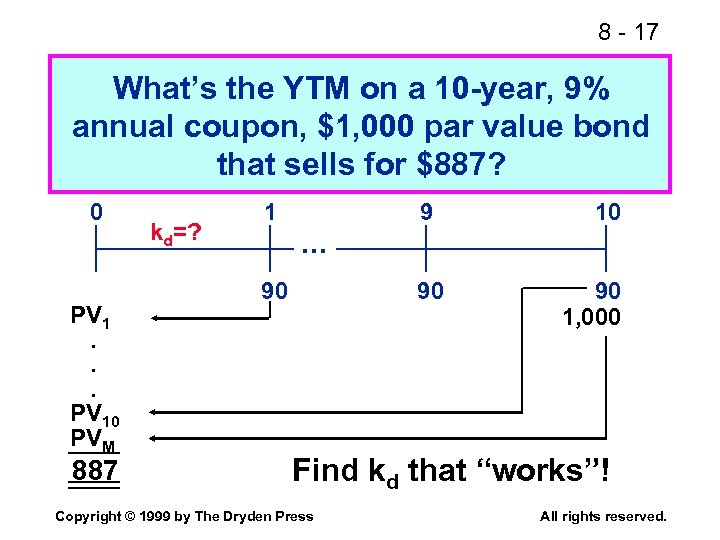
8 - 17 What’s the YTM on a 10 -year, 9% annual coupon, $1, 000 par value bond that sells for $887? 0 PV 1. . . PV 10 PVM 887 kd=? 1 . . . 90 9 90 10 90 1, 000 Find kd that “works”! Copyright © 1999 by The Dryden Press All rights reserved.
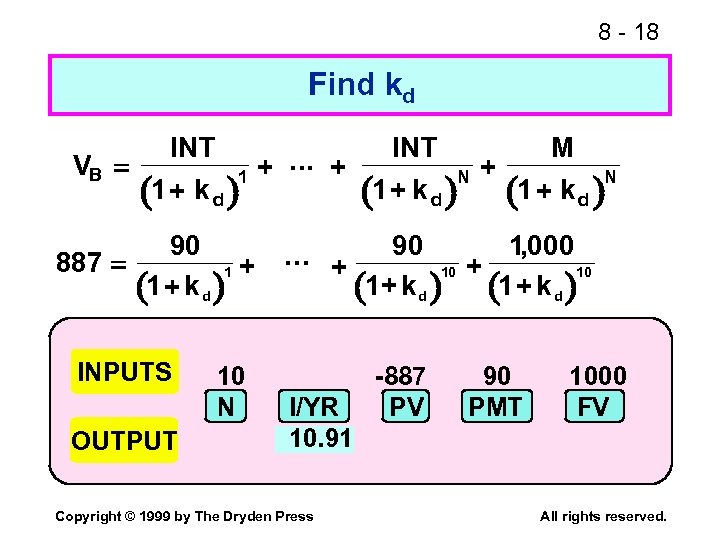
8 - 18 Find kd VB = INT . . . + 1 + (1 + k d ) 90 887 = 1 + (1 + k d ) INPUTS OUTPUT 10 N . . . + I/YR 10. 91 Copyright © 1999 by The Dryden Press INT (1 + k d ) N + M (1 + k d ) N 90 1, 000 10 + 10 (1+ k d ) (1 + k d ) -887 PV 90 PMT 1000 FV All rights reserved.
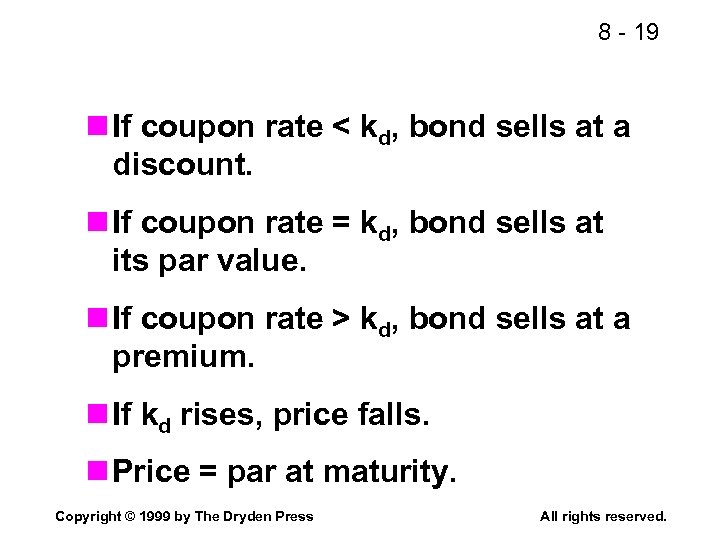
8 - 19 n If coupon rate < kd, bond sells at a discount. n If coupon rate = kd, bond sells at its par value. n If coupon rate > kd, bond sells at a premium. n If kd rises, price falls. n Price = par at maturity. Copyright © 1999 by The Dryden Press All rights reserved.
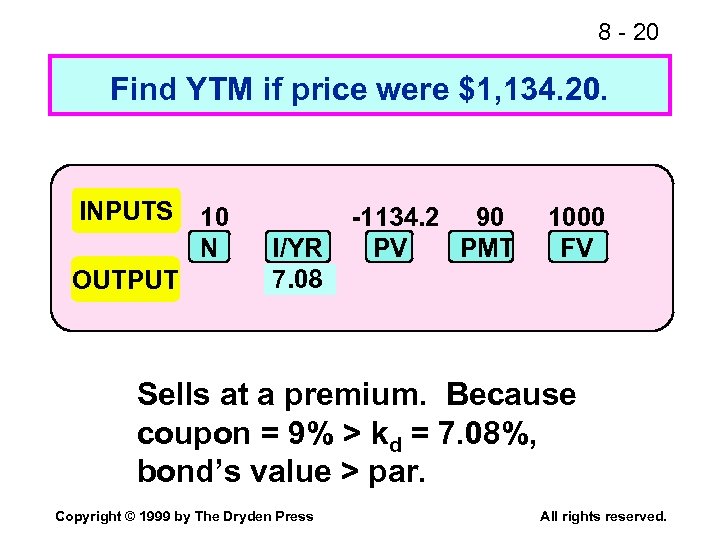
8 - 20 Find YTM if price were $1, 134. 20. INPUTS OUTPUT 10 N I/YR 7. 08 -1134. 2 90 PV PMT 1000 FV Sells at a premium. Because coupon = 9% > kd = 7. 08%, bond’s value > par. Copyright © 1999 by The Dryden Press All rights reserved.
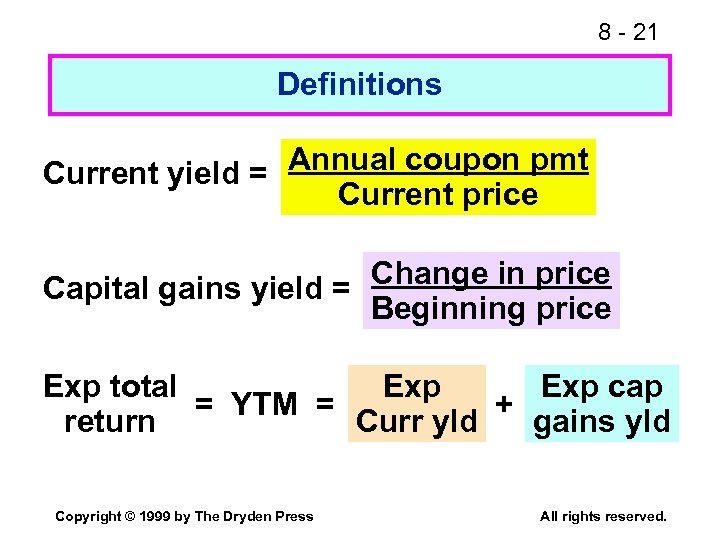
8 - 21 Definitions Annual coupon pmt Current yield = Current price Capital gains yield = Change in price Beginning price Exp total Exp cap = YTM = + return Curr yld gains yld Copyright © 1999 by The Dryden Press All rights reserved.
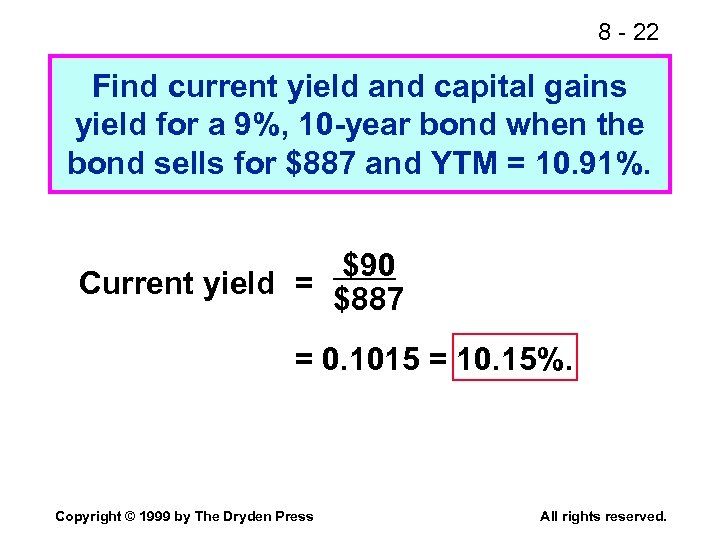
8 - 22 Find current yield and capital gains yield for a 9%, 10 -year bond when the bond sells for $887 and YTM = 10. 91%. $90 Current yield = $887 = 0. 1015 = 10. 15%. Copyright © 1999 by The Dryden Press All rights reserved.
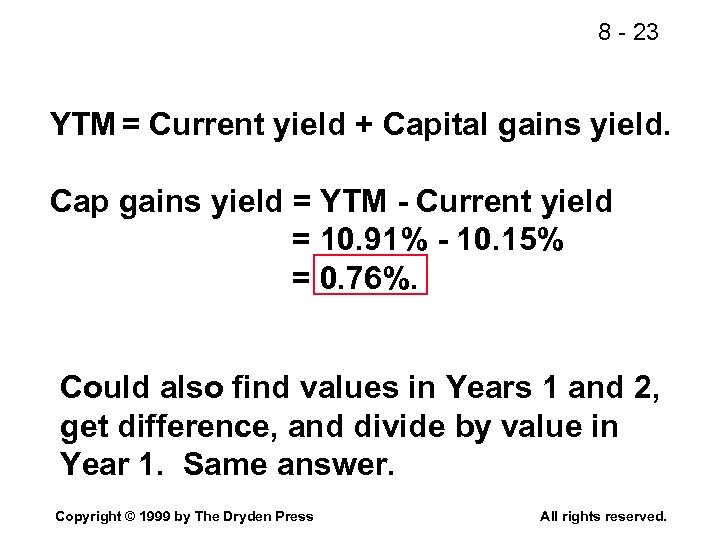
8 - 23 YTM = Current yield + Capital gains yield. Cap gains yield = YTM - Current yield = 10. 91% - 10. 15% = 0. 76%. Could also find values in Years 1 and 2, get difference, and divide by value in Year 1. Same answer. Copyright © 1999 by The Dryden Press All rights reserved.
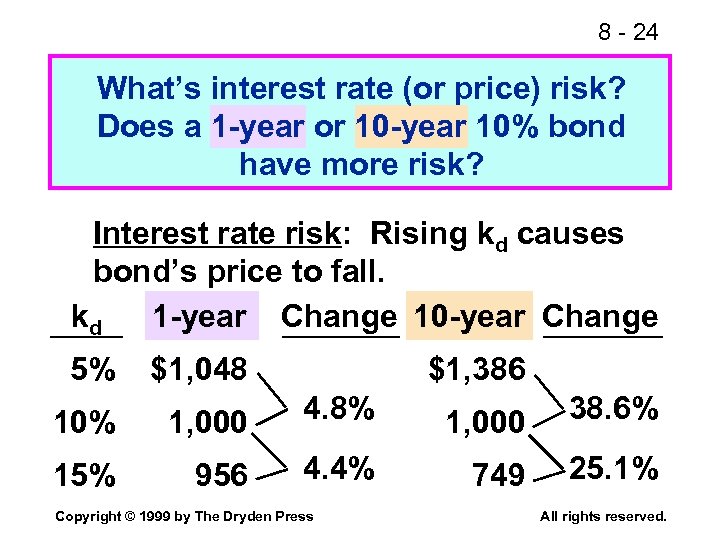
8 - 24 What’s interest rate (or price) risk? Does a 1 -year or 10 -year 10% bond have more risk? Interest rate risk: Rising kd causes bond’s price to fall. kd 1 -year Change 10 -year Change 5% $1, 048 $1, 386 10% 1, 000 4. 8% 15% 956 4. 4% Copyright © 1999 by The Dryden Press 1, 000 38. 6% 749 25. 1% All rights reserved.
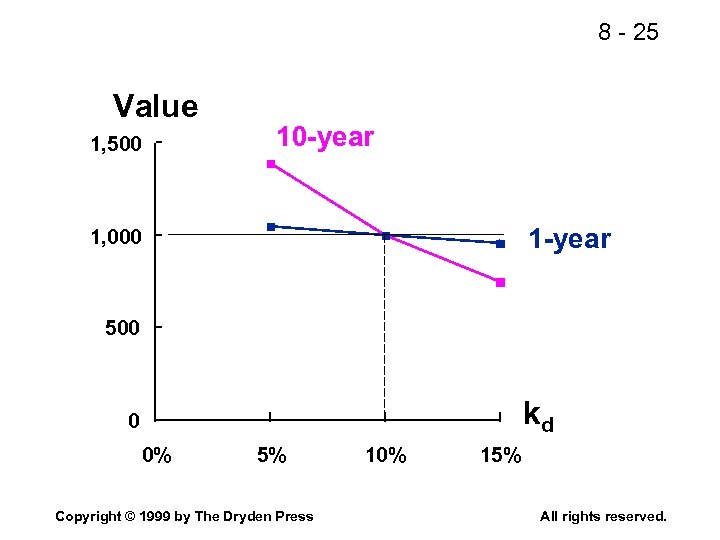
8 - 25 Value 1, 500 10 -year 1, 000 500 kd 0 0% 5% Copyright © 1999 by The Dryden Press 10% 15% All rights reserved.
8 - 26 What is reinvestment rate risk? The risk that CFs will have to be reinvested in the future at lower rates, reducing income. Illustration: Suppose you just won $500, 000 playing the lottery. You’ll invest the money and live off the interest. You buy a 1 -year bond with a YTM of 10%. Copyright © 1999 by The Dryden Press All rights reserved.
8 - 27 Year 1 income = $50, 000. At yearend get back $500, 000 to reinvest. If rates fall to 3%, income will drop from $50, 000 to $15, 000. Had you bought 30 -year bonds, income would have remained constant. Copyright © 1999 by The Dryden Press All rights reserved.
8 - 28 n Long-term bonds: High interest rate risk, low reinvestment rate risk. n Short-term bonds: Low interest rate risk, high reinvestment rate risk. n Nothing is riskless! Copyright © 1999 by The Dryden Press All rights reserved.
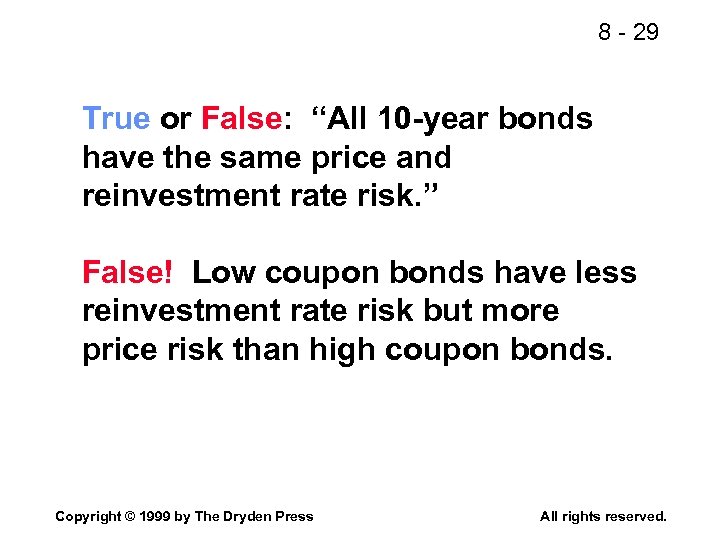
8 - 29 True or False: “All 10 -year bonds have the same price and reinvestment rate risk. ” False! Low coupon bonds have less reinvestment rate risk but more price risk than high coupon bonds. Copyright © 1999 by The Dryden Press All rights reserved.
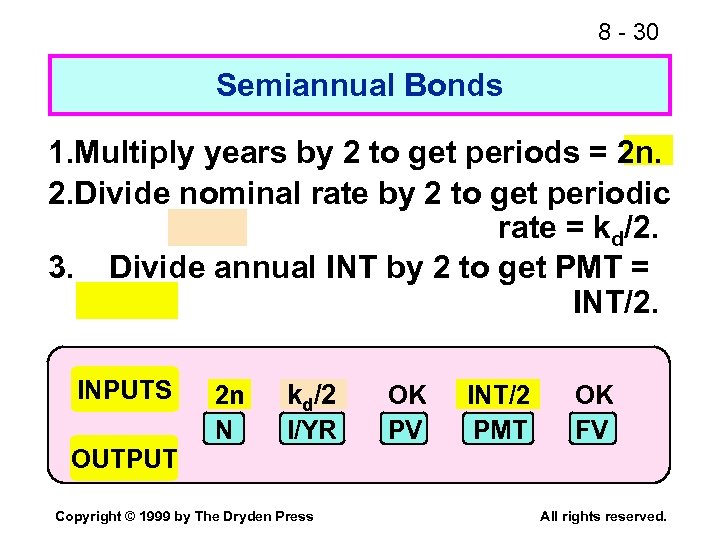
8 - 30 Semiannual Bonds 1. Multiply years by 2 to get periods = 2 n. 2. Divide nominal rate by 2 to get periodic rate = kd/2. 3. Divide annual INT by 2 to get PMT = INT/2. INPUTS OUTPUT 2 n N kd/2 I/YR Copyright © 1999 by The Dryden Press OK PV INT/2 PMT OK FV All rights reserved.
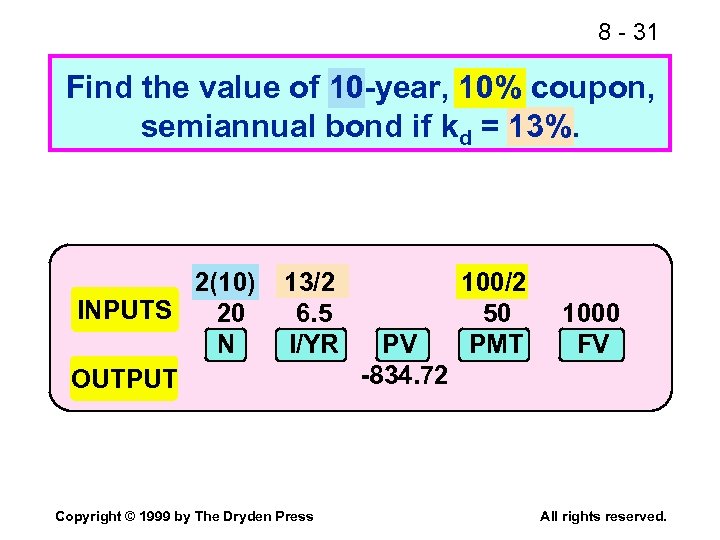
8 - 31 Find the value of 10 -year, 10% coupon, semiannual bond if kd = 13%. 2(10) INPUTS 20 N OUTPUT 13/2 6. 5 I/YR Copyright © 1999 by The Dryden Press PV -834. 72 100/2 50 PMT 1000 FV All rights reserved.
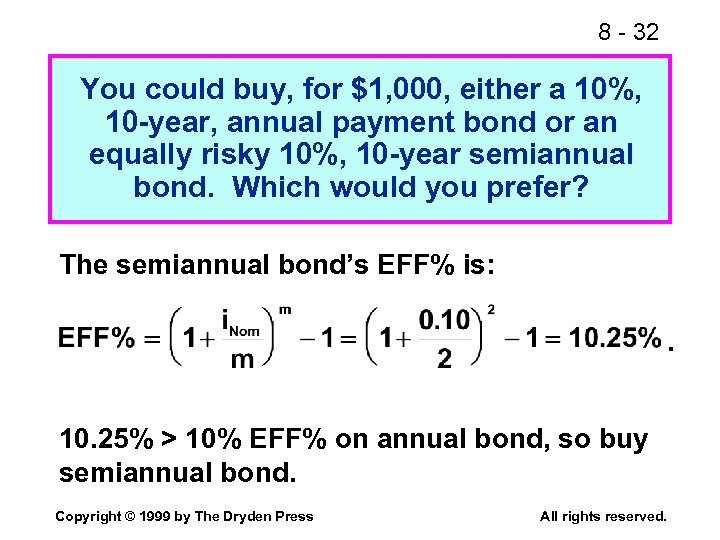
8 - 32 You could buy, for $1, 000, either a 10%, 10 -year, annual payment bond or an equally risky 10%, 10 -year semiannual bond. Which would you prefer? The semiannual bond’s EFF% is: . 10. 25% > 10% EFF% on annual bond, so buy semiannual bond. Copyright © 1999 by The Dryden Press All rights reserved.
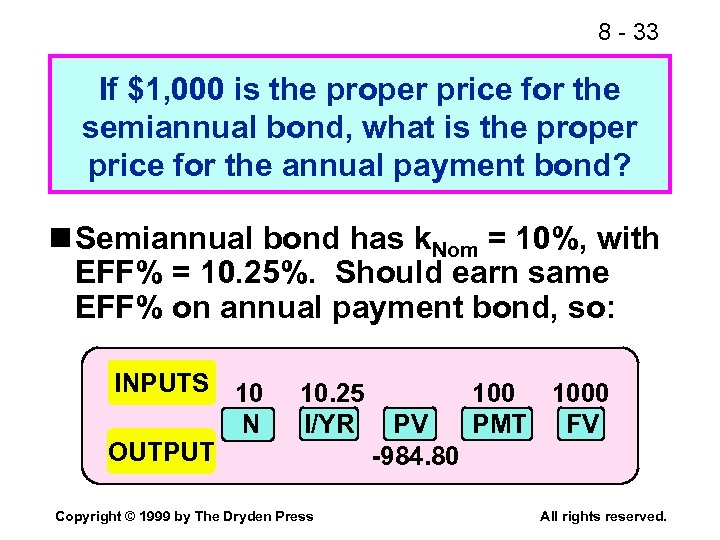
8 - 33 If $1, 000 is the proper price for the semiannual bond, what is the proper price for the annual payment bond? n Semiannual bond has k. Nom = 10%, with EFF% = 10. 25%. Should earn same EFF% on annual payment bond, so: INPUTS 10 N OUTPUT 10. 25 I/YR Copyright © 1999 by The Dryden Press PV -984. 80 1000 PMT FV All rights reserved.
8 - 34 n At a price of $984. 80, the annual and semiannual bonds would be in equilibrium, because investors would earn EFF% = 10. 25% on either bond. Copyright © 1999 by The Dryden Press All rights reserved.
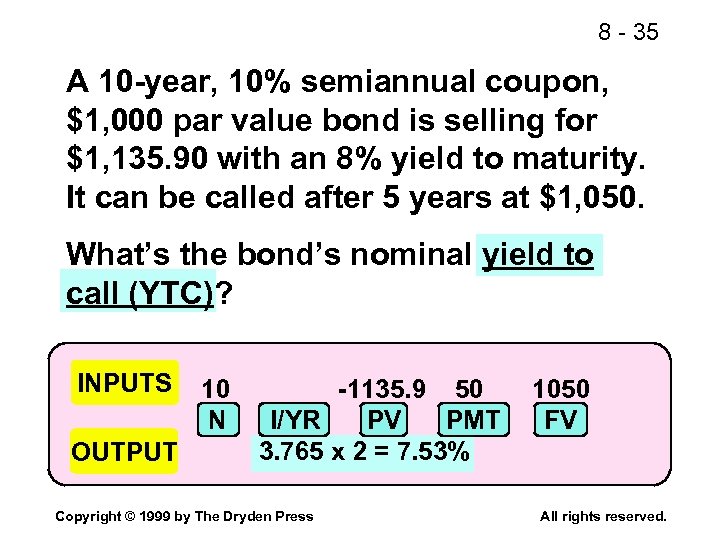
8 - 35 A 10 -year, 10% semiannual coupon, $1, 000 par value bond is selling for $1, 135. 90 with an 8% yield to maturity. It can be called after 5 years at $1, 050. What’s the bond’s nominal yield to call (YTC)? INPUTS OUTPUT 10 N -1135. 9 50 I/YR PV PMT 3. 765 x 2 = 7. 53% Copyright © 1999 by The Dryden Press 1050 FV All rights reserved.
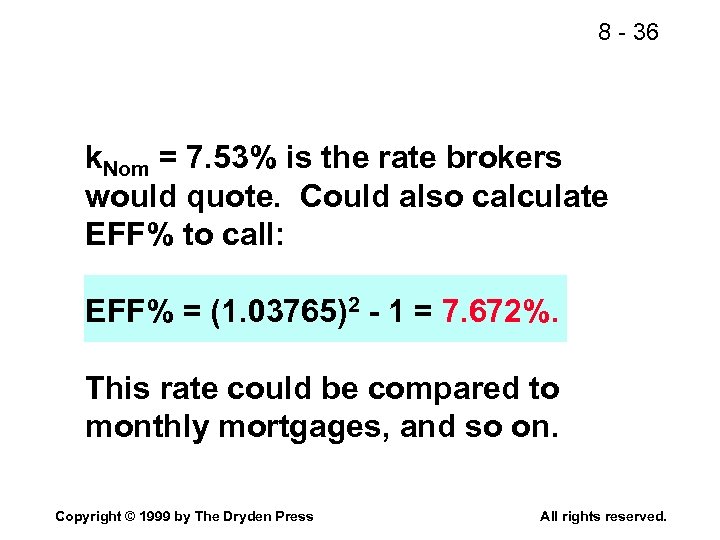
8 - 36 k. Nom = 7. 53% is the rate brokers would quote. Could also calculate EFF% to call: EFF% = (1. 03765)2 - 1 = 7. 672%. This rate could be compared to monthly mortgages, and so on. Copyright © 1999 by The Dryden Press All rights reserved.
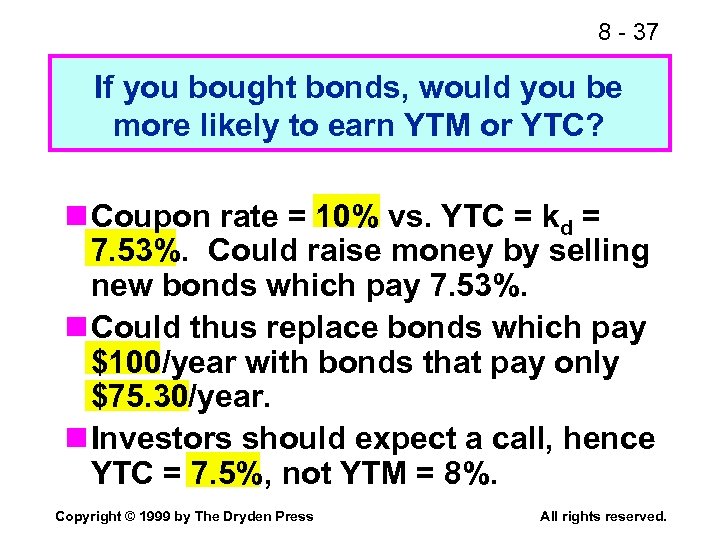
8 - 37 If you bought bonds, would you be more likely to earn YTM or YTC? n Coupon rate = 10% vs. YTC = kd = 7. 53%. Could raise money by selling new bonds which pay 7. 53%. n Could thus replace bonds which pay $100/year with bonds that pay only $75. 30/year. n Investors should expect a call, hence YTC = 7. 5%, not YTM = 8%. Copyright © 1999 by The Dryden Press All rights reserved.
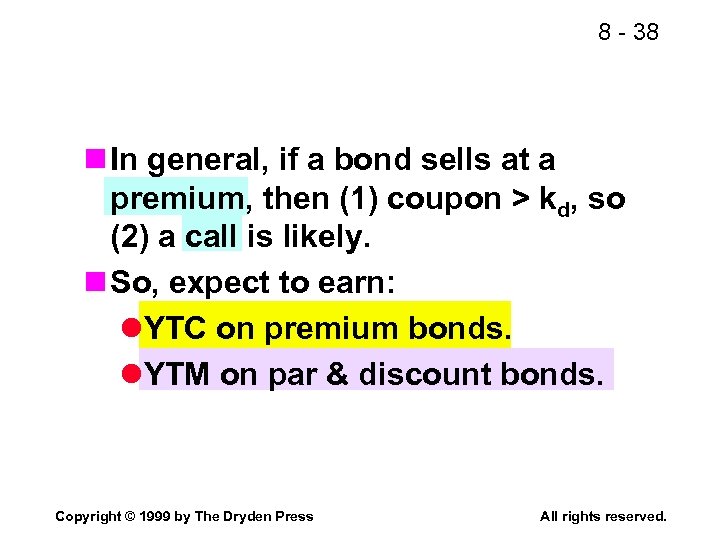
8 - 38 n In general, if a bond sells at a premium, then (1) coupon > kd, so (2) a call is likely. n So, expect to earn: l. YTC on premium bonds. l. YTM on par & discount bonds. Copyright © 1999 by The Dryden Press All rights reserved.
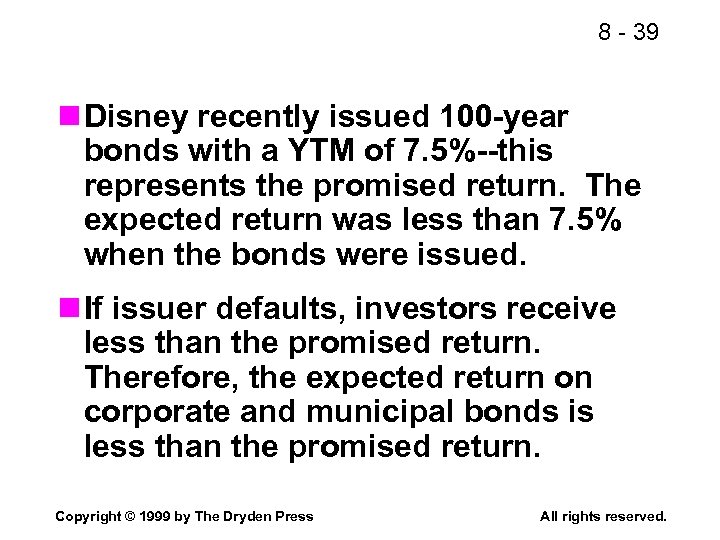
8 - 39 n Disney recently issued 100 -year bonds with a YTM of 7. 5%--this represents the promised return. The expected return was less than 7. 5% when the bonds were issued. n If issuer defaults, investors receive less than the promised return. Therefore, the expected return on corporate and municipal bonds is less than the promised return. Copyright © 1999 by The Dryden Press All rights reserved.
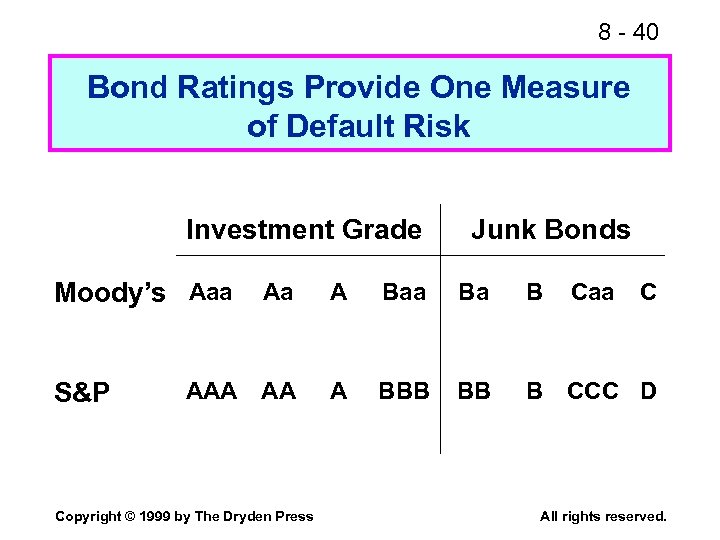
8 - 40 Bond Ratings Provide One Measure of Default Risk Investment Grade Moody’s Aaa S&P Junk Bonds Aa A Baa Ba B AAA AA A BBB BB B CCC D Copyright © 1999 by The Dryden Press Caa C All rights reserved.
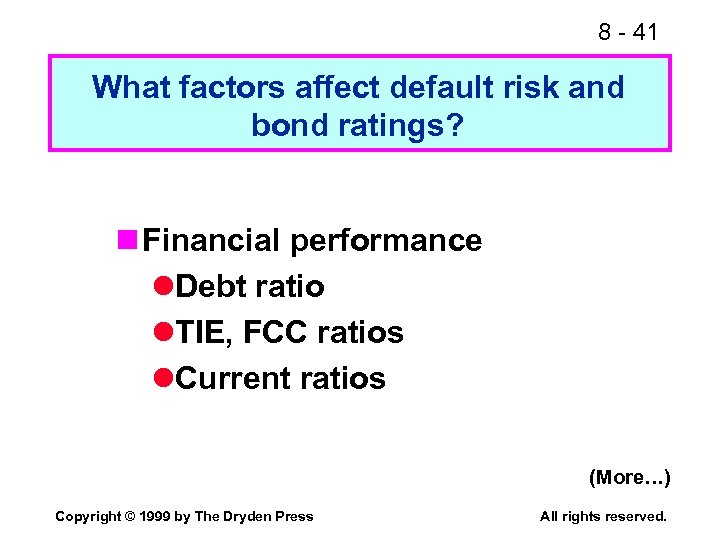
8 - 41 What factors affect default risk and bond ratings? n Financial performance l. Debt ratio l. TIE, FCC ratios l. Current ratios (More…) Copyright © 1999 by The Dryden Press All rights reserved.
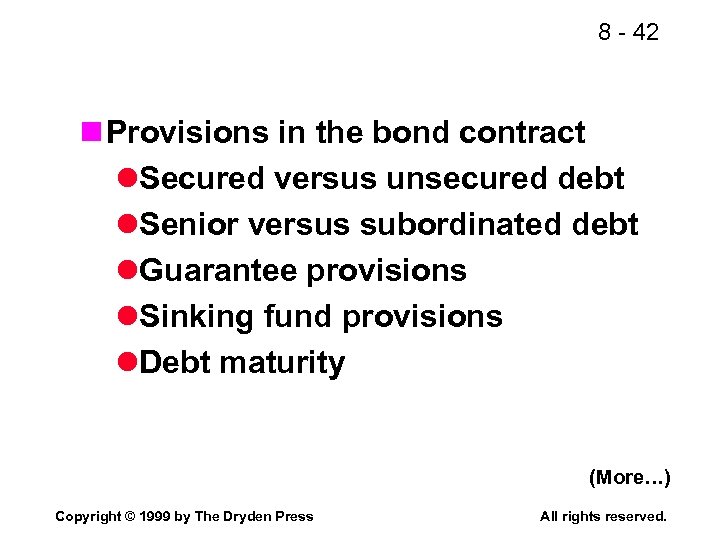
8 - 42 n Provisions in the bond contract l. Secured versus unsecured debt l. Senior versus subordinated debt l. Guarantee provisions l. Sinking fund provisions l. Debt maturity (More…) Copyright © 1999 by The Dryden Press All rights reserved.
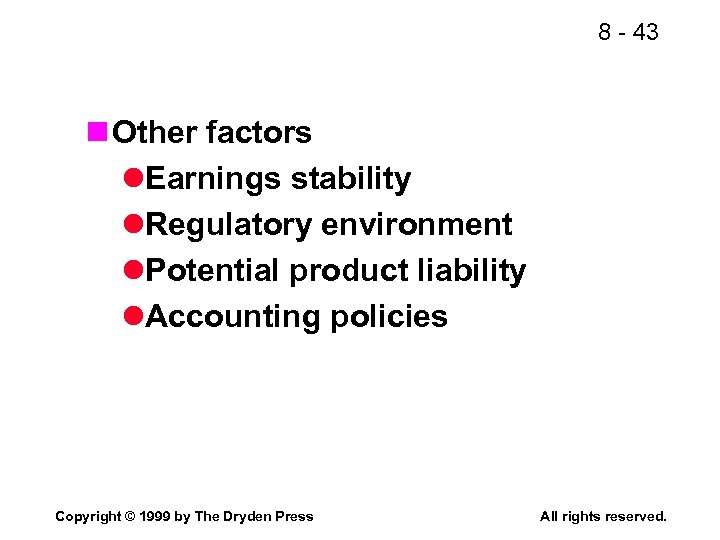
8 - 43 n Other factors l. Earnings stability l. Regulatory environment l. Potential product liability l. Accounting policies Copyright © 1999 by The Dryden Press All rights reserved.
Скачать презентацию 8 -1 CHAPTER 8 Bonds and Their Valuation
6093873e04430e4dbcfc1a514ecd92db.ppt