 Скачать презентацию 8 การพฒนาระบบโครงสรางพ นฐาน CVE 619 Infrastructure System Development
3fe08e81b968ae24d0762472e9837d5a.ppt
- Количество слайдов: 93



#8 การพฒนาระบบโครงสรางพ นฐาน CVE 619 Infrastructure System Development โครงการวศวกรรมและการบรหารการกอส ราง ภาควชาวศวกรรมโยธา CM@KMUTT มหาวทยาลยเทคโนโลยพระจอมเกลาธนบ ร
Financial Derivatives CM@KMUTT )ตราสารอนพนธ ( 2
อะไรคอ ตราสารอนพนธ ¢ CM@KMUTT ¢ ¢ เปนตราสารทางการเงนประเภทหนงทมม ลคาหรอราคา เกยวเนองกบ มลคาขอ งสนทรพยทตราสารอนพนธนนอา งองอย (สนทรพยอางอง – underlying asset) สนทรพยอางองเหลานโดยปกตจะอย ในตลาดโดยมการซอขายและสงมอบกนใน ทนท ณ ราคาเงนสด หรอ ราคาสปอต(cash price or spot price) ตราสารอนพนธจะมการกำหนดวนครบก 3
จดประสงคของการใชตราสารอน พนธ ¢ Objectives: 1. Risk management )การจดการความเสยง ( CM@KMUTT 2. Speculation) การเกงกำไร ( 4
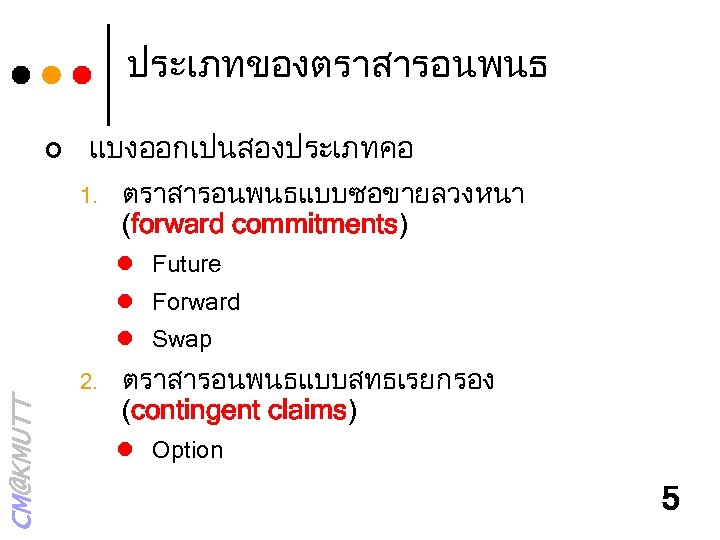
ประเภทของตราสารอนพนธ ¢ แบงออกเปนสองประเภทคอ 1. ตราสารอนพนธแบบซอขายลวงหนา (forward commitments) l Future l Forward l Swap CM@KMUTT 2. ตราสารอนพนธแบบสทธเรยกรอง (contingent claims) l Option 5

“Futures” - สญญาซอขายลวงหนาฟวเจอร ¢ CM@KMUTT ¢ คอ สญญา ระหวางผซอและผขายในการ ตกลงวาจะซอจะขาย สนทรพยอางอง โดยมการ กำหนดราคาและวนเวลาสงมอบท แนนอน ไวลวงหนา ซอขายกนตลาดแลกเปลยนกลาง เชนตลาดหลกทรพย – 6
“Forward” - สญญาซอขายลวงหนาฟอรเวรด CM@KMUTT ¢ ลกษณะเหมอน future เพยงแตเปนการซอขายในตลาดตอรอง (over-the-counter) ทำการซอขายโดยไมตองมกลไกตลาดรองร บ 7
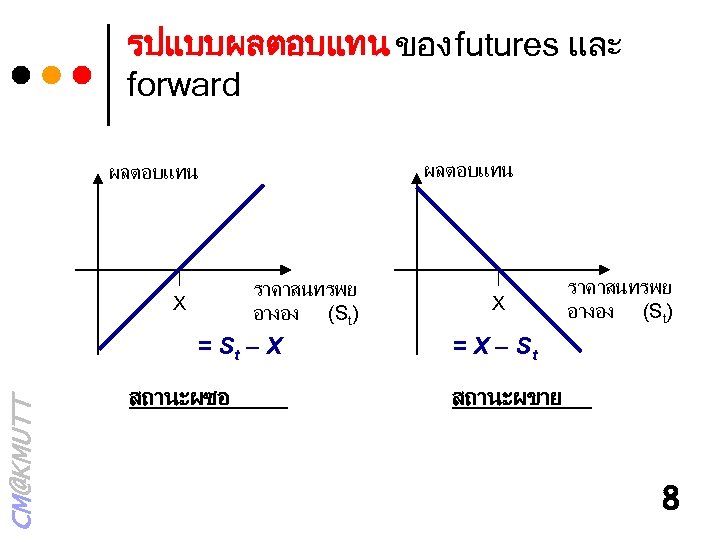
รปแบบผลตอบแทน ของ futures และ forward ผลตอบแทน ราคาสนทรพย อางอง (St) X CM@KMUTT = St – X สถานะผซอ X ราคาสนทรพย อางอง (St) = X – St สถานะผขาย 8
“Option” - สญญาออปชน ¢ CM@KMUTT ¢ คอสญญาทใหสทธ (แตไมใชภาระผกพน ) กบผถอครองสญญาในการทจะ ขาย สนทรพยอางอง ) ในราคาทตกลงกน ไว และภายใน ระยะเวลาทกำหนด ซอ (หรอ A contract which gives its holder the right, without obligation, to buy (or sell) an asset at some pre-agreed price within a specified period of time 9
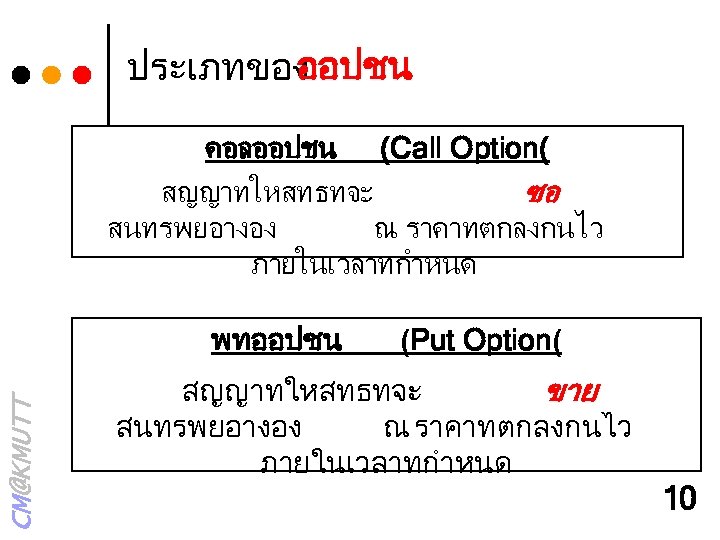
ประเภทของ ออปชน คอลออปชน (Call Option( สญญาทใหสทธทจะ ซอ สนทรพยอางอง ณ ราคาทตกลงกนไว ภายในเวลาทกำหนด CM@KMUTT พทออปชน (Put Option( สญญาทใหสทธทจะ ขาย สนทรพยอางอง ณ ราคาทตกลงกนไว ภายในเวลาทกำหนด 10
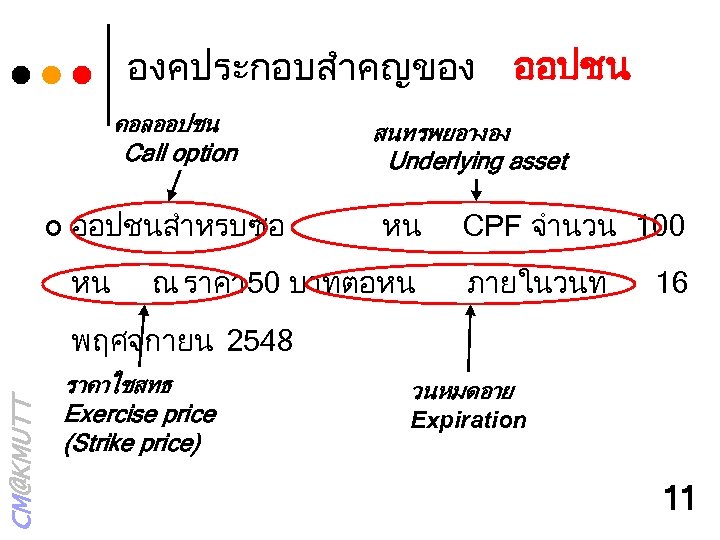
องคประกอบสำคญของ คอลออปชน Call option ¢ ออปชนสำหรบซอ หน ออปชน สนทรพยอางอง Underlying asset หน ณ ราคา 50 บาทตอหน CPF จำนวน 100 ภายในวนท 16 CM@KMUTT พฤศจกายน 2548 ราคาใชสทธ Exercise price (Strike price) วนหมดอาย Expiration 11
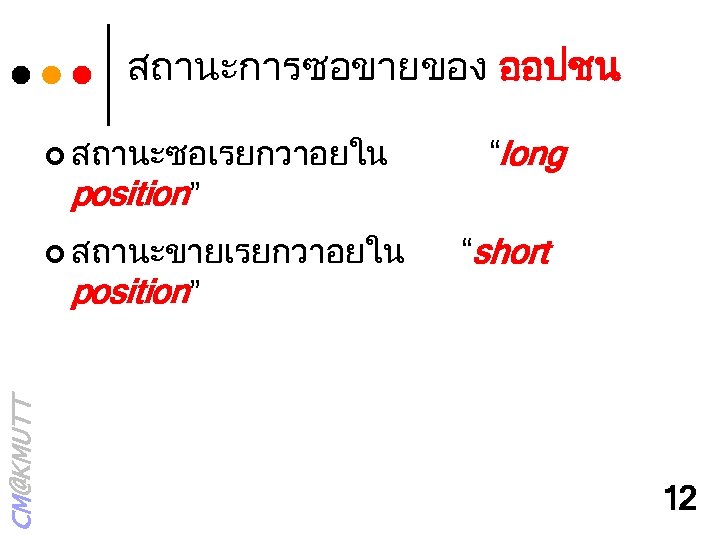
สถานะการซอขายของ ออปชน ¢ สถานะซอเรยกวาอยใน “long position” ¢ สถานะขายเรยกวาอยใน “short CM@KMUTT position” 12
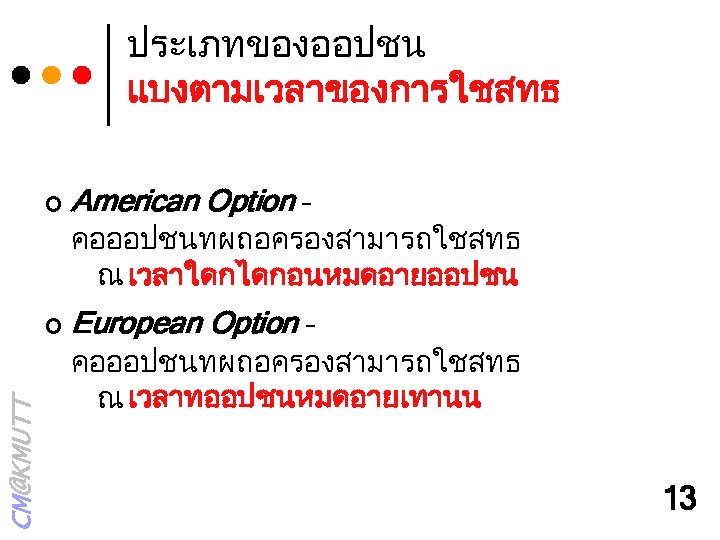
ประเภทของออปชน แบงตามเวลาของการใชสทธ ¢ American Option – คอออปชนทผถอครองสามารถใชสทธ ณ เวลาใดกไดกอนหมดอายออปชน CM@KMUTT ¢ European Option – คอออปชนทผถอครองสามารถใชสทธ ณ เวลาทออปชนหมดอายเทานน 13
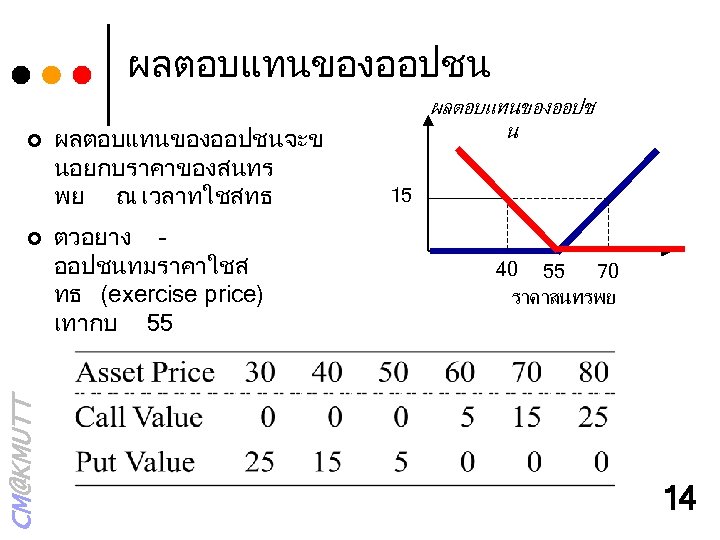
ผลตอบแทนของออปชน ¢ CM@KMUTT ¢ ผลตอบแทนของออปชนจะข นอยกบราคาของสนทร พย ณ เวลาทใชสทธ ตวอยาง – ออปชนทมราคาใชส ทธ (exercise price) เทากบ 55 ผลตอบแทนของออปช น 15 40 55 70 ราคาสนทรพย 14
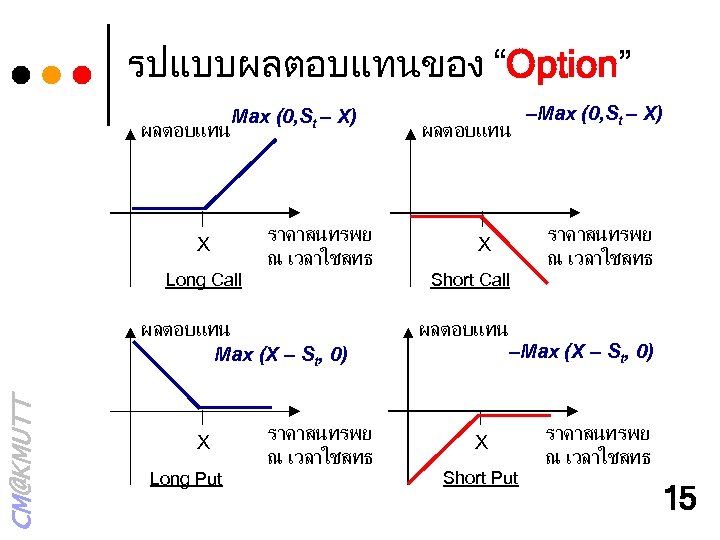
รปแบบผลตอบแทนของ “Option” ผลตอบแทน Max (0, St – X) X ราคาสนทรพย ณ เวลาใชสทธ Long Call CM@KMUTT Long Put ราคาสนทรพย ณ เวลาใชสทธ X Short Call ผลตอบแทน Max (X – St, 0) X ผลตอบแทน –Max (0, St – X) ราคาสนทรพย ณ เวลาใชสทธ ผลตอบแทน –Max (X – St, 0) X Short Put ราคาสนทรพย ณ เวลาใชสทธ 15
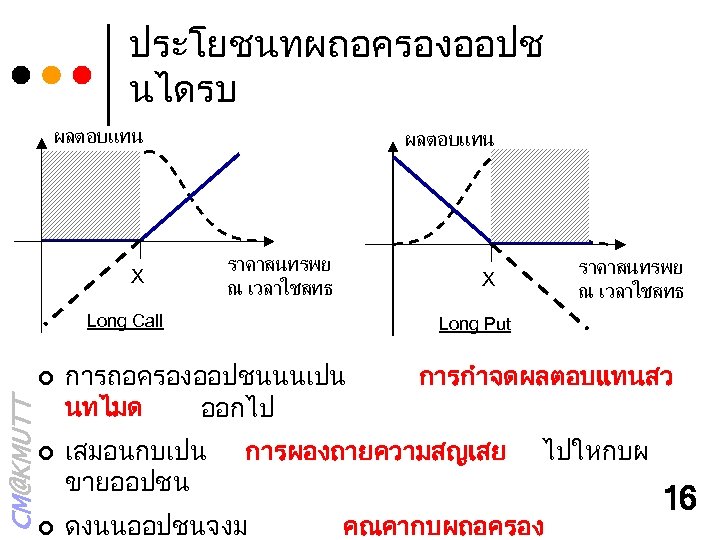
ประโยชนทผถอครองออปช นไดรบ ผลตอบแทน X ผลตอบแทน ราคาสนทรพย ณ เวลาใชสทธ Long Call CM@KMUTT ¢ ¢ ¢ Long Put การถอครองออปชนนนเปน นทไมด ออกไป เสมอนกบเปน ขายออปชน ราคาสนทรพย ณ เวลาใชสทธ X การกำจดผลตอบแทนสว การผองถายความสญเสย ดงนนออปชนจงม ไปใหกบผ คณคากบผถอครอง 16
วธการคำนวณราคา “ออปชน ” ¢ (คณคา ) ของ ทฤษฎ “Option pricing theory” 1. วธการเชงวเคราะห ¢ Black-Scholes model 2. วธการแบบ Numerical ¢ Finite differences CM@KMUTT ¢ Binomial 3. วธการแบบ Simulation ¢ Monte Carlo simulation 4. Etc. 17
วธ ¢ Binomial เราสามารถสรางกลมของหลกทรพยทใหผล ตอบแทนเชนเดยวกบผลตอบแทนของออปชนทก ประการได ฉะนนราคาของออปชนตองเทากบตนทนใน การสรางกลมของหลกทรพยนนเอง CM@KMUTT No Arbitrage opportunities ¢ กลมของหลกทรพยนเรยกวา portfolio” “replicating 18
No arbitrage opportunity ¢ CM@KMUTT ¢ ¢ ตลาดทำงานอยาง มประสทธภาพ market) (Efficient หลกทรพยทมรปแบบผลตอบแทน (ทงมลคาและความเสยงของผลตอบแทน เหมอนกน จะตองมราคา (คณคา ) เทากนดวย หากมการ overprice หรอ underprice ตลาดจะปรบตวเขาส จดดลยภาพ (Equilibrium) อยางรวดเรว ) 19
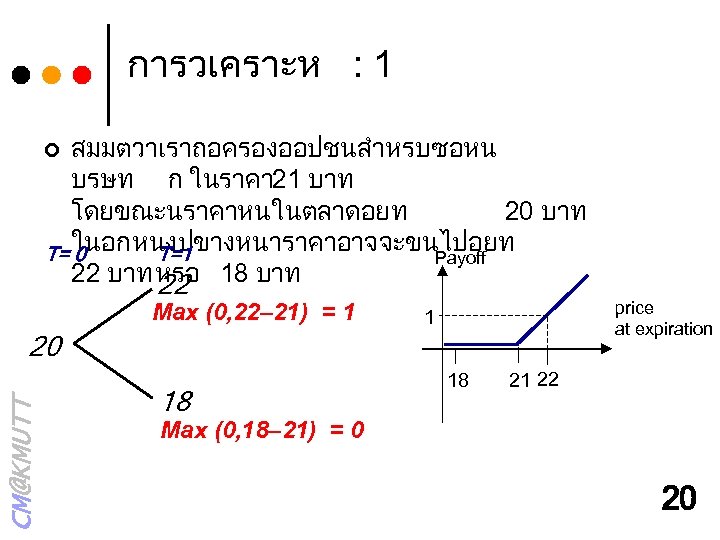
การวเคราะห : 1 สมมตวาเราถอครองออปชนสำหรบซอหน บรษท ก ในราคา 21 บาท โดยขณะนราคาหนในตลาดอยท 20 บาท ในอกหนงปขางหนาราคาอาจจะขนไปอยท T= 0 T=1 Payoff 22 บาท หรอ 18 บาท 22 ¢ Max (0, 22– 21) = 1 1 CM@KMUTT 20 18 18 price at expiration 21 22 Max (0, 18– 21) = 0 20
![การวเคราะห : 2 – รปแบบการเคลอนไหวของราคาหลก ทรพยและราคาออปชน Cu = max [0, u. S 0-X] u.](https://present5.com/presentation/3fe08e81b968ae24d0762472e9837d5a/image-21.jpg "การวเคราะห : 2 – รปแบบการเคลอนไหวของราคาหลก ทรพยและราคาออปชน Cu = max [0, u. S 0-X] u.")
การวเคราะห : 2 – รปแบบการเคลอนไหวของราคาหลก ทรพยและราคาออปชน Cu = max [0, u. S 0-X] u. S 0 C Cd= max [0, d. S 0-X] d. S 0 Stock price movement Option value CM@KMUTT ¢ S = Stock price ¢ X = Exercise price of the option ¢ u = up movement factor ¢ C = Option value ¢ d = down movement factor ¢ Cu = Option value when price move up ¢ Cd = Option value when price move down 21
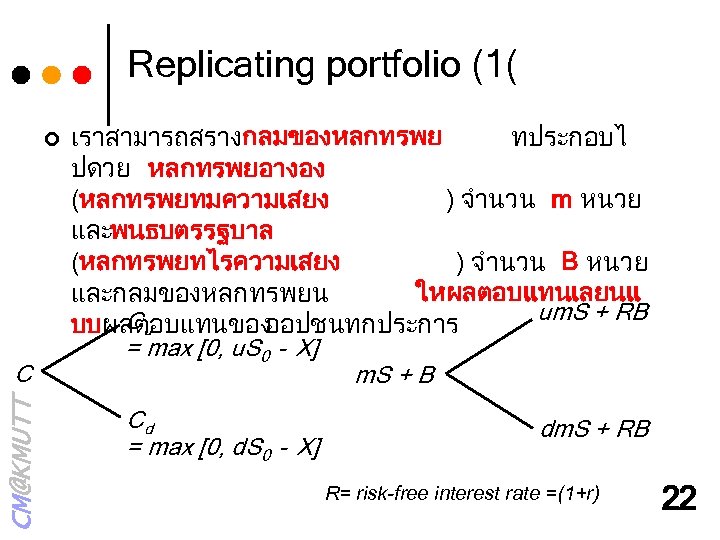
Replicating portfolio (1( ¢ CM@KMUTT C เราสามารถสรางกลมของหลกทรพย ทประกอบไ ปดวย หลกทรพยอางอง (หลกทรพยทมความเสยง ) จำนวน m หนวย และพนธบตรรฐบาล (หลกทรพยทไรความเสยง ) จำนวน B หนวย และกลมของหลกทรพยน ใหผลตอบแทนเลยนแ um. S + RB Cu บบผลตอบแทนของ ออปชนทกประการ = max [0, u. S 0-X] m. S + B Cd = max [0, d. S 0-X] dm. S + RB R= risk-free interest rate =(1+r) 22
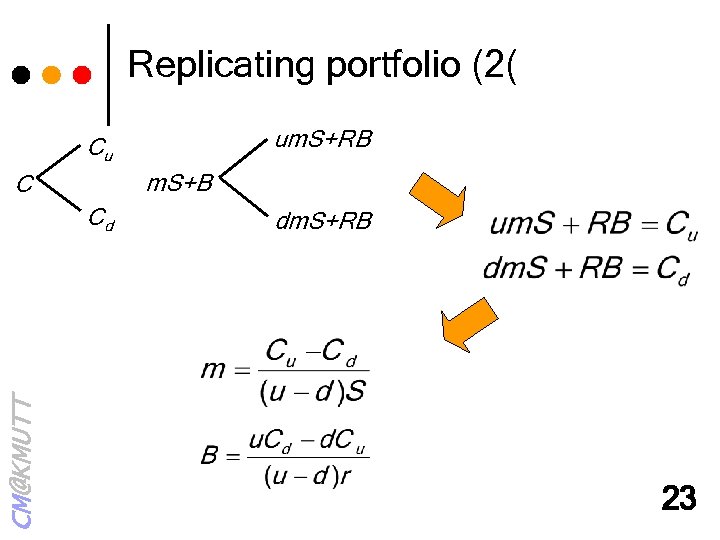
Replicating portfolio (2( um. S+RB Cu m. S+B C Cd dm. S+RB CM@KMUTT 23
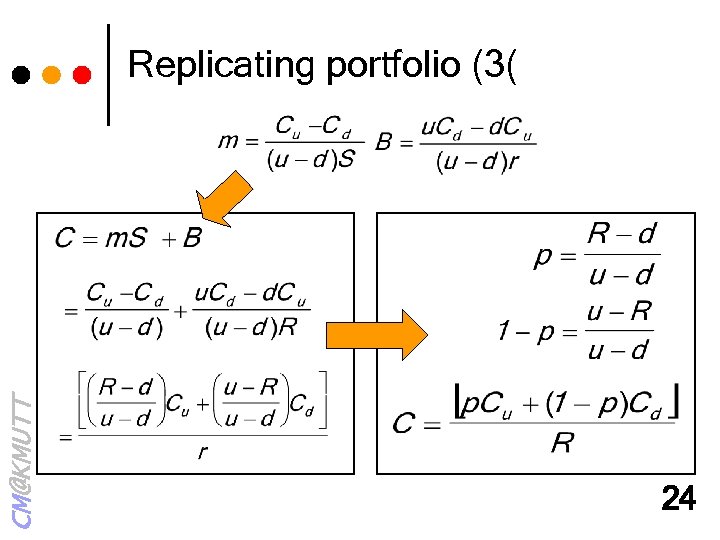
CM@KMUTT Replicating portfolio (3( 24
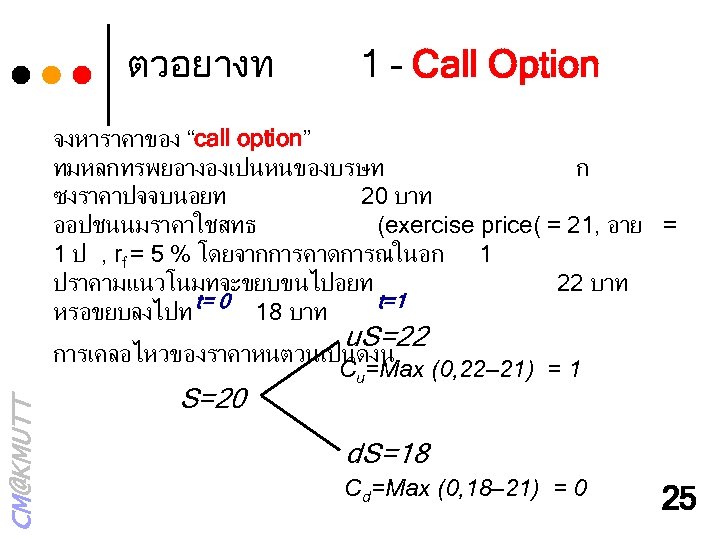
ตวอยางท 1 – Call Option จงหาราคาของ “call option” ทมหลกทรพยอางองเปนหนของบรษท ก ซงราคาปจจบนอยท 20 บาท ออปชนนมราคาใชสทธ (exercise price( = 21, อาย = 1 ป , rf = 5 % โดยจากการคาดการณในอก 1 ปราคามแนวโนมทจะขยบขนไปอยท 22 บาท t=1 หรอขยบลงไปท t= 0 18 บาท u. S=22 CM@KMUTT การเคลอไหวของราคาหนตวนเปนดงน Cu=Max (0, 22– 21) = 1 S=20 d. S=18 Cd=Max (0, 18– 21) = 0 25
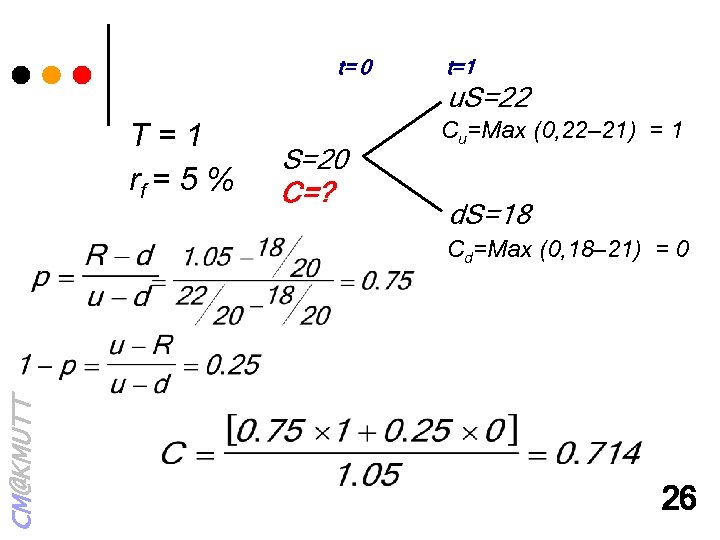
t= 0 t=1 u. S=22 T=1 rf = 5 % S=20 C=? Cu=Max (0, 22– 21) = 1 d. S=18 CM@KMUTT Cd=Max (0, 18– 21) = 0 26
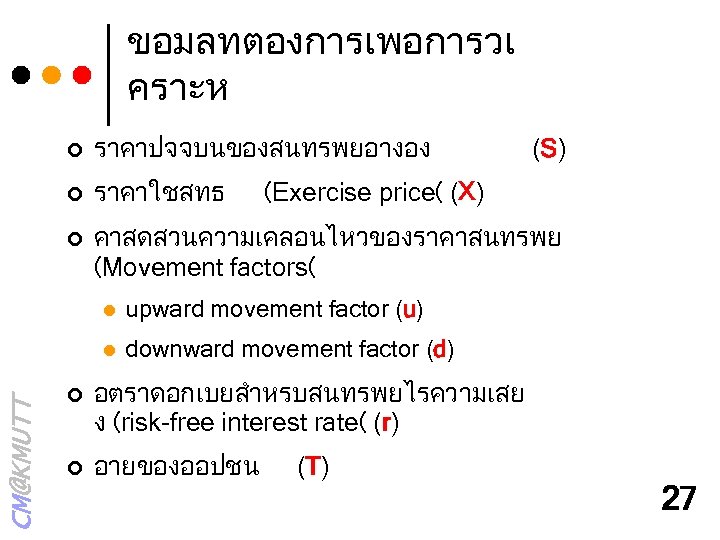
ขอมลทตองการเพอการวเ คราะห ¢ ราคาปจจบนของสนทรพยอางอง ¢ ราคาใชสทธ ¢ (Exercise price( (X) คาสดสวนความเคลอนไหวของราคาสนทรพย (Movement factors( ¢ upward movement factor (u) l CM@KMUTT l ¢ (S) downward movement factor (d) อตราดอกเบยสำหรบสนทรพยไรความเสย ง (risk-free interest rate( (r) อายของออปชน (T) 27
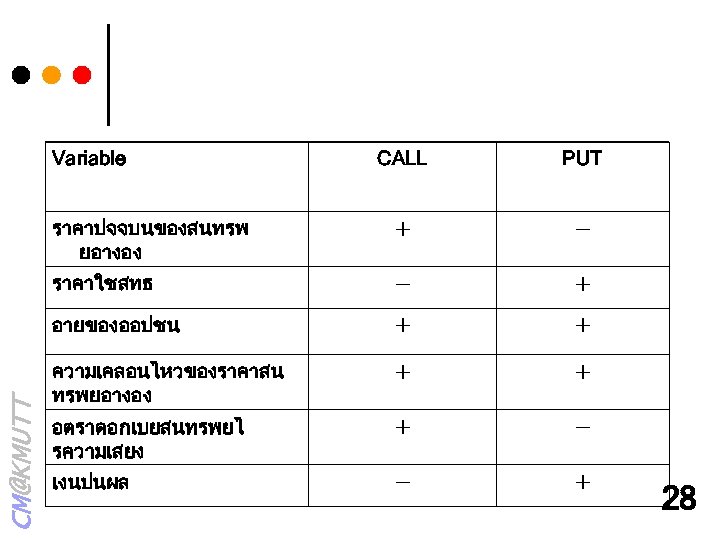
CALL PUT ราคาปจจบนของสนทรพ ยอางอง + - ราคาใชสทธ - + อายของออปชน CM@KMUTT Variable + + ความเคลอนไหวของราคาสน ทรพยอางอง + + อตราดอกเบยสนทรพยไ รความเสยง + - เงนปนผล - + 28
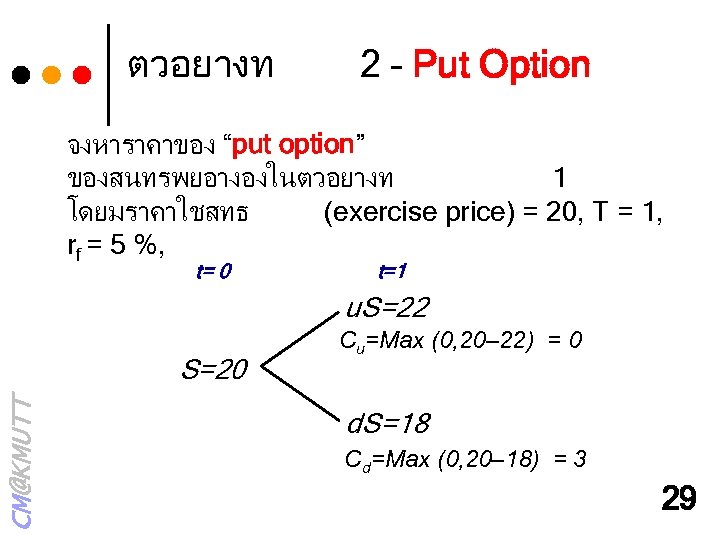
ตวอยางท 2 – Put Option จงหาราคาของ “put option” ของสนทรพยอางองในตวอยางท 1 โดยมราคาใชสทธ (exercise price) = 20, T = 1, rf = 5 %, t= 0 t=1 u. S=22 CM@KMUTT S=20 Cu=Max (0, 20– 22) = 0 d. S=18 Cd=Max (0, 20– 18) = 3 29
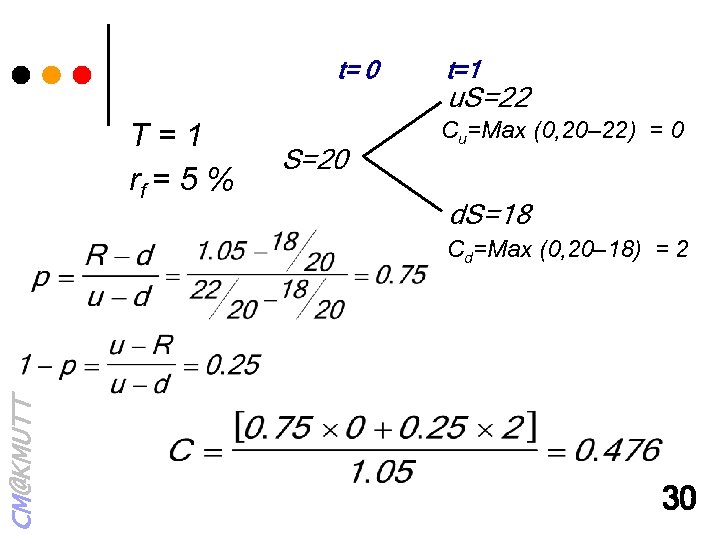
t= 0 T=1 rf = 5 % S=20 t=1 u. S=22 Cu=Max (0, 20– 22) = 0 d. S=18 CM@KMUTT Cd=Max (0, 20– 18) = 2 30
Generalization (1) 1. Single Multiple time step The example was single time step l In practice, multiple step valuation is necessary l CM@KMUTT l Dividing time into multiple step improves accuracy of the valuation 2. Matching volatility with u and d 3. Discrete Continuous compounding interest 31
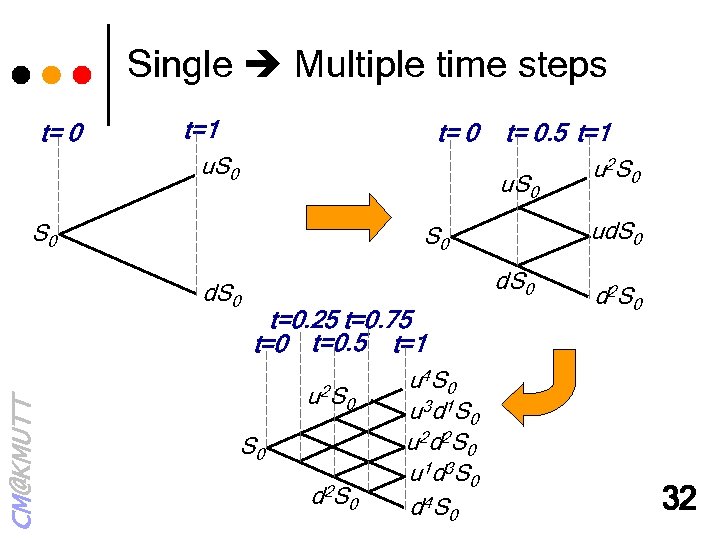
Single Multiple time steps t= 0 t=1 u. S 0 t= 0 S 0 ud. S 0 CM@KMUTT t= 0. 5 t=1 u 2 S 0 u. S 0 t=0. 25 t=0. 75 t=0. 5 t=1 u 4 S 0 u 2 S 0 u 3 d 1 S 0 u 2 d 2 S 0 u 1 d 3 S 0 d 2 S 0 d 4 S 0 d 2 S 0 32
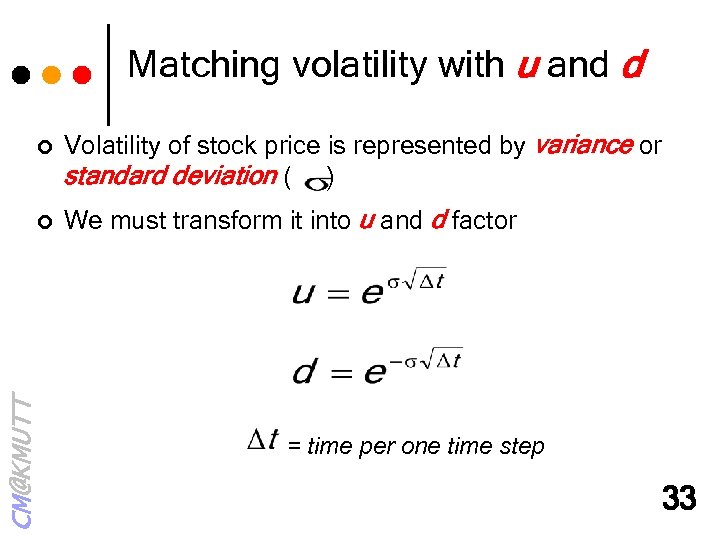
Matching volatility with u and d Volatility of stock price is represented by variance or standard deviation ( ) ¢ CM@KMUTT ¢ We must transform it into u and d factor = time per one time step 33
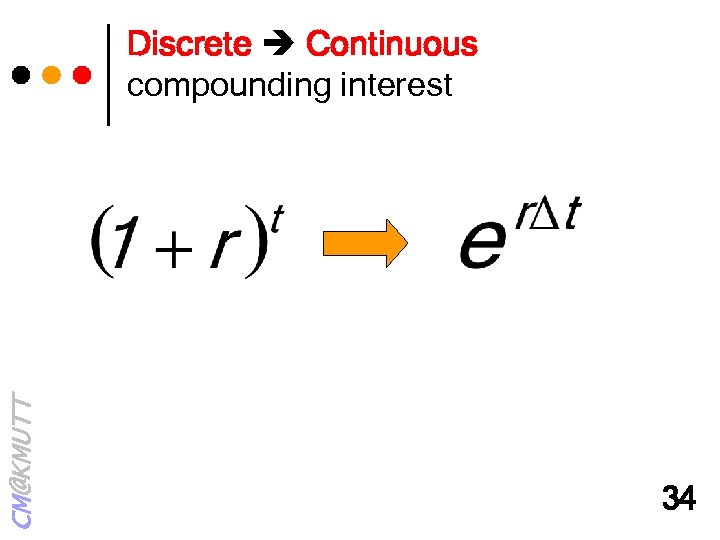
CM@KMUTT Discrete Continuous compounding interest 34
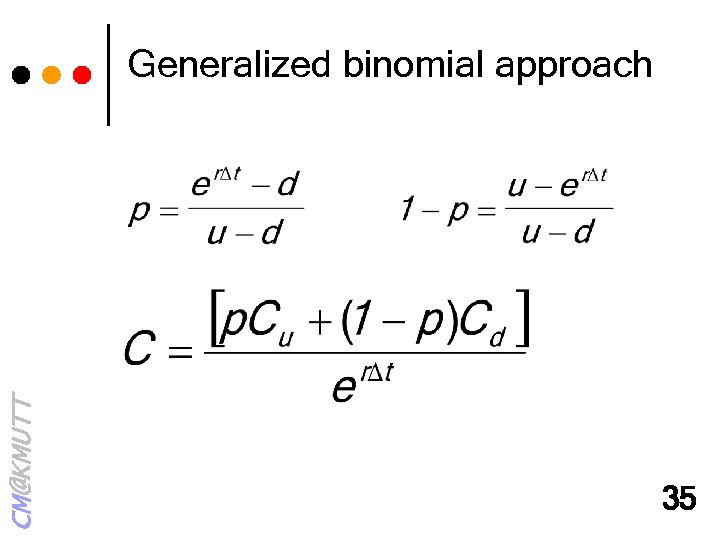
CM@KMUTT Generalized binomial approach 35
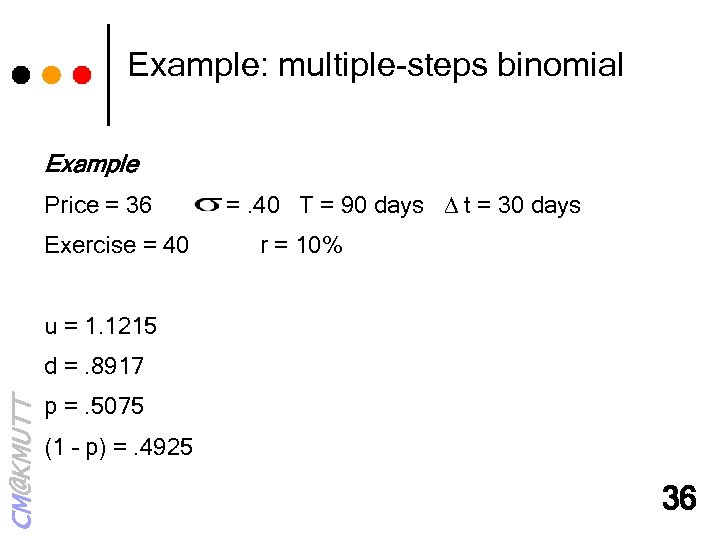
Example: multiple-steps binomial Example Price = 36 Exercise = 40 =. 40 T = 90 days D t = 30 days r = 10% u = 1. 1215 CM@KMUTT d =. 8917 p =. 5075 (1 – p) =. 4925 36
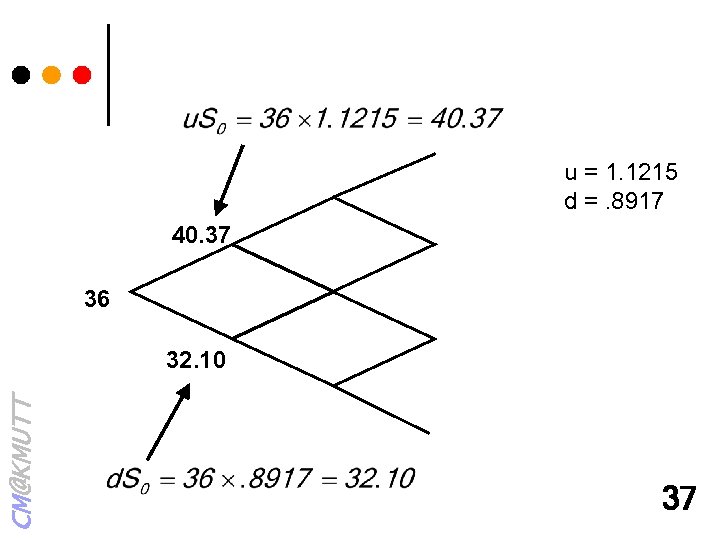
u = 1. 1215 d =. 8917 40. 37 36 CM@KMUTT 32. 10 37
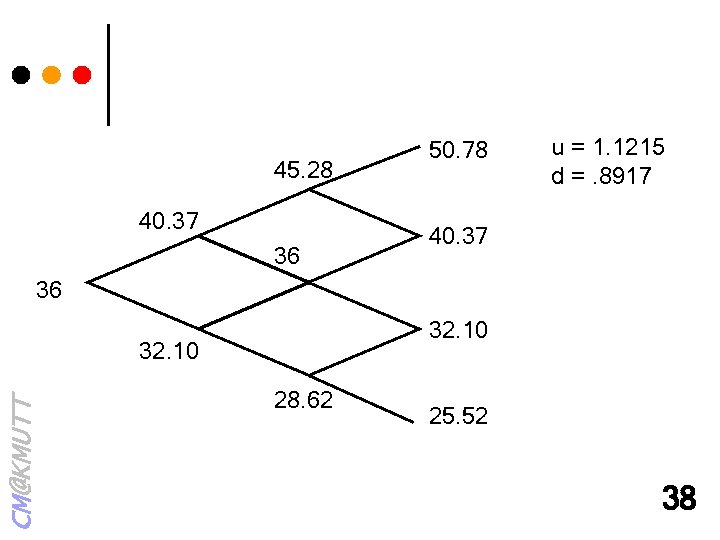
45. 28 40. 37 36 50. 78 u = 1. 1215 d =. 8917 40. 37 36 32. 10 CM@KMUTT 32. 10 28. 62 25. 52 38
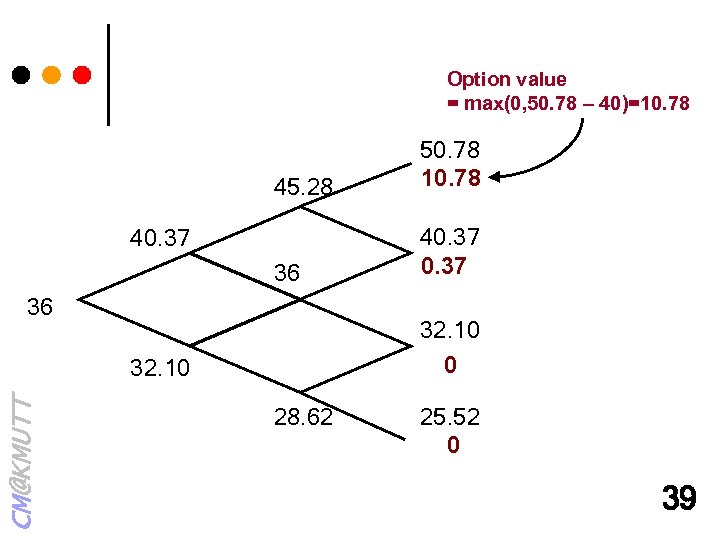
Option value = max(0, 50. 78 – 40)=10. 78 45. 28 50. 78 10. 78 36 40. 37 36 32. 10 0 CM@KMUTT 32. 10 28. 62 25. 52 0 39
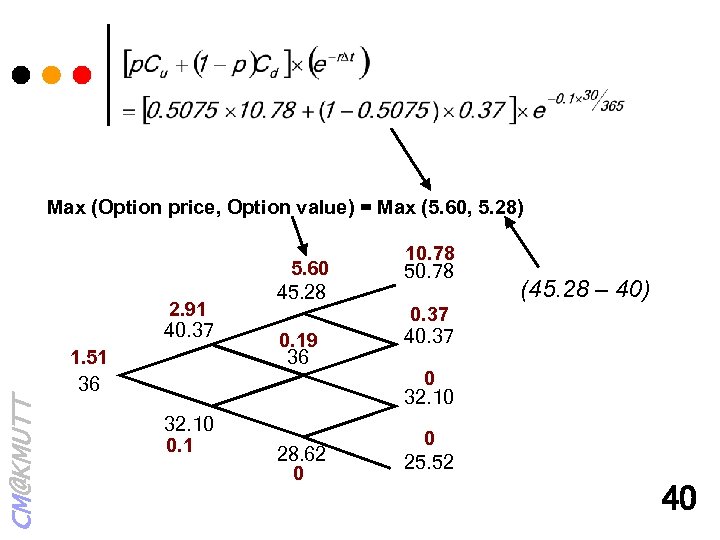
Max (Option price, Option value) = Max (5. 60, 5. 28) 2. 91 40. 37 CM@KMUTT 1. 51 36 32. 10 0. 1 5. 60 45. 28 0. 19 36 28. 62 0 10. 78 50. 78 (45. 28 – 40) 0. 37 40. 37 0 32. 10 0 25. 52 40
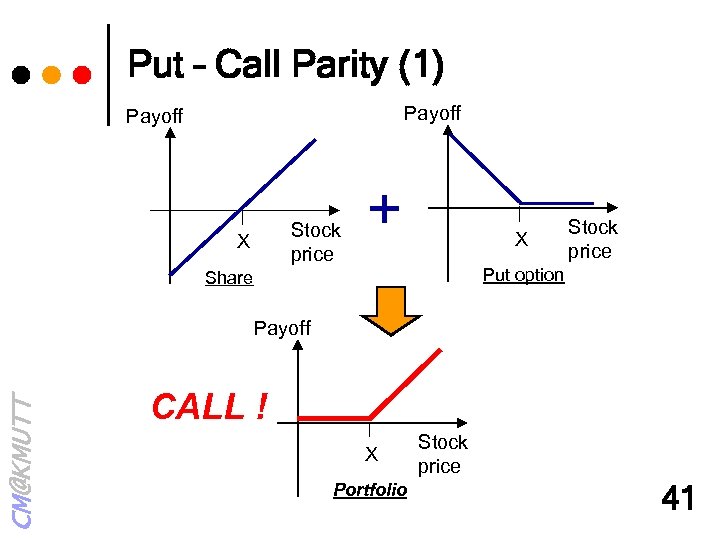
Put – Call Parity (1) Payoff Stock price X + X Stock price Put option Share CM@KMUTT Payoff CALL ! X Portfolio Stock price 41
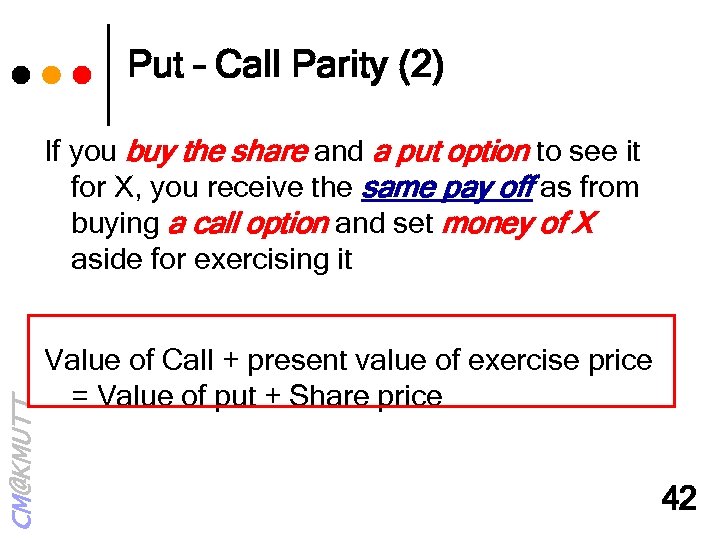
Put – Call Parity (2) CM@KMUTT If you buy the share and a put option to see it for X, you receive the same pay off as from buying a call option and set money of X aside for exercising it Value of Call + present value of exercise price = Value of put + Share price 42
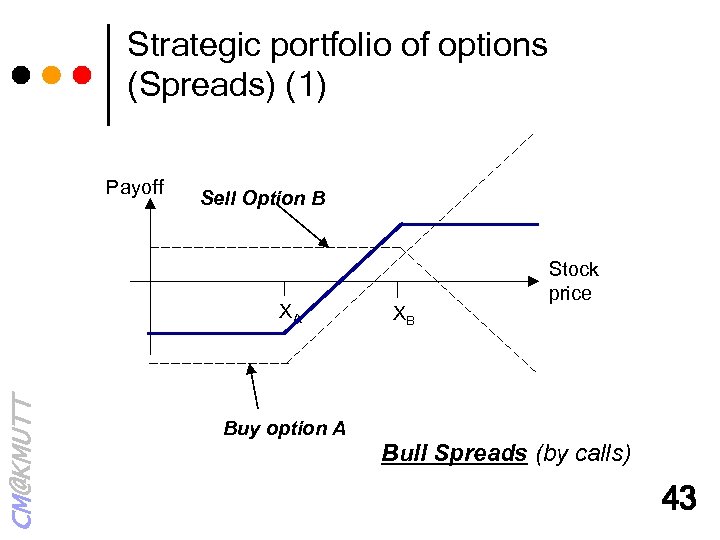
Strategic portfolio of options (Spreads) (1) Payoff Sell Option B CM@KMUTT XA XB Stock price Buy option A Bull Spreads (by calls) 43
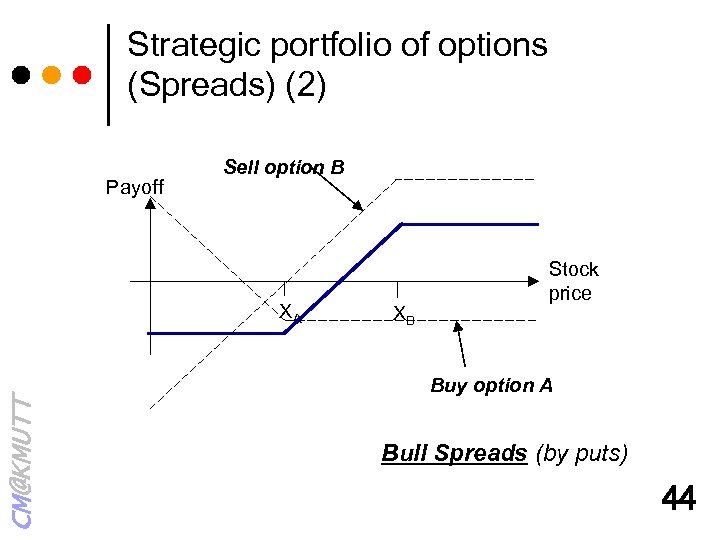
Strategic portfolio of options (Spreads) (2) Payoff Sell option B XA XB Stock price CM@KMUTT Buy option A Bull Spreads (by puts) 44
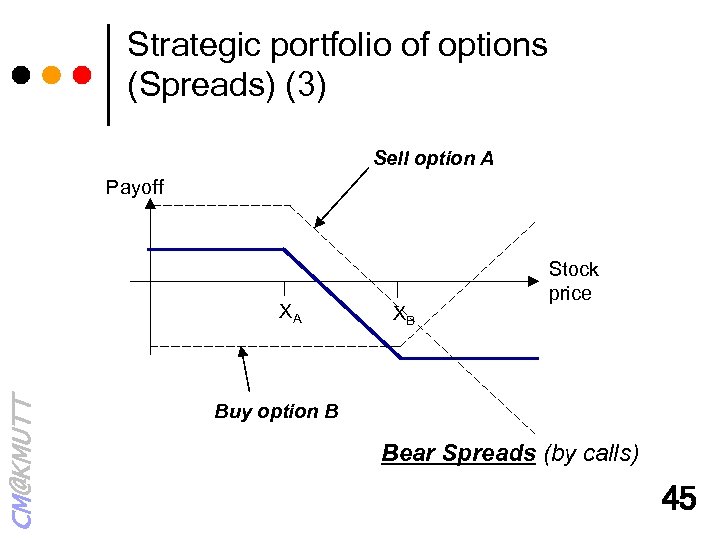
Strategic portfolio of options (Spreads) (3) Sell option A Payoff CM@KMUTT XA XB Stock price Buy option B Bear Spreads (by calls) 45
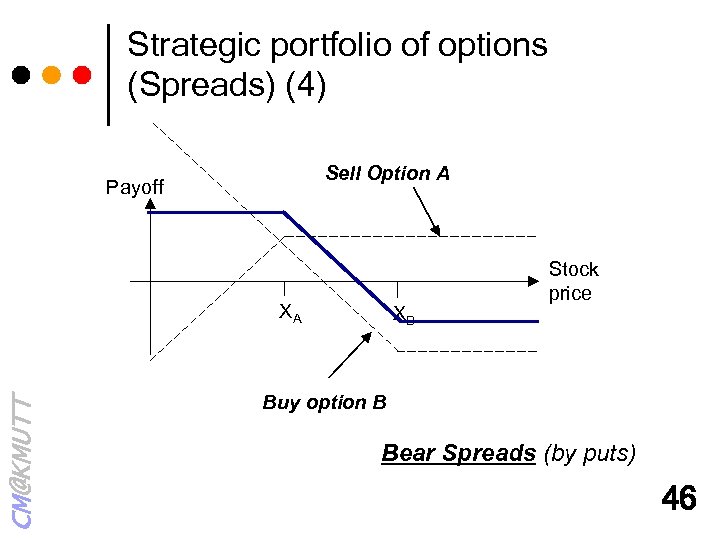
Strategic portfolio of options (Spreads) (4) Sell Option A Payoff CM@KMUTT XA XB Stock price Buy option B Bear Spreads (by puts) 46
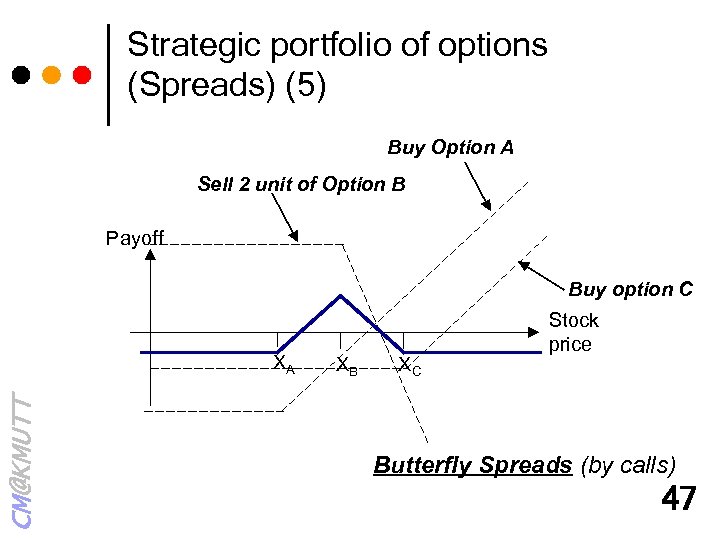
Strategic portfolio of options (Spreads) (5) Buy Option A Sell 2 unit of Option B Payoff Buy option C CM@KMUTT XA XB XC Stock price Butterfly Spreads (by calls) 47
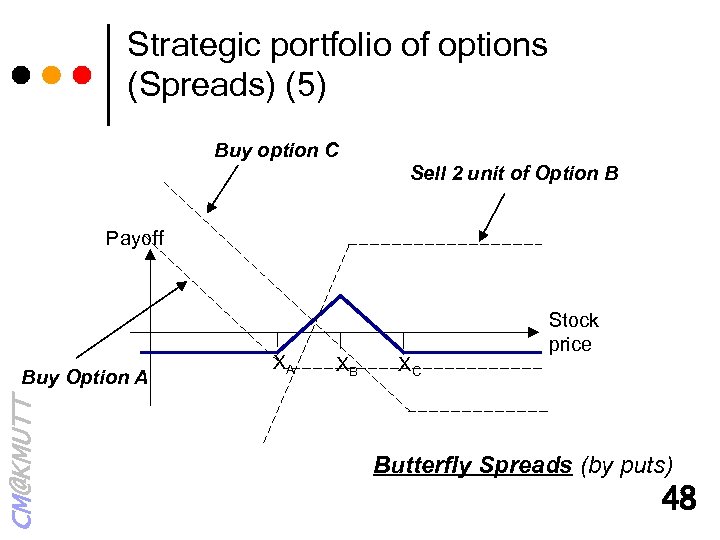
Strategic portfolio of options (Spreads) (5) Buy option C Sell 2 unit of Option B Payoff CM@KMUTT Buy Option A XA XB XC Stock price Butterfly Spreads (by puts) 48
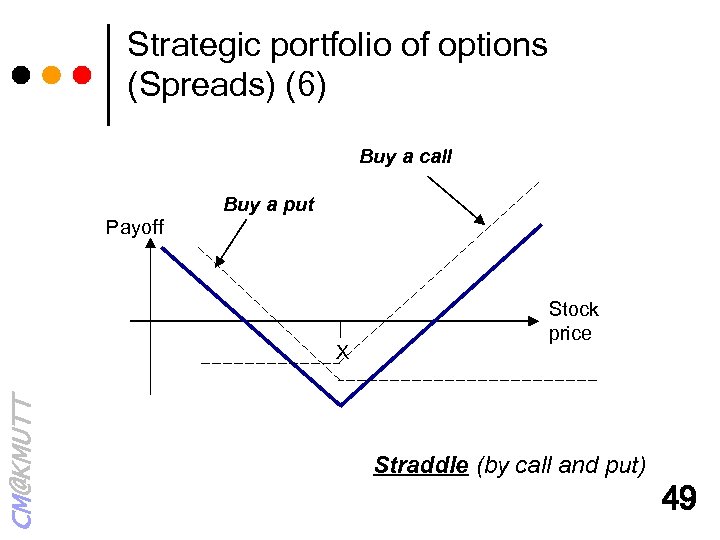
Strategic portfolio of options (Spreads) (6) Buy a call Buy a put Payoff CM@KMUTT X Stock price Straddle (by call and put) 49
CM@KMUTT What’s “Real Options”? 50
What is “Real Options”? ¢ Options l ¢ Real Options l CM@KMUTT The right, but not the obligation, to buy (or sell) an asset at some predetermined price within a specified period of time The right, but not the obligation, to take action with a predetermined expenses within a specified period of time 51
Where are they? ¢ “Real ¢ Options are everywhere” Real Options are embedded in almost every activities (both business and non-business) Investment l CM@KMUTT l Life l Industrial activity l Construction process l Etc. 52
What “Real Options” help? ¢ Concept of real options is used for over a decade in investment valuation theory ¢ Real options fit management’s intuition better than the traditional way of valuation (NPV) NPV assumes that management looks passively during project process ¢ CM@KMUTT ¢ In fact, management can actively takes valuable actions that can improve profitability of the project ¢ Management actions are “Real Options” – the right but not obligation to take action 53
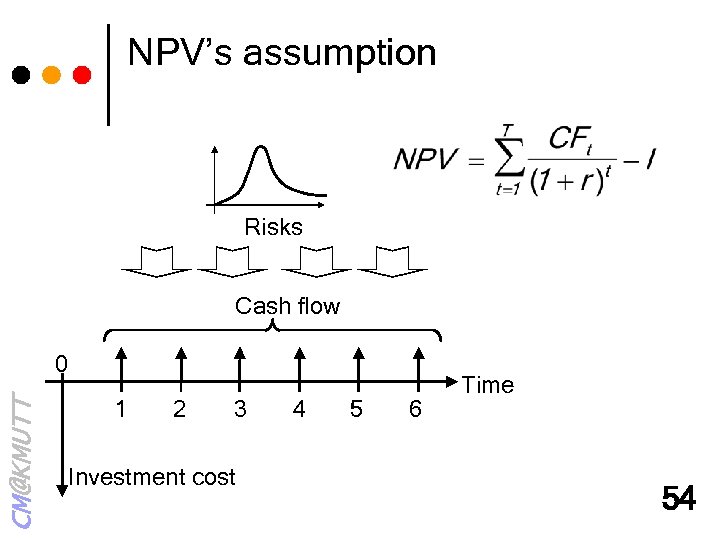
NPV’s assumption Risks Cash flow CM@KMUTT 0 1 2 3 Investment cost 4 5 6 Time 54
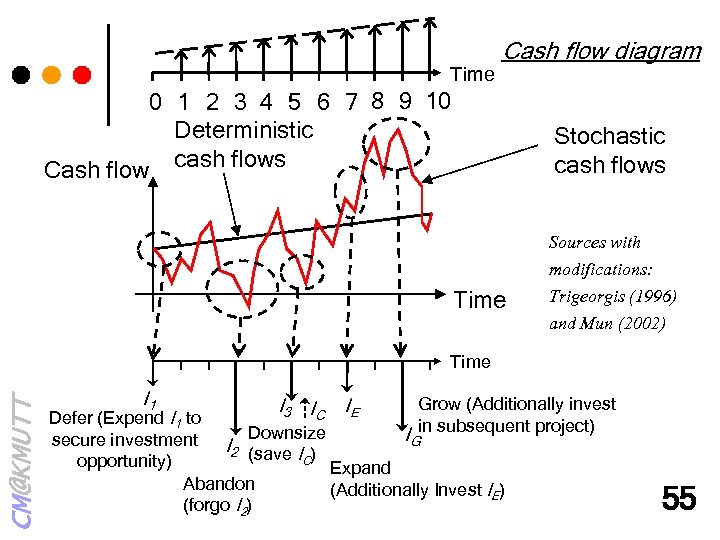
Time Cash flow diagram 0 1 2 3 4 5 6 7 8 9 10 Deterministic Cash flow cash flows Stochastic cash flows Time Sources with modifications: Trigeorgis (1996) and Mun (2002) CM@KMUTT Time I 1 Grow (Additionally invest I 3 IC IE Defer (Expend I 1 to Downsize IGin subsequent project) secure investment I 2 (save I ) C opportunity) Expand Abandon (Additionally Invest IE) (forgo I 2) 55
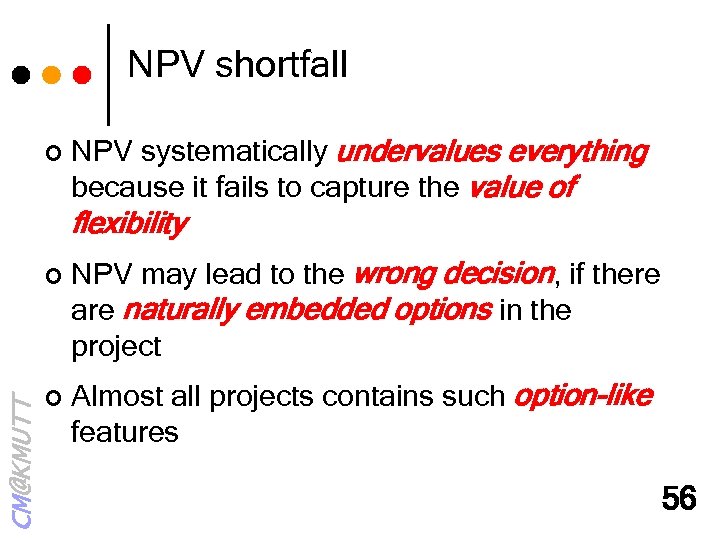
NPV shortfall ¢ NPV systematically undervalues everything because it fails to capture the value of flexibility CM@KMUTT ¢ NPV may lead to the wrong decision, if there are naturally embedded options in the project ¢ Almost all projects contains such option-like features 56
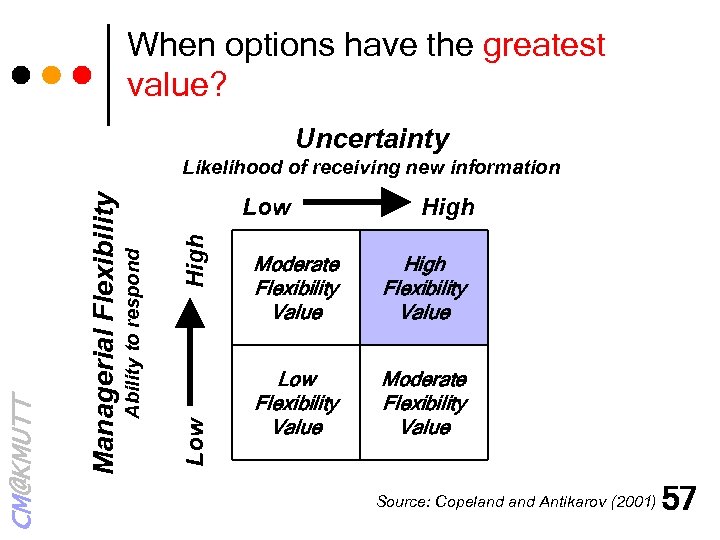
When options have the greatest value? Uncertainty Low High Low Ability to respond Managerial Flexibility CM@KMUTT Likelihood of receiving new information High Moderate Flexibility Value High Flexibility Value Low Flexibility Value Moderate Flexibility Value Source: Copeland Antikarov (2001) 57
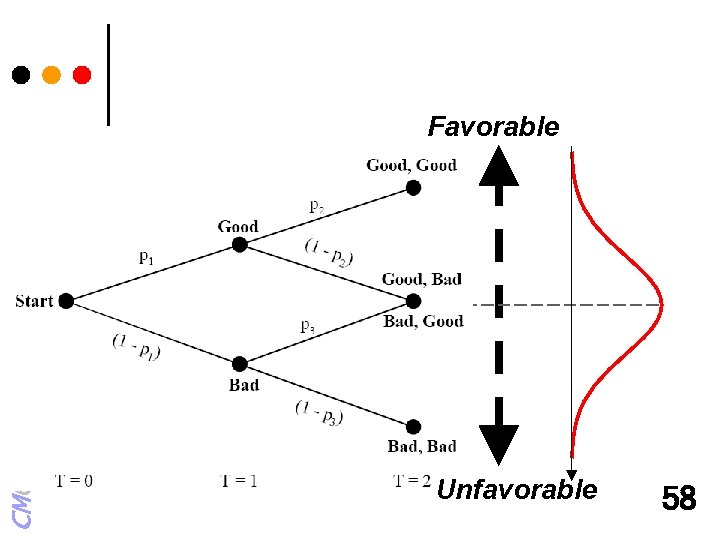
CM@KMUTT Favorable Unfavorable 58
How can we have options? Naturally embedded option in many activities ¢ CM@KMUTT ¢ By creation 59
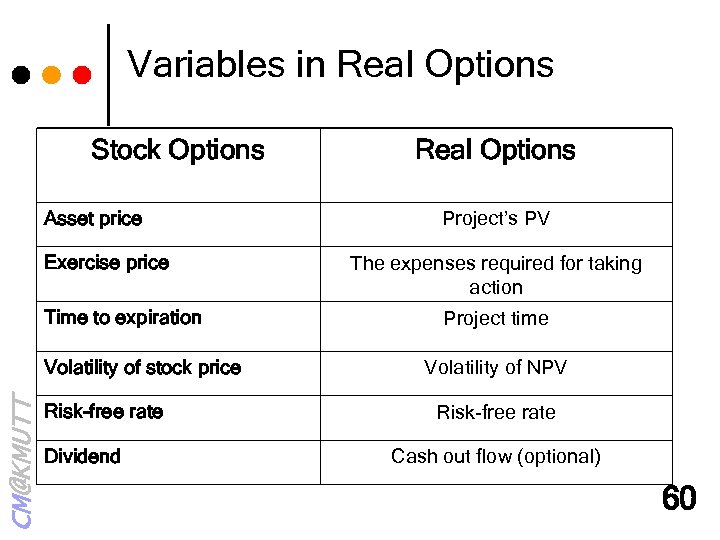
Variables in Real Options Stock Options Asset price Exercise price Time to expiration CM@KMUTT Volatility of stock price Risk-free rate Dividend Real Options Project’s PV The expenses required for taking action Project time Volatility of NPV Risk-free rate Cash out flow (optional) 60
CM@KMUTT “Real options” in investment valuation 61
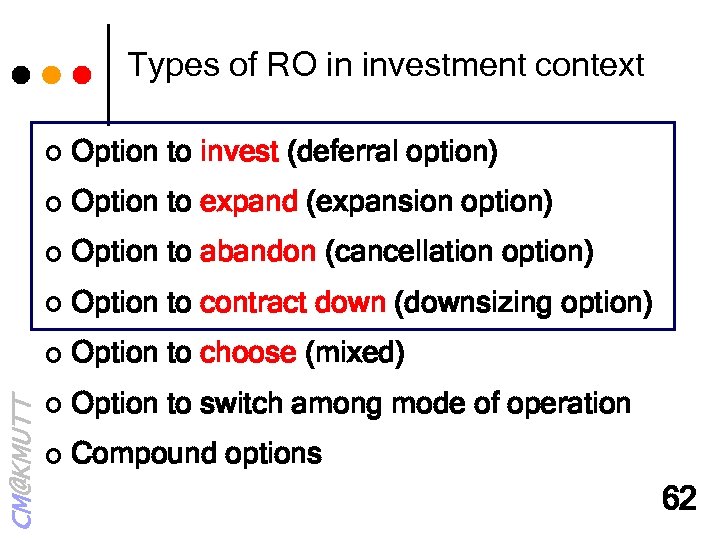
Types of RO in investment context Option to invest (deferral option) ¢ Option to expand (expansion option) ¢ Option to abandon (cancellation option) ¢ Option to contract down (downsizing option) ¢ CM@KMUTT ¢ Option to choose (mixed) ¢ Option to switch among mode of operation ¢ Compound options 62
CM@KMUTT Option to invest 63
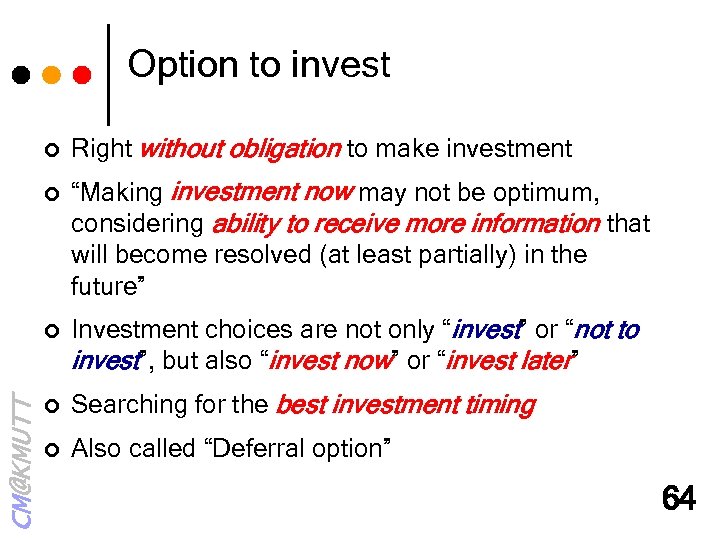
Option to invest Right without obligation to make investment ¢ “Making investment now may not be optimum, considering ability to receive more information that will become resolved (at least partially) in the future” ¢ CM@KMUTT ¢ Investment choices are not only “invest” or “not to invest”, but also “invest now” or “invest later” ¢ Searching for the best investment timing ¢ Also called “Deferral option” 64
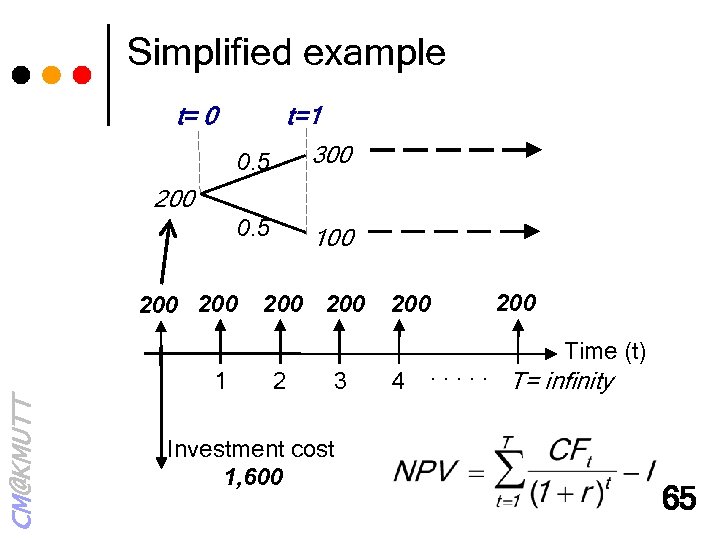
Simplified example t= 0 t=1 0. 5 300 0. 5 100 200 200 Time (t) CM@KMUTT 1 2 3 Investment cost 1, 600 4 . . . T= infinity 65
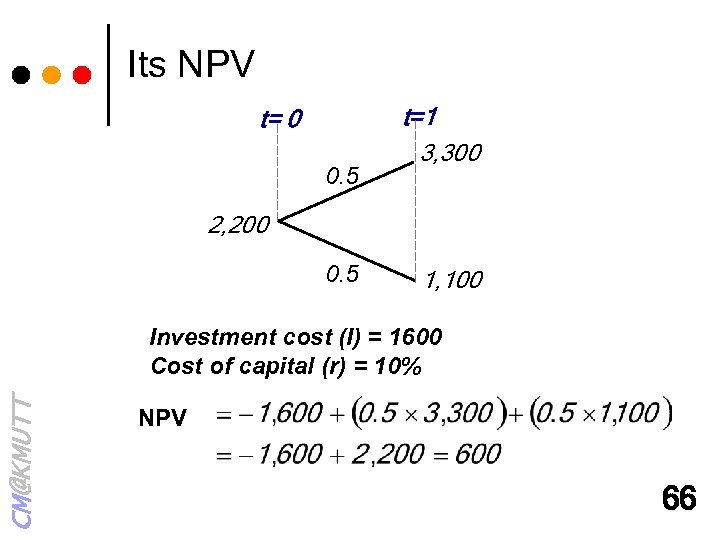
Its NPV t= 0 0. 5 t=1 3, 300 2, 200 0. 5 1, 100 CM@KMUTT Investment cost (I) = 1600 Cost of capital (r) = 10% NPV 66
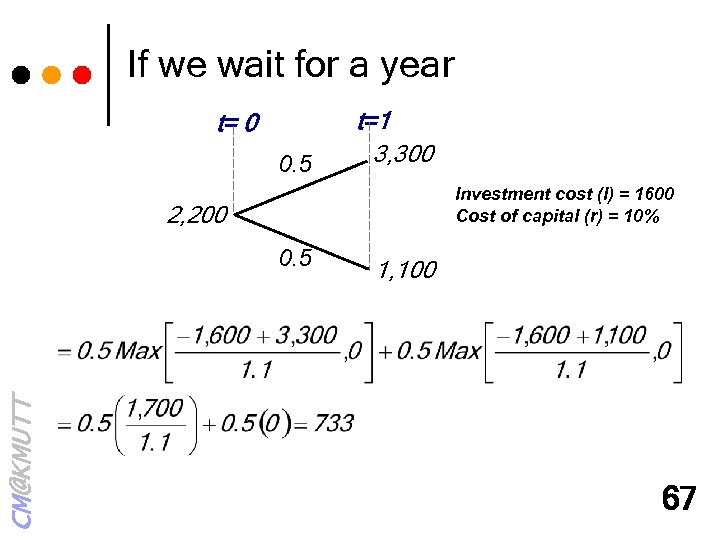
If we wait for a year t= 0 0. 5 t=1 3, 300 Investment cost (I) = 1600 Cost of capital (r) = 10% 2, 200 CM@KMUTT 0. 5 1, 100 67
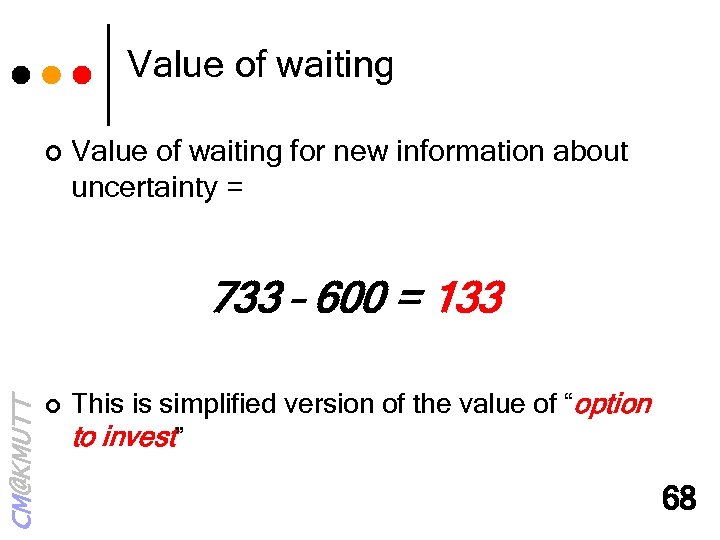
Value of waiting ¢ Value of waiting for new information about uncertainty = CM@KMUTT 733 – 600 = 133 ¢ This is simplified version of the value of “option to invest” 68
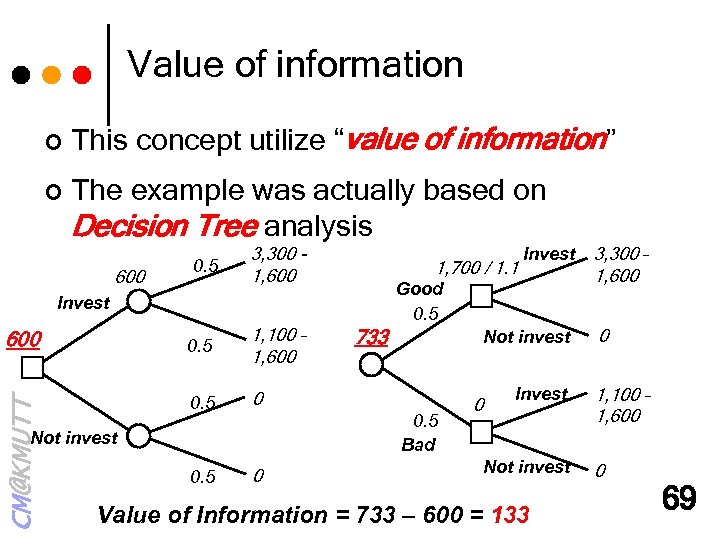
Value of information ¢ This concept utilize “value of information” ¢ The example was actually based on Decision Tree analysis 600 0. 5 3, 300 1, 600 1, 700 / 1. 1 Good 0. 5 1, 100 – 1, 600 CM@KMUTT Invest 600 0. 5 0 733 Not invest 0. 5 Bad Not invest Invest 3, 300 – 0 Invest Not invest Value of Information = 733 – 600 = 133 1, 600 0 1, 100 – 1, 600 0 69
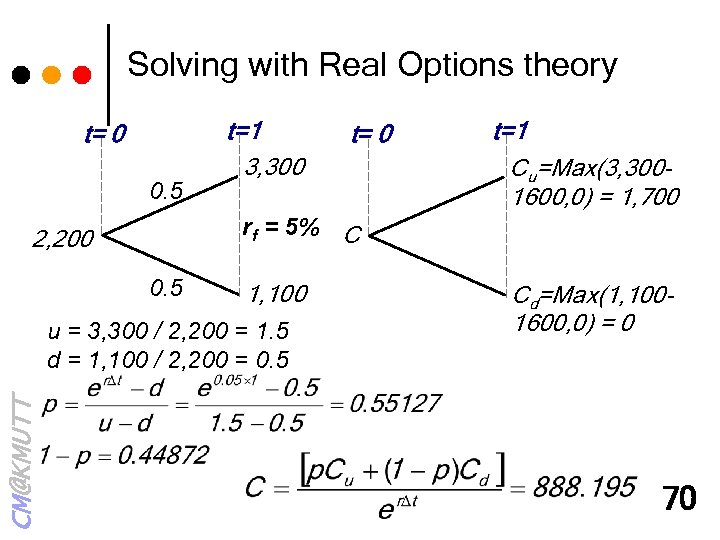
Solving with Real Options theory t= 0 0. 5 t=1 3, 300 t=1 Cu=Max(3, 3001600, 0) = 1, 700 rf = 5% C 2, 200 0. 5 1, 100 u = 3, 300 / 2, 200 = 1. 5 d = 1, 100 / 2, 200 = 0. 5 CM@KMUTT t= 0 Cd=Max(1, 1001600, 0) = 0 70
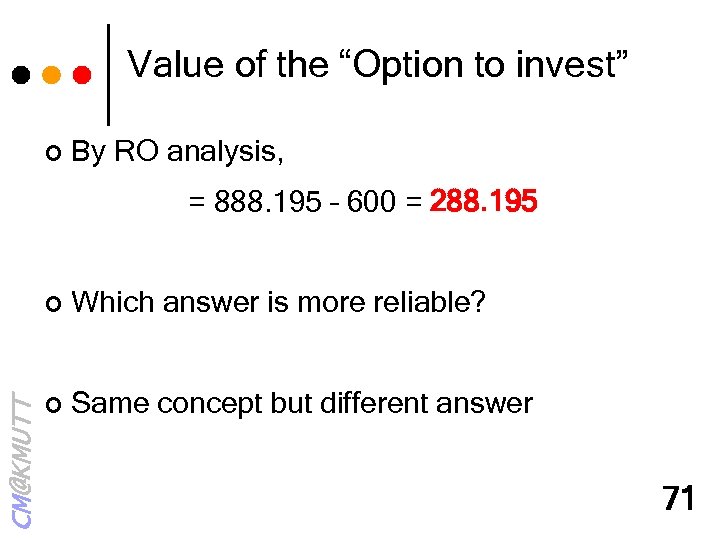
Value of the “Option to invest” ¢ By RO analysis, = 888. 195 – 600 = 288. 195 CM@KMUTT ¢ Which answer is more reliable? ¢ Same concept but different answer 71
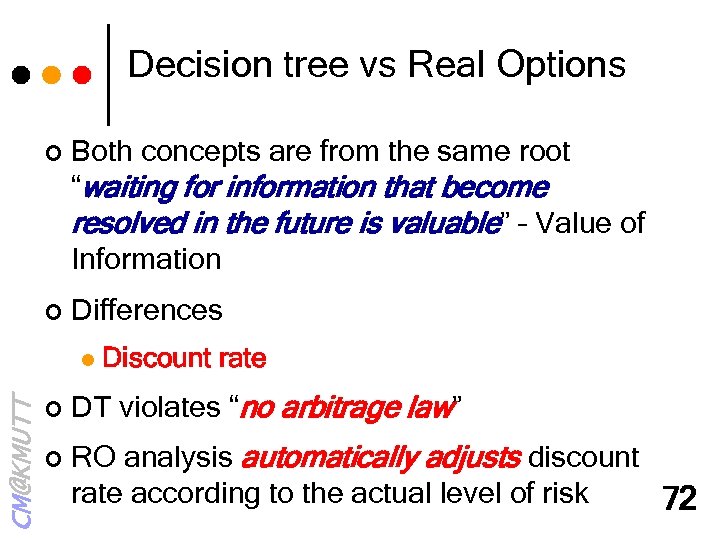
Decision tree vs Real Options ¢ Both concepts are from the same root “waiting for information that become resolved in the future is valuable” – Value of Information ¢ Differences CM@KMUTT l Discount rate ¢ DT violates “no arbitrage law” ¢ RO analysis automatically adjusts discount rate according to the actual level of risk 72
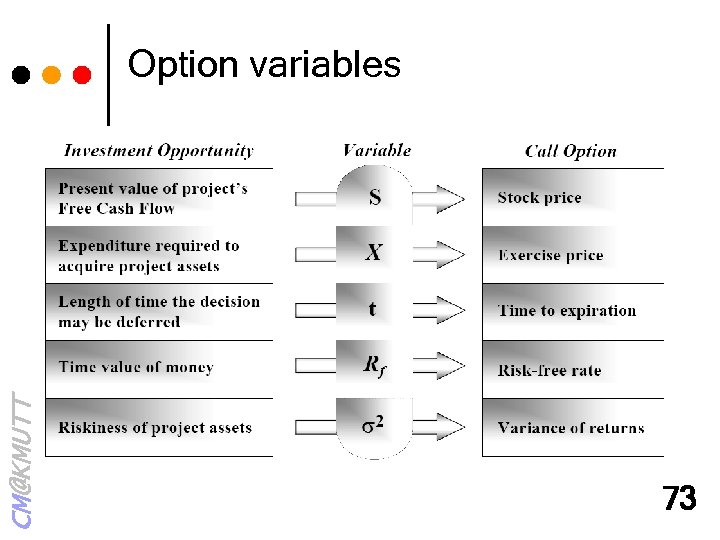
CM@KMUTT Option variables 73
CM@KMUTT Option to expand 74
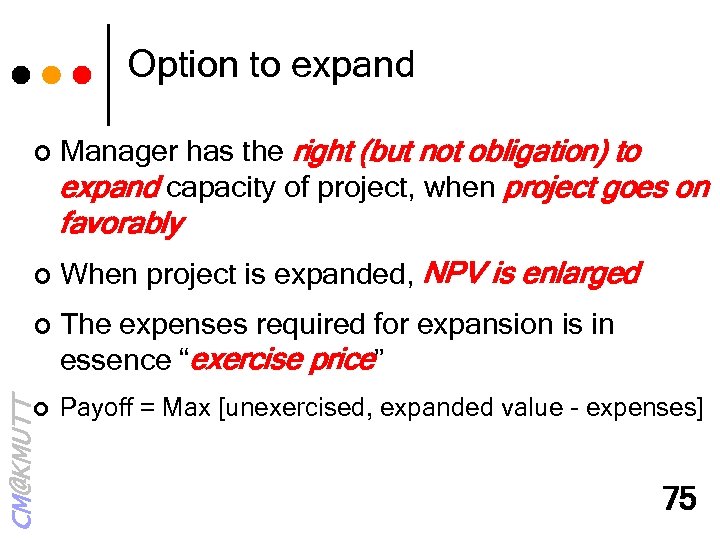
Option to expand ¢ Manager has the right (but not obligation) to expand capacity of project, when project goes on favorably When project is expanded, NPV is enlarged ¢ The expenses required for expansion is in essence “exercise price” CM@KMUTT ¢ ¢ Payoff = Max [unexercised, expanded value - expenses] 75
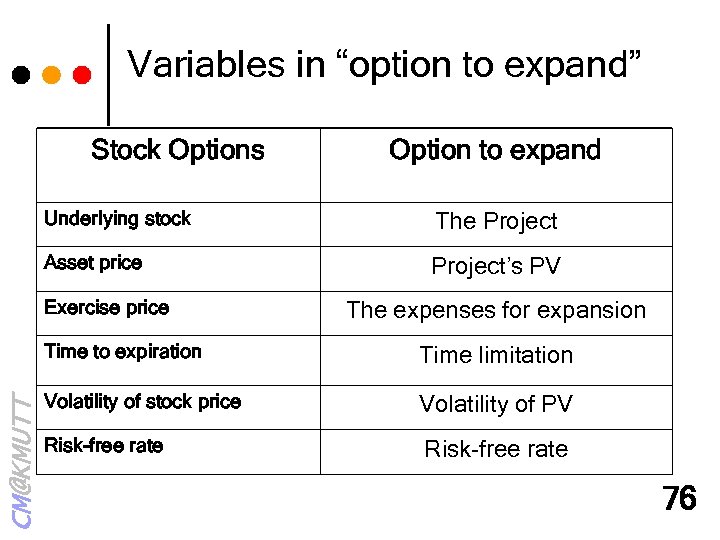
Variables in “option to expand” Stock Options Option to expand Underlying stock The Project Asset price Project’s PV Exercise price The expenses for expansion CM@KMUTT Time to expiration Time limitation Volatility of stock price Volatility of PV Risk-free rate 76
Option to abandon CM@KMUTT (cancellation) 77
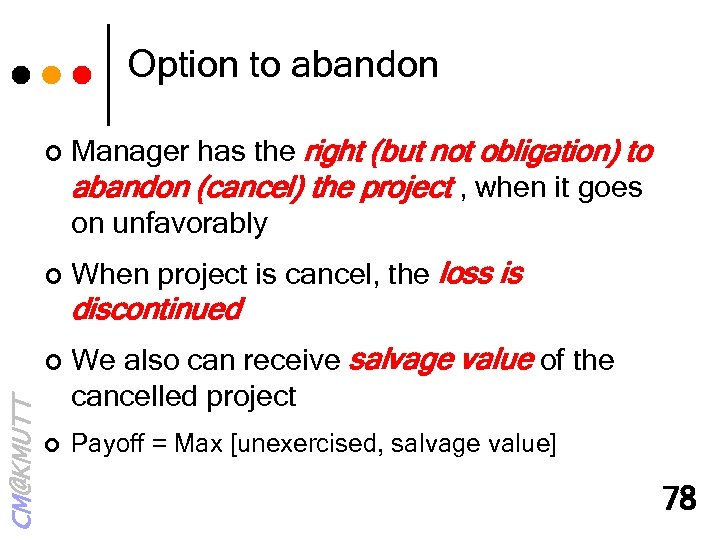
Option to abandon ¢ Manager has the right (but not obligation) to abandon (cancel) the project , when it goes on unfavorably ¢ When project is cancel, the loss is discontinued CM@KMUTT ¢ ¢ We also can receive salvage value of the cancelled project Payoff = Max [unexercised, salvage value] 78
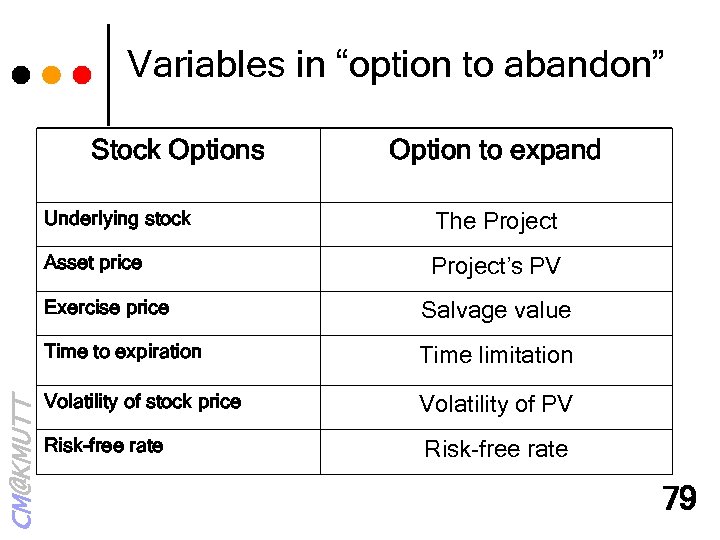
Variables in “option to abandon” Stock Options Option to expand Underlying stock The Project Asset price Project’s PV Salvage value Time to expiration CM@KMUTT Exercise price Time limitation Volatility of stock price Volatility of PV Risk-free rate 79
Option to contract CM@KMUTT (downsizing) 80
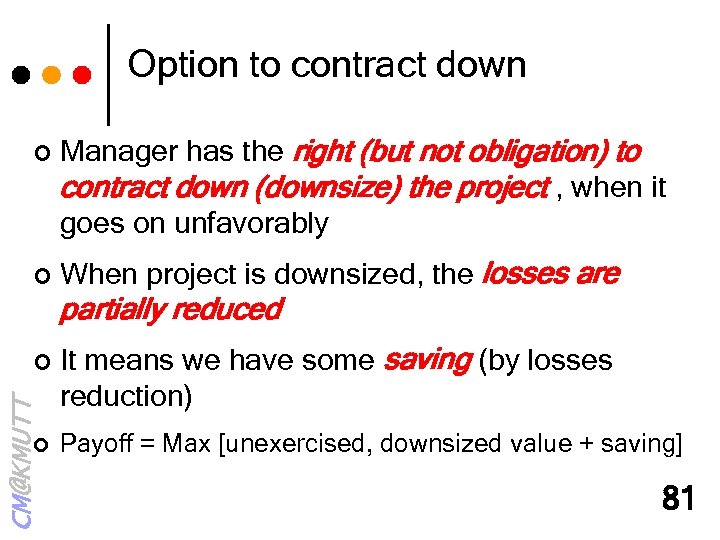
Option to contract down ¢ Manager has the right (but not obligation) to contract down (downsize) the project , when it goes on unfavorably ¢ When project is downsized, the losses are partially reduced CM@KMUTT ¢ ¢ It means we have some saving (by losses reduction) Payoff = Max [unexercised, downsized value + saving] 81
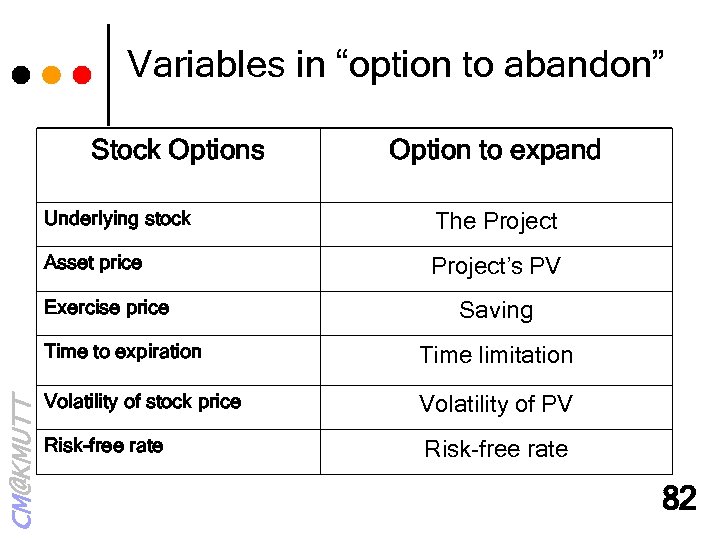
Variables in “option to abandon” Stock Options Option to expand Underlying stock The Project Asset price Project’s PV Exercise price Saving CM@KMUTT Time to expiration Time limitation Volatility of stock price Volatility of PV Risk-free rate 82
Option to choose CM@KMUTT (expansion + cancellation + downsizing) 83
Option to choose ¢ Manager has the right (but not obligation) to expand, abandon or contract down the project , according to changing uncertainties CM@KMUTT ¢ Manager hold a portfolio consisted of “option to expand”, “option to abandon”, and “option to contract” ¢ Payoff = Max [unexercised, expand, contract, abandon] 84
Interaction of options in portfolio ¢ Sum of value of options in portfolio is not equal to value of portfolio of options ¢ Exercise of one option affects the others ¢ For example, CM@KMUTT l Exercise of abandon option killed the other options l Exercise of contract down option downsize magnitudes of the other options 85
Compound option ¢ Options whose value is contingent on the value of other options ¢ Option on Option ¢ Two types: CM@KMUTT l Simultaneously compound – option on equity (stock) l Sequentially compound – phased investment, R&D investment 86
Switching option ¢ Buying flexibility ¢ Right (without obligation) to change to better mode of production when environment is changed ¢ Change mode of production CM@KMUTT = abandon existing mode + utilize the other mode 87
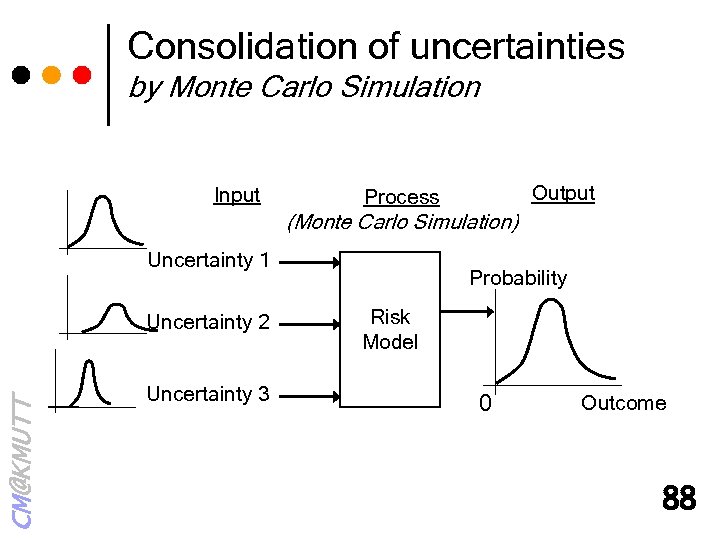
Consolidation of uncertainties by Monte Carlo Simulation Input Output Process (Monte Carlo Simulation) Uncertainty 1 CM@KMUTT Uncertainty 2 Uncertainty 3 Probability Risk Model 0 Outcome 88
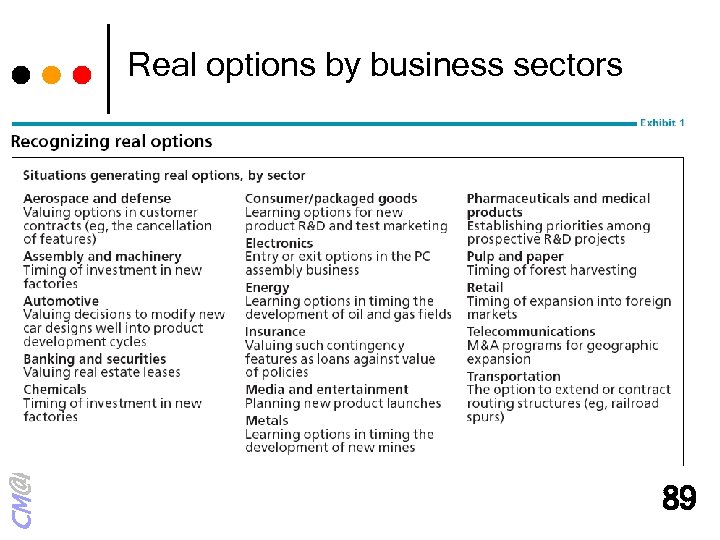
CM@KMUTT Real options by business sectors 89
RO from risk management viewpoint (1) 1. Risk is not always unfavorable 2. By RO idea, more efforts should be made to maintain flexibility (to create options) 3. How to have option? l CM@KMUTT l Identify the existing (hidden) option Manage to have new option 90
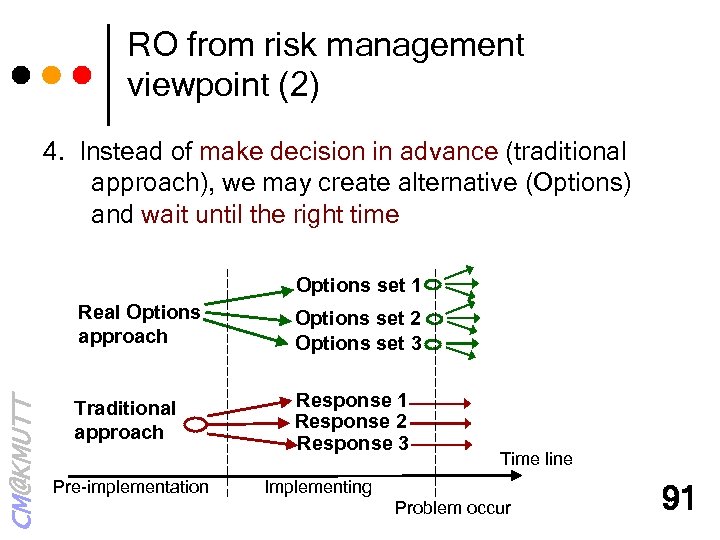
RO from risk management viewpoint (2) 4. Instead of make decision in advance (traditional approach), we may create alternative (Options) and wait until the right time Options set 1 CM@KMUTT Real Options approach Options set 2 Options set 3 Traditional approach Response 1 Response 2 Response 3 Pre-implementation Time line Implementing Problem occur 91
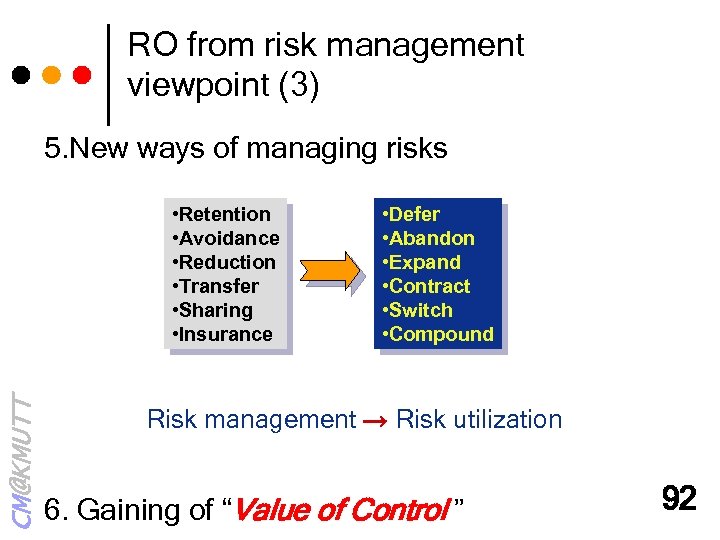
RO from risk management viewpoint (3) 5. New ways of managing risks CM@KMUTT • Retention • Avoidance • Reduction • Transfer • Sharing • Insurance • Defer • Abandon • Expand • Contract • Switch • Compound Risk management → Risk utilization 6. Gaining of “Value of Control ” 92
Utilizing concept of “real options” Environments in real market are somehow different from those in financial market ¢ Critical issue is “how to recognize and structure mechanism of RO in phenomenon occurred in everyday world” ¢ CM@KMUTT ¢ How to match real variables with options ¢ Aim is to meet “risk management” demand “lower risk premium” variables 93
Скачать презентацию 8 การพฒนาระบบโครงสรางพ นฐาน CVE 619 Infrastructure System Development
3fe08e81b968ae24d0762472e9837d5a.ppt