Скачать презентацию 7 th EGO conference on autonomous ocean gliders
1456065c31164b13d0c313058f66d5e0.ppt
- Количество слайдов: 21
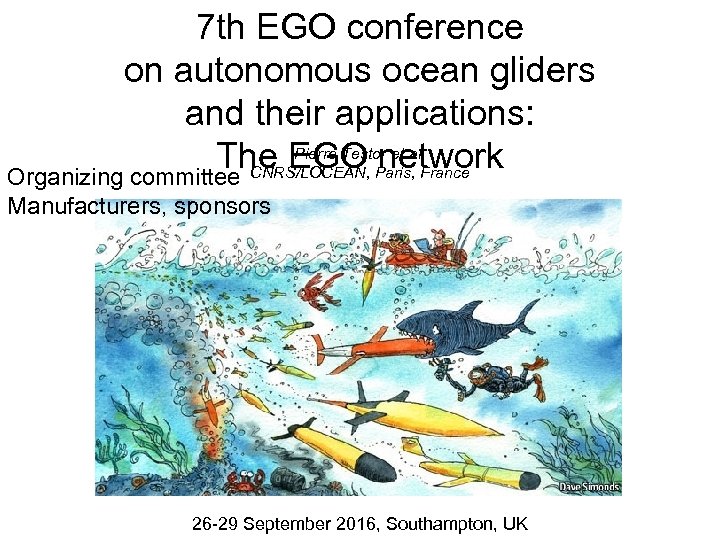 7 th EGO conference on autonomous ocean gliders and their applications: Pierre Testor et al. The EGO network Organizing committee CNRS/LOCEAN, Paris, France Manufacturers, sponsors 26 -29 September 2016, Southampton, UK
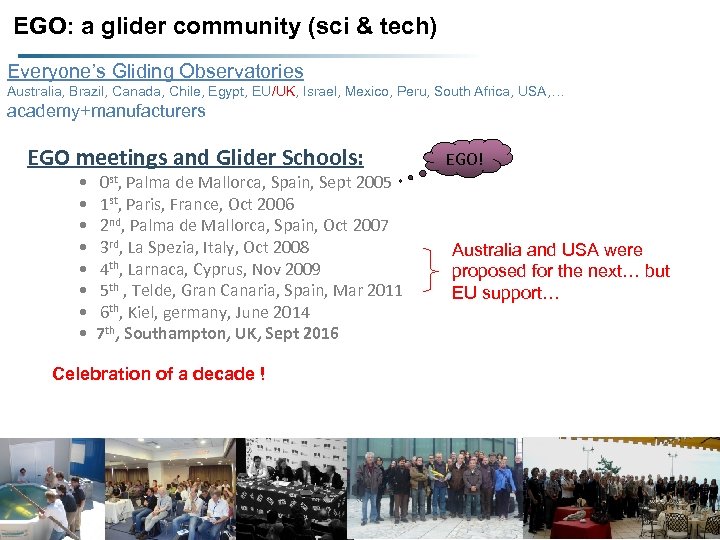 EGO: a glider community (sci & tech) Everyone’s Gliding Observatories Australia, Brazil, Canada, Chile, Egypt, EU/UK, Israel, Mexico, Peru, South Africa, USA, … academy+manufacturers EGO meetings and Glider Schools: • • 0 st, Palma de Mallorca, Spain, Sept 2005 1 st, Paris, France, Oct 2006 2 nd, Palma de Mallorca, Spain, Oct 2007 3 rd, La Spezia, Italy, Oct 2008 4 th, Larnaca, Cyprus, Nov 2009 5 th , Telde, Gran Canaria, Spain, Mar 2011 6 th, Kiel, germany, June 2014 7 th, Southampton, UK, Sept 2016 Celebration of a decade ! EGO! Australia and USA were proposed for the next… but EU support…
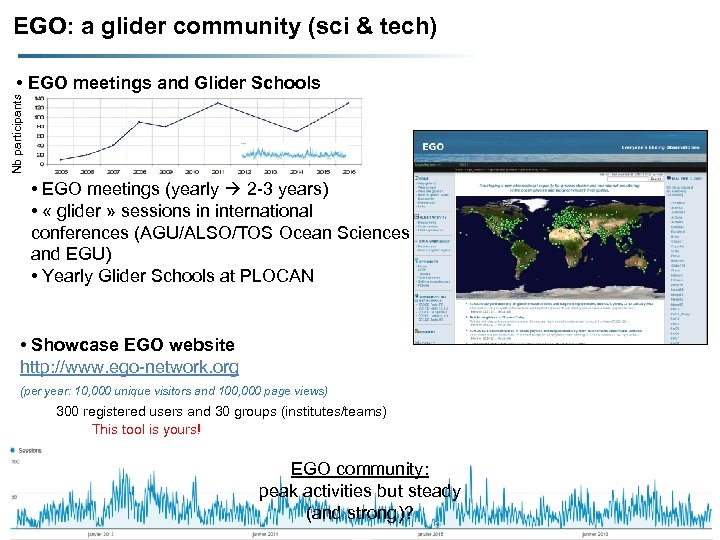 EGO: a glider community (sci & tech) Nb participants • EGO meetings and Glider Schools • EGO meetings (yearly 2 -3 years) • « glider » sessions in international conferences (AGU/ALSO/TOS Ocean Sciences and EGU) • Yearly Glider Schools at PLOCAN • Showcase EGO website http: //www. ego-network. org (per year: 10, 000 unique visitors and 100, 000 page views) 300 registered users and 30 groups (institutes/teams) This tool is yours! EGO community: peak activities but steady (and strong)?
 EGO: a glider community (sci & tech) • Coordination at different levels • best practice, standardization • data management • Spin-off of international/national research and development projects (regional, national, EU, international) Multi-institutional, with heterogeneous fleets, (but) coordinated experiments • (outreach) we have to reach out! All indicators must be gre have to find a way. We are stronger together ! Coordination brings unity of action and integrates different activities of organisation. bringing together the activities and resources of organisation and bringing harmony in them. various departments of an organisation are working independently and there is need to relate and integrate their activities. Tangible medium term socio-economic impacts we can have more ambitious targets than individually I will try to express a shared vision science technology society
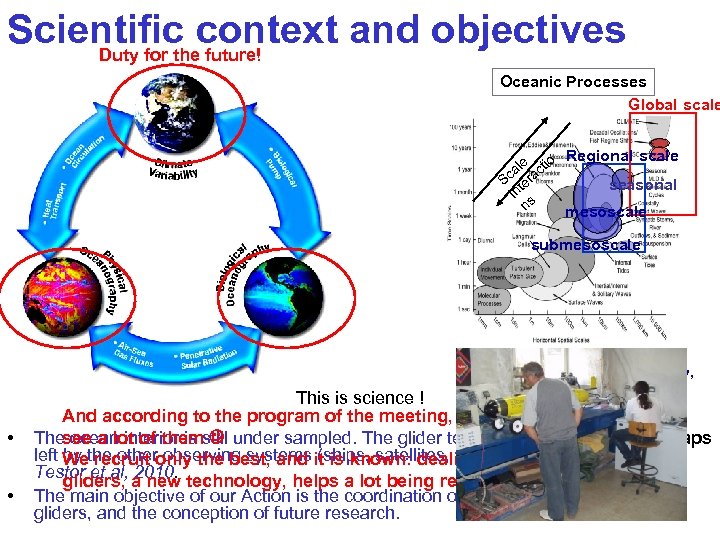 Scientific context and objectives Duty for the future! Oceanic Processes Global scale e io Regional scale al act Sc ter seasonal in ns mesoscale submesoscale - climate - «green» objectives, security, industry • • This is science ! And according to the program of the meeting, we will The ocean interior is still under sampled. The glider technology can help fill the gaps see a lot of them left by the other observing systems (ships, satellites, moorings, floats, drifters). We recruit only the best, and it is known: dealing with Testor et al, 2010. 5 gliders, a new technology, helps a lot being recruited. The main objective of our Action is the coordination of ongoing research using gliders, and the conception of future research.
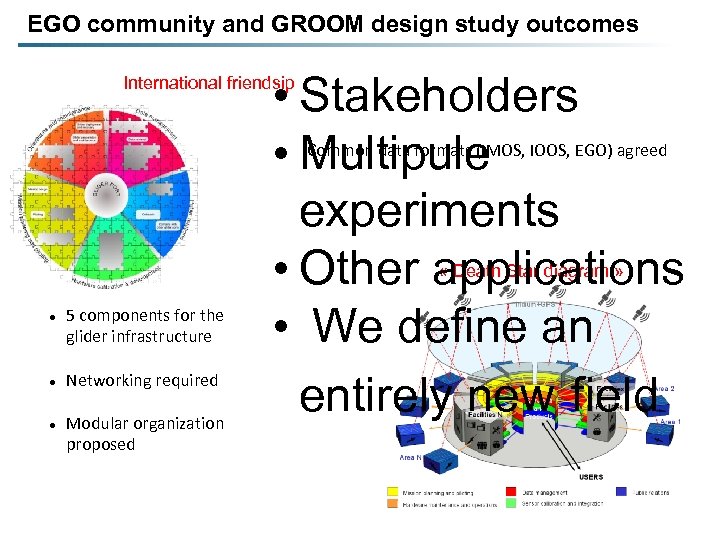 EGO community and GROOM design study outcomes • Stakeholders • Multipule experiments • Other applications • We define an entirely new field International friendsip Common data formats (IMOS, IOOS, EGO) agreed « Death Star diagram » 5 components for the glider infrastructure Networking required Modular organization proposed
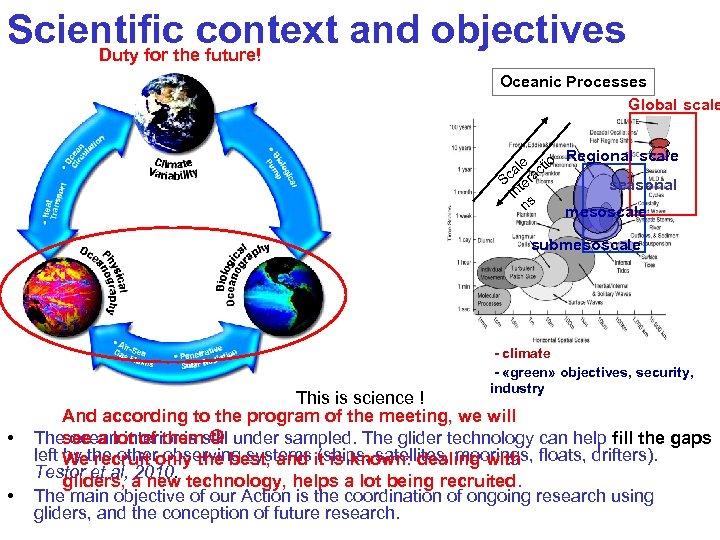 Scientific context and objectives Duty for the future! Oceanic Processes Global scale e io Regional scale al act Sc ter seasonal in ns mesoscale submesoscale - climate - «green» objectives, security, industry • • This is science ! And according to the program of the meeting, we will The ocean interior is still under sampled. The glider technology can help fill the gaps see a lot of them left by the other observing systems (ships, satellites, moorings, floats, drifters). We recruit only the best, and it is known: dealing with Testor et al, 2010. 7 gliders, a new technology, helps a lot being recruited. The main objective of our Action is the coordination of ongoing research using gliders, and the conception of future research.
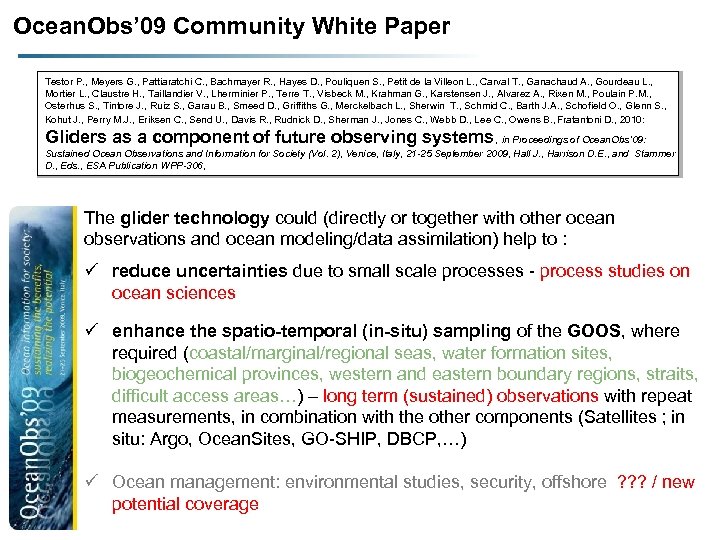 Ocean. Obs’ 09 Community White Paper Testor P. , Meyers G. , Pattiaratchi C. , Bachmayer R. , Hayes D. , Pouliquen S. , Petit de la Villeon L. , Carval T. , Ganachaud A. , Gourdeau L. , Mortier L. , Claustre H. , Taillandier V. , Lherminier P. , Terre T. , Visbeck M. , Krahman G. , Karstensen J. , Alvarez A. , Rixen M. , Poulain P. M. , Osterhus S. , Tintore J. , Ruiz S. , Garau B. , Smeed D. , Griffiths G. , Merckelbach L. , Sherwin T. , Schmid C. , Barth J. A. , Schofield O. , Glenn S. , Kohut J. , Perry M. J. , Eriksen C. , Send U. , Davis R. , Rudnick D. , Sherman J. , Jones C. , Webb D. , Lee C. , Owens B. , Fratantoni D. , 2010: Gliders as a component of future observing systems, in Proceedings of Ocean. Obs’ 09: Sustained Ocean Observations and Information for Society (Vol. 2), Venice, Italy, 21 -25 September 2009, Hall J. , Harrison D. E. , and Stammer D. , Eds. , ESA Publication WPP-306, The glider technology could (directly or together with other ocean observations and ocean modeling/data assimilation) help to : reduce uncertainties due to small scale processes - process studies on ocean sciences enhance the spatio-temporal (in-situ) sampling of the GOOS, where required (coastal/marginal/regional seas, water formation sites, biogeochemical provinces, western and eastern boundary regions, straits, difficult access areas…) – long term (sustained) observations with repeat measurements, in combination with the other components (Satellites ; in situ: Argo, Ocean. Sites, GO-SHIP, DBCP, …) Ocean management: environmental studies, security, offshore ? ? ? / new potential coverage
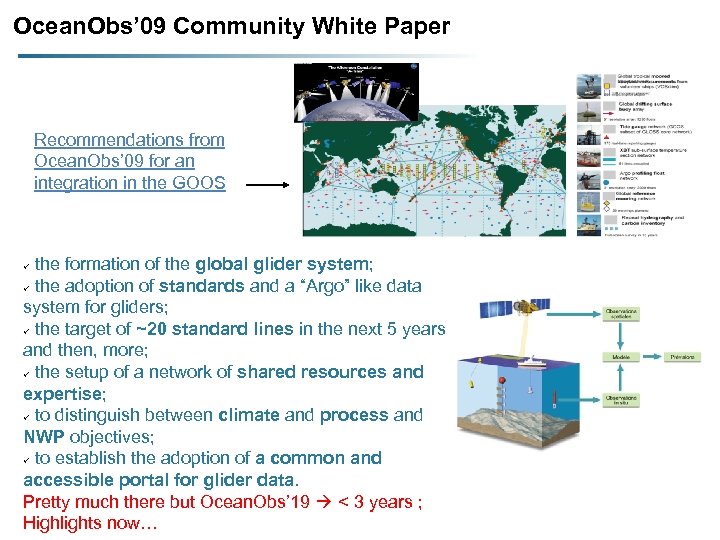 Ocean. Obs’ 09 Community White Paper Recommendations from Ocean. Obs’ 09 for an integration in the GOOS the formation of the global glider system; the adoption of standards and a “Argo” like data system for gliders; the target of ~20 standard lines in the next 5 years and then, more; the setup of a network of shared resources and expertise; to distinguish between climate and process and NWP objectives; to establish the adoption of a common and accessible portal for glider data. Pretty much there but Ocean. Obs’ 19 < 3 years ; Highlights now…
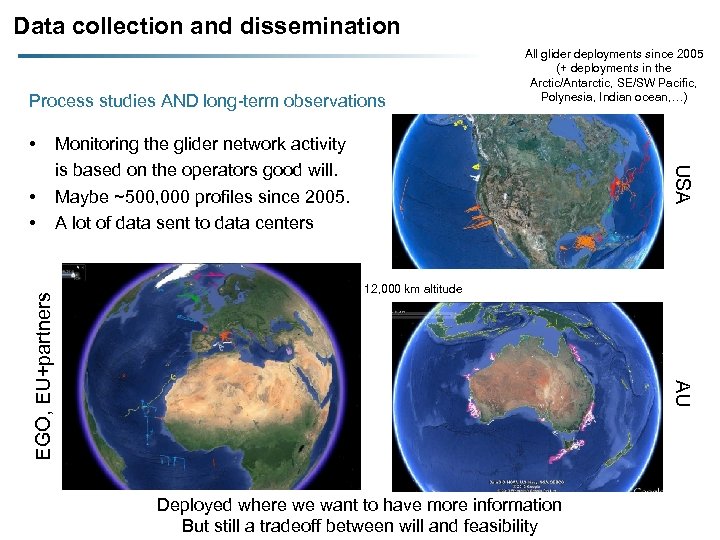 Data collection and dissemination Process studies AND long-term observations • ~ 12, 000 km altitude AU EGO, EU+partners Monitoring the glider network activity is based on the operators good will. Maybe ~500, 000 profiles since 2005. A lot of data sent to data centers USA • • All glider deployments since 2005 (+ deployments in the Arctic/Antarctic, SE/SW Pacific, Polynesia, Indian ocean, …) Deployed where we want to have more information But still a tradeoff between will and feasibility
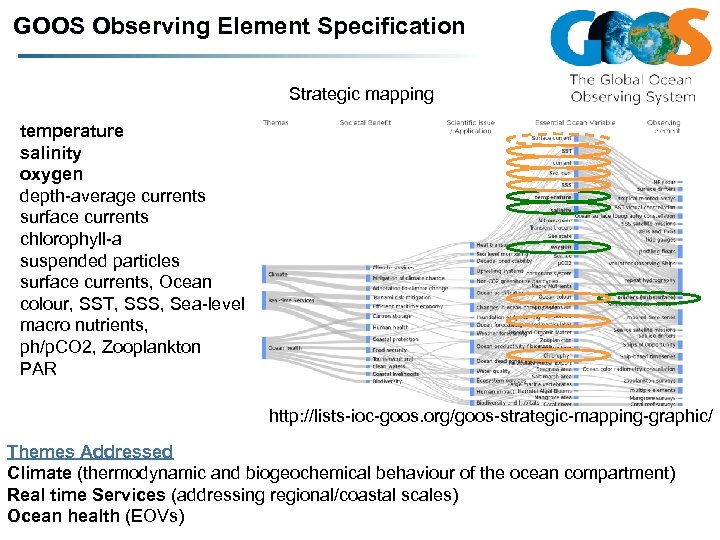 GOOS Observing Element Specification Strategic mapping temperature salinity oxygen depth-average currents surface currents chlorophyll-a suspended particles surface currents, Ocean colour, SST, SSS, Sea-level macro nutrients, ph/p. CO 2, Zooplankton PAR http: //lists-ioc-goos. org/goos-strategic-mapping-graphic/ Themes Addressed Climate (thermodynamic and biogeochemical behaviour of the ocean compartment) Real time Services (addressing regional/coastal scales) Ocean health (EOVs)
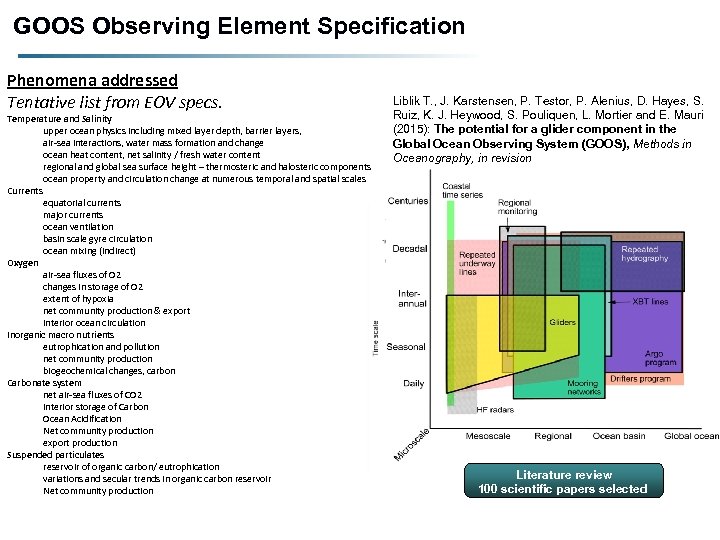 GOOS Observing Element Specification Phenomena addressed Tentative list from EOV specs. Temperature and Salinity upper ocean physics including mixed layer depth, barrier layers, air-sea interactions, water mass formation and change ocean heat content, net salinity / fresh water content regional and global sea surface height – thermosteric and halosteric components ocean property and circulation change at numerous temporal and spatial scales Currents equatorial currents major currents ocean ventilation basin scale gyre circulation ocean mixing (indirect) Oxygen air-sea fluxes of O 2 changes in storage of O 2 extent of hypoxia net community production & export interior ocean circulation Inorganic macro nutrients eutrophication and pollution net community production biogeochemical changes, carbon Carbonate system net air-sea fluxes of CO 2 interior storage of Carbon Ocean Acidification Net community production export production Suspended particulates reservoir of organic carbon/ eutrophication variations and secular trends in organic carbon reservoir Net community production Liblik T. , J. Karstensen, P. Testor, P. Alenius, D. Hayes, S. Ruiz, K. J. Heywood, S. Pouliquen, L. Mortier and E. Mauri (2015): The potential for a glider component in the Global Ocean Observing System (GOOS), Methods in Oceanography, in revision Stommel’s diagram Literature review 100 scientific papers selected
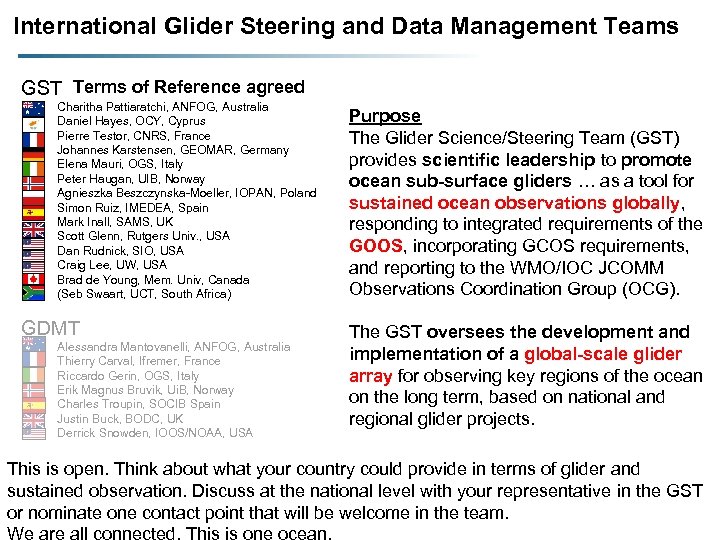 International Glider Steering and Data Management Teams GST Terms of Reference agreed Charitha Pattiaratchi, ANFOG, Australia Daniel Hayes, OCY, Cyprus Pierre Testor, CNRS, France Johannes Karstensen, GEOMAR, Germany Elena Mauri, OGS, Italy Peter Haugan, UIB, Norway Agnieszka Beszczynska-Moeller, IOPAN, Poland Simon Ruiz, IMEDEA, Spain Mark Inall, SAMS, UK Scott Glenn, Rutgers Univ. , USA Dan Rudnick, SIO, USA Craig Lee, UW, USA Brad de Young, Mem. Univ, Canada (Seb Swaart, UCT, South Africa) GDMT Alessandra Mantovanelli, ANFOG, Australia Thierry Carval, Ifremer, France Riccardo Gerin, OGS, Italy Erik Magnus Bruvik, Ui. B, Norway Charles Troupin, SOCIB Spain Justin Buck, BODC, UK Derrick Snowden, IOOS/NOAA, USA Purpose The Glider Science/Steering Team (GST) provides scientific leadership to promote ocean sub-surface gliders … as a tool for sustained ocean observations globally, responding to integrated requirements of the GOOS, incorporating GCOS requirements, and reporting to the WMO/IOC JCOMM Observations Coordination Group (OCG). The GST oversees the development and implementation of a global-scale glider array for observing key regions of the ocean on the long term, based on national and regional glider projects. This is open. Think about what your country could provide in terms of glider and sustained observation. Discuss at the national level with your representative in the GST or nominate one contact point that will be welcome in the team.
 Glider Science/Steering Team - Terms of Reference The GST will • define the scope, and promote the long-term development, of global-scale glider activities addressing relevant requirements as well as advice from relevant panels and working groups for purposes of research, forecasts, and other uses. Such activities should have a primary objective of obtaining profiles of temperature and salinity, dissolved oxygen, as well as ocean current in key regions of the ocean on a sustained basis, in complement with other observing networks (additional sensors/variables can be added based on readiness and maturity). • fully consider unique capabilities of gliders, complementarity with other observing systems, and incorporate recommendations from numerical design studies, e. g. OSSEs, and regional observing development activities/processes (e. g. TPOS 2020, Atlant. OS, SOOS).
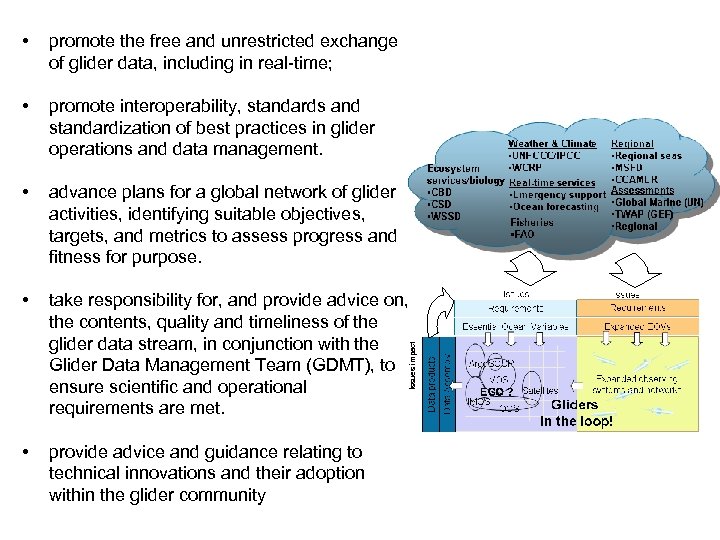 promote the free and unrestricted exchange of glider data, including in real-time; • promote interoperability, standards and standardization of best practices in glider operations and data management. • advance plans for a global network of glider activities, identifying suitable objectives, targets, and metrics to assess progress and fitness for purpose. • take responsibility for, and provide advice on, the contents, quality and timeliness of the glider data stream, in conjunction with the Glider Data Management Team (GDMT), to ensure scientific and operational requirements are met. • provide advice and guidance relating to technical innovations and their adoption within the glider community Issues impact •
 • • work through the WMO/IOC JCOMM Observations Coordination Group (OCG) to liaise with related global observing systems (e. g. Argo, Ocean. SITES, GO-SHIP, . . . ) in the framework of the GOOS, its expert panels and development projects. assist national and regional programs to ensure sustained funding for the operation of the glider array and related activities. (support letters? ) • report regularly to JCOMM OCG. The GST shall supervise the activities of the Glider Technical Coordinator. • establish the Terms of Reference for the Glider Technical Coordinator in consultation with the JCOMM OCG. • explore requirements for international capacity development and develop a capacity building strategy/workplan.
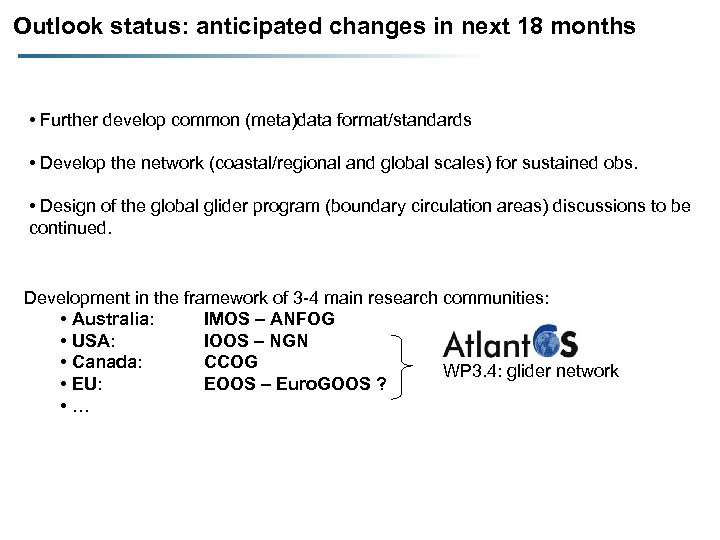 Outlook status: anticipated changes in next 18 months • Further develop common (meta)data format/standards • Develop the network (coastal/regional and global scales) for sustained obs. • Design of the global glider program (boundary circulation areas) discussions to be continued. Development in the framework of 3 -4 main research communities: • Australia: IMOS – ANFOG • USA: IOOS – NGN • Canada: CCOG WP 3. 4: glider network • EU: EOOS – Euro. GOOS ? • …
 What is important is that we are now able to interact with the other stakeholders as a network, with a minimal individual effort. Wonderful stories during this meeting. Left-overs GROOM/EGO 92 keuro en missions Thank you Yvone Firing NOC team, Organizing Committee David Smeed, Mark Inall, Dan Hayes, Agnieszka Beszczynska-Moeller, Alberto Alvarez, Peter Haugan Simon Ruiz, Johannes Karstensen, Ralf Bachmayer, Carlos Barrera, Estelle Dumont, Elena Mauri Seb Swart, Oscar Schofield, Laurent Mortier and Pierre Testor, OSSE ? Rely on, develop national programs Develop links with industry JERICO-Next – Trans. National Access (TNA) Awful situation, fighting for funds although our approach is legitimate
 Thank you!
 Since the last (6 th) EGO meeting, Kiel, June 2014 Last symposium of the COST Action ES 0904 « EGO » Formation of the global system: Euro. GOOS Glider Task Team, IOOS/OOI NGN (USA), IMOS ANFOG (Australia), CCOG (Canada), … - JCOMM-OCG-5 (Washington DC, March 2015) - H 2020 BRIDGES Kick-off meeting (Paris, May 2015), - H 2020 Atlant. OS Kick-off meeting (Brussels, June 2015) H 2020 Atlant. OS – glider network tech. Coordinator; https: //twitter. com/GOOSocean Victor Turpin hired by CNRS, collaboration with JCOMMOPS started with a meeting in Brest with JCOMMOPS, in Feb. 2016 and Claire Gourcuff, glider data manager - H 2020 Intar. OS, Med. OS, EOOS (? ? ) - JCOMM-OCG-6 (Cape Town, March 2015) Formation of the International Glider Steering Team and Data Management Team in line with the EGO COST Action ES 0904 - IOC Science Day at IOC/UNESCO, June 2015 - Session at AGU/ASLO/TOS Ocean Sciences meeting in New Orleans, Feb 2016 – – Session : Autonomous Observations of Coupled Physical-Biogeochemical Properties and Processes in the Open Ocean: From the Diel and Local Scales to Climate on the Global Scale « Glider network side meeting led to: – Draft of Observing Element Specification document – Draft of 1 -pager ”Sustained Observations of Ocean Boundary Currents with Underwater Gliders” - JCOMM-OCG-7 (Palma de Mallorca, IMEDEA, Mallorca, March 2016) S a