 Скачать презентацию 7 Convergence of fixed and mobile networks basing
2acca86210f1deea4c468a7a45572a37.ppt
- Количество слайдов: 35



7. Convergence of fixed and mobile networks basing on IP Multimedia Subsystem (IMS) paradigm. 7. 1. Fixed-mobile convergence, IMS definition, standardization 7. 2. IMS-3 GPP architecture, main building blocks 7. 3. IMS-TISPAN architecture 7. 4. IMS services 7. 5. Conclusion 1
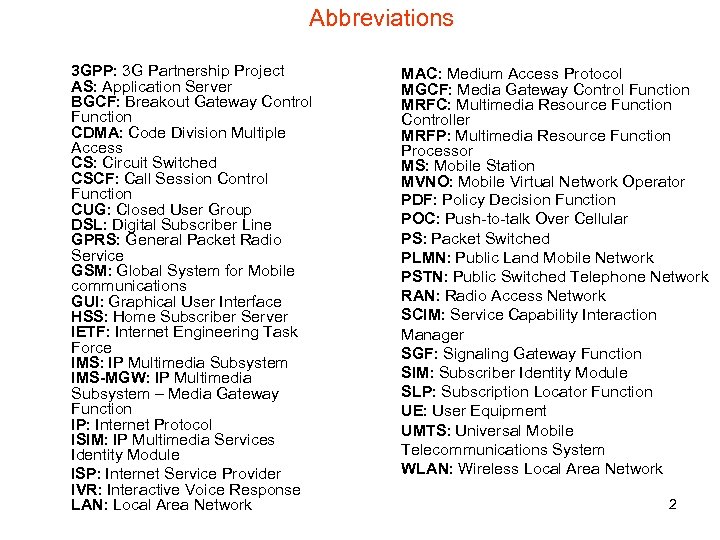
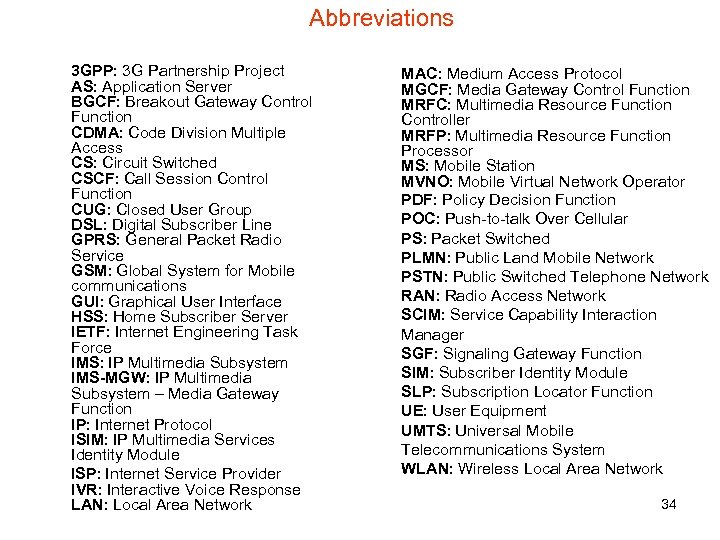
Abbreviations 3 GPP: 3 G Partnership Project AS: Application Server BGCF: Breakout Gateway Control Function CDMA: Code Division Multiple Access CS: Circuit Switched CSCF: Call Session Control Function CUG: Closed User Group DSL: Digital Subscriber Line GPRS: General Packet Radio Service GSM: Global System for Mobile communications GUI: Graphical User Interface HSS: Home Subscriber Server IETF: Internet Engineering Task Force IMS: IP Multimedia Subsystem IMS-MGW: IP Multimedia Subsystem – Media Gateway Function IP: Internet Protocol ISIM: IP Multimedia Services Identity Module ISP: Internet Service Provider IVR: Interactive Voice Response LAN: Local Area Network MAC: Medium Access Protocol MGCF: Media Gateway Control Function MRFC: Multimedia Resource Function Controller MRFP: Multimedia Resource Function Processor MS: Mobile Station MVNO: Mobile Virtual Network Operator PDF: Policy Decision Function POC: Push-to-talk Over Cellular PS: Packet Switched PLMN: Public Land Mobile Network PSTN: Public Switched Telephone Network RAN: Radio Access Network SCIM: Service Capability Interaction Manager SGF: Signaling Gateway Function SIM: Subscriber Identity Module SLP: Subscription Locator Function UE: User Equipment UMTS: Universal Mobile Telecommunications System WLAN: Wireless Local Area Network 2
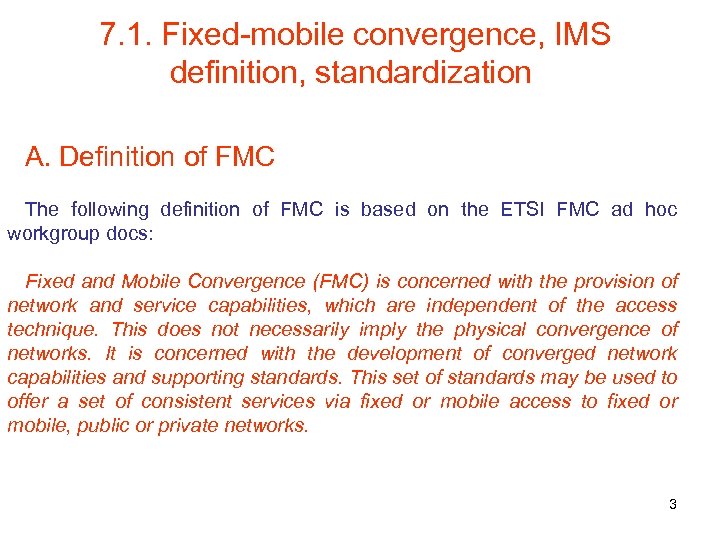
7. 1. Fixed-mobile convergence, IMS definition, standardization A. Definition of FMC The following definition of FMC is based on the ETSI FMC ad hoc workgroup docs: Fixed and Mobile Convergence (FMC) is concerned with the provision of network and service capabilities, which are independent of the access technique. This does not necessarily imply the physical convergence of networks. It is concerned with the development of converged network capabilities and supporting standards. This set of standards may be used to offer a set of consistent services via fixed or mobile access to fixed or mobile, public or private networks. 3
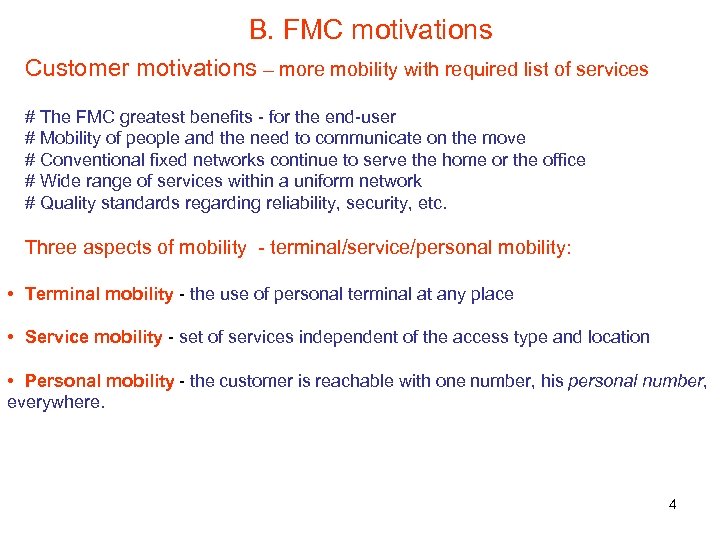
B. FMC motivations Customer motivations – more mobility with required list of services # The FMC greatest benefits - for the end-user # Mobility of people and the need to communicate on the move # Conventional fixed networks continue to serve the home or the office # Wide range of services within a uniform network # Quality standards regarding reliability, security, etc. Three aspects of mobility - terminal/service/personal mobility: • Terminal mobility - the use of personal terminal at any place • Service mobility - set of services independent of the access type and location • Personal mobility - the customer is reachable with one number, his personal number, everywhere. 4
FMC motivations • Operator motivations – better position on the market –increasing revenue, gaining new users # FMC can be understood as a marketing strategy to attract new customers by launching new innovative products # Offering customized set of attractive services: (VPN, VHE, …) # IN Services developed in fixed networks - Call Forwarding, Personal Number # Services developed in mobile networks - Prepaid Service, SMS # Investment cost saving (HW/SW for billing, IN equipment, …) # Operational cost savings (common OAM processes, common numbering plan, …) 5
C. FMC components Fixed-mobile convergence involves: • • unified core network multi-radio terminals devices such as PCs, PDAs, fixed phones common multi-access service delivery platform FMC is described through the four distinct categorizations: • • service convergence terminal convergence network convergence industry convergence 6
Service convergence Focus - on end-user requirements and the service experience. The primary goal is the concurrent delivery of all media types — voice, data, and video— to an easy-to-use graphical user interface, with mobility, access, and device awareness. Multitude of services (person-to-person, person-to-content, and content-to-person) can be provided to the same user over different access networks and to different devices. From a service perspective, the consumer and enterprise user expect convenience, ease of use, reliability, security and support to be always connected in the best way. 7
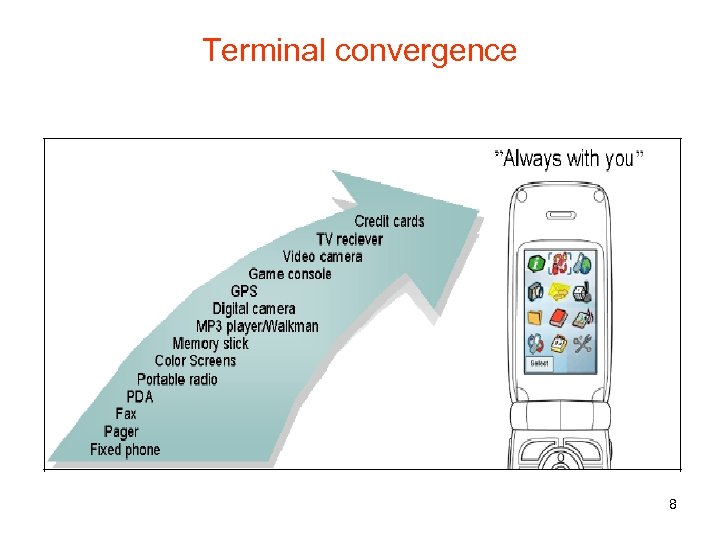
Terminal convergence 8
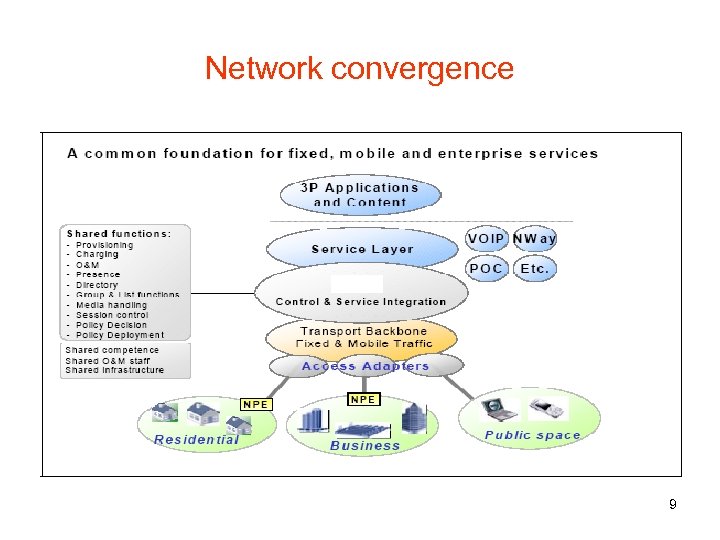
Network convergence 9
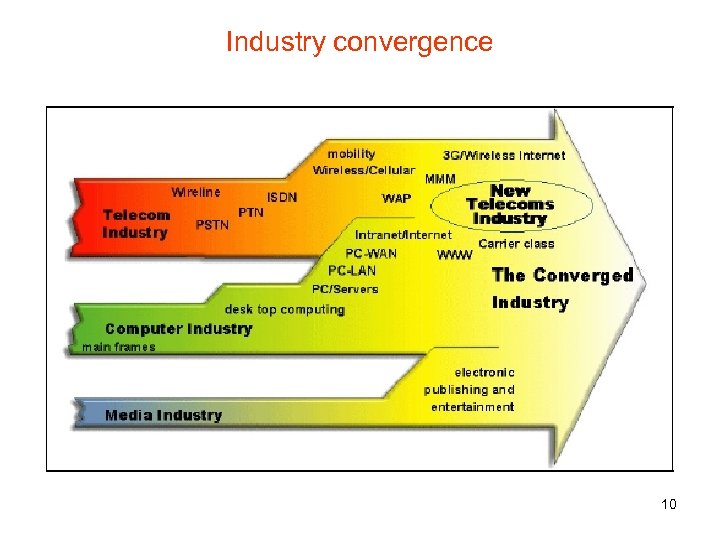
Industry convergence 10
D. IMS Definition • The IP Multimedia Subsystem (IMS) is a standardized NGN architecture for telecom operator that want to provide mobile and fixed multimedia services. It uses a Vo. IP implementation based on a 3 GPP standardized implementation of SIP, and runs over the standard IP. Existing both PS and CS systems are supported. • The aim of IMS - providing all services for fixed and mobile users. • IMS provides the unified architecture that supports a wide range of IPbased services over both packet- and circuit-switched networks, employing a range of different wireless and fixed access technologies. • IMS uses open standard IP protocols. • Interfaces for service developers are also based on IP protocols. • For providers - the ability to control and charge for each service. • For users – the ability to execute all their services when roaming as well as from their home networks. 11
E. IMS Standardization IP Multimedia Subsystem (IMS) is a concept developed and specified by the 3 rd Generation Partnership Project (3 GPP). Currently 3 GPP includes different SDOs: • Alliance for Telecommunications Industry Solutions (ATIS) - USA • Association of Radio Industries and Businesses (ARIB) - Japan • China Communications Standards Association (CCSA) • European Telecommunications Standards Institute (ETSI) • Telecommunications Technology Association (TTA) – Korea 12
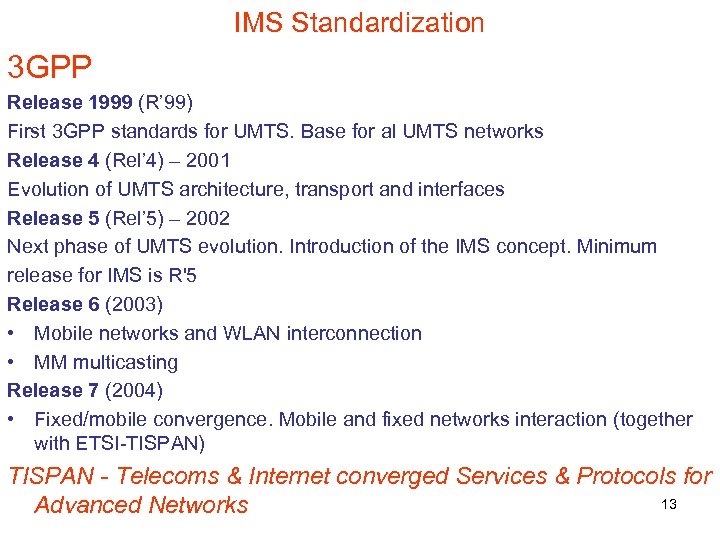
IMS Standardization 3 GPP Release 1999 (R’ 99) First 3 GPP standards for UMTS. Base for al UMTS networks Release 4 (Rel’ 4) – 2001 Evolution of UMTS architecture, transport and interfaces Release 5 (Rel’ 5) – 2002 Next phase of UMTS evolution. Introduction of the IMS concept. Minimum release for IMS is R'5 Release 6 (2003) • Mobile networks and WLAN interconnection • ММ multicasting Release 7 (2004) • Fixed/mobile convergence. Mobile and fixed networks interaction (together with ETSI-TISPAN) TISPAN - Telecoms & Internet converged Services & Protocols for 13 Advanced Networks
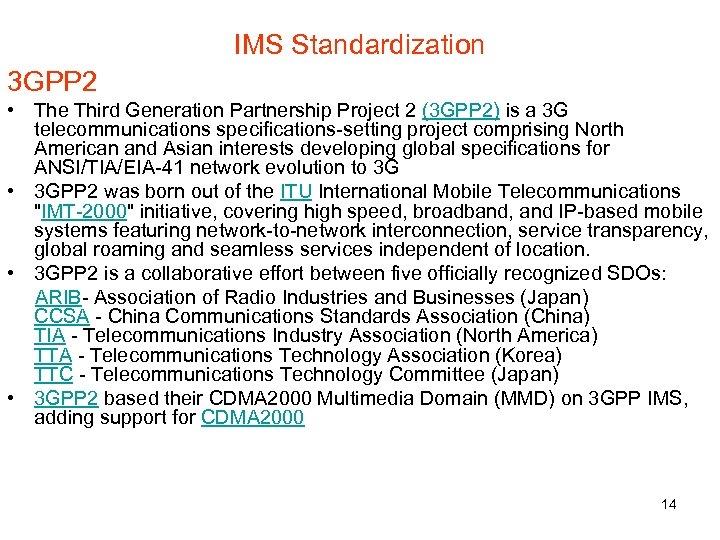
IMS Standardization 3 GPP 2 • The Third Generation Partnership Project 2 (3 GPP 2) is a 3 G telecommunications specifications-setting project comprising North American and Asian interests developing global specifications for ANSI/TIA/EIA-41 network evolution to 3 G • 3 GPP 2 was born out of the ITU International Mobile Telecommunications "IMT-2000" initiative, covering high speed, broadband, and IP-based mobile systems featuring network-to-network interconnection, service transparency, global roaming and seamless services independent of location. • 3 GPP 2 is a collaborative effort between five officially recognized SDOs: ARIB- Association of Radio Industries and Businesses (Japan) CCSA - China Communications Standards Association (China) TIA - Telecommunications Industry Association (North America) TTA - Telecommunications Technology Association (Korea) TTC - Telecommunications Technology Committee (Japan) • 3 GPP 2 based their CDMA 2000 Multimedia Domain (MMD) on 3 GPP IMS, adding support for CDMA 2000 14
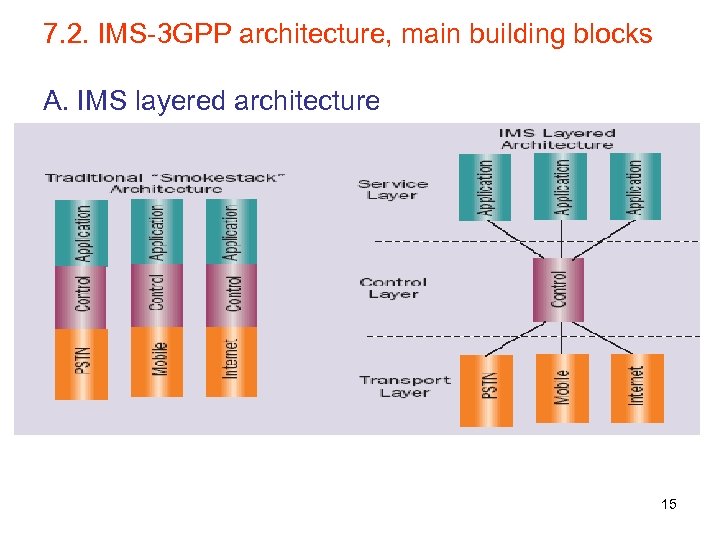
7. 2. IMS-3 GPP architecture, main building blocks A. IMS layered architecture 15
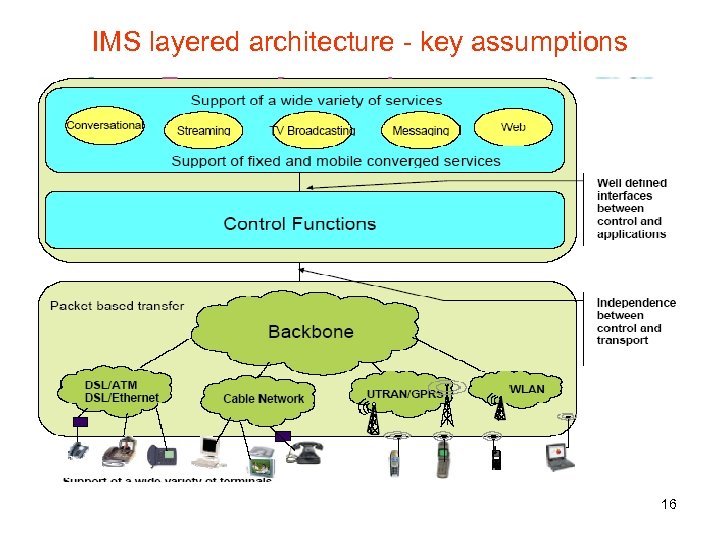
IMS layered architecture - key assumptions 16
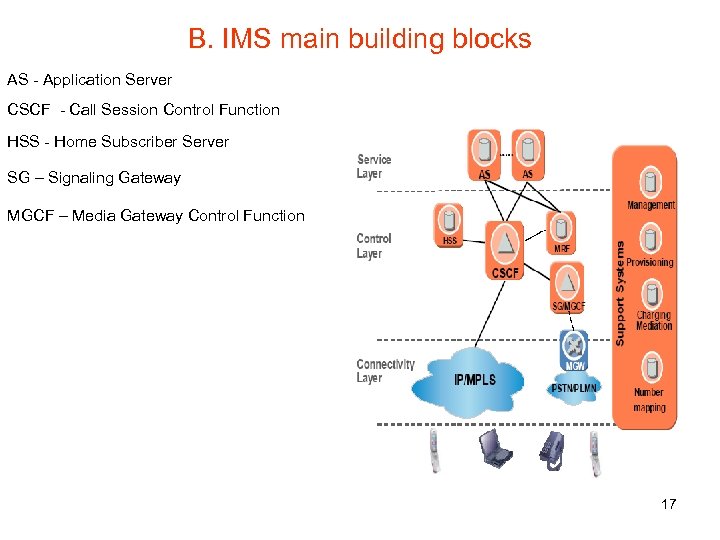
B. IMS main building blocks AS - Application Server CSCF - Call Session Control Function HSS - Home Subscriber Server SG – Signaling Gateway MGCF – Media Gateway Control Function 17
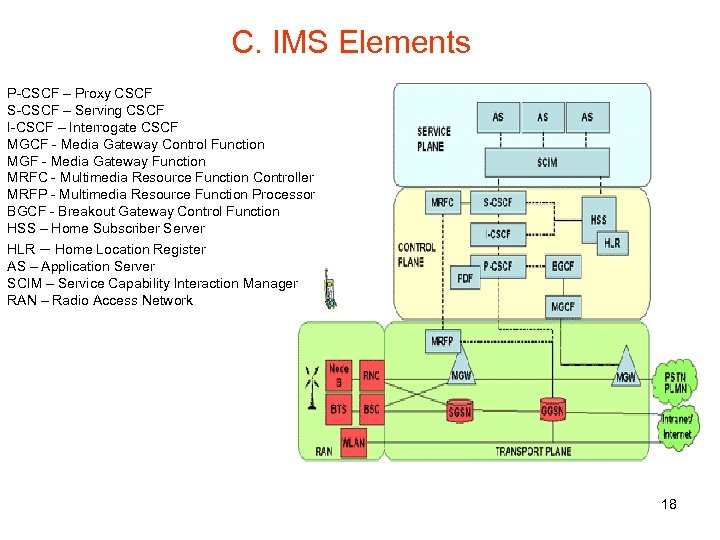
C. IMS Elements P-CSCF – Proxy CSCF S-CSCF – Serving CSCF I-CSCF – Interrogate CSCF MGCF - Media Gateway Control Function MGF - Media Gateway Function MRFC - Multimedia Resource Function Controller MRFP - Multimedia Resource Function Processor BGCF - Breakout Gateway Control Function HSS – Home Subscriber Server HLR – Home Location Register AS – Application Server SCIM – Service Capability Interaction Manager RAN – Radio Access Network 18
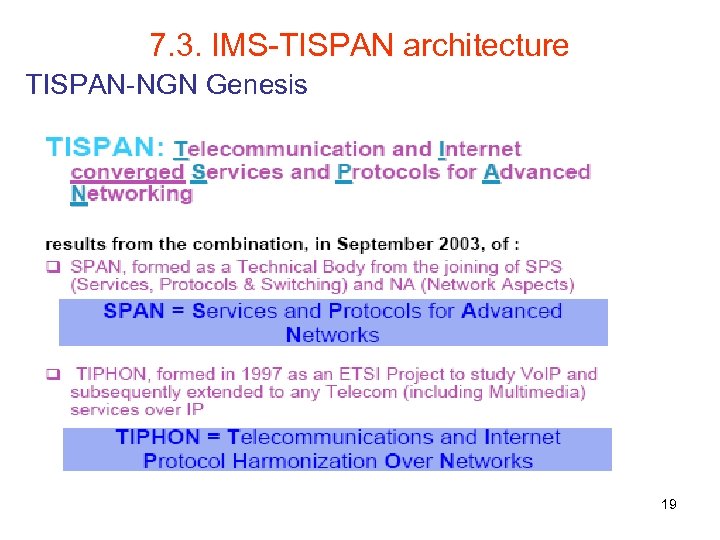
7. 3. IMS-TISPAN architecture TISPAN-NGN Genesis 19
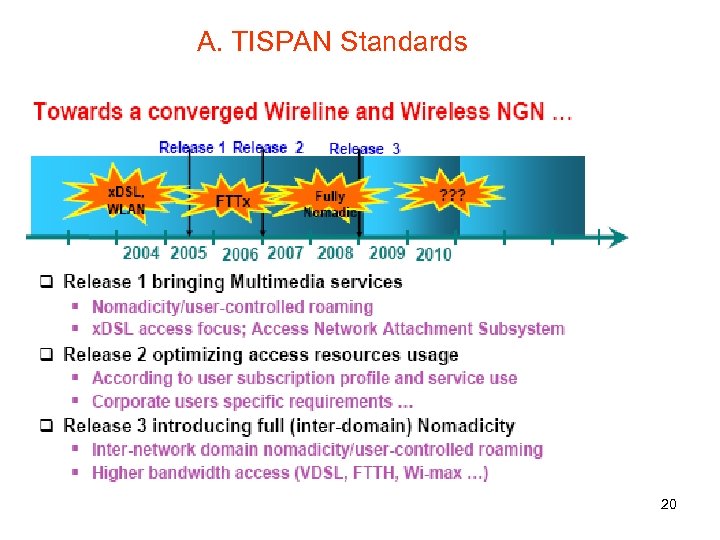
A. TISPAN Standards 20
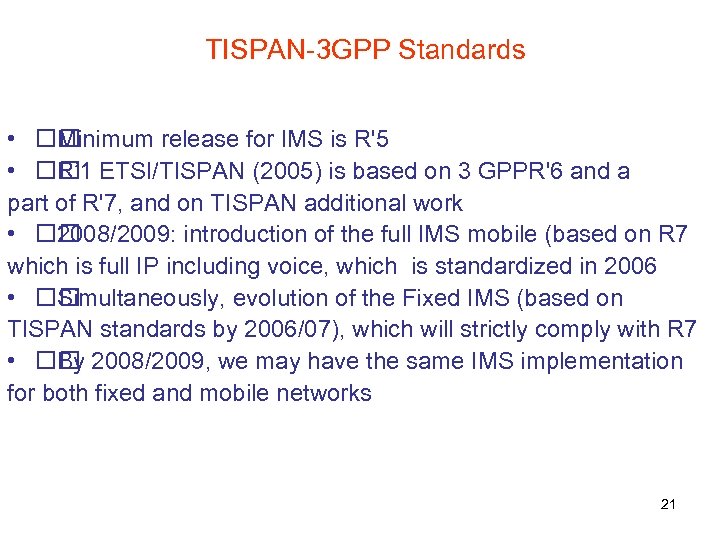
TISPAN-3 GPP Standards • Minimum release for IMS is R'5 • ETSI/TISPAN (2005) is based on 3 GPPR'6 and a R’ 1 part of R'7, and on TISPAN additional work • 2008/2009: introduction of the full IMS mobile (based on R 7 which is full IP including voice, which is standardized in 2006 • Simultaneously, evolution of the Fixed IMS (based on TISPAN standards by 2006/07), which will strictly comply with R 7 • 2008/2009, we may have the same IMS implementation By for both fixed and mobile networks 21
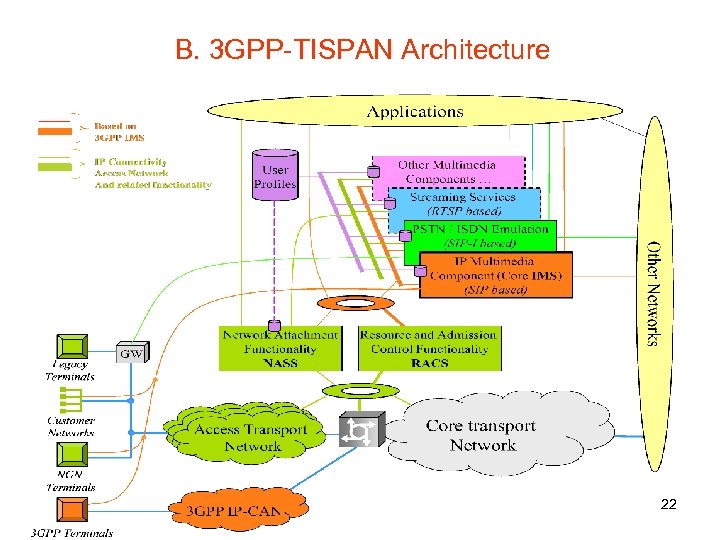
B. 3 GPP-TISPAN Architecture 22
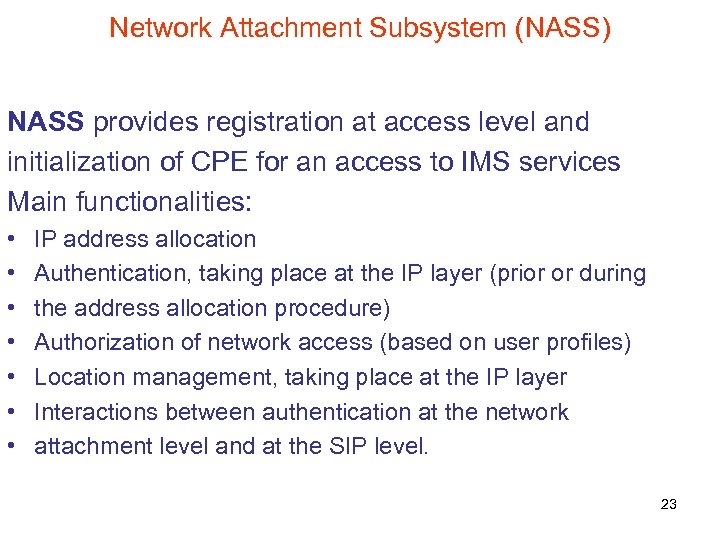
Network Attachment Subsystem (NASS) NASS provides registration at access level and initialization of CPE for an access to IMS services Main functionalities: • • IP address allocation Authentication, taking place at the IP layer (prior or during the address allocation procedure) Authorization of network access (based on user profiles) Location management, taking place at the IP layer Interactions between authentication at the network attachment level and at the SIP level. 23
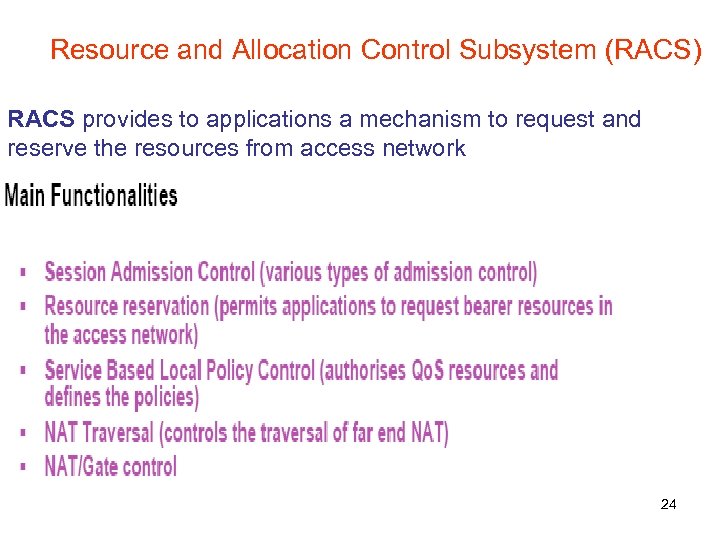
Resource and Allocation Control Subsystem (RACS) RACS provides to applications a mechanism to request and reserve the resources from access network 24
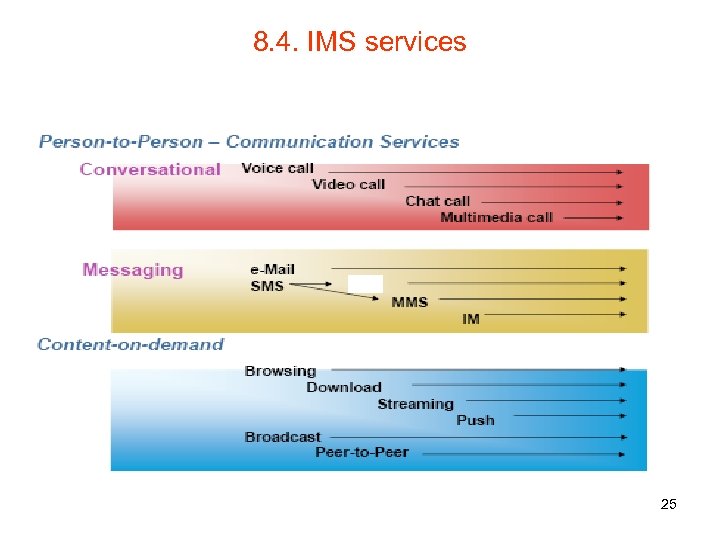
8. 4. IMS services 25

IMS service requirements 26
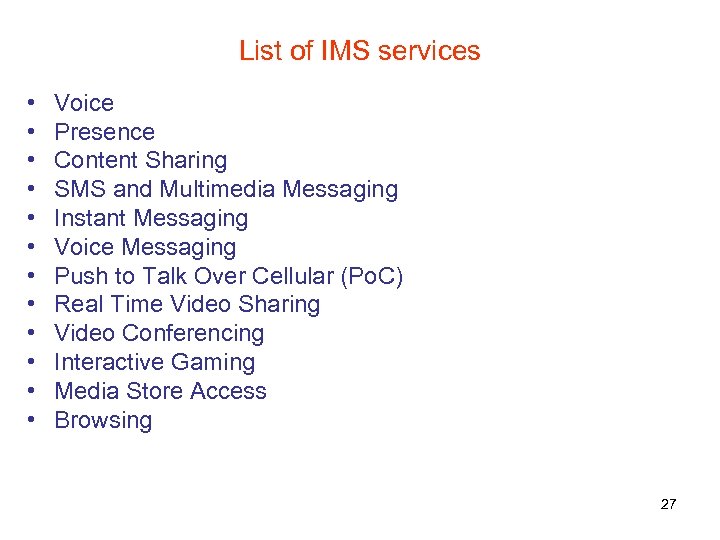
List of IMS services • • • Voice Presence Content Sharing SMS and Multimedia Messaging Instant Messaging Voice Messaging Push to Talk Over Cellular (Po. C) Real Time Video Sharing Video Conferencing Interactive Gaming Media Store Access Browsing 27
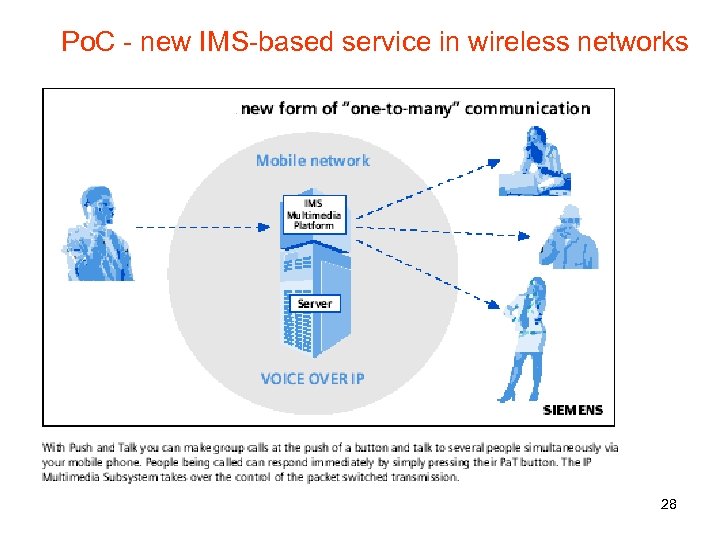
Po. C - new IMS-based service in wireless networks 28
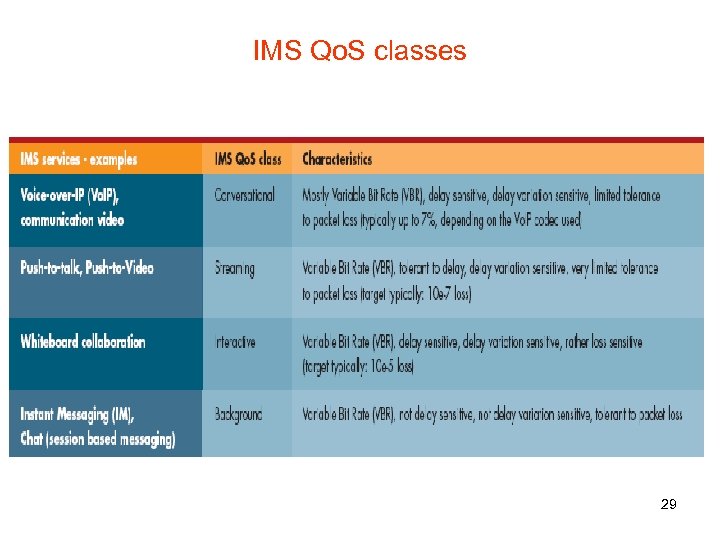
IMS Qo. S classes 29
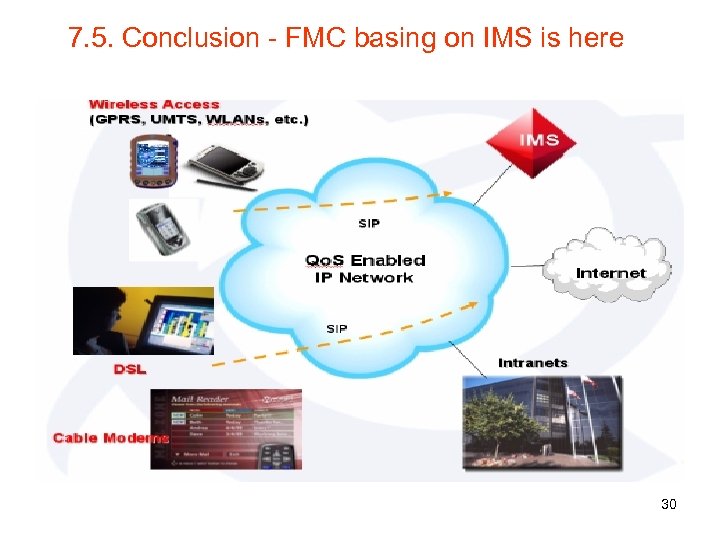
7. 5. Conclusion - FMC basing on IMS is here 30
Key attractions of IMS • Access independence: IMS will eventually work with any network (fixed or mobile) with packet-switching functions, such as CDMA 2000, GPRS, UMTS, and WLAN. Open interfaces between control and service layers allow elements and calls/sessions from different access networks to be mixed. • Different network architectures: IMS allows operators and service providers to use different underlying network architectures. • Terminal and user mobility: The mobile network provides terminal mobility, while user mobility is provided by IMS and SIP. • Extensive IP-based services: IMS should make it easier to offer just about any IP-based service. Examples include voice over IP (VOIP), pushto-talk over cellular (POC), multiparty gaming, video/audio conferencing, and content sharing. 31
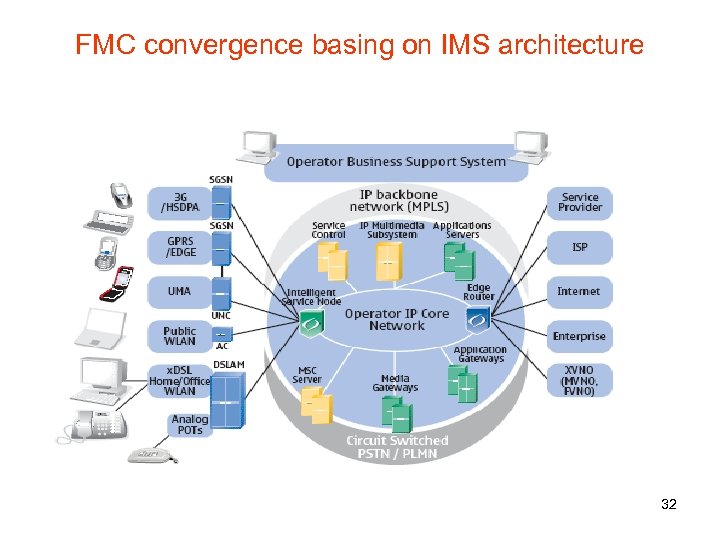
FMC convergence basing on IMS architecture 32
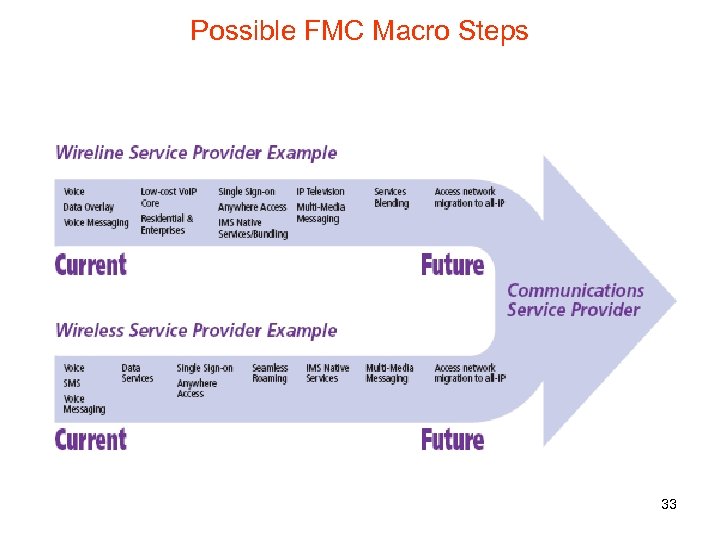
Possible FMC Macro Steps 33
Abbreviations 3 GPP: 3 G Partnership Project AS: Application Server BGCF: Breakout Gateway Control Function CDMA: Code Division Multiple Access CS: Circuit Switched CSCF: Call Session Control Function CUG: Closed User Group DSL: Digital Subscriber Line GPRS: General Packet Radio Service GSM: Global System for Mobile communications GUI: Graphical User Interface HSS: Home Subscriber Server IETF: Internet Engineering Task Force IMS: IP Multimedia Subsystem IMS-MGW: IP Multimedia Subsystem – Media Gateway Function IP: Internet Protocol ISIM: IP Multimedia Services Identity Module ISP: Internet Service Provider IVR: Interactive Voice Response LAN: Local Area Network MAC: Medium Access Protocol MGCF: Media Gateway Control Function MRFC: Multimedia Resource Function Controller MRFP: Multimedia Resource Function Processor MS: Mobile Station MVNO: Mobile Virtual Network Operator PDF: Policy Decision Function POC: Push-to-talk Over Cellular PS: Packet Switched PLMN: Public Land Mobile Network PSTN: Public Switched Telephone Network RAN: Radio Access Network SCIM: Service Capability Interaction Manager SGF: Signaling Gateway Function SIM: Subscriber Identity Module SLP: Subscription Locator Function UE: User Equipment UMTS: Universal Mobile Telecommunications System WLAN: Wireless Local Area Network 34
Books • The 3 G IP Multimedia Subsystem (IMS): Merging the Internet and the Cellular Worlds by Gonzalo Camarillo, Miguel-Angel García. Martín (John Wiley & Sons, 2006) • The IMS: IP Multimedia Concepts and Services by Miikka Poikselka, Aki Niemi, Hisham Khartabil, Georg Mayer (John Wiley & Sons, 2006) 35
Скачать презентацию 7 Convergence of fixed and mobile networks basing
2acca86210f1deea4c468a7a45572a37.ppt