
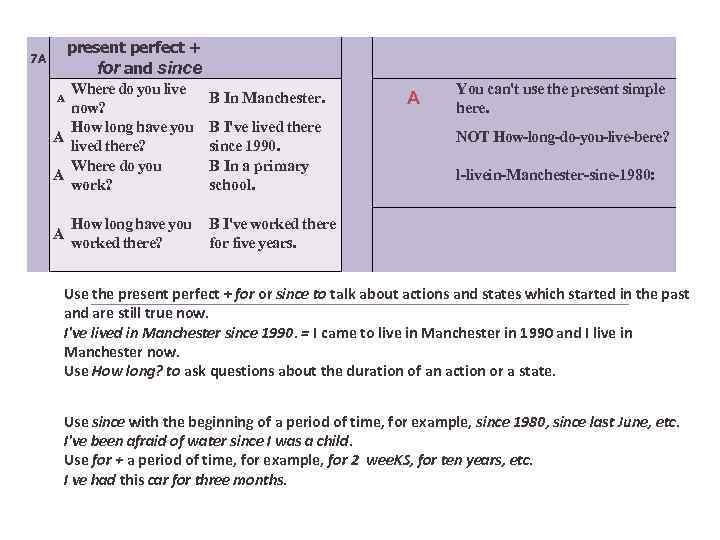
 7 A present perfect + for and since Where do you live A B In Manchester. now? How long have you B I've lived there A lived there? since 1990. Where do you B In a primary A work? school. A How long have you A worked there? B I've worked there for five years. You can't use the present simple here. NOT How-long-do-you-live-bere? l-livein-Manchester-sine-1980: Use the present perfect + for or since to talk about actions and states which started in the past and are still true now. I've lived in Manchester since 1990. = I came to live in Manchester in 1990 and I live in Manchester now. Use How long? to ask questions about the duration of an action or a state. Use since with the beginning of a period of time, for example, since 1980, since last June, etc. I've been afraid of water since I was a child. Use for + a period of time, for example, for 2 wee. KS, for ten years, etc. I ve had this car for three months.
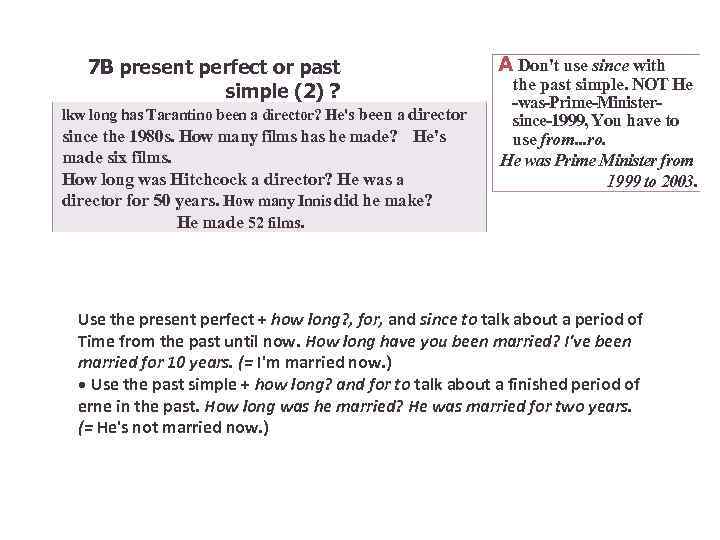 7 B present perfect or past simple (2) ? lkw long has Tarantino been a director? He's been a director since the 1980 s. How many films has he made? He's made six films. How long was Hitchcock a director? He was a director for 50 years. How many Innis did he make? He made 52 films. A Don't use since with the past simple. NOT He -was-Prime-Minister since-1999, You have to use from. . . ro. He was Prime Minister from 1999 to 2003. Use the present perfect + how long? , for, and since to talk about a period of Time from the past until now. How long have you been married? I've been married for 10 years. (= I'm married now. ) • Use the past simple + how long? and for to talk about a finished period of erne in the past. How long was he married? He was married for two years. (= He's not married now. )
 used to / didn't useyou to You H` used to She wear glasses. It We They Did he use to she wear we glasses? they You He didn't use She to It wear We glasses. They you didn't. he he Yes, she No, she we they used to / didn't use to + infinitive for things that happened repeatedly or over a long period of time in the past, but are usually not true now, for example for things which happened when you were a child. 1 used to have long hair. I used to play in the street. I didn't use to have a TV You can also use the past simple here. I had long hair when I twat a child. A used to only exists in the past. Don't use to for present habits. Use the present simple + usually. 1 usually cook in the evenings. .
 Risotto is made with rice. It isn't made with pasta. These offices are cleaned every morning. They aren't cleaned on Saturdays. Past passive: be + past participle Guernica was painted by Picasso. It wasn't painted by Dali. When was it painted? The pyramids were built by the Egyptians. They weren't built by the Greeks. Why were they built? You can often say things in two ways, in the active or in the passive. Picasso painted Guernica. (active) Guemica was painted by Picasso. (passive) In the active sentence, the focus is more on the person (e. g. Picasso). In the passive sentence the focus is more on the painting (e. g Guernica). You can also use the passive when it's not known or not important who does or did the action. My air was stolen last week (I don't know who stole it. ) Make the present passive with am is / are + the past participle. Make the past passive with was / were + the past participle. Use 17 to say who did the action. The Lord of the Rings was written by Tolkien.
 READING & VOCABULARY a Match the words with the pictures. flying heights closed spaces open spaces snakes spiders wasps water b Are you afraid of any of these things? Why? Do you know any people who are? I'm afraid of flying. . --- I have a friend who is afraid of water. He can't swim. c Read the article and complete each paragraph with a word from a. d Underline the four words in the text related to being afraid.
 • 1 VOCABULARY & PRONUNCIATION • a Underline the stressed syllable in the Events in your life go to university ❑ • fall in love be born ❑ • get divorced go to primary school ❑ • have children❑ • get married ❑ • go to secondary school ❑ • separate • highlighted • start work ❑ • leave school ❑ • die ❑ • retire ❑ • words below
 • • • VOCABULARY school subjects a Match the words with the pictures. PE (=physical education) geography technology maths history foreign languages (English, etc. ) literature science (physics, chemistry, and biology)
 • • • VOCABULARY a time expressions Complete the sentences with for or since. I've lived here _. $18 c. e_ 1998. I I've had this pen 1 was a child. 2 He's been married last June. 3 They've known each other a long time. 4 She's studied French literature three years. 5 You've worn that sweater every day Christmas! b verb phrases Complete the phrases with a verb. be get fall have leave retire _have _ children in love 2 school / university 3 married / divorced 4 when you're 65 5 born
 We're all afraid. . . Famous people have phobias like the rest of us, and sometimes they seriously affect their lives. Winona Ryder, American actress Winona Ryder has been afraid of since 1983. When she was 12 years old she fell into a lake and nearly died. Luckily someone pulled her out, and after a few minutes she came back to life again. It can be a real problem when she's making a film. For example in some of the scenes in Alien lll, she had to go in a boat and she was terrified. Rupert Grint, British actor Rupert Grint has been afraid of since he was a child. In this respect he is like the character he played in the Harry Potter films, Ron Weasley, who is also frightened of them. Rupert had a very hard time in the second Harry Potter film where he and Harry had to fight a giant one (the size of an elephant) with very hairy legs! Dennis Bergkamp, ex-international footballer Dennis Bergkamp has been afraid of since 1994. He was on a plane in the USA with the Dutch national team during the World Cup. A journalist said that there was a bomb on the plane (there wasn't), and everybody started to panic, including Dennis. He decided never to travel by plane again. Because of his fear Bergkamp could not play in many important matches for Holland, Inter Milan. and Arsenal.
 • SPEAKING Ask and answer in pairs. the other students in this class A ask B six Now long. . . ? questions know your oldest friend with a verb phrase. B answer with for or since • the teacher Give more information if you can. Then swap roles. How long have you known your oldest friend? • Since we were at primary school together. • in this town • in your house or flat • in this school • a lawyer, nurse, etc. • your car • the shoes you're wearing • your watch
 • • • • • hitchcock or Tarantino I He appeared in small roles in almost all of his films. 2 He was a very intelligent child, but he had difficulties with reading and writing. He left school when he was 15 and went to work in a cinema, where he checked tickets at the entrance. 3 He was born in London in 1899. 4 His muse is Uma Thurman, who he has directed in several of his most successful films. 5 He was married and his daughter Patricia appeared in several of his films. 6 He went to school at St Ignatius College, in London, and later studied art at the University of London. 7 He was famous for not liking actors. He once said 'all actors are children and should be treated like cattle' 8 He was born in Knoxville, Tennesee in 1963. 9 He spent a short tow in prison because he could not pay a parking ode. 10 His muse was Grace Kelly Baer princess Gate el Monaco). who he deected in several el his most successful films II He died in 1980 12 He began his career as an acme His biggest role was in an epsodc of the TV sees the Golden Cerh I played the pan of a men who impersonated Ellis Presley 13 He never veon an Oscar i 01 Best Panto: . although he was nominated five tines. Mien the Academy finely gave Ain an honorary Oscar he received • stanc. Eng ovation. He rust said "hank not and left the stage. 14 He has been no hated kw an CONS for Best Dada but he hasn't won one wt 15 He says he hates drugs and wolerxe Out they tope* a lot in As films
 • • • • SPEAKING a Think about a member of your family (who is alive). for example a parent, uncle. aunt. or grandparent. Prepare to answer the questions below about their life. The past Where horn? Where I go to school? What do after Ihelshe)kit school? When / start work? When get married? How many children / have? The present Where I live now How long / Inc Mere? Is he / she married'. How long! be married? Is lot! she retired? How long has he / she be retired?
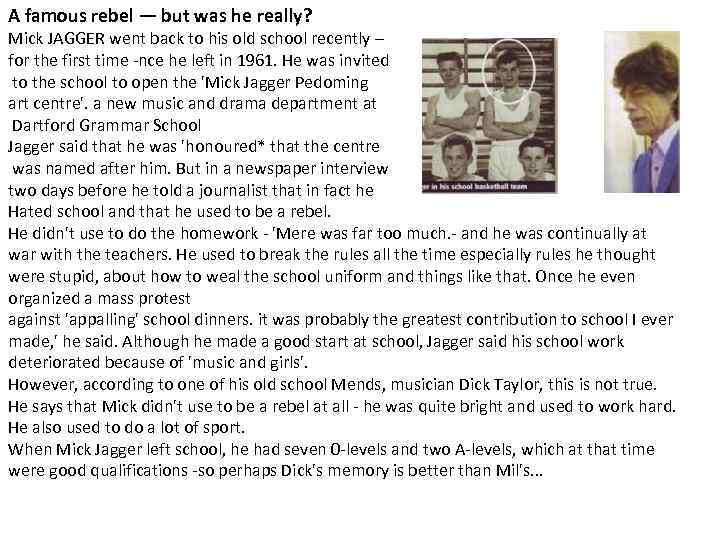 A famous rebel — but was he really? Mick JAGGER went back to his old school recently – for the first time -nce he left in 1961. He was invited to the school to open the 'Mick Jagger Pedoming art centre'. a new music and drama department at Dartford Grammar School Jagger said that he was 'honoured* that the centre was named after him. But in a newspaper interview two days before he told a journalist that in fact he Hated school and that he used to be a rebel. He didn't use to do the homework - 'Mere was far too much. - and he was continually at war with the teachers. He used to break the rules all the time especially rules he thought were stupid, about how to weal the school uniform and things like that. Once he even organized a mass protest against 'appalling' school dinners. it was probably the greatest contribution to school I ever made, ' he said. Although he made a good start at school, Jagger said his school work deteriorated because of 'music and girls'. However, according to one of his old school Mends, musician Dick Taylor, this is not true. He says that Mick didn't use to be a rebel at all - he was quite bright and used to work hard. He also used to do a lot of sport. When Mick Jagger left school, he had seven 0 -levels and two A-levels, which at that time were good qualifications -so perhaps Dick's memory is better than Mil's. . .

 • SPEAKING • a Think alwut when you were II or 12. Were these things true or false about you? Why? • I used to he a rebel. I used to do a lot of spun. • • • I used to work hard. I used to wear glasses. I used to like all the teachers. I used to wear a uniform. • • I used to hate school. I used to have longer luir. Work in groups of three. A tell B and C about how you used to be. B and C Intro and ask for more information. Then swap rolec. Did you have anything in common? • I didn't we to be a rebel I was a load be
 • The most bea tiful building in my town is the ‘cathedral (the Duomo). It is in the centre of Milan. in the Piazza del Duomo. • Nobody knows who it was • but people think it was an architect from northern Europe. Construction began in 1384. but the building wasn't • for another 500 years • 3 It is one of the largest cathedra % in the world and it has 135 spires and 3. 400 statues On top of the Duarso there is a gold' of the Madonna which watches over the crty. The statue is called the 'Madonnina. or the little • Madonna. althought rt n four metres tall. • 4 Inside the Duomo it is quite dark. There are beautiful big '. and 3 10( of intresting statues and monuments. In the chapel of Sc Fina there are some • wonderful frescoes by 6 h: elands**. • S One of the best things you can do In Milan is to go up to the ' of the Duomo. • The' n fantastic - on a deer day you can see the Italian Alps You can get the Eft or if you are feeling energetic you can walk up the 250' • 6 It 4 free to go on. but you must dress apropriatety.