 Скачать презентацию 7 -1 Mc Graw-Hill Irwin Copyright 2011 by
c6d3085ea48e6f5c3ed3b93ee883ecfc.ppt
- Количество слайдов: 44



7 -1 Mc. Graw-Hill/Irwin Copyright © 2011 by the Mc. Graw-Hill Companies, Inc. All rights reserved.
Key Concepts and Skills • Understand how stock prices depend on future dividends and dividend growth • Be able to compute stock prices using the dividend growth model • Understand how corporate directors are elected • Understand how stock markets work • Understand how stock prices are quoted 7 -2
Chapter Outline 7. 1 Common Stock Valuation 7. 2 Some Features of Common and Preferred Stocks 7. 3 The Stock Markets 7 -3
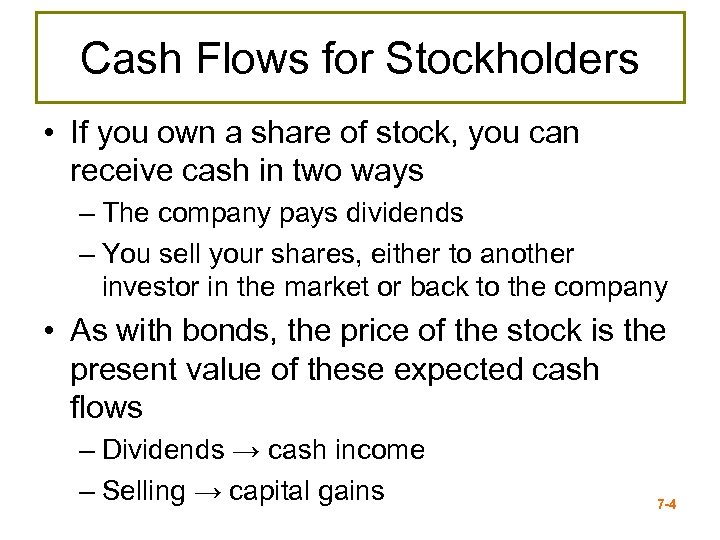
Cash Flows for Stockholders • If you own a share of stock, you can receive cash in two ways – The company pays dividends – You sell your shares, either to another investor in the market or back to the company • As with bonds, the price of the stock is the present value of these expected cash flows – Dividends → cash income – Selling → capital gains 7 -4
One Period Example • Suppose you are thinking of purchasing the stock of Moore Oil, Inc. – You expect it to pay a $2 dividend in one year – You believe you can sell the stock for $14 at that time. – You require a return of 20% on investments of this risk – What is the maximum you would be willing to pay? 7 -5
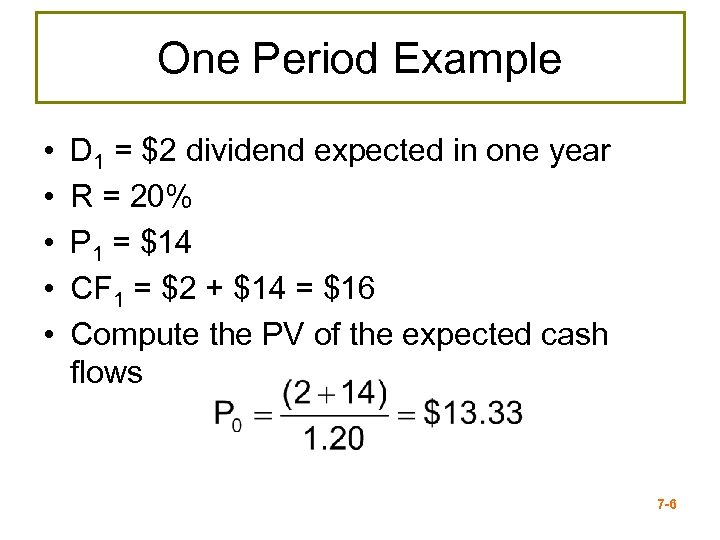
One Period Example • • • D 1 = $2 dividend expected in one year R = 20% P 1 = $14 CF 1 = $2 + $14 = $16 Compute the PV of the expected cash flows 7 -6
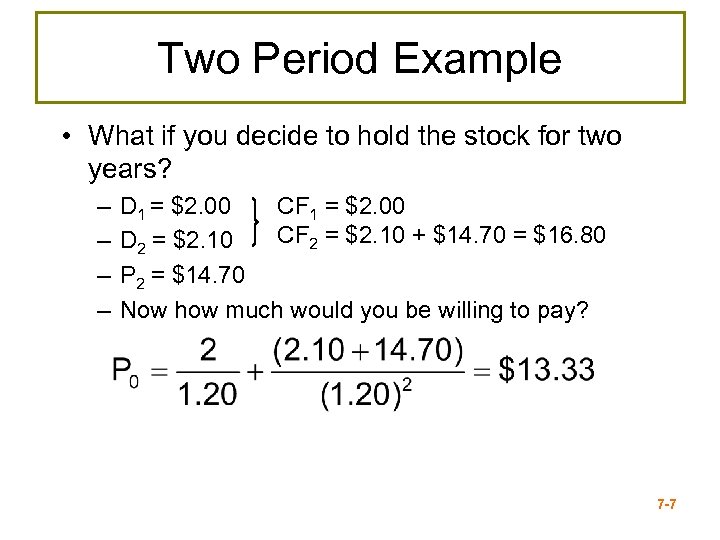
Two Period Example • What if you decide to hold the stock for two years? – – D 1 = $2. 00 CF 2 = $2. 10 + $14. 70 = $16. 80 D 2 = $2. 10 P 2 = $14. 70 Now how much would you be willing to pay? 7 -7
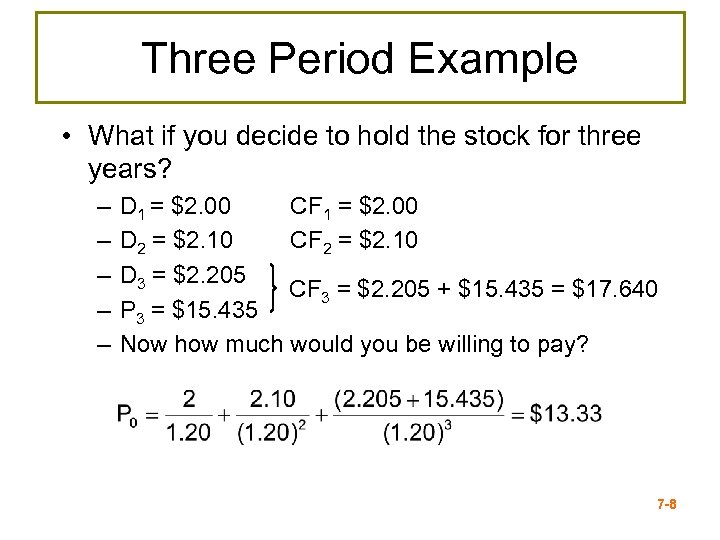
Three Period Example • What if you decide to hold the stock for three years? – – – D 1 = $2. 00 CF 1 = $2. 00 D 2 = $2. 10 CF 2 = $2. 10 D 3 = $2. 205 CF 3 = $2. 205 + $15. 435 = $17. 640 P 3 = $15. 435 Now how much would you be willing to pay? 7 -8
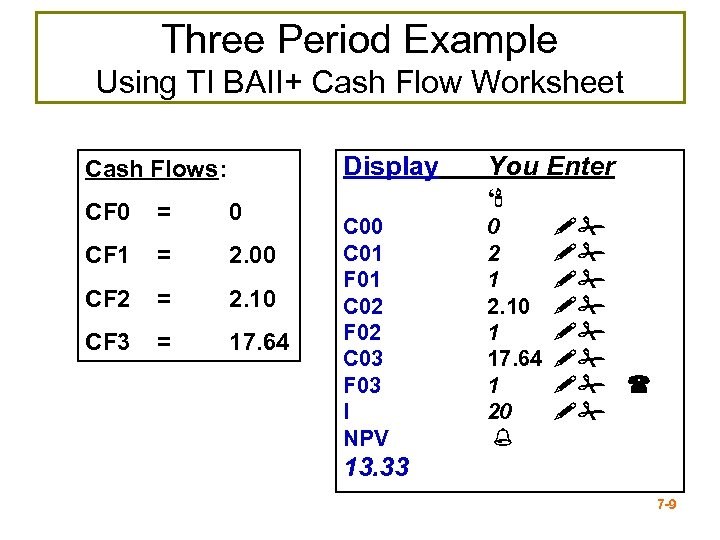
Three Period Example Using TI BAII+ Cash Flow Worksheet Display Cash Flows: CF 0 = 0 CF 1 = 2. 00 CF 2 = 2. 10 CF 3 = 17. 64 You Enter ‘' C 00 C 01 F 01 C 02 F 02 C 03 F 03 I NPV 0 2 1 2. 10 1 17. 64 1 20 % !# !# ( !# 13. 33 7 -9
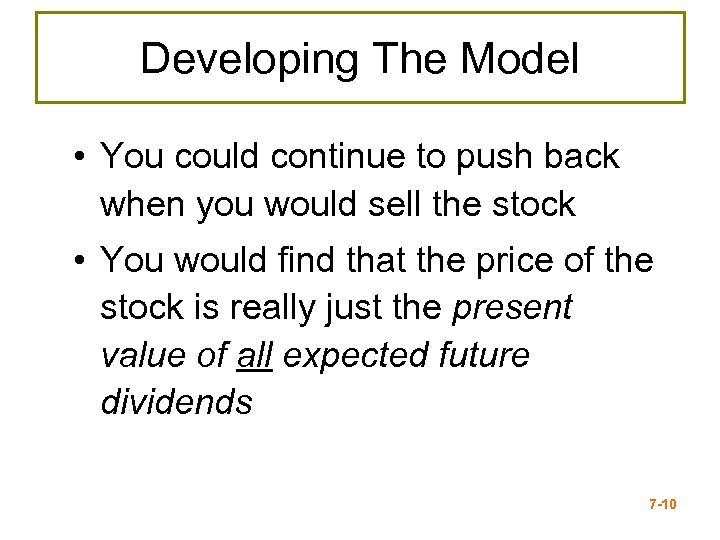
Developing The Model • You could continue to push back when you would sell the stock • You would find that the price of the stock is really just the present value of all expected future dividends 7 -10
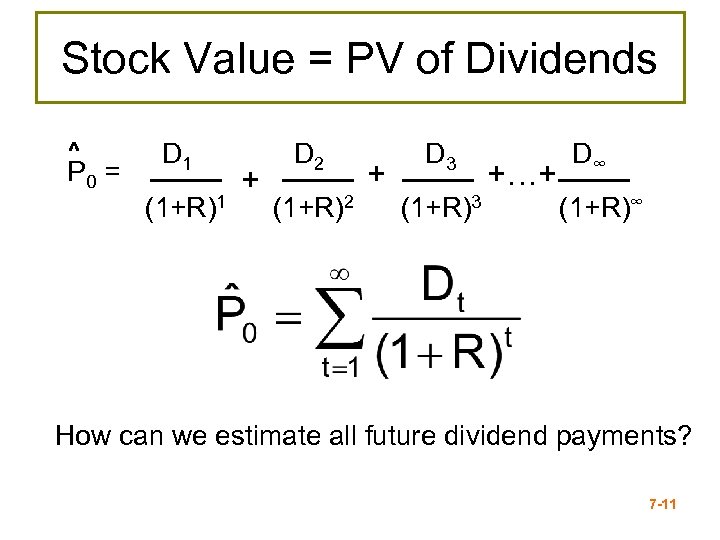
Stock Value = PV of Dividends ^ P 0 = D 1 (1+R)1 + D 2 (1+R)2 + D 3 (1+R)3 +…+ D∞ (1+R)∞ How can we estimate all future dividend payments? 7 -11
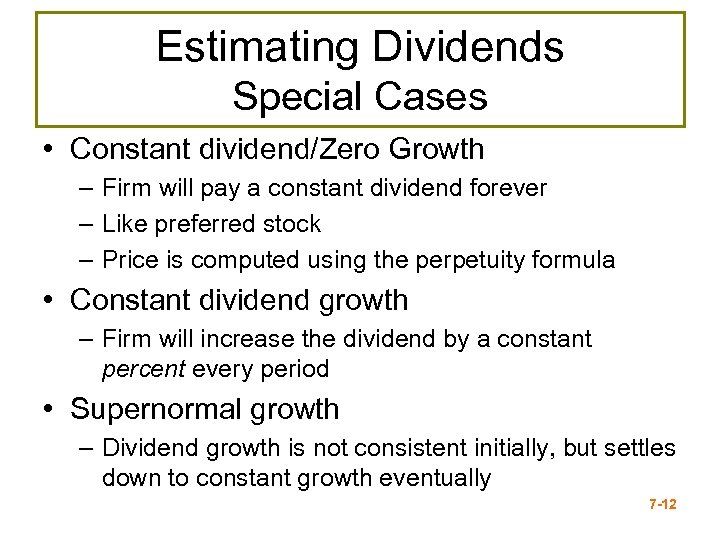
Estimating Dividends Special Cases • Constant dividend/Zero Growth – Firm will pay a constant dividend forever – Like preferred stock – Price is computed using the perpetuity formula • Constant dividend growth – Firm will increase the dividend by a constant percent every period • Supernormal growth – Dividend growth is not consistent initially, but settles down to constant growth eventually 7 -12
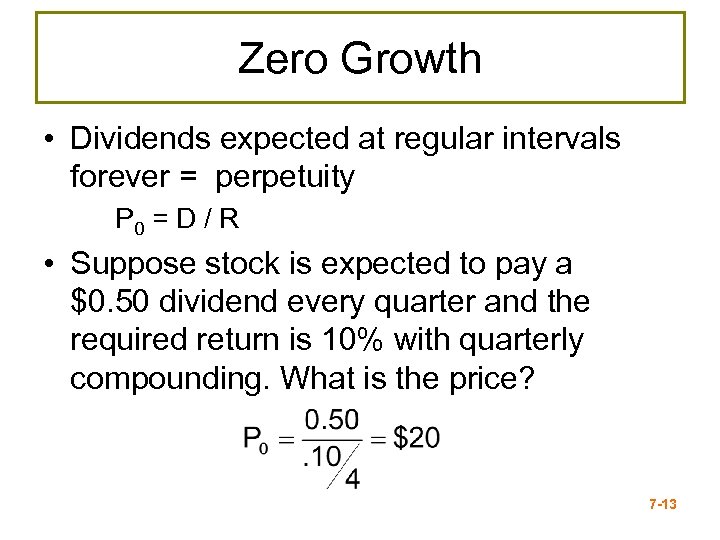
Zero Growth • Dividends expected at regular intervals forever = perpetuity P 0 = D / R • Suppose stock is expected to pay a $0. 50 dividend every quarter and the required return is 10% with quarterly compounding. What is the price? 7 -13
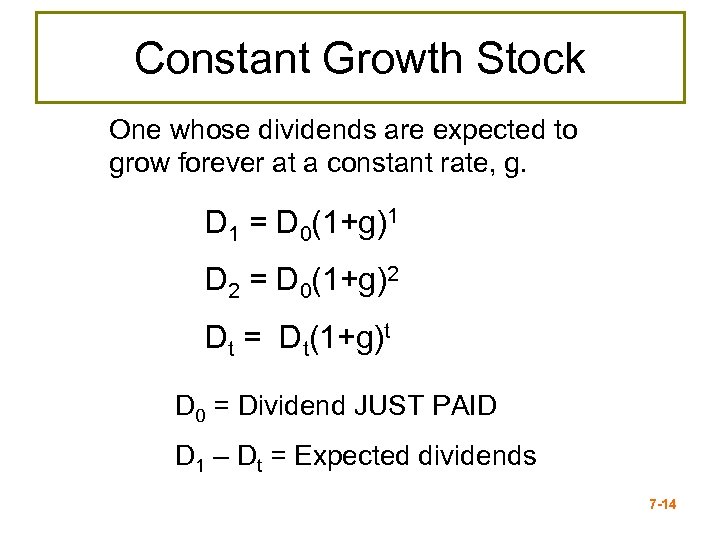
Constant Growth Stock One whose dividends are expected to grow forever at a constant rate, g. D 1 = D 0(1+g)1 D 2 = D 0(1+g)2 Dt = Dt(1+g)t D 0 = Dividend JUST PAID D 1 – Dt = Expected dividends 7 -14
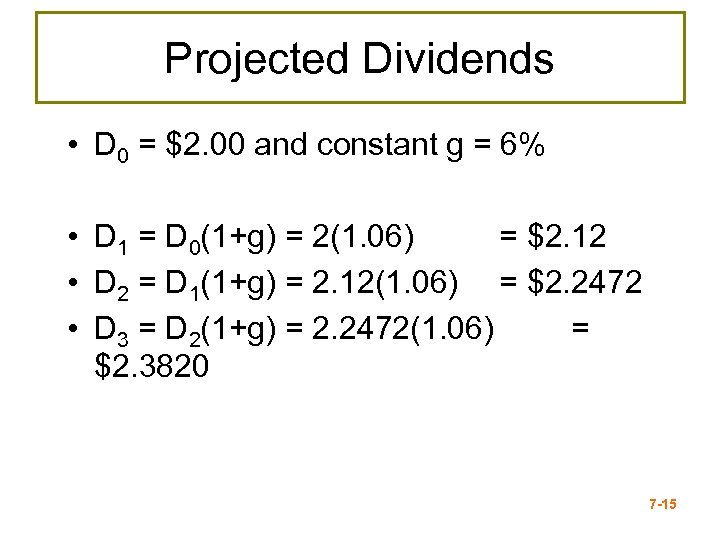
Projected Dividends • D 0 = $2. 00 and constant g = 6% • D 1 = D 0(1+g) = 2(1. 06) = $2. 12 • D 2 = D 1(1+g) = 2. 12(1. 06) = $2. 2472 • D 3 = D 2(1+g) = 2. 2472(1. 06) = $2. 3820 7 -15
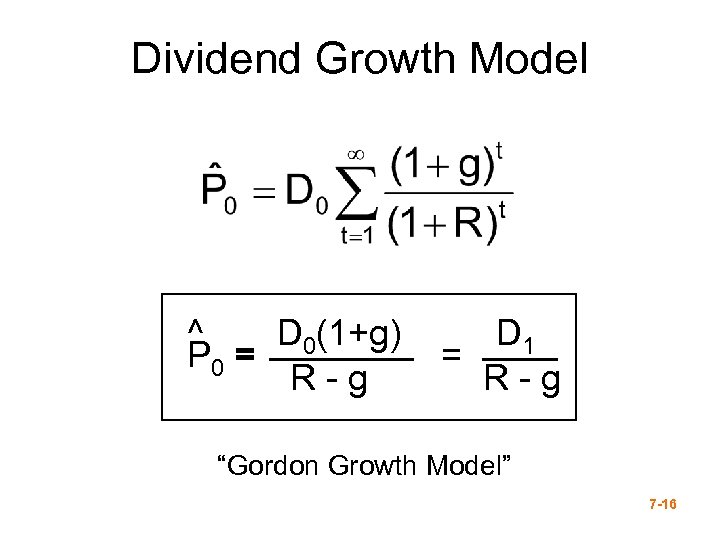
Dividend Growth Model ^ D 0(1+g) P 0 = R-g D 1 = R-g “Gordon Growth Model” 7 -16
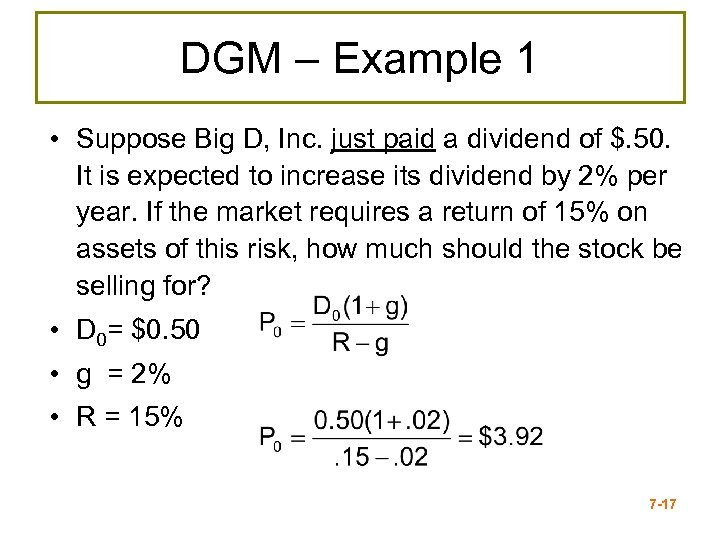
DGM – Example 1 • Suppose Big D, Inc. just paid a dividend of $. 50. It is expected to increase its dividend by 2% per year. If the market requires a return of 15% on assets of this risk, how much should the stock be selling for? • D 0= $0. 50 • g = 2% • R = 15% 7 -17
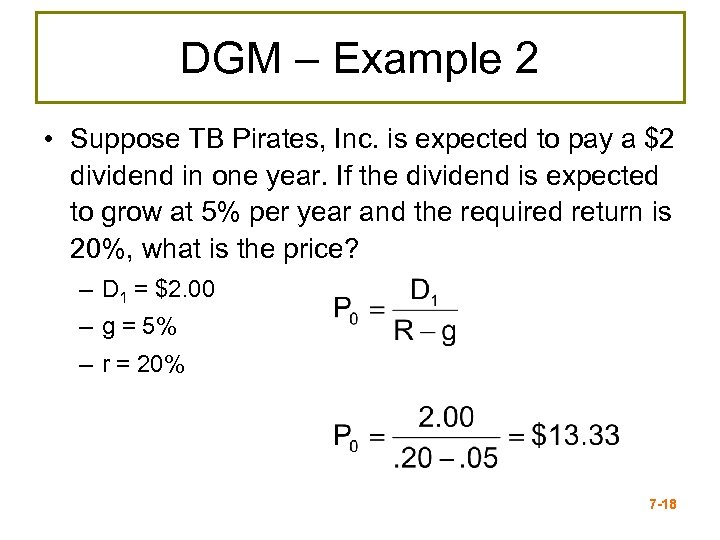
DGM – Example 2 • Suppose TB Pirates, Inc. is expected to pay a $2 dividend in one year. If the dividend is expected to grow at 5% per year and the required return is 20%, what is the price? – D 1 = $2. 00 – g = 5% – r = 20% 7 -18
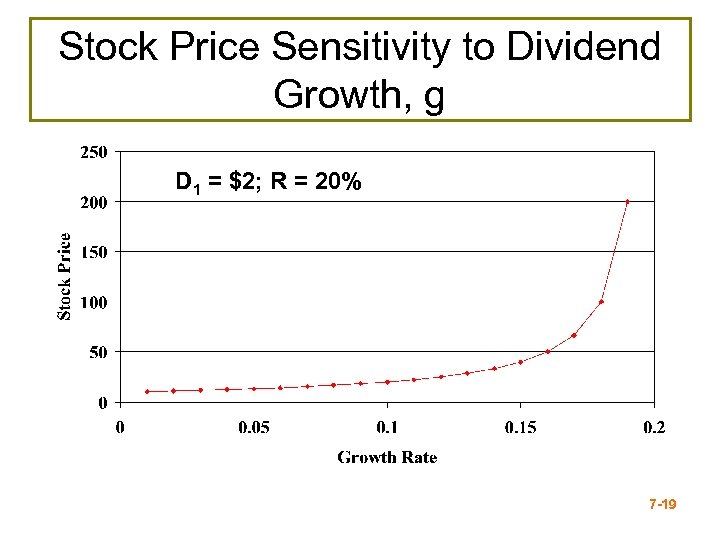
Stock Price Sensitivity to Dividend Growth, g D 1 = $2; R = 20% 7 -19
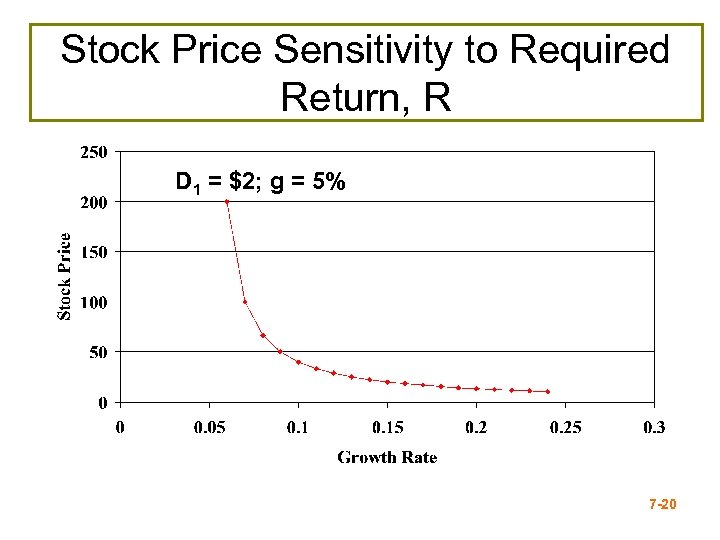
Stock Price Sensitivity to Required Return, R D 1 = $2; g = 5% 7 -20
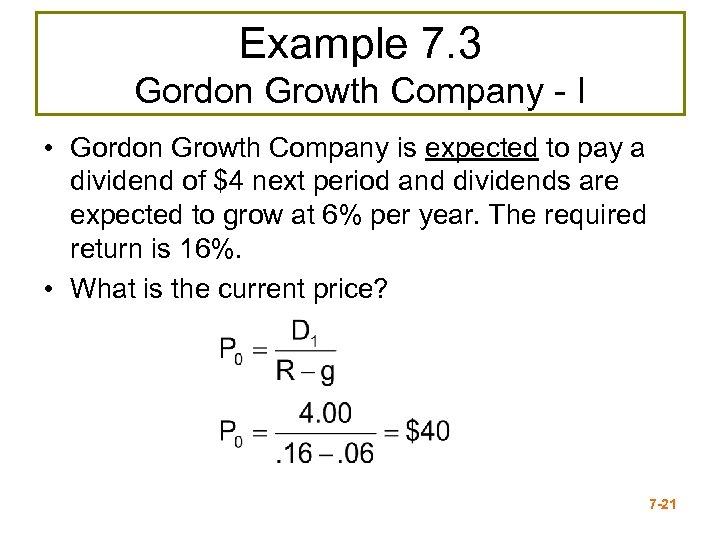
Example 7. 3 Gordon Growth Company - I • Gordon Growth Company is expected to pay a dividend of $4 next period and dividends are expected to grow at 6% per year. The required return is 16%. • What is the current price? 7 -21
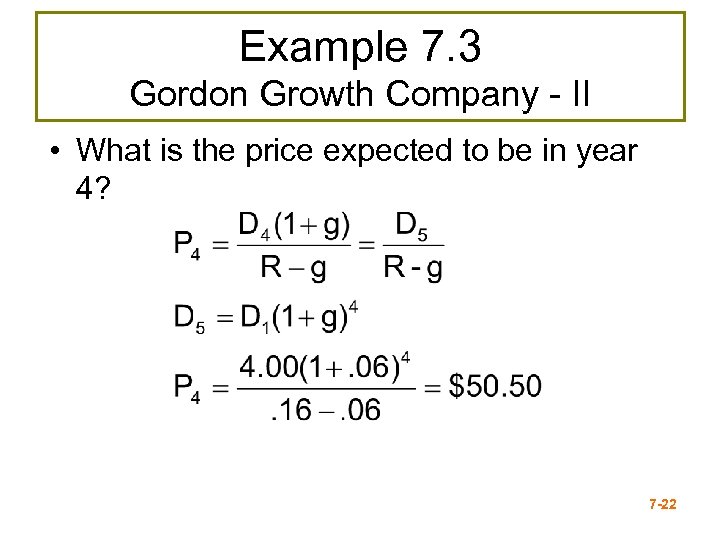
Example 7. 3 Gordon Growth Company - II • What is the price expected to be in year 4? 7 -22
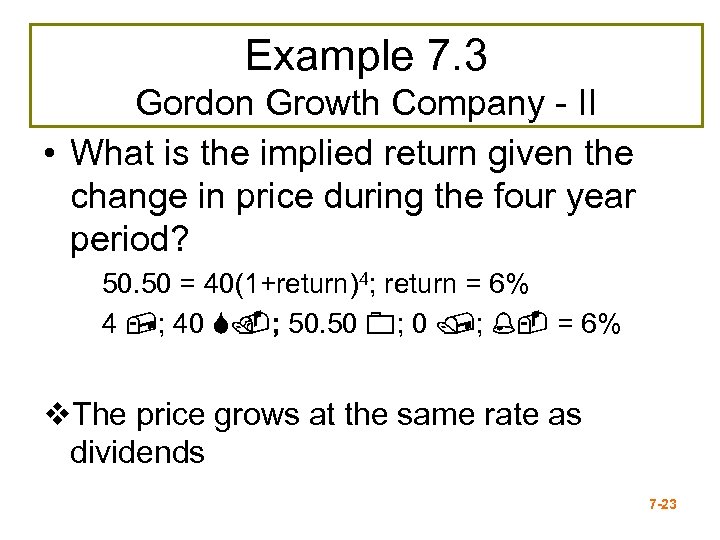
Example 7. 3 Gordon Growth Company - II • What is the implied return given the change in price during the four year period? 50. 50 = 40(1+return)4; return = 6% 4 , ; 40 S. ; 50. 50 0; 0 /; %- = 6% v. The price grows at the same rate as dividends 7 -23
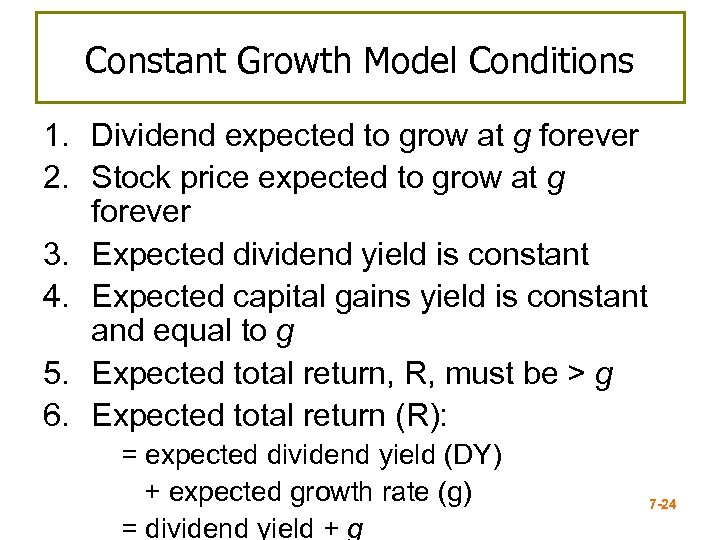
Constant Growth Model Conditions 1. Dividend expected to grow at g forever 2. Stock price expected to grow at g forever 3. Expected dividend yield is constant 4. Expected capital gains yield is constant and equal to g 5. Expected total return, R, must be > g 6. Expected total return (R): = expected dividend yield (DY) + expected growth rate (g) = dividend yield + g 7 -24
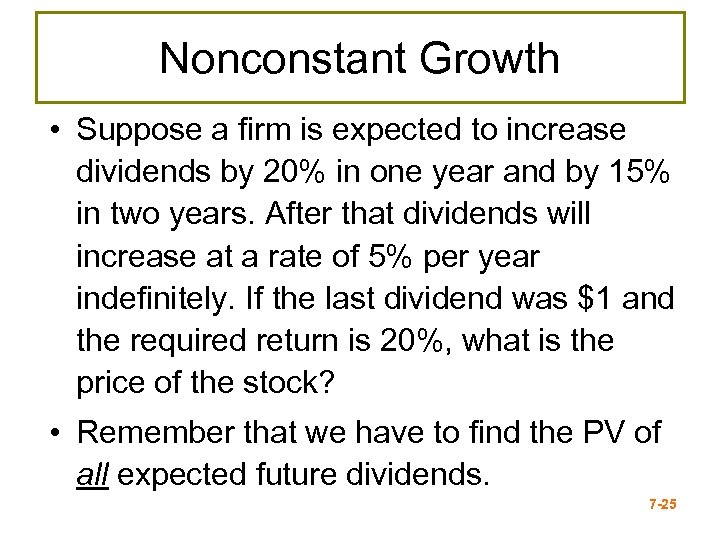
Nonconstant Growth • Suppose a firm is expected to increase dividends by 20% in one year and by 15% in two years. After that dividends will increase at a rate of 5% per year indefinitely. If the last dividend was $1 and the required return is 20%, what is the price of the stock? • Remember that we have to find the PV of all expected future dividends. 7 -25
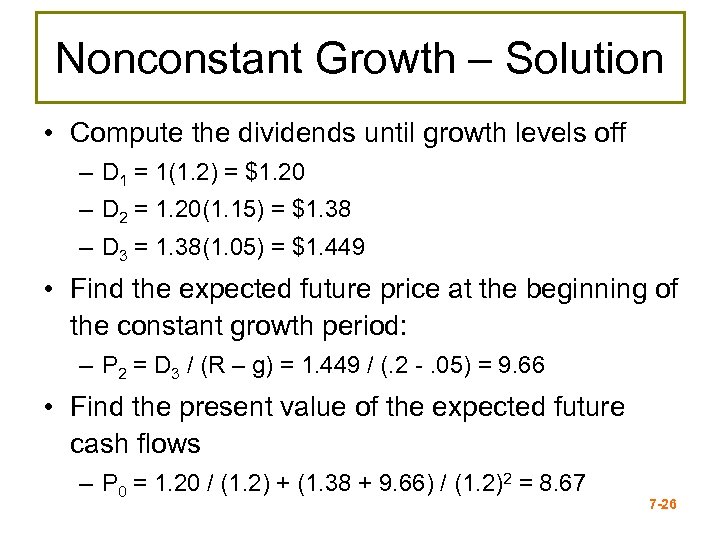
Nonconstant Growth – Solution • Compute the dividends until growth levels off – D 1 = 1(1. 2) = $1. 20 – D 2 = 1. 20(1. 15) = $1. 38 – D 3 = 1. 38(1. 05) = $1. 449 • Find the expected future price at the beginning of the constant growth period: – P 2 = D 3 / (R – g) = 1. 449 / (. 2 -. 05) = 9. 66 • Find the present value of the expected future cash flows – P 0 = 1. 20 / (1. 2) + (1. 38 + 9. 66) / (1. 2)2 = 8. 67 7 -26
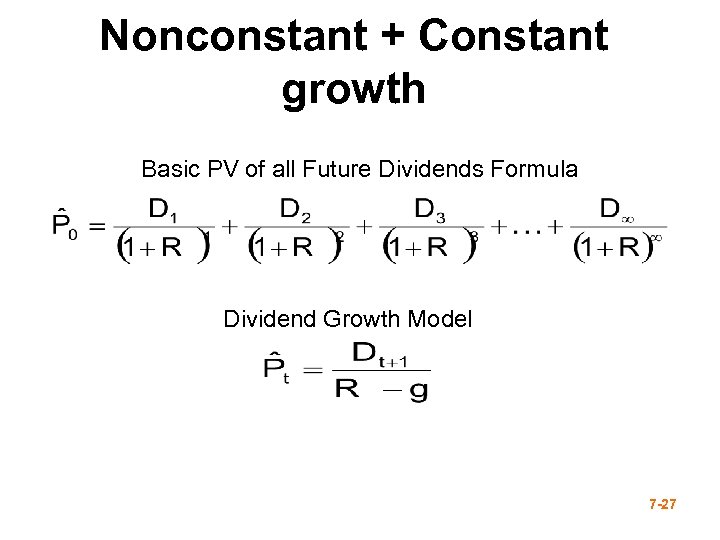
Nonconstant + Constant growth Basic PV of all Future Dividends Formula Dividend Growth Model 7 -27
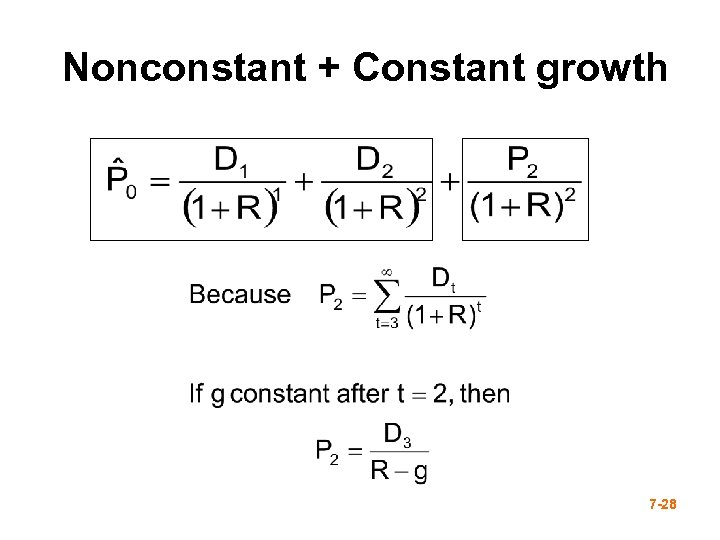
Nonconstant + Constant growth 7 -28
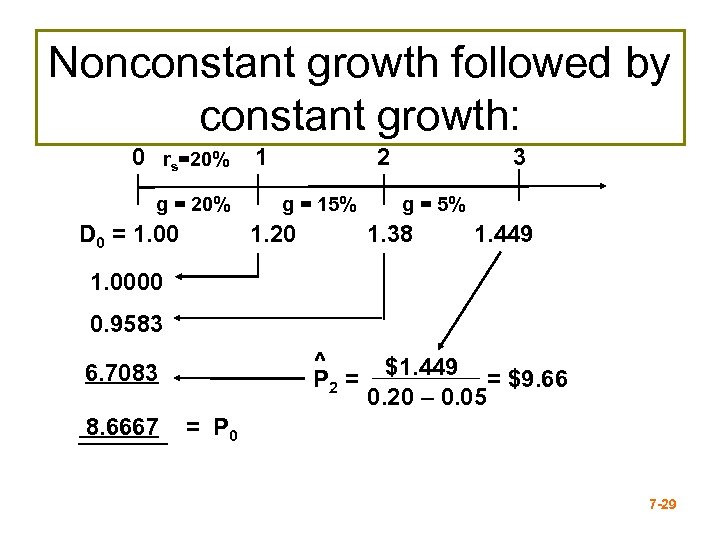
Nonconstant growth followed by constant growth: 0 rs=20% g = 20% D 0 = 1. 00 1 2 g = 15% 1. 20 3 g = 5% 1. 38 1. 449 1. 0000 0. 9583 ^ P 2 = 6. 7083 8. 6667 $1. 449 = $9. 66 0. 20 – 0. 05 = P 0 7 -29
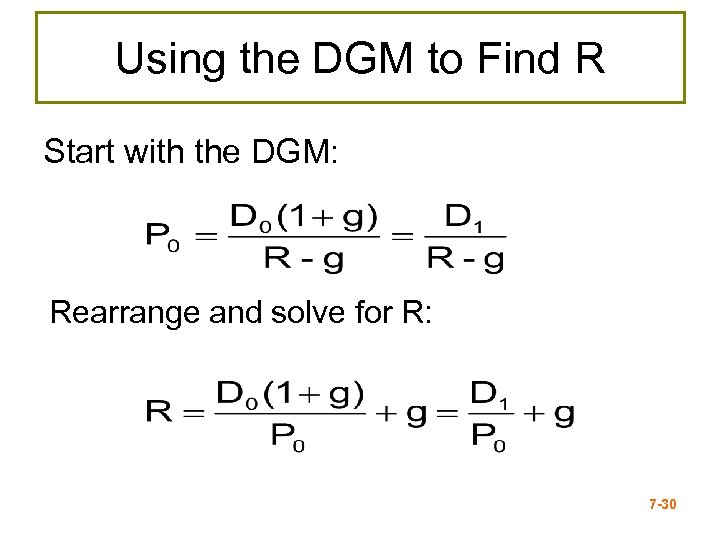
Using the DGM to Find R Start with the DGM: Rearrange and solve for R: 7 -30
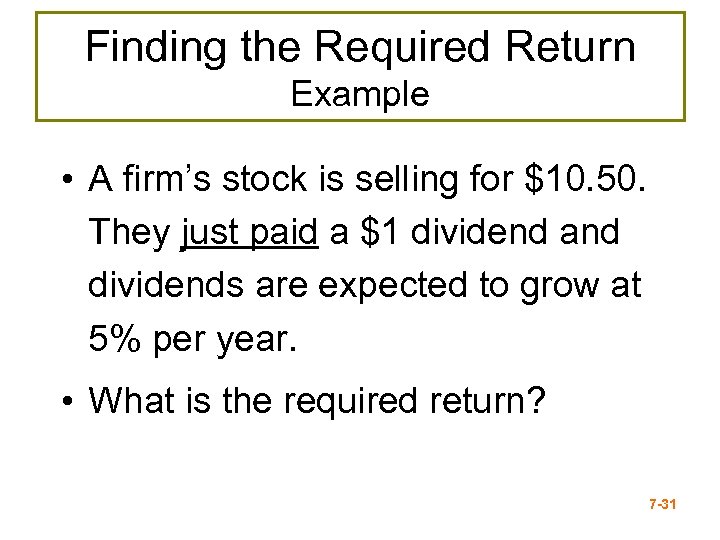
Finding the Required Return Example • A firm’s stock is selling for $10. 50. They just paid a $1 dividend and dividends are expected to grow at 5% per year. • What is the required return? 7 -31
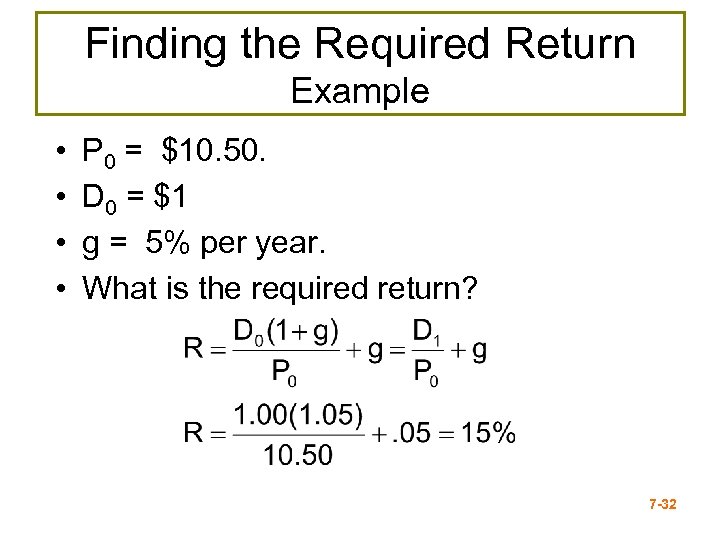
Finding the Required Return Example • • P 0 = $10. 50. D 0 = $1 g = 5% per year. What is the required return? 7 -32
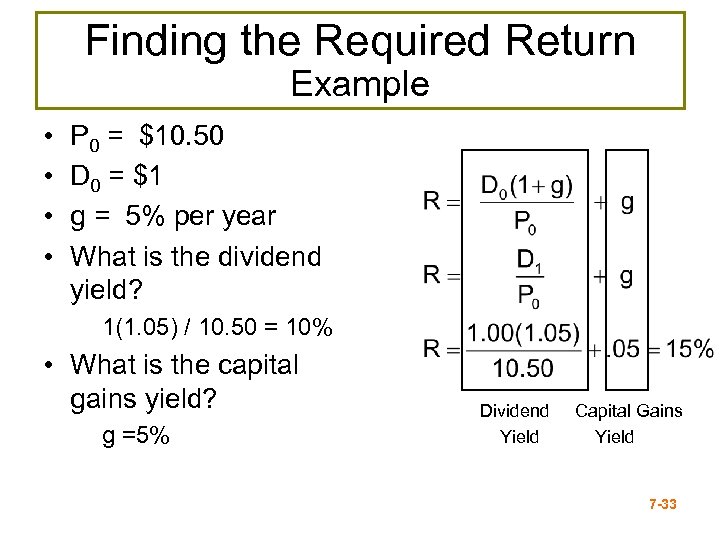
Finding the Required Return Example • • P 0 = $10. 50 D 0 = $1 g = 5% per year What is the dividend yield? 1(1. 05) / 10. 50 = 10% • What is the capital gains yield? g =5% Dividend Yield Capital Gains Yield 7 -33
Features of Common Stock • Voting Rights – Stockholders elect directors – Cumulative voting vs. Straight voting – Proxy voting • Classes of stock – Founders’ shares – Class A and Class B shares Return to Quick Quiz 7 -34
Features of Common Stock • Other Rights – Share proportionally in declared dividends – Share proportionally in remaining assets during liquidation – Preemptive right • Right of first refusal to buy new stock issue to maintain proportional ownership if desired Return to Quick Quiz 7 -35
Dividend Characteristics • Dividends are not a liability of the firm until declared by the Board of Directors – A firm cannot go bankrupt for not declaring dividends • Dividends and Taxes – Dividends are not tax deductible for firm – Taxed as ordinary income for individuals – Dividends received by corporations have a minimum 70% exclusion from taxable income 7 -36
Features of Preferred Stock • Dividends – Must be paid before dividends can be paid to common stockholders – Not a liability of the firm – Can be deferred indefinitely – Most preferred dividends are cumulative • Missed preferred dividends have to be paid before common dividends can be paid • Preferred stock generally does not carry voting rights Return to Quick Quiz 7 -37
The Stock Markets • Primary vs. Secondary Markets – Primary = new-issue market – Secondary = existing shares traded among investors • Dealers vs. Brokers – Dealer: Maintains an inventor Ready to buy or sell at any time Think “Used car dealer” – Broker: Brings buyers and sellers together Think “Real estate broker” 7 -38
New York Stock Exchange (NYSE) • NYSE Euronext (merged 2007) • Members (Historically) – Buy a trading license (own a seat) – Commission brokers – Specialists – Super. DOT – Floor brokers – Floor traders 7 -39
NYSE Operations • Operational goal = attract order flow • NYSE Specialist: – Assigned broker/dealer • Each stock has one assigned specialist • All trading in that stock occurs at the “specialist’s post” – Trading takes place between customer orders placed with the specialists and “the crowd” – “Crowd” = commission and floor brokers and traders 7 -40
NASDAQ • • • NASDAQ OMX (merged 2007) Computer-based quotation system Multiple market makers Electronic Communications Networks Three levels of information – Level 1 – median quotes, registered representatives – Level 2 – view quotes, brokers & dealers – Level 3 – view and update quotes, dealers only • Large portion of technology stocks 7 -41
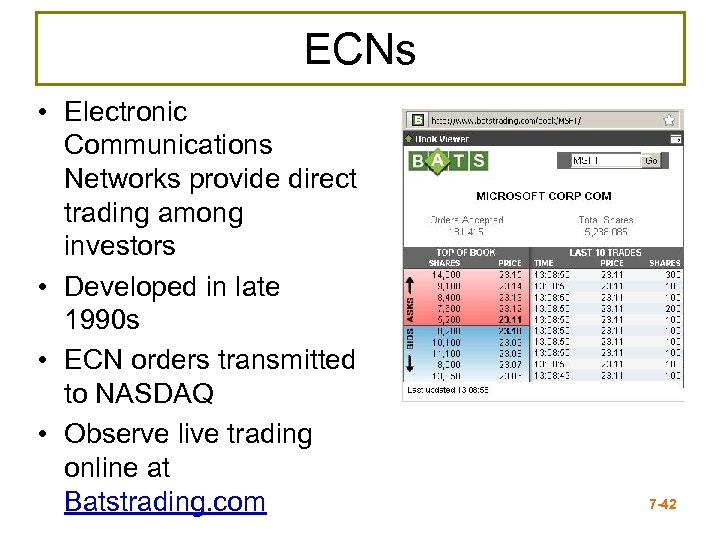
ECNs • Electronic Communications Networks provide direct trading among investors • Developed in late 1990 s • ECN orders transmitted to NASDAQ • Observe live trading online at Batstrading. com 7 -42
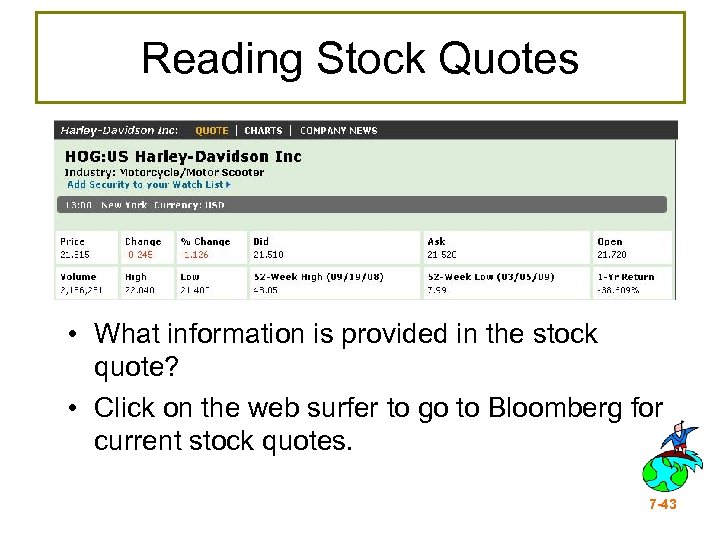
Reading Stock Quotes • What information is provided in the stock quote? • Click on the web surfer to go to Bloomberg for current stock quotes. 7 -43
Chapter 7 END
Скачать презентацию 7 -1 Mc Graw-Hill Irwin Copyright 2011 by
c6d3085ea48e6f5c3ed3b93ee883ecfc.ppt