


 Скачать презентацию 6 th Plan Conservation Resource Cost Effectiveness Conservation
5fdbb3b2c68501bd5a397c3562c5bc42.ppt
- Количество слайдов: 58
 6 th Plan Conservation Resource Cost. Effectiveness Conservation Resource Advisory Committee March 12, 2009 Northwest Power and Conservation Council
 How the Plan’s Cost-Effectiveness Analysis Impacts Regional Conservation Programs n Council Plan – Establishes regional conservation targets based its interpretation of the Act’s requirements – Contains methodology and assumptions (e. g. , future market prices, measure cost & savings) for determining costeffectiveness – Contains specific “measure level” (e. g. high efficiency electric water heaters) determinations of cost-effectiveness n n Bonneville’s resource acquisitions are to be consistent with the Council’s Plan Utilities covered by I-937 in Washington state must adhere to the Council’s “methodology” slide 2 Northwest Power and Conservation Council
 The Plan’s Definition of Resource Cost. Effectiveness Comes From the Regional Act n slide 3 "Cost-effective, ” means that a measure or resource must be forecast: – to be reliable and available within the time it is needed – to meet or reduce the electric power demand of the consumers at an estimated incremental system cost no greater than that of the leastcost similarly reliable and available alternative measure or resource, or any combination thereof. Northwest Power and Conservation Council
 Under the Act the term "system cost" means: n An estimate of all direct costs of a measure or resource over its effective life, including: – the cost of distribution and transmission to the consumer – waste disposal costs – end-of-cycle costs – fuel costs (including projected increases) – and such quantifiable environmental costs and benefits as are directly attributable to such measure or resource slide 4 Northwest Power and Conservation Council
 The Act’s Definition of Cost. Effectiveness n Seeks to minimize the total cost of meeting the region’s need for the services provided by electricity, i. e. , its goal is economic efficiency. n Does not address the distribution of these costs among parties in the region slide 5 Northwest Power and Conservation Council
 The Council Does Not Use A Single Regional Avoided Cost To Determine Conservation’s Cost-Effectiveness n 1) 2) 3) We Use What We Learn from the Portfolio Model Pick any forecast of future market prices Add “Risk Premiums” for conservation’s hedge value to that forecast (different ones for lost-opportunity & dispatchable) Use this risk adjusted price to determine the value of the energy savings slide 6 Northwest Power and Conservation Council
 IRP Methodology n n 6 th Plan is testing thousands of “plans” against 750 futures Model identifies “plans” with the lowest cost for a given level of risk Model tests alternative conservation deployment schedules (amount and timing) as well as “risk mitigation” benefits of buying conservation above forecast avoided cost Regional Conservation Targets are derived from Plans on lowest-cost lowest-risk frontier slide 7 Northwest Power and Conservation Council
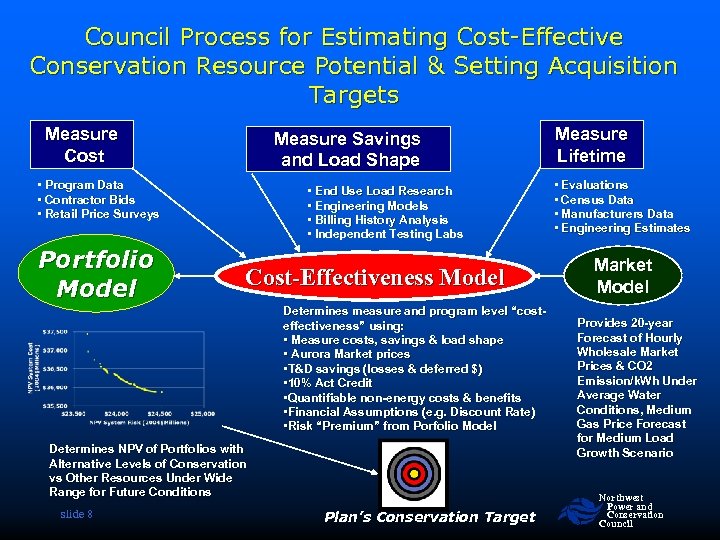 Council Process for Estimating Cost-Effective Conservation Resource Potential & Setting Acquisition Targets Measure Cost Measure Savings and Load Shape • Program Data • Contractor Bids • Retail Price Surveys Portfolio Model • End Use Load Research • Engineering Models • Billing History Analysis • Independent Testing Labs Cost-Effectiveness Model Determines measure and program level “costeffectiveness” using: • Measure costs, savings & load shape • Aurora Market prices • T&D savings (losses & deferred $) • 10% Act Credit • Quantifiable non-energy costs & benefits • Financial Assumptions (e. g. Discount Rate) • Risk “Premium” from Porfolio Model Determines NPV of Portfolios with Alternative Levels of Conservation vs Other Resources Under Wide Range for Future Conditions slide 8 Plan’s Conservation Target Measure Lifetime • Evaluations • Census Data • Manufacturers Data • Engineering Estimates Market Model Provides 20 -year Forecast of Hourly Wholesale Market Prices & CO 2 Emission/k. Wh Under Average Water Conditions, Medium Gas Price Forecast for Medium Load Growth Scenario Northwest Power and Conservation Council
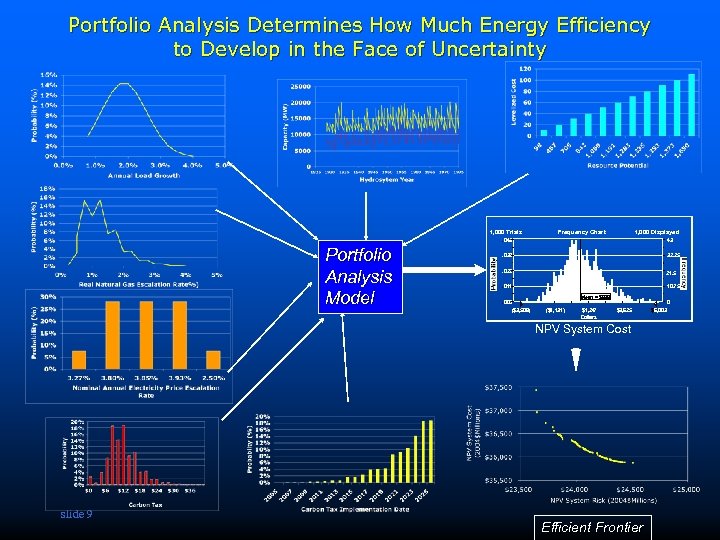 Portfolio Analysis Determines How Much Energy Efficiency to Develop in the Face of Uncertainty 1, 000 Trials Frequency Chart 1, 000 Displayed . 043 Portfolio Analysis Model 43 . 032 32. 25 . 022 21. 5 . 011 10. 75 Mean = $689 . 000 ($3, 509) ($1, 131) $1, 247 Dollars 0 $3, 625 NPV System Cost slide 9 Efficient Frontier $6, 003
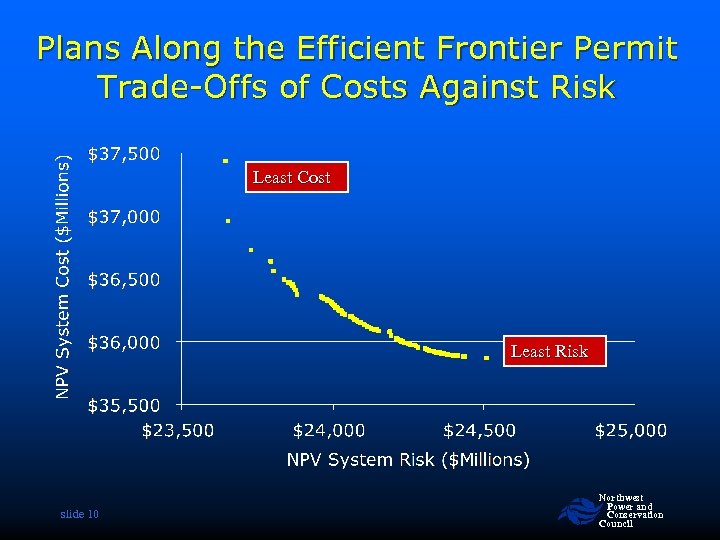 Plans Along the Efficient Frontier Permit Trade-Offs of Costs Against Risk Least Cost Least Risk slide 10 Northwest Power and Conservation Council
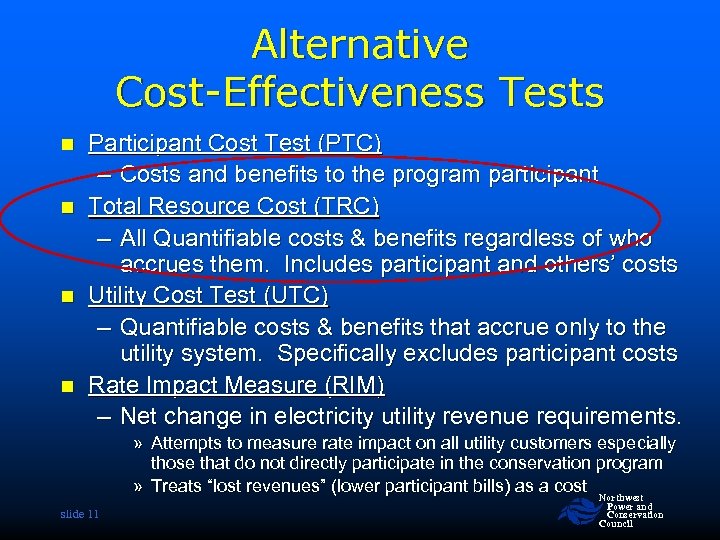 Alternative Cost-Effectiveness Tests n n Participant Cost Test (PTC) – Costs and benefits to the program participant Total Resource Cost (TRC) – All Quantifiable costs & benefits regardless of who accrues them. Includes participant and others’ costs Utility Cost Test (UTC) – Quantifiable costs & benefits that accrue only to the utility system. Specifically excludes participant costs Rate Impact Measure (RIM) – Net change in electricity utility revenue requirements. » Attempts to measure rate impact on all utility customers especially those that do not directly participate in the conservation program » Treats “lost revenues” (lower participant bills) as a cost Northwest slide 11 Power and Conservation Council
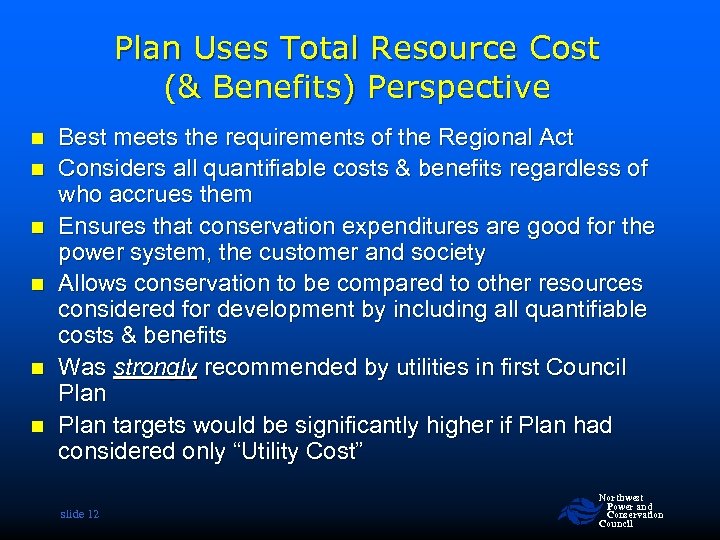 Plan Uses Total Resource Cost (& Benefits) Perspective n n n Best meets the requirements of the Regional Act Considers all quantifiable costs & benefits regardless of who accrues them Ensures that conservation expenditures are good for the power system, the customer and society Allows conservation to be compared to other resources considered for development by including all quantifiable costs & benefits Was strongly recommended by utilities in first Council Plan targets would be significantly higher if Plan had considered only “Utility Cost” slide 12 Northwest Power and Conservation Council
 Some Utilities Now Recommend Use of Utility Cost Test Perspective n Considers only those costs & benefits that accrue to electric utility system – Energy k. Wh at avoided wholesale cost at time saved – Transmission & distribution k. W benefits if coincident with system peak and at value of deferred expansion cost – Utility cost for incentives & program administration n n Does not count customer costs or benefits Ensure that conservation is good for the utility Acts as the upper limit on utility incentives for measures with large non-electricity benefits Used as a measure of utility cost efficiency – Striving for low utility cost share keeps revenue requirements Northwest Power and lower slide 13 Conservation Council
 NEET Process Raised Additional Issues n Review method of calculating cost-effectiveness – Is the Council’s existing interpretation of the Act’s definition “too conservative”? n At what “level of aggregation” should the calculation of costs and benefits be performed? – Measure – System – Building – Program – Portfolio slide 14 Northwest Power and Conservation Council
 Why Council Uses TRC: Avoids Potential Double Counting of the Savings n Utility invest $2500 in efficient motor to acquire 5000 k. Wh/yr savings – Levelized Cost = 3. 4 cents/k. Wh – B/C = 1. 32 n Customer matches $2500 utility investment to save the same 5000 k. Wh/yr – Simple payback = 10 years, motor last 20 years n Total of all direct cost is $5000 for 5000 k. Wh/yr of savings – Levelized cost = 6. 8 cents/k. Wh – B/C ratio = 0. 66 slide 15 Northwest Power and Conservation Council
 Why Council Uses TRC Directs Funds Toward Measures That Optimize Total Utility and Customer Investments n Utility invest $600 toward cost of $6000 solar PV system that saves 1200 k. Wh/yr – Alternatively utility and consumer could: » Invest $160 in 40 CFLs to save 1200 k. Wh, reducing cost $440 » Invest $600 to buy 150 CFLs, saving 5000 k. Wh, quadrupling savings n Especially important when budgets are limited slide 16 Northwest Power and Conservation Council
 Why Council Uses TRC Avoids promoting measures that may impose nonenergy costs on others n n n Act directs the Council give second priority to the use of renewable resources Analysis in 1 st Plan concluded that cost of using wood stoves to offset use of electric heat was below cost of electricity from new generating facilities 1 st Plan excluded use of wood heat due to “non-energy” cost (air pollution) imposed on the region slide 17 Northwest Power and Conservation Council
 Why Council Uses TRC Expands list of conservation options by allowing consideration of quantifiable “non-energy” benefits n Energy Star Clothes Washer in Homes with Gas Water Heater and Dryer – Present Value Capital Cost = $58/MWh – Present Value to Power System = $17/MWh (B/C = 0. 3) – Value to Region/Society (includes natural gas, detergent & water savings) = $110/MWh (B/C = 2. 0) n Power system’s “willingness-to-pay” for these savings should be limited to its present value benefits » Electric Utility could provide incentive up to $17/MWh for washer in a home with gas water and dryer heat slide 18 Northwest Power and Conservation Council
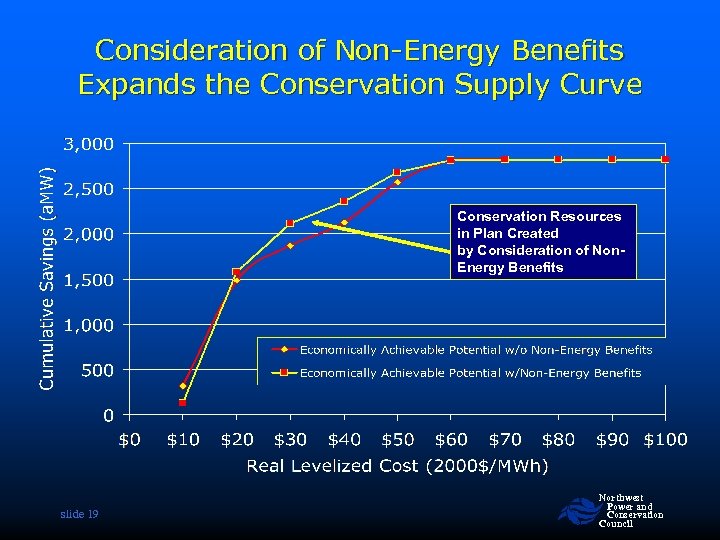 Consideration of Non-Energy Benefits Expands the Conservation Supply Curve Conservation Resources in Plan Created by Consideration of Non. Energy Benefits slide 19 Northwest Power and Conservation Council
 Care Must Be Used in Applying The Plan’s Cost-Effectiveness Results “Prescriptively” n Not all measures are in the draft 6 th Plan – Plan contains over 1000 applications of specific EE technologies – NOT an exhaustive list of all possible measures & applications (e. g. custom measures) n Plan assumes administrative costs = 20% of capital – Administrative cost vary widely by measure & by program design n Measure cost-effectiveness in Plan is an estimate – Measure costs and savings are a single point estimate, but vary widely in practice – Plan targets are based on full portfolio model analysis, 750 forecasts of “avoided costs” – Measure/Program/Portfolio cost-effectiveness generally determined on a single forecast of “avoided costs” for the next 20 years (with adders for “hedge risk”) slide 20 Northwest Power and Conservation Council
 Granularity/Bundling – So What’s “A Measure”? n "Resource" means-- electric power, including the actual or planned electric power capability of generating facilities, or actual or planned load reduction resulting from direct application of a renewable energy resource by a consumer, or from a conservation measure. slide 21 Northwest Power and Conservation Council
 Why “Bundle” n Measures are interactive, so total savings are not the sum of their “parts” – Example: Heat pumps, duct sealing and commissioning n “Deeper” savings are lower cost – Example: Conversions and/upgrades to HSPF 9. 0 have a higher TRC B/C ratio than to HSPF 8. 5 n Adding a “non-cost effective” measure reduces cost per unit of savings by increasing market penetration – Example: Adding “prime window replacements” increases participation in weatherization program, spreading fixed cost over more savings slide 22 Northwest Power and Conservation Council
 Risks of Bundling n Reduces in economic benefits of conservation – If the average cost of all conservation equals the avoided cost, there’s no room for a mistakes n n If “non-cost effective” measure dominates program/portfolio, it places all savings at risk (i. e. , not recoverable, not counted toward target) Slippery slope – Can bundling of any measures (e. g. PVs w/CFLs) be justified? – Is there a need for consistent application across the region? slide 23 Northwest Power and Conservation Council
 Care Must Be Used in Applying The Plan’s Cost-Effectiveness Results “Prescriptively” n Plan’s cost & savings estimates are “averages” – Site-specific applications may be more or less “costeffective” than in Plan – The Plan “average” may not accurately reflect specific program conditions n n Programs should be tailored to reflect specific program designs, delivery mechanisms, measure applications, location and other key cost or savings factors Program estimates need to be more or less granular than Plan estimates – Individual measures evaluated in Plan are aggregated into programs/portfolios (e. g. , Plan doesn’t have “Energy Star New Homes” as a measure) slide 24 Northwest Power and Conservation Council
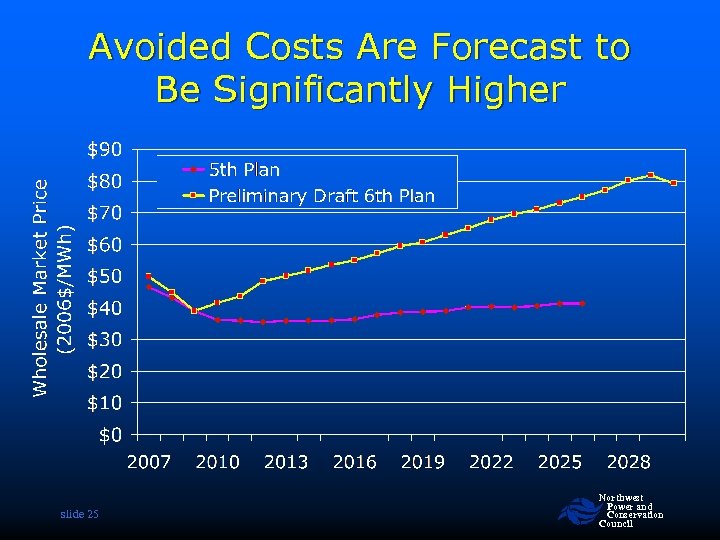 Avoided Costs Are Forecast to Be Significantly Higher slide 25 Northwest Power and Conservation Council
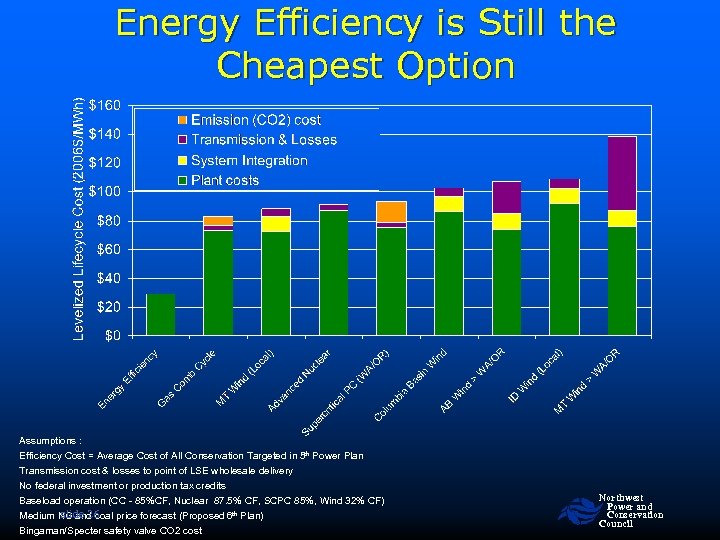 Energy Efficiency is Still the Cheapest Option Assumptions : Efficiency Cost = Average Cost of All Conservation Targeted in 5 th Power Plan Transmission cost & losses to point of LSE wholesale delivery No federal investment or production tax credits Baseload operation (CC - 85%CF, Nuclear 87. 5% CF, SCPC 85%, Wind 32% CF) slide 26 Medium NG and coal price forecast (Proposed 6 th Plan) Bingaman/Specter safety valve CO 2 cost Northwest Power and Conservation Council
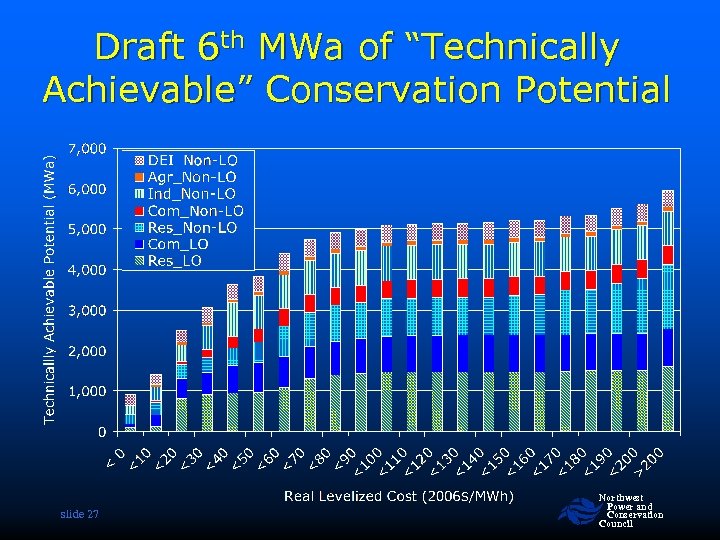 Draft 6 th MWa of “Technically Achievable” Conservation Potential slide 27 Northwest Power and Conservation Council
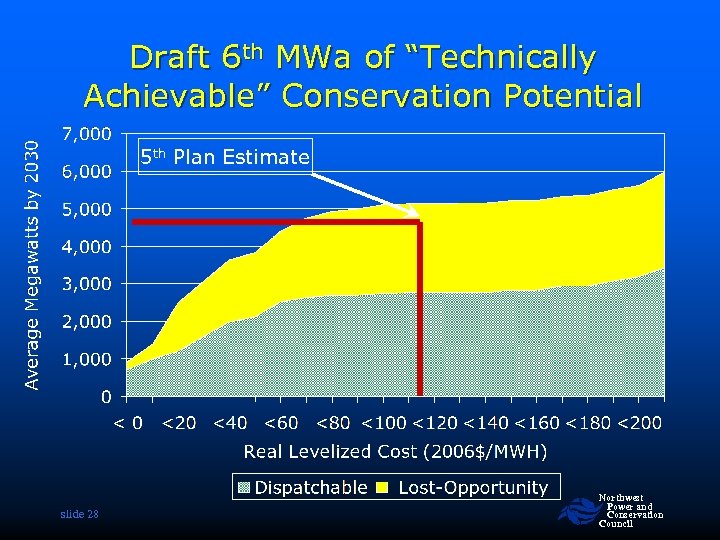 Draft 6 th MWa of “Technically Achievable” Conservation Potential 5 th Plan Estimate slide 28 Northwest Power and Conservation Council
 Backup Slides slide 29 Northwest Power and Conservation Council
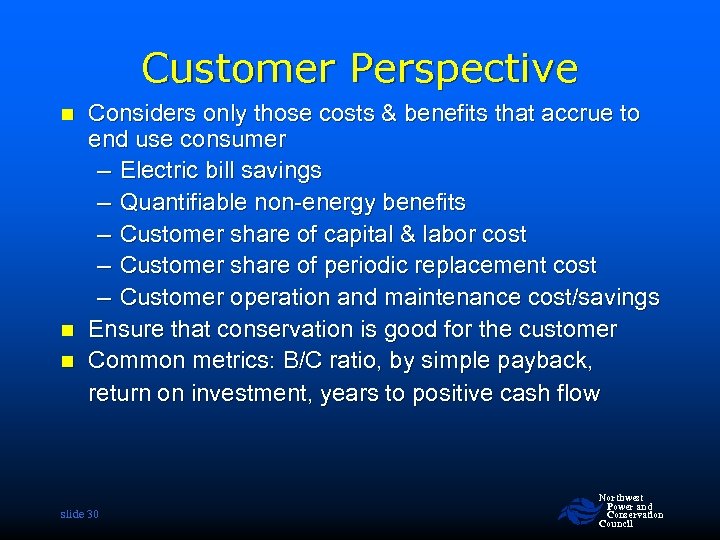 Customer Perspective n n n Considers only those costs & benefits that accrue to end use consumer – Electric bill savings – Quantifiable non-energy benefits – Customer share of capital & labor cost – Customer share of periodic replacement cost – Customer operation and maintenance cost/savings Ensure that conservation is good for the customer Common metrics: B/C ratio, by simple payback, return on investment, years to positive cash flow slide 30 Northwest Power and Conservation Council
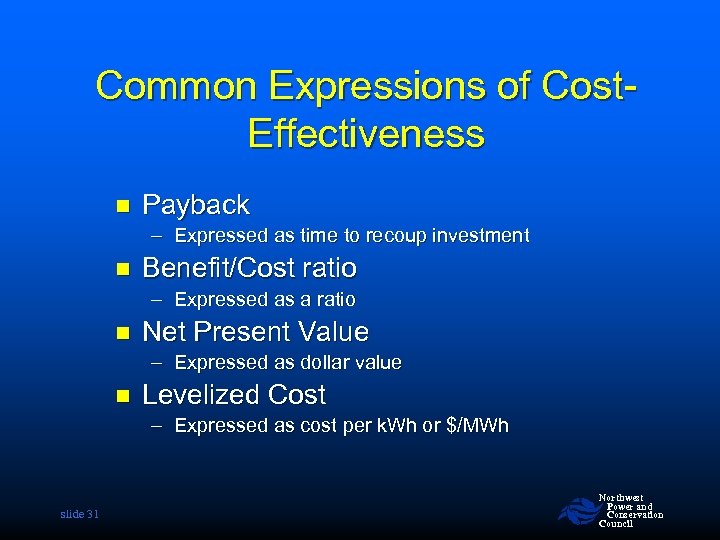 Common Expressions of Cost. Effectiveness n Payback – Expressed as time to recoup investment n Benefit/Cost ratio – Expressed as a ratio n Net Present Value – Expressed as dollar value n Levelized Cost – Expressed as cost per k. Wh or $/MWh slide 31 Northwest Power and Conservation Council
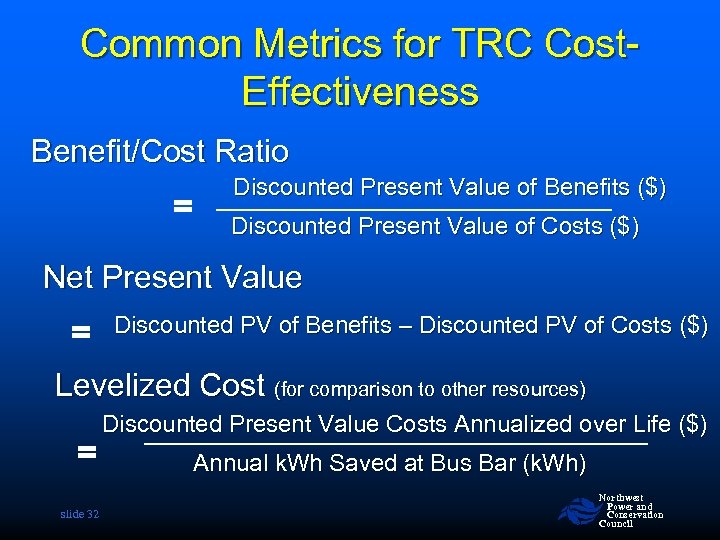 Common Metrics for TRC Cost. Effectiveness Benefit/Cost Ratio = Discounted Present Value of Benefits ($) Discounted Present Value of Costs ($) Net Present Value = Discounted PV of Benefits – Discounted PV of Costs ($) Levelized Cost (for comparison to other resources) = slide 32 Discounted Present Value Costs Annualized over Life ($) Annual k. Wh Saved at Bus Bar (k. Wh) Northwest Power and Conservation Council
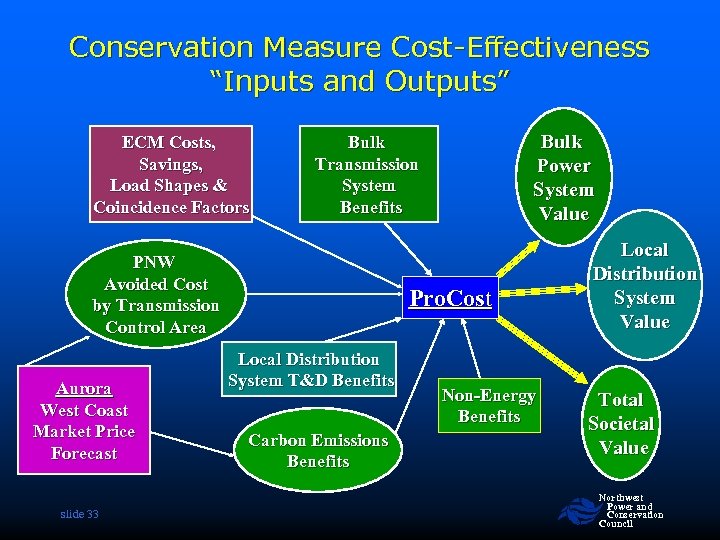 Conservation Measure Cost-Effectiveness “Inputs and Outputs” ECM Costs, Savings, Load Shapes & Coincidence Factors PNW Avoided Cost by Transmission Control Area Aurora West Coast Market Price Forecast slide 33 Bulk Power System Value Bulk Transmission System Benefits Pro. Cost Local Distribution System T&D Benefits Carbon Emissions Benefits Non-Energy Benefits Local Distribution System Value Total Societal Value Northwest Power and Conservation Council
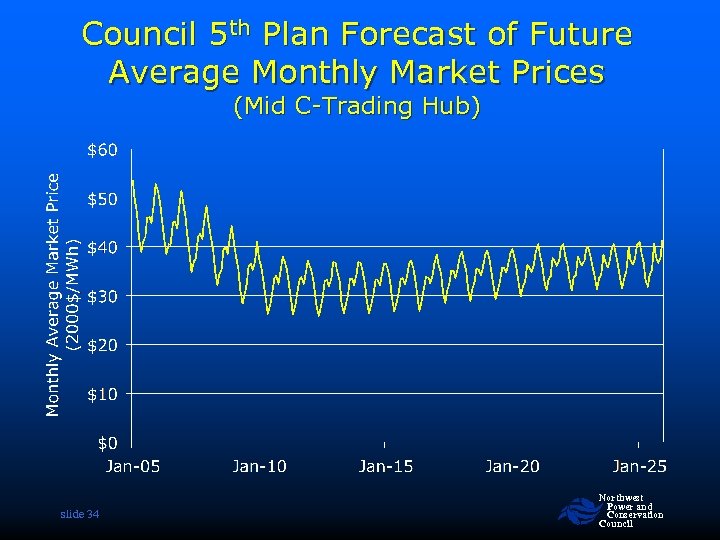 Council 5 th Plan Forecast of Future Average Monthly Market Prices (Mid C-Trading Hub) slide 34 Northwest Power and Conservation Council
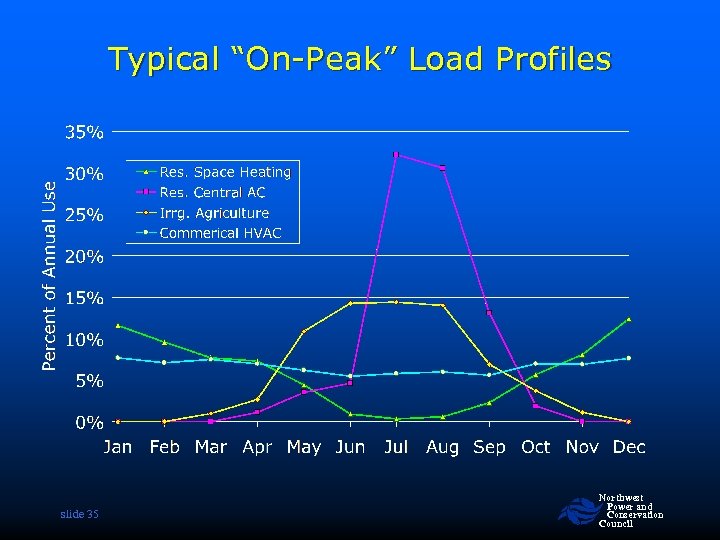 Typical “On-Peak” Load Profiles slide 35 Northwest Power and Conservation Council
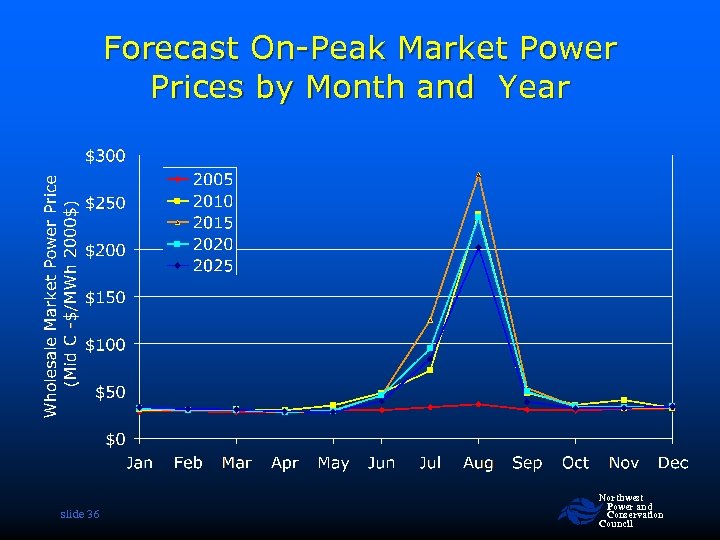 Forecast On-Peak Market Power Prices by Month and Year slide 36 Northwest Power and Conservation Council
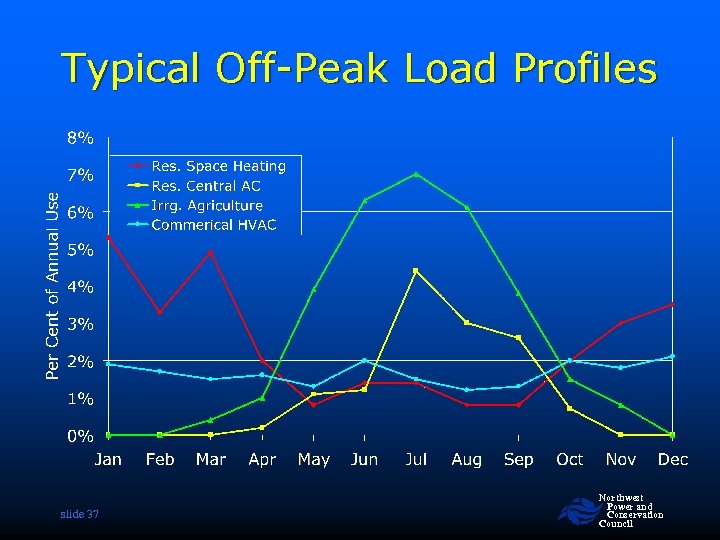 Typical Off-Peak Load Profiles slide 37 Northwest Power and Conservation Council
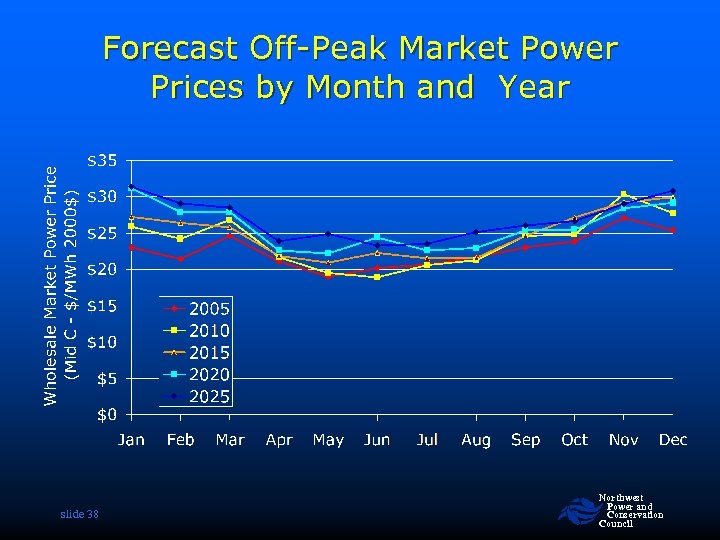 Forecast Off-Peak Market Power Prices by Month and Year slide 38 Northwest Power and Conservation Council
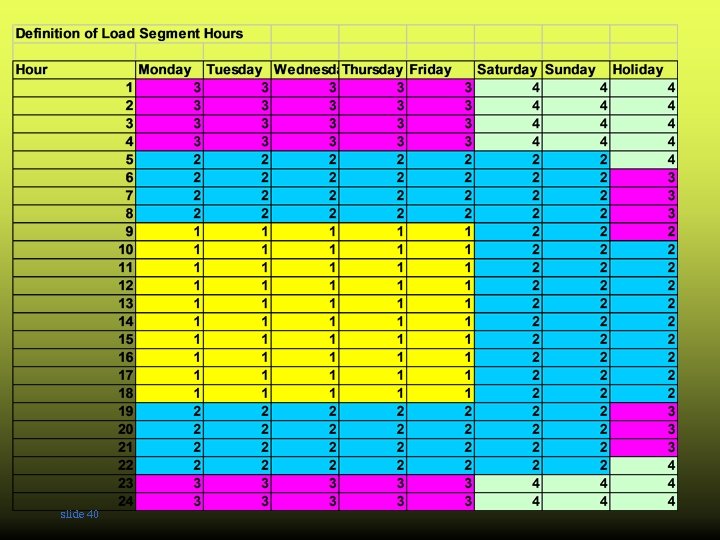
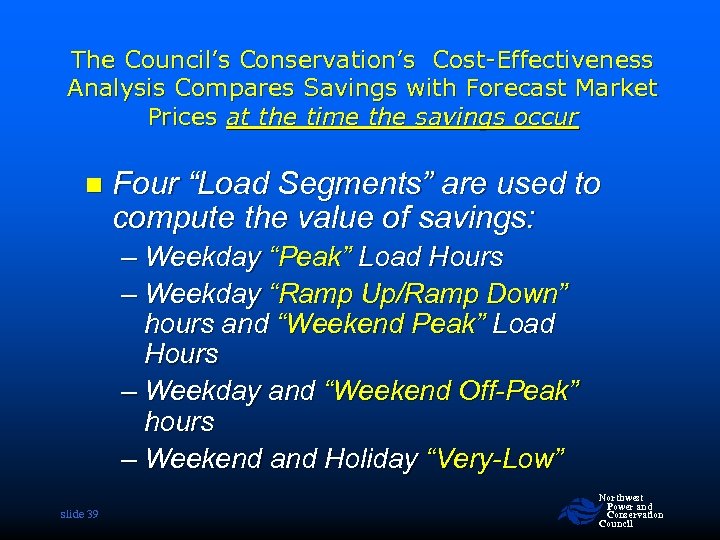 The Council’s Conservation’s Cost-Effectiveness Analysis Compares Savings with Forecast Market Prices at the time the savings occur n Four “Load Segments” are used to compute the value of savings: – Weekday “Peak” Load Hours – Weekday “Ramp Up/Ramp Down” hours and “Weekend Peak” Load Hours – Weekday and “Weekend Off-Peak” hours – Weekend and Holiday “Very-Low” slide 39 Northwest Power and Conservation Council
 slide 40
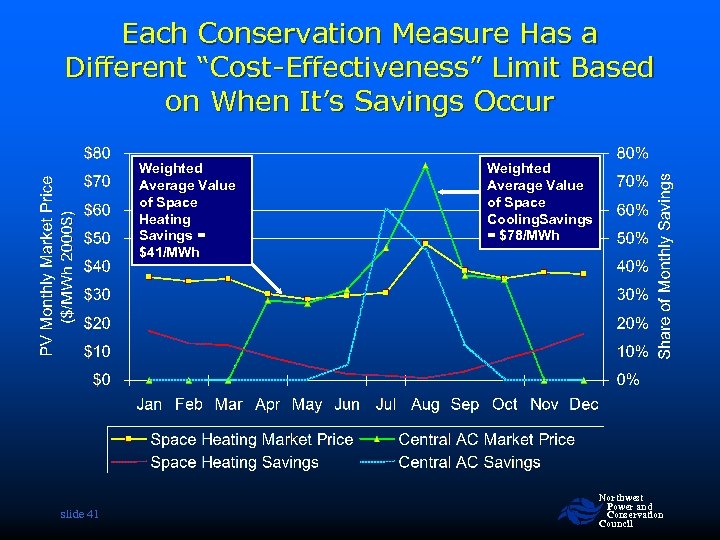 Each Conservation Measure Has a Different “Cost-Effectiveness” Limit Based on When It’s Savings Occur Weighted Average Value of Space Heating Savings = $41/MWh slide 41 Weighted Average Value of Space Cooling. Savings = $78/MWh Northwest Power and Conservation Council
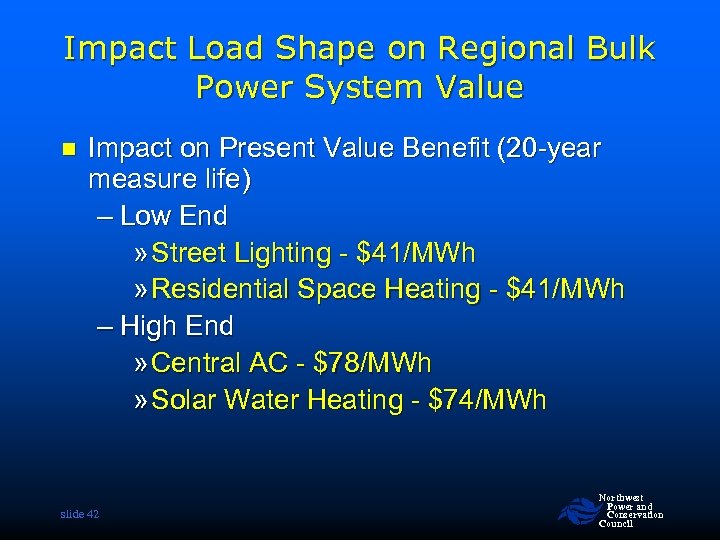 Impact Load Shape on Regional Bulk Power System Value n Impact on Present Value Benefit (20 -year measure life) – Low End » Street Lighting - $41/MWh » Residential Space Heating - $41/MWh – High End » Central AC - $78/MWh » Solar Water Heating - $74/MWh slide 42 Northwest Power and Conservation Council
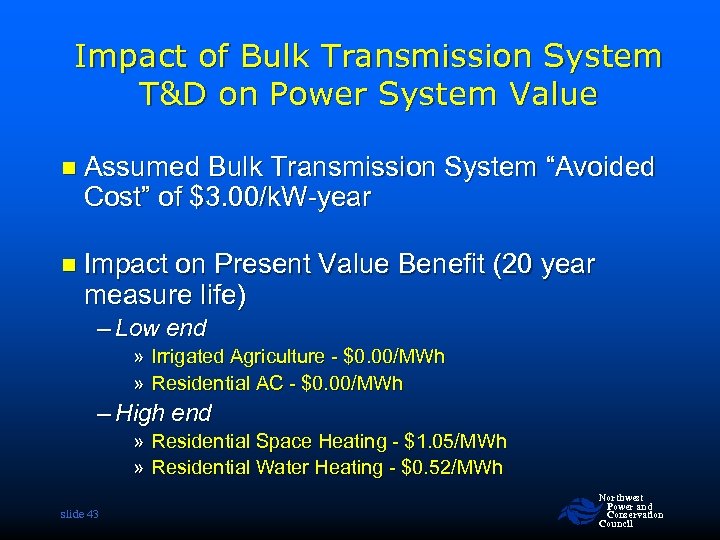 Impact of Bulk Transmission System T&D on Power System Value n Assumed Bulk Transmission System “Avoided Cost” of $3. 00/k. W-year n Impact on Present Value Benefit (20 year measure life) – Low end » Irrigated Agriculture - $0. 00/MWh » Residential AC - $0. 00/MWh – High end » Residential Space Heating - $1. 05/MWh » Residential Water Heating - $0. 52/MWh slide 43 Northwest Power and Conservation Council
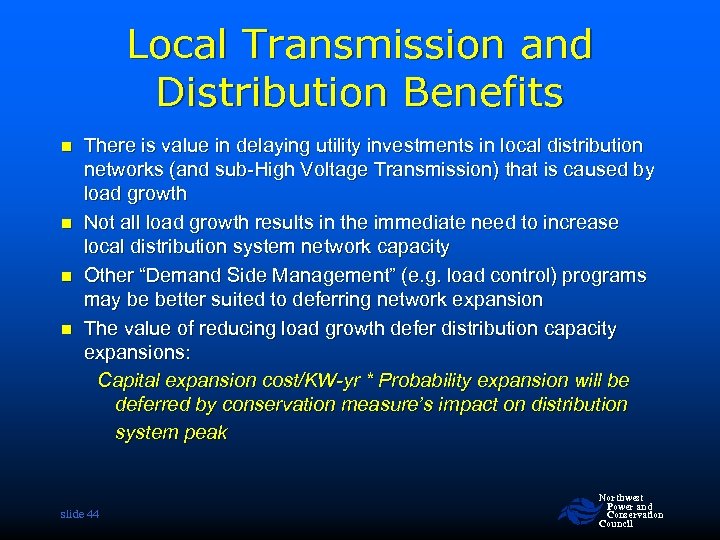 Local Transmission and Distribution Benefits n n There is value in delaying utility investments in local distribution networks (and sub-High Voltage Transmission) that is caused by load growth Not all load growth results in the immediate need to increase local distribution system network capacity Other “Demand Side Management” (e. g. load control) programs may be better suited to deferring network expansion The value of reducing load growth defer distribution capacity expansions: Capital expansion cost/KW-yr * Probability expansion will be deferred by conservation measure’s impact on distribution system peak slide 44 Northwest Power and Conservation Council
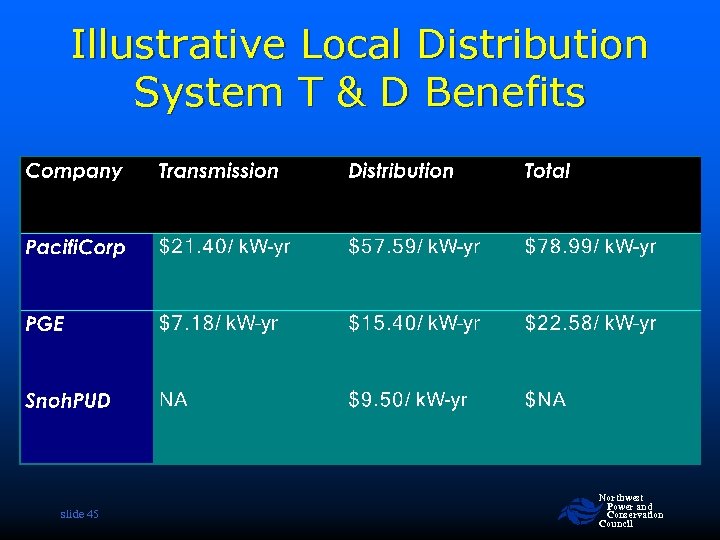 Illustrative Local Distribution System T & D Benefits slide 45 Northwest Power and Conservation Council
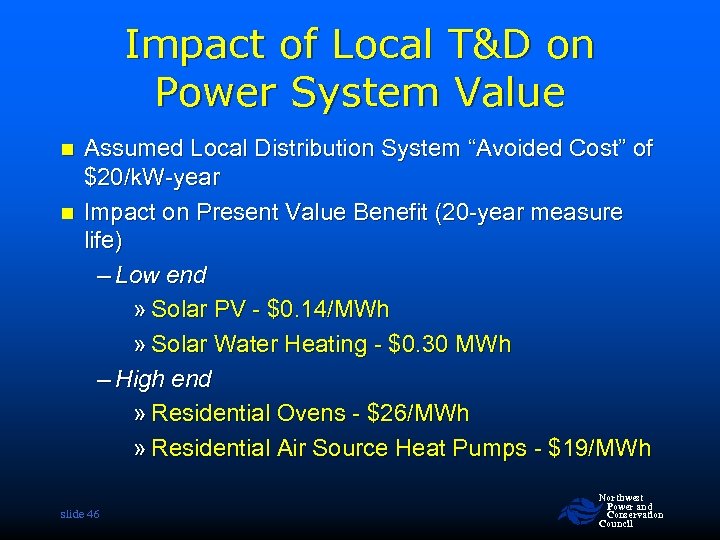 Impact of Local T&D on Power System Value n n Assumed Local Distribution System “Avoided Cost” of $20/k. W-year Impact on Present Value Benefit (20 -year measure life) – Low end » Solar PV - $0. 14/MWh » Solar Water Heating - $0. 30 MWh – High end » Residential Ovens - $26/MWh » Residential Air Source Heat Pumps - $19/MWh slide 46 Northwest Power and Conservation Council
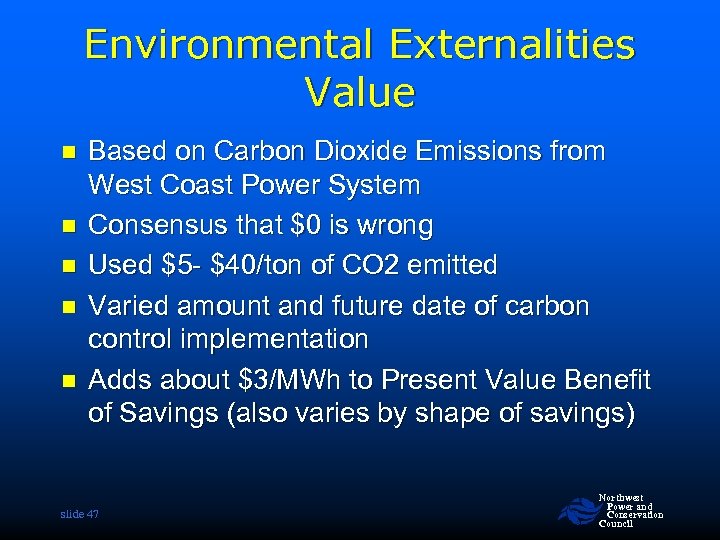 Environmental Externalities Value n n n Based on Carbon Dioxide Emissions from West Coast Power System Consensus that $0 is wrong Used $5 - $40/ton of CO 2 emitted Varied amount and future date of carbon control implementation Adds about $3/MWh to Present Value Benefit of Savings (also varies by shape of savings) slide 47 Northwest Power and Conservation Council
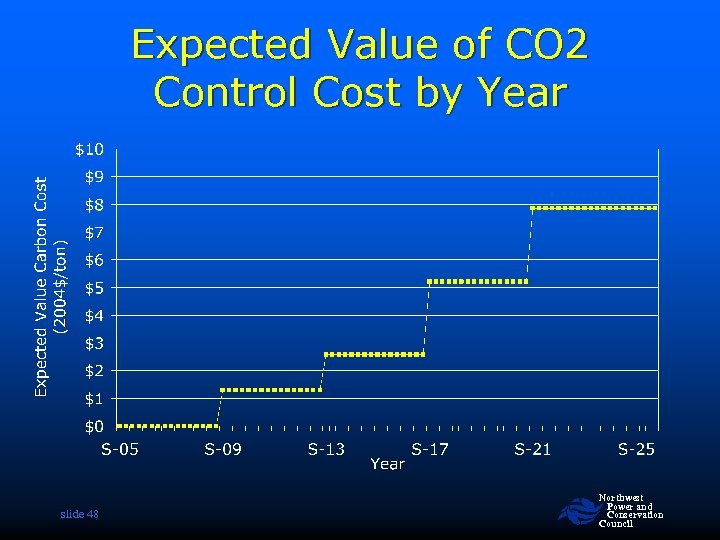 Expected Value of CO 2 Control Cost by Year slide 48 Northwest Power and Conservation Council
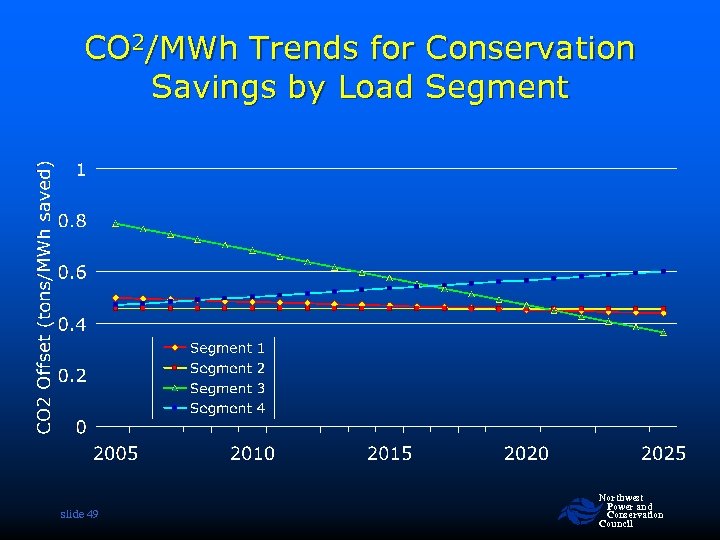 CO 2/MWh Trends for Conservation Savings by Load Segment slide 49 Northwest Power and Conservation Council
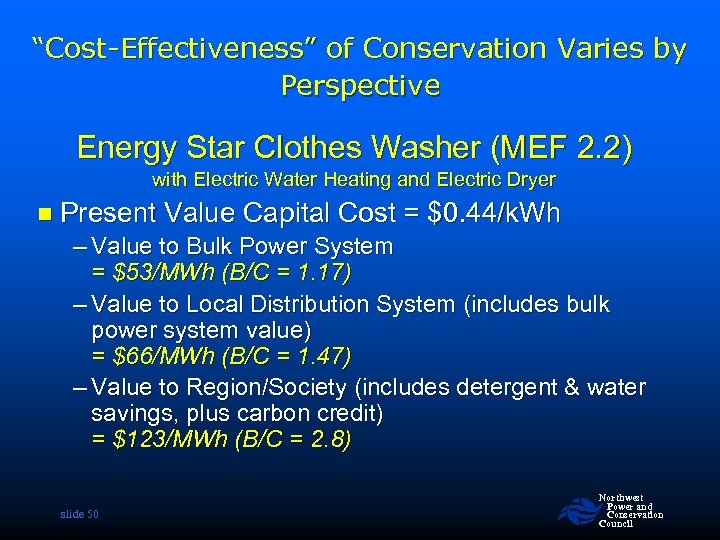 “Cost-Effectiveness” of Conservation Varies by Perspective Energy Star Clothes Washer (MEF 2. 2) with Electric Water Heating and Electric Dryer n Present Value Capital Cost = $0. 44/k. Wh – Value to Bulk Power System = $53/MWh (B/C = 1. 17) – Value to Local Distribution System (includes bulk power system value) = $66/MWh (B/C = 1. 47) – Value to Region/Society (includes detergent & water savings, plus carbon credit) = $123/MWh (B/C = 2. 8) slide 50 Northwest Power and Conservation Council
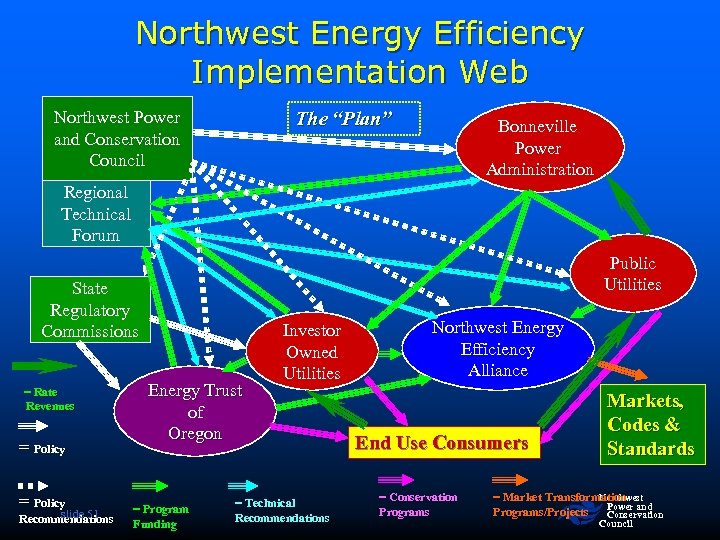 Northwest Energy Efficiency Implementation Web Northwest Power and Conservation Council The “Plan” Bonneville Power Administration Regional Technical Forum Public Utilities State Regulatory Commissions = Rate Revenues = Policy slide 51 Recommendations Energy Trust of Oregon = Program Funding Investor Owned Utilities = Technical Recommendations Northwest Energy Efficiency Alliance End Use Consumers = Conservation Programs Markets, Codes & Standards = Market Transformation Northwest Programs/Projects Power and Conservation Council
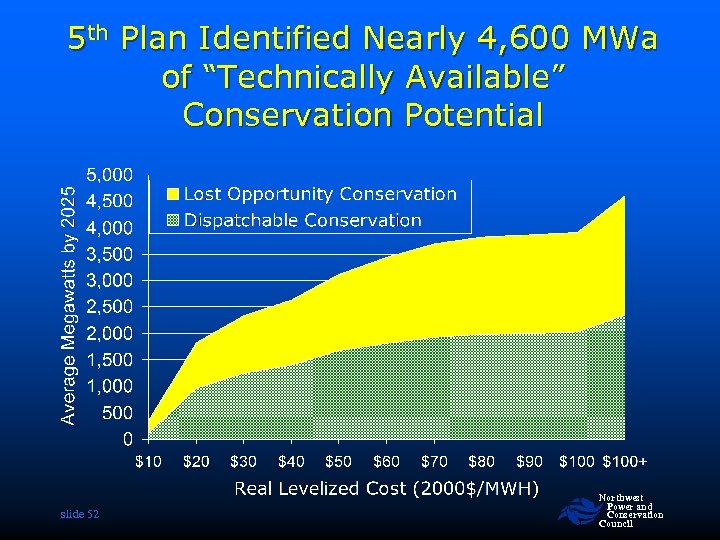 5 th Plan Identified Nearly 4, 600 MWa of “Technically Available” Conservation Potential slide 52 Northwest Power and Conservation Council
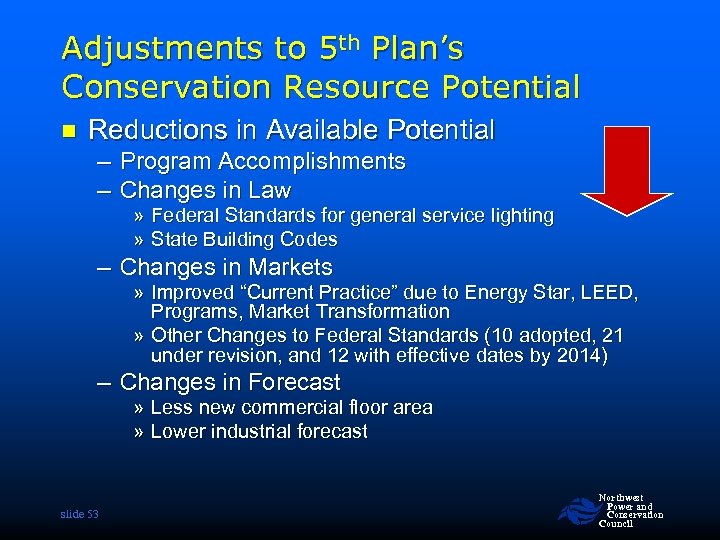 Adjustments to 5 th Plan’s Conservation Resource Potential n Reductions in Available Potential – Program Accomplishments – Changes in Law » Federal Standards for general service lighting » State Building Codes – Changes in Markets » Improved “Current Practice” due to Energy Star, LEED, Programs, Market Transformation » Other Changes to Federal Standards (10 adopted, 21 under revision, and 12 with effective dates by 2014) – Changes in Forecast » Less new commercial floor area » Lower industrial forecast slide 53 Northwest Power and Conservation Council
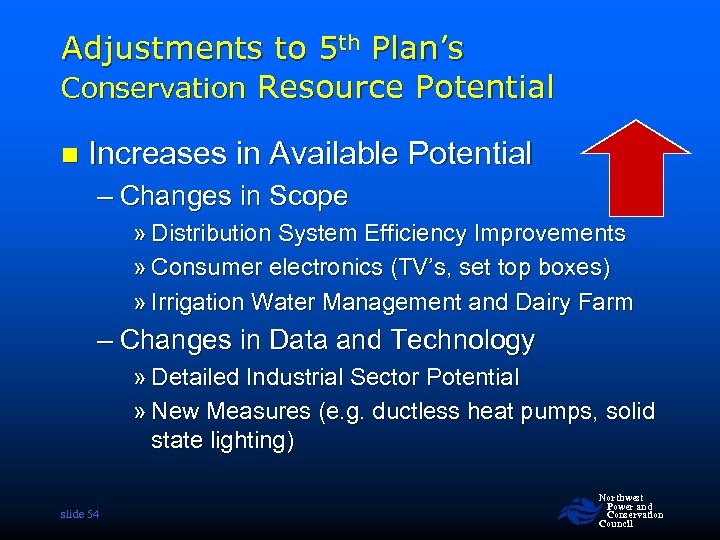 Adjustments to 5 th Plan’s Conservation Resource Potential n Increases in Available Potential – Changes in Scope » Distribution System Efficiency Improvements » Consumer electronics (TV’s, set top boxes) » Irrigation Water Management and Dairy Farm – Changes in Data and Technology » Detailed Industrial Sector Potential » New Measures (e. g. ductless heat pumps, solid state lighting) slide 54 Northwest Power and Conservation Council
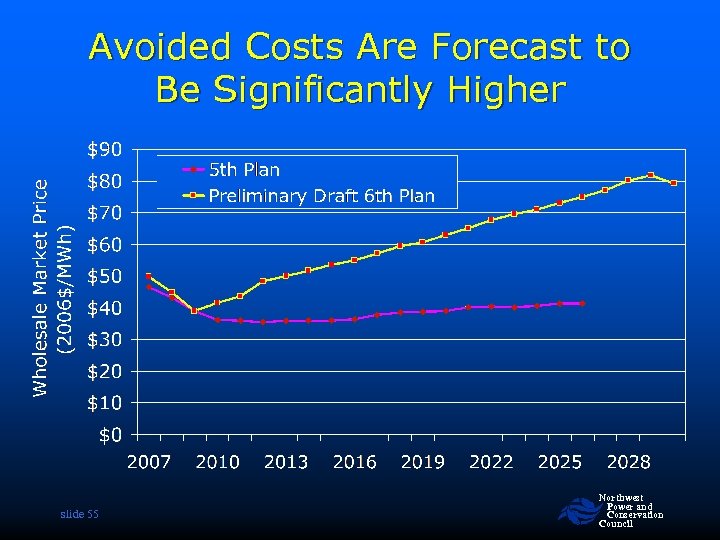 Avoided Costs Are Forecast to Be Significantly Higher slide 55 Northwest Power and Conservation Council
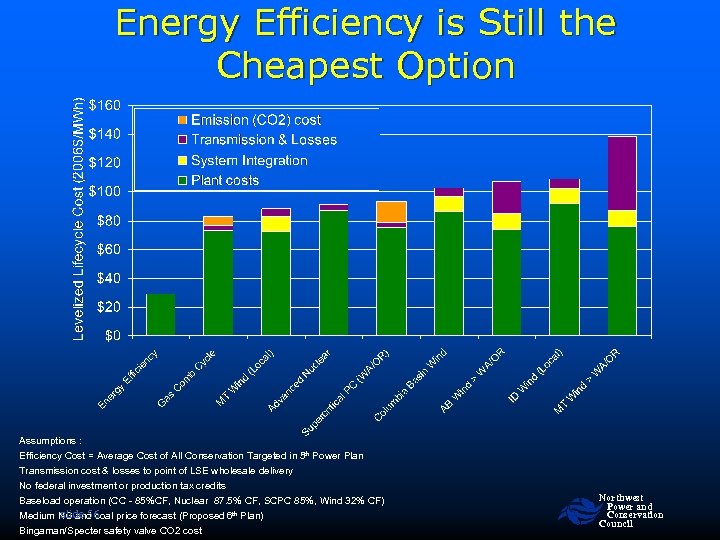 Energy Efficiency is Still the Cheapest Option Assumptions : Efficiency Cost = Average Cost of All Conservation Targeted in 5 th Power Plan Transmission cost & losses to point of LSE wholesale delivery No federal investment or production tax credits Baseload operation (CC - 85%CF, Nuclear 87. 5% CF, SCPC 85%, Wind 32% CF) slide 56 Medium NG and coal price forecast (Proposed 6 th Plan) Bingaman/Specter safety valve CO 2 cost Northwest Power and Conservation Council
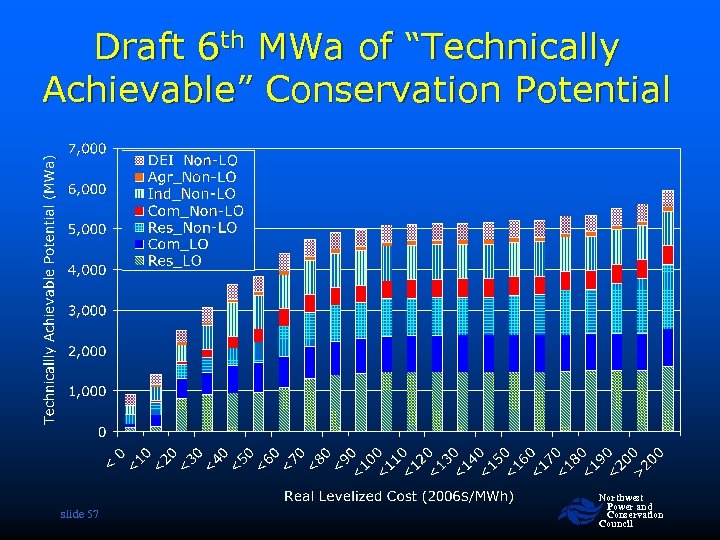 Draft 6 th MWa of “Technically Achievable” Conservation Potential slide 57 Northwest Power and Conservation Council
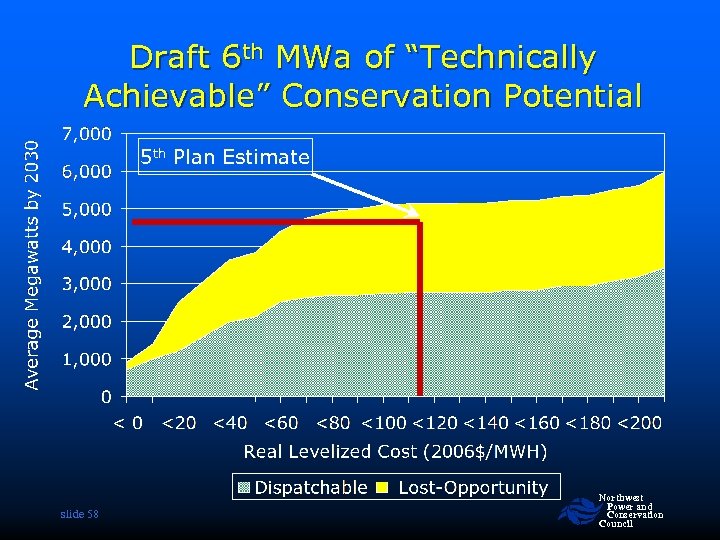 Draft 6 th MWa of “Technically Achievable” Conservation Potential 5 th Plan Estimate slide 58 Northwest Power and Conservation Council