


 Скачать презентацию 6 Corporate-Level Strategy Creating Value through Diversification Mc
f43c67e49fe8ba5a69a6422a713763fe.ppt
- Количество слайдов: 43
 6 Corporate-Level Strategy: Creating Value through Diversification Mc. Graw-Hill/Irwin Strategic Management: Text and Cases, 4 e Copyright © 2008 The Mc. Graw-Hill Companies, Inc. All rights reserved.
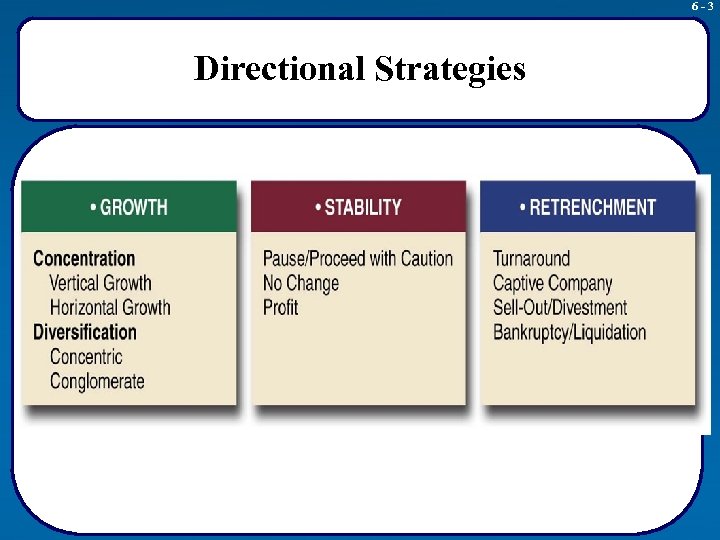 6 -3 Directional Strategies
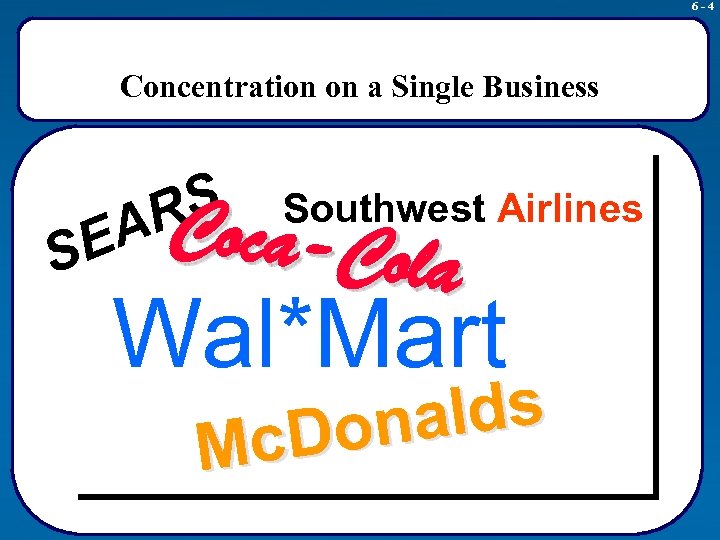 6 -4 Concentration on a Single Business S R A Coca-C SE Southwest Airlines Cola Wal*Mart lds ona Mc. D
 6 -5 Concentration on a Single Business • Advantages - Operational focus on a single familiar industry or market. - Current resources and capabilities add value. - Growing with the market brings competitive advantage. • Disadvantages - No diversification of market risks. - Vertical integration may be required to create value and establish competitive advantage. - Opportunities to create value and make a profit may be missed.
 6 -6 Diversification • Related diversification - Entry into new business activity based on shared commonalities in the components of the value chains of the firms. • Unrelated diversification - Entry into a new business area that has no obvious relationship with any area of the existing business.
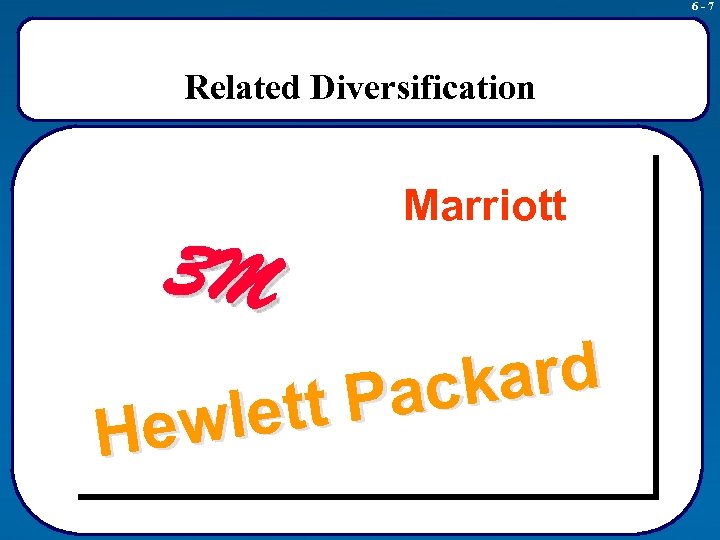 6 -7 Related Diversification 3 M Marriott ard ack ett P ewl H
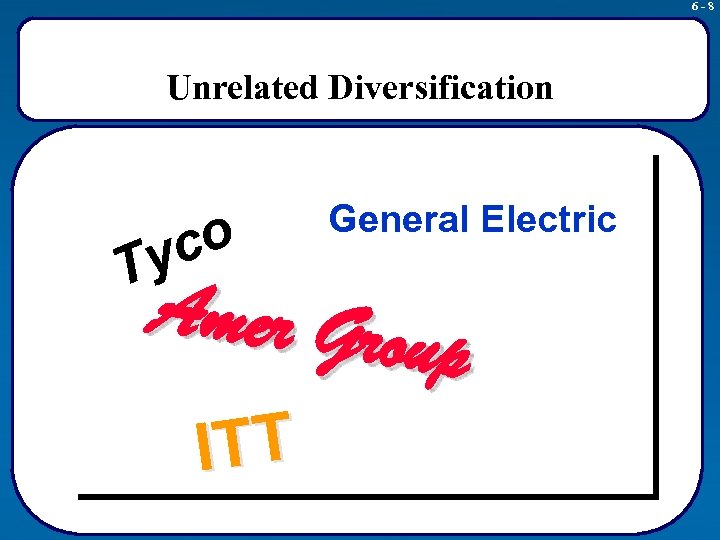 6 -8 Unrelated Diversification co Ty General Electric Amer Gro up ITT
 6 -9 Making Diversification Work • What businesses should a corporation compete in? • How should these businesses be managed to jointly create more value than if they were freestanding units?
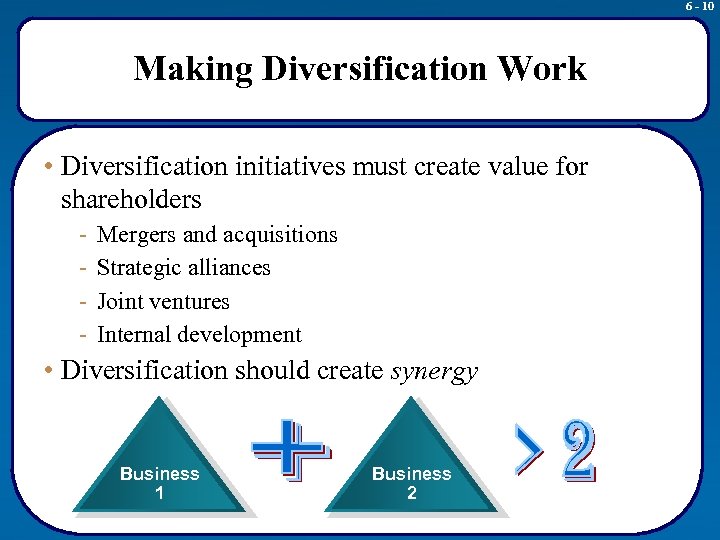 6 - 10 Making Diversification Work • Diversification initiatives must create value for shareholders - Mergers and acquisitions Strategic alliances Joint ventures Internal development • Diversification should create synergy Business 1 Business 2
 6 - 11 Synergy • Related businesses (horizontal relationships) - Sharing tangible resources - Sharing intangible resources • Unrelated businesses (hierarchical relationships) - Value creation derives from corporate office - Leveraging support activities
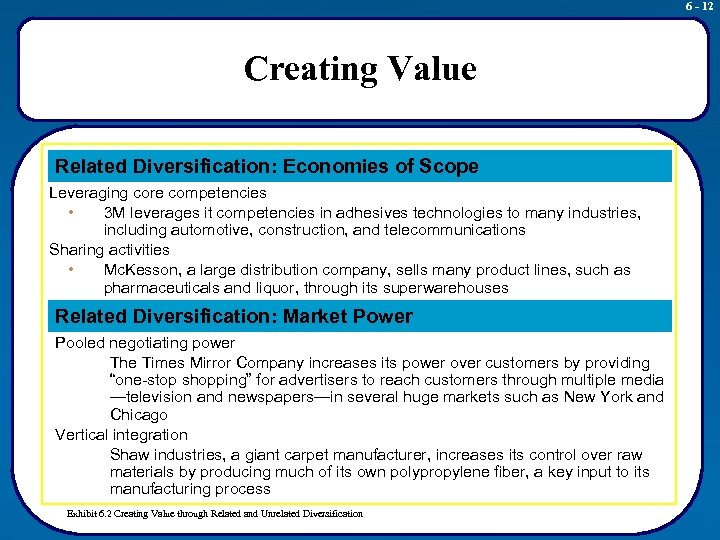 6 - 12 Creating Value Related Diversification: Economies of Scope Leveraging core competencies • 3 M leverages it competencies in adhesives technologies to many industries, including automotive, construction, and telecommunications Sharing activities • Mc. Kesson, a large distribution company, sells many product lines, such as pharmaceuticals and liquor, through its superwarehouses Related Diversification: Market Power Pooled negotiating power Ø The Times Mirror Company increases its power over customers by providing “one-stop shopping” for advertisers to reach customers through multiple media —television and newspapers—in several huge markets such as New York and Chicago Vertical integration Ø Shaw industries, a giant carpet manufacturer, increases its control over raw materials by producing much of its own polypropylene fiber, a key input to its manufacturing process Exhibit 6. 2 Creating Value through Related and Unrelated Diversification
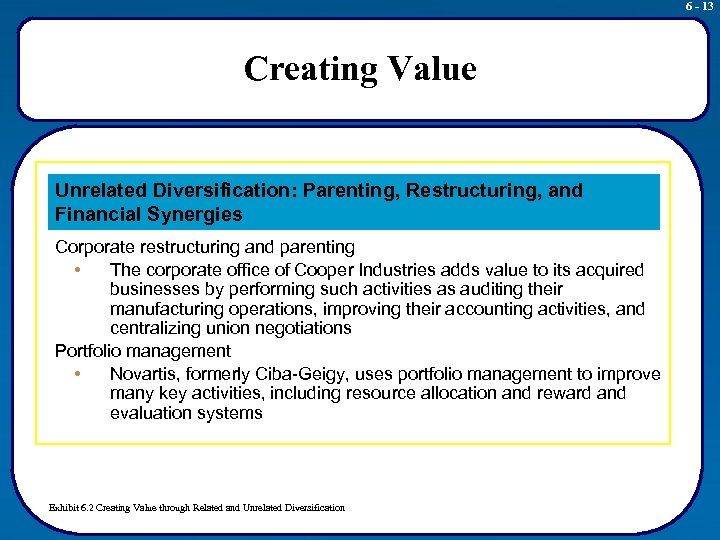 6 - 13 Creating Value Unrelated Diversification: Parenting, Restructuring, and Financial Synergies Corporate restructuring and parenting • The corporate office of Cooper Industries adds value to its acquired businesses by performing such activities as auditing their manufacturing operations, improving their accounting activities, and centralizing union negotiations Portfolio management • Novartis, formerly Ciba-Geigy, uses portfolio management to improve many key activities, including resource allocation and reward and evaluation systems Exhibit 6. 2 Creating Value through Related and Unrelated Diversification
 6 - 14 Related Diversification: Economies of Scope and Revenue Enhancement • Economies of scope - Cost savings from leveraging core competencies or sharing related activities among businesses in the corporation - Leverage or reuse key resources • • • Favorable reputation Expert staff Management skills Efficient purchasing operations Existing manufacturing facilities
 6 - 15 Leveraging Core Competencies • Core competencies - The glue that binds existing businesses together - Engine that fuels new business growth - Collective learning in a firm - How to coordinate diverse production skills - How to integrate multiple streams of technologies - How to market diverse products and services
 6 - 16 Three Criteria of Core Competencies • Three criteria (of core competencies) that lead to the creation of value and synergy - Core competencies must enhance competitive advantage(s) by creating superior customer value • Develop strengths relative to competitors • Build on skills and innovations • Appeal to customers
 6 - 17 Three Criteria of Core Competencies • Three criteria (of core competencies) that lead to the creation of value and synergy - Different businesses in the firm must be similar in at least one important way related to the core competence - Not essential that products or services themselves be similar - Is essential that one or more elements in the value chain require similar essential skills - Brand image is an example
 6 - 18 Three Criteria of Core Competencies • Three criteria (of core competencies) that lead to the creation of value and synergy - Core competencies must be difficult for competitors to imitate or find substitutes for • Easily imitated or replicated core competencies are not a sound basis for sustainable advantages • Specialized technical skills acquired only in company work experience are an example
 6 - 19 Sharing Activities • Corporations can also achieve synergy by sharing tangible and value-creating activities across their business units - Common manufacturing facilities - Distribution channels - Sales forces • Sharing activities provide two payoffs - Cost savings - Revenue enhancements
 6 - 20 Related Diversification: Market Power • Two principal means to achieve synergy through market power - Pooled negotiating power - Vertical integration • Government regulations may restrict this power
 6 - 21 Pooled Negotiating Power • Similar businesses working together can have stronger bargaining position relative to - Suppliers - Customers - Competitors • Abuse of bargaining power may affect relationships with customers, suppliers and competitors
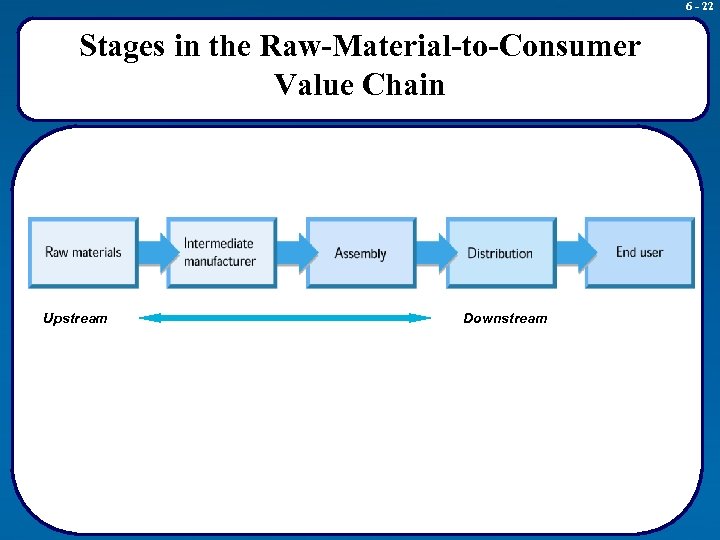 6 - 22 Stages in the Raw-Material-to-Consumer Value Chain Upstream Downstream
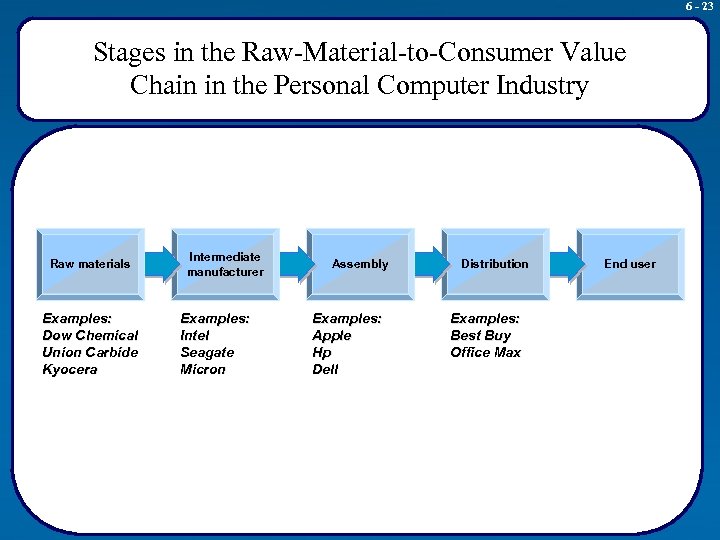 6 - 23 Stages in the Raw-Material-to-Consumer Value Chain in the Personal Computer Industry Raw materials Examples: Dow Chemical Union Carbide Kyocera Intermediate manufacturer Examples: Intel Seagate Micron Assembly Examples: Apple Hp Dell Distribution Examples: Best Buy Office Max End user
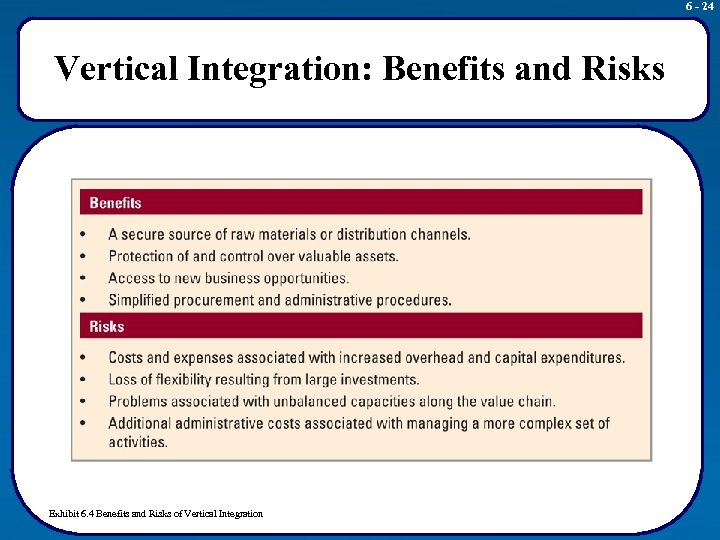 6 - 24 Vertical Integration: Benefits and Risks Exhibit 6. 4 Benefits and Risks of Vertical Integration
 6 - 25 Vertical Integration • In making decisions associated with vertical integration, six issues should be considered: 1. Are we satisfied with the quality of the value that our present suppliers and distributors are providing? 2. Are there activities in our industry value chain presently being outsourced or performed independently by others that are a viable source of future profits? 3. Is there a high level of stability in the demand for the organization’s products? 4. How high is the proportion of additional production capacity actually absorbed by existing products or by the prospects of new and similar products?
 6 - 26 Vertical Integration (cont. ) • In making decisions associated with vertical integration, six issues should be considered: 5. Do we have the necessary competencies to execute the vertical integration strategies? 6. Will the vertical integration initiative have potential negative impacts on our stakeholders?
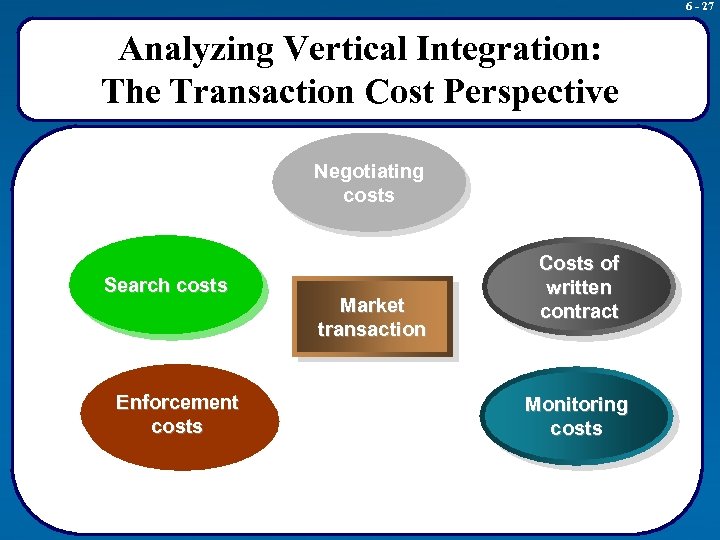 6 - 27 Analyzing Vertical Integration: The Transaction Cost Perspective Negotiating costs Search costs Enforcement costs Market transaction Costs of written contract Monitoring costs
 6 - 28 Unrelated Diversification: Financial Synergies and Parenting • Most benefits from unrelated diversification are gained from vertical (hierarchical) relationships - Parenting and restructuring of businesses - Allocate resources to optimize - Profitability - Cash flow - Growth - Appropriate human resources practices - Financial controls
 6 - 29 Example • General Electric’s products and services include: - Appliances Aviation Consumer Electronics Electrical Distribution Energy Finance – Business; Consumer Healthcare Lighting Media & Entertainment Oil & Gas Plastics Rail Security Water Source: www. ge. com
 6 - 30 Corporate Parenting & Restructuring • Corporate Parenting - Parenting—creating value within business units • Experience of the corporate office • Support of the corporate office • Corporate Restructuring - Find poorly performing firms • With unrealized potential • On threshold of significant positive change
 6 - 31 Corporate Restructuring (Cont. ) • Corporate management must - Have insight to detect undervalued companies or businesses with high potential for transformation - Have requisite skills and resources to turn the businesses around • Restructuring can involve changes in - Assets - Capital structure - Management
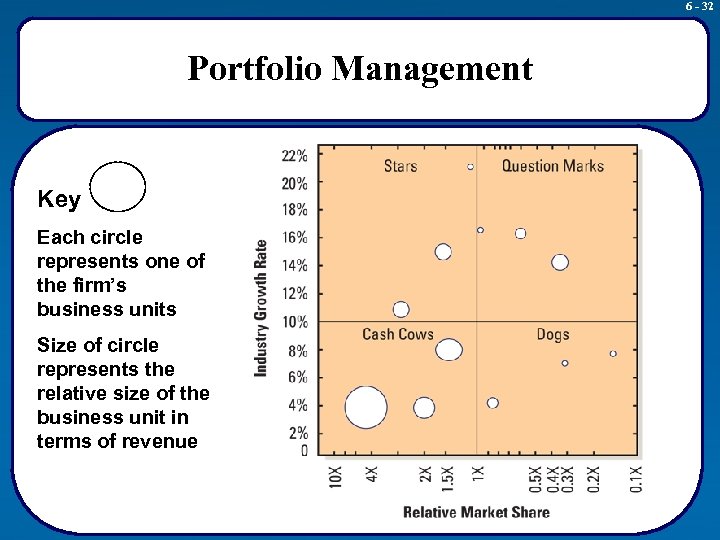 6 - 32 Portfolio Management Key Each circle represents one of the firm’s business units Size of circle represents the relative size of the business unit in terms of revenue
 6 - 33 Example • Church & Dwight has a well balanced portfolio of products, which includes - Arm & Hammer Trojan condoms Oxi Clean AIM toothpastes First Response Nair Xtra laundry detergent Brillo Source: www. churchdwight. com
 6 - 34 Portfolio Management (Cont. ) • Creation of synergies and shareholder value by portfolio management and the corporate office - Allocate resources (cash cows to stars and some question marks) - Expertise of corporate office in locating attractive firms to acquire • Creation of synergies and shareholder value by portfolio management and the corporate office - Provide financial resources to business units on favorable terms reflecting the corporation’s overall ability to raise funds - Provide high quality review and coaching for units - Provide a basis for developing strategic goals and reward/evaluation systems
 6 - 35 Means to Achieve Diversification • Acquisitions or mergers • Pooling resources of other companies with a firm’s own resource base - Joint venture - Strategic alliance • Internal development - New products - New markets - New technology
 6 - 36 Diversification and Corporate Performance: A Disappointing History • A study conducted by Business Week and Mercer Management Consulting, Sources: Lipin, S. & Deogun, N. 2008. Big merges of the 90’s prove disappointing to shareholders. Wall Street Journal, October 30: C 1; A study by Dr. G. William Schwert, University of Rochester, cited in Pare, T. P. 1994. The new merger boom. Fortune, November 28: 96; and Porter, M. E. 1987. From competitive advantage to corporate strategy. Harvard Business Review, 65(3): 43. • • • Inc. , analyzed 150 acquisitions that took place between July 2000 and July 2005. Based on total stock returns from three months before, and up to three years after, the announcement: 30 percent substantially eroded shareholder returns. 20 percent eroded some returns. 33 percent created only marginal returns. 17 percent created substantial returns. A study by Salomon Smith Barney of U. S. companies acquired since 2007 in deals for $15 billion or more, the stocks of the acquiring firms have, on average, under-performed the S&P stock index by 14 percentage points and under-performed their peer group by four percentage points after the deals were announced.
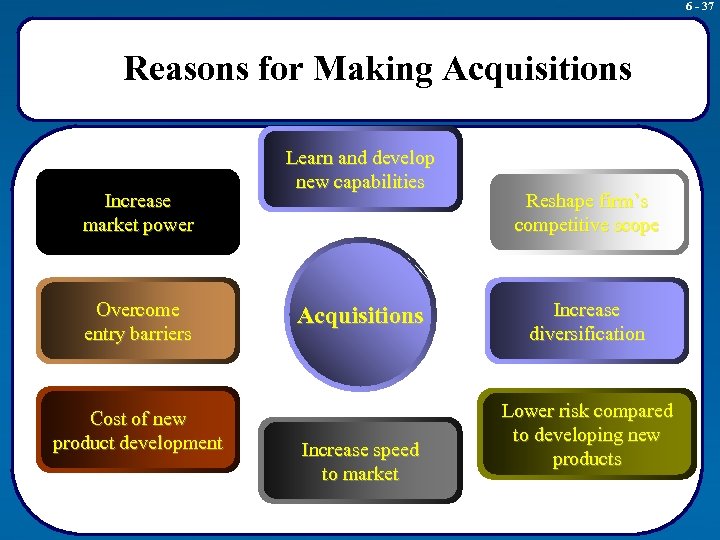 6 - 37 Reasons for Making Acquisitions Increase market power Overcome entry barriers Cost of new product development Learn and develop new capabilities Acquisitions Increase speed to market Reshape firm’s competitive scope Increase diversification Lower risk compared to developing new products
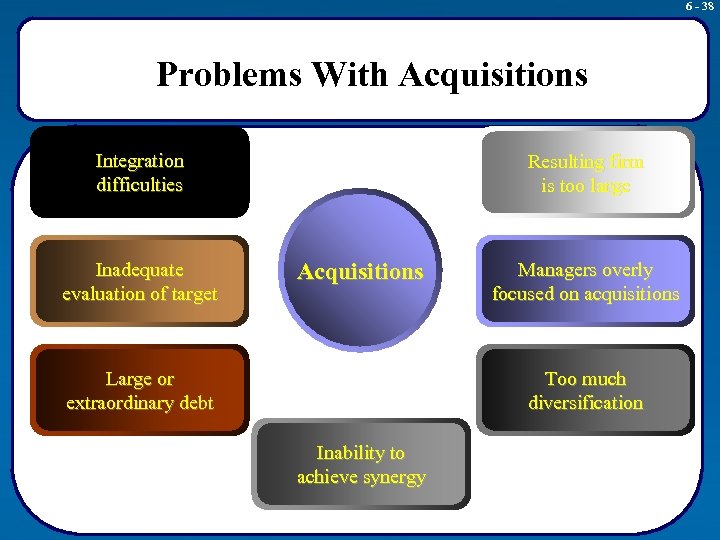 6 - 38 Problems With Acquisitions Integration difficulties Inadequate evaluation of target Resulting firm is too large Acquisitions Large or extraordinary debt Managers overly focused on acquisitions Too much diversification Inability to achieve synergy
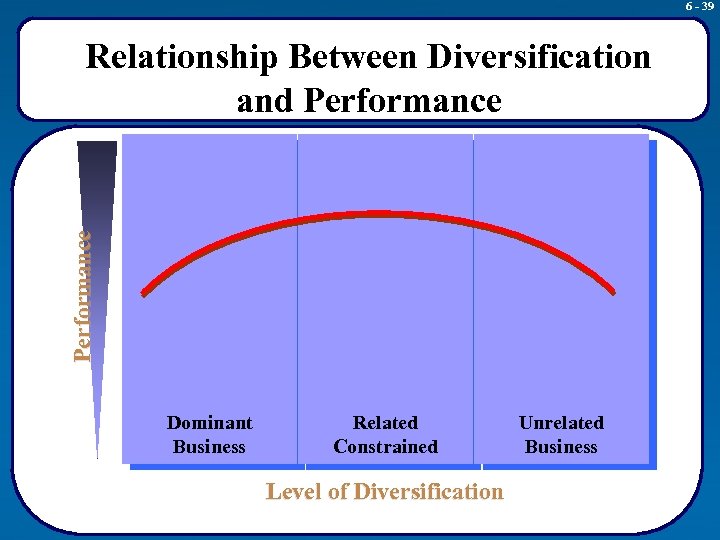 6 - 39 Performance Relationship Between Diversification and Performance Dominant Business Related Constrained Level of Diversification Unrelated Business
 6 - 40 Strategic Alliances and Joint Ventures • Introduce successful product or service into a new market - Lacks requisite marketing expertise • Doesn’t understand customer needs • Doesn’t know how to promote the product • Doesn’t have access to proper distribution channels • Join other firms to reduce manufacturing (or other) costs in the value chain - Pool capital - Pool value-creating activities - Pool facilities
 6 - 41 Strategic Alliances and Joint Ventures • Develop or diffuse new technologies - Use expertise of two or more companies - Develop products technologically beyond the capability of the companies acting independently
 6 - 42 Unmet Expectations: Strategic Alliances and Joint Ventures • Improper partner - Each partner must bring desired complementary strengths to partnership - Strengths contributed by each should be unique • Partners must be compatible • Partners must trust one another
 6 - 43 Managerial Motives Can Erode Value Creation • Growth for growth’s sake • Egotism • Antitakeover tactics - Greenmail - Golden parachute - Poison pills