


 Скачать презентацию 6 Calculators Discounted Cash Flow Valuation Part II
52de378cfd6a120978b87f869b4be1cd.ppt
- Количество слайдов: 42
 6 Calculators Discounted Cash Flow Valuation: Part II Mc. Graw-Hill/Irwin Copyright © 2008 by The Mc. Graw-Hill Companies, Inc. All rights reserved.
 Chapter Outline § Part I § Future and Present Values of Multiple Cash Flows § Part II § Valuing Level Cash Flows: Annuities and Perpetuities § Comparing Rates: The Effect of Compounding § Loan Types and Loan Amortization 6 (Calculators)-1
 Annuities and Perpetuities Defined § Annuity – finite series of equal payments that occur at regular intervals § If the first payment occurs at the end of the period, it is called an ordinary annuity § If the first payment occurs at the beginning of the period, it is called an annuity due § Perpetuity – infinite series of equal payments 6 (Calculators)-2
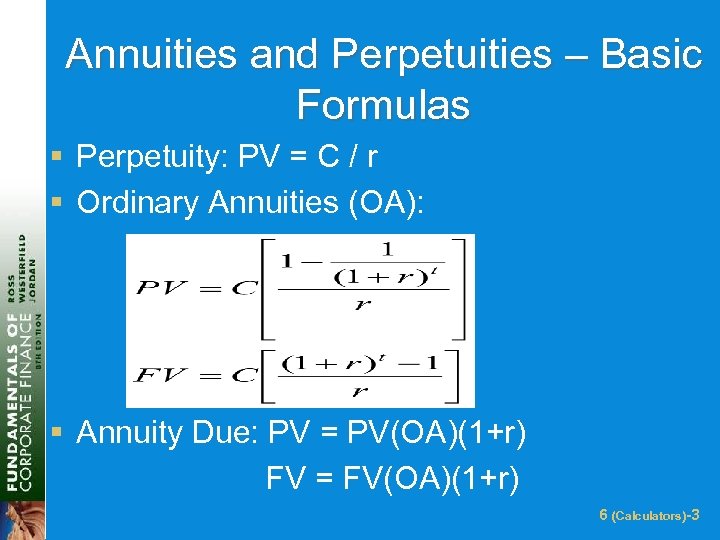 Annuities and Perpetuities – Basic Formulas § Perpetuity: PV = C / r § Ordinary Annuities (OA): § Annuity Due: PV = PV(OA)(1+r) FV = FV(OA)(1+r) 6 (Calculators)-3
 Annuities and the Calculator § You can use the PMT key on the calculator for the equal payment § The sign convention still holds § Ordinary annuity versus annuity due § For annuity due, switch your calculator between the two types by using the [SHIFT] [BEG/END] Set on the HP 10 B-II calculator § If you see “BEGIN” in the display of your calculator, you have it set for an annuity due § Most problems are ordinary annuities 6 (Calculators)-4
 Annuity – PV Example 6. 5 § An asset promises to pay 632 per year for 48 years. If you wanted to earn 10% on your money, how much are you willing to pay today? § Calculator: 48 N; 10 I/Y; 632 PMT; PV = -6, 254. 86 § Formula: 6 (Calculators)-5
 Annuity – Sweepstakes Example § Suppose you win the Publishers Clearinghouse $10 million sweepstakes. The money is paid in equal annual end-of -year installments of $333, 333. 33 over 30 years. If the appropriate discount rate is 5%, how much is the sweepstakes actually worth today? § 30 N; 5 I/Y; 333, 333. 33 PMT; § PV = -5, 124, 150. 29 (ignore –ve sign) 6 (Calculators)-6
 PV of Annuity: Ordinary vs Due § Suppose that as a tenant, you just signed a lease to pay $1, 000 per month for 5 years. Simultaneously, you can sublease the property for $1, 800 for 5 years. What is the value of your leasehold if the discount rate is 12% and …? 1. All payments are made at the end of each year 2. All payments are made at the beginning of each year 6 -7 (Calculators)
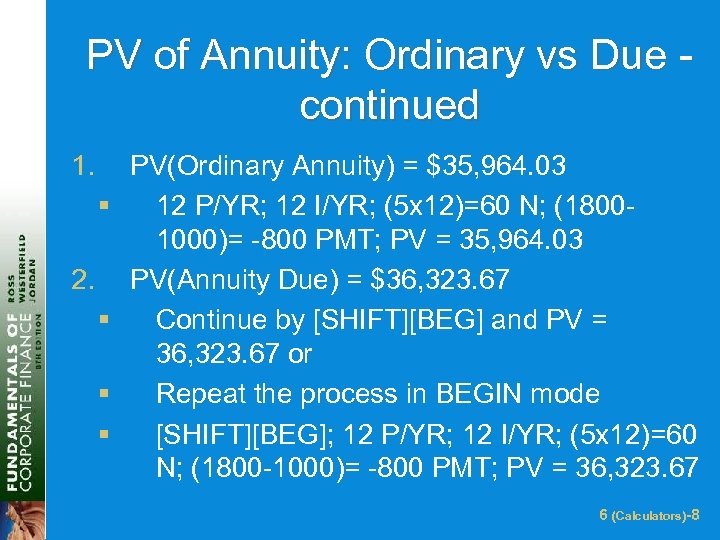 PV of Annuity: Ordinary vs Due continued 1. § 2. § § § PV(Ordinary Annuity) = $35, 964. 03 12 P/YR; 12 I/YR; (5 x 12)=60 N; (18001000)= -800 PMT; PV = 35, 964. 03 PV(Annuity Due) = $36, 323. 67 Continue by [SHIFT][BEG] and PV = 36, 323. 67 or Repeat the process in BEGIN mode [SHIFT][BEG]; 12 P/YR; 12 I/YR; (5 x 12)=60 N; (1800 -1000)= -800 PMT; PV = 36, 323. 67 6 (Calculators)-8
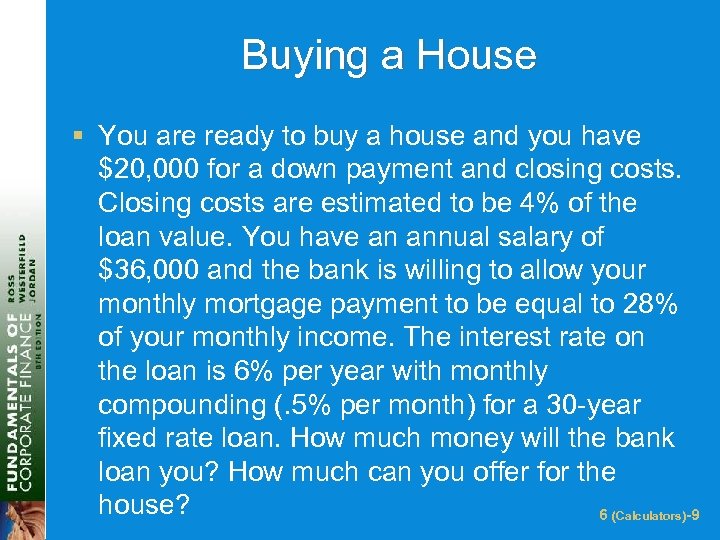 Buying a House § You are ready to buy a house and you have $20, 000 for a down payment and closing costs. Closing costs are estimated to be 4% of the loan value. You have an annual salary of $36, 000 and the bank is willing to allow your monthly mortgage payment to be equal to 28% of your monthly income. The interest rate on the loan is 6% per year with monthly compounding (. 5% per month) for a 30 -year fixed rate loan. How much money will the bank loan you? How much can you offer for the house? 6 (Calculators)-9
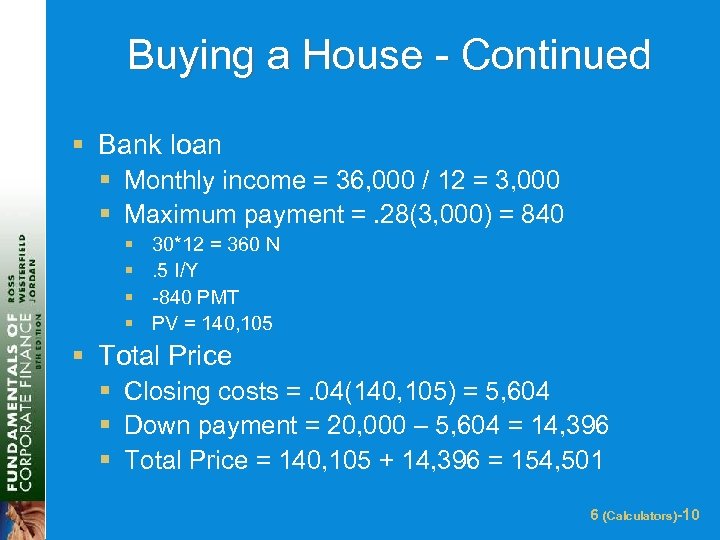 Buying a House - Continued § Bank loan § Monthly income = 36, 000 / 12 = 3, 000 § Maximum payment =. 28(3, 000) = 840 § § 30*12 = 360 N. 5 I/Y -840 PMT PV = 140, 105 § Total Price § Closing costs =. 04(140, 105) = 5, 604 § Down payment = 20, 000 – 5, 604 = 14, 396 § Total Price = 140, 105 + 14, 396 = 154, 501 6 (Calculators)-10
 Annuities on the Spreadsheet Example § The present value and future value formulas in a spreadsheet include a place for annuity payments § Click on the Excel icon to see an example 6 (Calculators)-11
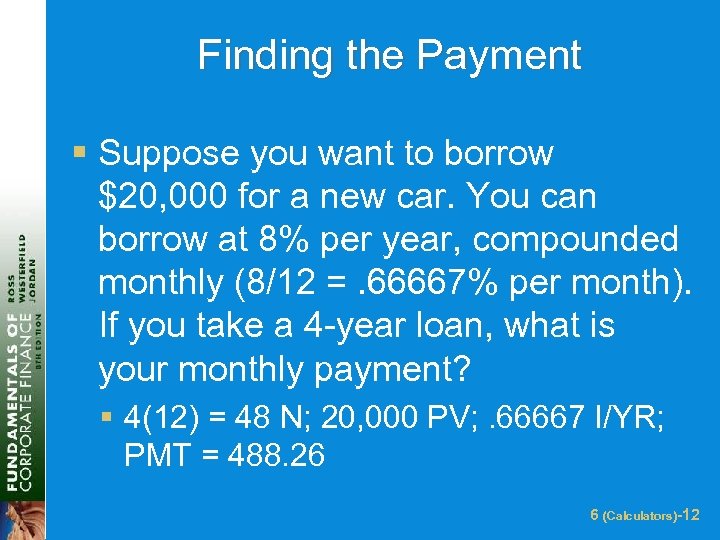 Finding the Payment § Suppose you want to borrow $20, 000 for a new car. You can borrow at 8% per year, compounded monthly (8/12 =. 66667% per month). If you take a 4 -year loan, what is your monthly payment? § 4(12) = 48 N; 20, 000 PV; . 66667 I/YR; PMT = 488. 26 6 (Calculators)-12
 Finding the Payment on a Spreadsheet § Another TVM formula that can be found in a spreadsheet is the payment formula § PMT(rate, nper, pv, fv) § The same sign convention holds as for the PV and FV formulas § Click on the Excel icon for an example 6 (Calculators)-13
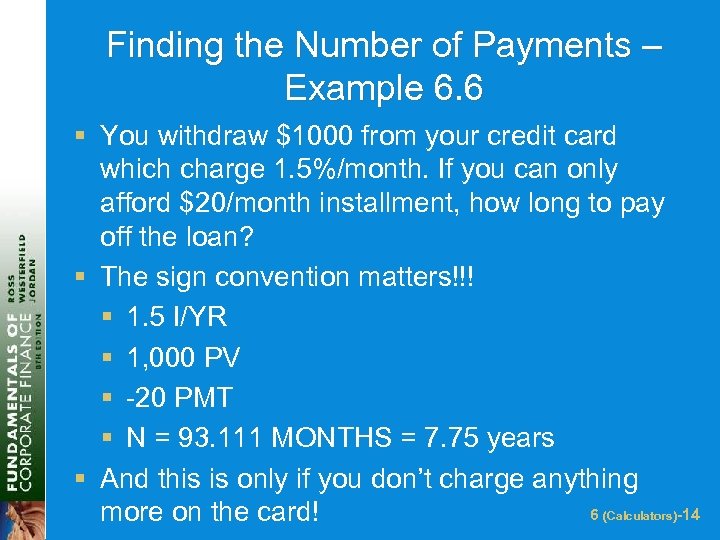 Finding the Number of Payments – Example 6. 6 § You withdraw $1000 from your credit card which charge 1. 5%/month. If you can only afford $20/month installment, how long to pay off the loan? § The sign convention matters!!! § 1. 5 I/YR § 1, 000 PV § -20 PMT § N = 93. 111 MONTHS = 7. 75 years § And this is only if you don’t charge anything 6 (Calculators)-14 more on the card!
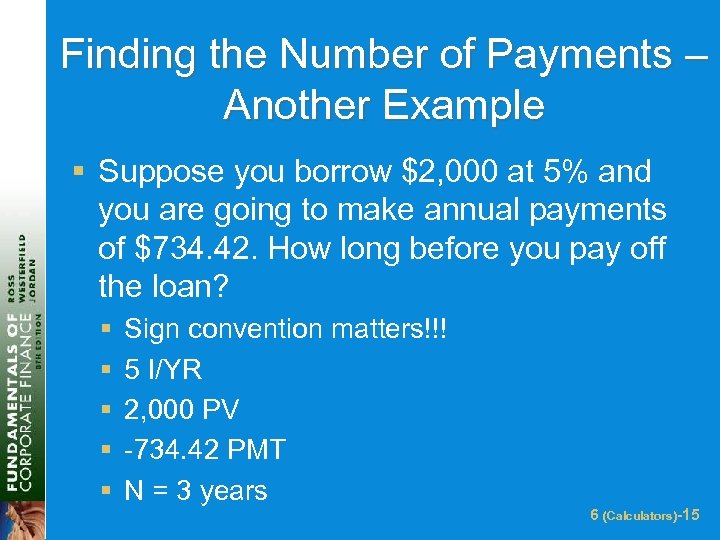 Finding the Number of Payments – Another Example § Suppose you borrow $2, 000 at 5% and you are going to make annual payments of $734. 42. How long before you pay off the loan? § § § Sign convention matters!!! 5 I/YR 2, 000 PV -734. 42 PMT N = 3 years 6 (Calculators)-15
 Finding the Rate § Suppose you borrow $10, 000 from your parents to buy a car. You agree to pay $207. 58 per month for 60 months. What is the monthly interest rate? § § § Sign convention matters!!! 60 N 10, 000 PV -207. 58 PMT I/YR =. 75% monthly rate 6 (Calculators)-16
 Annuity – Finding the Rate Without a Financial Calculator § Trial and Error Process § Choose an interest rate and compute the PV of the payments based on this rate § Compare the computed PV with the actual loan amount § If the computed PV > loan amount, then the interest rate is too low § If the computed PV < loan amount, then the interest rate is too high § Adjust the rate and repeat the process until the computed PV and the loan amount are equal -17 6 (Calculators)
 Future Values for Annuities § Suppose you begin saving for your retirement by depositing $2, 000 per year in an IRA. If the interest rate is 7. 5%, how much will you have in 40 years? § § § Remember the sign convention!!! 40 N 7. 5 I/Y -2, 000 PMT CPT FV = 454, 513. 04 6 (Calculators)-18
 Annuity Due § You are saving for a new house and you put $10, 000 per year in an account paying 8%. The first payment is made today. How much will you have at the end of 3 years? § [SHIFT] [BEG] (you should see BEGIN in the display) § 3 N § -10, 000 PMT § 8 I/Y § FV = 35, 061. 12 § [SHIFT] [BEG] mode (to change it back to an ordinary annuity) 6 (Calculators)-19
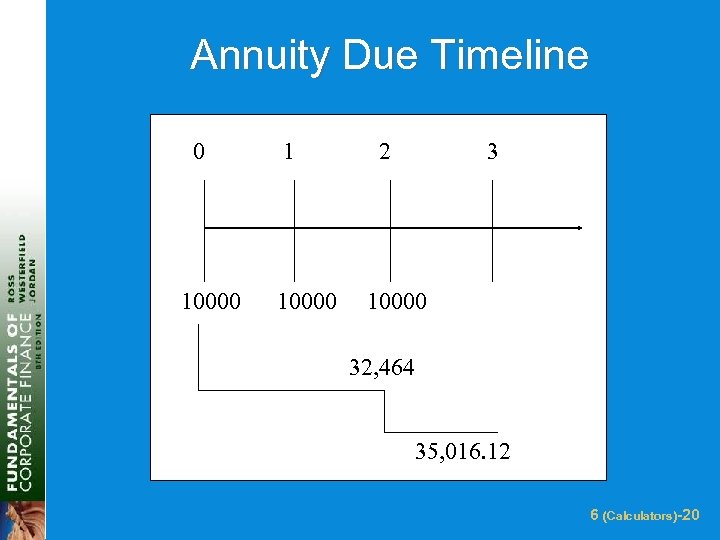 Annuity Due Timeline 0 10000 1 10000 2 3 10000 32, 464 35, 016. 12 6 (Calculators)-20
 FV of An Annuity- Ordinary vs Due § You plan to deposit $4, 000 at the end of each 6 -month period for the next 10 years. You can earn annual interest of 6%. 1. What is the balance at the end of 10 years? 2. If the deposits are structured as an annuity due, what is the balance at the end of 10 years? 6 (Calculators)-21
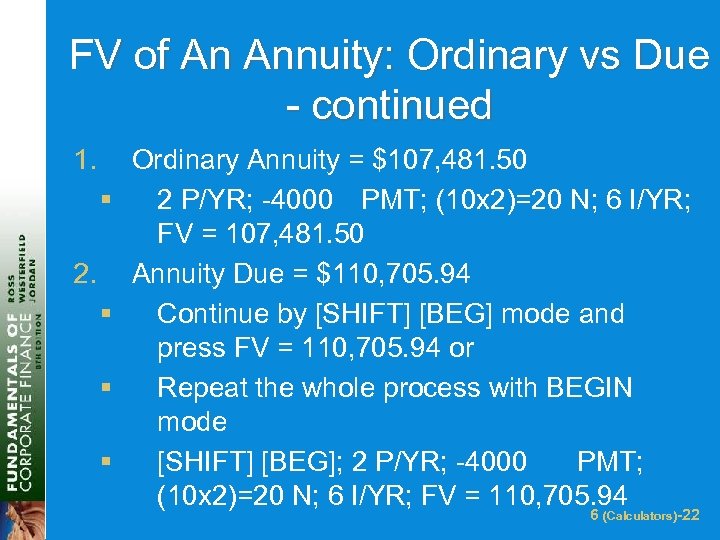 FV of An Annuity: Ordinary vs Due - continued 1. § 2. § § § Ordinary Annuity = $107, 481. 50 2 P/YR; -4000 PMT; (10 x 2)=20 N; 6 I/YR; FV = 107, 481. 50 Annuity Due = $110, 705. 94 Continue by [SHIFT] [BEG] mode and press FV = 110, 705. 94 or Repeat the whole process with BEGIN mode [SHIFT] [BEG]; 2 P/YR; -4000 PMT; (10 x 2)=20 N; 6 I/YR; FV = 110, 705. 94 6 (Calculators)-22
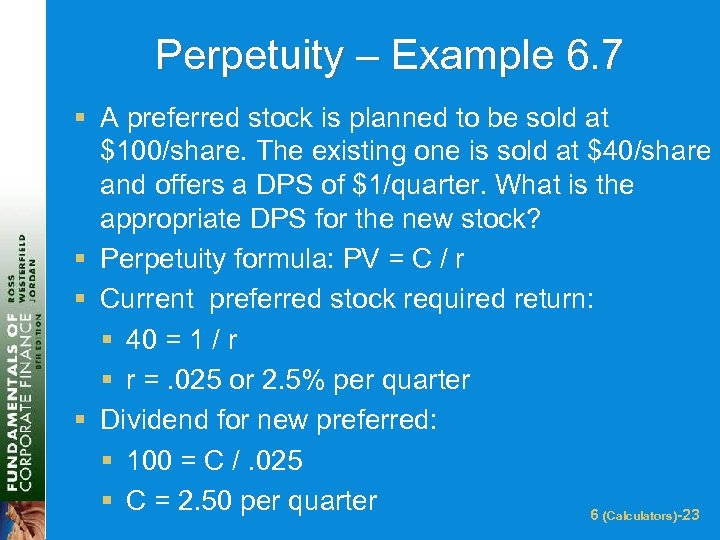 Perpetuity – Example 6. 7 § A preferred stock is planned to be sold at $100/share. The existing one is sold at $40/share and offers a DPS of $1/quarter. What is the appropriate DPS for the new stock? § Perpetuity formula: PV = C / r § Current preferred stock required return: § 40 = 1 / r § r =. 025 or 2. 5% per quarter § Dividend for new preferred: § 100 = C /. 025 § C = 2. 50 per quarter 6 (Calculators)-23
 Effective Annual Rate (EAR) § This is the actual rate paid (or received) after accounting for compounding that occurs during the year § If you want to compare two alternative investments with different compounding periods you need to compute the EAR and use that for comparison. 6 (Calculators)-24
 Annual Percentage Rate § This is the annual rate that is quoted by law § By definition APR = period rate times the number of periods per year § Consequently, to get the period rate we rearrange the APR equation: § Period rate = APR / number of periods per year § You should NEVER divide the effective rate by the number of periods per year – it will NOT give you the period rate 6 -25 (Calculators)
 Computing APRs § What is the APR if the monthly rate is. 5%? §. 5(12) = 6% § What is the APR if the semiannual rate is. 5%? §. 5(2) = 1% § What is the monthly rate if the APR is 12% with monthly compounding? § 12 / 12 = 1% 6 (Calculators)-26
 Things to Remember § You ALWAYS need to make sure that the interest rate and the time period match. § If you are looking at annual periods, you need an annual rate. § If you are looking at monthly periods, you need a monthly rate. § If you have an APR based on monthly compounding, you have to use monthly periods for lump sums, or adjust the interest rate appropriately if you have payments other than monthly 6 (Calculators)-27
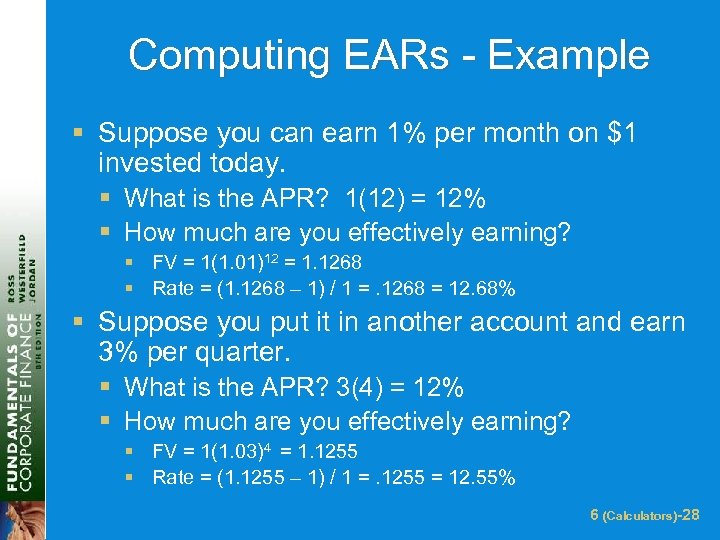 Computing EARs - Example § Suppose you can earn 1% per month on $1 invested today. § What is the APR? 1(12) = 12% § How much are you effectively earning? § FV = 1(1. 01)12 = 1. 1268 § Rate = (1. 1268 – 1) / 1 =. 1268 = 12. 68% § Suppose you put it in another account and earn 3% per quarter. § What is the APR? 3(4) = 12% § How much are you effectively earning? § FV = 1(1. 03)4 = 1. 1255 § Rate = (1. 1255 – 1) / 1 =. 1255 = 12. 55% 6 (Calculators)-28
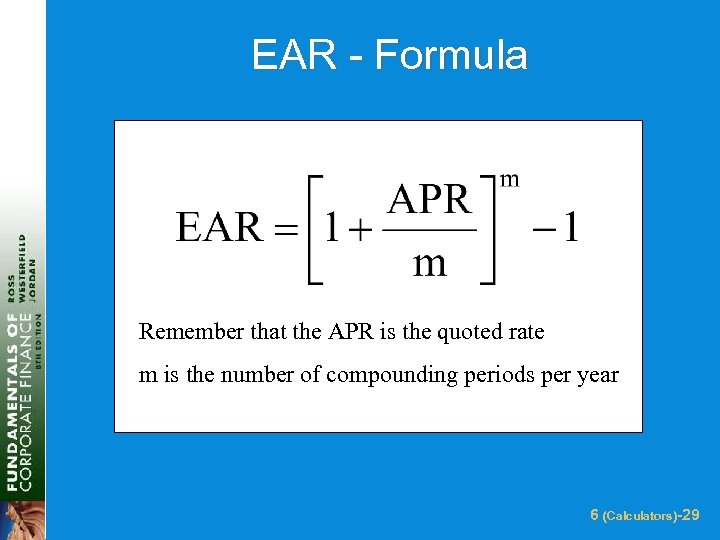 EAR - Formula Remember that the APR is the quoted rate m is the number of compounding periods per year 6 (Calculators)-29
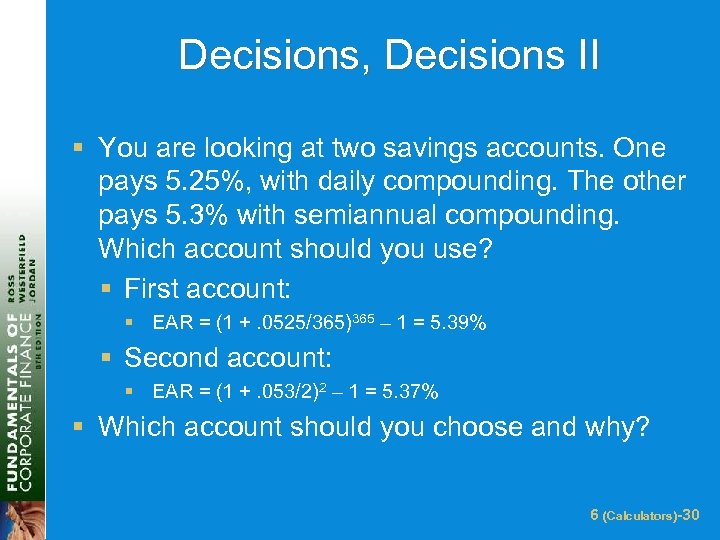 Decisions, Decisions II § You are looking at two savings accounts. One pays 5. 25%, with daily compounding. The other pays 5. 3% with semiannual compounding. Which account should you use? § First account: § EAR = (1 +. 0525/365)365 – 1 = 5. 39% § Second account: § EAR = (1 +. 053/2)2 – 1 = 5. 37% § Which account should you choose and why? 6 (Calculators)-30
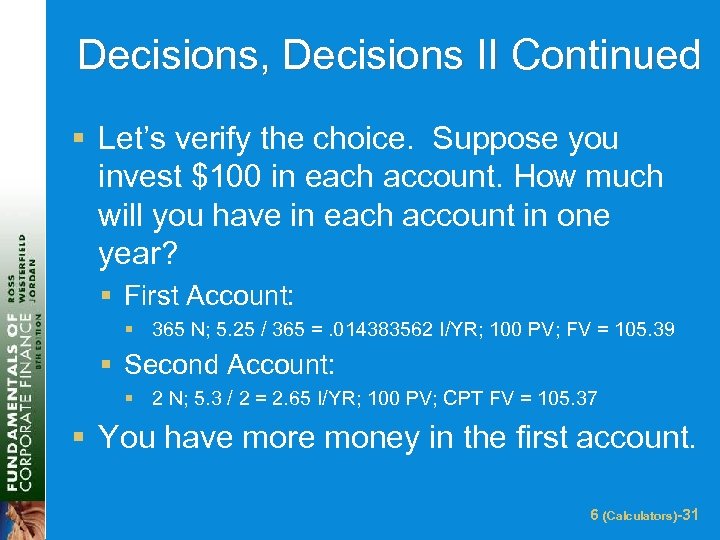 Decisions, Decisions II Continued § Let’s verify the choice. Suppose you invest $100 in each account. How much will you have in each account in one year? § First Account: § 365 N; 5. 25 / 365 =. 014383562 I/YR; 100 PV; FV = 105. 39 § Second Account: § 2 N; 5. 3 / 2 = 2. 65 I/YR; 100 PV; CPT FV = 105. 37 § You have more money in the first account. 6 (Calculators)-31
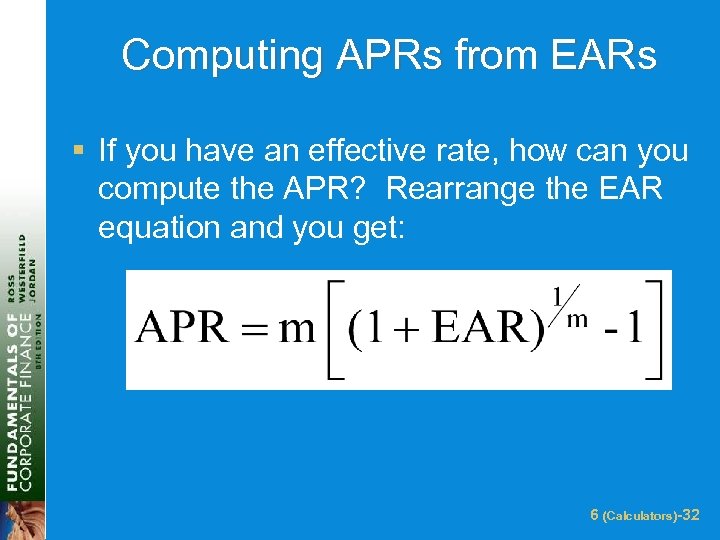 Computing APRs from EARs § If you have an effective rate, how can you compute the APR? Rearrange the EAR equation and you get: 6 (Calculators)-32
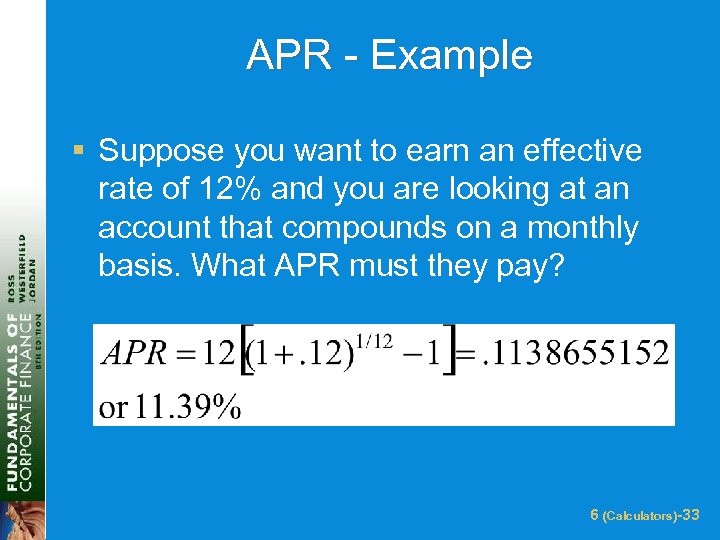 APR - Example § Suppose you want to earn an effective rate of 12% and you are looking at an account that compounds on a monthly basis. What APR must they pay? 6 (Calculators)-33
 Computing Payments with APRs § Suppose you want to buy a new computer system and the store is willing to sell it to allow you to make monthly payments. The entire computer system costs $3, 500. The loan period is for 2 years and the interest rate is 16. 9% with monthly compounding. What is your monthly payment? § 1 SHIFT P/YR; 2(12) = 24 N; 16. 9 / 12 = 1. 408333333 I/YR; 3, 500 PV; PMT = -172. 88 6 (Calculators)-34
 Future Values with Monthly Compounding § Suppose you deposit $50 a month into an account that has an APR of 9%, based on monthly compounding. How much will you have in the account in 35 years? § § § 1 SHIFT P/YR 35(12) = 420 N 9 / 12 =. 75 I/YR 50 PMT FV = 147, 089. 22 6 (Calculators)-35
 Present Value with Daily Compounding § You need $15, 000 in 3 years for a new car. If you can deposit money into an account that pays an APR of 5. 5% based on daily compounding, how much would you need to deposit? § § § 1 SHIFT P/YR 3(365) = 1, 095 N 5. 5 / 365 =. 015068493 I/YR 15, 000 FV PV = -12, 718. 56 6 (Calculators)-36
 Continuous Compounding § Sometimes investments or loans are figured based on continuous compounding § EAR = eq – 1 § The e is a special function on the calculator normally denoted by ex § Example: What is the effective annual rate of 7% compounded continuously? § EAR = e. 07 – 1 =. 0725 or 7. 25% § HP 10 BII 0. 07 SHIFT ex - 1 6 (Calculators)-37
 Pure Discount Loans – Example 6. 12 § Treasury bills are excellent examples of pure discount loans. The principal amount is repaid at some future date, without any periodic interest payments. § If a T-bill promises to repay $10, 000 in 12 months and the market interest rate is 7 percent, how much will the bill sell for in the market? § 1 N; 10, 000 FV; 7 I/YR; PV = -9, 345. 79 6 (Calculators)-38
 Interest-Only Loan - Example § Consider a 5 -year, interest-only loan with a 7% interest rate. The principal amount is $10, 000. Interest is paid annually. § What would the stream of cash flows be? § Years 1 – 4: Interest payments of. 07(10, 000) = 700 § Year 5: Interest + principal = 10, 700 § This cash flow stream is similar to the cash flows on corporate bonds and we will talk about them in greater detail in Chapter 7. 6 (Calculators)-39
 Amortized Loan with Fixed Principal Payment - Example § Consider a $50, 000, 10 year loan at 8% interest. The loan agreement requires the firm to pay $5, 000 in principal each year plus interest for that year. § Click on the Excel icon to see the amortization table 6 (Calculators)-40
 Amortized Loan with Fixed Payment - Example § Each payment covers the interest expense plus reduces principal § Consider a 4 year loan with annual payments. The interest rate is 8% and the principal amount is $5, 000. § What is the annual payment or installment? § § 4 N 8 I/YR 5, 000 PV PMT = -1, 509. 60 § Click on the Excel icon to see the amortization table 6 (Calculators)-41