 Скачать презентацию 6 Basic Methods I Overview n n n
667d81908138ebe74cab32eda1c6d277.ppt
- Количество слайдов: 30



6. Basic Methods I Overview n n n 6. 1 Models 6. 2 Taxonomy 6. 3 Finite State Model 6. 4 State Transition Model 6. 5 Dataflow Model 6. 6 User Manual 1
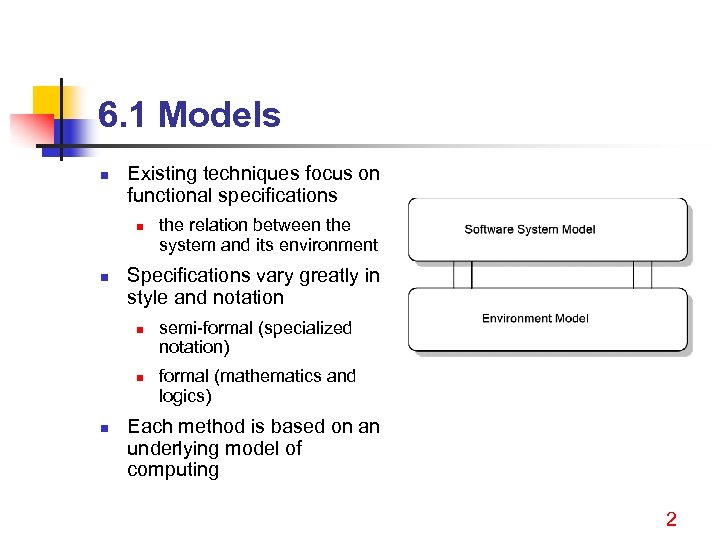
6. 1 Models n Existing techniques focus on functional specifications n n Specifications vary greatly in style and notation n the relation between the system and its environment semi-formal (specialized notation) formal (mathematics and logics) Each method is based on an underlying model of computing 2
Choosing the Right Model n n The choice of model is determined by the need for precise and concise communication Aspects of the specification that do not fit the model are left out or are treated using other models When multiple models are used, consistency becomes a critical verification concern The document organization is determined by the nature of the model 3
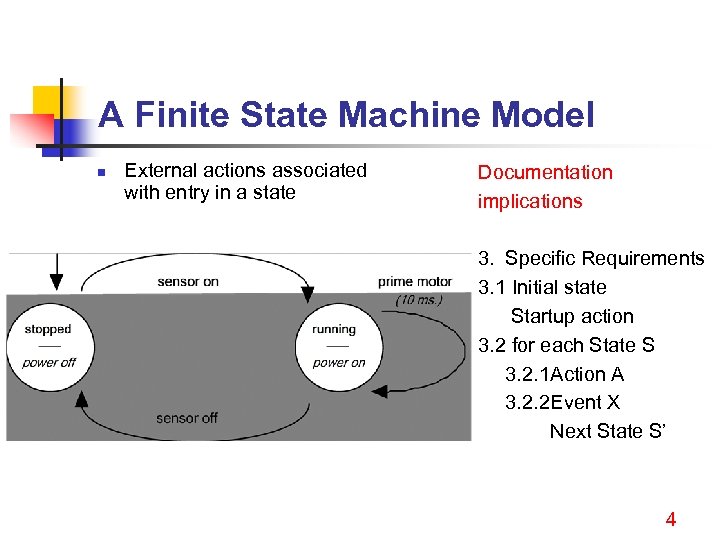
A Finite State Machine Model n External actions associated with entry in a state Documentation implications 3. Specific Requirements 3. 1 Initial state Startup action 3. 2 for each State S 3. 2. 1 Action A 3. 2. 2 Event X Next State S’ 4
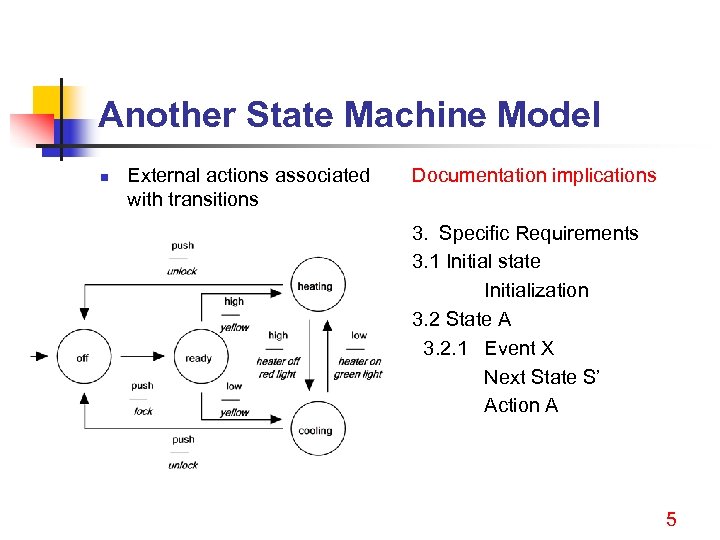
Another State Machine Model n External actions associated with transitions Documentation implications 3. Specific Requirements 3. 1 Initial state Initialization 3. 2 State A 3. 2. 1 Event X Next State S’ Action A 5
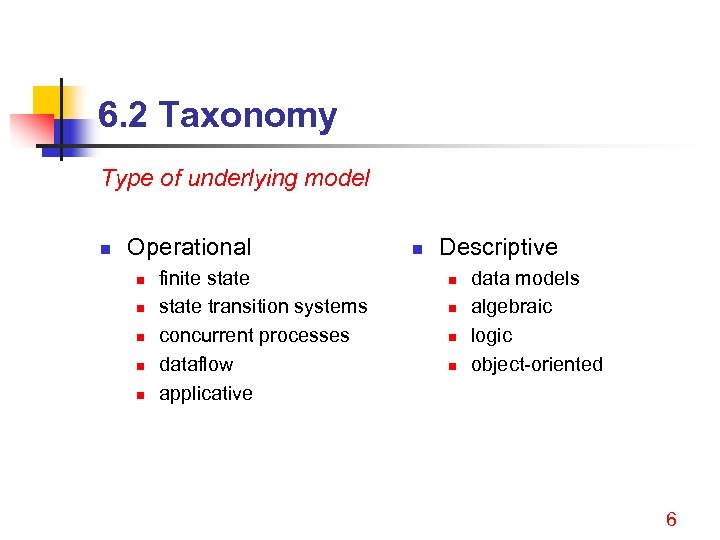
6. 2 Taxonomy Type of underlying model n Operational n n n finite state transition systems concurrent processes dataflow applicative n Descriptive n n data models algebraic logic object-oriented 6
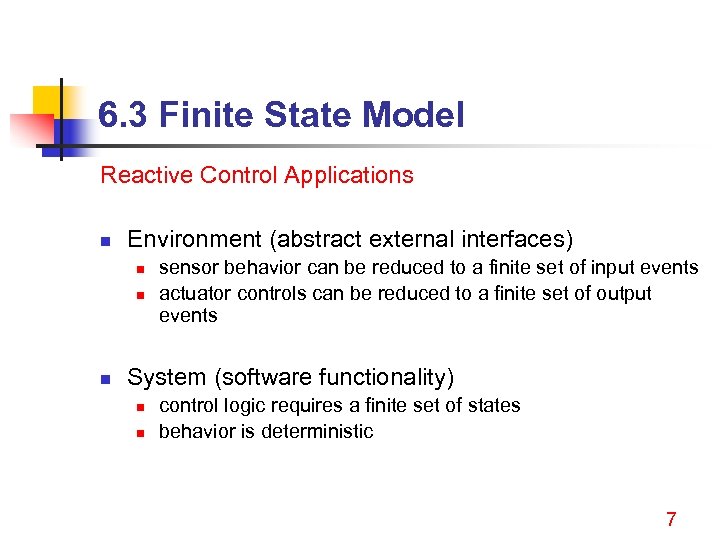
6. 3 Finite State Model Reactive Control Applications n Environment (abstract external interfaces) n n n sensor behavior can be reduced to a finite set of input events actuator controls can be reduced to a finite set of output events System (software functionality) n n control logic requires a finite set of states behavior is deterministic 7
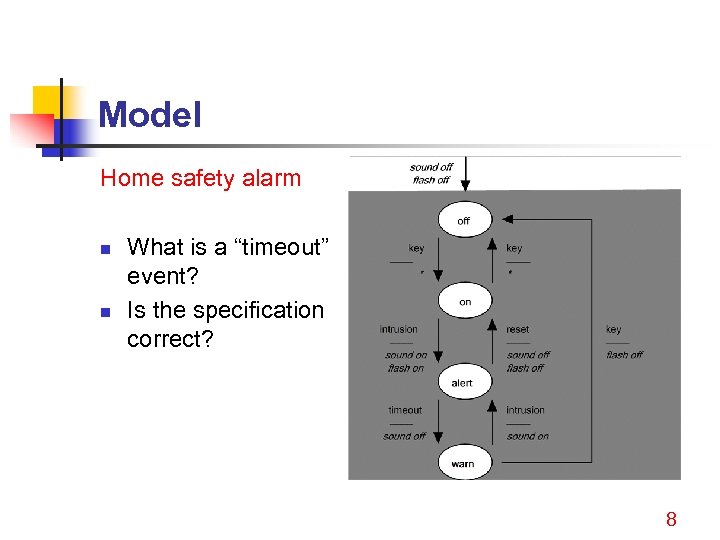
Model Home safety alarm n n What is a “timeout” event? Is the specification correct? 8
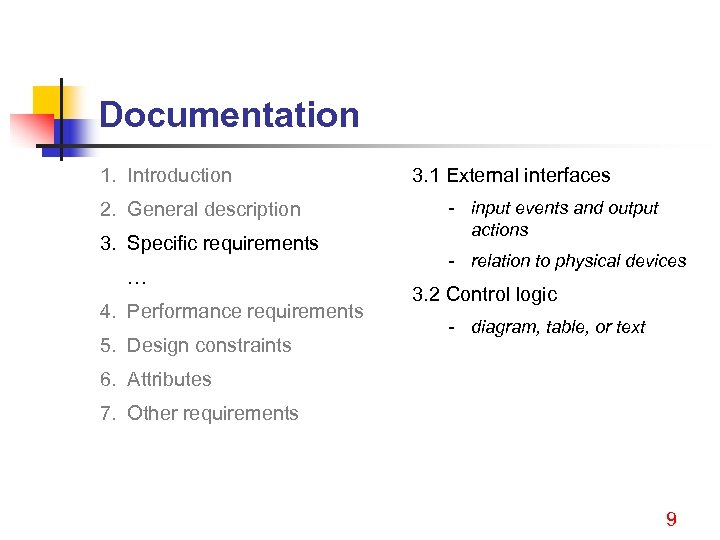
Documentation 1. Introduction 2. General description 3. Specific requirements … 4. Performance requirements 5. Design constraints 3. 1 External interfaces - input events and output actions - relation to physical devices 3. 2 Control logic - diagram, table, or text 6. Attributes 7. Other requirements 9
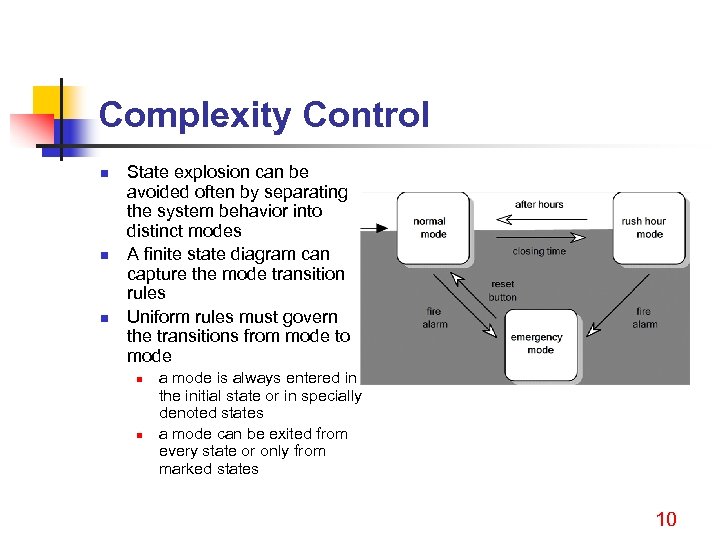
Complexity Control n n n State explosion can be avoided often by separating the system behavior into distinct modes A finite state diagram can capture the mode transition rules Uniform rules must govern the transitions from mode to mode n n a mode is always entered in the initial state or in specially denoted states a mode can be exited from every state or only from marked states 10
Object-Oriented Variations n Interfaces are encapsulated as external objects n n a step towards an object-oriented design Non-finite-state aspects of the system are encapsulated in internal objects n these objects have little or no implication on the subsequent design structure 11
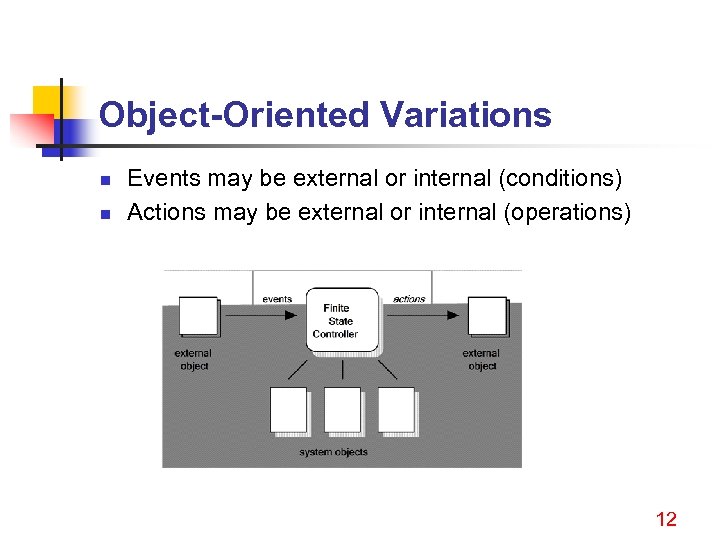
Object-Oriented Variations n n Events may be external or internal (conditions) Actions may be external or internal (operations) 12
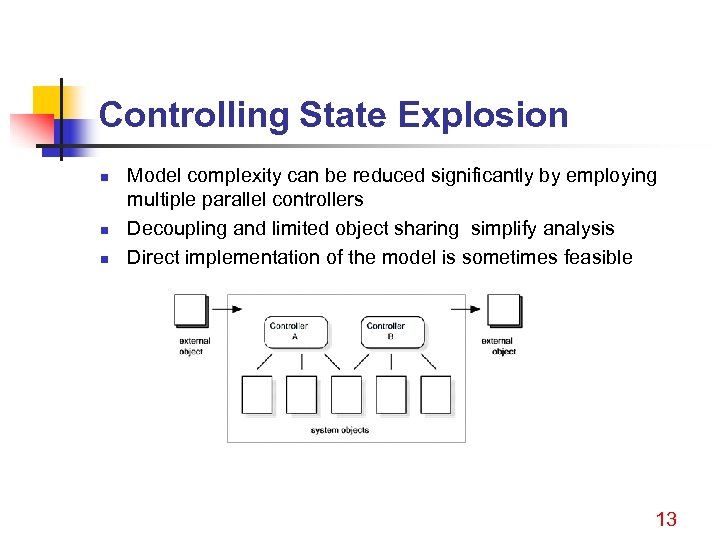
Controlling State Explosion n Model complexity can be reduced significantly by employing multiple parallel controllers Decoupling and limited object sharing simplify analysis Direct implementation of the model is sometimes feasible 13
Case Study: Hot Water Heater n n n During the preheating period (first 2 minutes) the heating element is on continuously. Continuous hot water output requires the heating element to stay on for 50% of the time while water is needed (low pressure). If the heater is no longer able to provide a continuous hot water supply (temperature drop), a warning light must turn on and the heating element must remain on for as long as water is needed. 14
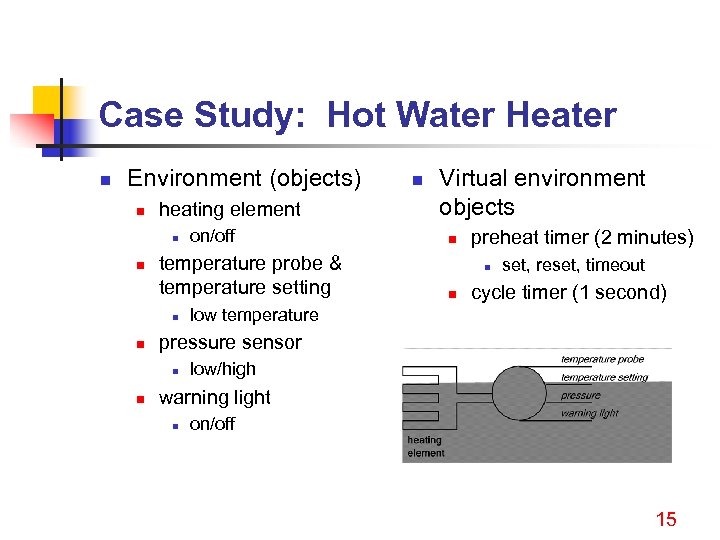
Case Study: Hot Water Heater n Environment (objects) n heating element n n temperature probe & temperature setting n n Virtual environment objects n preheat timer (2 minutes) n n set, reset, timeout cycle timer (1 second) low temperature pressure sensor n n on/off n low/high warning light n on/off 15
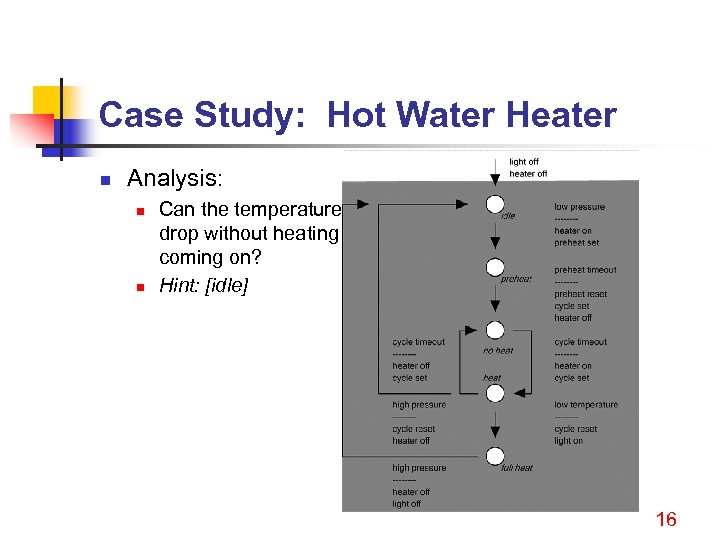
Case Study: Hot Water Heater n Analysis: n n Can the temperature drop without heating coming on? Hint: [idle] 16
6. 4 State Transition Model Data Processing Applications n Environment (abstract external interfaces) n n n inputs are data records supplied in a nondeterministic manner outputs are immediately consumed data records System (software functionality) n n the system maintains significant amounts of data system operation involves data updating and output computation in response to input arrival 17
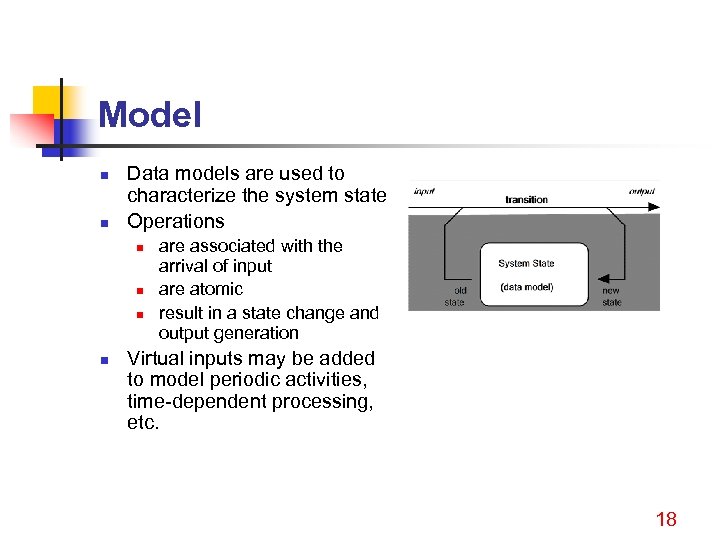
Model n n Data models are used to characterize the system state Operations n n are associated with the arrival of input are atomic result in a state change and output generation Virtual inputs may be added to model periodic activities, time-dependent processing, etc. 18
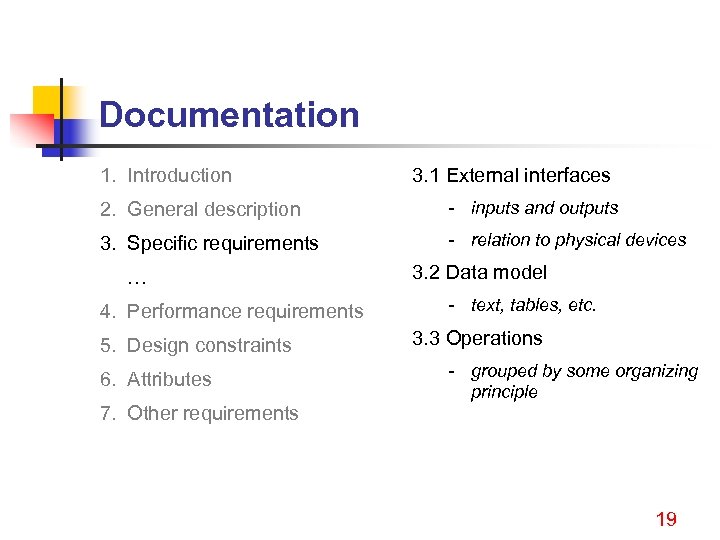
Documentation 1. Introduction 3. 1 External interfaces 2. General description - inputs and outputs 3. Specific requirements - relation to physical devices … 4. Performance requirements 5. Design constraints 6. Attributes 7. Other requirements 3. 2 Data model - text, tables, etc. 3. 3 Operations - grouped by some organizing principle 19
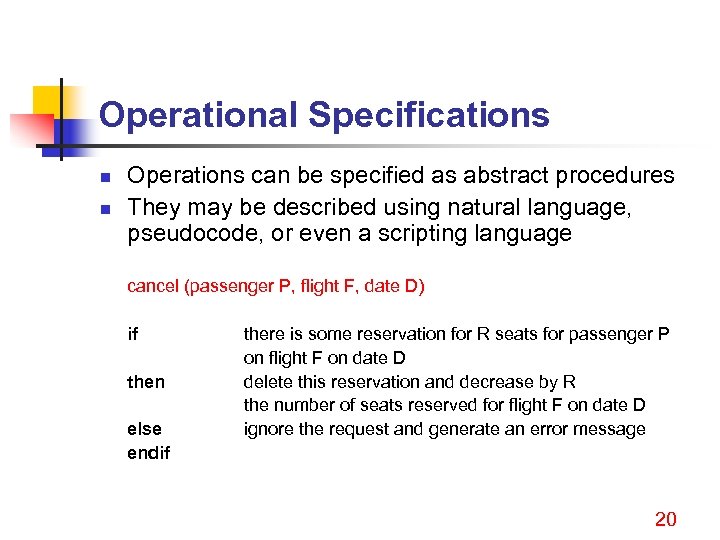
Operational Specifications n n Operations can be specified as abstract procedures They may be described using natural language, pseudocode, or even a scripting language cancel (passenger P, flight F, date D) if then else endif there is some reservation for R seats for passenger P on flight F on date D delete this reservation and decrease by R the number of seats reserved for flight F on date D ignore the request and generate an error message 20
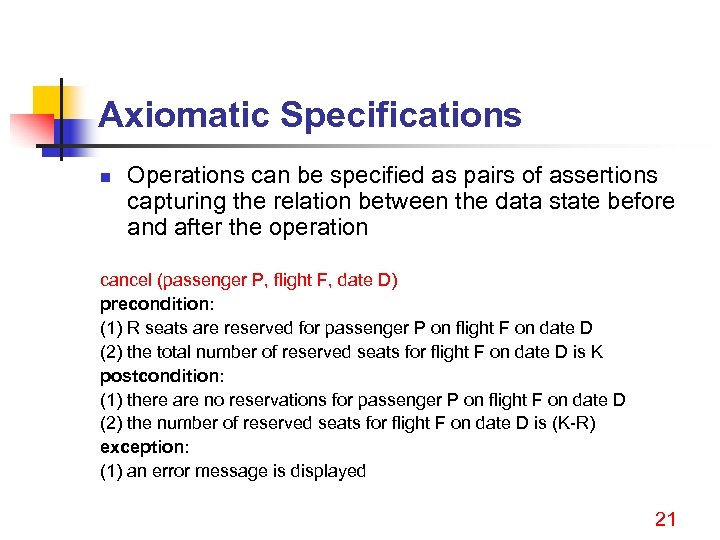
Axiomatic Specifications n Operations can be specified as pairs of assertions capturing the relation between the data state before and after the operation cancel (passenger P, flight F, date D) precondition: (1) R seats are reserved for passenger P on flight F on date D (2) the total number of reserved seats for flight F on date D is K postcondition: (1) there are no reservations for passenger P on flight F on date D (2) the number of reserved seats for flight F on date D is (K-R) exception: (1) an error message is displayed 21
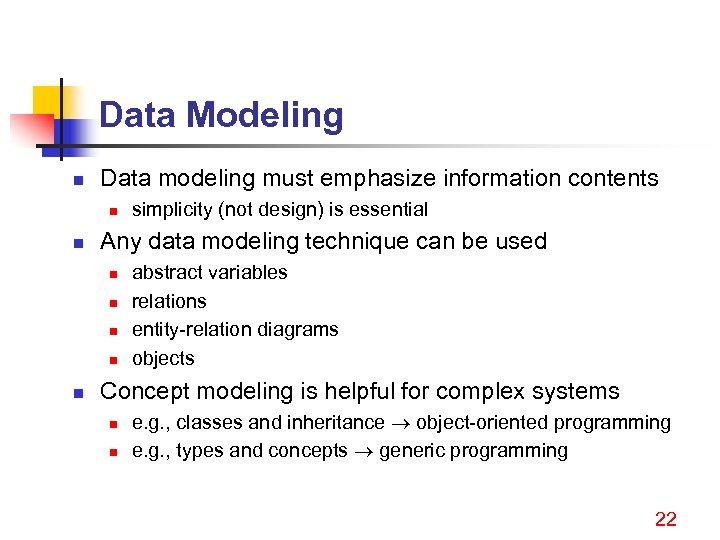
Data Modeling n Data modeling must emphasize information contents n n Any data modeling technique can be used n n n simplicity (not design) is essential abstract variables relations entity-relation diagrams objects Concept modeling is helpful for complex systems n n e. g. , classes and inheritance object-oriented programming e. g. , types and concepts generic programming 22
Abstract Variables n n n The system state may be characterized by a set of components that represent information maintained by the system The domain of values assumed by such components should be application specific The representation should be abstract, mathematical forms are preferred 23
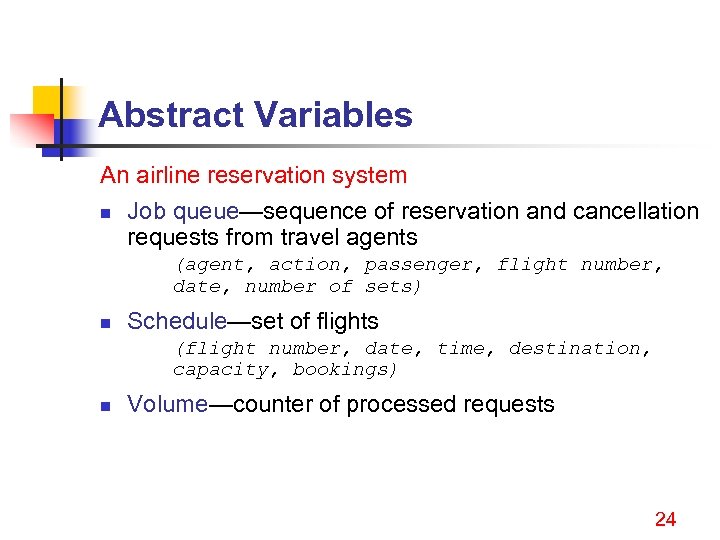
Abstract Variables An airline reservation system n Job queue—sequence of reservation and cancellation requests from travel agents (agent, action, passenger, flight number, date, number of sets) n Schedule—set of flights (flight number, date, time, destination, capacity, bookings) n Volume—counter of processed requests 24
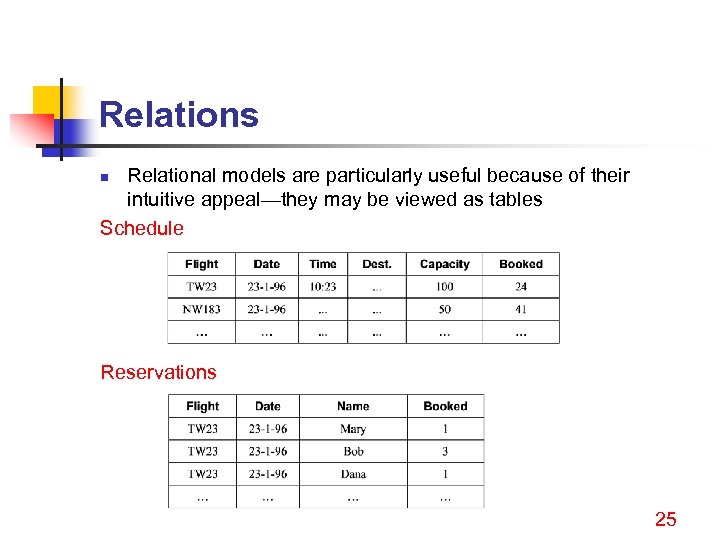
Relations Relational models are particularly useful because of their intuitive appeal—they may be viewed as tables Schedule n Reservations 25
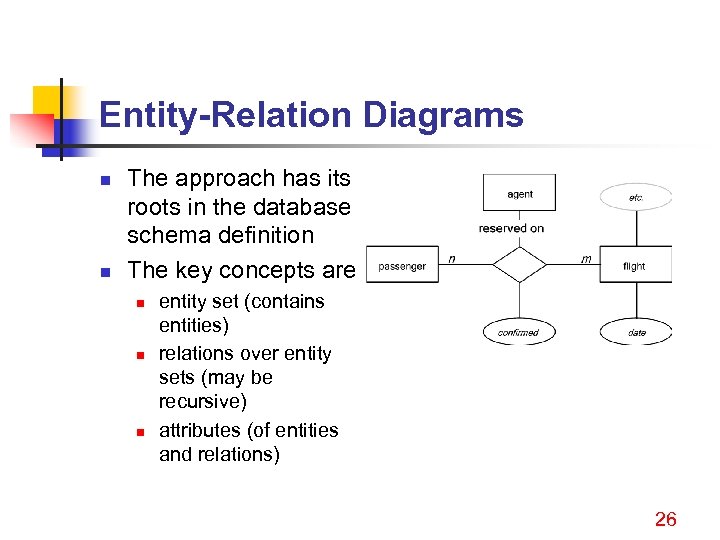
Entity-Relation Diagrams n n The approach has its roots in the database schema definition The key concepts are n n n entity set (contains entities) relations over entity sets (may be recursive) attributes (of entities and relations) 26
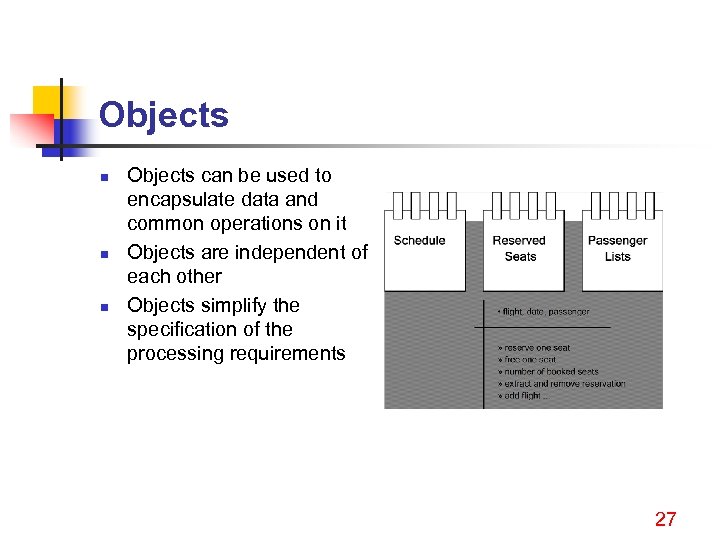
Objects n n n Objects can be used to encapsulate data and common operations on it Objects are independent of each other Objects simplify the specification of the processing requirements 27
Integrity n Semantic constraints capture important aspects of the application “reservations and cancellations involve only future flights” n Local constraints can be tested by examining some data component in isolation “a flight has a single departure time for each individual date, if any” n Global constraints involve relations among multiple components “the number of reserved seats cannot exceed the flight capacity plus the general overbooking factor” 28
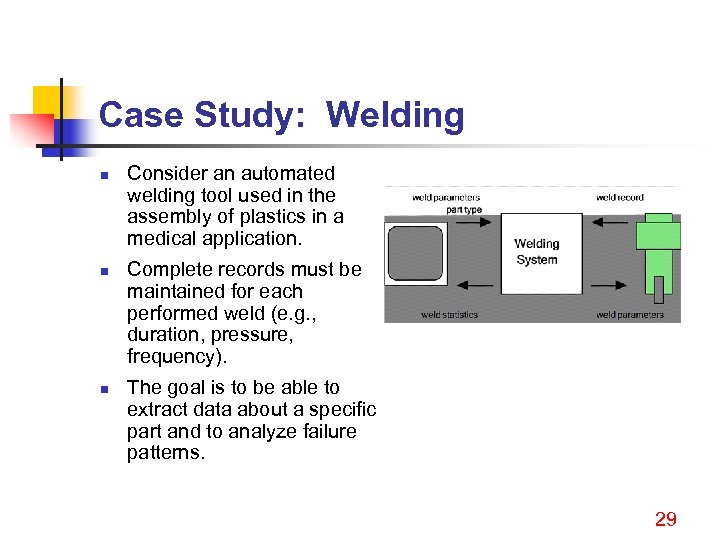
Case Study: Welding n n n Consider an automated welding tool used in the assembly of plastics in a medical application. Complete records must be maintained for each performed weld (e. g. , duration, pressure, frequency). The goal is to be able to extract data about a specific part and to analyze failure patterns. 29
Case Study: Welding n Data Model n Operations n Current part n Work on part N n Specifications n New welding record n Add part specification n Remove part specification n Display statistics n n Statistics n n part number, duration, pressure, frequency part number, number of welds, number of failures Questions n Calibration, tolerances, etc. n Questions n n Can modifications take place during welding? How long are statistics kept? 30
Скачать презентацию 6 Basic Methods I Overview n n n
667d81908138ebe74cab32eda1c6d277.ppt