


 Скачать презентацию 6 772 SMA 5111 — Compound Semiconductors Lecture 25
8d6b43230db443f621cb6175716e2407.ppt
- Количество слайдов: 28
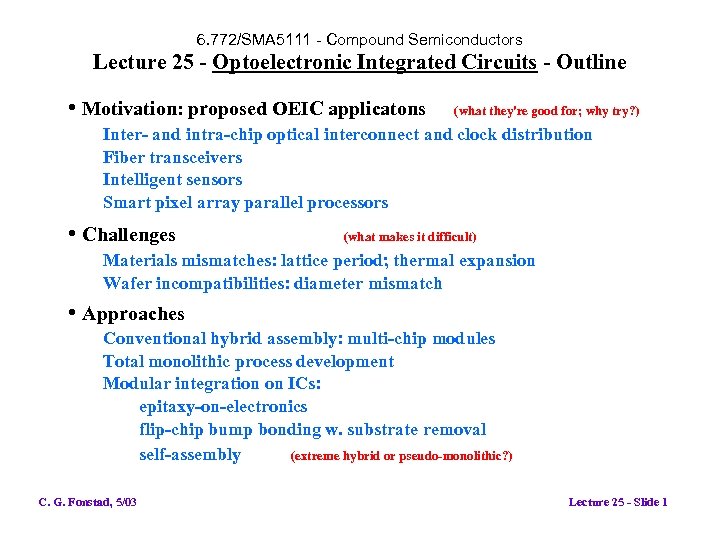 6. 772/SMA 5111 - Compound Semiconductors Lecture 25 - Optoelectronic Integrated Circuits - Outline • Motivation: proposed OEIC applicatons (what they're good for; why try? ) Inter- and intra-chip optical interconnect and clock distribution Fiber transceivers Intelligent sensors Smart pixel array parallel processors • Challenges (what makes it difficult) Materials mismatches: lattice period; thermal expansion Wafer incompatibilities: diameter mismatch • Approaches Conventional hybrid assembly: multi-chip modules Total monolithic process development Modular integration on ICs: epitaxy-on-electronics flip-chip bump bonding w. substrate removal self-assembly (extreme hybrid or pseudo-monolithic? ) C. G. Fonstad, 5/03 Lecture 25 - Slide 1
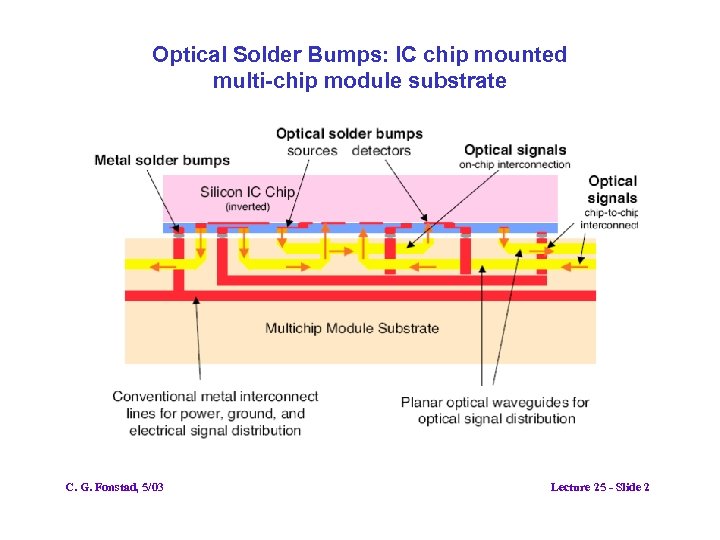 Optical Solder Bumps: IC chip mounted multi-chip module substrate C. G. Fonstad, 5/03 Lecture 25 - Slide 2
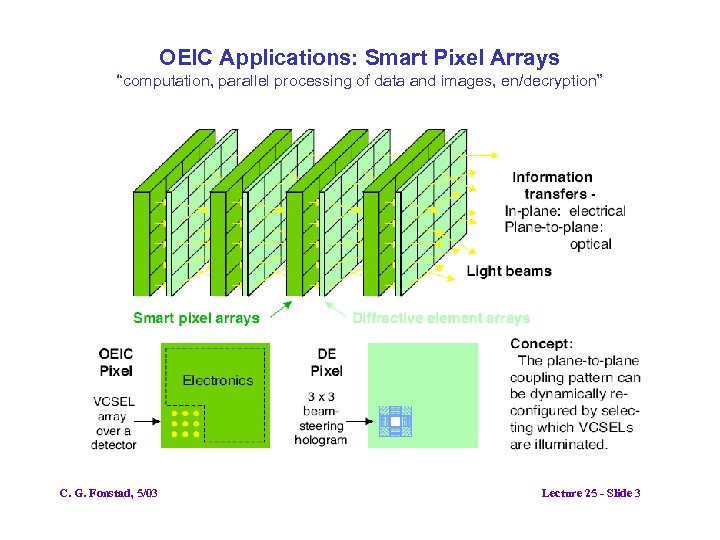 OEIC Applications: Smart Pixel Arrays “computation, parallel processing of data and images, en/decryption” C. G. Fonstad, 5/03 Lecture 25 - Slide 3
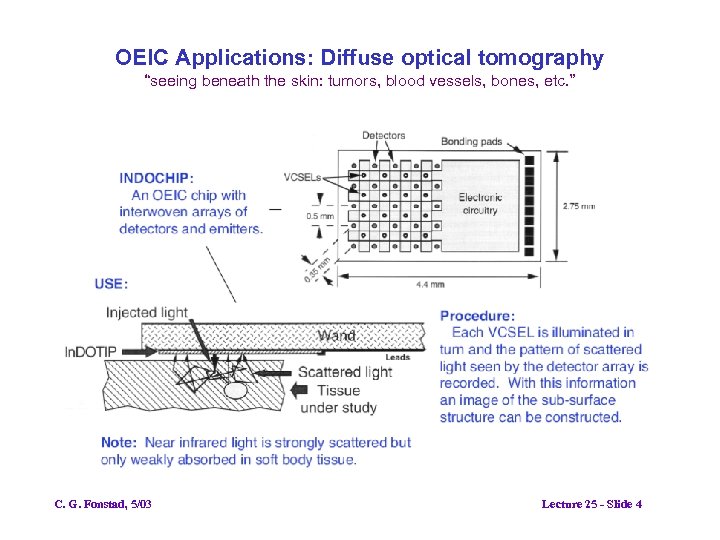 OEIC Applications: Diffuse optical tomography “seeing beneath the skin: tumors, blood vessels, bones, etc. ” C. G. Fonstad, 5/03 Lecture 25 - Slide 4
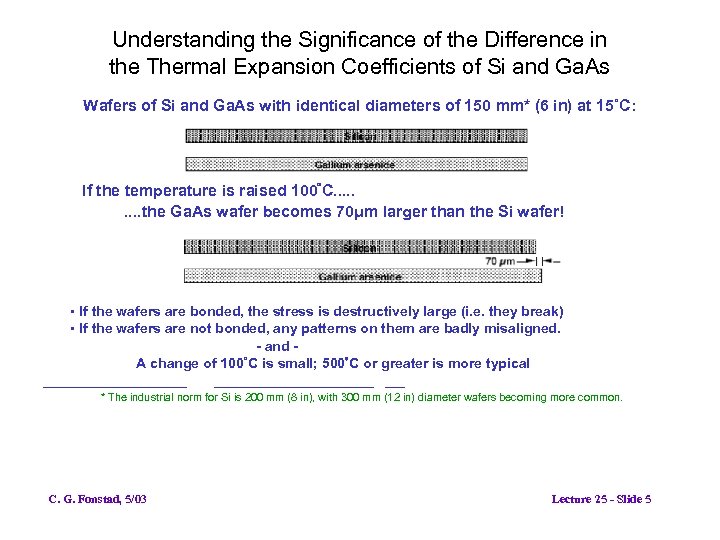 Understanding the Significance of the Difference in the Thermal Expansion Coefficients of Si and Ga. As Wafers of Si and Ga. As with identical diameters of 150 mm* (6 in) at 15˚C: If the temperature is raised 100˚C. . the Ga. As wafer becomes 70μm larger than the Si wafer! • If the wafers are bonded, the stress is destructively large (i. e. they break) • If the wafers are not bonded, any patterns on them are badly misaligned. - and A change of 100˚C is small; 500˚C or greater is more typical * The industrial norm for Si is 200 mm (8 in), with 300 mm (12 in) diameter wafers becoming more common. C. G. Fonstad, 5/03 Lecture 25 - Slide 5
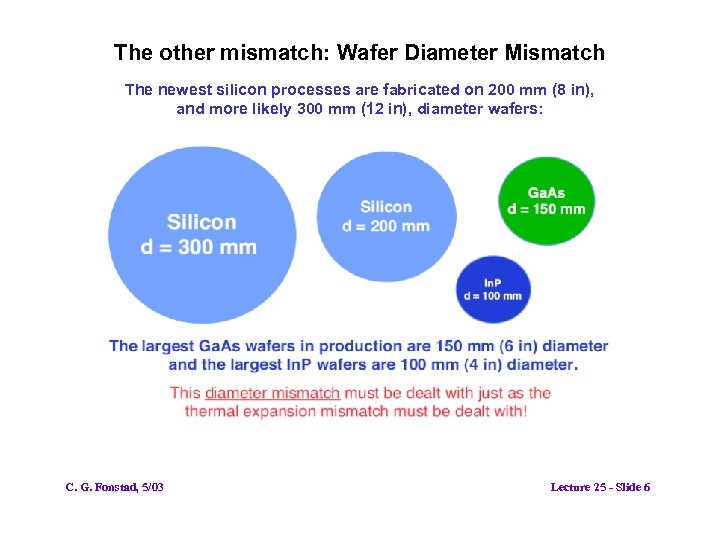 The other mismatch: Wafer Diameter Mismatch The newest silicon processes are fabricated on 200 mm (8 in), and more likely 300 mm (12 in), diameter wafers: C. G. Fonstad, 5/03 Lecture 25 - Slide 6
 Optoelectronic integration - solder ball flip-chip assembly on opto-multi-chip module • Flip-chip p-i-n diode astride polymer waveguide/mirror Waveguide cross-section: 10 by 10 μm Die size: 750 μm square by 250 μm thick C. G. Fonstad, 5/03 Lecture 25 - Slide 7
 Optoelectronic integration - solder ball flip-chip assembly on a silicon chip • Lasers or detectors flip-chip mounted on silicon chips with v-grooves etched to align to optical fibers (concept drawings) Note: V-grooves are formed using anisotropic etchants that reveal <111> planes (Images deleted) See FIgs. 12 and 12. 13 in H. P. Zappe, Introduction to Semiconductor Integrated Optics. Artech House, Norwood, MA, 1995. Perspective Before: After: End view Concept drawings. Assemblies like this have been demonstrated. C. G. Fonstad, 5/03 The pulling and wetting action of the molten solder is strong enough to align the chips to the under-lying electronics. Lecture 25 - Slide 8
 OEIC Processes - Indium bump bonding with substrate removal (Images deleted) See Chapter 5 in J. Trezza et al, Heterogeneous Optoectonics Integration, E. Towe, ed. SPIE Press, Bellingham, WA, 2000. • BAE Systems, Xanoptics: Above: Schematic of process sequence Right: Solder bump formation and alignment Lower left: Photomicrograph of solder bump array. Lower right: Cross-section of QWIP array integrated using indium solder bump bonding C. G. Fonstad, 5/03 Lecture 25 - Slide 9
 OEIC Processes - Bump bonding with substrate removal (Images deleted) See Chapter 4 in C. Wilmsen et al, Heterogeneous Optoectonics Integration, E. Towe, ed. SPIE Press, Bellingham, WA, 2000. C. G. Fonstad, 5/03 U. of Colorado co-planar process Left: Full assembly process Above: Top view of IC before and after integration Below: VCSEL prior to bonding (left) and after integration (rt) Lecture 25 - Slide 10
 OEIC Processes - Bump bonding with substrate removal, cont. (Images deleted) See Chapter 4 in C. Wilmsen et al, Heterogeneous Optoectonics Integration, E. Towe, ed. SPIE Press, Bellingham, WA, 2000. C. G. Fonstad, 5/03 U. of Colorado top-bottom process Left: Full assembly process Below: Top view of IC after integration Lecture 25 - Slide 11
 OEIC Processes - Bump bonding with substrate removal, cont. U. of Colorado top contact process Left: Full assembly process Below: Top view of IC after integration (Images deleted) See Chapter 4 in C. Wilmsen et al, Heterogeneous Optoectonics Integration, E. Towe, ed. SPIE Press, Bellingham, WA, 2000. C. G. Fonstad, 5/03 Lecture 25 - Slide 12
 OEIC Processes - Bump bonding with dual-use heterostructures and substrate microlenses • UCSB Right: Cross-section of full assembly Lower left: VCSELs and detectors fabricated from the same heterostructure Lower right: Microlens array on stubstrate C. G. Fonstad, 5/03 (Images deleted) See FIgs. 4. 20, 4. 18, and 4. 16 in Coldren, L. A and Corzine S. W, Diode Lasers and Photonic Integrated Circuits. New York: Wiley Interscience, 1995. Lecture 25 - Slide 13
 OEIC Processes - Total monolithic process development • 4 full monolithic examples: pin-HBT: msm-HFET: pin-HFET: WGPD-HFET: C. G. Fonstad, 5/03 Lecture 25 - Slide 14
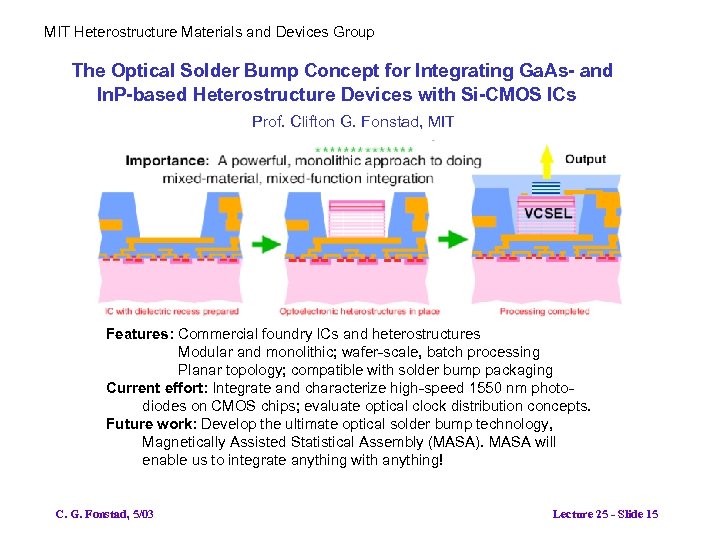 MIT Heterostructure Materials and Devices Group The Optical Solder Bump Concept for Integrating Ga. As- and In. P-based Heterostructure Devices with Si-CMOS ICs Prof. Clifton G. Fonstad, MIT Features: Commercial foundry ICs and heterostructures Modular and monolithic; wafer-scale, batch processing Planar topology; compatible with solder bump packaging Current effort: Integrate and characterize high-speed 1550 nm photodiodes on CMOS chips; evaluate optical clock distribution concepts. Future work: Develop the ultimate optical solder bump technology, Magnetically Assisted Statistical Assembly (MASA). MASA will enable us to integrate anything with anything! C. G. Fonstad, 5/03 Lecture 25 - Slide 15
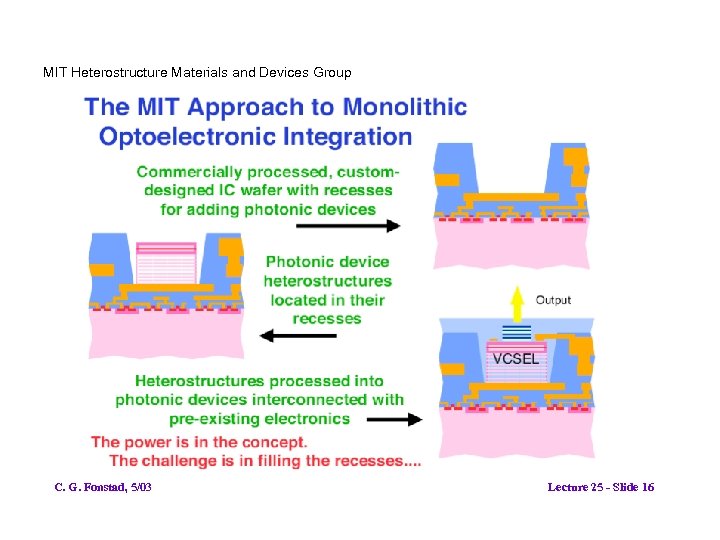 MIT Heterostructure Materials and Devices Group C. G. Fonstad, 5/03 Lecture 25 - Slide 16
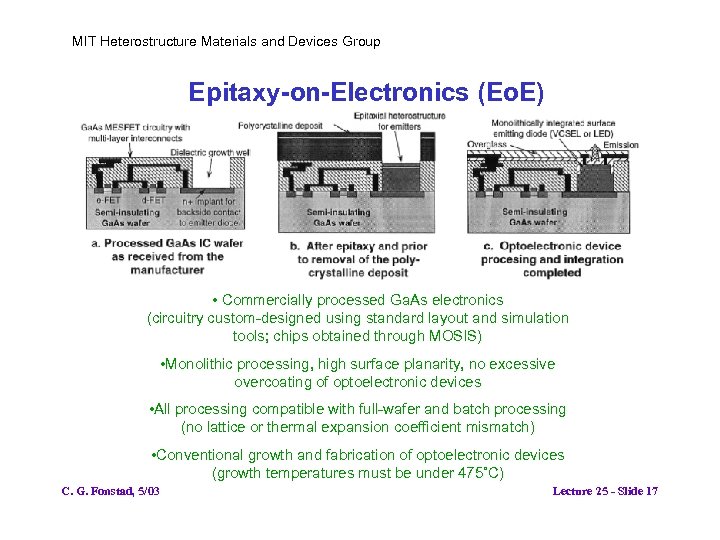 MIT Heterostructure Materials and Devices Group Epitaxy-on-Electronics (Eo. E) • Commercially processed Ga. As electronics (circuitry custom-designed using standard layout and simulation tools; chips obtained through MOSIS) • Monolithic processing, high surface planarity, no excessive overcoating of optoelectronic devices • All processing compatible with full-wafer and batch processing (no lattice or thermal expansion coefficient mismatch) • Conventional growth and fabrication of optoelectronic devices (growth temperatures must be under 475˚C) C. G. Fonstad, 5/03 Lecture 25 - Slide 17
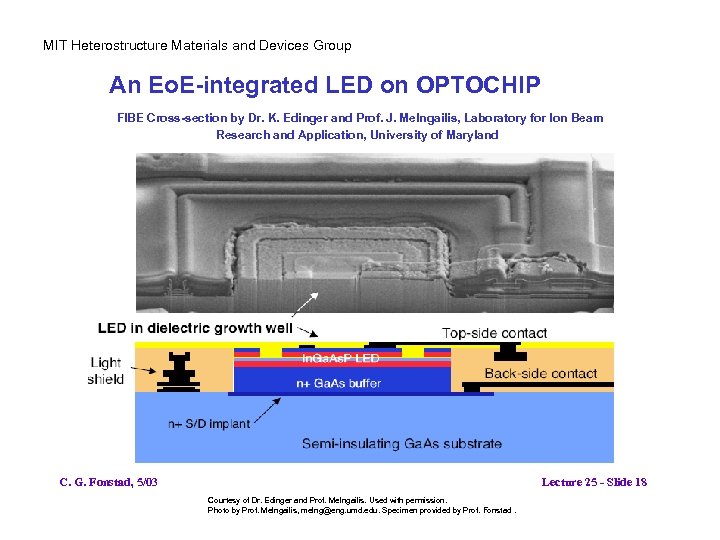 MIT Heterostructure Materials and Devices Group An Eo. E-integrated LED on OPTOCHIP FIBE Cross-section by Dr. K. Edinger and Prof. J. Melngailis, Laboratory for Ion Beam Research and Application, University of Maryland C. G. Fonstad, 5/03 Lecture 25 - Slide 18 Courtesy of Dr. Edinger and Prof. Melngailis. Used with permission. Photo by Prof. Melngailis, melng@eng. umd. edu. Specimen provided by Prof. Fonstad.
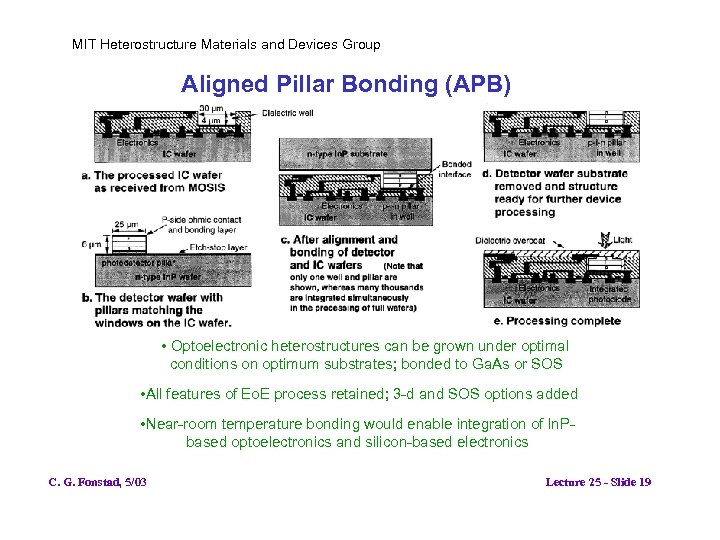 MIT Heterostructure Materials and Devices Group Aligned Pillar Bonding (APB) • Optoelectronic heterostructures can be grown under optimal conditions on optimum substrates; bonded to Ga. As or SOS • All features of Eo. E process retained; 3 -d and SOS options added • Near-room temperature bonding would enable integration of In. Pbased optoelectronics and silicon-based electronics C. G. Fonstad, 5/03 Lecture 25 - Slide 19
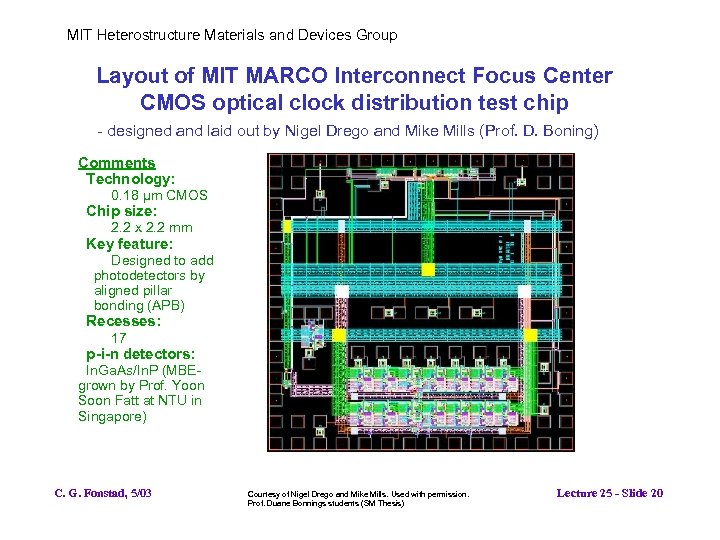 MIT Heterostructure Materials and Devices Group Layout of MIT MARCO Interconnect Focus Center CMOS optical clock distribution test chip - designed and laid out by Nigel Drego and Mike Mills (Prof. D. Boning) Comments Technology: 0. 18 μm CMOS Chip size: 2. 2 x 2. 2 mm Key feature: Designed to add photodetectors by aligned pillar bonding (APB) Recesses: 17 p-i-n detectors: In. Ga. As/In. P (MBEgrown by Prof. Yoon Soon Fatt at NTU in Singapore) C. G. Fonstad, 5/03 Courtesy of Nigel Drego and Mike Mills. Used with permission. Prof. Duane Bonnings students (SM Thesis) Lecture 25 - Slide 20
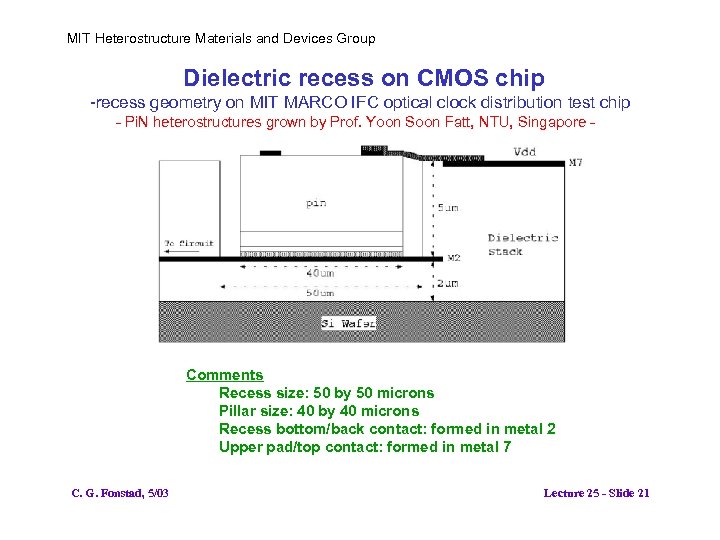 MIT Heterostructure Materials and Devices Group Dielectric recess on CMOS chip -recess geometry on MIT MARCO IFC optical clock distribution test chip - Pi. N heterostructures grown by Prof. Yoon Soon Fatt, NTU, Singapore - Comments Recess size: 50 by 50 microns Pillar size: 40 by 40 microns Recess bottom/back contact: formed in metal 2 Upper pad/top contact: formed in metal 7 C. G. Fonstad, 5/03 Lecture 25 - Slide 21
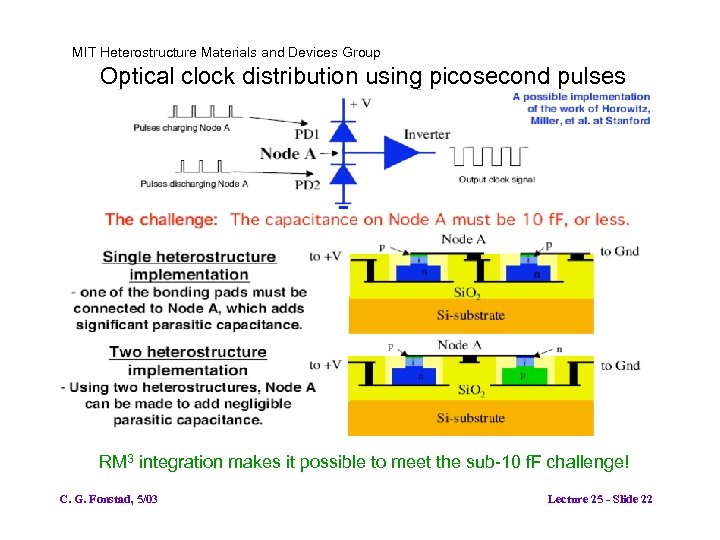 MIT Heterostructure Materials and Devices Group Optical clock distribution using picosecond pulses RM 3 integration makes it possible to meet the sub-10 f. F challenge! C. G. Fonstad, 5/03 Lecture 25 - Slide 22
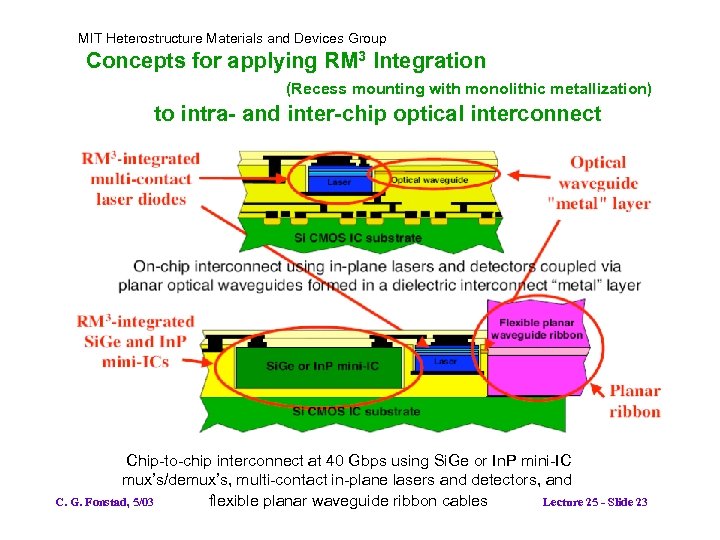 MIT Heterostructure Materials and Devices Group Concepts for applying RM 3 Integration (Recess mounting with monolithic metallization) to intra- and inter-chip optical interconnect Chip-to-chip interconnect at 40 Gbps using Si. Ge or In. P mini-IC mux’s/demux’s, multi-contact in-plane lasers and detectors, and C. G. Fonstad, 5/03 flexible planar waveguide ribbon cables Lecture 25 - Slide 23
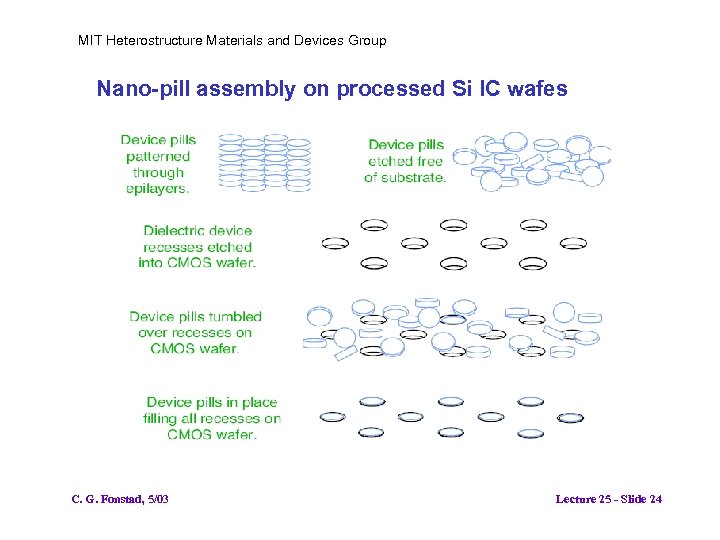 MIT Heterostructure Materials and Devices Group Nano-pill assembly on processed Si IC wafes C. G. Fonstad, 5/03 Lecture 25 - Slide 24
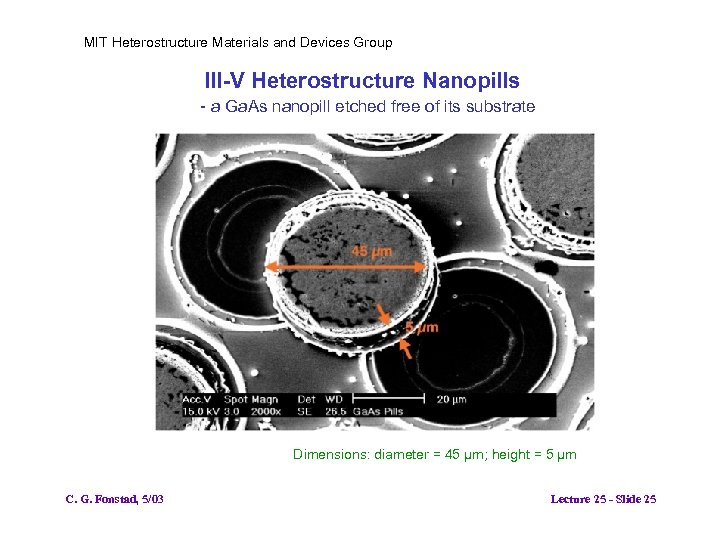 MIT Heterostructure Materials and Devices Group III-V Heterostructure Nanopills - a Ga. As nanopill etched free of its substrate Dimensions: diameter = 45 μm; height = 5 μm C. G. Fonstad, 5/03 Lecture 25 - Slide 25
 OEIC Processes - DNA-assisted self assembly • Two implementations: Right: DNA-assisted attachment to a carrier substrate, with subsequent transfer and bonding to final Si host. Below: DNA-assisted attachment to host Si substrate directly (Images deleted) See p. 113 -140 in Sadik C. Esener, Daniel Hartmann, Michael J. Heller, and Jeffrey M. Cable, "DNA Assisted Micro-Assembly: A Heterogeneous Integration Technology for Optoelectronics, " in Heterogeneous Integration: Systems on a Chip, Ed. Anis Husain and Mahmoud Fallahi, Critical Reviews of Optical Engineering, Vol. CR 70, SPIE Optical Engineering Press, Bellingham, WA, 1998. • Lock-and-key DNA-like chemicals are used to encourage nanopills to attach themselves to the appropriate sites on the substrate surface C. G. Fonstad, 5/03 Lecture 25 - Slide 26
 OEIC Processes - Fluidic self assembly • Assembly of trapezoidal nanopills in matching recesses (Images deleted) See Joseph J. Talghader, Jay K. Tu, and Stephen Smith, "Integration of Fluidically Self-Assembled Optoelectronic Devices Using a Si-Based Process, " IEEE Photon. Tech. Lett. 7 (1995) 1321 -1323. C. G. Fonstad, 5/03 Lecture 25 - Slide 27
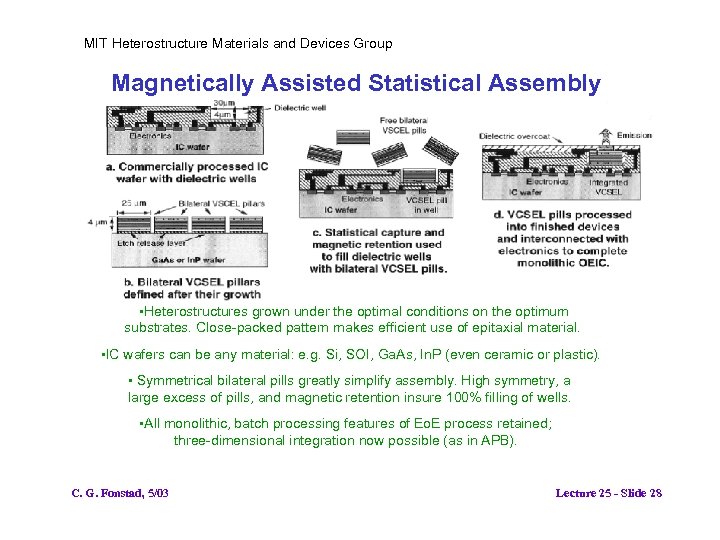 MIT Heterostructure Materials and Devices Group Magnetically Assisted Statistical Assembly • Heterostructures grown under the optimal conditions on the optimum substrates. Close-packed pattern makes efficient use of epitaxial material. • IC wafers can be any material: e. g. Si, SOI, Ga. As, In. P (even ceramic or plastic). • Symmetrical bilateral pills greatly simplify assembly. High symmetry, a large excess of pills, and magnetic retention insure 100% filling of wells. • All monolithic, batch processing features of Eo. E process retained; three-dimensional integration now possible (as in APB). C. G. Fonstad, 5/03 Lecture 25 - Slide 28