


 Скачать презентацию 6 4 Notes Human Development
942e760e0521d174e014857eddafd202.ppt
- Количество слайдов: 10
 6. 4 Notes – Human Development • • Cells make up tissues. Tissues make up organs. Organs make up systems. cell – the basic unit of life tissues – groups of similar cells that do a particular job organs – body parts made up of different tissues joined together to perform a specific function body systems – a group of organs that work together to carry out related tasks
 6. 4 Notes – Human Development • When does a baby form? – During fertilization (sperm and egg meet) • • embryo – the developing organism from fertilization to the 8 th week of development fetus – the developing organism from the end of the 8 th week until birth
 6. 4 Notes – Human Development • 3 months: – New features: arms, legs, fingers, toes, brain, nerves, tiny heartbeat – Behavior: begins to move • 6 months: – New features: eyebrows, fingernails – Behavior: kicks, hears sounds • 9 months: – New features: smooth skin – Behavior: eyes open, fingers can grasp, body organs & systems can work on their own
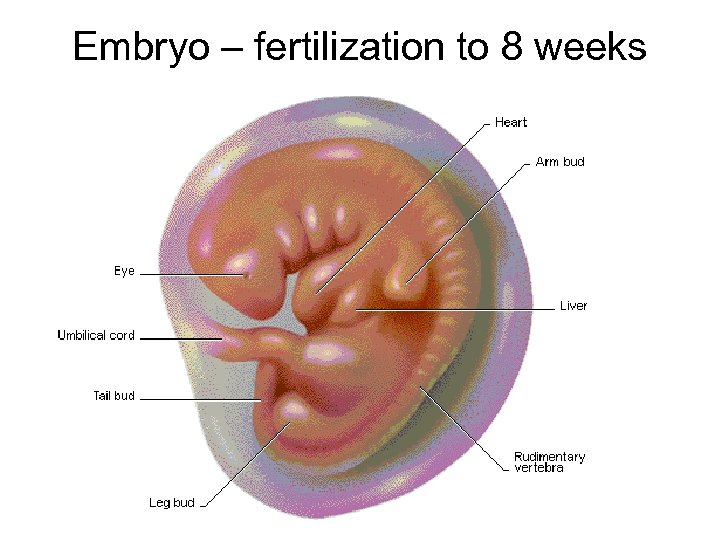 Embryo – fertilization to 8 weeks
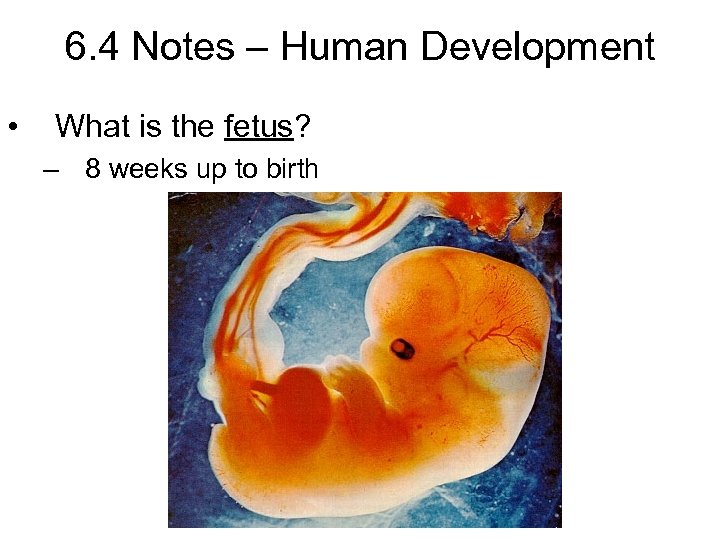 6. 4 Notes – Human Development • What is the fetus? – 8 weeks up to birth
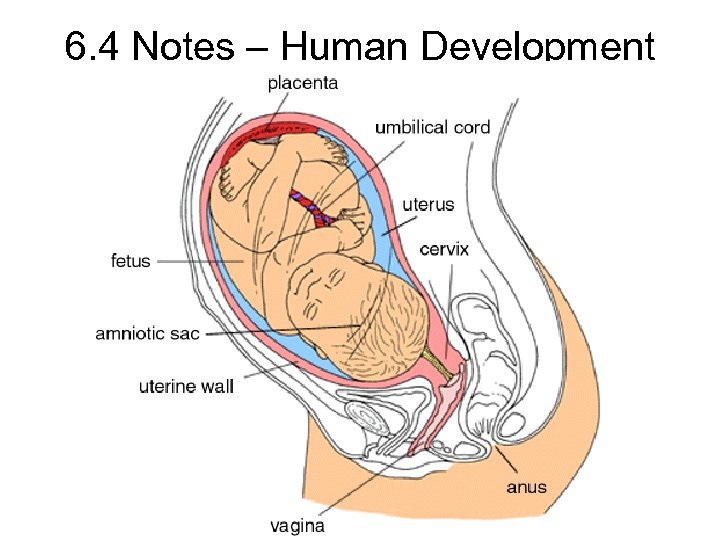 6. 4 Notes – Human Development
 6. 4 Notes – Human Development • • chromosomes – threadlike structures that carry the codes for inherited traits genes – the basic units of heredity
 6. 4 Notes – Human Development • What should a pregnant mother do to help keep her baby healthy? – exercise carefully – eat healthy foods (fruits, vegetables, certain kinds of meat) – go to the OB-GYN (obstetricians/gynecologists) doctor – keep clean, take showers, clean her hands before she eats – be aware of diseases – take her vitamins (prenatal vitamins) – go to her gynecologist
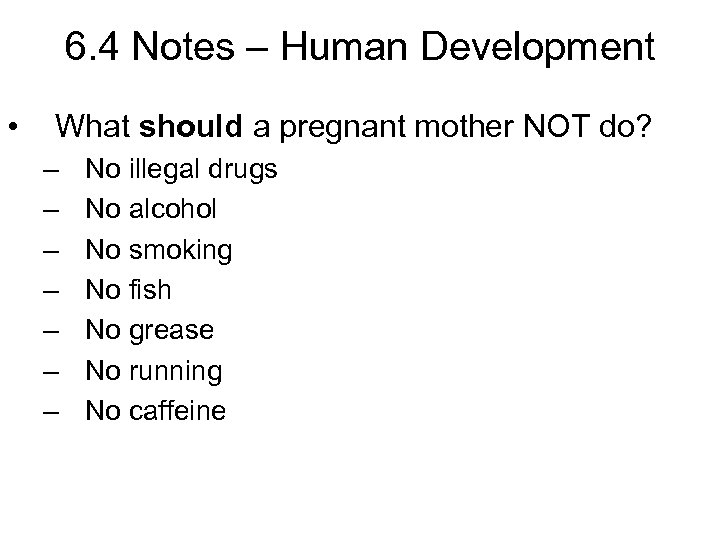 6. 4 Notes – Human Development • What should a pregnant mother NOT do? – – – – No illegal drugs No alcohol No smoking No fish No grease No running No caffeine
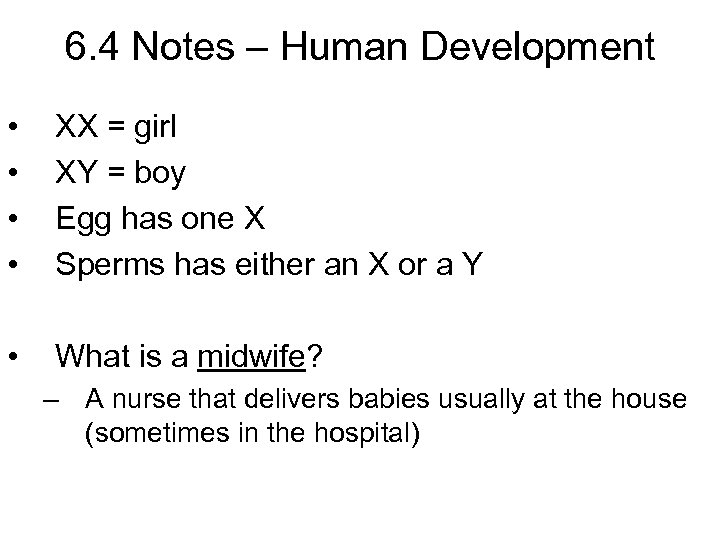 6. 4 Notes – Human Development • • XX = girl XY = boy Egg has one X Sperms has either an X or a Y • What is a midwife? – A nurse that delivers babies usually at the house (sometimes in the hospital)