 Скачать презентацию 6 001 SICP Variations on a Scheme Beyond
ca253486014844ca44752dd8ff2cfd0c.ppt
- Количество слайдов: 40



6. 001 SICP Variations on a Scheme Beyond Scheme – designing language variants: Lazy evaluation • Complete conversion – normal order evaluator • Upward compatible extension – lazy, lazy-memo 1
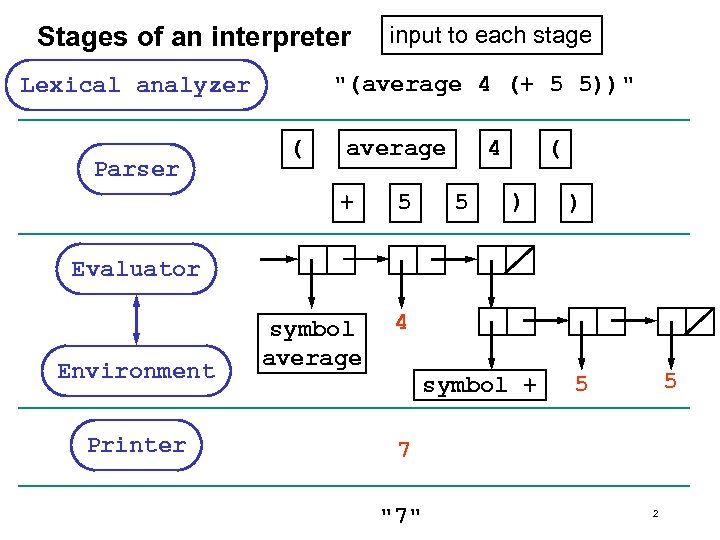
Stages of an interpreter "(average 4 (+ 5 5))" Lexical analyzer Parser input to each stage ( average + 5 4 5 ( ) ) Evaluator Environment Printer symbol average 4 symbol + 5 5 7 "7" 2
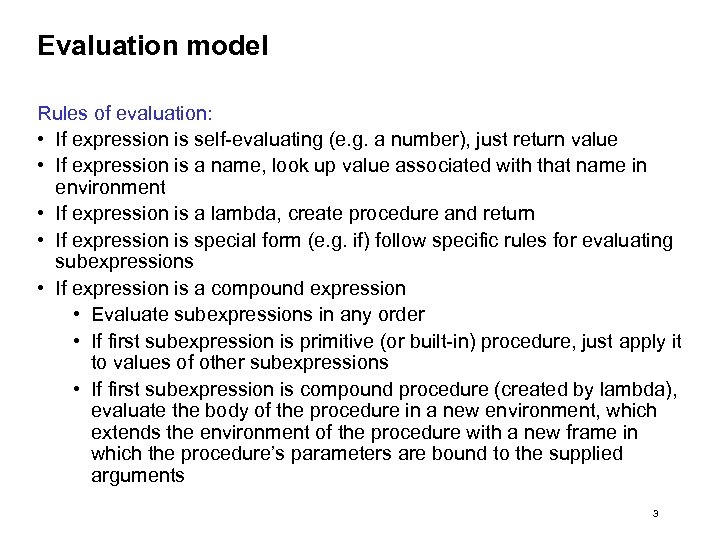
Evaluation model Rules of evaluation: • If expression is self-evaluating (e. g. a number), just return value • If expression is a name, look up value associated with that name in environment • If expression is a lambda, create procedure and return • If expression is special form (e. g. if) follow specific rules for evaluating subexpressions • If expression is a compound expression • Evaluate subexpressions in any order • If first subexpression is primitive (or built-in) procedure, just apply it to values of other subexpressions • If first subexpression is compound procedure (created by lambda), evaluate the body of the procedure in a new environment, which extends the environment of the procedure with a new frame in which the procedure’s parameters are bound to the supplied arguments 3
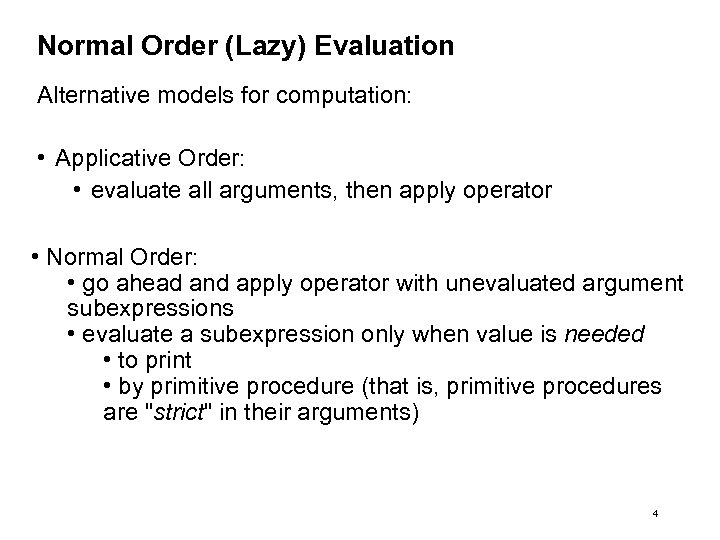
Normal Order (Lazy) Evaluation Alternative models for computation: • Applicative Order: • evaluate all arguments, then apply operator • Normal Order: • go ahead and apply operator with unevaluated argument subexpressions • evaluate a subexpression only when value is needed • to print • by primitive procedure (that is, primitive procedures are "strict" in their arguments) 4
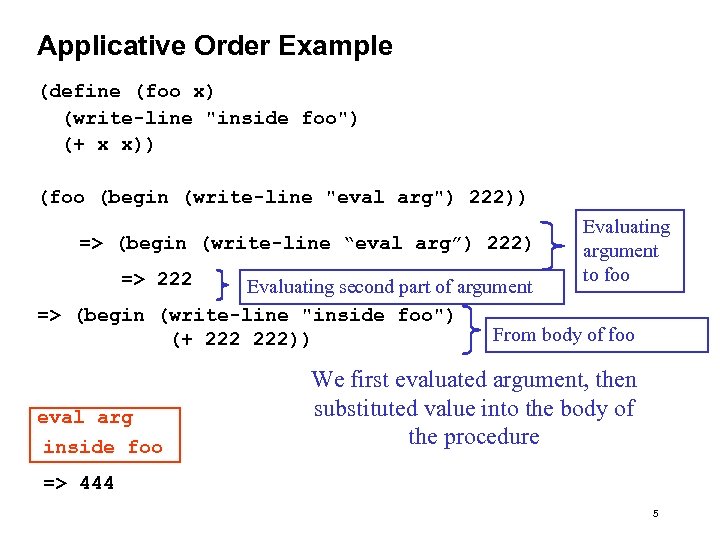
Applicative Order Example (define (foo x) (write-line "inside foo") (+ x x)) (foo (begin (write-line "eval arg") 222)) => (begin (write-line “eval arg”) 222) => 222 Evaluating argument to foo Evaluating second part of argument => (begin (write-line "inside foo") From body of foo (+ 222)) eval arg inside foo We first evaluated argument, then substituted value into the body of the procedure => 444 5
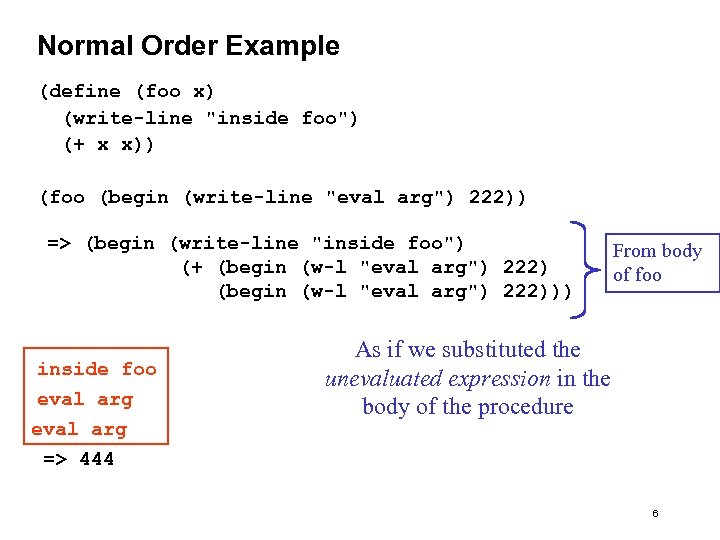
Normal Order Example (define (foo x) (write-line "inside foo") (+ x x)) (foo (begin (write-line "eval arg") 222)) => (begin (write-line "inside foo") (+ (begin (w-l "eval arg") 222))) inside foo eval arg => 444 From body of foo As if we substituted the unevaluated expression in the body of the procedure 6
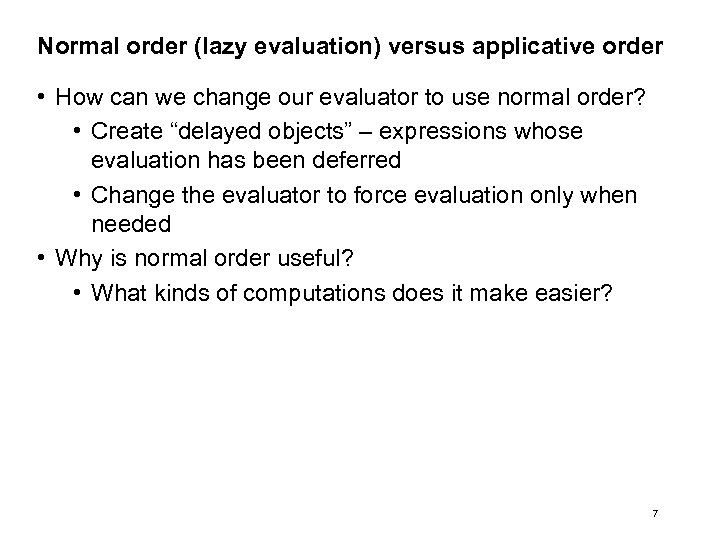
Normal order (lazy evaluation) versus applicative order • How can we change our evaluator to use normal order? • Create “delayed objects” – expressions whose evaluation has been deferred • Change the evaluator to force evaluation only when needed • Why is normal order useful? • What kinds of computations does it make easier? 7
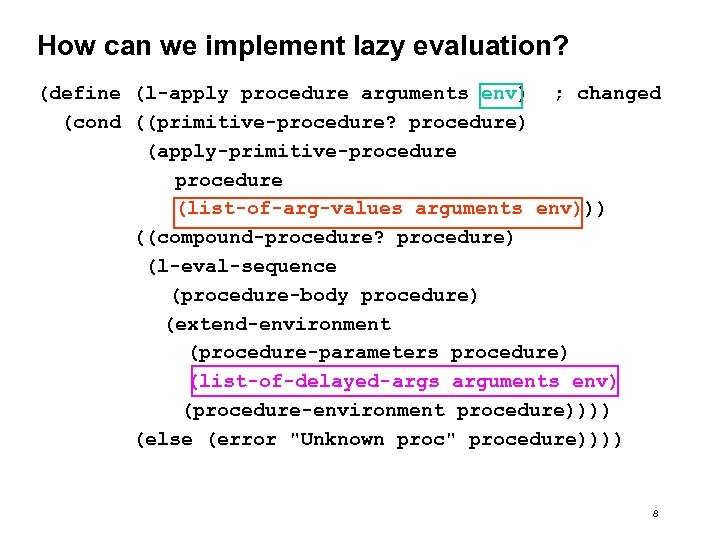
How can we implement lazy evaluation? (define (l-apply procedure arguments env) ; changed (cond ((primitive-procedure? procedure) (apply-primitive-procedure (list-of-arg-values arguments env))) ((compound-procedure? procedure) (l-eval-sequence (procedure-body procedure) (extend-environment (procedure-parameters procedure) (list-of-delayed-args arguments env) (procedure-environment procedure)))) (else (error "Unknown proc" procedure)))) 8
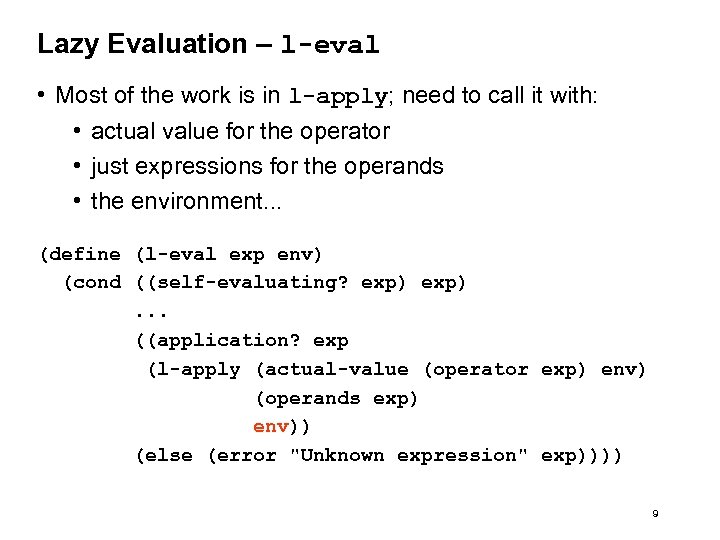
Lazy Evaluation – l-eval • Most of the work is in l-apply; need to call it with: • actual value for the operator • just expressions for the operands • the environment. . . (define (l-eval exp env) (cond ((self-evaluating? exp). . . ((application? exp (l-apply (actual-value (operator exp) env) (operands exp) env)) (else (error "Unknown expression" exp)))) 9
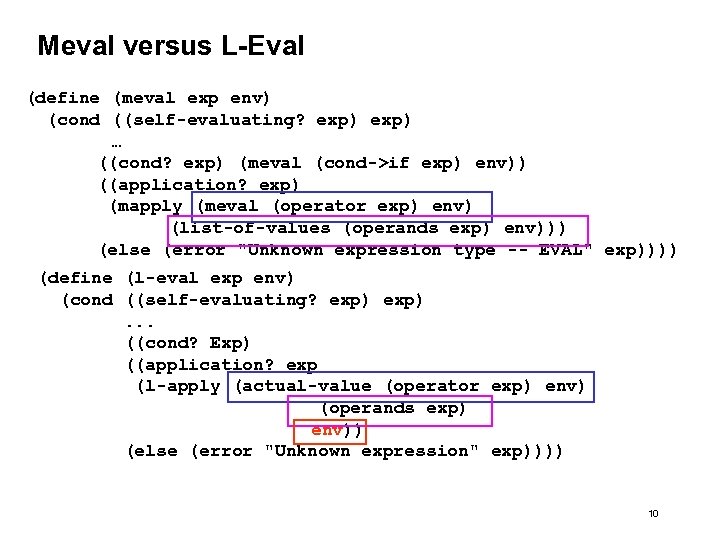
Meval versus L-Eval (define (meval exp env) (cond ((self-evaluating? exp) … ((cond? exp) (meval (cond->if exp) env)) ((application? exp) (mapply (meval (operator exp) env) (list-of-values (operands exp) env))) (else (error "Unknown expression type -- EVAL" exp)))) (define (l-eval exp env) (cond ((self-evaluating? exp). . . ((cond? Exp) ((application? exp (l-apply (actual-value (operator exp) env) (operands exp) env)) (else (error "Unknown expression" exp)))) 10
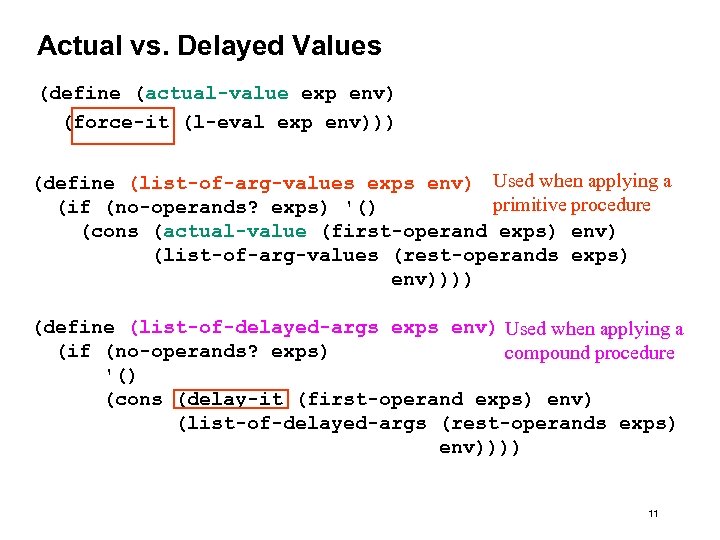
Actual vs. Delayed Values (define (actual-value exp env) (force-it (l-eval exp env))) (define (list-of-arg-values exps env) Used when applying a primitive procedure (if (no-operands? exps) '() (cons (actual-value (first-operand exps) env) (list-of-arg-values (rest-operands exps) env)))) (define (list-of-delayed-args exps env) Used when applying a (if (no-operands? exps) compound procedure '() (cons (delay-it (first-operand exps) env) (list-of-delayed-args (rest-operands exps) env)))) 11
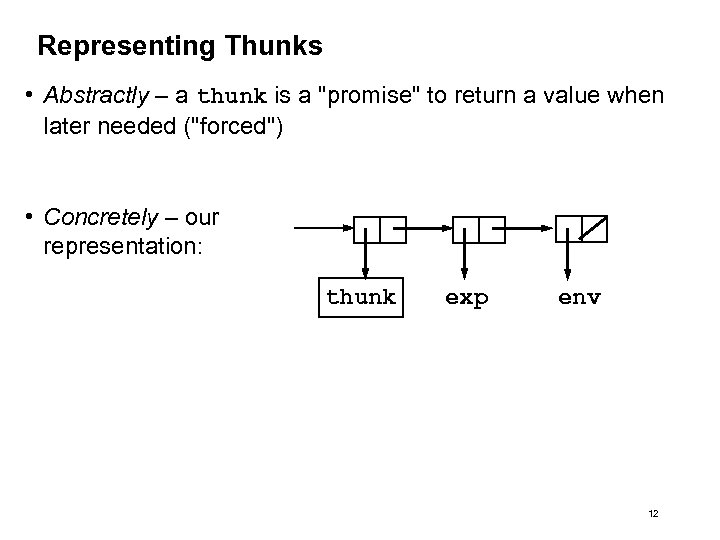
Representing Thunks • Abstractly – a thunk is a "promise" to return a value when later needed ("forced") • Concretely – our representation: thunk exp env 12
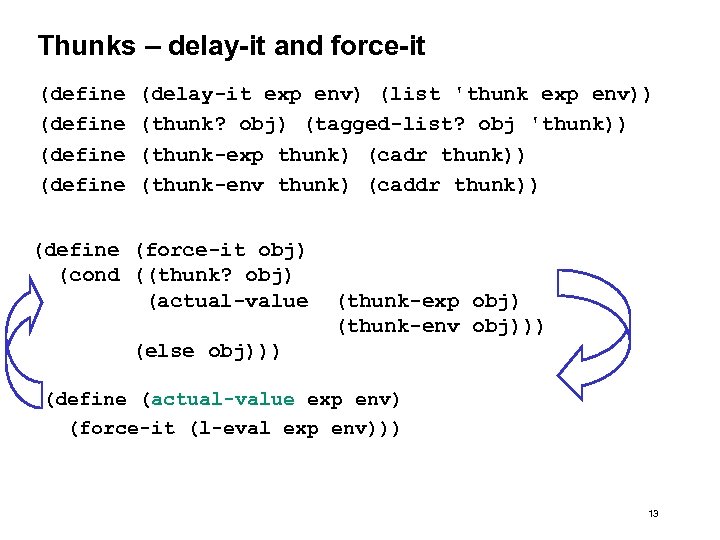
Thunks – delay-it and force-it (define (delay-it exp env) (list 'thunk exp env)) (thunk? obj) (tagged-list? obj 'thunk)) (thunk-exp thunk) (cadr thunk)) (thunk-env thunk) (caddr thunk)) (define (force-it obj) (cond ((thunk? obj) (actual-value (thunk-exp obj) (thunk-env obj))) (else obj))) (define (actual-value exp env) (force-it (l-eval exp env))) 13
Memo-izing evaluation • In lazy evaluation, if we reuse an argument, have to reevaluate each time • In normal evaluation, argument is evaluated once, and just referenced • Can we keep track of values once we’ve obtained them, and avoid cost of reevaluation? 14
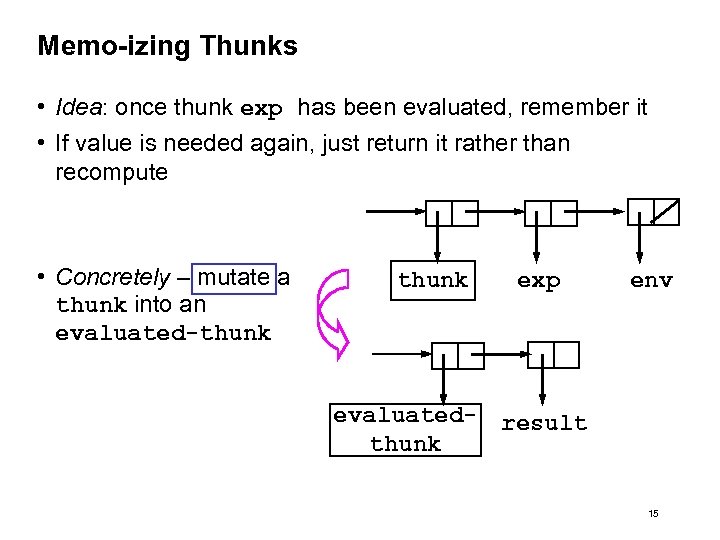
Memo-izing Thunks • Idea: once thunk exp has been evaluated, remember it • If value is needed again, just return it rather than recompute • Concretely – mutate a thunk into an evaluated-thunk exp env evaluated- result thunk 15
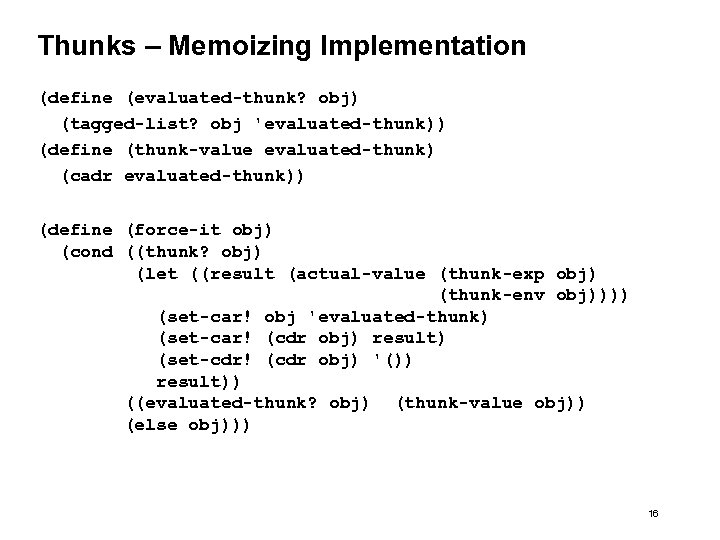
Thunks – Memoizing Implementation (define (evaluated-thunk? obj) (tagged-list? obj 'evaluated-thunk)) (define (thunk-value evaluated-thunk) (cadr evaluated-thunk)) (define (force-it obj) (cond ((thunk? obj) (let ((result (actual-value (thunk-exp obj) (thunk-env obj)))) (set-car! obj 'evaluated-thunk) (set-car! (cdr obj) result) (set-cdr! (cdr obj) '()) result)) ((evaluated-thunk? obj) (thunk-value obj)) (else obj))) 16
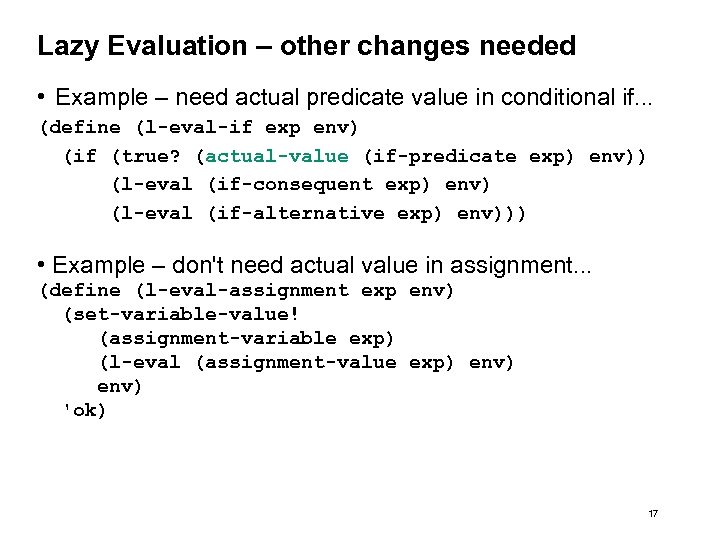
Lazy Evaluation – other changes needed • Example – need actual predicate value in conditional if. . . (define (l-eval-if exp env) (if (true? (actual-value (if-predicate exp) env)) (l-eval (if-consequent exp) env) (l-eval (if-alternative exp) env))) • Example – don't need actual value in assignment. . . (define (l-eval-assignment exp env) (set-variable-value! (assignment-variable exp) (l-eval (assignment-value exp) env) 'ok) 17
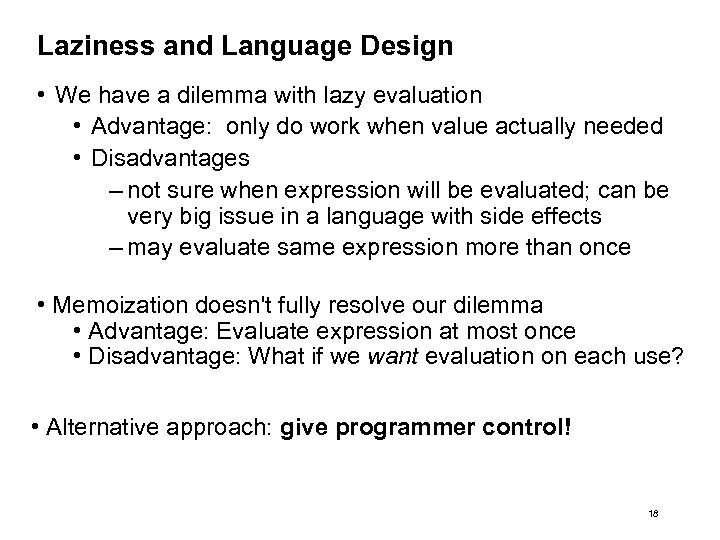
Laziness and Language Design • We have a dilemma with lazy evaluation • Advantage: only do work when value actually needed • Disadvantages – not sure when expression will be evaluated; can be very big issue in a language with side effects – may evaluate same expression more than once • Memoization doesn't fully resolve our dilemma • Advantage: Evaluate expression at most once • Disadvantage: What if we want evaluation on each use? • Alternative approach: give programmer control! 18
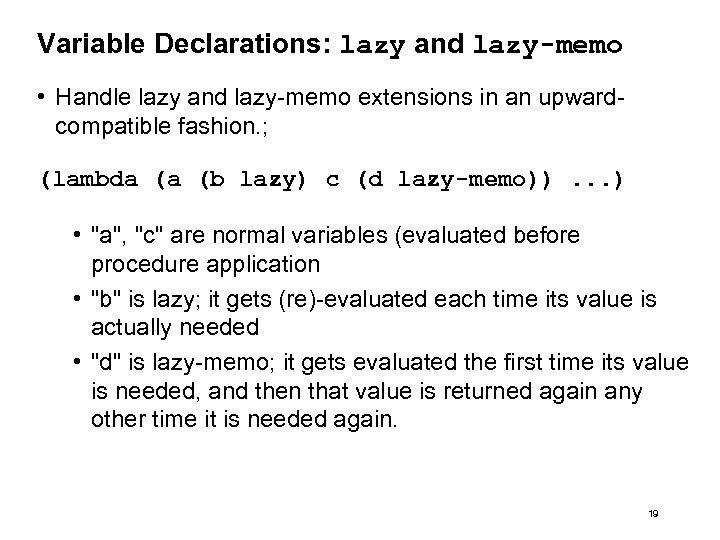
Variable Declarations: lazy and lazy-memo • Handle lazy and lazy-memo extensions in an upwardcompatible fashion. ; (lambda (a (b lazy) c (d lazy-memo)). . . ) • "a", "c" are normal variables (evaluated before procedure application • "b" is lazy; it gets (re)-evaluated each time its value is actually needed • "d" is lazy-memo; it gets evaluated the first time its value is needed, and then that value is returned again any other time it is needed again. 19
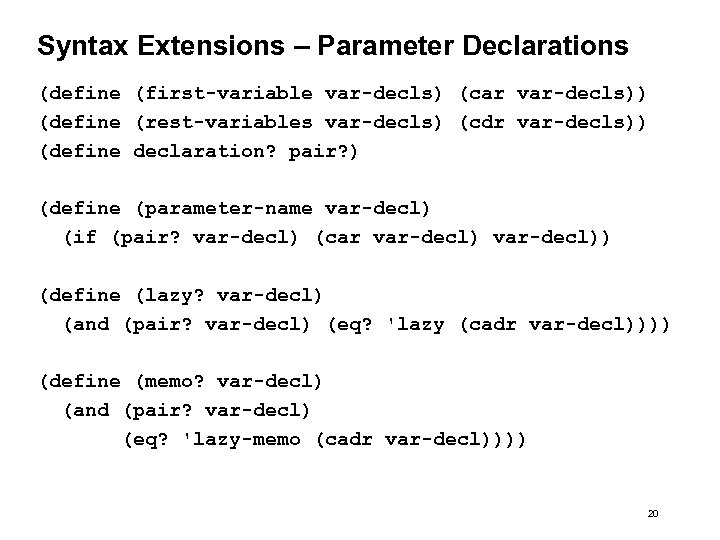
Syntax Extensions – Parameter Declarations (define (first-variable var-decls) (car var-decls)) (define (rest-variables var-decls) (cdr var-decls)) (define declaration? pair? ) (define (parameter-name var-decl) (if (pair? var-decl) (car var-decl)) (define (lazy? var-decl) (and (pair? var-decl) (eq? 'lazy (cadr var-decl)))) (define (memo? var-decl) (and (pair? var-decl) (eq? 'lazy-memo (cadr var-decl)))) 20
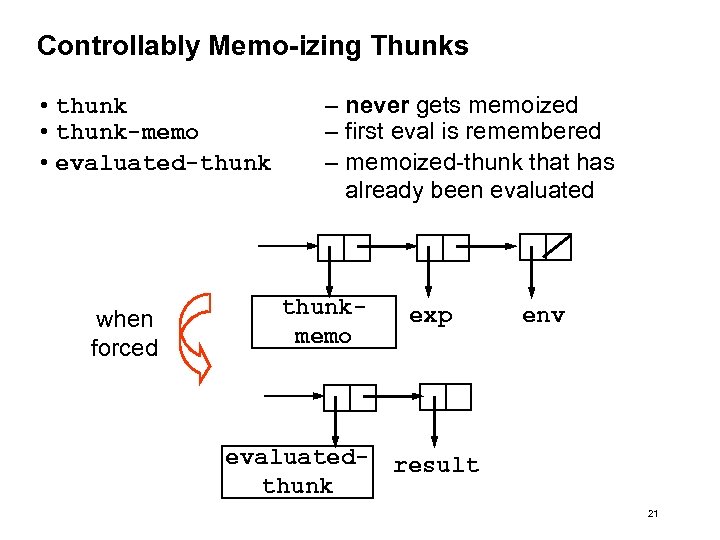
Controllably Memo-izing Thunks • thunk-memo • evaluated-thunk when forced – never gets memoized – first eval is remembered – memoized-thunk that has already been evaluated thunkmemo exp env evaluated- result thunk 21
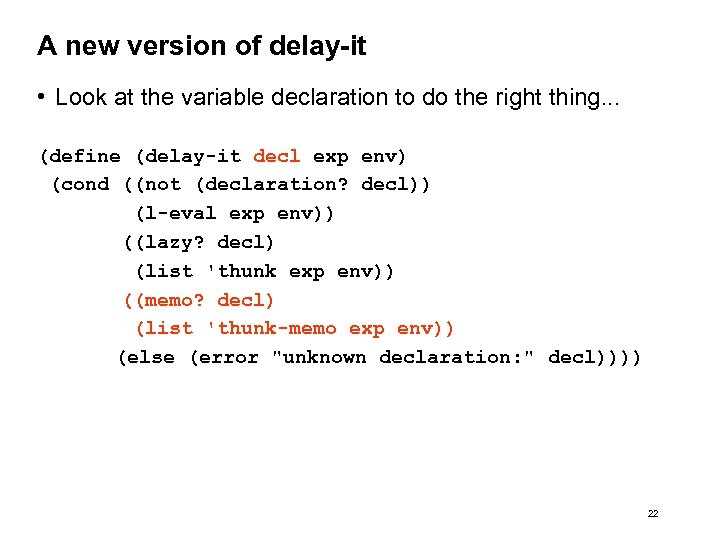
A new version of delay-it • Look at the variable declaration to do the right thing. . . (define (delay-it decl exp env) (cond ((not (declaration? decl)) (l-eval exp env)) ((lazy? decl) (list 'thunk exp env)) ((memo? decl) (list 'thunk-memo exp env)) (else (error "unknown declaration: " decl)))) 22
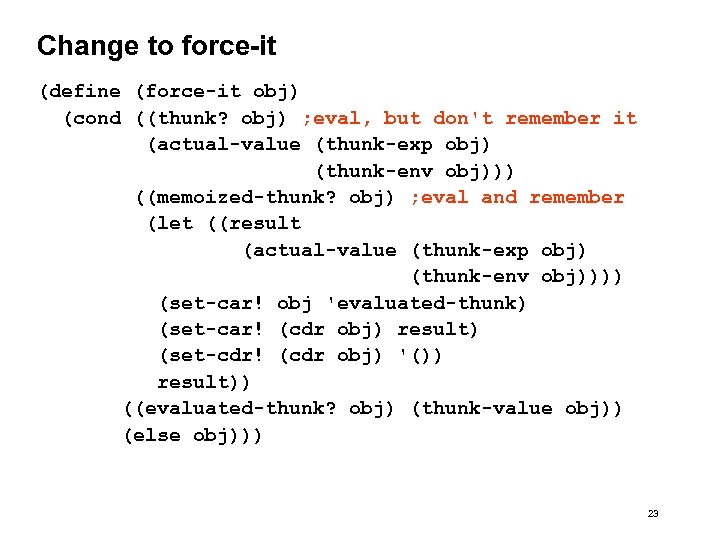
Change to force-it (define (force-it obj) (cond ((thunk? obj) ; eval, but don't remember it (actual-value (thunk-exp obj) (thunk-env obj))) ((memoized-thunk? obj) ; eval and remember (let ((result (actual-value (thunk-exp obj) (thunk-env obj)))) (set-car! obj 'evaluated-thunk) (set-car! (cdr obj) result) (set-cdr! (cdr obj) '()) result)) ((evaluated-thunk? obj) (thunk-value obj)) (else obj))) 23
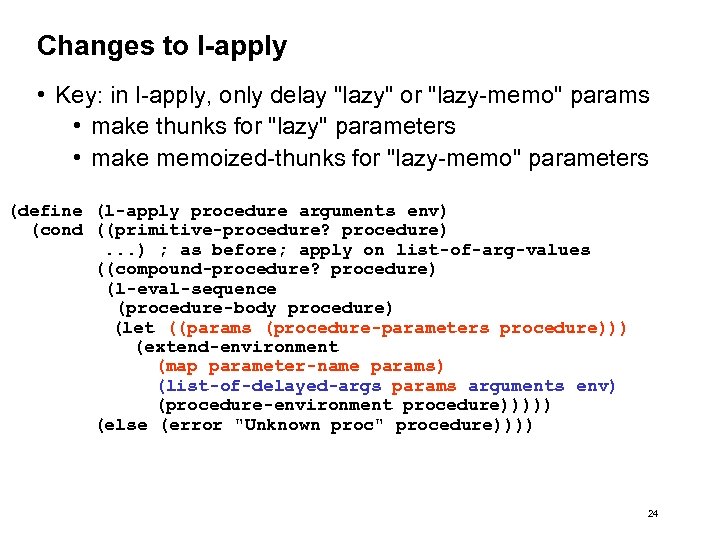
Changes to l-apply • Key: in l-apply, only delay "lazy" or "lazy-memo" params • make thunks for "lazy" parameters • make memoized-thunks for "lazy-memo" parameters (define (l-apply procedure arguments env) (cond ((primitive-procedure? procedure). . . ) ; as before; apply on list-of-arg-values ((compound-procedure? procedure) (l-eval-sequence (procedure-body procedure) (let ((params (procedure-parameters procedure))) (extend-environment (map parameter-name params) (list-of-delayed-args params arguments env) (procedure-environment procedure))))) (else (error "Unknown proc" procedure)))) 24
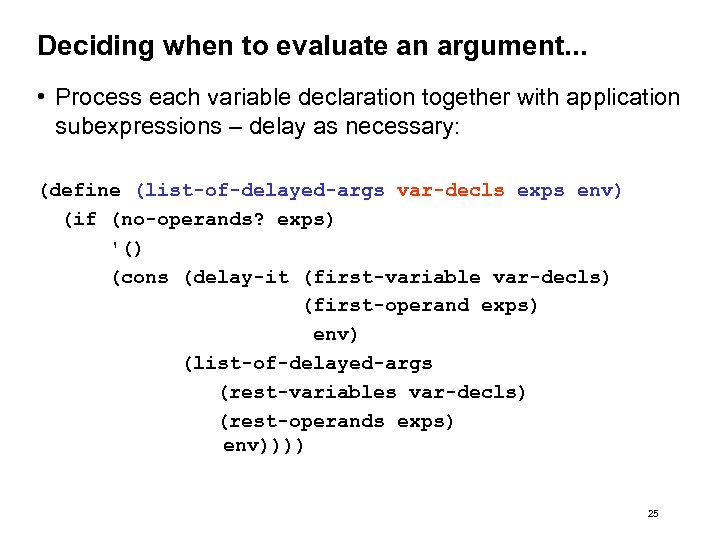
Deciding when to evaluate an argument. . . • Process each variable declaration together with application subexpressions – delay as necessary: (define (list-of-delayed-args var-decls exps env) (if (no-operands? exps) '() (cons (delay-it (first-variable var-decls) (first-operand exps) env) (list-of-delayed-args (rest-variables var-decls) (rest-operands exps) env)))) 25
Summary • Lazy evaluation – control over evaluation models • Convert entire language to normal order • Upward compatible extension – lazy & lazy-memo parameter declarations 26
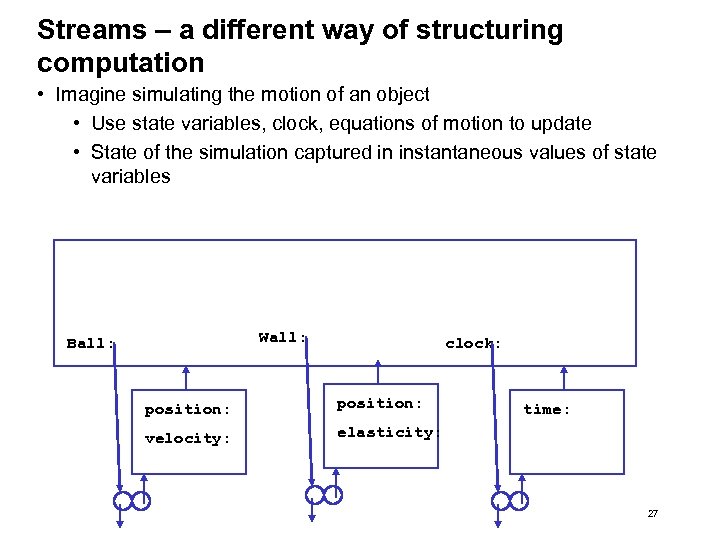
Streams – a different way of structuring computation • Imagine simulating the motion of an object • Use state variables, clock, equations of motion to update • State of the simulation captured in instantaneous values of state variables Wall: Ball: clock: position: velocity: elasticity: time: 27
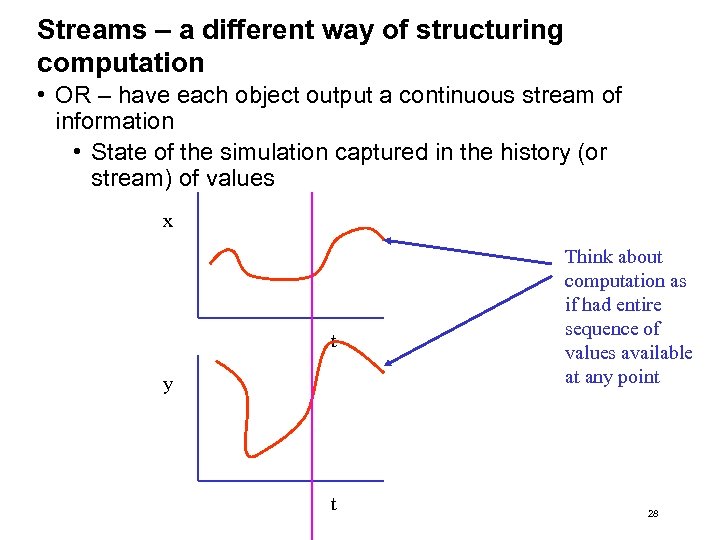
Streams – a different way of structuring computation • OR – have each object output a continuous stream of information • State of the simulation captured in the history (or stream) of values x t y t Think about computation as if had entire sequence of values available at any point 28
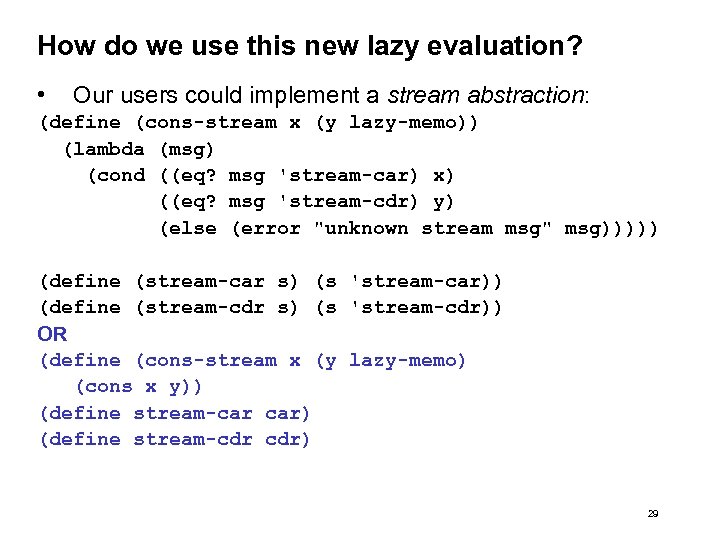
How do we use this new lazy evaluation? • Our users could implement a stream abstraction: (define (cons-stream x (y lazy-memo)) (lambda (msg) (cond ((eq? msg 'stream-car) x) ((eq? msg 'stream-cdr) y) (else (error "unknown stream msg" msg))))) (define (stream-car s) (s 'stream-car)) (define (stream-cdr s) (s 'stream-cdr)) OR (define (cons-stream x (y lazy-memo) (cons x y)) (define stream-car car) (define stream-cdr cdr) 29
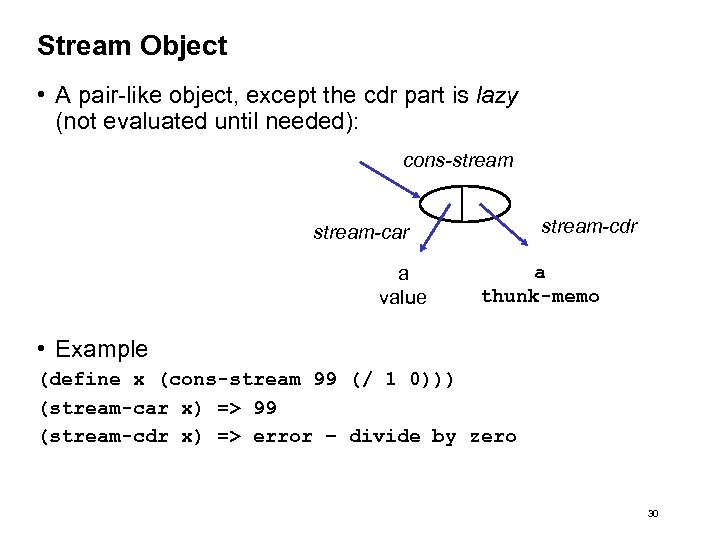
Stream Object • A pair-like object, except the cdr part is lazy (not evaluated until needed): cons-stream-cdr stream-car a value a thunk-memo • Example (define x (cons-stream 99 (/ 1 0))) (stream-car x) => 99 (stream-cdr x) => error – divide by zero 30
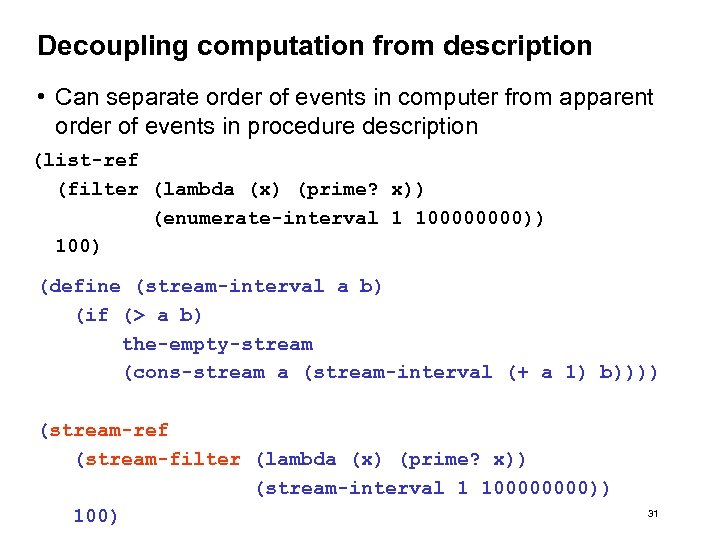
Decoupling computation from description • Can separate order of events in computer from apparent order of events in procedure description (list-ref (filter (lambda (x) (prime? x)) (enumerate-interval 1 10000)) 100) (define (stream-interval a b) (if (> a b) the-empty-stream (cons-stream a (stream-interval (+ a 1) b)))) (stream-ref (stream-filter (lambda (x) (prime? x)) (stream-interval 1 10000)) 100) 31
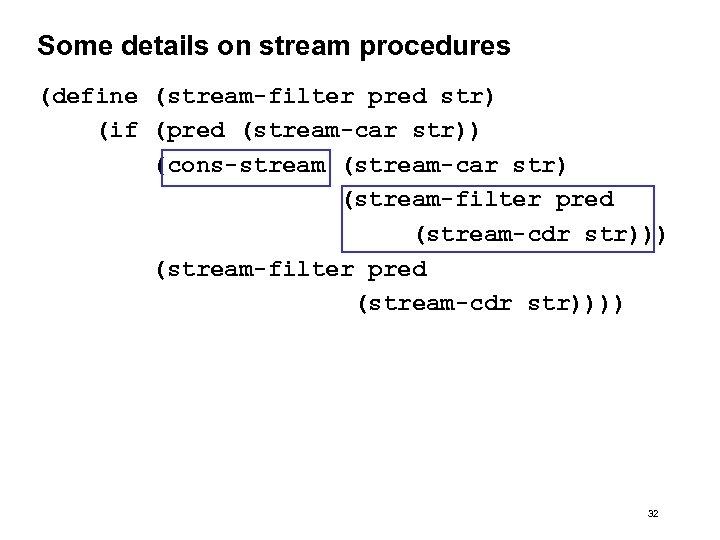
Some details on stream procedures (define (stream-filter pred str) (if (pred (stream-car str)) (cons-stream (stream-car str) (stream-filter pred (stream-cdr str)))) 32
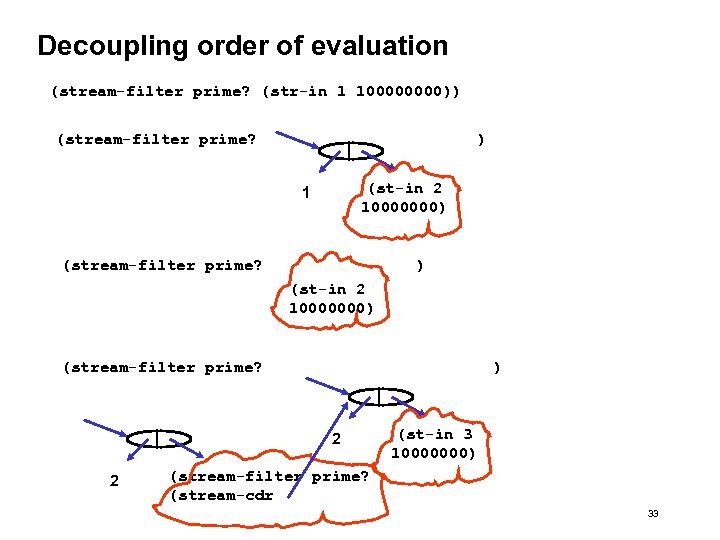
Decoupling order of evaluation (stream-filter prime? (str-in 1 10000)) (stream-filter prime? ) (st-in 2 10000000) 1 (stream-filter prime? ) (st-in 2 10000000) (stream-filter prime? ) 2 2 (st-in 3 10000000) (stream-filter prime? (stream-cdr 33
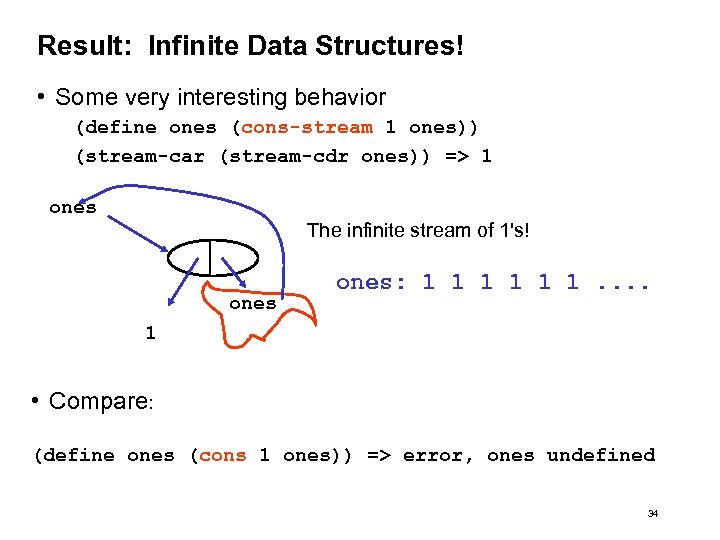
Result: Infinite Data Structures! • Some very interesting behavior (define ones (cons-stream 1 ones)) (stream-car (stream-cdr ones)) => 1 ones The infinite stream of 1's! ones: 1 1 1. . 1 • Compare: (define ones (cons 1 ones)) => error, ones undefined 34
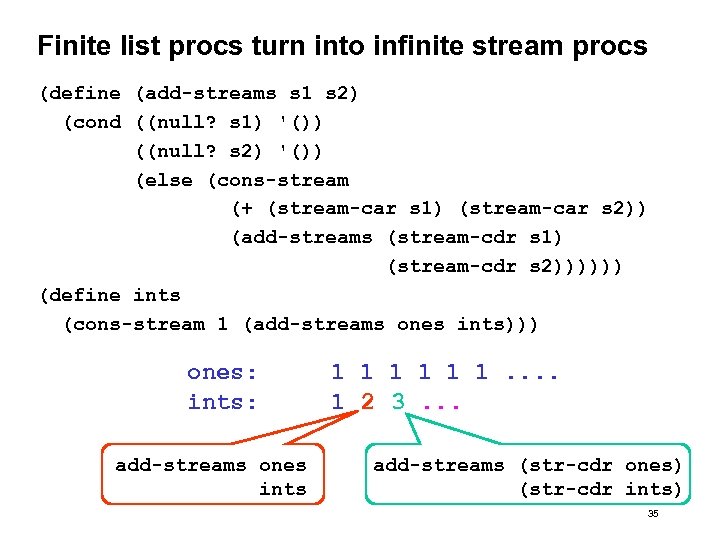
Finite list procs turn into infinite stream procs (define (add-streams s 1 s 2) (cond ((null? s 1) '()) ((null? s 2) '()) (else (cons-stream (+ (stream-car s 1) (stream-car s 2)) (add-streams (stream-cdr s 1) (stream-cdr s 2)))))) (define ints (cons-stream 1 (add-streams ones ints))) ones: ints: add-streams ones ints 1 1 1. . 1 2 3. . . add-streams (str-cdr ones) (str-cdr ints) 35
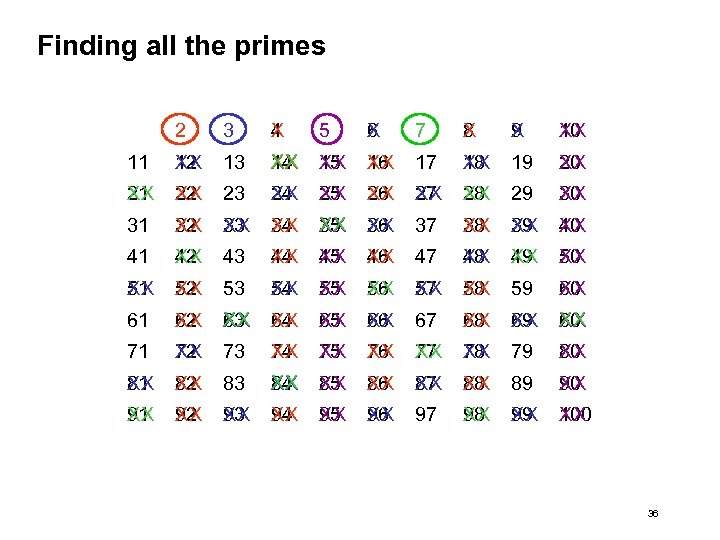
Finding all the primes 2 3 X 4 5 X 6 7 X 8 X 9 XX 10 11 12 XX 13 14 XX 15 XX 16 XX 17 18 XX 19 20 XX XX 21 22 XX 23 24 XX 25 XX 26 XX 27 XX XX 28 29 30 XX 31 XX 32 XX 33 XX 34 XX 35 XX 36 37 XX 38 XX 39 XX 40 41 XX 42 43 XX 44 XX 45 XX 46 47 XX 48 XX 49 XX 50 XX 51 XX 52 53 XX 54 XX 55 XX 56 XX 57 XX 58 59 XX 60 61 62 XX 63 XX 64 XX 65 XX 66 XX 67 68 XX 69 XX 60 XX 71 72 XX 73 74 XX 75 XX 76 XX XX 77 78 XX 79 80 XX XX 81 XX 82 83 XX 84 XX 85 XX 86 XX 87 XX 88 89 XX 90 XX 91 XX 92 XX 93 XX 94 XX 95 XX 96 97 XX 98 XX 99 XX 100 36
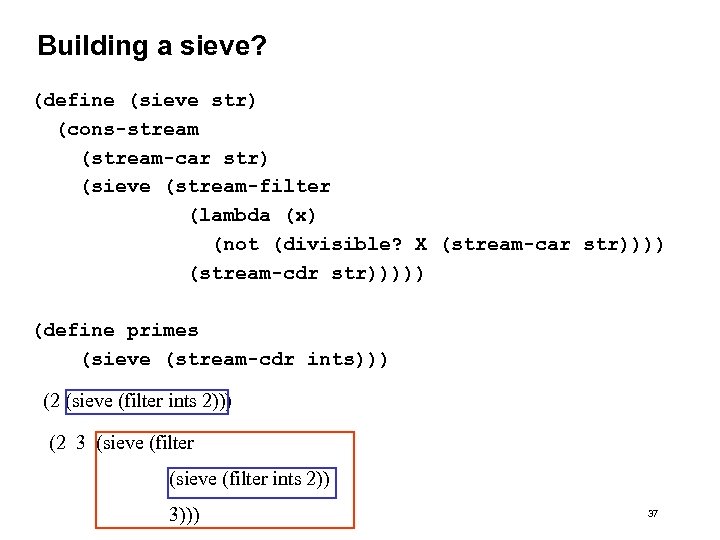
Building a sieve? (define (sieve str) (cons-stream (stream-car str) (sieve (stream-filter (lambda (x) (not (divisible? X (stream-car str)))) (stream-cdr str))))) (define primes (sieve (stream-cdr ints))) (2 (sieve (filter ints 2))) (2 3 (sieve (filter ints 2)) 3))) 37
![Streams Programming • Signal processing: x[n] + Delay y[n] G • Streams model: x](https://present5.com/presentation/ca253486014844ca44752dd8ff2cfd0c/image-38.jpg "Streams Programming • Signal processing: x[n] + Delay y[n] G • Streams model: x")
Streams Programming • Signal processing: x[n] + Delay y[n] G • Streams model: x addstreams streamcdr y streamscale G 38
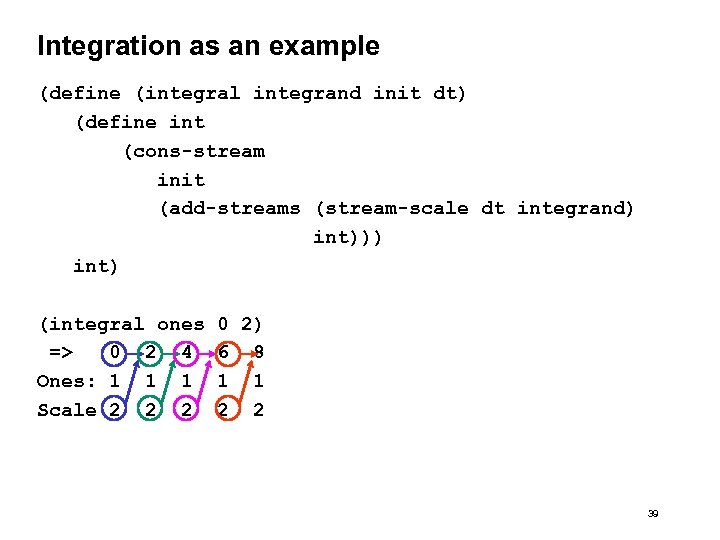
Integration as an example (define (integral integrand init dt) (define int (cons-stream init (add-streams (stream-scale dt integrand) int))) int) (integral ones => 0 2 4 Ones: 1 1 1 Scale 2 2 2 0 2) 6 8 1 1 2 2 39
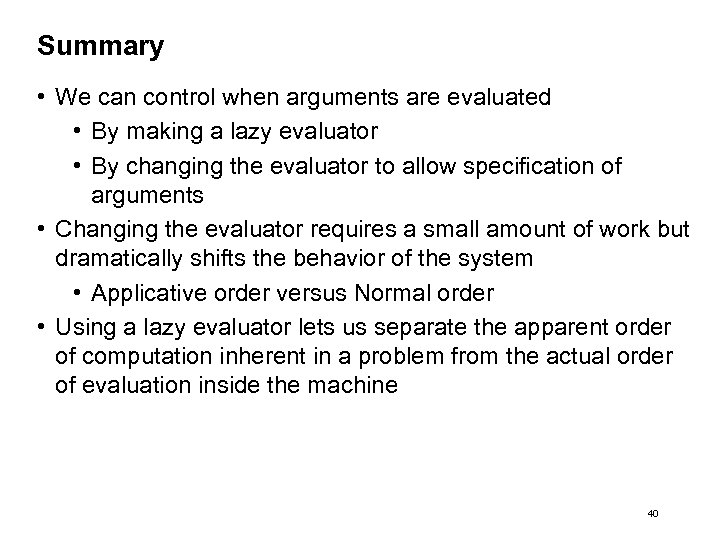
Summary • We can control when arguments are evaluated • By making a lazy evaluator • By changing the evaluator to allow specification of arguments • Changing the evaluator requires a small amount of work but dramatically shifts the behavior of the system • Applicative order versus Normal order • Using a lazy evaluator lets us separate the apparent order of computation inherent in a problem from the actual order of evaluation inside the machine 40
Скачать презентацию 6 001 SICP Variations on a Scheme Beyond
ca253486014844ca44752dd8ff2cfd0c.ppt