


 Скачать презентацию 57 th IETF CAPWAP Security Issues David Molnar
dc6f582ae4d258c6d781669b271f0399.ppt
- Количество слайдов: 16
 57 th IETF CAPWAP Security Issues David Molnar Security Architect July 18, 2003
 57 th IETF CAPWAP Security Issues David Molnar Security Architect July 18, 2003
 What I’m Going To Talk About § Identify choices and goals for discussion § Make assumptions explicit § Scenarios for provisioning associations – Not last word § “Heavyweight” protocols on “lightweight” APs ? § Guiding principle: be paranoid – Weigh costs vs. benefits – Realize adversaries tend to do it if it can be done 3
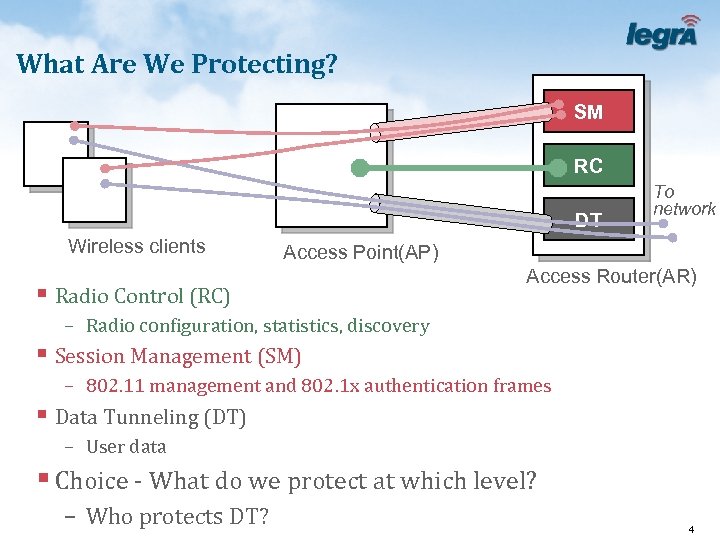 What Are We Protecting? SM RC DT Wireless clients To network Access Point(AP) § Radio Control (RC) Access Router(AR) – Radio configuration, statistics, discovery § Session Management (SM) – 802. 11 management and 802. 1 x authentication frames § Data Tunneling (DT) – User data § Choice - What do we protect at which level? – Who protects DT? 4
 Choice: MAC Termination § Terminate 802. 11 MAC at AR or AP? – Issues with Qo. S (802. 11 e), L 2 fragmentation § Terminate at AP § Terminate at AR § Split Termination – Example: LWAPP drops encryption at AP, packetization at AR 5
 Constraints § § § Wireless between Station and AP AP-AR link may be L 2, routed, or even wireless MAC addresses spoofable APs lightweight (more later) Existing hardware crypto support in AP, AR Must not break 802. 11 Attacks § § § “Rogue” APs and “Rogue” ARs De-association and De-authentication of users Eavesdropping on user data Taking over AP or AR Denial of Service 6
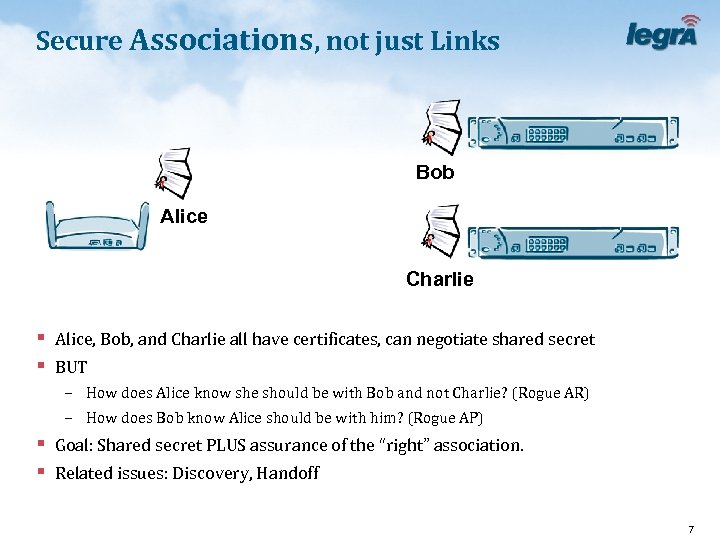 Secure Associations, not just Links Bob Alice Charlie § Alice, Bob, and Charlie all have certificates, can negotiate shared secret § BUT – How does Alice know she should be with Bob and not Charlie? (Rogue AR) – How does Bob know Alice should be with him? (Rogue AP) § Goal: Shared secret PLUS assurance of the “right” association. § Related issues: Discovery, Handoff 7
 After Secure Association: Secure Transport § Now need to use shared secret § Some attacks possible on session: – – – – Eavesdropping Changing packets Truncation Reordering Replay Redirection Reflection § Secure transport should prevent ALL such attacks § Choice: Adapt existing secure transport or build our own? – Extensive peer review critical for finding security flaws – Special requirements for AP-AR affect decision 8
 Some Transport Pros&Cons § IPSec – Pros: widespread, scrutinized, works w/any IP transport – Cons: Heavyweight, NAT/firewall issues, assumes IP § TLS – Pros: widespread, scrutinized – Cons: Assumes certs, reliable transport § Can work around to use shared secret (Gutmann ID) § CMS (PKCS #7) – Pros: Indifferent to transport layer – Cons: No replay/reorder prevention, no session control § Custom – Pro: Can meet requirements exactly – Con: Time-consuming, error-prone 9
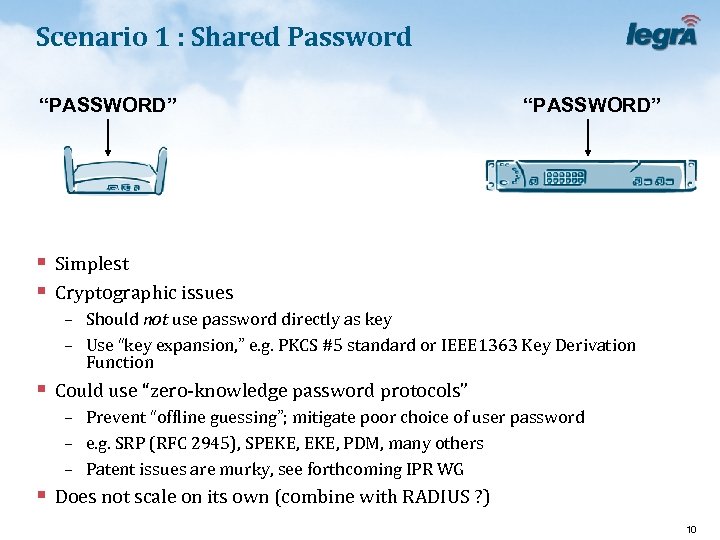 Scenario 1 : Shared Password “PASSWORD” § Simplest § Cryptographic issues – Should not use password directly as key – Use “key expansion, ” e. g. PKCS #5 standard or IEEE 1363 Key Derivation Function § Could use “zero-knowledge password protocols” – Prevent “offline guessing”; mitigate poor choice of user password – e. g. SRP (RFC 2945), SPEKE, PDM, many others – Patent issues are murky, see forthcoming IPR WG § Does not scale on its own (combine with RADIUS ? ) 10
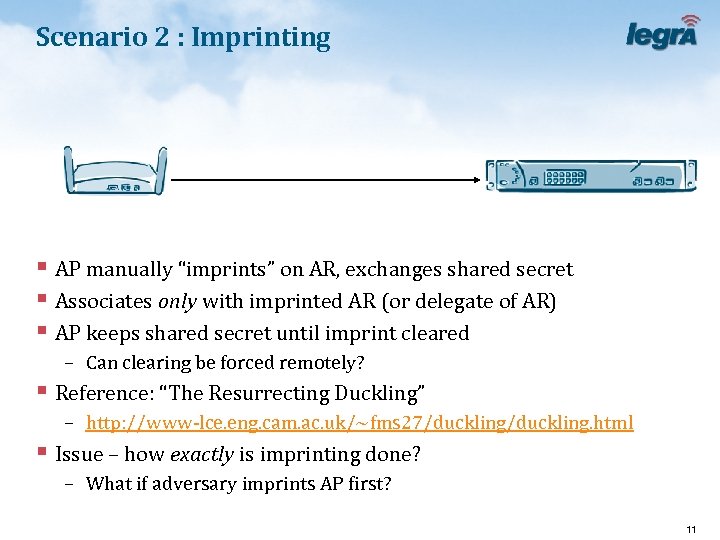 Scenario 2 : Imprinting § AP manually “imprints” on AR, exchanges shared secret § Associates only with imprinted AR (or delegate of AR) § AP keeps shared secret until imprint cleared – Can clearing be forced remotely? § Reference: “The Resurrecting Duckling” – http: //www-lce. eng. cam. ac. uk/~fms 27/duckling. html § Issue – how exactly is imprinting done? – What if adversary imprints AP first? 11
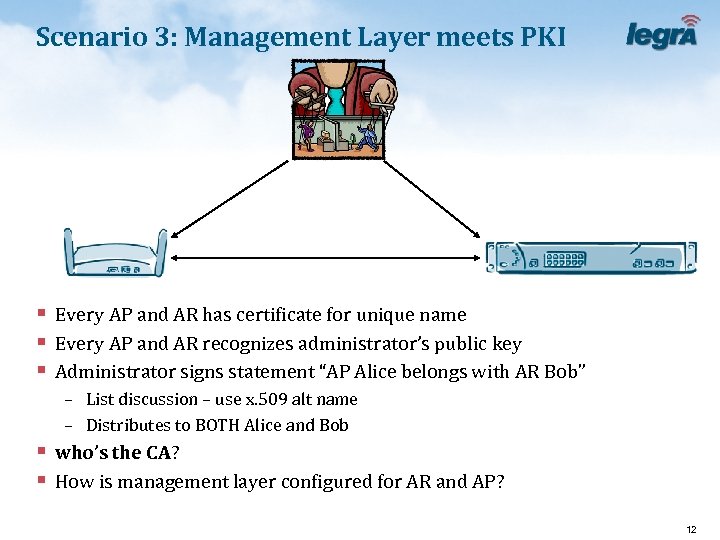 Scenario 3: Management Layer meets PKI § Every AP and AR has certificate for unique name § Every AP and AR recognizes administrator’s public key § Administrator signs statement “AP Alice belongs with AR Bob” – List discussion – use x. 509 alt name – Distributes to BOTH Alice and Bob § who’s the CA? § How is management layer configured for AR and AP? 12
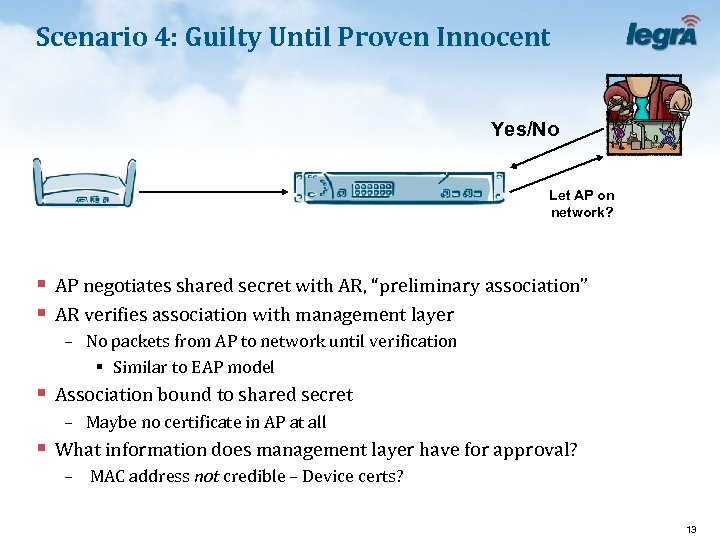 Scenario 4: Guilty Until Proven Innocent Yes/No Let AP on network? § AP negotiates shared secret with AR, “preliminary association” § AR verifies association with management layer – No packets from AP to network until verification § Similar to EAP model § Association bound to shared secret – Maybe no certificate in AP at all § What information does management layer have for approval? – MAC address not credible – Device certs? 13
 Wait, Aren’t APs Lightweight? § Public-key crypto expensive, slow § Symmetric-key crypto less expensive (and hardware support) § APs do not have physical random number generators – Good randomness critical § Conclusions – Use public-key rarely, establish long term symmetric key – Design protocols for no AP random number generation – OR design secure PRNG seed protocol for AP § Where does seed come from? – Factory-implanted seed – Shipped from AR (secured how? replays? ) – 802. 11 informational document on seed generation http: //www. ieee 802. org/11/Documents/Document. Holder/2 -477. zip 14
 Future Directions § Clarify requirements § Evaluate transport layer requirements – Address AP RNG issue, L 2/L 3 § Pick secure transport § Evaluate provisioning scenarios; develop new ones § Track relevant concurrent work – DNSSEC, Authenticated DHCP, enroll, TLS/UDP, etc… Suggestion § Solve secure transport, secure association separately – For transport, assume shared secret exists – Protocol extensions for methods to derive shared secret 15
 Questions? Download presentation at http: //www. legra. com/info_center. htm 16