


 Скачать презентацию 5 th World Water Forum 16 -22 March
8d43a0a7acbff179ec189a30e1d3a638.ppt
- Количество слайдов: 35
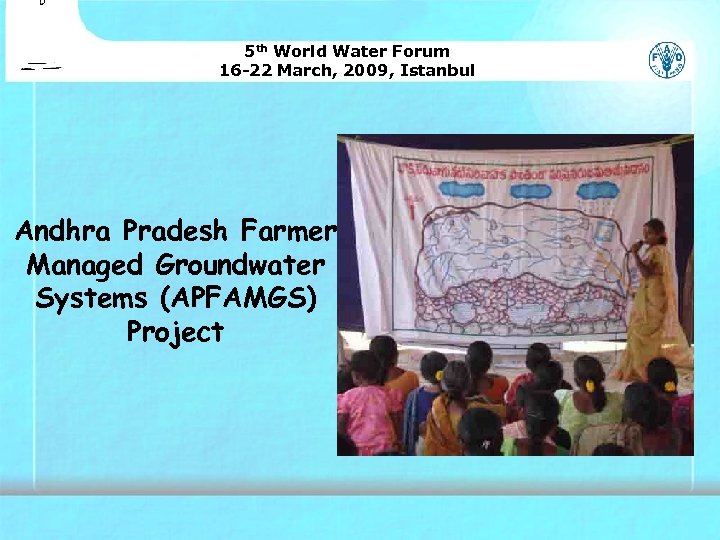 5 th World Water Forum 16 -22 March, 2009, Istanbul Andhra Pradesh Farmer Managed Groundwater Systems (APFAMGS) Project
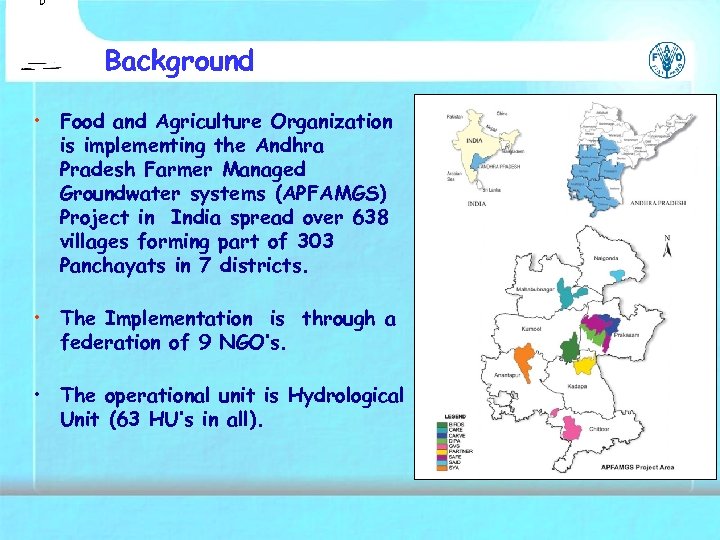 Background • Food and Agriculture Organization is implementing the Andhra Pradesh Farmer Managed Groundwater systems (APFAMGS) Project in India spread over 638 villages forming part of 303 Panchayats in 7 districts. • The Implementation is through a federation of 9 NGO’s. • The operational unit is Hydrological Unit (63 HU’s in all).
 Knowledge based Community action for sustainable groundwater development
 Project Approach APFAMGS project’s premise is to enable farmers with knowledge capacity skills triggering behavioral change resulting in voluntary self regulation Promote pro-active partnerships between up-stream and downstream water users with in a drainage unit Farmers work unitedly towards managing the available groundwater resource optimally Offer no incentives either as cash or subsidies to make difficult choices Enable opportunities and forum for women to participate in decision making Nurture people’s institutions to initiate local governance on groundwater management
 Demand Side Groundwater Management APFAMGS concept of Demand Side Groundwater Management (DSGM) project is a community driven initiative that adopts number of steps to: – strengthen local institutions at the habitation and hydrologic unit level – bring on center stage discussions on emerging water crisis especially on groundwater. – demystify the science of water and train the farmers to participate in technical data collection – ensure proper understanding on groundwater resource that can be safely pumped – treat groundwater as common property resource – adopt numerous steps at the farm level towards • Improve crop water efficiency, • Reduce wastage • Minimize contamination of aquifers
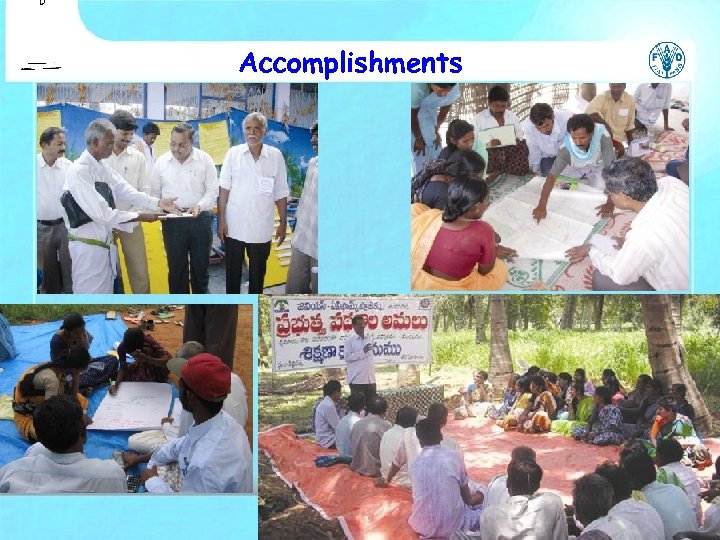
 Farmer Water Schools • Farmer Water School (FWS) approach promotes group learning aimed at improving skills and knowledge amongst the farmers • 30 Farmers meet as a school once every 15 days for 12 months (June–May) to discuss and diagnose the different problems related to groundwater resource availability based on the data they have collected • Farmers are enabled with Non formal Education Tools to understand the science of Hydrology and are supported to carry out short and long term experiments to identify solutions for solving the various problems • FWS is facilitated through farmer facilitators who are one among them who are already trained and have adequate experience • Topics covered include geology, hydrogeology, water cycle, soil, land use, cropping system water availability, organic farming, water use efficiency, gender role in water sharing, crop planning and issues on HIV/AID’s affecting the farming sector • The project has already trained over 15000 Farmer Facilitators whose services are tapped for various government programmes
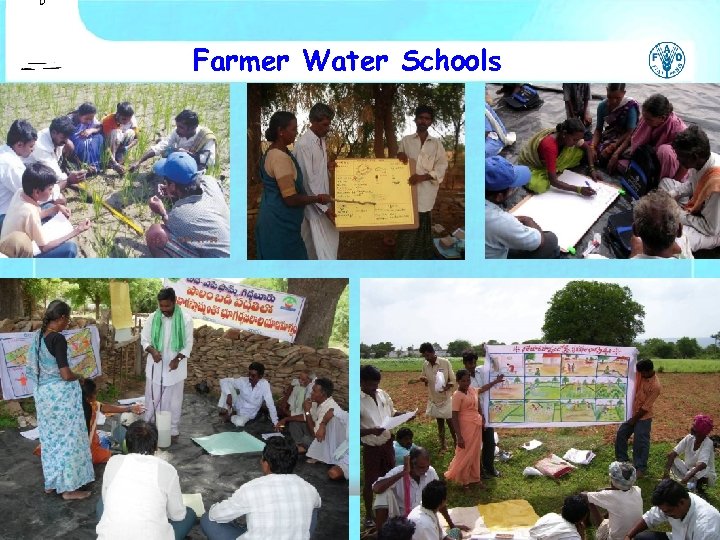 Farmer Water Schools
 Participatory Hydrologic Monitoring Groundwater Management Committees (GMC) are involved in technical data collection in 638 habitation and share it with close to a million farmers. 4333 farmer volunteers (men and women) involved in collecting technical data (voluntarily) • Daily rainfall measurement collected from 190 rain gauge stations • Daily groundwater levels monitored from 90 monitoring wells • Fortnightly groundwater levels monitored from 2019 monitoring wells • Fortnightly well discharge measurement carried out from 969 monitoring wells • Daily Surface water outflows from the Hydrological unit measured at 65 micro-basins • Seasonal groundwater quality measurements are carried out from 300 drinking water wells • Data stored in computerized data base. • Farmers share data freely with Government. • Data Prized for others (used for maintenance and upkeep of infrastructure)
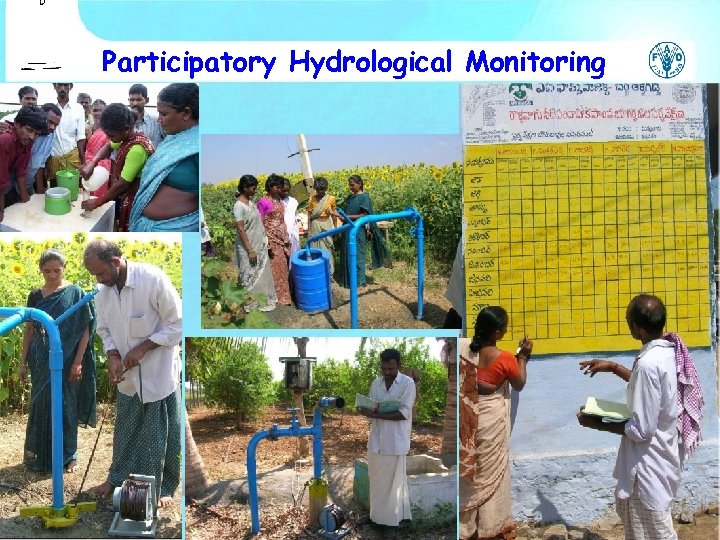 Participatory Hydrological Monitoring
 People’s Institutions • Multi layer inclusive institution (638 -GMC, 63 -HUN) integrated vertically – Ground water Management Committee (GMC) operate at the Habitation level with membership of men and women farmers – GMC’s within a hydrological boundary federated to form Hydrological Unit Network (HUN) – HUN’s provided with legal cover (registered under societies act) to receive funds and implement the project on their own – HUN’s receive funds from NGO’s and transact all business independently – Furnish monthly reports, annual balance sheet and develop vision document – Institutions ensure farmers overcome selfish interests and work towards common goal – Institutions consolidate individual views, develop common perspective towards handling groundwater distress collectively – Institutions help in getting appropriate price for produce as well as tap government schemes
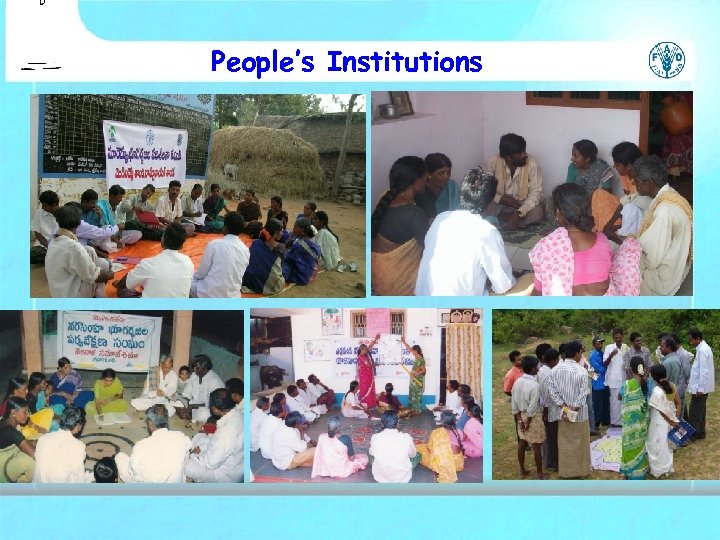 People’s Institutions
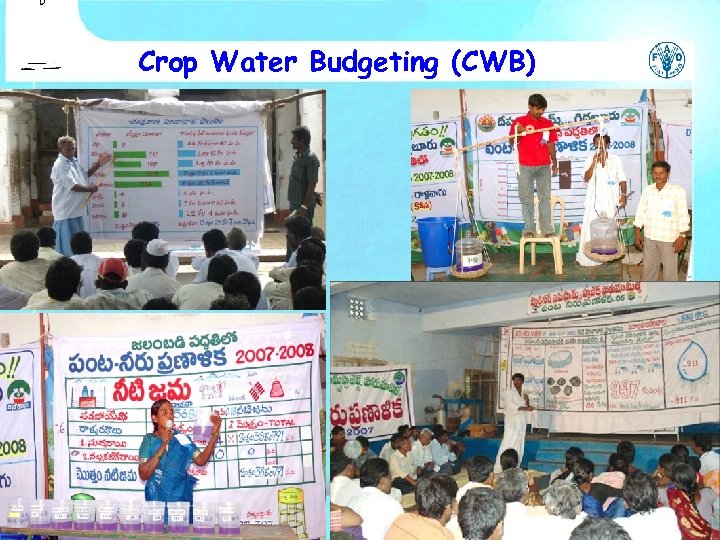
 Crop Water Budget (CWB) • Groundwater balance estimation referred to as Crop Water Budget (CWB) exercise is carried out annually prior to second cropping season for individual Hydrological Units. • CWB provides a platform for the all the groundwater user community to come together and share data for the entire Hydrological Unit. • Community of farmers on their own compute groundwater resource availability for the coming cropping season • Estimate the amount of groundwater that can be safely pumped • Set framework for adoption of appropriate crop plan matching with the groundwater availability • Understand the potential risks related to water intensive crops • Identify opportunities for water savings and improving crop water efficiency • Establish linkage with government departments for tapping schemes supporting water savings
 Crop Water Budgeting (CWB)
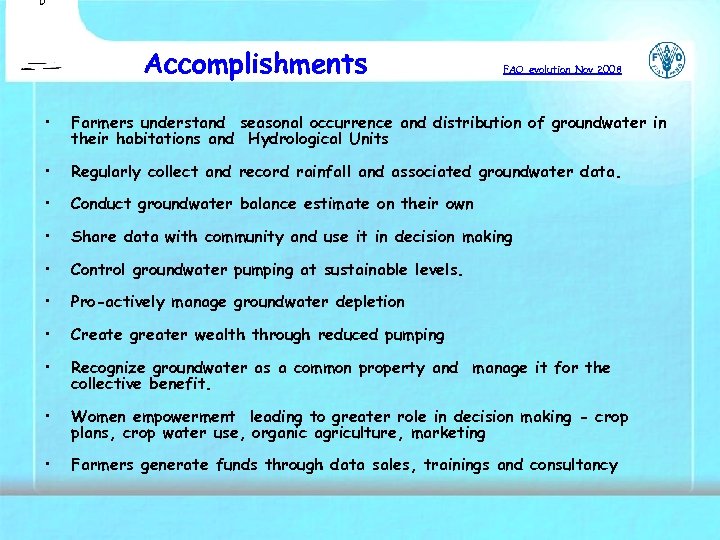 Accomplishments FAO evolution Nov 2008 • Farmers understand seasonal occurrence and distribution of groundwater in their habitations and Hydrological Units • Regularly collect and record rainfall and associated groundwater data. • Conduct groundwater balance estimate on their own • Share data with community and use it in decision making • Control groundwater pumping at sustainable levels. • Pro-actively manage groundwater depletion • Create greater wealth through reduced pumping • Recognize groundwater as a common property and manage it for the collective benefit. • Women empowerment leading to greater role in decision making - crop plans, crop water use, organic agriculture, marketing • Farmers generate funds through data sales, trainings and consultancy
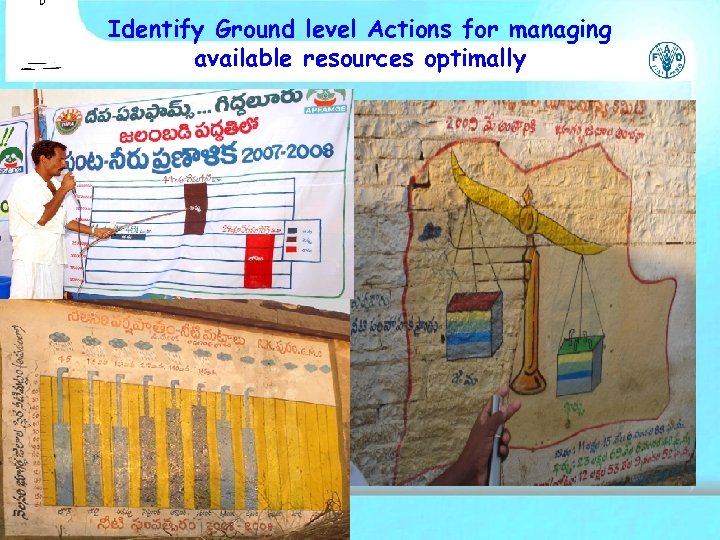 Identify Ground level Actions for managing available resources optimally
 Accomplishments
 Positive changes in groundwater balance
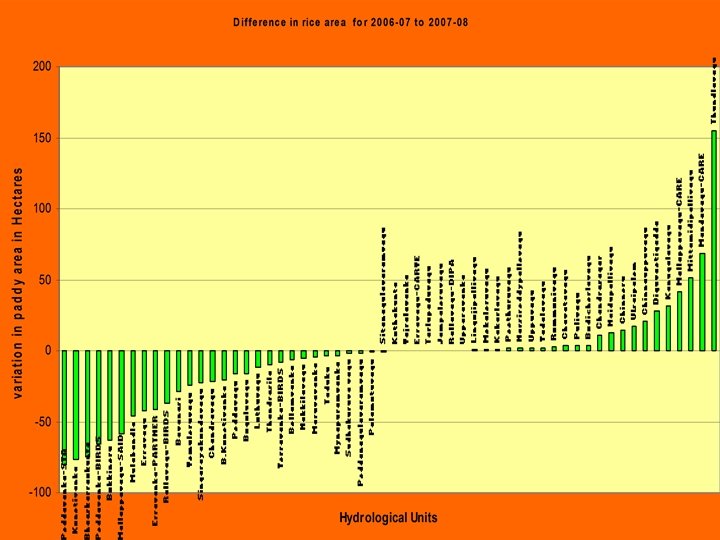
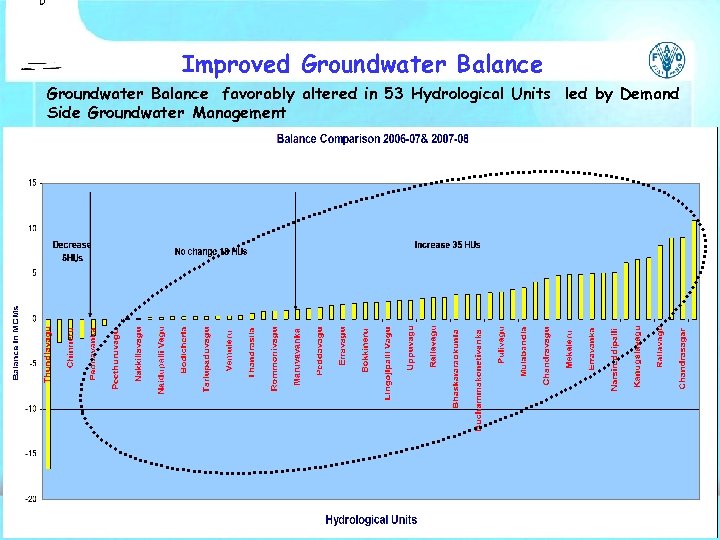 Improved Groundwater Balance favorably altered in 53 Hydrological Units led by Demand Side Groundwater Management
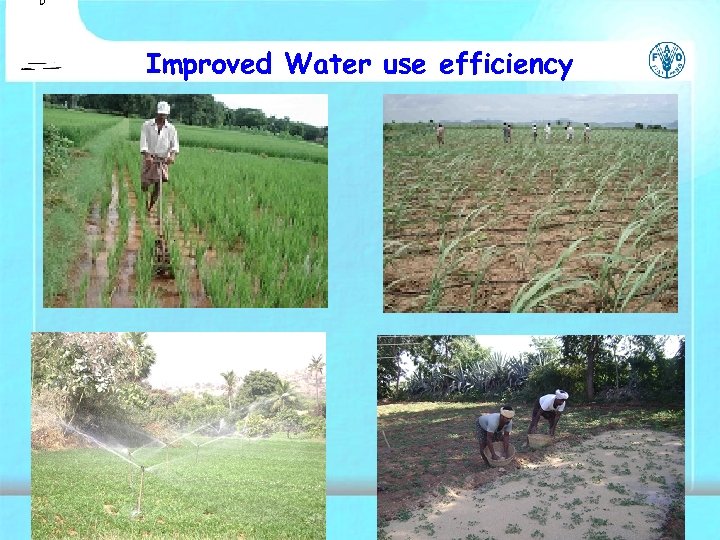
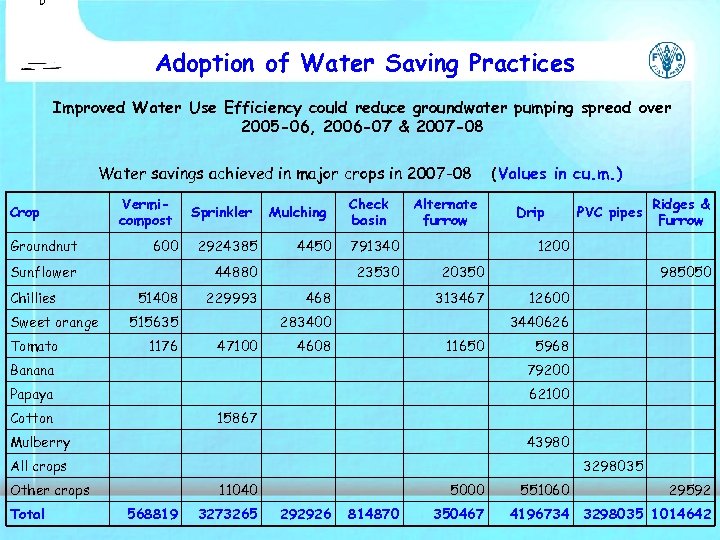 Adoption of Water Saving Practices Improved Water Use Efficiency could reduce groundwater pumping spread over 2005 -06, 2006 -07 & 2007 -08 Water savings achieved in major crops in 2007 -08 Crop Groundnut Vermicompost 600 Sunflower Chillies Sweet orange Tomato Sprinkler 2924385 Mulching 4450 44880 51408 229993 515635 1176 Check basin Alternate furrow 791340 23530 468 Drip PVC pipes Ridges & Furrow 1200 20350 313467 283400 47100 (Values in cu. m. ) 985050 12600 3440626 4608 11650 5968 Banana 79200 Papaya 62100 Cotton 15867 Mulberry 43980 All crops 3298035 Other crops Total 11040 568819 3273265 5000 292926 814870 350467 551060 29592 4196734 3298035 1014642
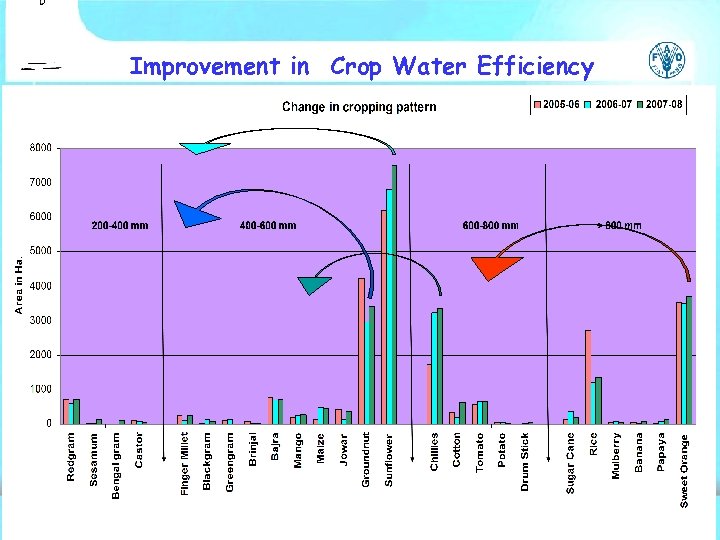 Improvement in Crop Water Efficiency
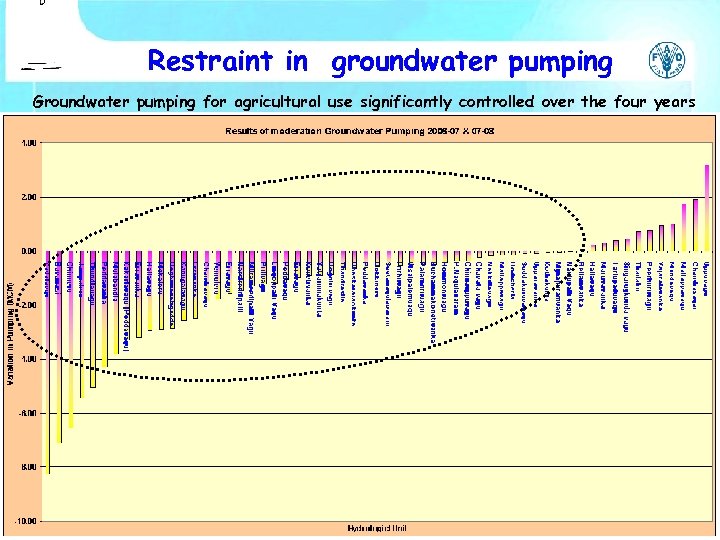 Restraint in groundwater pumping Groundwater pumping for agricultural use significantly controlled over the four years
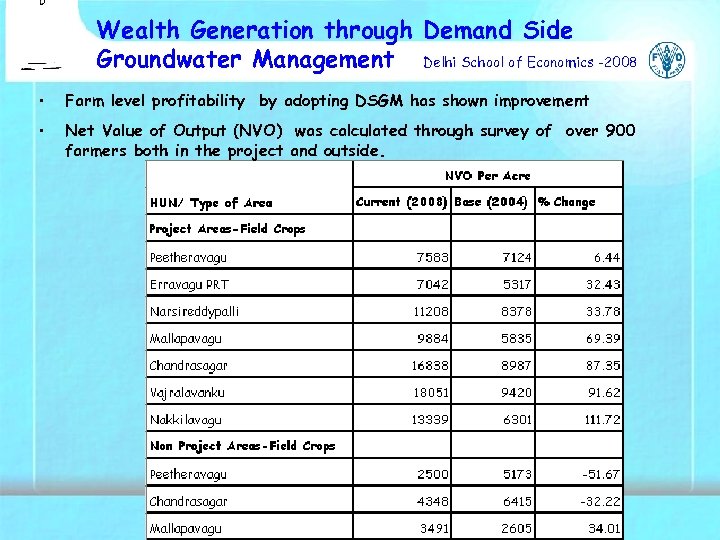 Wealth Generation through Demand Side Groundwater Management Delhi School of Economics -2008 • Farm level profitability by adopting DSGM has shown improvement • Net Value of Output (NVO) was calculated through survey of over 900 farmers both in the project and outside.
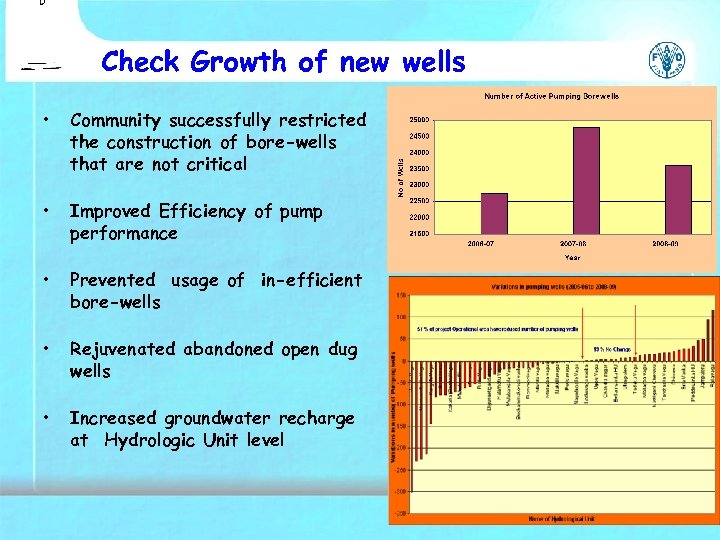 Check Growth of new wells • Community successfully restricted the construction of bore-wells that are not critical • Improved Efficiency of pump performance • Prevented usage of in-efficient bore-wells • Rejuvenated abandoned open dug wells • Increased groundwater recharge at Hydrologic Unit level
 Reduced Groundwater use in raising water intensive crops
 Improved Water use efficiency
 Replication of FAO experience by International donors and Government programmes
 Replication of APFAMGS project learning's • World Bank Funded –Andhra Pradesh Community. Based Tank Management Project Andhra Pradesh India • Australian Centre for International Agriculture Research: Impacts of Watershed Development in Andhra Pradesh (India) and North West Victoria Irrigation Area (Australia) • Climate Adaptation Flagship (CSIRO Sustainable Ecosystems) Building adaptive capacity of farming communities in rainfed farming systems of Andhra Pradesh, India
 Taking IT to farmers for sustainable management of groundwater resources
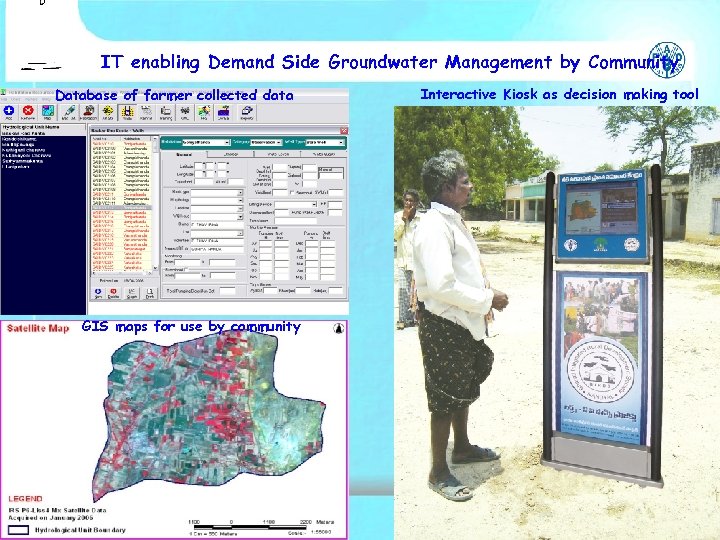 IT enabling Demand Side Groundwater Management by Community Database of farmer collected data GIS maps for use by community Interactive Kiosk as decision making tool
 Dissemination of Project Learning's
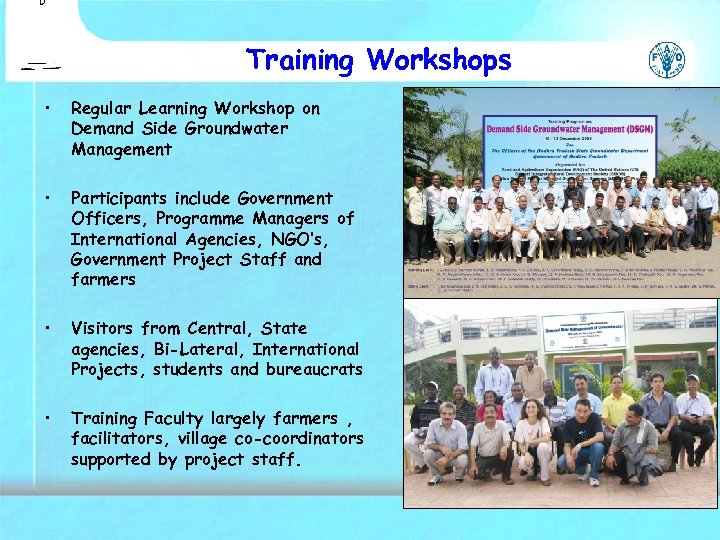 Training Workshops • Regular Learning Workshop on Demand Side Groundwater Management • Participants include Government Officers, Programme Managers of International Agencies, NGO’s, Government Project Staff and farmers • Visitors from Central, State agencies, Bi-Lateral, International Projects, students and bureaucrats • Training Faculty largely farmers , facilitators, village co-coordinators supported by project staff.
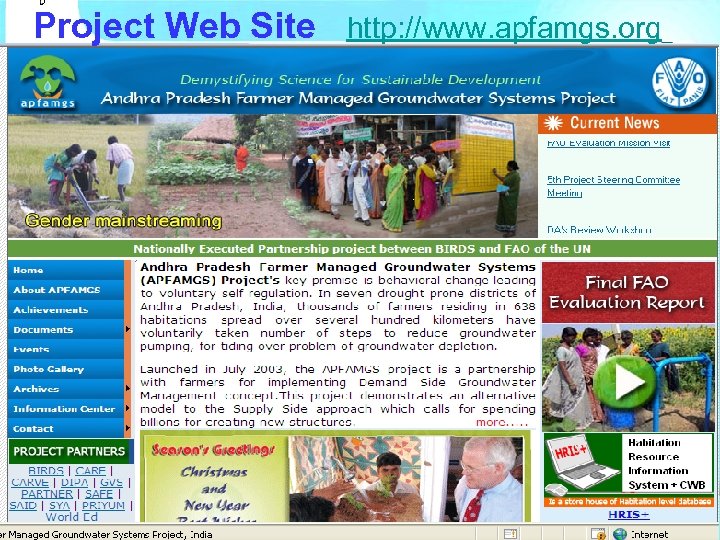 Project Web Site http: //www. apfamgs. org
 Thank You email: ananthmaniin@yahoo. com http: //www. apfamgs. org