


 Скачать презентацию 5 th professional development seminar for parliamentary officers
85f1b5b57fd1e9b8f3d64b4978269c52.ppt
- Количество слайдов: 59
 5 th professional development seminar for parliamentary officers Sydney 28 -30 January 2004
 Back to Basics on privilege 28 January 2004
 Welcome and introductions • President of ANZACATT, Mr Wayne Tunnecliffe • Secretary of ANZACATT and Clerk of the NSW Legislative Assembly, Mr Russell Grove • Clerk of the Parliaments and Clerk of the Legislative Council, Mr John Evans 3
 Fundamental principles Ms Lynn Lovelock, Deputy Clerk, NSW Legislative Council and Clerk, Standing Committee on Parliamentary Privilege and Ethics 4
 Parliamentary privilege defined Parliamentary privilege refers to the powers and immunities possessed by individual Houses of Parliament, their members, and other participants in parliamentary proceedings, without which they could not perform their functions. 5
 Parliamentary privilege in context • Parliamentary privilege must be seen against the context of the constitutional functions of Parliament: legislation; debate; scrutiny. • The powers and immunities from the general law exist to enable Parliament to perform these functions, free from undue interference from outside bodies. 6
 Powers include: • Power to regulate internal affairs and determine own constitution, procedures and agenda • Power to conduct inquiries • Power to deal with contempt 7
 Immunities include: • Freedom of speech in Parliament • Immunity for parliamentary witnesses • Qualified immunity from legal process 8
 Contempt and privilege • Contempt is an offence against the authority of a House • A contempt must obstruct or impede a House or members, or have a tendency to produce this result • For a contempt to be found an offence must be of such seriousness that it could have a substantial and detrimental impact on the House, committee or member concerned • Need for alleged offender to have acted with improper intent or reckless disregard 9
 Sources of parliamentary privilege (in NSW) (In the absence of general privileges legislation) • Common law: such powers and immunities as are “reasonably necessary” for the exercise of the functions of the House • Article 9 of the Bill of Rights 1689 • Legislation: Defamation Act 1974, other legislation (eg Parliamentary Evidence Act 1901) 10
 Jurisdictional differences (Australia) • Some parliaments have been vested with the privileges of the House of Commons (UK): – At a specified date: Cth, Vic, Qld, SA, NT (ACT) – From time to time: WA • In some jurisdictions legislation has codified certain aspects of privilege (to a greater or lesser extent): – Most comprehensive: Cth, Qld, NT, WA – Less comprehensive privileges legislation: ACT, SA, Vic, Tas 11
 Privileges legislation • Advantages: – Clarity, certainty – Accessibility (enhanced understanding by outside bodies) • Disadvantages: – Inflexibility (cannot evolve over time) – Enhanced scope for judicial review (legislation interpreted by the courts) • NB: Most privileges legislation has been enacted in response to particular issues / problems • Article 9 of the Bill of Rights is itself legislation 12
 Parliamentary Privileges Act 1987 (Cth) Mr Ian Harris, Clerk, House of Representatives Commonwealth Parliament 13
 Freedom of Speech & Article 9 of the Bill of Rights 1689 14
 Historical background (I) • NB early assertion (and acceptance) of freedom of speech under Henry VIII and Elizabeth I • 1629 Arrest, prosecution and conviction of Sir John Eliot & others for words used in the House of Commons • 1641 entry into House of Commons by Charles I attempting to arrest 5 members on a charge of treason resulting from proceedings in the House 15
 Historical background (II) • 1686 prosecution and fine of Sir Williams for authorisation (as former Speaker) of publication of a pamphlet which contained libels about then Duke of York (who had become James II by the time of the prosecution): – this case is specifically referred to in the Commons debate and in the preamble to Article 9 16
 Article 9 of the Bill of Rights 1689 “That the freedom of speech and debate or proceedings in Parliament ought not to be impeached or questioned in any court or place out of Parliament. ” 17
 Rationale for Article 9 “the need to ensure so far as possible that a member of the legislature and witnesses before committees of the House can speak freely without fear that what they say will be later held against them in the courts. The important public interest protected by such privilege is to ensure that the member or witness at the time he speaks is not inhibited from stating fully and freely what he has to say. ” Prebble v Television New Zealand Ltd [1995] 1 AC 321 at 334. 18
 Purpose of the immunity of freedom of speech “to enhance deliberative democracy and responsible government by some measure of immunity granted to the parliamentary conduct of Members, particularly against threats or reprisals from the Executive. ” (Advice of Bret Walker SC concerning “Search warrant on offices of the Hon Peter Breen MLC”, 9 October 2003) 19
 Article 9: areas of uncertainty • “proceedings in Parliament” • “impeached or questioned” • “place out of Parliament” 20
 Proceedings in Parliament • Has not been comprehensively defined by the courts • Includes formal transaction of business in a House or committee (eg debate, motions, questions and answers, evidence, petitions, tabling of documents) 21
 Section 16(2) Parliamentary Privileges Act 1987 (Cth) • Defines proceedings in Parliament to include not only matters in the House and committees but also words and acts “for the purposes of or incidental to” such proceedings 22
 Exercise • In groups of three consider the following types of documents / activities: – correspondence between members and constituents; – correspondence between members and Ministers; – research material prepared by member’s’ staff; – documents concerning party meetings; – Members’ travel records • discuss: which of these would qualify as “proceedings in Parliament”; which are definitely not “proceedings in Parliament”; which are in doubt and how to resolve the status of those in doubt 23
 Impeached or questioned • Prevents court proceedings having legal consequences for a member (or parliamentary witness) • Also prevents the bringing into question of anything said or done in Parliament (so as to suggest improper motive, or that they were untrue or misleading) • Risk of “chilling effect” of any such questioning • Does not prevent use of Hansard to prove what has taken place in Parliament 24
 Place out of Parliament • Does not prevent comment in the media or elsewhere • This phrase has never been judicially defined • Generally accepted as including royal commissions and permanent commissions of inquiry (eg NSW Independent Commission Against Corruption) – but how to determine where to draw the line? • Police questioning? 25
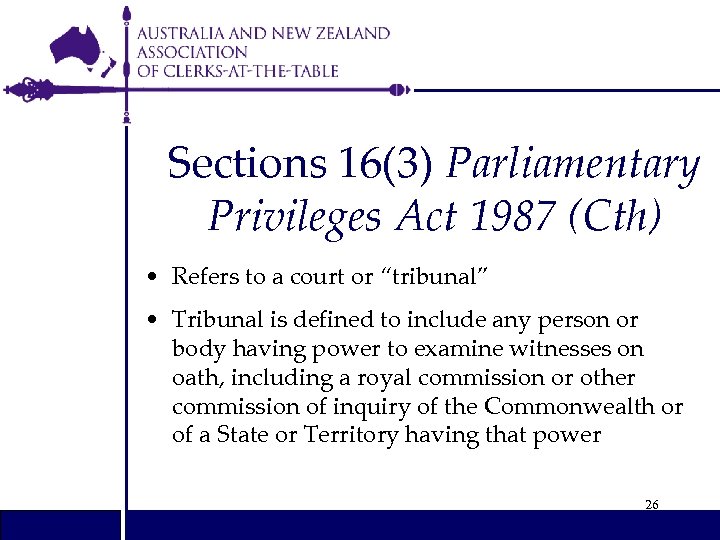 Sections 16(3) Parliamentary Privileges Act 1987 (Cth) • Refers to a court or “tribunal” • Tribunal is defined to include any person or body having power to examine witnesses on oath, including a royal commission or other commission of inquiry of the Commonwealth or of a State or Territory having that power 26
 Powers of Houses 27
 Exercise • In groups of three consider the functions of a legislature: – Legislation – Debate – Scrutiny of the executive • Discuss: what powers does a House of Parliament require in order to be able to exercise these functions? 28
 Power to regulate internal affairs • Right to control its own agenda • Right to make and vary its own procedures • Right to determine its own constitution and to discipline its own members (NB in NSW self protective and not punitive): – Expulsion – Suspension – Censure – Apology / withdrawal – Reprimand / admonishment 29
 Power to conduct inquiries • Parliament as the “Grand Inquisition of the Nation” • Powers to compel the attendance of witnesses • Power to order the production of documents (including common law power to require the production of state papers: Egan v Willis (1998) 195 CLR 424 • Claims of privilege and immunity: Egan v Chadwick [1999] 46 NSWLR 563 30
 Some final terms and principles • Whose privilege is it? • Absolute and qualified privilege 31
 Whose privilege is it? Parliamentary privilege: • Exists to ensure the integrity, independence and authority of Parliament • Essentially belongs to the Houses of Parliament as a whole, and is not the privilege of an individual member • Can only be claimed by a member where an action would impede them in carrying out their duties as a member, or adversely affect the proper functioning of the House or a committee 32
 Absolute and qualified privilege • Parliamentary privilege is absolute: – Statements made in the House (or a committee) are protected from legal action however injurious they are to another party • Statements outside the House (or a committee) are subject to the normal laws of defamation and protected by qualified privilege only: – This is a separate branch of the law relating to defamation – Qualified privilege is defeated by proof of malice – NB also defence of fair protected report 33
 ‘Men behaving badly’: parliamentary privilege cases in NSW, 1844 -1996 Gareth Griffith
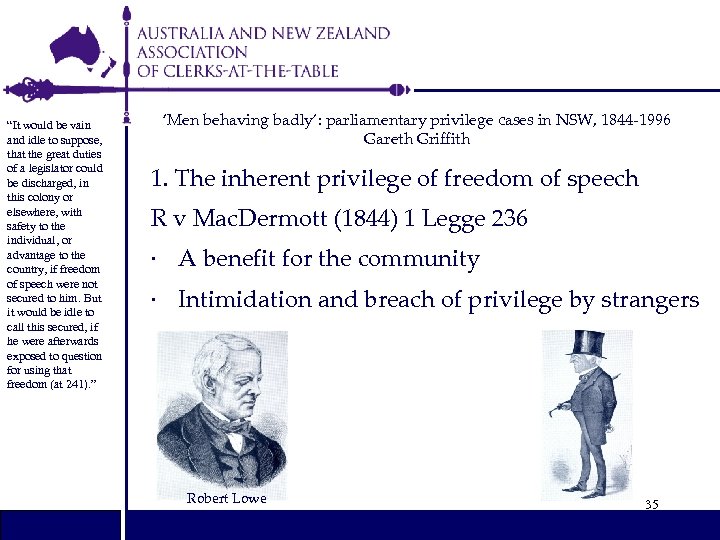 “It would be vain and idle to suppose, that the great duties of a legislator could be discharged, in this colony or elsewhere, with safety to the individual, or advantage to the country, if freedom of speech were not secured to him. But it would be idle to call this secured, if he were afterwards exposed to question for using that freedom (at 241). ” ‘Men behaving badly’: parliamentary privilege cases in NSW, 1844 -1996 Gareth Griffith 1. The inherent privilege of freedom of speech R v Mac. Dermott (1844) 1 Legge 236 · A benefit for the community · Intimidation and breach of privilege by strangers Robert Lowe 35
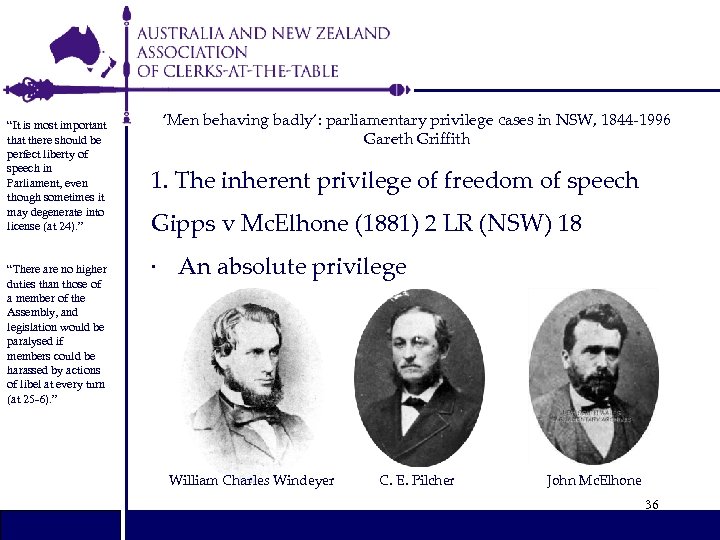 “It is most important that there should be perfect liberty of speech in Parliament, even though sometimes it may degenerate into license (at 24). ” “There are no higher duties than those of a member of the Assembly, and legislation would be paralysed if members could be harassed by actions of libel at every turn (at 25 -6). ” ‘Men behaving badly’: parliamentary privilege cases in NSW, 1844 -1996 Gareth Griffith 1. The inherent privilege of freedom of speech Gipps v Mc. Elhone (1881) 2 LR (NSW) 18 · An absolute privilege William Charles Windeyer C. E. Pilcher John Mc. Elhone 36
 “It seems to me that the present question is rightly dealt with, by reference to the Constitutional and Electoral Acts alone. These are the exclusive tests by which it is to be decided, and it is quite unnecessary to encumber the case by any reference to the privileges and usages of the Parliament of England, or with arguments of analogy derived from them. ” ‘Men behaving badly’: parliamentary privilege cases in NSW, 1844 -1996 Gareth Griffith 2. Disqualification and judicial review Martin v Nicholson (1850) 1 Legge 618 · A statutory regime and judicial review of the power of a House to determine its own composition James Martin 37
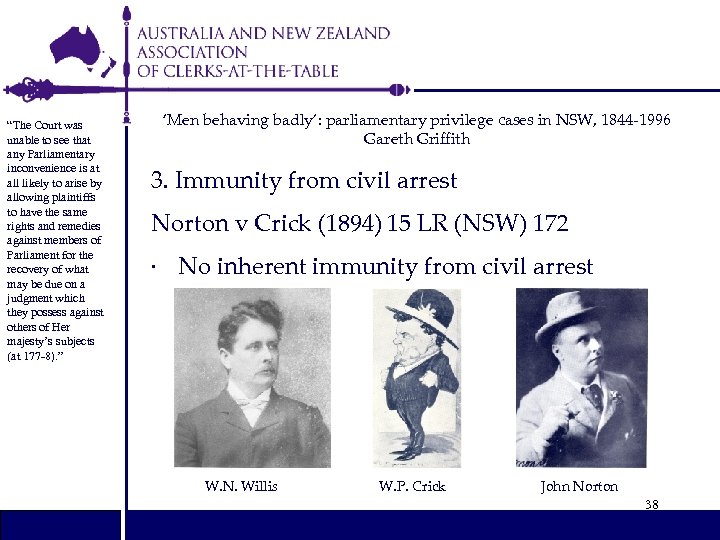 “The Court was unable to see that any Parliamentary inconvenience is at all likely to arise by allowing plaintiffs to have the same rights and remedies against members of Parliament for the recovery of what may be due on a judgment which they possess against others of Her majesty’s subjects (at 177 -8). ” ‘Men behaving badly’: parliamentary privilege cases in NSW, 1844 -1996 Gareth Griffith 3. Immunity from civil arrest Norton v Crick (1894) 15 LR (NSW) 172 · No inherent immunity from civil arrest W. N. Willis W. P. Crick John Norton 38
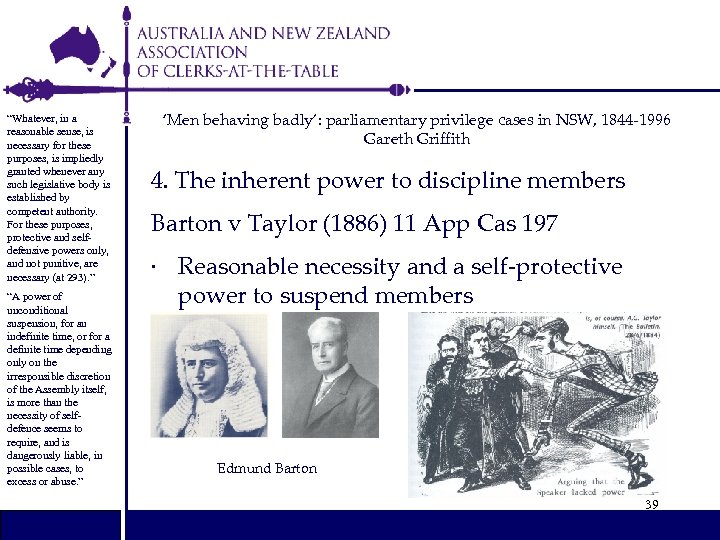 “Whatever, in a reasonable sense, is necessary for these purposes, is impliedly granted whenever any such legislative body is established by competent authority. For these purposes, protective and selfdefensive powers only, and not punitive, are necessary (at 293). ” “A power of unconditional suspension, for an indefinite time, or for a definite time depending only on the irresponsible discretion of the Assembly itself, is more than the necessity of selfdefence seems to require, and is dangerously liable, in possible cases, to excess or abuse. ” ‘Men behaving badly’: parliamentary privilege cases in NSW, 1844 -1996 Gareth Griffith 4. The inherent power to discipline members Barton v Taylor (1886) 11 App Cas 197 · Reasonable necessity and a self-protective power to suspend members Edmund Barton 39
 “The Chairman of Committees in Committees of the Whole House, or the Speaker, if the House is sitting, is clothed with every power which is necessary to maintain order (at 139). ” ‘Men behaving badly’: parliamentary privilege cases in NSW, 1844 -1996 Gareth Griffith 4. The inherent power to discipline members Toohey v Melville (1892) 13 LR (NSW) 132 · The power applies to the Committee of the Whole Ninian Melville 40
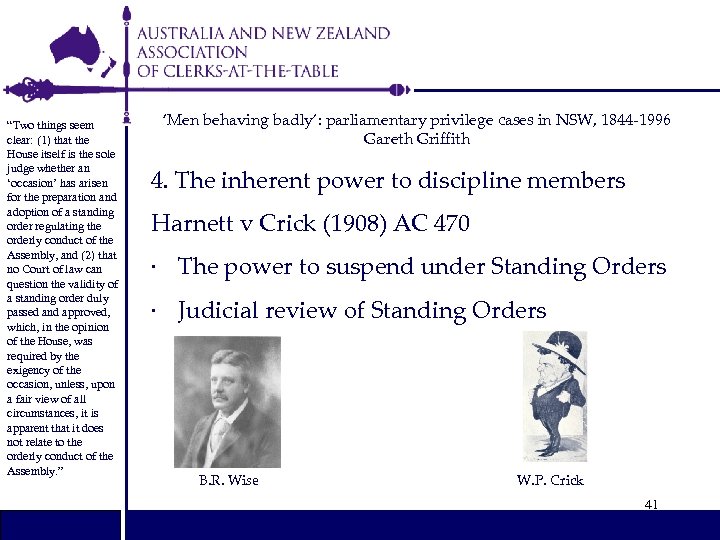 “Two things seem clear: (1) that the House itself is the sole judge whether an ‘occasion’ has arisen for the preparation and adoption of a standing order regulating the orderly conduct of the Assembly, and (2) that no Court of law can question the validity of a standing order duly passed and approved, which, in the opinion of the House, was required by the exigency of the occasion, unless, upon a fair view of all circumstances, it is apparent that it does not relate to the orderly conduct of the Assembly. ” ‘Men behaving badly’: parliamentary privilege cases in NSW, 1844 -1996 Gareth Griffith 4. The inherent power to discipline members Harnett v Crick (1908) AC 470 · The power to suspend under Standing Orders · Judicial review of Standing Orders B. R. Wise W. P. Crick 41
![“In my opinion the Speaker had no more authority over the plaintiff [Perry] when](https://present5.com/presentation/85f1b5b57fd1e9b8f3d64b4978269c52/image-42.jpg "“In my opinion the Speaker had no more authority over the plaintiff [Perry] when") “In my opinion the Speaker had no more authority over the plaintiff [Perry] when he was outside the chamber than he had over a person who was not a member (at 598). ” ‘Men behaving badly’: parliamentary privilege cases in NSW, 1844 -1996 Gareth Griffith 4. The inherent power to discipline members Willis and Christie v Perry (1912) 13 CLR 592 · Limits on the inherent power to control proceedings confirmed · No power to punish or deter disorderly conduct Henry Willis 42
“In my opinion the Speaker had no more authority over the plaintiff [Perry] when he was outside the chamber than he had over a person who was not a member (at 598). ” ‘Men behaving badly’: parliamentary privilege cases in NSW, 1844 -1996 Gareth Griffith 4. The inherent power to discipline members Willis and Christie v Perry (1912) 13 CLR 592 · Limits on the inherent power to control proceedings confirmed · No power to punish or deter disorderly conduct Henry Willis 42
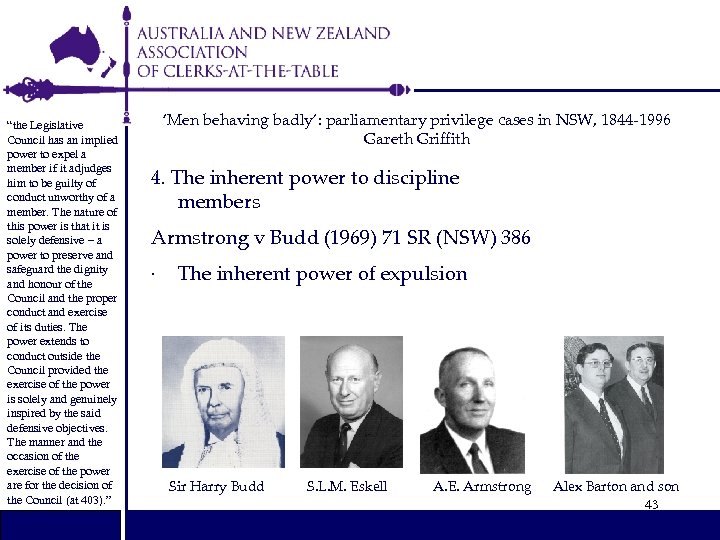 “the Legislative Council has an implied power to expel a member if it adjudges him to be guilty of conduct unworthy of a member. The nature of this power is that it is solely defensive – a power to preserve and safeguard the dignity and honour of the Council and the proper conduct and exercise of its duties. The power extends to conduct outside the Council provided the exercise of the power is solely and genuinely inspired by the said defensive objectives. The manner and the occasion of the exercise of the power are for the decision of the Council (at 403). ” ‘Men behaving badly’: parliamentary privilege cases in NSW, 1844 -1996 Gareth Griffith 4. The inherent power to discipline members Armstrong v Budd (1969) 71 SR (NSW) 386 · The inherent power of expulsion Sir Harry Budd S. L. M. Eskell A. E. Armstrong Alex Barton and son 43
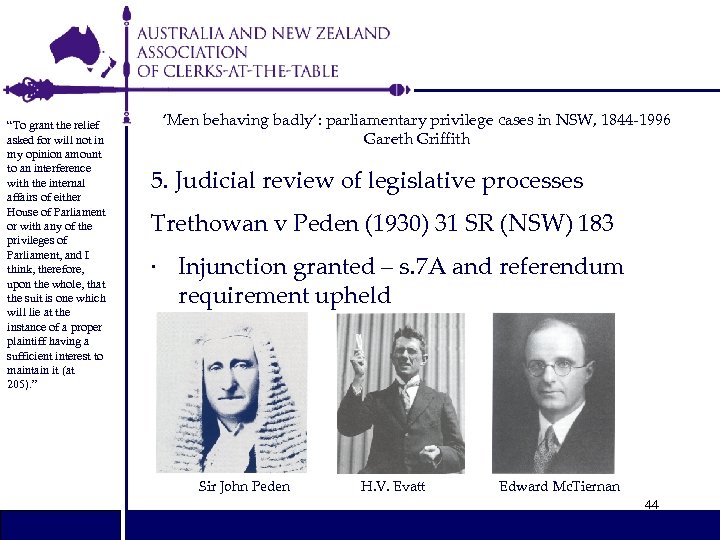 “To grant the relief asked for will not in my opinion amount to an interference with the internal affairs of either House of Parliament or with any of the privileges of Parliament, and I think, therefore, upon the whole, that the suit is one which will lie at the instance of a proper plaintiff having a sufficient interest to maintain it (at 205). ” ‘Men behaving badly’: parliamentary privilege cases in NSW, 1844 -1996 Gareth Griffith 5. Judicial review of legislative processes Trethowan v Peden (1930) 31 SR (NSW) 183 · Injunction granted – s. 7 A and referendum requirement upheld Sir John Peden H. V. Evatt Edward Mc. Tiernan 44
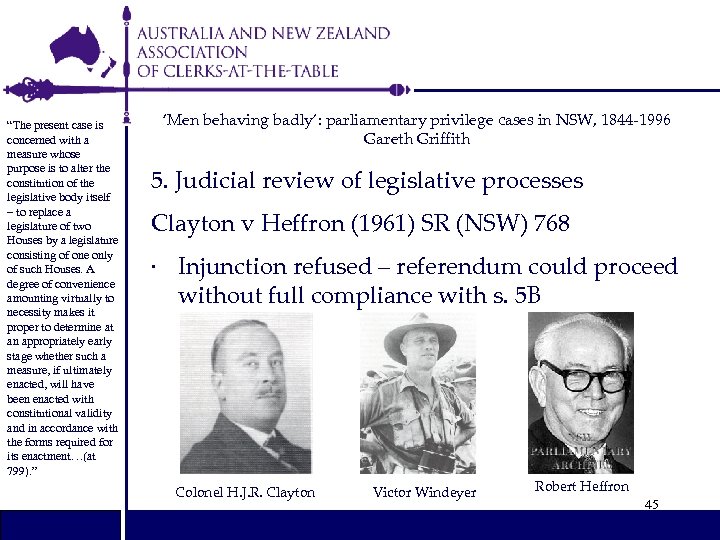 “The present case is concerned with a measure whose purpose is to alter the constitution of the legislative body itself – to replace a legislature of two Houses by a legislature consisting of one only of such Houses. A degree of convenience amounting virtually to necessity makes it proper to determine at an appropriately early stage whether such a measure, if ultimately enacted, will have been enacted with constitutional validity and in accordance with the forms required for its enactment…(at 799). ” ‘Men behaving badly’: parliamentary privilege cases in NSW, 1844 -1996 Gareth Griffith 5. Judicial review of legislative processes Clayton v Heffron (1961) SR (NSW) 768 · Injunction refused – referendum could proceed without full compliance with s. 5 B Colonel H. J. R. Clayton Victor Windeyer Robert Heffron 45
 “Kirby P observed that it was ‘now settled practice in Australia that…an injunction will virtually never be issued, nor a declaration be made, at that stage’, that is before a Bill had received the royal assent (at 193). ” ‘Men behaving badly’: parliamentary privilege cases in NSW, 1844 -1996 Gareth Griffith Eastgate and Rozzoli (1990) 20 NSWLR 188 · Injunction refused – non-intervention affirmed Hon. Kevin Rozzoli 46
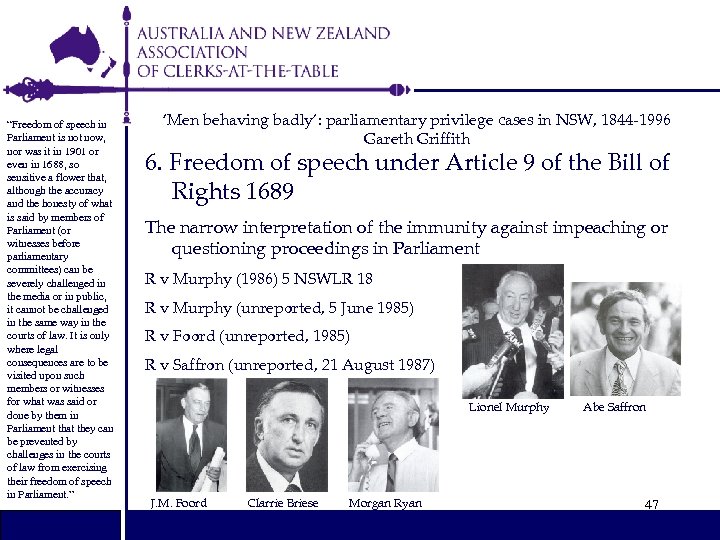 “Freedom of speech in Parliament is not now, nor was it in 1901 or even in 1688, so sensitive a flower that, although the accuracy and the honesty of what is said by members of Parliament (or witnesses before parliamentary committees) can be severely challenged in the media or in public, it cannot be challenged in the same way in the courts of law. It is only where legal consequences are to be visited upon such members or witnesses for what was said or done by them in Parliament that they can be prevented by challenges in the courts of law from exercising their freedom of speech in Parliament. ” ‘Men behaving badly’: parliamentary privilege cases in NSW, 1844 -1996 Gareth Griffith 6. Freedom of speech under Article 9 of the Bill of Rights 1689 The narrow interpretation of the immunity against impeaching or questioning proceedings in Parliament R v Murphy (1986) 5 NSWLR 18 R v Murphy (unreported, 5 June 1985) R v Foord (unreported, 1985) R v Saffron (unreported, 21 August 1987) Lionel Murphy J. M. Foord Clarrie Briese Morgan Ryan Abe Saffron 47
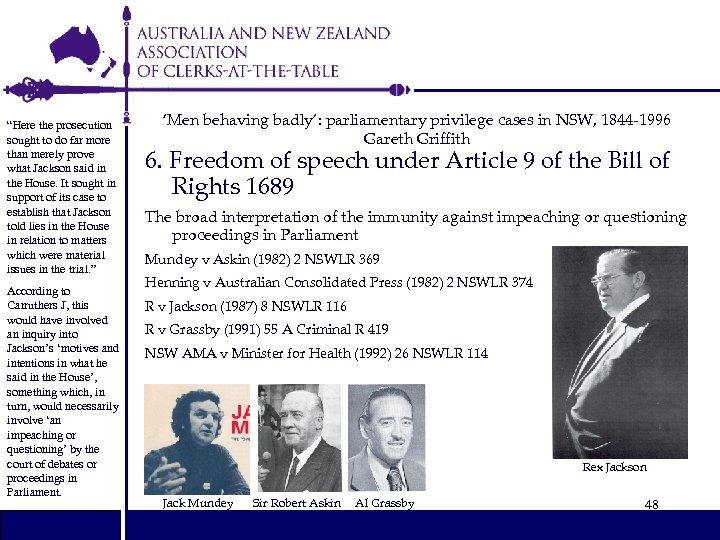 “Here the prosecution sought to do far more than merely prove what Jackson said in the House. It sought in support of its case to establish that Jackson told lies in the House in relation to matters which were material issues in the trial. ” According to Carruthers J, this would have involved an inquiry into Jackson’s ‘motives and intentions in what he said in the House’, something which, in turn, would necessarily involve ‘an impeaching or questioning’ by the court of debates or proceedings in Parliament. ‘Men behaving badly’: parliamentary privilege cases in NSW, 1844 -1996 Gareth Griffith 6. Freedom of speech under Article 9 of the Bill of Rights 1689 The broad interpretation of the immunity against impeaching or questioning proceedings in Parliament Mundey v Askin (1982) 2 NSWLR 369 Henning v Australian Consolidated Press (1982) 2 NSWLR 374 R v Jackson (1987) 8 NSWLR 116 R v Grassby (1991) 55 A Criminal R 419 NSW AMA v Minister for Health (1992) 26 NSWLR 114 Rex Jackson Jack Mundey Sir Robert Askin Al Grassby 48
 Contemporary Issues Parliament and the courts Mr Neil Laurie Clerk, Queensland Legislative Assembly 49
 Contemporary Issues Waiver of privilege Mr John Evans Clerk of the Parliaments and Clerk of the Legislative Council (NSW) 50
 Contemporary Issues Some recent U. K. cases Mr David Natzler Principal Clerk, Select Committees House of Commons 51
 Contemporary Issues Areas of statutory uncertainty Mr Brendan Keith Clerk of the Judicial Office and Registrar of Interests, House of Lords 52
 Contemporary Issues Areas of statutory uncertainty Ms Lynn Lovelock Deputy Clerk, NSW Legislative Council and Clerk, Standing Committee on Parliamentary Privilege and Ethics 53
 Some areas of statutory uncertainty from NSW (I): o Precise effect of express preservation of parliamentary privilege in statutes (eg ICAC Act) = ? o Clash between the statutory powers of investigative agencies and parliamentary privilege (eg search and seizure of documents from a Member’s office) 54
 Some areas of statutory uncertainty from NSW (II): o What is a “lawful question” that a witness cannot refuse to answer? o Clash between statutory secrecy provisions and parliamentary committees o What obligations do members have to report suspected criminal offences to the Police? 55
 Contemporary Issues Panel discussion 56
 Real life privilege issues Small groups 57
 Real life privilege issues Report back session 58
 Workshop concludes Afternoon tea ANZACATT AGM Reception for participants and accompanying persons 59