


 Скачать презентацию 5 th International Conference on the Frontiers of
2da46ce41ca8c26347a747d9ee485f6d.ppt
- Количество слайдов: 56
 5 th International Conference on the Frontiers of Plasma Physics and Technology 18 -22 April 2011, Singapore The Plasma Focus- Numerical Experiments Leading Technology Sor Heoh Saw 1, 2 and Sing Lee 1, 2, 3 1 INTI International University, 71800 Nilai, Malaysia 2 Institute for Plasma Focus Studies, 32 Oakpark Drive, Chadstone, VIC 3148, Australia 3 Nanyang Technological University, National Institute of Education, Singapore 637616 e-mails: sorheoh. saw@newinti. edu. my; leesing@optusnet. com. au
 The Plasma Focus- Numerical Experiments Leading Technology Outline of talk: Numerical experiments assist design; provide reference for diagnostics and provide guidance for implementation of technology for Plasma Focus devices. Pointed the way to development of the Nanofocus, extending proven scalable range of DPF devices from 0. 1 J to MJ over unprecedented 7 orders of magnitude in storage energy Important guidance uncovered by numerical experiments include: (1) Plasma current limitation effect, so show that it is futile to lower static inductance below around 20 n. H (2) Scaling laws of neutron yield and soft x-ray yield as functions of E 0 & I (3) Deterioration of scaling laws due to dynamic impedance; so need to go to yield enhancement techniques: high-Z seeding, higher voltage operation & circuit manipulation
 The Plasma Focus 1/2 Plasma focus: small fusion device, complements international efforts to study nuclear fusion Multi-radiation device - x-rays, particle beams and fusion neutrons Soft XR applications include microelectronics lithography and micro-machining Large range of device-from J to thousands of k. J Experiments-dynamics, radiation, instabilities and non-linear phenomena
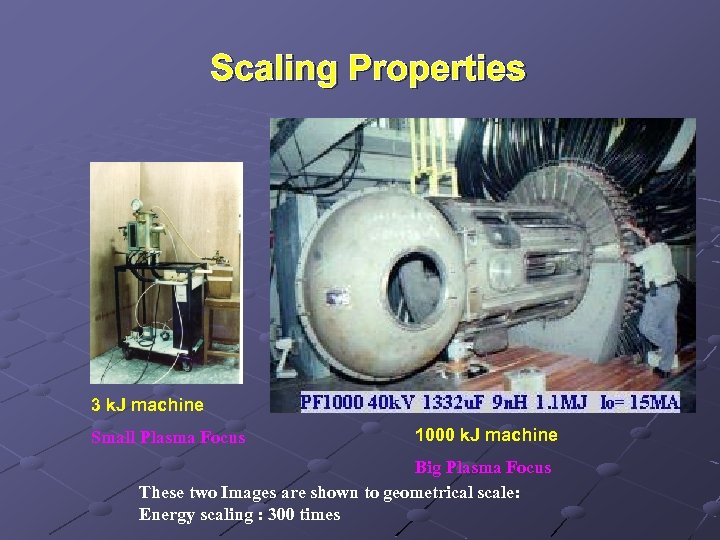 Scaling Properties 3 k. J machine Small Plasma Focus 1000 k. J machine Big Plasma Focus These two Images are shown to geometrical scale: Energy scaling : 300 times
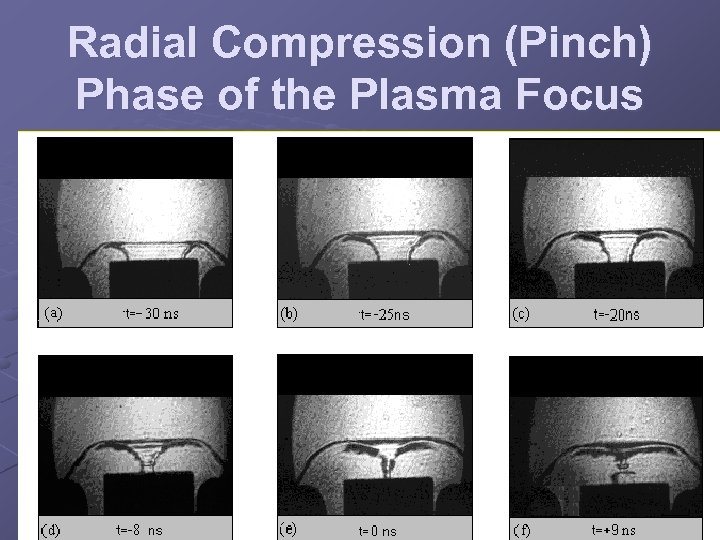 Radial Compression (Pinch) Phase of the Plasma Focus
![Our early numerical work [Lee & Serban IEEE Trans Plasma Sci 24 (1996) 1101]](https://present5.com/presentation/2da46ce41ca8c26347a747d9ee485f6d/image-6.jpg "Our early numerical work [Lee & Serban IEEE Trans Plasma Sci 24 (1996) 1101]") Our early numerical work [Lee & Serban IEEE Trans Plasma Sci 24 (1996) 1101] already showed the following scaling rules-of-thumb Axial phase energy density (per unit mass) constant Radial phase energy density (per unit mass) constant Pinch radius ratio constant Pinch length ratio constant Pinch duration per unit anode radius constant
Our early numerical work [Lee & Serban IEEE Trans Plasma Sci 24 (1996) 1101] already showed the following scaling rules-of-thumb Axial phase energy density (per unit mass) constant Radial phase energy density (per unit mass) constant Pinch radius ratio constant Pinch length ratio constant Pinch duration per unit anode radius constant
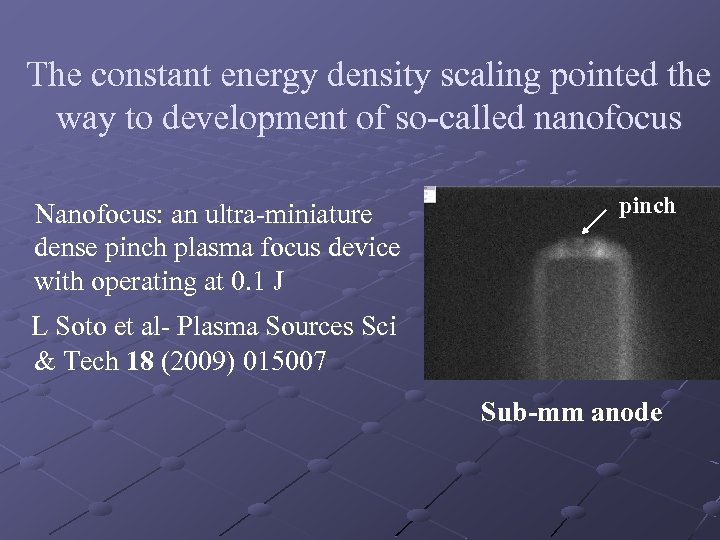 The constant energy density scaling pointed the way to development of so-called nanofocus Nanofocus: an ultra-miniature dense pinch plasma focus device with operating at 0. 1 J pinch L Soto et al- Plasma Sources Sci & Tech 18 (2009) 015007 Sub-mm anode
 Scaling Rules-of-thumb predicted numerically are used to design nanofocus- DPF’s operate over 7 orders of magnitude: 0. 1 J to 1 MJAxial phase energy density (per unit mass) constant Radial phase energy density (per unit mass) constant Pinch radius ratio constant Pinch length ratio constant Pinch duration per unit anode radius constant
 Extending DPF’s to operate over an unprecedented scalable 7 orders of magnitude: 0. 1 J to 1 MJ- This is an example of: Numerical Experiments Leading Technology
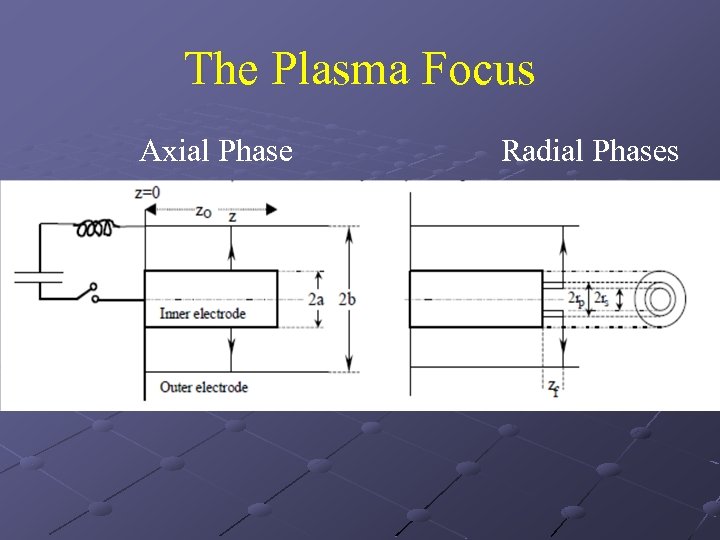 The Plasma Focus Axial Phase Radial Phases
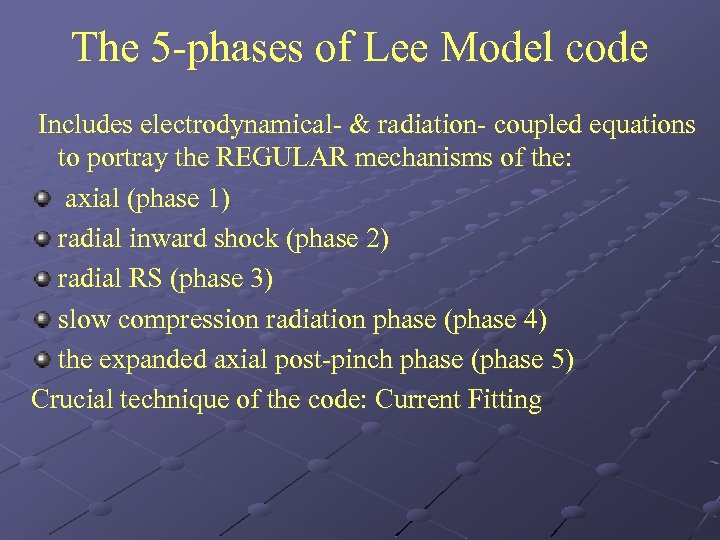 The 5 -phases of Lee Model code Includes electrodynamical- & radiation- coupled equations to portray the REGULAR mechanisms of the: axial (phase 1) radial inward shock (phase 2) radial RS (phase 3) slow compression radiation phase (phase 4) the expanded axial post-pinch phase (phase 5) Crucial technique of the code: Current Fitting
 The Lee Model code. Comprehensive Numerical Experiments The approach of the Lee Model code To model the plasma dynamics & plasma conditions Then obtain insights into scaling properties Then uncover scaling laws Critical to the approach: Model is linked to physical reality by the current waveform
 Insights 1/2 The Lee model code has produced groundbreaking insights no other plasma focus codes has been able to produce These insights have led to other examples of Numerical Experiments leading Technology
 Ground-breaking Insights published- Numerical Experiments leading Technology Limitation to Pinch Current and Yields- Appl Phys Letts. 92 (2008) S Lee & S H Saw: an unexpected, important result Neutron Yield Scaling-sub k. J to 1 MJ-J Fusion Energy 27 (2008) S Lee & S H Saw- multi-MJ- PPCF 50 (2008) S Lee Neon Soft x-ray Scaling- PPCF 51 (2009) S Lee, S H Saw, P Lee, R S Rawat Neutron Yield Saturation- Appl Phys Letts. 95 (2009) S Lee Simple explanation of major obstruction to progress
 From Measured Current Waveform to Modelling for Diagnostics 1/2 Procedure to operate the code: Step 1: Configure the specific plasma focus Input: Bank parameters, L 0, C 0 and stray circuit resistance r 0; Tube parameters b, a and z 0 and Operational parameters V 0 and P 0 and the fill gas
 Step 2: Fitting the computed current waveform to the measured waveform-(connecting with reality) 2/2 A measured discharge current Itotal waveform for the specific plasma focus is required The code is run successively. At each run the computed Itotal waveform is fitted to the measured Itotal waveform by varying model parameters fm, fc, fmr and fcr one by one, one step for each run, until computed waveform agrees with measured waveform. The 5 -Point Fit: First, the axial model factors fm, fc are adjusted (fitted) until n n n (1) computed rising slope of the Itotal trace and (2) the rounding off of the peak current as well as (3) the peak current itself are in reasonable (typically very good) fit with the measured Itotal trace. Next, adjust (fit) the radial phase model factors fmr and fcr until - (4) the computed slope and (5) the depth of the dip agree with the measured Itotal waveform.
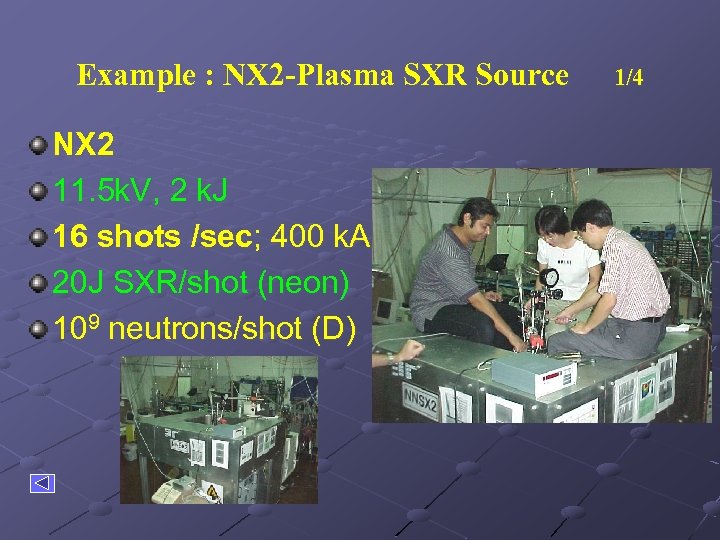 Example : NX 2 -Plasma SXR Source NX 2 11. 5 k. V, 2 k. J 16 shots /sec; 400 k. A 20 J SXR/shot (neon) 109 neutrons/shot (D) 1/4
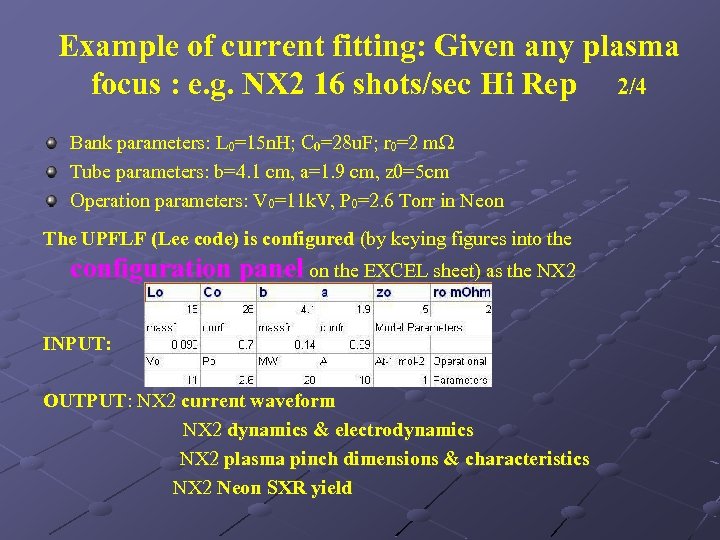 Example of current fitting: Given any plasma focus : e. g. NX 2 16 shots/sec Hi Rep 2/4 Bank parameters: L 0=15 n. H; C 0=28 u. F; r 0=2 m. W Tube parameters: b=4. 1 cm, a=1. 9 cm, z 0=5 cm Operation parameters: V 0=11 k. V, P 0=2. 6 Torr in Neon The UPFLF (Lee code) is configured (by keying figures into the configuration panel on the EXCEL sheet) as the NX 2 INPUT: OUTPUT: NX 2 current waveform NX 2 dynamics & electrodynamics NX 2 plasma pinch dimensions & characteristics NX 2 Neon SXR yield
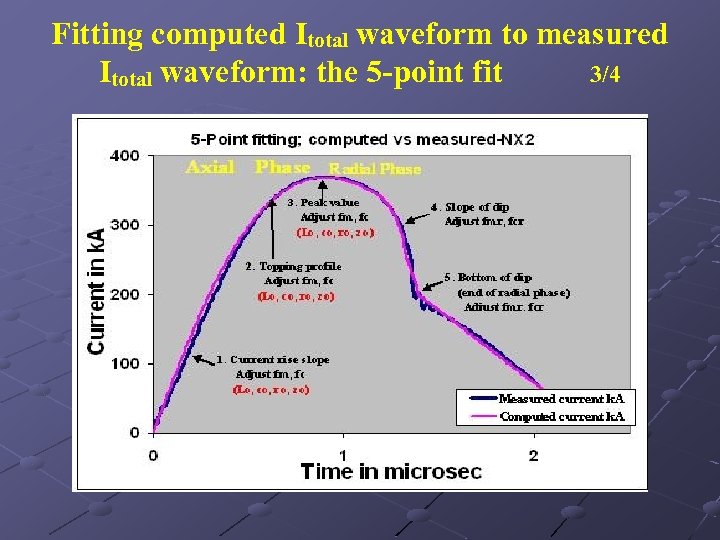 Fitting computed Itotal waveform to measured Itotal waveform: the 5 -point fit 3/4
 Once fitted: model is energy-wise & mass-wise equivalent to the physical situation 4/4 All dynamics, electrodynamics, radiation, plasma properties and neutron yields are realistically simulated; so that the code output of these quantities may be used as reference points for diagnostics
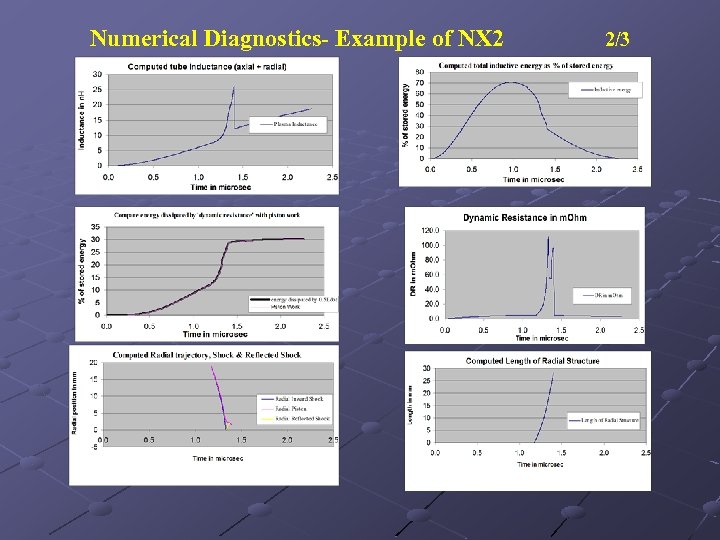
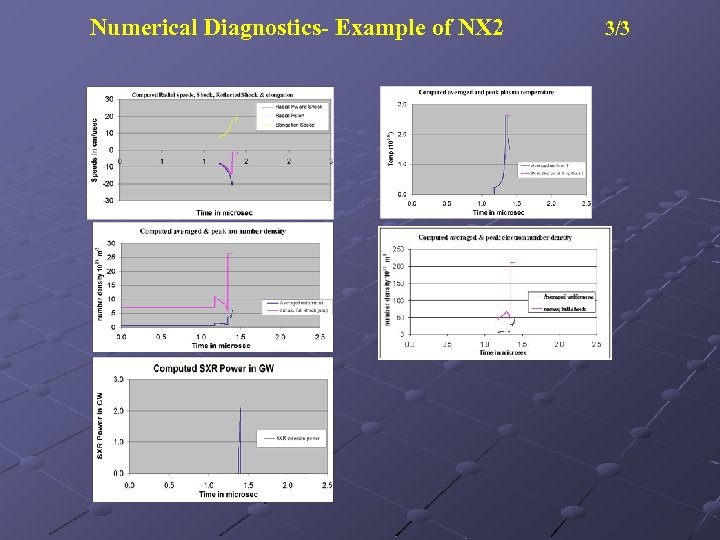
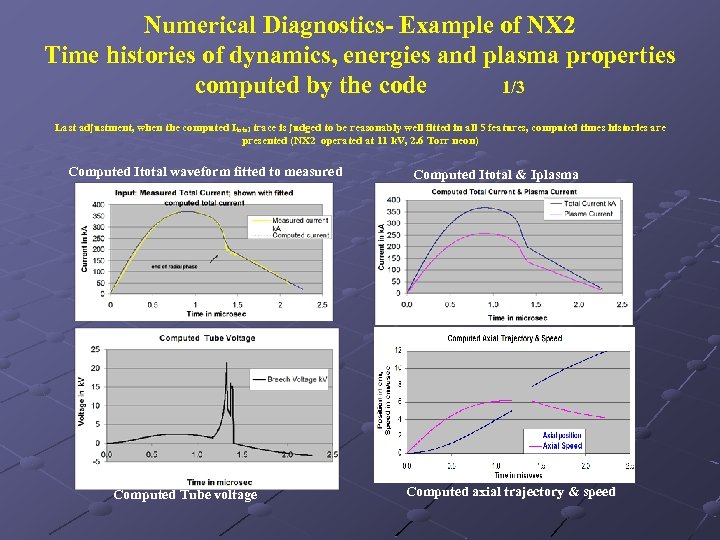 Numerical Diagnostics- Example of NX 2 Time histories of dynamics, energies and plasma properties computed by the code 1/3 Last adjustment, when the computed Itotal trace is judged to be reasonably well fitted in all 5 features, computed times histories are presented (NX 2 operated at 11 k. V, 2. 6 Torr neon) Computed Itotal waveform fitted to measured Computed Tube voltage Computed Itotal & Iplasma Computed axial trajectory & speed
 Numerical Diagnostics- Example of NX 2 2/3
 Numerical Diagnostics- Example of NX 2 3/3
 More on the The Lee Model Code 1/3 Realistic simulation of all gross focus properties Couples the electrical circuit with plasma focus dynamics, thermodynamics and radiation (Lee 1983, 1984) 5 -phase model; axial & radial phases Includes plasma self-absorption for SXR yield (Lee 2000) Includes neutron yield, Yn, using a beam–target mechanism (Lee & Saw 2008, J Fusion energy)
 Numerical Experiments leading Technology Pinch current limitation effect in plasma focus (S. Lee and S. H. Saw, Appl. Phys. Lett. 92, 021503 (2008), DOI: 10. 1063/1. 2827579) Pinch current limitation effect. Ipinch does not increase beyond a certain value however low Lo, the static inductance is reduced to. Decreasing the present Lo of the PF 1000 machine will neither increase the pinch current nor the neutron yield, contrary to expectations.
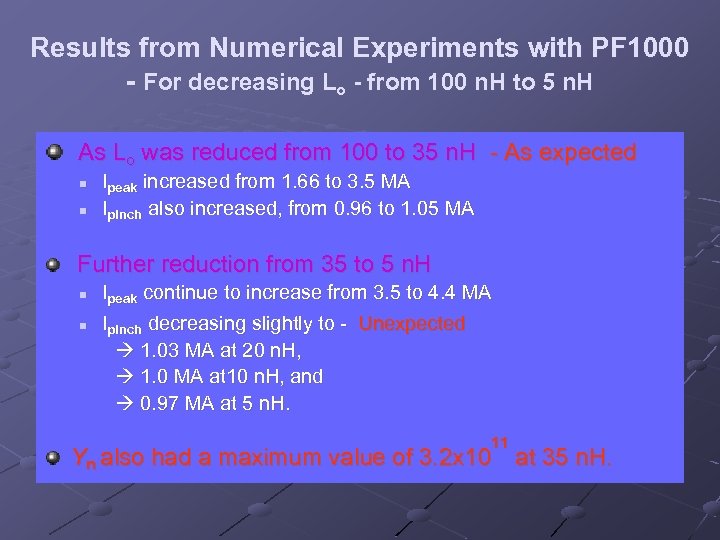 Results from Numerical Experiments with PF 1000 - For decreasing Lo - from 100 n. H to 5 n. H As Lo was reduced from 100 to 35 n. H - As expected n n Ipeak increased from 1. 66 to 3. 5 MA Ipinch also increased, from 0. 96 to 1. 05 MA Further reduction from 35 to 5 n. H n n Ipeak continue to increase from 3. 5 to 4. 4 MA Ipinch decreasing slightly to - Unexpected 1. 03 MA at 20 n. H, 1. 0 MA at 10 n. H, and 0. 97 MA at 5 n. H. 11 Yn also had a maximum value of 3. 2 x 10 at 35 n. H.
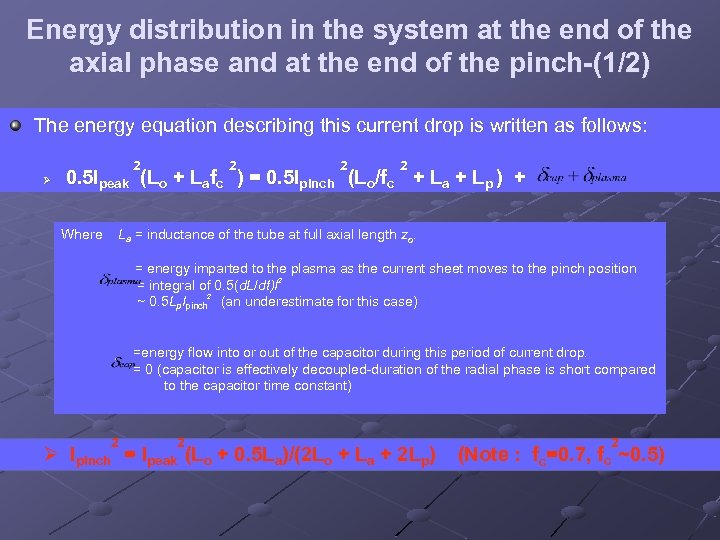 Energy distribution in the system at the end of the axial phase and at the end of the pinch-(1/2) The energy equation describing this current drop is written as follows: 2 Ø 2 2 2 0. 5 Ipeak (Lo + Lafc ) = 0. 5 Ipinch (Lo/fc + La + Lp ) + Where La = inductance of the tube at full axial length zo. = energy imparted to the plasma as the current sheet moves to the pinch position = integral of 0. 5(d. L/dt)I 2 ~ 0. 5 Lp. Ipinch 2 (an underestimate for this case) =energy flow into or out of the capacitor during this period of current drop. = 0 (capacitor is effectively decoupled-duration of the radial phase is short compared to the capacitor time constant) 2 2 Ø Ipinch = Ipeak (Lo + 0. 5 La)/(2 Lo + La + 2 Lp) 2 (Note : fc=0. 7, fc ~0. 5)
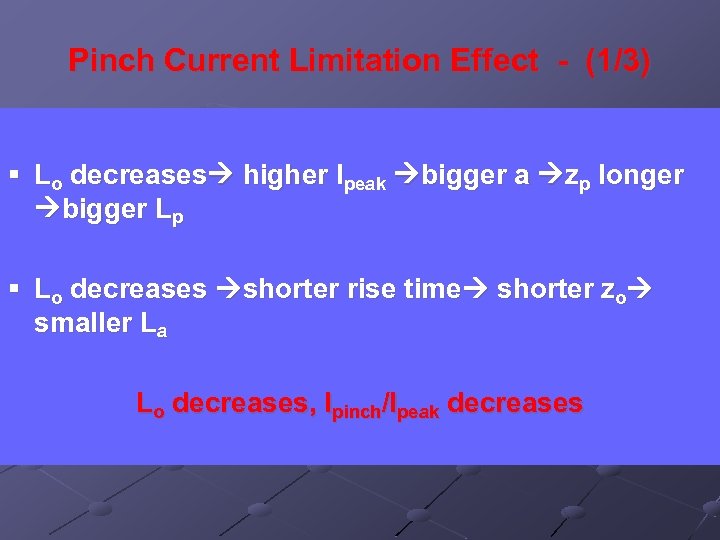 Pinch Current Limitation Effect - (1/3) § Lo decreases higher Ipeak bigger a zp longer bigger Lp § Lo decreases shorter rise time shorter zo smaller La Lo decreases, Ipinch/Ipeak decreases
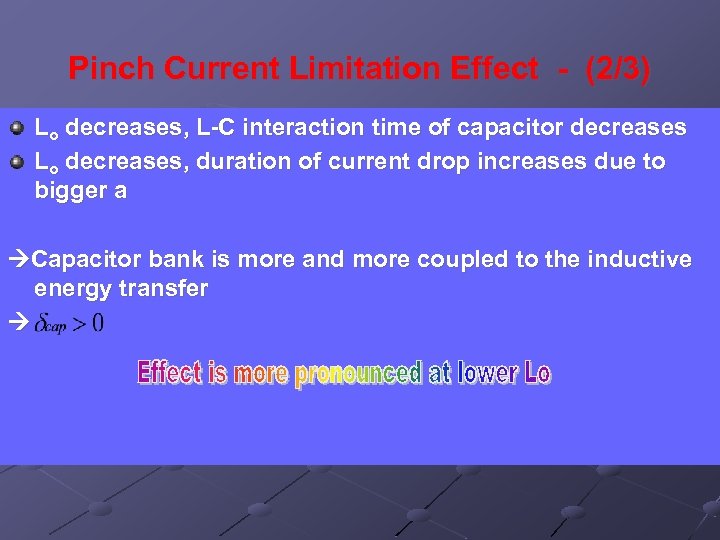 Pinch Current Limitation Effect - (2/3) Lo decreases, L-C interaction time of capacitor decreases Lo decreases, duration of current drop increases due to bigger a Capacitor bank is more and more coupled to the inductive energy transfer
 Pinch Current Limitation Effect - (3/3) A combination of two complex effects • • Interplay of various inductances Increasing coupling of Co to the inductive energetic processes as Lo is reduced
 Conclusions – (1/2) Several sets of Numerical results For PF 1000 with different damping factors indicate • • Optimum inductances are around 30 -60 n. H with Ipinch decreasing for Lo below optimum value Reducing Lo from its present 20 -30 n. H will increase neither Ipinch nor Yn
 Conclusions – (2/2) • • For a fixed Co powering a plasma focus, there exist an optimum Lo for maximum Ipinch Reducing Lo will increase neither Ipinch nor Yn Because of the Pinch Current Limitation Effect
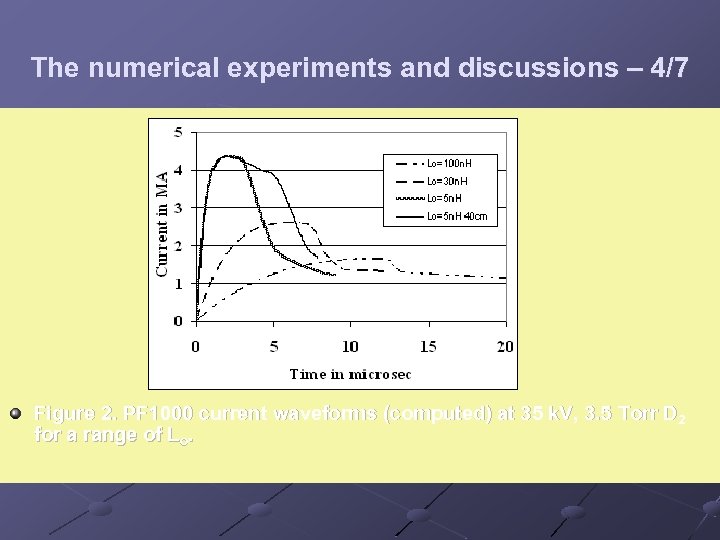 The numerical experiments and discussions – 4/7 Figure 2. PF 1000 current waveforms (computed) at 35 k. V, 3. 5 Torr D 2 for a range of Lo.
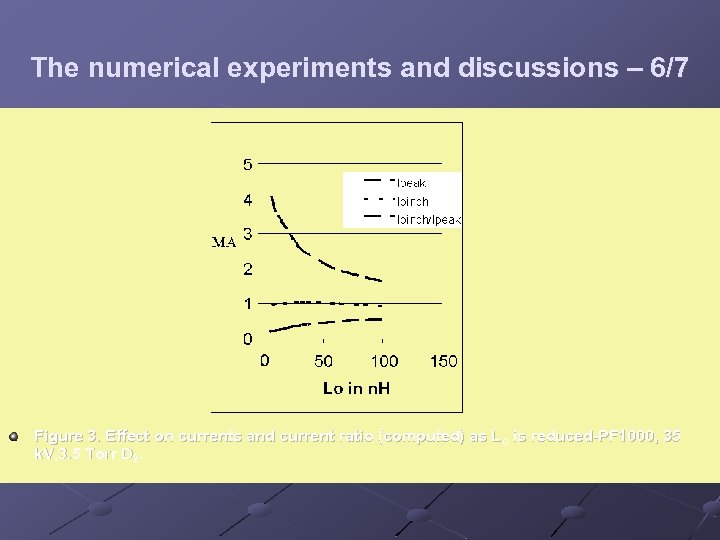 The numerical experiments and discussions – 6/7 Figure 3. Effect on currents and current ratio (computed) as Lo is reduced-PF 1000, 35 k. V, 3. 5 Torr D 2.
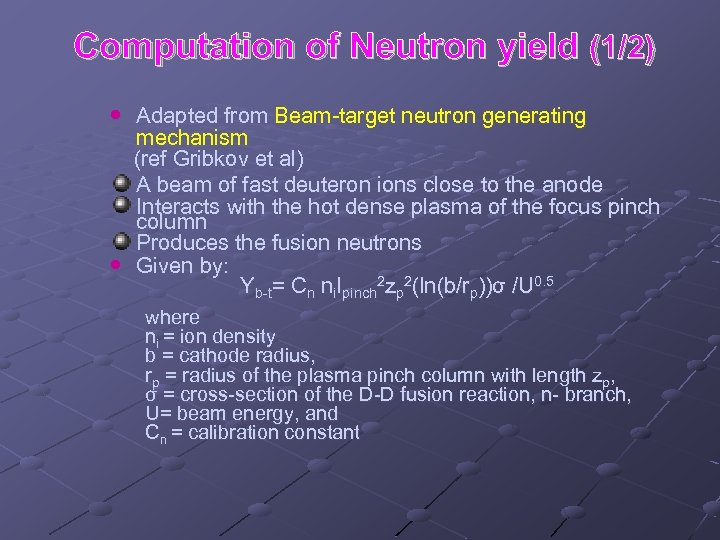 Computation of Neutron yield (1/2) Adapted from Beam-target neutron generating mechanism (ref Gribkov et al) A beam of fast deuteron ions close to the anode Interacts with the hot dense plasma of the focus pinch column Produces the fusion neutrons Given by: Yb-t= Cn ni. Ipinch 2 zp 2(ln(b/rp))σ /U 0. 5 where ni = ion density b = cathode radius, rp = radius of the plasma pinch column with length zp, σ = cross-section of the D-D fusion reaction, n- branch, U= beam energy, and Cn = calibration constant
 Computation of Neutron yield (2/2) Note: • • The D-D cross-section is sensitive to the beam energy in the range 15 -150 k. V; so it is necessary to use the appropriate range of beam energy to compute σ. The code computes induced voltages (due to current motion inductive effects) Vmax of the order of only 15 -50 k. V. However it is known, from experiments that the ion energy responsible for the beam-target neutrons is in the range 50 -150 ke. V, and for smaller lower-voltage machines the relevant energy could be lower at 30 -60 ke. V. In line with experimental observations the D-D cross section σ is reasonably obtained by using U= 3 Vmax. The model uses a value of Cn =2. 7 x 10⁷ obtained by calibrating the yield at an experimental point of 0. 5 MA.
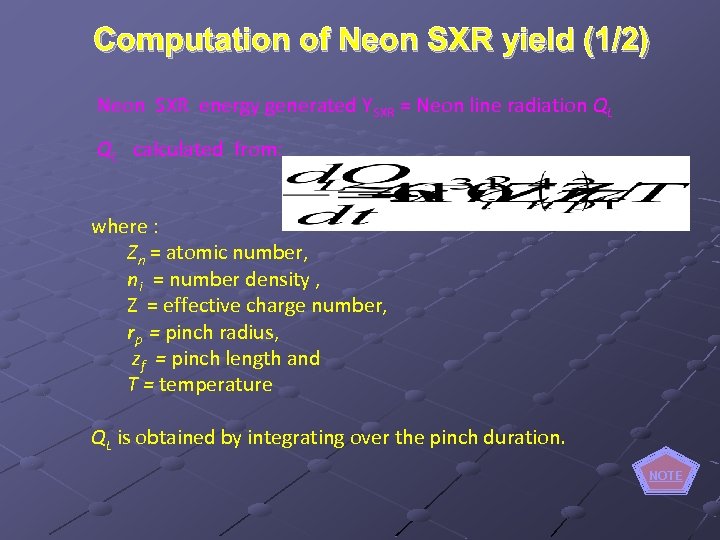 Computation of Neon SXR yield (1/2) Neon SXR energy generated YSXR = Neon line radiation QL QL calculated from: where : Zn = atomic number, ni = number density , Z = effective charge number, rp = pinch radius, zf = pinch length and T = temperature QL is obtained by integrating over the pinch duration. NOTE
 Computation of Neon SXR yield (2/2) Note: The SXR yield is the reduced quantity of generated energy after plasma self -absorption which depends primarily on density and temperature The model computes the volumetric plasma self-absorption factor A derived from the photonic excitation number M which is a function of the Zn, ni, Z and T. In our range of operation the numerical experiments show that the self absorption is not significant. Liu Mahe (1999) first pointed out that a temperature around 300 e. V is optimum for SXR production. Shan Bing’s (2000) subsequent work and our experience through numerical experiments suggest that around 2 x 10⁶ K (below 200 e. V) or even a little lower could be better. Hence for SXR scaling there is an optimum small range of temperatures (T window) to operate.
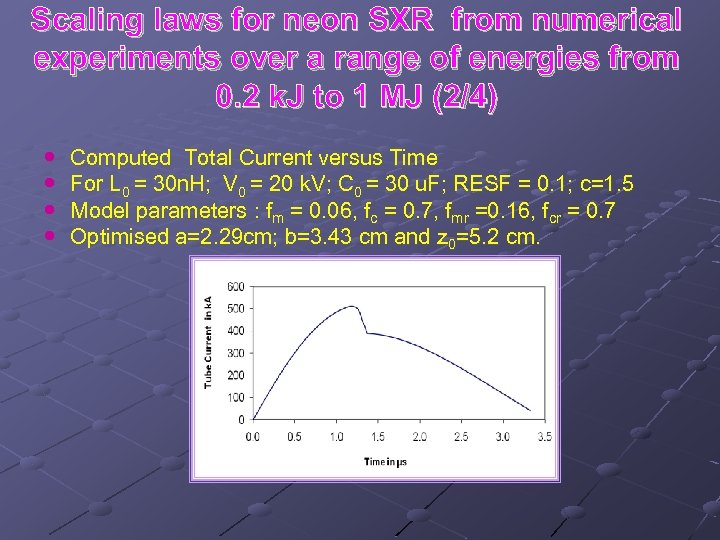 Scaling laws for neon SXR from numerical experiments over a range of energies from 0. 2 k. J to 1 MJ (2/4) Computed Total Current versus Time For L 0 = 30 n. H; V 0 = 20 k. V; C 0 = 30 u. F; RESF = 0. 1; c=1. 5 Model parameters : fm = 0. 06, fc = 0. 7, fmr =0. 16, fcr = 0. 7 Optimised a=2. 29 cm; b=3. 43 cm and z 0=5. 2 cm.
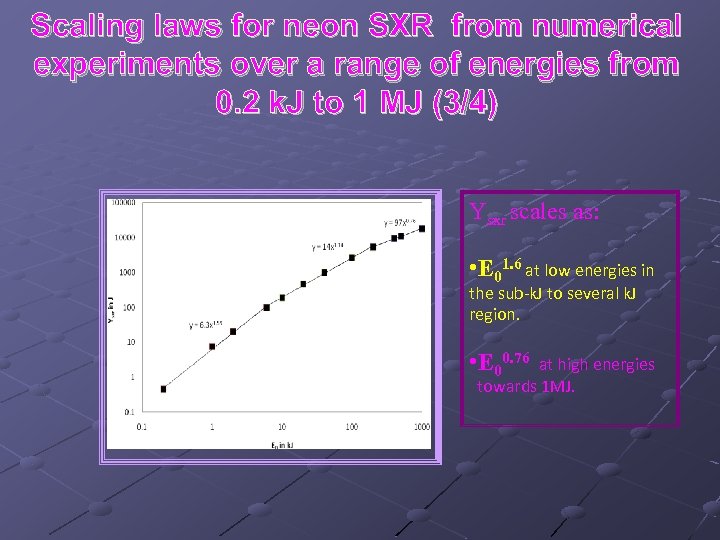 Scaling laws for neon SXR from numerical experiments over a range of energies from 0. 2 k. J to 1 MJ (3/4) Ysxr scales as: • E 01. 6 at low energies in the sub-k. J to several k. J region. • E 00. 76 at high energies towards 1 MJ.
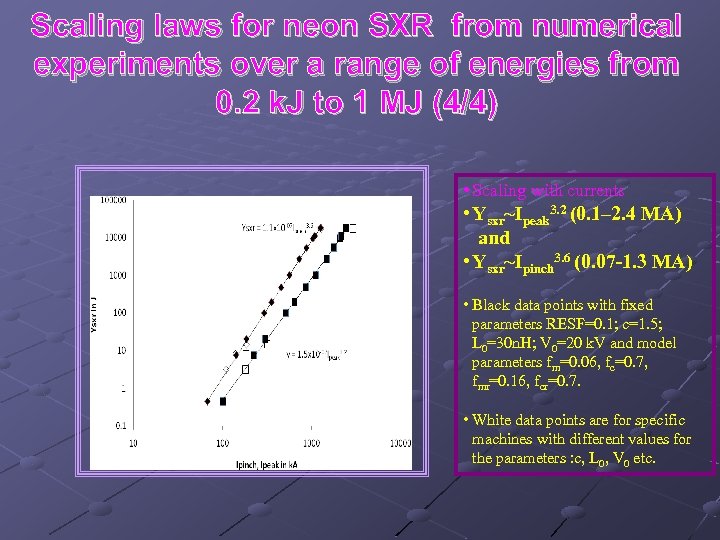 Scaling laws for neon SXR from numerical experiments over a range of energies from 0. 2 k. J to 1 MJ (4/4) • Scaling with currents • Ysxr~Ipeak 3. 2 (0. 1– 2. 4 MA) and • Ysxr~Ipinch 3. 6 (0. 07 -1. 3 MA) • Black data points with fixed parameters RESF=0. 1; c=1. 5; L 0=30 n. H; V 0=20 k. V and model parameters fm=0. 06, fc=0. 7, fmr=0. 16, fcr=0. 7. • White data points are for specific machines with different values for the parameters : c, L 0, V 0 etc.
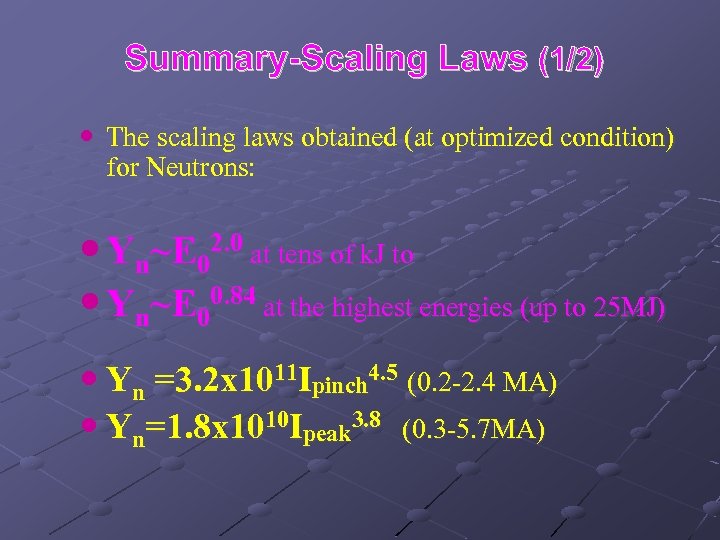 Summary-Scaling Laws (1/2) The scaling laws obtained (at optimized condition) for Neutrons: Yn~E 02. 0 at tens of k. J to Yn~E 00. 84 at the highest energies (up to 25 MJ) Yn =3. 2 x 10¹¹ Ipinch 4. 5 (0. 2 -2. 4 MA) Yn=1. 8 x 10¹⁰ Ipeak 3. 8 (0. 3 -5. 7 MA)
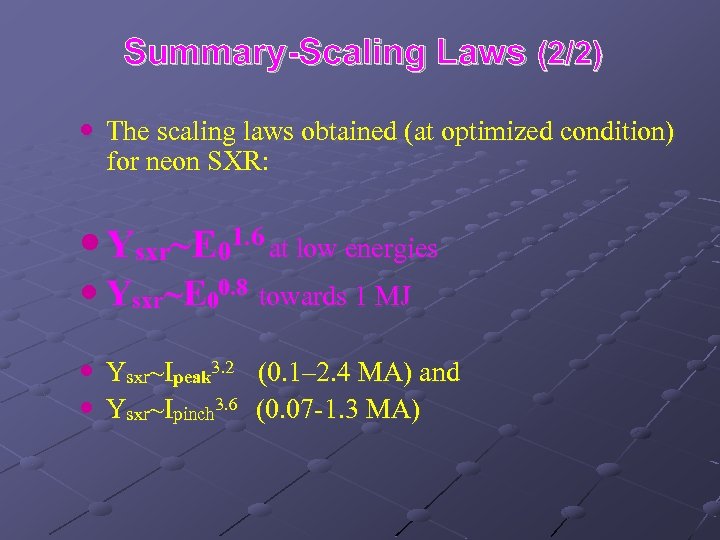 Summary-Scaling Laws (2/2) The scaling laws obtained (at optimized condition) for neon SXR: Ysxr~E 01. 6 at low energies Ysxr~E 00. 8 towards 1 MJ Ysxr~Ipeak 3. 2 (0. 1– 2. 4 MA) and Ysxr~Ipinch 3. 6 (0. 07 -1. 3 MA)
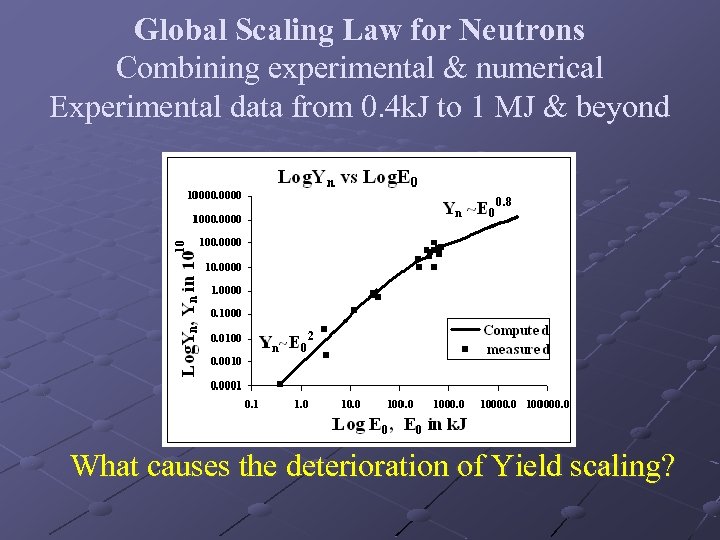 Global Scaling Law for Neutrons Combining experimental & numerical Experimental data from 0. 4 k. J to 1 MJ & beyond What causes the deterioration of Yield scaling?
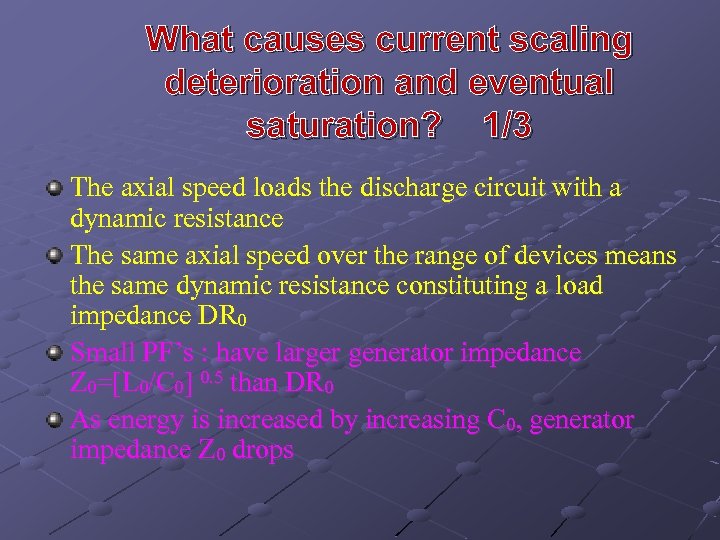 What causes current scaling deterioration and eventual saturation? 1/3 The axial speed loads the discharge circuit with a dynamic resistance The same axial speed over the range of devices means the same dynamic resistance constituting a load impedance DR 0 Small PF’s : have larger generator impedance Z 0=[L 0/C 0] 0. 5 than DR 0 As energy is increased by increasing C 0, generator impedance Z 0 drops
 What causes current scaling deterioration and eventual saturation? 2/3 At E 0 of k. J and tens of k. J the discharge circuit is dominated by Z 0 Hence as E 0 increases, I~C 0 -0. 5 At the level typically of 100 k. J, Z 0 has dropped to the level of DR 0; circuit is now no longer dominated by Z 0; and current scaling deviates from I~C 0 -0. 5, beginning of current scaling deterioration. At MJ levels and above, the circuit becomes dominated by DR 0, current saturates
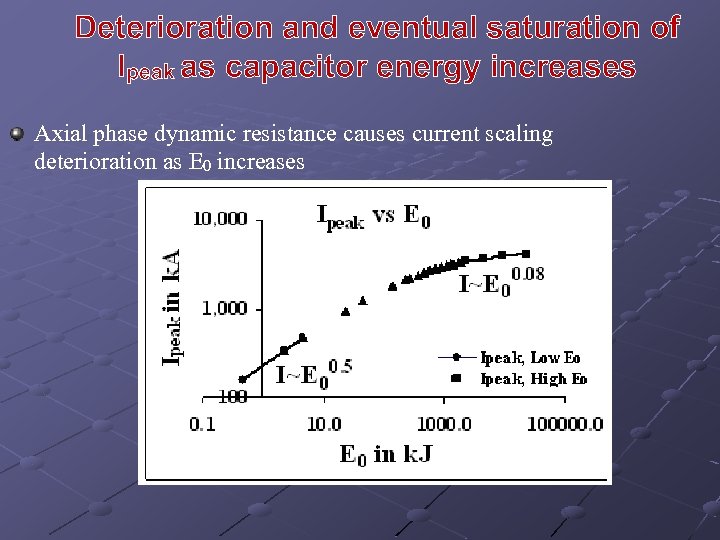 Deterioration and eventual saturation of Ipeak as capacitor energy increases Axial phase dynamic resistance causes current scaling deterioration as E 0 increases
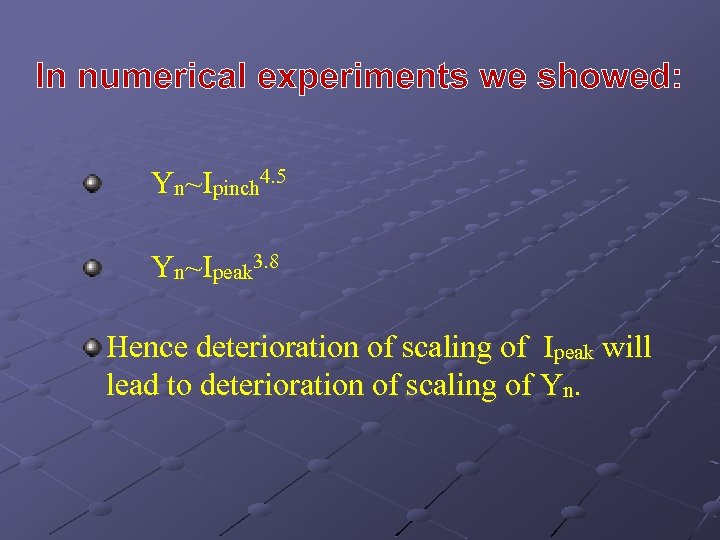 In numerical experiments we showed: Yn~Ipinch 4. 5 Yn~Ipeak 3. 8 Hence deterioration of scaling of Ipeak will lead to deterioration of scaling of Yn.
 What causes current scaling deterioration and eventual saturation? 3/3 Analysis using the Lee model code has thus shown that the constancy of the dynamic resistance causes the current scaling deterioration resulting in the deterioration of the neutron yield and eventual saturation. This puts the global scaling law for neutron yield on a firmer footing
 Into the Future Beyond Saturation Plasma Focus?
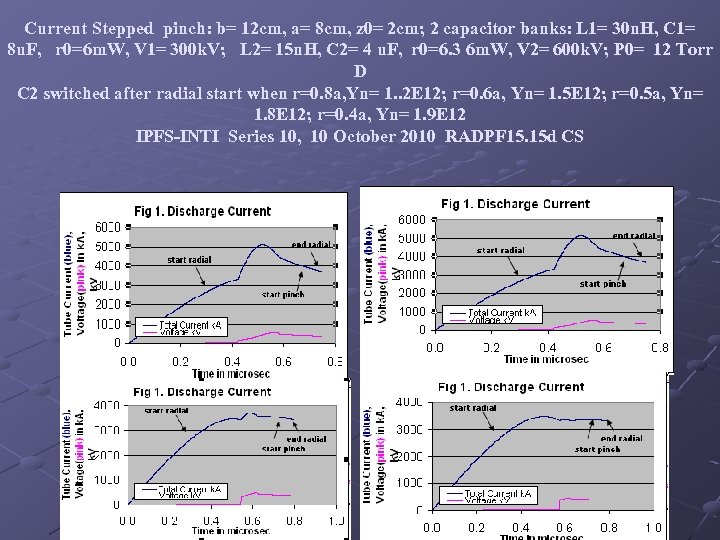 Current Stepped pinch: b= 12 cm, a= 8 cm, z 0= 2 cm; 2 capacitor banks: L 1= 30 n. H, C 1= 8 u. F, r 0=6 m. W, V 1= 300 k. V; L 2= 15 n. H, C 2= 4 u. F, r 0=6. 3 6 m. W, V 2= 600 k. V; P 0= 12 Torr D C 2 switched after radial start when r=0. 8 a, Yn= 1. . 2 E 12; r=0. 6 a, Yn= 1. 5 E 12; r=0. 5 a, Yn= 1. 8 E 12; r=0. 4 a, Yn= 1. 9 E 12 IPFS-INTI Series 10, 10 October 2010 RADPF 15. 15 d CS
 Other methods For example: Enhanced compressions by: Thermodynamics effects Radiative cooling and radiative collapse (already covered by S Lee & S H Saw in earlier paper) Further steps: will be discussed by P Lee in his paper tomorrow
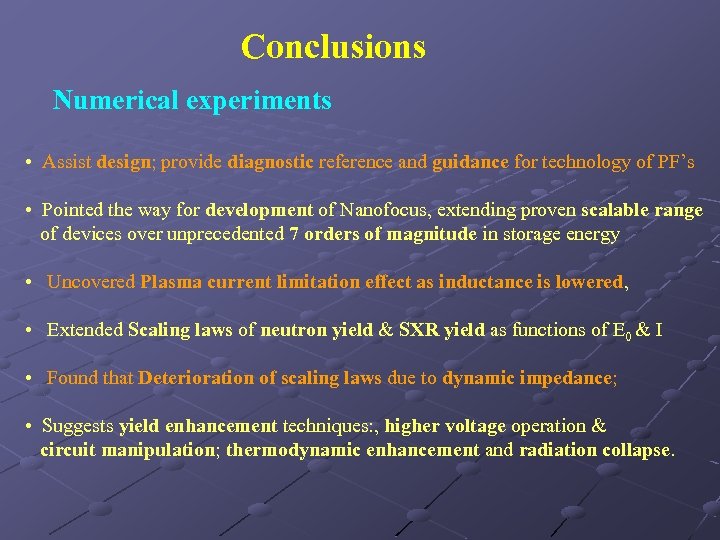 Conclusions Numerical experiments • Assist design; provide diagnostic reference and guidance for technology of PF’s • Pointed the way for development of Nanofocus, extending proven scalable range of devices over unprecedented 7 orders of magnitude in storage energy • Uncovered Plasma current limitation effect as inductance is lowered, • Extended Scaling laws of neutron yield & SXR yield as functions of E 0 & I • Found that Deterioration of scaling laws due to dynamic impedance; • Suggests yield enhancement techniques: , higher voltage operation & circuit manipulation; thermodynamic enhancement and radiation collapse.
 5 th International Conference on the Frontiers of Plasma Physics and Technology 18 -22 April 2011, Singapore The Plasma Focus- Numerical Experiments Leading Technology Sor Heoh Saw 1, 2 and Sing Lee 1, 2, 3 1 INTI International University, 71800 Nilai, Malaysia 2 Institute for Plasma Focus Studies, 32 Oakpark Drive, Chadstone, VIC 3148, Australia 3 Nanyang Technological University, National Institute of Education, Singapore 637616 e-mails: sorheoh. saw@newinti. edu. my; leesing@optusnet. com. au
 Papers from Lee model code S Lee and S H Saw, “Pinch current limitation effect in plasma focus, ” Appl. Phys. Lett. 92, 2008, 021503. S Lee and S H Saw, “Neutron scaling laws from numerical experiments, ” J Fusion Energy 27, 2008, pp. 292 -295. S Lee, P Lee, S H Saw and R S Rawat, “Numerical experiments on plasma focus pinch current limitation, ” Plasma Phys. Control. Fusion 50, 2008, 065012 (8 pp). S Lee, S H Saw, P C K Lee, R S Rawat and H Schmidt, “Computing plasma focus pinch current from total current measurement, ” Appl. Phys. Lett. 92 , 2008, 111501. S Lee, “Current and neutron scaling for megajoule plasma focus machine, ” Plasma Phys. Control. Fusion 50, 2008, 105005, (14 pp). S Lee and S H Saw, “Response to “Comments on ‘Pinch current limitation effect in plasma focus’”[Appl. Phys. Lett. 94, 076101 (2009)], ” Appl. Phys. Leet. 94, 2009, 076102. S Lee, S H Saw, L Soto, S V Springham and S P Moo, “Numerical experiments on plasma focus neutron yield versus pressure compared with laboratory experiments, ” Plasma Phys. Control. Fusion 51, 2009, 075006 (11 pp). S H Saw, P C K Lee, R S Rawat and S Lee, “Optimizing UNU/ICTP PFF Plasma Focus for Neon Soft X-ray Operation, ” accepted for publication in IEEE Trans. on Plasma Science. Lee S, Rawat R S, Lee P and Saw S H. “Soft x-ray yield from NX 2 plasma focus- correlation with plasma pinch parameters” (to be published) S Lee, S H Saw, P Lee and R S Rawat, “Numerical experiments on plasma focus neon soft xray scaling”, (to be published).
 References (2/5) Lee S, Rawat R S, Lee P and Saw S H. “Soft x-ray yield from NX 2 plasma focus” International, Journal of Applied Physics, 106, 30 July 2009. S Lee & S H Saw, “Neutron scaling laws from numerical experiments, ” J Fusion Energy 27, 2008, pp. 292 -295. S Lee, “Current and neutron scaling for megajoule plasma focus machine, ” Plasma Phys. Control. Fusion 50, 2008, 105005, (14 pp). S Lee, S H Saw, P C K Lee, R S Rawat and H Schmidt, “Computing plasma focus pinch current from total current measurement, ” Appl. Phys. Lett. 92 , 2008, 111501. S Lee and S H Saw, “Pinch current limitation effect in plasma focus, ” Appl. Phys. Lett. 92, 2008, 021503. S Lee, P Lee, S H Saw and R S Rawat, “Numerical experiments on plasma focus pinch current limitation, ” Plasma Phys. Control. Fusion 50, 2008, 065012 (8 pp). S Lee, “Plasma focus model yielding trajectory and structure” in Radiations in Plasmas, ed B Mc. Namara (Singapore: World Scientific Publishing Co, ISBN 9971966 -37 -9) vol. II, 1984, pp. 978– 987 S Lee S et al, “A simple facility for the teaching of plasma dynamics and plasma nuclear fusion, ” Am. J. Phys. 56, 1988, pp. 62 -68. T Y Tou, S Lee and K H Kwek, “Non perturbing plasma focus measurements in the run-down phase, ” IEEE Trans. Plasma Sci. 17, 1989, pp. 311 -315.