


 Скачать презентацию 5 th conference on New Frontiers in Physics
d7ec7df40f9dedce411ff3cd7b3f518f.ppt
- Количество слайдов: 31
 5 th conference on New Frontiers in Physics The proton radius puzzle M. Bonesini Sezione INFN Milano Bicocca, Dipartimento di Fisica G. Occhialini, Universita’ di Milano Bicocca On behalf of the FAMU Collaboration M. Bonesini - ICNFC 2016 Slide# : 1
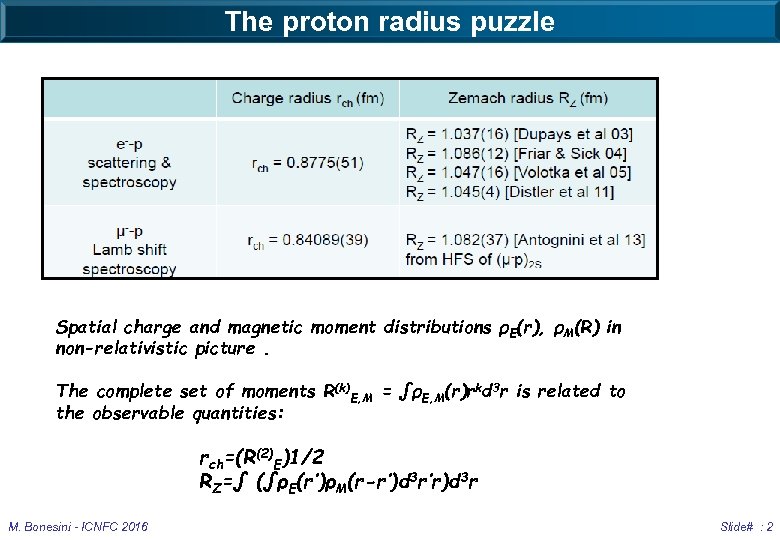 The proton radius puzzle Spatial charge and magnetic moment distributions ρE(r), ρM(R) in non-relativistic picture. The complete set of moments R(k)E, M = ∫ρE, M(r)rkd 3 r is related to the observable quantities: rch=(R(2)E)1/2 RZ=∫ (∫ρE(r’)ρM(r-r’)d 3 r’r)d 3 r M. Bonesini - ICNFC 2016 Slide# : 2
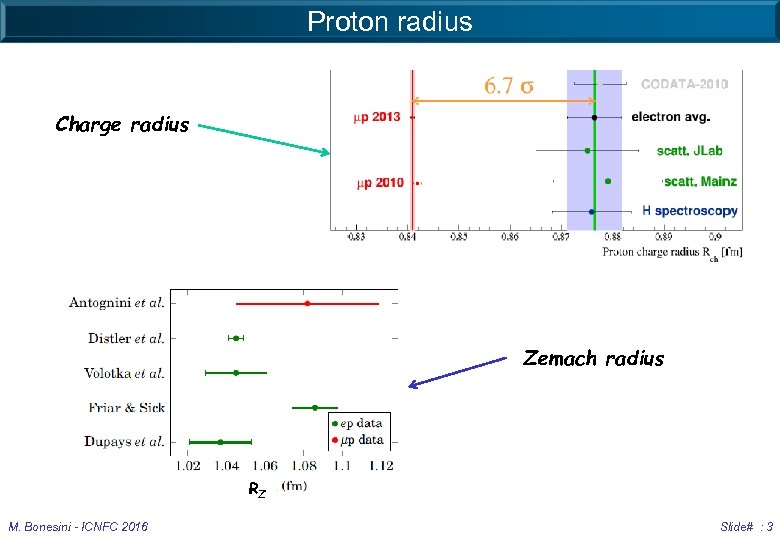 Proton radius Charge radius Zemach radius RZ M. Bonesini - ICNFC 2016 Slide# : 3
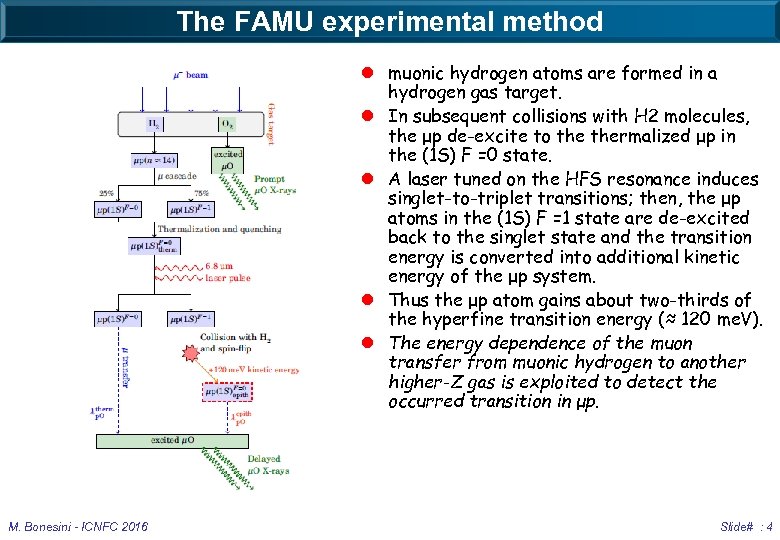 The FAMU experimental method l muonic hydrogen atoms are formed in a hydrogen gas target. l In subsequent collisions with H 2 molecules, the μp de-excite to thermalized μp in the (1 S) F =0 state. l A laser tuned on the HFS resonance induces singlet-to-triplet transitions; then, the μp atoms in the (1 S) F =1 state are de-excited back to the singlet state and the transition energy is converted into additional kinetic energy of the μp system. l Thus the μp atom gains about two-thirds of the hyperfine transition energy (≈ 120 me. V). l The energy dependence of the muon transfer from muonic hydrogen to another higher-Z gas is exploited to detect the occurred transition in μp. M. Bonesini - ICNFC 2016 Slide# : 4
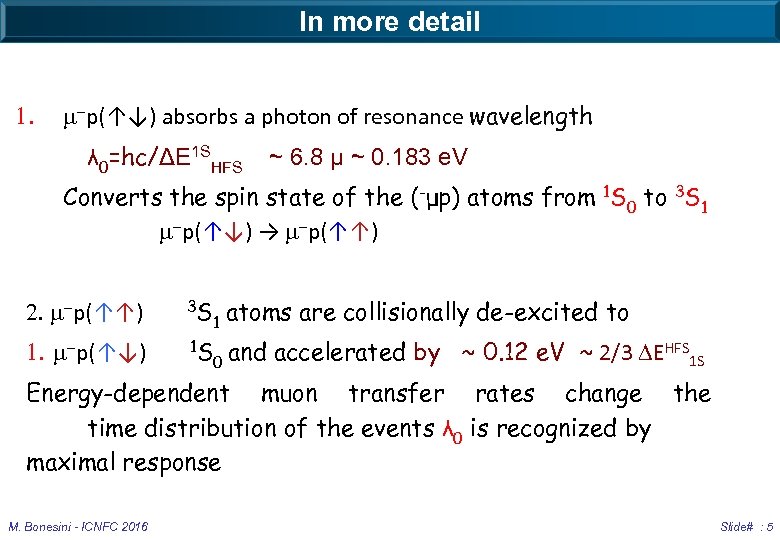 In more detail 1. m-p(↑↓) absorbs a photon of resonance wavelength λ 0=hc/ΔE 1 SHFS ~ 6. 8 μ ~ 0. 183 e. V Converts the spin state of the (-μp) atoms from 1 S 0 to 3 S 1 m-p(↑↓) → m-p(↑↑) 2. m-p(↑↑) 3 S 1. m-p(↑↓) 1 S 1 atoms are collisionally de-excited to and accelerated by ~ 0. 12 e. V ~ 2/3 DEHFS 1 S 0 Energy-dependent muon transfer rates change the time distribution of the events λ 0 is recognized by maximal response M. Bonesini - ICNFC 2016 Slide# : 5
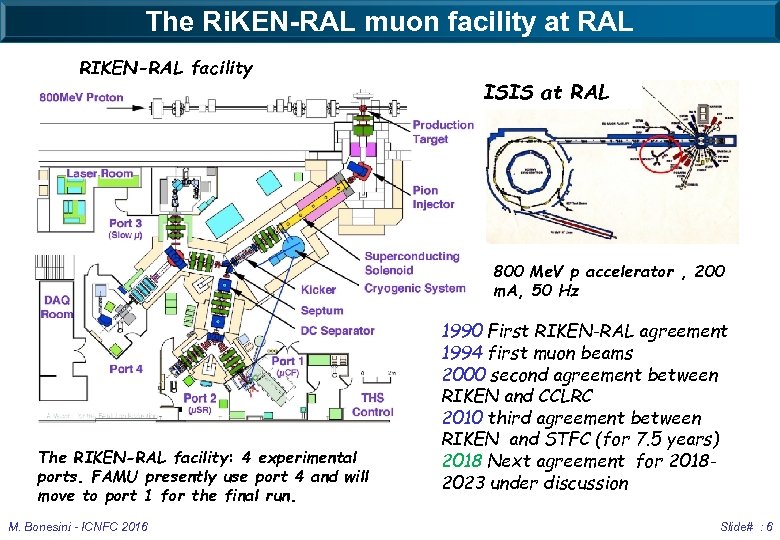 The Ri. KEN-RAL muon facility at RAL RIKEN-RAL facility ISIS at RAL 800 Me. V p accelerator , 200 m. A, 50 Hz The RIKEN-RAL facility: 4 experimental ports. FAMU presently use port 4 and will move to port 1 for the final run. M. Bonesini - ICNFC 2016 1990 First RIKEN-RAL agreement 1994 first muon beams 2000 second agreement between RIKEN and CCLRC 2010 third agreement between RIKEN and STFC (for 7. 5 years) 2018 Next agreement for 20182023 under discussion Slide# : 6
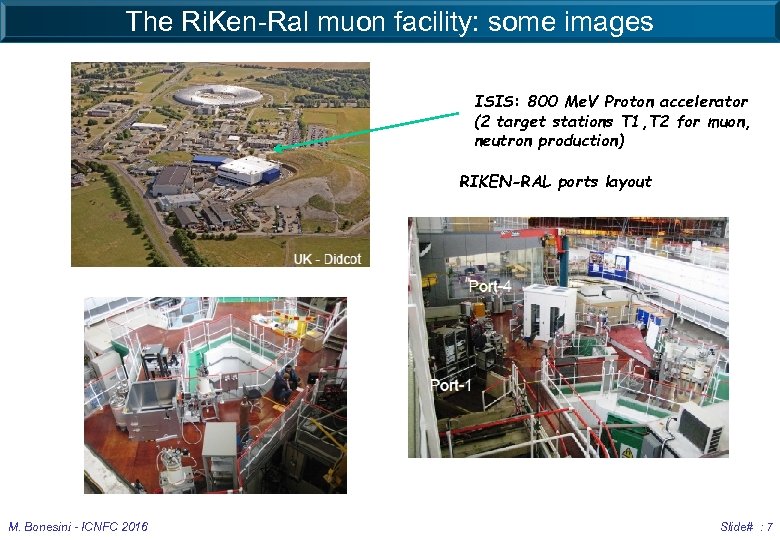 The Ri. Ken-Ral muon facility: some images ISIS: 800 Me. V Proton accelerator (2 target stations T 1, T 2 for muon, neutron production) RIKEN-RAL ports layout M. Bonesini - ICNFC 2016 Slide# : 7
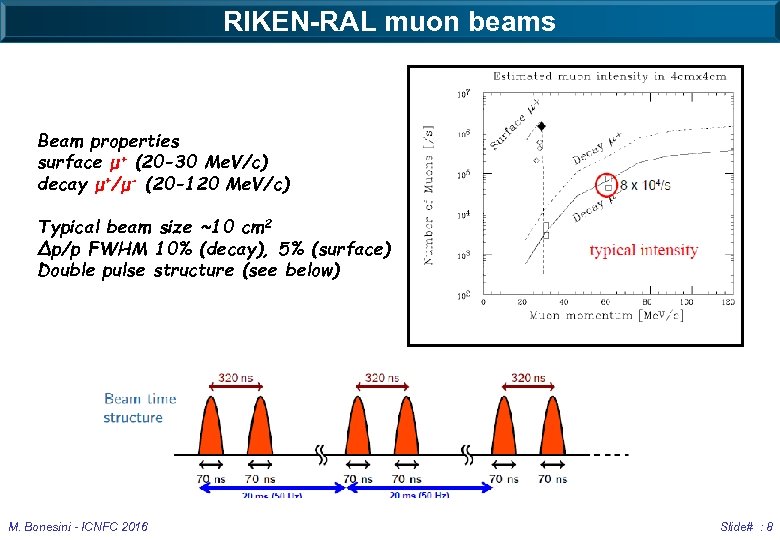 RIKEN-RAL muon beams Beam properties surface μ+ (20 -30 Me. V/c) decay μ+/μ- (20 -120 Me. V/c) Typical beam size ~10 cm 2 Δp/p FWHM 10% (decay), 5% (surface) Double pulse structure (see below) M. Bonesini - ICNFC 2016 Slide# : 8
 The FAMU proposal experimental phases 1. Muon beam study, target and detectors tests, preliminary measure of transfer rate (@ constant conditions of PTV) – 2014 beam test (results later) 2. Optimize run conditions: best gas mixture at temperature T and pressure p (to be determined) to observe and measure the transfer rate energy dependennce – 2015 December run and February 2016 run → At this point the validity of the method to measure HFS is demonstrated 3. Full working setup with laser and cavity to determine proton Zemach radius (2017 -2018) M. Bonesini - ICNFC 2016 Slide# : 9
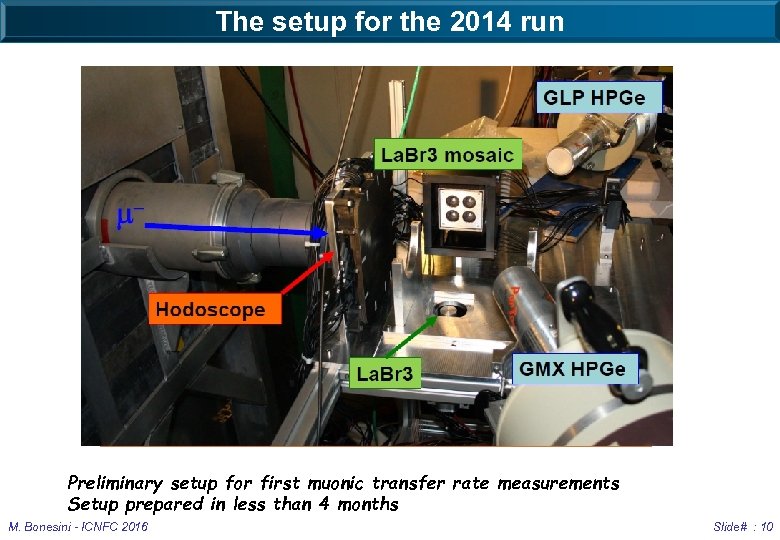 The setup for the 2014 run Preliminary setup for first muonic transfer rate measurements Setup prepared in less than 4 months M. Bonesini - ICNFC 2016 Slide# : 10
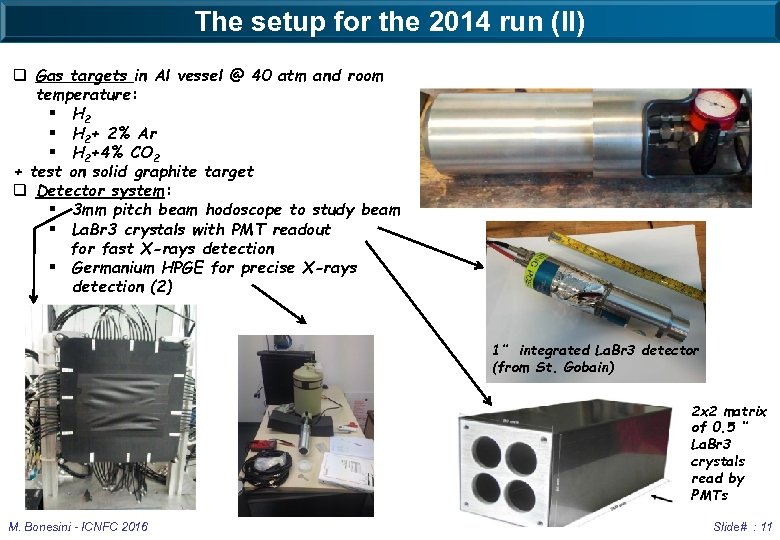 The setup for the 2014 run (II) q Gas targets in Al vessel @ 40 atm and room temperature: § H 2+ 2% Ar § H 2+4% CO 2 + test on solid graphite target q Detector system: § 3 mm pitch beam hodoscope to study beam § La. Br 3 crystals with PMT readout for fast X-rays detection § Germanium HPGE for precise X-rays detection (2) 1’’ integrated La. Br 3 detector (from St. Gobain) 2 x 2 matrix of 0. 5 ‘’ La. Br 3 crystals read by PMTs M. Bonesini - ICNFC 2016 Slide# : 11
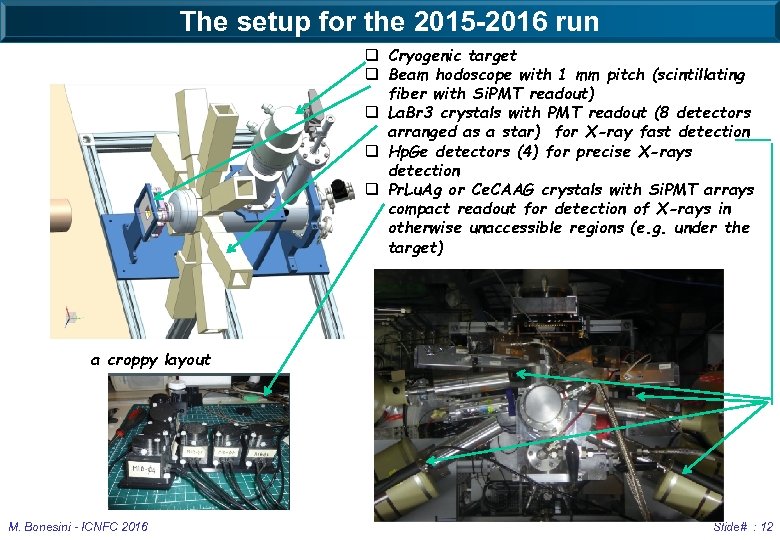 The setup for the 2015 -2016 run q Cryogenic target q Beam hodoscope with 1 mm pitch (scintillating fiber with Si. PMT readout) q La. Br 3 crystals with PMT readout (8 detectors arranged as a star) for X-ray fast detection q Hp. Ge detectors (4) for precise X-rays detection q Pr. Lu. Ag or Ce. CAAG crystals with Si. PMT arrays compact readout for detection of X-rays in otherwise unaccessible regions (e. g. under the target) a croppy layout M. Bonesini - ICNFC 2016 Slide# : 12
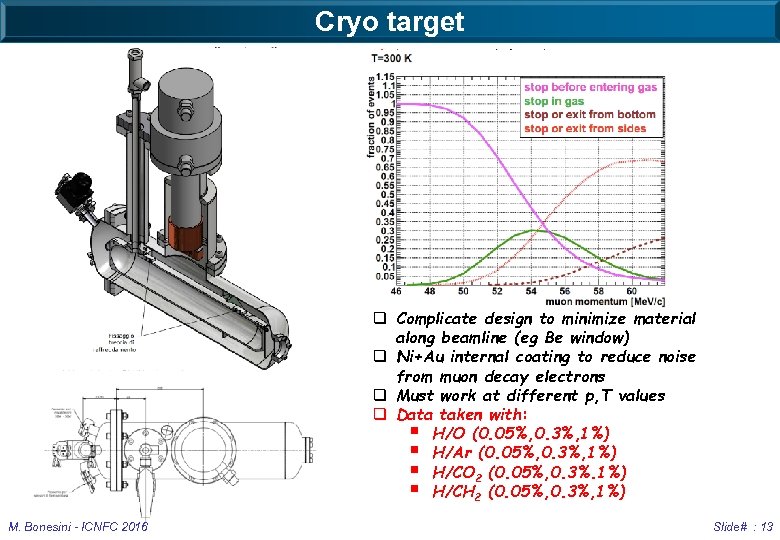 Cryo target q Complicate design to minimize material along beamline (eg Be window) q Ni+Au internal coating to reduce noise from muon decay electrons q Must work at different p, T values q Data taken with: § H/O (0. 05%, 0. 3%, 1%) § H/Ar (0. 05%, 0. 3%, 1%) § H/CO 2 (0. 05%, 0. 3%. 1%) § H/CH 2 (0. 05%, 0. 3%, 1%) M. Bonesini - ICNFC 2016 Slide# : 13
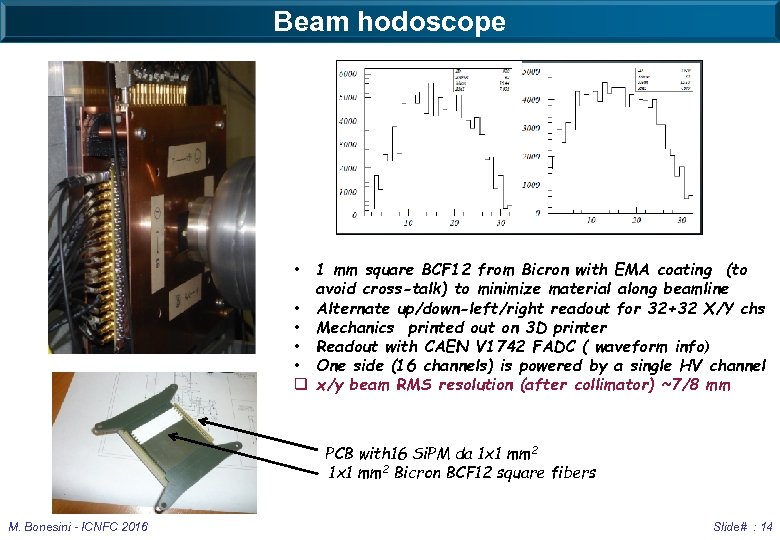 Beam hodoscope 1 mm square BCF 12 from Bicron with EMA coating (to avoid cross-talk) to minimize material along beamline • Alternate up/down-left/right readout for 32+32 X/Y chs • Mechanics printed out on 3 D printer • Readout with CAEN V 1742 FADC ( waveform info) • One side (16 channels) is powered by a single HV channel q x/y beam RMS resolution (after collimator) ~7/8 mm • PCB with 16 Si. PM da 1 x 1 mm 2 Bicron BCF 12 square fibers M. Bonesini - ICNFC 2016 Slide# : 14
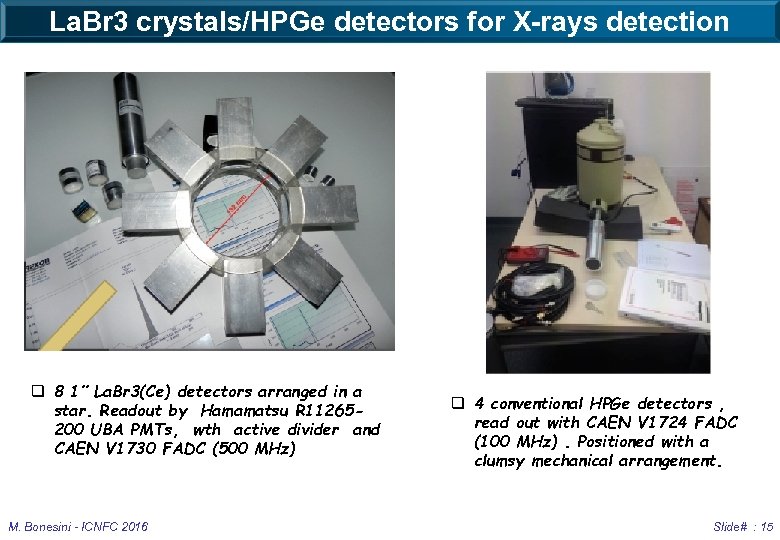 La. Br 3 crystals/HPGe detectors for X-rays detection q 8 1’’ La. Br 3(Ce) detectors arranged in a star. Readout by Hamamatsu R 11265200 UBA PMTs, wth active divider and CAEN V 1730 FADC (500 MHz) M. Bonesini - ICNFC 2016 q 4 conventional HPGe detectors , read out with CAEN V 1724 FADC (100 MHz). Positioned with a clumsy mechanical arrangement. Slide# : 15
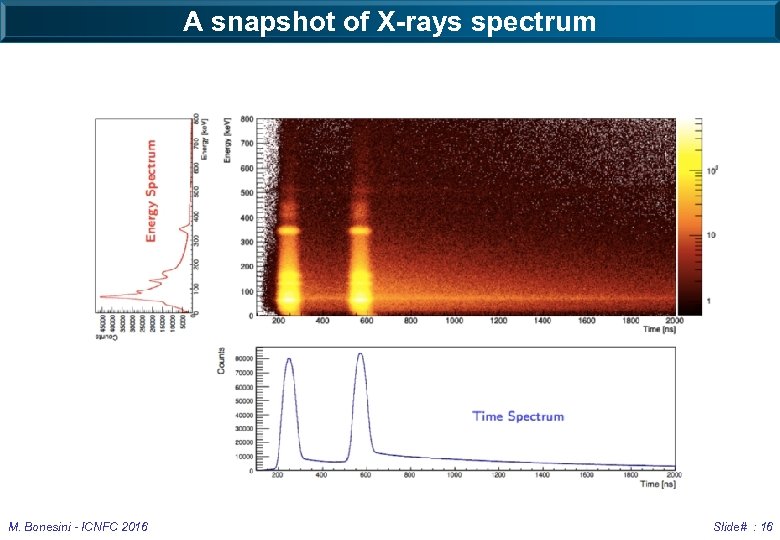 A snapshot of X-rays spectrum M. Bonesini - ICNFC 2016 Slide# : 16
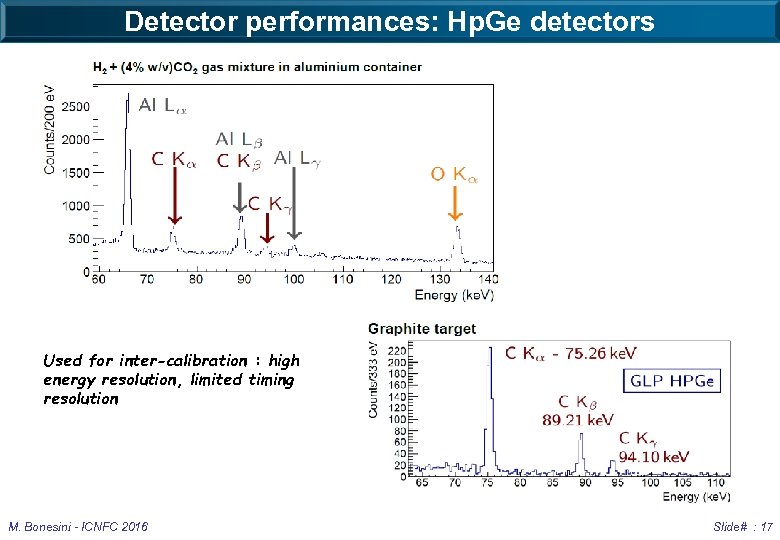 Detector performances: Hp. Ge detectors Used for inter-calibration : high energy resolution, limited timing resolution M. Bonesini - ICNFC 2016 Slide# : 17
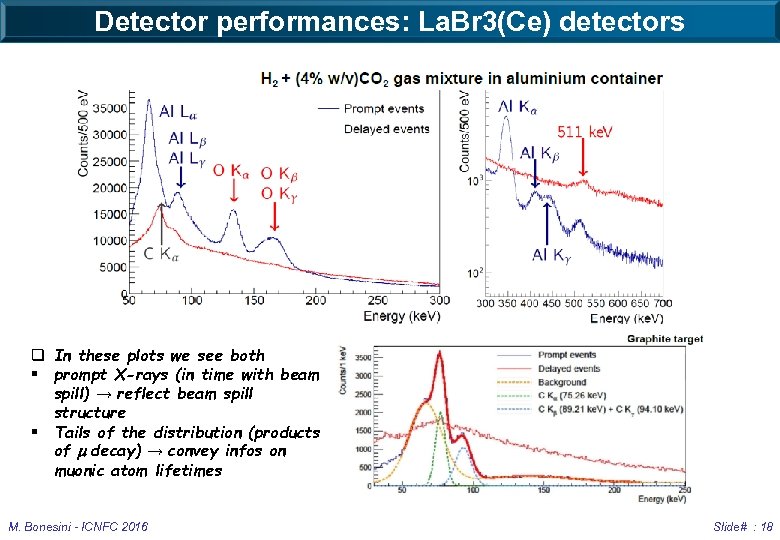 Detector performances: La. Br 3(Ce) detectors q In these plots we see both § prompt X-rays (in time with beam spill) → reflect beam spill structure § Tails of the distribution (products of m decay) → convey infos on muonic atom lifetimes M. Bonesini - ICNFC 2016 Slide# : 18
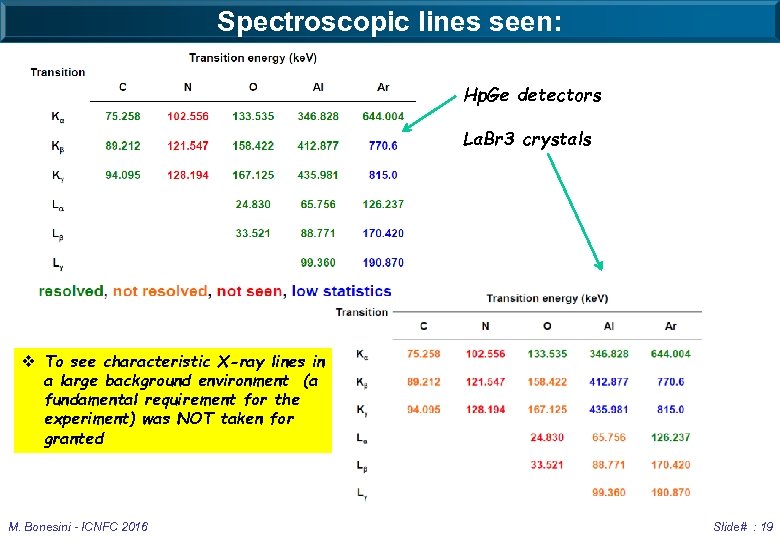 Spectroscopic lines seen: Hp. Ge detectors La. Br 3 crystals v To see characteristic X-ray lines in a large background environment (a fundamental requirement for the experiment) was NOT taken for granted M. Bonesini - ICNFC 2016 Slide# : 19
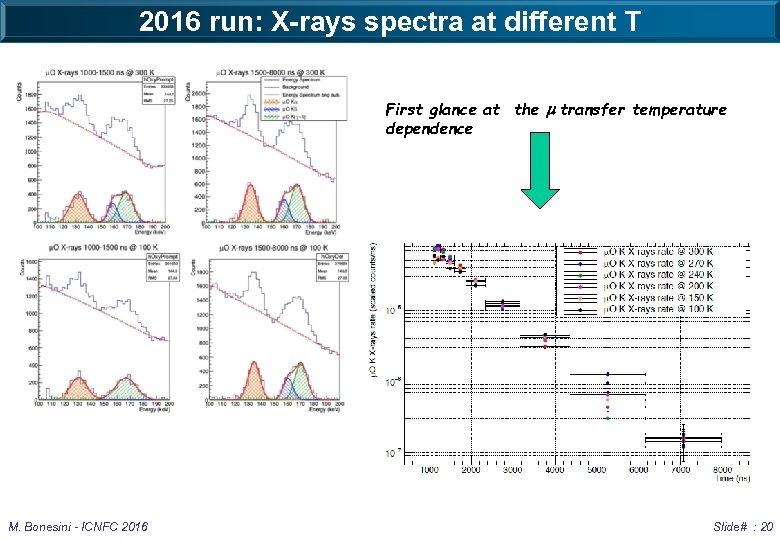 2016 run: X-rays spectra at different T First glance at the m transfer temperature dependence M. Bonesini - ICNFC 2016 Slide# : 20
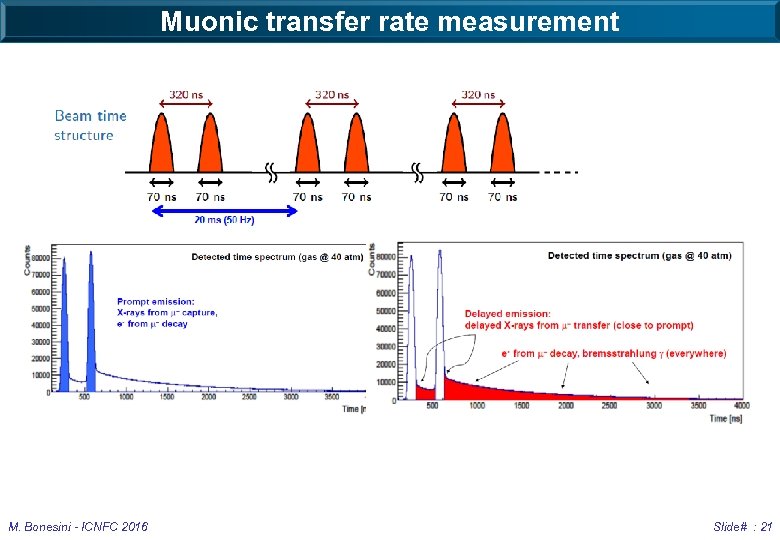 Muonic transfer rate measurement M. Bonesini - ICNFC 2016 Slide# : 21
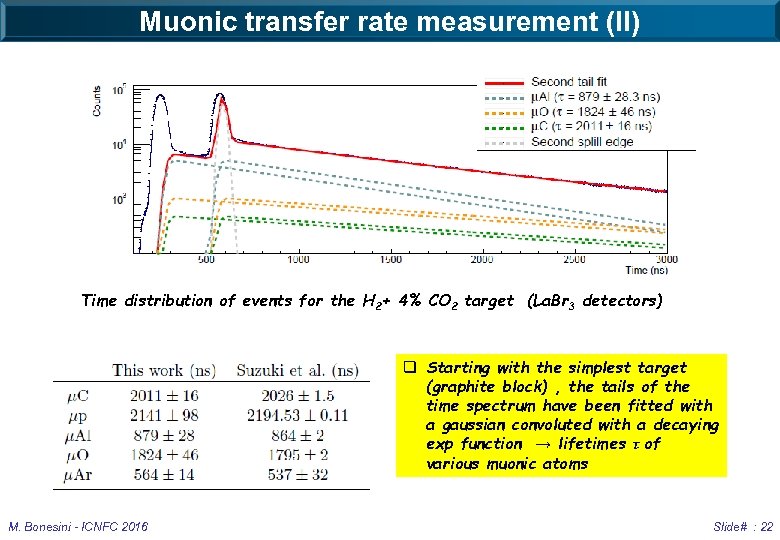 Muonic transfer rate measurement (II) Time distribution of events for the H 2+ 4% CO 2 target (La. Br 3 detectors) q Starting with the simplest target (graphite block) , the tails of the time spectrum have been fitted with a gaussian convoluted with a decaying exp function → lifetimes τ of various muonic atoms M. Bonesini - ICNFC 2016 Slide# : 22
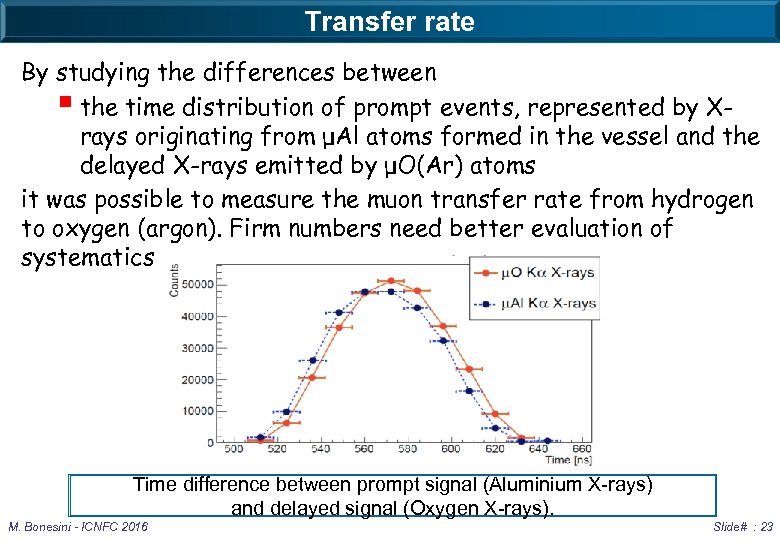 Transfer rate By studying the differences between § the time distribution of prompt events, represented by Xrays originating from μAl atoms formed in the vessel and the delayed X-rays emitted by μO(Ar) atoms it was possible to measure the muon transfer rate from hydrogen to oxygen (argon). Firm numbers need better evaluation of systematics Time difference between prompt signal (Aluminium X-rays) and delayed signal (Oxygen X-rays). M. Bonesini - ICNFC 2016 Slide# : 23
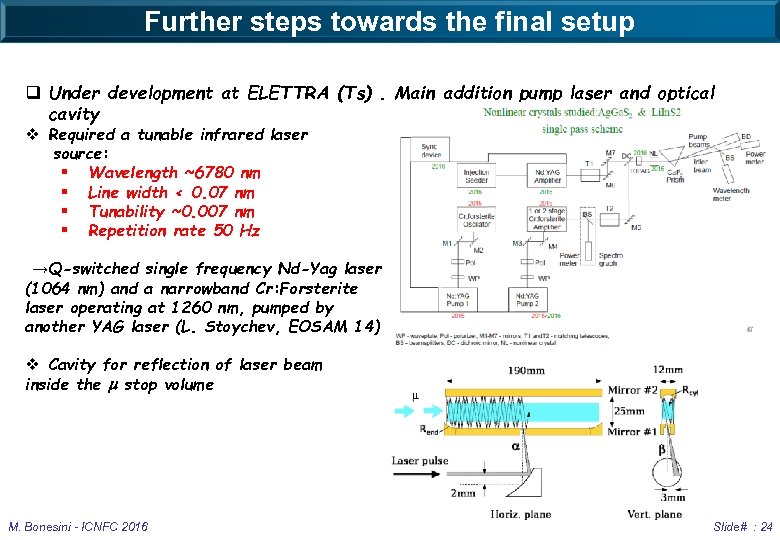 Further steps towards the final setup q Under development at ELETTRA (Ts). Main addition pump laser and optical cavity v Required a tunable infrared laser source: § Wavelength ~6780 nm § Line width < 0. 07 nm § Tunability ~0. 007 nm § Repetition rate 50 Hz →Q-switched single frequency Nd-Yag laser (1064 nm) and a narrowband Cr: Forsterite laser operating at 1260 nm, pumped by another YAG laser (L. Stoychev, EOSAM 14) v Cavity for reflection of laser beam inside the m stop volume M. Bonesini - ICNFC 2016 Slide# : 24
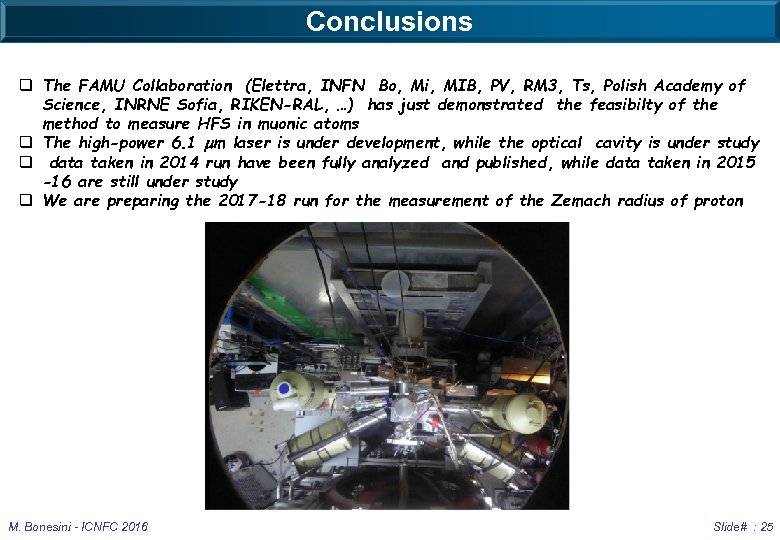 Conclusions q The FAMU Collaboration (Elettra, INFN Bo, Mi, MIB, PV, RM 3, Ts, Polish Academy of Science, INRNE Sofia, RIKEN-RAL, …) has just demonstrated the feasibilty of the method to measure HFS in muonic atoms q The high-power 6. 1 mm laser is under development, while the optical cavity is under study q data taken in 2014 run have been fully analyzed and published, while data taken in 2015 -16 are still under study q We are preparing the 2017 -18 run for the measurement of the Zemach radius of proton M. Bonesini - ICNFC 2016 Slide# : 25
 Backup material M. Bonesini - ICNFC 2016 Slide# : 26
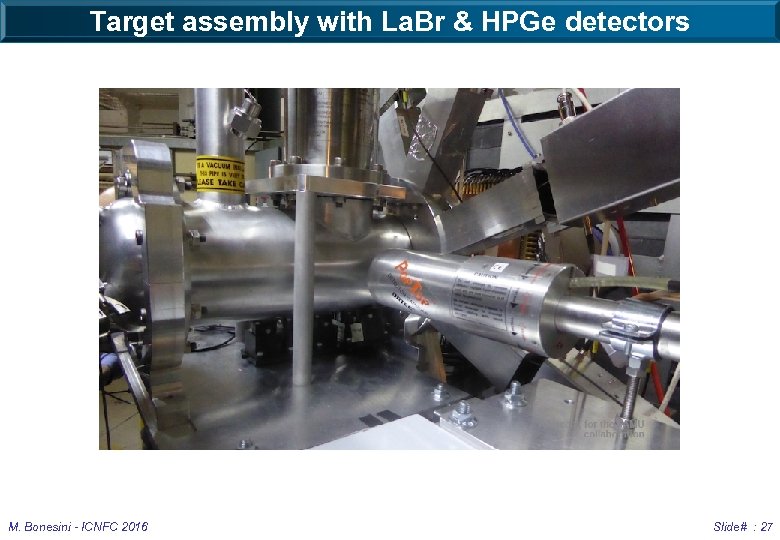 Target assembly with La. Br & HPGe detectors M. Bonesini - ICNFC 2016 Slide# : 27
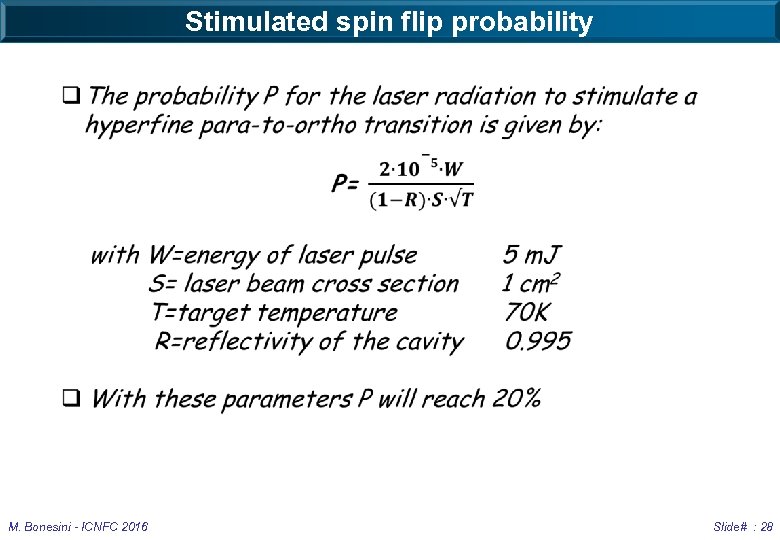 Stimulated spin flip probability M. Bonesini - ICNFC 2016 Slide# : 28
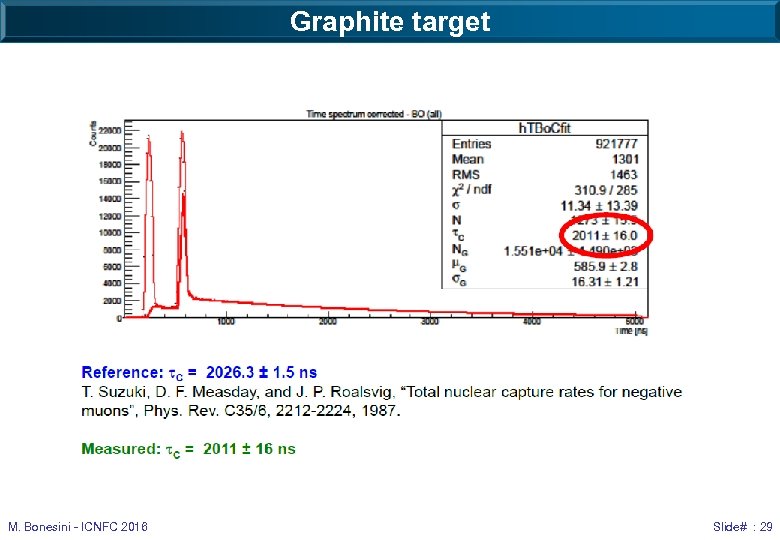 Graphite target M. Bonesini - ICNFC 2016 Slide# : 29
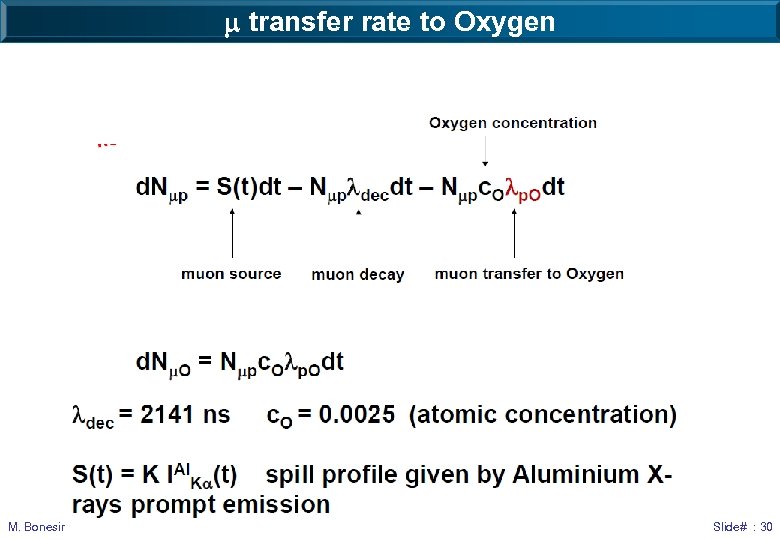 m transfer rate to Oxygen M. Bonesini - ICNFC 2016 Slide# : 30
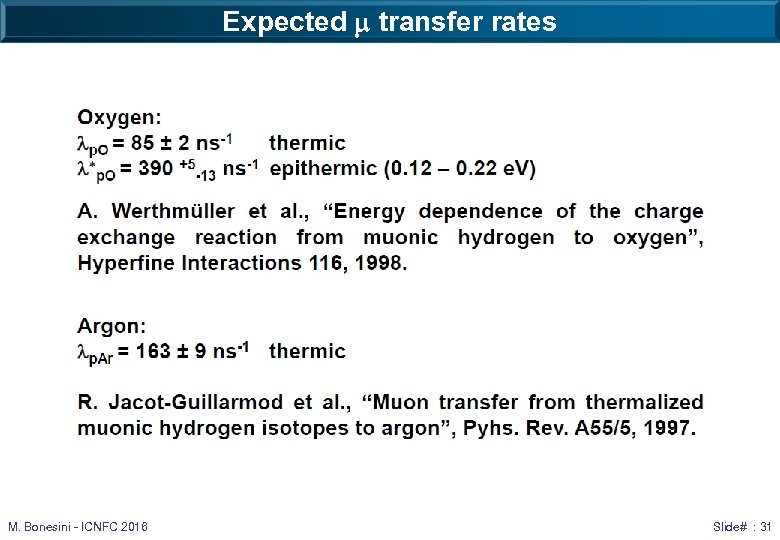 Expected m transfer rates M. Bonesini - ICNFC 2016 Slide# : 31