


 Скачать презентацию 5 OH 5 -1 Controlling Food Costs in
14624dbcab4c33c974f3b50ddf3edaba.ppt
- Количество слайдов: 34
 5 OH 5 -1 Controlling Food Costs in Purchasing and Receiving
 Learning Objectives After completing this chapter, you should be able to: • Explain the purchase process and determine who should make purchasing decisions. • Describe the importance of par levels and how to establish them. • Explain different types of purchasing methods and their uses. • Describe the parts of a purchase specification and of a purchase order. • Explain the importance of maintaining an ordering system. OH 5 -2
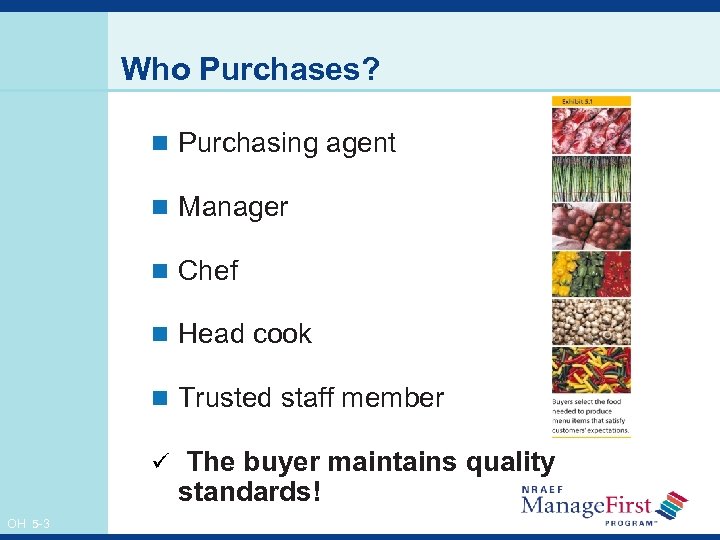 Who Purchases? n Purchasing agent n Manager n Chef n Head cook n Trusted staff member ü The buyer maintains quality standards! OH 5 -3
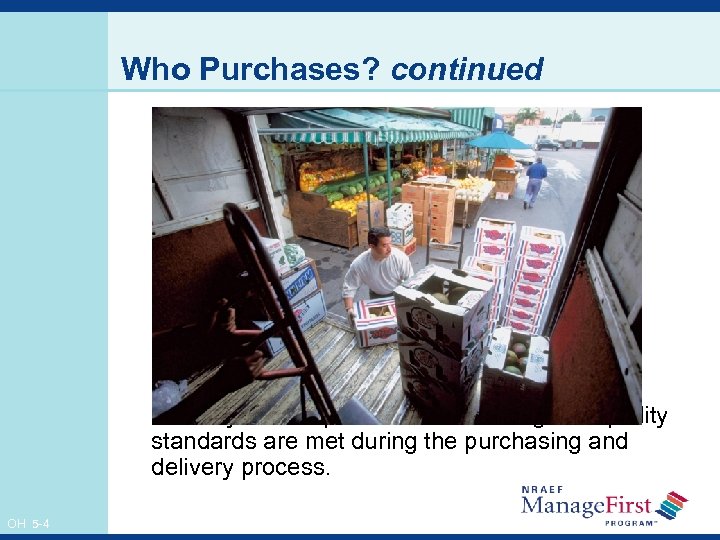 Who Purchases? continued The buyer is responsible for ensuring that quality standards are met during the purchasing and delivery process. OH 5 -4
 What to Buy n Avoid buying the “cheapest. ” n Use purchase specifications. n Buy at the best cost from sellers who meet or exceed the purchase specifications. n Consider both AP price and EP cost. OH 5 -5
 Two Kinds of Costs n As purchased (AP)—the cost of food as delivered to the restaurant n Edible portion (EP)—the cost of food as served to the guest OH 5 -6
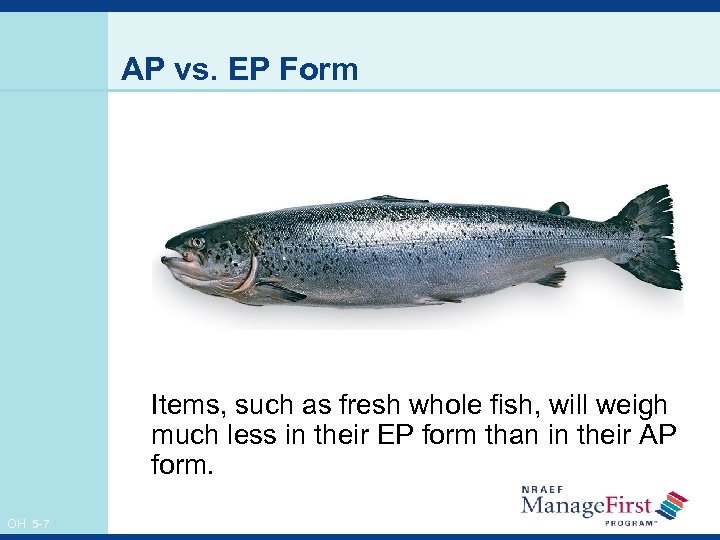 AP vs. EP Form Items, such as fresh whole fish, will weigh much less in their EP form than in their AP form. OH 5 -7
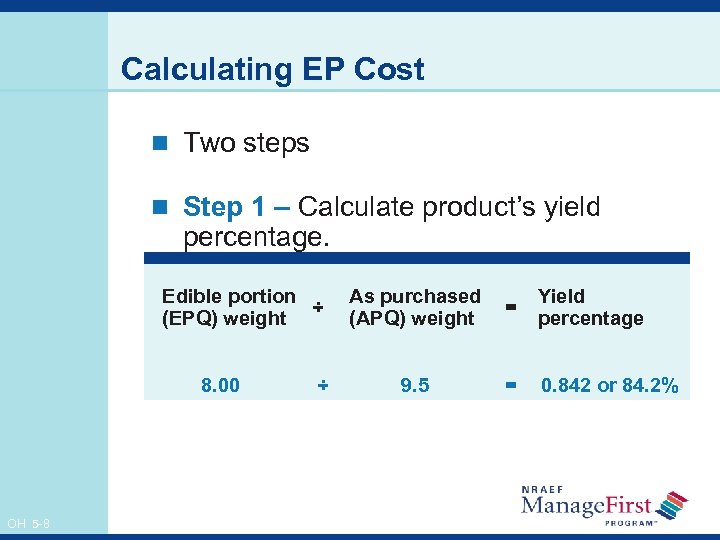 Calculating EP Cost n Two steps n Step 1 – Calculate product’s yield percentage. Edible portion ÷ (EPQ) weight 8. 00 OH 5 -8 ÷ As purchased (APQ) weight = Yield percentage 9. 5 = 0. 842 or 84. 2%
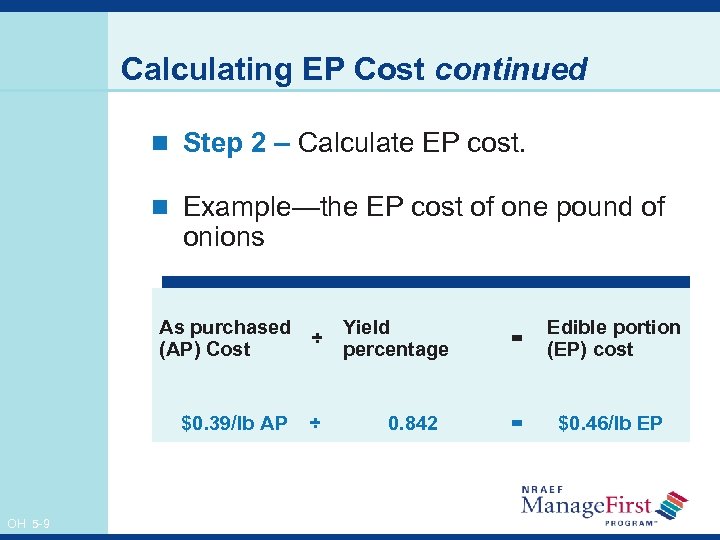 Calculating EP Cost continued n Step 2 – Calculate EP cost. n Example—the EP cost of one pound of onions As purchased (AP) Cost $0. 39/lb AP OH 5 -9 ÷ ÷ Yield percentage 0. 842 = Edible portion (EP) cost = $0. 46/lb EP
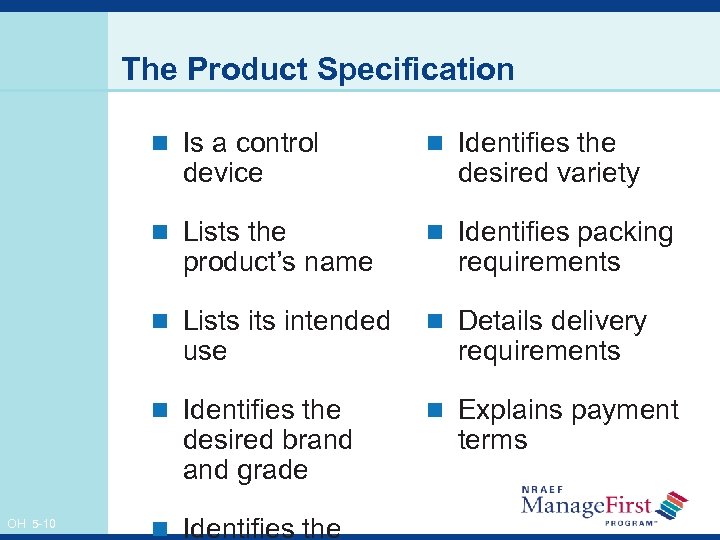 The Product Specification n Is a control n Identifies the n Lists the n Identifies packing n Lists intended n Details delivery n Identifies the n Explains payment device product’s name use desired brand grade OH 5 -10 n Identifies the desired variety requirements terms
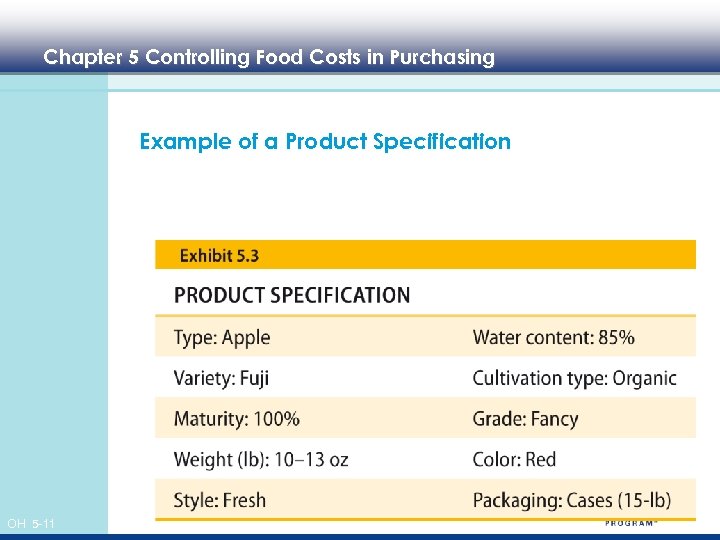 Chapter 5 Controlling Food Costs in Purchasing Example of a Product Specification OH 5 -11
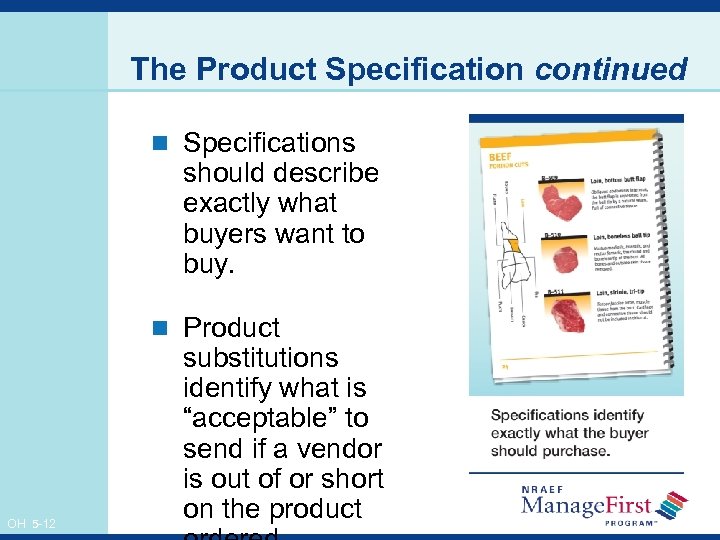 The Product Specification continued n Specifications should describe exactly what buyers want to buy. n Product OH 5 -12 substitutions identify what is “acceptable” to send if a vendor is out of or short on the product
 When to Buy n Purchase perishable items daily or every few days. n Purchase nonperishable items weekly or monthly. OH 5 -13
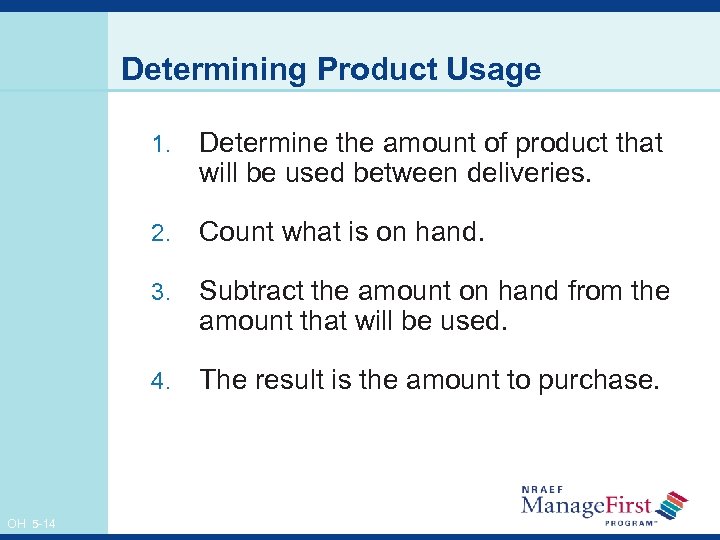 Determining Product Usage 1. 2. Count what is on hand. 3. Subtract the amount on hand from the amount that will be used. 4. OH 5 -14 Determine the amount of product that will be used between deliveries. The result is the amount to purchase.
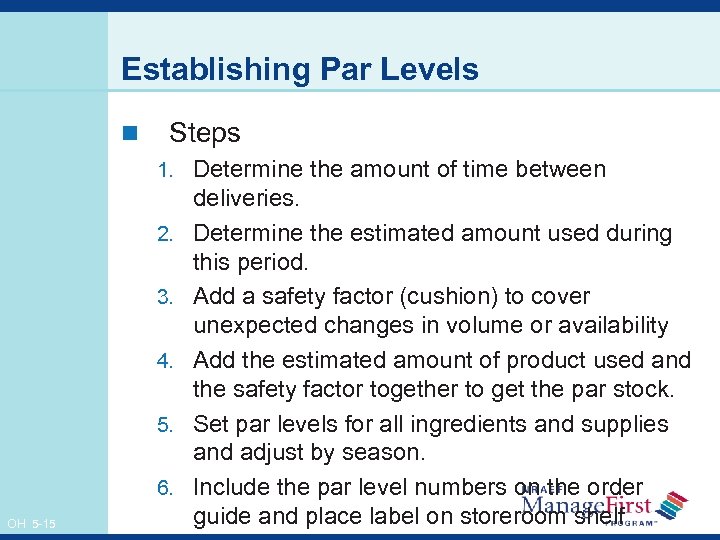 Establishing Par Levels n Steps 1. Determine the amount of time between 2. 3. 4. 5. 6. OH 5 -15 deliveries. Determine the estimated amount used during this period. Add a safety factor (cushion) to cover unexpected changes in volume or availability Add the estimated amount of product used and the safety factor together to get the par stock. Set par levels for all ingredients and supplies and adjust by season. Include the par level numbers on the order guide and place label on storeroom shelf
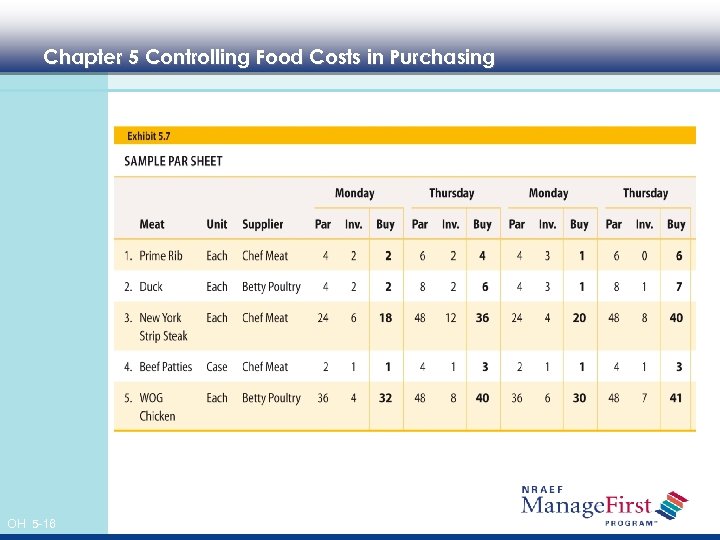 Chapter 5 Controlling Food Costs in Purchasing OH 5 -16
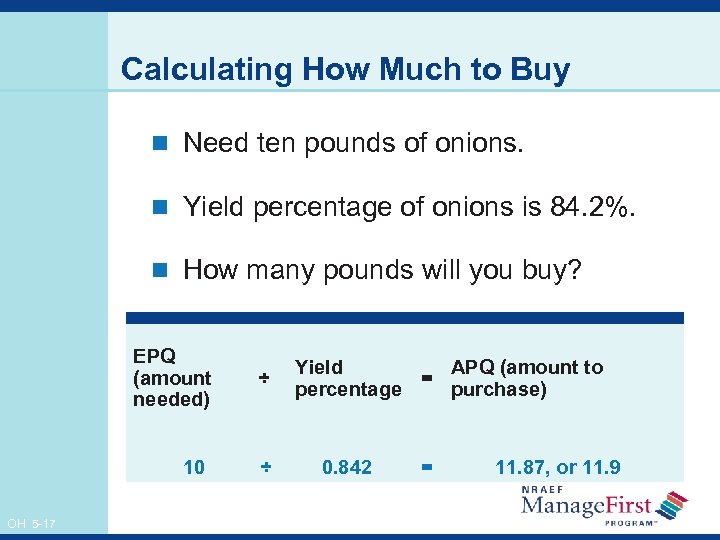 Calculating How Much to Buy n Need ten pounds of onions. n Yield percentage of onions is 84. 2%. n How many pounds will you buy? EPQ (amount needed) 10 OH 5 -17 ÷ ÷ Yield APQ (amount to = percentage purchase) 0. 842 = 11. 87, or 11. 9
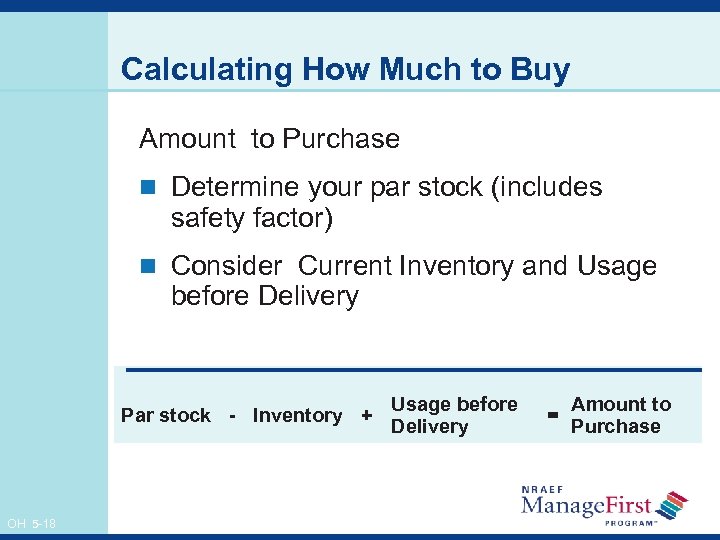 Calculating How Much to Buy Amount to Purchase n Determine your par stock (includes safety factor) n Consider Current Inventory and Usage before Delivery Par stock - Inventory + OH 5 -18 Usage before Delivery = Amount to Purchase
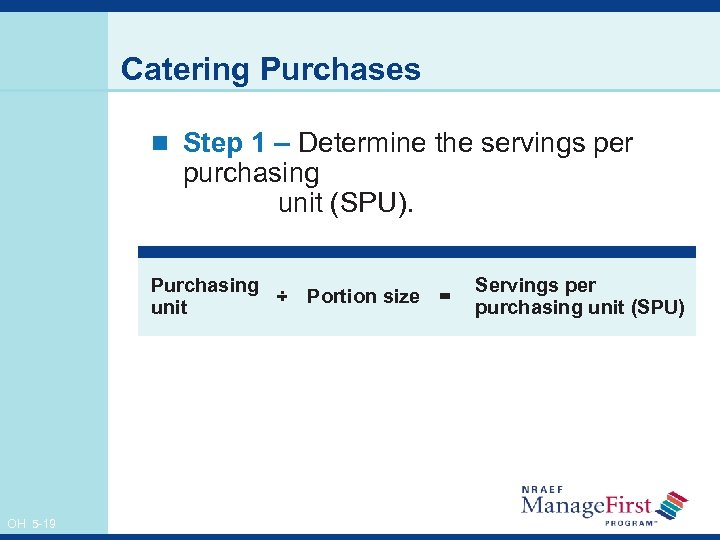 Catering Purchases n Step 1 – Determine the servings per purchasing unit (SPU). Purchasing ÷ Portion size = unit OH 5 -19 Servings per purchasing unit (SPU)
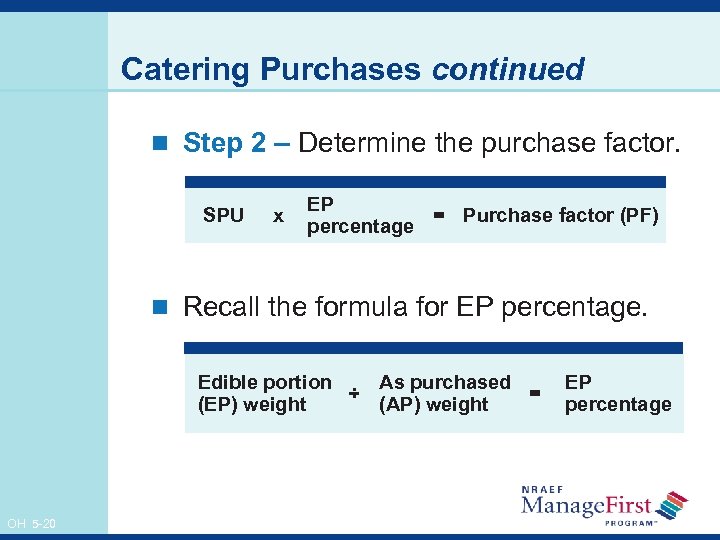 Catering Purchases continued n Step 2 – Determine the purchase factor. SPU x EP = Purchase factor (PF) percentage n Recall the formula for EP percentage. Edible portion As purchased ÷ = (EP) weight (AP) weight OH 5 -20 EP percentage
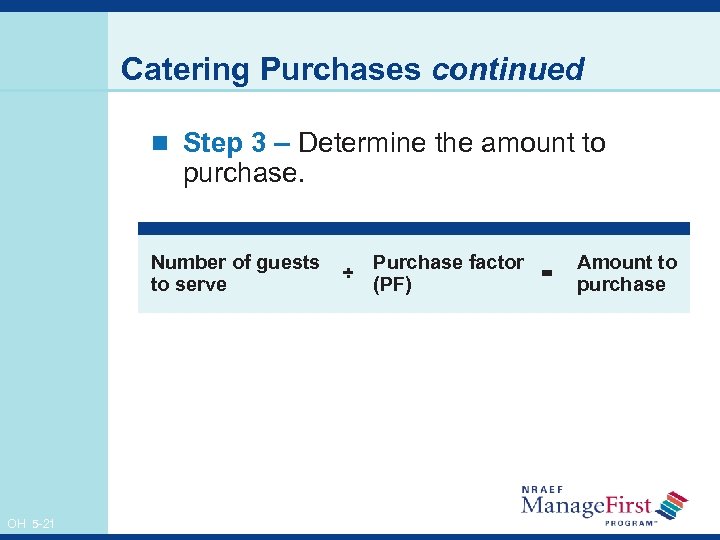 Catering Purchases continued n Step 3 – Determine the amount to purchase. Number of guests to serve OH 5 -21 ÷ Purchase factor = (PF) Amount to purchase
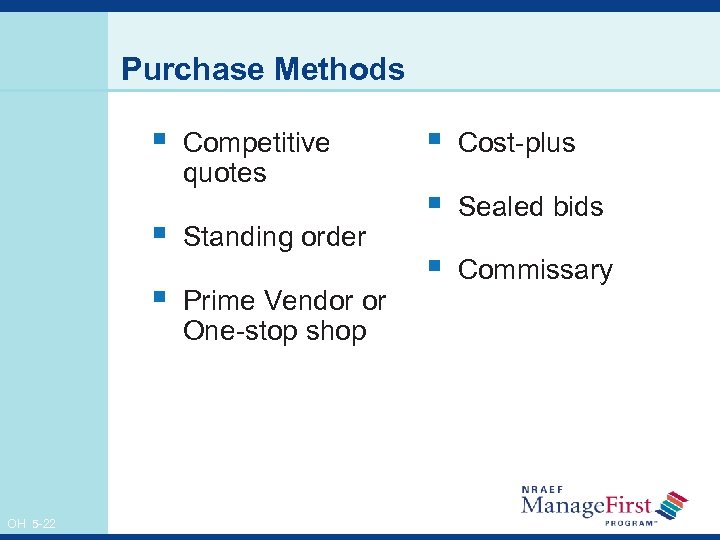 Purchase Methods § § § OH 5 -22 Competitive quotes Standing order Prime Vendor or One-stop shop § Cost-plus § Sealed bids § Commissary
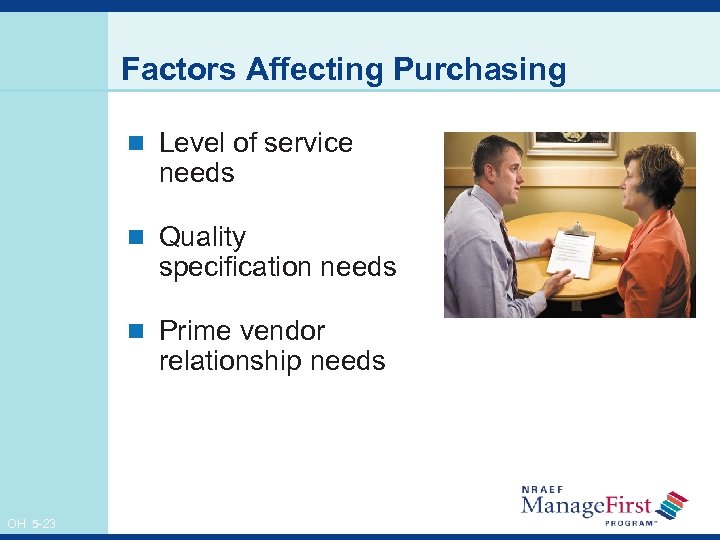 Factors Affecting Purchasing n Level of service needs n Quality specification needs n Prime vendor relationship needs OH 5 -23
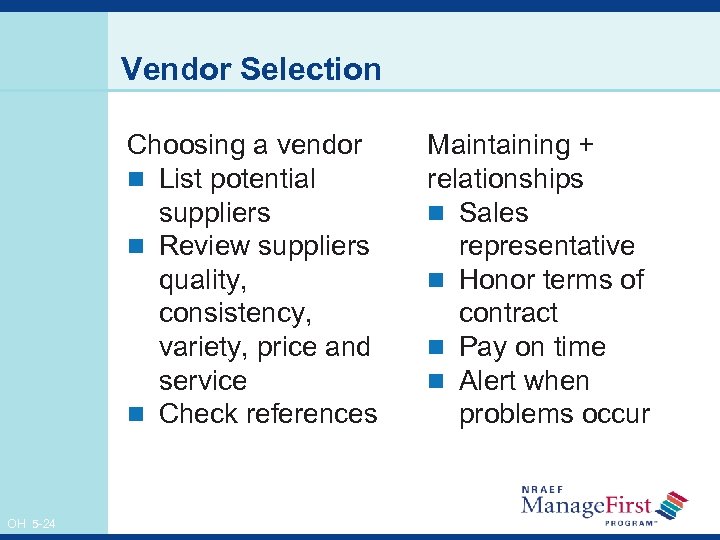 Vendor Selection Choosing a vendor n List potential suppliers n Review suppliers quality, consistency, variety, price and service n Check references OH 5 -24 Maintaining + relationships n Sales representative n Honor terms of contract n Pay on time n Alert when problems occur
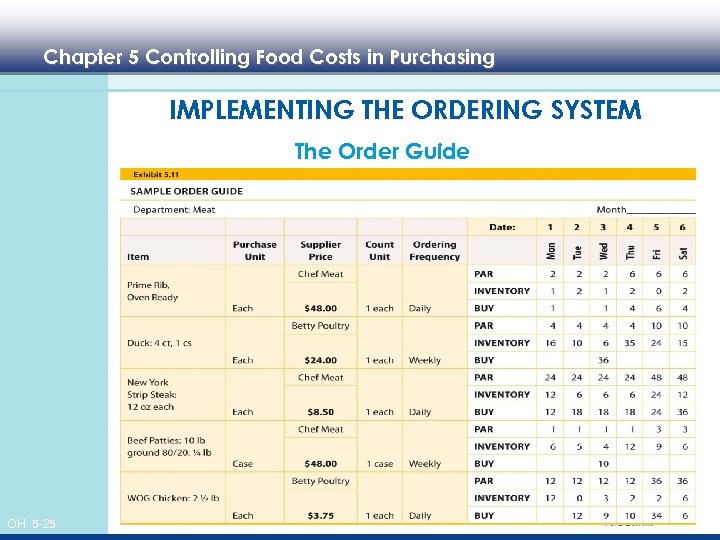 Chapter 5 Controlling Food Costs in Purchasing IMPLEMENTING THE ORDERING SYSTEM The Order Guide OH 5 -25
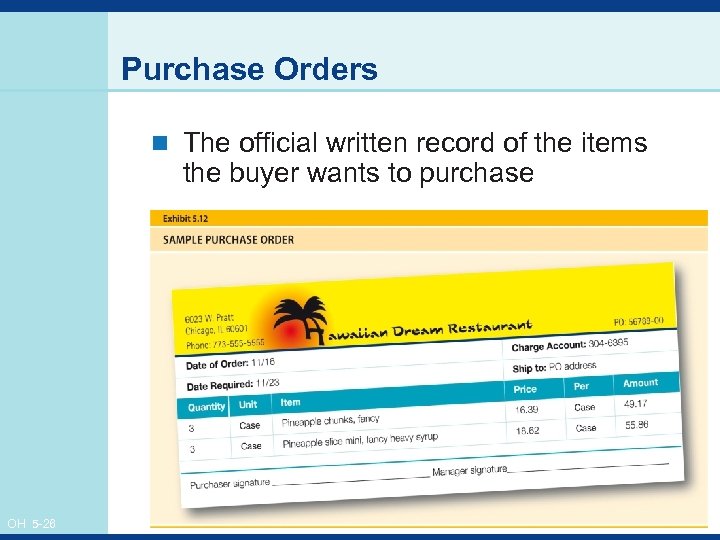 Purchase Orders n The official written record of the items the buyer wants to purchase OH 5 -26
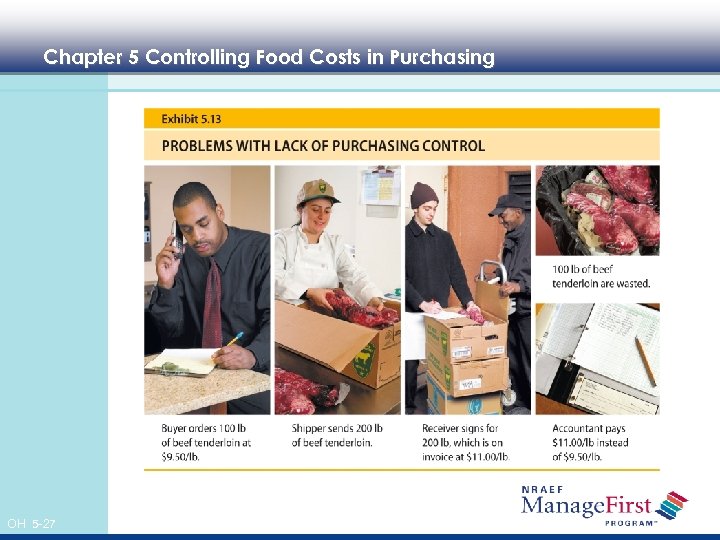 Chapter 5 Controlling Food Costs in Purchasing OH 5 -27
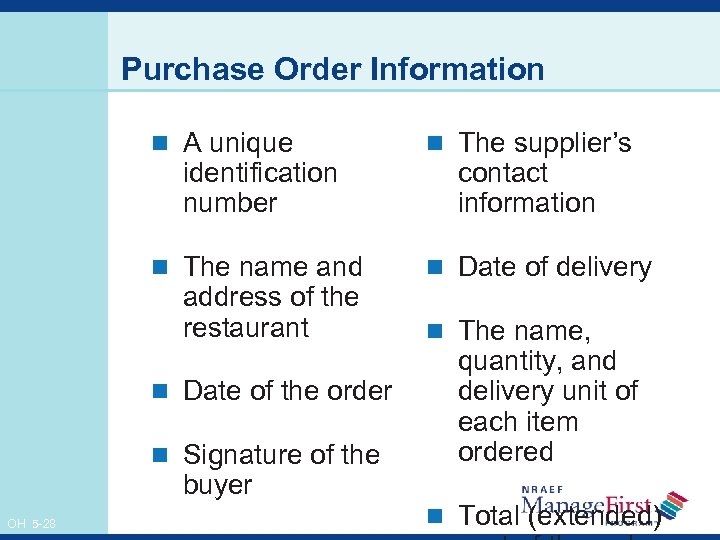 Purchase Order Information n A unique n The supplier’s n The name and n Date of delivery identification number address of the restaurant n Date of the order n Signature of the buyer OH 5 -28 contact information n The name, quantity, and delivery unit of each item ordered n Total (extended)
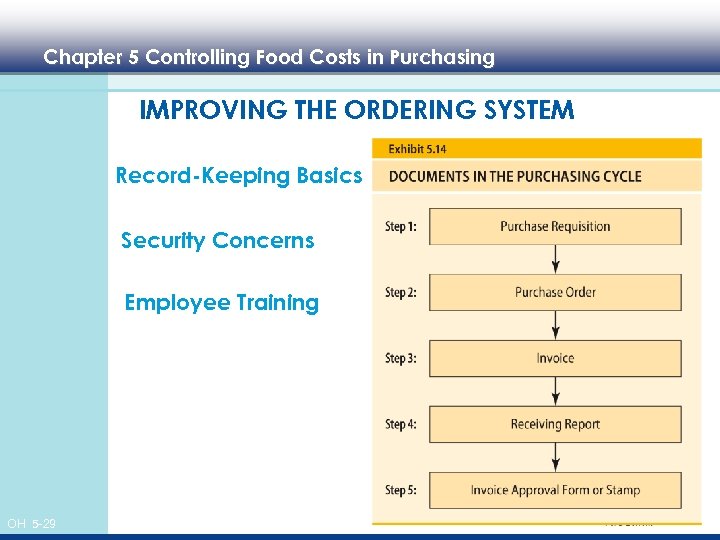 Chapter 5 Controlling Food Costs in Purchasing IMPROVING THE ORDERING SYSTEM Record-Keeping Basics Security Concerns Employee Training OH 5 -29
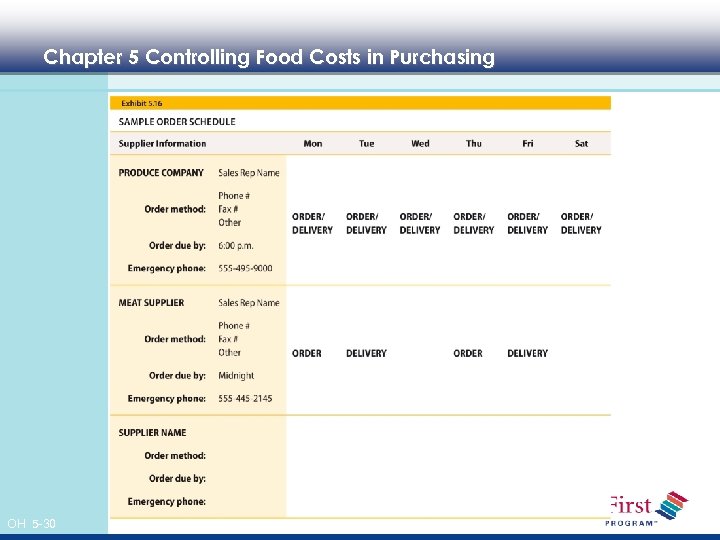 Chapter 5 Controlling Food Costs in Purchasing OH 5 -30
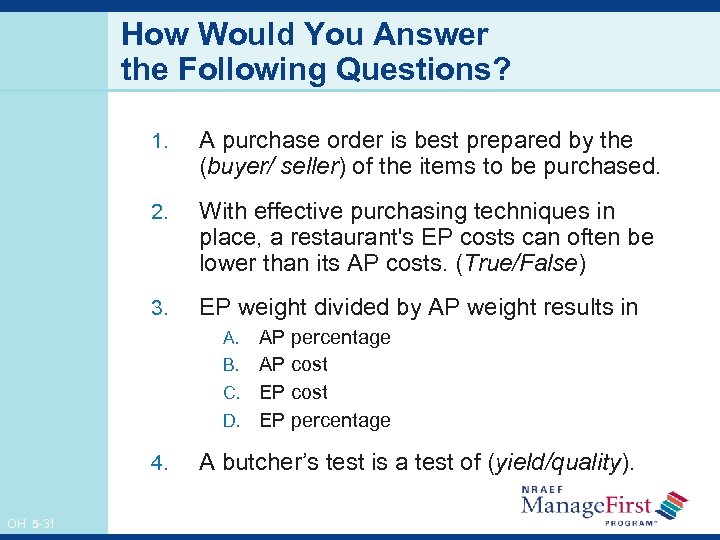 How Would You Answer the Following Questions? 1. A purchase order is best prepared by the (buyer/ seller) of the items to be purchased. 2. With effective purchasing techniques in place, a restaurant's EP costs can often be lower than its AP costs. (True/False) 3. EP weight divided by AP weight results in AP percentage B. AP cost C. EP cost D. EP percentage A. 4. OH 5 -31 A butcher’s test is a test of (yield/quality).
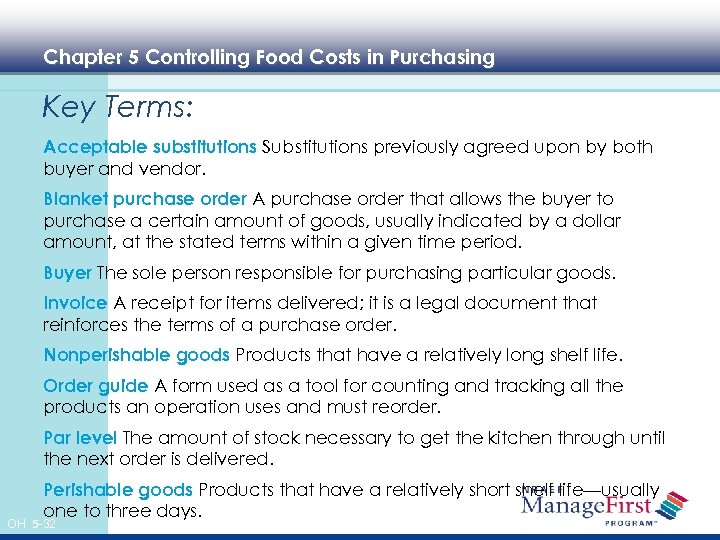 Chapter 5 Controlling Food Costs in Purchasing Key Terms: Acceptable substitutions Substitutions previously agreed upon by both buyer and vendor. Blanket purchase order A purchase order that allows the buyer to purchase a certain amount of goods, usually indicated by a dollar amount, at the stated terms within a given time period. Buyer The sole person responsible for purchasing particular goods. Invoice A receipt for items delivered; it is a legal document that reinforces the terms of a purchase order. Nonperishable goods Products that have a relatively long shelf life. Order guide A form used as a tool for counting and tracking all the products an operation uses and must reorder. Par level The amount of stock necessary to get the kitchen through until the next order is delivered. Perishable goods Products that have a relatively short shelf life—usually one to three days. OH 5 -32
 Chapter 5 Controlling Food Costs in Purchasing Key Terms continued: Perpetual inventory A theoretical count based on goods received and issued, which exists on paper only. Prime vendor A purchasing method that involves purchasing most, if not all, of an operation’s goods from one supplier; also called the one-stop shop. Purchase order (PO) A form issued by a buyer and sent to a vendor that indicates the items and quantities to be purchased. Quotes An offer made by a supplier. Sales representative A supplier’s salesperson who would be assigned to an operation. Specification A description of the desired product’s name, intended use, grade, size, and other product characteristics; it can include general instructions regarding delivery, payment procedures, and other pertinent data. OH 5 -33
 Chapter 5 Controlling Food Costs in Purchasing Key Terms continued: Standing order The replenishment of stock by a vendor made on a regular basis. Supplier A company that provides products purchased for use in restaurant and foodservice operations, also called a vendor. OH 5 -34