


 Скачать презентацию 5 3 Order of pronouns Envoyez-le-moi French
c83c837c4857f0ec56eee1b3d34b9f51.ppt
- Количество слайдов: 31
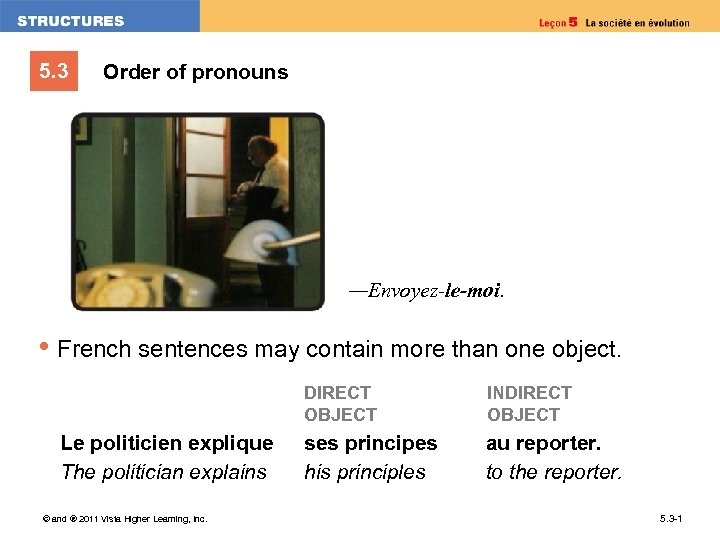 5. 3 Order of pronouns —Envoyez-le-moi. • French sentences may contain more than one object. DIRECT OBJECT Le politicien explique The politician explains © and ® 2011 Vista Higher Learning, Inc. INDIRECT OBJECT ses principes his principles au reporter. to the reporter. 5. 3 -1
 5. 3 Order of pronouns • You can replace multiple objects with multiple object pronouns. Use the same pronouns you would use if there were only one object. Il les explique au reporter. He explains them to the reporter. Il lui explique ses principes. He explains his principles to him. Il les lui explique. He explains them to him. © and ® 2011 Vista Higher Learning, Inc. 5. 3 -2
 5. 3 Order of pronouns • Where there is more than one object pronoun, they are placed in this order. me te se nous vous le la before les before lui leur before y before en l’ Le guide montre la sculpture aux touristes. The guide shows the sculpture to the tourists. Il la leur montre. He shows it to them. Qui s’occupe des réservations? Who is taking care of the reservations? Hubert s’en occupe. Hubert is taking care of them. © and ® 2011 Vista Higher Learning, Inc. 5. 3 -3
 5. 3 Order of pronouns ATTENTION! The pronouns me, te, se, le, and la drop their vowel before other vowel sounds. This always occurs before y and en and frequently occurs in the passé composé. —Nous t’avons parlé de la polémique? —Did we talk to you about the controversy? —Oui, vous m’en avez parlé. —Yes, you talked to me about it. © and ® 2011 Vista Higher Learning, Inc. 5. 3 -4
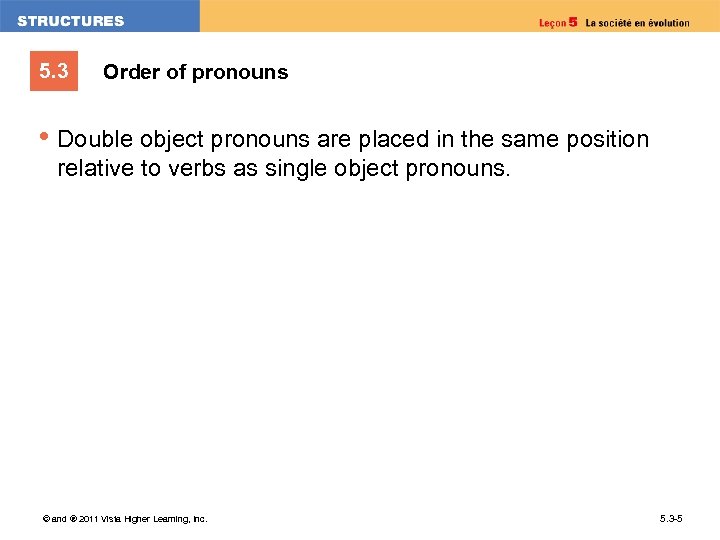 5. 3 Order of pronouns • Double object pronouns are placed in the same position relative to verbs as single object pronouns. © and ® 2011 Vista Higher Learning, Inc. 5. 3 -5
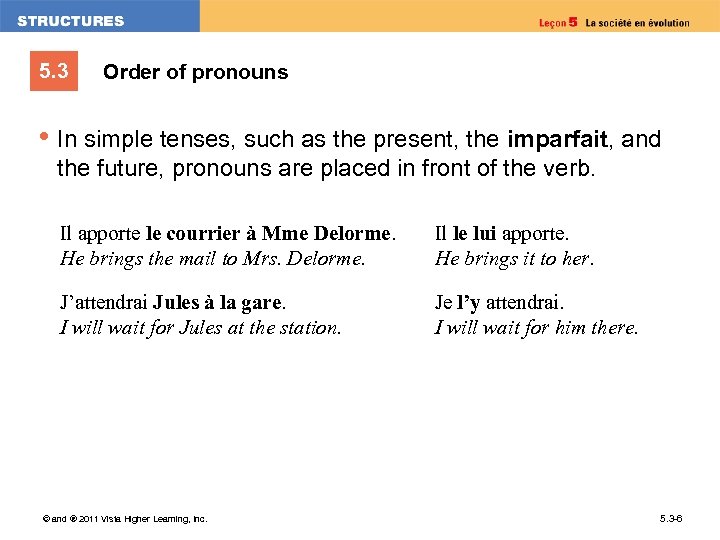 5. 3 Order of pronouns • In simple tenses, such as the present, the imparfait, and the future, pronouns are placed in front of the verb. Il apporte le courrier à Mme Delorme. He brings the mail to Mrs. Delorme. Il le lui apporte. He brings it to her. J’attendrai Jules à la gare. I will wait for Jules at the station. Je l’y attendrai. I will wait for him there. © and ® 2011 Vista Higher Learning, Inc. 5. 3 -6
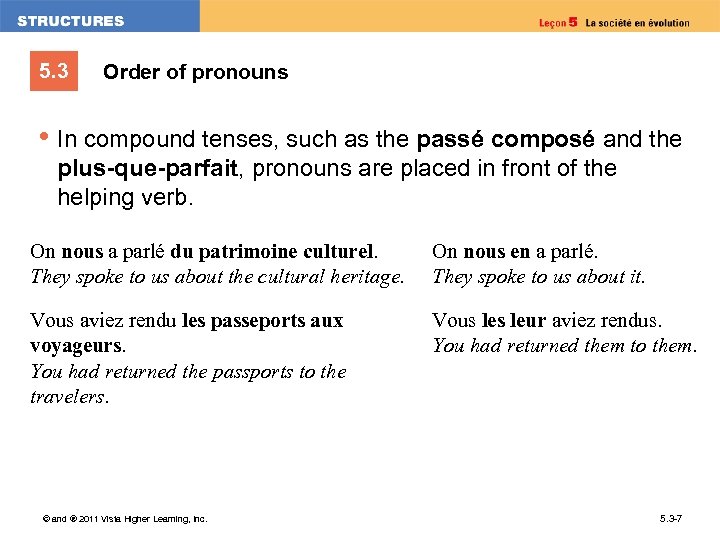 5. 3 Order of pronouns • In compound tenses, such as the passé composé and the plus-que-parfait, pronouns are placed in front of the helping verb. On nous a parlé du patrimoine culturel. They spoke to us about the cultural heritage. On nous en a parlé. They spoke to us about it. Vous aviez rendu les passeports aux voyageurs. You had returned the passports to the travelers. Vous leur aviez rendus. You had returned them to them. © and ® 2011 Vista Higher Learning, Inc. 5. 3 -7
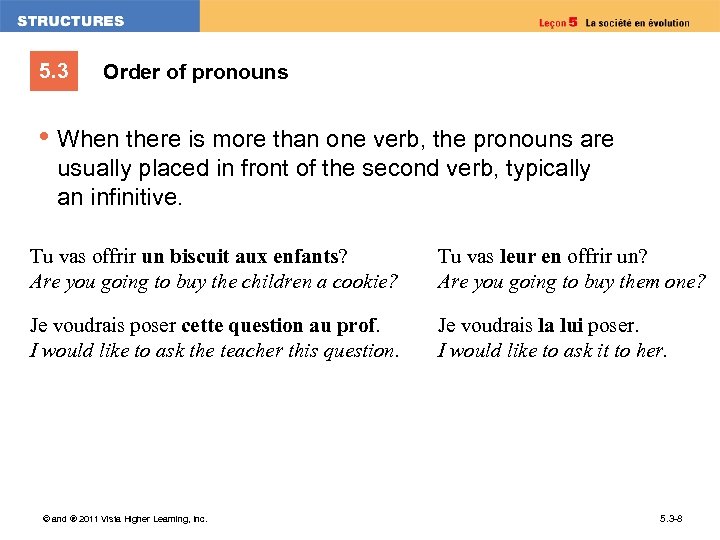 5. 3 Order of pronouns • When there is more than one verb, the pronouns are usually placed in front of the second verb, typically an infinitive. Tu vas offrir un biscuit aux enfants? Are you going to buy the children a cookie? Tu vas leur en offrir un? Are you going to buy them one? Je voudrais poser cette question au prof. I would like to ask the teacher this question. Je voudrais la lui poser. I would like to ask it to her. © and ® 2011 Vista Higher Learning, Inc. 5. 3 -8
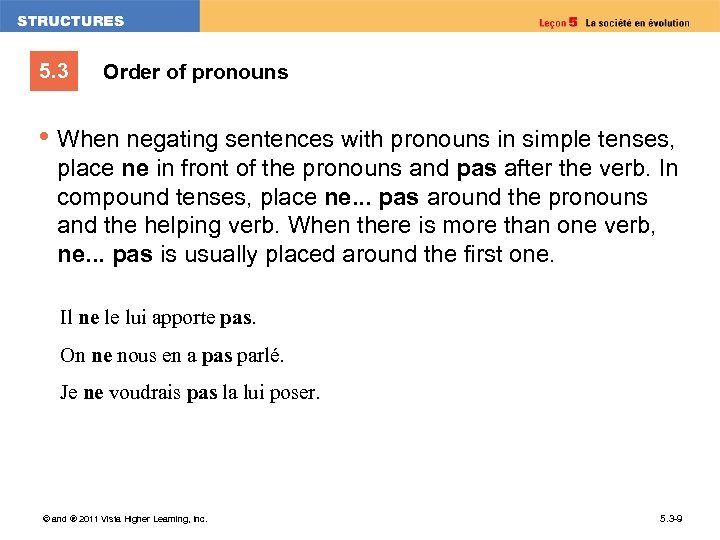 5. 3 Order of pronouns • When negating sentences with pronouns in simple tenses, place ne in front of the pronouns and pas after the verb. In compound tenses, place ne. . . pas around the pronouns and the helping verb. When there is more than one verb, ne. . . pas is usually placed around the first one. Il ne le lui apporte pas. On ne nous en a pas parlé. Je ne voudrais pas la lui poser. © and ® 2011 Vista Higher Learning, Inc. 5. 3 -9
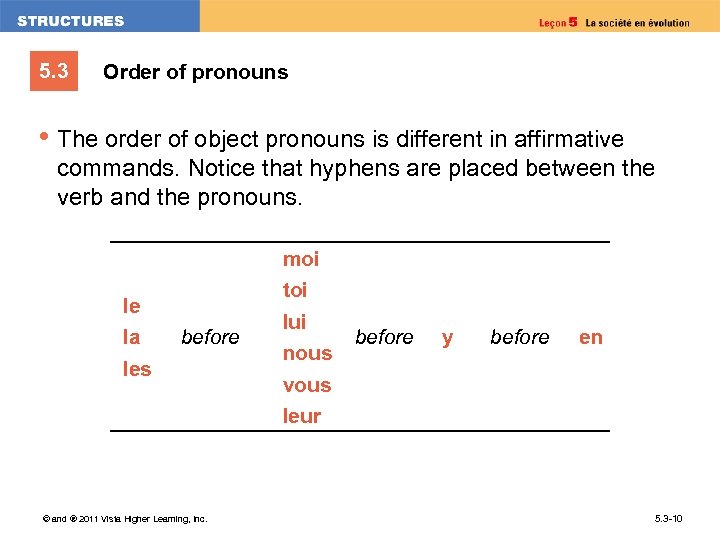 5. 3 Order of pronouns • The order of object pronouns is different in affirmative commands. Notice that hyphens are placed between the verb and the pronouns. le la les moi toi before © and ® 2011 Vista Higher Learning, Inc. lui nous vous leur before y before en 5. 3 -10
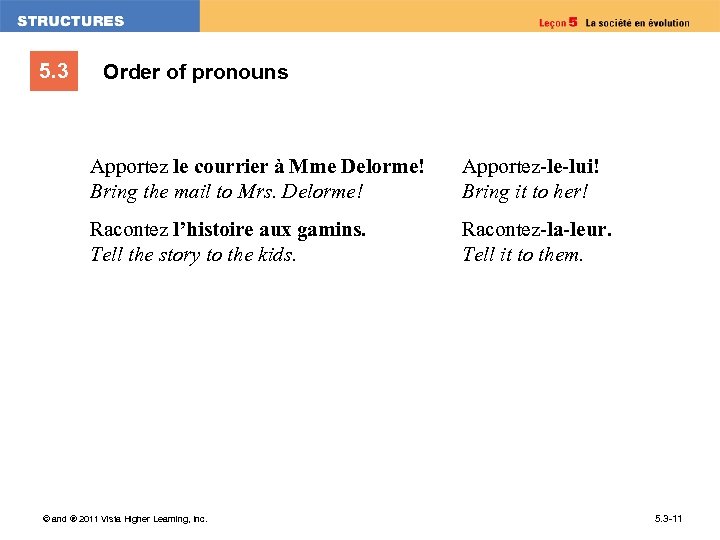 5. 3 Order of pronouns Apportez le courrier à Mme Delorme! Bring the mail to Mrs. Delorme! Apportez-le-lui! Bring it to her! Racontez l’histoire aux gamins. Tell the story to the kids. Racontez-la-leur. Tell it to them. © and ® 2011 Vista Higher Learning, Inc. 5. 3 -11
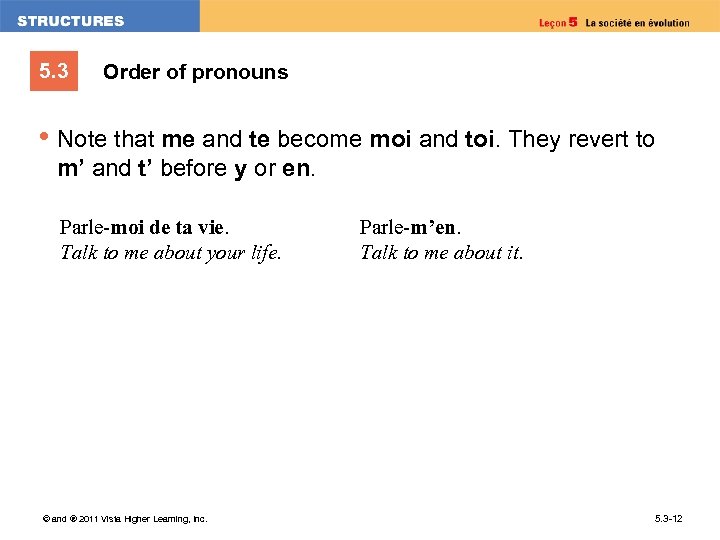 5. 3 Order of pronouns • Note that me and te become moi and toi. They revert to m’ and t’ before y or en. Parle-moi de ta vie. Talk to me about your life. © and ® 2011 Vista Higher Learning, Inc. Parle-m’en. Talk to me about it. 5. 3 -12
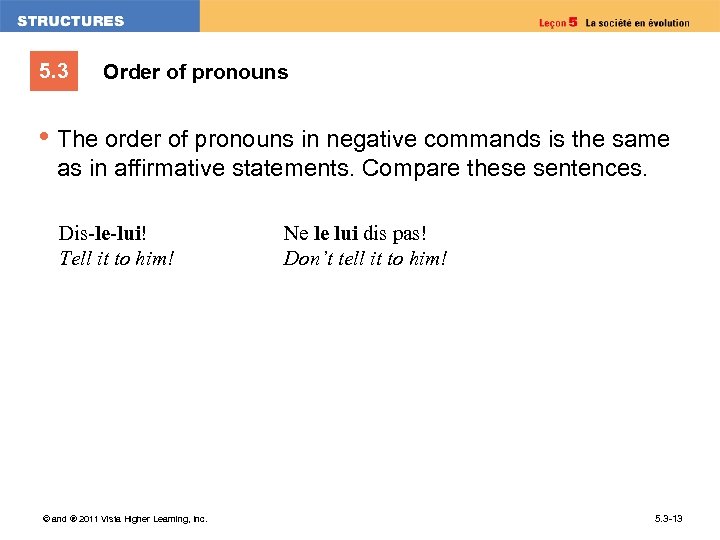 5. 3 Order of pronouns • The order of pronouns in negative commands is the same as in affirmative statements. Compare these sentences. Dis-le-lui! Tell it to him! © and ® 2011 Vista Higher Learning, Inc. Ne le lui dis pas! Don’t tell it to him! 5. 3 -13
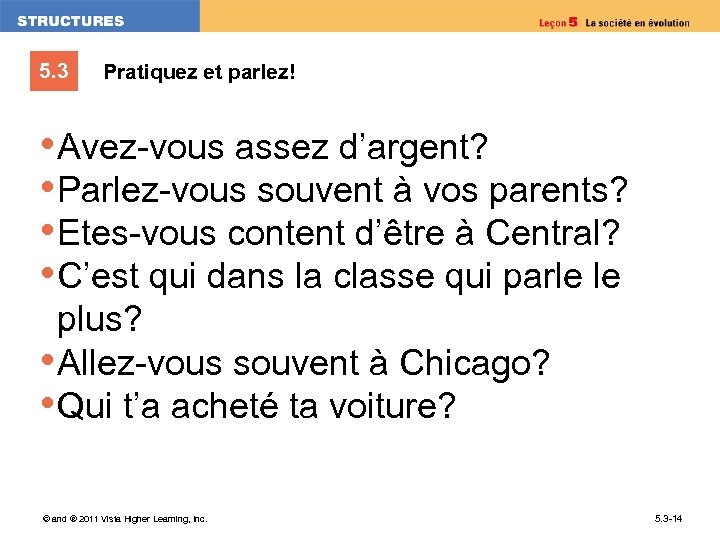 5. 3 Pratiquez et parlez! • Avez-vous assez d’argent? • Parlez-vous souvent à vos parents? • Etes-vous content d’être à Central? • C’est qui dans la classe qui parle le plus? • Allez-vous souvent à Chicago? • Qui t’a acheté ta voiture? © and ® 2011 Vista Higher Learning, Inc. 5. 3 -14
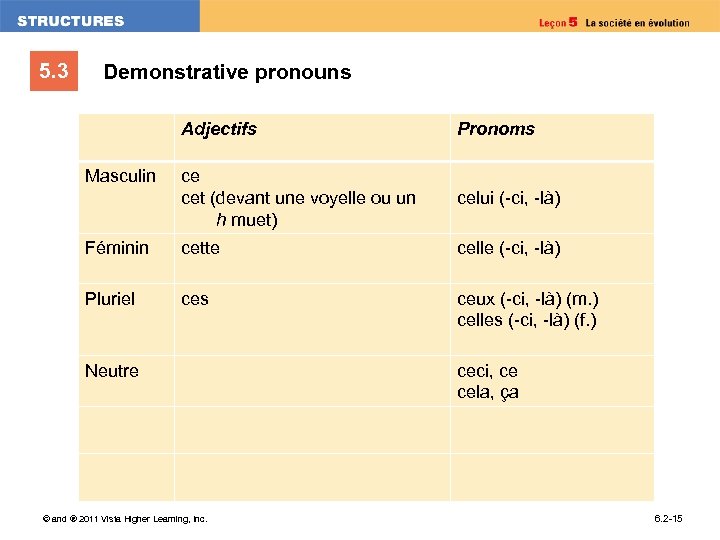 5. 3 Demonstrative pronouns Adjectifs Pronoms ce cet (devant une voyelle ou un h muet) celui (-ci, -là) Féminin cette celle (-ci, -là) Pluriel ces ceux (-ci, -là) (m. ) celles (-ci, -là) (f. ) Masculin Neutre © and ® 2011 Vista Higher Learning, Inc. ceci, ce cela, ça 6. 2 -15
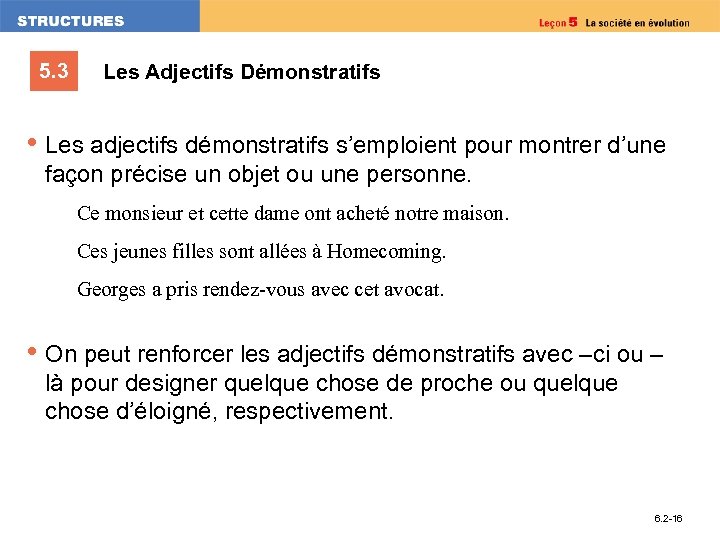 5. 3 Les Adjectifs Démonstratifs • Les adjectifs démonstratifs s’emploient pour montrer d’une façon précise un objet ou une personne. Ce monsieur et cette dame ont acheté notre maison. Ces jeunes filles sont allées à Homecoming. Georges a pris rendez-vous avec cet avocat. • On peut renforcer les adjectifs démonstratifs avec –ci ou – là pour designer quelque chose de proche ou quelque chose d’éloigné, respectivement. 6. 2 -16
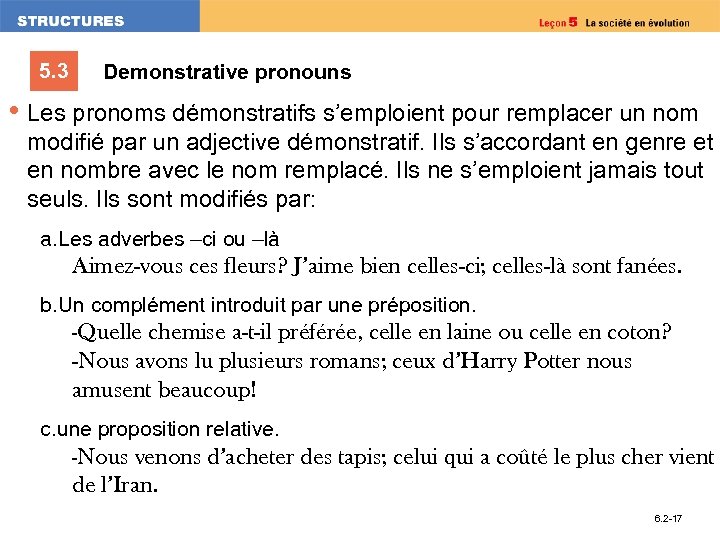 5. 3 Demonstrative pronouns • Les pronoms démonstratifs s’emploient pour remplacer un nom modifié par un adjective démonstratif. Ils s’accordant en genre et en nombre avec le nom remplacé. Ils ne s’emploient jamais tout seuls. Ils sont modifiés par: a. Les adverbes –ci ou –là Aimez-vous ces fleurs? J’aime bien celles-ci; celles-là sont fanées. b. Un complément introduit par une préposition. -Quelle chemise a-t-il préférée, celle en laine ou celle en coton? -Nous avons lu plusieurs romans; ceux d’Harry Potter nous amusent beaucoup! c. une proposition relative. -Nous venons d’acheter des tapis; celui qui a coûté le plus cher vient de l’Iran. 6. 2 -17
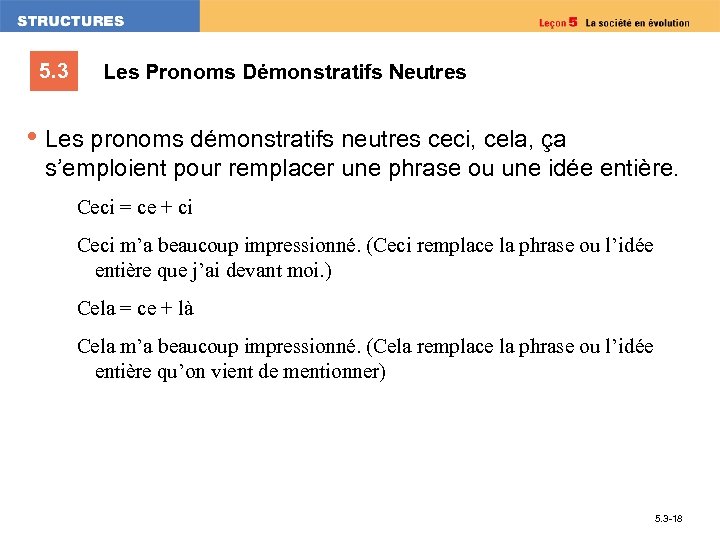 5. 3 Les Pronoms Démonstratifs Neutres • Les pronoms démonstratifs neutres ceci, cela, ça s’emploient pour remplacer une phrase ou une idée entière. Ceci = ce + ci Ceci m’a beaucoup impressionné. (Ceci remplace la phrase ou l’idée entière que j’ai devant moi. ) Cela = ce + là Cela m’a beaucoup impressionné. (Cela remplace la phrase ou l’idée entière qu’on vient de mentionner) 5. 3 -18
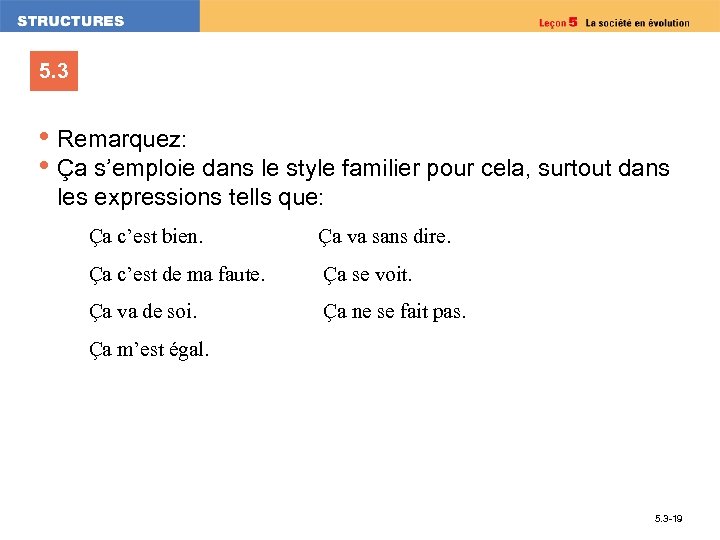 5. 3 • Remarquez: • Ça s’emploie dans le style familier pour cela, surtout dans les expressions tells que: Ça c’est bien. Ça va sans dire. Ça c’est de ma faute. Ça se voit. Ça va de soi. Ça ne se fait pas. Ça m’est égal. 5. 3 -19
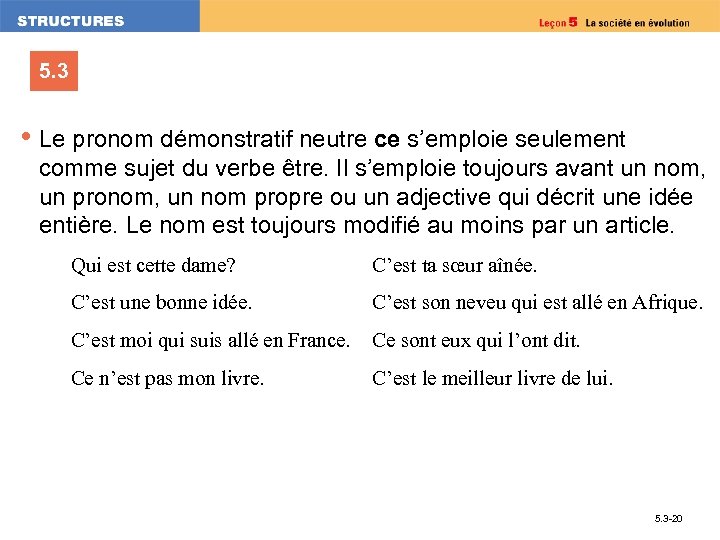 5. 3 • Le pronom démonstratif neutre ce s’emploie seulement comme sujet du verbe être. Il s’emploie toujours avant un nom, un pronom, un nom propre ou un adjective qui décrit une idée entière. Le nom est toujours modifié au moins par un article. Qui est cette dame? C’est ta sœur aînée. C’est une bonne idée. C’est son neveu qui est allé en Afrique. C’est moi qui suis allé en France. Ce sont eux qui l’ont dit. Ce n’est pas mon livre. C’est le meilleur livre de lui. 5. 3 -20
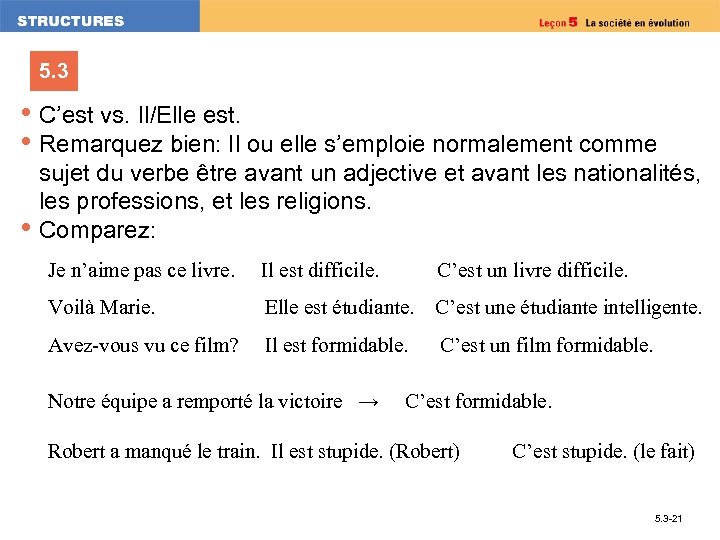 5. 3 • C’est vs. Il/Elle est. • Remarquez bien: Il ou elle s’emploie normalement comme • sujet du verbe être avant un adjective et avant les nationalités, les professions, et les religions. Comparez: Je n’aime pas ce livre. Il est difficile. C’est un livre difficile. Voilà Marie. Elle est étudiante. C’est une étudiante intelligente. Avez-vous vu ce film? Il est formidable. C’est un film formidable. Notre équipe a remporté la victoire → C’est formidable. Robert a manqué le train. Il est stupide. (Robert) C’est stupide. (le fait) 5. 3 -21
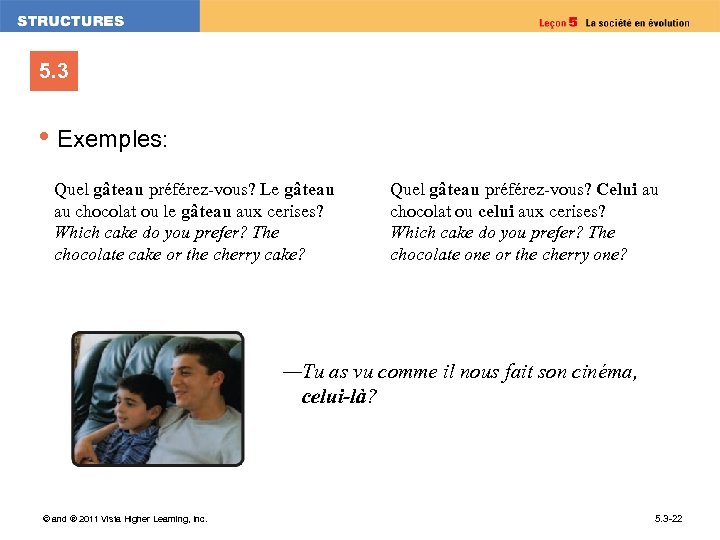 5. 3 • Exemples: Quel gâteau préférez-vous? Le gâteau au chocolat ou le gâteau aux cerises? Which cake do you prefer? The chocolate cake or the cherry cake? Quel gâteau préférez-vous? Celui au chocolat ou celui aux cerises? Which cake do you prefer? The chocolate one or the cherry one? —Tu as vu comme il nous fait son cinéma, celui-là? © and ® 2011 Vista Higher Learning, Inc. 5. 3 -22
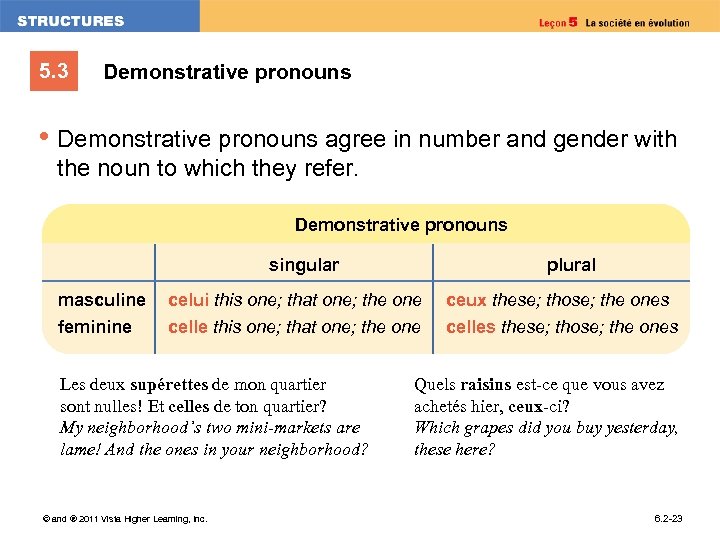 5. 3 Demonstrative pronouns • Demonstrative pronouns agree in number and gender with the noun to which they refer. Demonstrative pronouns singular plural masculine celui this one; that one; the one ceux these; those; the ones feminine celle this one; that one; the one celles these; those; the ones Les deux supérettes de mon quartier sont nulles! Et celles de ton quartier? My neighborhood’s two mini-markets are lame! And the ones in your neighborhood? © and ® 2011 Vista Higher Learning, Inc. Quels raisins est-ce que vous avez achetés hier, ceux-ci? Which grapes did you buy yesterday, these here? 6. 2 -23
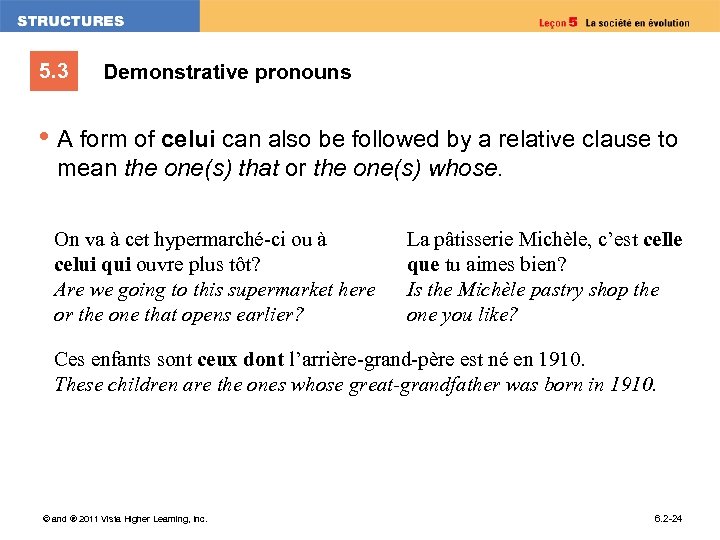 5. 3 Demonstrative pronouns • A form of celui can also be followed by a relative clause to mean the one(s) that or the one(s) whose. On va à cet hypermarché-ci ou à celui qui ouvre plus tôt? Are we going to this supermarket here or the one that opens earlier? La pâtisserie Michèle, c’est celle que tu aimes bien? Is the Michèle pastry shop the one you like? Ces enfants sont ceux dont l’arrière-grand-père est né en 1910. These children are the ones whose great-grandfather was born in 1910. © and ® 2011 Vista Higher Learning, Inc. 6. 2 -24
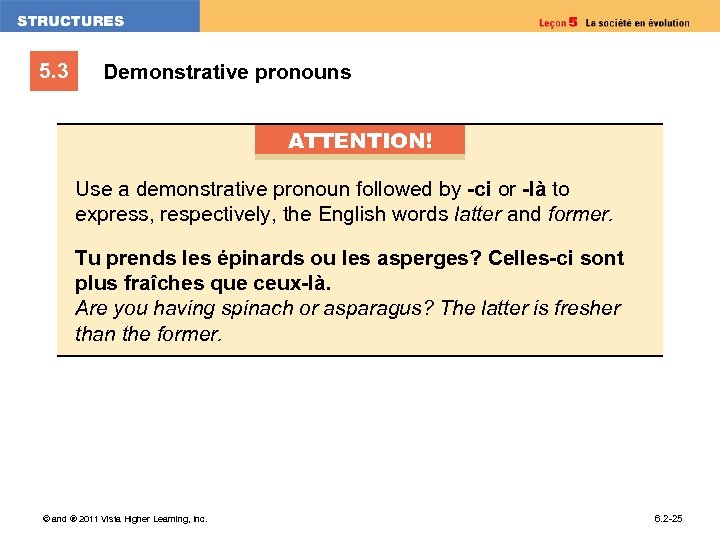 5. 3 Demonstrative pronouns ATTENTION! Use a demonstrative pronoun followed by -ci or -là to express, respectively, the English words latter and former. Tu prends les épinards ou les asperges? Celles-ci sont plus fraîches que ceux-là. Are you having spinach or asparagus? The latter is fresher than the former. © and ® 2011 Vista Higher Learning, Inc. 6. 2 -25
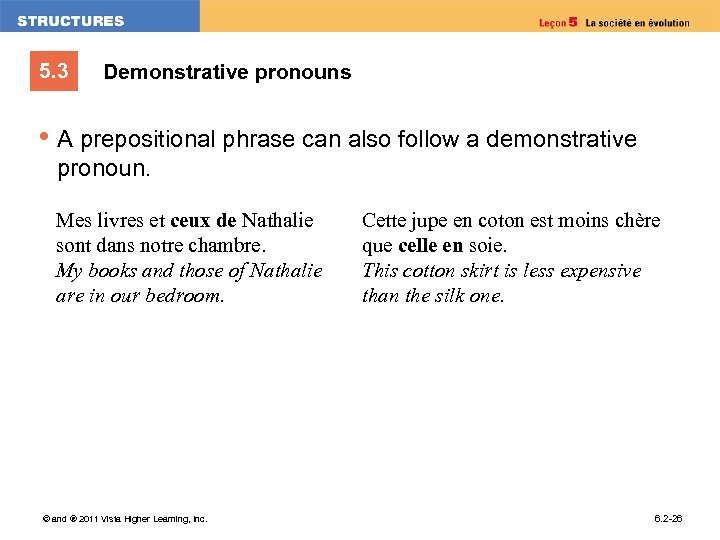 5. 3 Demonstrative pronouns • A prepositional phrase can also follow a demonstrative pronoun. Mes livres et ceux de Nathalie sont dans notre chambre. My books and those of Nathalie are in our bedroom. © and ® 2011 Vista Higher Learning, Inc. Cette jupe en coton est moins chère que celle en soie. This cotton skirt is less expensive than the silk one. 6. 2 -26
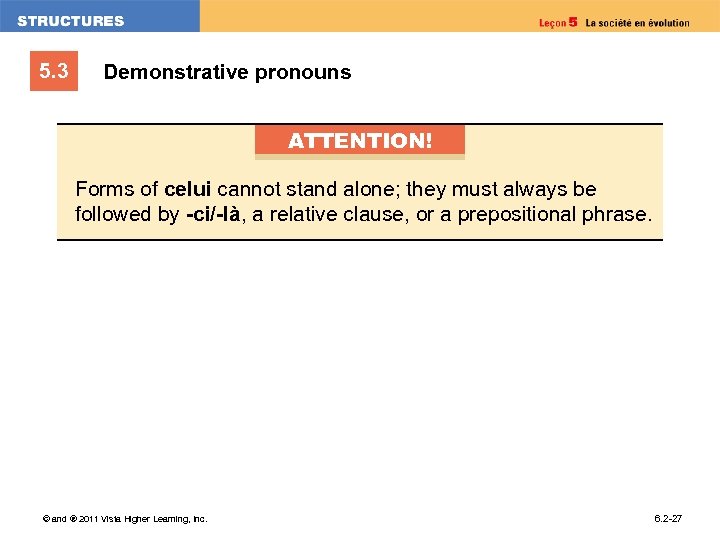 5. 3 Demonstrative pronouns ATTENTION! Forms of celui cannot stand alone; they must always be followed by -ci/-là, a relative clause, or a prepositional phrase. © and ® 2011 Vista Higher Learning, Inc. 6. 2 -27
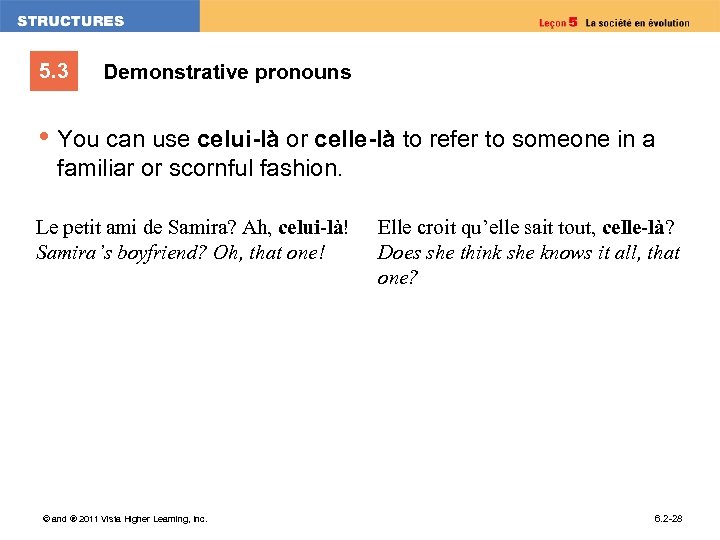 5. 3 Demonstrative pronouns • You can use celui-là or celle-là to refer to someone in a familiar or scornful fashion. Le petit ami de Samira? Ah, celui-là! Samira’s boyfriend? Oh, that one! © and ® 2011 Vista Higher Learning, Inc. Elle croit qu’elle sait tout, celle-là? Does she think she knows it all, that one? 6. 2 -28
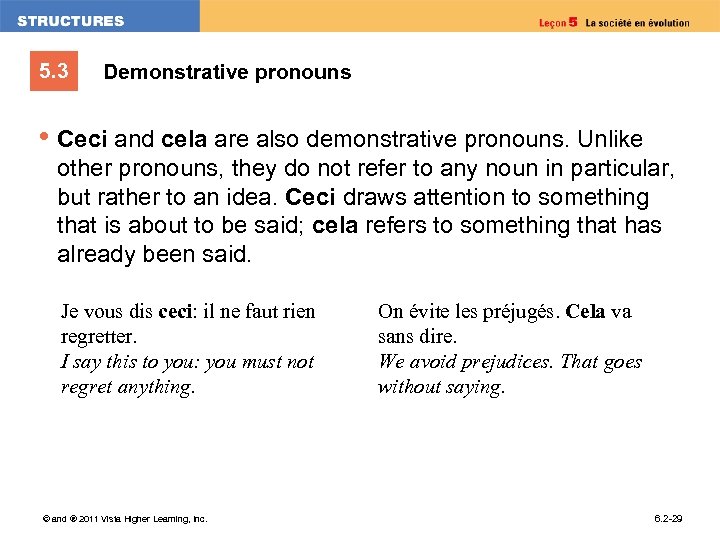 5. 3 Demonstrative pronouns • Ceci and cela are also demonstrative pronouns. Unlike other pronouns, they do not refer to any noun in particular, but rather to an idea. Ceci draws attention to something that is about to be said; cela refers to something that has already been said. Je vous dis ceci: il ne faut rien regretter. I say this to you: you must not regret anything. © and ® 2011 Vista Higher Learning, Inc. On évite les préjugés. Cela va sans dire. We avoid prejudices. That goes without saying. 6. 2 -29
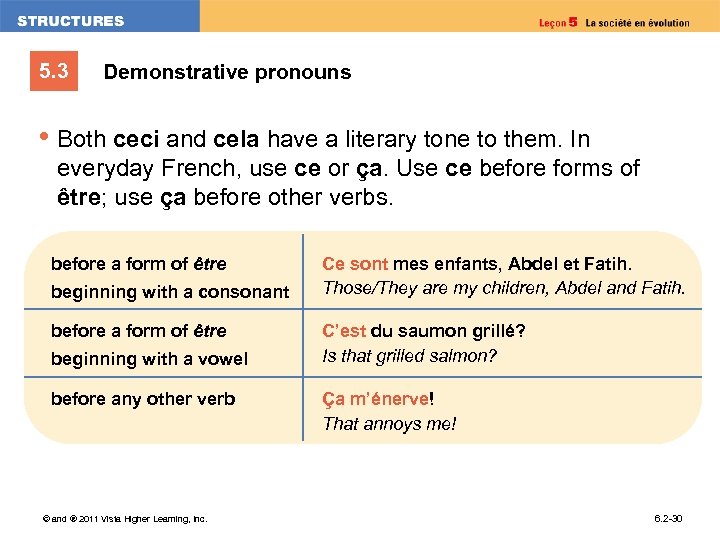 5. 3 Demonstrative pronouns • Both ceci and cela have a literary tone to them. In everyday French, use ce or ça. Use ce before forms of être; use ça before other verbs. before a form of être beginning with a consonant before a form of être beginning with a vowel before any other verb © and ® 2011 Vista Higher Learning, Inc. Ce sont mes enfants, Abdel et Fatih. Those/They are my children, Abdel and Fatih. C’est du saumon grillé? Is that grilled salmon? Ça m’énerve! That annoys me! 6. 2 -30
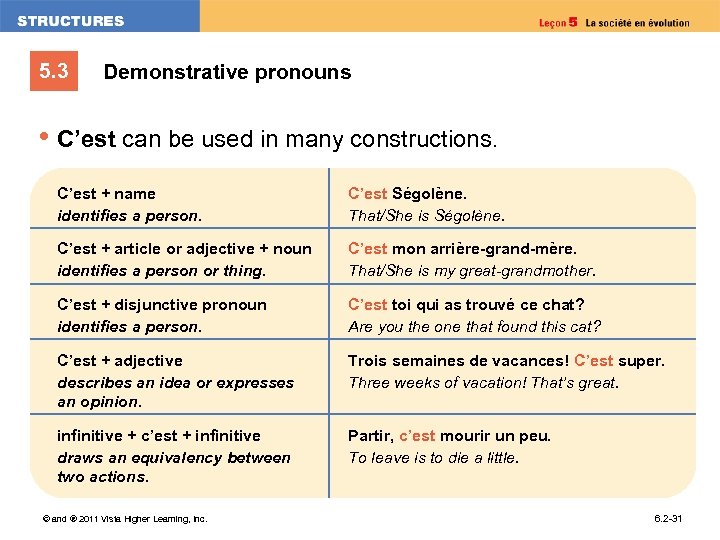 5. 3 Demonstrative pronouns • C’est can be used in many constructions. C’est + name identifies a person. C’est Ségolène. That/She is Ségolène. C’est + article or adjective + noun identifies a person or thing. C’est mon arrière-grand-mère. That/She is my great-grandmother. C’est + disjunctive pronoun identifies a person. C’est toi qui as trouvé ce chat? Are you the one that found this cat? C’est + adjective describes an idea or expresses an opinion. Trois semaines de vacances! C’est super. Three weeks of vacation! That’s great. infinitive + c’est + infinitive draws an equivalency between two actions. Partir, c’est mourir un peu. To leave is to die a little. © and ® 2011 Vista Higher Learning, Inc. 6. 2 -31