


 Скачать презентацию 5 3 Order of pronouns Envoyez-le-moi French
1869f3073b9d2cd652c5b37bcd66a52b.ppt
- Количество слайдов: 13
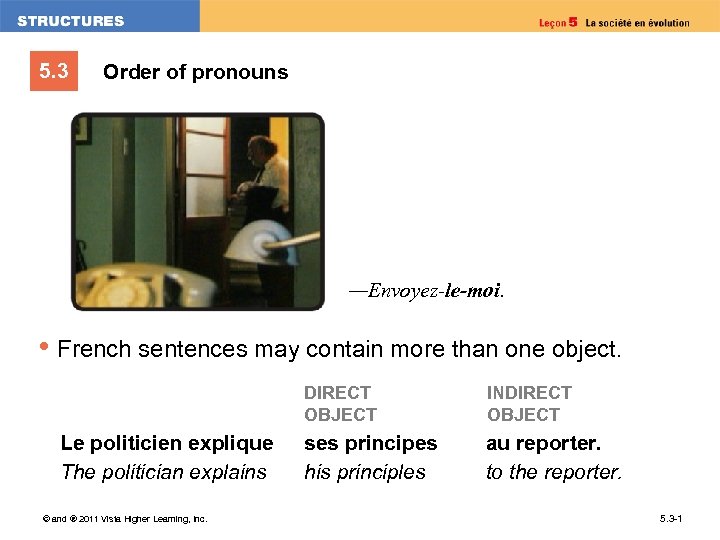 5. 3 Order of pronouns —Envoyez-le-moi. • French sentences may contain more than one object. DIRECT OBJECT Le politicien explique The politician explains © and ® 2011 Vista Higher Learning, Inc. INDIRECT OBJECT ses principes his principles au reporter. to the reporter. 5. 3 -1
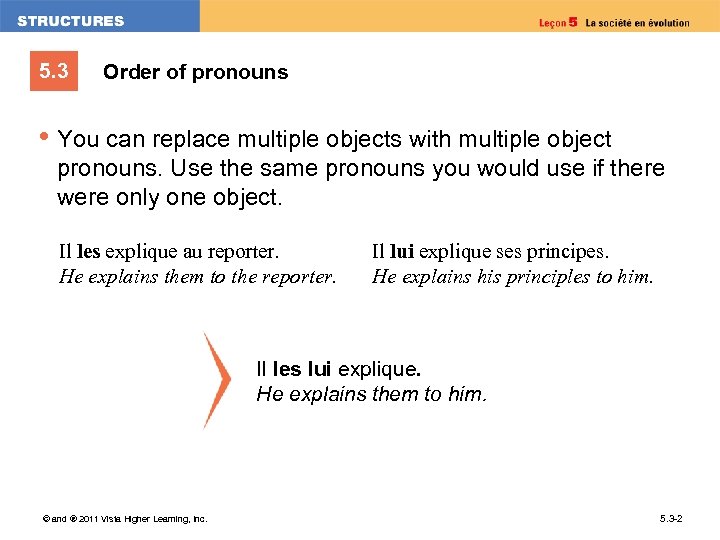 5. 3 Order of pronouns • You can replace multiple objects with multiple object pronouns. Use the same pronouns you would use if there were only one object. Il les explique au reporter. He explains them to the reporter. Il lui explique ses principes. He explains his principles to him. Il les lui explique. He explains them to him. © and ® 2011 Vista Higher Learning, Inc. 5. 3 -2
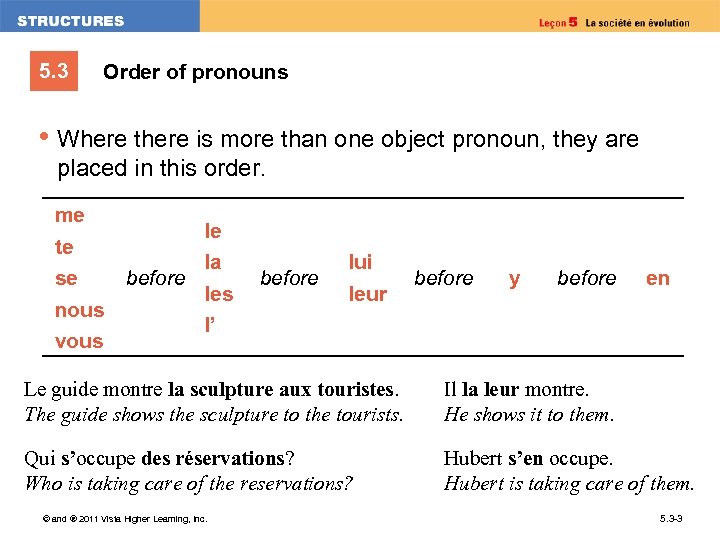 5. 3 Order of pronouns • Where there is more than one object pronoun, they are placed in this order. me te se nous vous le la before les before lui leur before y before en l’ Le guide montre la sculpture aux touristes. The guide shows the sculpture to the tourists. Il la leur montre. He shows it to them. Qui s’occupe des réservations? Who is taking care of the reservations? Hubert s’en occupe. Hubert is taking care of them. © and ® 2011 Vista Higher Learning, Inc. 5. 3 -3
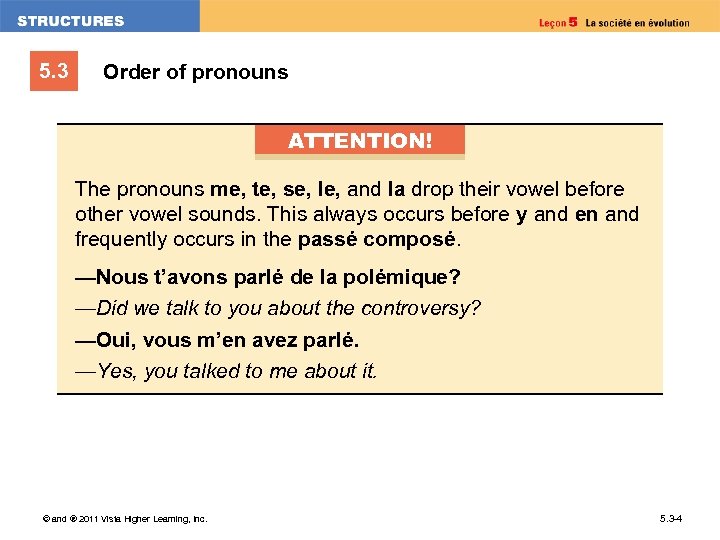 5. 3 Order of pronouns ATTENTION! The pronouns me, te, se, le, and la drop their vowel before other vowel sounds. This always occurs before y and en and frequently occurs in the passé composé. —Nous t’avons parlé de la polémique? —Did we talk to you about the controversy? —Oui, vous m’en avez parlé. —Yes, you talked to me about it. © and ® 2011 Vista Higher Learning, Inc. 5. 3 -4
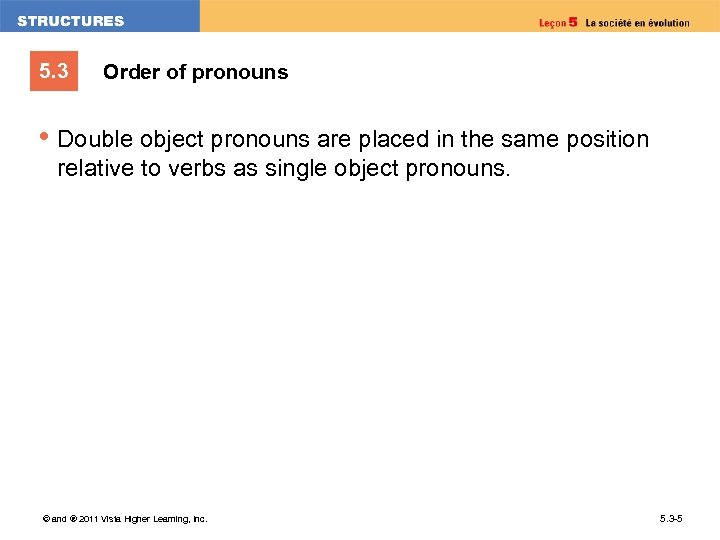 5. 3 Order of pronouns • Double object pronouns are placed in the same position relative to verbs as single object pronouns. © and ® 2011 Vista Higher Learning, Inc. 5. 3 -5
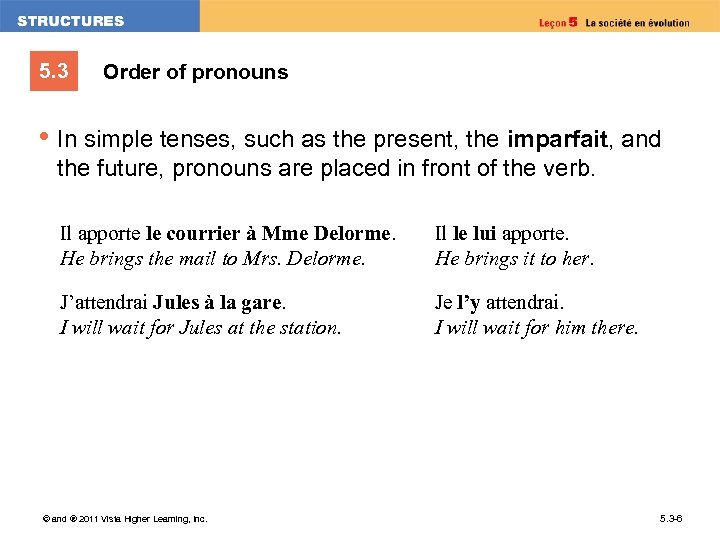 5. 3 Order of pronouns • In simple tenses, such as the present, the imparfait, and the future, pronouns are placed in front of the verb. Il apporte le courrier à Mme Delorme. He brings the mail to Mrs. Delorme. Il le lui apporte. He brings it to her. J’attendrai Jules à la gare. I will wait for Jules at the station. Je l’y attendrai. I will wait for him there. © and ® 2011 Vista Higher Learning, Inc. 5. 3 -6
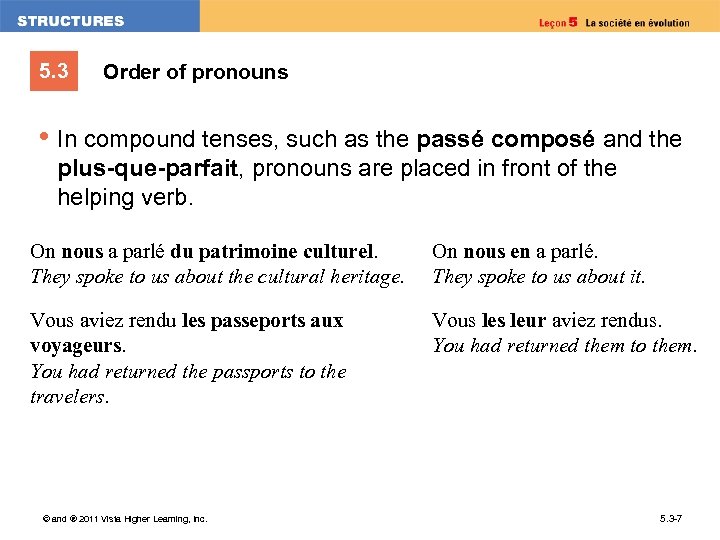 5. 3 Order of pronouns • In compound tenses, such as the passé composé and the plus-que-parfait, pronouns are placed in front of the helping verb. On nous a parlé du patrimoine culturel. They spoke to us about the cultural heritage. On nous en a parlé. They spoke to us about it. Vous aviez rendu les passeports aux voyageurs. You had returned the passports to the travelers. Vous leur aviez rendus. You had returned them to them. © and ® 2011 Vista Higher Learning, Inc. 5. 3 -7
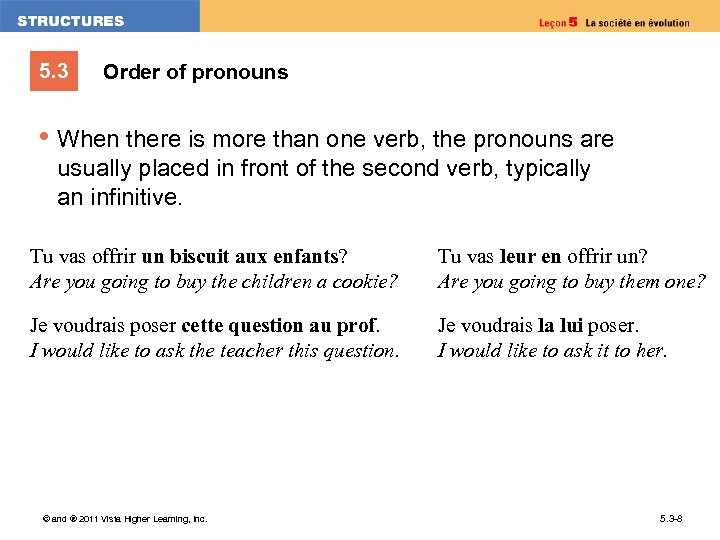 5. 3 Order of pronouns • When there is more than one verb, the pronouns are usually placed in front of the second verb, typically an infinitive. Tu vas offrir un biscuit aux enfants? Are you going to buy the children a cookie? Tu vas leur en offrir un? Are you going to buy them one? Je voudrais poser cette question au prof. I would like to ask the teacher this question. Je voudrais la lui poser. I would like to ask it to her. © and ® 2011 Vista Higher Learning, Inc. 5. 3 -8
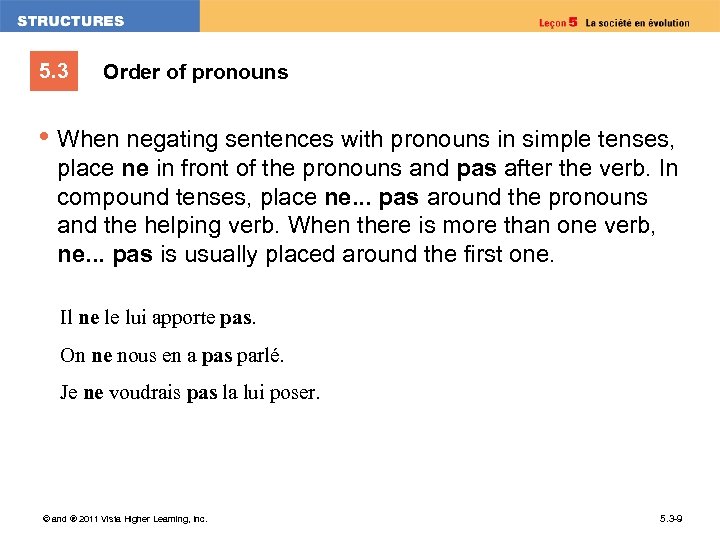 5. 3 Order of pronouns • When negating sentences with pronouns in simple tenses, place ne in front of the pronouns and pas after the verb. In compound tenses, place ne. . . pas around the pronouns and the helping verb. When there is more than one verb, ne. . . pas is usually placed around the first one. Il ne le lui apporte pas. On ne nous en a pas parlé. Je ne voudrais pas la lui poser. © and ® 2011 Vista Higher Learning, Inc. 5. 3 -9
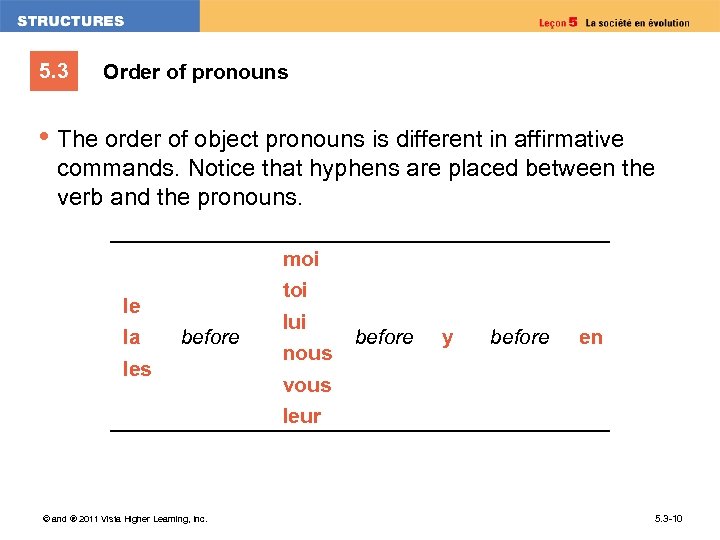 5. 3 Order of pronouns • The order of object pronouns is different in affirmative commands. Notice that hyphens are placed between the verb and the pronouns. le la moi toi before les © and ® 2011 Vista Higher Learning, Inc. lui nous vous leur before y before en 5. 3 -10
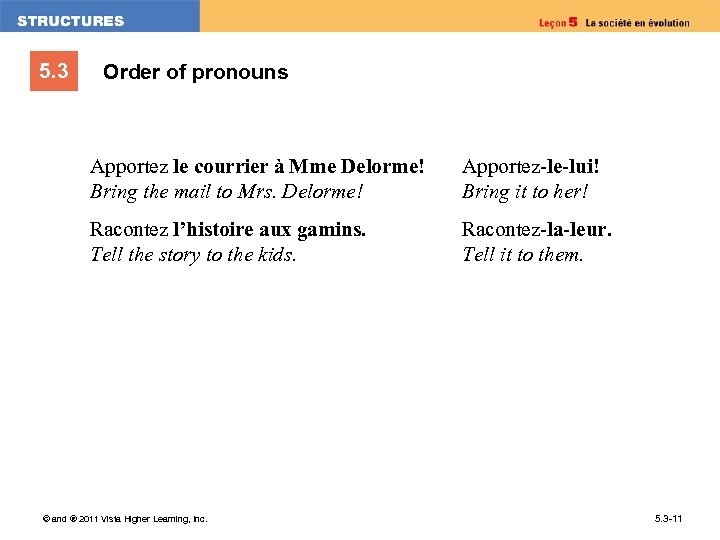 5. 3 Order of pronouns Apportez le courrier à Mme Delorme! Bring the mail to Mrs. Delorme! Apportez-le-lui! Bring it to her! Racontez l’histoire aux gamins. Tell the story to the kids. Racontez-la-leur. Tell it to them. © and ® 2011 Vista Higher Learning, Inc. 5. 3 -11
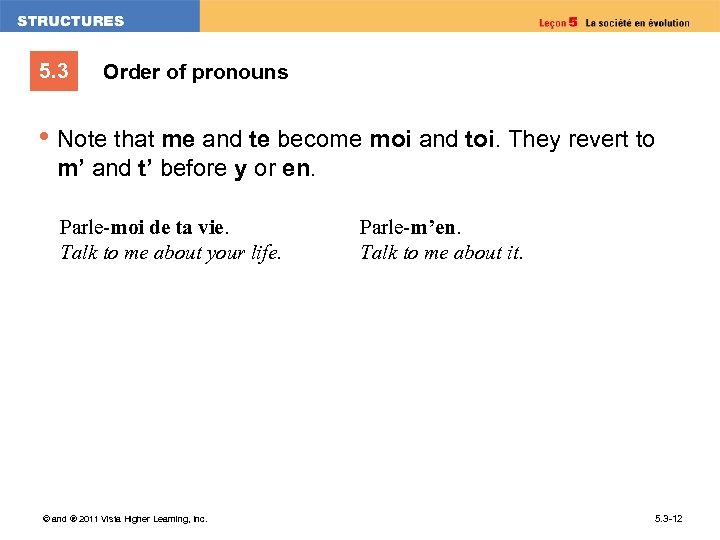 5. 3 Order of pronouns • Note that me and te become moi and toi. They revert to m’ and t’ before y or en. Parle-moi de ta vie. Talk to me about your life. © and ® 2011 Vista Higher Learning, Inc. Parle-m’en. Talk to me about it. 5. 3 -12
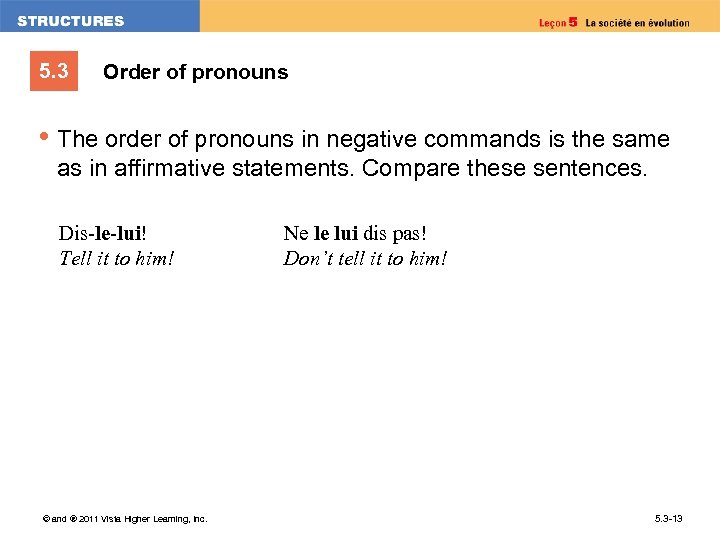 5. 3 Order of pronouns • The order of pronouns in negative commands is the same as in affirmative statements. Compare these sentences. Dis-le-lui! Tell it to him! © and ® 2011 Vista Higher Learning, Inc. Ne le lui dis pas! Don’t tell it to him! 5. 3 -13