 Скачать презентацию 433 -652 Distributed Systems Dr Rajkumar Buyya Senior
4c6859626dfff633a71bb8d2b02ff785.ppt
- Количество слайдов: 38



433 -652: Distributed Systems Dr. Rajkumar Buyya Senior Lecturer and Director of MEDC Course Grid Computing and Distributed Systems (GRIDS) Laboratory Dept. of Computer Science and Software Engineering The University of Melbourne, Australia http: //www. buyya. com
Introduction to Distributed Systems and Characterisation Dr. Rajkumar Buyya Senior Lecturer and Director of MEDC Course Grid Computing and Distributed Systems (GRIDS) Laboratory Dept. of Computer Science and Software Engineering The University of Melbourne, Australia http: //www. cs. mu. oz. au/652 Most concepts are drawn from Chapter 1 © Pearson Education
Presentation Outline n n n 3 Introduction Defining Distributed Systems Characteristics of Distributed Systems Example Distributed Systems Challenges of Distributed Systems Summary
Introduction n n 4 Networks of computers are everywhere! n Mobile phone networks n Corporate networks n Factory networks n Campus networks n Home networks n In-car networks n On board networks in aero planes and trains This subject aims: n to cover characteristics of networked computers that impact system designers and implementers, and n to present the main concepts and techniques that have been developed to help in the tasks of designing and implementing systems and applications that are based on them (networks).
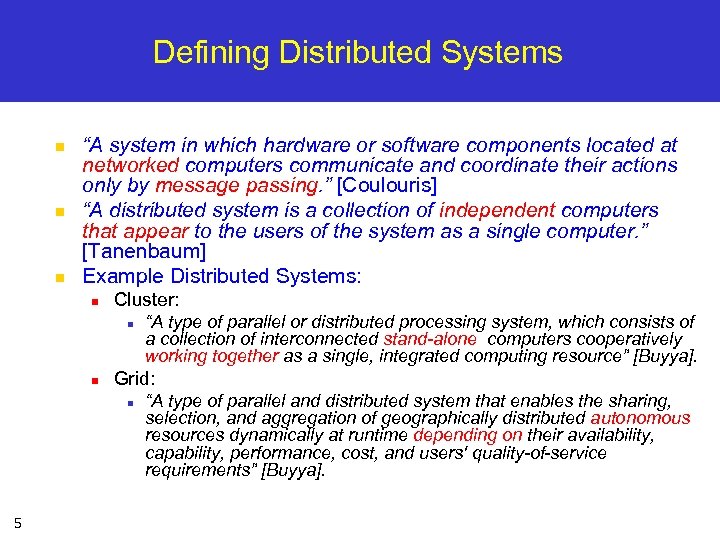
Defining Distributed Systems n n n “A system in which hardware or software components located at networked computers communicate and coordinate their actions only by message passing. ” [Coulouris] “A distributed system is a collection of independent computers that appear to the users of the system as a single computer. ” [Tanenbaum] Example Distributed Systems: n Cluster: n n Grid: n 5 “A type of parallel or distributed processing system, which consists of a collection of interconnected stand-alone computers cooperatively working together as a single, integrated computing resource” [Buyya]. “A type of parallel and distributed system that enables the sharing, selection, and aggregation of geographically distributed autonomous resources dynamically at runtime depending on their availability, capability, performance, cost, and users' quality-of-service requirements” [Buyya].
Leslie Lamport’s Definition n "A distributed system is one on which I cannot get any work done because some machine I have never heard of has crashed. “ n 6 Leslie Lamport – a famous researcher on timing, message ordering, and clock synchronization in distributed systems.
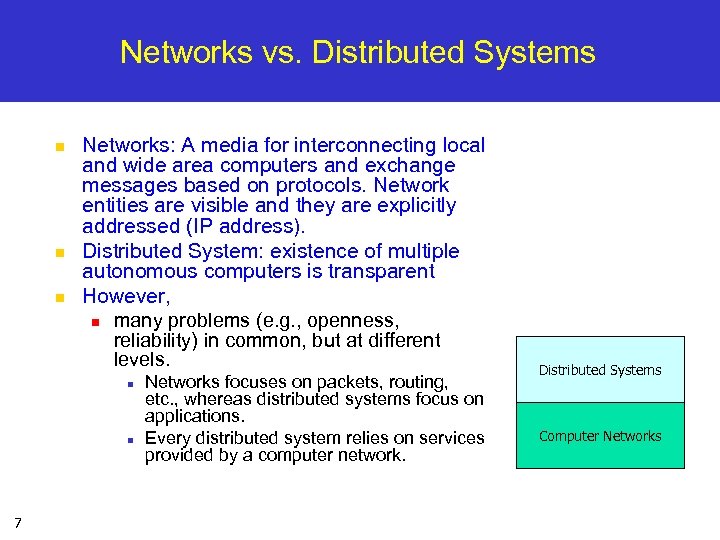
Networks vs. Distributed Systems n n n Networks: A media for interconnecting local and wide area computers and exchange messages based on protocols. Network entities are visible and they are explicitly addressed (IP address). Distributed System: existence of multiple autonomous computers is transparent However, n many problems (e. g. , openness, reliability) in common, but at different levels. n n 7 Networks focuses on packets, routing, etc. , whereas distributed systems focus on applications. Every distributed system relies on services provided by a computer network. Distributed Systems Computer Networks
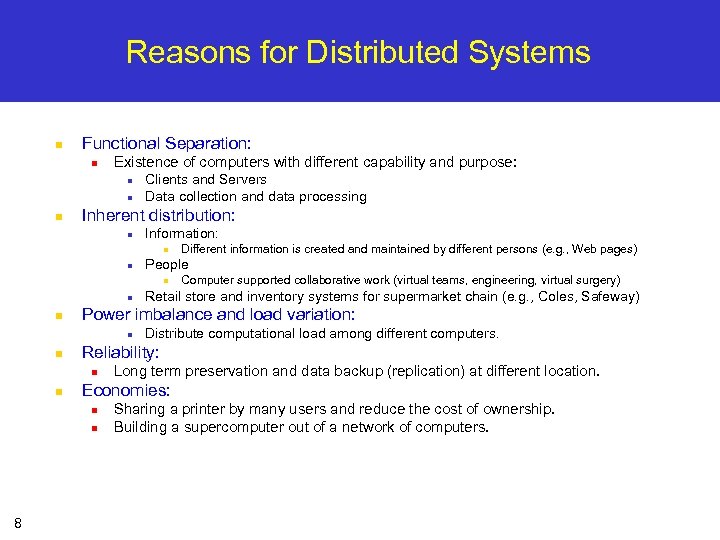
Reasons for Distributed Systems n Functional Separation: n Existence of computers with different capability and purpose: n n n Clients and Servers Data collection and data processing Inherent distribution: n Information: n n People n n n Distribute computational load among different computers. Long term preservation and data backup (replication) at different location. Economies: n n 8 Retail store and inventory systems for supermarket chain (e. g. , Coles, Safeway) Reliability: n n Computer supported collaborative work (virtual teams, engineering, virtual surgery) Power imbalance and load variation: n n Different information is created and maintained by different persons (e. g. , Web pages) Sharing a printer by many users and reduce the cost of ownership. Building a supercomputer out of a network of computers.
Consequences of Distributed Systems n Computers in distributed systems may be on separate continents, in the same building, or the same room. DS have the following consequences: n Concurrency – each system is autonomous. n n n 9 Carry out tasks independently Tasks coordinate their actions by exchanges messages. Heterogeneity No global clock Independent Failures
Characteristics of distributed systems n Parallel activities n n Communication via message passing n n No single process can have knowledge of the current global state of the system No global clock n 10 Printer, database, other services No global state n n No shared memory Resource sharing n n Autonomous components executing concurrent tasks Only limited precision for processes to synchronize their clocks
Goals of Distributed Systems n n n 11 Connecting Users and Resources Transparency Openness Scalability Enhanced Availability
![Differentiation with parallel systems [1] n Multiprocessor systems n n Shared memory Bus-based interconnection](https://present5.com/presentation/4c6859626dfff633a71bb8d2b02ff785/image-12.jpg "Differentiation with parallel systems [1] n Multiprocessor systems n n Shared memory Bus-based interconnection")
Differentiation with parallel systems [1] n Multiprocessor systems n n Shared memory Bus-based interconnection network E. g. SMPs (symmetric multiprocessors) with two or more CPUs Multicomputer systems n n No shared memory Homogeneous in hard- and software n Massively Parallel Processors (MPP) n n PC/Workstation clusters n 12 Tightly coupled high-speed network High-speed networks/switches based connection.
Differentiation with parallel systems is blurring n Extensibility of clusters leads to heterogeneity n n Extending clusters to include user desktops by harnessing their idle resources. n n 13 Adding additional nodes are requirements grow E. g. , SETI@Home Leading to the rapid convergence various concepts of parallel and distributed systems.
Examples of Distributed Systems n They are based on familiar and widely used computer networks: n n n 14 Internet Intranets, and wireless networks
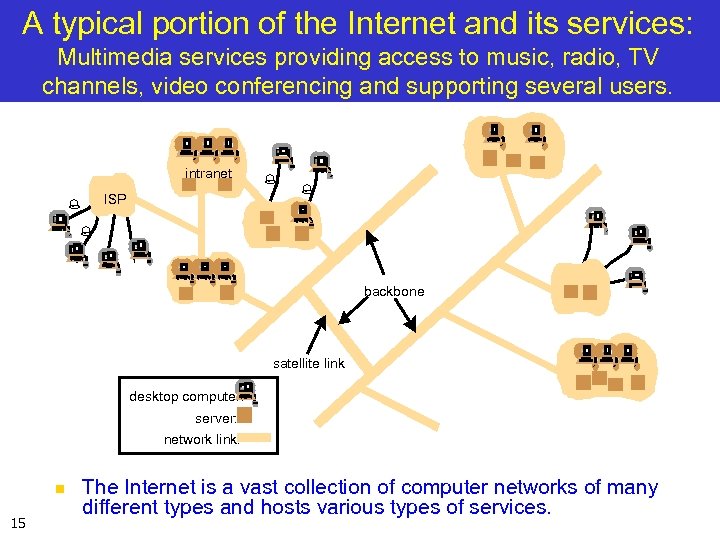
A typical portion of the Internet and its services: Multimedia services providing access to music, radio, TV channels, video conferencing and supporting several users. intranet ISP % % backbone satellite link desktop computer: server: network link: n 15 The Internet is a vast collection of computer networks of many different types and hosts various types of services.
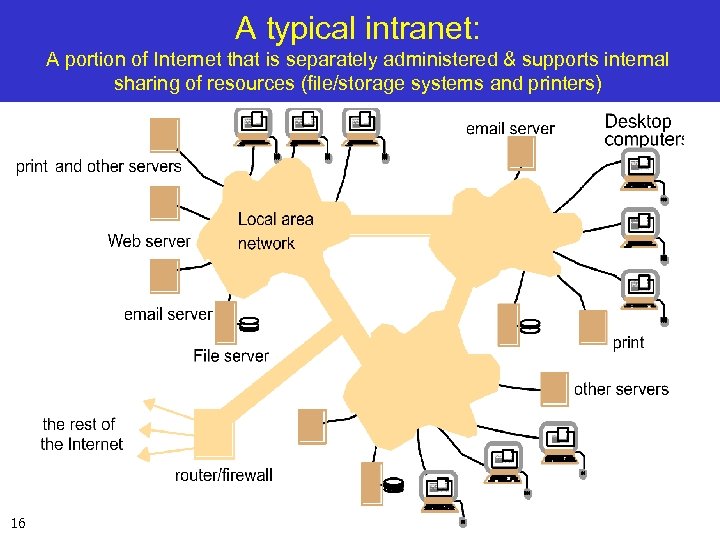
A typical intranet: A portion of Internet that is separately administered & supports internal sharing of resources (file/storage systems and printers) 16
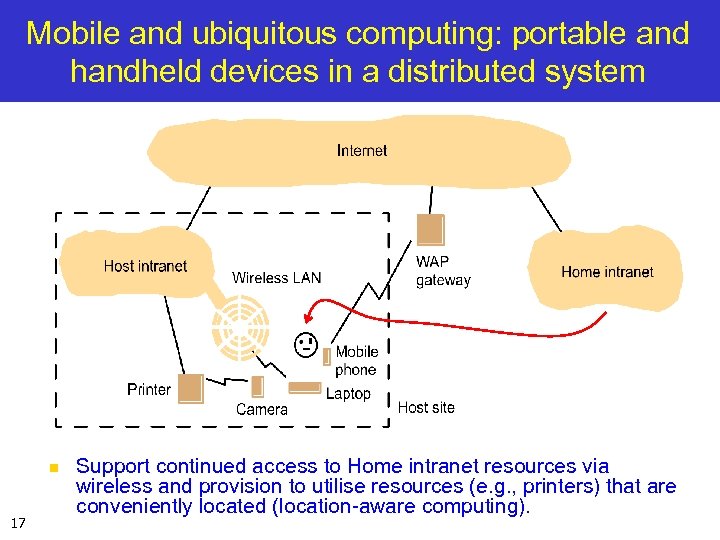
Mobile and ubiquitous computing: portable and handheld devices in a distributed system n 17 Support continued access to Home intranet resources via wireless and provision to utilise resources (e. g. , printers) that are conveniently located (location-aware computing).
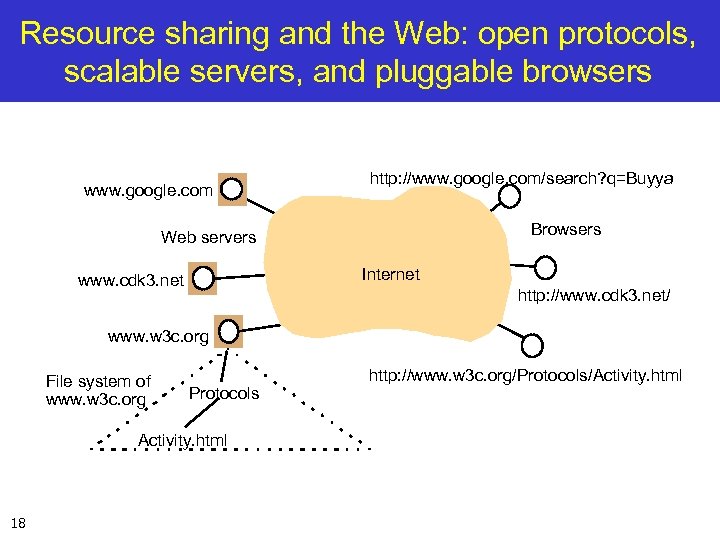
Resource sharing and the Web: open protocols, scalable servers, and pluggable browsers www. google. com http: //www. google. com/search? q=Buyya Browsers Web servers Internet www. cdk 3. net http: //www. cdk 3. net/ www. w 3 c. org File system of www. w 3 c. org Protocols Activity. html 18 http: //www. w 3 c. org/Protocols/Activity. html
Business Example and Challenges n Online bookstore (e. g. in the World Wide Web) n Customers can connect their computer to your computer (web server): n n n 19 Browse your inventory Place orders … This example Adopted from Torbin Weis, Berlin University of Technology
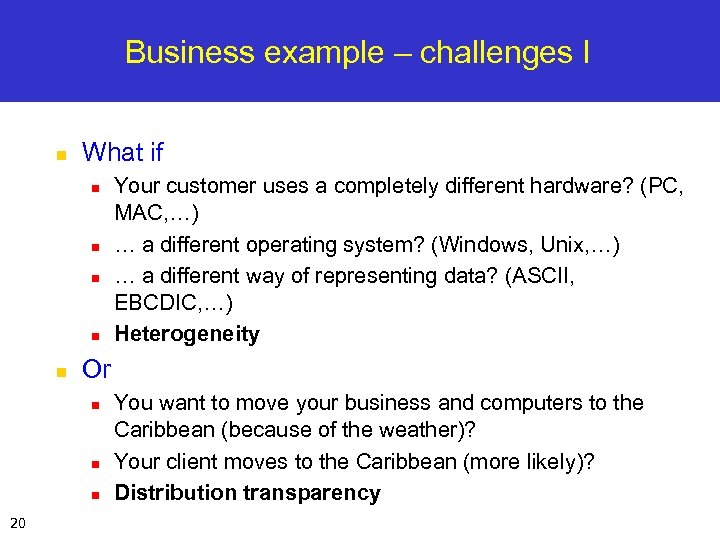
Business example – challenges I n What if n n n Or n n n 20 Your customer uses a completely different hardware? (PC, MAC, …) … a different operating system? (Windows, Unix, …) … a different way of representing data? (ASCII, EBCDIC, …) Heterogeneity You want to move your business and computers to the Caribbean (because of the weather)? Your client moves to the Caribbean (more likely)? Distribution transparency
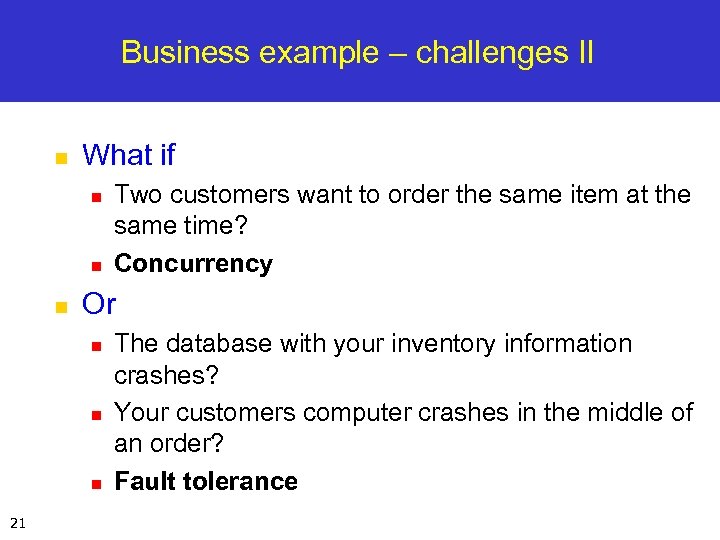
Business example – challenges II n What if n n n Or n n n 21 Two customers want to order the same item at the same time? Concurrency The database with your inventory information crashes? Your customers computer crashes in the middle of an order? Fault tolerance
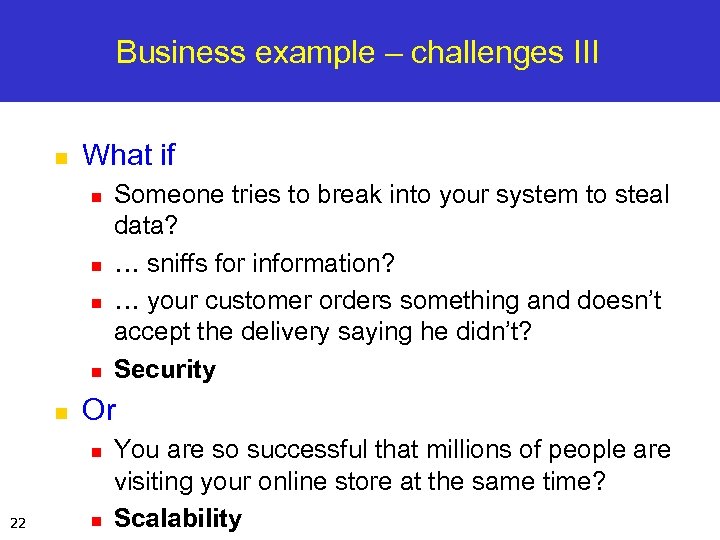
Business example – challenges III n What if n n n Or n 22 Someone tries to break into your system to steal data? … sniffs for information? … your customer orders something and doesn’t accept the delivery saying he didn’t? Security n You are so successful that millions of people are visiting your online store at the same time? Scalability
Business example – challenges IV n When building the system… n n n 23 Do you want to write the whole software on your own (network, database, …)? What about updates, new technologies? Reuse and Openness (Standards)
Overview challenges I n Heterogeneity n n Distribution transparency n n Failure of a component (partial failure) should not result in failure of the whole system Scalability n n 24 Distribution should be hidden from the user as much as possible Fault tolerance n n Heterogeneous components must be able to interoperate System should work efficiently with an increasing number of users System performance should increase with inclusion of additional resources.
Overview challenges II n Concurrency n n Openness n n Interfaces should be publicly available to ease adding new components Security n 25 Shared access to resources must be possible The system should only be used in the way intended
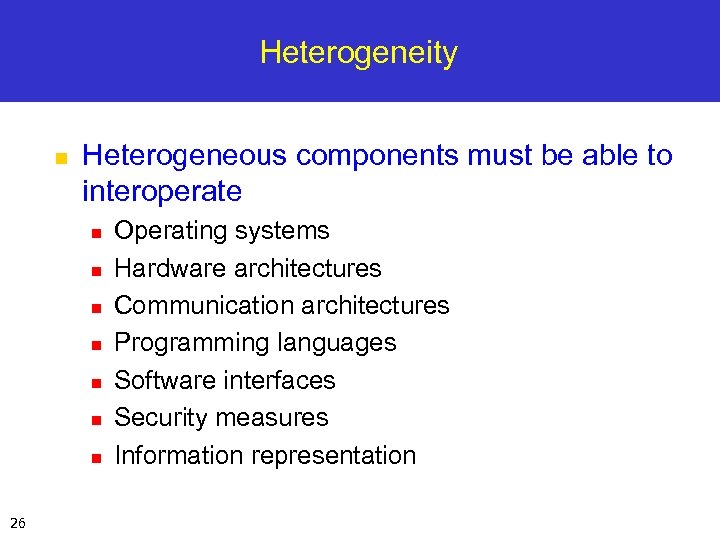
Heterogeneity n Heterogeneous components must be able to interoperate n n n n 26 Operating systems Hardware architectures Communication architectures Programming languages Software interfaces Security measures Information representation
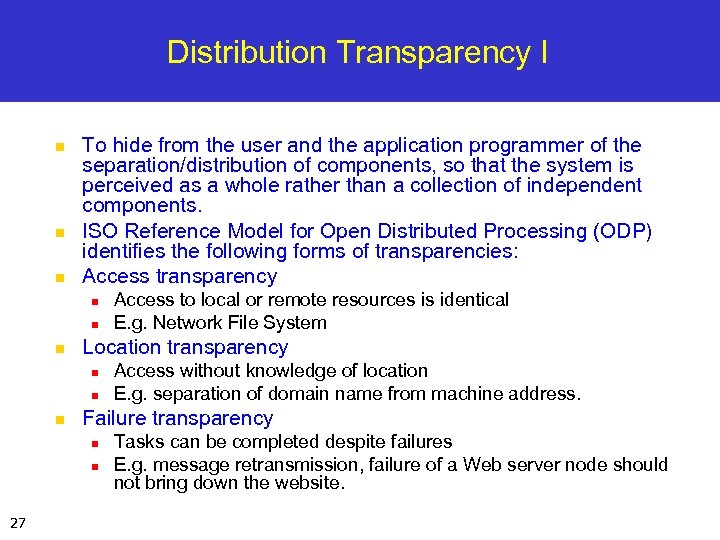
Distribution Transparency I n n n To hide from the user and the application programmer of the separation/distribution of components, so that the system is perceived as a whole rather than a collection of independent components. ISO Reference Model for Open Distributed Processing (ODP) identifies the following forms of transparencies: Access transparency n n n Location transparency n n n Access without knowledge of location E. g. separation of domain name from machine address. Failure transparency n n 27 Access to local or remote resources is identical E. g. Network File System Tasks can be completed despite failures E. g. message retransmission, failure of a Web server node should not bring down the website.
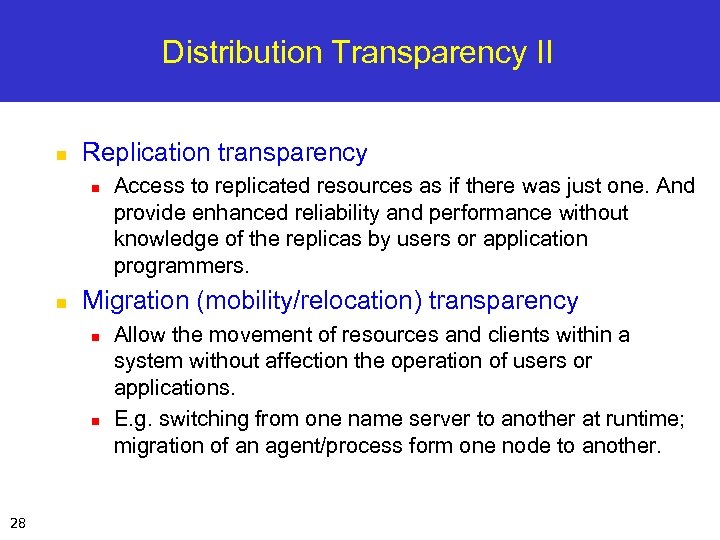
Distribution Transparency II n Replication transparency n n Migration (mobility/relocation) transparency n n 28 Access to replicated resources as if there was just one. And provide enhanced reliability and performance without knowledge of the replicas by users or application programmers. Allow the movement of resources and clients within a system without affection the operation of users or applications. E. g. switching from one name server to another at runtime; migration of an agent/process form one node to another.
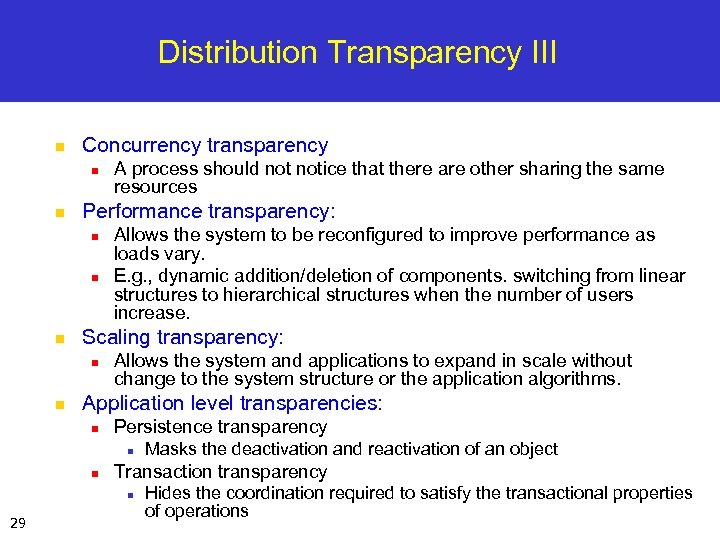
Distribution Transparency III n Concurrency transparency n n Performance transparency: n n n Allows the system to be reconfigured to improve performance as loads vary. E. g. , dynamic addition/deletion of components. switching from linear structures to hierarchical structures when the number of users increase. Scaling transparency: n n A process should notice that there are other sharing the same resources Allows the system and applications to expand in scale without change to the system structure or the application algorithms. Application level transparencies: n Persistence transparency n n Transaction transparency n 29 Masks the deactivation and reactivation of an object Hides the coordination required to satisfy the transactional properties of operations
Fault tolerance n n n 30 Failure: an offered service no longer complies with its specification Fault: cause of a failure (e. g. failure of a component) Fault tolerance: no failure despite faults
Fault tolerance mechanisms n Fault detection n n Fault masking n n Exception handling, timeouts, … Fault recovery n 31 Retransmission of corrupt messages, redundancy, … Fault toleration n n Checksums, heartbeat, … Rollback mechanisms, …
Scalability n n n System should work efficiently at many different scales, ranging from a small Intranet to the Internet. Remain effective when there is a significant increase in the number of resources and the number of users. Challenges of designing scalable distributed systems: n Cost of physical resources n n Performance Loss n n n Numbers used to represent Internet address (32 bit->64 bit) Y 2 K like problem. Avoiding performance bottlenecks: n 32 For example, in hierarchically structure data, search performance loss due to data growth should not be beyond O(log n), where n is the size of data. Preventing software resources running out: n n Cost should linearly increase with system size Use decentralized algorithms (centralized DNS to decentralized).
Concurrency n Provide and manage concurrent access shared resources: n n n 33 Fair scheduling Preserve dependencies (e. g. distributed transactions) Avoid deadlocks
Openness and Interoperability n n 34 Open system: ". . . a system that implements sufficient open specifications for interfaces, services, and supporting formats to enable properly engineered applications software to be ported across a wide range of systems with minimal changes, to interoperate with other applications on local and remote systems, and to interact with users in a style which facilitates user portability" (Guide to the POSIX Open Systems Environment, IEEE POSIX 1003. 0). Open spec/standard developers - communities: n ANSI, IETF, W 3 C, ISO, IEEE, OMG, Trade associations, . . .
Security I n n The resources are accessible to authorized users and used in the way they are intended. Confidentiality n n n Integrity n n 35 Protection against disclosure to authorized individual. E. g. ACLs (access control lists) to provide authorized access to information. Protection against alternation or corruption. E. g. changing the account number or amount value in a money order
Security II n Availability n n n Non-repudiation n n 36 Protection against interference with the means to access the resources. E. g. denial of service attacks Proof of sending / receiving an information E. g. digital signature
Security mechanisms n Encryption n n Authentication n n E. g. password, public key authentication Authorization n 37 E. g. Blowfish, RSA E. g. access control lists
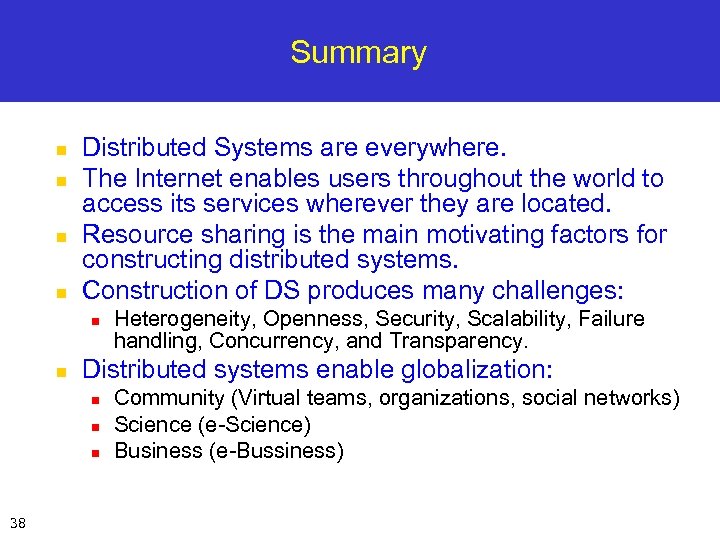
Summary n n Distributed Systems are everywhere. The Internet enables users throughout the world to access its services wherever they are located. Resource sharing is the main motivating factors for constructing distributed systems. Construction of DS produces many challenges: n n Distributed systems enable globalization: n n n 38 Heterogeneity, Openness, Security, Scalability, Failure handling, Concurrency, and Transparency. Community (Virtual teams, organizations, social networks) Science (e-Science) Business (e-Bussiness)
Скачать презентацию 433 -652 Distributed Systems Dr Rajkumar Buyya Senior
4c6859626dfff633a71bb8d2b02ff785.ppt