


 Скачать презентацию 40 m Prototype Upgrade
998e1323f87cf3c2e64fdc70f9011e3e.ppt
- Количество слайдов: 57
 40 m Prototype Upgrade § § § § § Objectives Recent activities Building modifications Optical layout, baffles, pickoffs, ISC tables Output chamber, active seismic isolation Optics parameters Noise CDS Modeling LSC, ASC LIGO-G 000194 -00 -R AJW, 40 m Advisory Committee, 8/16/00
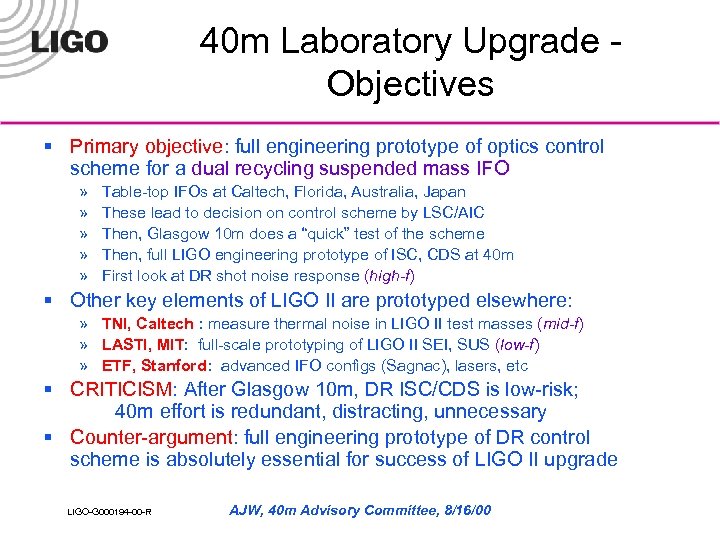 40 m Laboratory Upgrade Objectives § Primary objective: full engineering prototype of optics control scheme for a dual recycling suspended mass IFO » » » Table-top IFOs at Caltech, Florida, Australia, Japan These lead to decision on control scheme by LSC/AIC Then, Glasgow 10 m does a “quick” test of the scheme Then, full LIGO engineering prototype of ISC, CDS at 40 m First look at DR shot noise response (high-f) § Other key elements of LIGO II are prototyped elsewhere: » TNI, Caltech : measure thermal noise in LIGO II test masses (mid-f) » LASTI, MIT: full-scale prototyping of LIGO II SEI, SUS (low-f) » ETF, Stanford: advanced IFO configs (Sagnac), lasers, etc § CRITICISM: After Glasgow 10 m, DR ISC/CDS is low-risk; 40 m effort is redundant, distracting, unnecessary § Counter-argument: full engineering prototype of DR control scheme is absolutely essential for success of LIGO II upgrade LIGO-G 000194 -00 -R AJW, 40 m Advisory Committee, 8/16/00
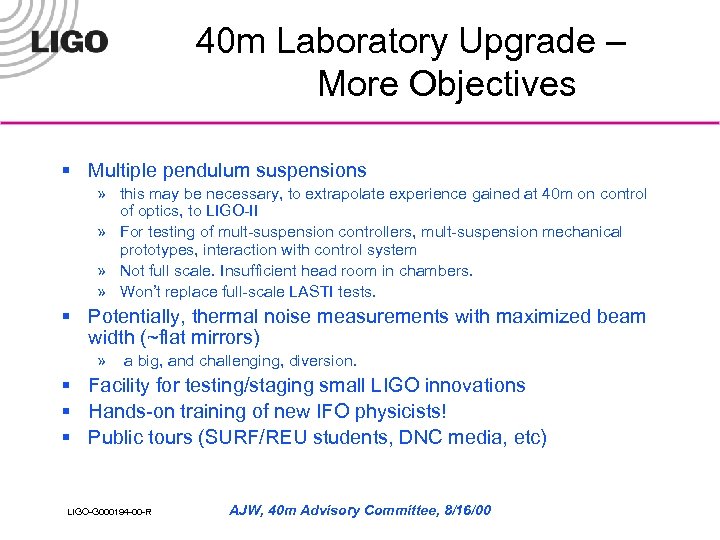 40 m Laboratory Upgrade – More Objectives § Multiple pendulum suspensions » this may be necessary, to extrapolate experience gained at 40 m on control of optics, to LIGO-II » For testing of mult-suspension controllers, mult-suspension mechanical prototypes, interaction with control system » Not full scale. Insufficient head room in chambers. » Won’t replace full-scale LASTI tests. § Potentially, thermal noise measurements with maximized beam width (~flat mirrors) » a big, and challenging, diversion. § Facility for testing/staging small LIGO innovations § Hands-on training of new IFO physicists! § Public tours (SURF/REU students, DNC media, etc) LIGO-G 000194 -00 -R AJW, 40 m Advisory Committee, 8/16/00
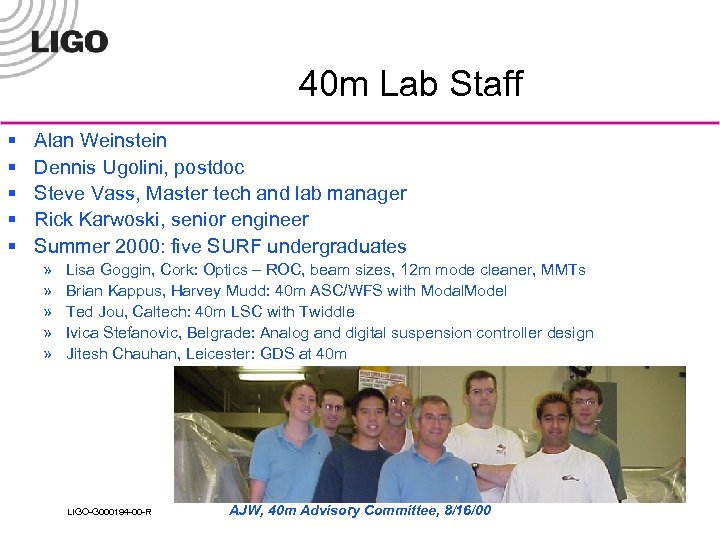 40 m Lab Staff § § § Alan Weinstein Dennis Ugolini, postdoc Steve Vass, Master tech and lab manager Rick Karwoski, senior engineer Summer 2000: five SURF undergraduates » » » Lisa Goggin, Cork: Optics – ROC, beam sizes, 12 m mode cleaner, MMTs Brian Kappus, Harvey Mudd: 40 m ASC/WFS with Modal. Model Ted Jou, Caltech: 40 m LSC with Twiddle Ivica Stefanovic, Belgrade: Analog and digital suspension controller design Jitesh Chauhan, Leicester: GDS at 40 m LIGO-G 000194 -00 -R AJW, 40 m Advisory Committee, 8/16/00
 40 m Lab recent activity § Dismantling: » Old PSL, all old electronics crates & racks, all cables (except for vacuum and RF) have been removed. » Old PSL, much electronics and green optics, transferred to Drever’s lab » Some electronics transferred to TNI lab. » LIGO-prototype DAQS moved to CDS lab (Wilson house) for DAQ development (Bork) » All optical benches (ISC, Oplevs) disassembled and stored » Test masses and suspensions are still in the vacuum chambers. To be disposed of per decision by Barish & Sanders: – – RM will go to Saulson & Harry EV suspension & controllers, with plastic test mass, will go to Hanford Remaining test masses and suspensions, to Drever’s lab We keep all useful scopes, analyzers, lasers, oplev optics, SRS amps, etc LIGO-G 000194 -00 -R AJW, 40 m Advisory Committee, 8/16/00
 40 m building modifications § § Remove "doghouse" on roof and patch temporarily. DONE. re-roof main IFO hall, and North and South Annexes » Caltech will do this by September, as routine maintenance. § § Need more space for CDS racks, ISC tables; so, remove wall between old control room and IFO hall; North Annex becomes new control room Extend the north wall of the North Annex building northward to become flush with the north wall of the main IFO hall. » DONE! And a time capsule was buried under new concrete slab, on 7/31/00 § § § remove south annex changing area wall new enclosed entrance room At this point, we will move from old control room to North Annex Remove wall between 40 m vacuum system and old control room new electrical wiring in North Annex and main IFO hall. » New isolation transformers, breaker panels, and runs to PSL, vertex CDS, end station CDS, and control room outlets. § Install new 12" cable trays in IFO main hall, for ISC, CDS LIGO-G 000194 -00 -R AJW, 40 m Advisory Committee, 8/16/00
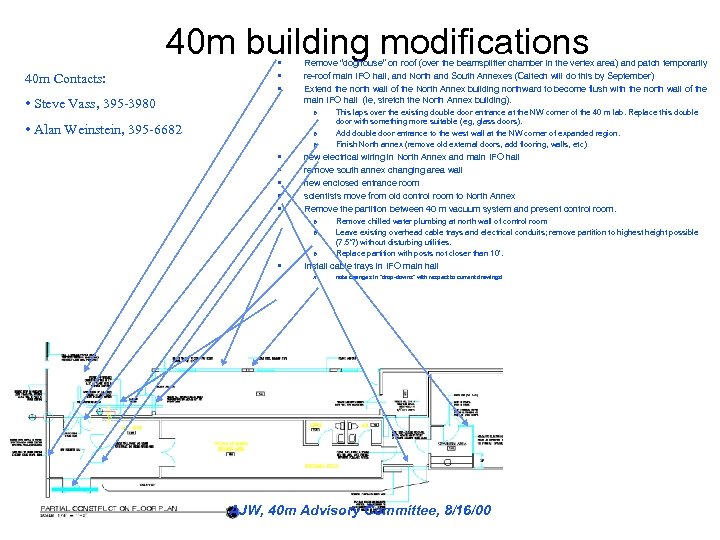 40 m building modifications 40 m Contacts: § § § • Steve Vass, 395 -3980 Remove “doghouse” on roof (over the beamsplitter chamber in the vertex area) and patch temporarily re-roof main IFO hall, and North and South Annexes (Caltech will do this by September) Extend the north wall of the North Annex building northward to become flush with the north wall of the main IFO hall (ie, stretch the North Annex building). » • Alan Weinstein, 395 -6682 » » § § § new electrical wiring in North Annex and main IFO hall remove south annex changing area wall new enclosed entrance room scientists move from old control room to North Annex Remove the partition between 40 m vacuum system and present control room. » » » § This laps over the existing double door entrance at the NW corner of the 40 m lab. Replace this double door with something more suitable (eg, glass doors). Add double door entrance to the west wall at the NW corner of expanded region. Finish North annex (remove old external doors, add flooring, walls, etc) Remove chilled water plumbing at north wall of control room Leave existing overhead cable trays and electrical conduits; remove partition to highest height possible (7. 5'? ) without disturbing utilities. Replace partition with posts not closer than 10'. Install cable trays in IFO main hall » note changes in “drop-downs” with respect to current drawings! AJW, 40 m Advisory Committee, 8/16/00
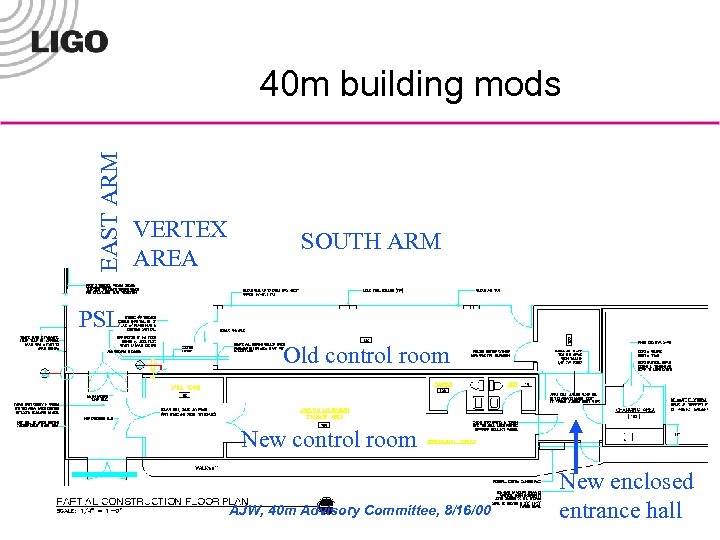 EAST ARM 40 m building mods VERTEX AREA SOUTH ARM PSL Old control room New control room LIGO-G 000194 -00 -R AJW, 40 m Advisory Committee, 8/16/00 New enclosed entrance hall
 Vacuum control system upgrade § Vacuum controls: 3 roughing pumps, 3 turbo pumps, 5 ion pumps, one cryopump, 18 vacuum gauges, 26 valves, etc § Was controlled by old PC-based system, Labview, Metra. Bus § Upgrade: keep all devices (plus a few more), control with VME cpu and EPICS controls/displays » » § § Interfaces with DAQS and rest of EPICS control system EPICS provides archiving, alarms, state transition hooks Keep essential hardware and software interlocks Add gate valves to ion pumps, regenerate them, so we can use them! Design documented and reviewed (John Worden) EPICS code, displays written and tested by Caltech frosh Ted Jou Rack/crate/wiring layout by Ugolini and Heefner Ugolini has implemented almost all the hardware; expect complete system, software shake-down, by end of summer. LIGO-G 000194 -00 -R AJW, 40 m Advisory Committee, 8/16/00
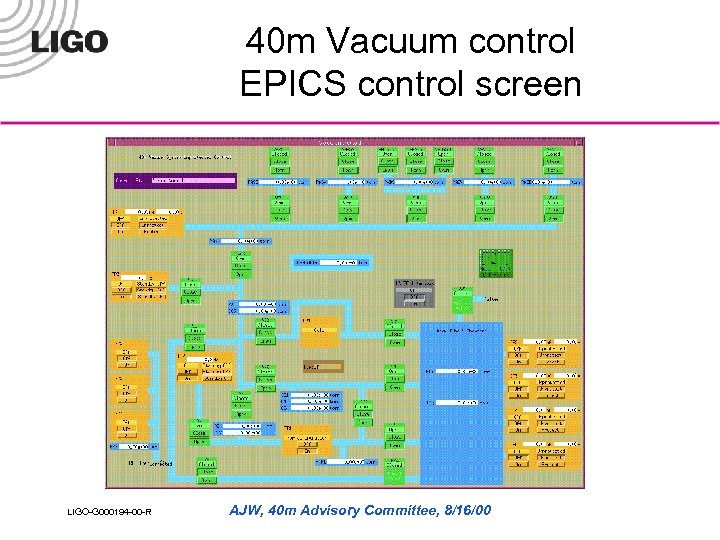 40 m Vacuum control EPICS control screen LIGO-G 000194 -00 -R AJW, 40 m Advisory Committee, 8/16/00
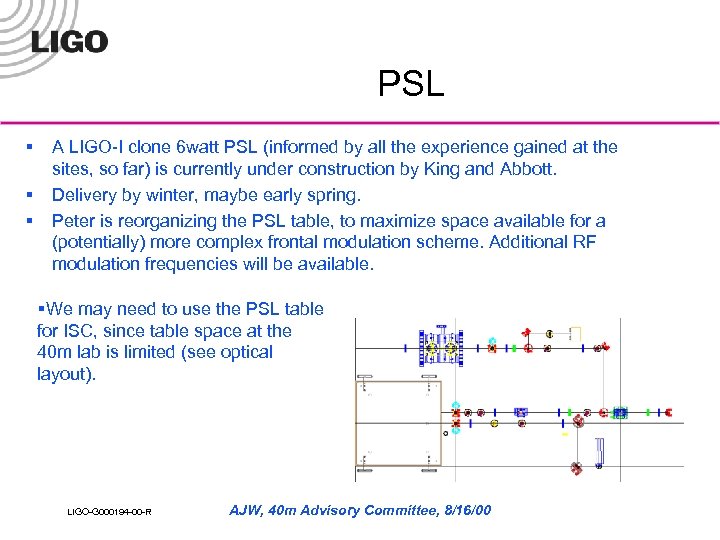 PSL § § § A LIGO-I clone 6 watt PSL (informed by all the experience gained at the sites, so far) is currently under construction by King and Abbott. Delivery by winter, maybe early spring. Peter is reorganizing the PSL table, to maximize space available for a (potentially) more complex frontal modulation scheme. Additional RF modulation frequencies will be available. §We may need to use the PSL table for ISC, since table space at the 40 m lab is limited (see optical layout). LIGO-G 000194 -00 -R AJW, 40 m Advisory Committee, 8/16/00
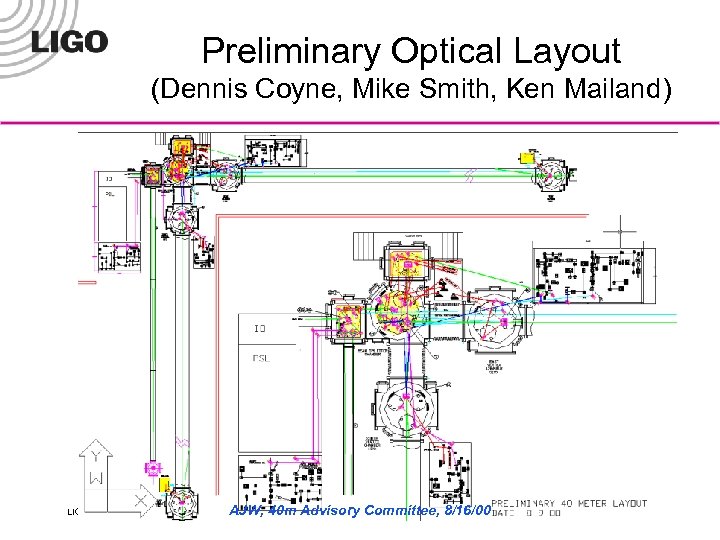 Preliminary Optical Layout (Dennis Coyne, Mike Smith, Ken Mailand) LIGO-G 000194 -00 -R AJW, 40 m Advisory Committee, 8/16/00
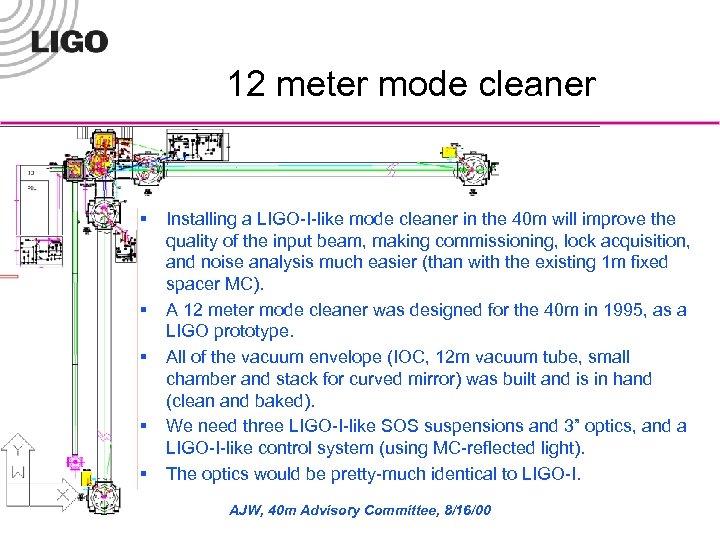 12 meter mode cleaner § § § LIGO-G 000194 -00 -R Installing a LIGO-I-like mode cleaner in the 40 m will improve the quality of the input beam, making commissioning, lock acquisition, and noise analysis much easier (than with the existing 1 m fixed spacer MC). A 12 meter mode cleaner was designed for the 40 m in 1995, as a LIGO prototype. All of the vacuum envelope (IOC, 12 m vacuum tube, small chamber and stack for curved mirror) was built and is in hand (clean and baked). We need three LIGO-I-like SOS suspensions and 3” optics, and a LIGO-I-like control system (using MC-reflected light). The optics would be pretty-much identical to LIGO-I. AJW, 40 m Advisory Committee, 8/16/00
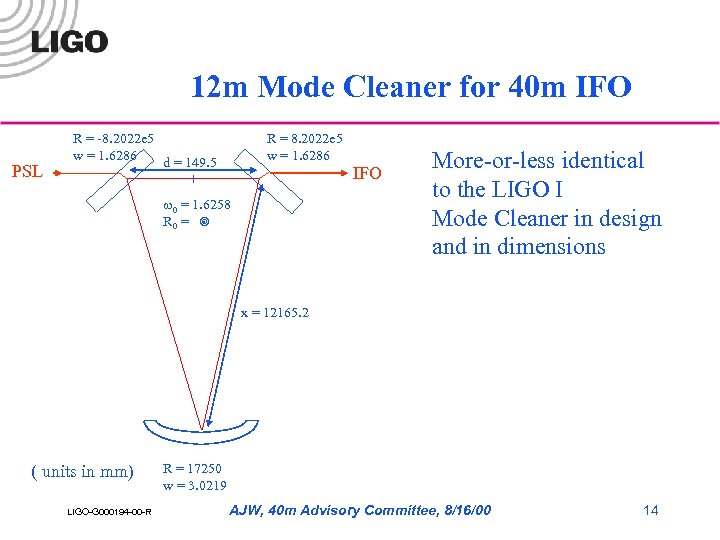 12 m Mode Cleaner for 40 m IFO PSL R = -8. 2022 e 5 w = 1. 6286 R = 8. 2022 e 5 w = 1. 6286 d = 149. 5 IFO w 0 = 1. 6258 R 0 = More-or-less identical to the LIGO I Mode Cleaner in design and in dimensions x = 12165. 2 ( units in mm) LIGO-G 000194 -00 -R R = 17250 w = 3. 0219 AJW, 40 m Advisory Committee, 8/16/00 14
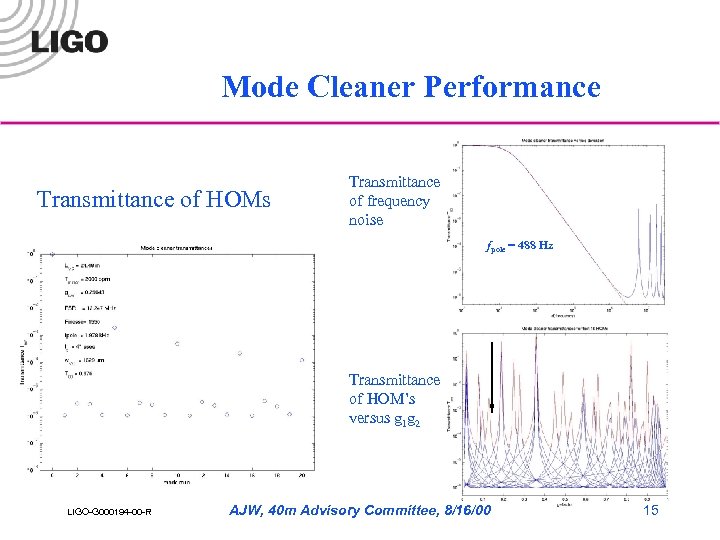 Mode Cleaner Performance Transmittance of HOMs Transmittance of frequency noise fpole = 488 Hz Transmittance of HOM’s versus g 1 g 2 LIGO-G 000194 -00 -R AJW, 40 m Advisory Committee, 8/16/00 15
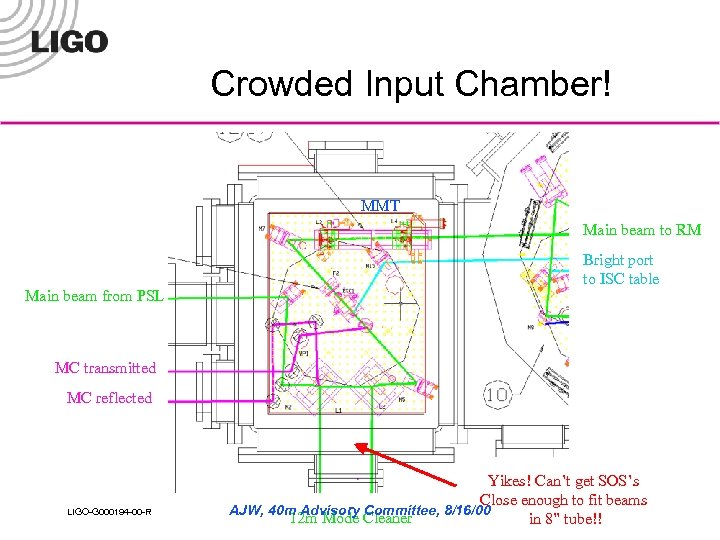 Crowded Input Chamber! MMT Main beam to RM Main beam from PSL Bright port to ISC table MC transmitted MC reflected LIGO-G 000194 -00 -R Yikes! Can’t get SOS’s Close enough to fit beams AJW, 40 m Advisory Committee, 8/16/00 12 m Mode Cleaner in 8” tube!!
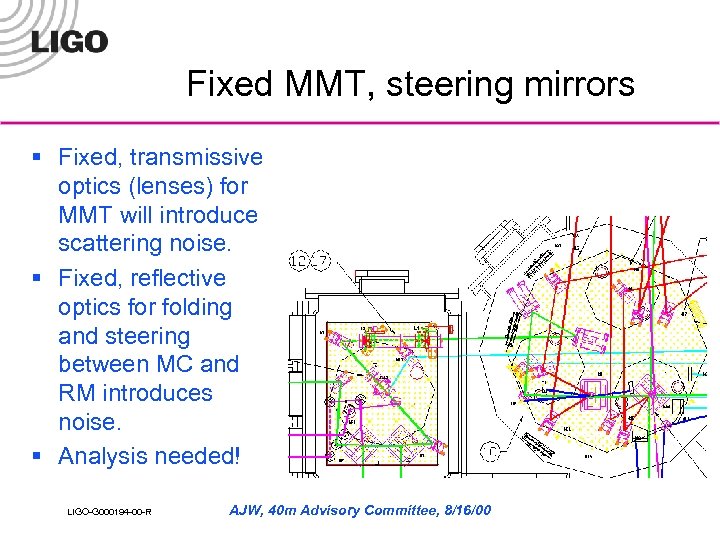 Fixed MMT, steering mirrors § Fixed, transmissive optics (lenses) for MMT will introduce scattering noise. § Fixed, reflective optics for folding and steering between MC and RM introduces noise. § Analysis needed! LIGO-G 000194 -00 -R AJW, 40 m Advisory Committee, 8/16/00
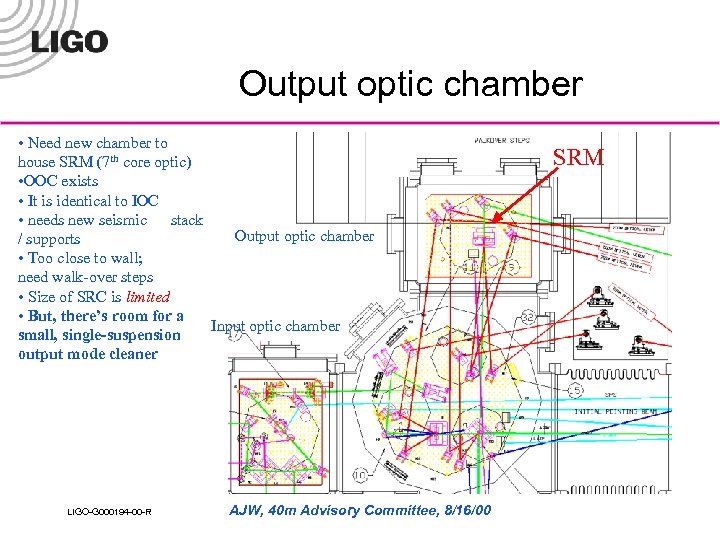 Output optic chamber • Need new chamber to house SRM (7 th core optic) • OOC exists • It is identical to IOC • needs new seismic stack Output optic chamber / supports • Too close to wall; need walk-over steps • Size of SRC is limited • But, there’s room for a Input optic chamber small, single-suspension output mode cleaner LIGO-G 000194 -00 -R AJW, 40 m Advisory Committee, 8/16/00 SRM
 Does the OOC need to be baked? • OOC is currently being pumped down (empty) with RGA, to determine whether it needs to be baked • Currently, pressure is • ptot ~ 5 E-6 torr, • p 41 ~ 5 E-9 torr • Pumping speed is around 10 ltr/sec. • advice on how to make this decision is requested! LIGO-G 000194 -00 -R AJW, 40 m Advisory Committee, 8/16/00
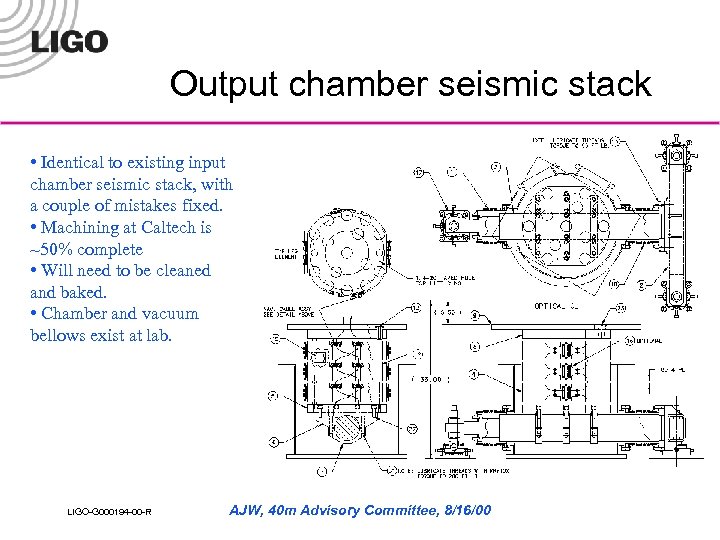 Output chamber seismic stack • Identical to existing input chamber seismic stack, with a couple of mistakes fixed. • Machining at Caltech is ~50% complete • Will need to be cleaned and baked. • Chamber and vacuum bellows exist at lab. LIGO-G 000194 -00 -R AJW, 40 m Advisory Committee, 8/16/00
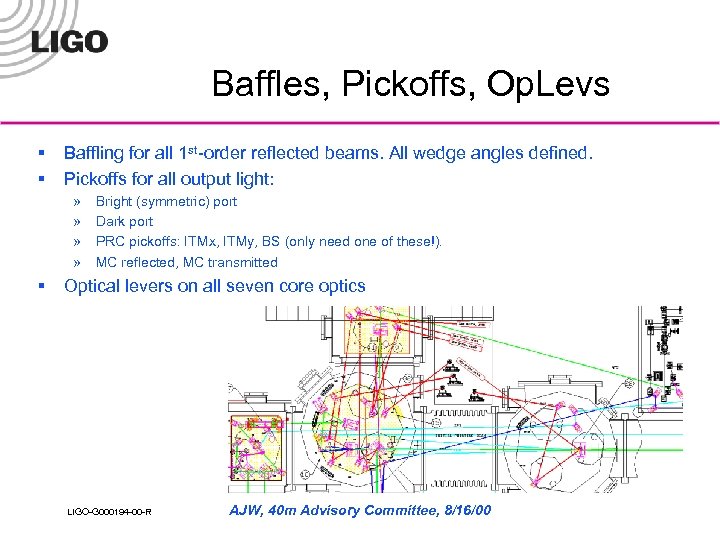 Baffles, Pickoffs, Op. Levs § § Baffling for all 1 st-order reflected beams. All wedge angles defined. Pickoffs for all output light: » » § Bright (symmetric) port Dark port PRC pickoffs: ITMx, ITMy, BS (only need one of these!). MC reflected, MC transmitted Optical levers on all seven core optics LIGO-G 000194 -00 -R AJW, 40 m Advisory Committee, 8/16/00
 Do we need active seismic isolation at 40 m? § § § § “seismic wall” at the 40 m, with existing stacks (viton springs), is at ~100 Hz (LIGO-I with damped-metal springs: < 40 Hz). Of course, seismic noise is much worse at 40 m than at LIGO! For prototyping a LIGO-II control system, we are not concerned with noise in this range We do need to keep the motion down to be able to acquire and keep lock. Mean time to acquire lock (MTTL): vthr estimated to be ~ /12 s-1 (depends on loop gains, etc) SO, MTTL 6 sec To estimate P(v < vthr), we need to » » Measure ground motion x(f) Measure & model stack transfer function, with and w/out active control Model pendulum transfer function Integrate v(f) spectrum (from, eg, 1 Hz up), calculate P(v < vthr), and MTTL LIGO-G 000194 -00 -R AJW, 40 m Advisory Committee, 8/16/00
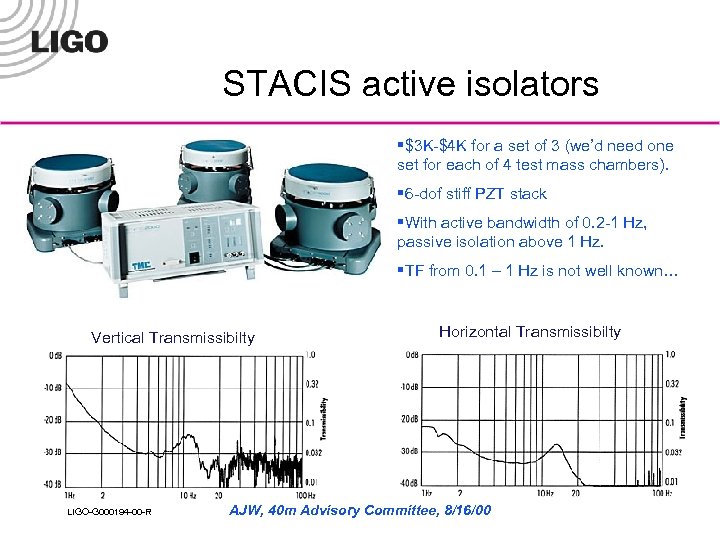 STACIS active isolators §$3 K-$4 K for a set of 3 (we’d need one set for each of 4 test mass chambers). § 6 -dof stiff PZT stack §With active bandwidth of 0. 2 -1 Hz, passive isolation above 1 Hz. §TF from 0. 1 – 1 Hz is not well known… Vertical Transmissibilty LIGO-G 000194 -00 -R Horizontal Transmissibilty AJW, 40 m Advisory Committee, 8/16/00
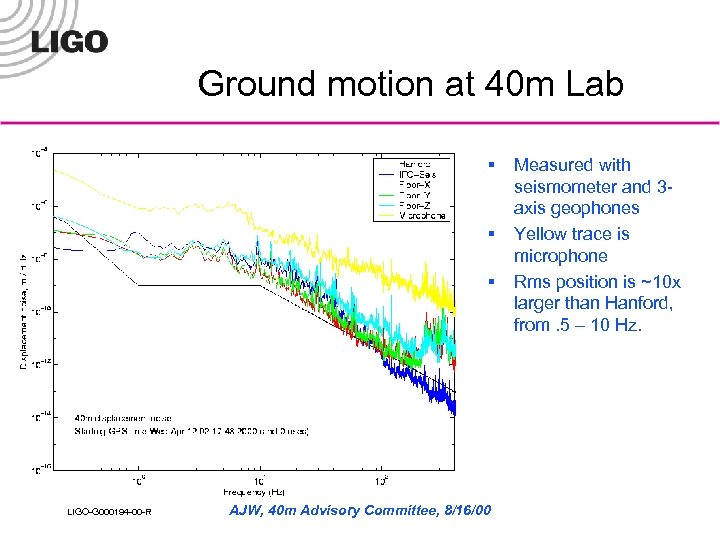 Ground motion at 40 m Lab § § § LIGO-G 000194 -00 -R AJW, 40 m Advisory Committee, 8/16/00 Measured with seismometer and 3 axis geophones Yellow trace is microphone Rms position is ~10 x larger than Hanford, from. 5 – 10 Hz.
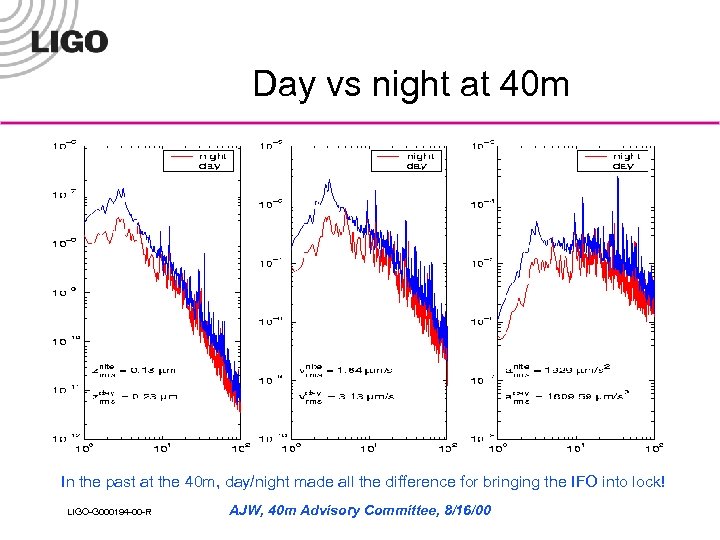 Day vs night at 40 m In the past at the 40 m, day/night made all the difference for bringing the IFO into lock! LIGO-G 000194 -00 -R AJW, 40 m Advisory Committee, 8/16/00
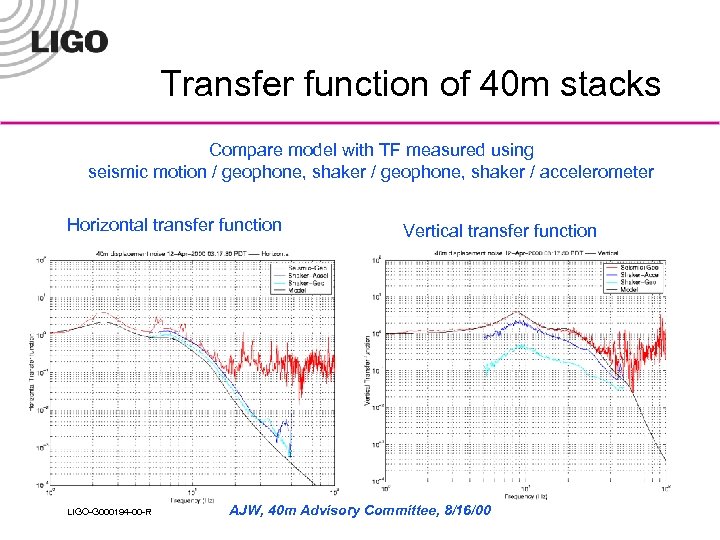 Transfer function of 40 m stacks Compare model with TF measured using seismic motion / geophone, shaker / accelerometer Horizontal transfer function LIGO-G 000194 -00 -R Vertical transfer function AJW, 40 m Advisory Committee, 8/16/00
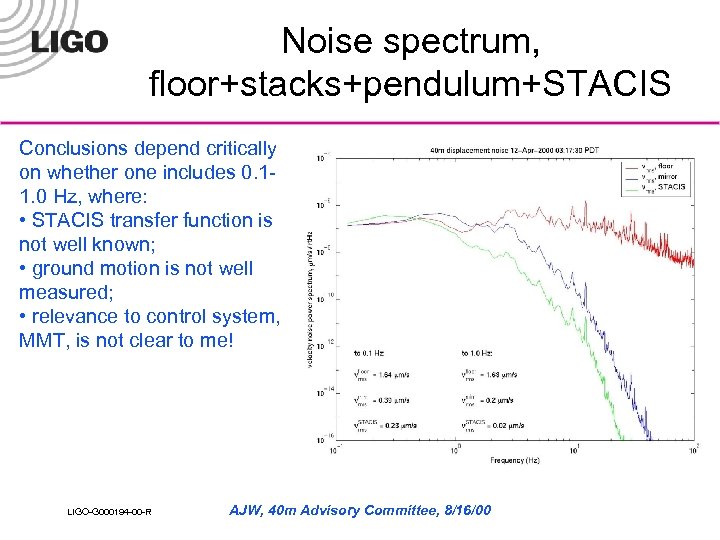 Noise spectrum, floor+stacks+pendulum+STACIS Conclusions depend critically on whether one includes 0. 11. 0 Hz, where: • STACIS transfer function is not well known; • ground motion is not well measured; • relevance to control system, MMT, is not clear to me! LIGO-G 000194 -00 -R AJW, 40 m Advisory Committee, 8/16/00
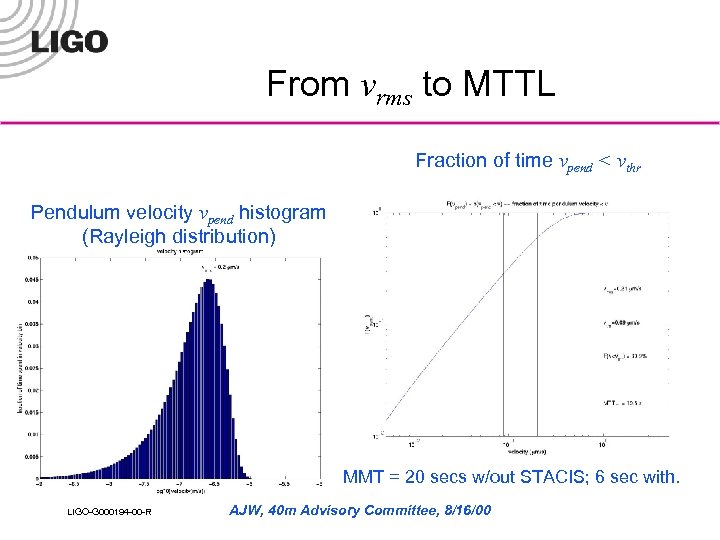 From vrms to MTTL Fraction of time vpend < vthr Pendulum velocity vpend histogram (Rayleigh distribution) MMT = 20 secs w/out STACIS; 6 sec with. LIGO-G 000194 -00 -R AJW, 40 m Advisory Committee, 8/16/00
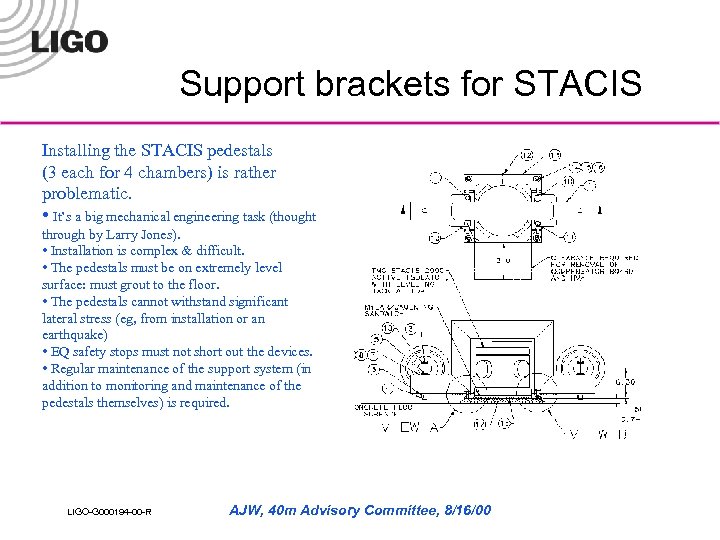 Support brackets for STACIS Installing the STACIS pedestals (3 each for 4 chambers) is rather problematic. • It’s a big mechanical engineering task (thought through by Larry Jones). • Installation is complex & difficult. • The pedestals must be on extremely level surface: must grout to the floor. • The pedestals cannot withstand significant lateral stress (eg, from installation or an earthquake) • EQ safety stops must not short out the devices. • Regular maintenance of the support system (in addition to monitoring and maintenance of the pedestals themselves) is required. LIGO-G 000194 -00 -R AJW, 40 m Advisory Committee, 8/16/00
 Size and mass of core optics • • • 40 m- recycling experiment used 4"diameter 3. 5"thick core optics (1. 56 kg, which require already-engineered scaled SOS/LOS suspension), LIGO SOS suspensions (MC, MMT) use 3"diameter 1"thick optics (0. 25 kg). 3” optics have sufficient aperture, even after OSEMs are taken into account, to cover all but ~ 1 ppm of the 40 m beam power (<1. 4" diam. everywhere). Smaller optics presumably cost less and take less time to grow. Smaller optics require a suspension with a smaller footprint on the already very crowded chamber tables. Suspension noise (which depends on mass of optic) is less than test mass internal thermal noise everywhere except for a few violin-mode spikes. LIGO experience with SOS, 3” optics is very valuable! I see no reason to not go with SOS 3” for all 40 m core optics If we go to multiple pendula, we might need bigger masses for mechanical reasons (K. Strain). LIGO-G 000194 -00 -R AJW, 40 m Advisory Committee, 8/16/00
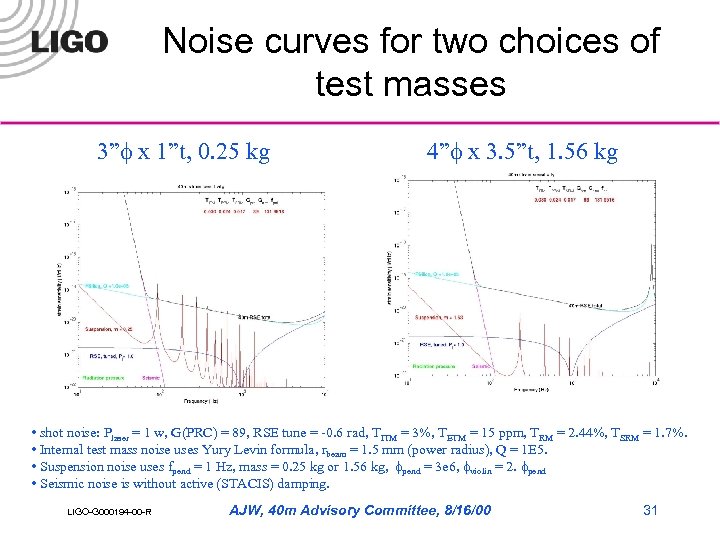 Noise curves for two choices of test masses 3” x 1”t, 0. 25 kg 4” x 3. 5”t, 1. 56 kg • shot noise: Plaser = 1 w, G(PRC) = 89, RSE tune = -0. 6 rad, TITM = 3%, TETM = 15 ppm, TRM = 2. 44%, TSRM = 1. 7%. • Internal test mass noise uses Yury Levin formula, rbeam = 1. 5 mm (power radius), Q = 1 E 5. • Suspension noise uses fpend = 1 Hz, mass = 0. 25 kg or 1. 56 kg, pend = 3 e 6, violin = 2. pend • Seismic noise is without active (STACIS) damping. LIGO-G 000194 -00 -R AJW, 40 m Advisory Committee, 8/16/00 31
 Other Optics issues § Optical quality (absorption). Typical numbers for LIGO glass, as measured by Garilynn Billingsley: » » Heraeus 311 & 312: ~ 3 ppm/cm » § Corning: ~13 ppm/cm Heraeus 311 SV: ~ 0. 5 ppm/cm It takes a long time to procure the substrate, polish, and coat. » 4 months ARO for the SV material. No difference in delivery time between 3 or 4" optics. » Polishing is 2 -3 months for something of this quality. » there is currently a long line at the door of the coating house (REO). § Cost scales with weight of optic, and SV is ~twice as expensive as Corning. § Bill Kells estimates the effect of thermal lensing (at 1 watt input power) to be negligible if correct ROC are applied, and SV glass used for ITMs, BS. § Will choose Heraeus SV for ITMs and BS, Corning for ETMs, RM, SM, and MC. § Can wait till “last minute” for coatings (TITM, TRM, TSM) LIGO-G 000194 -00 -R AJW, 40 m Advisory Committee, 8/16/00
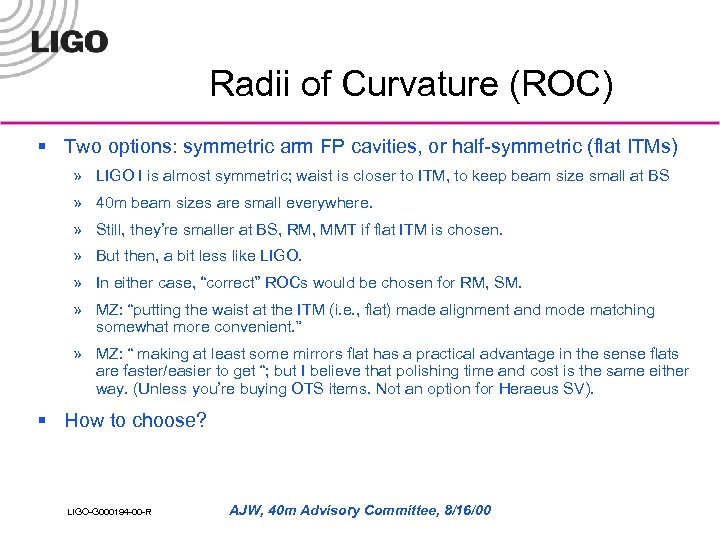 Radii of Curvature (ROC) § Two options: symmetric arm FP cavities, or half-symmetric (flat ITMs) » LIGO I is almost symmetric; waist is closer to ITM, to keep beam size small at BS » 40 m beam sizes are small everywhere. » Still, they’re smaller at BS, RM, MMT if flat ITM is chosen. » But then, a bit less like LIGO. » In either case, “correct” ROCs would be chosen for RM, SM. » MZ: “putting the waist at the ITM (i. e. , flat) made alignment and mode matching somewhat more convenient. ” » MZ: “ making at least some mirrors flat has a practical advantage in the sense flats are faster/easier to get “; but I believe that polishing time and cost is the same either way. (Unless you’re buying OTS items. Not an option for Heraeus SV). § How to choose? LIGO-G 000194 -00 -R AJW, 40 m Advisory Committee, 8/16/00
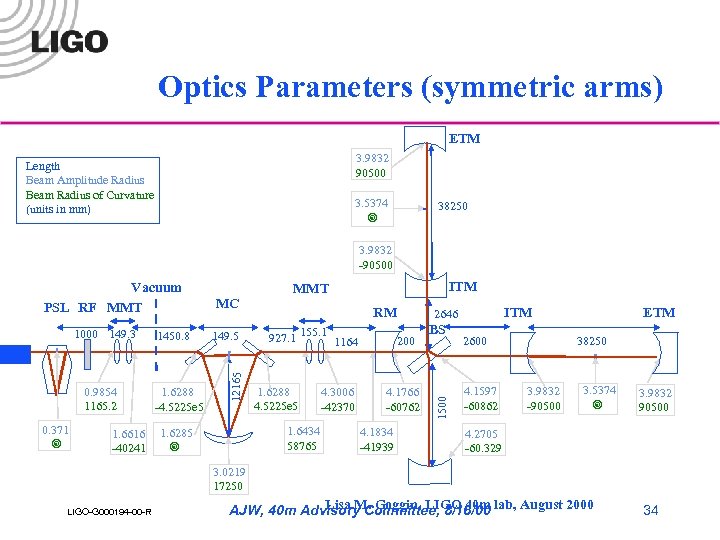 Optics Parameters (symmetric arms) ETM 3. 9832 90500 Length Beam Amplitude Radius Beam Radius of Curvature (units in mm) 3. 5374 38250 3. 9832 -90500 0. 9854 1165. 2 0. 371 1. 6616 -40241 1450. 8 1. 6288 -4. 5225 e 5 149. 5 RM 927. 1 155. 1 1164 1. 6288 4. 5225 e 5 1. 6434 58765 1. 6285 ITM MMT 4. 3006 -42370 200 4. 1766 -60762 4. 1834 -41939 BS ETM ITM 2646 1500 1000 149. 3 MC 12165 Vacuum PSL RF MMT 2600 4. 1597 -60862 38250 3. 9832 -90500 3. 5374 3. 9832 90500 4. 2705 -60. 329 3. 0219 17250 LIGO-G 000194 -00 -R Lisa M. Goggin, LIGO 40 m AJW, 40 m Advisory Committee, 8/16/00 lab, August 2000 34
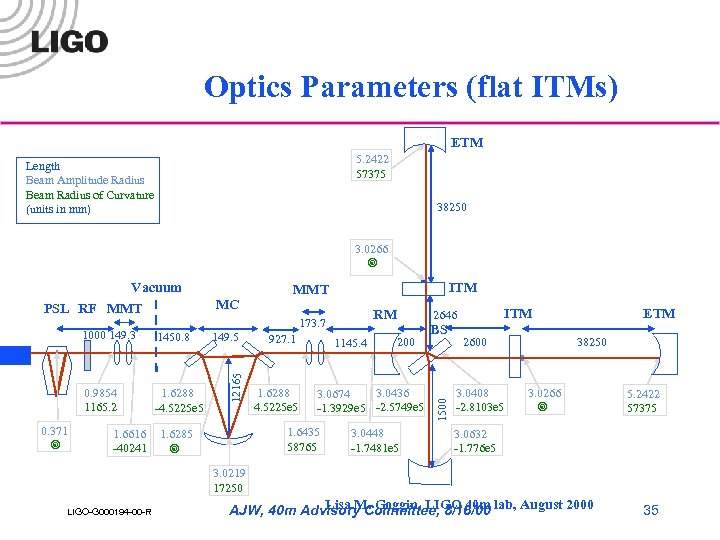 Optics Parameters (flat ITMs) ETM 5. 2422 57375 Length Beam Amplitude Radius Beam Radius of Curvature (units in mm) 38250 3. 0266 0. 9854 1165. 2 1. 6288 -4. 5225 e 5 149. 5 12165 1450. 8 1. 6616 -40241 RM 173. 7 1000 149. 3 0. 371 MC ITM MMT 927. 1 1. 6288 4. 5225 e 5 1145. 4 3. 0436 3. 0674 -1. 3929 e 5 -2. 5749 e 5 1. 6435 58765 1. 6285 200 3. 0448 -1. 7481 e 5 BS ETM ITM 2646 1500 Vacuum PSL RF MMT 2600 3. 0408 -2. 8103 e 5 38250 3. 0266 5. 2422 57375 3. 0632 -1. 776 e 5 3. 0219 17250 LIGO-G 000194 -00 -R Lisa M. Goggin, LIGO 40 m AJW, 40 m Advisory Committee, 8/16/00 lab, August 2000 35
 CDS electronics work § Rick Karwoski is assembling a (preliminary) parts list for all CDS electronics (suspension controllers, LSC, ASC, ISC, racks, crates, CPUs, reflective memory, GPS, PD heads, OSEMs, amplifiers, drivers, power supplies, cables, connectors), with help from Heefner & Bork. § CDS for 40 m is almost the same as for an entire LIGO IFO. It drives the cost of the upgrade! LIGO-G 000194 -00 -R AJW, 40 m Advisory Committee, 8/16/00
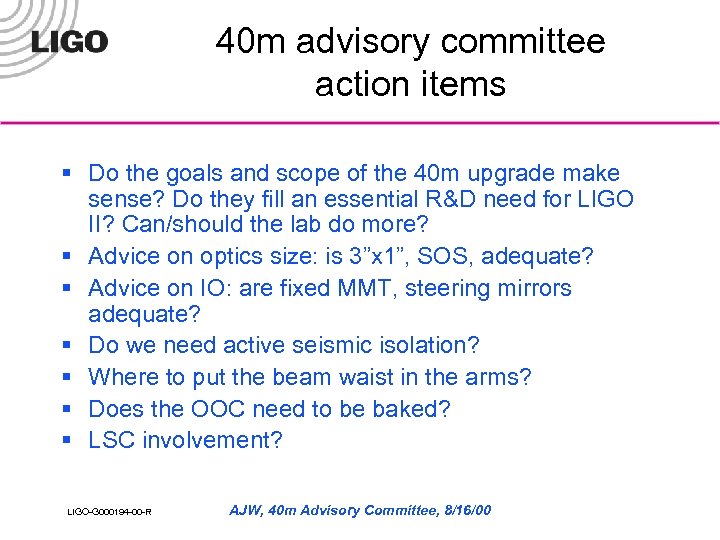 40 m advisory committee action items § Do the goals and scope of the 40 m upgrade make sense? Do they fill an essential R&D need for LIGO II? Can/should the lab do more? § Advice on optics size: is 3”x 1”, SOS, adequate? § Advice on IO: are fixed MMT, steering mirrors adequate? § Do we need active seismic isolation? § Where to put the beam waist in the arms? § Does the OOC need to be baked? § LSC involvement? LIGO-G 000194 -00 -R AJW, 40 m Advisory Committee, 8/16/00
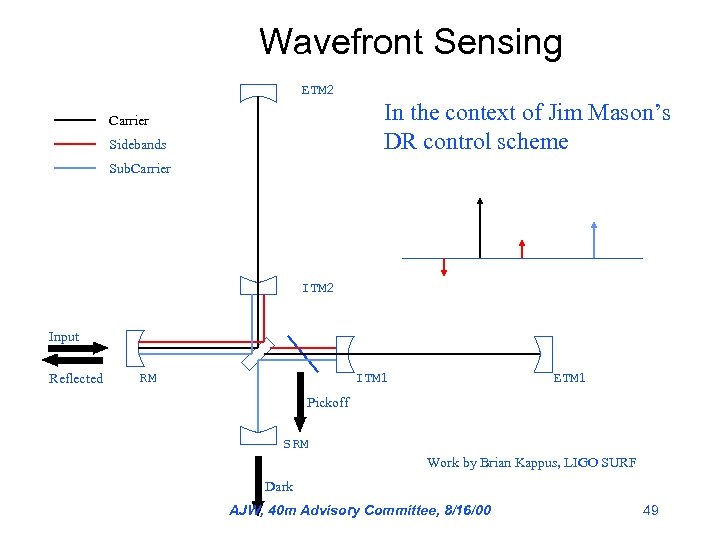
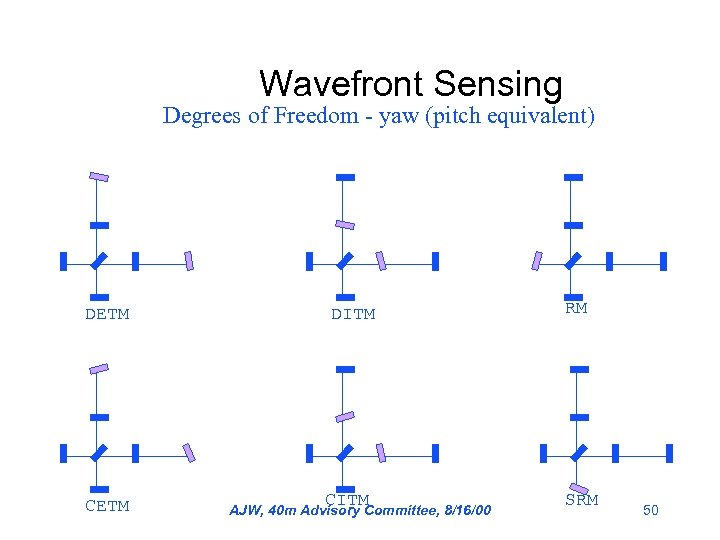
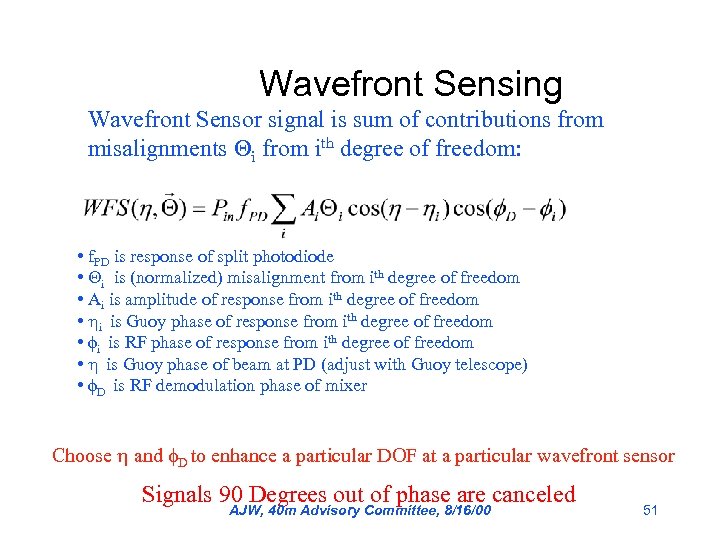
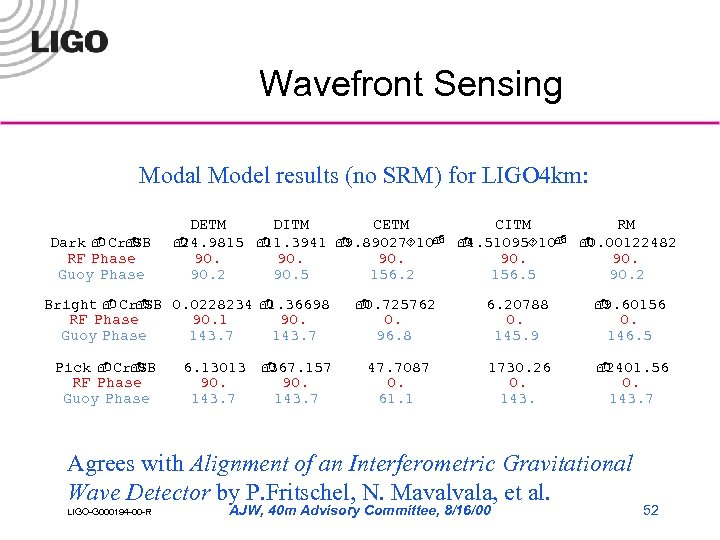
 Modeling Length- and Alignment control schemes § We worked in the context of Jim Mason’s dualrecycling control scheme (other control schemes would be implemented quite differently, and would require re-modeling). § Work by SURF 2000 students: » Ted Jou, Caltech: 40 m LSC with Twiddle, lots of help from Jim Mason » Brian Kappus, Harvey Mudd: 40 m ASC/WFS with Modal. Model, lots of help from Nergis and Daniel Sigg LIGO-G 000194 -00 -R AJW, 40 m Advisory Committee, 8/16/00
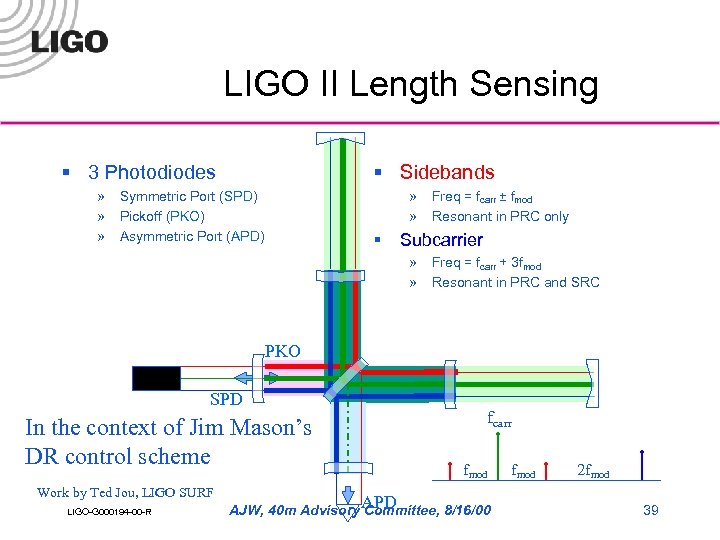 LIGO II Length Sensing § 3 Photodiodes § Sidebands » Symmetric Port (SPD) » Pickoff (PKO) » Asymmetric Port (APD) » Freq = fcarr ± fmod » Resonant in PRC only § Subcarrier » Freq = fcarr + 3 fmod » Resonant in PRC and SRC PKO SPD fcarr In the context of Jim Mason’s DR control scheme Work by Ted Jou, LIGO SURF LIGO-G 000194 -00 -R fmod APD AJW, 40 m Advisory Committee, 8/16/00 fmod 2 fmod 39
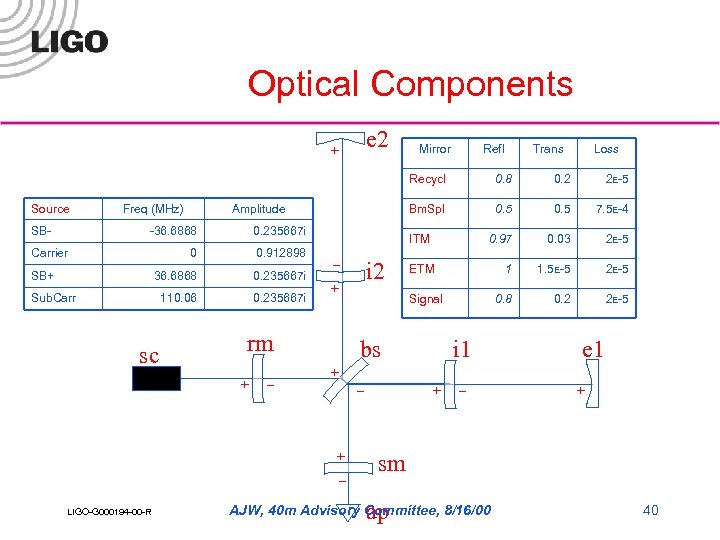 Optical Components e 2 + Mirror Refl Trans Loss Recycl Source SB- Freq (MHz) -36. 6868 0. 235667 i 0 0. 912898 36. 6868 0. 235667 i 110. 06 0. 235667 i Carrier SB+ Sub. Carr sc _ _ i 2 + 0. 5 7. 5 E-4 0. 97 0. 03 2 E-5 1 1. 5 E-5 2 E-5 0. 8 0. 2 2 E-5 ETM Signal bs + + _ LIGO-G 000194 -00 -R 2 E-5 ITM rm + 0. 2 Bm. Spl Amplitude 0. 8 _ i 1 + _ e 1 + sm ap AJW, 40 m Advisory Committee, 8/16/00 40
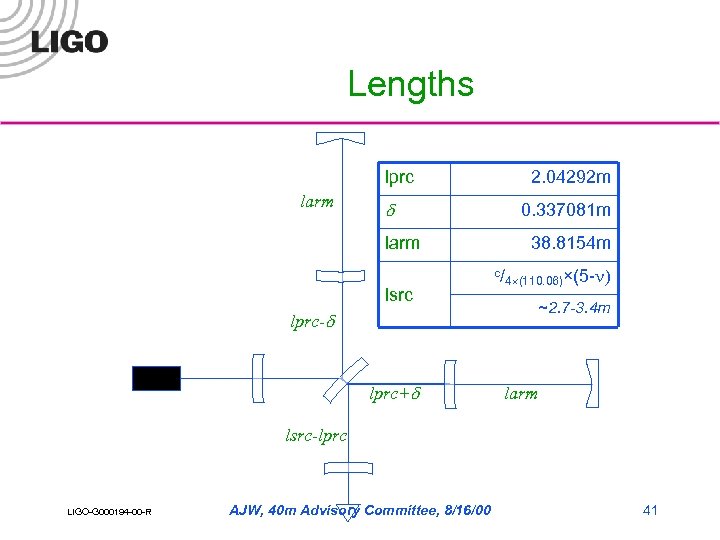 Lengths lprc larm 2. 04292 m d 0. 337081 m larm lsrc 38. 8154 m c/ 4 (110. 06)×(5 -n) ~2. 7 -3. 4 m lprc-d lprc+d larm lsrc-lprc LIGO-G 000194 -00 -R AJW, 40 m Advisory Committee, 8/16/00 41
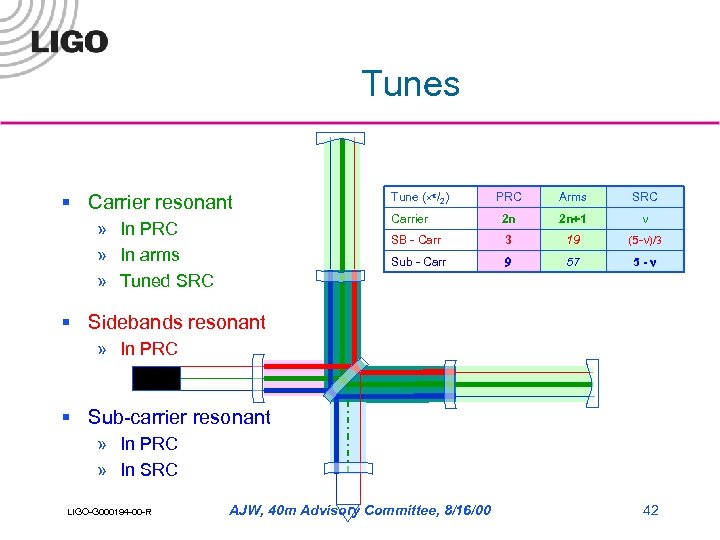 Tunes Tune ( p/2) Arms SRC 2 n 2 n+1 n 3 19 (5 -n)/3 Sub - Carr » In PRC » In arms » Tuned SRC PRC SB - Carr § Carrier resonant 9 57 5 -n Carrier § Sidebands resonant » In PRC § Sub-carrier resonant » In PRC » In SRC LIGO-G 000194 -00 -R AJW, 40 m Advisory Committee, 8/16/00 42
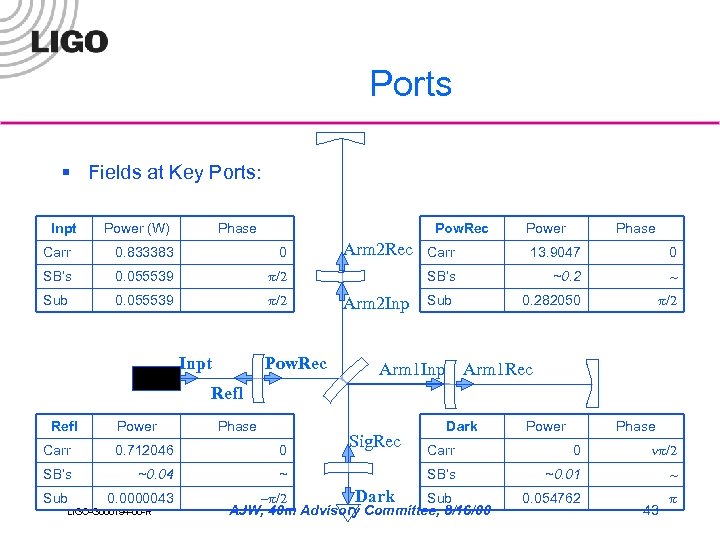 Ports § Fields at Key Ports: Inpt Power (W) Phase Pow. Rec Carr 0. 833383 0 SB’s 0. 055539 p/2 Sub 0. 055539 p/2 Arm 2 Rec Inpt Pow. Rec Power Phase 13. 9047 0 SB’s Arm 2 Inp Carr ~0. 2 ~ Sub 0. 282050 p/2 Arm 1 Inp Arm 1 Rec Refl Power Phase Carr 0. 712046 0 SB’s ~0. 04 ~ Sub 0. 0000043 LIGO-G 000194 -00 -R Sig. Rec Dark Power Phase Carr 0 np/2 SB’s ~0. 01 ~ Dark Sub p/2 AJW, 40 m Advisory Committee, 8/16/00 0. 054762 43 p
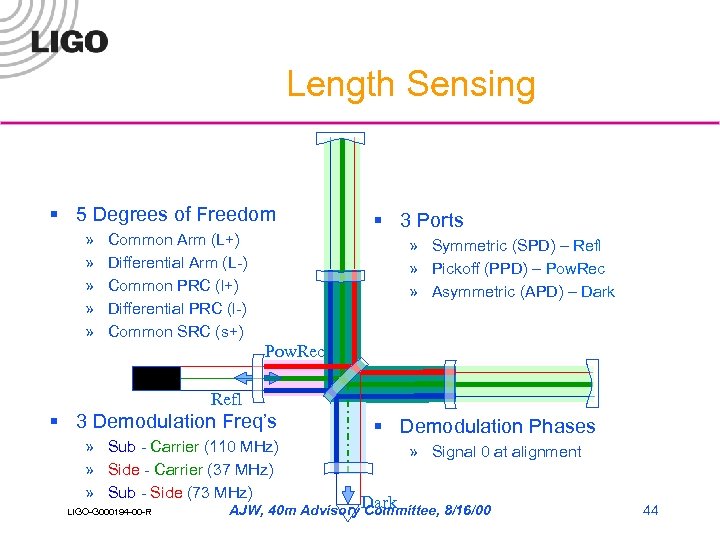 Length Sensing § 5 Degrees of Freedom » » » Common Arm (L+) Differential Arm (L-) Common PRC (l+) Differential PRC (l-) Common SRC (s+) § 3 Ports » Symmetric (SPD) – Refl » Pickoff (PPD) – Pow. Rec » Asymmetric (APD) – Dark Pow. Rec Refl § 3 Demodulation Freq’s » Sub - Carrier (110 MHz) » Side - Carrier (37 MHz) » Sub - Side (73 MHz) LIGO-G 000194 -00 -R § Demodulation Phases » Signal 0 at alignment Dark AJW, 40 m Advisory Committee, 8/16/00 44
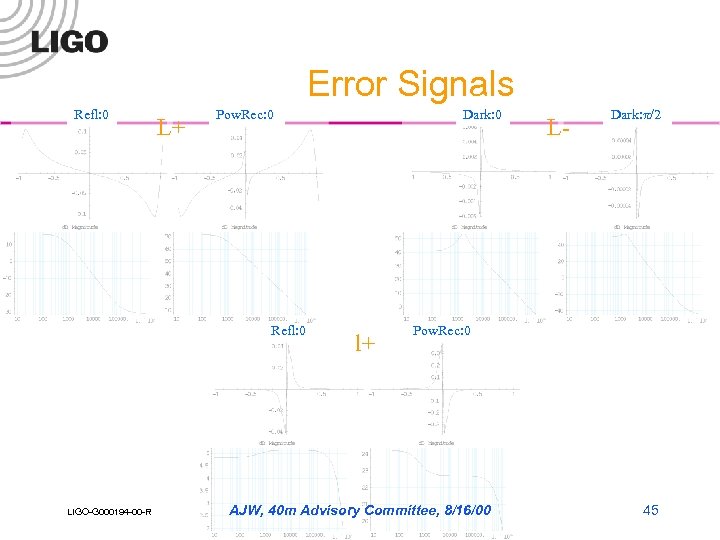 Error Signals Refl: 0 L+ Pow. Rec: 0 Refl: 0 LIGO-G 000194 -00 -R Dark: 0 l+ L- Dark: p/2 Pow. Rec: 0 AJW, 40 m Advisory Committee, 8/16/00 45
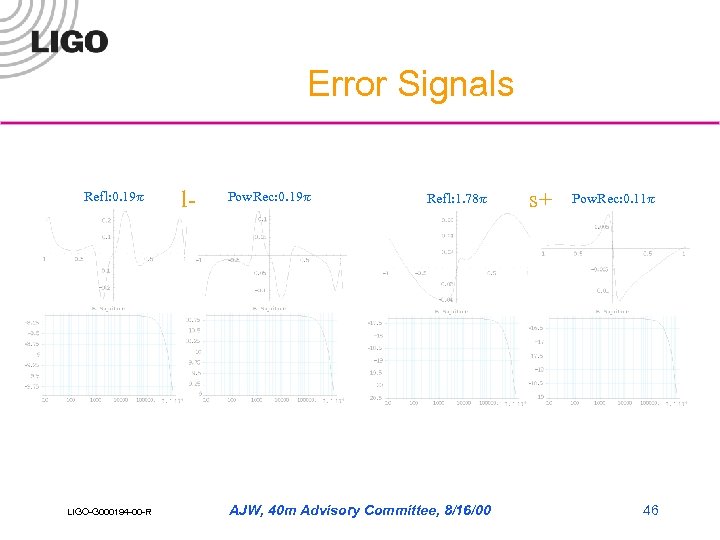 Error Signals Refl: 0. 19 p LIGO-G 000194 -00 -R l- Pow. Rec: 0. 19 p Refl: 1. 78 p AJW, 40 m Advisory Committee, 8/16/00 s+ Pow. Rec: 0. 11 p 46
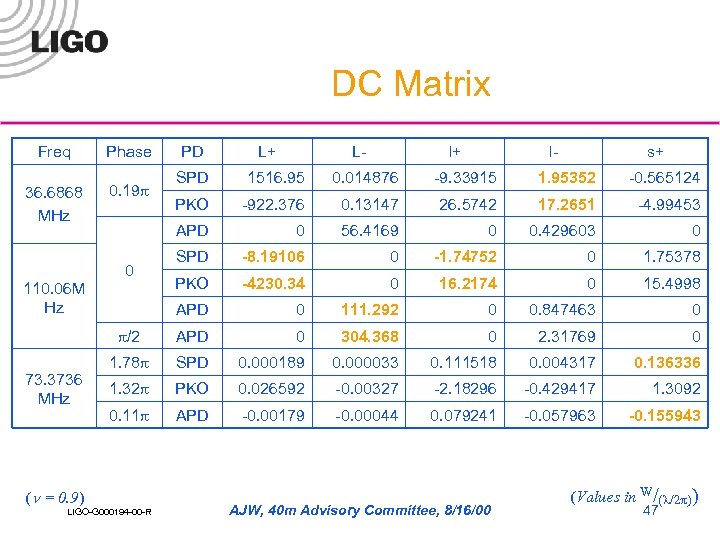 DC Matrix Freq Phase PD L+ L- l+ l- s+ 1516. 95 0. 014876 -9. 33915 1. 95352 -0. 565124 PKO -922. 376 0. 13147 26. 5742 17. 2651 -4. 99453 APD 0 56. 4169 0 0. 429603 0 SPD -8. 19106 0 -1. 74752 0 1. 75378 PKO -4230. 34 0 16. 2174 0 15. 4998 APD 0 111. 292 0 0. 847463 0 p/2 36. 6868 MHz SPD APD 0 304. 368 0 2. 31769 0 1. 78 p SPD 0. 000189 0. 000033 0. 111518 0. 004317 0. 136336 1. 32 p PKO 0. 026592 -0. 00327 -2. 18296 -0. 429417 1. 3092 0. 11 p APD -0. 00179 -0. 00044 0. 079241 -0. 057963 -0. 155943 0. 19 p 0 110. 06 M Hz 73. 3736 MHz (n = 0. 9) LIGO-G 000194 -00 -R AJW, 40 m Advisory Committee, 8/16/00 (Values in W/( /2 p)) 47
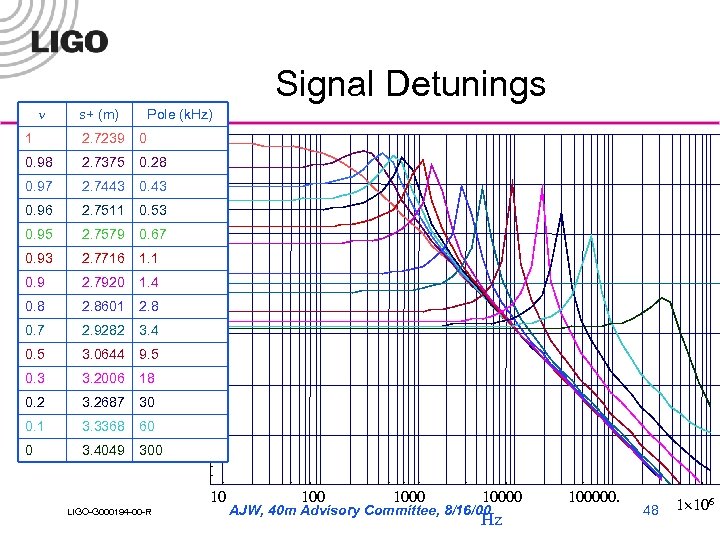 Signal Detunings n s+ (m) Pole (k. Hz) 1 2. 7239 0 0. 98 2. 7375 0. 28 0. 97 2. 7443 0. 96 2. 7511 0. 53 0. 95 2. 7579 0. 67 0. 93 2. 7716 1. 1 0. 9 2. 7920 1. 4 0. 8 2. 8601 2. 8 0. 7 2. 9282 3. 4 0. 5 3. 0644 9. 5 0. 3 3. 2006 18 0. 2 3. 2687 30 0. 1 3. 3368 60 0 3. 4049 300 10 LIGO-G 000194 -00 -R 10000 AJW, 40 m Advisory Committee, 8/16/00 Hz 100000. 48 1 106
 Wavefront Sensing ETM 2 In the context of Jim Mason’s DR control scheme Carrier Sidebands Sub. Carrier ITM 2 Input Reflected RM ITM 1 ETM 1 Pickoff SRM Work by Brian Kappus, LIGO SURF Dark AJW, 40 m Advisory Committee, 8/16/00 49
 Wavefront Sensing Degrees of Freedom - yaw (pitch equivalent) DETM CETM DITM CITM AJW, 40 m Advisory Committee, 8/16/00 RM SRM 50
 Wavefront Sensing Wavefront Sensor signal is sum of contributions from misalignments i from ith degree of freedom: • f. PD is response of split photodiode • i is (normalized) misalignment from ith degree of freedom • Ai is amplitude of response from ith degree of freedom • i is Guoy phase of response from ith degree of freedom • i is RF phase of response from ith degree of freedom • is Guoy phase of beam at PD (adjust with Guoy telescope) • D is RF demodulation phase of mixer Choose and D to enhance a particular DOF at a particular wavefront sensor Signals 90 Degrees out of phase are canceled AJW, 40 m Advisory Committee, 8/16/00 51
 Wavefront Sensing Modal Model results (no SRM) for LIGO 4 km: Dark - Cr. SB RF Phase Guoy Phase DETM DITM CETM CITM RM 6 6 24. 9815 11. 3941 9. 89027´ 10 - 4. 51095´ 10 - 0. 00122482 90. 90. 90. 2 90. 5 156. 2 156. 5 90. 2 Bright - Cr- 0. 0228234 SB 1. 36698 RF Phase 90. 1 90. Guoy Phase 143. 7 Pick - Cr. SB RF Phase Guoy Phase 6. 13013 90. 143. 7 367. 157 90. 143. 7 0. 725762 0. 96. 8 6. 20788 0. 145. 9 9. 60156 - 47. 7087 0. 61. 1 1730. 26 0. 143. 2401. 56 - 0. 146. 5 0. 143. 7 Agrees with Alignment of an Interferometric Gravitational Wave Detector by P. Fritschel, N. Mavalvala, et al. LIGO-G 000194 -00 -R AJW, 40 m Advisory Committee, 8/16/00 52
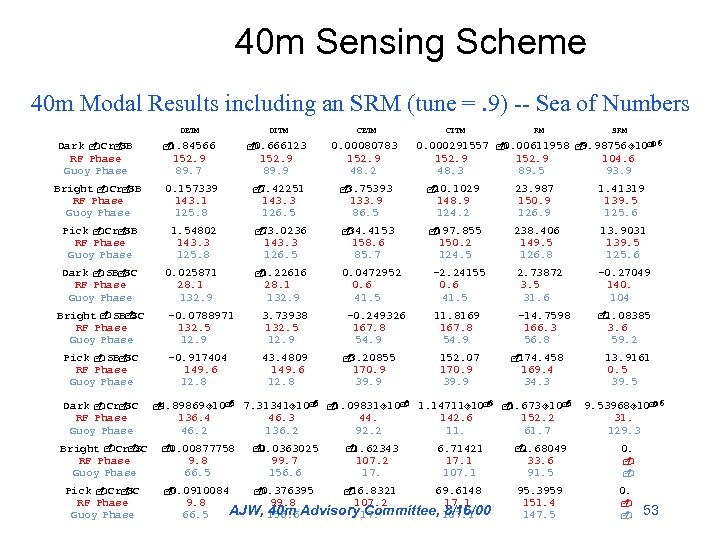 40 m Sensing Scheme 40 m Modal Results including an SRM (tune =. 9) -- Sea of Numbers DETM DITM CETM Dark - Cr. SB RF Phase Guoy Phase 1. 84566 - 0. 666123 152. 9 89. 9 0. 00080783 152. 9 48. 2 Bright - Cr. SB RF Phase Guoy Phase 0. 157339 143. 1 125. 8 7. 42251 - 3. 75393 - 20. 1029 - 23. 987 150. 9 126. 9 1. 41319 139. 5 125. 6 Pick - Cr. SB RF Phase Guoy Phase 1. 54802 143. 3 125. 8 73. 0236 - 34. 4153 - 197. 855 - 238. 406 149. 5 126. 8 13. 9031 139. 5 125. 6 Dark - SBSC RF Phase Guoy Phase 0. 025871 28. 1 132. 9 1. 22616 - 0. 0472952 0. 6 41. 5 -2. 24155 0. 6 41. 5 2. 73872 3. 5 31. 6 -0. 27049 140. 104 11. 8169 167. 8 54. 9 -14. 7598 166. 3 56. 8 1. 08385 - 152. 9 89. 7 143. 3 126. 5 28. 1 132. 9 Bright - SBSC RF Phase Guoy Phase -0. 0788971 132. 5 12. 9 3. 73938 132. 5 12. 9 Pick - SBSC RF Phase Guoy Phase -0. 917404 149. 6 12. 8 43. 4809 149. 6 12. 8 Dark - Cr. SC RF Phase Guoy Phase 133. 9 86. 5 158. 6 85. 7 -0. 249326 167. 8 54. 9 3. 20855 170. 9 39. 9 CITM RM 16 0. 000291557 0. 00611958 9. 98756´ 10152. 9 104. 6 48. 3 89. 5 93. 9 148. 9 124. 2 150. 2 124. 5 152. 07 170. 9 39. 9 174. 458 169. 4 34. 3 6 6 8 8 6 4. 89869´ 10 - 7. 31341´ 10 - 1. 09831´ 10 - 1. 14711´ 10 - 1. 673 ´ 10 - 136. 4 46. 2 46. 3 136. 2 Bright - Cr. SC RF Phase Guoy Phase 0. 00877758 - Pick - Cr. SC RF Phase Guoy Phase 0. 0910084 - 9. 8 66. 5 0. 0363025 99. 7 156. 6 0. 376395 - 44. 92. 2 1. 62343 107. 2 17. SRM 142. 6 11. 6. 71421 17. 1 107. 1 16. 8321 69. 6148 99. 8 107. 2 17. 1 AJW, 156. 6 Advisory 17. 40 m Committee, 107. 1 8/16/00 152. 2 61. 7 2. 68049 33. 6 91. 5 95. 3959 151. 4 147. 5 3. 6 59. 2 13. 9161 0. 5 39. 5 16 9. 53968´ 1031. 129. 3 0. - 53
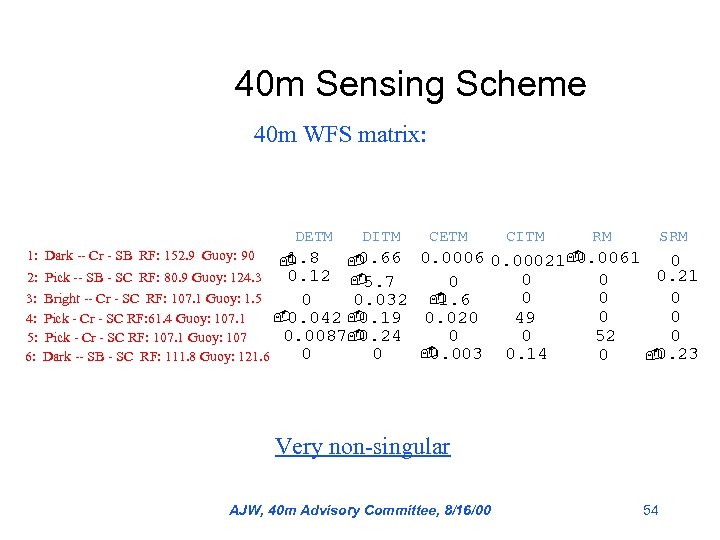 40 m Sensing Scheme 40 m WFS matrix: DETM 1: Dark -- Cr - SB RF: 152. 9 Guoy: 90 1. 8 - DITM CETM CITM RM SRM 0. 66 5. 7 0. 0006 0. 000210. 0061 0 0. 12 0. 21 2: Pick -- SB - SC RF: 80. 9 Guoy: 124. 3 0 0 0 3: Bright -- Cr - SC RF: 107. 1 Guoy: 1. 5 0 0 0. 032 1. 6 -0. 042 0 0 4: Pick - Cr - SC RF: 61. 4 Guoy: 107. 1 0. 19 0. 020 49 0 0 0. 00870. 24 0 52 5: Pick - Cr - SC RF: 107. 1 Guoy: 107 0 0 0. 003 0. 14 0. 23 0 6: Dark -- SB - SC RF: 111. 8 Guoy: 121. 6 Very non-singular AJW, 40 m Advisory Committee, 8/16/00 54
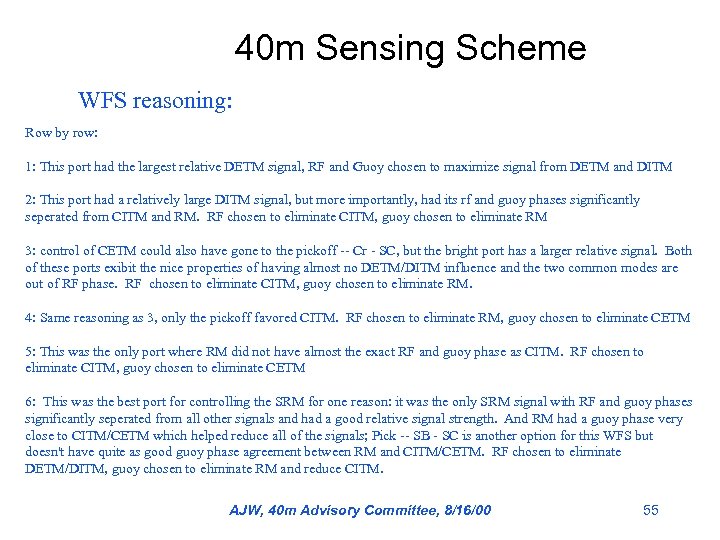 40 m Sensing Scheme WFS reasoning: Row by row: 1: This port had the largest relative DETM signal, RF and Guoy chosen to maximize signal from DETM and DITM 2: This port had a relatively large DITM signal, but more importantly, had its rf and guoy phases significantly seperated from CITM and RM. RF chosen to eliminate CITM, guoy chosen to eliminate RM 3: control of CETM could also have gone to the pickoff -- Cr - SC, but the bright port has a larger relative signal. Both of these ports exibit the nice properties of having almost no DETM/DITM influence and the two common modes are out of RF phase. RF chosen to eliminate CITM, guoy chosen to eliminate RM. 4: Same reasoning as 3, only the pickoff favored CITM. RF chosen to eliminate RM, guoy chosen to eliminate CETM 5: This was the only port where RM did not have almost the exact RF and guoy phase as CITM. RF chosen to eliminate CITM, guoy chosen to eliminate CETM 6: This was the best port for controlling the SRM for one reason: it was the only SRM signal with RF and guoy phases significantly seperated from all other signals and had a good relative signal strength. And RM had a guoy phase very close to CITM/CETM which helped reduce all of the signals; Pick -- SB - SC is another option for this WFS but doesn't have quite as good guoy phase agreement between RM and CITM/CETM. RF chosen to eliminate DETM/DITM, guoy chosen to eliminate RM and reduce CITM. AJW, 40 m Advisory Committee, 8/16/00 55
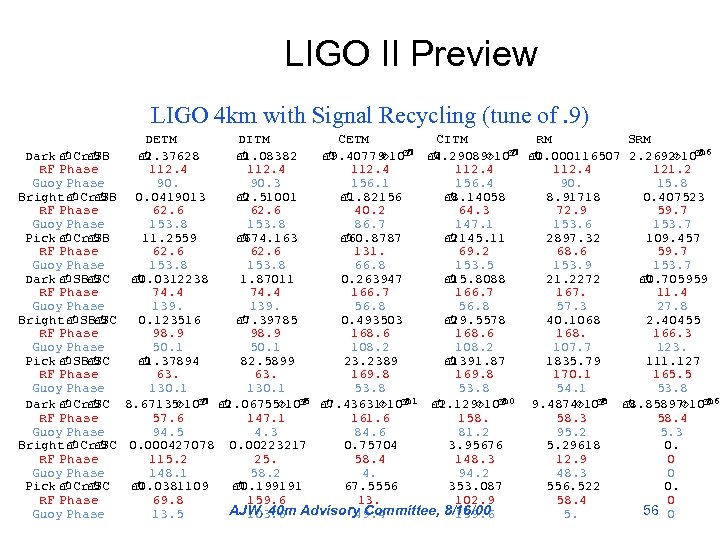 LIGO II Preview LIGO 4 km with Signal Recycling (tune of. 9) DETM DITM CETM CITM RM SRM 7 7 16 - - Dark - Cr. SB 2. 37628 1. 08382 9. 40779 10 4. 29089 10 0. 000116507 2. 2692 10´ ´ ´ RF Phase 112. 4 121. 2 Guoy Phase 90. 3 156. 1 156. 4 90. 15. 8 Bright - Cr. SB 0. 0419013 2. 51001 1. 82156 8. 14058 8. 91718 0. 407523 RF Phase 62. 6 40. 2 64. 3 72. 9 59. 7 Guoy Phase 153. 8 86. 7 147. 1 153. 6 153. 7 Pick - Cr. SB 11. 2559 674. 163 60. 8787 2145. 11 2897. 32 109. 457 RF Phase 62. 6 131. 69. 2 68. 6 59. 7 Guoy Phase 153. 8 66. 8 153. 5 153. 9 153. 7 Dark - SBSC 0. 0312238 1. 87011 0. 263947 15. 8088 21. 2272 0. 705959 RF Phase 74. 4 166. 7 167. 11. 4 Guoy Phase 139. 56. 8 57. 3 27. 8 Bright - SBSC 0. 123516 7. 39785 0. 493503 29. 5578 40. 1068 2. 40455 RF Phase 98. 9 168. 6 168. 166. 3 Guoy Phase 50. 1 108. 2 107. 7 123. Pick - SBSC 1. 37894 82. 5899 23. 2389 1391. 87 1835. 79 111. 127 RF Phase 63. 169. 8 170. 1 165. 5 Guoy Phase 130. 1 53. 8 54. 1 53. 8 7 6 11 10 8 16 - - Dark - Cr. SC 8. 67135 10 2. 06755 10 7. 43631 10 2. 129´ 10 9. 4874 10 8. 85897 10´ ´ ´ RF Phase 57. 6 147. 1 161. 6 158. 3 58. 4 Guoy Phase 94. 5 4. 3 84. 6 81. 2 95. 2 5. 3 Bright - Cr. SC 0. 000427078 0. 00223217 0. 75704 3. 95676 5. 29618 0. RF Phase 115. 2 25. 58. 4 148. 3 12. 9 0 Guoy Phase 148. 1 58. 2 4. 94. 2 48. 3 0 Pick - Cr. SC 0. 0381109 0. 199191 67. 5556 353. 087 556. 522 0. RF Phase 69. 8 159. 6 13. 102. 9 58. 4 0 AJW, 40 m Advisory Committee, 8/16/00 56 0 Guoy Phase 13. 5 103. 6 49. 4 139. 6 5.
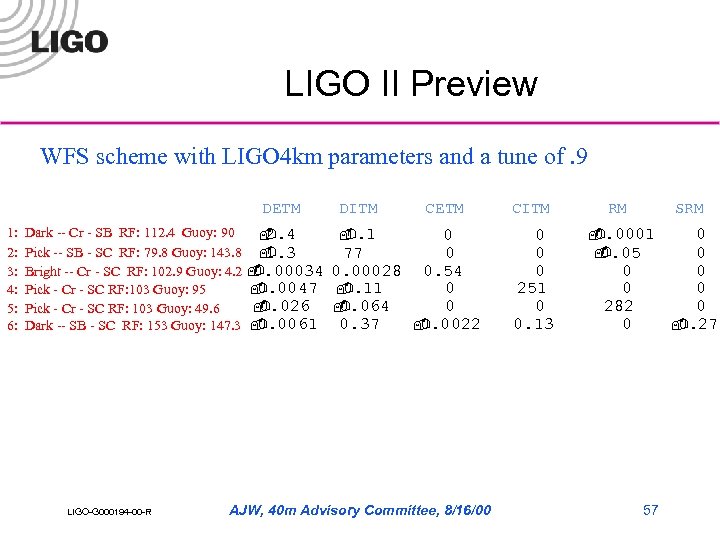 LIGO II Preview WFS scheme with LIGO 4 km parameters and a tune of. 9 DETM 1: 2: 3: 4: 5: 6: Dark -- Cr - SB RF: 112. 4 Guoy: 90 Pick -- SB - SC RF: 79. 8 Guoy: 143. 8 Bright -- Cr - SC RF: 102. 9 Guoy: 4. 2 Pick - Cr - SC RF: 103 Guoy: 95 Pick - Cr - SC RF: 103 Guoy: 49. 6 Dark -- SB - SC RF: 153 Guoy: 147. 3 LIGO-G 000194 -00 -R DITM 2. 4 1. 3 0. 00034 0. 0047 0. 026 0. 0061 - CETM 1. 1 - 0 77 0 0. 00028 0. 54 0. 11 0 0. 064 0 0. 37 0. 0022 - AJW, 40 m Advisory Committee, 8/16/00 CITM RM SRM 0 0 0 251 0 0. 13 0. 0001 0. 05 0 0 282 0 57 0 0 0. 27 -