


 Скачать презентацию 4 The Monetary System What It Is and
33c3fc789c118a8b57a9b250abfe2cc2.ppt
- Количество слайдов: 40
 4 The Monetary System: What It Is and How It Works MACROECONOMICS N. Gregory Mankiw Power. Point ® Slides by Ron Cronovich © 2013 Worth Publishers, all rights reserved
 IN THIS CHAPTER, YOU WILL LEARN: § the definition, functions, and types of money § how banks “create” money § what a central bank is and how it controls the money supply 1
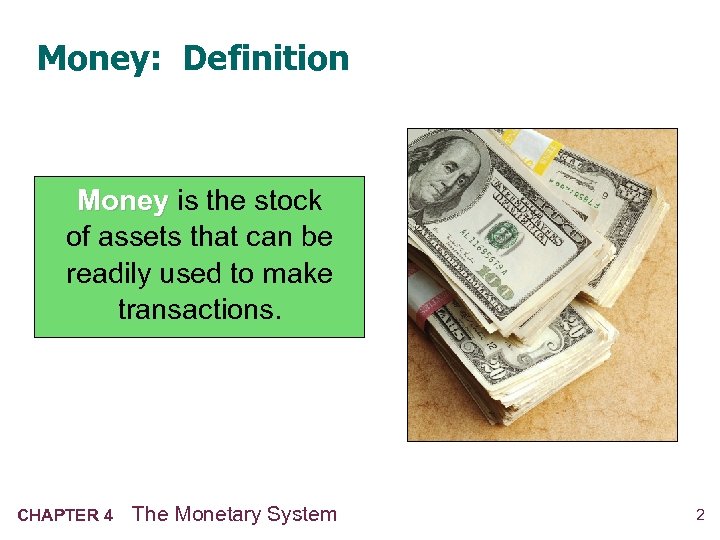 Money: Definition Money is the stock of assets that can be readily used to make transactions. CHAPTER 4 The Monetary System 2
 Money: Functions § medium of exchange we use it to buy stuff § store of value transfers purchasing power from the present to the future § unit of account the common unit by which everyone measures prices and values CHAPTER 4 The Monetary System 3
 Money: Types 1. Fiat money § has no intrinsic value § example: the paper currency we use 2. Commodity money § has intrinsic value § examples: gold coins, cigarettes in P. O. W. camps CHAPTER 4 The Monetary System 4
 NOW YOU TRY Discussion Question Which of these are money? a. Currency b. Checks c. Deposits in checking accounts (“demand deposits”) d. Credit cards e. Certificates of deposit (“time deposits”) 5
 The money supply and monetary policy definitions § The money supply is the quantity of money available in the economy. § Monetary policy is the control over the money supply. CHAPTER 4 The Monetary System 6
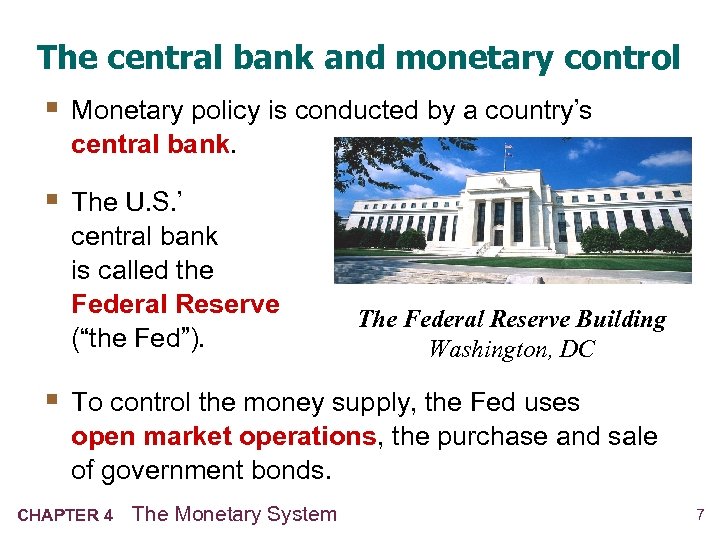 The central bank and monetary control § Monetary policy is conducted by a country’s central bank. § The U. S. ’ central bank is called the Federal Reserve (“the Fed”). The Federal Reserve Building Washington, DC § To control the money supply, the Fed uses open market operations, the purchase and sale of government bonds. CHAPTER 4 The Monetary System 7
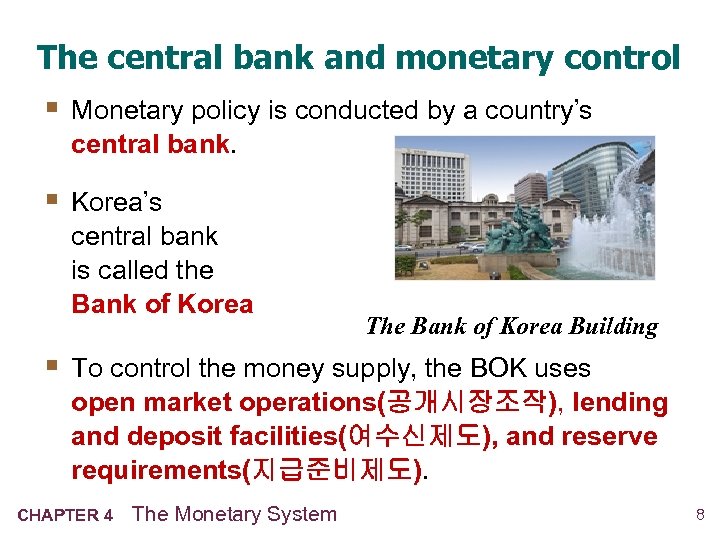 The central bank and monetary control § Monetary policy is conducted by a country’s central bank. § Korea’s central bank is called the Bank of Korea The Bank of Korea Building § To control the money supply, the BOK uses open market operations(공개시장조작), lending and deposit facilities(여수신제도), and reserve requirements(지급준비제도). CHAPTER 4 The Monetary System 8
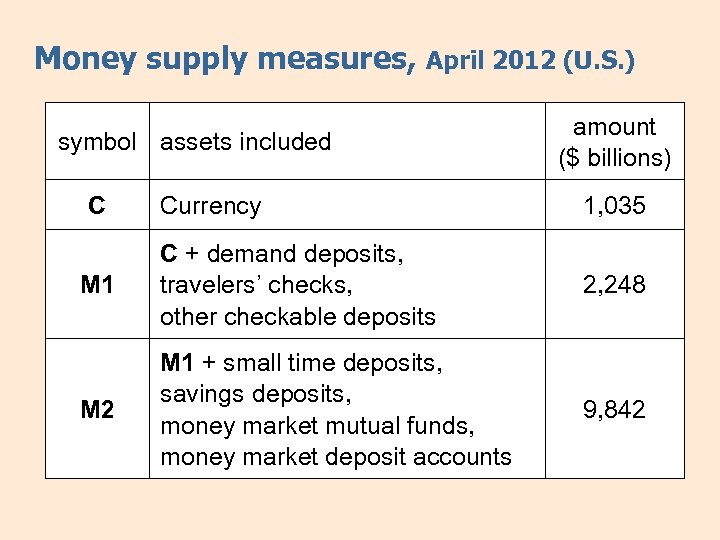 Money supply measures, April 2012 (U. S. ) symbol assets included C amount ($ billions) Currency 1, 035 M 1 C + demand deposits, travelers’ checks, other checkable deposits 2, 248 M 2 M 1 + small time deposits, savings deposits, money market mutual funds, money market deposit accounts 9, 842
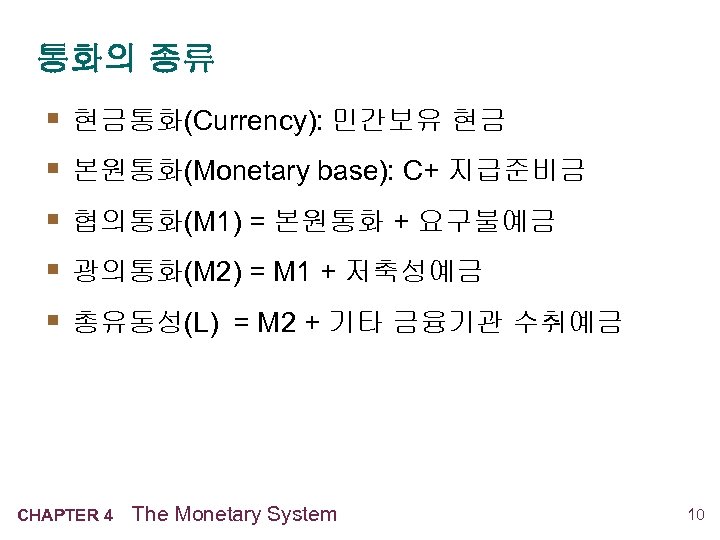 통화의 종류 § § § 현금통화(Currency): 민간보유 현금 본원통화(Monetary base): C+ 지급준비금 협의통화(M 1) = 본원통화 + 요구불예금 광의통화(M 2) = M 1 + 저축성예금 총유동성(L) = M 2 + 기타 금융기관 수취예금 CHAPTER 4 The Monetary System 10
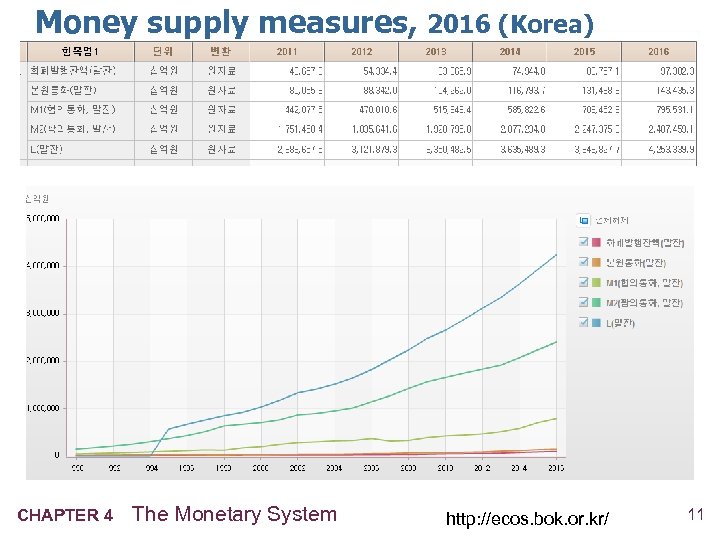 Money supply measures, 2016 (Korea) CHAPTER 4 The Monetary System http: //ecos. bok. or. kr/ 11
 Banks’ role in the monetary system § The money supply equals currency plus demand (checking account) deposits: M = C + D § Since the money supply includes demand deposits, the banking system plays an important role. CHAPTER 4 The Monetary System 12
 A few preliminaries § Reserves (R ): the portion of deposits that banks have not lent. § A bank’s liabilities include deposits; assets include reserves and outstanding loans. § 100 -percent-reserve banking: a system in which banks hold all deposits as reserves. § Fractional-reserve banking: a system in which banks hold a fraction of their deposits as reserves. CHAPTER 4 The Monetary System 13
 Banks’ role in the monetary system § To understand the role of banks, we will consider three scenarios: 1. No banks 2. 100 -percent-reserve banking (banks hold all deposits as reserves) 3. Fractional-reserve banking (banks hold a fraction of deposits as reserves, use the rest to make loans) § In each scenario, we assume C = $1, 000. CHAPTER 4 The Monetary System 14
 SCENARIO 1: No banks With no banks, D = 0 and M = C = $1, 000. CHAPTER 4 The Monetary System 15
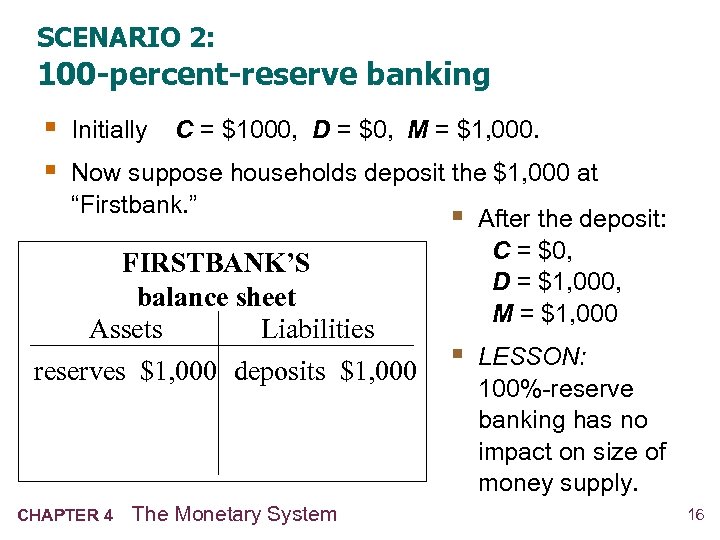 SCENARIO 2: 100 -percent-reserve banking § Initially C = $1000, D = $0, M = $1, 000. § Now suppose households deposit the $1, 000 at “Firstbank. ” FIRSTBANK’S balance sheet Assets Liabilities reserves $1, 000 deposits $1, 000 CHAPTER 4 The Monetary System § After the deposit: C = $0, D = $1, 000, M = $1, 000 § LESSON: 100%-reserve banking has no impact on size of money supply. 16
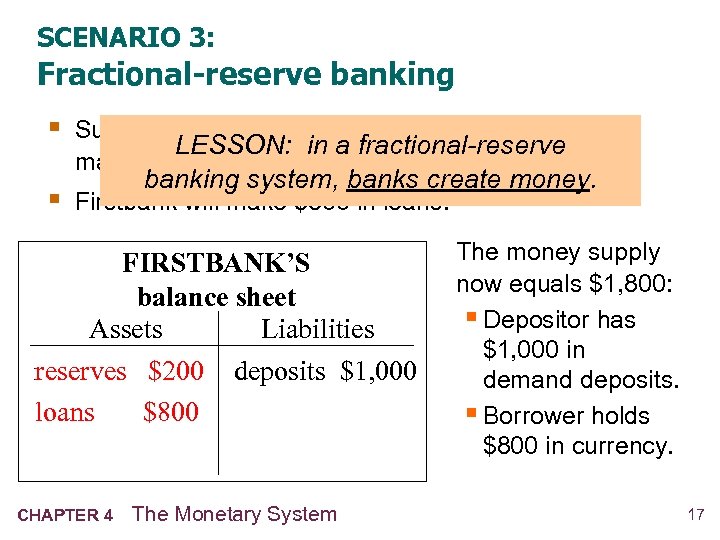 SCENARIO 3: Fractional-reserve banking § Suppose banks hold 20% of deposits in reserve, LESSON: in a fractional-reserve making loans with the rest. banking system, banks create money. § Firstbank will make $800 in loans. FIRSTBANK’S balance sheet Assets Liabilities $200 reserves $1, 000 deposits $1, 000 loans $800 CHAPTER 4 The Monetary System The money supply now equals $1, 800: § Depositor has $1, 000 in demand deposits. § Borrower holds $800 in currency. 17
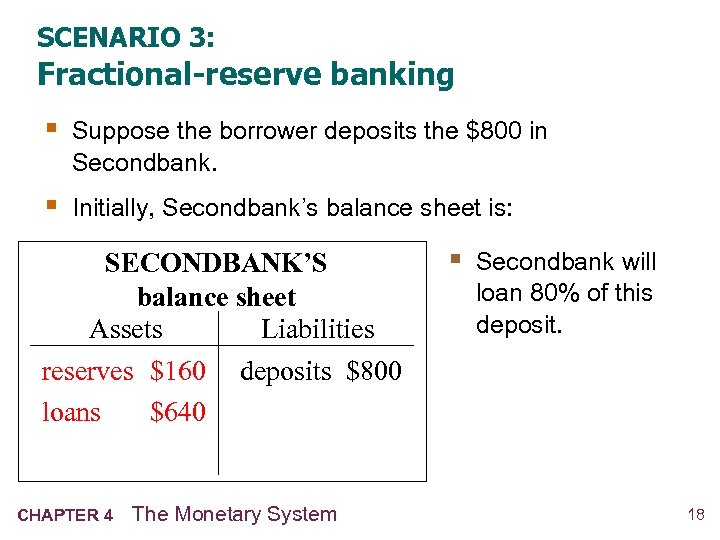 SCENARIO 3: Fractional-reserve banking § Suppose the borrower deposits the $800 in Secondbank. § Initially, Secondbank’s balance sheet is: SECONDBANK’S balance sheet Assets Liabilities reserves $800 deposits $800 $160 loans $640 $0 CHAPTER 4 The Monetary System § Secondbank will loan 80% of this deposit. 18
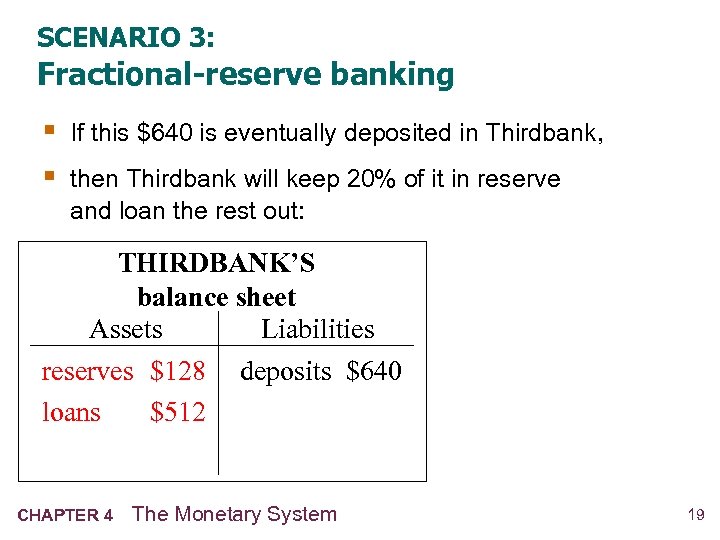 SCENARIO 3: Fractional-reserve banking § If this $640 is eventually deposited in Thirdbank, § then Thirdbank will keep 20% of it in reserve and loan the rest out: THIRDBANK’S balance sheet Assets Liabilities reserves $640 deposits $640 $128 loans $512 $0 CHAPTER 4 The Monetary System 19
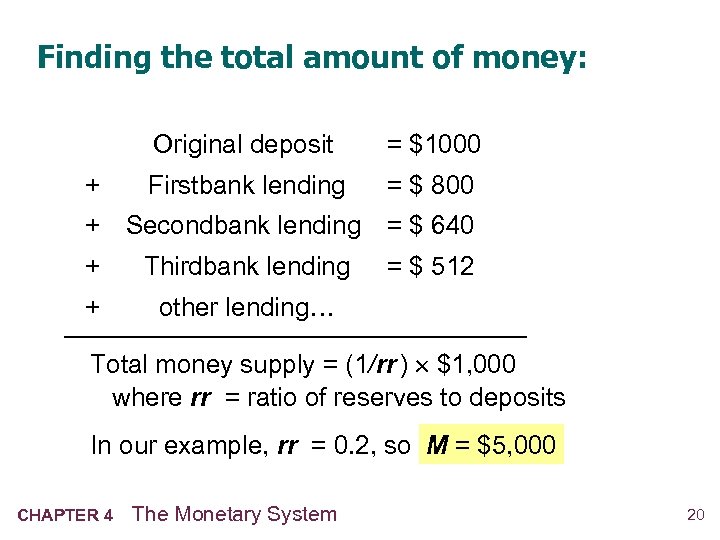 Finding the total amount of money: Original deposit + = $1000 Firstbank lending = $ 800 + Secondbank lending = $ 640 + Thirdbank lending + = $ 512 other lending… Total money supply = (1/rr ) $1, 000 where rr = ratio of reserves to deposits In our example, rr = 0. 2, so M = $5, 000 CHAPTER 4 The Monetary System 20
 Money creation in the banking system A fractional-reserve banking system creates money, but it doesn’t create wealth: Bank loans give borrowers some new money and an equal amount of new debt. CHAPTER 4 The Monetary System 21
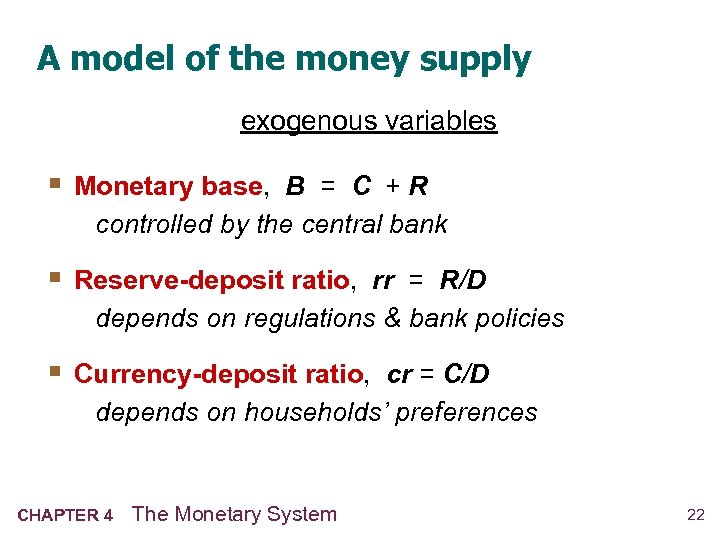 A model of the money supply exogenous variables § Monetary base, B = C + R controlled by the central bank § Reserve-deposit ratio, rr = R/D depends on regulations & bank policies § Currency-deposit ratio, cr = C/D depends on households’ preferences CHAPTER 4 The Monetary System 22
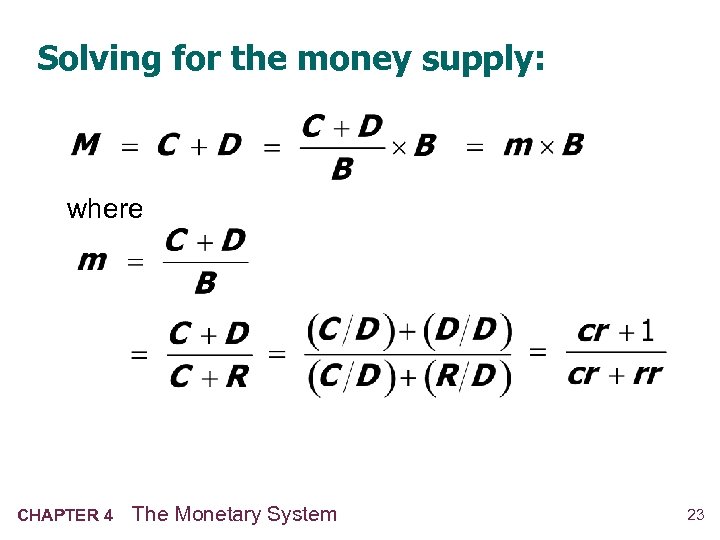 Solving for the money supply: where CHAPTER 4 The Monetary System 23
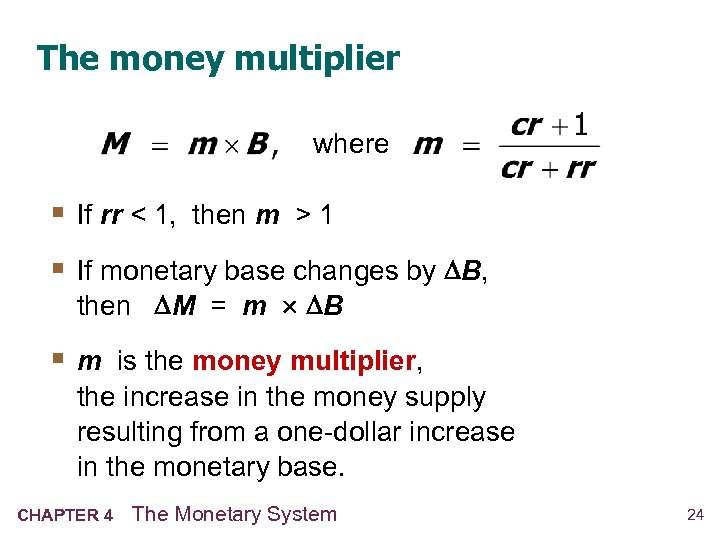 The money multiplier where § If rr < 1, then m > 1 § If monetary base changes by B, then M = m B § m is the money multiplier, the increase in the money supply resulting from a one-dollar increase in the monetary base. CHAPTER 4 The Monetary System 24
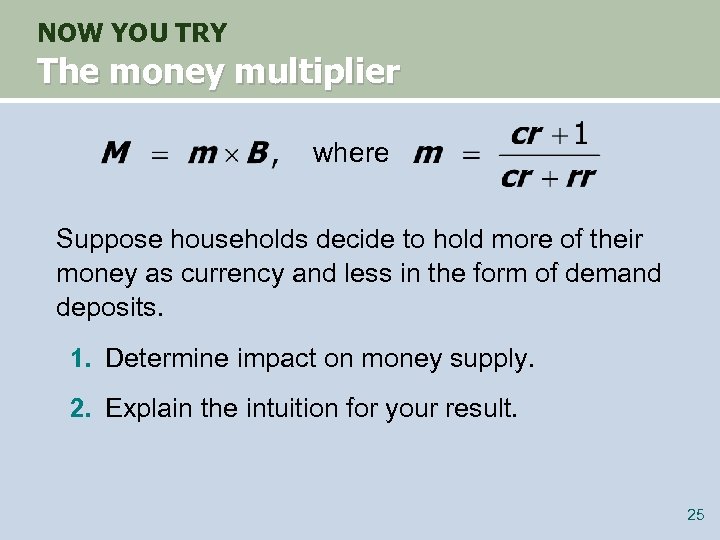 NOW YOU TRY The money multiplier where Suppose households decide to hold more of their money as currency and less in the form of demand deposits. 1. Determine impact on money supply. 2. Explain the intuition for your result. 25
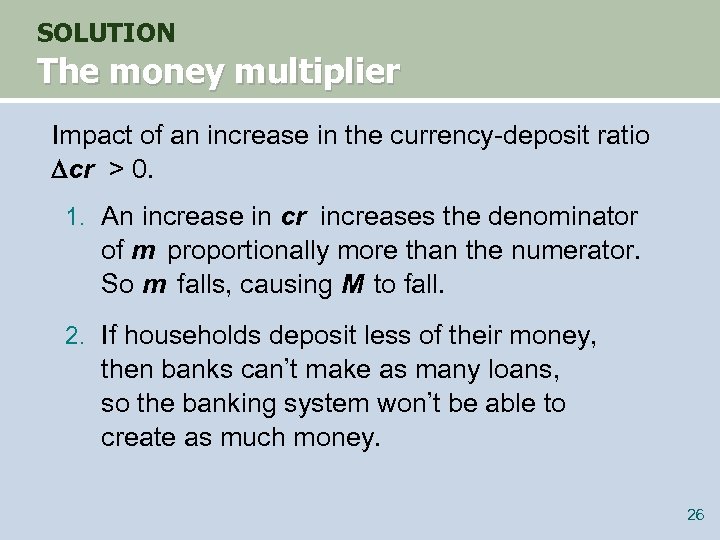 SOLUTION The money multiplier Impact of an increase in the currency-deposit ratio cr > 0. 1. An increase in cr increases the denominator of m proportionally more than the numerator. So m falls, causing M to fall. 2. If households deposit less of their money, then banks can’t make as many loans, so the banking system won’t be able to create as much money. 26
 The instruments of monetary policy The Fed can change the monetary base using § open market operations (the Fed’s preferred method of monetary control) § To increase the base, the Fed could buy government bonds, paying with new dollars. § the discount rate: the interest rate the Fed charges on loans to banks § To increase the base, the Fed could lower the discount rate, encouraging banks to borrow more reserves. CHAPTER 4 The Monetary System 27
 The instruments of monetary policy The Fed can change the reserve-deposit ratio using § reserve requirements: Fed regulations that impose a minimum reserve-deposit ratio § To reduce the reserve-deposit ratio, the Fed could reduce reserve requirements § interest on reserves: the Fed pays interest on bank reserves deposited with the Fed § To reduce the reserve-deposit ratio, the Fed could pay a lower interest rate on reserves CHAPTER 4 The Monetary System 28
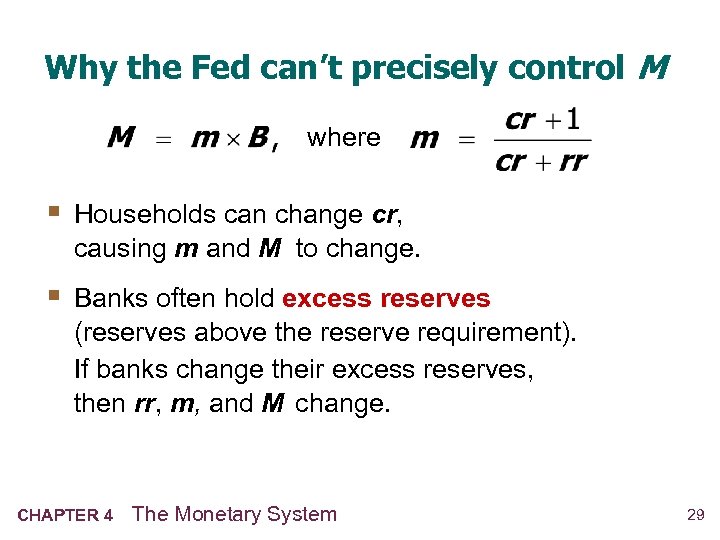 Why the Fed can’t precisely control M where § Households can change cr, causing m and M to change. § Banks often hold excess reserves (reserves above the reserve requirement). If banks change their excess reserves, then rr, m, and M change. CHAPTER 4 The Monetary System 29
 CASE STUDY: Quantitative Easing CHAPTER 4 The Monetary System 30
 CASE STUDY: Quantitative Easing CHAPTER 4 The Monetary System 31
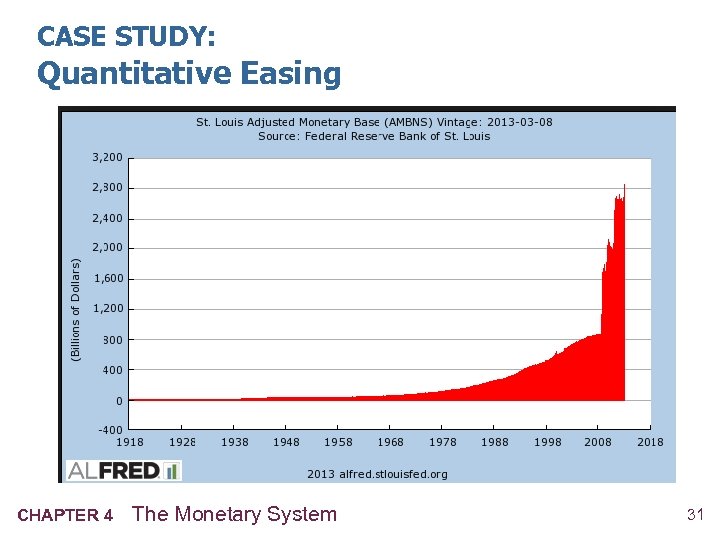
 CASE STUDY: Quantitative Easing § Quantitative easing: the Fed bought long-term govt bonds instead of T-bills to reduce long-term rates. § The Fed also bought mortgage-backed securities to help the housing market. § But after losses on bad loans, banks tightened lending standards and increased excess reserves, causing money multiplier to fall. § If banks start lending more as economy recovers, rapid money growth may cause inflation. To prevent, the Fed is considering various “exit strategies. ” CHAPTER 4 The Monetary System 32
 CASE STUDY: Bank failures in the 1930 s § From 1929 to 1933: § over 9, 000 banks closed § money supply fell 28% § This drop in the money supply may not have caused the Great Depression, but certainly contributed to its severity. CHAPTER 4 The Monetary System 33
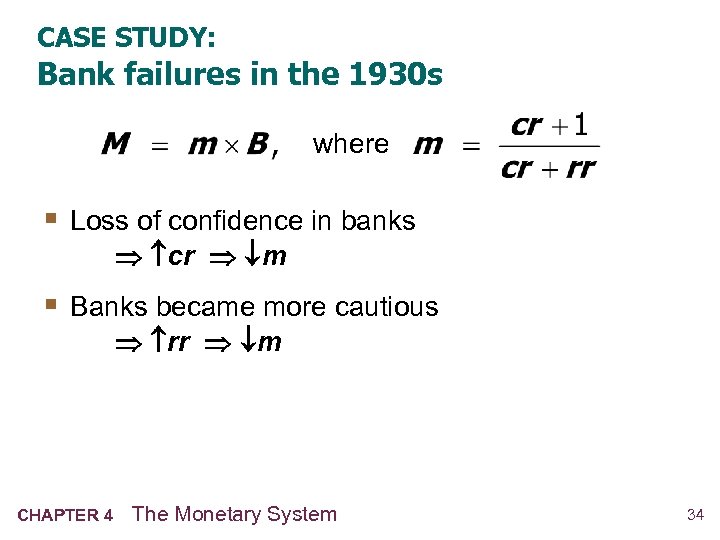 CASE STUDY: Bank failures in the 1930 s where § Loss of confidence in banks cr m § Banks became more cautious rr m CHAPTER 4 The Monetary System 34
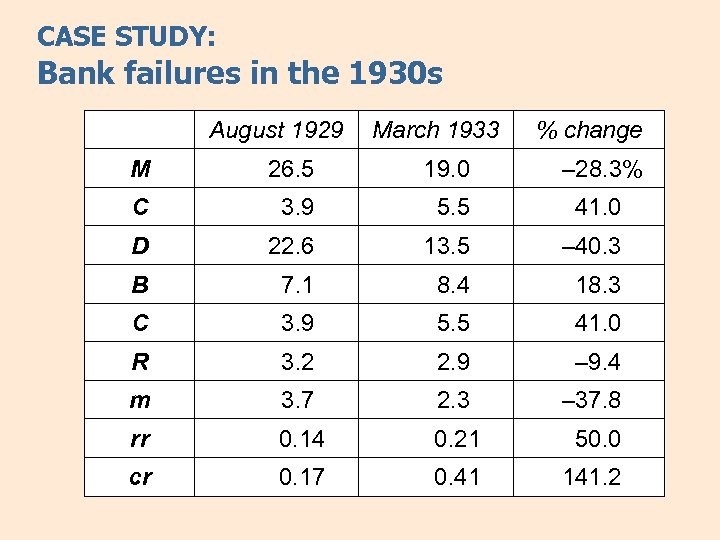 CASE STUDY: Bank failures in the 1930 s August 1929 March 1933 % change M 26. 5 19. 0 – 28. 3% C 3. 9 5. 5 41. 0 D 22. 6 13. 5 – 40. 3 B 7. 1 8. 4 18. 3 C 3. 9 5. 5 41. 0 R 3. 2 2. 9 – 9. 4 m 3. 7 2. 3 – 37. 8 rr 0. 14 0. 21 50. 0 cr 0. 17 0. 41 141. 2
 Could this happen again? § Many policies have been implemented since the 1930 s to prevent such widespread bank failures. § E. g. , Federal Deposit Insurance, to prevent bank runs and large swings in the currency-deposit ratio. CHAPTER 4 The Monetary System 36
 CHAPTER SUMMARY Money § def: the stock of assets used for transactions § functions: medium of exchange, store of value, unit of account § types: commodity money (has intrinsic value), fiat money (no intrinsic value) § money supply controlled by central bank 37
 CHAPTER SUMMARY Fractional reserve banking creates money because each dollar of reserves generates many dollars of demand deposits. The money supply depends on the: § monetary base § currency-deposit ratio § reserve ratio The Fed can control the money supply with: § open market operations § the reserve requirement § the discount rate § interest on reserves 38
 CHAPTER SUMMARY Bank capital, leverage, capital requirements § Bank capital is the owners’ equity in the bank. § Because banks are highly leveraged, a small decline in the value of bank assets can have a huge impact on bank capital. § Bank regulators require that banks hold sufficient capital to ensure that depositors can be repaid. 39