


 Скачать презентацию 4 th Technical Review Meeting for the Health
2632258bac8f04e0d8b7472e29c24682.ppt
- Количество слайдов: 20
 4 th Technical Review Meeting for the Health Policy and Health Finance Knowledge Hub The path to universal coverage: The World Health Report 2010 11 October, Nossal Institute, Melbourne Martina Pellny, Technical Officer Health Care Financing, WHO Regional Office for the Western Pacific (WPRO), DPS, Fiji
 WHR 2010: Universal Coverage l WHR topic based on World Health Assembly Resolution in 2005 þ The Resolution 58. 33 defined “Universal Coverage” as coverage with: needed health services; financial risk protection; for everyone. l The aspiration to attain universal coverage is not new. You find reference to it in: WHO's constitution-1948; Alma-Ata Declaration 1978; World Health Report on Primary Health Care-2008 etc l The resolution also states that universal (health) coverage can not be achieved without a well-functioning health financing system Health Systems Financing and the Path to Universal Coverage | The World Health Report 2010 2
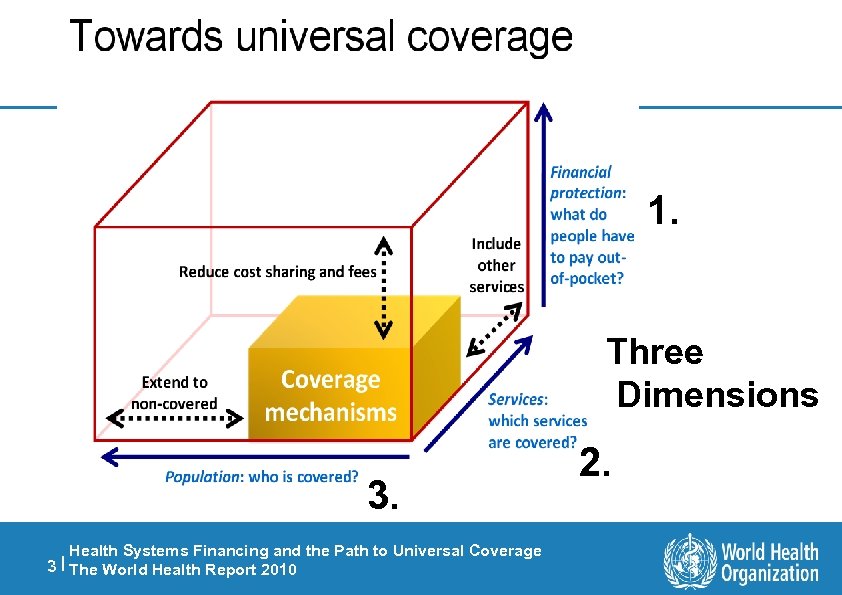 1. Three Dimensions 3. Health Systems Financing and the Path to Universal Coverage | The World Health Report 2010 3 2.
 1. Dimension: Financial Protection Millions suffer financial ruin when they use health services: Ü Globally around 150 million suffer severe financial hardship/ catastrophic health expenditures each year. Ü 100 million are pushed into poverty because they must pay out-of-pocket at the time they receive health services. Health Systems Financing and the Path to Universal Coverage | The World Health Report 2010 4
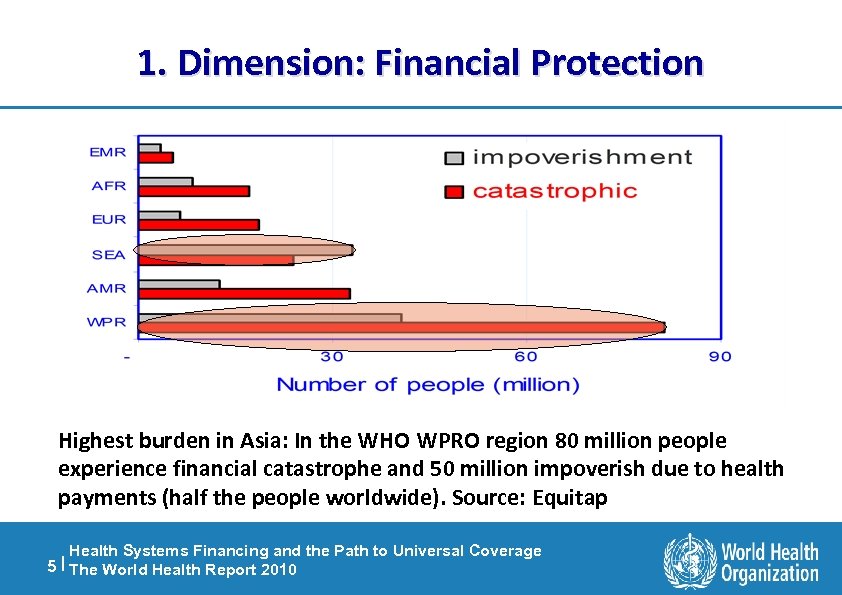 1. Dimension: Financial Protection Highest burden in Asia: In the WHO WPRO region 80 million people experience financial catastrophe and 50 million impoverish due to health payments (half the people worldwide). Source: Equitap Health Systems Financing and the Path to Universal Coverage | The World Health Report 2010 5
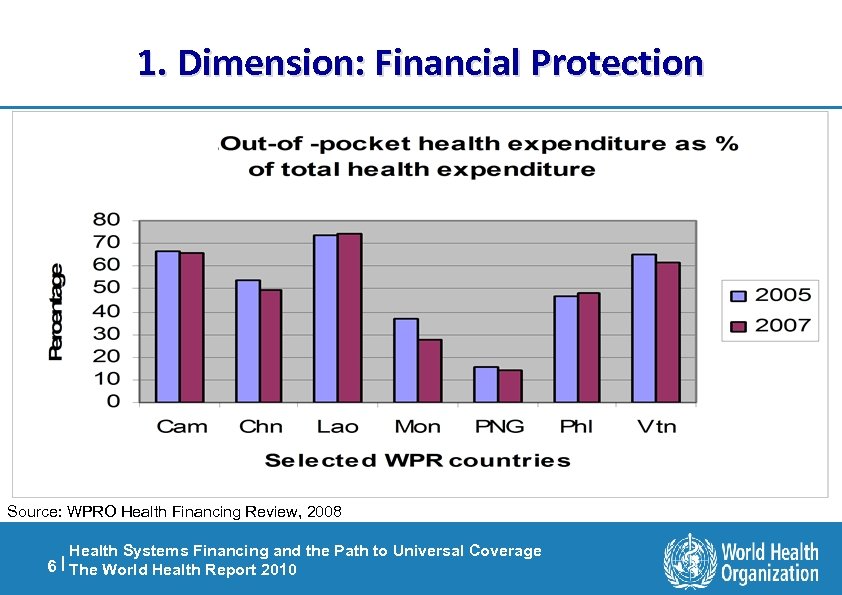 1. Dimension: Financial Protection Source: WPRO Health Financing Review, 2008 Health Systems Financing and the Path to Universal Coverage | The World Health Report 2010 6
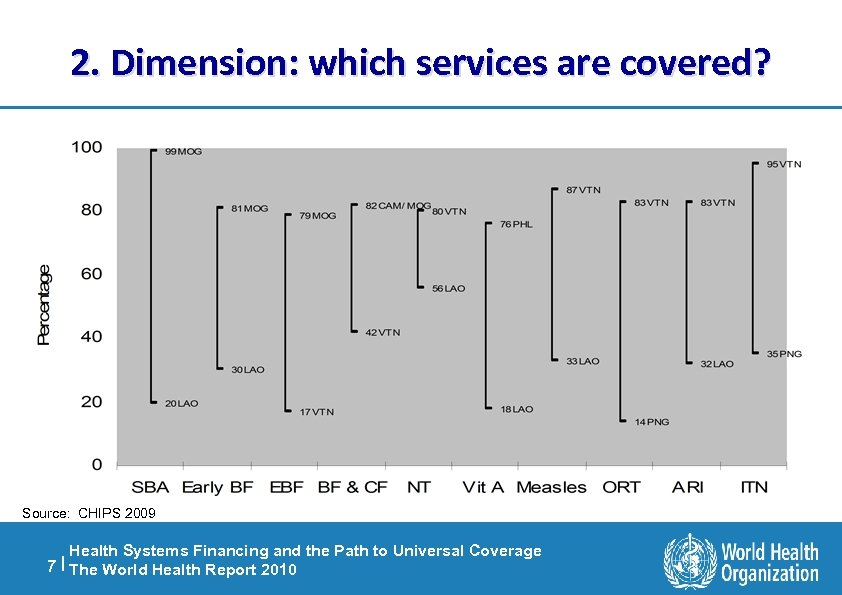 2. Dimension: which services are covered? Source: CHIPS 2009 Health Systems Financing and the Path to Universal Coverage | The World Health Report 2010 7
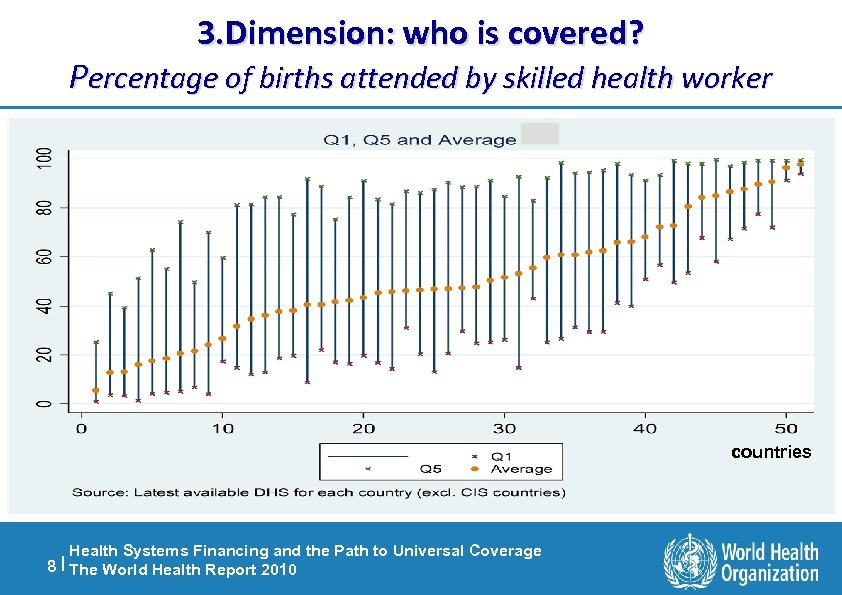 3. Dimension: who is covered? Percentage of births attended by skilled health worker countries Health Systems Financing and the Path to Universal Coverage | The World Health Report 2010 8
 Proposing solutions: the WHR 2010 l The WHR-2010 proposes three interrelated health financing strategic options for universal coverage: - Raise sufficient funds for health: More money for health - Reduce heavy reliance on direct OOP: More equity for health. - Reduce and eliminate inefficient use of resources: More health for the money Health Systems Financing and the Path to Universal Coverage | The World Health Report 2010 9
 Problem 1: Insufficient funds £ A set of essential health services focusing on the Millennium Development Goals would cost on average US$ 44 per capita in low-income countries in 2009, rising to US$ 60 in 2015 (estimates provided by the HLTF on Innovative International Financing for Health Systems). Ü 31 low income countries spent less than US$ 35 person (2008) Ü Only 8 have any chance of reaching the required funding from domestic sources by 2015 - even assuming rapid growth of their domestic economies. Ü CAM (30), Laos (24), PNG (29), Solomon Islands (44), Vietnam(46) Health Systems Financing and the Path to Universal Coverage | The World Health Report 2010 10
 Options for raising more domestic funds for health Increase the priority given to health in government budget allocations ð Mo. Hs often not powerful enough – loose out in budget negotiations ð Ex: MTEF - clear and transparent targets ð Ex: Abuja declaration: African heads of state declared in 2001 to increase the share of government expenditures going to health to 15% of GGE in 2007, and failed Raise revenue for health more efficiently – e. g. increase the total availability of resources (strong tax base) ð In Indonesia, clear and consistent regulations and a policy of zerotolerance for corruption increased tax yield from 9. 9% to 11% of GDP over four years – with a subsequent increase in health expenditures. Health Systems Financing and the Path to Universal Coverage | The World Health Report 2010 11
 Options for raising more domestic funds for health Find new sources of domestic funds e. g. ð "Sin" taxes on tobacco and alcohol: a 50% increase in tobacco tax alone would yield an additional US$ 1. 42 billion - this could increase government health expenditure by up to 25%. ð Excise tax on unhealthy food – Romania – 20% on foods high in fat, salt, sugar ð Levy on currency transactions would be feasible in countries with large markets – e. g. India could raise US$ 370 million per year from a very small levy (0. 005%). ð Levy on remittance transactions - Gabon ð Levy on large/ profitable companies – Australia (mining companies); Pakistan (pharmaceutical companies), Gabon (mobile ph. companies). Health Systems Financing and the Path to Universal Coverage | The World Health Report 2010 12
 Problem 2: Heavy reliance on direct OOPs l The WHR-2010 proposes three interrelated health financing strategic options for universal coverage: - Raise sufficient funds for health: More money for health - Reduce heavy reliance on direct OOP: More equity for health. - Reduce and eliminate inefficient use of resources: More health for the money Health Systems Financing and the Path to Universal Coverage | The World Health Report 2010 13
 Options to reduce the impact of OOPs Ü Reducing OOPs requires switching to systems of “prepayment” with subsequent “pooling” of revenues (Prepayment means paying before illness – and it can take the form of taxation or insurance – Beveridge/ Bismarck/ mix). PREPAYMENT Ü There seems a minimum level of compulsory prepaid funding that is necessary to ensure that the poor and vulnerable are covered: ca. 4 -6% of GDP. See WHO WPRO benchmark: “Universal coverage is difficult to achieve if public financing is less than 5% of GDP”. MINIMUM Ü Community and micro-insurance can play a useful role in the early stages, but plans to merge them over time are important - bigger pools are more financially viable than small community-based pooled funds. CONSOLIDATE POOLS AND REGULATE Health Systems Financing and the Path to Universal Coverage | The World Health Report 2010 14
 Options to reduce the impact of OOPs Options in addition to prepaid and pooled resources to ensure greater coverage and lower financial barriers: Ü Free or subsidized services (e. g. through exemptions or vouchers) for specific groups of people (i. e. the poor) or for specific health conditions (i. e. child or maternal care). Ü Subsidized or free insurance contributions for the poor and vulnerable. Ü Cash payments to cover for ex. transport costs for the poor. Health Systems Financing and the Path to Universal Coverage | The World Health Report 2010 15
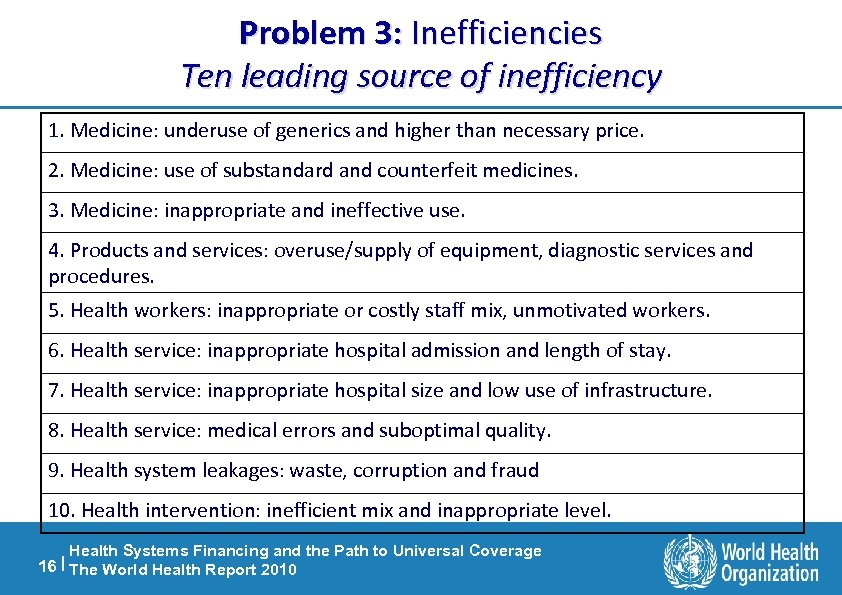 Problem 3: Inefficiencies Ten leading source of inefficiency 1. Medicine: underuse of generics and higher than necessary price. 2. Medicine: use of substandard and counterfeit medicines. 3. Medicine: inappropriate and ineffective use. 4. Products and services: overuse/supply of equipment, diagnostic services and procedures. 5. Health workers: inappropriate or costly staff mix, unmotivated workers. 6. Health service: inappropriate hospital admission and length of stay. 7. Health service: inappropriate hospital size and low use of infrastructure. 8. Health service: medical errors and suboptimal quality. 9. Health system leakages: waste, corruption and fraud 10. Health intervention: inefficient mix and inappropriate level. Health Systems Financing and the Path to Universal Coverage | The World Health Report 2010 16
 Options to encourage greater efficiency For example: 1. Paying providers: move away from fee for service if possible. Consider results-based payment where good monitoring is possible etc. 2. Medicines: improve prescribing guidance, training of staff; incentives for generic substitution; regulate promotional activities, more public information (irrational use) etc. 3. Health services/ governance: Provide more continuity of care, monitor hospital performance, improve regulatory capacity 4. Reduce duplication – avoid “fragmentation” with - Funding channels; - Laboratory systems; - Auditing and monitoring systems; - Reporting systems including reporting to donors (Aid effectiveness principles). Health Systems Financing and the Path to Universal Coverage | The World Health Report 2010 17
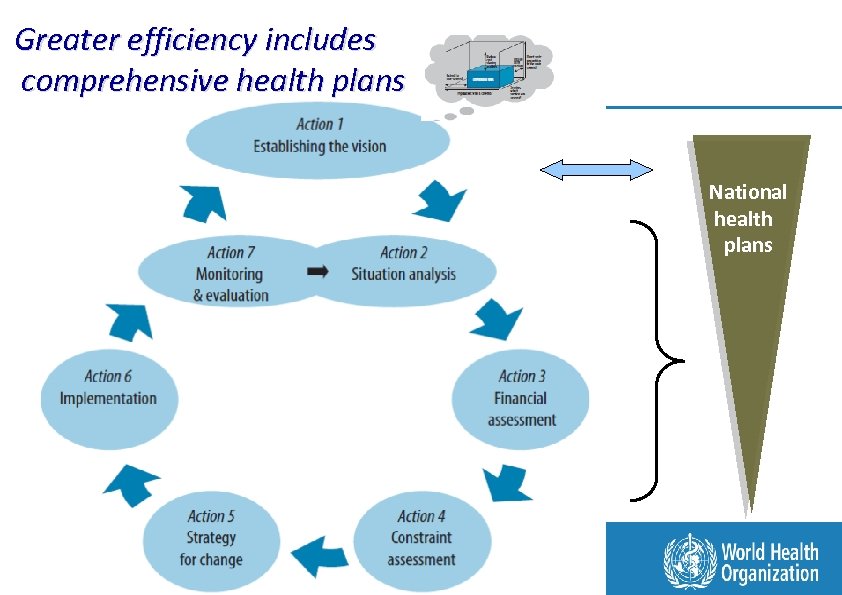 Greater efficiency includes comprehensive health plans National health plans Health Systems Financing and the Path to Universal Coverage | The World Health Report 2010 18
 Conclusion Ü Regardless of the stages of development, each country can improve their financing systems to maintain or progress towards universal coverage. Ü The global community can do more to raise needed funds and strengthen national financing institutions and capacities to attain universal coverage. Ü Stop introducing more global initiatives with more secretariats at the international level. Ü Buy into the countries national health plans and channel funds to countries in ways that build domestic financing capacities and institutions, rather than bypassing weak systems – e. g. fund Sector Wide Approaches, General Budget Support etc Health Systems Financing and the Path to Universal Coverage | The World Health Report 2010 19
 Thank you Health Systems Financing and the Path to Universal Coverage | The World Health Report 2010 20