


 Скачать презентацию 4 th Meeting of the Steering Committee Meeting
abadf68e96ffc0d8a66dc10ce3f103d1.ppt
- Количество слайдов: 22
 4 th Meeting of the Steering Committee Meeting on Competence of Human Resources for Regulatory Bodies, 4 – 7 Dec 2012, Vienna Current Status in the Area of Competence Ministry of Science, Technology and Innovation of Malaysia Monalija Kostor monalija@aelb. gov. my
 OUTLINE OF PRESENTATION • Regulatory Body • Government Policy • Regulator Policy • Needs and Challenges • Education and Training • International Cooperation • Conclusion
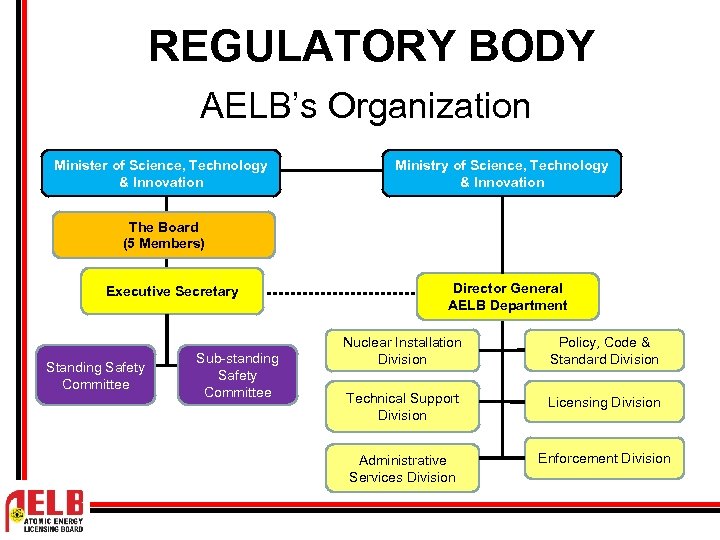 REGULATORY BODY AELB’s Organization Minister of Science, Technology & Innovation Ministry of Science, Technology & Innovation The Board (5 Members) Executive Secretary Standing Safety Committee Sub-standing Safety Committee Director General AELB Department Nuclear Installation Division Policy, Code & Standard Division Technical Support Division Licensing Division Administrative Services Division Enforcement Division
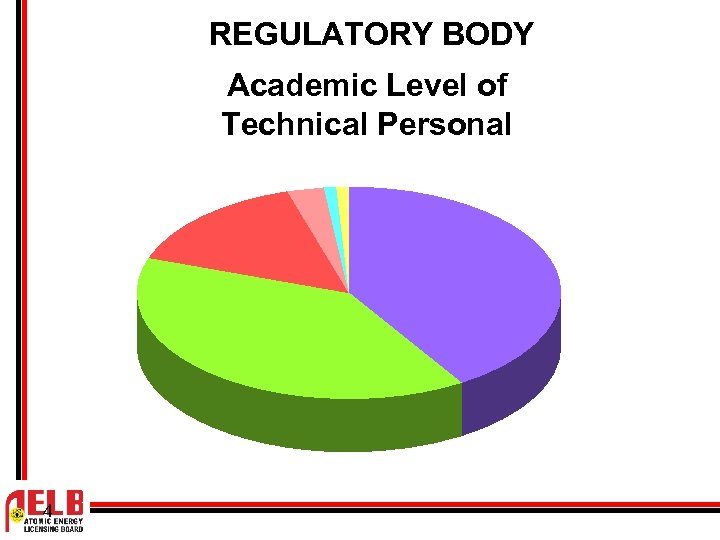 REGULATORY BODY Academic Level of Technical Personal 4
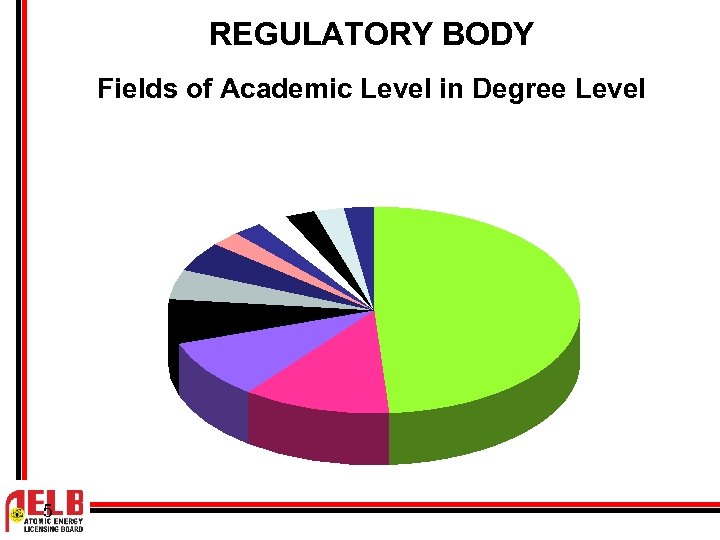 REGULATORY BODY Fields of Academic Level in Degree Level 5
 GOVERNMENT POLICY • In line with the Government new interest to embark on the first NPP, government has adopted a National Nuclear Policy for energy and non-energy application on 16 th July 2010. • The policy is intended to guide the development of peaceful, safe and secure applications of nuclear science and technology. • The policy comprising 10 policy thrusts. The 8 th policy thrust is on “Human Capital Development and Competency Verification for Peaceful, Safe and Secure Utilization of Nuclear Energy and Technology”.
 GOVERNMENT POLICY NATIONAL NUCLEAR POLICY: MALAYSIA NUCLEAR SECTOR DEVELOPMENT – 16 th JULY 2010 VISION Peaceful, safe and secure utilisation of nuclear energy and technology, for national well-being and sustainable development MISSION To enhance the national capability and competency for peaceful, safe and secure utilisation of nuclear energy and technology, for sustainable development and national well-being, through technological innovation and appropriate legal and regulatory framework, towards eventual technological self-reliance OBJECTIVE Energy Applications To enhance the national readiness for the utilisation of nuclear energy as one of the fuel options for electricity generation to ensure energy supply security post-2020 OBJECTIVE Non-Energy Applications To enhance nuclear and radiation technology innovation and application, in various industrial sectors, healthcare, agriculture, resource management and environmental protection towards enhancing national economic competitiveness, societal well-being, food and water security, and sustainable development in line with other relevant national policies, particularly the national policies for the relevant sectors of applications FIVE SECTORAL APPLICATION THRUST AREAS THRUST 1: Energy THRUST 2: Industry THRUST 3: Medicine and Healthcare THRUST 4: Food and Agriculture THRUST 5; Water, Natural Resource and Environmental Management FIVE CAPACITY-BUILDING THRUST AREAS AS FOUNDATION THRUST 6: Research, Development and Application THRUST 7: Comprehensive Nuclear Legislation and Regulations THRUST 8: Human Capital Development and Competency THRUST 9: Public Information THRUST 10: Compliance with International Nuclear Governance
 GOVERNMENT POLICY • In addition, the government, through the Malaysia Nuclear Power Cooperation (MNPC) [NEPIO of Malaysia], has develop the: – Nuclear Power Infrastructure Development Plan (NPIDP); and – Nuclear Power Regulatory Infrastructure Development Plan (NPRIDP) • These plans will further elaborate the national nuclear education and training requirements for introduction of nuclear power programme in Malaysia.
 REGULATOR POLICY Atomic Energy Licensing Board (AELB) Human Capital Policy Under the initiative of 10 th Malaysian Plan and Vision 2020 for the Strategic Management of Human Capital, people (employees) are considered assets, whose value to the organization can be enhanced through investment. Employees are AELB’s most valuable assets. AELB Human Capital Plan sets out strategic approaches which are designed to help AELB achieve results as stated in the AELB’s Mission and Strategic Thrusts. AELB Human Capital Vision The Human Resources Development (HRD) Section is committed to meet human resource needs, to support AELB mission for the safety, security and safeguards of peaceful nuclear activities, in a manner that is customer driven and cost effective. The HRD Section will continually seeks and uses innovative approaches that are models for AELB and the government of Malaysia as a whole.
![REGULATOR POLICY TRAINING SCOPE Table 2, LEM/TEK/44 Rev. 3 [Part A] RADIATION PROTECTION OFFICER:](https://present5.com/presentation/abadf68e96ffc0d8a66dc10ce3f103d1/image-10.jpg "REGULATOR POLICY TRAINING SCOPE Table 2, LEM/TEK/44 Rev. 3 [Part A] RADIATION PROTECTION OFFICER:") REGULATOR POLICY TRAINING SCOPE Table 2, LEM/TEK/44 Rev. 3 [Part A] RADIATION PROTECTION OFFICER: MINIMUM TRAINING DURATION (HOUR) FOR EACH ACTIVITY* TOTAL HOUR I 1 50 P 1 50 I 2 46 *ACTIVITY: I 1 P 1 I 2 P 2 I 3 P 3 : Category 1 (Industry Sector) : Category 1 (Medical Sector) : Category 2 (Industry Sector) : Category 2 (Medical Sector) : Category 3 (Industry Sector) : Category 3 (Medical Sector) P 2 50 I 3 45 P 3 44
REGULATOR POLICY TRAINING SCOPE Table 2, LEM/TEK/44 Rev. 3 [Part A] RADIATION PROTECTION OFFICER: MINIMUM TRAINING DURATION (HOUR) FOR EACH ACTIVITY* TOTAL HOUR I 1 50 P 1 50 I 2 46 *ACTIVITY: I 1 P 1 I 2 P 2 I 3 P 3 : Category 1 (Industry Sector) : Category 1 (Medical Sector) : Category 2 (Industry Sector) : Category 2 (Medical Sector) : Category 3 (Industry Sector) : Category 3 (Medical Sector) P 2 50 I 3 45 P 3 44
![REGULATOR POLICY Table 1, LEM/TEK/44 Rev. 3 [Part A] : RADIATION PROTECTION OFFICER: ACADEMIC](https://present5.com/presentation/abadf68e96ffc0d8a66dc10ce3f103d1/image-11.jpg "REGULATOR POLICY Table 1, LEM/TEK/44 Rev. 3 [Part A] : RADIATION PROTECTION OFFICER: ACADEMIC") REGULATOR POLICY Table 1, LEM/TEK/44 Rev. 3 [Part A] : RADIATION PROTECTION OFFICER: ACADEMIC QUALIFICATION AND MINIMUM EXPERIENCE DURATION (MONTH) NO MINIMUM ACADEMIC QUALIFICATION EXPERIENCE DURATION FOR EACH ACTIVITY* (MONTH) I 1 P 1 I 2 P 2 I 3 P 3 1. Degree (engineering, science or medical) 6 6 6 2. Diploma (engineering or science ) 12 - 6 6 3. Certificate (SPM, STPM, polytechnic) or equivalent 36 - 24 - *ACTIVITY: I 1 P 1 I 2 P 2 I 3 P 3 : Category 1 (Industry Sector) : Category 1 (Medical Sector) : Category 2 (Industry Sector) : Category 2 (Medical Sector : Category 3 (Industry Sector) : Category 3 (Medical Sector) ”Experience” is working experience in the particular activity.
REGULATOR POLICY Table 1, LEM/TEK/44 Rev. 3 [Part A] : RADIATION PROTECTION OFFICER: ACADEMIC QUALIFICATION AND MINIMUM EXPERIENCE DURATION (MONTH) NO MINIMUM ACADEMIC QUALIFICATION EXPERIENCE DURATION FOR EACH ACTIVITY* (MONTH) I 1 P 1 I 2 P 2 I 3 P 3 1. Degree (engineering, science or medical) 6 6 6 2. Diploma (engineering or science ) 12 - 6 6 3. Certificate (SPM, STPM, polytechnic) or equivalent 36 - 24 - *ACTIVITY: I 1 P 1 I 2 P 2 I 3 P 3 : Category 1 (Industry Sector) : Category 1 (Medical Sector) : Category 2 (Industry Sector) : Category 2 (Medical Sector : Category 3 (Industry Sector) : Category 3 (Medical Sector) ”Experience” is working experience in the particular activity.
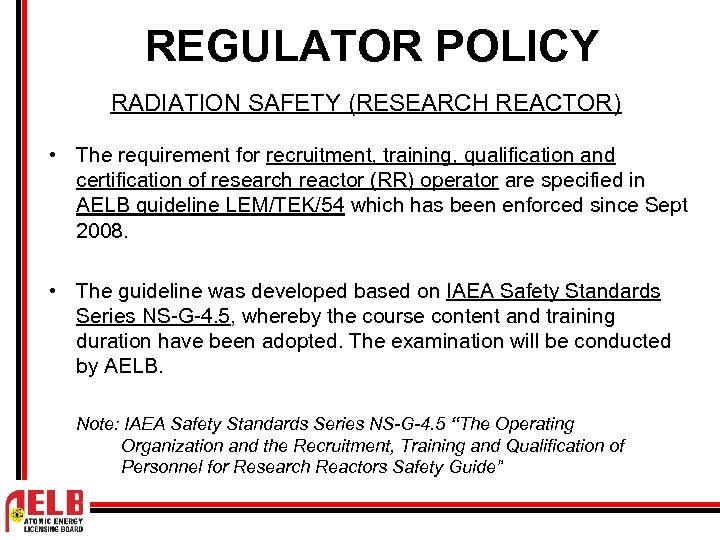 REGULATOR POLICY RADIATION SAFETY (RESEARCH REACTOR) • The requirement for recruitment, training, qualification and certification of research reactor (RR) operator are specified in AELB guideline LEM/TEK/54 which has been enforced since Sept 2008. • The guideline was developed based on IAEA Safety Standards Series NS-G-4. 5, whereby the course content and training duration have been adopted. The examination will be conducted by AELB. Note: IAEA Safety Standards Series NS-G-4. 5 “The Operating Organization and the Recruitment, Training and Qualification of Personnel for Research Reactors Safety Guide”
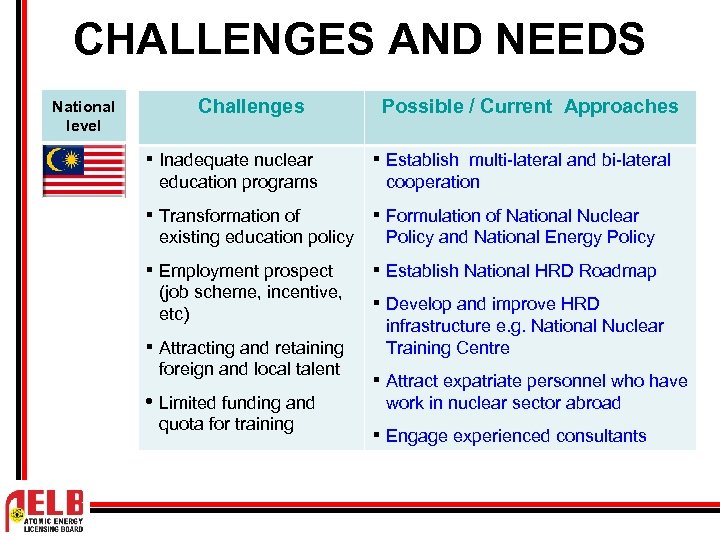 CHALLENGES AND NEEDS National level Challenges ▪ Inadequate nuclear education programs ▪ Transformation of existing education policy ▪ Employment prospect (job scheme, incentive, etc) ▪ Attracting and retaining foreign and local talent • Limited funding and quota for training Possible / Current Approaches ▪ Establish multi-lateral and bi-lateral cooperation ▪ Formulation of National Nuclear Policy and National Energy Policy ▪ Establish National HRD Roadmap ▪ Develop and improve HRD infrastructure e. g. National Nuclear Training Centre ▪ Attract expatriate personnel who have work in nuclear sector abroad ▪ Engage experienced consultants
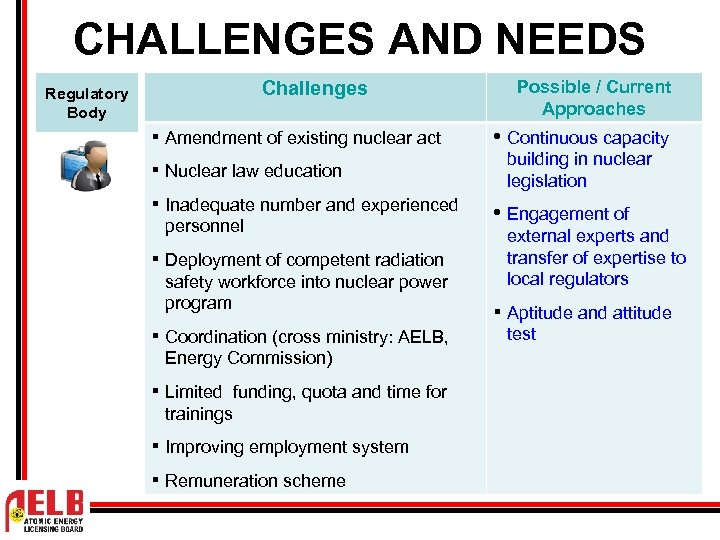 CHALLENGES AND NEEDS Challenges Regulatory Body ▪ Amendment of existing nuclear act ▪ Nuclear law education ▪ Inadequate number and experienced personnel ▪ Deployment of competent radiation safety workforce into nuclear power program ▪ Coordination (cross ministry: AELB, Energy Commission) ▪ Limited funding, quota and time for trainings ▪ Improving employment system ▪ Remuneration scheme Possible / Current Approaches • Continuous capacity building in nuclear legislation • Engagement of external experts and transfer of expertise to local regulators ▪ Aptitude and attitude test
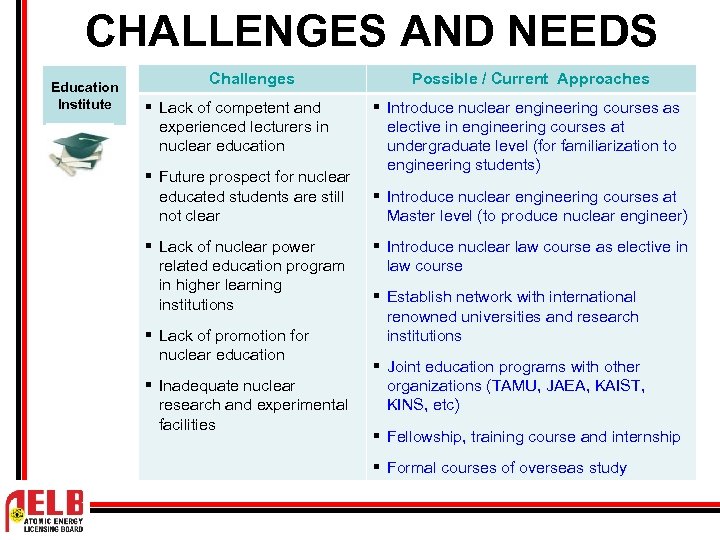 CHALLENGES AND NEEDS Education Institute Challenges ▪ Lack of competent and experienced lecturers in nuclear education ▪ Future prospect for nuclear educated students are still not clear ▪ ▪ ▪ Lack of nuclear power related education program in higher learning institutions Lack of promotion for nuclear education Inadequate nuclear research and experimental facilities Possible / Current Approaches ▪ Introduce nuclear engineering courses as elective in engineering courses at undergraduate level (for familiarization to engineering students) ▪ Introduce nuclear engineering courses at Master level (to produce nuclear engineer) ▪ Introduce nuclear law course as elective in law course ▪ Establish network with international renowned universities and research institutions ▪ Joint education programs with other organizations (TAMU, JAEA, KAIST, KINS, etc) ▪ Fellowship, training course and internship ▪ Formal courses of overseas study
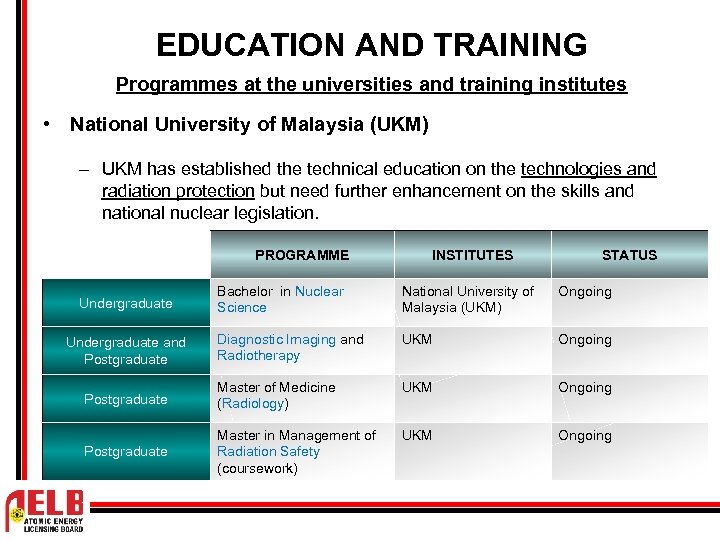 EDUCATION AND TRAINING Programmes at the universities and training institutes • National University of Malaysia (UKM) – UKM has established the technical education on the technologies and radiation protection but need further enhancement on the skills and national nuclear legislation. PROGRAMME INSTITUTES STATUS Bachelor in Nuclear Science National University of Malaysia (UKM) Ongoing Diagnostic Imaging and Radiotherapy UKM Ongoing Postgraduate Master of Medicine (Radiology) UKM Ongoing Postgraduate Master in Management of Radiation Safety (coursework) Undergraduate and Postgraduate
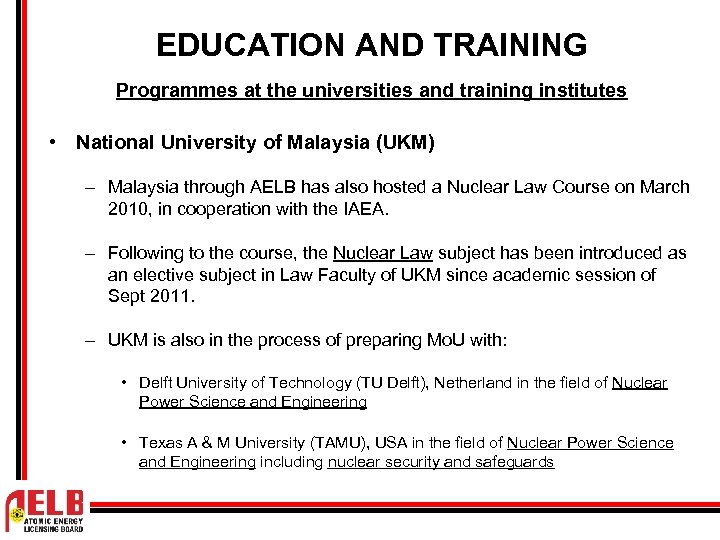 EDUCATION AND TRAINING Programmes at the universities and training institutes • National University of Malaysia (UKM) – Malaysia through AELB has also hosted a Nuclear Law Course on March 2010, in cooperation with the IAEA. – Following to the course, the Nuclear Law subject has been introduced as an elective subject in Law Faculty of UKM since academic session of Sept 2011. – UKM is also in the process of preparing Mo. U with: • Delft University of Technology (TU Delft), Netherland in the field of Nuclear Power Science and Engineering • Texas A & M University (TAMU), USA in the field of Nuclear Power Science and Engineering including nuclear security and safeguards
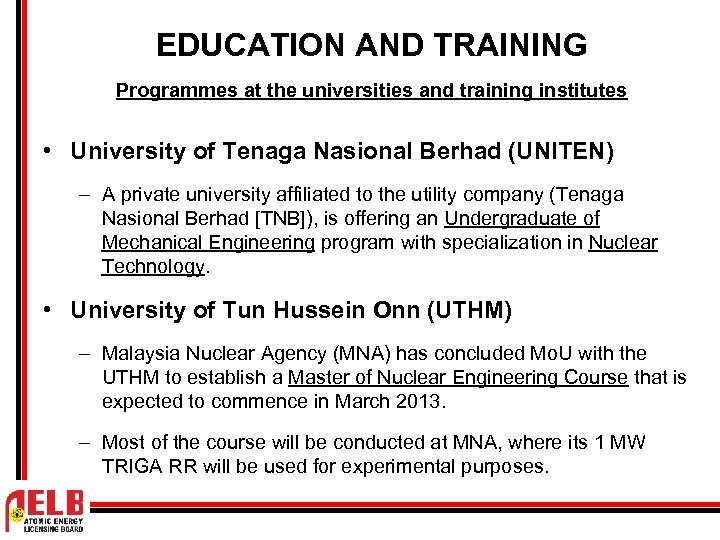 EDUCATION AND TRAINING Programmes at the universities and training institutes • University of Tenaga Nasional Berhad (UNITEN) – A private university affiliated to the utility company (Tenaga Nasional Berhad [TNB]), is offering an Undergraduate of Mechanical Engineering program with specialization in Nuclear Technology. • University of Tun Hussein Onn (UTHM) – Malaysia Nuclear Agency (MNA) has concluded Mo. U with the UTHM to establish a Master of Nuclear Engineering Course that is expected to commence in March 2013. – Most of the course will be conducted at MNA, where its 1 MW TRIGA RR will be used for experimental purposes.
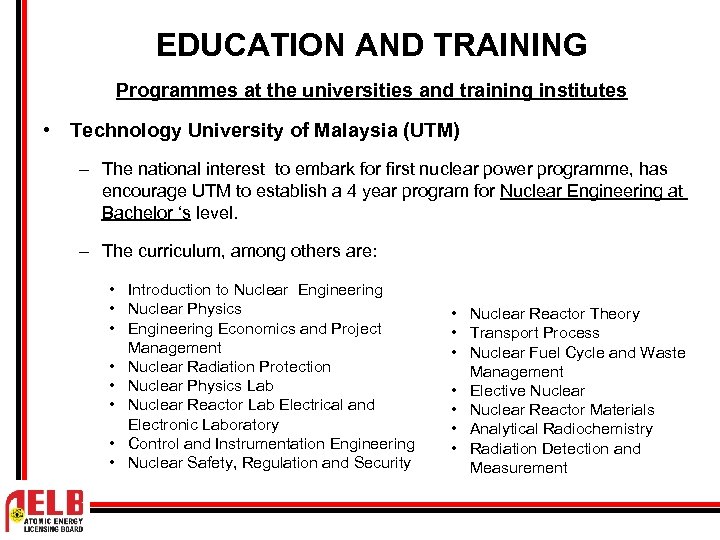 EDUCATION AND TRAINING Programmes at the universities and training institutes • Technology University of Malaysia (UTM) – The national interest to embark for first nuclear power programme, has encourage UTM to establish a 4 year program for Nuclear Engineering at Bachelor ‘s level. – The curriculum, among others are: • Introduction to Nuclear Engineering • Nuclear Physics • Engineering Economics and Project Management • Nuclear Radiation Protection • Nuclear Physics Lab • Nuclear Reactor Lab Electrical and Electronic Laboratory • Control and Instrumentation Engineering • Nuclear Safety, Regulation and Security • Nuclear Reactor Theory • Transport Process • Nuclear Fuel Cycle and Waste Management • Elective Nuclear • Nuclear Reactor Materials • Analytical Radiochemistry • Radiation Detection and Measurement
 INTERNATIONAL COOPERATION • The gaps between competencies required in the regulatory body and the competencies available has been identified. • Due to national interest to embark on the first nuclear power programme, the national education and training established has limited capability to fill in the gaps. Therefore international and bilateral cooperation is required. – Norwegian funded IAEA program on nuclear safety assessment • The training program was held alternately in Malaysia and Vietnam and hosted by regulatory bodies (AELB for Malaysia and Vietnam Agency for Radiation and Nuclear Safety [VARANS] for Vietnam) of each country.
 INTERNATIONAL COOPERATION – European Nuclear Safety, Training and Tutoring Institute (ENSTTI) on training and tutoring for professional in nuclear safety, security and radiation protection – US Nuclear Regulatory Commission (USNRC) on siting – Korean Institute for Nuclear Safety (KINS) on nuclear safety – National Nuclear Security Administration (NNSA) USDo. E on nuclear security, safeguards and non-proliferation – Japan Atomic Energy Agency (JAEA) on nuclear safety, nuclear security, safeguards and non-proliferation
 CONCLUSION • Regulatory Body • Government Policy • Regulator Policy • Needs and Challenges • Education and Training • International Cooperation • Conclusion