


 Скачать презентацию 4 th International Vanguard Science Congress The role
265a74e71c8dee706256227f33eee9e9.ppt
- Количество слайдов: 75
 4 th International Vanguard Science Congress The role of Science, Technology and Geo-Politics in the Self-Determination of Mankind Ciudad de México, May 28 -30, 2013 Universidad Autónoma Metropolitana Unidad Xochimilco El papel de los servicios en las economías contemporáneas: Una formulación consistente dentro de los marcos de la teoría del valor del trabajo de Marx. The role of services in contemporary economies: A consistent formulation within the framework of Marx´s labour theory of value. Peter Fleissner, catedrático de cibernética social, Viena, Austria contacto: fleissner@arrakis. es
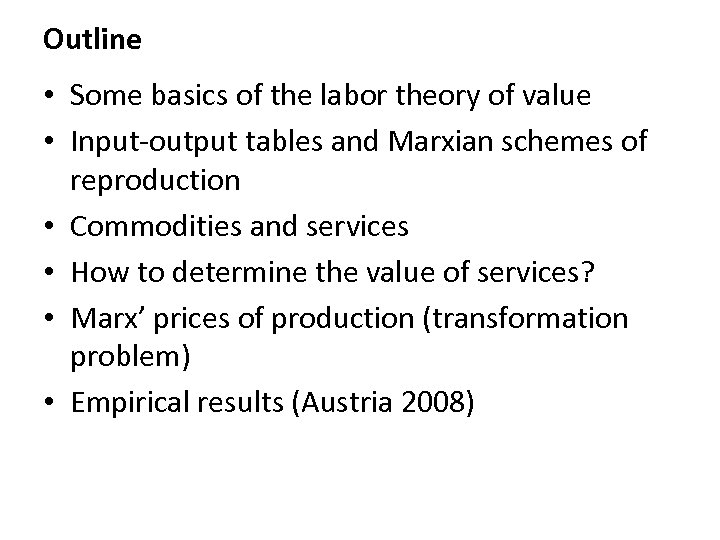 Outline • Some basics of the labor theory of value • Input-output tables and Marxian schemes of reproduction • Commodities and services • How to determine the value of services? • Marx’ prices of production (transformation problem) • Empirical results (Austria 2008)
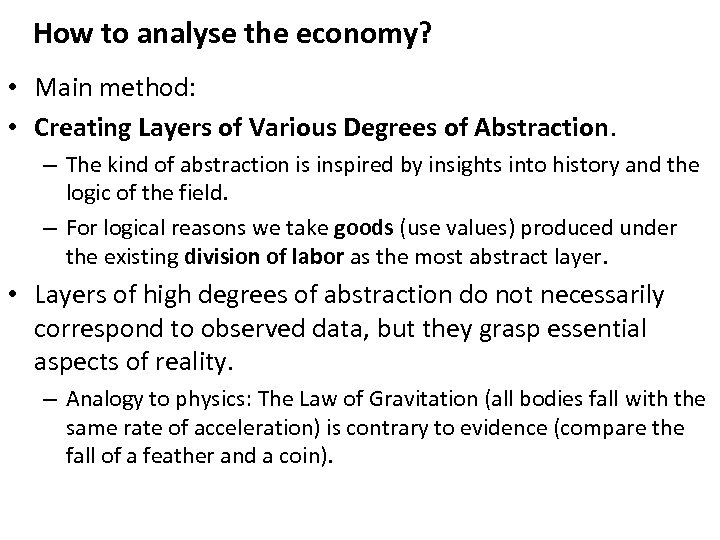 How to analyse the economy? • Main method: • Creating Layers of Various Degrees of Abstraction. – The kind of abstraction is inspired by insights into history and the logic of the field. – For logical reasons we take goods (use values) produced under the existing division of labor as the most abstract layer. • Layers of high degrees of abstraction do not necessarily correspond to observed data, but they grasp essential aspects of reality. – Analogy to physics: The Law of Gravitation (all bodies fall with the same rate of acceleration) is contrary to evidence (compare the fall of a feather and a coin).
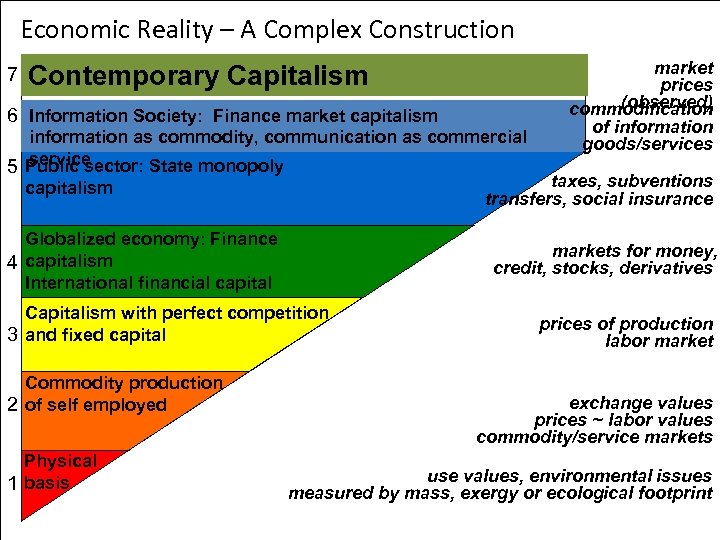 Economic Reality – A Complex Construction 7 Contemporary Capitalism 6 Information Society: Finance market capitalism market prices (observed) commodification of information goods/services information as commodity, communication as commercial service 5 Public sector: State monopoly taxes, subventions capitalism transfers, social insurance Globalized economy: Finance 4 capitalism International financial capital markets for money, credit, stocks, derivatives Capitalism with perfect competition 3 and fixed capital Commodity production 2 of self employed Physical 1 basis prices of production labor market exchange values prices ~ labor values commodity/service markets use values, environmental issues measured by mass, exergy or ecological footprint
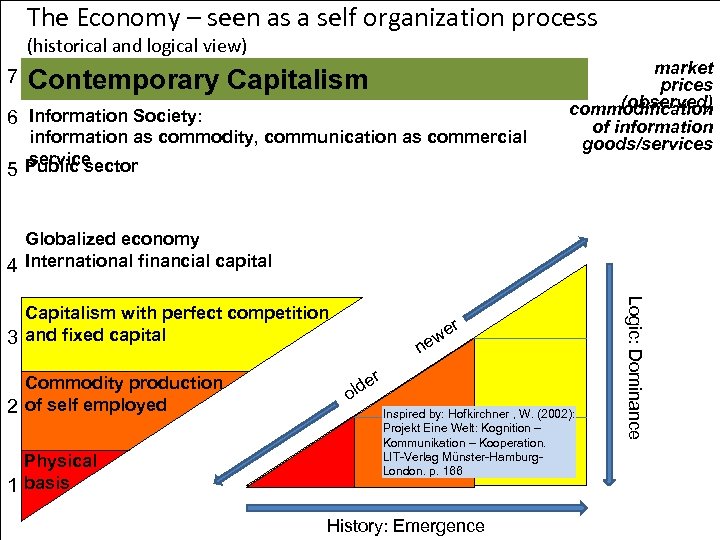 The Economy – seen as a self organization process (historical and logical view) 7 Contemporary Capitalism 6 Information Society: 5 information as commodity, communication as commercial service Public sector market prices (observed) commodification of information goods/services Globalized economy 4 International financial capital Commodity production 2 of self employed Physical 1 basis r e r we e n old Inspired by: Hofkirchner , W. (2002): Projekt Eine Welt: Kognition – Kommunikation – Kooperation. LIT-Verlag Münster-Hamburg. London. p. 166 History: Emergence Logic: Dominance Capitalism with perfect competition 3 and fixed capital
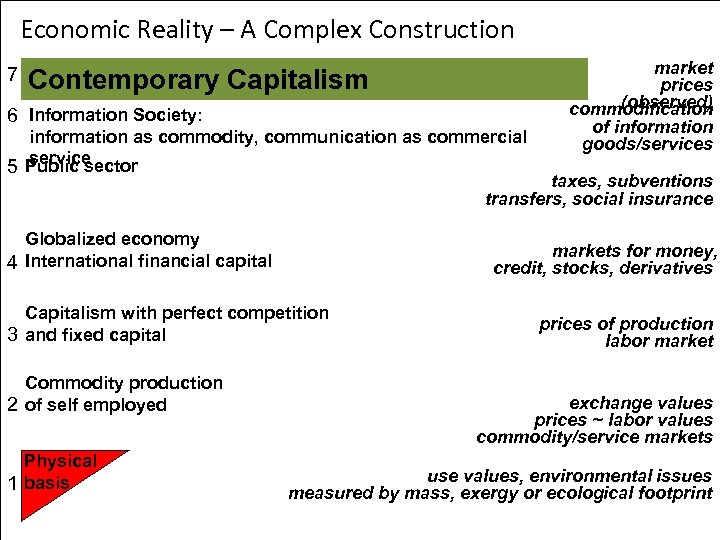 Economic Reality – A Complex Construction 7 Contemporary Capitalism 6 Information Society: 5 information as commodity, communication as commercial service Public sector taxes, subventions transfers, social insurance Globalized economy 4 International financial capital markets for money, credit, stocks, derivatives Capitalism with perfect competition 3 and fixed capital Commodity production 2 of self employed Physical 1 basis market prices (observed) commodification of information goods/services prices of production labor market exchange values prices ~ labor values commodity/service markets use values, environmental issues measured by mass, exergy or ecological footprint
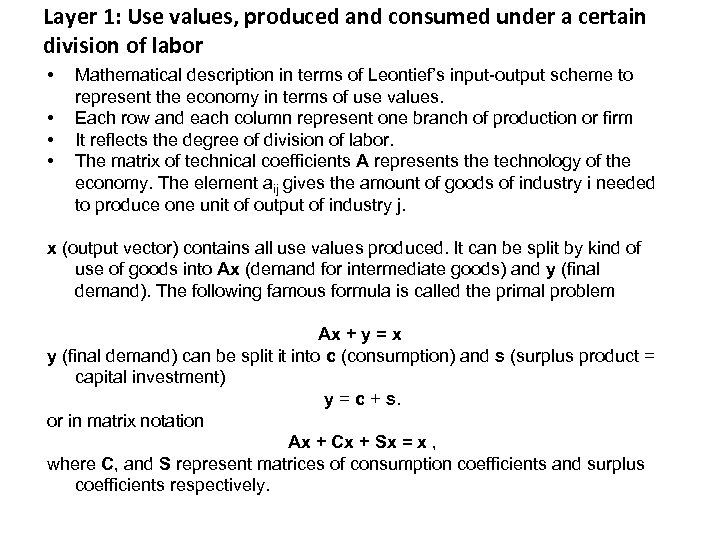 Layer 1: Use values, produced and consumed under a certain division of labor • • Mathematical description in terms of Leontief’s input-output scheme to represent the economy in terms of use values. Each row and each column represent one branch of production or firm It reflects the degree of division of labor. The matrix of technical coefficients A represents the technology of the economy. The element aij gives the amount of goods of industry i needed to produce one unit of output of industry j. x (output vector) contains all use values produced. It can be split by kind of use of goods into Ax (demand for intermediate goods) and y (final demand). The following famous formula is called the primal problem Ax + y = x y (final demand) can be split it into c (consumption) and s (surplus product = capital investment) y = c + s. or in matrix notation Ax + Cx + Sx = x , where C, and S represent matrices of consumption coefficients and surplus coefficients respectively.
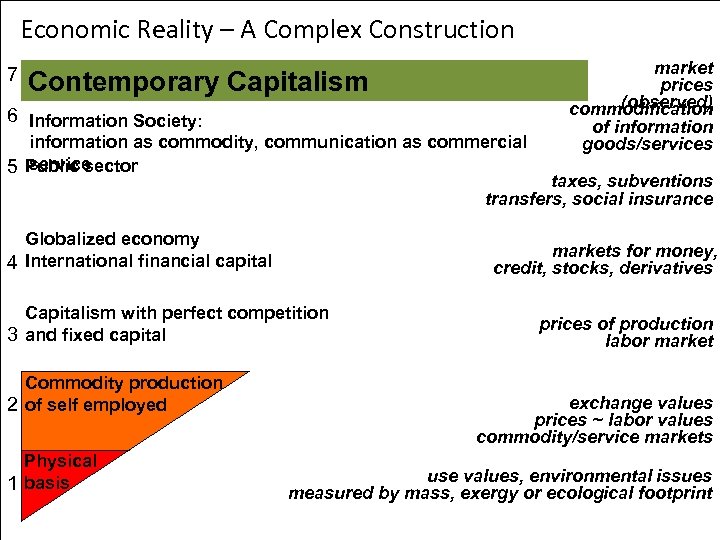 Economic Reality – A Complex Construction 7 Contemporary Capitalism 6 Information Society: information as commodity, communication as commercial service 5 Public sector market prices (observed) commodification of information goods/services taxes, subventions transfers, social insurance Globalized economy 4 International financial capital markets for money, credit, stocks, derivatives Capitalism with perfect competition 3 and fixed capital Commodity production 2 of self employed Physical 1 basis prices of production labor market exchange values prices ~ labor values commodity/service markets use values, environmental issues measured by mass, exergy or ecological footprint
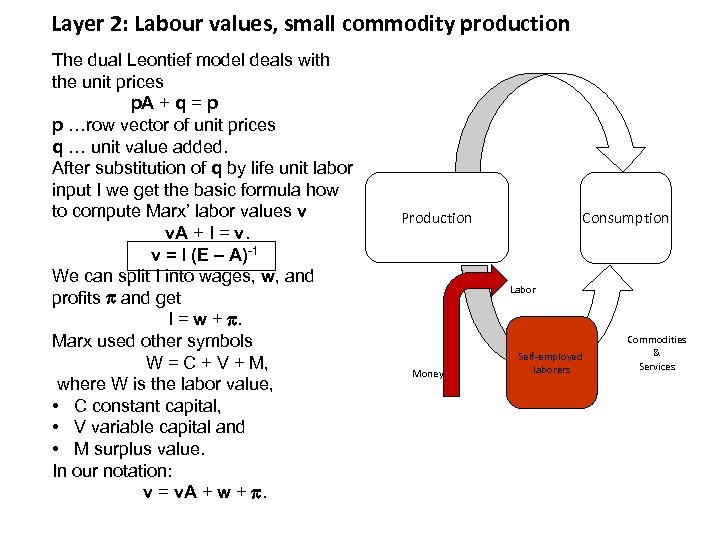 Layer 2: Labour values, small commodity production The dual Leontief model deals with the unit prices p. A + q = p p …row vector of unit prices q … unit value added. After substitution of q by life unit labor input l we get the basic formula how to compute Marx’ labor values v v. A + l = v. v = l (E – A)-1 We can split l into wages, w, and profits p and get l = w + p. Marx used other symbols W = C + V + M, where W is the labor value, • C constant capital, • V variable capital and • M surplus value. In our notation: v = v. A + w + p. Production Consumption Labor Money Self-employed laborers Commodities & Services
 Basic terms in Marxian Political Economics • commodity • value in use • value in exchange • • (labor)value constant capital variable capital surplus value • rate of surplus value/rate of exploitaiton • organic composition of capital • rate of profit
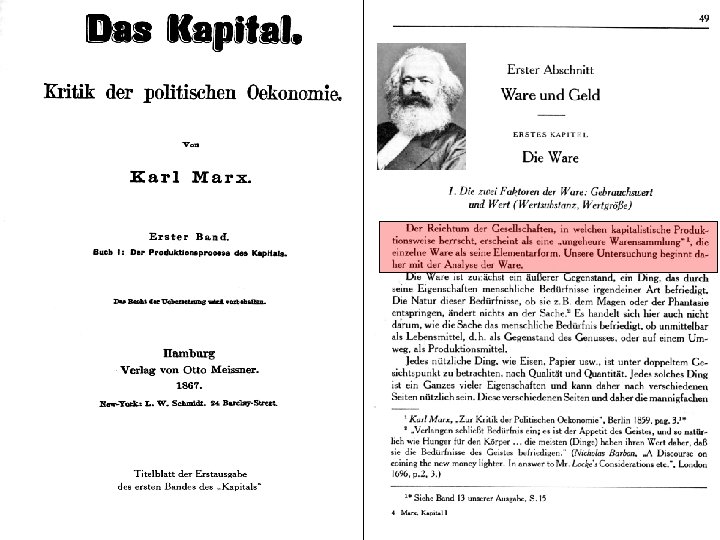
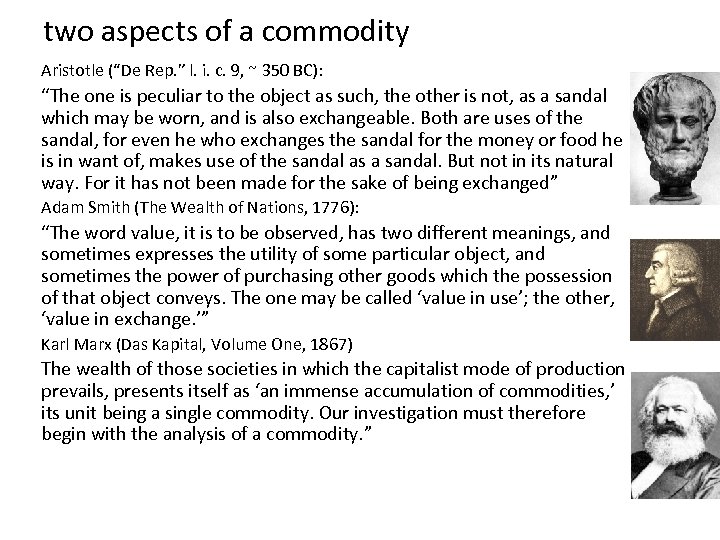 two aspects of a commodity Aristotle (“De Rep. ” l. i. c. 9, ~ 350 BC): “The one is peculiar to the object as such, the other is not, as a sandal which may be worn, and is also exchangeable. Both are uses of the sandal, for even he who exchanges the sandal for the money or food he is in want of, makes use of the sandal as a sandal. But not in its natural way. For it has not been made for the sake of being exchanged” Adam Smith (The Wealth of Nations, 1776): “The word value, it is to be observed, has two different meanings, and sometimes expresses the utility of some particular object, and sometimes the power of purchasing other goods which the possession of that object conveys. The one may be called ‘value in use’; the other, ‘value in exchange. ’” Karl Marx (Das Kapital, Volume One, 1867) The wealth of those societies in which the capitalist mode of production prevails, presents itself as ‘an immense accumulation of commodities, ’ its unit being a single commodity. Our investigation must therefore begin with the analysis of a commodity. ”
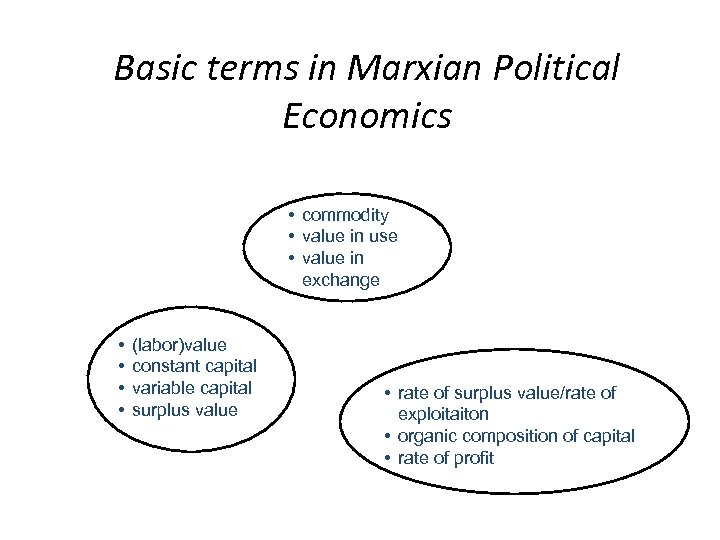
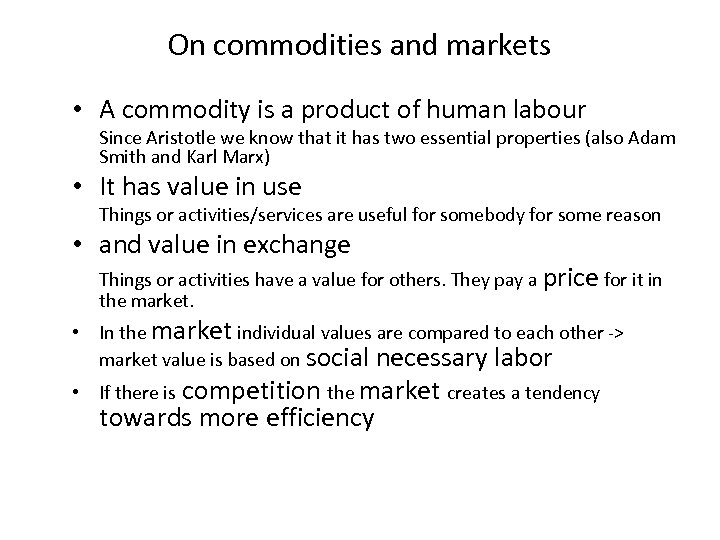 On commodities and markets • A commodity is a product of human labour Since Aristotle we know that it has two essential properties (also Adam Smith and Karl Marx) • It has value in use Things or activities/services are useful for somebody for some reason • and value in exchange Things or activities have a value for others. They pay a price for it in the market. • In the market individual values are compared to each other -> market value is based on social necessary labor competition the market creates a tendency towards more efficiency • If there is
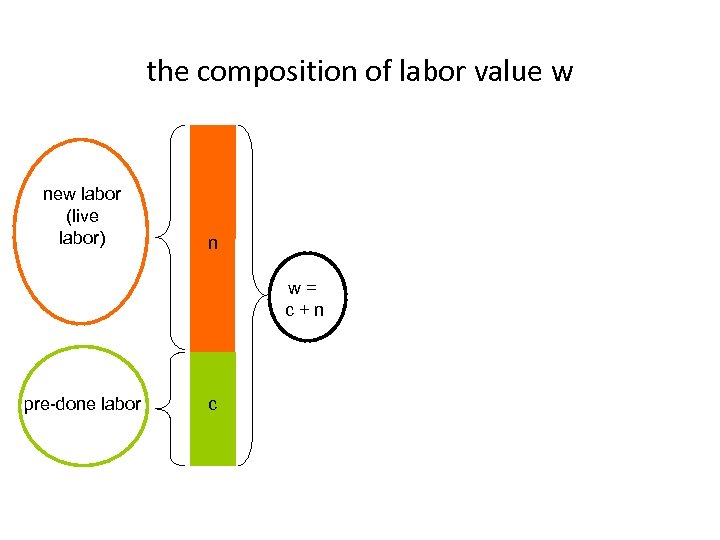 the composition of labor value w new labor (live labor) n w = c + n pre-done labor c
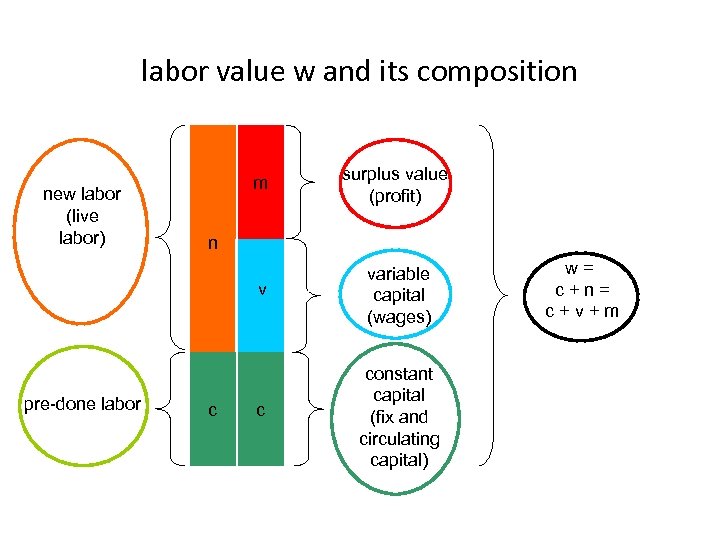 labor value w and its composition pre-done labor surplus value (profit) v new labor (live labor) m variable capital (wages) c constant capital (fix and circulating capital) n c w = c + n = c + v + m
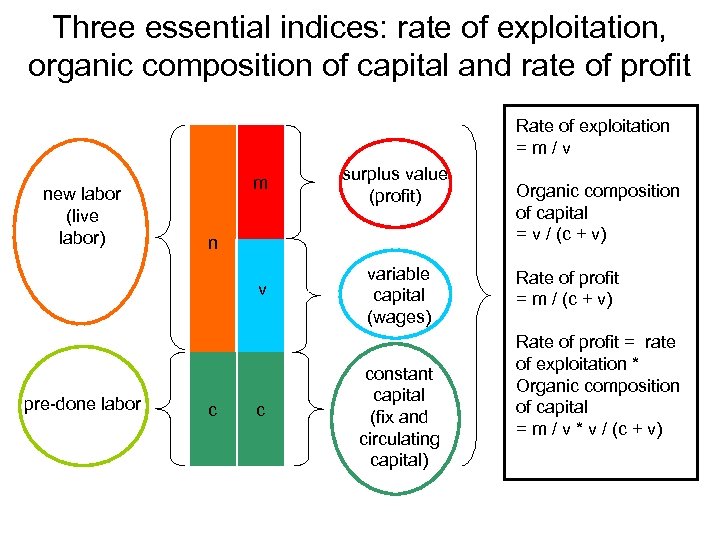 Three essential indices: rate of exploitation, organic composition of capital and rate of profit Rate of exploitation = m / v pre-done labor surplus value (profit) v new labor (live labor) m variable capital (wages) n c c constant capital (fix and circulating capital) Organic composition of capital = v / (c + v) Rate of profit = m / (c + v) Rate of profit = rate of exploitation * Organic composition of capital = m / v * v / (c + v)
 New aspects of the labour theory of value 1. 2. 3. 4. Empirical estimates of labour values Simple and complex labour Treating services as value consuming Transformation of values into prices ü ü Marxian Von Bortkiewicz Geometric interpretation Less abstract transformation
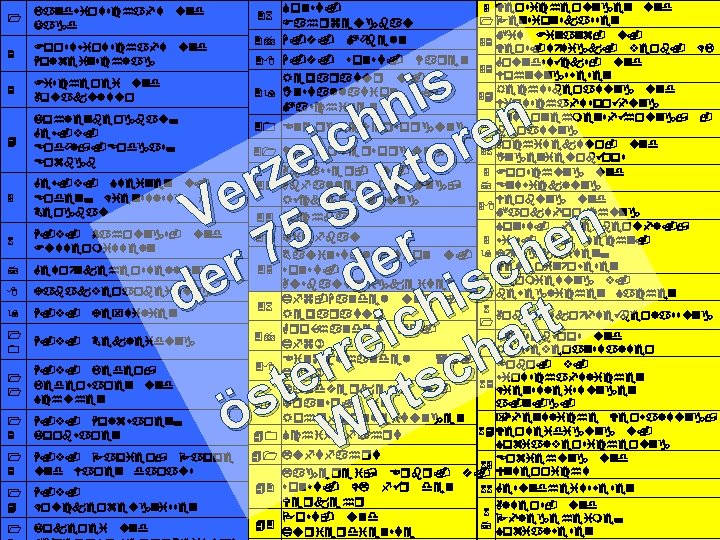
 Nr 1 2 3 4 5 6 7 8 9 10 11 12 13 14 15 16 17 18 19 20 21 22 23 24 25 Industry Agriculture, hunting Forestry, logging Fishing, fish farms Mining of coal and lignite Extract. o. crude petrol. a. nat. gas, min. o. metal ores Other mining and quarrying Manufacture of food products and beverages Manufacture of tobacco products Manufacture of textiles Manufacture of wearing apparel Manufacture of leather, leather products, footwear Manufacture of wood and of products of wood Manufacture of paper and paper products Publishing, printing and reproduction Manufacture of coke, refined petroleum products Manufacture of chemicals and chemical products Manufacture of rubber and plastic products Manufacture of other non-metallic mineral products Manufacture of basic metals Manufacture of fabricated metal products Manufacture of machinery and equipment n. e. c. Manufacture of office machinery and computers Manufacture of electrical machinery and apparatus n. e. c. Manufacture of radio, television equipment Manuf. of medical, precision, optical instruments, clocks 2 9 3 0 3 1 3 2 3 3 3 4 3 5 3 6 3 7 3 8 3 9 4 0 4 1 4 2 4 3 4 4 Recycling Electricity, gas, steam and hot water supply Collection, purification and distribution of water Construction Sale and repair of motor vehicles; automotive fuel Wholesale and commission trade Retail trade, repair of household goods Hotels and restaurants Land transport; transport via pipelines Water transport Air transport Supporting a. auxiliary transport activities; travel agencies Post and tele-communications Financial intermediation, except insur. Insurance and pension funding, except social security Activities auxiliary to financial intermediation
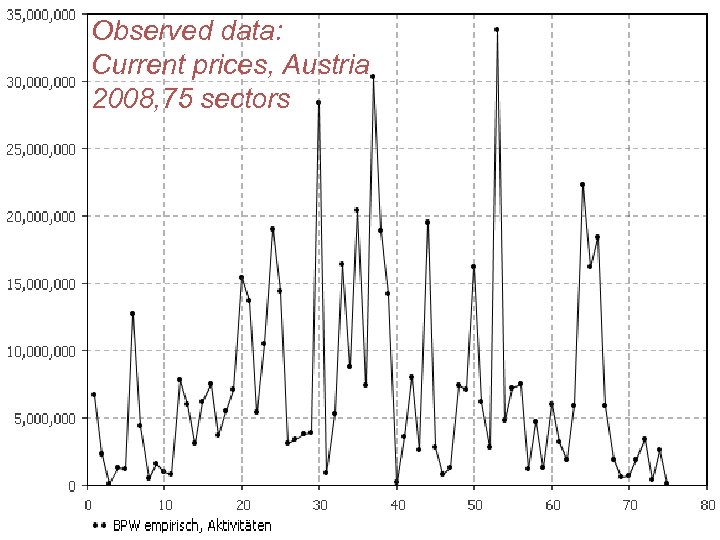
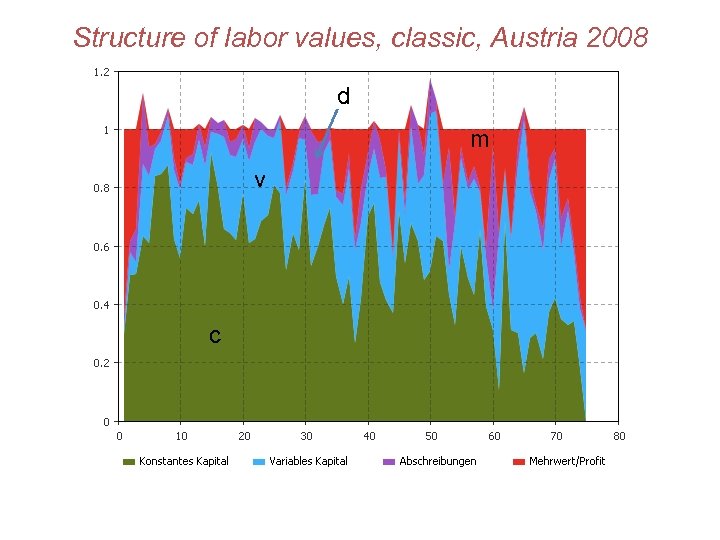
 Stucture of gross output (observed) c - constant capital, v - variable capital, m - surplus value Austria 2008: 75 industries (percent) d m v c
 Stucture of gross output (observed) c - constant capital, v - variable capital, m - surplus value Austria 2008: 75 industries (percent) d m v c
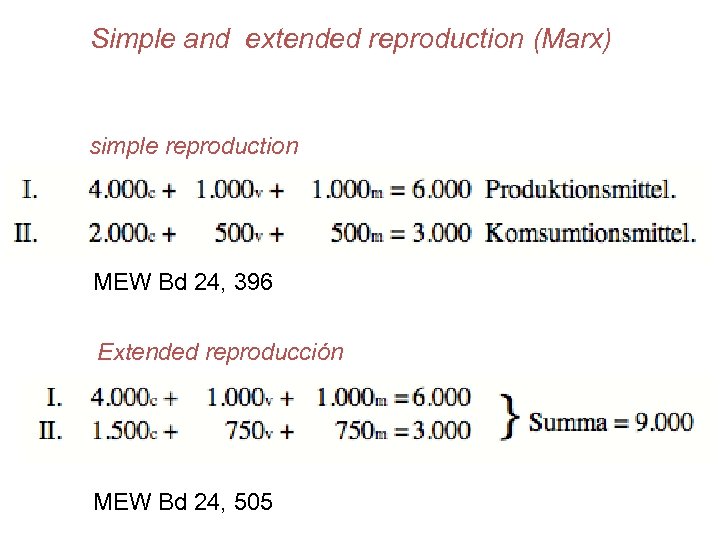 Simple and extended reproduction (Marx) simple reproduction MEW Bd 24, 396 Extended reproducción MEW Bd 24, 505
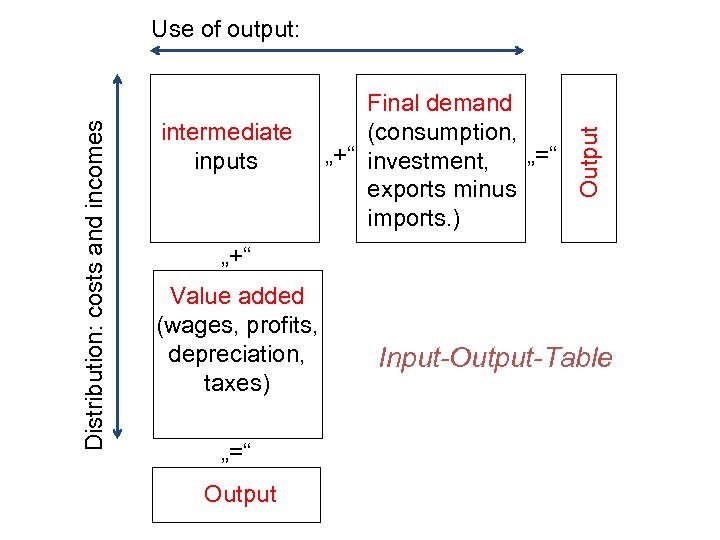
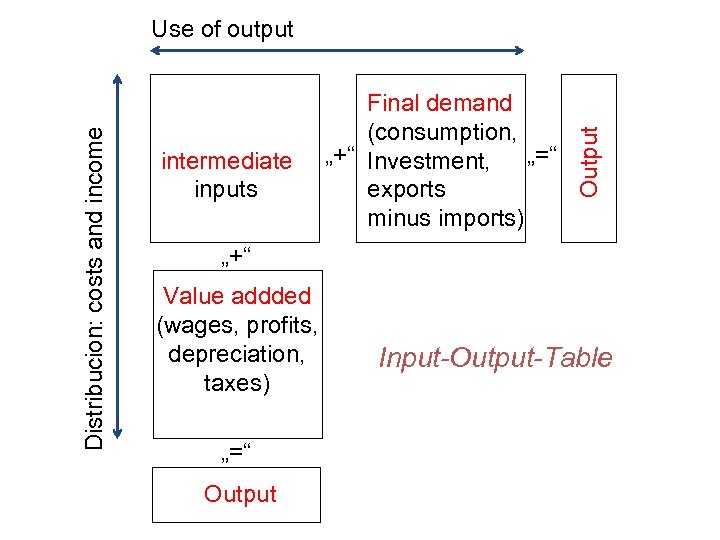 intermediate inputs Final demand (consumption, „+“ Investment, „=“ exports minus imports) Output Distribucion: costs and income Use of output „+“ Value addded (wages, profits, depreciation, taxes) „=“ Output Input-Output-Table
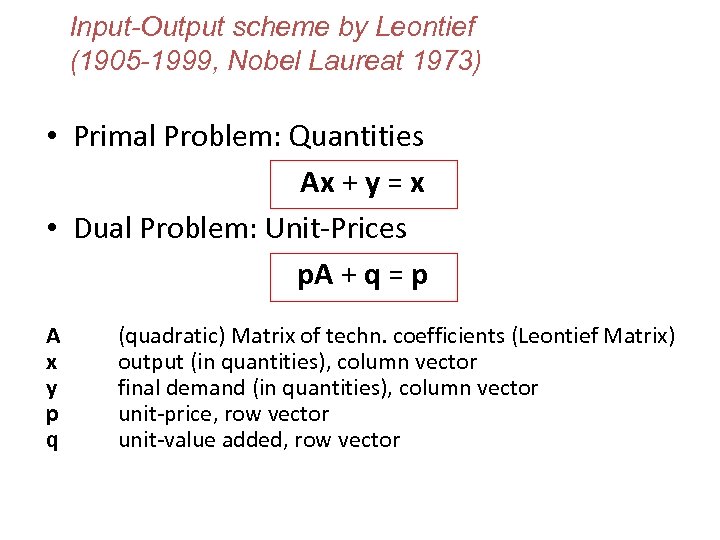 Input-Output scheme by Leontief (1905 -1999, Nobel Laureat 1973) • Primal Problem: Quantities Ax + y = x • Dual Problem: Unit-Prices p. A + q = p A x y p q (quadratic) Matrix of techn. coefficients (Leontief Matrix) output (in quantities), column vector final demand (in quantities), column vector unit-price, row vector unit-value added, row vector
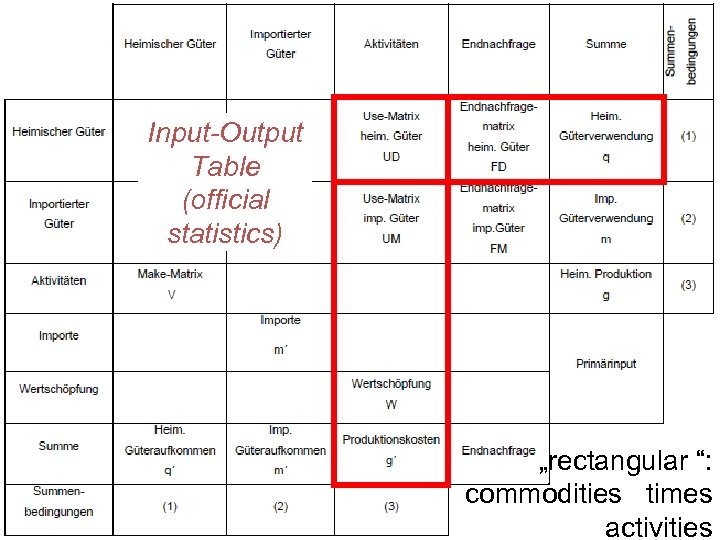 Input-Output Table (official statistics) „rectangular “: commodities times activities
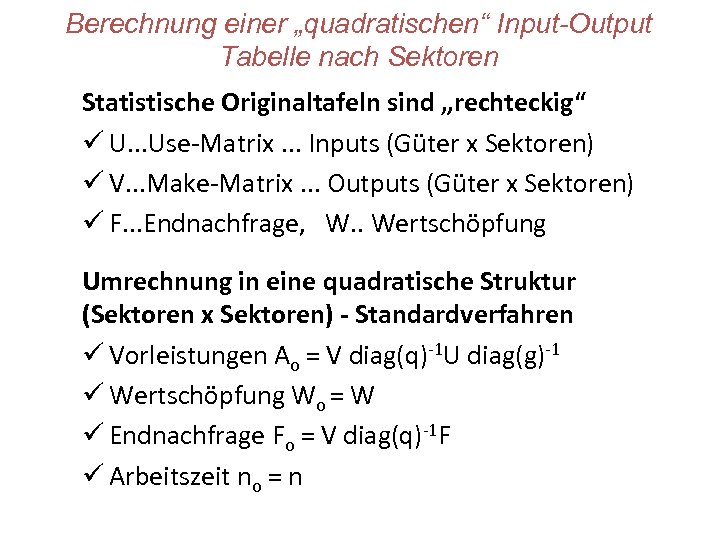 Berechnung einer „quadratischen“ Input-Output Tabelle nach Sektoren Statistische Originaltafeln sind „rechteckig“ ü U. . . Use-Matrix. . . Inputs (Güter x Sektoren) ü V. . . Make-Matrix. . . Outputs (Güter x Sektoren) ü F. . . Endnachfrage, W. . Wertschöpfung Umrechnung in eine quadratische Struktur (Sektoren x Sektoren) - Standardverfahren ü Vorleistungen Ao = V diag(q)-1 U diag(g)-1 ü Wertschöpfung Wo = W ü Endnachfrage Fo = V diag(q)-1 F ü Arbeitszeit no = n
 intermediate inputs Final demand (consumption, „+“ investment, „=“ exports minus imports. ) Output Distribution: costs and incomes Use of output: „+“ Value added (wages, profits, depreciation, taxes) „=“ Output Input-Output-Table
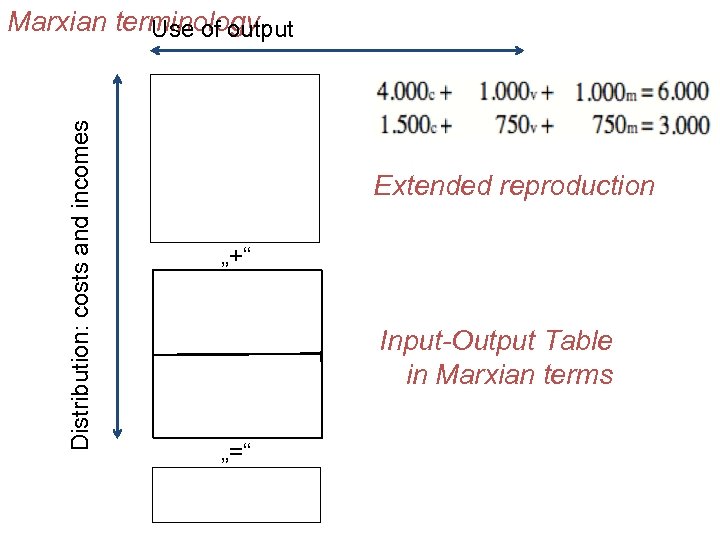 konstantes Vorleistungen Endnachfrage zirkulierendes Inputs (Konsum, Kapital (Lieferungen „+“ Investitionen, „=“ Extended reproduction c zwischen Exporte minus Unternehmen) Importe) Output Distribution: costs and incomes Marxian terminology Use of output „+“ Wertschöpfung variables Lebendige Kapital v Arbeit (Löhne, Gewinn n Abschreibung Mehrwert Steuern etc. ) m „=“ Output Wert w Input-Output Table in Marxian terms
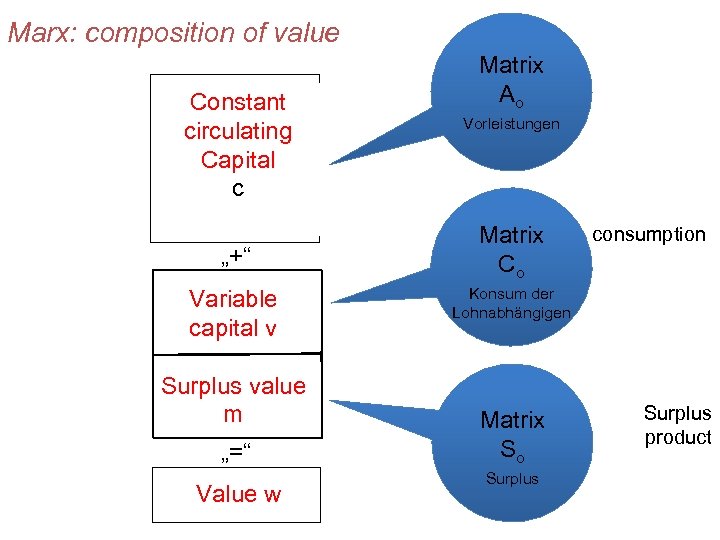 Marx: composition of value Matrix A Endnachfrageo Output Constant Vorleistungen circulating Inputs (Konsum, Capital (Lieferungen „+“ Investitionen, „=“ c zwischen Exporte minus Unternehmen) Importe) consumption Matrix „+“ Co Konsum der Wertschöpfung Variable Lohnabhängigen Lebendige capital v Arbeit (Löhne, Gewinn n Abschreibung Surplus value Steuern etc. ) Surplus m Matrix product So „=“ Output Value w Surplus
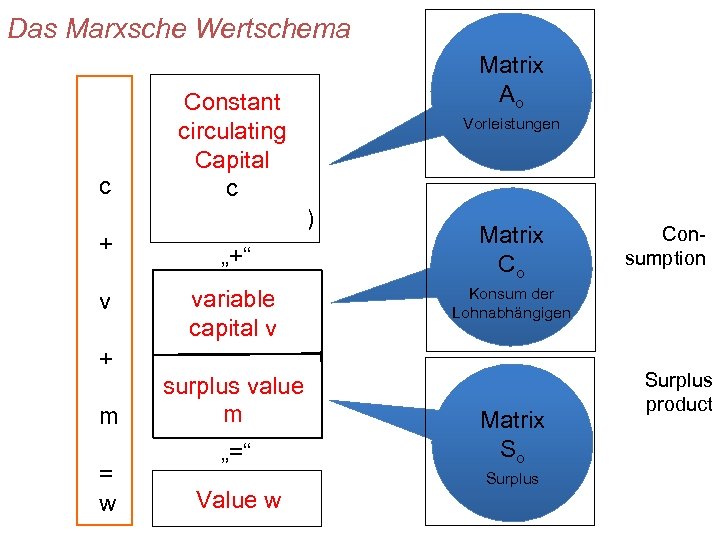 Das Marxsche Wertschema c + v + m = w Constant Vorleistungen circulating Inputs (Konsum, Capital (Lieferungen „+“ Investitionen, „=“ c zwischen Exporte minus Unternehmen) Importe) Matrix „+“ Co Konsum der Wertschöpfung variable Lohnabhängigen Lebendige capital v Arbeit (Löhne, Gewinn n Abschreibung surplus value Steuern etc. ) m Matrix So „=“ Output Value w Surplus Output Matrix A Endnachfrageo Consumption Surplus product
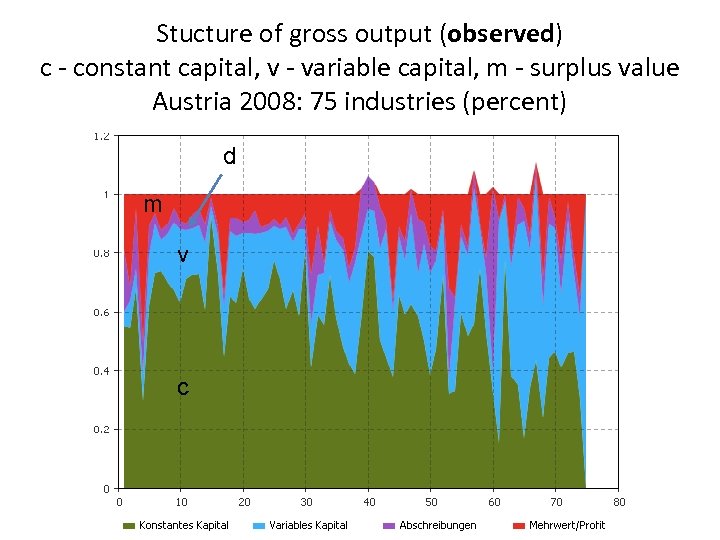
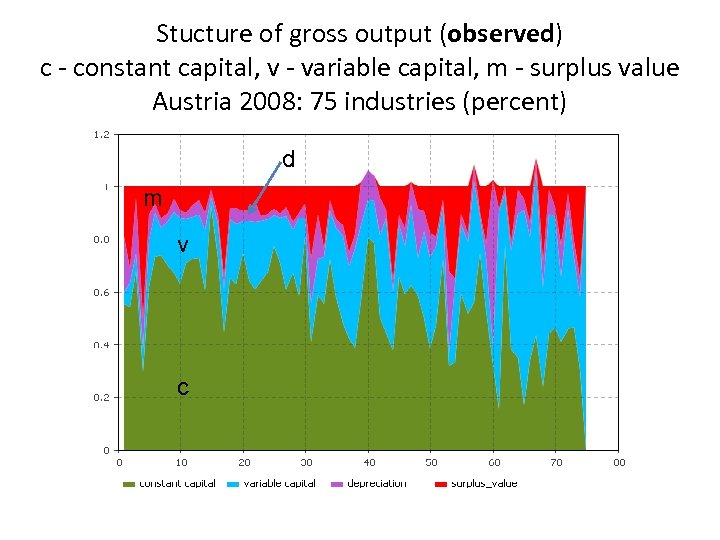
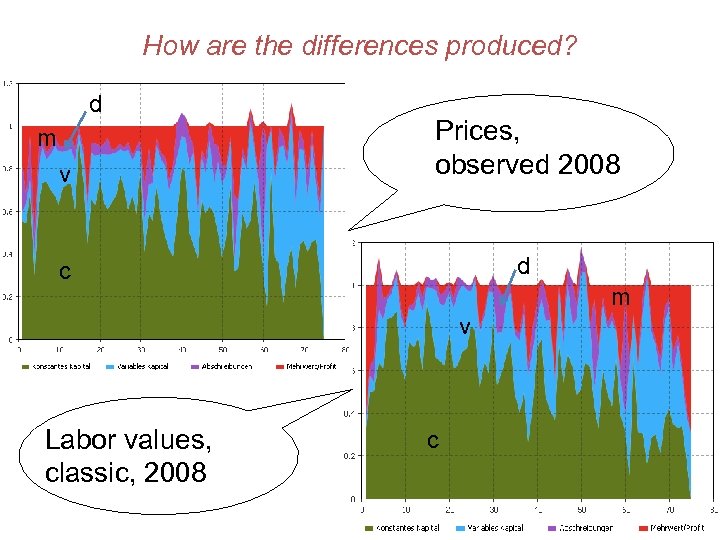
 Observed data: Current prices, Austria 2008, 75 sectors
 Landwirtschaft Jagd 2 Forstwirtschaft Holzeinschlag 3 Fischerei und Aquakultur 4 Kohlenbergbau; Gew. v. Erdö l, . Erdgas; Erzbgb 5 Gew. v. Steinen u. Erden; Dienstlstg f Bergbau 32 6 H. v. Nahrungs. Futtermitteln 34 7 Geträ nkeherstellung 8 Tabakverarbeitung 9 H. v. Textilien 1 0 H. v. Bekleidung 1 1 H. v. Leder, Lederwaren und Schuhen 1 2 H. v. Holzwaren; Korbwaren 1 3 H. v. Papier, Pappe und Waren daraus 1 4 H. v. Druckerzeugnissen 1 Kokerei und und 5 Versicherungen und 1 Pensionskassen Mit Finanz- u. 52 Vers. tä tigk. verb. DL H. v. sonst. Waren Grundstü cks- und 53 Wohnungswesen Reparatur u. Rechtsberatung und Installation v. 54 Wirtschaftsprü fung Maschinen Unternehmensfü hrung, Energieversorgung 55 beratung Architektur- und 56 Wasserversorgung Ingenieurbü ros Abwasser- u. 5 Forschung und 7 Entwicklung Abfallentsorgung, Werbung und Rü ckgewinnung 58 Marktforschung Hochbau Sonst. freiberufl. , Tiefbau 5 wiss. u. techn. tigkeiten; Bauinstallation u. 9 Tä Veterinä rwesen sonst. 6 Vermietung v. Ausbautä tigkeiten 0 beweglichen Sachen Kfz-Handel und 6 Reparatur Arbeitskrä fteü berlassung 1 Groß handel (o. Reisebü ros und 62 Kfz) Reiseveranstalter Einzelhandel (o. Erbr. v. Kfz) wirtschaftlichen 63 Landverkehr u. Dienstleistungen Transp. in a. n. g. Ö ffentliche Verwaltung, Rohrfernleitungen 64 Verteidigung u. Schifffahrt Sozialversicherung Luftfahrt Erziehung und 65 Lagerei, Erbr. v. Unterricht Sonst. Fahrzeugbau 27 H. v. Mö beln 1 26 28 is n n e h r ic to ze ek er S V 5 n r che 7 r de is e d h ft ic ha re c r s te irt s ö W 29 30 31 und 33 35 36 37 38 39 40 41 42 sonst. DL fü r den Verkehr Post- und 43 Kurierdienste 66 Gesundheitswesen Alters- und 6 Pflegeheime; 7 Sozialwesen
 Structure of „classical“ labour values all industries are value producers c - constant capital, v - variable capital, m - surplus value Austria 2006: 57 industries (percent), r = 0. 819 m v c
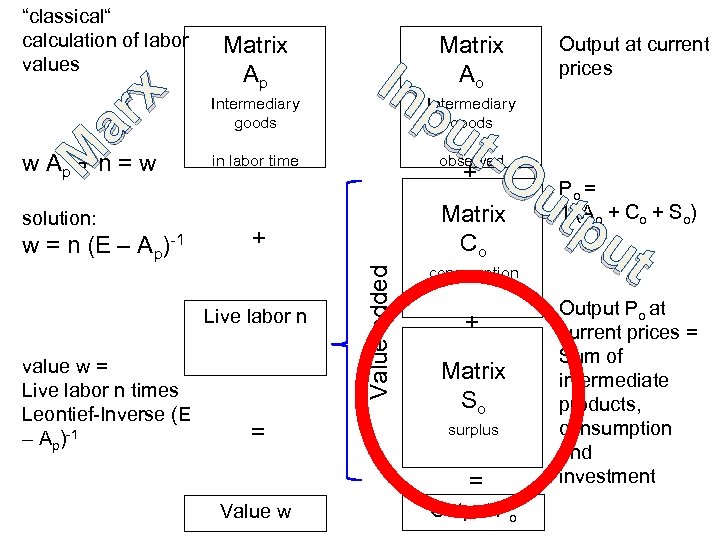
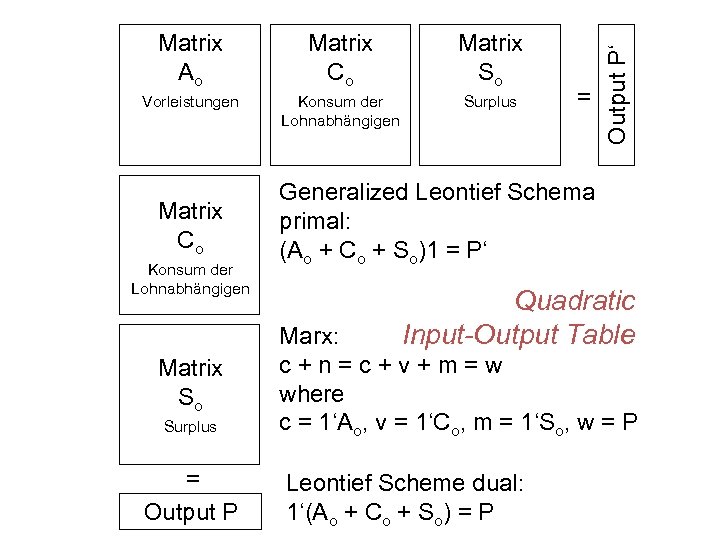 Matrix Co Matrix So Vorleistungen Konsum der Lohnabhängigen Surplus Matrix Co Konsum der Lohnabhängigen Matrix So Surplus = Output P‘ Matrix Ao Generalized Leontief Schema primal: (Ao + Co + So)1 = P‘ Quadratic Input-Output Table Marx: c + n = c + v + m = w where c = 1‘Ao, v = 1‘Co, m = 1‘So, w = P Leontief Scheme dual: 1‘(Ao + Co + So) = P
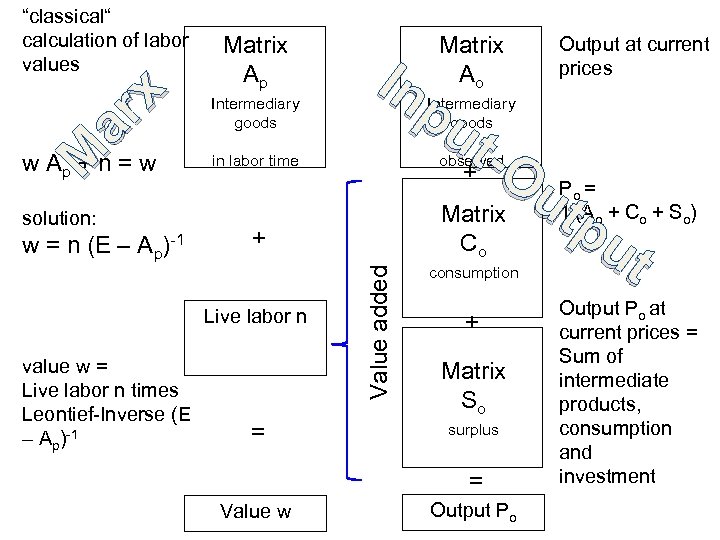 w Ap + n = w solution: w = n (E – Ap)-1 Matrix Ap Intermediary goods in labor time + Live labor n value w = Live labor n times Leontief-Inverse (E – Ap)-1 = Matrix Ao Intermediary goods observed Po = 1‘(Ao + Co + So) o consumption + Matrix So surplus = Value w Output at current prices In pu t-O + ut Matrix pu C t Value added M ar x “classical“ calculation of labor values Output Po at current prices = Sum of intermediate products, consumption and investment
 Labor values and observed data Empirical results Austria 2005 -2008 ü Classical definition ü Material definition Geometric representation of prices and values Transformation problem a la Marx and von Bortkiewicz
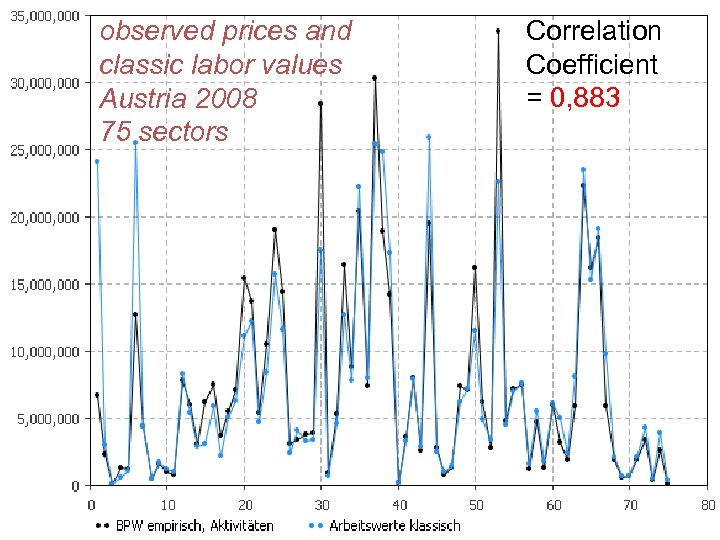 observed prices and classic labor values Austria 2008 75 sectors Correlation Coefficient = 0, 883
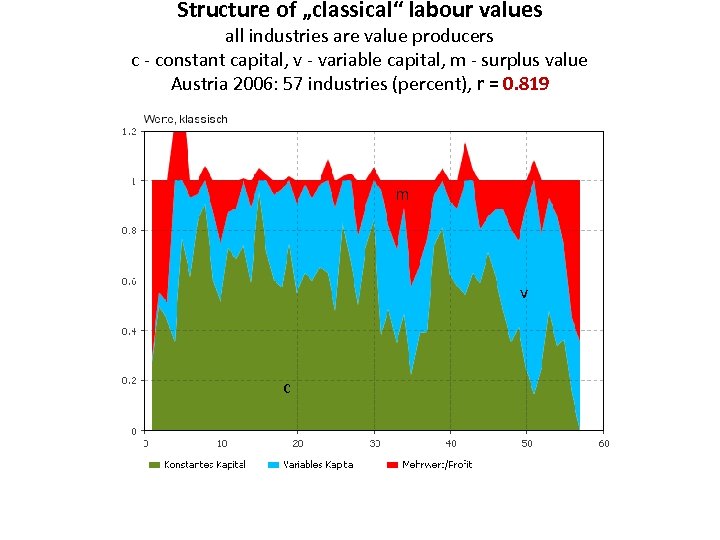
 Structure of labor values, classic, Austria 2008 d m v c
 How are the differences produced? d m v Prices, observed 2008 d c m v Labor values, classic, 2008 c
 w Ap + n = w solution: w = n (E – Ap)-1 Matrix Ap Intermediary goods in labor time + Live labor n value w = Live labor n times Leontief-Inverse (E – Ap)-1 = Matrix Ao Intermediary goods observed Po = 1‘(Ao + Co + So) o consumption + Matrix So surplus = Value w Output at current prices In pu t-O + ut Matrix pu C t Value added M ar x “classical“ calculation of labor values Output Po at current prices = Sum of intermediate products, consumption and investment
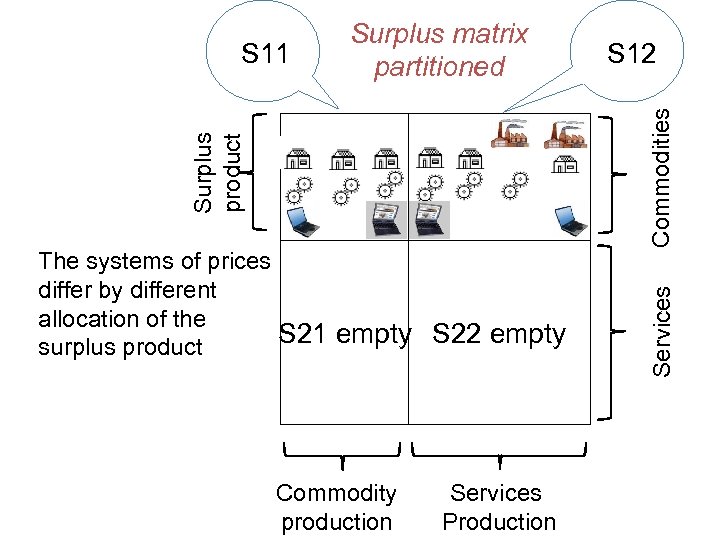
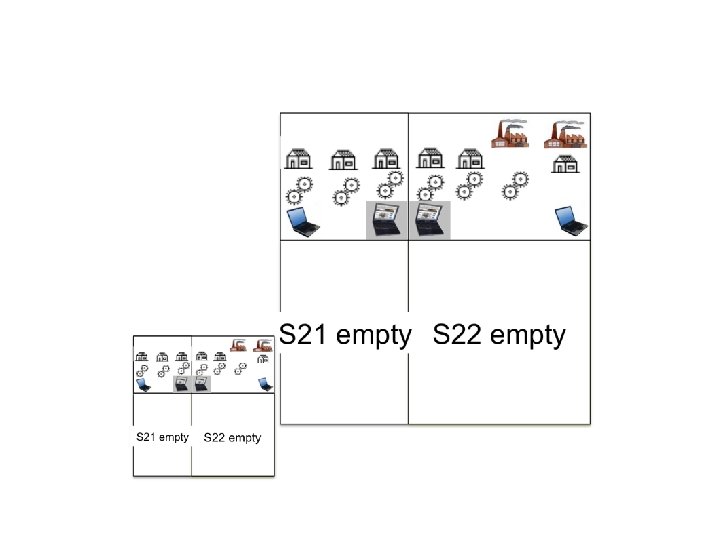
 The shape of the surplus matrix S determines the structure of relative prices • Assumptions: • A) the basic socio-technical structure is identical for all S 11 <>0 S 12 <> 0 systems of feasible prices. • B) The sum of the surplus prouct is constant • C) Sum of Prices = sum of values S 21 empty S 22 empty • Origin of price changes is a different allocation of the surplus product among branches of production • Values of commodities and services are essentially different Services • Z. B: Austria 2008: 45 out of 75 Sektoren Commodity do not sell any investment goods production
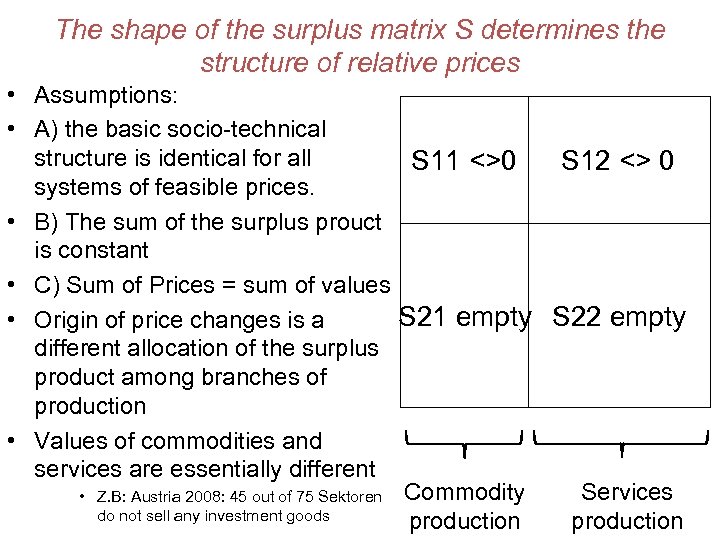
 Commodity production Services Production Commodities The systems of prices differ by different allocation of the S 21 empty S 22 empty surplus product S 12 Services Surplus product S 11 Surplus matrix partitioned
 General assumptions to determine labour values • Each hour of labour has the same value • The labour value of the output of a sector is proportionate to directly and indirectly spent average labor time = sum of past and actual labor • The computation of the labor values are based on the concept of equivalent exchange: the enterprises receive for their commodities / services the full amount of the labor they have used. • The sum of values = sum of prices, therefore a comparison of relative prices is possible
 Consequences for services • Enterprises who produce and sell services actually appropriate parts of the surplus product without contributing to it with their own production. • In an economy in equilibrium commodity producing sectors are therefore unable to realise the full value of their product in the market – this means a violation of the principle of equal exchange • The only possibility for them to realise the full value is to evaluate services under the condition of simple reproduction – without appropriation of surplus product • Therefore we have to evaluate the value of services at reproduction cost
 The labour of some of the most respectable orders in the society is, like that of menial servants, unproductive of any value, and does not fix or realize itself in any permanent subject; or vendible commodity, which endures after that labour is past, and for which an equal quantity of labour could afterwards be procured. . . …In the same class must be ranked, some both of the gravest and most important, and some of the most frivolous professions: churchmen, lawyers, physicians, men of letters of all kinds; players, buffoons, musicians, opera-singers, opera-dancers, &c. …Like the declamation of the actor, the harangue of the orator, or the tune of the musician, the work of all of them perishes in the very instant of its production. Smith, Adam, An Inquiry into the Nature and Causes of the Wealth of Nations, Book II, Chapter III, Of the Accumulation of Capital, or of Productive and Unproductive Labour, http: //www. econlib. org/LIBRARY/Smith/sm. WN. html.
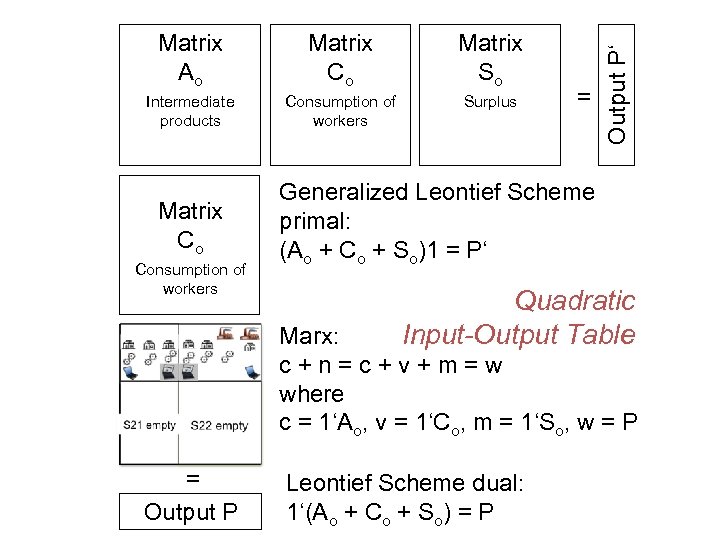 Matrix Co Matrix So Intermediate products Consumption of workers Surplus Matrix Co Consumption of workers Matrix So Surplus = Output P‘ Matrix Ao Generalized Leontief Scheme primal: (Ao + Co + So)1 = P‘ Quadratic Input-Output Table Marx: c + n = c + v + m = w where c = 1‘Ao, v = 1‘Co, m = 1‘So, w = P Leontief Scheme dual: 1‘(Ao + Co + So) = P
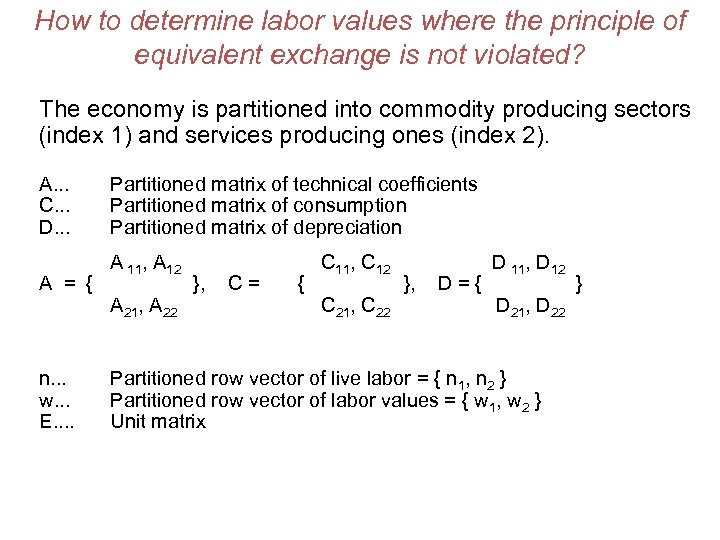 How to determine labor values where the principle of equivalent exchange is not violated? The economy is partitioned into commodity producing sectors (index 1) and services producing ones (index 2). A. . . C. . . D. . . Partitioned matrix of technical coefficients Partitioned matrix of consumption Partitioned matrix of depreciation A 11, A 12 C 11, C 12 D 11, D 12 A = { }, C = { }, D = { } A 21, A 22 C 21, C 22 D 21, D 22 n. . . w. . . E. . Partitioned row vector of live labor = { n 1, n 2 } Partitioned row vector of labor values = { w 1, w 2 } Unit matrix
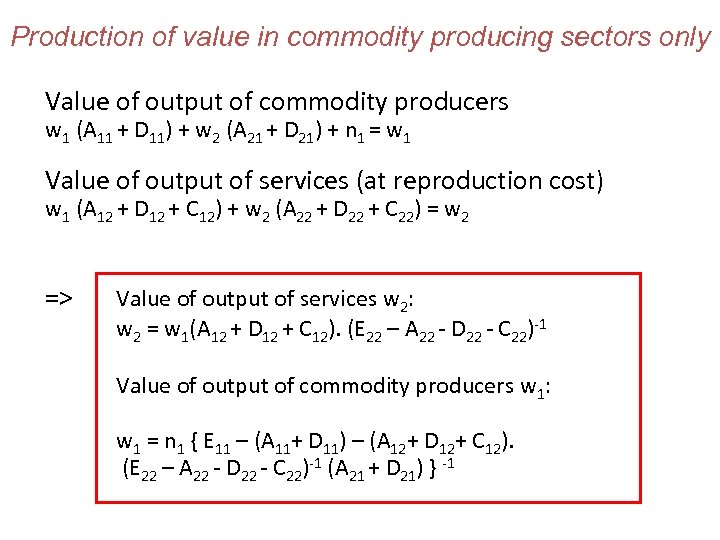 Production of value in commodity producing sectors only Value of output of commodity producers w 1 (A 11 + D 11) + w 2 (A 21 + D 21) + n 1 = w 1 Value of output of services (at reproduction cost) w 1 (A 12 + D 12 + C 12) + w 2 (A 22 + D 22 + C 22) = w 2 => Value of output of services w 2: w 2 = w 1(A 12 + D 12 + C 12). (E 22 – A 22 - D 22 - C 22)-1 Value of output of commodity producers w 1: w 1 = n 1 { E 11 – (A 11+ D 11) – (A 12+ D 12+ C 12). (E 22 – A 22 - D 22 - C 22)-1 (A 21 + D 21) } -1
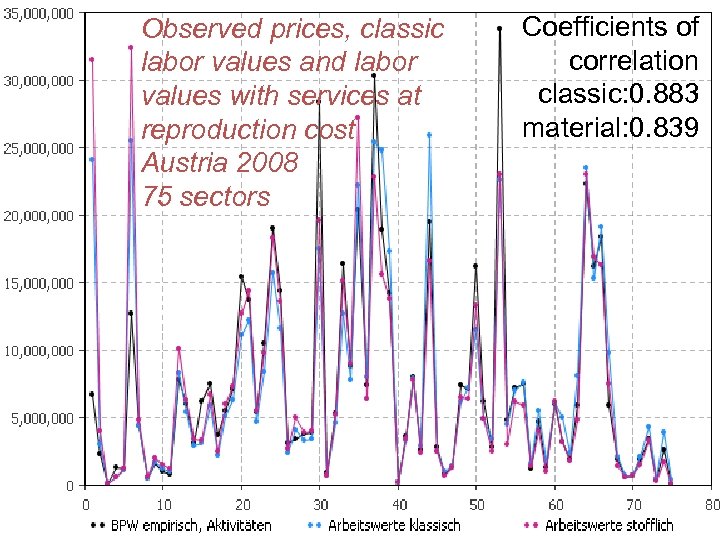 Observed prices, classic labor values and labor values with services at reproduction cost Austria 2008 75 sectors Coefficients of correlation classic: 0. 883 material: 0. 839
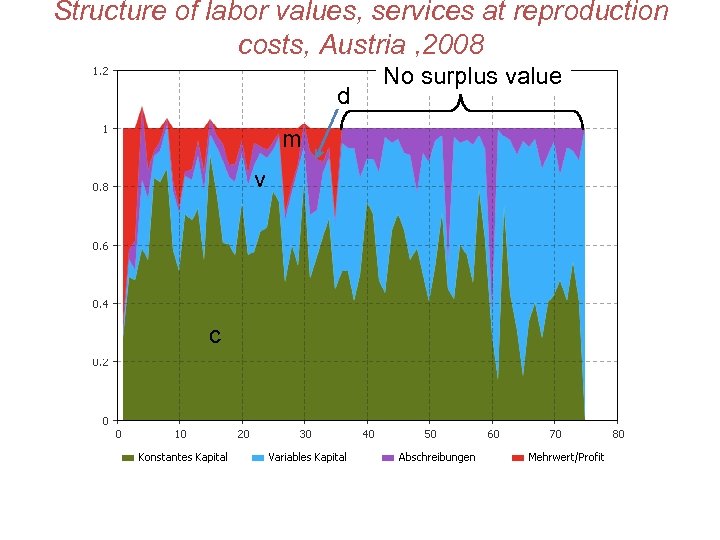 Structure of labor values, services at reproduction costs, Austria , 2008 d m v c No surplus value
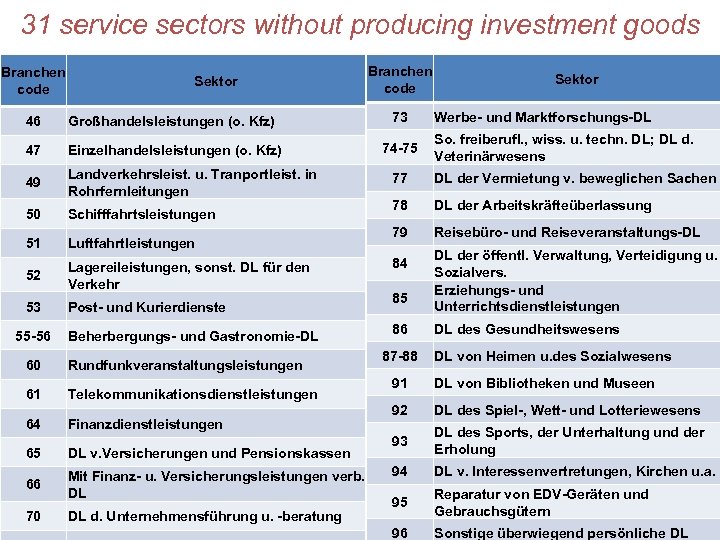 31 service sectors without producing investment goods Branchen code Sektor Branchen code 46 Großhandelsleistungen (o. Kfz) 73 47 Einzelhandelsleistungen (o. Kfz) 74 -75 49 Landverkehrsleist. u. Tranportleist. in Rohrfernleitungen 50 Schifffahrtsleistungen 51 Luftfahrtleistungen 52 Lagereileistungen, sonst. DL für den Verkehr 53 Post- und Kurierdienste 55 -56 Beherbergungs- und Gastronomie-DL 60 Rundfunkveranstaltungsleistungen 61 Telekommunikationsdienstleistungen 64 Finanzdienstleistungen 65 DL v. Versicherungen und Pensionskassen 66 Mit Finanz- u. Versicherungsleistungen verb. DL 70 DL d. Unternehmensführung u. -beratung Sektor Werbe- und Marktforschungs-DL So. freiberufl. , wiss. u. techn. DL; DL d. Veterinärwesens 77 DL der Vermietung v. beweglichen Sachen 78 DL der Arbeitskräfteüberlassung 79 Reisebüro- und Reiseveranstaltungs-DL 84 85 86 87 -88 DL der öffentl. Verwaltung, Verteidigung u. Sozialvers. Erziehungs- und Unterrichtsdienstleistungen DL des Gesundheitswesens DL von Heimen u. des Sozialwesens 91 DL von Bibliotheken und Museen 92 DL des Spiel-, Wett- und Lotteriewesens 93 DL des Sports, der Unterhaltung und der Erholung 94 DL v. Interessenvertretungen, Kirchen u. a. 95 Reparatur von EDV-Geräten und Gebrauchsgütern 96 Sonstige überwiegend persönliche DL
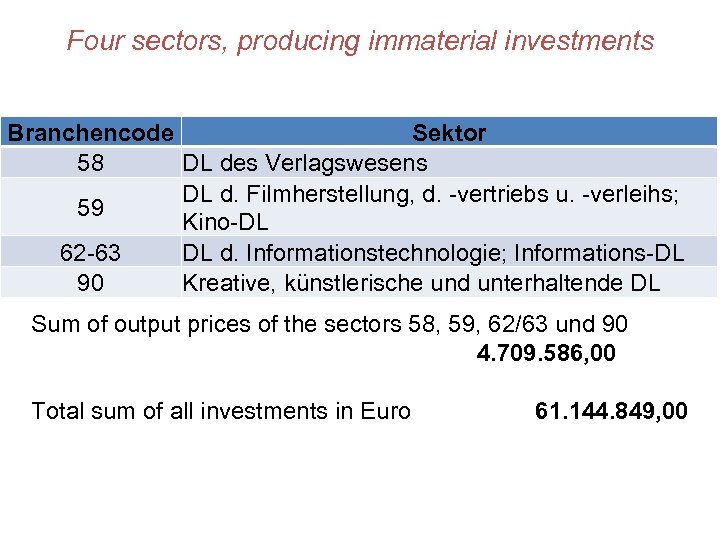 Four sectors, producing immaterial investments Branchencode Sektor 58 DL des Verlagswesens DL d. Filmherstellung, d. -vertriebs u. -verleihs; 59 Kino-DL 62 -63 DL d. Informationstechnologie; Informations-DL 90 Kreative, künstlerische und unterhaltende DL Sum of output prices of the sectors 58, 59, 62/63 und 90 4. 709. 586, 00 Total sum of all investments in Euro 61. 144. 849, 00
 Consequences • The extension the services is ceteris paribus connected with a lower accumulation rate in the average, because the produced surplus product will become relatively more scarce as the advances of capital increase • Eventually this could be an explanation of the smaller growth rates in developed economies with a high share of services. • In addition to that there is also a self-strangulation of effective demand by restrictive wage policy
 Transformation problem By Marx and von Bortkiewicz
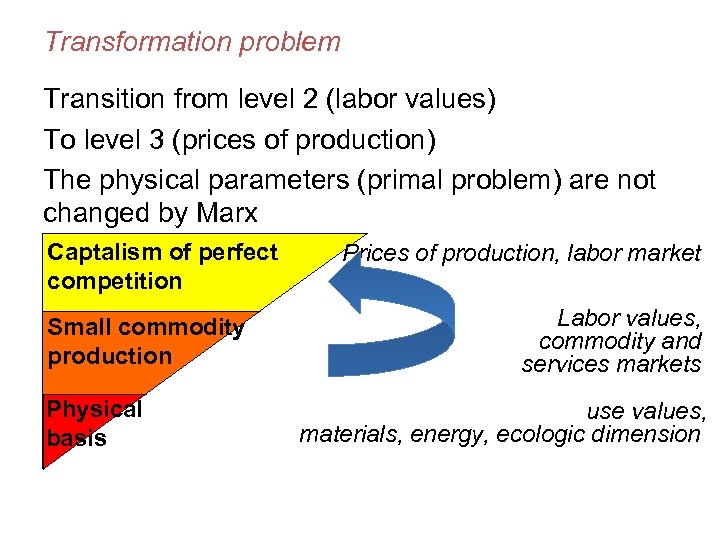 Transformation problem Transition from level 2 (labor values) To level 3 (prices of production) The physical parameters (primal problem) are not changed by Marx Captalism of perfect competition Small commodity production Physical basis Prices of production, labor market Labor values, commodity and services markets use values, materials, energy, ecologic dimension
 Transformation problem can be seen as “experiment of thought” There are two different ideal types of economic systems 1. Small commodity production: producers work for their own, without fixed capital, without wage labor. Prices will finally become proportionate to labor values 2. Capitalistic Produktion: wage labor exists, capitalists invest in sectors with higher rate of profit than their own. Expectation by Marx: Rates of profit approach a general rate of profit. Prices change to prices of production, proportionate to capital advanced. 3. Quantities remain invariant by transformation
 Transformation problem • Marx explained the modification of values by competition of capitalists • He assumed that the movements come to an end if all the rates of profit are equal. • In a mathematical perspective he described the first step of an iterative process – similar to Andrew Kliman’s Temporal Single System Interpretation (TSSI). • The repeated application of Marx’ method (but also of TSSI) leads to the solution by von Bortkiewicz resp. to the Simultaneous Single System Interpretation (SSSI) (i. e. input prices become equal to output prices) • One should not see SSSI and TSSI in Opposition, but as a process which contains both moments.
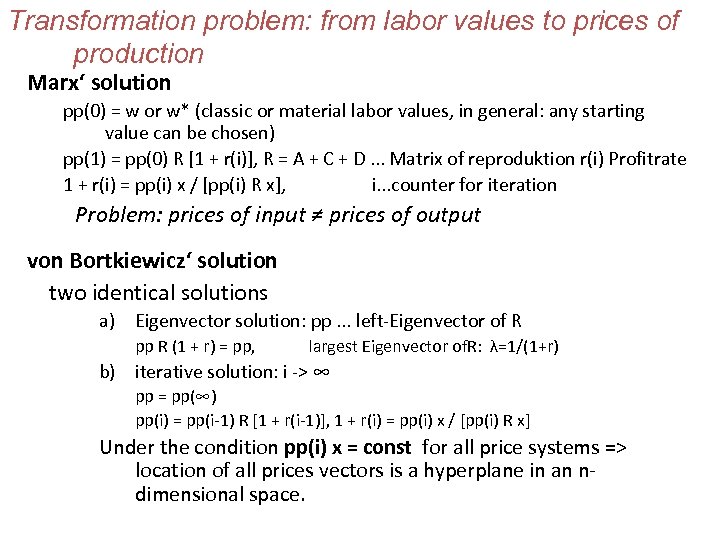 Transformation problem: from labor values to prices of production Marx‘ solution pp(0) = w or w* (classic or material labor values, in general: any starting value can be chosen) pp(1) = pp(0) R [1 + r(i)], R = A + C + D. . . Matrix of reproduktion r(i) Profitrate 1 + r(i) = pp(i) x / [pp(i) R x], i. . . counter for iteration Problem: prices of input ≠ prices of output von Bortkiewicz‘ solution two identical solutions a) Eigenvector solution: pp. . . left-Eigenvector of R pp R (1 + r) = pp, largest Eigenvector of. R: λ=1/(1+r) b) iterative solution: i -> ∞ pp = pp(∞) pp(i) = pp(i-1) R [1 + r(i-1)], 1 + r(i) = pp(i) x / [pp(i) R x] Under the condition pp(i) x = const for all price systems => location of all prices vectors is a hyperplane in an ndimensional space.
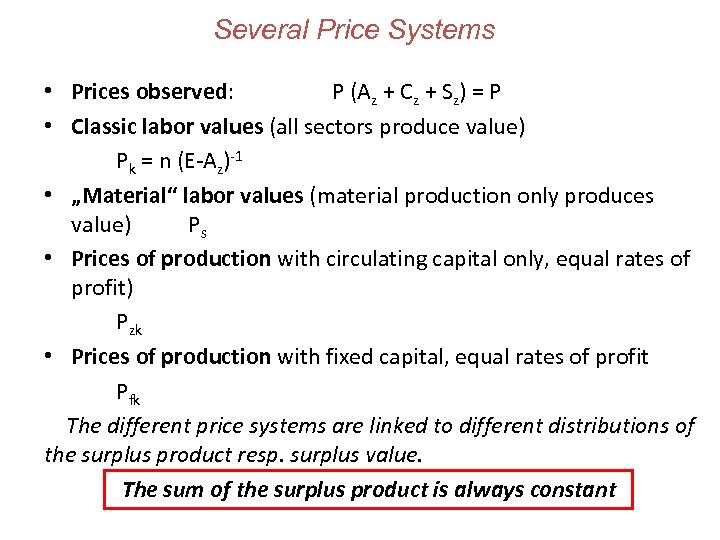 Several Price Systems • Prices observed: P (Az + Cz + Sz) = P • Classic labor values (all sectors produce value) Pk = n (E-Az)-1 • „Material“ labor values (material production only produces value) Ps • Prices of production with circulating capital only, equal rates of profit) Pzk • Prices of production with fixed capital, equal rates of profit Pfk The different price systems are linked to different distributions of the surplus product resp. surplus value. The sum of the surplus product is always constant
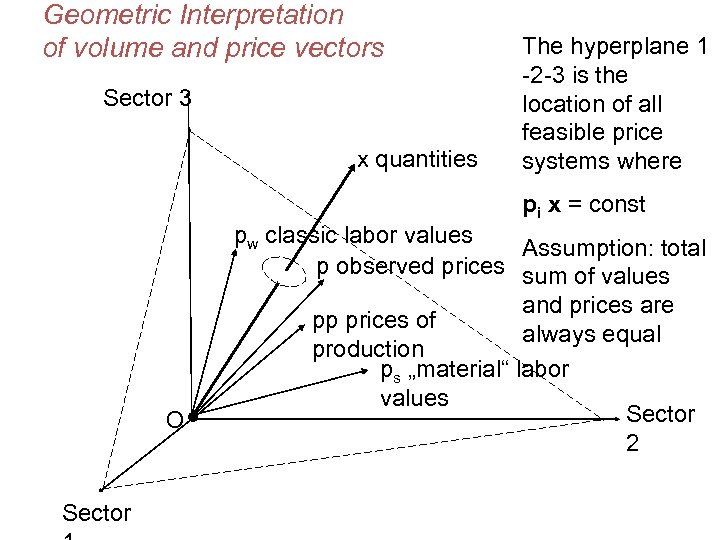 Geometric Interpretation of volume and price vectors Sector 3 x quantities The hyperplane 1 -2 -3 is the location of all feasible price systems where pi x = const O Sector pw classic labor values Assumption: total p observed prices sum of values and prices are pp prices of always equal production ps „material“ labor values Sector 2
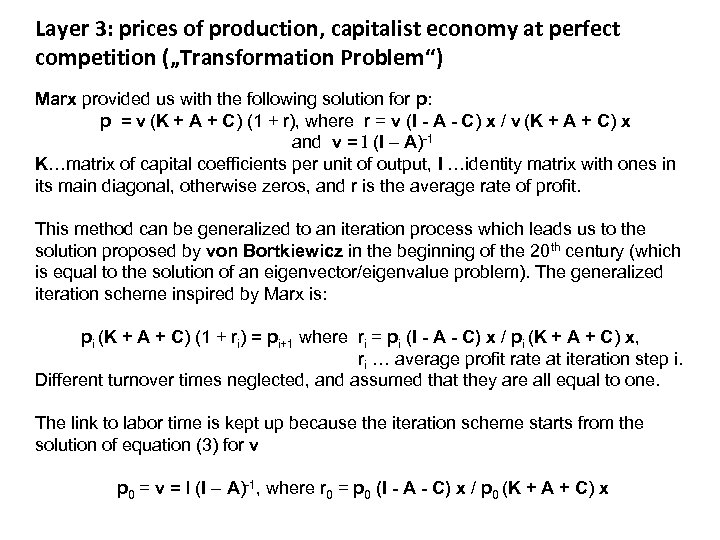 Layer 3: prices of production, capitalist economy at perfect competition („Transformation Problem“) Marx provided us with the following solution for p: p = v (K + A + C) (1 + r), where r = v (I - A - C) x / v (K + A + C) x and v = l (I – A)-1 K…matrix of capital coefficients per unit of output, I …identity matrix with ones in its main diagonal, otherwise zeros, and r is the average rate of profit. This method can be generalized to an iteration process which leads us to the solution proposed by von Bortkiewicz in the beginning of the 20 th century (which is equal to the solution of an eigenvector/eigenvalue problem). The generalized iteration scheme inspired by Marx is: pi (K + A + C) (1 + ri) = pi+1 where ri = pi (I - A - C) x / pi (K + A + C) x, ri … average profit rate at iteration step i. Different turnover times neglected, and assumed that they are all equal to one. The link to labor time is kept up because the iteration scheme starts from the solution of equation (3) for v p 0 = v = l (I – A)-1, where r 0 = p 0 (I - A - C) x / p 0 (K + A + C) x
 Prices of production: Empirical results for Austria 2005 - 2008
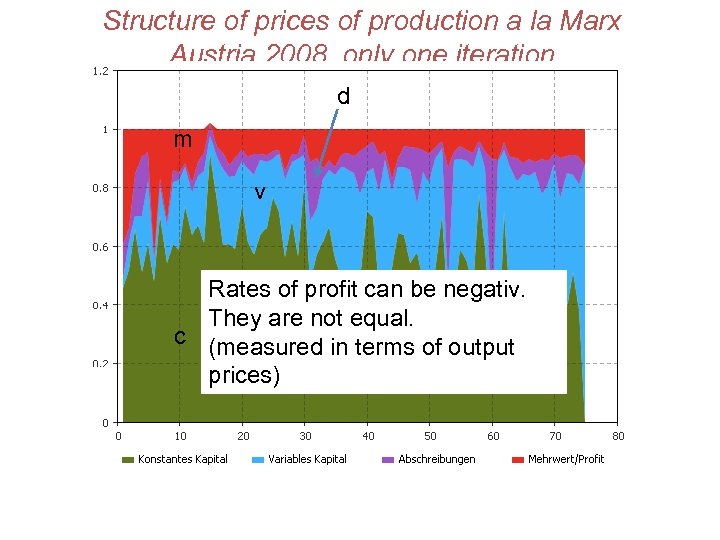 Structure of prices of production a la Marx Austria 2008, only one iteration d m v Rates of profit can be negativ. They are not equal. c (measured in terms of output prices)
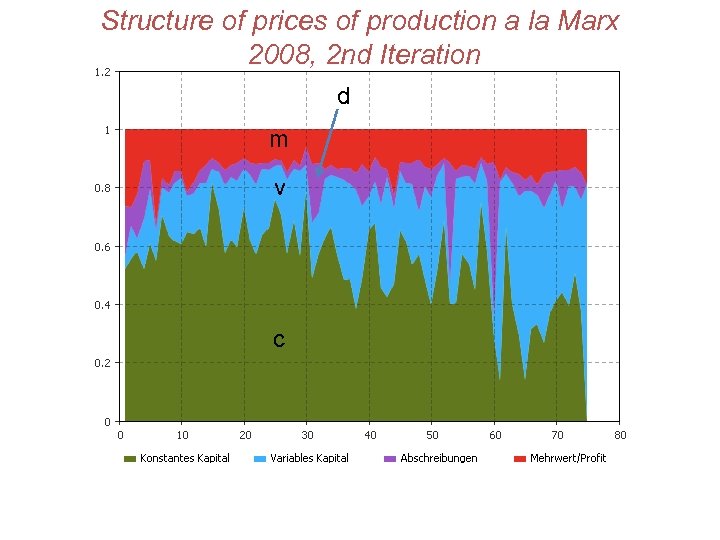 Structure of prices of production a la Marx 2008, 2 nd Iteration d m v c
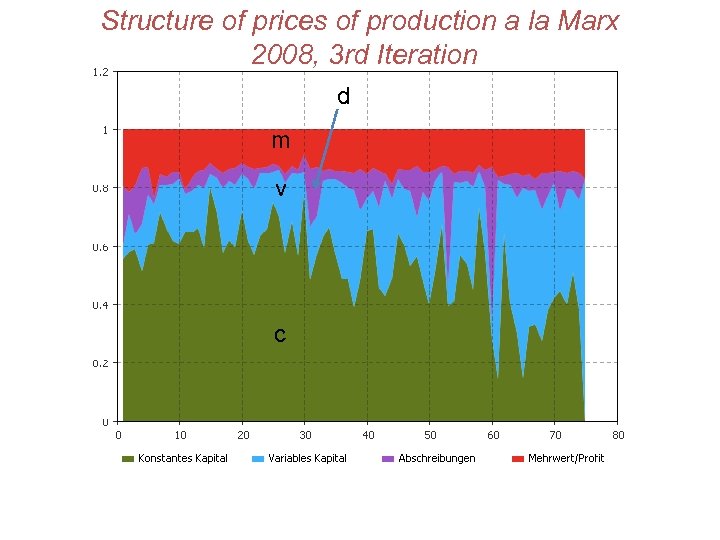 Structure of prices of production a la Marx 2008, 3 rd Iteration d m v c
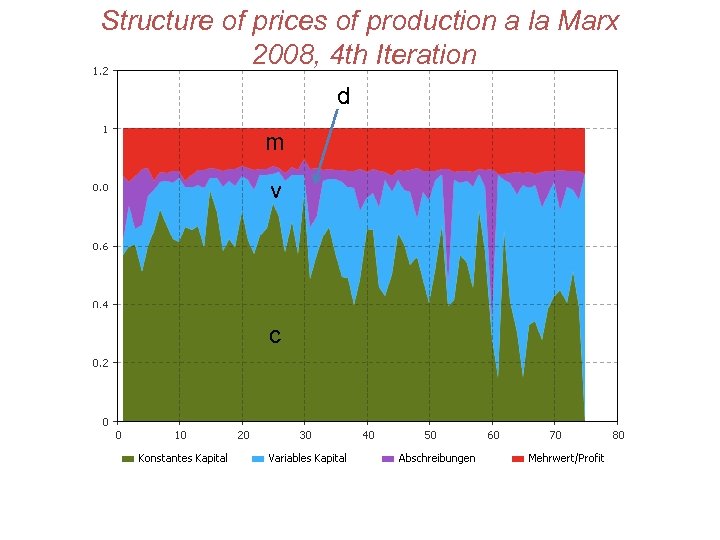 Structure of prices of production a la Marx 2008, 4 th Iteration d m v c
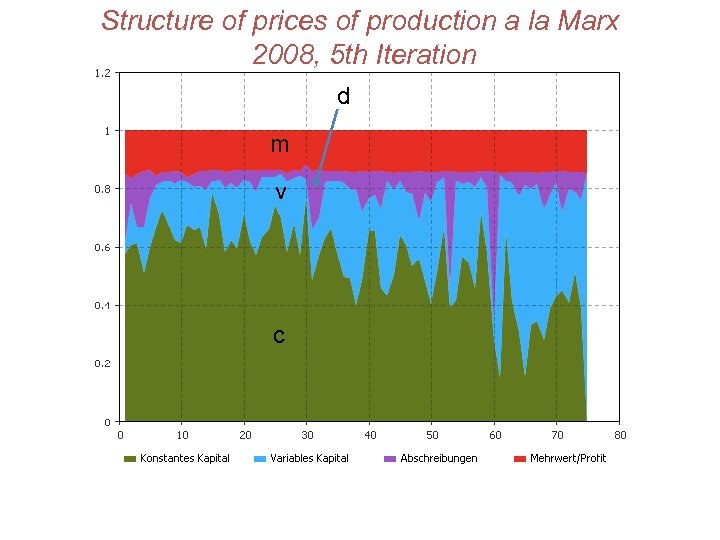 Structure of prices of production a la Marx 2008, 5 th Iteration d m v c
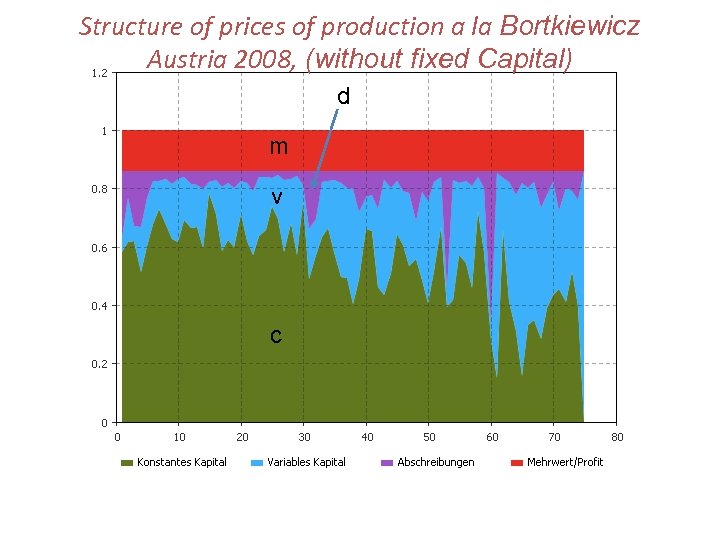 Structure of prices of production a la Bortkiewicz Austria 2008, (without fixed Capital) d m v c
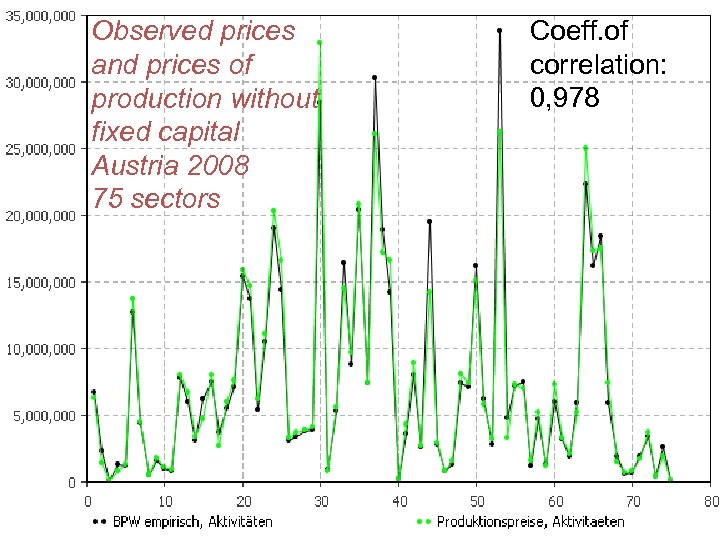 Observed prices and prices of production without fixed capital Austria 2008 75 sectors Coeff. of correlation: 0, 978
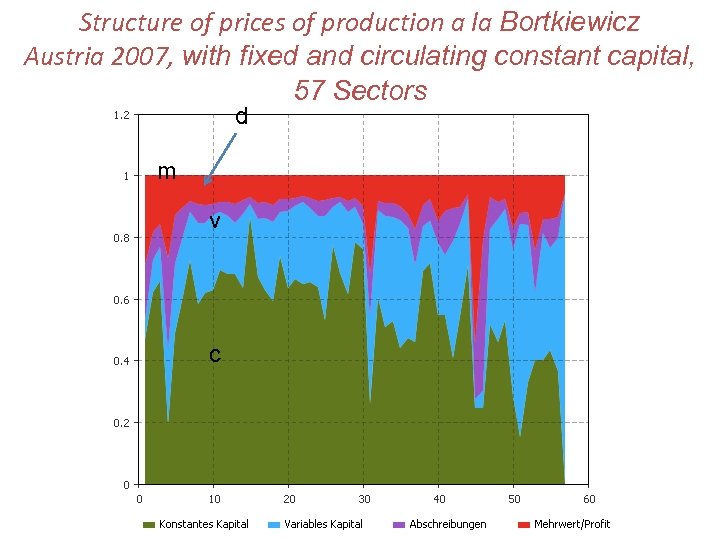 Structure of prices of production a la Bortkiewicz Austria 2007, with fixed and circulating constant capital, 57 Sectors d m v c
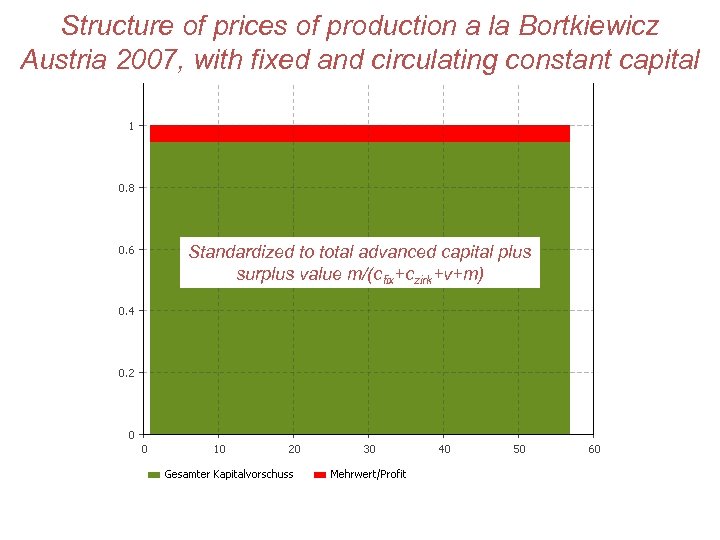 Structure of prices of production a la Bortkiewicz Austria 2007, with fixed and circulating constant capital Standardized to total advanced capital plus surplus value m/(cfix+czirk+v+m)
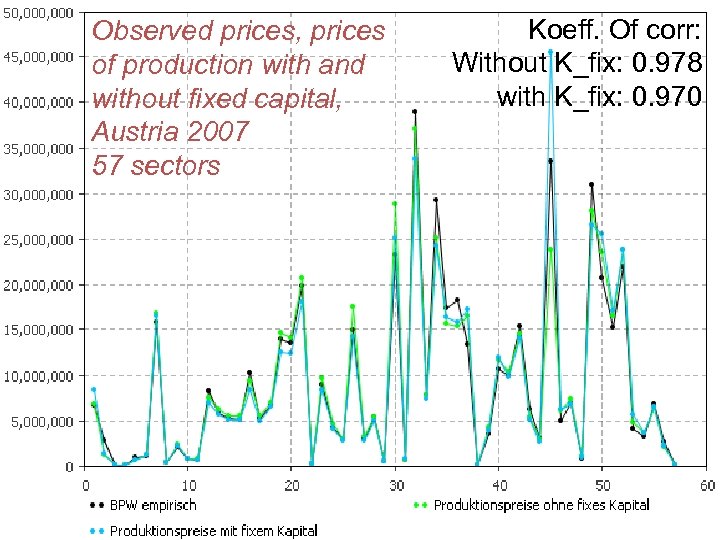 Observed prices, prices of production with and without fixed capital, Austria 2007 57 sectors Koeff. Of corr: Without K_fix: 0. 978 with K_fix: 0. 970
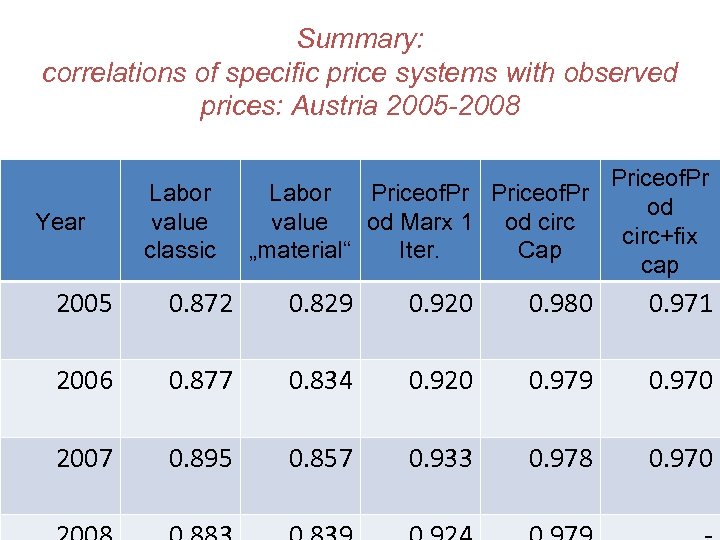 Summary: correlations of specific price systems with observed prices: Austria 2005 -2008 Year Labor value classic Priceof. Pr Labor Priceof. Pr od value od Marx 1 od circ+fix „material“ Iter. Cap cap 2005 0. 872 0. 829 0. 920 0. 980 0. 971 2006 0. 877 0. 834 0. 920 0. 979 0. 970 2007 0. 895 0. 857 0. 933 0. 978 0. 970
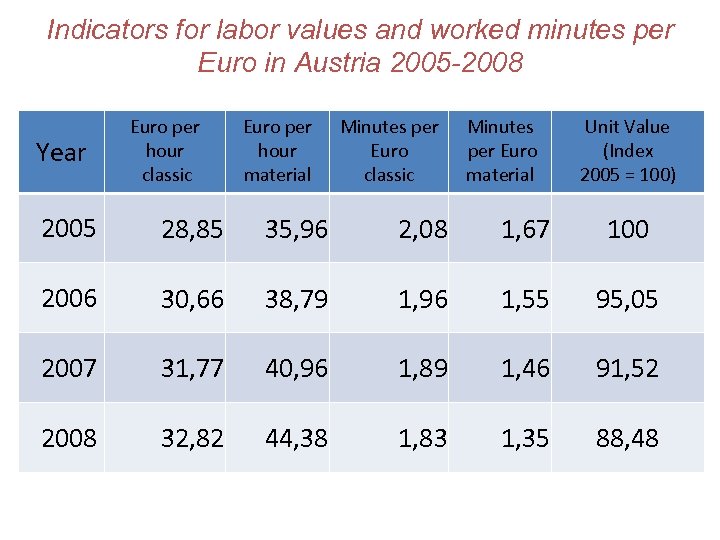 Indicators for labor values and worked minutes per Euro in Austria 2005 -2008 Year Euro per hour classic Euro per hour material Minutes per Euro classic Minutes per Euro material Unit Value (Index 2005 = 100) 2005 28, 85 35, 96 2, 08 1, 67 100 2006 30, 66 38, 79 1, 96 1, 55 95, 05 2007 31, 77 40, 96 1, 89 1, 46 91, 52 2008 32, 82 44, 38 1, 83 1, 35 88, 48
 Thanks for your attention! Contact: fleissner@arrakis. es