 Скачать презентацию 4 th BI-CEPR Conference on Money Banking and
c7add8459ee784b89c7f2e803eb47b92.ppt
- Количество слайдов: 9



4 th BI-CEPR Conference on Money, Banking, and Finance “Lender Behavior During Credit Cycles” by Giovanni Dell’Ariccia, Deniz Igan, and Luc Laeven Discussion: Alex Popov (European Central Bank) October 2, 2009 1
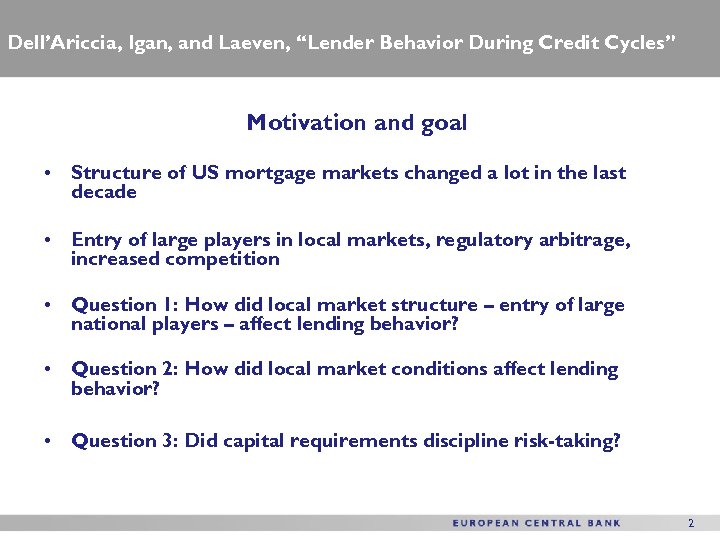
Dell’Ariccia, Igan, and Laeven, “Lender Behavior During Credit Cycles” Motivation and goal • Structure of US mortgage markets changed a lot in the last decade • Entry of large players in local markets, regulatory arbitrage, increased competition • Question 1: How did local market structure – entry of large national players – affect lending behavior? • Question 2: How did local market conditions affect lending behavior? • Question 3: Did capital requirements discipline risk-taking? 2
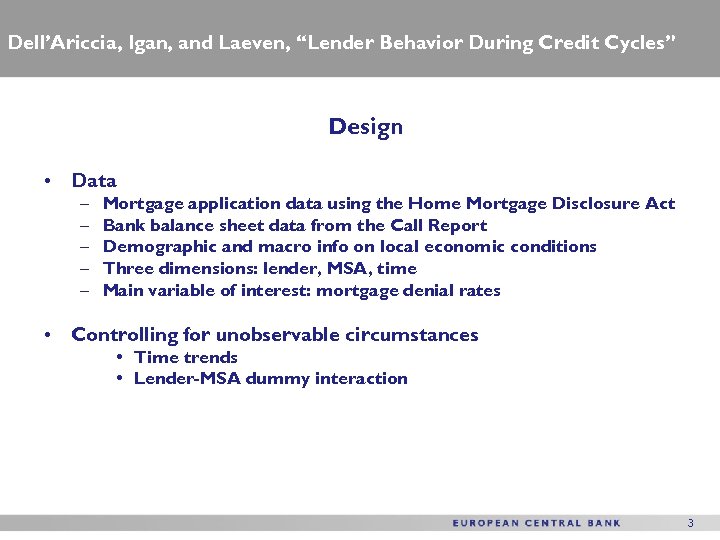
Dell’Ariccia, Igan, and Laeven, “Lender Behavior During Credit Cycles” Design • Data – – – Mortgage application data using the Home Mortgage Disclosure Act Bank balance sheet data from the Call Report Demographic and macro info on local economic conditions Three dimensions: lender, MSA, time Main variable of interest: mortgage denial rates • Controlling for unobservable circumstances • Time trends • Lender-MSA dummy interaction 3
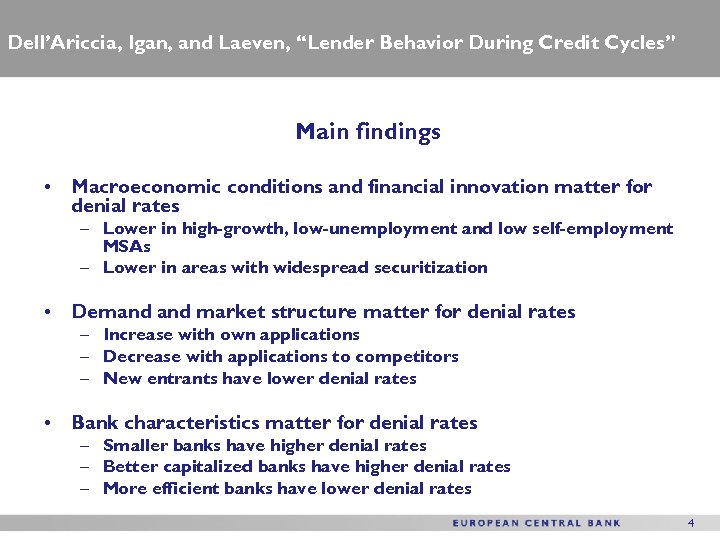
Dell’Ariccia, Igan, and Laeven, “Lender Behavior During Credit Cycles” Main findings • Macroeconomic conditions and financial innovation matter for denial rates – Lower in high-growth, low-unemployment and low self-employment MSAs – Lower in areas with widespread securitization • Demand market structure matter for denial rates – Increase with own applications – Decrease with applications to competitors – New entrants have lower denial rates • Bank characteristics matter for denial rates – Smaller banks have higher denial rates – Better capitalized banks have higher denial rates – More efficient banks have lower denial rates 4
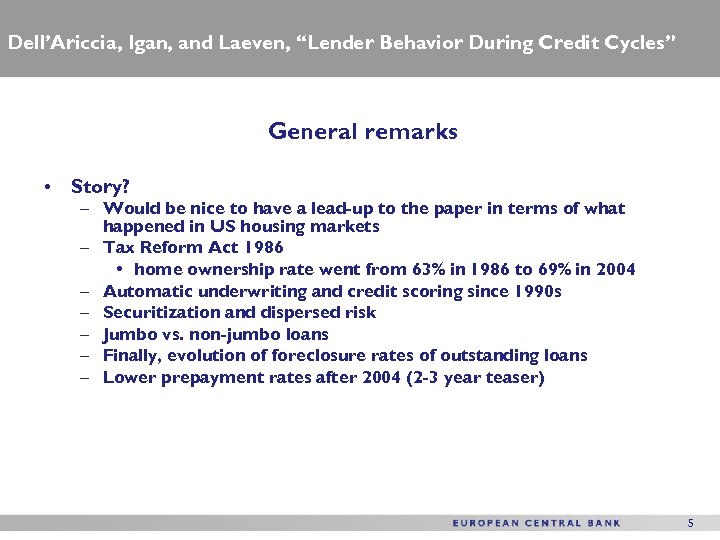
Dell’Ariccia, Igan, and Laeven, “Lender Behavior During Credit Cycles” General remarks • Story? – Would be nice to have a lead-up to the paper in terms of what happened in US housing markets – Tax Reform Act 1986 • home ownership rate went from 63% in 1986 to 69% in 2004 – Automatic underwriting and credit scoring since 1990 s – Securitization and dispersed risk – Jumbo vs. non-jumbo loans – Finally, evolution of foreclosure rates of outstanding loans – Lower prepayment rates after 2004 (2 -3 year teaser) 5
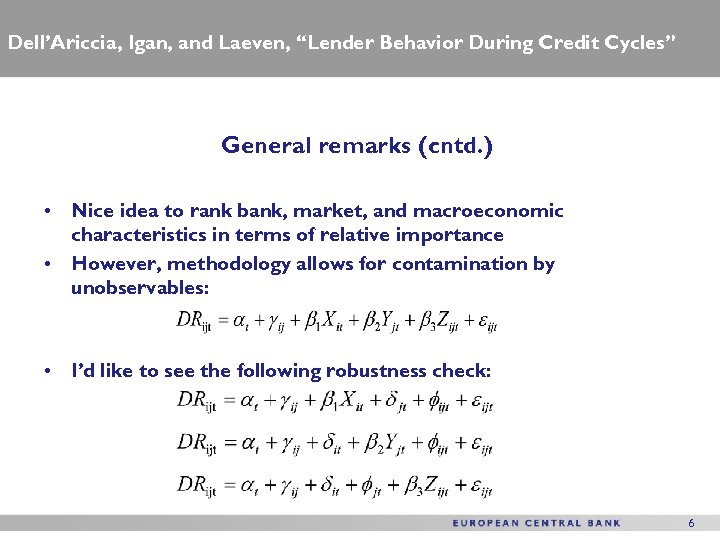
Dell’Ariccia, Igan, and Laeven, “Lender Behavior During Credit Cycles” General remarks (cntd. ) • Nice idea to rank bank, market, and macroeconomic characteristics in terms of relative importance • However, methodology allows for contamination by unobservables: • I’d like to see the following robustness check: 6
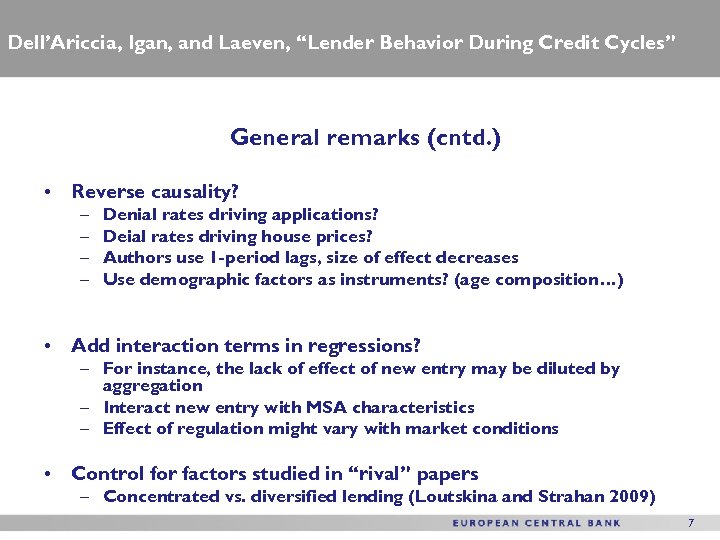
Dell’Ariccia, Igan, and Laeven, “Lender Behavior During Credit Cycles” General remarks (cntd. ) • Reverse causality? – – Denial rates driving applications? Deial rates driving house prices? Authors use 1 -period lags, size of effect decreases Use demographic factors as instruments? (age composition…) • Add interaction terms in regressions? – For instance, the lack of effect of new entry may be diluted by aggregation – Interact new entry with MSA characteristics – Effect of regulation might vary with market conditions • Control for factors studied in “rival” papers – Concentrated vs. diversified lending (Loutskina and Strahan 2009) 7
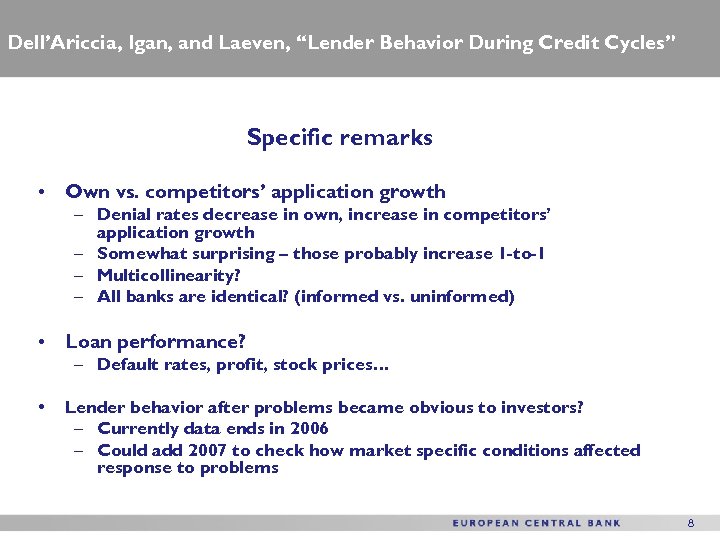
Dell’Ariccia, Igan, and Laeven, “Lender Behavior During Credit Cycles” Specific remarks • Own vs. competitors’ application growth – Denial rates decrease in own, increase in competitors’ application growth – Somewhat surprising – those probably increase 1 -to-1 – Multicollinearity? – All banks are identical? (informed vs. uninformed) • Loan performance? – Default rates, profit, stock prices… • Lender behavior after problems became obvious to investors? – Currently data ends in 2006 – Could add 2007 to check how market specific conditions affected response to problems 8
Dell’Ariccia, Igan, and Laeven, “Lender Behavior During Credit Cycles” Just a thought • Some more thinking needed on competition and entry – Higher approval rates not necessarily bad – informed vs. uninformed – How the rising approval rates relate to the decrease in market share of informed investors? – Compare approval rates in new markets vs. old markets – Entry into similar vs. different markets 9
Скачать презентацию 4 th BI-CEPR Conference on Money Banking and
c7add8459ee784b89c7f2e803eb47b92.ppt