


 Скачать презентацию 4 Product and Service Design Mc Graw-Hill Irwin Copyright
d7ef3d5b341b1950f1d128ceca3dcc3b.ppt
- Количество слайдов: 51
 4 Product and Service Design Mc. Graw-Hill/Irwin Copyright © 2007 by The Mc. Graw-Hill Companies, Inc. All rights reserved.
 Learning Objectives § § § Explain the strategic importance of product and service design. List some key reasons for design or redesign. Identify the main objectives of product and service design. Discuss the importance of standardization. Discuss the importance of legal, ethical, and environmental issues in product and service design. 2
 Learning Objectives § § § § Briefly describe the phases in product design and development. Describe some of the main sources of design ideas. Name several key issues in manufacturing design. Name several key issues in service design. Name the phases in service design. List the characteristics of well-designed service systems. Name some of the challenges of service design. 3
 Product and Service Design § Major factors in design strategy § § § Cost Quality Time-to-market Customer satisfaction Competitive advantage Product and service design – or redesign – should be closely tied to an organization’s strategy 4
 Product or Service Design Activities 1. Translate customer wants and needs into product and service requirements 2. Refine existing products and services 3. Develop new products and services 4. Formulate quality goals 5. Formulate cost targets 6. Construct and test prototypes 7. Document specifications 5
 Objectives of Product and Service Design § Main focus § Customer satisfaction § Understand what the customer wants § Secondary focus § § § Function of product/service Cost/profit Quality Appearance Ease of production/assembly Ease of maintenance/service 6
 Designing For Operations § Taking into account the capabilities of the organization in designing goods and services. § Failure to take this into account can: § Reduce productivity § Reduce quality § Increase costs 7
 Legal, Ethical, and Environmental Issues § Legal § FDA, OSHA, IRS § Product liability § Uniform commercial code § Ethical § Releasing products with defects § Environmental § EPA 8
 Other Issues in Product and Service Design § § § § Product/service life cycles How much standardization Mass customization Product/service reliability Robust design Degree of newness Cultural differences 9
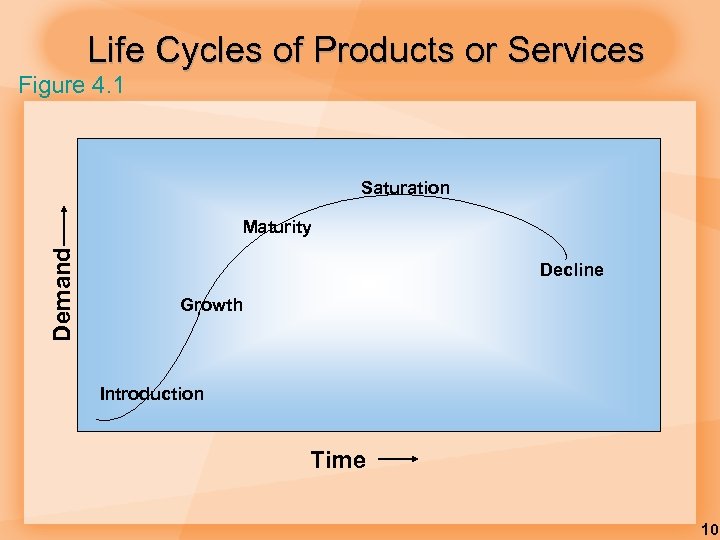 Life Cycles of Products or Services Figure 4. 1 Saturation Demand Maturity Decline Growth Introduction Time 10
 Standardization § Extent to which there is an absence of variety in a product, service or process § Standardized products are immediately available to customers 11
 Advantages of Standardization § Fewer parts to deal with in inventory & manufacturing § Design costs are generally lower § Reduced training costs and time § More routine purchasing, handling, and inspection procedures § Quality is more consistent 12
 Advantages of Standardization (Cont’d) § Orders fillable from inventory § Opportunities for long production runs and automation § Need for fewer parts justifies increased expenditures on perfecting designs and improving quality control procedures. 13
 Disadvantages of Standardization § Designs may be frozen with too many imperfections remaining. § High cost of design changes increases resistance to improvements. § Decreased variety results in less consumer appeal. 14
 Mass Customization • Mass customization: § A strategy of producing standardized goods or services, but incorporating some degree of customization § Delayed differentiation § Modular design 15
 Delayed Differentiation • Delayed differentiation is a postponement tactic § Producing but not quite completing a product or service until customer preferences or specifications are known 16
 Modular Design Modular design is a form of standardization in which component parts are subdivided into modules that are easily replaced or interchanged. It allows: § easier diagnosis and remedy of failures § easier repair and replacement § simplification of manufacturing and assembly 17
 Reliability § Reliability: The ability of a product, part, or system to perform its intended function under a prescribed set of conditions § Failure: Situation in which a product, part, or system does not perform as intended § Normal operating conditions: The set of conditions under which an item’s reliability is specified 18
 Improving Reliability • Component design • Production/assembly techniques • Testing • Redundancy/backup • Preventive maintenance procedures • User education • System design 19
 Product Design § Product Life Cycles § Robust Design § Concurrent Engineering § Computer-Aided Design § Modular Design 20
 Robust Design: Design that results in products or services that can function over a broad range of conditions 21
 Taguchi Approach Robust Design § Design a robust product § Insensitive to environmental factors either in manufacturing or in use. § Central feature is Parameter Design. § Determines: § § factors that are controllable and those not controllable their optimal levels relative to major product advances 22
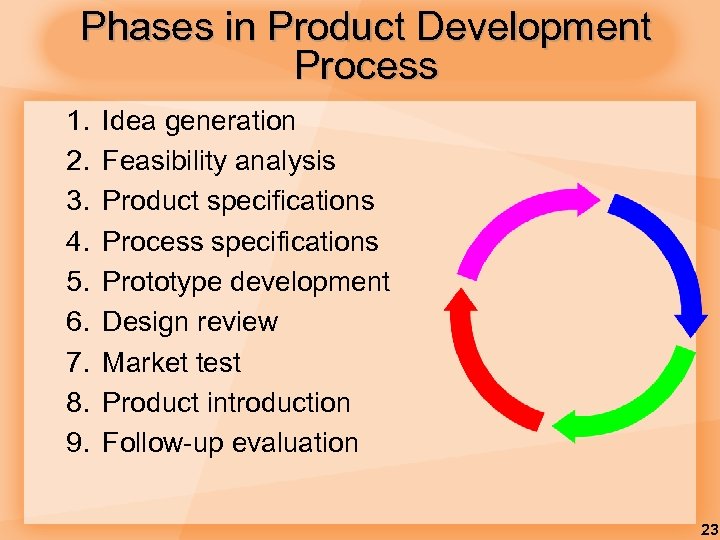 Phases in Product Development Process 1. 2. 3. 4. 5. 6. 7. 8. 9. Idea generation Feasibility analysis Product specifications Process specifications Prototype development Design review Market test Product introduction Follow-up evaluation 23
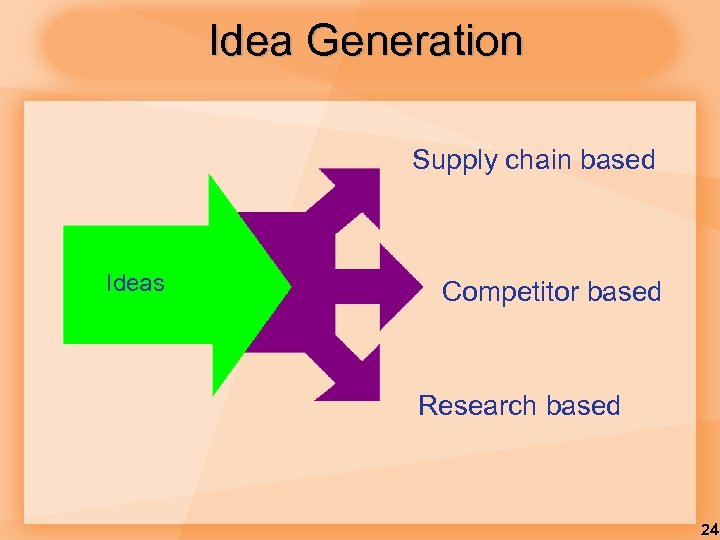 Idea Generation Supply chain based Ideas Competitor based Research based 24
 Reverse Engineering Reverse engineering is the dismantling and inspecting of a competitor’s product to discover product improvements. 25
 Research & Development (R&D) § Organized efforts to increase scientific knowledge or product innovation & may involve: § § § Basic Research advances knowledge about a subject without near-term expectations of commercial applications. Applied Research achieves commercial applications. Development converts results of applied research into commercial applications. 26
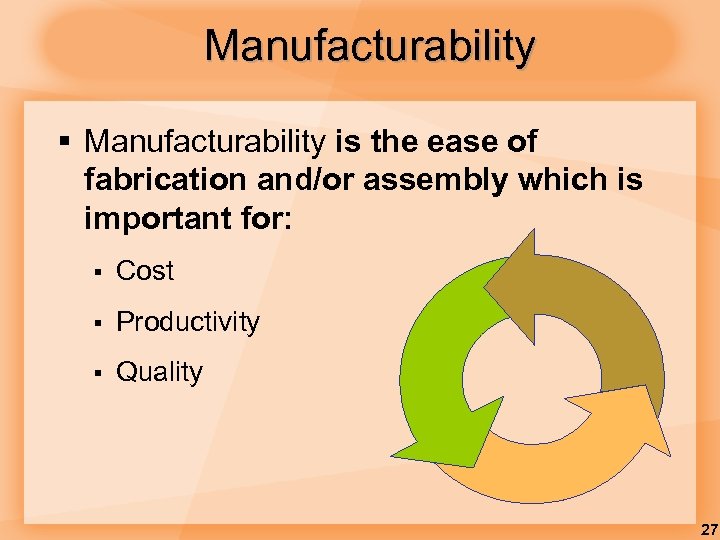 Manufacturability § Manufacturability is the ease of fabrication and/or assembly which is important for: § Cost § Productivity § Quality 27
 Designing for Manufacturing Beyond the overall objective to achieve customer satisfaction while making a reasonable profit is: Design for Manufacturing(DFM) The designers’ consideration of the organization’s manufacturing capabilities when designing a product. The more general term design for operations encompasses services as well as manufacturing 28
 Concurrent Engineering Concurrent engineering is the bringing together of engineering design and manufacturing personnel early in the design phase. 29
 Computer-Aided Design § Computer-Aided Design (CAD) is product design using computer graphics. § increases productivity of designers, 3 to 10 times § creates a database for manufacturing information on product specifications § provides possibility of engineering and cost analysis on proposed designs 30
 Product design § § § Design for manufacturing (DFM) Design for assembly (DFA) Design for recycling (DFR) Remanufacturing Design for disassembly (DFD) Robust design 31
 Recycling § Recycling: recovering materials for future use § Recycling reasons § Cost savings § Environment concerns § Environment regulations 32
 Remanufacturing § Remanufacturing: Refurbishing used products by replacing worn-out or defective components. § Remanufactured products can be sold for 50% of the cost of a new producr § Remanufacturing can use unskilled labor § Some governments require manufacturers to take back used products § Design for Disassembly (DFD): Designing products so that they can be easily taken apart. 33
 Component Commonality § Multiple products or product families that have a high degree of similarity can share components § Automakers using internal parts § Engines and transmissions § Water pumps § Etc. § Other benefits § Reduced training for assemble and installation § Reduced repair time and costs 34
 Quality Function Deployment § Voice of the customer § House of quality QFD: An approach that integrates the “voice of the customer” into the product and service development process. 35
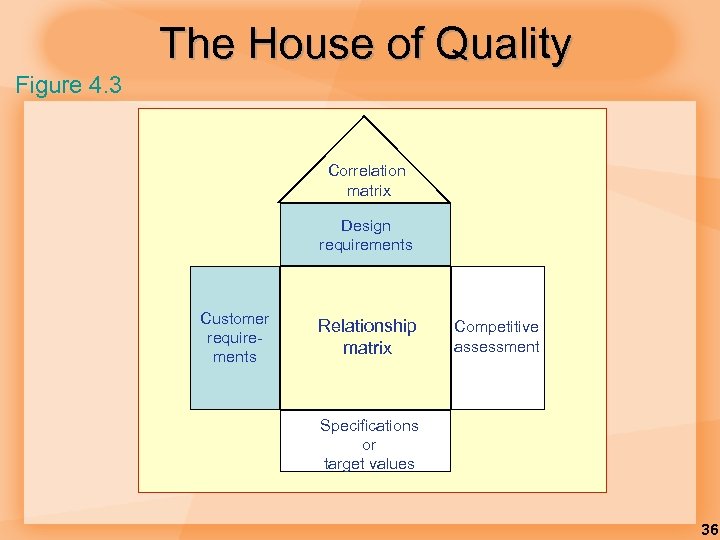 The House of Quality Figure 4. 3 Correlation matrix Design requirements Customer requirements Relationship matrix Competitive assessment Specifications or target values 36
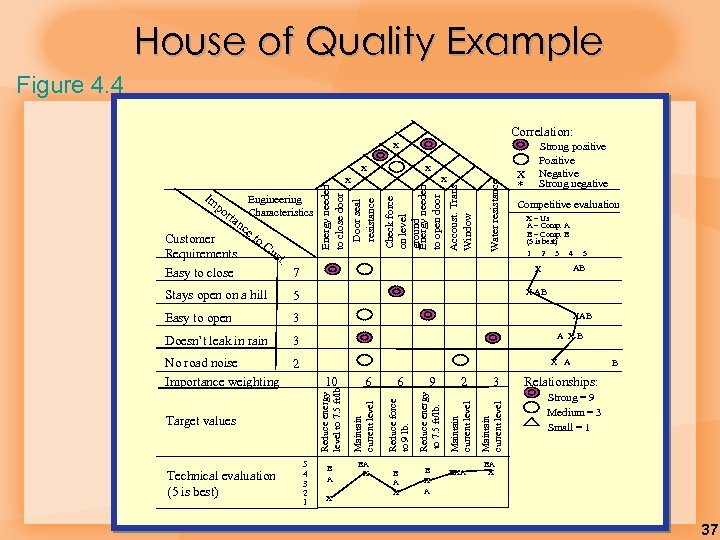 House of Quality Example Figure 4. 4 Correlation: X X o. C us t. Water resistance Customer Requirements Easy to close et Accoust. Trans. Window nc Check force on level ground Energy needed to open door rta Engineering Characteristics Door seal resistance po Energy needed to close door Im X X * Strong positive Positive Negative Strong negative Competitive evaluation X = Us A = Comp. A B = Comp. B (5 is best) 1 2 3 4 7 5 X AB Easy to open 3 Doesn’t leak in rain 3 No road noise Importance weighting 2 AB X Stays open on a hill 5 XAB A XB X A Technical evaluation (5 is best) 5 4 3 2 1 B A X B X A BXA 3 Maintain current level 2 Maintain current level 9 Reduce energy to 7. 5 ft/lb. 6 Reduce force to 9 lb. Target values 6 Maintain current level Reduce energy level to 7. 5 ft/lb 10 B Relationships: Strong = 9 Medium = 3 Small = 1 BA X 37
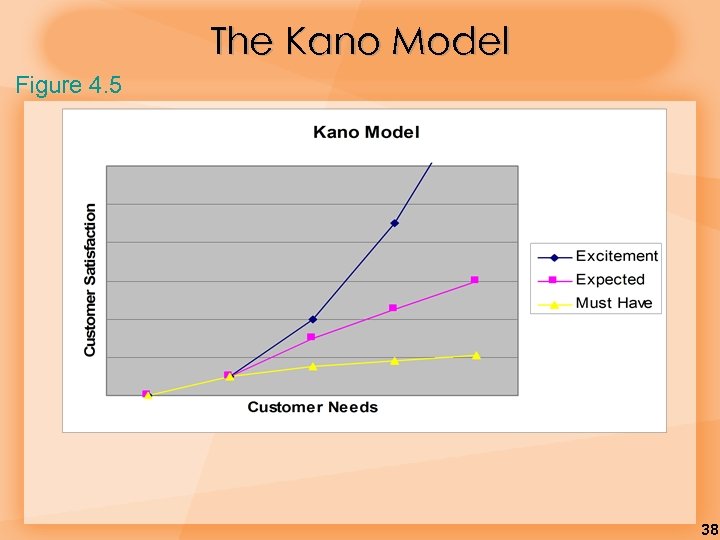 The Kano Model Figure 4. 5 38
 Service Design § Service is an act § Service delivery system § Facilities § Processes § Skills § Many services are bundled with products 39
 Service Design § Service design involves § The physical resources needed § The goods that are purchased or consumed by the customer § Explicit services § Implicit services 40
 Service Design § Service § Something that is done to or for a customer § Service delivery system § The facilities, processes, and skills needed to provide a service § Product bundle § The combination of goods and services provided to a customer § Service package § The physical resources needed to perform the service 41
 Differences Between Product and Service Design § Tangible – intangible § Services created and delivered at the same time § Services cannot be inventoried § Services highly visible to customers § Services have low barrier to entry § Location important to service § Range of service systems § Demand variability 42
 Service Systems § Service systems range from those with little or no customer contact to very high degree of customer contact such as: § § § Insulated technical core (software development) Production line (automatic car wash) Personalized service (hair cut, medical service) Consumer participation (diet program) Self service (supermarket) 43
 Service Demand Variability § Demand variability creates waiting lines and idle service resources § Service design perspectives: § Cost and efficiency perspective § Customer participation makes quality and demand variability hard to manage § Attempts to achieve high efficiency may depersonalize service and change customer’s perception of quality 44
 Phases in Service Design 1. Conceptualize 2. Identify service package components 3. Determine performance specifications 4. Translate performance specifications into design specifications 5. Translate design specifications into delivery specifications 45
 Service Blueprinting § Service blueprinting § A method used in service design to describe and analyze a proposed service § A useful tool for conceptualizing a service delivery system 46
 Major Steps in Service Blueprinting 1. Establish boundaries 2. Identify sequence of customer interactions • Prepare a flowchart 3. Develop time estimates 4. Identify potential failure points 47
 Characteristics of Well Designed Service Systems 1. 2. 3. 4. 5. 6. 7. 8. 9. Consistent with the organization mission User friendly Robust Easy to sustain Cost effective Value to customers Effective linkages between back operations Single unifying theme Ensure reliability and high quality 48
 Challenges of Service Design 1. 2. 3. 4. Variable requirements Difficult to describe High customer contact Service – customer encounter 49
 Guidelines for Successful Service Design 1. 2. 3. 4. 5. 6. 7. 8. 9. Define the service package Focus on customer’s perspective Consider image of the service package Recognize that designer’s perspective is different from the customer’s perspecticve Make sure that managers are involved Define quality for tangible and intangibles Make sure that recruitment, training and rewards are consistent with service expectations Establish procedures to handle exceptions Establish systems to monitor service 50
 Operations Strategy 1. Increase emphasis on component commonality 2. Package products and services 3. Use multiple-use platforms 4. Consider tactics for mass customization 5. Look for continual improvement 6. Shorten time to market 51