 Скачать презентацию 4 -hour Disaster Orientation Vincent J Giblin General
42bb2bea25cdb585b9c7ce1a67accdd4.ppt
- Количество слайдов: 109



4 -hour Disaster Orientation Vincent J. Giblin, General President Phone: (304) 253 -8674 1293 Airport Road Fax: (304) 253 -7758 Beaver, WV 25813 E-mail: hazmat@iuoeiettc. org
This material was produced under grant number 46 C 5 -HT 16 from the Occupational Safety and Health Administration, U. S. Department of Labor. It does not necessarily reflect the views or policies of the U. S. Department of Labor, nor does mention of trade names, commercial products, or organizations imply endorsement by the U. S. Government. 2
• This training program is based on recommendations from the CDC, NIOSH, OSHA, and the U. S. Army • You can find a link to their fact sheets and other important information at the National Clearinghouse for Worker Safety and Health Training at: www. wetp. org • Hurricane Katrina Worker Health and Safety Plan 3
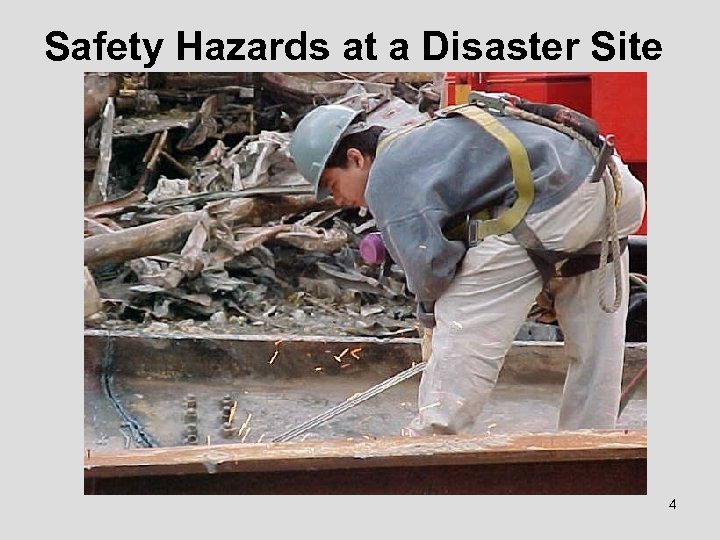
Safety Hazards at a Disaster Site 4
Objectives • Describe possible safety hazards you may encounter • Explain how to protect yourself from these safety hazards • List sources of safety information 5
Recordkeeping • • OSHA 300 Log Five working days Provide to OSHA on a weekly basis Days away from work/restricted time (DART) • Contact OSHA – Fatality / Catastrophe (FAT / CAT) – HAZMAT spill in excess of reportable quantity (RQ) 6
Worker Rights & Responsibilities • Employers – Comply with General Duty Clause • “… provide a safe and healthful workplace for workers” • Employee – May refuse to perform task(s) that create imminent danger – Have right to complain about unsafe or unhealthful working conditions – File complaints without being subject to discrimination 7
Worker Rights & Responsibilities Employees • Comply with Employer’s Health and Safety Plan (HASP) – Use PPE – Obtain vaccinations – Reporting requirements using the proper chain of command • Maintain constant awareness of your surroundings 8
Job Hazard Analysis (JHAs) Employers • Develop JHAs for all tasks • Update as needed • Enforce adherence to • Maintain permit(s) with JHAs and make available • JHA development criteria – Description of task or job – The hazards involved (actual or potential) – Controls for removing hazards and protecting workers 9
Hazard Control Hierarchy of Controls: • Elimination or Substitution • Engineering Controls • Work-practice or Administrative Controls • PPE 10
PPE JHAs and HASP should identify PPE requirements: • Respiratory Control – Must be NIOSH approved – Must adhere to 1910. 134 • Hearing Protection Program – Required when employee exposure ≥ 85 d. BA – Must adhere to 1910. 95 and 1926. 52 • Head Protection – Consult JHA and HASP – Must adhere to 1910. 135 and 1926. 100 11
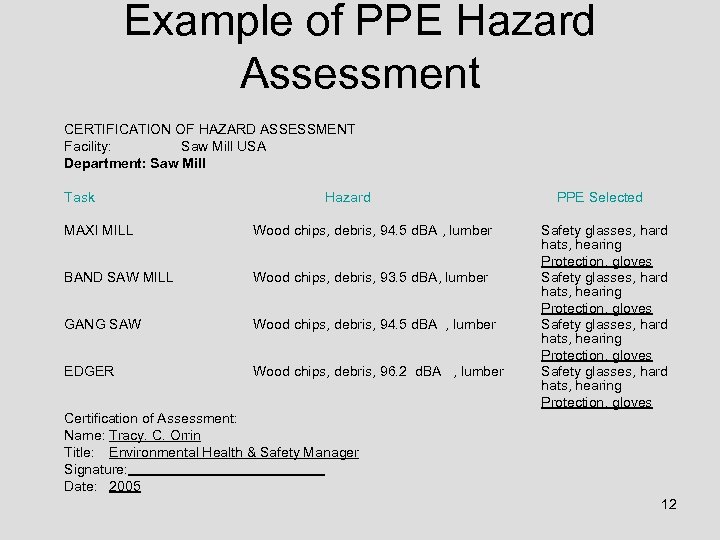
Example of PPE Hazard Assessment CERTIFICATION OF HAZARD ASSESSMENT Facility: Saw Mill USA Department: Saw Mill Task Hazard MAXI MILL Wood chips, debris, 94. 5 d. BA , lumber BAND SAW MILL Wood chips, debris, 93. 5 d. BA, lumber GANG SAW Wood chips, debris, 94. 5 d. BA , lumber EDGER Wood chips, debris, 96. 2 d. BA , lumber PPE Selected Safety glasses, hard hats, hearing Protection, gloves Certification of Assessment: Name: Tracy. C. Orrin Title: Environmental Health & Safety Manager Signature: Date: 2005 12
PPE (cont'd) • JHAs and HASP should identify PPE requirements • Eye & Face Protection – Must conform to ANSI Z 87. 1 and OSHA standards • High Visibility Garments • Foot Protection – Steel toe and shank based on JHA and HASP – 1910. 136 Foot Protection • Personal Flotation Devices (PFDs) – 1926. 106 13
Training • General training for Disaster Site Worker • Site-specific – An overview of conditions specific to the locales where the employee will be deployed • Task specific – HAZCOM, PPE, use of tools, trip, slip and fall hazards 14
Training (cont'd) • Pre-deployment & pre-job briefings – Conduct on a daily basis by workers’ immediate supervisor • Employers shall: – Maintain employee training records • Date • Name of trainer and trained employees • Safety topic / curriculum – Provide “competent / qualified “ persons to conduct training 15
Training (cont'd) • General training for DSW* – Incident Command (NIMS-ICS) – HAZCOM (1910. 1200) – HAZWOPER (1910. 120) – Confined Space (1910. 146) – Traumatic Incident Stress Awareness – Medical Services (as part of HASP 1910. 120) • Heat and Psychological Stress • Animal & plant hazards • Sanitation (1910. 142) * In Accordance With (IAW) Katrina HASP 16
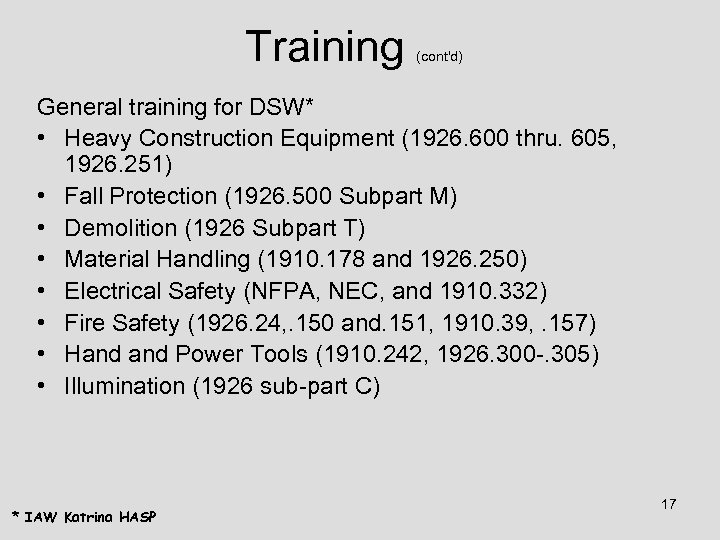
Training (cont'd) General training for DSW* • Heavy Construction Equipment (1926. 600 thru. 605, 1926. 251) • Fall Protection (1926. 500 Subpart M) • Demolition (1926 Subpart T) • Material Handling (1910. 178 and 1926. 250) • Electrical Safety (NFPA, NEC, and 1910. 332) • Fire Safety (1926. 24, . 150 and. 151, 1910. 39, . 157) • Hand Power Tools (1910. 242, 1926. 300 -. 305) • Illumination (1926 sub-part C) * IAW Katrina HASP 17
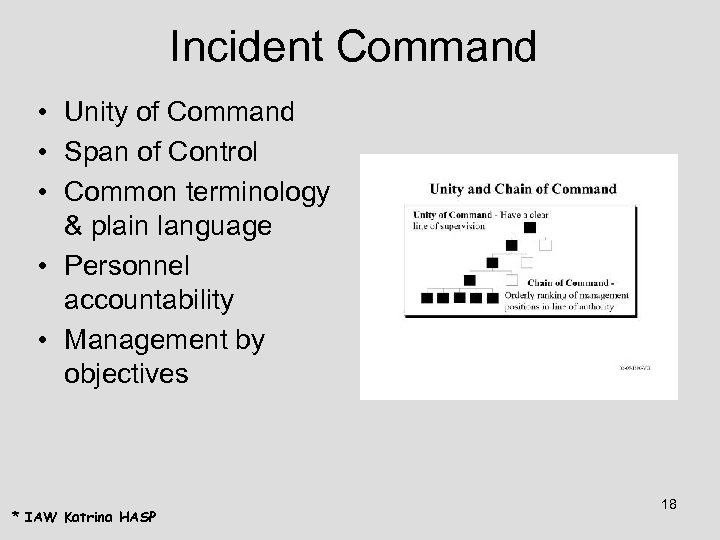
Incident Command • Unity of Command • Span of Control • Common terminology & plain language • Personnel accountability • Management by objectives * IAW Katrina HASP 18
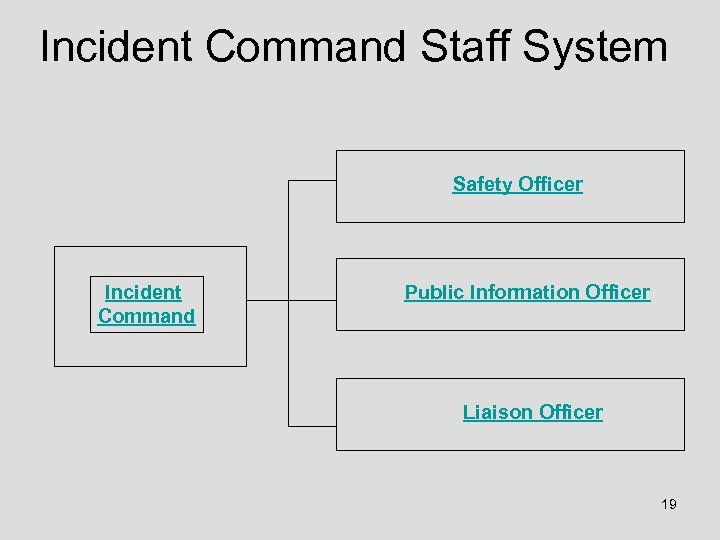
Incident Command Staff System Safety Officer Incident Command Public Information Officer Liaison Officer 19
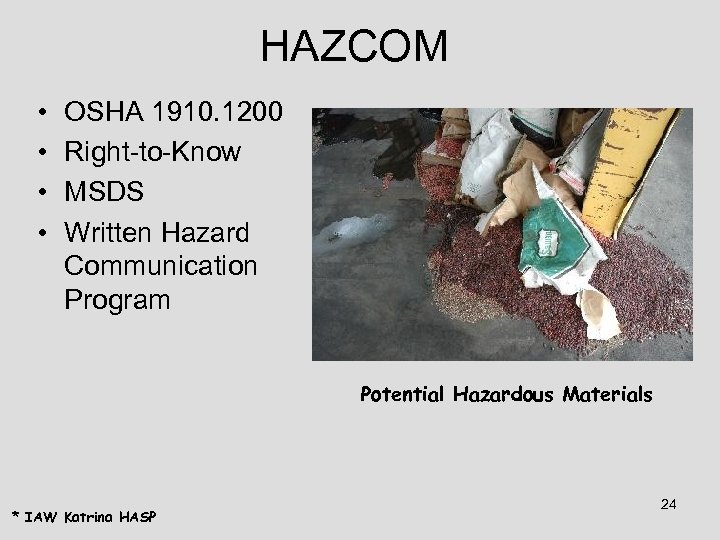
HAZCOM • • OSHA 1910. 1200 Right-to-Know MSDS Written Hazard Communication Program Potential Hazardous Materials * IAW Katrina HASP 24
HAZWOPER • • OSHA 1910. 120 /1926. 65 Hazardous Waste Operations 40 -hour, 24 -hour and 8 -hour refresher HASP – PPE – Respirators – Medical Surveillance – Monitoring * IAW Katrina HASP 25
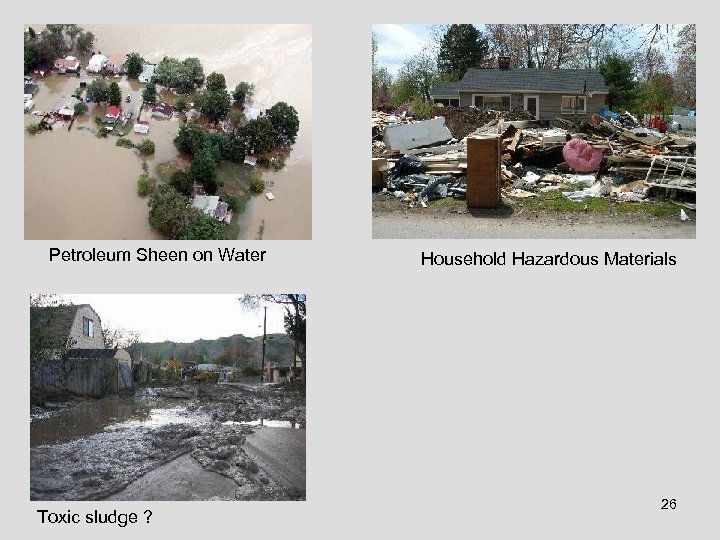
Petroleum Sheen on Water Toxic sludge ? Household Hazardous Materials 26
Confined Space Definition Confined Space: • Is large enough and so configured that an employee can bodily enter and perform assigned work; and • Has limited or restricted means for entry or exit (for example, tanks, vessels, silos, storage bins, hoppers, vaults, and pits are spaces that may have limited means of entry. ); and • Is not designed for continuous employee occupancy Permit-required confined space has one or more characteristics: • Contains or has a potential to contain a hazardous atmosphere; • Contains a material that has the potential for engulfing an entrant; • Has an internal configuration such that an entrant could be trapped or asphyxiated by inwardly converging walls or by a floor which slopes downward and tapers to a smaller crosssection; or • Contains any other recognized serious safety or health hazard. 27
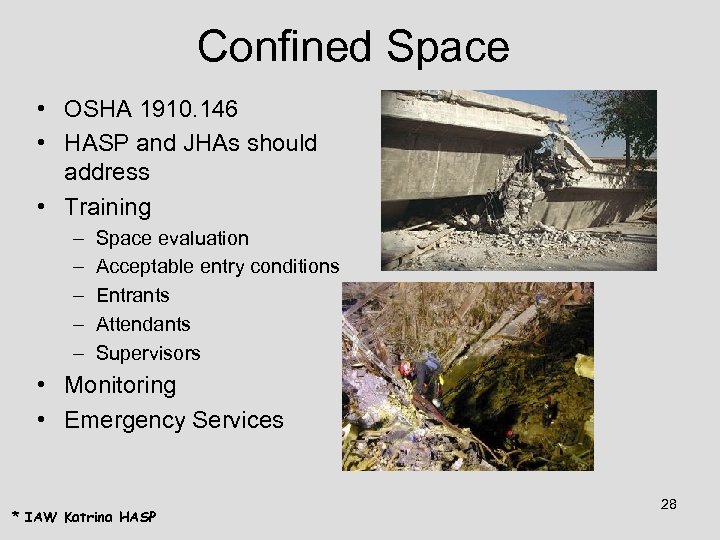
Confined Space • OSHA 1910. 146 • HASP and JHAs should address • Training – – – Space evaluation Acceptable entry conditions Entrants Attendants Supervisors • Monitoring • Emergency Services * IAW Katrina HASP 28
Confined Spaces The following must be done before you enter a confined space. Your supervisor must: • Ventilate and monitor for hazardous conditions • Lock out or tag out all power equipment in the space • Issue appropriate PPE, possibly including selfcontained breathing apparatus (SCBA) • Establish barriers to external traffic such as vehicles and pedestrians • Provide ladders or similar equipment for safe entry and exit in the space • Provide good communications equipment and alarm systems • Have rescue equipment nearby 29
Traumatic Incident Stress Awareness • Psychological First Aid – Maintain normal eating & sleeping habits – Exercise, take breaks when possible – Make counseling available • Alcohol & Drug Abuse – Agencies & Contractors shall establish policies in accordance with Department of Transportation • Work-rest regimen, fatigue – Creates unsafe conditions – Rotation of shifts and personnel • Heat Stress – Be familiar with signs and symptoms – Have regular rest periods – Hydrate your body 30
Animal & Plant Hazards • • • Domestic animals have been displaced Avoid working in standing water Use caution when reaching into voids Use insect repellent containing DEET When possible wear long pants and shirts 31
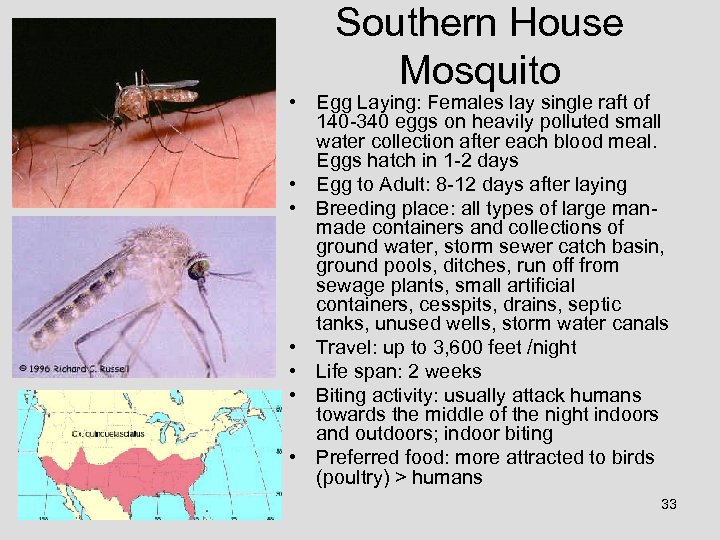
Southern House Mosquito • Egg Laying: Females lay single raft of 140 -340 eggs on heavily polluted small water collection after each blood meal. Eggs hatch in 1 -2 days • Egg to Adult: 8 -12 days after laying • Breeding place: all types of large manmade containers and collections of ground water, storm sewer catch basin, ground pools, ditches, run off from sewage plants, small artificial containers, cesspits, drains, septic tanks, unused wells, storm water canals • Travel: up to 3, 600 feet /night • Life span: 2 weeks • Biting activity: usually attack humans towards the middle of the night indoors and outdoors; indoor biting • Preferred food: more attracted to birds (poultry) > humans 33
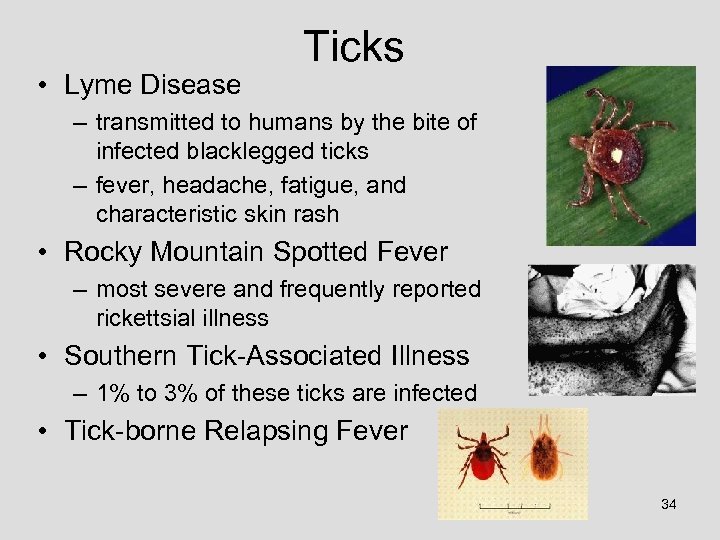
• Lyme Disease Ticks – transmitted to humans by the bite of infected blacklegged ticks – fever, headache, fatigue, and characteristic skin rash • Rocky Mountain Spotted Fever – most severe and frequently reported rickettsial illness • Southern Tick-Associated Illness – 1% to 3% of these ticks are infected • Tick-borne Relapsing Fever 34
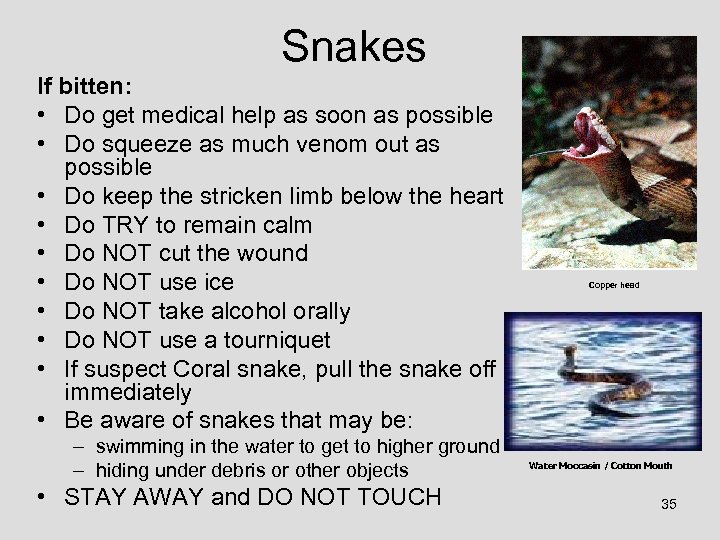
Snakes If bitten: • Do get medical help as soon as possible • Do squeeze as much venom out as possible • Do keep the stricken limb below the heart • Do TRY to remain calm • Do NOT cut the wound • Do NOT use ice • Do NOT take alcohol orally • Do NOT use a tourniquet • If suspect Coral snake, pull the snake off immediately • Be aware of snakes that may be: – swimming in the water to get to higher ground – hiding under debris or other objects • STAY AWAY and DO NOT TOUCH Copper head Water Moccasin / Cotton Mouth 35
Rodent Control • Store grains and animal feed in rodent-proof containers. • Woodpiles and stacks of lumber, or other materials to be saved for later use should be stored at least 12 inches above the ground as far away from the home as possible. • Glue traps and live traps are not recommended. Rodents caught in live traps will likely reenter the dwelling. Glue traps can scare mice that are caught live and cause them to urinate. This may increase your risk of being exposed to diseases. • Spray dead rodents, rodent urine or droppings with a disinfectant or a 1: 10 chlorine solution (1 part bleach to 10 parts water) until thoroughly soaked. Use a paper towel to pick up the urine and the droppings and discard it outdoors in a sealed container. 36
Dog Bites/Rabies • Man and woman's best friend bites more than 4. 7 million people a year. • Each year, 800, 000 Americans seek medical attention for dog bites; half of these are children. • Of those injured, 386, 000 require treatment in an emergency department and about a dozen die. • Do not approach an unfamiliar dog. • The most common mode of rabies virus transmission is through the bite and viruscontaining saliva of an infected host. Source: www. cdc. gov 37
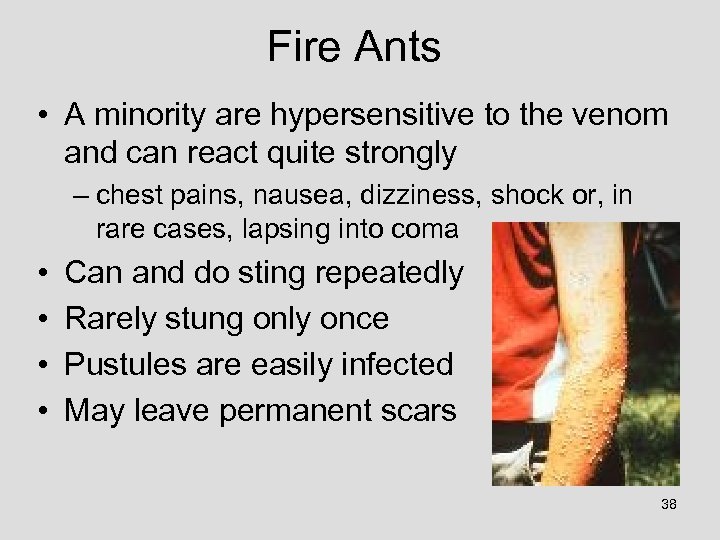
Fire Ants • A minority are hypersensitive to the venom and can react quite strongly – chest pains, nausea, dizziness, shock or, in rare cases, lapsing into coma • • Can and do sting repeatedly Rarely stung only once Pustules are easily infected May leave permanent scars 38
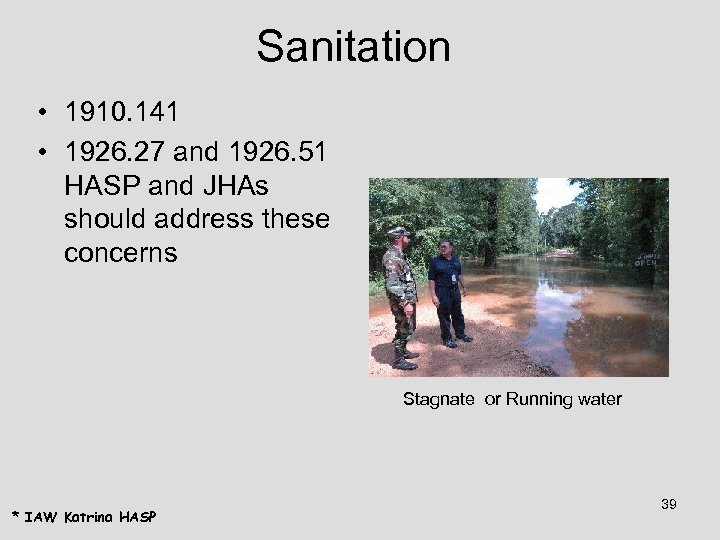
Sanitation • 1910. 141 • 1926. 27 and 1926. 51 HASP and JHAs should address these concerns Stagnate or Running water * IAW Katrina HASP 39
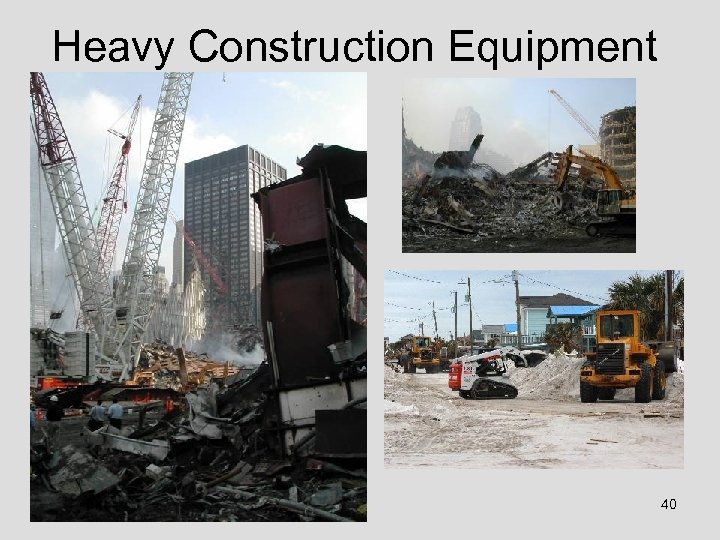
Heavy Construction Equipment 40
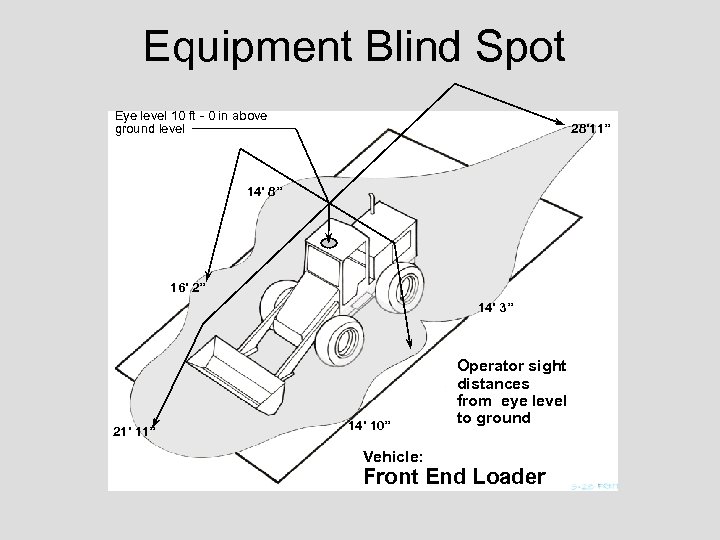
Equipment Blind Spot Eye level 10 ft - 0 in above ground level 28’ 11” 14’ 8” 16’ 2” 14’ 3” 21’ 11” 14’ 10” Vehicle: Operator sight distances from eye level to ground Front End Loader
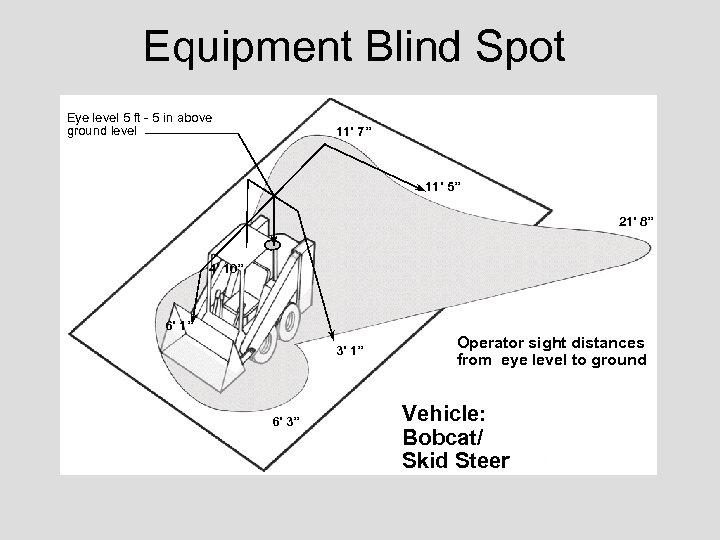
Equipment Blind Spot Eye level 5 ft - 5 in above ground level 11’ 7” 11’ 5” 21’ 8” 4’ 10” 6’ 1” 3’ 1” 6’ 3” Operator sight distances from eye level to ground Vehicle: Bobcat/ Skid Steer
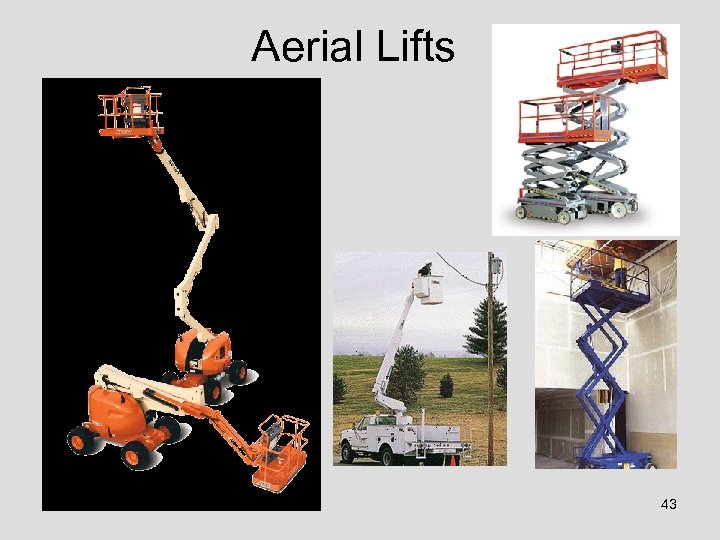
Aerial Lifts 43
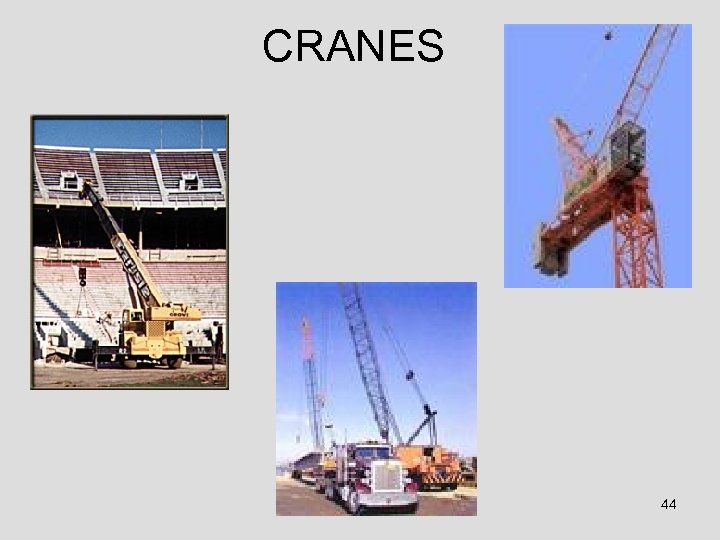
CRANES 44
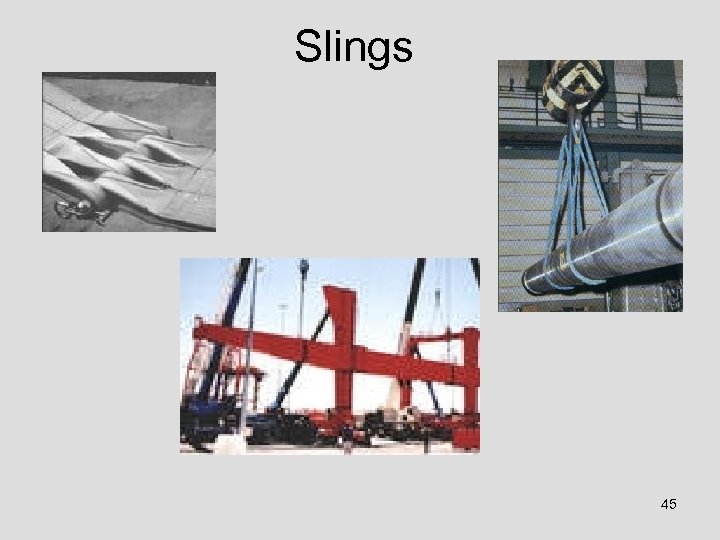
Slings 45
Work Zone Traffic Safety • Workers who drive in the course of their duties shall possess a valid license appropriate for the vehicles they are driving • Employers shall ensure compliance with state laws governing use of seat belts • Anticipate the unexpected – Missing and/or unserviceable traffic lights – Missing road signs – Defensive driving 46
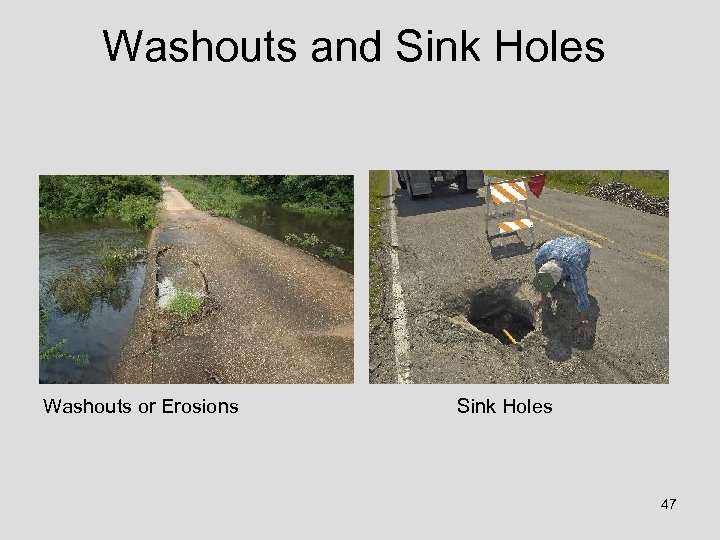
Washouts and Sink Holes Washouts or Erosions Sink Holes 47
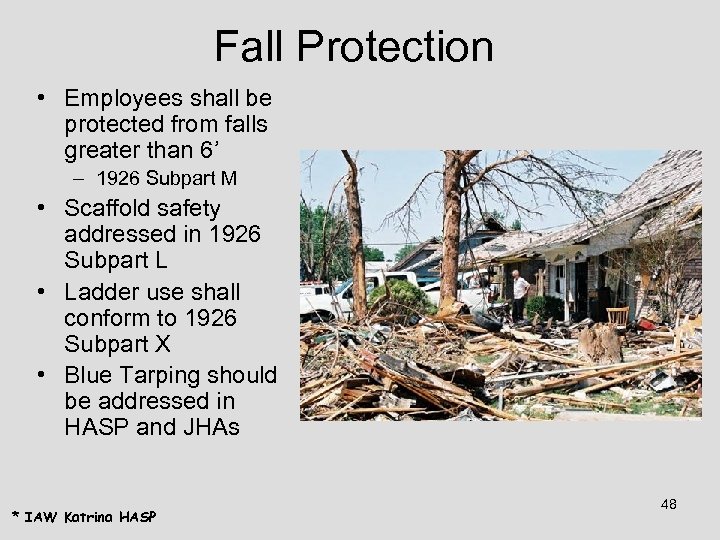
Fall Protection • Employees shall be protected from falls greater than 6’ – 1926 Subpart M • Scaffold safety addressed in 1926 Subpart L • Ladder use shall conform to 1926 Subpart X • Blue Tarping should be addressed in HASP and JHAs * IAW Katrina HASP 48
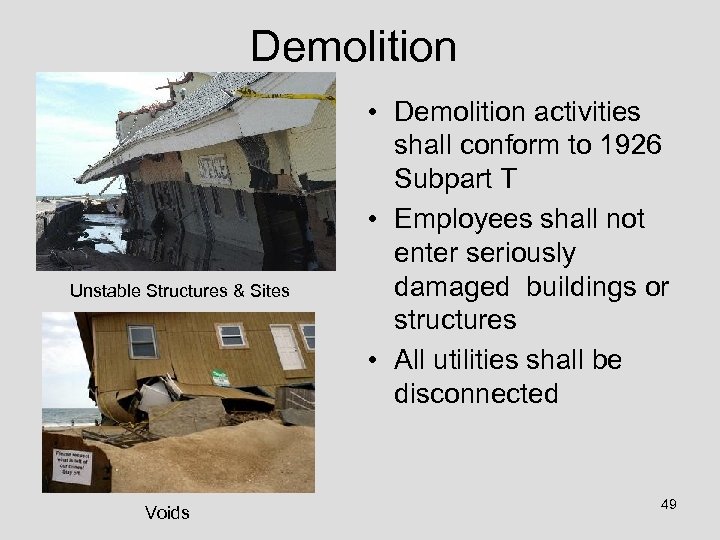
Demolition Unstable Structures & Sites Voids • Demolition activities shall conform to 1926 Subpart T • Employees shall not enter seriously damaged buildings or structures • All utilities shall be disconnected 49
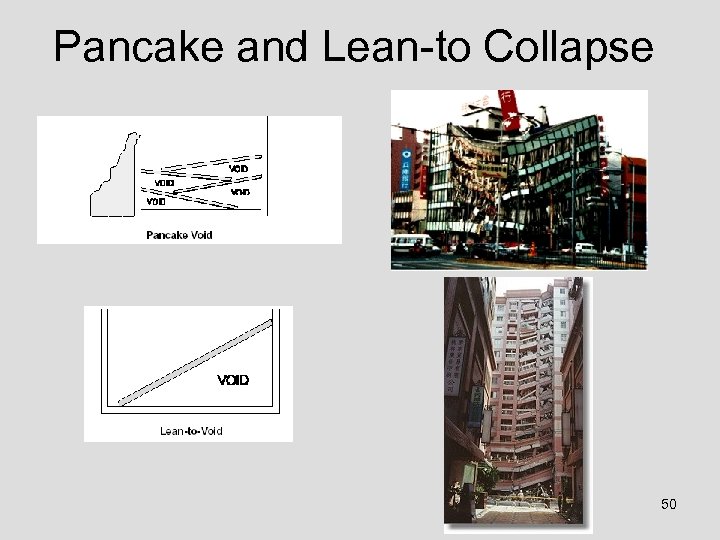
Pancake and Lean-to Collapse 50
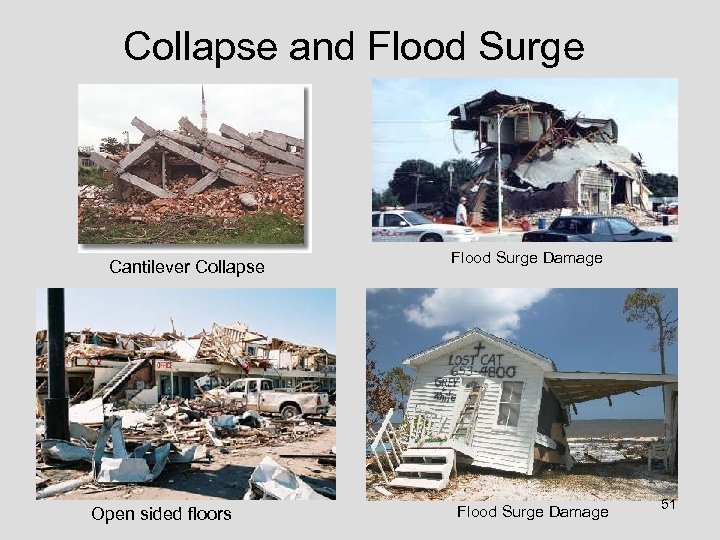
Collapse and Flood Surge Cantilever Collapse Open sided floors Flood Surge Damage 51
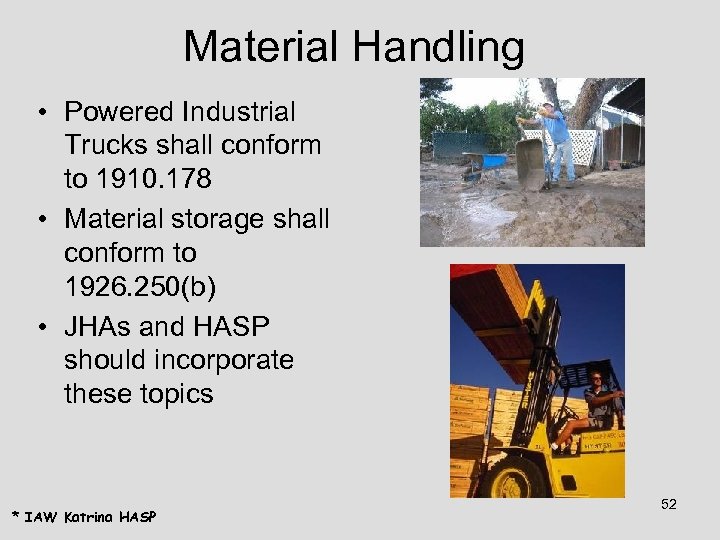
Material Handling • Powered Industrial Trucks shall conform to 1910. 178 • Material storage shall conform to 1926. 250(b) • JHAs and HASP should incorporate these topics * IAW Katrina HASP 52
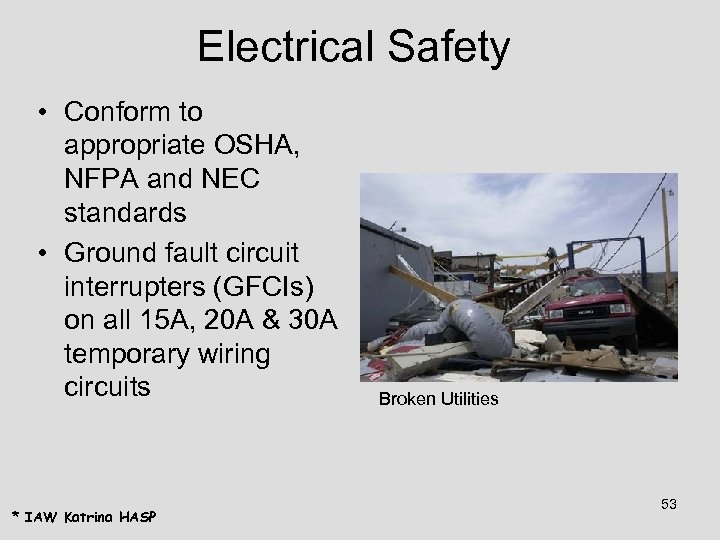
Electrical Safety • Conform to appropriate OSHA, NFPA and NEC standards • Ground fault circuit interrupters (GFCIs) on all 15 A, 20 A & 30 A temporary wiring circuits * IAW Katrina HASP Broken Utilities 53
Utilities and Associated Hazards • Power – Electrocution – Sparking • Natural Gas – Explosive hazard – Carbon Monoxide/Asphyxiation • Water – Flooding of confined spaces – Electrical conductor 54
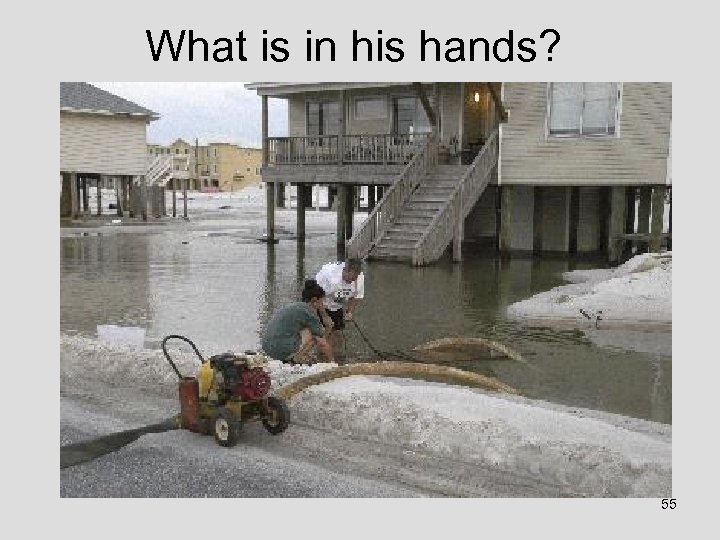
What is in his hands? 55
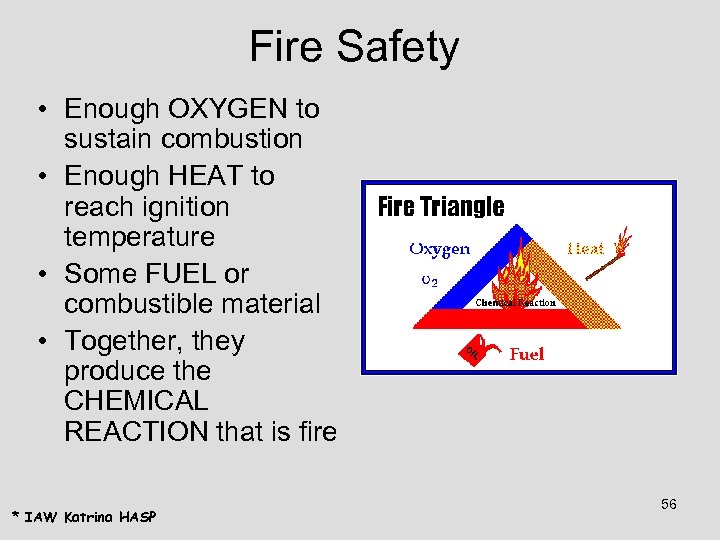
Fire Safety • Enough OXYGEN to sustain combustion • Enough HEAT to reach ignition temperature • Some FUEL or combustible material • Together, they produce the CHEMICAL REACTION that is fire * IAW Katrina HASP 56
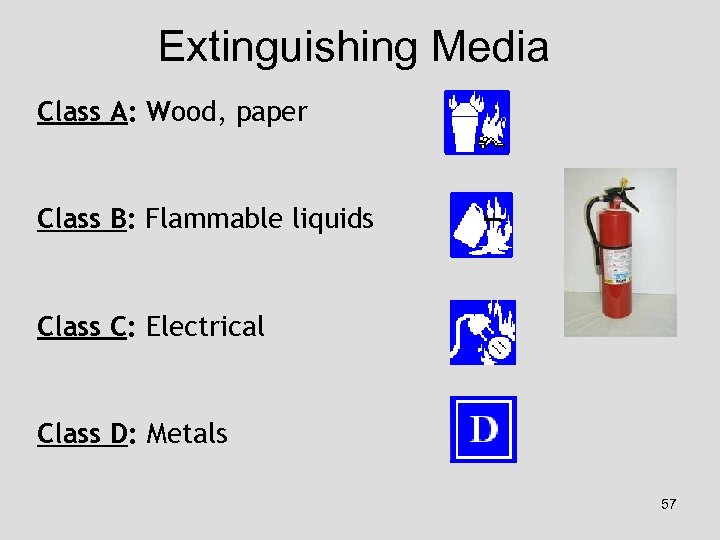
Extinguishing Media Class A: Wood, paper Class B: Flammable liquids Class C: Electrical Class D: Metals 57
Fire Safety • Provide fire extinguishers at work sites and/or on work vehicles • Incorporate fire extinguishers into JHAs • Fire Watch & Hot Work Permitting • Safe storage of combustible and flammable liquids 58
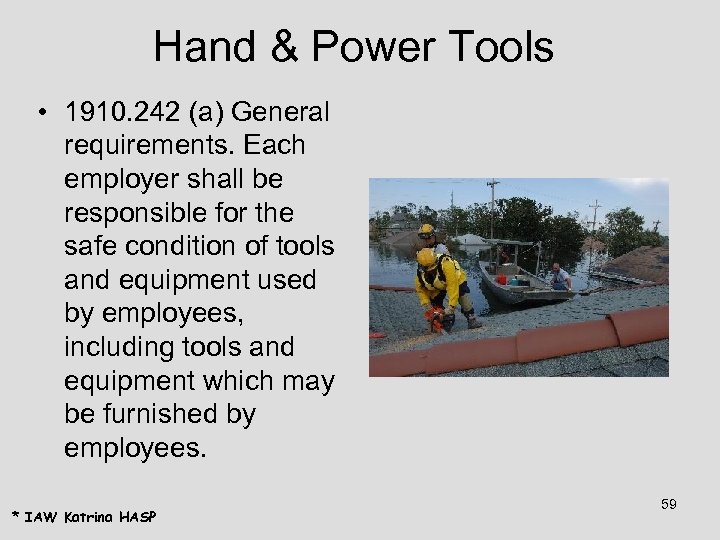
Hand & Power Tools • 1910. 242 (a) General requirements. Each employer shall be responsible for the safe condition of tools and equipment used by employees, including tools and equipment which may be furnished by employees. * IAW Katrina HASP 59
Regulations Covering Hand Power Tools For Construction Industry • 1926 Subpart I, - Tools – Hand Power • 1926. 300, General Requirements • 1926. 301, Hand Tools. • 1926. 303, Abrasive Wheels and Tools. • 1926. 304, Woodworking Tools. • 1926. 305, Jacks– Lever and Ratchet, Screw and Hydraulic • 1926. 306, Air Receivers • 1926. 307, Mechanical Power-Transmission Apparatus 60
Construction Industry • 1926. 301(a) – Employers shall not issue or permit the use of unsafe hand tools. • 1926. 301(b) – Wrenches, including adjustable, pipe, end, and socket wrenches shall not be used when jaws are sprung to the point that slippage occurs. • 1926. 301(c) – Impact tools, such as drift pins, wedges, and chisels, shall be kept free of mushroomed heads. • 1926. 301(d) – The wooden handles of tools shall be kept free of splinters or cracks and shall be kept tight in the tool. 61
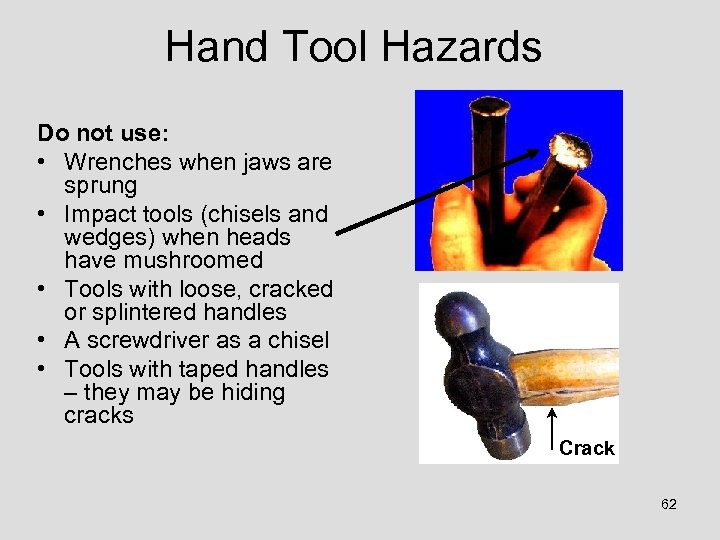
Hand Tool Hazards Do not use: • Wrenches when jaws are sprung • Impact tools (chisels and wedges) when heads have mushroomed • Tools with loose, cracked or splintered handles • A screwdriver as a chisel • Tools with taped handles – they may be hiding cracks Crack 62
Types of Power Tools • • • Electric Pneumatic (air) Liquid fuel Hydraulic Powder-actuated 63
The Five Basic Rules for Power Tools • Keep all tools regularly maintained • Use the right tool for the job • Examine each tool for damage before use • Operate tools in accordance with the manufacturer • Provide and use the proper personal protective equipment 64
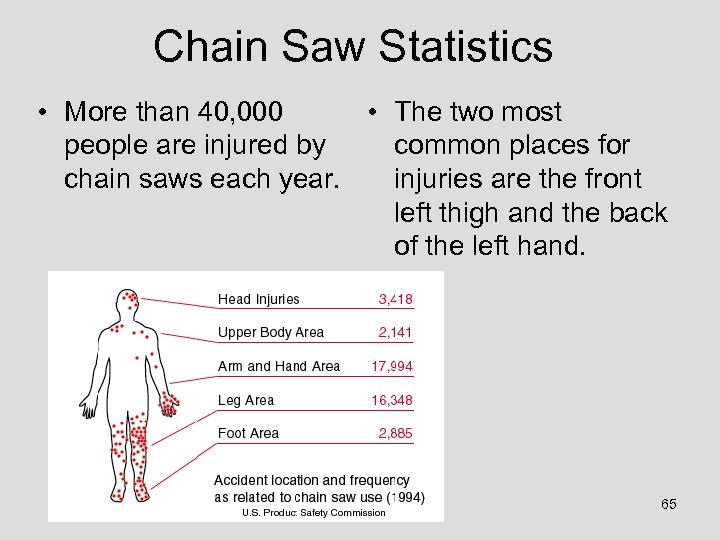
Chain Saw Statistics • More than 40, 000 • The two most people are injured by common places for chain saws each year. injuries are the front left thigh and the back of the left hand. 65
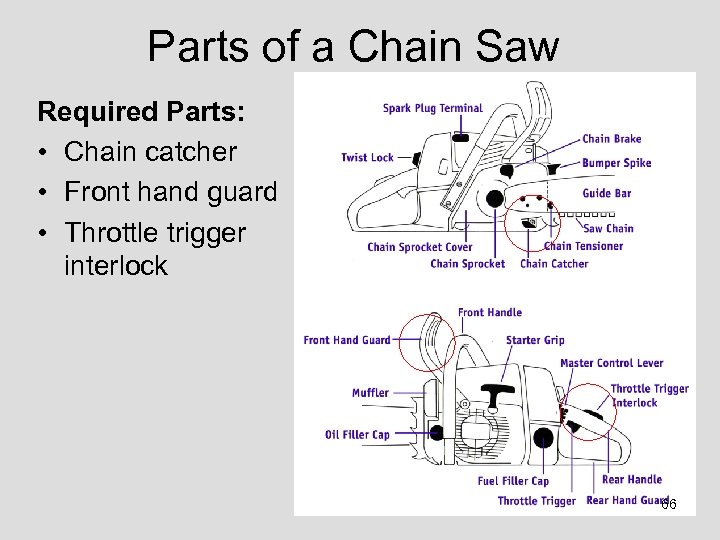
Parts of a Chain Saw Required Parts: • Chain catcher • Front hand guard • Throttle trigger interlock 66
Look for these safety features • Low kickback saw chain • Hand guard • Safety tip • Chain brake • Vibration reduction system • Spark arrestor on gasoline models • Trigger or throttle lockout • Chain catcher • Bumper spikes 67
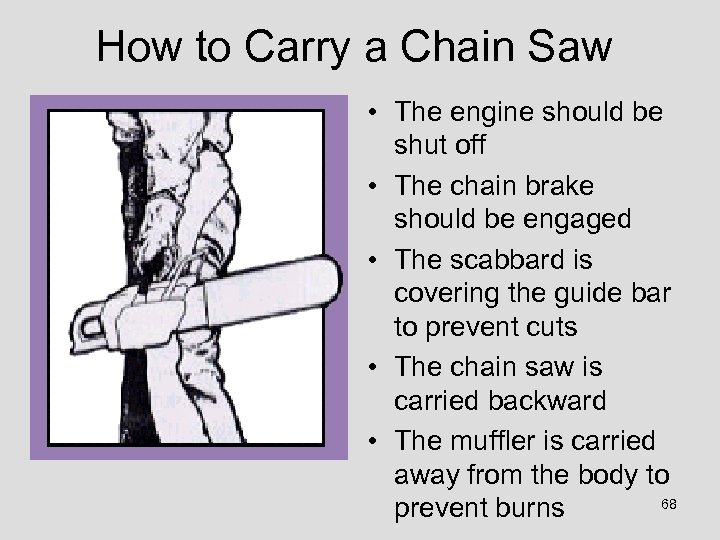
How to Carry a Chain Saw • The engine should be shut off • The chain brake should be engaged • The scabbard is covering the guide bar to prevent cuts • The chain saw is carried backward • The muffler is carried away from the body to 68 prevent burns
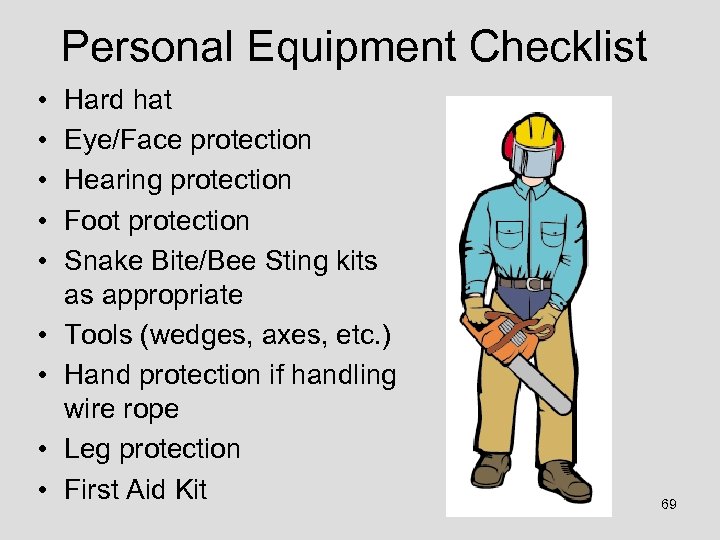
Personal Equipment Checklist • • • Hard hat Eye/Face protection Hearing protection Foot protection Snake Bite/Bee Sting kits as appropriate Tools (wedges, axes, etc. ) Hand protection if handling wire rope Leg protection First Aid Kit 69
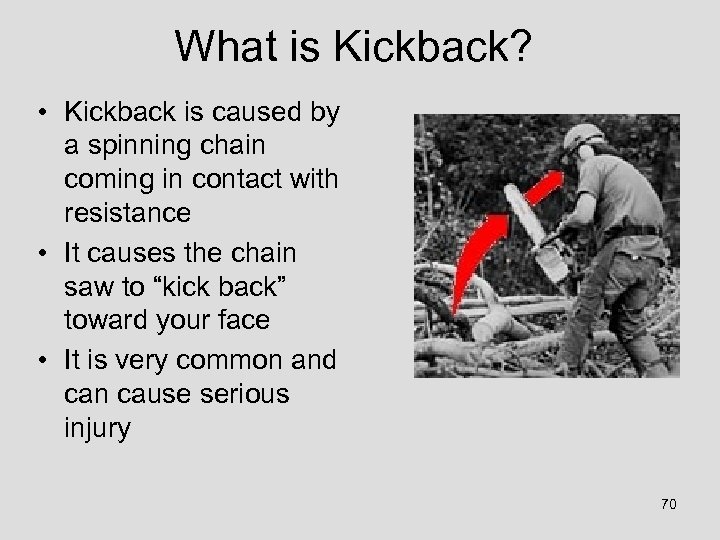
What is Kickback? • Kickback is caused by a spinning chain coming in contact with resistance • It causes the chain saw to “kick back” toward your face • It is very common and can cause serious injury 70
Kickback Prevention • NEVER cut with the tip of the chain saw! • Lock your front elbow • Be careful not to cut through nails or knots in the wood • Stand to the side • Use a low kickback chain • Use a chain brake 71
OSHA Chain Saw Use Requirements Before starting the saw: • Check controls, chain tension, and all bolts and handles to ensure they are functioning properly and adjusted according to the manufacturer's instructions. • Fuel the saw at least 10 feet from sources of ignition. • Start the saw at least 10 feet from fueling area, with chain brake engaged, and with the chainsaw on the ground or otherwise firmly supported. • Fuel container requirements: – Must be metal or plastic – Must not exceed a 3 gallon capacity – Must be approved by the Underwriters Laboratory, Factory Mutual (FM) or the Department of Transportation (DOT). 72
OSHA Chain Saw Use Requirements While operating the saw: • Keep hands on the handles, and maintain secure footing while operating the chainsaw. • Clear the area of obstacles that might interfere with cutting the tree or using the retreat path. • Do not cut directly overhead. • Shut off or throttle released prior to retreating. • Shut off or the chain brake engaged whenever the saw is carried more than 50 feet, or on hazardous terrain. 73
Chain Saw Checklist 29 CFR 1910. 266(e)(1)(ii) • • Chain brake Throttle interlock Chain catcher Chain tension Muffler Chain saw kickback Chain sharpness, cutter shape, depth usage setting, lubrication • Handles and guards - On Tight • No chain movement when engine is idling 74
Required Work Practices 29 CFR 1910. 266(e)(2) ii - Continuous Pressure Throttle iii - Operated and adjusted in accordance with the manufacturer's instructions iv - Fueled 20 feet from sources of ignition [Standard says "10"] v - Started 10 feet from fueling area vi - Starting Methods vii - Chain brake engaged when starting viii - Thumb and finger position on handles ix - Footing/body position x- Clear area prior to felling xi - No cutting above head xii - Carrying the saw xiii - Retreating with the saw 75 xiv - Moving with a running chain saw
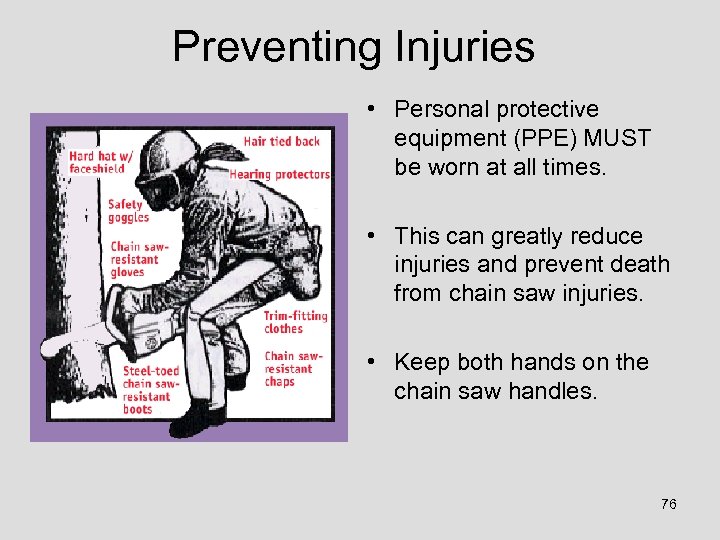
Preventing Injuries • Personal protective equipment (PPE) MUST be worn at all times. • This can greatly reduce injuries and prevent death from chain saw injuries. • Keep both hands on the chain saw handles. 76
Illumination • 1926. 26 Subpart C • 1910. 178(h) • General Duty Clause * IAW Katrina HASP 77
Safety Hazards Summary • Record keeping • Employee and Employer responsibilities • Job hazard Analysis and Health and Safety Plans • Required Training according to HASP 78
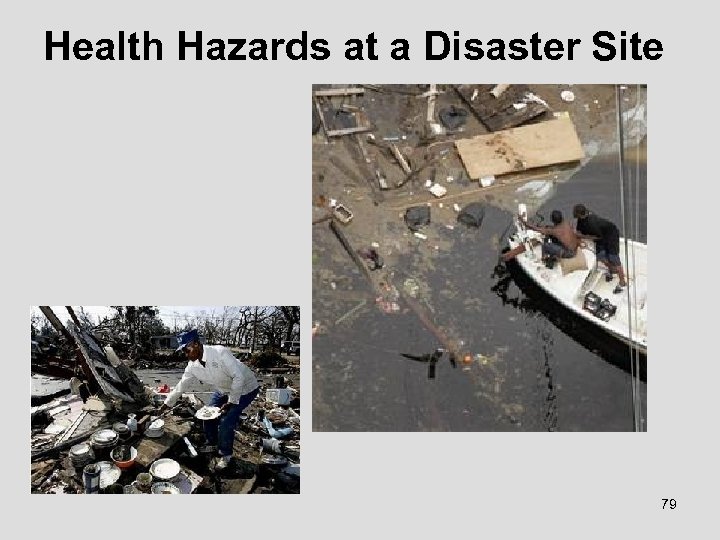
Health Hazards at a Disaster Site 79
• This training program is based on recommendations from the CDC, NIOSH, OSHA, and the U. S. Army • You can find a link to their fact sheets and other important information at the National Clearinghouse for Worker Safety and Health Training at: www. wetp. org • Hurricane Katrina Worker Health and Safety Plan 80
Objectives • Describe possible health hazards you may encounter • Explain how to protect yourself from these health hazards • List the symptoms that indicate you may be suffering traumatic psychological stress • Explain how to get medical or psychological help, if you need it • List sources of health information 81
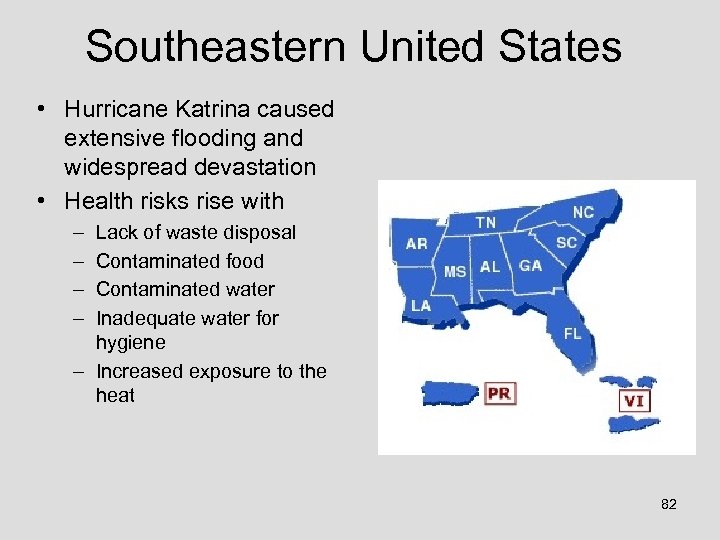
Southeastern United States • Hurricane Katrina caused extensive flooding and widespread devastation • Health risks rise with – – Lack of waste disposal Contaminated food Contaminated water Inadequate water for hygiene – Increased exposure to the heat 82
Louisiana Disease Trends (1999 data) • Hepatitis A rate – 4. 9 per 100, 000 – half the national rate • Hepatitis C rate – 7. 0 per 100, 000 – six times higher than the national rate • Louisiana - 10 th highest number of AIDS cases in the nation • Two confirmed human cases of Eastern Equine Encephalitis (EEE), 97 in horses • 15 cases of Lyme Disease Source: http: //www. oph. dhh. state. la. us/infectiousdisease/page 4 fbf. html? page=113 83
Immunization Recommendations following Hurricane Katrina Department of Health and Human Services Centers for Disease Control and Prevention October 12, 2005 • Tetanus and diphtheria – primary series – Td booster within 10 years • Hepatitis B vaccine series – persons who will performing direct patient care or expected to have contact with bodily fluids 84
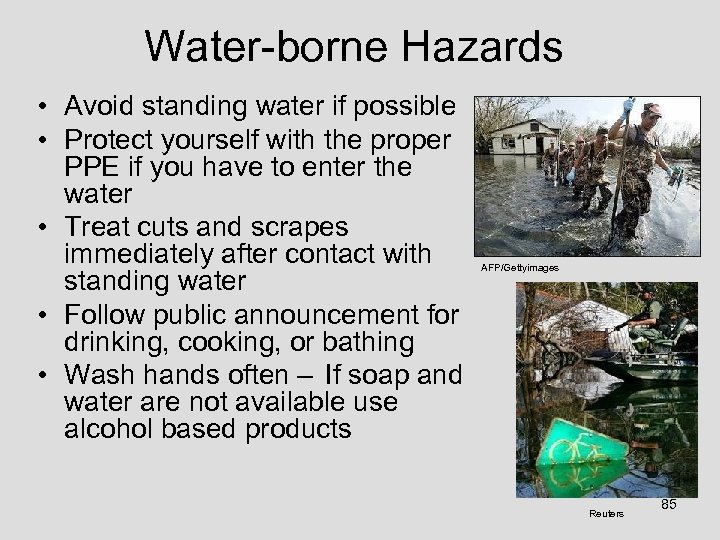
Water-borne Hazards • Avoid standing water if possible • Protect yourself with the proper PPE if you have to enter the water • Treat cuts and scrapes immediately after contact with standing water • Follow public announcement for drinking, cooking, or bathing • Wash hands often – If soap and water are not available use alcohol based products AFP/Gettyimages Reuters 85
Food-borne Disease Hazard • Identify and throw away food that: – – May not be safe to eat. May have come in contact with flood or storm water. Has an unusual odor, color, or texture. Perishable foods (including meat, poultry, fish, eggs and leftovers) that have been above 40 degrees Fahrenheit (F) for 2 hours or more. – Food containers with screw-caps, snap-lids, crimped caps (soda pop bottles), twist caps, flip tops, snap-open, and home canned foods should be discarded if they have come into contact with floodwater because they cannot be disinfected. • Store food safely: – While the power is out, keep the refrigerator and freezer doors closed as much as possible. – Add block ice or dry ice to your refrigerator if the electricity is expected to be off longer than 4 hours. Wear heavy gloves when handling ice. 86
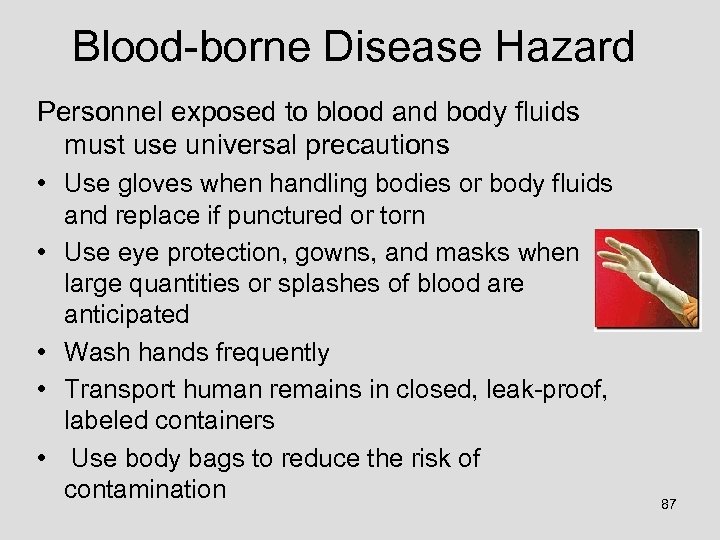
Blood-borne Disease Hazard Personnel exposed to blood and body fluids must use universal precautions • Use gloves when handling bodies or body fluids and replace if punctured or torn • Use eye protection, gowns, and masks when large quantities or splashes of blood are anticipated • Wash hands frequently • Transport human remains in closed, leak-proof, labeled containers • Use body bags to reduce the risk of contamination 87
Universal Precautions • Prevention strategy in which all blood, potentially infectious materials, and respiratory secretions are treated as if they are, in fact, infectious, regardless of the perceived status of the source individual. • In other words: treat all blood and body fluids as infected with blood-borne pathogens 88
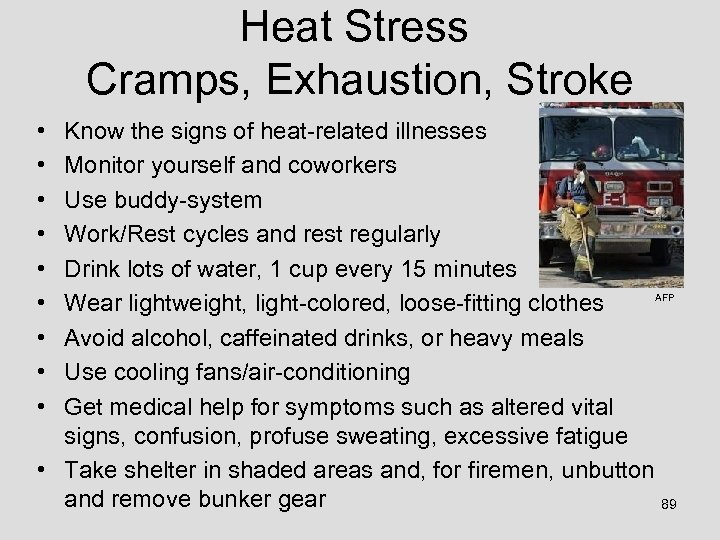
Heat Stress Cramps, Exhaustion, Stroke • • • Know the signs of heat-related illnesses Monitor yourself and coworkers Use buddy-system Work/Rest cycles and rest regularly Drink lots of water, 1 cup every 15 minutes AFP Wear lightweight, light-colored, loose-fitting clothes Avoid alcohol, caffeinated drinks, or heavy meals Use cooling fans/air-conditioning Get medical help for symptoms such as altered vital signs, confusion, profuse sweating, excessive fatigue • Take shelter in shaded areas and, for firemen, unbutton and remove bunker gear 89
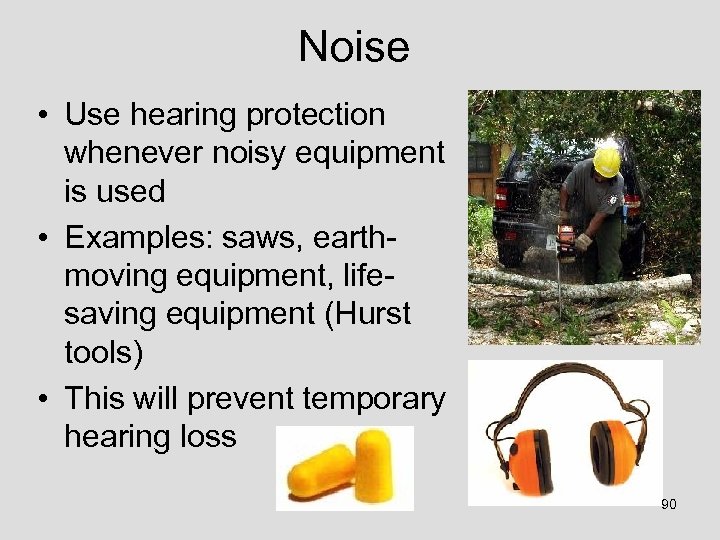
Noise • Use hearing protection whenever noisy equipment is used • Examples: saws, earthmoving equipment, life- saving equipment (Hurst tools) • This will prevent temporary hearing loss 90
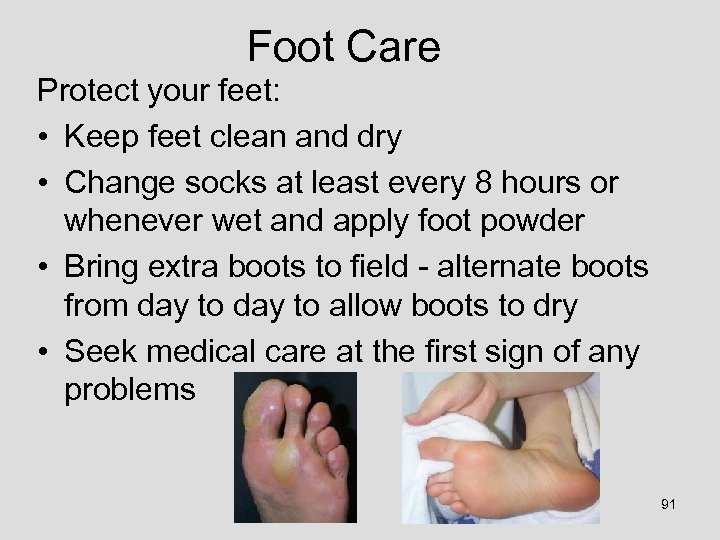
Foot Care Protect your feet: • Keep feet clean and dry • Change socks at least every 8 hours or whenever wet and apply foot powder • Bring extra boots to field - alternate boots from day to allow boots to dry • Seek medical care at the first sign of any problems 91
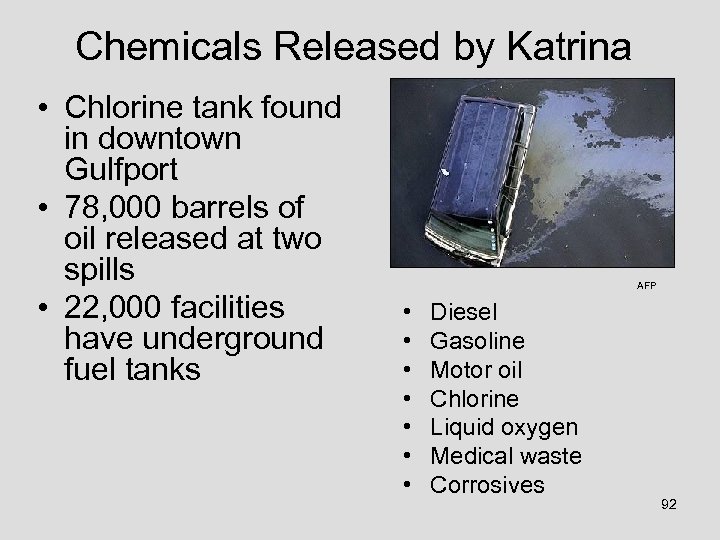
Chemicals Released by Katrina • Chlorine tank found in downtown Gulfport • 78, 000 barrels of oil released at two spills • 22, 000 facilities have underground fuel tanks AFP • • Diesel Gasoline Motor oil Chlorine Liquid oxygen Medical waste Corrosives 92
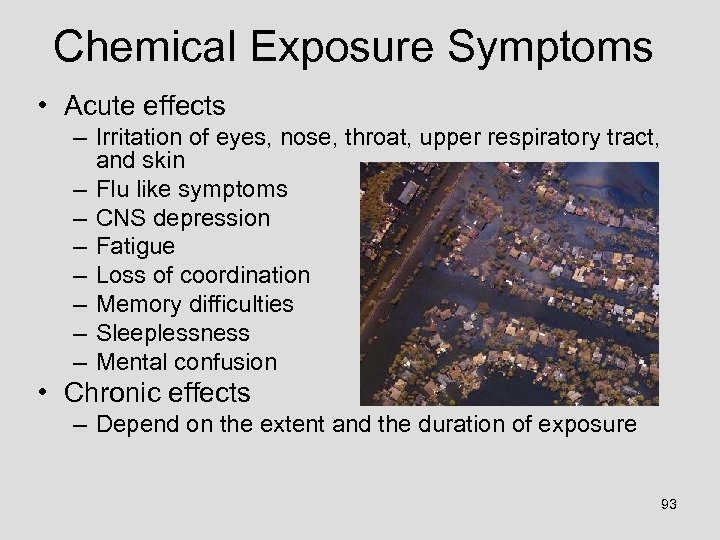
Chemical Exposure Symptoms • Acute effects – Irritation of eyes, nose, throat, upper respiratory tract, and skin – Flu like symptoms – CNS depression – Fatigue – Loss of coordination – Memory difficulties – Sleeplessness – Mental confusion • Chronic effects – Depend on the extent and the duration of exposure 93
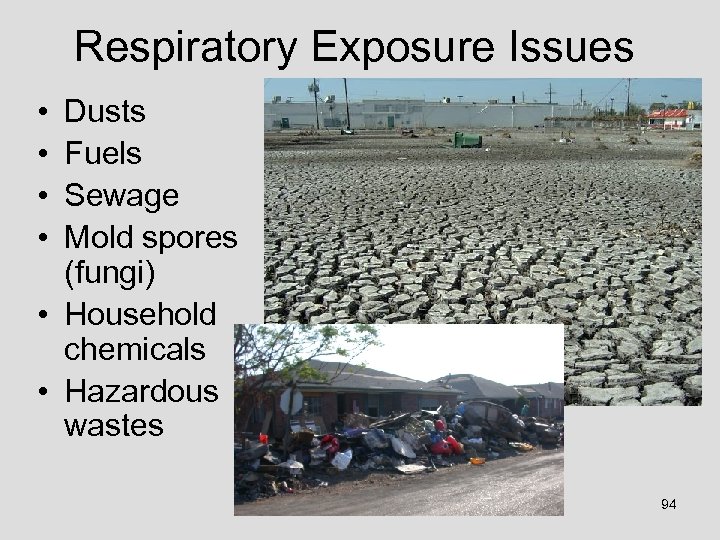
Respiratory Exposure Issues • • Dusts Fuels Sewage Mold spores (fungi) • Household chemicals • Hazardous wastes 94
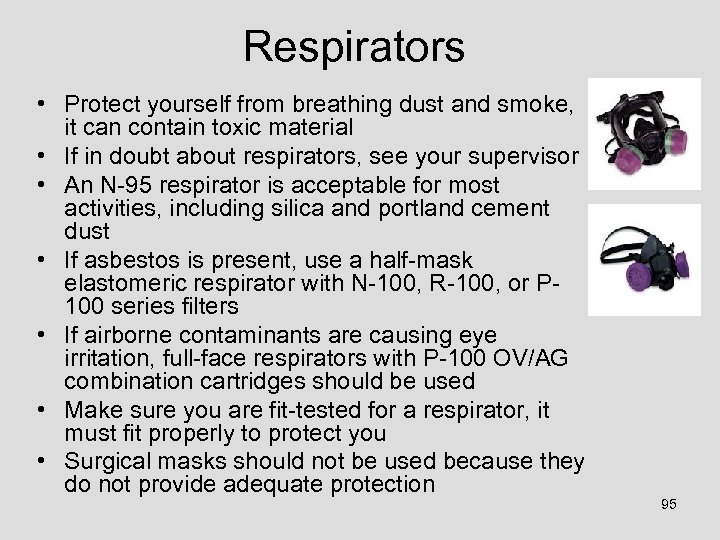
Respirators • Protect yourself from breathing dust and smoke, it can contain toxic material • If in doubt about respirators, see your supervisor • An N-95 respirator is acceptable for most activities, including silica and portland cement dust • If asbestos is present, use a half-mask elastomeric respirator with N-100, R-100, or P 100 series filters • If airborne contaminants are causing eye irritation, full-face respirators with P-100 OV/AG combination cartridges should be used • Make sure you are fit-tested for a respirator, it must fit properly to protect you • Surgical masks should not be used because they do not provide adequate protection 95
Carbon Monoxide (CO) • Gasoline, diesel, or propane powered combustion sources – – Generators Heavy machinery Water pump Vehicle • General Recommendations and Warnings – Do not use in confined spaces or poorly ventilated areas – Do not work in areas close to engine exhaust – CO poisoning can occur outdoors if engines generate high concentrations of CO and worker is in the area of the exhaust gases – Use CO warning sensors when working around combustion sources – Shut off engine immediately if symptoms of exposure appear 96
Carbon Monoxide Exposure Symptoms • Acute effects – – – – Headache Dizziness Drowsiness Nausea progressing to vomiting Loss of consciousness Collapse Coma Death under prolonged or high exposure • Chronic effects – Depend on the extent and the duration of exposure 97
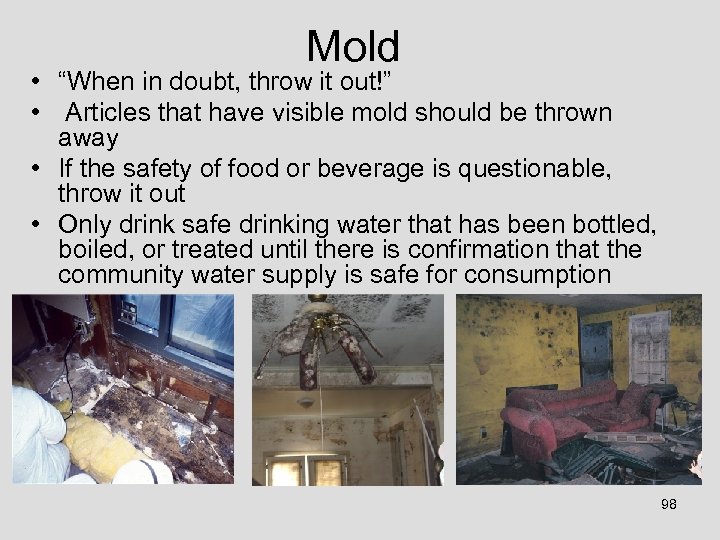
Mold • “When in doubt, throw it out!” • Articles that have visible mold should be thrown away • If the safety of food or beverage is questionable, throw it out • Only drink safe drinking water that has been bottled, boiled, or treated until there is confirmation that the community water supply is safe for consumption 98
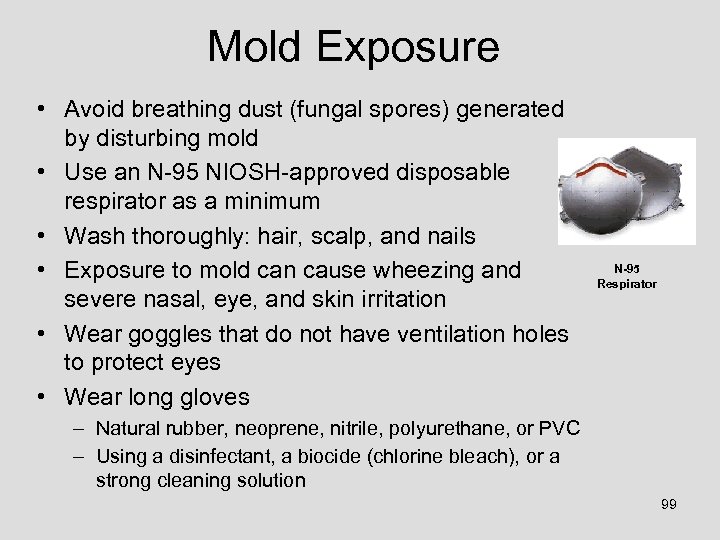
Mold Exposure • Avoid breathing dust (fungal spores) generated by disturbing mold • Use an N-95 NIOSH-approved disposable respirator as a minimum • Wash thoroughly: hair, scalp, and nails • Exposure to mold can cause wheezing and severe nasal, eye, and skin irritation • Wear goggles that do not have ventilation holes to protect eyes • Wear long gloves N-95 Respirator – Natural rubber, neoprene, nitrile, polyurethane, or PVC – Using a disinfectant, a biocide (chlorine bleach), or a strong cleaning solution 99
Exposure Monitoring • Performed on a health risk basis by a qualified person* *”By position of a recognized degree, certificate, professional standing, extensive knowledge, training, or experience. ” • • • Types: personal, area, grab, direct reading Contact information is needed Consideration given to likely contaminates Initial screening, short-term, or full-shift Occupational limits differ from environmental “If there is any doubt, perform sampling” 100
Resistance to Psychological Stress • Prepare yourself for what you will see and do • Remember the larger purpose of what you must do – You are showing care, giving hope, and preventing disease for the living – You are recovering the bodies for registrations and respectful burial • Limit exposure to the stimuli • Mask odors with disinfectants, deodorants, or airfresheners • Have people who did NOT search the body examine any materials collected for identification of the body or intelligence • Remind yourself the body is not “the person, ” just the remains • AVOID FOCUSING on any individual victim 101
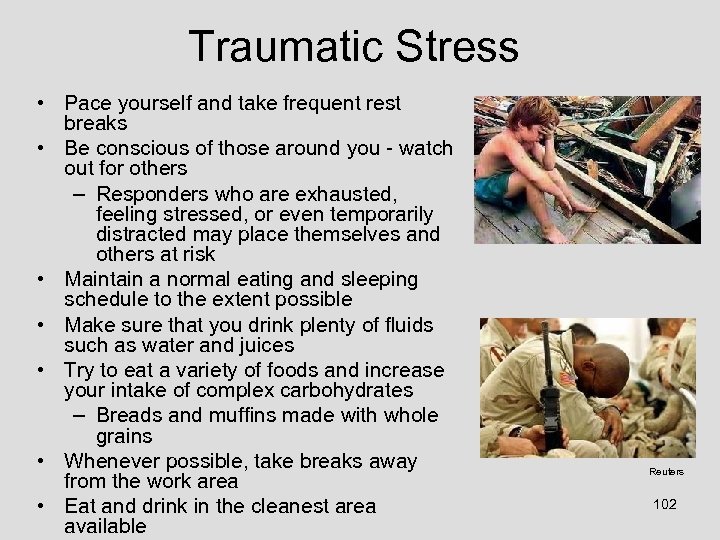
Traumatic Stress • Pace yourself and take frequent rest breaks • Be conscious of those around you - watch out for others – Responders who are exhausted, feeling stressed, or even temporarily distracted may place themselves and others at risk • Maintain a normal eating and sleeping schedule to the extent possible • Make sure that you drink plenty of fluids such as water and juices • Try to eat a variety of foods and increase your intake of complex carbohydrates – Breads and muffins made with whole grains • Whenever possible, take breaks away from the work area • Eat and drink in the cleanest area available Reuters 102
Traumatic Stress • Recognize and accept what you cannot change – Chain of command, organizational structure, waiting, equipment failures, etc. • Talk to people when YOU feel like it. You decide when you want to discuss your experience. • If your employer provides you with formal mental health support, use it! • Give yourself permission to feel rotten: You are in a difficult situation. • Recurring thoughts, dreams, or flashbacks are common • Communicate with your loved ones at home as frequently as possible 103
Returning Home Stress • • • Reach out - people really do care Reconnect with family, spiritual, and community supports Consider keeping a journal Do not make any big life decisions Make as many daily decisions as possible to give yourself a feeling of control over your life Spend time with others or alone doing the things you enjoy to refresh and recharge yourself Be aware that you may feel particularly fearful for your family Remember that "getting back to normal" takes time Gradually work back into your routine 104
Returning Home Stress • Be aware that recovery is not a straight path • Appreciate a sense of humor in yourself and others • It is OK to laugh again • Your family will experience the disaster along with you – You need to support each other – This is a time for patience, understanding, and communication • Avoid overuse of drugs or alcohol • Get plenty of rest and normal exercise • Eat well balanced, regular meals 105
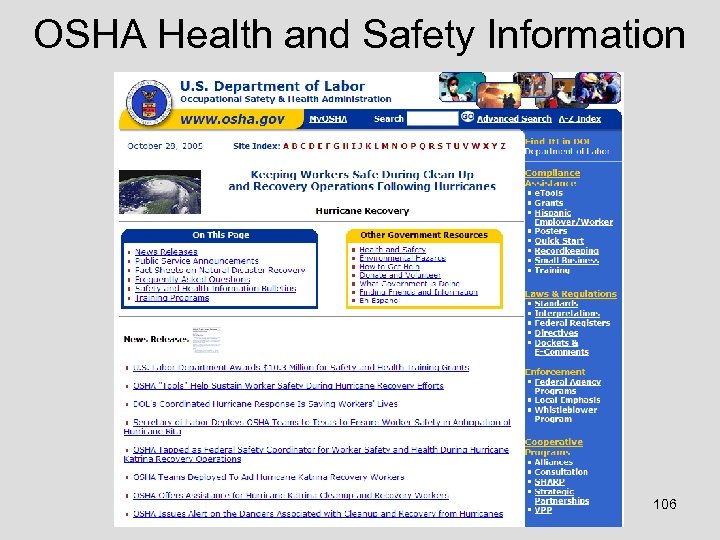
OSHA Health and Safety Information 106
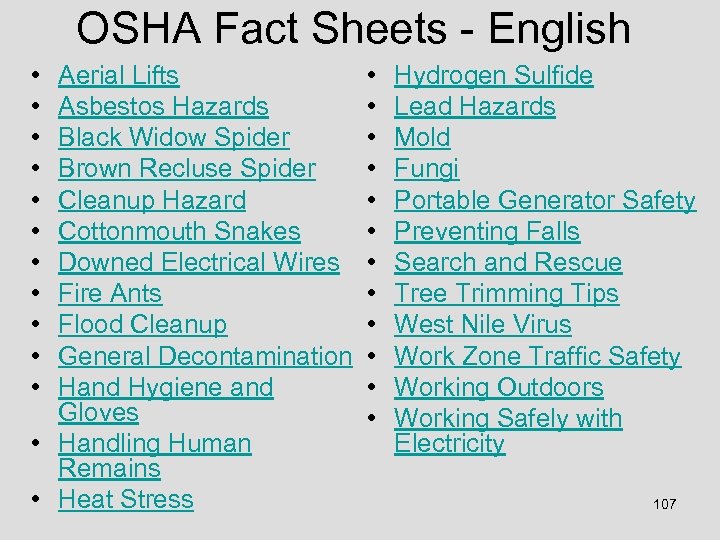
OSHA Fact Sheets - English • • • Aerial Lifts Asbestos Hazards Black Widow Spider Brown Recluse Spider Cleanup Hazard Cottonmouth Snakes Downed Electrical Wires Fire Ants Flood Cleanup General Decontamination Hand Hygiene and Gloves • Handling Human Remains • Heat Stress • • • Hydrogen Sulfide Lead Hazards Mold Fungi Portable Generator Safety Preventing Falls Search and Rescue Tree Trimming Tips West Nile Virus Work Zone Traffic Safety Working Outdoors Working Safely with Electricity 107
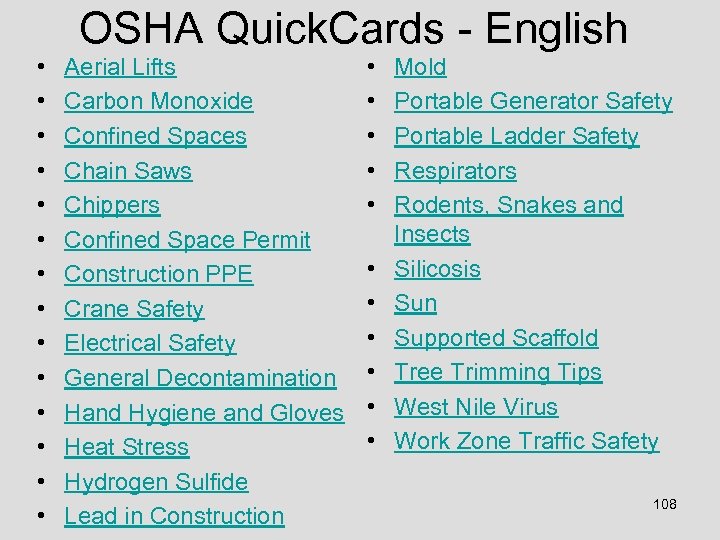
OSHA Quick. Cards - English • • • • Aerial Lifts Carbon Monoxide Confined Spaces Chain Saws Chippers Confined Space Permit Construction PPE Crane Safety Electrical Safety General Decontamination Hand Hygiene and Gloves Heat Stress Hydrogen Sulfide Lead in Construction • • • Mold Portable Generator Safety Portable Ladder Safety Respirators Rodents, Snakes and Insects Silicosis Sun Supported Scaffold Tree Trimming Tips West Nile Virus Work Zone Traffic Safety 108
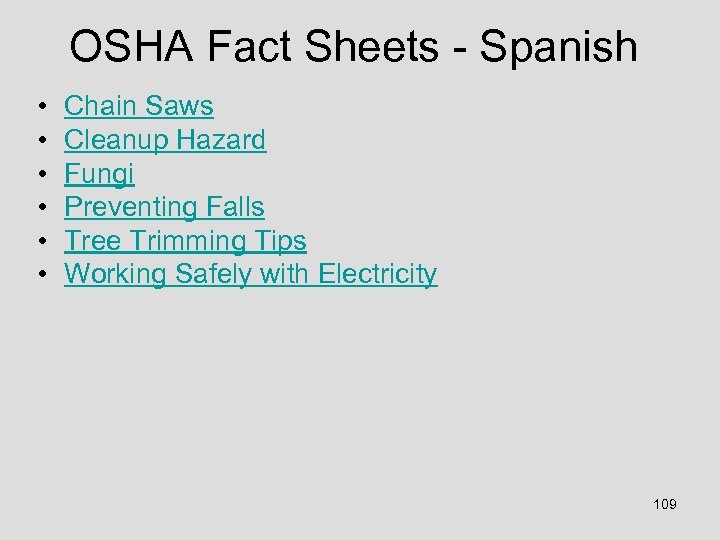
OSHA Fact Sheets - Spanish • • • Chain Saws Cleanup Hazard Fungi Preventing Falls Tree Trimming Tips Working Safely with Electricity 109
OSHA Quick. Cards - Spanish • • • Aerial Lifts Carbon Monoxide Chippers Construction PPE Hand Hygiene and Gloves Heat Stress Silicosis Sun Supported Scaffold 110
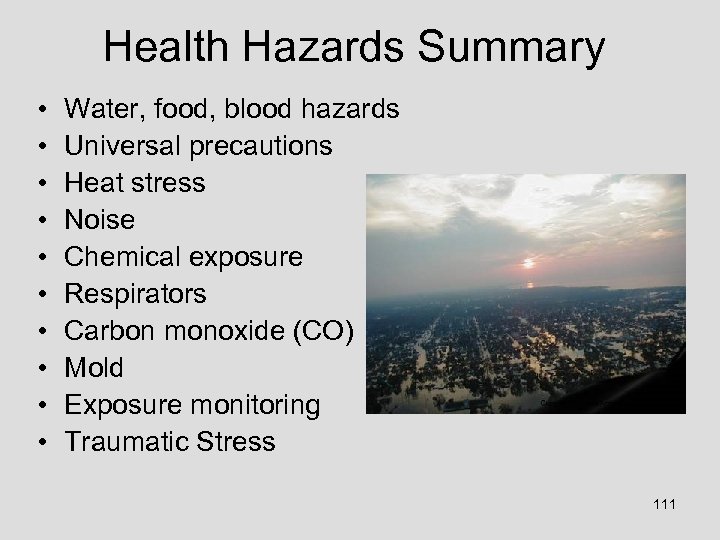
Health Hazards Summary • • • Water, food, blood hazards Universal precautions Heat stress Noise Chemical exposure Respirators Carbon monoxide (CO) Mold Exposure monitoring Traumatic Stress 111
"Preparation through education is less costly than learning through tragedy. " MAX MAYFIELD, DIRECTOR NATIONAL HURRICANE CENTER 112
Credits This presentation was adapted from: • NIOSH Guide called “Suggested Guidance for Supervisors at Disaster Rescue Sites. ” More information is available at their site: http: //www. cdc. gov/niosh/emhaz 2. html • CDC web site entitled “Hurricanes, what you should know” http: //www. bt. cdc. gov/disasters/hurricanes/index. asp • U. S. Army Center for Health Promotion and Preventive Medicine Power. Point: http: //chppmwww. apgea. army. mil/news/PMMfor. Katrina. ppt 113
END This material was produced under grant number 46 C 5 -HT 16 from the Occupational Safety and Health Administration, U. S. Department of Labor. It does not necessarily reflect the views or policies of the U. S. Department of Labor, nor does mention of trade names, commercial products, or organizations imply endorsement by the U. S. Government. 114
Скачать презентацию 4 -hour Disaster Orientation Vincent J Giblin General
42bb2bea25cdb585b9c7ce1a67accdd4.ppt